











-
Soil organic carbon (SOC) constitutes the largest terrestrial carbon reservoir, with an estimated global stock of 1,500–2,400 Gt[1,2]. It plays a critical role in sustaining soil fertility and modulating global climate dynamics[3]. Paddy soils demonstrate greater carbon sequestration potential than their upland counterparts[4], which is largely attributed to their unique anaerobic–aerobic cycling environment[5,6]. Long-term water-management practices, including periodic flooding and drainage, directly shape soil aggregate structure[7]. Furthermore, they profoundly influence SOC stabilization through organo–mineral interactions[8].
The dynamics of SOC are largely governed by iron oxides[9]. As important inorganic cementing agents, iron oxides promote aggregate formation and stabilization[10], with their effectiveness strongly depending on crystallinity and mineral phase. Iron oxides primarily exist in three forms: complexed, amorphous, and crystalline[11]. Complexed iron, formed through iron–humus interactions and extractable with sodium pyrophosphate[12], is crucial for aggregate formation[13]. Amorphous iron oxides possess high specific surface area and strong reactivity, thereby exhibiting a high aggregating capacity[14]. In contrast, crystalline iron oxides are characterized by high stability and low reactivity, which have been positively associated with micro-aggregate stability[15]. Given their distinct properties, elucidating how iron oxide morphology governs aggregate stability in paddy soil remains a priority.
Iron-bound organic carbon, formed through adsorption or co-precipitation with iron oxides, represents a stable carbon pool and plays a significant role in SOC stabilization[16,17]. A global meta-analysis estimated that iron-bound organic carbon accounts for 33% ± 15% of the total SOC stock in surface soils[18]. The strong association is attributed to the high specific surface area of iron oxides, which promotes OC adsorption onto mineral surfaces and confers chemical protection[19,20]. Under alternating anaerobic–aerobic conditions, iron oxides undergo frequent phase transformations, which can either stabilize bound OC or trigger its release[21]. Such dynamic behavior implies that the forms and stability of iron-bound carbon are critical factors in assessing soil carbon persistence.
The double-rice system is a key cropping model in subtropical China and plays a vital role in national grain production[22]. In this system, straw return and winter green-manure planting have been widely adopted as effective measures for soil conservation and fertility enhancement. However, how iron oxides respond to long-term straw return and green manure incorporation and how such responses affect SOC accumulation remain largely unknown in subtropical red soils under double-cropping rice systems.
To fill this gap, the present study utilizes an 11-year field experiment with double-cropping rice. We aim to systematically explore the mechanism by which long-term straw return influences SOC accumulation in paddy soil from the perspectives of physical protection and chemical interactions with iron oxides. We hypothesize that: (1) straw return regulates the content of iron oxides, thereby affecting the formation and stability of soil aggregates; and (2) straw return improves the capacity and stability of iron-bound carbon, thereby promoting SOC sequestration.
-
The long-term fertilization experiment was initiated in 2012 at Qiyang Red Soil Experimental Station in Hunan Province, China (111°52'32" E, 26°45'42" N). The site experiences a typical subtropical monsoon climate, with a mean annual temperature of 17.8 °C, annual precipitation of 1,290 mm, a frost-free period of approximately 293 d, and an average annual sunshine duration of 1,613 h. The soil is a paddy soil developed from Quaternary red clay and has a clay loam texture. Before the experiment, soil physicochemical properties in the 0–20 cm layer were determined using standard analytical methods. The initial soil characteristics were as follows: 8.64 g·kg−1 SOC, 1.48 g·kg−1 total nitrogen (TN), 12.69 mg·kg−1 available phosphorus (AP), 49.0 mg·kg−1 available potassium (AK), and a pH of 6.47.
The field experiment treatments were arranged in a randomized design with three replicate plots (21 m2 per plot). There were four treatments: (1) NPK: NPK fertilization, winter fallow without straw return; (2) NPKS: NPK fertilization, winter fallow with straw return; (3) NPKGM: NPK fertilization, winter green manure (Chinese milk vetch) without straw return; and (4) NPKGMS: NPK fertilization, winter green manure with straw return. A double-rice cropping system was employed, with early rice transplanted in late April (harvested mid-July) and late rice transplanted in late July (harvested late October). On the day of harvest, rice straw was immediately incorporated into the soil in the straw return treatments, whereas all straw was removed from the plots on the same harvest day in the non-straw return treatments. For NPKGM and NPKGMS treatments, Chinese milk vetch was sown in late September and returned to the soil at 22,500 kg·ha−1 in late March. Identical fertilizer rates were used for all treatments per season: 165 kg N·ha−1, 90 kg P2O5·ha−1, and 90 kg K2O·ha−1.
Soil samples (0–20 cm) were collected from five systematically arranged sampling points after the late rice harvest in October 2023. The samples were mixed to form a composite sample, placed in a plastic box, and immediately transported to the laboratory. The soil was gently broken along its natural structural planes, passed through an 8 mm sieve to remove visible stones and roots, and then air-dried for subsequent use.
Aggregate separation
-
Soil aggregates were separated by the wet-sieving method described by Elliott[23]. Briefly, a 100 g mixed soil sample was evenly distributed on the top sieve (2 mm) of a nested set (2, 0.25, and 0.053 mm). The assembly was immersed in distilled water for 10 min and then oscillated vertically at 30 cycles per min for 20 min using a soil aggregate analyzer. After wet sieving, the aggregates retained on each sieve were collected into aluminum trays, oven-dried at 50 °C for 2 d, and weighed. The resulting aggregate size fractions (> 2, 0.25–2, 0.053–0.25, and < 0.053 mm) were used for subsequent analyses.
The mean weight diameter (MWD) was calculated using the following Eq. (1)[24]:
$ MWD=\sum\nolimits_{i=1}^{4}{W}_{i} \times {X}_{i} $ (1) where, Wi is the mass percentage of aggregate fraction (%), and Xi is the mean sieve diameter (mm) of the aggregate fraction.
The organic carbon content of the bulk soil (g·kg−1) was calculated as the sum of OC contributions from each aggregate fraction (2):
$ {SOC}_{\text{bulk}}=\sum\nolimits_{i=1}^{4}{OC}_{i} \times {W}_{i}$ (2) where, OCi is the OC content in the aggregate fraction (> 2, 0.25–2, 0.053–0.25, < 0.053 mm) (g·kg−1 aggregate), and Wi is the mass percentage of aggregate fraction (%).
Iron oxides and iron-bound carbon determination
-
A sequential extraction method was employed to separate different iron oxides and iron-bound organic carbon using the following extractants in order[25]: sodium pyrophosphate (0.1 M Na4P2O7, pH = 10) to target complexed iron oxides (FePP) and complexed iron-bound organic carbon (OCPP); HCl-hydroxylamine (0.25 M NH2OH·0.25 M HCl) to target amorphous iron oxides (FeHH) and amorphous iron-bound organic carbon (OCHH), and dithionite-HCl (0.0574 M Na2S2O4 followed by 0.05 M HCl rinse) to target crystalline iron oxides (FeDH) and crystalline iron-bound organic carbon (OCDH). For each extraction step, 0.5 g was mixed with 30 mL of the corresponding extractant and shaken at 180 rpm for 16 h at 25 ˚C. After centrifugation and filtration, iron concentrations were determined by ICP-OES (Agilent, USA), and iron-bound organic carbon was measured using a TOC analyzer (Vario TOC, Germany). The total iron-bound organic carbon (OCT) was calculated using the following Eq. (3):
$ {OC}_{\text{T}}={OC}_{\text{PP}}+{OC}_{\text{HH}}+{OC}_{\text{DH}} $ (3) The extracts were diluted to a suitable concentration, and their absorbances at 254, 260, and 280 nm were measured using a UV-Vis spectrophotometer. Specific ultraviolet absorbance (SUVA) values at these wavelengths (SUVA254, SUVA260, and SUVA280, L·mg−1·m−1) reflect the aromaticity, hydrophobicity, and high-molecular-weight compound content of the iron-bound organic carbon, respectively. They were calculated using the following Eq. (4)[26]:
$ SUVA=\frac{100 \times UV}{DOC} $ (4) where, UV is the absorbance at the specified wavelength (cm−1), DOC is iron-bound organic carbon fractions (OCPP, OCHH, and OCDH) measured in the extracts (mg·L−1).
Statistical analysis
-
One-way ANOVA was performed to compare differences among treatments, followed by Duncan’s multiple range test, with p < 0.05 considered statistically significant. All statistical analyses were conducted using Microsoft Excel 2020 and IBM SPSS Statistics 26, and data visualization was performed with Origin 2025.
-
The aggregate mass distribution was concentrated in the > 0.25 mm size fraction, which collectively accounted for 88.2%–93.0% (Fig. 1a). Compared to the non-straw-return treatments (NPK and NPKGM), the percentage of > 2 mm aggregates was significantly higher under straw return treatments (NPKS and NPKGMS). However, NPKS decreased the 0.25–2 mm fraction by 21.4% relative to NPK, and NPKGMS reduced the 0.25–2 mm and 0.053–0.25 mm aggregates by 21.8% and 7.36%, respectively, relative to NPKGM (p < 0.05). The fraction of < 0.053 mm aggregates showed no significant differences across the treatments.
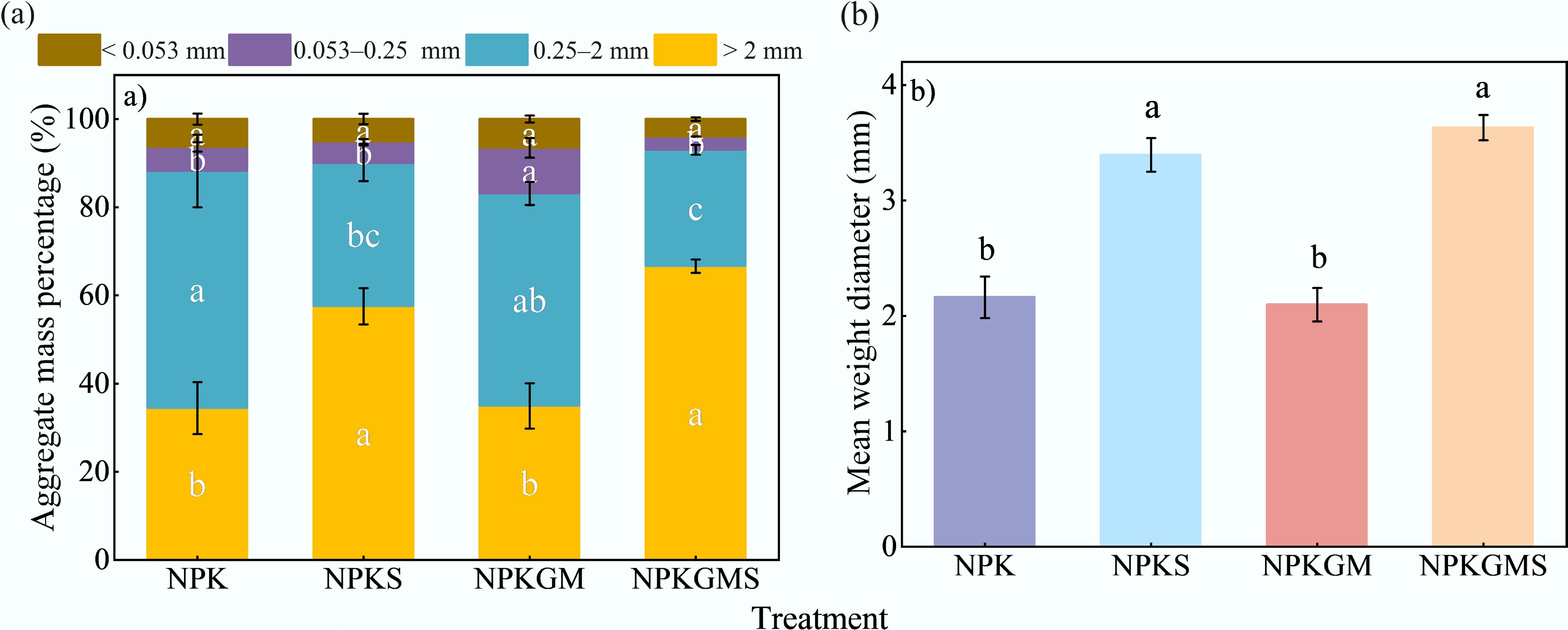
Figure 1.
(a) Mass percentage and (b) mean weight diameter of soil aggregates under different treatments. Different lowercase letters indicate significant differences among treatments at p < 0.05. Error bars represent the standard deviation (n = 3). NPK: NPK fertilization, winter fallow without straw return; NPKS: NPK fertilization, winter fallow with straw return; NPKGM: NPK fertilization, winter green manure (Chinese milk vetch) without straw return; and NPKGMS: NPK fertilization, winter green manure with straw return.
Straw return enhanced aggregate stability (Fig. 1b). Compared to the NPK treatment, the NPKS treatment dramatically increased the mean weight diameter (MWD) by 57.2%, and the NPKGMS treatment increased MWD by 73.1% relative to NPKGM (p < 0.05).
SOC content
-
Long-term (11-year) application of all tested fertilization practices significantly increased the SOC content compared to the pre-experiment level (Fig. 2). Even without straw return, SOC still increased after 11 years, primarily due to root-derived carbon from NPK fertilization and green manure input (NPKGM). The lowest and highest content were observed in the NPK and NPKGMS treatments, respectively. Compared to the NPK treatment, SOC content increased significantly by 13.6% in NPKS, 5.3% in NPKGM, and 22.7% in NPKGMS (p < 0.05).
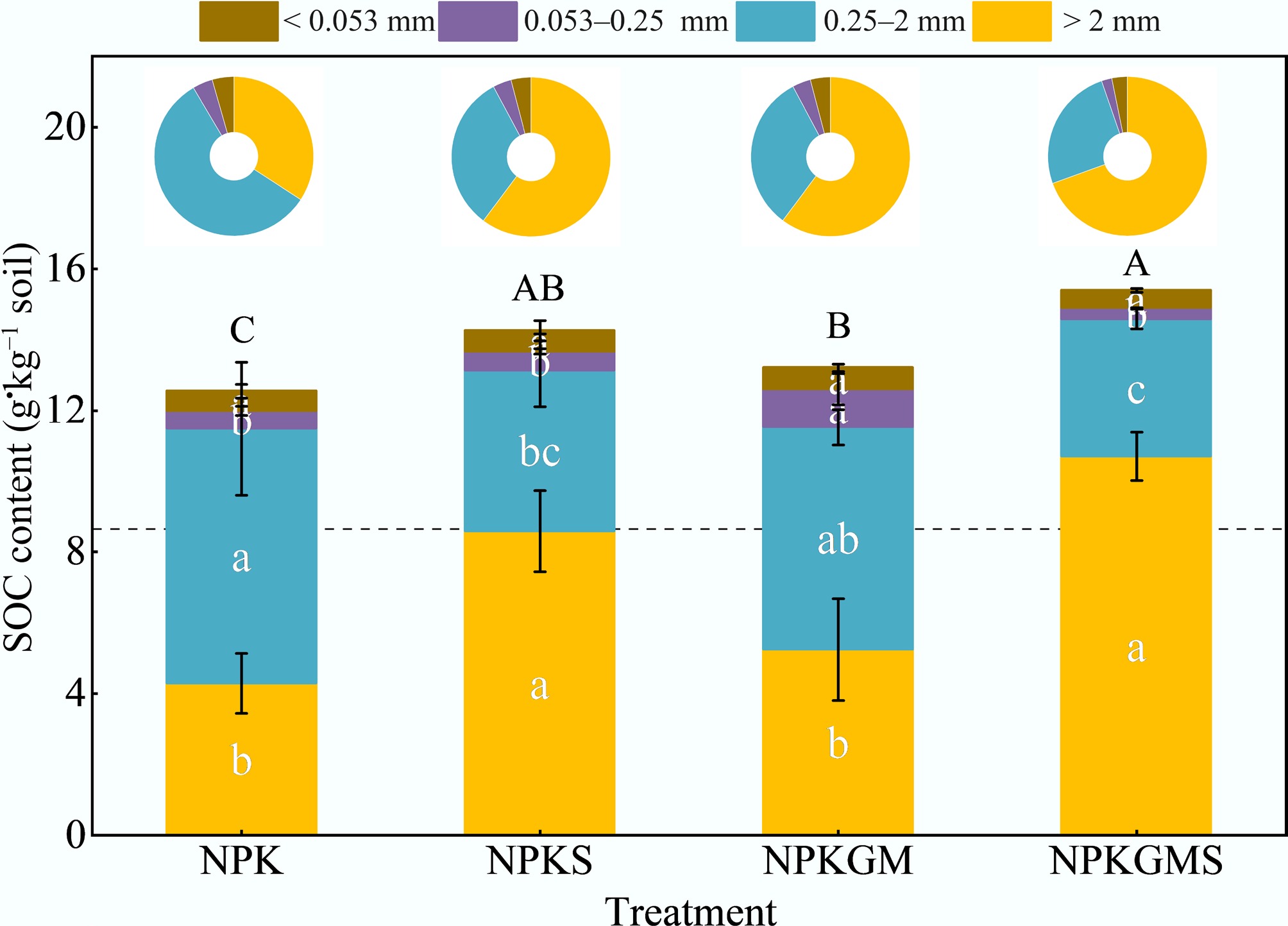
Figure 2.
Soil organic carbon content under different treatments. Stacked bars represent the organic carbon content in each aggregate fraction, with the total bar height representing the total soil organic carbon content. The inset pie charts show the proportional distribution of organic carbon across aggregate fractions. The dashed line indicates the organic carbon content before the experiment. Different lowercase letters within aggregate fractions and uppercase letters for total SOC indicate significant differences among treatments at p < 0.05. Error bars represent the standard deviation (n = 3). NPK: NPK fertilization, winter fallow without straw return; NPKS: NPK fertilization, winter fallow with straw return; NPKGM: NPK fertilization, winter green manure (Chinese milk vetch) without straw return; and NPKGMS: NPK fertilization, winter green manure with straw return.
SOC was predominantly sequestered in > 0.25 mm aggregates. Straw return promoted SOC accumulation in > 2 mm aggregates to approximately twice that in the non-straw-return treatment, while it reduced SOC in the 0.25–2 mm fraction by about 37%.
Iron oxides in the bulk soil
-
Regardless of treatment, the field soils exhibited relatively high contents of complexed (FePP: 1.9–3.7 g·kg−1) and crystalline (FeDH: 2.3–3.3 g·kg−1) iron oxides, while amorphous iron oxides (FeHH) were lower (0.5–0.8 g·kg−1) (Fig. 3a). Straw incorporation significantly elevated soil iron oxide content. Compared to NPK, the NPKS treatment approximately doubled FePP content and increased FeHH and FeDH by around 17%. Similarly, NPKGMS increased FePP, FeHH, and FeDH by 9.4%, 4.8%, and 28.4%, relative to NPKGM, respectively. Additionally, NPKGM treatment significantly increased FePP by 74.0% but decreased FeHH content by 23.7% compared to NPK treatment. Between the two straw-return treatments, only FeDH was significantly higher in NPKGMS, showing an increase of 20.3%. Moreover, both FePP and FeDH showed significant positive correlations with SOC content (Fig. 4) (p < 0.05).
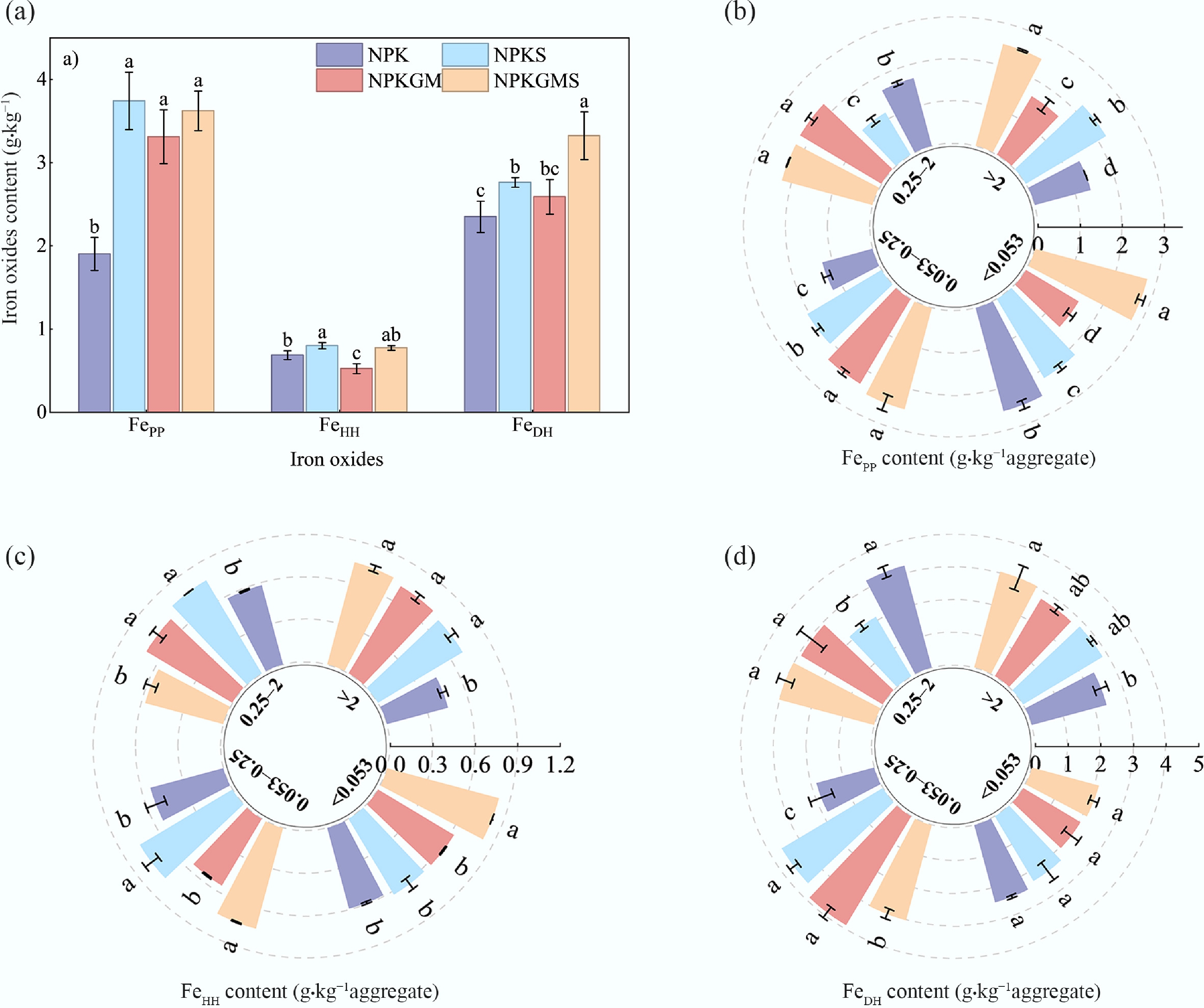
Figure 3.
The contents of iron oxides in (a) bulk soil and (b)–(d) soil aggregates under different treatments. Different lowercase letters indicate significant differences among treatments at p < 0.05. Error bars represent the standard deviation (n = 3). NPK: NPK fertilization, winter fallow without straw return; NPKS: NPK fertilization, winter fallow with straw return; NPKGM: NPK fertilization, winter green manure (Chinese milk vetch) without straw return; and NPKGMS: NPK fertilization, winter green manure with straw return. FePP: complexed iron oxides; FeHH: amorphous iron oxides; FeDH: crystalline iron oxides.
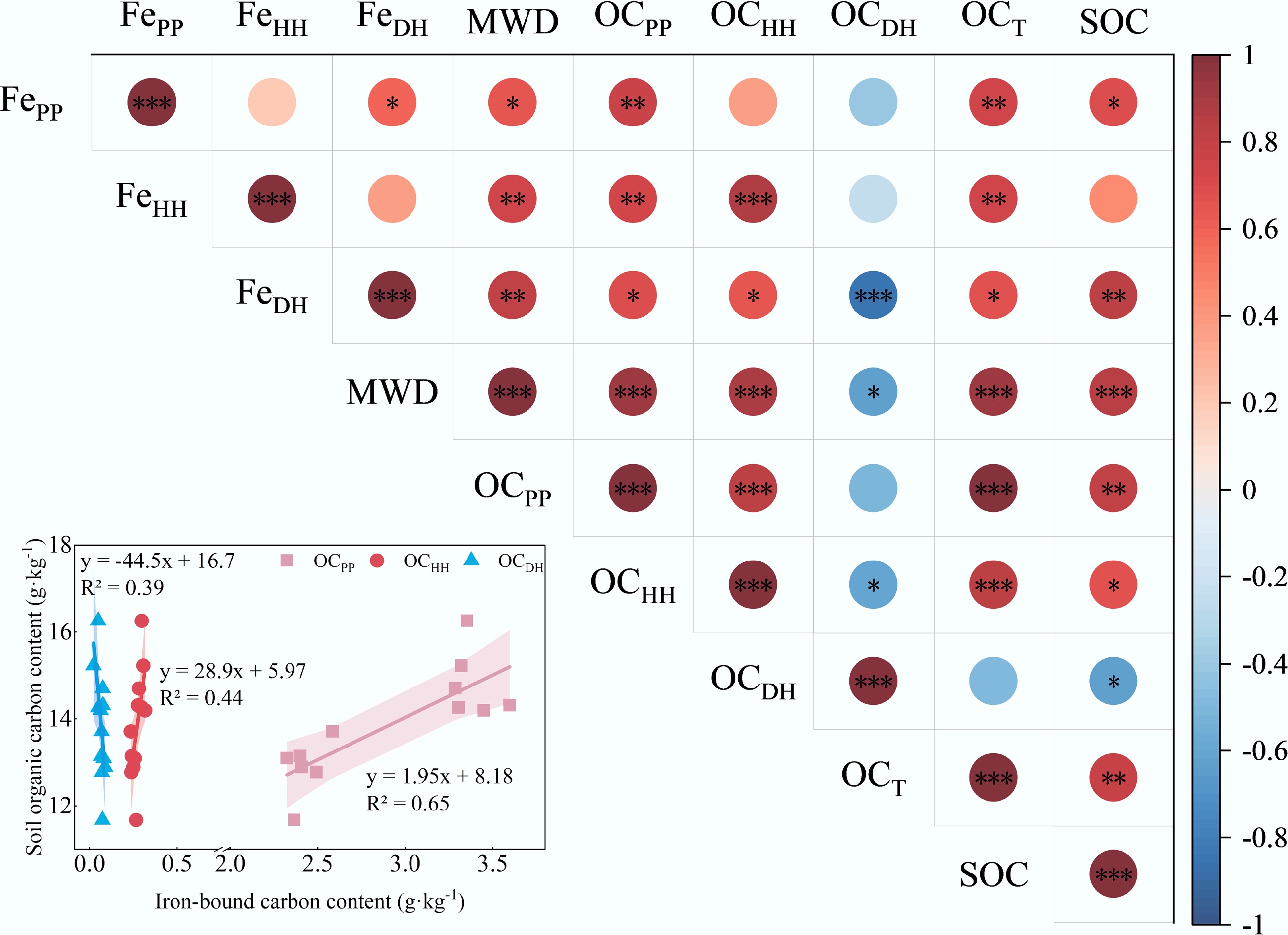
Figure 4.
Correlation analysis between different indicators and SOC, and linear correlation between iron-bound carbon content and SOC content. *** indicates p < 0.001, ** indicates p < 0.01, and * indicates p < 0.05 (n = 12).
Iron oxides in the aggregates
-
FePP content showed little variation across aggregate fractions (Fig. 3b). The NPKS treatment significantly enhanced FePP content in both the > 2 mm and the 0.053–0.25 mm aggregate fractions compared to NPK, whereas it caused a reduction in the 0.25–2 and < 0.053 mm fractions. Relative to the NPKGM treatment, the NPKGMS treatment significantly increased FePP content in > 2 and < 0.053 mm aggregate fractions by 54.8% and 89.7%, respectively (p < 0.05). Correlation analysis showed that FePP content in > 2 mm aggregates was significantly positively correlated with > 2 mm aggregate mass content and MWD (Table 1) (p < 0.01).
Table 1. Correlation of iron oxides in soil aggregates and mass content and stability of aggregates
Iron oxide content (g·kg−1) Particle size
(mm)Aggregate mass
contentMWD FePP > 2 0.91** 0.95** 0.25–2 ns ns 0.053–0.25 ns ns < 0.053 ns ns FeHH > 2 ns ns 0.25–2 ns ns 0.053–0.25 ns 0.94** < 0.053 0.60* 0.71* FeDH > 2 ns ns 0.25–2 ns ns 0.053–0.25 ns ns < 0.053 ns ns Note: numbers indicate the Pearson correlation coefficient, ** indicates p < 0.01, * indicates p < 0.05, and ns indicates no statistical significance at the p < 0.05 level (n = 3). Straw return also influenced FeHH distribution (Fig. 3c). NPKS treatment increased FeHH content across all aggregate fractions except < 0.053 mm compared to NPK treatment. For NPKGMS treatment, FeHH content increased in the 0.053–0.25 mm (34.5%) and the < 0.053 mm (31.1%) aggregate fractions but decreased in the 0.25–2 mm fraction (19.2%) relative to NPKGM. In addition, FeHH in the 0.053–0.25 mm and < 0.053 mm aggregate fractions was positively correlated with MWD (Table 1) (p < 0.05).
For FeDH, compared to the NPK treatment, the NPKS treatment led to a significant decrease of 34.6% in the 0.25–2 mm fraction, while causing an increase of 97.3% in the 0.053–0.25 mm fraction. Relative to the NPKGM treatment, the NPKGMS treatment significantly reduced FeDH content in the 0.053–0.25 mm fraction by 22.3% (Fig. 3d) (p < 0.05).
Iron-bound carbon content in bulk soil
-
In contrast to crystalline iron-bound carbon (OCDH), the contents of complexed iron-bound organic carbon (OCPP) and amorphous iron-bound organic carbon (OCHH) in soil were significantly elevated under straw return treatments (Fig. 5a). Compared to the NPK treatment, OCPP, OCHH, and total iron-bound carbon (OCT) contents under the NPKS treatment increased significantly by 45.9%, 15.1%, and 41.0%, respectively. Similarly, relative to the NPKGM treatment, NPKGMS treatment resulted in significant increases of 33.2% in OCPP, 23.9% in OCHH, and 30.9% in OCT. Linear regression analysis revealed positive correlations of OCPP and OCHH with SOC, with slopes of 1.95 and 28.9, indicating that SOC increased by 1.95 and 28.9 units per unit increase in OCPP and OCHH, respectively. In contrast, OCDH was negatively correlated with SOC, with a slope of −44.5, indicating a 44.5-unit decline in SOC per unit increase in OCDH (Fig. 4).
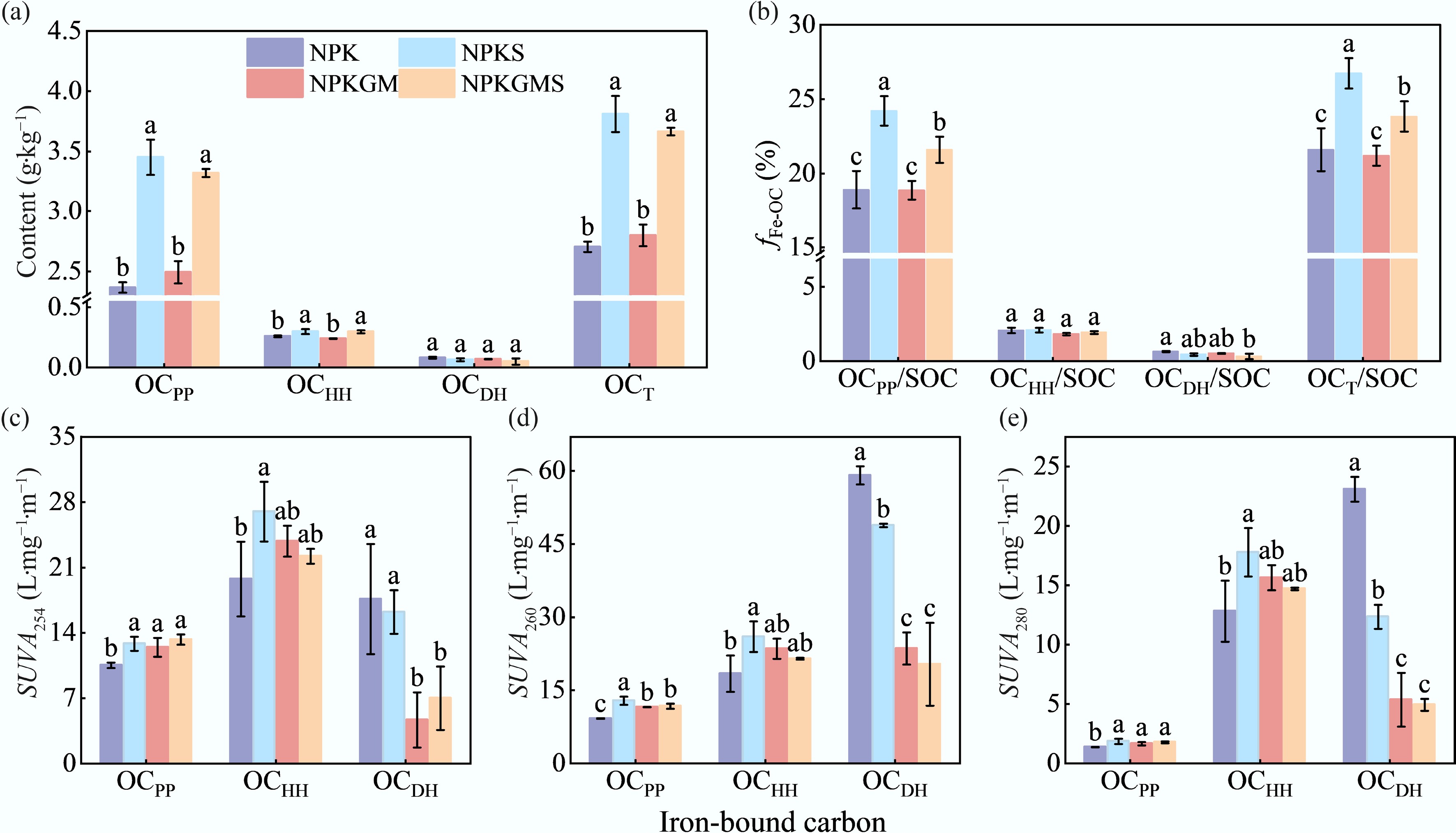
Figure 5.
(a) The iron-bound organic carbon content, (b) its ratios to total SOC, and the specific UV absorbance values of (c) SUVA254, (d) SUVA260, and (e) SUVA280 under different treatments. Different lowercase letters indicate significant differences among treatments at p < 0.05. Error bars represent the standard deviation (n = 3). NPK: NPK fertilization, winter fallow without straw return; NPKS: NPK fertilization, winter fallow with straw return; NPKGM: NPK fertilization, winter green manure (Chinese milk vetch) without straw return; and NPKGMS: NPK fertilization, winter green manure with straw return. OCPP: complexed iron-bound organic carbon; OCHH: amorphous iron-bound organic carbon; OCDH: crystalline iron-bound organic carbon; OCT: total iron-bound organic carbon; OCPP/SOC: complexed iron-bound organic carbon ratio; OCHH/SOC: amorphous iron-bound organic carbon ratio; OCDH/SOC: crystalline iron-bound organic carbon ratio; and OCT/SOC: total iron-bound organic carbon ratio. SUVA254: aromaticity; SUVA260: hydrophobicity; and SUVA280: high-molecular-weight compounds.
The proportion of iron-bound organic carbon in soil organic carbon (OCT/SOC) ranged from 21.2% to 26.7%, with complexed iron-bound organic carbon (OCPP/SOC) being the dominant form (Fig. 5b). Compared to the NPK treatment, NPKS treatment significantly increased OCPP/SOC and OCT/SOC by 5.3% and 5.1%, respectively. Similar trends were observed between the NPKGM and NPKGMS treatments (p < 0.05).
Iron-bound carbon property in bulk soil
-
To further characterize the iron-bound organic carbon, specific ultraviolet absorbance indices—SUVA254 (aromaticity), SUVA260 (hydrophobicity), and SUVA280 (high-molecular-weight compounds)—were used as indicators of its stability (Fig. 5c–e). Compared to the NPK treatment, the NPKS treatment enhanced the aromaticity, hydrophobicity, and high-molecular-weight compounds in both OCPP and OCHH, but decreased hydrophobicity and high-molecular-weight compounds in OCDH. There was no significant difference between the NPKGM and NPKGMS treatments (p < 0.05).
-
Soil aggregates are a fundamental component of soil, and their stability serves as a key indicator of soil structural quality[27]. A higher proportion of > 0.25 mm aggregates is generally associated with better soil structure. In this study, > 0.25 mm aggregates dominated all four treatments (Fig. 1a), which can be attributed to the combined effects of soil parent material and long-term field management[28]. Within the double-cropping rice system, straw return treatments promoted the formation of the > 2 mm (macro-aggregate) fraction. This is largely due to the physical breakdown of existing aggregates during straw incorporation, followed by their reorganization with organic residues and soil colloids into larger, more stable aggregates. Furthermore, straw return directly enhances soil organic matter and stimulates biological activity[29]. The polysaccharides derived from straw decomposition and crop root exudates, in conjunction with fungal hyphae and other binding agents, facilitate the cementation of soil particles and the formation of macro-aggregates[30].
In this study, NPKS and NPKGMS treatments significantly increased MWD (Fig. 1b), demonstrating their superior effect on improving aggregate stability compared to chemical fertilizer alone. This enhancement is primarily attributed to increased inputs of organic and inorganic binding agents such as soil organic matter and iron oxides following straw addition[31]. In contrast, chemical-only fertilization tends to lower the soil C/N ratio, which accelerates the mineralization of aggregate-associated organic carbon and thus undermines aggregate stability[32].
The morphology and crystallinity of iron oxides not only influence their distribution within soil aggregates but also determine their role in aggregate stability. Our results showed that straw return significantly increased the accumulation of FePP in aggregates > 2 mm, representing a 54.8%–61.5% increase relative to non-straw-return treatments (Fig. 3b). This is primarily because straw return introduces a substantial amount of fresh organic matter, accelerates humification, and enhances the complexation between iron and humic substances. As complexed iron is typically associated with organic matter distribution[12], and macro-aggregates often serve as hotspots of organic matter enrichment[33], FePP showed a clear tendency to accumulate in macro-aggregates. Accordingly, the FePP content in macro-aggregates was positively correlated with aggregate stability (r = 0.95, p < 0.01) (Table 1). In contrast to FePP, FeHH mainly accumulated in < 0.25 mm aggregates after straw return, with a 34.5%–42.6% increase compared to non-straw-return treatments (Fig. 3c). Its content was positively correlated with MWD (r = 0.94, p < 0.01) (Table 1), indicating that FeHH was a key contributor to micro-aggregate stability. This is closely related to its high specific surface area and abundant reactive sites, which enable it to tightly adsorb soil colloids and fine organic matter[12], thereby maintaining the structural stability of micro-aggregates. The increase in bulk soil FeDH content was mainly driven by the elevated mass proportion of macro-aggregates after straw return, while the FeDH within each aggregate fraction remained unchanged, likely because straw return favors the formation of active iron oxides over the accumulation of crystalline iron oxides[34].
The content and stability of iron-bound organic carbon
-
Iron oxides differ in their capacity to retain organic carbon due to their distinct physicochemical properties. In this study, OCPP was the dominant form across all fertilization treatments (Fig. 5b), indicating that iron-carbon association in these soils occurs primarily through complexation, which plays a major role in SOC stabilization, a finding consistent with a previous report[35]. Notably, although the concentration of FeHH was much higher than that of FeDH, the amount of OCHH exceeded OCDH. This highlights the stronger carbon-binding ability of FeHH, attributable to their greater surface reactivity and abundance of active sites[36]. OCPP and OCHH were positively correlated with their respective iron oxide concentrations (Fig. 4), suggesting that soils with higher iron availability tend to form more iron-associated carbon. However, the concentration of OC extracted by sodium dithionite (OCDH) did not increase with rising FeDH content, implying that the abundance of iron alone cannot fully predict the concentration of associated OC, as different iron phases contribute unevenly to OC stability[33].
Iron-bound organic carbon represents a key component of the SOC pool and is sensitive to agricultural management practices[37,38]. In this 11-year field experiment, straw return significantly altered the content of iron-bound organic carbon (Fig. 5a). The incorporation of straw likely promotes iron-bound carbon complexation through several pathways: (i) straw decomposition releases low-molecular-weight plant-derived compounds and microbial necromass, which serve as precursors for iron-carbon formation[39]; (ii) these compounds then interact with iron oxides via adsorption or co-precipitation[40]; and (iii) the resulting complexes are physically protected within soil aggregates[41]. The three forms of iron-bound carbon responded differently to straw return. Compared with the non-straw-return treatments, straw return significantly increased the content of OCPP. The decomposition of straw releases organic acids, lowering soil pH, which in turn promotes the dissolution of iron oxides and enhances the chelation between iron oxides and organic functional groups, thereby facilitating the formation of OCPP[42]. Straw return also significantly increased OCHH content. Emerging evidence from long-term field experiments suggests that organic amendments consistently increase the availability of short-range-ordered (SRO) minerals, which act as 'nuclei' for carbon retention and initiate a positive feedback loop for further carbon binding[43]. This mechanism led to elevated OCHH. In contrast, OCDH content showed no significant change, indicating that crystalline iron oxides, owing to their high stability and low reactivity, are less responsive to organic matter inputs.
Specific ultraviolet absorbance at 254 nm (SUVA254), at 260 nm (SUVA260), and at 280 nm (SUVA280) reflect the aromaticity, hydrophobicity, and proportion of high-molecular-weight compounds in organic carbon, respectively, with higher values generally indicating greater chemical stability. This study found that OCHH and OCDH exhibited similar stability, which was stronger than that of OCPP (Fig. 5). Chen et al.[16] reported that iron-bound carbon with a lower C/Fe molar ratio (C/Fe = 1.5) tended to enrich aromatic compounds. In the present study, the C/Fe molar ratio of OCPP was 3.5–5.8, whereas those of OCHH and OCDH were 1.7–2.1 and 0.1–0.2, respectively, which may partly explain the higher aromaticity of OCHH and OCDH. In addition, Coward et al.[44] found that SOC extracted by sodium pyrophosphate was mainly composed of aliphatic compounds and carbohydrates, with only a minor proportion of aromatic compounds. Compared with the NPK treatment, NPKS increased stability for both OCPP and OCHH (Fig. 5c, d). This is attributed to the selective adsorption of aromatic compounds released during straw decomposition onto clay mineral surfaces, followed by their encapsulation within micro-aggregates via cementation and coagulation, which enhances the stability of iron-bound organic carbon[45]. In contrast, OCDH exhibited the highest stability under the NPK treatment (Fig. 5e). This may be explained by the low input of fresh organic matter in the NPK treatment, which limits microbial activity and enzymatic access to the crystalline-iron-protected carbon pool and increases its stability. However, given the heterogeneity of soil and the complexity of organic carbon composition, future research should employ advanced spectroscopic techniques such as X-ray photoelectron spectroscopy (XPS), nuclear magnetic resonance (NMR), and Fourier transform ion cyclotron resonance mass spectrometry (FT-ICR-MS) to advance our understanding of SOC persistence. Therefore, our findings indicated that straw incorporation enhanced the formation and chemical stability of iron-bound organic carbon, particularly for complexed and amorphous fractions, representing a crucial pathway for long-term carbon storage in paddy soils.
Implications for global agricultural carbon management
-
This study was conducted in a typical subtropical red paddy soil. The underlying mechanism involves straw return regulating iron oxide transformation, which enhances aggregate stability and the formation of iron-bound organic carbon. This mechanism may also apply to other agricultural soils with similar physicochemical properties. Nevertheless, the effectiveness of this mechanism is likely shaped by both soil type and climatic conditions. In terms of soil properties, soils rich in iron oxides and high in clay content are more favorable for this carbon sequestration pathway[10,46]. In contrast, sandy soils, alkaline soils, or iron-deficient soils tend to show a weaker response, as iron oxide reactivity is limited or aggregate formation is constrained in these soils. From a climatic perspective, the effect of temperature on straw decomposition is nonlinear[47], where moderate temperatures enhance decomposition and supply organic carbon for iron–carbon interactions, whereas extreme heat weakens this process. To establish straw return as a sustainable practice for SOC sequestration, systematic research across diverse soil and climatic conditions is essential. Future studies should incorporate factors such as soil texture, pH, iron oxide content, temperature, and precipitation, and apply complementary measures such as iron fertilization when necessary to optimize iron-mediated carbon sequestration outcomes.
-
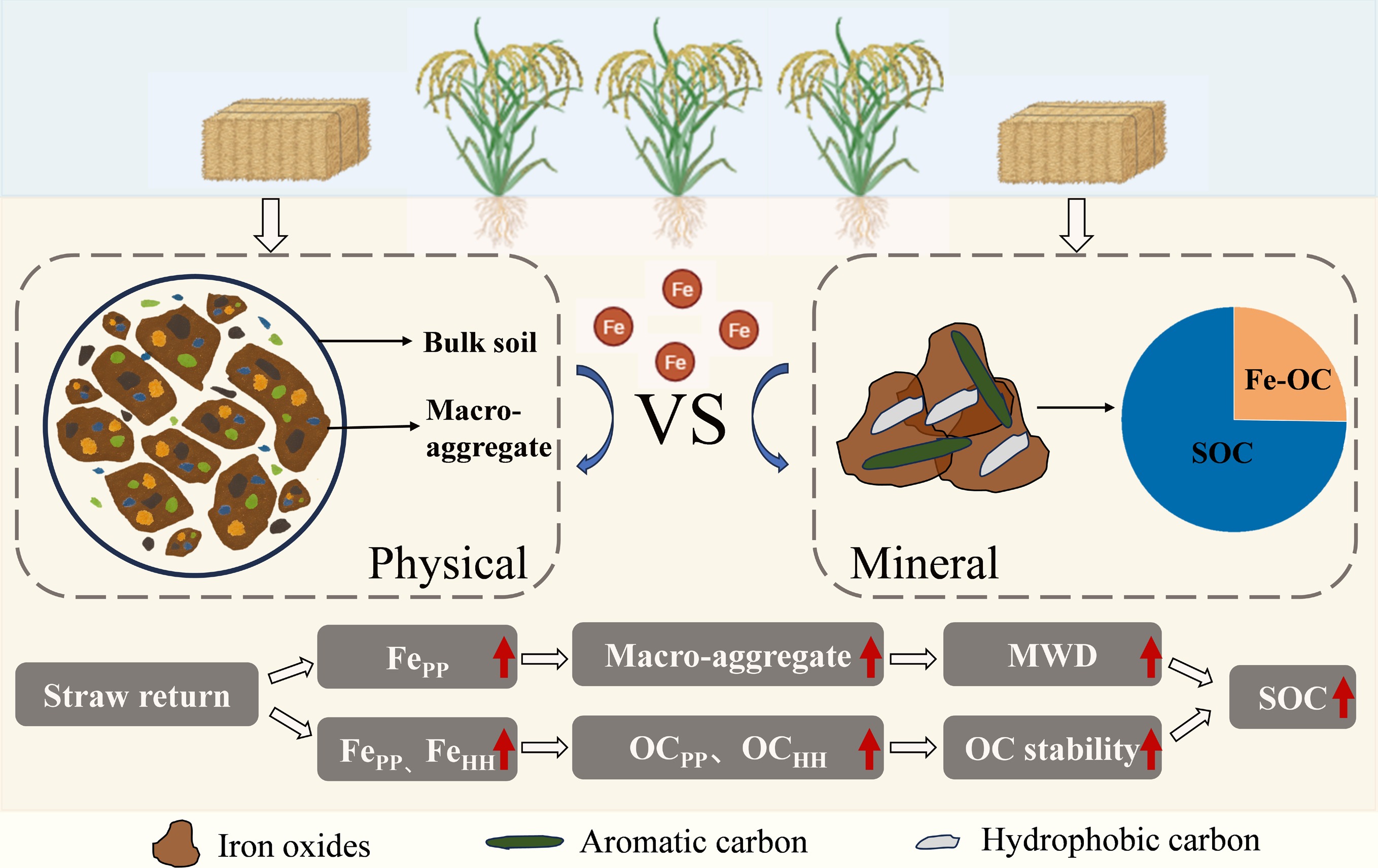
In this study, straw return enhanced SOC accumulation primarily by altering iron oxide dynamics. The underlying mechanisms can be summarized as follows: (i) Straw return increased the content of iron oxides in soil, particularly elevating complexed iron in macro-aggregates (> 2 mm) and amorphous iron oxides in micro-aggregates (< 0.25 mm). These changes promoted aggregate formation and stability, thereby strengthening the physical protection of organic carbon. (ii) Straw return facilitated the association of complexed and amorphous iron oxides with dissolved organic carbon rich in aromatic and hydrophobic constituents. This interaction enhanced both the concentration and stability of iron-bound organic carbon, contributing further to the accumulation and stabilization of SOC. Collectively, these findings highlight the critical role of straw return in regulating iron-mediated carbon stabilization in paddy soils, offering practical implications for sustainable soil fertility management in subtropical agricultural systems.
-
Not applicable.
-
The authors confirm their contributions to the paper as follows: Bingjie Li: writing – original draft, visualization, methodology, data curation. Jing Huang: writing – review & editing, supervision. Lisheng Liu: writing – review & editing, supervision. Dongchu Li: writing – review & editing, supervision. Yinghua Duan: writing – review & editing, supervision, resources, project administration. Minggang Xu: writing – review & editing. All authors reviewed the results and approved the final version of the manuscript.
-
The datasets generated during and/or analyzed during the current study are available from the corresponding author on reasonable request.
-
This study was supported by the Innovation Program of Chinese Academy of Agricultural Sciences (CAAS-CSAL-202302), the Central Public-Interest Scientific Institution Basal Research Fund (No. Y2025YC88), and the Chinese Long-Term Experimental Network for Agricultural and Rural Development (CLENARD-DAC-AR and CLENARD-HY).
-
The authors declare that they have no known competing financial interests or personal relationships that could have appeared to influence the work reported in this paper.
-
Full list of author information is available at the end of the article.
- Copyright: © 2026 by the author(s). Published by Maximum Academic Press, Fayetteville, GA. This article is an open access article distributed under Creative Commons Attribution License (CC BY 4.0), visit https://creativecommons.org/licenses/by/4.0/.
-
About this article
Cite this article
Li B, Huang J, Liu L, Li D, Duan Y, et al. 2026. Straw return promotes soil organic carbon sequestration through aggregate protection and chemical bonding mediated by iron oxides. Agricultural Ecology and Environment 2: e018 doi: 10.48130/aee-0026-0015 

Straw return promotes soil organic carbon sequestration through aggregate protection and chemical bonding mediated by iron oxides
- Received: 27 January 2026
- Revised: 25 April 2026
- Accepted: 05 June 2026
- Published online: 22 June 2026
Abstract: Straw serves as a major source of soil organic matter, yet the specific pathways and mechanisms by which straw incorporation regulates different forms of iron oxide, and thereby their influence on organic carbon accumulation, remain poorly understood in paddy soil. To address this gap, a long-term field experiment was established in 2012 in a double-cropping rice system. Soil samples were collected after 11 consecutive years from four treatments: NPK (NPK fertilization, winter fallow without straw return), NPKS (NPK fertilization, winter fallow with straw return), NPKGM (NPK fertilization, winter green manure [Chinese milk vetch] without straw return), and NPKGMS (NPK fertilization, winter green manure with straw return). We systematically analyzed soil organic carbon (SOC), iron oxides, aggregates, and iron-bound organic carbon. Results showed that SOC content increased significantly by 13.6% in NPKS, 5.3% in NPKGM, and 22.7% in NPKGMS relative to the NPK treatment. Straw return (NPKS and NPKGMS) promoted the formation of > 2 mm aggregates and increased the mean weight diameter by 57.2% and 73.1% compared to NPK and NPKGM, respectively. Straw return significantly elevated soil iron oxide content, with the complexed iron predominantly accumulating in macro-aggregates (> 2 mm) and amorphous iron oxides in micro-aggregates (< 0.25 mm), thereby enhancing the stability of aggregates. Crystalline iron oxides showed inconsistent responses to straw returns across aggregate fractions and were not significantly correlated with aggregate stability. Total iron-bound organic carbon (OCT) accounted for 21.2%–26.7% of total SOC and was dominated by the complexed iron-bound carbon. Straw return significantly increased OCT content, with NPKS and NPKGMS showing increases of 41.0% and 30.9% relative to NPK and NPKGM, respectively. Characterization of the different forms of iron-bound organic carbon using specific ultraviolet absorbance (SUVA) revealed that straw return enhanced the chemical stability of both complexed and amorphous iron-bound carbon, as indicated by higher SUVA254, SUVA260, and SUVA280 values, supporting greater accumulation and persistence of organic carbon. In summary, straw return enhances SOC primarily through two iron-mediated pathways: (i) physical protection via improved aggregate formation and stability; and (ii) chemical stabilization through stronger binding between iron oxides and organic carbon.
-
Key words:
- Paddy soil /
- Straw return /
- Iron oxides /
- Aggregates /
- Iron-bound carbon