












-
Laboratory-based training is a core component of scientific education in disciplines such as chemistry, biochemistry, microbiology, and medical laboratory sciences. These environments require routine handling of chemical reagents and biological materials that may exert varying degrees of biological and occupational stress on the users. Although these exposures are generally controlled within academic settings, repeated contact with laboratory substances has been associated with cellular and physiological stress responses in experimental and occupational contexts[1−3].
Laboratory environments in chemical and biomedical disciplines involve the frequent use of organic solvents, aldehydes, acids, disinfectants, and staining reagents. Many of these substances are capable of inducing cellular alterations through reactive intermediates or metabolic activation pathways, thereby contributing to biological stress responses in exposed individuals[4,5]. In academic settings, repeated low-level exposure is common during routine practical sessions and research activities. Over time, such repeated exposure patterns may contribute to subtle and cumulative physiological effects that are not immediately observable[6].
In addition to environmental exposure, nutritional habits represent an important determinant of general health and resilience to external stressors. Dietary components such as vitamins C and E, carotenoids, flavonoids, and polyphenolic compounds have been widely recognized for their role in supporting cellular protection mechanisms and maintaining physiological balance[7,8]. However, dietary patterns among university students are often characterized by a low intake of fruits and vegetables and increased consumption of processed foods[9]. Such dietary habits may reduce overall nutritional quality and potentially influence how individuals respond to environmental and occupational exposures.
Previous studies have examined occupational and environmental chemical exposure in various settings, as well as the influence of dietary patterns on general health outcomes[10−12]. However, these factors are often investigated independently, with limited integration into a single analytical framework that considers both environmental exposure and lifestyle behaviors. Furthermore, most available evidence has focused on industrial workers and healthcare professionals, but relatively fewer studies have addressed undergraduate and postgraduate students who are regularly engaged in laboratory-based training and may have variable levels of adherence to safety practices[13].
Understanding the interaction among laboratory exposure patterns, dietary behaviors, and safety practices is important for strengthening occupational health awareness in academic environments. This is particularly relevant in developing institutional settings where the enforcement of laboratory safety procedures and awareness of healthy lifestyle practices may be inconsistent. A combined assessment of these factors may provide useful insights into behavioral and environmental contributors to self-reported health experiences among laboratory users.
Therefore, this study aimed to investigate the combined associations between laboratory chemical exposure patterns and dietary habits among young scientists in academic laboratory settings. Specifically, the study assessed the knowledge of chemical hazards, frequency of laboratory exposure, dietary intake patterns, self-reported health symptoms, and laboratory safety practices. The findings are expected to contribute to an improved understanding of occupational health risks in academic laboratories and support the development of targeted interventions to enhance a laboratory safety culture and students' wellbeing.
-
A descriptive cross-sectional study was conducted to evaluate the combined effects of dietary patterns and laboratory chemical exposures on oxidative stress-related outcomes among young scientists.
Study area and population
-
The study was carried out among undergraduate and postgraduate students enrolled in chemistry, biochemistry, microbiology, and medical laboratory science programs in selected universities in Ekiti State, Nigeria. Participants included students who were actively engaged in laboratory practical sessions involving routine handling of chemical reagents. Students without laboratory exposure were excluded from the study.
Sample size determination and sampling technique
-
The sample size was determined using Cochran’s formula for cross-sectional studies at a 95% confidence level and a 5% margin of error, assuming a 50% prevalence. A minimum sample size of 384 was obtained. To account for nonresponse, 450 questionnaires were distributed, and 426 valid responses were retrieved, giving a response rate of 94.7%.
A stratified random sampling technique was used to ensure adequate representation across academic levels (undergraduate and postgraduate) and disciplines.
Data collection instrument
-
Data were collected using a structured, self-administered questionnaire adapted from validated instruments on chemical exposure, dietary assessment, and laboratory safety practices.
The questionnaire was adapted from previously published instruments assessing occupational chemical exposure, laboratory safety practices, dietary habits, and self-reported health symptoms in academic and occupational settings. Items were modified to reflect laboratory practices and dietary behaviors relevant to university students in Nigeria. The adapted questionnaire consisted of 14 main items distributed across six sections: Demographic information (4 items), knowledge of oxidative stress and chemical hazards (2 items), laboratory chemical exposure (2 items), dietary antioxidant intake (2 items), self-reported symptoms (1 item), and laboratory safety practices (3 items), as shown in Supplementary File 1.
The questionnaire comprised six sections:
Section A: Demographic characteristics (age, gender, program, and level of study);
Section B: Knowledge of oxidative stress and chemical hazards;
Section C: Laboratory chemical exposure (types, frequency, and duration);
Section D: Dietary antioxidant intake (frequency of consumption of fruits, vegetables, and antioxidant-rich foods);
Section E: Self-reported oxidative stress-related and hematological symptoms (fatigue, pallor, headaches, and bruising);
Section F: Laboratory safety practices (personal protective equipment [PPE] use, fume hood utilization, spill management, and waste disposal).
The responses were coded as correct = 1 and incorrect = 0 for the knowledge and practice sections.
Validation and reliability of the questionnaire
-
The questionnaire was adapted from previously published instruments assessing occupational chemical exposure, laboratory safety practices, dietary antioxidant intake, and self-reported health symptoms. The instrument was reviewed by two experts in occupational health and one hematologist for content validity. A pilot study involving 25 students outside the study population was conducted to assess clarity, reliability, and internal consistency. Minor wording modifications were made following feedback from the pilot study. The overall Cronbach's alpha coefficient for the questionnaire sections was 0.81, indicating acceptable internal consistency.
Scoring and categorization
-
● Knowledge and safety practices
Scores were categorized as poor (< 50%), moderate (50%–74%), and good (≥ 75%).
● Dietary antioxidant intake
This was categorized according to weekly consumption frequency:
○ Low (< 3 servings/week);
○ Moderate (3–6 servings/week);
○ High (> 6 servings/week).
● Exposure level
Participants were categorized as frequently exposed (daily/weekly exposure) or less exposed (occasional/rare exposure).
Exposure in this study was assessed on the basis of the frequency of handling laboratory chemicals (daily/weekly versus occasional/rare exposure) and did not include quantitative parameters such as the exposure's concentration and/or duration, the route of exposure, ventilation conditions, use of fume hoods, PPE compliance during each exposure event, or cumulative years of laboratory work. This limits a detailed characterization of the intensity of exposure.
Knowledge and laboratory safety practice scores were calculated by assigning one point for each correct or appropriate response and zero for incorrect responses. Total knowledge scores ranged from 0 to 5, whereas safety practice scores ranged from 0 to 3. Categorization thresholds were adapted from previous questionnaire-based occupational health studies and were defined as poor (< 50%), moderate (50%–74%), or good (≥ 75%).
Categories of dietary antioxidant intake were based on the weekly frequency of consumption of fruits, vegetables, and antioxidant-rich foods using a simplified frequency-based assessment rather than a validated dietary antioxidant index. Exposure levels were based on the self-reported frequency of handling laboratory chemicals.
Data collection procedure
-
The questionnaire was administered physically during lecture periods and laboratory sessions. The participants were informed about the purpose of the study, and written informed consent was obtained prior to participation. Each questionnaire required approximately 10–15 min to complete. Completed questionnaires were collected immediately and checked for completeness before data entry.
Statistical analysis
-
Data were entered into Microsoft Excel and analyzed using SPSS version 26.0 (IBM Corp., USA).
● Descriptive statistics: Frequencies, percentages, and mean ± standard deviation (SD).
● Inferential statistics
○ The chi-square (χ2) test was used to assess associations among chemical exposure, dietary intake, knowledge, and self-reported symptoms.
○ Logistic regression analysis to identify predictors of good laboratory safety practices.
Statistical significance was set at p < 0.05.
Binary logistic regression was used to examine the predictors of self-reported oxidative stress symptoms. The dependent variable was the presence of symptoms (yes/no), with 'no symptoms' as the reference category. Independent variables included laboratory chemical exposure (frequent vs. less), dietary antioxidant intake (low, moderate, high), and relevant covariates such as age, gender, level of study, and laboratory safety practices. Adjusted odds ratios (AORs) with 95% confidence intervals (CIs) were reported. The model's fit was assessed using the Hosmer–Lemeshow test and pseudo-R2 statistics. The interaction between dietary intake and chemical exposure was tested by including an interaction term in the model.
-
In total, 426 students completed the survey (response rate: 94.7%). The age range was 18–35 years (mean ± SD: 23.9 ± 4.7). Females constituted 54.0% and males 46.0%. Undergraduate students represented 69.2% of the sample; postgraduates comprised 30.8%. The distribution across academic programs is summarized in Table 1.
Table 1. Sociodemographic characteristics of the respondents (n = 426)
Variable Category Frequency (n) Percentage (%) Age (years) 18–25 260 61.0 26–30 112 26.3 > 30 54 12.7 Gender Male 196 46.0 Female 230 54.0 Level of study Undergraduate 295 69.2 Postgraduate 131 30.8 Program Chemistry/science 240 56.3 Medical-related 186 43.7 Knowledge of oxidative stress and chemical hazards
-
Overall, 57.0% of the respondents demonstrated good knowledge, 28.6% moderate, and 14.4% poor knowledge. Postgraduates showed significantly higher knowledge than undergraduates (χ2 = 15.32; degrees of freedom [df] = 2; p = 0.0005). The distribution of knowledge levels by academic status is shown in Table 2.
Table 2. Knowledge level by academic status
Level Good, n (%) Moderate, n (%) Poor, n (%) Total χ2 df p-value Undergraduate 155 (52.5) 90 (30.5) 50 (17.0) 295 Postgraduate 88 (67.2) 32 (24.4) 11 (8.4) 131 15.32 2 0.0005 Total 243 (57.0) 122 (28.6) 61 (14.4) 426 As shown in Table 2, postgraduates exhibited higher knowledge scores compared with undergraduates, highlighting the effect of academic level on awareness.
Laboratory chemical exposure
-
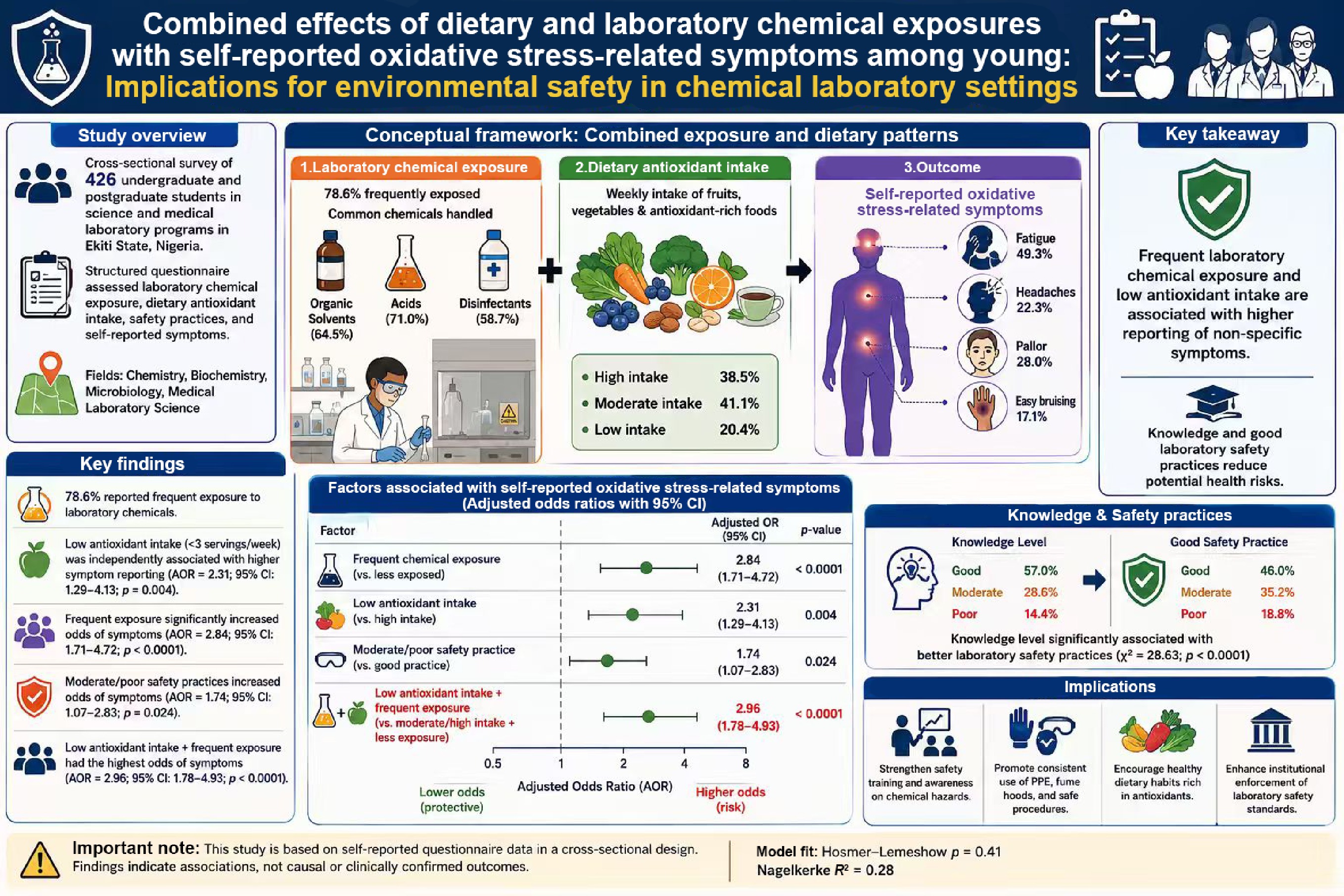
The questionnaire revealed that 78.6% of students reported frequent exposure to laboratory chemicals.
The most common chemicals included organic solvents (64.5%), acids (71.0%), and disinfectants (58.7%).
The simplified exposure categorization was adopted because of the cross-sectional questionnaire design and feasibility constraints in self-reported academic settings.
Dietary antioxidant intake
-
In total, 38.5% reported high intake, 41.1% reported moderate intake, and 20.4% reported low intake.
Self-reported oxidative stress symptoms
-
The participants reported the following symptoms: Fatigue (49.3%); Pallor (28.0%); Recurrent headaches (22.3%); Easy bruising (17.1%).
A significant association was found between frequent chemical exposure and self-reported oxidative stress symptoms (χ2 = 22.30; df = 1; p < 0.0001). The association between chemical exposure and self-reported oxidative stress symptoms is presented in Table 3.
Table 3. Association between chemical exposure and self-reported oxidative stress symptoms (n = 426)
Exposure status Symptoms present,
n (%)No symptoms,
n (%)Total Frequently exposed 210 (62.7) 125 (37.3) 335 Less exposed 32 (35.2) 59 (64.8) 91 Total 242 184 426 Statistical analysis: χ2 = 22.30, df = 1, p < 0.0001. A significant association was observed between laboratory chemical exposure frequency and self-reported oxidative stress-related symptoms (χ2 = 22.30, df = 1, p < 0.0001).
As shown in Table 3, participants reporting frequent laboratory chemical exposure had a higher prevalence of self-reported oxidative stress-related symptoms (62.7%) compared with those reporting less exposure (35.2%). The association between exposure status and reporting symptoms was statistically significant (χ2 = 22.30, df = 1, p < 0.0001).
These findings indicate that a higher frequency of laboratory chemical exposure is associated with increased reporting of symptoms that are potentially consistent with oxidative stress-related conditions among young scientists. However, these symptoms are self-reported and nonspecific, and they may also be influenced by other physiological or environmental factors.
Preventive laboratory practices
-
The participants reported the following rates of following preventive laboratory practices: Good practices (46.0%); Moderate practices (35.2%); Poor practices (18.8%).
Knowledge level was significantly associated with preventive practices (χ2 = 28.63; df = 2; p < 0.0001). The relationship between knowledge level and laboratory safety practices is summarized in Table 4.
Table 4. Association between knowledge level and laboratory safety practices
Knowledge
levelGood practice,
n (%)Poor/moderate,
n (%)Total χ2 df p-value Good 142 (58.4) 101 (41.6) 243 Moderate 30 (24.6) 92 (75.4) 122 28.63 2 <0.0001 Poor 8 (13.1) 53 (86.9) 61 As shown in Table 4, participants with better knowledge levels demonstrated more compliant laboratory safety practices, emphasizing the importance of education for preventive behavior.
Association between dietary intake and chemical exposure
-
Binary logistic regression analysis showed that participants with frequent laboratory chemical exposure had significantly increased odds of reporting oxidative stress-related symptoms compared with less exposed participants (AOR = 2.84; 95% CI: 1.71–4.72; p < 0.0001). Similarly, low dietary antioxidant intake was independently associated with higher odds of reporting symptoms (AOR = 2.31; 95% CI: 1.29–4.13; p = 0.004). Participants with moderate to poor laboratory safety practices also demonstrated significantly increased odds of symptoms (AOR = 1.74; 95% CI: 1.07–2.83; p = 0.024).
Participants reporting both low antioxidant intake and frequent laboratory chemical exposure showed the highest likelihood of self-reported oxidative stress-related symptoms (AOR = 2.96; 95% CI: 1.78–4.93; p < 0.0001). However, the formal statistical interaction between dietary intake and chemical exposure was not significant; therefore, the findings are interpreted as a combined association rather than a synergistic effect.
The regression model demonstrated acceptable goodness-of-fit (Hosmer–Lemeshow p = 0.41), with moderate explanatory capacity (Nagelkerke R2 = 0.28).
-
This study evaluated the combined associations between laboratory chemical exposure, dietary patterns, and self-reported health symptoms among young scientists in academic laboratory environments. A high proportion of participants reported frequent exposure to laboratory chemicals, particularly organic solvents, acids, and disinfectants commonly used during practical and research activities. Participants with frequent chemical exposure reported a higher prevalence of self-reported symptoms such as fatigue, headaches, pallor, and easy bruising compared with less exposed participants[11,12].
Previous studies have shown that repeated exposure to laboratory and occupational chemicals may contribute to physiological stress responses and general health complaints, particularly in environments with inconsistent safety practices or prolonged durations of exposure. Organic solvents, volatile compounds, and reactive chemicals have been associated with irritation, fatigue, headaches, and other nonspecific symptoms in occupational settings. However, the present study did not measure biochemical markers of oxidative stress, internal chemical doses, or clinical hematological parameters. Therefore, the observed findings should be interpreted as self-reported symptom associations rather than evidence of confirmed oxidative stress or hematological impairment.
Organic solvents, particularly ethanol and acetone, induce oxidative stress primarily through the induction of cytochrome P450 enzymes, such as CYP2E1. This metabolic pathway results in the heightened production of superoxide radicals and hydrogen peroxide, which overwhelm cellular antioxidant defenses[13]. Some major chemicals encountered in academic laboratories and their chemical structures are as follows:
● Acetone (CH3COCH3);
● Ethanol (C2H5OH);
● Hydrochloric acid (HCl);
● Sulfuric acid (H2SO4);
● Sodium hypochlorite (NaOCl).
These chemicals are routinely encountered in academic laboratory environments and represent some of the most frequently handled reagents with documented potential to induce oxidative stress. Their physicochemical properties, including polarity, redox activity, and reactivity with biological molecules, render them capable of generating reactive oxygen species (ROS) either directly or through metabolic transformation[11].
The category of combined low dietary antioxidant intake and frequent laboratory chemical exposure showed the highest likelihood of reporting symptoms. However, the formal statistical interaction between exposure and dietary intake was not significant, and therefore, the findings are more appropriately interpreted as a combined association rather than a synergistic effect. These results suggest that both environmental exposure patterns and lifestyle-related factors may contribute to how students perceive and report health-related symptoms within laboratory settings.
Figure 1 shows the AORs and 95% CIs for factors associated with self-reported oxidative stress-related symptoms among young scientists in academic laboratory settings. Frequent laboratory chemical exposure, low dietary antioxidant intake, and moderate to poor laboratory safety practices were significantly associated with increased odds of reporting symptoms. The category of combined low antioxidant intake and frequent chemical exposure demonstrated the highest likelihood of symptom occurrence. Error bars represent the 95% CIs.
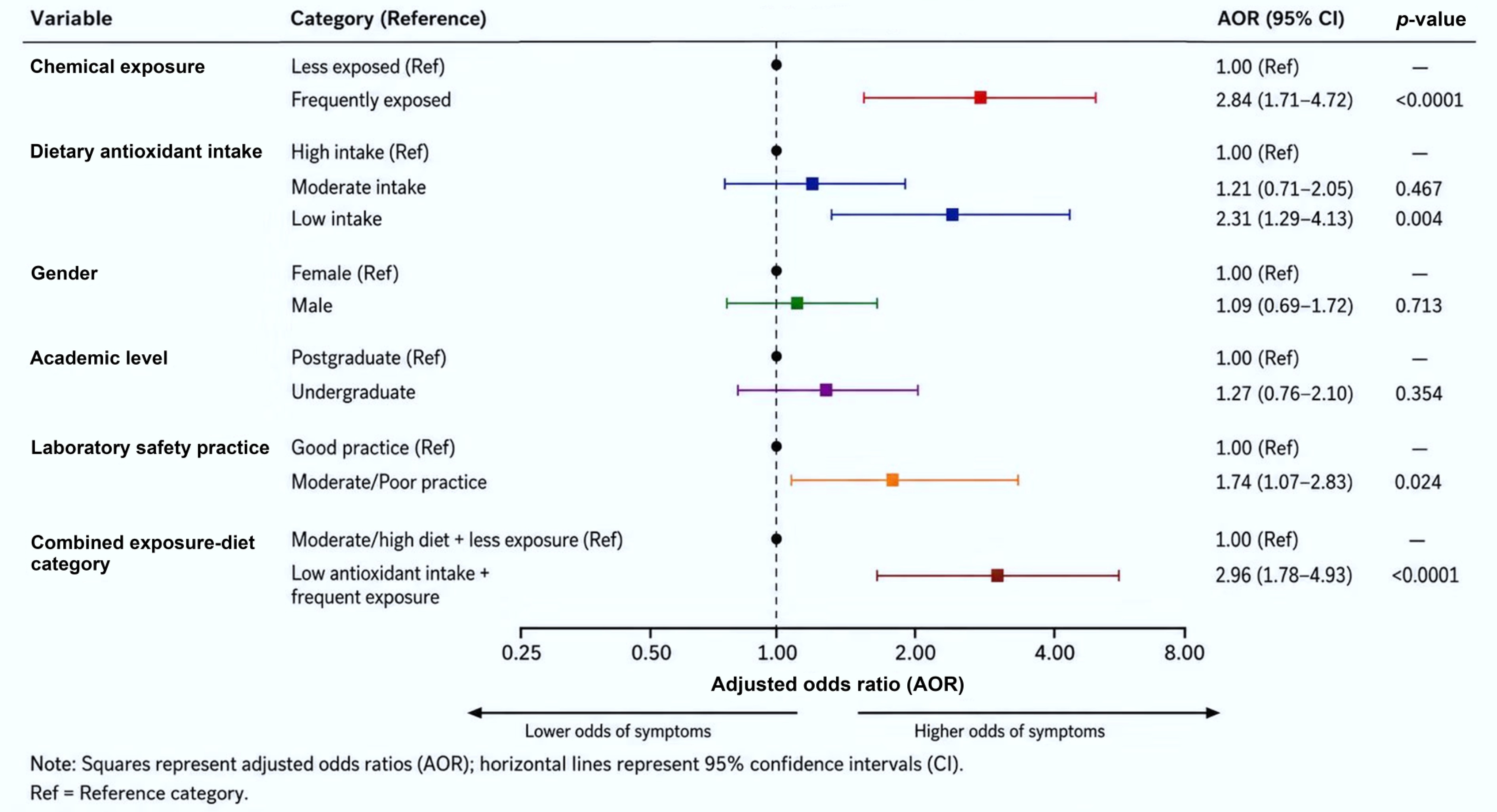
Figure 1.
Forest plot of adjusted odds ratios for factors associated with self-reported oxidative stress-related symptoms among participants (n = 426).
Previous studies have suggested that prolonged exposure to some organic solvents may affect hematopoietic processes and blood-related parameters in occupational settings[14,15].
Participants reporting a moderate to high intake of antioxidant-rich foods (including fruits and vegetables) reported fewer self-reported oxidative stress-related symptoms compared with those reporting low intake across similar categories of laboratory chemical exposure (Table 5). These findings are consistent with established literature suggesting that dietary antioxidants such as Vitamins C and E, carotenoids, and polyphenols may play a role in modulating oxidative balance through free radical scavenging and reducing lipid peroxidation processes[16,17].
Table 5. Binary logistic regression analysis of factors associated with self-reported oxidative stress-related symptoms among participants (n = 426)
Variable Category Crude OR (95% CI) p-value AOR (95% CI) p-value Chemical exposure Less exposed (Ref.) 1.00 — 1.00 — Frequently exposed 3.10 (1.92–5.01) < 0.0001 2.84 (1.71–4.72) < 0.0001 Dietary antioxidant intake High intake (Ref.) 1.00 — 1.00 — Moderate intake 1.29 (0.78–2.13) 0.311 1.21 (0.71–2.05) 0.467 Low intake 2.76 (1.61–4.73) < 0.0001 2.31 (1.29–4.13) 0.004 Gender Female (Ref.) 1.00 — 1.00 — Male 1.18 (0.77–1.81) 0.432 1.09 (0.69–1.72) 0.713 Academic level Postgraduate (Ref.) 1.00 — 1.00 — Undergraduate 1.42 (0.88–2.29) 0.146 1.27 (0.76–2.10) 0.354 Laboratory safety practice Good practice (Ref.) 1.00 — 1.00 — Moderate/poor practice 2.03 (1.29–3.18) 0.002 1.74 (1.07–2.83) 0.024 Combined exposure–diet category Moderate/high diet + less exposure (Ref.) 1.00 — 1.00 — Low antioxidant intake + frequent exposure 3.12 (1.92–5.09) < 0.0001 2.96 (1.78–4.93) < 0.0001 Model statistics Hosmer–Lemeshow goodness-of-fit test: p = 0.41; Nagelkerke's R2 = 0.28. Self-reported symptoms such as fatigue, headaches, pallor, and easy bruising are nonspecific and may arise from multiple causes including stress, sleep deprivation, nutritional deficiencies, infections, academic workload, or other underlying conditions[18]. Although some of these symptoms have been discussed in previous occupational health literature in relation to chemical exposure, the absence of objective biomarkers or clinical evaluation prevents attribution of the symptoms solely to laboratory chemical exposure in this study population[19,20].
Knowledge of laboratory safety was significantly associated with better preventive practices, supporting the importance of education and awareness in promoting safer laboratory behavior. Nevertheless, only 46.0% of the respondents demonstrated good safety compliance, indicating room for improvement in the consistent use of PPE, proper waste disposal, spill management, and fume hood utilization. Strengthening the institutional safety culture, routine training, and supervision may help reduce unnecessary exposure risks in academic laboratories[21,22].
This study has several limitations. The cross-sectional design does not permit causal inference. Data were based on self-reported questionnaires and may be affected by recall bias or subjective interpretation of the symptoms. Exposure assessment relied primarily on the frequency of handling chemicals and did not include quantitative exposure measurements, duration, concentration, ventilation conditions, or biomonitoring data. Similarly, dietary assessment was simplified and did not evaluate portion sizes, total dietary quality, supplement use, or validated antioxidant intake indices. In addition, no biochemical oxidative stress markers or hematological parameters were measured. Future studies incorporating biomonitoring, validated dietary assessment tools, longitudinal follow-up, and clinical laboratory investigations would provide stronger evidence regarding the relationship among laboratory chemical exposure, dietary patterns, and health outcomes among young scientists.
-
This study demonstrates that young scientists in academic laboratory environments frequently report exposure to laboratory chemicals alongside varying dietary habits and safety practices. Frequent laboratory chemical exposure and a lower intake of antioxidant-rich foods were significantly associated with increased reporting of nonspecific health symptoms such as fatigue, headaches, pallor, and easy bruising. In addition, knowlege of laboratory safety was positively associated with improved preventive practices.
The findings emphasize the importance of strengthening the laboratory safety culture through regular training, improved access to PPE, enhanced supervision, and increased awareness of healthy lifestyle practices among laboratory users. However, because the study was based on self-reported questionnaire data without biochemical or clinical assessments, the findings should not be interpreted as evidence of confirmed oxidative stress, hematological impairment, or causal toxicological effects.
Future studies should incorporate objective exposure assessment, validated dietary evaluation tools, biochemical biomarkers, and hematological investigations to better understand the potential health implications of repeated laboratory chemical exposure in academic settings.
The authors appreciate the collaborative support of the Chemistry Collaborative Research Environment (CHEMCORE) for providing an enabling academic network for interdisciplinary research discussions and technical guidance during the manuscript's preparation.
-
It accompanies this paper at: https://doi.org/10.48130/newcontam-0026-0016.
-
The study was conducted in accordance with the Declaration of Helsinki and was approved by the Health Research Ethics Committee of the Ekiti State University Teaching Hospital (EKSUTH), Ado-Ekiti, Nigeria (Protocol Number: EKSUTH/A67/2026/04/022), which also provides ethical coverage for research involving participants from Ekiti State University (EKSU). Formal administrative consent and institutional clearance were also obtained from the relevant authorities at the Federal University Oye-Ekiti (FUOYE) prior to data collection.
-
Kanayo Samuel Okonji conceptualized the study, designed the methodology, drafted the manuscript, supervised the project, performed the data analysis, conducted the literature review, performed manuscript revision, and coordinated laboratory activities and data collection. Alaba Olanrewaju Daramola and Olufemi Ebenezer Folaranmi provided clinical insights, medical expertise, interpretation, and critical revision. All authors approved the final manuscript.
-
All data generated or analyzed during this study are included in this manuscript.
-
This research received no external funding.
-
The authors declare that they have no competing interests.
-
Full list of author information is available at the end of the article.
- The supplementary files can be downloaded from here.
- Copyright: © 2026 by the author(s). Published by Maximum Academic Press, Fayetteville, GA. This article is an open access article distributed under Creative Commons Attribution License (CC BY 4.0), visit https://creativecommons.org/licenses/by/4.0/.
-
About this article
Cite this article
Okonji KS, Daramola AO, Folaranmi OE. 2026. Combined effects of dietary and laboratory chemical exposures with self-reported oxidative stress-related symptoms among young scientists: implications for environmental safety in chemical laboratory settings. New Contaminants 2: e019 doi: 10.48130/newcontam-0026-0016 

Combined effects of dietary and laboratory chemical exposures with self-reported oxidative stress-related symptoms among young scientists: implications for environmental safety in chemical laboratory settings
- Received: 18 April 2026
- Revised: 20 May 2026
- Accepted: 27 May 2026
- Published online: 11 June 2026
Abstract: Young scientists in academic laboratory settings are routinely exposed to diverse chemical reagents alongside varying dietary patterns that may influence self-reported health experiences and laboratory safety outcomes. This cross-sectional study assessed 426 undergraduate and postgraduate students in chemistry, biochemistry, microbiology, and medical laboratory science programs in Ekiti State, Nigeria. Data on laboratory chemical exposure, dietary intake patterns, self-reported health symptoms, and laboratory safety practices were collected using a structured questionnaire. The results showed that 78.6% of participants reported frequent exposure to laboratory chemicals, including organic solvents, strong acids, and disinfectants. Participants with low dietary antioxidant intake and frequent chemical exposure reported a higher prevalence of self-reported symptoms such as fatigue, headaches, pallor, and easy bruising (adjusted odds ratio [AOR] = 2.96; 95% confidence interval [CI]: 1.78–4.93; p < 0.0001). Frequent chemical exposure independently increased the odds of reporting symptoms (AOR = 2.84; 95% CI: 1.71–4.72; p < 0.0001), whereas low dietary antioxidant intake was also significantly associated with symptom occurrence (AOR = 2.31; 95% CI: 1.29–4.13; p = 0.004). Knowledge of laboratory safety was significantly associated with improved safety practices (χ2 = 28.63; p < 0.0001), although only 46.0% demonstrated good compliance. These findings suggest a combined association of laboratory chemical exposure, dietary patterns, and self-reported health symptoms among young scientists in academic laboratory environments. The study highlights the importance of strengthening laboratory safety training, improving institutional enforcement of protective practices, and promoting healthier dietary habits among laboratory users. As this was a questionnaire-based cross-sectional survey, the findings should be interpreted as self-reported associations rather than clinically confirmed oxidative stress or hematological outcomes.