












-
Radish (Raphanus sativus L.) is an important root vegetable crop belonging to the Brassicaceae family. Radish taproots possess significant nutritional value and health benefits, including antioxidant properties and essential nutrients[1]. As a typical cross-pollinated crop, the high genetic diversity and heterozygosity of the radish present major challenges within populations. This variability complicates consistent selection for desirable traits, necessitating multiple generations of stabilization[2]. Traditional breeding strategies are time-consuming and difficult to purify.
Double Haploid (DH) technology has been widely applied in plant biotechnology due to its advantages in terms of speed and high purity compared to traditional high-generation self-pollination[3,4]. In recent years, the exploration of haploid induction (HI) genes has greatly promoted the development of crop breeding technology. For example, in vivo HI technology has been widely applied in maize breeding[5]. The loss-of-function of the PATATIN-LIKE PHOSPHOLIPASE A1/MATRILINEAL/NOT LIKE DAD gene (ZmPLA1/MTL/NLD), encoding a phospholipase expressed in sperm, can trigger HI[5−7]. The function of CENTROMERIC HISTONE 3 (CENH3) has also been utilized in HI in maize, Arabidopsis thaliana, and other plant species[8,9]. Therefore, the combination of gene editing and DH technology provides a potentially efficient way for the rapid improvement of specific traits in breeding programs[10].
The DOMAIN OF UNKNOWN FUNCTION 679 membrane protein (DMP) family constitutes a distinctive group of membrane proteins exclusive to plants, particularly abundant in angiosperms[11,12]. In Arabidopsis, the DMP gene family comprises ten members, which are distributed across four chromosomes[12]. Among these, AtDMP1 has been notably implicated in senescence, as it is upregulated during senescence processes in various plant tissues[13]. Furthermore, AtDMP1 is highly expressed in the dehiscence and abscission zones of siliques. Similarly, AtDMP3 and AtDMP4 exhibit upregulation during senescence in rosette leaves, cauline leaves, and siliques[14]. This suggests potential functional overlap in senescence-related pathways[15]. The AtDMP8 and AtDMP9 genes encode proteins that localize to the sperm membrane and participate in regulating the sperm–egg fusion process[16]. It has been reported that ZmDMP originates from the HI locus qhir8 in maize[17], and HI was achieved through targeted knockout of ZmDMP. Its orthologs, AtDMP8 and AtDMP9, have similarly been successfully identified in A. thaliana[10]. In recent years, several orthologs of AtDMP8 and AtDMP9 have been functionally validated in monocots (maize, rice, etc.) and dicots (Arabidopsis, Brassica napus, tomato, watermelon, potato, cucumber, etc.), and their knockouts could induce haploids[10,17−22]. However, the characterization and potential roles of the DMP family in radish remain elusive, which has significantly hindered progress in haploid breeding and new cultivar development.
The CRISPR (clustered regularly interspaced short palindromic repeats)/Cas9 system is composed of two components: CRISPR-associated protein 9 (Cas9) and a single short guide RNA (sgRNA). It identifies a specific site through complementarity between the sgRNA and the target DNA sequence, enabling genome editing in many species[23]. U6 small nuclear RNA (snRNA) promoters, such as RNA polymerase III (Pol III), play a central role in CRISPR/Cas9 systems by driving the efficient and precise expression of single-guide RNAs (sgRNAs)[23]. The transcriptional activity of U6 promoters directly influences sgRNA expression levels, thereby determining genome editing efficiency[24]. However, these promoters typically exhibit species specificity, resulting in minimal or negligible transcriptional activity in distantly related species. Using species-specific endogenous U6 promoters has been shown to significantly improve gene editing efficiency in species such as cotton[25], apple[26], and strawberry[27]. Nevertheless, the endogenous U6 promoter of the radish has not been reported to date, so there is a lack of crucial components for efficient gene editing in radish.
A genome editing system based on protoplast transient expression has been employed to rapidly assess the editing efficiency of CRISPR constructs and to regenerate transgene-free, gene-edited plants, as demonstrated in citrus[28]. This approach utilizes enzymes to digest leaf or cotyledon tissues and break down cell walls. This procedure yields protoplasts that can be transfected with exogenous nucleic acids, such as CRISPR/Cas9 ribonucleoprotein complexes (RNPs), sgRNAs, or expression vectors, via polyethylene glycol (PEG)-mediated delivery, electroporation, or liposome transfection[29]. Unlike stable transformation, protoplast-based editing enables rapid detection of gene expression or editing efficiency within 24–72 h, eliminating the need for whole-plant regeneration. For regeneration-recalcitrant species like the radish, testing gene editing efficiency through stable transformation is extremely time-consuming. Moreover, while the CRISPR/Cas9 system has revolutionized plant genetic engineering, its utilization in radish remains in a nascent stage. Conversely, protoplast-based transient CRISPR editing provides a platform to quickly evaluate sgRNA targeting efficiency and Cas9 activity without requiring plant regeneration. Therefore, it is imperative to develop a practical and efficient genome editing method for radish that utilizes protoplast transient gene expression.
The objective of this study was to characterize RsDMP genes and to screen HI candidates. The evolutionary relationships, structural features, and expression profiles of RsDMP genes were also investigated. RsDMP9, an ortholog of the haploid-inducing AtDMP8 and AtDMP9, was validated as a key candidate due to its high pollen-specific expression and plasma membrane localization. The isolation and prioritization of the endogenous RsU6-6 promoter (a 326- base pair [bp] truncated variant), together with the establishment of a rapid protoplast-based transient editing platform integrating RsU6-6-driven CRISPR/Cas9, were achieved for gene function validation. These findings offer insights into the evolutionary conservation and functional diversification of RsDMP genes, address gene-editing challenges in non-model crops through endogenous promoter optimization, and facilitate precise improvement of important traits in radish breeding programs.
-
The sequences of AtDMP proteins were retrieved from The Arabidopsis Information Resource (TAIR;
www.arabidopsis.org )[30] and used as queries for BLASTP searches (E-value < 1 × 10⁻¹⁰) against the NAU-LB chromosome-scale radish genome[31].For domain identification and gene validation, Hidden Markov Model (HMM) profiles of the conserved DUF679 domain (Pfam ID: PF05078) were retrieved from the Pfam database (
http://pfam-legacy.xfam.org )[32]. Candidate DMP genes were identified through a sequential screening workflow.The physicochemical properties of RsDMP proteins, including molecular weight (Mw), theoretical isoelectric point (pI), the grand average of hydropathicity (GRAVY), and the aliphatic index were predicted using the ExPASy ProtParam tool (
https://web.expasy.org/protparam )[33]. The subcellular localization of DMP proteins and the number of transmembrane domains were predicted using the DeepLoc tool (https://services.healthtech.dtu.dk/services/DeepLoc-2.0 )[34] and the TMHMM tool (https://services.healthtech.dtu.dk/services/TMHMM-2.0 )[35].Analysis of chromosome localization and gene collinearity in radish
-
The chromosomal locations of RsDMP genes were mapped using the NAU-LB chromosome-scale radish genome[31]. Genomic coordinates were extracted from the annotated GFF3 file and visualized using TBtools to generate chromosome distribution maps[36].
To investigate evolutionary relationships, collinearity analysis was conducted among the genomes of R. sativus, A. thaliana, and Brassica oleracea using MCScanX, implemented within TBtools. Collinear gene pairs were visualized with TBtools, where connecting lines were used to highlight conserved genomic regions.
Analysis of the gene structure and conserved protein motifs
-
The conserved motifs of RsDMP genes were identified using the MEME (Multiple Expectation Maximization for Motif Elicitation) tool accessed via the MEME Suite website (
https://meme-suite.org/meme/tools/meme )[37]. The analysis was conducted using MEME Suite version 5.4.1 with parameters set to the classic mode for motif discovery. The amino acid sequences of all analyzed conserved motifs identified in radish DMP proteins are provided in Supplementary Table S1. The structure of each RsDMP gene was analyzed using the Gene Structure Display Server (GSDS) (http://gsds.cbi.pku.edu.cn )[38]. Phylogenetic trees, along with gene structures, motifs, and conserved domains of radish and Arabidopsis DMPs, were generated using the TBtools software and the TVBOT tool (www.chiplot.online )[39].Phylogenetic analysis of DMP genes
-
To investigate the phylogenetic relationships of DMP genes, protein sequences from 12 species—including A. thaliana, R. sativus, Brassica juncea, Zea mays, Oryza sativa, and Medicago truncatula—were aligned using ClustalW. A neighbor-joining phylogenetic tree was constructed in MEGA11[40] using the p-distance model with pairwise deletion and 1,000 bootstrap replicates. The resulting unrooted tree was visualized and annotated using the iTOL platform (
https://itol.embl.de )[39]. Accession numbers for all the DMP sequences were analyzed and are provided in Supplementary Table S2.Analysis of promoter regions
-
The 2,000 bp upstream sequence of the initiation codon (ATG) for each gene was obtained from the NAU-LB database.[31] Then these sequences were submitted to the CARE (Cis-Acting Regulatory Element) search tool available in the PlantCARE database (
https://bioinformatics.psb.ugent.be/webtools/plantcare/html ) for the prediction and analysis of cis-acting regulatory elements, which were visualized using Tbtools. The distribution of cis-acting regulatory elements within the promoter regions is presented in Supplementary Table S3, followed by visualization using the TVBOT tool (www.chiplot.online )[39].Transcriptome-based expression analysis
-
Transcriptomic data from four tissue types and various stress conditions were obtained from the Genomic Sequence Archive (GSA) database (
https://bigd.big.ac.cn ) under the biological engineering projects PRJCA011507, PRJNA606861, PRJNA598318, and PRJNA274183. The expression profiles of RsDMP genes were analyzed using log2-transformed fragments per kilobase of transcript per million mapped reads (FPKM) values, normalized to ensure comparability across samples. Detailed information is provided in Supplementary Table S4. Expression heat maps and hierarchical clustering were generated using TBtools, employing Euclidean distance matrices and complete linkage methods to illustrate expression divergence across developmental and reproductive tissues.Quantitative real-time polymerase chain reaction (RT-qPCR) analysis
-
R. sativus NAU-LB seeds were germinated in the dark at room temperature for 2 d. After sprouting, they were transferred to a greenhouse for cultivation. Total RNA was extracted from the leaves, stems, flower buds, sepals, petals, pistils, and pollen, using the RNA simple Total RNA Kit (TIANGEN, Beijing, China). First-strand complementary DNA (cDNA) synthesis was performed with the HiScript II 1st Strand cDNA Synthesis Kit (Vazyme, Nanjing, China). Real-time quantitative polymerase chain reaction (RT-qPCR) was conducted using the LightCycler® 480 System (Roche, Mannheim, Germany). Relative expression levels were calculated using the 2−ΔΔCᴛ method[41], with RsActin as the internal control. Each reaction included three biological replicates and three technical replicates. The primers used for RT-qPCR are listed in Supplementary Table S5.
Subcellular localization of RsDMP9
-
The RsDMP9 coding sequence was cloned into the plant expression vector pCAMBIA1300, with the empty vector (EV) serving as a negative control. Recombinant plasmids were then transformed into Agrobacterium tumefaciens GV3101 and cultured in LB medium containing 50 μg/mL kanamycin and 25 μg/mL rifampicin. When Nicotiana benthamiana plants reached the four to five-leaf stage, a suspension of Agrobacterium carrying 35S::GFP, RsDMP9-GFP, and the plasma membrane-specific marker PM-mCherry (OD600 = 0.8) was injected into the leaves using a syringe at a 1:1 ratio. After incubation in the dark for 48 h, GFP fluorescence was observed using a laser scanning confocal microscope (Zeiss, Baden-Württemberg, Germany). The primer sequences used for vector construction are listed in Supplementary Table S4.
Analysis of U6 promoter activity
-
A local BLAST search based on the AtU6-1 promoter was conducted in the R. sativus genome database[31]. Eight 1,500-bp R. sativus U6 snRNA promoters were identified and amplified by PCR using 2 × Hieff DNA Polymerase (Vazyme, Nanjing, China). The recombinant vector carrying the radish U6 promoter sequence and the plant expression vector pGreenII-0800-Luc were each subjected to double digestion. The target fragments were recovered and ligated using T4 ligase to construct expression vectors in which the luciferase reporter gene is driven by the radish U6 promoter. The constructed fusion expression vectors RsU6::LUC, AtU6-1::LUC, and the negative control pGreenII-0800-Luc were transformed into competent A. tumefaciens GV3101 cells. Finally, the transformed bacterial suspensions were infiltrated into the leaves of N. benthamiana. After incubation in the dark for 48 h, the leaves were collected and sprayed with 1 × D-luciferin potassium salt, incubated in the dark for 10 min, and then images of in vivo fluorescent signals were captured using a plant imaging system.
Isolation and transformation of radish protoplasts
-
Protoplasts were isolated from R. sativus NAU-LB seedlings and purified following a previously established protocol[42]. Healthy young leaves were excised and cut into 1 mm segments, which were then immersed in 20 mL of enzymatic hydrolysis solution (Supplementary Table S6). The plate was subsequently wrapped in tin foil and incubated on a shaker at 40 rpm at room temperature (RT). An equal volume of W5 solution (Supplementary Table S7) was added to the protoplast suspension, followed by centrifugation at 500 rpm for 10 min at 8 °C to separate intact protoplasts from the enzymatic mixture. The resulting protoplast pellet was resuspended in 2 mL of MMG solution (Supplementary Table S8). A 10 μL aliquot of the protoplast-MMG suspension was loaded onto a hemocytometer, where viability and concentration were assessed using an optical microscope. Finally, the protoplast concentration was adjusted to a range of 1.0 × 10⁴ to 2.0 × 10⁵ protoplasts/mL.
The transfection protocol was adapted from established methods used in Brassicaceae crops[43]. Briefly, 200 μL of the protoplast-MMG suspension was aliquoted into a 1.5-mL microcentrifuge tube, followed by the sequential addition of 10–15 μg of DNA and 215 μL of 40% PEG-calcium transfection solution (Supplementary Table S9), with gentle mixing using pipette tips. After incubation in the dark for 30 min at 25 °C, the reaction was terminated by adding an equal volume of W5. The mixture was centrifuged at 700 g using a benchtop centrifuge, followed by removal of the supernatant and resuspension in 500 μL of W5 solution. Transfected protoplasts were incubated in the dark at 25 °C for 36 h. Prior to imaging, the transformed protoplasts were homogenized by pipetting, pelleted by centrifugation at 700 g for 3 min, and the supernatant was discarded. Fluorescent signals were visualized using a laser scanning confocal microscope (LSM 800, Zeiss, Germany). All fluorescence observation experiments were repeated at least three times independently.
CRISPR-Cas9 gene-editing in radish protoplasts using the RsU6-6 promoter
-
To create the pRsU6-6::GFP vector, the promoter regions were amplified and inserted into the 2300GN-Cas9-EGFP vector. The RsU6-6 promoter fragments were amplified from genomic DNA using PCR and subsequently cloned into the Sbf I and Sma I sites of the 2300GN-Cas9-EGFP plasmid, respectively.
Genomic DNA was extracted from transfected radish protoplasts using the cetyltrimethylammonium bromide (CTAB) method[44]. Genomic fragments containing the target sites were amplified by PCR using DNA polymerase (Vazyme, Nanjing, China) and gene-specific primers. To detect mutations at the target sites, PCR products were subjected to high-throughput sequencing, and the sequencing data were analyzed using the CRISPResso2 tool[45]. Editing efficiency was calculated as the ratio of mutant DNA to total DNA. To detect mutation at each target site, triplicate amplicon sequencing was performed using genomic DNA. The PCR and sequencing primers used in the study are listed in Supplementary Table S5.
Statistical analysis
-
All data are presented as the mean ± standard deviation (SD) using at least three biological replicates. SPSS Statistics version 22.0 (SPSS Institute Inc., Chicago, IL, USA) was used for the statistical analysis.
-
To analyze phylogenetic relationships within the DMP family, an unrooted phylogenetic tree was constructed using 173 DMP proteins from both monocot and dicot crop species (Fig. 1). The DMP proteins cluster into five major clades. Clade I consists of 17 DMP protein homologs, except for AtDMP10. No other homologous proteins from dicot plants are found in this clade. Clade II includes 24 DMPs, which contain the male gametophyte-specific genes AtDMP8 and AtDMP9. Multiple homologs of AtDMP8 and AtDMP9 in the Brassicaceae may have originated from multiple genome-wide duplications and triploidization events during the genome evolution of the Brassicaceae ancestors. Based on these findings, these genes may share conserved functions and thus represent potential candidate genes for HI in R. sativus. Clade III contains 40 direct homologs of AtDMP1 and AtDMP2, which are considered senescence-related proteins. These proteins are involved in remodeling the endoplasmic reticulum and vacuolar membranes. Clade IV consists of 26 DMPs, with R. sativus homologs RsDMP3 and RsDMP5 corresponding to AtDMP3 and AtDMP5 in A. thaliana, respectively. The largest clade, Clade V, contains 66 DMPs, including RsDMP6-like, RsDMP6, RsDMP4-like, RsDMP4, and RsDMP7. These data indicate diverse functional roles of DMP proteins in plant aging, membrane remodeling, and HI.
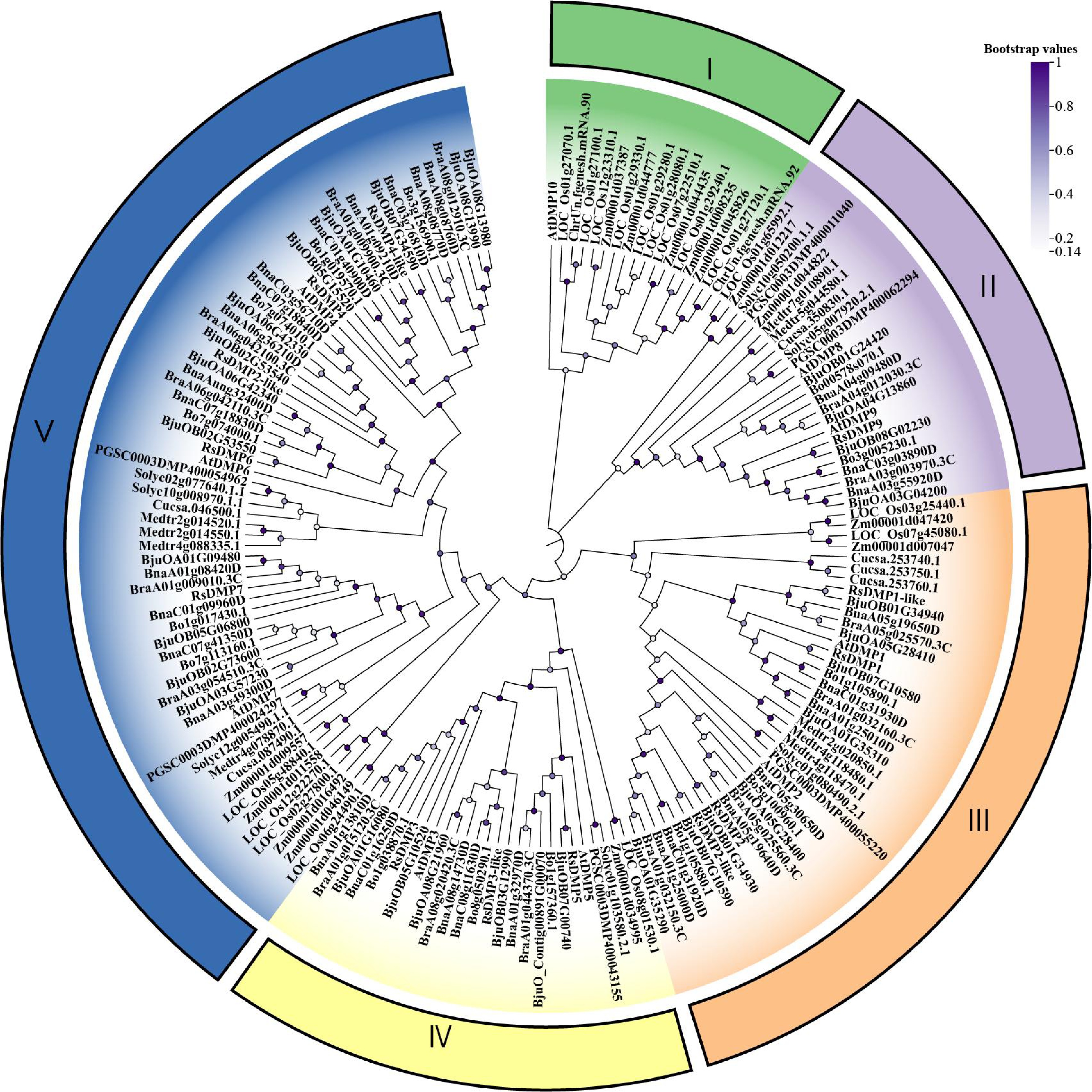
Figure 1.
Phylogenetic relationships of DMP among 12 plant species. The DMP protein were divided into five clades, represented by colors. Bootstrap values are shown on the nodes. For accession ID details of the genes, refer to Supplementary Table S10.
Based on the NAU-LB radish genome database, 13 RsDMP genes containing the DMP domain were identified at the genome-wide level. A combination of similarity and diversity was observed in several key physicochemical properties of the RsDMP proteins, including length, molecular weight (Mw), theoretical isoelectric point (pI), the aliphatic index, and hydropathicity (Supplementary Table S10). The predicted lengths of the RsDMP polypeptides range from 185 to 242 amino acids, with a molecular weight varying from 20.34 kDa (RsDMP2) to 26.38 kDa (RsDMP9). The aliphatic index ranges from 84.55 (RsDMP9) to 97.53 (RsDMP4-like). The theoretical pI ranges from 5.12 (RsDMP6) to 9.03 (RsDMP7), suggesting that most RsDMP proteins are relatively stable. Predictions of transmembrane domains and subcellular localization revealed that most RsDMP proteins contain two to five transmembrane domains, with potential localization in the lysosome, while six are likely localized to the cell membrane. These findings indicate that the DMP family of proteins shares conserved transmembrane domains.
Chromosomal localization and collinearity analysis of RsDMP genes
-
Chromosomal localization analysis revealed that RsDMP genes are distributed across six chromosomes (Fig. 2a). Notably, RsDMP6 and RsDMP6-like exhibit tandem duplication on chromosome 4, while RsDMP2 and RsDMP2-like are tandem duplicates on chromosome 5, suggesting that these genes may have arisen from whole-genome duplication (WGD) events during radish evolution. Collinearity analysis identified 19 collinear blocks between R. sativus and B. oleracea, but only four blocks between radish and A. thaliana (Fig. 2b). This indicates significantly lower synteny between R. sativus and Arabidopsis, likely reflecting divergent adaptation strategies or evolutionary trajectories. In contrast, the stronger collinearity between the radish and the cabbage suggests a conserved genomic organization of this gene family, which may reflect their closer evolutionary relationship.
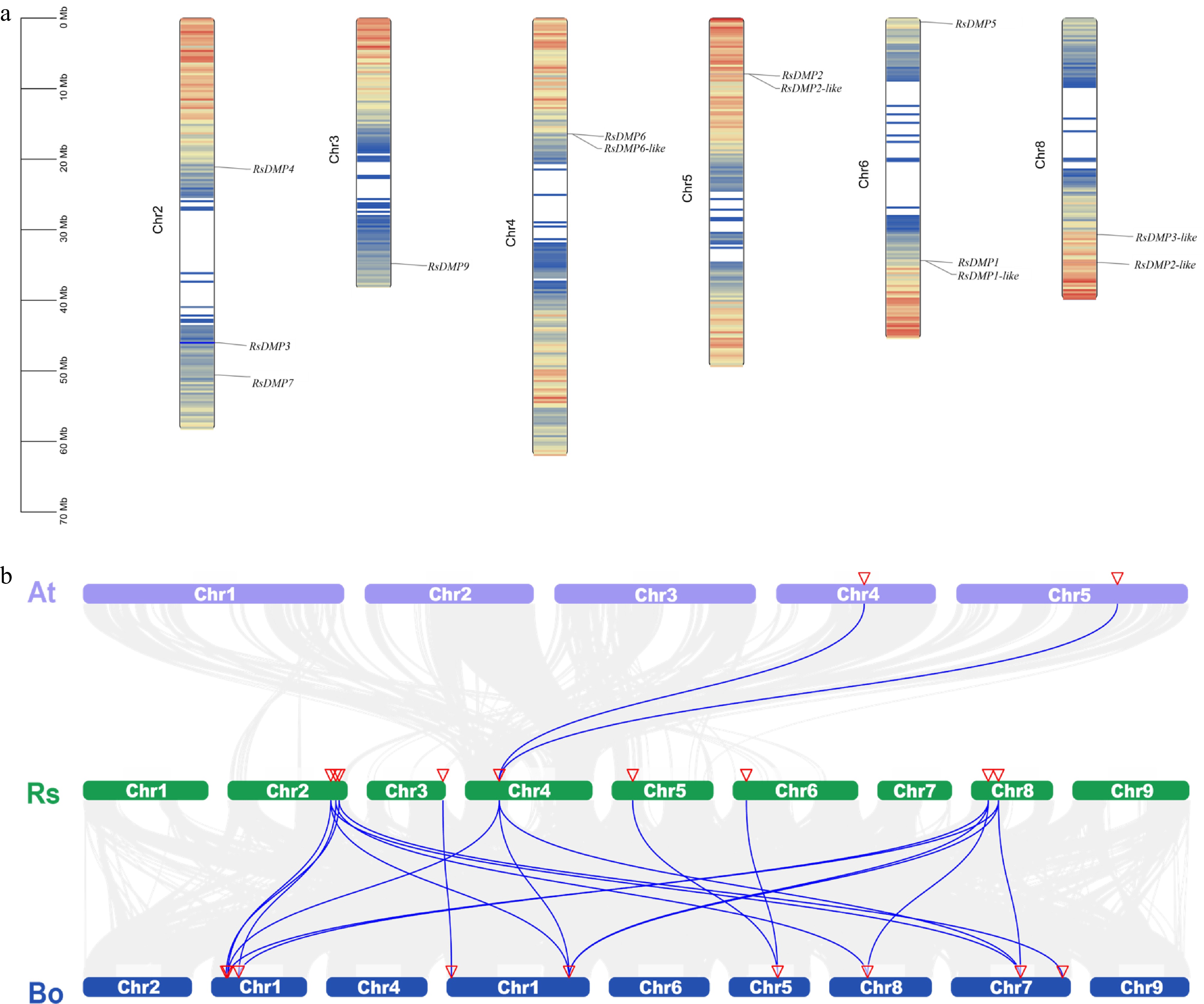
Figure 2.
Chromosomal locations and collinearity of DMP genes. (a) DMP chromosome mapping. The DMP genes of radish were distributed on six chromosomes. Mb, megabase. (b) Collinearity analysis among Raphanus sativus (Rs), Arabidopsis thaliana (At), and Brassica oleracea (Bo). Blue lines indicate collinear gene pairs.
Analysis of RsDMP structure and conserved protein motifs in radish
-
To investigate the diversity and similarity of gene structures and motifs between proteins from these two species, a phylogenetic tree was constructed using MEGA11 (Fig. 3a). The MEME server was employed to predict ten distinct conserved motifs in DMP proteins, revealing that all DMP proteins contain three to seven conserved motifs (Fig. 3b). Although most DMP proteins exhibit both similar and divergent conserved sites, motifs 1, 2, 3, 4, and 5 constitute the majority of conserved regions in RsDMP proteins, suggesting that these active sites are critical for the transmembrane functions of the proteins. Except for AtDMP7 and RsDMP7, all other DMP genes consist of a single exon (Fig. 3c). This finding underscores the highly conserved gene structure within the DMP family, suggesting a potential evolutionary significance of this single-exon configuration in maintaining functional integrity.
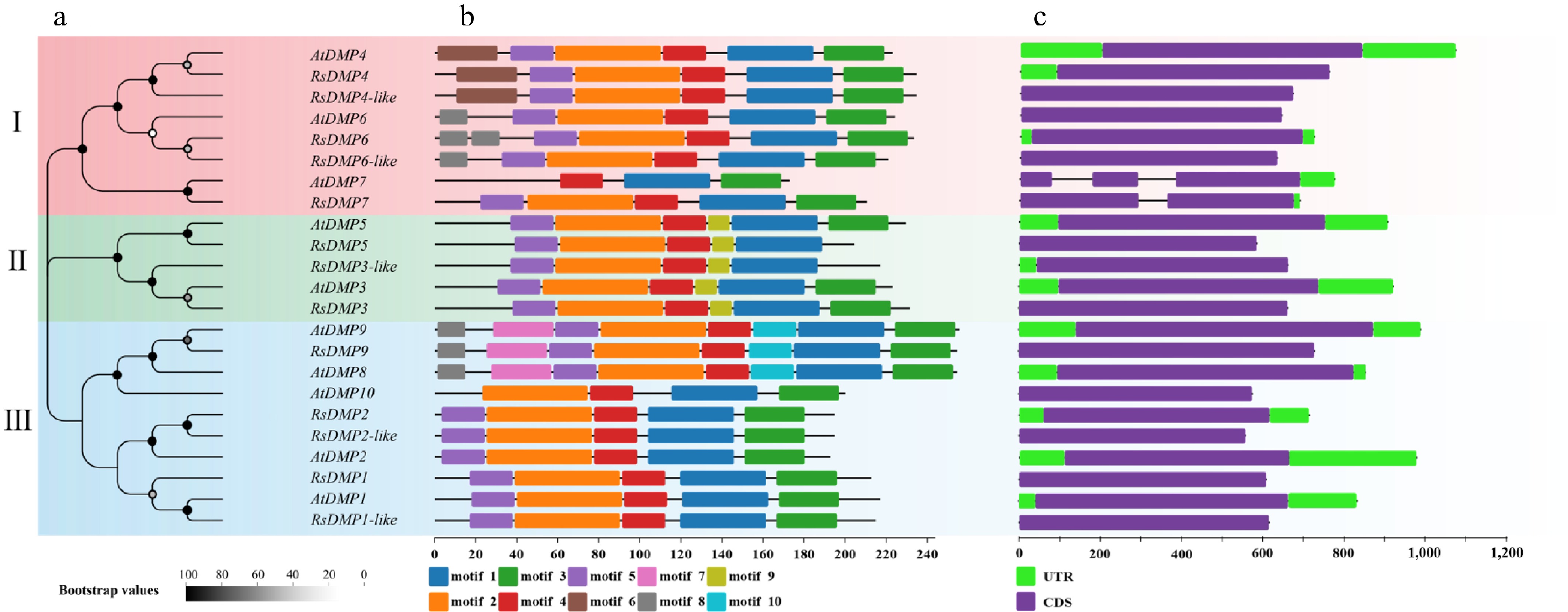
Figure 3.
Gene structure and motif distribution of RsDMP and AtDMP genes. (a) Constructing phylogenetic trees of RsDMP genes and AtDMP genes using MEGA 11 based on the NJ method. (b) Schematic diagram of the conserved motifs of RsDMP and AtDMP proteins. The motifs 1 to 10 are highlighted with different colored boxes. For the details of each motif, refer to Supplementary Table S2. (c) Distribution of structure for each RsDMP and AtDMP gene. The purple boxes represent CDS, the green boxes indicate an untranslated region, and the black line represents introns.
Cis-element analysis of DMP promoters in radish
-
The prediction of cis-acting elements in the upstream 2,000 bp of the DMP gene family in R. sativus revealed the presence of various environmental and stress-responsive elements (Fig. 4a). The promoters of 13 RsDMP genes contain 40 growth and development-related elements, 170 light-responsive elements, 158 phyhormone-responsive elements, and 224 stress-related responsive elements. The highest number of binding sites was detected in the promoters of RsDMP1-like and RsDMP6-like (56 binding sites each), followed by RsDMP2 (54 binding sites). In contrast, the promoter of RsDMP4 contains the fewest binding sites (32 binding sites). The greater abundance of stress-responsive elements in these promoters suggests that their expression is linked to stress response and regulation. Among the growth and stress-responsive elements, dehydration-responsive elements (containing MYB and MYC transcription factor binding sites), anaerobic response elements (ARE), and the W box (fungal elicitor-responsive) are predominant (Fig. 4b). In addition, there are the light-responsive cis-elements in the RsDMP promoters, including G-box, Box 4, TCT-motif, GT1-motif, MRE, and AE-box, indicating that the expression of RsDMP genes may be regulated by light. Furthermore, hormonal-responsive elements such as abscisic acid response (ABRE), TGACG-motif (methyl jasmonate [MeJA] response), CGTCA-motif (MeJA response), and TCA-element (salicylic acid response), among others, indicate that RsDMP genes are primarily regulated by abscisic acid, MeJA, and salicylic acid signaling pathways. These results reveal that RsDMP genes are involved in hormone response, stress response, and other plant growth processes (Fig. 4b).
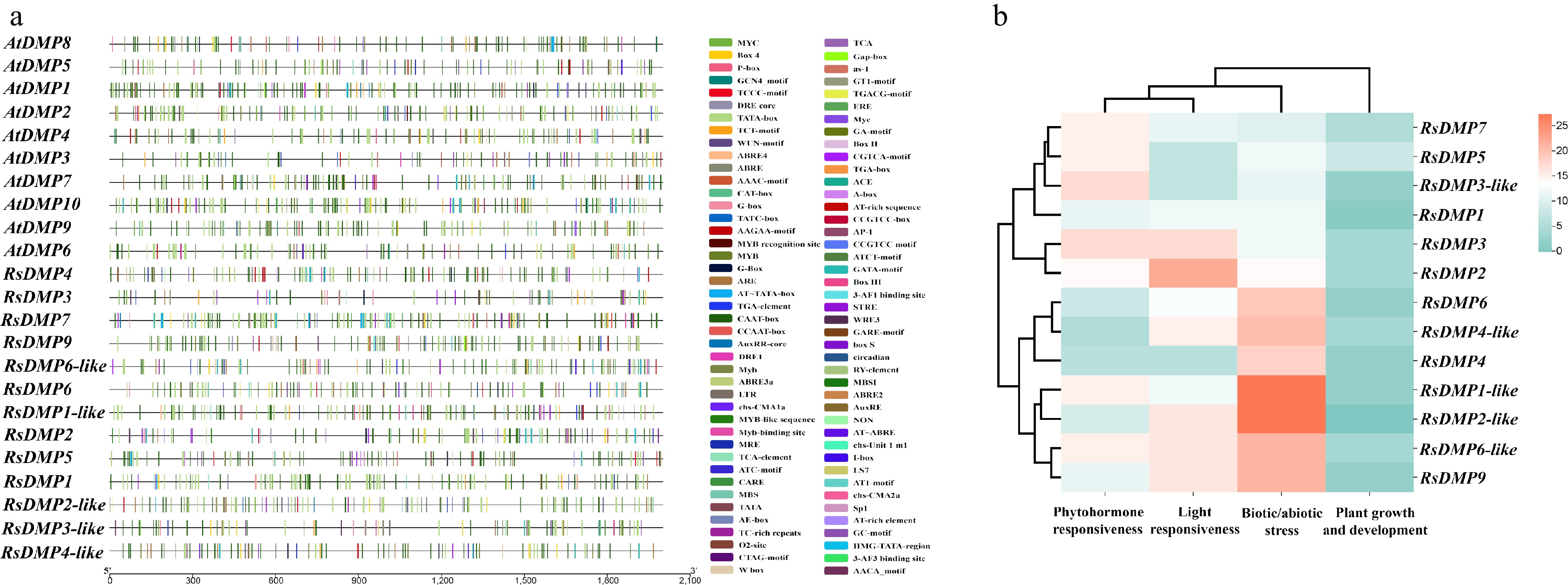
Figure 4.
Characterization of cis-regulatory elements (CAREs) in the promoter regions of RsDMP genes. (a) Distribution of CAREs in different colored rectangles. (b) Variation in different types of cis-acting regulatory elements (CAREs, refer to Supplementary Table S3).
Expression profiles of the RsDMP family in different tissues and abiotic stress
-
To investigate the functional roles of the RsDMP family in radish, the expression profiles of 13 RsDMP genes across different tissues were analyzed using existing transcriptomic data (Fig. 5a). RsDMP2-like exhibited the highest expression level in leaf tissues. RsDMP9, RsDMP2-like, and RsDMP1 showed differential expression in stamens, with RsDMP9 displaying the highest expression.
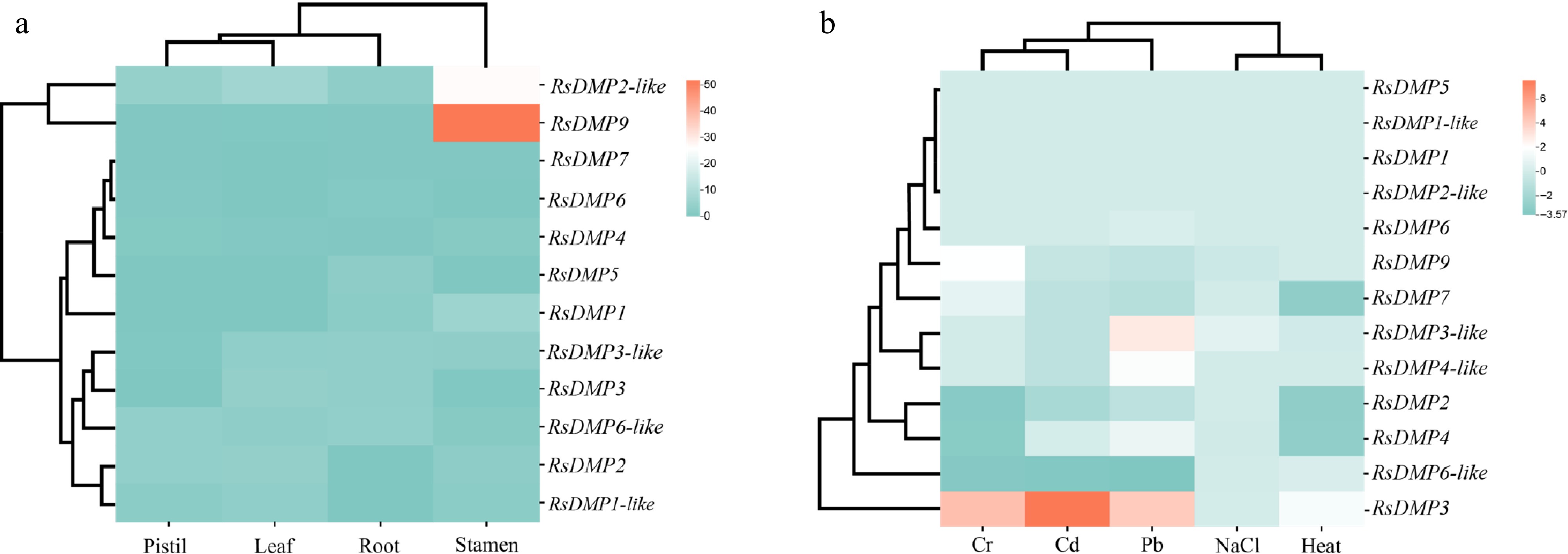
Figure 5.
Expression pattern of radish DMP genes. (a) Transcriptome-based expression profiling of RsDMP genes from four radish tissues consisted of leaf, root, pistil, and stamen. (b) The relative expression of RsDMP genes under Cd stress (200 μM/24 h), Cr stress (200 μM/24 h), heat stress (42 °C/24 h), Pb stress(200 μM/24 h), and NaCl stress (200 mM/24 h). Cd, cadmium; Cr, chromium; and Pb, lead. The plant material is sourced from NAU-LB. For details of each gene expression, refer to Supplementary Table S4.
To explore the potential functions of RsDMP genes under abiotic stress, transcriptomic data for 13 RsDMP genes were analyzed under heavy metal stress (chromium [Cr], lead [Pb], and cadmium [Cd]), salt stress, and heat stress (Fig. 5b). RsDMP4 was downregulated under both Cr and heat stress, while RsDMP2 and RsDMP7 were downregulated under all three heavy metals and heat stress. Similarly, RsDMP6-like exhibited downregulation under heavy metal and heat stresses. In contrast, RsDMP3 was upregulated to varying degrees under all three heavy metals. RsDMP3-like also showed upregulation under Pb stress, suggesting that RsDMP3 and RsDMP3-like may participate in detoxification, defense, or repair mechanisms, potentially contributing to abiotic stress tolerance.
RT-qPCR analysis of RsDMP genes and subcellular localization
-
To further investigate the expression patterns of RsDMP genes in reproductive organs, RT-qPCR was performed on 13 RsDMP genes across six radish tissues: sepals, pollen, petals, pistils, taproots, and leaves (Fig. 6). Compared to non-reproductive tissues (taproots and leaves), RsDMP genes generally exhibited higher expression in reproductive organs. RsDMP4 and RsDMP6 were highly expressed in pistils, suggesting potential roles in double fertilization or ovule development. RsDMP2-like, RsDMP3-like, RsDMP5, and RsDMP9 showed predominant expression in pollen. The elevated expression of RsDMP9 is consistent with its Arabidopsis homologs AtDMP8/AtDMP9, which regulate double fertilization. RsDMP1 and RsDMP2 displayed varying degrees of upregulation in petals, potentially linked to floral morphogenesis. RsDMP1-like, RsDMP4-like, RsDMP6-like, and RsDMP7 were most highly expressed in sepals, indicating their involvement in sepal development. Collectively, these tissue-specific expression patterns highlight the potential roles of RsDMP genes in reproductive processes and underscore their functional diversity in radish.
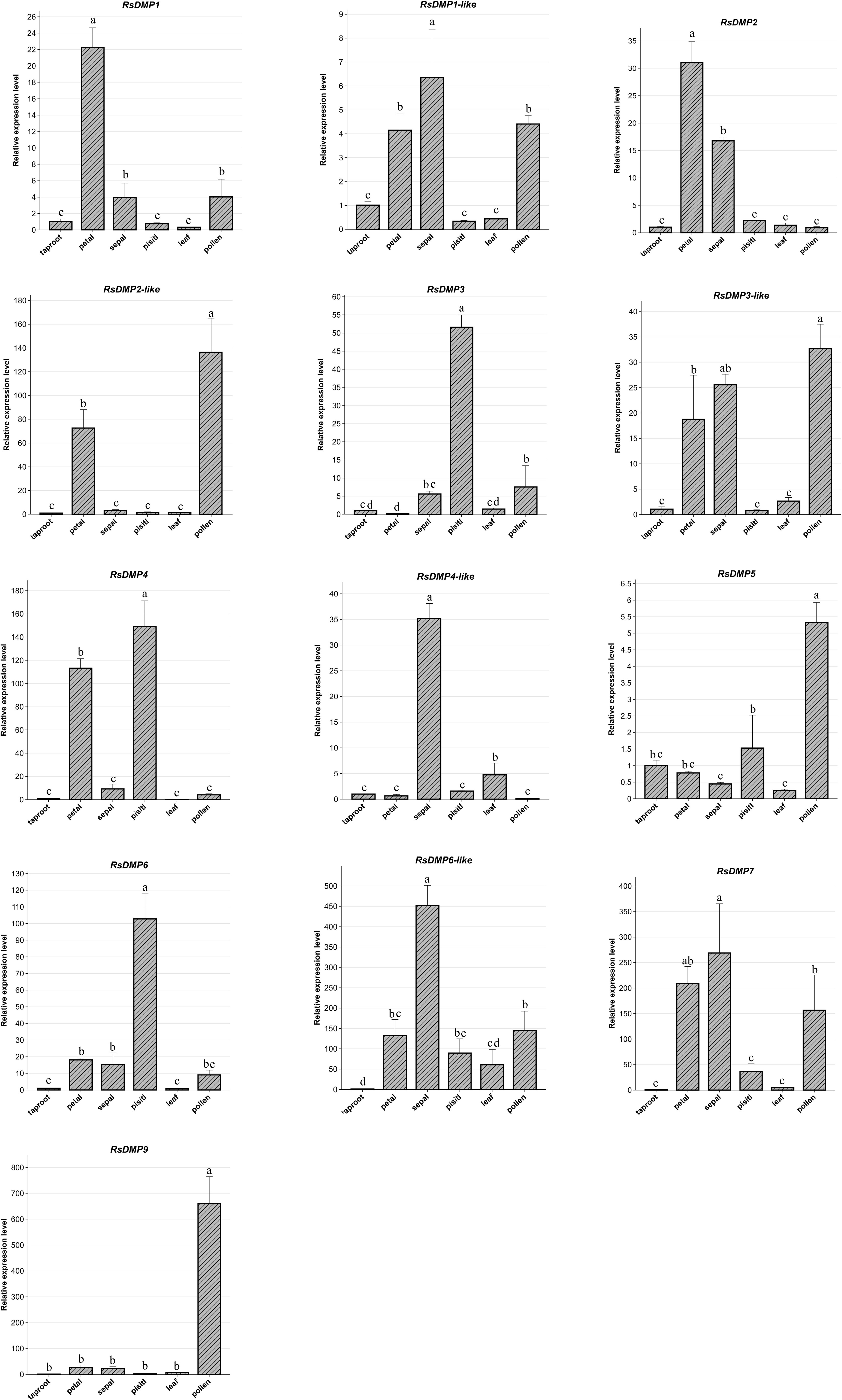
Figure 6.
The relative expression levels of RsDMP genes in different tissues by qPCR analysis. Data are shown as the means ± SD from three biological replicates. Different letters above the bar indicate a significant differences among columns by Duncan's multiple comparison test (p < 0.05).
To further explore the functional basis of these tissue-specific expression patterns, particular focus was placed on RsDMP9, whose predominant expression in pollen and homology to AtDMP8/AtDMP9 (known regulators of double fertilization) strongly suggest a conserved role in reproductive processes, including a predicted HI function. Prior research has shown that DMP HI proteins perform their functions at the plasma membrane. To determine the subcellular localization of RsDMP9, an RsDMP9-GFP fusion construct was transiently expressed in N. benthamiana leaves via Agrobacterium-mediated infiltration. Imaging revealed precise colocalization of the RsDMP9-GFP fluorescence signal with the plasma membrane-specific marker PM-mCherry (Supplementary Fig. S1), demonstrating that RsDMP9 localizes to the plasma membrane. This spatial distribution pattern is consistent with its predicted role as a membrane-associated transporter protein.
Cloning and transcriptional activity analysis of endogenous U6 promoters in radish
-
Based on the radish genome and homology alignment, eight highly homologous U6 small nuclear RNA (snRNA) loci were identified. Correspondingly, eight upstream promoter fragments—designated RsU6-1, RsU6-2, RsU6-4, RsU6-6, RsU6-8, RsU6-9, RsU6-10, and RsU6-13—were successfully cloned from radish genomic DNA. Sequence alignment revealed that all eight RsU6 promoters, along with the Arabidopsis AtU6-1 promoter, initiate transcription at a conserved guanine (G) nucleotide and contain canonical core regulatory elements: a TATA box located about 30 bp upstream of the transcription start site (TSS) and an upstream sequence element (USE) approximately 60 bp upstream (Fig. 7a).
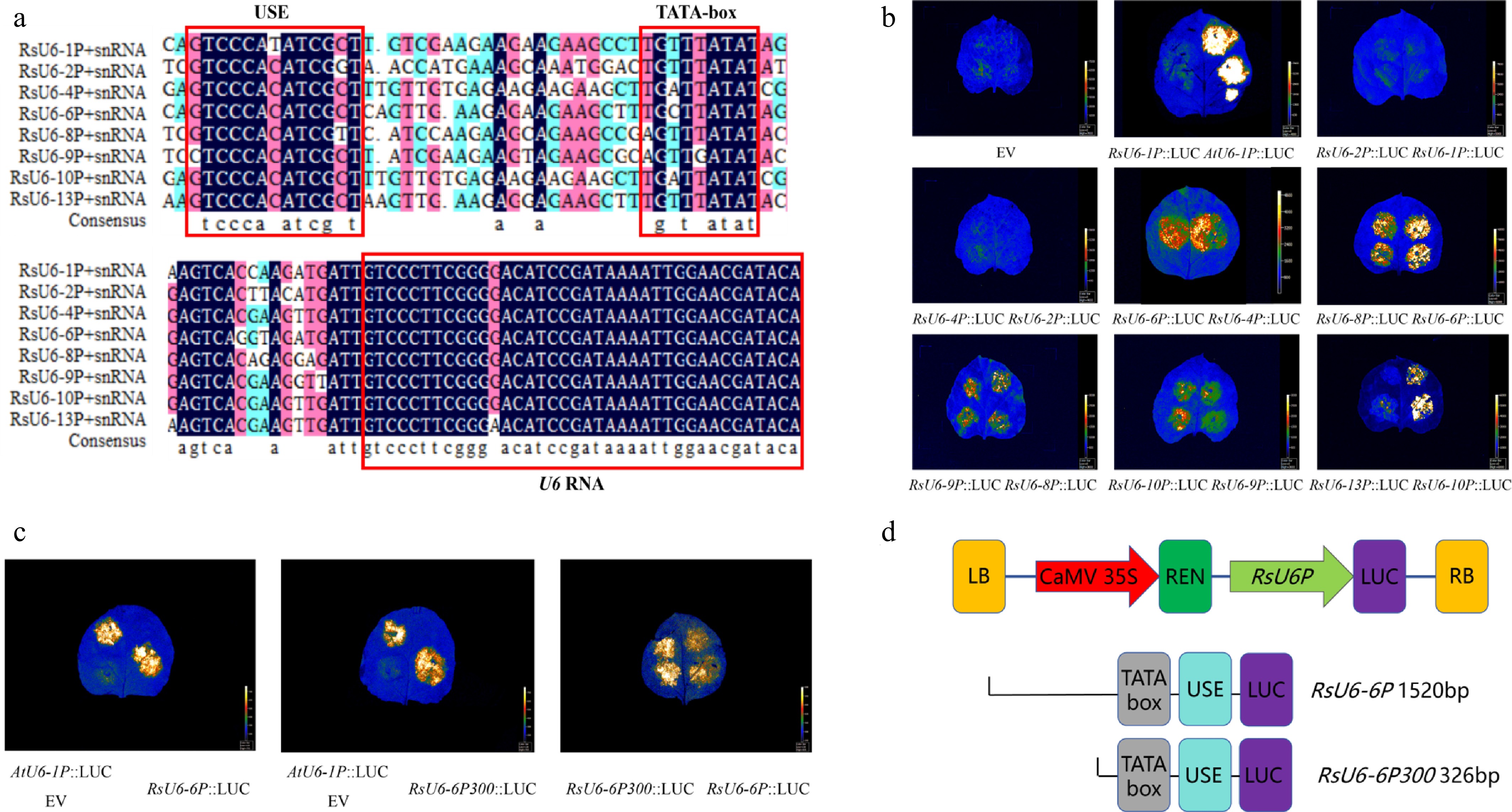
Figure 7.
Functional analysis and expression vector validation of the RsU6 promoter. (a) Conservation element analysis of the RsU6 promoter region (including sequence alignment of TATA box, USE, and U6 RNA-related conserved sequences). (b) RsU6P::LUC and AtU6-1P::LUC are transiently expressed in N. benthamiana leaves. (c) RsU6P-6P300::LUC, RsU6P-6P::LUC, and AtU6-1P::LUC are transiently expressed in N. benthamiana leaves. (d) Schematic diagram of the RsU6P-6P300::LUC and RsU6P-6P::LUC constructs, along with a comparative diagram of the functional segments between the truncated variant and the full-length sequence.
To assess transcriptional activity, these eight RsU6 promoters and AtU6-1 (the positive control) were cloned into the pGreen II 0800-Luc vector and transiently transformed into N. benthamiana leaves via Agrobacterium infiltration. Fluorescence signal analysis indicated that RsU6-6 and AtU6-1 drove the strongest luciferase expression, followed by RsU6-8, RsU6-10, RsU6-9, and RsU6-4. In contrast, RsU6-1, RsU6-2, RsU6-13, and EV showed extremely weak luciferase signals, indicating marked heterogeneity in transcriptional activity across the RsU6 promoter family. Notably, RsU6-6 not only outperformed most RsU6 promoters but also exhibited stronger luciferase expression than AtU6-1, highlighting its superior transcriptional potency as an endogenous promoter candidate in radish (Fig. 7b).
Truncation of U6 promoters could reduce the length of the sgRNA expression cassette and enhance transcriptional activity by removing redundant sequences while preserving key regulatory elements (Fig. 7d). To assess the effect of truncation on RsU6-6 activity, a truncated 326-bp variant of RsU6-6 was cloned into pGreen II 0800-Luc. Fluorescence signal analysis showed that the truncated RsU6-6 promoter exhibited higher luciferase activity than AtU6-1 (Fig. 7c), confirming that truncation did not reduce its transcriptional activity.
CRISPR-Cas9 gene-editing in radish protoplasts using the RsU6-6 promoter
-
Functional validation of the HI gene RsDMP9 (Rsa3g028070), an ortholog of AtDMP8/AtDMP9, was performed using CRISPR/Cas9-mediated genome editing. Two sgRNAs targeting RsDMP9 were designed using web-based tools. To compare the efficiency of the RsU6-6 and AtU6-1 promoters in driving sgRNA expression in radish protoplasts, a CRISPR/Cas9 vector containing two sgRNA expression cassettes was constructed. Specifically, sgRNA1 and sgRNA2 were driven by the RsU6-6 and AtU6-1 promoters, respectively, and co-cloned into the gene-editing vector 2300GN-Cas9-EGFP (Fig. 8a, c). After incubation for 48 h, GFP fluorescence in protoplasts was detected via confocal microscopy (Supplementary Fig. S2). The transfection efficiency of radish protoplasts was 43.1% ± 3.1% (Fig. 8b). Subsequently, protoplast DNA was extracted, and sequences containing the two target sites of gRNA1 and gRNA2 were amplified. Next-generation sequencing (NGS) data analyzed using CRISPResso2 revealed that the mutation frequency induced by gRNA1 driven by RsU6-6 was 6.69% (99 mutant reads) (Fig. 8d, e). Among these mutations, the frameshift mutation rate caused by a 1-base deletion located 3 bp upstream of the PAM sequence was 0.88% (21 reads), consistent with the typical Cas9 cleavage site. In contrast, the mutation frequency of sgRNA2 driven by AtU6-1 was significantly lower at 0.55% (26 reads), with no detectable frameshift mutations, indicating lower editing efficiency (Supplementary Fig. S3).
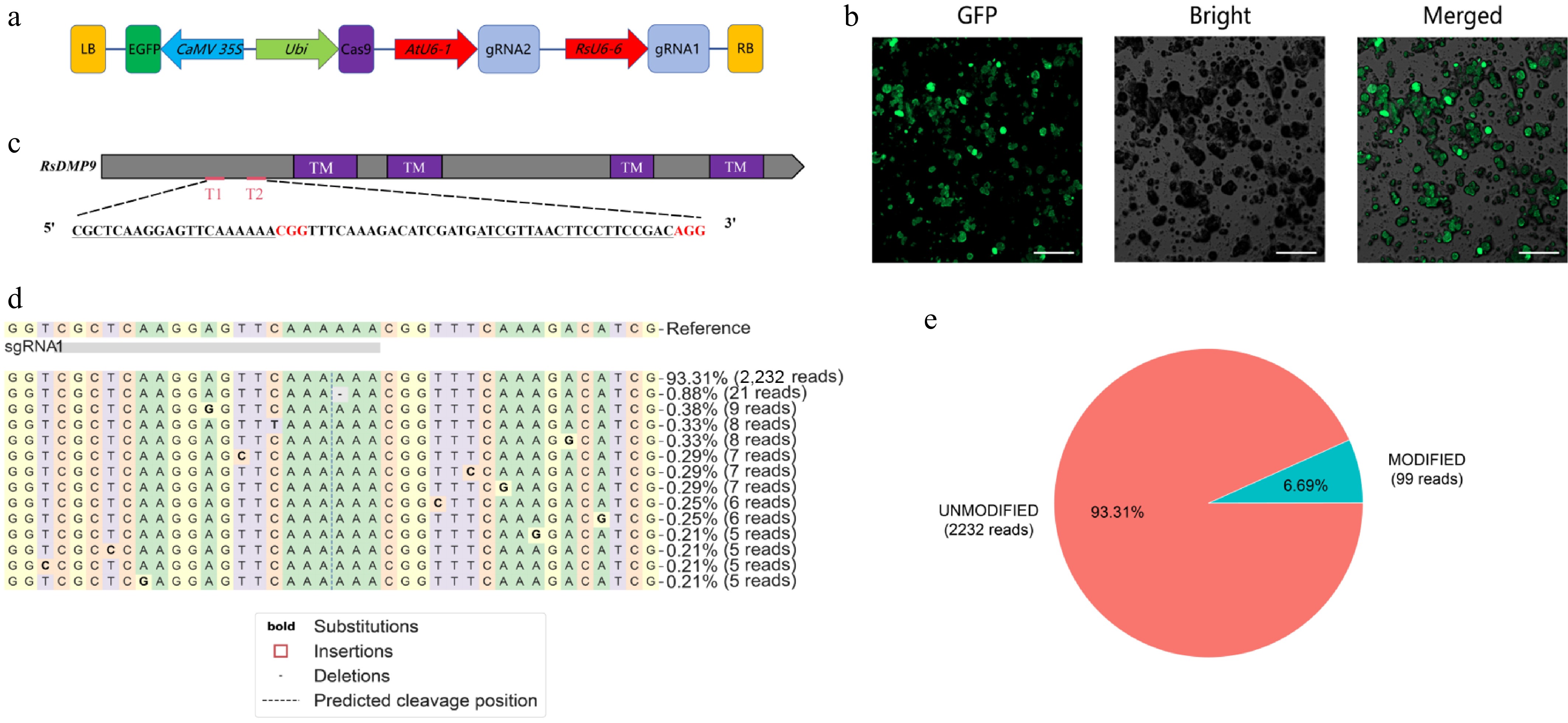
Figure 8.
The radish protoplast transient transfection system was employed to validate the activity of CRISPR/Cas9 vectors. (a) Schematic diagram of the CRISPR/Cas9 construct targeting RsDMP9. EGFP, enhanced green fluorescent protein. (b) Radish protoplasts were imaged under GFP, bright field, and merged channel. Green fluorescent signals reflected the transformed cells. Scale bar = 100 μm. (c) Schematic of RsDMP9. Grey blocks, gene coding region; purple blocks, predicted transmembrane domains (TMs); black lines, the region (T1 and T2) targeted by sgRNAs. (d) The types of mutations detected in the sgRNA1 target site. (e) Pie chart showing the mutation as a percentage of total reads.
-
This study presents the first genome-wide identification of the DMP gene family in radish. There are ten DMP genes in A. thaliana[10], while a total of 13 RsDMP genes were identified in radish, the same number as in the closely related species B. oleracea. Phylogenetic analysis revealed that these genes could be divided into five clades and exhibited high homology with DMP genes from A. thaliana, B. juncea, B. oleracea, and B. napus. RsDMP9 clustered in subclade II alongside the pollen-specific genes AtDMP8/AtDMP9, indicating functional conservation in reproductive processes. Notably, Brassicaceae species typically possess two to four orthologs of AtDMP8/AtDMP9, whereas radish retains only one. This is most likely because the Brassicaceae ancestor underwent multiple whole-genome duplication (WGD) events. However, during the subsequent rediploidization process, redundant gene copies were gradually eliminated through unequal crossing-over during homologous recombination or chromosomal fragment deletion[21]. Intriguingly, RsDMP2 and RsDMP2-like (tandem duplicates on chromosome 5), RsDMP6 and RsDMP6-like (tandem duplicates on chromosome 6) indicate lineage-specific gene duplication events in radish. Cross-species collinearity analysis demonstrated stronger synteny between radish and B. oleracea DMP genes compared to Arabidopsis DMP genes, reflecting convergence and adaptive similarity during Brassicaceae evolution.
Tissue-specific expression of RsDMP genes and its multifunctional role in plant reproduction and stress adaptation
-
The DMP family represents a class of membrane proteins found exclusively in green plants. Members of this family participate in various physiological processes, particularly senescence and reproduction[11,12,46]. In this study, tissue-specific transcriptome analysis and RT-qPCR data demonstrated that RsDMP genes are predominantly expressed in reproductive organs (e.g., stamens, pistils, and pollen) compared to vegetative organs such as taproots and leaves.
With the development of haploid breeding technology, DMP family proteins have garnered increasing attention and are widely used in HI across various species, including maize[17], Arabidopsis[10], potato[21], tomato[47], watermelon[19], and cucumber[20]. In this study, RsDMP9 exhibited the highest expression level in pollen. Consistent with previous studies suggesting that DMP genes are involved in HI, this indicates that it may be a male gamete-specific gene[10]. Subcellular localization experiments confirmed that RsDMP9 is localized to the plasma membrane. These results align with its orthologs, maize ZmDMP and Arabidopsis AtDMP8/AtDMP9, which are associated with sperm-egg fusion and fertilization[11,46]. It can be inferred that RsDMP9 regulates fertilization through gamete membrane interactions[10,16].
The elevated expression of RsDMP1-like, RsDMP4-like, RsDMP6-like, and RsDMP7 in sepals highlights their roles in sepal development. These tissue-specific expression patterns emphasize the functional diversification of DMP genes in reproductive processes, providing new opportunities to investigate their pleiotropic functions. Additionally, RsDMP3 expression was upregulated under heavy metal stress, along with the abundance of stress-responsive cis-elements in their promoters, suggesting that DMP genes may integrate developmental and environmental signals.
In vitro editing of RsDMP9 in radish protoplasts
-
HI-edit technology, which combines haploid inducer lines with CRISPR/Cas9-mediated gene editing, represents a recent advancement in HI. This approach utilizes in vitro HI to produce haploid plants within two generations, significantly improving crop breeding efficiency. Prior research has shown that targeted editing of genes such as DMP, CENH3, and MTL/PLA1/NLD can induce haploid plant formation[5,17,48]. Among these, the DMP gene has been the most widely applied across various crops for HI. These findings highlight the considerable potential of gene-specific editing for HI, offering valuable applications for accelerating crop improvement.
Protoplasts serve as an ideal system for genetic manipulation due to their ability to directly take up exogenous DNA, proteins, or chemicals. The protoplast transformation system was first established in Arabidopsis. Recently, a protoplast-based transient gene expression system for genome editing was established in citrus[28]. In this study, a radish protoplast transient transformation system successfully validated the editing activity of CRISPR/Cas9 vectors targeting RsDMP9, confirming that radish protoplasts provide a reliable platform for rapid assessment of editing efficiency. Next-generation sequencing data revealed a 6.69% mutation frequency at the T1 site in protoplasts, including 0.88% frameshift mutations, demonstrating the feasibility of applying this CRISPR/Cas9 editing system to stable transformation in radish. These findings lay a critical foundation for the future development of an HI system targeting RsDMP9 in radish. However, there was relatively low overall editing efficiency in radish compared to the established protoplast editing systems in other plant species. For example, in citrus, an optimized PEG-mediated method for callus protoplasts achieved a gene mutation frequency of 14.2%, more than twice that of the radish system[28]. Similarly, in the medicinal plant Salvia miltiorrhiza, the selection of endogenous regulatory elements and a codon-optimized Cas9 driven by the SlEF1α promoter significantly boosted editing efficiency, demonstrating that selection of tailored genetic elements can effectively enhance CRISPR/Cas9 performance in protoplasts[49]. Despite these limitations, the successful validation of CRISPR/Cas9 activity in radish protoplasts confirms its potential as a rapid platform for assessing editing efficiency. Future work should focus on optimizing transfection protocols, exploring endogenous regulatory elements suitable for radish, and testing alternative Cas nucleases. These improvements will enhance the utility of the radish protoplast system, providing a more robust foundation for developing HI systems and advancing genome-editing applications in radish genetic improvement.
The critical role of U6 promoters in CRISPR/Cas9-mediated genome editing
-
A total of eight highly homologous U6 snRNA loci were identified in radish. Sequence alignment revealed conserved structural features shared with functionally validated U6 promoters from Arabidopsis (AtU6-1). All RsU6 promoters initiate transcription at a conserved G nucleotide, consistent with the canonical transcription start site (TSS) of U6 promoters[50]. Critical core elements were identified: a TATA box located approximately 30 bp upstream of the TSS and an Upstream Sequence Element (USE) about 60 bp upstream (Fig. 7a), both of which are essential for Pol III recruitment and transcriptional initiation[50]. These conserved elements strongly suggest that RsU6 promoters are functional Pol III promoters, providing a foundation for their application in sgRNA expression.
RsU6-6 and AtU6-1 (positive control) exhibited the strongest luciferase activity, followed by RsU6-8, while the remaining RsU6 promoters (RsU6-8, RsU6-10, RsU6-9, RsU6-4, RsU6-1, RsU6-2, and RsU6-13) displayed lower but detectable activity.
A major challenge in CRISPR vector construction is the large size of full-length U6 promoters, which can limit cloning efficiency and the design of sgRNA expression cassettes. Truncation of U6 promoters, while retaining core regulatory elements, has been shown to shorten the cassette length and even enhance activity by removing redundant or inhibitory sequences[25]. In apple (Malus domestica) and cotton (Gossypium barbadense), truncation of MdU6-10P (from 1,500 to 275 bp) and GbU6-5P could enhance transcriptional activity[25,51]. To optimize RsU6-6 for practical use, it was truncated to 326 bp. Strikingly, the truncated RsU6-6 promoter exhibited higher luciferase activity than AtU6-1 (Fig. 7c), indicating that key regulatory elements are preserved within this 326-bp region. The truncated RsU6-6 thus represents a superior tool for radish genome editing: Its reduced size simplifies vector construction, while its high activity ensures robust sgRNA expression.
Our study presents the characterization of endogenous U6 promoters in radish, identifying RsU6-6 (both the full-length and truncated forms) as a leading candidate for sgRNA expression. Its high activity, conserved regulatory elements, and compact truncated form (326 bp) make it ideal for developing efficient CRISPR/Cas9 systems in radish. Additionally, RsU6-6, exhibiting moderate activity, could serve as a secondary promoter for multiplex editing, enabling the co-expression of multiple sgRNAs without promoter crosstalk.
Ultimately, these endogenous U6 promoters will accelerate precision breeding in radish, enabling targeted improvements in agronomic traits such as haploid breeding, storage quality, and nutritional content.
-
In total, 13 DMP genes were identified in the radish genome. Phylogenetic analysis indicated that RsDMP9 clusters alongside haploid-inducing genes from A. thaliana. These genes are distributed across six chromosomes and exhibit tandem duplication events. Collinearity analysis revealed greater similarity to B. oleracea than to A. thaliana. RsDMP proteins display conserved structural features. Promoter analysis identified regulatory elements responsive to light, growth regulators, hormones, and stress. Transcriptomic and RT-qPCR data demonstrated predominant expression in reproductive tissues; notably, RsDMP9 showed significantly higher expression in pollen. Subcellular localization confirmed that RsDMP9 is localized to the plasma membrane.
Radish endogenous U6 promoters were further characterized, and RsU6-6 (a 326-bp truncated variant) was prioritized for robust sgRNA expression. By integrating RsU6-6-driven CRISPR/Cas9 with protoplast transient editing, a 6.69% mutation frequency (0.88% frameshift mutations) for RsDMP9 in radish protoplasts was achieved.
This protoplast-based editing system could be efficiently validate gene functions and enhance the precision of key trait improvements in radish breeding programs.
-
The authors confirm their contributions to the paper as follows: study conception and design: Liu L, Zhang P, Zhao B, Dong H, Ying J; data collection: Zhang P, Zhao B, Dong H, Wang M; analysis and interpretation of results: Zhang P, Zhao B, Cui F, Li J; draft manuscript preparation: Zhang P, Zhao B, Liu L, Li J, Zhang X, Xu L, Wang Y, Chen S. All authors reviewed the results and approved the final version of the manuscript.
-
The datasets generated during and/or analyzed in the current study are available from the corresponding author on reasonable request.
-
This study was supported by the Key Technology R&D Program of Jiangsu Province (Grant No. BE2023366), Jiangsu Seed Industry Revitalization Project (Grant No. JBGS[2021]071), the Jiangsu Agricultural S&T Innovation Fund (Grant No. CX[2023]1013), National Natural Science Foundation of China (Grant No. 32573040), Yancheng S&T Key Project (Grant No. YCBN202312), Postgraduate Research & Practice Innovation Program of Jiangsu Province (Grant No. KYCX19_0562) and the Project Funded by the Priority Academic Program Development of Jiangsu Higher Education Institutions (PAPD).
-
The authors declare that they have no conflict of interest.
-
accompanies this paper online at: https://doi.org/10.48130/vegres-0026-0015.
-
# Authors contributed equally: Peng Zhang, Boya Zhao, Hongxiang Dong
- Supplementary Table S1 List of conserved motif in radish DMP proteins.
- Supplementary Table S2 List of DMP gene family members in different crops.
- Supplementary Table S3 The distribution of the cis-acting regulatory elements in the promoter region of 13 RsDMP genes.
- Supplementary Table S4 List of Transcriptome of RsDMP family in different tissues and under different stresses.
- Supplementary Table S5 List of primers.
- Supplementary Table S6 Composition of enzymatic hydrolysis solution.
- Supplementary Table S7 Composition of W5 solution.
- Supplementary Table S8 Composition of MMG solution.
- Supplementary Table S9 Composition of 40% PEG solution.
- Supplementary Table S10 Physiochemical properties and subcellular location prediction of 13 RsDMPs in radish.
- Supplementary Fig. S1 Subcellular localization profiling of RsDMP9.
- Supplementary Fig. S2 Radish protoplasts were imaged under GFP, bright field, and merged channel.
- Supplementary Fig. S3 The mutation frequency of sgRNA2 driven by AtU6-1.
- Copyright: © 2026 by the author(s). Published by Maximum Academic Press, Fayetteville, GA. This article is an open access article distributed under Creative Commons Attribution License (CC BY 4.0), visit https://creativecommons.org/licenses/by/4.0/.
-
About this article
Cite this article
Zhang P, Zhao B, Dong H, Wang M, Zhang X, et al. 2026. Genome-wide identification of the DMP gene family and CRISPR/Cas9-mediated editing of the DMP9 gene in radish (Raphanus sativus L.). Vegetable Research 6: e025 doi: 10.48130/vegres-0026-0015 

Genome-wide identification of the DMP gene family and CRISPR/Cas9-mediated editing of the DMP9 gene in radish (Raphanus sativus L.)
- Received: 21 December 2025
- Revised: 16 April 2026
- Accepted: 27 April 2026
- Published online: 14 July 2026
Abstract: The DMP (Domain of Unknown Function 679 Membrane Proteins) gene family consists of proteins specifically expressed in plant membranes with functions associated with gamete fusion. However, its functional characterization remains largely unexplored in radishes (Raphanus sativus L.). In this study, a total of 13 DMP genes were identified in the radish genome; they were distributed unevenly across six chromosomes. Phylogenetic analysis revealed five distinct clades, based on the classification and nomenclature of this gene family in Arabidopsis. RsDMP9 was grouped with the haploid-inducing genes AtDMP8 and AtDMP9, which play a potential role in haploid induction. Light, growth, hormone, and stress-responsive elements were identified in the promoter of RsDMP9. Quantitative real-time polymerase chain reaction demonstrated the preferential expression of RsDMP9 in pollen, while other RsDMP genes showed differential expression in the roots, petals, and sepals. The RsDMP9 protein was confirmed to be localized to the plasma membrane. The identification and cloning of endogenous U6 promoter sequences from the radish genome were achieved based on the conserved U6 small nuclear RNA (snRNA) sequences of Arabidopsis thaliana. In vivo imaging and a dual-luciferase reporter system indicated that RsU6-6 exhibited strong transcriptional activity comparable to that of AtU6-1; truncation of RsU6-6 to 326 base pairs could enhance transcriptional activity, making it ideal for single guide RNA (sgRNA) expression and multiplex editing by avoiding promoter crosstalk. Additionally, the CRISPR/Cas9 system driven by RsU6-6 has been shown to achieve a high mutation frequency by protoplast transformation technology, thus demonstrating the effective validation of the CRISPR/Cas9 editing vector in radish protoplasts. These findings provide insights into the evolutionary conservation and functional diversification of RsDMP genes, and this protoplast-based editing system would facilitate effectively validating gene function and precision improvement of important traits in radish breeding programs.
-
Key words:
- Radish /
- DMP gene family /
- RsDMP9 /
- Gene editing /
- U6 promoter