












-
Species of the genus Tuber P. Micheli ex F.H. Wigg. belong to the family Tuberaceae (Ascomycota). The fruiting bodies of Tuber species are known as "truffles", which are generally hypogeous sporocarps and are regarded as one of the prized edible fungi owing to their unique flavor[1]. Tuber species establish obligate mycorrhizal associations and promote the growth of major forest tree species such as Betulaceae, Cistaceae, Corylaceae, Fagaceae, and Pinaceae[2]. These fungi are ecologically and economically significant owing to their role in maintaining forest ecosystems and their value in gourmet markets[3]. To date, Species Fungorum includes 293 species of Tuber (
www.speciesfungorum.org/Names/Names.asp , accessed on 16 February 2026), while the molecular data of around 192 species are available in GenBank (www.ncbi.nlm.nih.gov/Taxonomy/Browser/wwwtax.cgi?id=36048 , accessed on 16 February 2026). The biodiversity hotspots of Tuber are distributed along the Alps in Europe, the Himalayas, and the Hengduan Mountains in Asia, and certain regions of North America[4].The study on Chinese Tuber species began in 1985, which led to the discovery of T. taiyuanense[5]. Wang et al.[6] and García-Montero et al.[7] presented a comprehensive review of Chinese Tuber species. Liu et al.[8] documented 62 species from China with their complete description. Yunnan, China, covers a major part of the Hengduan Mountains and is recognized as a global biodiversity hotspot, harboring exceptional fungal diversity. Recent studies have revealed several new Tuber species in this region over the past decade, such as T. baoshanense, T. caoi, T. crassitunicatum, T. humilireticulatum, T. laojunshanense, T. shidianense, T. wumengense, and T. yunnanense[9−16]. Despite the discoveries, many areas in Yunnan remain unexplored, and cryptic Tuber lineages are yet to be investigated and described.
Traditionally, identification of Tuber species is based on their morphological characteristics. Macroscopically, the surface ornamentation and color of the peridium, as well as the presence of cavities and the marbled patterning of the gleba, serve as important diagnostic criteria[7,17]. Microscopically, key taxonomic characteristics for distinguishing different species include the structure of the peridium (viewed in cross-section), the structure of the asci (particularly the number of ascospores per ascus), and the color, size, shape, and ornamentation of the mature ascospores, specifically the morphology of the alveolate reticulum[7,18,19]. However, the taxonomic and systematic assessment of Tuber has been challenging because of its many cryptic species and a limited number of diagnostic characteristics. In the past two decades, modern taxonomic approaches integrating molecular phylogenetics (such as combined internal transcribed spacer [ITS], nuclear large subunit ribosomal RNA [nrLSU], RNA polymerase II subunit [rpb2], and translation elongation factor 1-alpha [tef1-α]) and morphological analysis were conducted to refine the taxonomy for species delimitation of Tuber in China[9]. In this study, we introduce and illustrate a novel Tuber species collected from the forest ecosystems of Yunnan using a combination of macro- and micromorphological characteristics and multi-locus phylogenetic analyses. This discovery expands the known diversity of Asian truffles and underscores the importance of Yunnan as a reservoir of undescribed fungal taxa.
-
Fresh samples were collected from Dayao County, Chuxiong Yi Autonomous Prefecture, Yunnan, China, and they were desiccated at 45 °C for 2 days. Morphological description was based on fresh materials and microscopic examination of dry materials following the methods of Wang et al.[12] Hand-cut sections were mounted in 10% (w/v) KOH solution and examined under a Nikon ECLIPSE Ni-U complex microscope with differential interference contrast (DIC) and phase contrast (PC) illumination. Key colors were obtained from the work of Kornerup and Wanscher[20]. To evaluate the range of spore size, at least 30 ascospores were measured for each collection. In the description of the ascospores, the abbreviation "Q" represents the ratio range of spore length to spore width calculated for each spore; "Qm" refers to the average Q of all ascospores ± standard deviation; "n" refers to the number of spores measured. Photo plates and measurements were processed using Adobe Photoshop 2021 (Adobe Systems, CA, USA). For scanning electron microscopy (SEM), spores were scraped from the dried gleba into a sterile centrifuge tube, followed by immersion in distilled water for 1 h. Subsequently, the hydrated spores were inverted onto a sterile filter paper. After drying, spores were scraped from the filter paper onto a SEM stub with a double-sided tape, coated with gold-palladium, and photographed using a JSM-5600LV SEM (JEOL, Tokyo, Japan). The specimens were deposited in the Herbarium of Cryptogams, Kunming Institute of Botany, Chinese Academy of Sciences (HKAS), China.
DNA extraction, PCR amplification, and sequencing
-
Genomic DNA was directly extracted from the ascoma using a Forensic DNA Kit (Omega®, USA) following the manufacturer’s protocol. The following primer pairs were used for polymerase chain reaction (PCR) amplification and sequencing: ITS1F/ITS4[21] for the ITS rDNA region; LR0R/LR5[22] for the nrLSU; EF1-983F/EF1-2218R[23] for the tef1-α; and RPB2-6F/bRPB2-7.1R[24] for the rpb2. PCR was performed in each region as described by Fan et al.[9] The PCR products were sent to Sangon Biotech Co., Ltd. (Shanghai, China) for purification and sequencing. The newly generated sequences were deposited in GenBank.
Alignment and phylogenetic analyses
-
Sequences (ITS, nrLSU, tef1-α, and rpb2) from the studied specimens were compiled along with sequences from the reference taxa curated in GenBank (
www.ncbi.nlm.nih.gov , accessed on 10 May 2025). A total of 147 taxa, including holotypes and two new strains from this study, were analyzed (Table 1). On the basis of previous research, Choiromyces alveolatus, Choiromyces meandriformis, and Labyrinthomyces sp. were selected and used as outgroups[9]. Sequences generated in this study were assembled, trimmed, and manually analyzed using Geneious 9.1.2[25]. Phylogenetic analysis was conducted using the One-click Fungal Phylogenetic Tool (OFPT) for establishing a combined maximum likelihood (ML) tree[26]. Using ModelFinder[27] via the OFPT[26], the best-fit model of substitution for analysis was estimated for each gene, based on the Bayesian Information Criterion (BIC). The ML analysis was performed using ultrafast bootstrap approximation with 1,000 replicates[28]. The consensus tree was summarized using the extended majority rule. The Bayesian Inference (BI) was performed using MrBayes v3.2.7[29], in which two parallel Metropolis-coupled Markov chain Monte Carlo (MCMC) chains were sampled every 100 generations starting from a random tree. Tree samples from the different runs were compared every 1,000 generations, and the run was stopped automatically when the average standard deviation of split frequencies fell below 0.01. The consensus tree was summarized after discarding the first 25% samples. A clade was considered to be strongly supported if it showed a bootstrap support (BS) value ≥ 80% and/or a posterior probability (PP) value ≥ 0.90. The resulting tree was visualized using FigTree v1.4.0 and edited using Adobe Illustrator 2024. The finalized alignment and tree were deposited in Zenodo under submission DOI: 10.5281/zenodo.17355046 (https://zenodo.org ).Table 1. Taxa information and GenBank accession numbers of the Tuber specimens used in the phylogenetic study.
Species name Voucher/strain GenBank accession numbers Ref. nrLSU ITS tef1-α rpb2 Choiromyces alveolatus MES97 JQ925660 HM485332 − JQ954470 [30] Choiromyces meandriformis RH691 − HM485330 JX022550 JQ954471 [31] Labyrinthomyces sp. JT27750 JQ925670 HM485335 − JQ954480 [31] Tuber aestivum GB202 JQ925679 − JX022565 JQ954487 [30] Tuber aestivum JT30500 − HM485340 − JQ954488 [31] Tuber anniae BJTC FAN640 OM366215 OM286868 OM649620 OM584274 [9] Tuber anniae JT13209, holotype JQ925680 HM485338 JX022567 − [30] Tuber anniae JT22695 JQ925681 HM485339 JX022568 − [30] Tuber badium BJTC FAN371 OM366192 OM256747 OM649597 OM584255 [9] Tuber badium BJTC FAN381 OM366193 OM256748 OM649598 OM584256 [9] Tuber baoshanense BJTC FAN400 OM366197 OM256791 OM649602 OM584260 [9] Tuber beyeleri JT32597, holotype JF419286 HM485408 JX022570 JQ954491 [31] Tuber bomiense BJTC FAN467 OM366206 OM265247 OM649611 − [9] Tuber borchii BJTC FAN217 KT067706 KT067681 KT067717 OM584229 [9,10] Tuber borchii GB1/GB32 FJ809799 FJ809852 JX022571 JQ954492 [30,32] Tuber brumale GB52 JQ925683 HM485345 − JQ954494 [30,31] Tuber brumale GB53 JQ925684 FJ748900 − JQ954495 [30,33] Tuber californicum JT28058 JQ925685 HM485346 JX022574 JQ954496 [30,31] Tuber calosporum BJTC FAN301 OM366182 OM246568 OM649586 OM584242 [9] Tuber calosporum BJTC FAN418 OM366202 OM246573 OM649607 OM584265 [9] Tuber canaliculatum JT28215 − JQ925643 JX022575 JQ954497 [30] Tuber canaliculatum OSC59072 − HM485347 JX022576 JQ954498 [30,31] Tuber caoi BJTC FAN271, holotype KP276197 KP276183 KP276216 OM584237 [9,11] Tuber caoi BJTC FAN293 KP276198 KP276182 KP276217 OM584240 [9,11] Tuber chuxiongense HKAS 148947, holotype PX247850 PX245746 PX512137 PX310545 This study Tuber chuxiongense HKAS 148948 PX247851 PX245747 PX512138 − This study Tuber crassitunicatum BJTC FAN465, holotype OM366205 MH115295 OM649610 OM584268 [9,13] Tuber depressum BJTC FAN340 OM366187 OM256744 OM649592 OM584250 [9] Tuber depressum BJTC FAN534 OM366211 OM256764 OM649616 − [9] Tuber dryophilum GB37 JQ925688 HM485354 JX022578 JQ954501 [30,31] Tuber elevatireticulatum XTAM3, holotype LC425121 MF540618 − − [34] Tuber excavatum A-OSC80639 JQ925690 HM485355 − − [30,31] Tuber excelsum-reticulatum BJTC FAN755, paratype OM366217 OM265262 OM649624 OM584278 [9] Tuber excelsum-reticulatum BJTC FAN758 OM366218 OM265264 OM649625 OM584279 [9] Tuber excelsum-reticulatum BJTC FAN863, holotype OM366224 OM265272 OM649631 OM584281 [9] Tuber flavidosporum K213, holotype AB553520 AB553446 AB553540 AB553560 [35] Tuber formosanum BJTC FAN107 OM366159 MF621549 OM649564 OM584210 [9] Tuber formosanum BJTC FAN356 OM366189 MF627986 OM649594 OM584252 [9] Tuber fulgens M2435 JQ925691 HM485358 JX022580 − [30,31] Tuber gennadii BM667 − HM485359 JX022581 JQ954502 [30,31] Tuber gennadii JT9627, paratype JQ925692 HM485360 JX022582 JQ954503 [31] Tuber gennadii M1904 JQ925693 HM485361 JX022583 JQ954504 [31] Tuber gibbosum JT26632 FJ809862 FJ809862 JX022584 JQ954505 [30,32] Tuber gibbosum JT30580 FJ809868 FJ809868 JX022585 JQ954506 [32] Tuber glabrum BJTC FAN228, holotype OM366177 KF002731 OM649581 OM584234 [9] Tuber glabrum BJTC FAN232, paratype OM366179 KF002727 OM649583 OM584236 [9] Tuber griseolivaceum BJTC FAN469, holotype OM366207 KY428921 OM649612 − [36] Tuber huidongense BJTC FAN101 OM366156 OM311172 OM649562 OM584208 [9] Tuber huidongense BJTC FAN104 OM366158 JF921163 OM649563 OM584209 [9] Tuber huiliense BJTC FAN288 OM366181 OM256781 OM649585 OM584238 [9] Tuber huizeanum BJTC FAN186, holotype OM366170 JQ910651 OM649575 − [9] Tuber huizeanum BJTC FAN313 KT067691 KT067684 KT067715 OM584245 [9,10] Tuber huizeanum BJTC FAN314 KT067692 KT067685 OM649588 OM584246 [10] Tuber humilireticulatum BJTC FAN174, holotype OM366168 KT067677 KT067724 OM584224 [10] Tuber humilireticulatum BJTC FAN189 OM366171 KT067689 KT067718 OM584226 [10] Tuber japonicum K228, paratype AB553519 AB553434 AB553539 AB553559 [35] Tuber jinshajiangense BJTC FAN406 OM366199 KX575841 OM649604 OM584262 [37] Tuber jinshajiangense BJTC FAN407 OM366200 KX575842 OM649605 OM584263 [37] Tuber huidongense SDBR-CMU-MTUF006, holotype KU207732 KT758730 − − Unpublished Tuber latisporum BJTC FAN125 KT067695 KT067676 KT067725 OM584214 [10] Tuber latisporum BJTC FAN126 KP276204 KP276189 KP276205 OM584215 [11] Tuber liaotongense BJTC FAN550 OM366213 MH115302 OM649618 OM584272 [13] Tuber lijiangense BJTC FAN307 KP276203 KP276188 KP276206 OM584244 [11] Tuber lishanense BJTC FAN718, holotype MH115304 MH115303 OM649622 OM584276 [13] Tuber lishanense BJTCFAN683 MH115306 MH115305 OM649621 OM584275 [13] Tuber liyuanum BJTC FAN162, holotype KT067698 JQ771191 KT067710 OM584218 [38] Tuber longispinosum K225 AB553518 AB553414 AB553538 AB553558 [35] Tuber luyashanense BJTC FAN1031, holotype OM366157 OM256769 OM649637 − [9] Tuber luyashanense BJTC FAN776 OM366219 OM256803 OM649626 − [9] Tuber luyashanense BJTC FAN803, paratype OM366220 OM256771 OM649627 − [9] Tuber luyashanense BJTC FAN830 OM366221 OM256821 OM649628 − [9] Tuber lyonii GB108 JQ925698 FJ748910 − JQ954510 [30,33] Tuber macrosporum JT13362 FJ809838 HM485373 JX022590 − [32] Tuber maculatum BJTC FAN868 OM366227 OM265274 OM649634 OM584283 [9] Tuber maculatum BJTC FAN876 OM366228 OM265278 OM649635 OM584284 [9] Tuber magnameshanum BJTC FAN537 OM366212 OM256767 OM649617 − [9] Tuber magnatum GB12 JQ925700 JQ925645 JX022591 JQ954512 [30] Tuber magnatum GB13 JQ925701 JQ925646 JX022592 JQ954513 [30] Tuber malacodermum JT32319 JQ925702 FJ809889 JX022593 JQ954514 [32] Tuber melanosporum GB200 JQ925703 FJ748904 JX022594 JQ954515 [32] Tuber mexiusanum ITCV181 JF419293 HM485411 JX022602 − [31] Tuber microcarpum BJTC FAN848 OM366223 OM256829 OM649630 − [9] Tuber microcarpum BJTC FAN866, holotype OM366225 OM256770 OM649632 OM584282 [9] Tuber microcarpum BJTC FAN867 OM366226 OM256831 OM649633 − [9] Tuber miquihuanense ITCV885 JF419292 HM485414 JX022603 − [31] Tuber multimaculatum OSC62169, paratype JQ925705 HM485377 JX022596 − [31] Tuber neoexcavatum BJTC FAN184, holotype OM366169 JX458715 OM649574 − [9] Tuber neoexcavatum BJTC FAN316 OM366184 OM256741 OM649589 OM584247 [9] Tuber nitidum BM105 FJ809807 FJ809885 JX022597 JQ954517 [32] Tuber oligospermum AH38984 JN392320 JN392261 − − Unpublished Tuber oregonense GB284, holotype FJ809874 FJ809874 − JQ954518 [32] Tuber parvomurphium BJTC FAN298, holotype KP276190 KP276186 KP276214 OM584241 [11] Tuber pseudobrumale BJTC FAN306 OM366183 OM287838 OM649587 OM584243 [9] Tuber pseudobrumale BJTC FAN322 OM366186 OM287839 OM649591 OM584249 [9] Tuber pseudofulgens BJTC FAN368 OM366191 OM256745 OM649596 OM584254 [9] Tuber pseudofulgens BJTC FAN388 OM366194 OM256755 OM649599 OM584257 [9] Tuber pseudofulgens BJTC FAN399, holotype OM366196 OM256757 OM649601 OM584259 [9] Tuber pseudohimalayaense BJTC FAN122 OM366162 MF627983 OM649567 OM584213 [9] Tuber pseudomaganatum BJTC FAN163, holotype KP276192 JQ771192 KP276208 OM584219 [11] Tuber pseudomaganatum BJTC FAN391 OM366195 OM265244 OM649600 OM584258 [9] Tuber pseudosphaerosporum BJTC FAN250, holotype OM366180 KF744063 OM649584 − [39] Tuber shearii OSC51052 JF419280 HM485389 − JQ954521 [31] Tuber shii BJTC FAN405 OM366198 KX555453 OM649603 OM584261 [37] Tuber shii BJTC FAN409, holotype OM366201 KX555454 OM649606 OM584264 [37] Tuber shii BJTC FAN431 OM366204 KX555462 OM649609 OM584267 [37] Tuber sinense BJTC FAN108 OM366160 MF627968 OM649565 OM584211 [9] Tuber sinense BJTC FAN110 OM366161 MF627970 OM649566 OM584212 [9] Tuber sinoaestivum BJTC FAN487 OM366209 OM256773 OM649614 OM584270 [9] Tuber sinoaestivum BJTC FAN522 OM366210 OM256774 OM649615 OM584271 [9] Tuber sinoborchii BJTC FAN169 OM366166 OM286800 OM649572 OM584222 [9] Tuber sinoborchii BJTC FAN171, holotype OM366167 OM286802 OM649573 OM584223 [9] Tuber sinoexcavatum BJTC FAN130, holotype OM366163 JX458717 OM649568 OM584216 [9] Tuber sinoexcavatum BJTC FAN166 OM366165 JX458718 OM649571 OM584221 [9] Tuber sinosphaerosporum BJTC FAN135, holotype KP276195 JX092086 OM649569 OM584217 [11] Tuber sp. 1_Japan K201 AB553512 AB553344 AB553532 AB553552 [35] Tuber sp. 11_Japan K131 − AB553456 AB553542 AB553562 [35] Tuber sp. 12_Japan K184 AB553523 AB553458 AB553543 AB553563 [35] Tuber huidongense K217 AB553514 AB553372 AB553534 AB553554 [35] Tuber sp. 4_Japan K109-2 AB553515 AB553379 AB553535 AB553555 [35] Tuber sp. 79 ITCV910 JQ925710 JQ925649 JX022612 JQ954522 [30] Tuber sp. CHN-1 BJTC FAN190 OM366172 OM256778 OM649576 OM584227 [9] Tuber sp. CHN-16 BJTC FAN986 OM366229 OM311257 OM649636 OM584285 [9] Tuber sp. 14_Japan K186 AB553525 AB553464 AB553545 AB553565 [35] Tuber sp. 16_Japan K221 AB553527 AB553466 AB553547 AB553567 [35] Tuber sp. 17_Japan N35 AB553528 AB553467 AB553548 AB553568 [35] Tuber sphaerospermum AH39184 JN392306 JN392247 − − [40] Tuber sphaerosporum JT12487 FJ809853 FJ809853 JX022609 − [32] Tuber spinoreticulatum U188, isotype FJ809815 FJ809884 JX022608 JQ954527 [32] Tuber subglobosum BJTC FAN222 OM366175 KF002728 OM649579 OM584232 [41] Tuber taiyuanense BJTC FAN164 OM366164 OM311182 OM649570 OM584220 [9] Tuber taiyuanense BJTC FAN220 OM366174 MH115315 OM649578 OM584231 [13] Tuber taiyuanense BJTC FAN225 OM366176 MH115325 OM649580 OM584233 [13] Tuber turmericum BJTC FAN471 OM366208 KT758835 OM649613 OM584269 [42] Tuber umbilicatum BJTC FAN212 OM366173 OM311201 OM649577 OM584228 [42] Tuber umbilicatum BJTC FAN230 OM366178 OM311205 OM649582 OM584235 [9] Tuber umbilicatum BJTC FAN317 OM366185 OM311216 OM649590 OM584248 [9] Tuber umbilicatum BJTC FAN344 OM366188 OM311220 OM649593 OM584251 [9] Tuber umbilicatum BJTC FAN428 OM366203 OM311229 OM649608 OM584266 [9] Tuber variabilisporum BJTC FAN362, holotype OM366190 OM287845 OM649595 OM584253 [9] Tuber verrucosivolvum HKAS 88863, holotype KY013650 KX904887 − − [14] Tuber wenchuanense BJTC FAN833 OM366222 OM311256 OM649629 OM584280 [9] Tuber wumengense BJTC FAN218A, holotype KT067707 KT067682 KT067714 OM584230 [10] Tuber wumengense BJTC FAN292 KT067709 KT067683 KT067716 OM584239 [9] Tuber xuanhuaense BJTC FAN618 OM366214 MK045627 OM649619 OM584273 [9] Tuber yigongense BJTC FAN729 − MF663716 OM649623 OM584277 [9] Tuber yigongense BJTC FAN731, holotype OM366216 MF663714 − − [9] Tuber zhongdianense BJTC FAN178 KT067701 KT067679 KT067722 OM584225 [10] Taxa information of the newly produced sequences in this study is shown in bold. -
A total of 536 sequences (146 ITS, 140 nrLSU, 132 tef1-α, and 118 rpb2 sequences) from 147 taxa (144 Tuber species with 3 outgroups) were used in the phylogenetic analysis, and 3,737 characteristics (443 for ITS, 1,459 for nrLSU, 785 for tef1-α, and 1,050 for rpb2) were analyzed. The RaxML analysis of the dataset yielded a best-scoring tree with a final ML optimization likelihood value of −43,852.917060. The Bayesian analysis resulted in 11,139 trees after 807,000 generations. The first 2,785 trees, representing the burn-in phase of the analysis, were discarded, while the remaining 8,354 trees were used for calculating posterior probabilities in the majority-rule consensus tree. The final average standard deviation of split frequencies was 0.009924. The best-fit models for each gene selected by BIC are as follows: TIM2+F+I+G4 (ITS), SYM+I+G4 (nrLSU), K3P+I+G4 (rpb2), and TNe+I+G4 (tef1-α). The final Bayesian analyses yielded similar tree topologies to the ML tree; the tree from the ML analysis is shown in Fig. 1. The ML tree had 12 distinct sections. T. chuxiongense was placed clearly in the Melanosporum section, within which it formed a clade with nine species, viz. T. brumale, T. formosanum, T. longispinosum, T. melanosporum, T. pseudobrumale, T. pseudohimalayaense, T. sinense, T. variabilisporum, and T. yigongense, with a strong BS (= 98). Phylogenetic analyses revealed that the new sequences generated in this study were sisters to T. pseudohimalayense G. Moreno, Manjón, J. Díez & García-Mont with a strong BS (= 99) (PP = 0.91). Pairwise sequence comparison between T. chuxiongense (HKAS 148947) and T. pseudohimalayaense (BJTC FAN122) revealed base pair differences (excluding gaps) of 31/770 (4.03%), 7/836 (0.84%), 11/614 (1.79%), and 6/483 (1.24%) for the ITS, nrLSU, tef1-α, and rpb2 regions, respectively. The base pair comparison between T. chuxiongense (HKAS 148948) and T. pseudohimalayaense (BJTC FAN122) revealed base pair differences (excluding gaps) of 23/791 (2.40%), 7/830 (0.84%), and 5/651 (0.77%) for the ITS, nrLSU, and tef1-α regions, respectively.
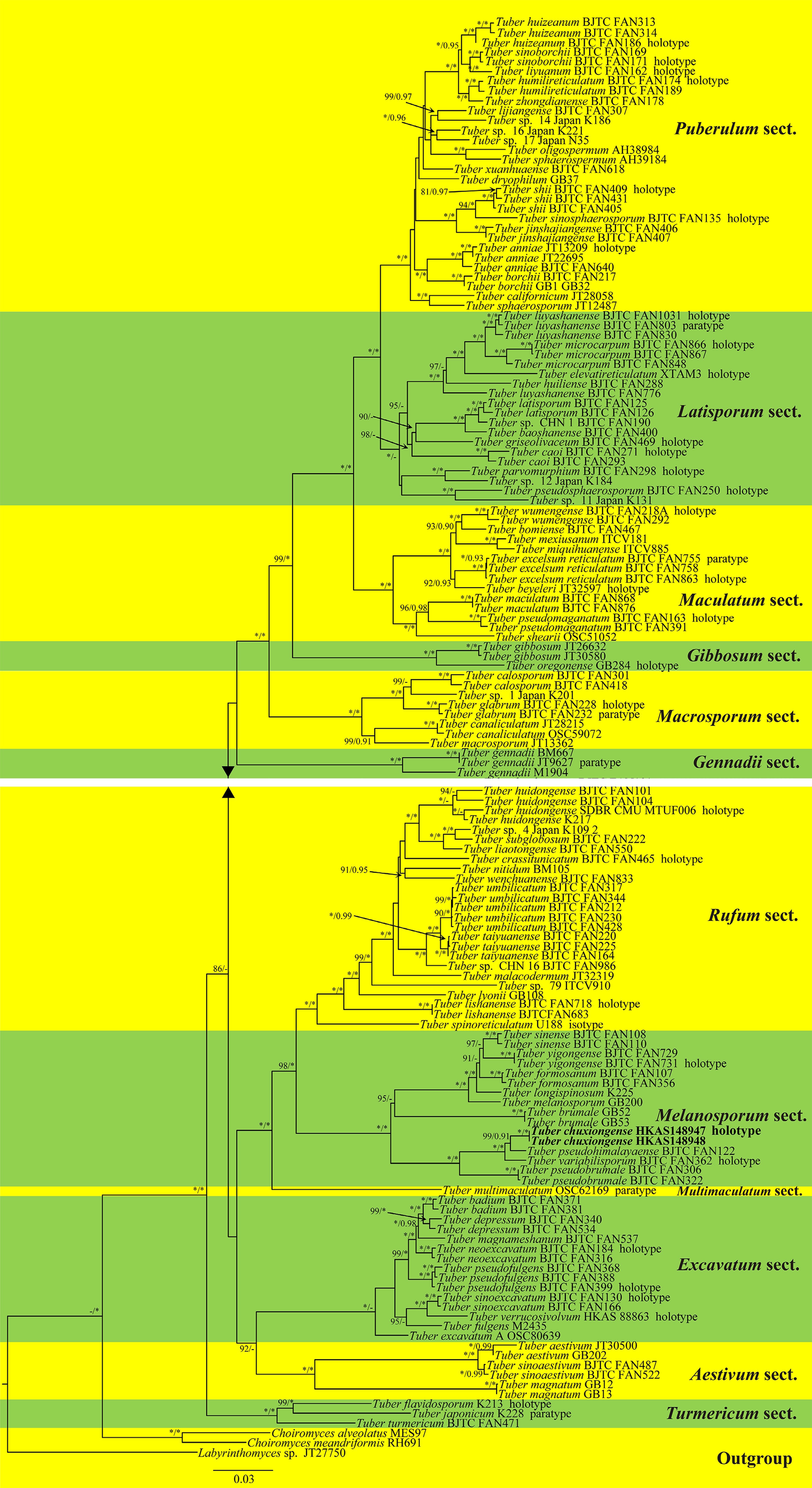
Figure 1.
Maximum likelihood phylogram of Tuber inferred from a dataset (ITS-nrLSU-tef1-α-rpb2), showing the phylogenetic relationship of the new species described in this study. Bootstrap support values over 80% of maximum likelihood (BS, left) and Bayesian posterior probabilities over 0.90 (PP, right) are mentioned on the nodes. The scale bar represents the number of mutations per site. The new species is shown in bold.
Taxonomy
-
Tuber chuxiongense Q.Q. Tao, Y.W. Hu, H.B. Jiang & J.F. Li, sp. nov. (Fig. 2).
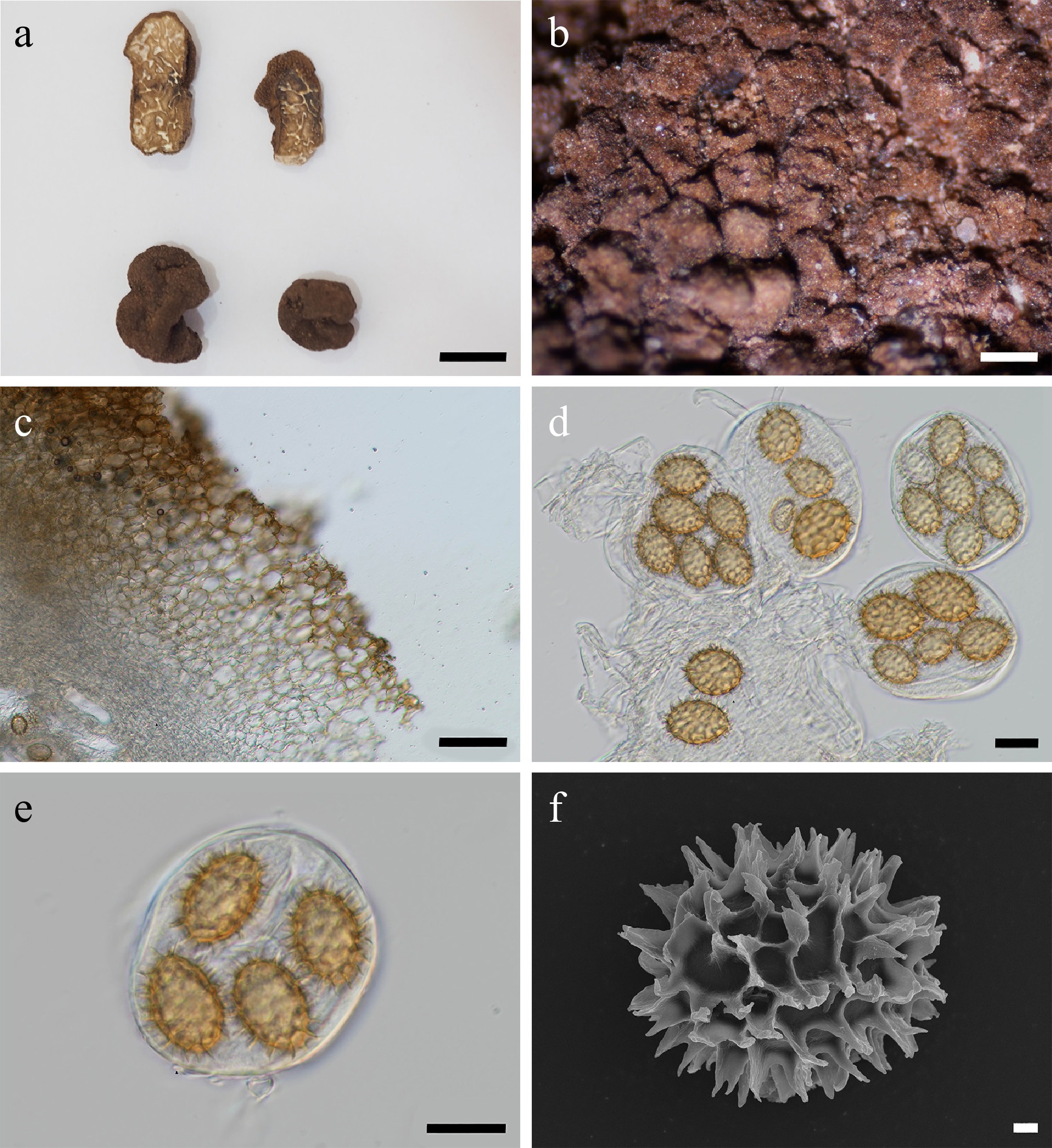
Figure 2.
Tuber chuxiongense (HKAS 148947, holotype). (a) Gleba and ascoma appearance. (b) Surface ascomata after drying. (c) Peridium hyphal arrangements in 10% KOH. (d, e) Asci and ascospores in 10% KOH. (f) Ascospore under scanning electron microscopy. Scale bars: a = 1 cm, b = 1 mm, c = 100 μm, d and e = 20 μm, f = 2 μm.
MycoBank no.: 860999
Etymology: In reference to Chuxiong Yi Autonomous Prefecture, the type locality.
Holotype: CHINA, Yunnan Prov., Chuxiong Yi Autonomous Prefecture, Dayao County, in soil under forest dominated by Pinus sp., 26 December 2024, Junfu Li & Hongbo Jiang, T12-2 (HKAS 148947).
Description: Ascomata hypogeous, irregular to subglobose with a distinct cavity, and generally depressed, 1.6–4 cm in diameter, dark brown (6F8). The surface has grooves and is covered by brown, loose-textured, irregular pyramidal warts when fresh. The gleba is marbled, with white sterile veins and yellowish brown to blackish beige fertile tissue. Odor mild, taste not recorded. The peridium is composed of two layers and is pseudoparenchymatous; the outer cortical layer is –338.6 µm thick, composed of subglobose to subangular cells, 7.7–34 × 5.4–20 µm, Q = 1.0–2.4, Qm = 1.3 ± 0.33 (n = 51), brown or hyaline; the inner layer is 71.4–140 µm thick, composed of intricately interwoven, hyaline, thin-walled hyphae. Asci are irregularly spherical, 43–84.5 × 35–80.0 µm (n = 91), with size and shape varying depending on the number of ascospores, with (1–)3–6(–7) ascospores. Ascospores are olive yellow (3D7) in color, ellipsoid or subglobose. Spore sizes are as follows: in 1-spored asci: (20–)22.2–38(–44) × (14–)16.3–25.5(–31) µm, Q = 1.2–1.6, Qm = 1.4 ± 0.13 (n = 9); in 2-spored asci: (17.7–)19–33.7(–35.3) × (14.5–)15.4–22.0(–24) µm, Q = 1.2–1.7, Qm = 1.4 ± 0.17 (n = 10); in 3-spored asci: (20.4–)21.7–34.0(–37.8) × (15.1–)15.5–23.6(–25.6) µm, Q = 1.2–1.9, Qm = 1.5 ± 0.15 (n = 46); in 4-spored asci: (16.8–)16.9–30(–30.6) × (11.7–)12.5–21(–21.2) µm, Q = 1.1–2.0, Qm = 1.5 ± 0.21 (n = 52); in 5-spored asci: (15.8–)16.5–31(–32.7) × (12.4–)12.6–24.5(–25.8) µm, Q = 1.1–1.7, Qm = 1.3 ± 0.16 (n = 71); in 6-spored asci: (15.6–)17.4–26.7(–27) × (12.6–)13.5–19.5(–19.8) µm, Q = 1.1–1.7, Qm = 1.4 ± 0.12 (n = 58); in 7-spored asci: (10.8–)14.8–26.3(–27) × (9.4–)11.9–19.7(–20.6) µm, Q = 1.2–1.6, Qm = 1.3 ± 0.13 (n = 33). Spines on the outer surface of each spore are 2–4.6 µm high; the spine apices are free, blunt to slightly acute, and some bear apical hooks; the broadened bases connect to form low ridges (0.3–1.3 µm high), creating a reticulate ornamentation, and some meshes occasionally exhibit discrete spines; mostly 5–6(–7) meshes are present across the spore width.
Ecology and distribution: hypogeous, gregarious, in soil under forest dominated by Pinus spp.
Additional material examined (paratype): CHINA, Yunnan Prov., Chuxiong Yi Autonomous Prefecture, Dayao County, in soil under forest dominated by Pinus sp., 26 December 2024, Junfu Li & Hongbo Jiang, T18-2 (HKAS 148948).
Notes: Tuber chuxiongense differs from T. pseudohimalayense primarily in its ascospore reticulum (5–6(–7) irregular meshes across width vs. 3–4 regular meshes) and from T. variabilisporum by a higher mesh count (5–6(–7) vs. 4–5 meshes/width). Although morphologically close to T. pseudohimalayense, phylogenetic analyses based on combined ITS, nrLSU, tef1-α, and rpb2 sequences placed T. chuxiongense in a distinct clade within the Melanosporum section (Fig. 1) (100% ML, 0.91 BYPP). The ITS rDNA sequence analysis showed that the similarity between T. chuxiongense and T. pseudohimalayense was 96.49%.
-
The morphological differences in the genus Tuber likely reflect evolutionary adaptations in their life history and ecology[30]. Mature ascomata of Tuber species, which develop from underground ectomycorrhizae and enclose ascospores in the gleba, attract animal dispersers via specific volatiles (e.g., dimethyl disulfide)[43,44], thus facilitating spore dispersal and negating the need for aerial discharge. The delineation of sections in the truffle phylogeny shows a strong correlation with the characteristics of the ascomatal surface, including color, and the presence of warts, pubescence, texture, as well as ascospore traits such as size, shape, and ornamentation[8]. For example, most Tuber species from the Melanosporum section have dark, rough ascomata with distinct cavities on the surface, and ascospores bearing a spinose-reticulate ornamentation[9,12].
The results of phylogenetic analysis placed our species in the Melanosporum section[12] (Fig. 1). Within the Melanosporum section, T. brumale and T. pseudobrumale are separated by an ascomata surface covered with pyramidal warts; the surface of T. brumale is covered with easily detachable, penta- or hexagonal flat warts[45], while sharp brownish-yellow cones are present on T. pseudobrumale[12]. The new species has distinct cavities that can be easily separated from T. formosanum, T. longispinosum, and T. yigongense, which have slightly lobed ascomata[9,46−48]. The morphology of T. variabilisporum has recently undergone a revision. Originally described by Fan et al.[9] as lacking basal cavities and possessing 1–5-spored asci with yellow-brown mature ascospores, the description was later amended by Wang et al.[12] to include the frequent occurrence of surface depressions. Our specimens are distinguished from T. variabilisporum by their olive-yellow (3D7) mature spores (vs. yellow-brown), a broader ascospore number range of 1–7 per ascus (vs. 1–6), and a higher mesh count on the spore reticulum. The olive yellow ascospores of T. chuxiongense also distinguish it from T. melanosporum (blackish spiny ascospores) and T. sinense (red-brown to blackish brown ascospores)[46]. T. chuxiongense is difficult to distinguish from T. pseudohimalayense in the fresh state. Moreno et al.[49] first described the morphological characteristics of T. pseudohimalayense, with the observation that its ascospores covered a regular and completely spinose-reticulate ornamentation. The ascospore ornamentation of T. pseudohimalayense was documented by Liu[50] as having 3–4 meshes along the transverse diameter. The discovery of T. chuxiongense adds to the growing inventory of endemic Tuber species in southwestern China. Further surveys are needed to determine the host associations and ecological preferences of this newly described taxon.
-
Based on both the morphological characteristics and phylogenetic analysis of combined ITS, nrLSU, rpb2, and tef1-α sequence data, this study describes T. chuxiongense as a new species of truffle from the pine forests of Yunnan, China, belonging to the Melanosporum group. These data will be useful for taxonomic, biogeographical, and agroforestry studies in the future.
This study was supported by the Department of Science and Technology of Yunnan, China (Grant Nos: 202303AP140001, 202202AE090091, and 202504BI09009). Qianqian Tao thanks the Faculty of Science and Graduate School, Chiang Mai University, for supporting the TA/RA Ph.D. scholarship scheme. Hongbo Jiang appre ciates the Postdoctoral Directional Training Foundation of Yunnan Province (Grant No. E33O38E261) under the Yunnan Provincial Department of Human Resources and Social Security, Yunnan, China, the 1st batch of national (Chinese) postdoctoral overseas attraction program in 2023 from the Ministry of Education of China (MOE).
-
The authors confirm their contributions to the paper as follows: study conception and design: Tao Q, Hu Y, Jiang H; data collection: Tao Q, Hu Y, Jiang H, Li J; analysis and interpretation of the results: Tao Q, Hu Y, Jiang H, Li J, Ye L, Xu J, Jeewon R; draft manuscript preparation: Tao Q, Hu Y, Jiang H. All authors reviewed the results and approved the final version of the manuscript.
-
All sequences generated in this study were submitted to GenBank. In addition, the new taxon was registered in MycoBank, and the final alignment of phylogeny based on the ITS-nrLSU-tef1-α-rpb2 dataset in this study was deposited in Zenodo.
-
The authors declare that they have no conflict of interest.
- Copyright: © 2026 by the author(s). Published by Maximum Academic Press, Fayetteville, GA. This article is an open access article distributed under Creative Commons Attribution License (CC BY 4.0), visit https://creativecommons.org/licenses/by/4.0/.
-
About this article
Cite this article
Tao Q, Li J, Ye L, Xu J, Jeewon R, et al. 2026. Phylogenetic and morphological analyses reveal Tuber chuxiongense (Tuberaceae, Pezizales), a new species from Yunnan, China. Studies in Fungi 11: e021 doi: 10.48130/sif-0026-0020 

Phylogenetic and morphological analyses reveal Tuber chuxiongense (Tuberaceae, Pezizales), a new species from Yunnan, China
- Received: 10 November 2025
- Revised: 21 April 2026
- Accepted: 30 April 2026
- Published online: 30 July 2026
Abstract: During a survey of the high-value fungal diversity in Yunnan, China, a new species of Tuber was identified on the basis of its morphological characteristics and combined molecular analyses of the internal transcribed spacer (ITS), nuclear large subunit ribosomal RNA (nrLSU), translation elongation factor 1-alpha (tef1-α), and RNA polymerase II subunit (rpb2) data. The novel species is characterized by small ascomata with a distinct cavity. The ascospores are covered with free apical spines and low ridges, forming an irregular reticulum 5–7 meshes across the spore width. Phylogenetic analyses using maximum likelihood and Bayesian inference methods showed a distinct position of the new species among known species belonging to the group Melanosporum, with significant statistical support. Color photographs of the ascomata, micromorphological structures based on scanning electron microscopy (SEM) of the ascospores, and an updated phylogenetic tree of Tuber are also provided in this study.
-
Key words:
- Ectomycorrhizal fungi /
- Multi-gene /
- Taxonomy /
- Truffle /
- Tuberaceae