










-
Rice (Oryza sativa L.) underpins food security for more than half of the global population and plays a critical socio-economic role in sub-Saharan Africa. Despite ongoing intensification efforts, yield stability in many rice-producing regions remains compromised by defoliating insect pests and foliar diseases that reduce leaf area duration, impair photosynthetic efficiency, and ultimately depress grain yield. Lepidopteran defoliators, sap-sucking insects, and fungal pathogens frequently co-occur, necessitating repeated pesticide applications during the rice cropping season. Although synthetic pesticides remain the dominant control strategy, their intensive use has contributed to the development of resistance, secondary pest outbreaks, contamination of aquatic ecosystems in lowland rice fields, and growing regulatory restrictions[1]. These challenges underscore the need for environmentally benign, resistant, and resilient alternatives within integrated pest management (IPM) systems[1,2].
Botanical biopesticides represent a promising class of crop protection inputs due to their biochemical diversity and multifunctional modes of action[2,3]. Unlike single-site synthetic chemicals, plant-derived formulations typically contain complex mixtures of bioactive metabolites such as alkaloids, phenolics, terpenoids, and flavonoids that can act synergistically as feeding deterrents, growth regulators, oviposition inhibitors, or antimicrobial agents[4,5]. Their rapid environmental degradation and comparatively lower mammalian toxicity enhance compatibility with agroecological intensification strategies[6]. Recent advances in formulation science and renewed interest in locally sourced botanical resources have strengthened the scientific basis for their integration into mainstream crop protection programs[7].
The genus Urtica (stinging nettle) is rich in secondary metabolites with documented insecticidal, acaricidal, antifungal, and antioxidant properties[5]. Extracts of Urtica spp. have demonstrated suppressive effects on aphids, lepidopteran larvae, and certain plant pathogens in horticultural systems. However, most studies remain laboratory-based or confined to vegetable crops, and robust field-scale evidence in cereal systems, particularly rice, is scarce[6]. Given the ecological complexity of rice agroecosystems, characterized by flooded conditions, high humidity, and diverse pest assemblages, empirical validation under field conditions is essential before recommending Urtica-based products for rice production.
Adamfo Pa is a botanical biopesticide formulated from Urtica spp. and recently tested in legume-based systems under tropical field conditions, where it showed measurable suppression of defoliators and pod-sucking insects[8]. Nevertheless, its performance in rice remains untested. Importantly, the potential dual functionality of Urtica-derived metabolites, simultaneous insecticidal and antimicrobial activity, suggests that such formulations may offer integrated management of both insect pests and foliar diseases. This multifunctionality, if validated, would represent a strategic advancement over single-target control agents and could enhance resilience in rice IPM programs.
Current literature on botanical pest management in rice is dominated by studies on neem-based products, with limited evaluation of alternative plant genera possessing distinct phytochemical profiles. No comprehensive field-based assessment of a Urtica spp. derived commercial formulation has been reported for rice systems under tropical production conditions. Furthermore, limited research has quantified the agronomic consequences (yield and yield components) of botanical-induced pest and disease suppression in rice. The present study addresses these gaps by providing a field-scale, agronomically integrated evaluation of Adamfo Pa in rice, linking biological efficacy with crop productivity outcomes. We hypothesize that:
(i) Application of Adamfo Pa (Urtica spp.) will significantly reduce defoliating insect pest density and foliar disease incidence relative to untreated controls.
(ii) Pest and disease suppression will translate into measurable improvements in leaf area retention, grain yield, and yield components.
(iii) Higher application rates or optimized spray intervals will enhance efficacy without compromising crop safety, demonstrating dose-dependent response patterns.
By integrating pest, disease, and yield assessments under field conditions, this study provides a rigorous evaluation of Urtica-based botanical protection in rice and contributes empirical evidence toward sustainable crop protection strategies aligned with reduced synthetic pesticide dependency.
-
Field experiments were conducted during the 2025 major cropping season at the Council for Scientific and Industrial Research, Crops Research Institute (CSIR-CRI) at Fumesua (6°45'00.58' N; 1°31'51.28' W) in the Semi-Deciduous Forest Agroecological Zone, and Ejura (7°23'8.088'' N; −1°21'22.212 E) in the Savannah-Transition Agroecological Zone, all in Ghana. Fumesua is characterized by a mean annual rainfall of approximately 1,550 mm, a minimum and maximum mean temperature of 21.1 and 32.7 °C, respectively, with an average temperature of 31.6 °C. Soils at Fumesua are classified as Ferric Acrisol, Asuansi soil series[9], with the topsoil being greyish-brown sandy loam with an effective depth of approximately 100 cm[9]. Soils in the area are inherently low in fertility and have limited moisture-retention capacity. Ejura experiences an annual rainfall of 1,200–1,500 mm, with a long-term mean of approximately 1,430 mm. Its mean annual temperature is about 26.3 °C, with typical daily temperatures ranging from 20 to 23 °C (min) and 29 to 36 °C (max). The soils in Ejura are classified as Ferric Acrisols/Ferralsols according to the FAO soil taxonomy. It is deep, well-drained, and sandy loam to loam in texture[10]. It has moderate soil organic matter content and a pH of 5.5–6.5[11].
Experimental design and treatment structure
-
The experiment was arranged in a split-plot design with four replications. There were two factors: application intervals (weekly and bi-weekly), set as main plot factors, and application dosage (water control at 0 mL·100 L−1 of water; Adamfo Pa at 300 mL·100 L−1 of water; Adamfo Pa at 400 mL·100 L−1 of water; and Adamfo Pa at 500 mL·100 L−1 of water), and biopesticide standard check Bypel for insect pests management and synthetic fungicide Mancozeb for diseases management. Plot size was 5 m × 5 m, with 1 m buffers to minimize chemical drift. Rice variety (CRI-Agyapa) released by CSIR-CRI was used. CRI-Agyapa is a lowland high-yielding aromatic rice variety tolerant to yellow mottled virus. It was established at a standard agronomic spacing (20 cm × 20 cm) in the lowland. Treatment application commenced in early May and June 2025 at Fumesua and Ejura, respectively. Applications began at 3 weeks after transplanting and were repeated based on assigned frequency; weekly plots received four applications, while bi-weekly plots received eight applications. Sprays were applied using a calibrated CO2-pressurized backpack sprayer. Uniform fertilization of 100:60:60 NPK ha−1 was applied across treatments. All field operations, such as weeding, pests and diseases scouting, were conducted under strict good agricultural practices (GAPs). Irrigation water was supplied when needed.
Botanical biopesticide description
-
Urtica (Adamfo Pa) is a botanical extract product derived from Urtica dioica and Urtica urens. It was developed by Naturnova Solutions, Zhengzhou Lubing Maoyi Co Ltd, PO Box 450000, Zhengzhou City, China.
Data collection
-
Pest and disease incidence and severity were visually monitored in a 2 m2 quadrant in the middle of each plot to minimize border effect. Monitoring was done on a weekly basis, following standard entomological field sampling procedures[12] and pathological field sampling procedures. The target insect pests were brown leaf hoppers, stem borers, grasshoppers, and leaf folders. Sampling was conducted between 06:30 h and 09:30 h when insect activity and plant moisture conditions were suitable for consistent observations. Leaf damage and severity were assessed. The percentage of damaged leaves was assessed by visually examining the plants in the quadrant for the presence of typical feeding symptoms such as lesions, wilting, or discoloration. A leaf was classified as 'damaged' when a characteristic damage symptom was detected[12]. Leaf damage was scored using a standardized 0–5 visual severity scale adapted from established crop-damage assessment protocols[13]. The scale was defined as: 0 = no visible leaf area damage; 1 = ≤ 10% leaf area damage; 2 = 11%–25% leaf area damage; 3 = 26%–50% leaf area damage; 4 = 51%–75% leaf area damage; and 5 = > 75% or more leaf area damaged. Each plant was scored independently, and the mean leaf damage per plant was calculated for each plot. Regular checks for symptoms of rice blast, brown leaf spot, and leaf scald, as well as leaf scorch, were also done. Disease incidence and severity were recorded using the Standard Evaluation System (SES) scales. Grain yield per plot was measured from the 2 m2 quadrant of each plot when the seed moisture content was 14%.
Statistical analysis
-
Data were subjected to analysis of variance (ANOVA) using Genstat, Edition 64-Bit v24.2. Before analysis, count and percentage data were checked for normality (Shapiro–Wilk test) and homogeneity of variance (Levene's test). Where necessary, arcsine or square root transformations were applied. Treatment means were separated using Tukey's Honestly Significant Difference (HSD) test at p ≤ 0.05. For pest and disease progression data, repeated-measures ANOVA was performed. To explore multivariate relationships and disentangle treatment-driven variability, Pearson correlation analysis and principal component analysis (PCA) were conducted. The correlation matrix quantified the strength and direction of associations among measured indices, while PCA reduced data dimensionality, identified latent structures, and highlighted the dominant components explaining overall variance in the system.
-
Leaf damage incidence and severity were significantly influenced by application dose (p ≤ 0.05), whereas application interval exerted no significant effect at either location (Table 1). Across both experimental sites (Fumesua and Ejura), weekly and bi-weekly application intervals resulted in statistically comparable leaf damage incidence and severity scores. At Fumesua, incidence averaged 29.93% and 31.07% under weekly and bi-weekly applications, respectively, while severity scores were 2.99 and 3.08. Similarly, at Ejura, incidence values of 29.36% (weekly interval) and 25.71% (bi-weekly interval) were observed and did not differ significantly. A similar trend was observed for severity scores, which were weekly interval (2.80), and bi-weekly interval (2.73).
Table 1. Effect of Adamfo Pa on rice insect pests leaf damage, and severity.
Leaf damage incidence (%) Severity score (scale 1–5) Fumesua Ejura Fumesua Ejura Application interval Weekly 29.93 ± 4.02a 29.36 ± 8.10a 2.99 ± 1.05a 2.80 ± 1.30a Bi-weekly 31.07 ± 9.93a 25.71 ± 9.36a 3.08 ± 1.16a 2.73 ± 1.43a Application dose Control at 0 mL·100 L−1 water 66.43 ± 8.94a 32.18 ± 6.56a 5.25 ± 1.38a 4.69 ± 1.12a Adamfo Pa at 300 mL·100 L−1 of water 28.04 ± 8.03b 17.41 ± 5.33b 2.53 ± 0.13b 2.74 ± 0.70b Adamfo Pa at 400 mL·100 L−1 of water 21.59 ± 7.76bc 14.44 ± 3.76bc 2.50 ± 0.97b 2.55 ± 0.83bc Adamfo Pa at 500 mL·100 L−1 of water 18.80 ± 6.70bc 11.94 ± 1.92c 2.47 ± 0.91b 2.02 ± 0.81cd Reference biopesticide (Bypel) 17.64 ± 7.50c 11.72 ± 4.12c 2.42 ± 0.82b 1.83 ± 0.96d Results are presented as mean ± standard deviation (SD) values. Mean followed by the same letter(s) within a column are not significantly different according to Tukey's Honest Significant Difference (HSD) test at 5% probability level. In contrast, application dose had a pronounced and consistent effect on both incidence and severity at the two ecozones (Table 1). The untreated control recorded the highest leaf damage incidence at Fumesua (66.43%) and Ejura (32.18%), with corresponding severity scores of 5.25 and 4.69, respectively. All Adamfo Pa treatments significantly reduced leaf damage compared with the control. At Fumesua, leaf damage incidence declined progressively with increasing doses, from 28.04% (300 mL·100 L−1 of water) to 18.80% (500 mL·100 L−1 of water), while the reference biopesticide (Bypel) achieved the lowest incidence (17.64%). A similar trend was observed at Ejura, where incidence decreased from 17.41% (300 mL·100 L−1 of water) to 11.94% (500 mL·100 L−1 of water), which was statistically comparable to Bypel (11.72%).
Severity scores mirrored the incidence patterns (Table 1). At Fumesua, Adamfo Pa treatments reduced severity to approximately 2.47–2.53, which were significantly lower than the control (5.25). At Ejura, severity declined from 2.74 (300 mL·100 L−1 of water) to 2.02 (500 mL·100 L−1 of water), with Bypel recording the lowest score (1.83). Overall, strong dose-dependent suppression of foliar damage, with 400–500 mL·100 L−1 of water providing controlled efficacy statistically comparable to that of Bypel, was observed. Results should be presented in a logical sequence in the text, tables, and figures, usually matching the order as described in Materials and Methods. Repeated presentation of the same data in different forms should be avoided. The results should not include a lengthy discussion.
Diseases
-
Field evaluations conducted at Fumesua (Semi-Deciduous Forest ecozone) and Ejura (Forest-Savanna Transition ecozone) revealed significant treatment effects on rice blast, brown leaf spot, and leaf scald severity (p ≤ 0.05), with clear responses to both application interval and dose (Table 2). Application intervals significantly influenced rice blast severity at Fumesua, where weekly application (28.59%) recorded higher disease incidence than bi-weekly application (20.90%), representing a 26.9% reduction under the bi-weekly schedule. In contrast, no significant application interval effect was observed at Ejura, where blast severity remained statistically similar between weekly (27.33%) and bi-weekly (26.07%) applications. For brown leaf spot, differences between weekly and bi-weekly applications were not significant (p ≥ 0.05) at either site. A similar observation was made for leaf-scald. However, leaf scald severity was numerically reduced under bi-weekly application at both locations, particularly at Ejura (4.53% vs 9.00%). Overall, application interval effects were site-specific and more pronounced for rice blast at Fumesua.
Table 2. Effect of Adamfo Pa on rice disease incidence.
Rice blast Brown leaf spot Leaf scald Fumesua Ejura Fumesua Ejura Fumesua Ejura Application interval Weekly 28.59 ± 16.9a 27.33 ± 16.9a 31.74 ± 13.6a 26.33 ± 13.7a 9.36 ± 11.5a 9.00 ± 7.1a Bi-weekly 20.90 ± 14.1b 26.07 ± 17.6a 28.90 ± 13.2a 25.73 ± 17.1a 6.90 ± 7.9a 4.53 ± 5.3a Application dose Control at 0 mL·100 L−1 of water 47.67 ± 16.9a 57.67 ± 9.5a 51.37 ± 10.3a 54.67 ± 6.8a 18.64 ± 11.7a 14.17 ± 8.6a Adamfo Pa at 300 mL·100 L−1 of water 18.75 ± 13.6b 20.83 ± 4.9b 28.50 ± 8.3b 20.83 ± 2.0b 8.50 ± 7.9ab 5.50 ± 4.6ab Adamfo Pa at 400 mL·100 L−1 of water 20.25 ± 5.4b 18.33 ± 5.2b 24.00 ± 7.0b 18.00 ± 2.5b 8.75 ± 8.3ab 4.17 ± 4.9ab Adamfo Pa at 500 mL·100 L−1 of water 16.54 ± 9.0b 19.17 ± 5.9b 24.97 ± 7.6b 19.17 ± 6.6b 2.26 ± 4.8b 3.67 ± 3.0ab Reference chemical (Mancozeb) 20.50 ± 5.5b 17.50 ± 6.9b 22.75 ± 4.8b 17.50 ± 2.7b 2.50 ± 4.6b 3.33 ± 2.6b Results are presented as mean ± standard deviation (SD) values. Means followed by the same letter(s) within a column are not significantly different according to Tukey's Honest Significant Difference (HSD) test at 5% probability level. Application dose significantly affected all three diseases across locations. The untreated control consistently recorded the highest severity levels, confirming substantial disease pressure during the season. For rice blast, the control plots exhibited 47.67% and 57.67% severity at Fumesua and Ejura, respectively. All Adamfo Pa treatments (300–500 mL·100 L–1 of water) and the reference chemical, Mancozeb, significantly reduced blast severity compared with the control. Reductions ranged from 56%–65% at Fumesua and 64%–70% at Ejura. Disease suppression under Adamfo Pa was statistically comparable to Mancozeb. Similarly, brown leaf spot incidence was markedly reduced by all Adamfo Pa rates relative to the control. At Fumesua, incidence declined from 51.37% (control) to 22.75% (standard chemical, Mancozeb) and 24.97%–28.50% for Adamfo Pa treatments, while at Ejura, reductions ranged from 54.67% (control) to 17.50% (standard chemical, Mancozeb) and 18.00%–20.83% for the Adamfo Pa-treated plots. The 400 mL·100 L−1 of water and 500 mL·100 L−1 of water rates showed consistent performance across both environments, approaching the efficacy of Mancozeb. Leaf scald exhibited the most pronounced response to dose. At Fumesua, leaf scald incidence decreased from 18.64% (control) to as low as 2.26% for 500 mL·100 L−1 of water Adamfo Pa, and 2.50% for Mancozeb. At Ejura, Mancozeb produced the lowest leaf scald incidence (3.33%), closely followed by the 400 mL·100 L−1 of water (4.17%) and 500 mL·100 L−1 of water (3.67%) rates of Adamfo Pa. Generally, across diseases and environments, Adamfo Pa demonstrated strong dose-dependent disease suppression, with the 400–500 mL·100 L−1 of water rates consistently achieving reductions comparable to the synthetic fungicide Mancozeb.
Grain yield response
-
Grain yield was significantly influenced by application dose at both locations, while the effect of application interval was site-specific (p ≤ 0.05) (Table 3). Clear dose-response trends were observed across the Semi-Deciduous Forest agroecology (Fumesua) and the Forest-Savannah Transition zone (Ejura). At Fumesua, grain yield did not differ significantly between weekly (5,497 kg·ha−1) and biweekly (5,655 kg·ha−1) applications. In contrast, weekly application (5,626 kg·ha−1) produced significantly higher grain yield than the bi-weekly regime (5,296 kg·ha−1) at Ejura.
Table 3. Effect of Adamfo Pa on rice grain yield.
Grain yield (kg·ha−1) Fumesua Ejura Application Interval Weekly 5,497.00 ± 769.9a 5,626.00 ± 904.7a Bi-weekly 5,655.00 ± 753.7a 5,296.00 ± 786.1b Application dose Control at 0 mL·100 L−1 of water 4,539.00 ± 340.2d 4,377.00 ± 39.4c Adamfo Pa at 300 mL·100 L−1 water 5,266.00 ± 259.5bc 5,105.00 ± 463.4b Adamfo Pa at 400 mL·100 L−1 water 5,624.00 ± 312.9b 5,463.00 ± 502.7b Adamfo Pa at 500 mL·100 L−1 water 6,058.00 ± 669.3ab 6,213.00 ± 1020.5a Reference biopesticide 6,394.00 ± 447.8a 6,149.00 ± 741.3a Results are presented as means ± standard deviation (SD) values. Means followed by the same letter(s) within a column are not significantly different according to Tukey's Honest Significant Difference (HSD) test at 5% probability level. The application dose exerted a strong and consistent effect on grain yield at both locations. The untreated control recorded the lowest yields at Fumesua (4,539 kg·ha−1) and Ejura (4,377 kg·ha−1). A progressive increase in grain yield was observed with increasing Adamfo Pa concentration. Adamfo Pa at 300 mL·100 L−1 of water improved yield by 16% (Fumesua) and 17% (Ejura) relative to the control, while Adamfo Pa at 400 mL·100 L−1 of water resulted in further yield gains of approximately 24% (Fumesua) and 25% (Ejura) over the control. Adamfo Pa at 500 mL·100 L−1 of water produced substantial yield enhancement, reaching 6,058 kg·ha−1 at Fumesua and 6,213 kg·ha−1 at Ejura, representing yield increases of 33% and 42%, respectively, compared with the untreated plots. The highest yields were recorded under the reference biopesticide/fungicide treatment (6,394 kg·ha−1 at Fumesua; 6,149 kg·ha−1 at Ejura). Notably, Adamfo Pa at 500 mL·100 L−1 of water was statistically comparable to the reference treatment at both sites.
Multivariate analysis of disease complex and grain yield response
-
To elucidate the multivariate relationships among disease indices and grain yields across treatments, Pearson correlation analysis and principal component analysis (PCA) were conducted separately for Fumesua and Ejura using standardized variables (leaf damage incidence and severity score, rice blast, brown leaf spot, leaf scald, and grain yield).
Pearson correlation
-
At both locations, strong positive correlations were observed among all disease-related variables (Fig. 1). At Fumesua, correlation coefficients among disease indices ranged from r = 0.88 to 0.99, with leaf damage incidence strongly associated with severity (r = 0.986) and brown leaf spot (r = 0.992). Leaf scald was also highly correlated with other disease variables (r = 0.884–0.929). Grain yield exhibited strong negative correlations with all disease indices, particularly leaf scald (r = −0.960), leaf damage (r = −0.895), and brown leaf spot (r = −0.881).
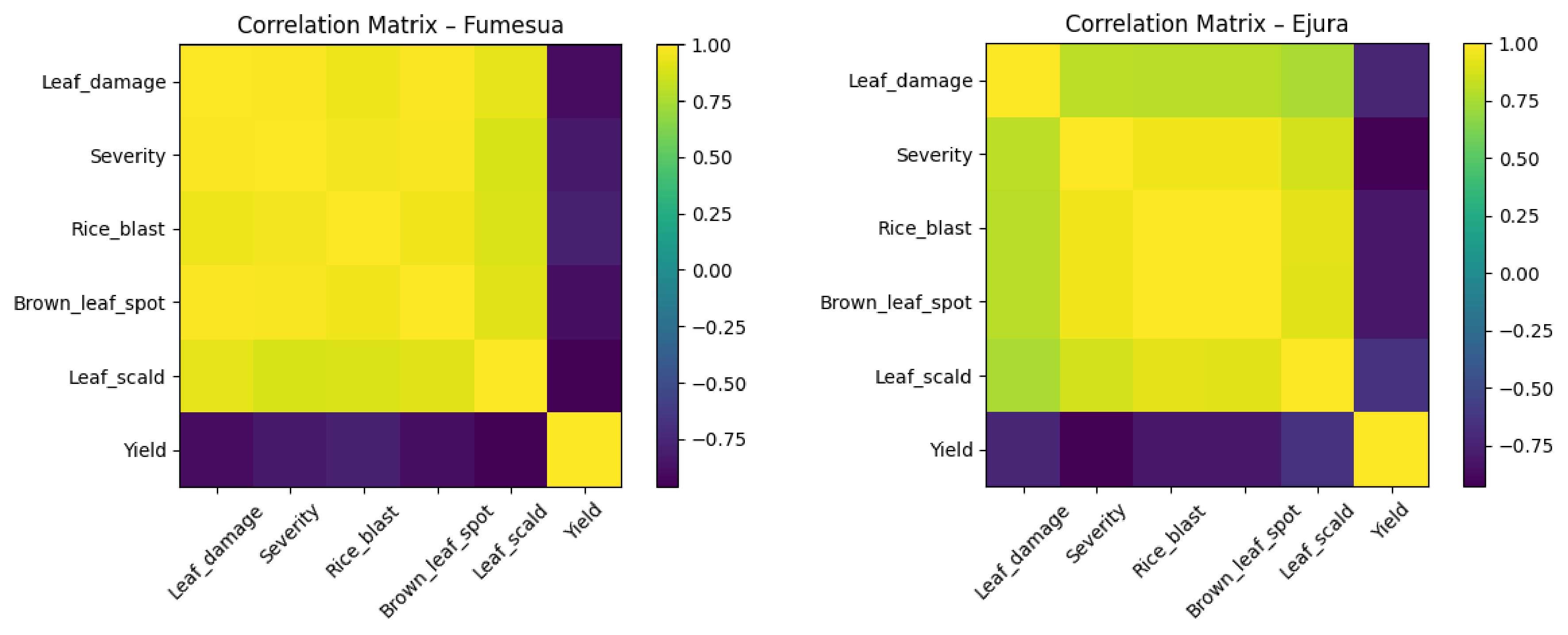
Figure 1.
Pearson correlation analysis of disease indices and grain yield.
At Ejura, disease variables were likewise positively correlated (r = 0.75–1.00). Rice blast and brown leaf spot showed near-perfect association (r = 1.000). Grain yield was negatively correlated with severity (r = −0.928), rice blast (r = −0.805), and brown leaf spot (r = −0.807). Although slightly weaker than at Fumesua, the negative yield-disease relationships remained strong and biologically meaningful.
Collectively, the correlation matrices confirm substantial multicollinearity among disease variables and a consistent inverse association between disease intensity and productivity across environments.
Principal component analysis
-
PCA further clarified the multivariate structure of treatment responses (Fig. 2). At Fumesua, the first principal component (PC1) explained 93.4% of the total variance, while PC2 accounted for 5.0%, yielding a cumulative contribution of 98.4%. All disease indices loaded strongly and positively on PC1 (0.406–0.419), whereas grain yield loaded negatively (−0.389). Treatments were distinctly separated along this axis: the untreated control aligned with high disease intensity, while Adamfo Pa at 500 mL·100 L−1 of water and the reference biopesticide/fungicide clustered on the low-disease, high-yield end. Application interval (weekly vs bi-weekly) showed minimal separation along PC1.
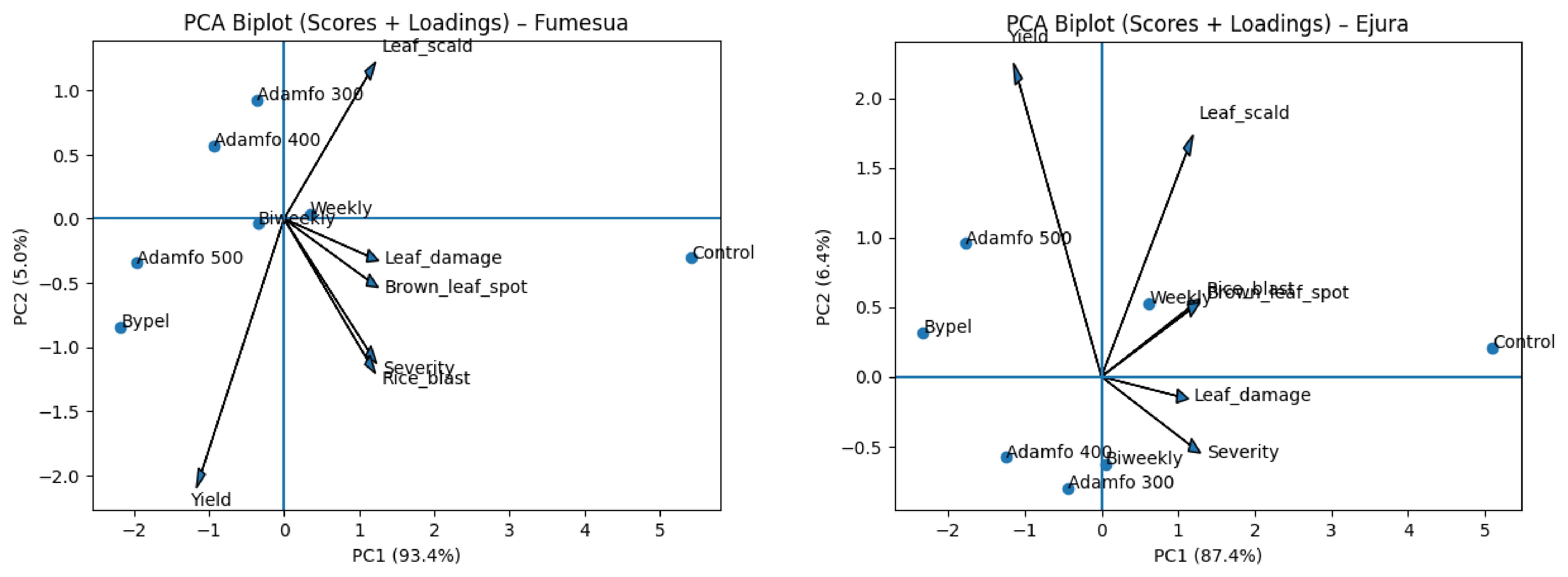
Figure 2.
Principal Component Analysis of disease indices and grain yield.
At Ejura, PC1 explained 87.4% of the total variance, and PC2 explained 6.4% (cumulative = 93.8%). Disease variables again loaded positively (0.378–0.431) and grain yield negatively (−0.382) on PC1, confirming the consistency of the disease-yield gradient across agroecological zones. The untreated control was clearly separated from treated plots, while higher application rates (400–500 mL·100 L−1 of water) grouped with the reference biopesticide in the favourable quadrant.
-
The present findings demonstrate that application dose, rather than application interval, was the dominant factor regulating foliar damage and disease intensity across both agroecological zones. The strong and consistent reduction in leaf damage incidence and severity with increasing Adamfo Pa concentration confirms a clear dose–response relationship. Such patterns are characteristic of plant-derived biopesticides, whose efficacy depends on sufficient concentrations of bioactive compounds to achieve contact toxicity, feeding deterrence, or pathogen growth inhibition[8,14,15].
The high levels of damage recorded in untreated plots confirm substantial pest pressure throughout the season and highlight the vulnerability of rice in tropical production systems. In contrast, Adamfo Pa at 400−500 mL·100 L−1 of water consistently reduced disease incidence and severity to levels statistically comparable to the commercial reference products (Bypel and Mancozeb). This equivalence suggests that the botanical formulation possesses bioactive phytochemicals capable of disrupting pests' feeding and pathogen establishment. Extracts of Urtica spp. have been reported to contain phenolics, flavonoids, organic acids, and lectins with antifungal and insect-deterrent properties[4,16,17]. These compounds may act synergistically to inhibit spore germination, reduce mycelial growth, or impair herbivore digestion.
Importantly, the lack of significant interval effects on leaf damage suggests that bi-weekly application maintained sufficient residual activity, particularly in the more humid (Fumesua) environment. Botanical formulations often degrade rapidly under UV radiation and high temperatures; thus, performance stability under extended intervals indicates favorable field persistence[15]. From a practical perspective, this supports reduced spray frequency without compromising control efficacy, improving cost-efficiency, and lowering environmental load.
Disease complex suppression across agroecologies
-
The botanical treatment demonstrated broad-spectrum suppression of rice blast, brown leaf spot, and leaf scald. The magnitude of disease reduction (56%–70% for blast; > 50% for brown leaf spot; > 80% for leaf scald at higher doses) indicates strong antifungal activity. Rice blast (Magnaporthe oryzae) remains the most destructive fungal disease of rice globally, with yield losses frequently exceeding 30% under severe epidemics[18−20]. The comparable performance of Adamfo Pa to Mancozeb suggests that its phytochemical profile effectively disrupts fungal infection processes.
The site-specific interval effect observed for blast at Fumesua likely reflects microclimatic differences between the humid Semi- Deciduous Forest ecozone and the relatively drier Forest-Savanna Transition ecology. Disease epidemiology in rice is highly sensitive to leaf wetness duration and relative humidity[21−23]. Under higher humidity, residual activity from bi-weekly applications may have remained adequate, whereas in Ejura's drier conditions, more frequent coverage slightly enhanced yield outcomes.
The pronounced response of leaf scald to dose indicates strong sensitivity of Microdochium oryzae to botanical extracts. Previous studies have shown that plant-based antifungals may induce systemic resistance pathways, enhancing plant defense responses such as phenylpropanoid activation and oxidative enzyme production[8,24−26]. Such dual action of direct antifungal inhibition plus host resistance induction may explain the substantial reductions observed.
Yield response and disease-productivity trade-off
-
Grain yield increases of 33%–42% under the 500 mL·100 L−1 of water rate relative to untreated plots confirm that disease suppression translated directly into productivity gains. The strong negative correlations between disease indices and yield, and the PCA-derived disease-yield trade-off axis explaining > 87% of total variance, reinforce this conclusion. These multivariate findings indicate that yield variation was largely governed by cumulative disease pressure, consistent with epidemiological theory linking foliar disease severity to reductions in photosynthetic area and assimilate partitioning[1,21,22]. The clustering of high-dose Adamfo Pa treatments with the synthetic reference along the favorable PCA quadrant demonstrates functional equivalence in disease-yield optimization. Notably, the application interval exerted minimal multivariate separation, further confirming that dose intensity is the primary driver of system performance.
Yield levels exceeding 6 t·ha−1 under optimal botanical treatment are agronomically significant within the Ghanaian rice production systems, where the national average (2.9–3.4 t·ha−1) remains below potential yield ceilings[27]. The results, therefore, position Adamfo Pa as a viable tool for sustainable intensification, capable of reducing reliance on synthetic fungicides while maintaining high productivity.
Implications for integrated disease management
-
The strong multicollinearity among disease variables indicates a tightly coupled disease complex in which effective management of one component likely suppresses others. The high explanatory power of PC1 (> 87%) suggests that integrated strategies targeting overall disease pressure may be more effective than pathogen-specific interventions. Botanical biopesticides are particularly well-suited to such integrated approaches due to their multi-site modes of action and lower risk of resistance compared with single-site synthetic fungicides[7,8].
Overall, the findings confirm that dose optimization is more critical than spray frequency for maximizing botanical efficacy. The 400–500 mL·100 L−1 of water range represents a biologically and agronomically optimal threshold across contrasting agroecologies. By providing disease suppression comparable to conventional fungicides while enabling reduced spray frequency, Adamfo Pa aligns with sustainable crop protection paradigms emphasizing environmental safety, resistance management, and economic viability.
-
This study demonstrates that the botanical biopesticide Adamfo Pa (Urtica spp.) provides effective, dose-dependent suppression of foliar insect damage and major rice diseases across contrasting agroecological zones in Ghana. Application dose consistently exerted a stronger influence on leaf damage and severity, disease incidence, and grain yield than spray interval. Increasing concentration from 300 to 500 mL·100 L−1 of water progressively reduced rice blast, brown leaf spot, leaf scald, and overall leaf damage, with the 400–500 mL rates achieving control levels statistically comparable to the reference standards (Bypel and Mancozeb). Multivariate analyses confirmed a dominant disease-yield trade-off axis, accounting for over 87% of the total variation across sites. Strong negative correlations between disease indices and grain yield indicate that productivity losses were primarily driven by cumulative disease pressure. Suppression of the disease complex, therefore, directly translated into significant yield gains of up to 42% relative to the untreated control. Importantly, bi-weekly application performed comparably to weekly application in most cases, particularly in the humid Semi-Deciduous Forest ecology, suggesting that reduced spray frequency can maintain efficacy under favorable environmental conditions. Generally, the results established Adamfo Pa at 400–500 mL·100 L−1 of water as an effective botanical alternative for integrated pest and disease management in rice. Its broad-spectrum activity, environmental adaptability, and yield-enhancing potential position it as a viable tool for sustainable intensification of rice production systems under Ghanaian field conditions.
-
The authors confirm contribution to the paper as follows: study conception and design: Keteku AK, Baafi E, Aidoo KAS; data collection: Keteku AK, Frimpong-Anin K, Awarikabey EN, Bosompem F, Agyekum A, Owusu RY; analysis and interpretation of results: Keteku AK, Yeboah S, Agyeman K, Tetteh EK; draft manuscript preparation: Keteku AK, Baafi E, Awarikabey EN, Aidoo KAS, Afriyie-Debrah C, Tetteh EK. All authors reviewed the results and approved the final version of the manuscript.
-
The data that support the findings of this study are available on request from the corresponding author.
-
The study was funded by Naturnova Solutions, Zhengzhou Lubing Maoyi Co. Ltd, China, and EcoEmpower Alliance Kanvili Tunayili, NR, Tamale, Ghana. The infrastructural support provided by the Council for Scientific and Industrial Research-Crops Research Institute (CSIR-CRI) is duly acknowledged.
-
The authors declare that they have no conflict of interest.
- Copyright: © 2026 by the author(s). Published by Maximum Academic Press, Fayetteville, GA. This article is an open access article distributed under Creative Commons Attribution License (CC BY 4.0), visit https://creativecommons.org/licenses/by/4.0/.
-
About this article
Cite this article
Keteku AK, Baafi E, Aidoo KAS, Frimpong-Anin K, Awarikabey EN, et al. 2026. Efficacy of a stinging nettle (Urtica spp.)-based biopesticide for management of defoliating insect pests and foliar diseases in rice. Circular Agricultural Systems 6: e020 doi: 10.48130/cas-0026-0021 

Efficacy of a stinging nettle (Urtica spp.)-based biopesticide for management of defoliating insect pests and foliar diseases in rice
- Received: 25 February 2026
- Revised: 02 June 2026
- Accepted: 08 June 2026
- Published online: 12 August 2026
Abstract: The growing need for environmentally sustainable disease and pest management strategies in rice production necessitates evaluating effective botanical alternatives to synthetic chemicals. This study assessed the efficacy of Adamfo Pa (Urtica spp.) for managing foliar insects and major rice diseases across two contrasting agroecological zones in Ghana (Semi-Deciduous Forest and Forest-Savanna Transition). A split-plot field experiment was conducted to evaluate two application intervals (weekly and bi-weekly) and three treatment dose rates of Adamfo Pa (300, 400, and 500 mL·100 L−1 of water), alongside an untreated control and reference products Bypel (biopesticide) and Mancozeb (fungicide). Application dose significantly influenced leaf damage incidence and grain yield (p ≤ 0.05). The control recorded the highest leaf damage (66.43%) and disease severity (5.25), all occurring in the Semi-Deciduous Forest ecozone. Adamfo Pa reduced rice blast, brown leaf spot, and leaf scald by 56%–70% relative to the control, with the 400–500 mL·100 L−1 rates performing statistically comparably to the reference fungicide. Grain yield increased progressively with an increased dose rate, reaching 6,058 kg·ha−1 in the Semi-Deciduous Forest ecozone and 6,213 kg·ha−1 in the Forest-Savanna Transition ecozone. Adamfo Pa at 500 mL·100 L−1 produced a yield of up to 42% over the control. Principal component analysis explained > 87% of the total variance along a dominant disease-yield trade-off axis. The findings demonstrate that Adamfo Pa at 400–500 mL·100 L−1 provides effective broad-spectrum disease and pest suppression and competitive yield performance, supporting its integration into sustainable rice pest and disease management systems.