












-
Parthenocarpy, a phenomenon in which the ovary initiates fruit set and development without pollination and fertilization, is widely distributed among important economic plant families, including Solanaceae, Brassicaceae, Rosaceae, and Cucurbitaceae[1,2]. Parthenocarpy confers stable and high fruit set ability under unfavorable cultivation conditions, thereby ensuring consistent yield of crops[3,4]. In addition, it produces seedless fruits with improved edibility and processing quality. Hence, parthenocarpy has been recognized as a highly attractive agronomic trait for increasing the yield of fruit crops[5].
Parthenocarpy is closely associated with hormones. Studies have revealed that genes involved in hormone synthesis, transport, and signal transduction regulate parthenocarpic fruit development. Downregulation of the auxin synthesis suppressor gene Pad-1 induces parthenocarpy in eggplant, tomato, and pepper[5]. Suppression of the auxin signaling genes IAA9, ARF5, ARF7, and ARF8 induces parthenocarpy in tomato and Arabidopsis[6−9]. Overexpression of cucumber auxin signaling genes CsTIR1 and CsARF10 leads to parthenocarpy in tomato[10]. Silencing the gibberellin signaling repressor DELLA also induces parthenocarpy in tomato and Arabidopsis[11,12]. Several studies have shown that parthenocarpy is closely associated with BRs. Fu et al.[13] first found that exogenous application of epibrassinolide induced parthenocarpy in cucumber. To date, the phenomenon of BR-induced parthenocarpy has been confirmed in various crops, including bitter gourd, pear, strawberry, and papaya[13−15]. However, the molecular mechanism by which BR signaling regulates parthenocarpy remains to be elucidated.
Cucumber is a model crop for studying parthenocarpy[4]. Parthenocarpy in cucumber is a complex quantitative trait controlled by genotype–environment interactions. Sun et al.[16] first identified 10 QTLs associated with parthenocarpy in North American processing cucumbers; however, these QTLs could not be assigned to specific chromosomal positions. Following the completion of the cucumber reference genome sequence[17], functional genomics research in cucumber entered a period of accelerated advancement. To date, at least 33 parthenocarpy-associated QTLs have been mapped across diverse cucumber ecotypes, including North American processing types[18], European greenhouse types[19−21], and South China types[22]. Several parthenocarpy-associated genes, CsTIR1, CsARF10, CsYUC4, CsNPF1, CaACA10, CsCaM, and CsCERT2, have been cloned via map-based cloning and genetic complementation analyses[4,10,20]. Due to interactions among QTLs and limited recombination events in bi-parental mapping populations, the functions of most of these QTLs remain unknown.
In a previous study, Wu et al.[19] identified a QTL, Parth7.1, associated with European greenhouse type cucumber using an F2 and F2:3 mapping population derived from EC1 and 8419s-1. In this study, we developed a near-isogenic line to enable fine mapping of the parthenocarpy QTL Parth7.1. Through whole-genome resequencing data analysis, transcriptomic data analysis, endogenous hormone measurement, and BR treatment, we screened and identified the BR signaling transcription factor gene CsBZS1 as a key functional gene underlying Parth7.1. These results provide valuable insights into the genetic basis of Parth7.1 and genetic resources for genetic improvement and studies on BR-mediated parthenocarpy.
-
In a prior study, Wu et al.[19] developed an F2:4 recombinant inbred line (RIL) population derived from the cross EC1 × 8419s-1. Parth7.1 was initially identified as a QTL associated with cucumber parthenocarpy, flanked by markers SSR30647 and SSR04689. To fine-map this locus, marker-assisted selection (MAS) was employed to select for Parth7.1 from the donor parent EC1. Briefly, the highly parthenocarpic RIL-139 lines harboring the Parth7.1 allele from EC1 in the F2:4 population were selected to backcross with the recurrent parent 8419s-1. After five generations of backcrossing (BC5F1), we obtained the near-isogenic line NIL7.1 for Parth7.1. To further fine-map Parth7.1, we generated a BC5F2 population by selfing BC5F1 plants (Fig. 1).
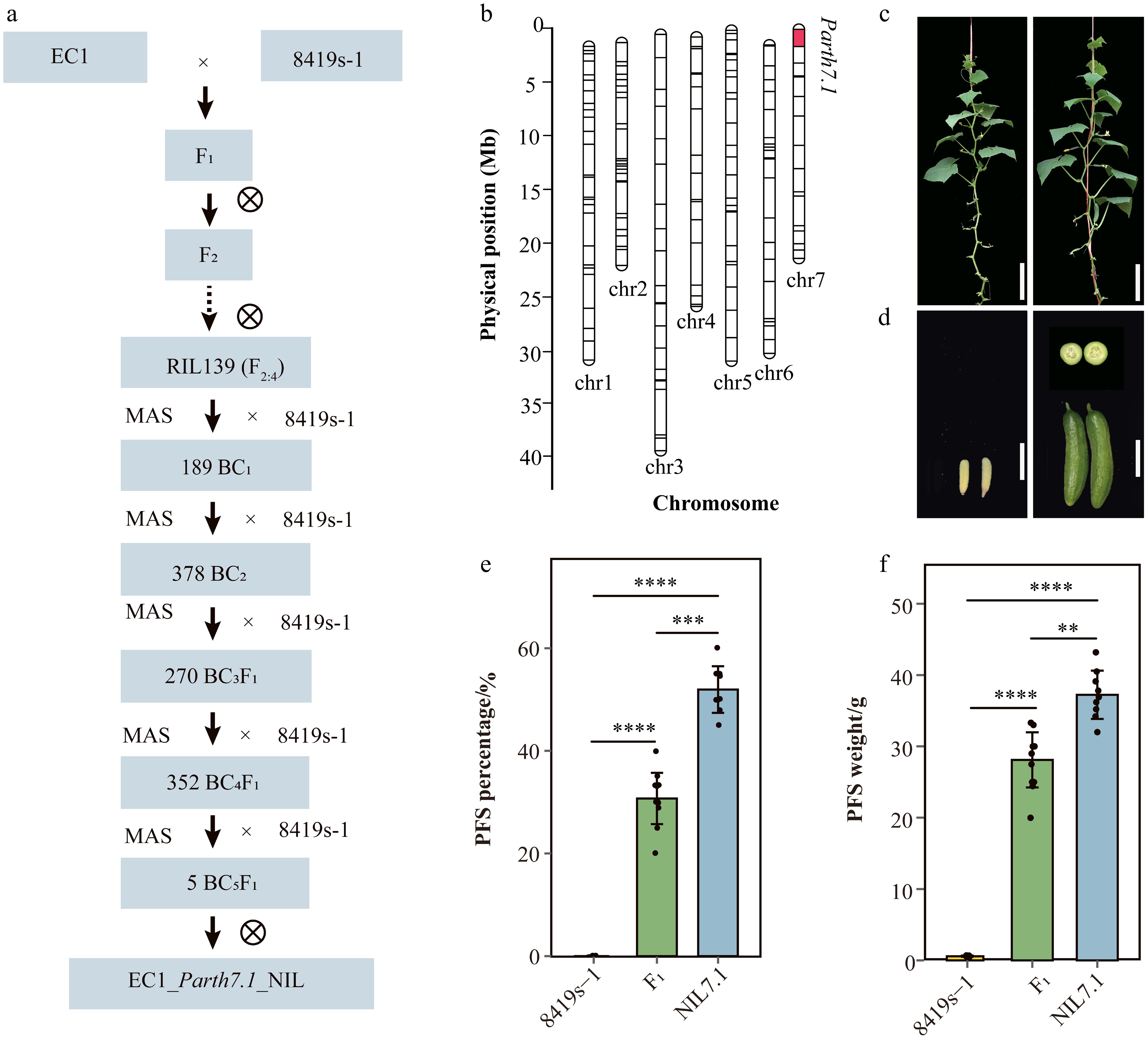
Figure 1.
The NIL7.1 associated with parthenocarpy in cucumber. (a) Schematic diagram of the generation of NIL7.1. (b) Genotyping of the NIL by 175 markers: the lines indicate the physical position of markers on the draft genome of 9930 V3.0. (c), (d) Plants and parthenocarpic fruit of NIL7.1 and 8419s-1 at 10 DPA. The white bars in (c) and (d) represent 20 and 2 cm, respectively. (e), (f) PFS percentage and weight of NIL7.1, F1 hybrid of NIL7.1 × 8419s-1, and 8419s-1 at 10 DPA. The **, ***, and **** indicate significant differences at p < 0.01, p < 0.001, and p < 0.0001, respectively.
All cucumber parthenocarpic mapping populations, parental lines, and NIL7.1 employed in this study were grown in plastic greenhouses at the Baima Experimental Base of Nanjing Agricultural University (31.65° N, 119.02° E). Planting was conducted during two conventional growing seasons: spring (March–June) and autumn (August–October). A randomized complete block design was implemented for all experiments, with a row spacing of 80 cm and an intra-row spacing of 30 cm. Standard horticultural practices, including drip irrigation and integrated pest and disease management, were applied throughout the growing period in accordance with established cucumber cultivation protocols.
Phenotypic evaluation of parthenocarpy
-
Individual plants from the mapping population, 8419s-1, NIL7.1, and F1 of NIL7.1 × 8419s-1, were selected to evaluate parthenocarpic ability according to the methods described by Wu et al.[19] and Zhu et al.[20]. In brief, all female flowers from the 6th to the 40th fruit node on each plant were tagged with colored metal wire to prevent pollen contamination before anthesis. Parthenocarpic phenotypes were evaluated at 10–12 d after anthesis (DPA). The tagged ovaries that showed any signs of growth and expansion were classified as parthenocarpic fruits, whereas those that exhibited obvious fruit abortion were counted as non-parthenocarpic fruits. The parthenocarpic ability of each plant was measured by parthenocarpic fruit set (PFS) rate, calculated as:
$ \dfrac{\text{Number of parthenocarpic fruits}}{\text{Total trapped ovaries}}\times 100{\text{%}} $ Genomic DNA extraction and PCR amplifications
-
To accelerate mapping population development, cotyledons were collected from each plant, including the mapping population, EC1, 8419s-1, and NIL7.1. Genomic DNA of these plants was extracted using a modified CTAB protocol[23]. All PCR amplifications were carried out using 2 × PCR MasterMix (YEASEN, Nanjing, China). Amplified products of PCR were separated by polyacrylamide gel electrophoresis. All primer sequences used for amplification and sequencing are listed in Supplementary Table S1.
QTL detection and fine mapping of Parth7.1
-
QTL detection for cucumber parthenocarpy was conducted using composite interval mapping in the R/qtl package with phenotype data of the BC3F1 population. The QTL threshold was calculated on the basis of 1,000 permutations, and the intervals of significant QTLs were determined using a 1.5 LOD interval. For fine mapping of Parth7.1, novel polymorphic markers (InDels and SNPs) were developed based on the resequencing reads of EC1 and 8419s-1[19]. These molecular markers were used to genotype the fine-mapping population and to screen for recombinant individuals. The genotype and phenotype data of recombinant individuals allowed the target gene to be narrowed down to a smaller region.
Prediction of candidate genes of Parth7.1
-
Within the mapped 111.2-kb interval for Parth7.1, all annotated genes were obtained from the 9930V3.0 genome[24]. First, we screened for genes harboring non-synonymous mutations in coding sequences or InDels/SNPs in promoter regions using published genome resequencing data of EC1 and 8419s-1[19]. Second, we analyzed the expression levels of these candidate genes using published transcriptome data generated from parthenocarpic ovaries of EC1 and 8419s-1[25]. Genes with non-synonymous mutations or promoter variants associated with gene expression were identified as the predicted candidate genes.
Analysis of gene expression
-
Total RNA of parthenocarpic fruit of NIL7.1 and 8419s-1 at 2 DPA was extracted as described in the text by using TRIzol (Invitrogen, USA) according to the manufacturer's instructions, and reverse transcribed using a First Strand cDNA Synthesis Kit (Fermentas). The qRT-PCR was performed as described in a previous study[19] using a SYBR Premix Ex Taq™ Kit (TaKaRa) in a Bio-Rad iQ1 Real-time PCR system (Bio-Rad). To characterize the transcriptional profiles of CsBZS1 and the other five candidate genes, qRT-PCR primers were designed against the cucumber 9930 V3.0 reference genome[24] using Primer 5.0 software. Quantitative real-time PCR was performed using ChamQ Universal SYBR qPCR Master Mix (Q711; NOVAZON, Nanjing, China) in a 10-μL reaction volume on a CFX96 Touch Real-Time PCR Detection System (Bio-Rad, Hercules, CA, USA). All cDNA samples were normalized to a uniform concentration of 400 ng/μL prior to amplification. The constitutively expressed CsActin (CsaV3_2G018090) served as the endogenous control. Each biological sample was analyzed in technical triplicate. Relative transcript abundance was determined using the 2−ΔΔCᴛ method[26].
Quantification of endogenous brassinosteroids
-
Parthenocarpic cucumber fruit were harvested at −2, 0, and 2 DPA. Samples were immediately flash-frozen in liquid nitrogen and homogenized to a fine powder under cryogenic conditions. For each sample, endogenous BRs were extracted using 1 mL of methanol/water/formic acid (15:4:1, v/v/v) according to the protocol of Oklestkova et al.[27]. Quantification of epibrassinolide (EBR) was performed on a coupled ultra-performance liquid chromatography–tandem mass spectrometry system (LC–MS/MS, Applied Biosystems 6500 Triple Quadrupole). Data acquisition and processing were conducted at the State Key Laboratory of Crop Genetics and Germplasm Enhancement, Nanjing Agricultural University. All results of EBR treatments were presented as mean ± SE of three biological replicates and three technical replicates.
Application of exogenous phytohormones to cucumber fruit
-
Based on the experimental results of the previous study conducted by our research group on the effects of different concentrations of hormones and polyamines on fruit development, ovaries of the near-isogenic line NIL7.1 and the 8419s-1 were treated with 0.02 μM EBR (Shanghai Yuanye Bio-Technology Co., Ltd.) at −2 DPA. All treatments were applied via fine-mist foliar spray, followed immediately by emasculation and floral clamping to prevent pollination. A second identical treatment was administered 2 d later. The experiment comprised three independent biological replicates; each replicate consisted of five genetically distinct plants, and exactly three ovaries per replicate were treated uniformly on the same day. Phenotypic data on parthenocarpy were recorded at 10 DPA. Control plants received mock treatments, with no exogenous phytohormones added.
Promoter activity assay
-
The 2,000-bp promoter fragments of CsBZS1 from NIL7.1 and 8419s-1 were inserted into the pGreenII 0800-LUC vector, in which the firefly luciferase (LUC) reporter is controlled by the target promoter and the Renilla luciferase (REN) is driven by the 35S promoter for internal normalization. The resulting constructs were introduced into Agrobacterium tumefaciens GV3101 and infiltrated into tobacco leaves. After 72 h, LUC and REN activities were detected using a Dual-Luciferase Reporter Assay Kit (YEASEN, China). The ratio of LUC to REN was calculated to assess promoter activity.
Statistical analysis of phenotypic data
-
Data analysis in this study was performed using Excel (Microsoft Office) and R (v4.5.2). An χ2 goodness-of-fit test was performed using the CHITEST procedure in Excel. Combination plots of scatter and bar charts were generated using the ggplot2 package. The significance of the mean values was calculated between two groups via the Wilcoxon test in R. The significance of the mean values was calculated among multiple groups (n > 2) via the Kruskal–Wallis test in R.
-
In a previous study, to genetically detect the QTLs for parthenocarpy, an F2 mapping population was constructed by crossing EC1 and 8419s-1 (Fig. 1a). A parthenocarpy QTL, Parth7.1, was detected on chromosome 7[19]. In this study, to fine-map Parth7.1, we developed a near-isogenic line EC1_Parth7.1_NIL (NIL7.1) via MAS by introducing the donor parent EC1 allele into the recurrent parent 8419s-1 (Fig. 1a, b). We selected 186 polymorphic SSR and InDel markers evenly distributed across the cucumber genome to check the genetic background of NIL7.1 (Fig. 1b; Supplementary Table S1). NIL7.1 exhibited only a target region from the donor parent line EC1, while all other regions were the same as the recurrent parent 8419s-1 (Fig. 1b; Supplementary Fig. S1). Compared with 8419s-1, NIL7.1 could set parthenocarpic fruit and exhibited a significant increase in parthenocarpic ability, whereas no significant differences were observed in other agronomic traits under field conditions (Fig. 1c, d). The average PFS rate and fruit weight of NIL7.1 were 49.5% and 37.5 g at 10 DPA (Fig. 1e, f).
Genetic analysis of parthenocarpy of NIL7.1
-
To identify the genetic basis of NIL7.1, we developed a BC5F2 segregating population and evaluated PFS across parental lines (NIL7.1 and 8419s-1), F1, and the BC5F2 population. As shown in Table 1, NIL7.1 exhibited a parthenocarpic fruit set rate of 45.7%, the F1 hybrid showed 27.4%, and the recurrent parent 8419s-1 displayed no parthenocarpy (0%). Among the 457 BC5F2 population, 108 plants had non-parthenocarpic ability, and 349 had parthenocarpic ability, which was consistent with the expected 1:3 segregation ratio (χ2 = 0.455, p = 0.529), suggesting that incomplete dominance inheritance of NIL7.1 controls parthenocarpic variation in this population.
Table 1. The segregation of parthenocarpy in NIL7.1, 8419s-1, F1, and BC5F2 populations derived from the cross between NIL7.1 and 8419s-1.
Population Total Parthenocarpic lines Non-parthenocarpic lines Expected ratio χ2 p value NIL7.1 15 15 0 − − − 8419s-1 15 0 15 − − − F1 15 15 0 − − − BC5F2 457 349 108 3:1 0.455 0.529 Fine mapping of Parth7.1 in cucumber
-
In a previous study by Wu et al.[19], Parth7.1 was flanked by markers SSR30647 and SSR04689, with a physical interval of 0.61–4.79 Mb. During the development of NIL7.1, we re-evaluated the parthenocarpy QTL using data from the BC3F1 population and found that Parth7.1 was consistent with the previously mapped interval but was confined to a smaller region (Fig. 2a). In this refined interval, Parth7.1 was mapped between the markers InDel-45 and SSR14797, corresponding to a physical interval of 0.25–3.59 Mb. At the BC5F1 generation, we obtained five heterozygous NIL7.1 lines and narrowed down the Parth7.1 region to a 796.8-kb region, which was flanked by InDel-20Y-45 and InDel-20Y-17, corresponding to a physical interval from 190.2 to 987.1 kb (Fig. 2b; Supplementary Fig. S1). To further fine-map Parth7.1, we developed a BC5F2 segregating population and seven polymorphic InDel or SSR markers within the initial Parth7.1 region (Fig. 2c). The 13 recombinant individuals were identified using these markers and finally narrowed down Parth7.1 to a 111.2-kb region between markers SSR29620 and Indel-7. The 111.2-kb region contains 16 annotated genes based on the reference genome 9,930V3 (Fig. 2d).
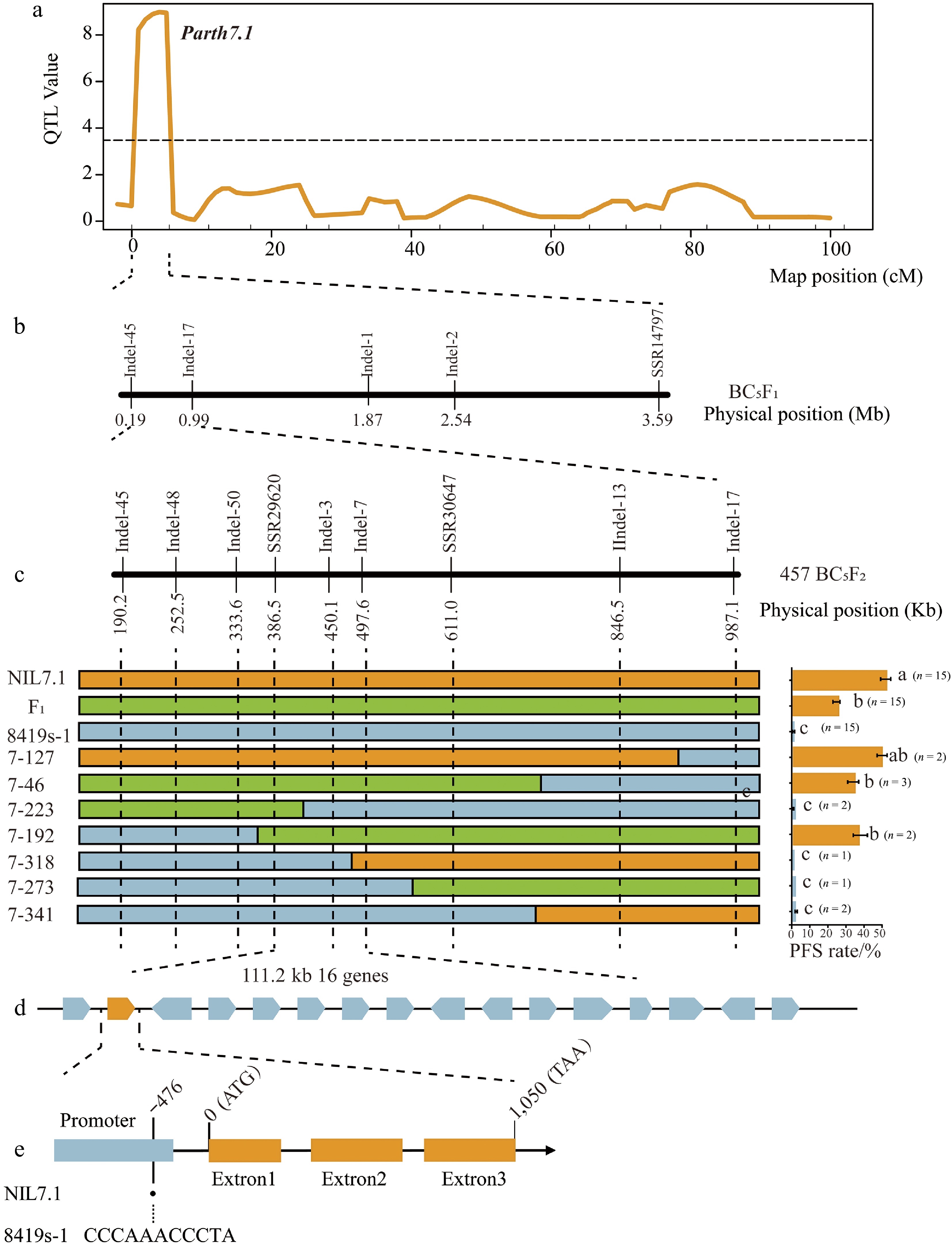
Figure 2.
Fine mapping and candidate gene analysis of the Parth7.1 locus. (a) QTL analysis of Parth7.1 using a BC3F1 population. (b) Linkage analysis with molecular markers on chromosome 7 placed Parth7.1 within a 3.7 cM interval flanked by Indel-45 and Indel-17 in the BC5F1 population. (c) Parth7.1 locus was narrowed down to a 111.2-kb region. N indicates the number of recombinant individuals. The significant differences at p < 0.05, as determined by the Wilcoxon test, are indicated by different letters. (d) Candidate genes within the 111.2-kb region of Parth7.1. (e) The key mutation site of candidate gene CsaV3_7G000270 (CsBZS1) identified by resequencing and RNA-seq data analysis of parent lines EC1 and 8419s-1.
Candidate gene analysis of the Parth7.1
-
Considering that mutations in coding sequence (CDS) and promoter regions can alter the gene function, we analyzed the sequence variations of the 111.2-kb region based on the re-sequencing data of EC1 and 8419s-1, and identified six candidate genes with non-synonymous mutations, including CsaV3_7G000280, CsaV3_7G000290, CsaV3_7G000340, CsaV3_7G000370, and CsaV3_7G000380 (Table 2). One candidate gene, CsaV3_7G000270, had an InDel in its promoter region. CsaV3_7G000270 encodes a B-box zinc finger protein, which plays important roles in the BR signaling pathway. CsaV3_7G000280 encodes kinesin-related protein 11, which is involved in microtubule-based movement. CsaV3_7G000290 encodes an RNA-binding CRM domain protein, which is involved in ribosomal large subunit assembly. CsaV3_7G000340 encodes a zinc finger CCCH domain-containing protein 19, which plays a central role in integrating RNA silencing and chromatin signals. However, the functions of CsaV3_7G000370 and CsaV3_7G000380 were unknown.
Table 2. Candidate gene analysis of Parth7.1 based on deep whole resequencing and RNA-seq data of parent lines.
Gene ID Position Region Whole re-sequence data analysis RNA-seq data analysis Annotation DNA mutant
(REF→ALT)Protein mutant
(REF→ALT)Mutant type log10
(EC1/8419s-1)CsaV3_7G000270 395282 Promoter CCCAAACCCTA→. − InDel 3.1* B-box zinc finger family protein CsaV3_7G000280 403189 Exon T→C Thr→Ala Nonsynonymous 0.124 Kinesin-related protein 11 CsaV3_7G000290 419734 Exon T→C Ser→Pro Nonsynonymous 1.54* RNA-binding CRM domain protein CsaV3_7G000340 447415 Exon C→T Asp→Asn Nonsynonymous 0.241 Zinc finger CCCH domain-containing
protein 19CsaV3_7G000370 472624 Exon G→C Arg→Pro Nonsynonymous 0.054 Laminin subunit alpha-1 CsaV3_7G000380 484364 Exon T→A Phe→Ile Nonsynonymous 0.078 Unknown protein * indicates a significant difference at p < 0.05 in RNA-seq data analysis. To further determine the expression levels of these candidate genes, we analyzed published transcriptome data. Among them, CsaV3_7G000270 and CsaV3_7G000290 were significantly upregulated in parthenocarpic fruit of EC1 relative to non-parthenocarpic 8419s-1 (Table 2; Supplementary Fig. S2). Furthermore, we examined the expression levels of these genes in parthenocarpic fruit and revealed that only CsaV3_7G000270 exhibited significantly higher expression in NIL7.1 compared with that of 8419s-1 (Fig. 3). Collectively, we speculate that CsaV3_7G000270 may regulate cucumber parthenocarpy through transcriptional regulation.
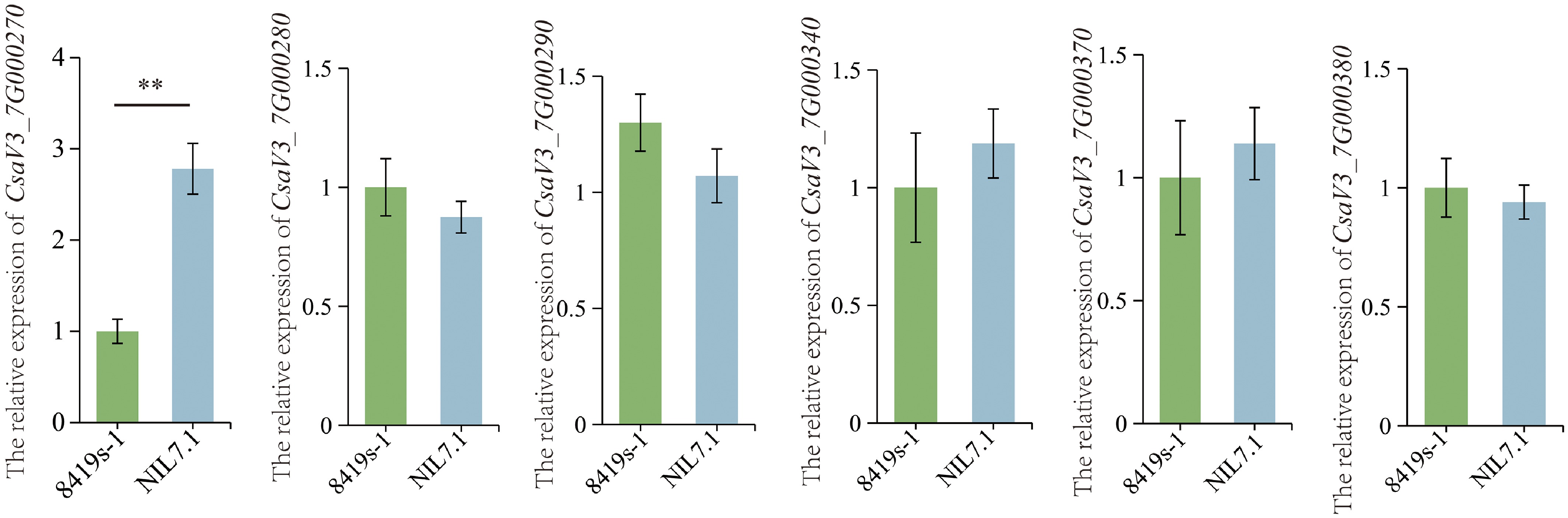
Figure 3.
The expression levels of five candidate genes for Parth7.1. The expression was examined in parthenocarpic fruit of NIL7.1 and 8419s-1 at 2 d after anthesis. Each experiment was repeated independently three times. The *** indicates a significant difference at p < 0.001.
CsBZS1 is the key functional candidate gene of Parth7.1
-
BRs are closely associated with parthenocarpy in plants. As an important transcription factor in the BR signaling pathway, CsBZS1 may regulate parthenocarpy in cucumber. To test this hypothesis, we first measured the content of EBR in NIL7.1 and 8419s-1 using LC-MS and found that the EBR content in the ovaries of NIL7.1 parthenocarpic fruits at different developmental stages was significantly higher than that in 8419s-1 (Fig. 4a). In addition, exogenous application of EBR induced parthenocarpic fruit set in 8419s-1 and significantly enhanced its parthenocarpic ability, with the PFS ratio increasing from 12.5% to 38.4%, although it remained lower than that of NIL7.1 (Fig. 4b, c). Furthermore, we examined the expression level of CsBZS1 in parthenocarpic fruit of 8419s-1EBR plants and observed that its expression was significantly higher than that in 8419s-1 (Fig. 4d). To determine whether the promoter mutation of CsBZS1 affects its promoter activity, we performed a promoter activity assay and observed that the CsBZS1 promoter activity was higher in NIL7.1 than in 8419s-1. These results indicate that CsBZS1 is a promising candidate gene for Parth7.1, and that its promoter mutation influences gene expression, thereby regulating parthenocarpy in cucumber.
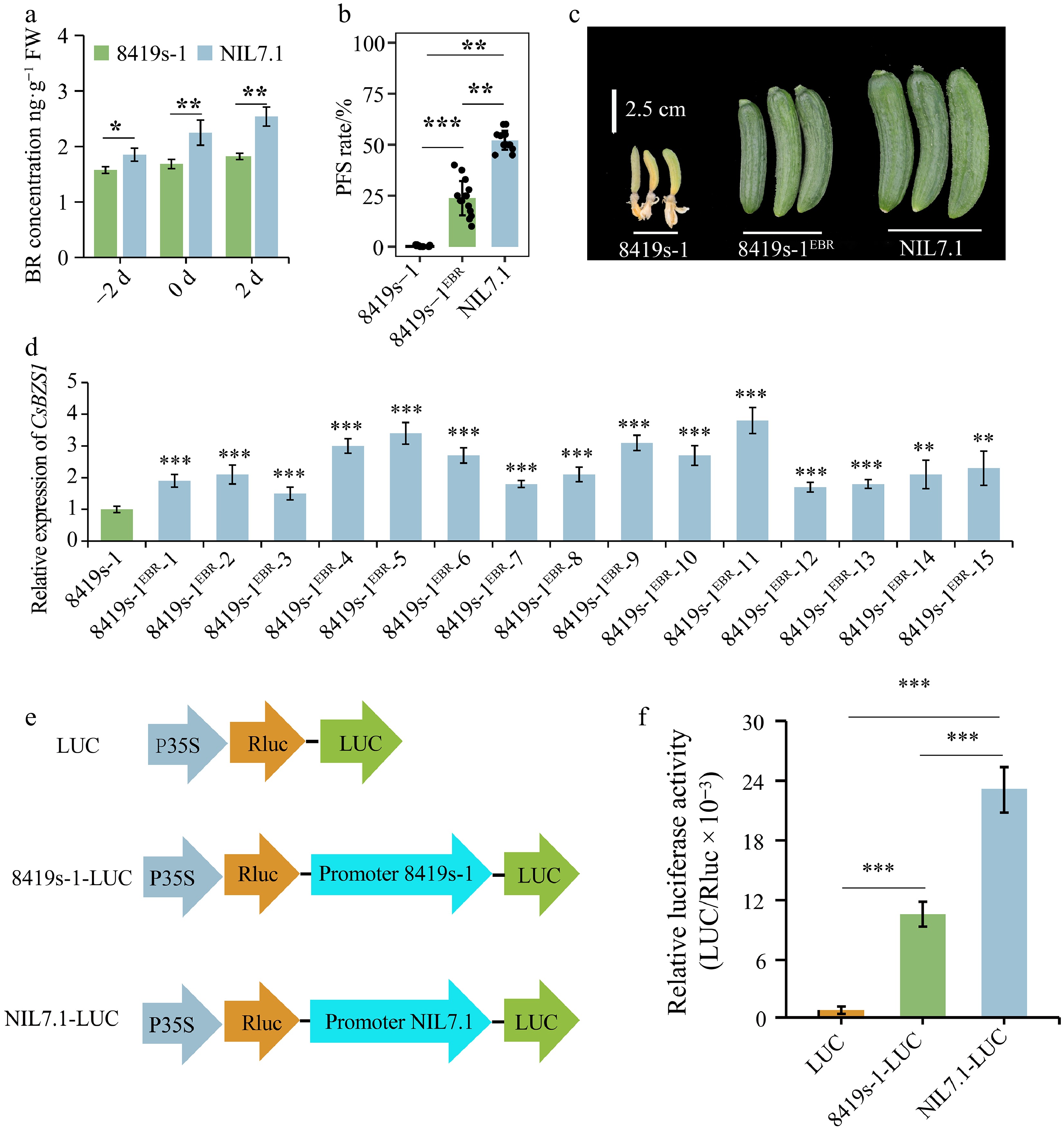
Figure 4.
CsBZS1 is proposed as a promising candidate gene for Parth7.1. (a) The EBR concentration of 8419s-1 and NIL7.1. Each experiment was repeated independently three times. (b) The PFS rate of EBR-treated 8419s-1 (8419s-1EBR). The 8419s-1 and NIL7.1 were control groups with water treatment. Each experiment was repeated independently with 15 plants. (c) The typical parthenocarpic fruit among the 8419s-1, 8419s-1EBR, and NIL7.1 groups. (d) The relative expression levels of CsBZS1 in parthenocarpic fruits between the 8419s-1 and 8419s-1EBR groups. Each experiment was repeated independently three times. The **, and *** indicate significant differences at p < 0.01 and p < 0.001, respectively. (e) Schematic diagram of the promoter activity assay. (f) LUC relative activities driven by promoters of CsBZS1 from NIL7.1 and 8419s-1. Each experiment was repeated independently three times. The *** indicates significant differences at p < 0.001.
-
Parthenocarpy is an agronomic trait that significantly affects crop yield and quality, and elucidating its genetic basis is of great importance for parthenocarpic breeding. Early studies suggested that parthenocarpy in cucumber is controlled by a single gene[28], whereas recent research has revealed that parthenocarpy is a complex trait coordinately regulated by genetic and environmental factors. To date, a total of 33 QTLs associated with parthenocarpy have been identified in cucumber. Several studies have reported that QTL Parth7.1 was detected repeatedly in different cucumber germplasms[19,20], indicating that Parth7.1 is an important locus regulating parthenocarpy. However, due to interactions among these QTLs, most of them have not yet been fine-mapped or cloned.
The NIL is an important genetic material for fine mapping of individual QTLs and cloning candidate genes[29,30]. The NIL retains most of the genetic background of the recurrent parent while carrying only a specific QTL segment from the donor parent, thereby significantly reducing interference from genetic background and allowing the effect of the target QTL to be detected and analyzed independently. In this study, we used the highly parthenocarpic line EC1 as the donor and the non-parthenocarpic line 8419s-1 as the recurrent parent to construct the NIL for Parth7.1. Phenotypic analysis showed that NIL7.1 exhibited significantly higher parthenocarpic fruit set ability than the recurrent parent 8419s-1, and genetic basis analysis revealed that parthenocarpy associated with Parth7.1 was controlled by a single dominant gene. Finally, we fine-mapped the cucumber parthenocarpy QTL Parth7.1 to a 111.2-kb region on chromosome 7.
Parthenocarpy in cucumber is closely associated with plant hormones. Exogenous application of plant growth regulators, including auxins, cytokinins, gibberellins, brassinosteroids, and ethylene biosynthesis inhibitors, has been shown to promote or regulate parthenocarpic fruit growth in cucumber[12−14,25]. Several auxin-related genes have been confirmed to be involved in the regulation of parthenocarpy; overexpression of the auxin transporter gene CsPIN2 and auxin-responsive genes CsARF10 can induce parthenocarpy in both cucumber and tomato[10]. In a recent study, Nie et al.[4] identified an AP2 family gene, CsNPF1, which is involved in the auxin signaling pathway. Knockout of CsNPF1 in the parthenocarpic cucumber line Cu2 using gene editing technology significantly reduced its parthenocarpic capacity. Furthermore, the auxin biosynthesis gene CsYUC4 was found to bind to the promoter region of CsNPF1, thereby regulating parthenocarpy. Zhu et al.[20] identified an ethylene signaling-related gene, CsERT2, through GWAS, and downregulation of CsERT2 expression was shown to enhance parthenocarpic ability. Although brassinosteroids can induce parthenocarpic fruit development in cucumber, the underlying molecular mechanism remains unclear. In this study, we found that the endogenous BR content in the near-isogenic line NIL7.1 was significantly higher than that in 8419s-1. Similarly, exogenous BR treatment was also able to induce parthenocarpic fruit set in 8419s-1. These results suggested that the parthenocarpy-associated gene controlled by NIL7.1 might be a BR signaling-related gene. Subsequently, through fine mapping of NIL7.1, we confirmed this hypothesis and successfully identified CsBZS1 as a key candidate gene involved in BR signaling.
Several studies have revealed that BZS1 is characterized as a negative regulator in the BR-signaling pathway and a positive regulator of the light-signaling pathway in Arabidopsis[31,32]. In contrast, we found that CsBZS1 was highly expressed in BR-induced parthenocarpic fruit, indicating that CsBZS1 acts as a positive regulator in BR signaling. Furthermore, we examined the expression levels of CsBZS1 in published transcriptome data of parthenocarpic fruit, all of which showed significant upregulation. These results suggest that CsBZS1 may play an opposite role in response to BR signaling compared with its homologous gene BZS1 in Arabidopsis.
BZS1 proteins are characterized by the presence of one or two conserved BBX domains at the N-terminus, which play critical roles in transcriptional regulation and protein–protein interactions[33−35]. BBX proteins have been shown to be involved in various aspects of plant growth and development, including photomorphogenesis, flowering regulation, signal transduction, and responses to abiotic and biotic stresses. BZS1/BBX20 interacts with the positive regulator of light signaling HY5 and mediates strigolactone regulation of photomorphogenesis[36]. BZS1/BBX18 interacts with APX proteins and binds to a cis-element in the APX1 promoter, leading to the repression of APX1 expression and thereby enhancing tomato sensitivity to drought stress[37]. In this study, we have only characterized the potential function of CsBZS1 in the regulation of parthenocarpy. Sequence analysis revealed a 15-bp deletion in the promoter region of CsBZS1 in NIL7.1 compared with 8419s-1, suggesting that this mutant site may affect transcriptional regulation by upstream transcription factors. Furthermore, a promoter activity assay confirmed that the promoter activity of NIL7.1 was significantly higher than that of 8419s-1, which may explain the higher expression level of CsBZS1 in NIL7.1 than that of 8419s-1. Future studies will focus on how the 15-bp promoter deletion affects the transcriptional regulation of CsBZS1 by upstream transcription factors, and how CsBZS1 mediates downstream BR signaling to regulate parthenocarpy.
-
In this study, we fine-mapped a cucumber parthenocarpy QTL, Parth7.1, and narrowed it down to a 111.2-kb region on chromosome 7. In addition, we identified CsBZS1 as the key candidate gene underlying Parth7.1 through whole-genome resequencing data, RNA-seq data, parental BR content measurement, and BR treatment. Taken together, this study provides important resources for cucumber parthenocarpy breeding and offers critical evidence for dissecting the molecular mechanism by which BR signaling regulates parthenocarpy.
-
The authors confirm their contributions to the paper as follows: methodology, formal analysis, draft manuscript preparation: Jing X, Zhu P; data curation: Zhu P; investigation: Zhu P, Wang S, Ma H, Gu S, Zhang H, Li M; validation: Dong B, Wang W, Sang M; conceptualization, writing − review and editing, supervision, resources: Ji Li. All authors reviewed the results and approved the final version of the manuscript.
-
All data generated or analyzed during this study are included as supplementary materials.
-
Although author Hai Zhang is an employee of Nanjing Agricultural Innovation Park Science and Technology Investment Group Co., Ltd., and author Maopeng Sang is an employee of Lhasa Qushui County Jingzhi Maoteng Agricultural Technology Co., Ltd., the work presented in this article constitutes independent academic research, unrelated to the commercial interests of these companies. The authors affirm that no financial or contractual agreements between the companies and the authors or their institutions have influenced the design, outcomes, or reporting of this study.
-
accompanies this paper online at: https://doi.org/10.48130/ph-0026-0019.
-
# Authors contributed equally: Xiaotong Jing, Pinyu Zhu
- Supplementary Table S1 Primer sequences used in this study.
- Supplementary Fig. S1 Five NILs for Parth7.1 identified in BC5F1 population.
- Supplementary Fig. S2 Candidate genes analysis of Parth7.1 based on RNA-seq data of parent lines.
- Copyright: © 2026 by the author(s). Published by Maximum Academic Press on behalf of Chongqing University. This article is an open access article distributed under Creative Commons Attribution License (CC BY 4.0), visit https://creativecommons.org/licenses/by/4.0/.
-
About this article
Cite this article
Jing X, Zhu P, Wang S, Wang W, Ma H, et al. 2026. Identification of CsBZS1, a BR signaling transcription factor that promotes parthenocarpy in cucumber (Cucumis sativus L.). Plant Hormones 2: e020 doi: 10.48130/ph-0026-0019 

Identification of CsBZS1, a BR signaling transcription factor that promotes parthenocarpy in cucumber (Cucumis sativus L.)
- Received: 03 April 2026
- Revised: 02 June 2026
- Accepted: 30 June 2026
- Published online: 18 August 2026
Abstract: Parthenocarpy is a key agronomic trait that enhances both cucumber yield and quality. Brassinosteroids (BRs) play important roles in regulating fruit development. However, the underlying molecular mechanism remains largely unclear. In the present study, CsaV3_7G000270 (CsBZS1), a transcription factor involved in the BR signaling pathway, was identified as a candidate parthenocarpy gene in cucumber (Cucumis sativus L.) through a map-based cloning procedure using a BC5F2 population derived from a highly parthenocarpic line EC1 and a non-parthenocarpic line 8419s-1. A 15-bp deletion in the promoter region of CsBZS1 might explain the promotion of parthenocarpy by leading to significantly higher expression levels of CsBZS1 in the parthenocarpic line than in the non-parthenocarpic line. Furthermore, we found that BR treatment induced parthenocarpy in the non-parthenocarpic line, and the expression level of CsBZS1 was markedly increased in BR-treated parthenocarpic fruits. These findings suggested that CsBZS1 may serve as a key entry point for unraveling the BR-mediated regulatory mechanism of parthenocarpy and will also provide a novel target gene resource for improving parthenocarpy in cucumber.
-
Key words:
- Cucumber /
- Parthenocarpy /
- Brassinosteroids /
- Map-based cloning /
- CsBZS1