













-
Grapes (Vitis vinifera), as one of the most widely cultivated fruits worldwide, hold significant importance in the economic and agricultural domains. Globally, grape cultivation not only provides abundant raw materials for the food industry but has also contributed substantially to the development of the wine industry. Wine, a time-honored beverage, carries profound cultural significance and exhibits notable economic value. However, as vineyard acreage expands and the regional workforce contracts under accelerating demographic aging, the scarcity of agricultural labor and the attendant surge in production costs have become the foremost constraints on local wine-sector growth in this region.
The canopy refers to the collective term for the leaf population of grapevines. During grape growth and development, canopy management techniques play critical roles, which include shoot thinning, leaf removal, and pruning systems, contributing to improving light conditions and air circulation within the canopy, thereby optimizing photosynthesis and reducing disease risk[1]. In addition, canopy management plays a pivotal role in optimizing the microclimate within vineyards, which directly affects grape growth, fruit ripening, and final wine quality[2]. As a core agronomic practice in viticulture, it involves targeted adjustments to the structure, density, and spatial distribution of grapevine canopies, thereby mitigating the limitations of unfavorable macroclimates and creating a microenvironment tailored to the physiological needs of grapes[3]. Summer pruning is one of the most important canopy management practices, focusing on regulating canopy thickness, height, shoot spacing, and lateral shoot growth to optimize microclimatic conditions; thus, it effectively enhances both grape yield and berry quality. Leaf removal, a widely adopted canopy management practice, has been shown to improve the grape composition and wine quality of several grape genotypes[4,5]. For instance, Palliotti et al.[6] demonstrated that leaf removal markedly increases the content of total soluble solids, anthocyanins, and polyphenolic components in Ciliegiolo grapes. Specifically, summer leaf removal exposes grapes to sunlight, and these sun-exposed berries exhibit significantly higher concentrations of secondary metabolites, a key contributor to fruit color and flavor, compared with shaded clusters[7]. An excessive number of leaves can lead to exuberant vegetative growth and a decline in fruit quality. Therefore, canopy management is crucial in summer grapevine management. However, with the increasing scale of wine grape growing and an aging population, labor shortages and the consequent high production costs have become the primary challenge for the wine industry regarding manual removal.
Mechanical summer pruning has been shown to be the way forward for the modern wine industry as it demonstrates significant benefits, including increased pruning efficiency and reduced labor costs[8]. In mechanical canopy management, the distinction between main and lateral shoots is typically discarded. Instead, canopy control focuses exclusively on total leaf quantity within predefined thickness and height parameters, regardless of whether the leaves originate from main or lateral shoots. Therefore, mechanical summer pruning techniques can be employed to rapidly and consistently construct a suitable leaf canopy structure. This approach not only enhances the effectiveness of grapevine management but also further improves the quality of fruit[9]. This technique is emerging as a key breakthrough in improving the quality of wine grape material. Mechanical pruning exerts distinct impacts on grape and wine quality compared with manual pruning. Several prior studies have indicated that the accumulation of total soluble solids in berries from mechanically pruned vineyards proceeds at a slower rate than that in vineyards managed via manual pruning[10]. This phenomenon is ascribed to a combination of factors, including a higher crop load coupled with shorter shoots, as well as an increased number of leaf layers that shade the fruit clusters[11]. In a separate study, Parker et al.[12] also observed that reducing the canopy size of 'Pinot Noir' vines via mechanical pruning resulted in a delayed accumulation of total soluble solids. This increased leaf exposure also facilitates the upregulation of the flavonoid biosynthesis pathway[13]. Consequently, ensuring an appropriate canopy thickness through mechanical summer pruning holds significant importance for maintaining grape quality in the wine industry.
Phenolic compounds, key products of grape secondary metabolism, influence wine quality through both their composition and spatial distribution. The principal phenolic classes in grapes include phenolic acids, anthocyanins, tannins, and other flavonoids. Canopy architecture shapes the heterogeneous distribution of phenolics within berry tissues; for example, studies conducted abroad on mechanical canopy pruning indicate that appropriately reducing canopy size can slow the accumulation of soluble solids, increase titratable acidity, delay overall ripening, and alter total anthocyanin and other phenolic contents[12]. However, due to differences in ecological conditions and vineyard management, these systems cannot be directly transferred to domestic production. It is therefore necessary to identify management strategies suited to local environments. As the wine-grape industry transitions from labor-intensive practices to mechanization, such knowledge is particularly timely.
In this study, we evaluated different canopy thicknesses achieved through mechanical canopy pruning and examined their effects on the phenolic composition in grape berries and wine. The study was conducted in the northern foothills of the Tianshan Mountains, Xinjiang, one of the prominent wine regions with arid and semiarid conditions, located at approximately 44° N, a latitude often referred to as the 'Golden Belt' for wine-grape cultivation in China. The region's climatic conditions favor an optimal balance of sugars and acids, as well as substantial dry-matter accumulation, providing a unique environment for high-quality wine-grape production. 'Merlot', the predominant cultivar in this area, was used as the experimental material. From 2023 to 2024, four canopy-thickness treatments (40, 60, 80, and 100 cm) were established to assess the effects of canopy thickness on vineyard microclimate, photosynthetic performance, and the synthesis of phenolics, flavonoids, anthocyanins, and related compounds in berries and wine. Our goal was to identify the optimal canopy thickness for mechanical pruning of 'Merlot' in this region to maximize production potential and improve overall berry and wine quality. The findings will provide a theoretical basis for canopy management at the study site and a practical reference for mechanical canopy pruning in other domestic regions with similar ecological and climatic conditions.
-
The experimental treatments were conducted at Anningqu Farm in Urumqi, Xinjiang, in 2023 and 2024, a region characterized by a temperate continental climate with an annual sunshine duration of 2,500–3,500 h, a diurnal temperature variation exceeding 15 °C, a mean annual temperature of 7.2 °C, annual precipitation ranging from 110 to 200 mm, and a frost-free period spanning 150–204 d.
The experimental variety 'Merlot' consists of own-rooted vines, which were planted in 2011 with a north–south row orientation and a spacing of 1.0 m × 3.2 m (within-row × between-row). Vines were trained to a slanting single-canopy trellis system and managed under uniform soil, fertilization, and irrigation practices, with mechanical pruning as the sole variable to regulate canopy thickness, using a mechanical summer pruning machine (1-ROW, COLLORD Company, France). During the fruit expansion stage, canopy thickness was mechanically trimmed every 7 d using a canopy trimmer. The experiment included four treatments: canopy thickness levels of 40 cm (M40), 60 cm (M60), 80 cm (M80), and 100 cm (M100). Each treatment plot measured 8 m in length (containing 5–7 vines) and was replicated three times in a randomized complete block design.
Harvest and winemaking
-
The primary sensory criteria for harvesting fruit at the optimal physiological ripeness are uniform color, retention of natural bloom, plumpness and juiciness, and ease of detachment from the vine; the soluble solids are around 22 °Brix. Twenty clusters per replicate plot were selected for morphological evaluation; 500 berries per cluster were stratified-sampled, sealed, and stored at –40 °C for quality analysis. For winemaking, 60 kg of fresh berries (22 °Brix) per group were cold-chain transported for single-variety fermentation (three biological replicates), with a yield of 20 kg each. Berries were destemmed, crushed, and transferred to 30 L stainless steel tanks; 60 mg·L−1 sulfite and 30 mg·L−1 pectinase (Lallzyme Ex) were added for prefermentation. After 24 h cold maceration, 150 mg·L−1 yeast RC212 was inoculated for alcoholic fermentation (25 °C, 10 d, with skin maceration). Wine was pressed, settled for 15 d at room temperature, decanted for clarification, bottled, and aged for 1 month (12–15 °C, light-protected). Samples were decorked before analysis, with three parallel vinifications per group to ensure data reliability.
Photosynthesis analysis
-
To determine photosynthetic physiological parameters, a standardized sampling strategy was used. The fifth fully expanded functional and healthy leaf from the top of each grapevine shoot was selected within three biological replicates per treatment. Selected leaves were required to be at a uniform developmental stage, free from visible damage, and exposed to consistent light conditions. Photosynthetic parameters were measured using a CIRAS-3 portable photosynthesis system (PP Systems, USA) between 09:00 and 12:00 on sunny, windless days, with three technical replicates per leaf. The light response curve was dynamically analyzed, and light intensity was precisely adjusted using the built-in LED light source across 14 gradients (0, 50, 100, 150, 200, 350, 500, 750, 1,000, 1,300, 1,600, 1,900, 2,200, and 2,500 μmol·m−2·s−1). Each gradient value was calibrated in real time by the instrument's optical sensor. Environmental conditions within the leaf chamber were strictly controlled, with leaf temperature maintained at 28.0 ± 0.5 °C, and CO2 concentration dynamically regulated at 360 ± 10 μmol·mol−1.
Analysis of phenolic compounds in grapes and wine
-
The total phenolic content was quantified using the Folin-Shoka colorimetric method[14]. Tannin content was assessed by the methylcellulose method[15], and total anthocyanin concentration was determined using the double buffer pH differential method[16]. Flavan-3-ols were quantified by the p-DMACA method[17], while total flavonoids were determined according to Peinado et al.[17]. All extraction and measurements were performed under light-protected conditions.
Determination of monomeric anthocyanins
Sample extraction
-
Dried powder (0.03 g) was mixed with 1 mL of 50% aqueous methanol, ultrasonically extracted (30 °C, 40 kHz, 30 min, light-protected), and centrifuged (4 °C, 8000 ×g, 10 min). The process was repeated three times, and the combined supernatants were 0.22 μm-filtered for analysis.
High-performance liquid chromatography (HPLC) analysis
-
Monomeric anthocyanins were analyzed via Agilent 1290 Infinity HPLC (25 μL injection of filtered samples) on an EC-C18 column (5 μm, 150 mm × 4 mm). The mobile phase consisted of 10% formic acid in water (A)/methanol (B) with specified gradient elution. The separation was carried out with a column temperature of 40 °C and a flow rate of 1 mL·min−1. Detection was performed at 520 nm (triplicate analysis). The compounds were semi-quantified using a malvidin-3-O-glucoside standard and a calibration curve.
Anthocyanins were qualitatively identified by chromatographic elution order and MRM ion transitions using an Agilent 1290 HPLC-6470 triple quadrupole MS with consistent chromatographic conditions as above. ESI+ and MRM modes were adopted; key MS parameters are as follows: gas temp 300 °C, nebulizer 45 psi, spray voltage 3.5 kV, sheath gas 250 °C per 11 L per min. The performance of the method is presented in Supplementary Table S1.
Determination of non-anthocyanin monomeric phenolic components
Sample extraction
-
Dried grape skin powder (0.5 g) was mixed with 0.5 mL of distilled water and 4.5 mL of ethyl acetate, and shaken at 25 °C/130 rpm for 30 min (light-protected), then centrifuged at 8000 ×g for 5 min. This was repeated three times; the supernatants were combined, rotary-evaporated to dryness at 33 °C (4–5 h), redissolved in 2 mL of methanol, and 0.22 μm-filtered before analysis.
Detection
-
Chromatographic analysis was conducted on a Shimadzu LC2030CD system with a Zorbax SB-C18 column (250 mm × 4.6 mm, 5 μm). The mobile phases consisted of 1% formic acid in water (A) and pure acetonitrile (B). The analysis utilized an injection volume of 10 μL and a flow rate of 0.95 mL·min−1. The column temperature was maintained at 25 °C, and detection was performed at 280 nm. Gradient elution was carried out as follows: 3%–45% B (0–40 min), 45%–3% B (40–50 min). Non-anthocyanin phenolic compounds were quantified using the external standard method (Supplementary Table S2) with commercial standards for qualitative and quantitative analyses.
Data analysis
-
Data were organized and analyzed using SPSS 26.0 and Origin. SPSS 26.0 was used to perform one-way analysis of variance (ANOVA), and Duncan's test (p < 0.05) was used to assess the significance of differences between treatments (different letters indicate significant differences). Heat maps were created using Chiplot (
www.chiplot.online ). Bar charts, line charts, and radar charts were created using Origin software. -
The leaf canopy redistributes and filters the external environment, thereby generating distinct microclimatic conditions within different canopy zones. In the present study, significant differences in total leaf area values were observed among treatments. Compared with the 100 cm control, total leaf area was reduced by 46.24%, 65.95%, and 83.87% in the 40, 60, and 80 cm treatments, respectively (Supplementary Fig. S1a). Altered canopy structure substantially modified the berry-zone microenvironment. Berry-zone temperatures decreased with increasing canopy thickness (Supplementary Fig. S1b). In addition, relative humidity peaked under the densest canopy (100 cm), and declined in thinner treatments (40–80 cm) (Supplementary Fig. S1c).
Changes in canopy thickness altered both the intensity and spectral composition of light reaching the fruit surface. Photosynthetically active radiation (PAR) transmission to the fruit zone was inversely related to canopy thickness. During peak sunlight hours (10:00–18:00), PAR exhibited a unimodal pattern, with the greatest fruit-zone exposure observed under the thinnest canopy (40 cm) (Supplementary Fig. S1d). Net photosynthesis (Pn) differed significantly among treatments. Dense canopies (100 cm) exhibited higher efficiency under low light, whereas moderately dense canopies (80 cm) showed greater adaptability to high irradiance (Supplementary Fig. S1e).
The combined results showed that different cultivation treatments significantly affected the canopy development and environmental response characteristics of 'Merlot' grapes, as evidenced by the differences in parameters such as leaf area index, temperature and humidity in the interarbuscular microdomain, PAR, and leaf photosynthetic efficiency.
Basic quality traits of grapes and wine under different canopy thicknesses
Effect on the basic quality of grape berries
-
After mechanized pruning of 'Merlot' grapevine canopies at varying thicknesses, key fruit growth indicators including cluster length, width, transverse diameter, longitudinal diameter, and hundred-berry weight are shown in Supplementary Fig. S2. The results showed that different canopy thicknesses had no significant effect on fruit morphological characteristics (Supplementary Fig. S2a–S2j), except that, in terms of weight per 100 berries, the M80 and M100 treatments exhibited a slightly higher weight per 100 berries than the other two groups (Supplementary Fig. S2e, S2j). Regarding the content of soluble solids, the M60 treatment achieved the highest levels (Supplementary Fig. S3a, S3c). For total acid content, M100 exhibited the highest level in 2023, whereas M80 showed the highest level in 2024 (Supplementary Fig. S3b, S3d).
Effect on the basic quality of wine
-
For wine, we focused on four key parameters, including pH, alcohol content, titratable acidity, and volatile acidity, that collectively govern balance and quality. pH was significantly affected by canopy thickness. In both 2023 and 2024, the M40 treatment yielded the highest pH values (Supplementary Fig. S4a, S4e). Alcohol content was negatively correlated with canopy thickness. M40 and M80 produced significantly lower alcohol levels than M100 in both vintages (Supplementary Fig. S4b, S4f). Titratable acidity differed markedly among treatments in both vintages; the M40 treatment showed the lowest values, which were significantly lower than those of the M60 and M80 treatments (Supplementary Fig. S4c, S4g). Volatile acidity was influenced by canopy thickness. M100 consistently yielded the lowest amount, whereas M80 always registered the highest, indicating that excessive canopy thickness suppresses volatile-acid formation (Supplementary Fig. S4d, S4h).
Overall, the 60–80 cm canopy treatments delivered the best combined profile in both years: alcohol 12.5% vol, titratable acidity 5.2–5.6 g·L−1, and volatile acidity 0.6–0.7 g·L−1. Therefore, it is recommended to optimize organic-acid balance in 'Merlot' wine.
Accumulation of total phenolic compounds in grapes and wine under different canopy thicknesses
Effect on the total phenolic content of grapes
-
Phenols, predominantly localized in grape skins and seeds, play a pivotal role in determining wine color, structure, and potential health benefits through their antioxidant and cardioprotective functions. Our findings indicate that canopy thickness by mechanical management have an impact on the accumulation of phenolic compounds. Total phenolic content peaked under M80 (2024), whereas in 2023, the M40, M80, and M100 treatment groups yielded comparable levels (Fig. 1a, f). Flavonoids accumulated most under M80, reaching 18.99 mg·g−1 and 16.69 mg·g−1 across the two vintages, which were significantly higher than those under thinner or denser canopies (Fig. 1b, g). By contrast, flavan-3-ols reached their maximum under M60, which was 1.11–1.75 times higher than in the other treatments (Fig. 1c, h). Regarding anthocyanin content, the M80 treatment yielded the best results and was the most conducive to anthocyanin accumulation in 2024 (Fig. 1d, i). Data from both years showed that tannin content under the M40 canopy treatment was significantly higher than in the M60, M80, and M100 treatments (Fig. 1e, j).
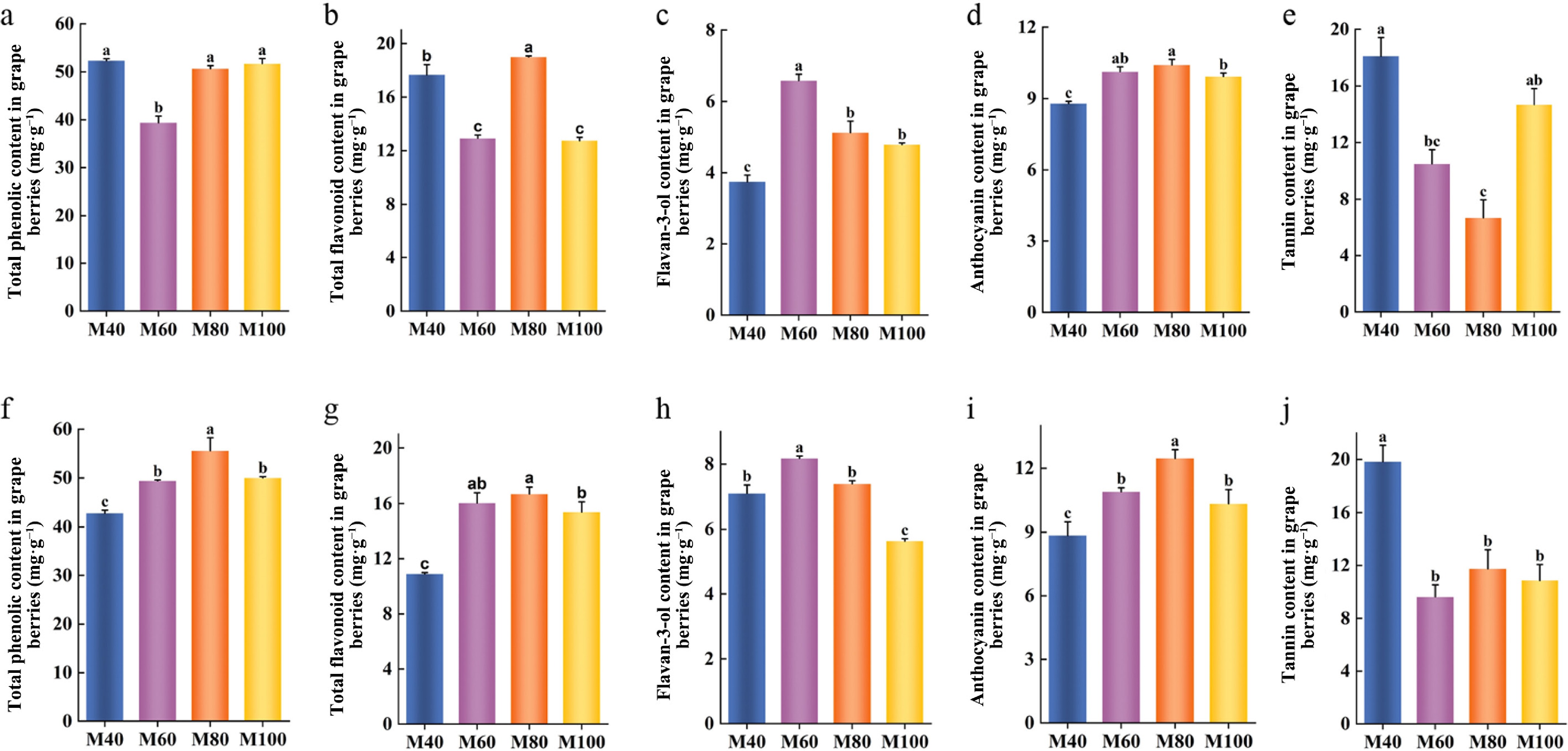
Figure 1.
Changes in total phenols, total flavonoids, and total flavan-3-ols in 'Merlot' grape berries under different canopy thicknesses. (a–e) illustrate the changes in the components in 2023; (f–j) illustrate the changes in the components in 2024. Bars show mean levels of three biological replicates (± SD). Different lowercase letters indicate levels of significance as determined by one-way ANOVA followed by Duncan's test: p < 0.05.
Overall, a thicker canopy (80 cm) promoted the accumulation of total phenolics, total flavonoids, and anthocyanins in most cases.
Effect on the total phenolic content of wine
-
The accumulation and concentration of phenolic compounds in wine are influenced by multiple factors such as cultivar, crop load, and climatic variables. In 'Merlot' wine, phenolic accumulation displayed clear canopy-dependent dynamics mediated by light–temperature microclimate regulation. Across both years, total phenols followed a biphasic pattern with canopy thickness, peaking under M60 and exceeding other treatments by 1.14–1.48 fold (Fig. 2a, f). Flavonoid and flavan-3-ol contents exhibited similar trends, with M60 consistently outperforming other groups in flavonoid accumulation (Fig. 2b, g), while flavan-3-ols ranked in the order M60 > M80 > M40 > M100 (Fig. 2c, h). In contrast, anthocyanins and tannins showed interannual variability in their optimal canopy configuration: M60 promoted the highest levels in 2023, whereas M80 dominated in 2024 (Fig. 2d, e, i, j), which suggests that anthocyanins and tannins are more sensitive to climatic fluctuations than other phenolic subclasses. Among the treatments, the M60 group emerged as the most stable configuration, reliably enhancing phenolic richness while buffering interannual variability.
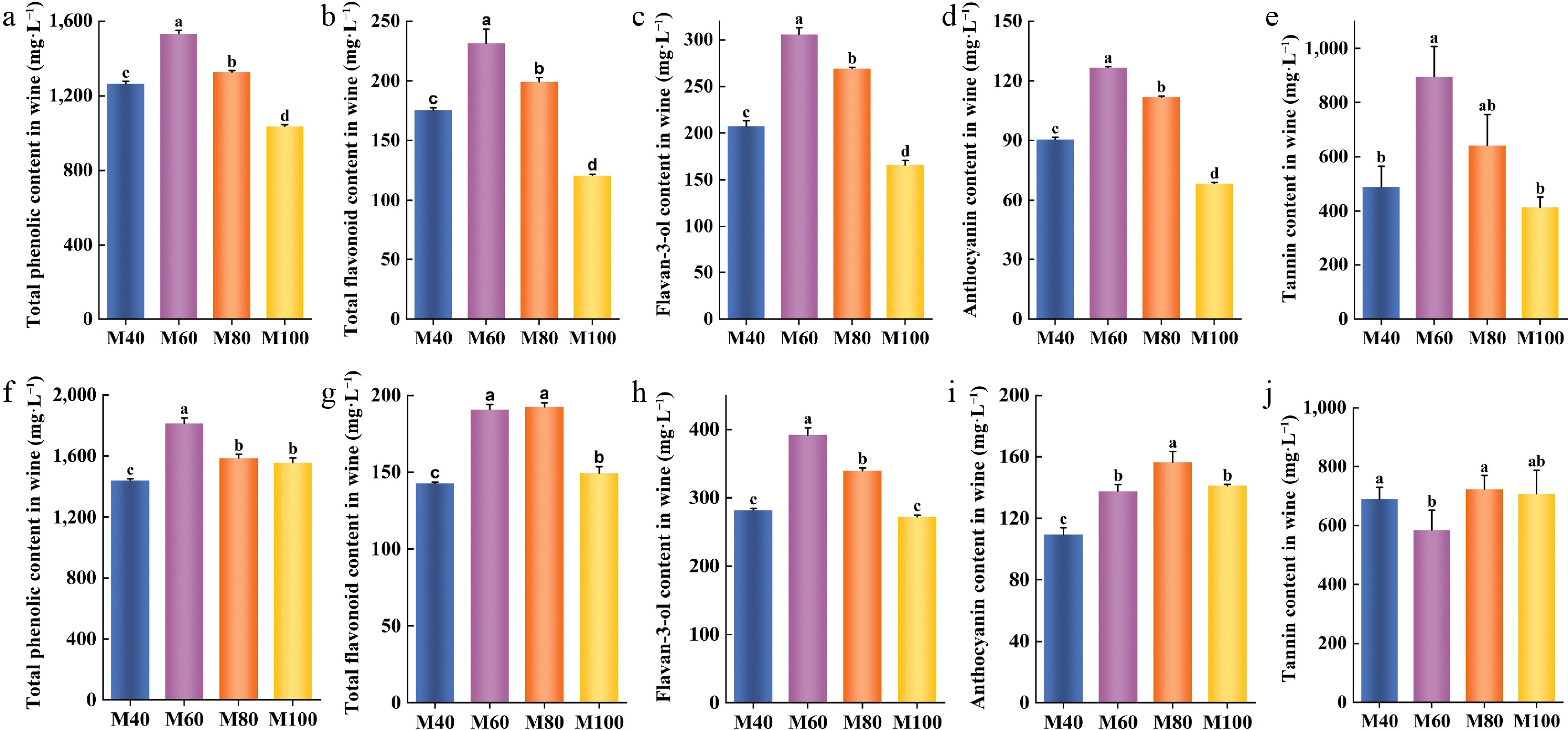
Figure 2.
Changes in total phenols, total flavonoids, total flavan-3-ols, total anthocyanins, and total tannins in 'Merlot' wine under different leaf canopy thicknesses. (a–e) show the changes in 2023; (f–j) show the changes in 2024. Bars show mean levels of three biological replicates (± SD). Different lowercase letters indicate levels of significance as determined by one-way ANOVA followed by Duncan's test: p < 0.05.
Profiles of monomeric anthocyanins in grapes and wine under different canopy thicknesses
Effect on monomeric anthocyanins in grapes
-
Monomeric anthocyanins, derived from grapes, are phenolic compounds found in the greatest concentration in young red wines and are also associated with potential health-promoting properties. To investigate distinct canopy-mediated monomeric anthocyanin profiles in 'Merlot' grape, HPLC analysis revealed that canopy thickness had a significant impact on the accumulation of anthocyanin constituents in the skins of 'Merlot' grapes. A total of 17 monomeric anthocyanins were identified in this study (Fig. 3 and Supplementary Table S3). Their concentrations exhibited the following patterns across the different treatment groups. M60 canopy thickness consistently yielded the highest total anthocyanin content. In this treatment group, both monosaccharides and acetylated glycosides accumulated at significantly higher levels than in other treatments, exceeding them by 22.06%–35.60% (Supplementary Table S3). By contrast, coumaroylated anthocyanins reached their maximum under M80 conditions (Fig. 3b, d), suggesting acyl-specific optimization and retention within a more buffered microclimatic environment. In addition, caffeoylated anthocyanins exhibited a nonsignificant difference across years or treatments, indicating that canopy thickness is not the primary determinant (Fig. 3b, d).
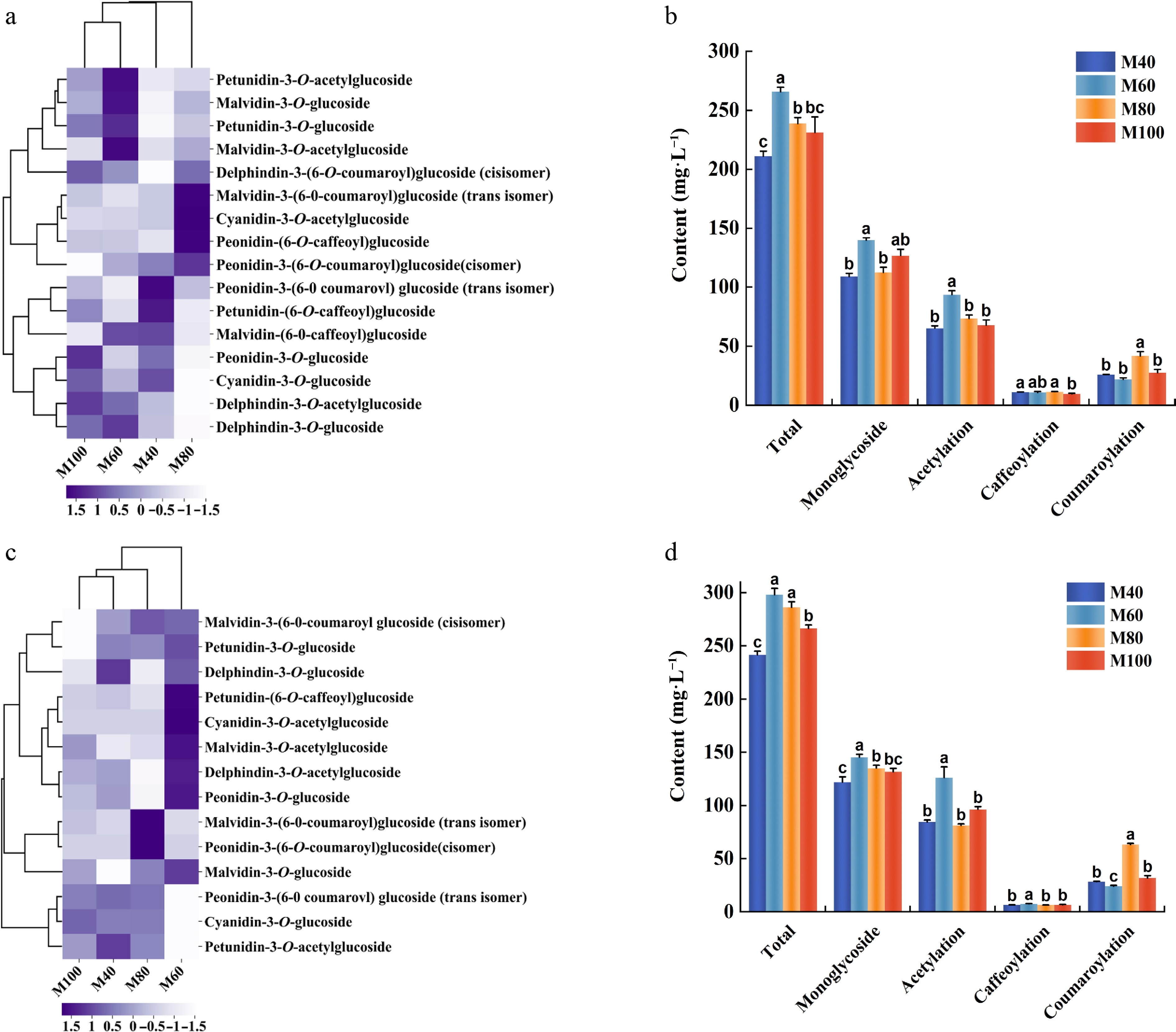
Figure 3.
Effects of canopy thickness on monomeric anthocyanins in 'Merlot' grapes. (a–d) show the heatmap clustering and quantitative classification of monomeric anthocyanins in 2023 (a, b) and 2024 (c, d). Bars show mean levels of three biological replicates (± SD). Different lowercase letters indicate levels of significance as determined by one-way ANOVA followed by Duncan's test: p < 0.05.
Among the four major classes of anthocyanin monomers, the most abundant compounds were malvidin-3-O-glucoside, malvidin-3-O-acetylglucoside, peonidin-3-O-caffeoylglucoside, and trans-malvidin-3-O-coumaroylglucoside. Of these, malvidin-3-O-glucoside and malvidin-3-O-acetylglucoside accumulated to the highest levels under M60, significantly exceeding those observed under other groups (Supplementary Table S3). In contrast, trans-malvidin-3-O-coumaroylglucoside was consistently enriched under M80 across two consecutive years, indicating that this canopy thickness exerts a stable effect on its accumulation. This enhancement may be attributed to the more favorable light penetration and air circulation provided by M80, which are conducive to the biosynthesis and stabilization of coumaroylated anthocyanins.
Overall, the effects of canopy thickness on the monomeric anthocyanins in the skins of 'Merlot' grapes were significantly different. The M60 treatment exhibited a greater accumulation of glucosides and acetylated glucosides, whereas the M80 treatment markedly enhanced the accumulation of coumaroylated glucosides. For certain compounds, such as malvidin acetylglucoside and peonidin caffeoylglucoside, the interannual variation was more complex, suggesting that their biosynthesis is regulated by multiple interacting factors.
Effect on monomeric anthocyanins in wine
-
Anthocyanins are the cornerstone of color stability and are major natural polyphenolic flavonoids with antioxidant, lipid-lowering, anti-inflammatory, and antitumor properties. HPLC was used for both qualitative and quantitative analyses of monomeric anthocyanins in the wine samples. As shown in Fig. 4b, d, four classes of anthocyanin derivatives were identified in wine: monosaccharide glucosides, acetylated glucosides, caffeoylated glucosides, and coumaroylated glucosides. At a canopy thickness of 80 cm, the total amount of monomeric anthocyanins in 'Merlot' wine exhibited a marked increase between years, which is 222.34 mg·L−1 in 2023 and 317.27 mg·L−1 in 2024 (Supplementary Table S4).
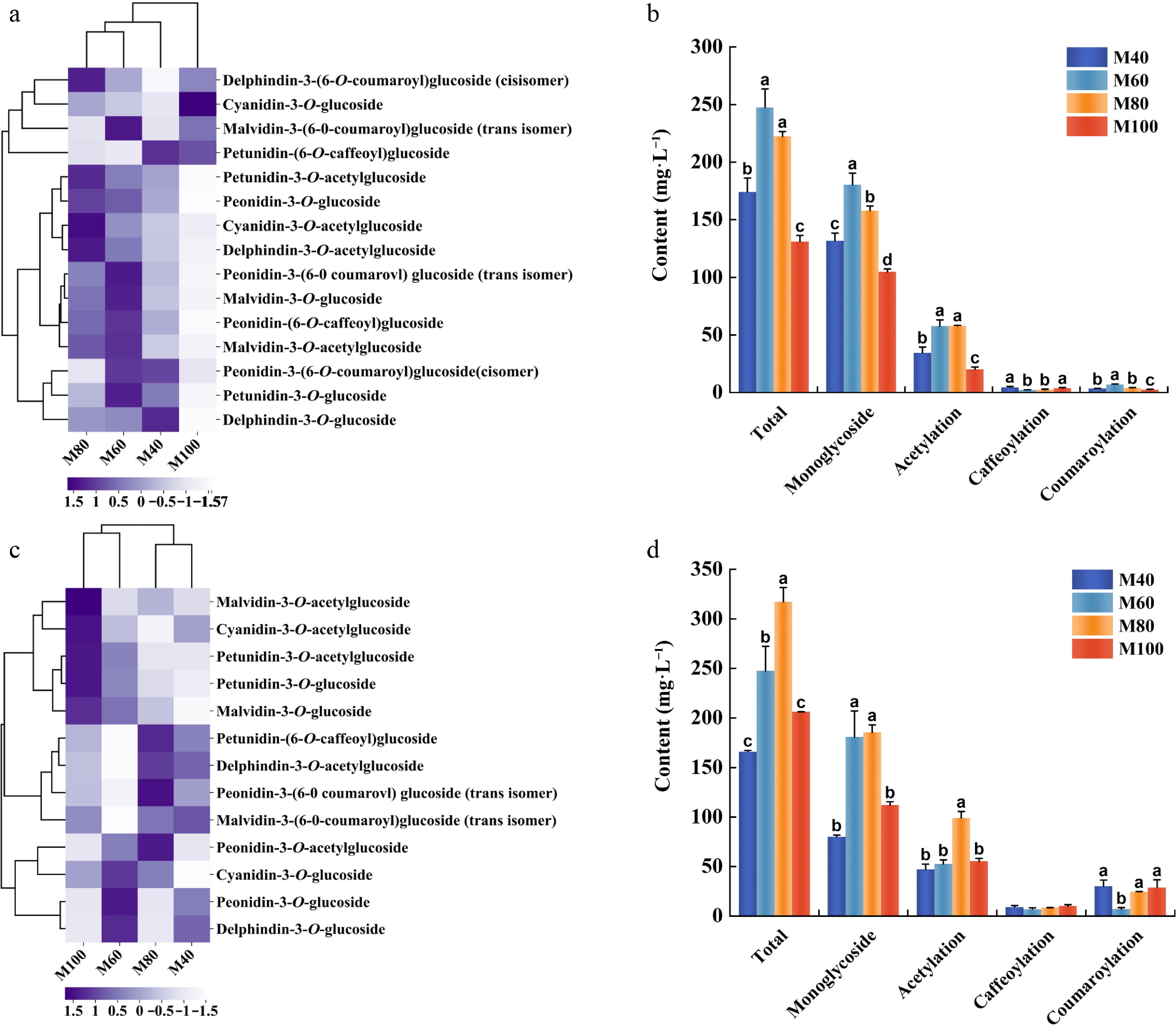
Figure 4.
Effects of canopy thickness on monomeric anthocyanins in 'Merlot' wine. (a, b) Clustering heatmap and classification with quantitative comparison of monomeric anthocyanins in 2023; (c, d) clustering heatmap and classification with quantitative comparison of monomeric anthocyanins in 2024. Bars show mean levels of three biological replicates (± SD). Different lowercase letters indicate levels of significance as determined by one-way ANOVA followed by Duncan's test: p < 0.05.
Analysis of anthocyanin composition revealed that monosaccharides represented the most abundant fraction, whereas caffeoylated and coumaroylated compounds were present at comparatively lower levels. Among the treatments, the M60 canopy showed the highest content of monosaccharide glycosides, which exceeded those in the M40 and M100 treatments by 26.96%–55.75% (Fig. 4 and Supplementary Table S4). The highest concentrations of acetylated monosaccharide anthocyanins were detected in the M80 treatment (Fig. 4 and Supplementary Table S4). In contrast, caffeoylated monomeric anthocyanins displayed relatively minor variations across treatments in both years; however, coumaroylated anthocyanins showed a consistent year-on-year increase, compared with the previous year (Fig. 4). Among the monoglucoside and acetylation kinds, the most abundant were malvidin-3-O-glucoside and malvidin-3-O-acetylglucoside, respectively. Malvidin-3-O-glucoside is also regarded as the predominant anthocyanin in the variety. Both compounds exhibited a pattern of increasing and then decreasing concentrations across treatments (Fig. 4 and Supplementary Table S4). This suggests that canopy thicknesses within the 60–80 cm range promote higher accumulation of these key anthocyanins, thereby contributing to improved color stability. Additionally, the results revealed a significant enrichment of coumaroylated anthocyanins derived primarily from malvidin and petunidin (Supplementary Table S4).
In summary, the accumulation of the four major classes of anthocyanin monomers in 'Merlot' wine was strongly influenced by canopy thickness. Treatments M60 and M80 significantly enhanced the total monomeric anthocyanin content, indicating that a moderate canopy thickness is optimal for promoting anthocyanin accumulation in 'Merlot' wine.
Profiles of non-anthocyanin monomeric phenolic compounds in grapes and wine under different canopy thicknesses
Effect on the non-anthocyanin monomeric phenolic compounds in grapes
-
Non-anthocyanin monomeric phenolic compounds play important roles in grapes by forming complexes with anthocyanins, thereby protecting their structures and enhancing overall grape quality. A total of 12 non-anthocyanidin monomeric phenolic compounds were detected by HPLC, covering five phenolic acids, two flavanols, four flavonols, and one astragaloid (Fig. 5). The total concentration of non-anthocyanin monomeric phenolics showed markedly higher values under M60 and M80 in 2023, exceeding M40 by 14.87% and 14.74%, respectively. In 2024, M60 maintained the highest levels, at 1.07-, 1.40-, and 1.55-fold greater than M40, M80, and M100, respectively (Supplementary Table S5). In addition, phenolic acids consistently accumulated at significantly higher levels than flavanols, flavonols, and stilbenes (Supplementary Table S5).
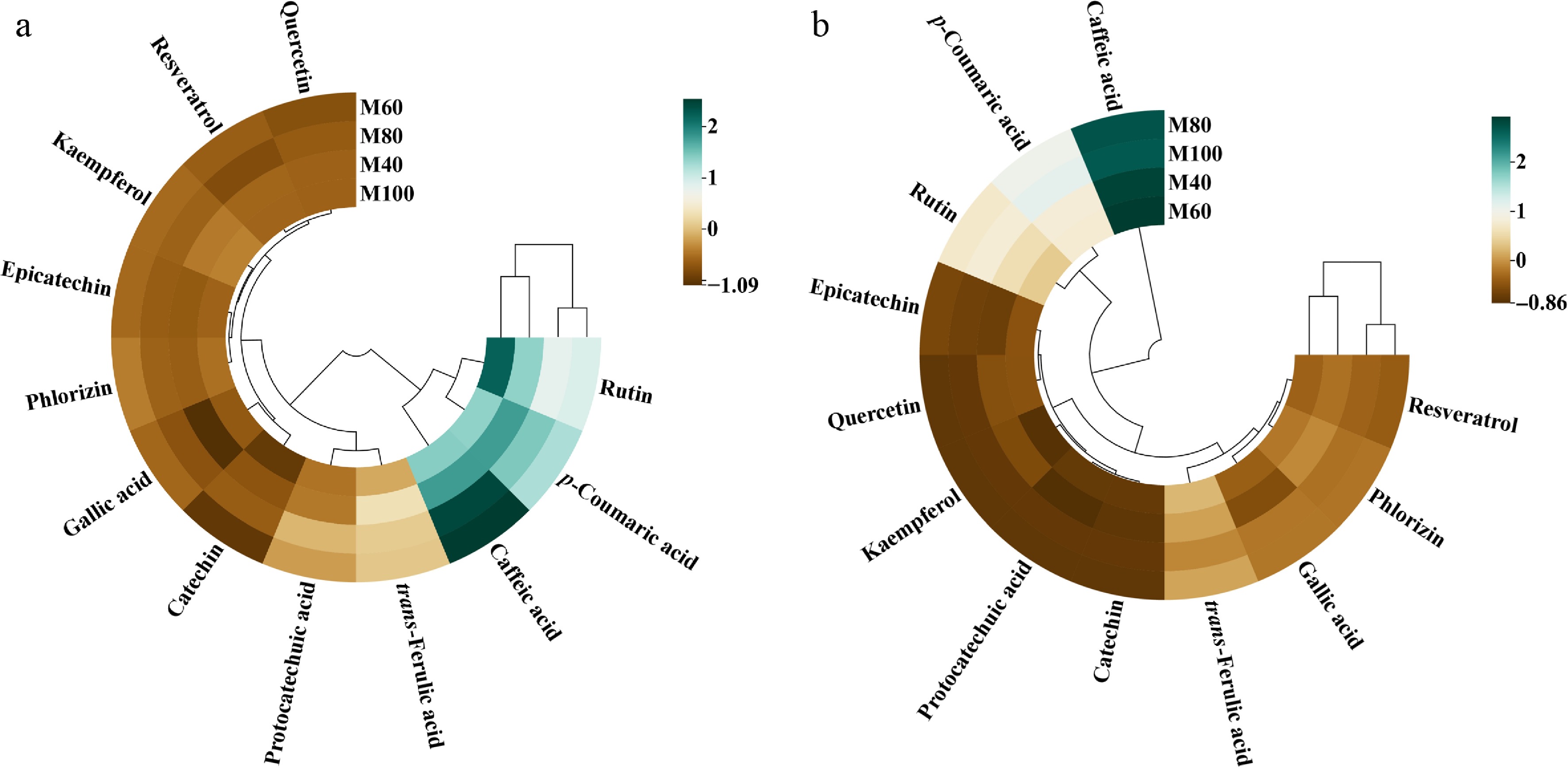
Figure 5.
Effects of canopy thickness on non-anthocyanin monomeric phenolic compounds in 'Merlot' grapes. (a) Clustered heat map of the distribution in 2023; (b) clustered heat map of the distribution in 2024.
Canopy thickness effect was less pronounced compared to flavonoid compounds (Fig. 5). Catechin levels varied substantially across the two years, indicating strong environmental modulation (Supplementary Table S5). However, resveratrol accumulation was largely unaffected by canopy thickness, with no significant differences among treatments (Supplementary Table S5).
Overall, these results highlight that the accumulation patterns of non-anthocyanin phenolic compounds, including phenolic acids, flavanols, flavonols, and stilbenes such as resveratrol, are highly variable during berry development, with a canopy thickness of 60 cm representing the optimal condition for phenolic enrichment.
Effect on the non-anthocyanin monomeric phenolic compounds in wine
-
Non-anthocyanin monomeric phenolic compounds play a crucial role in wine quality by contributing to flavor, texture, and aromatic complexity. The influence of canopy thickness on these compounds in 'Merlot' wine differed significantly across treatments (Fig. 6).
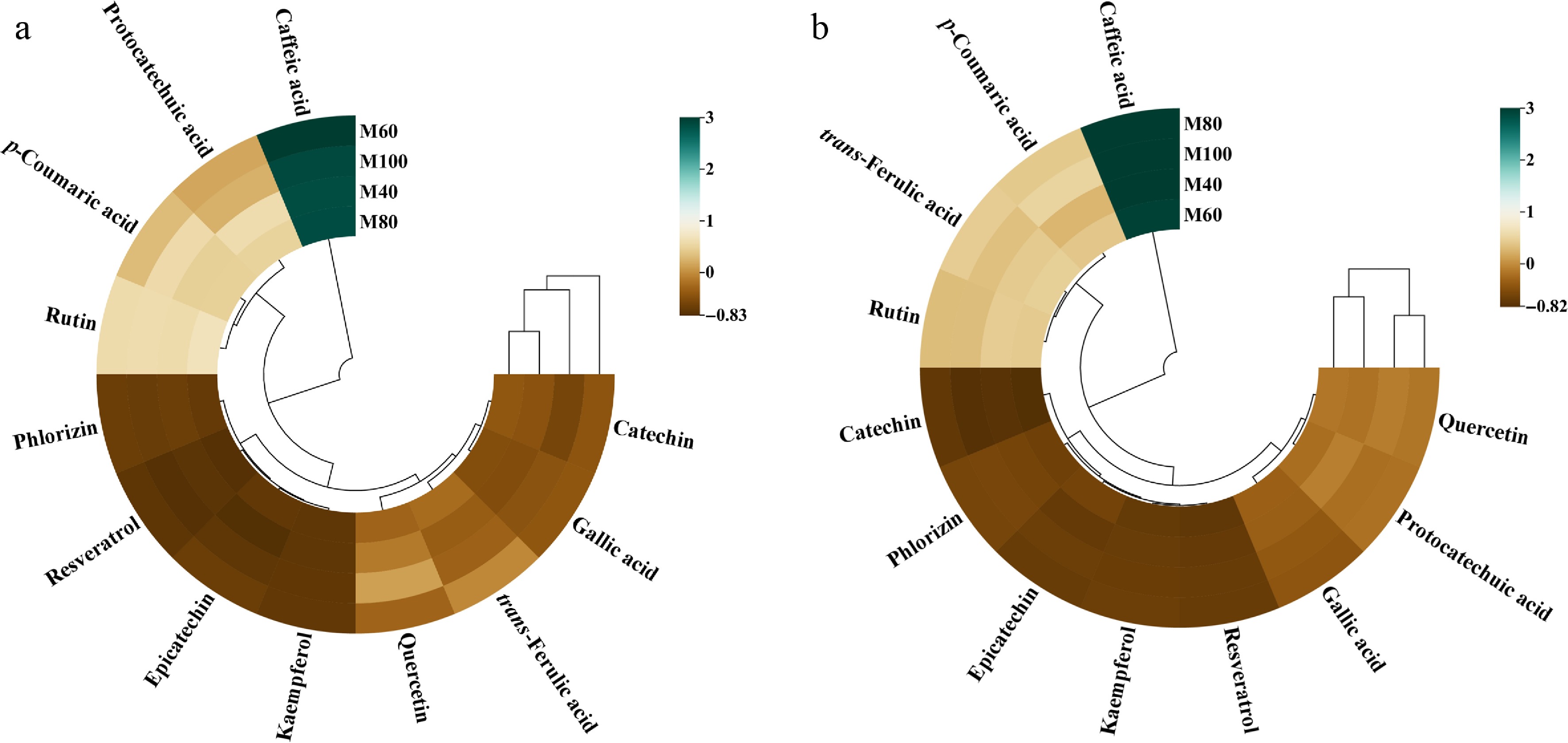
Figure 6.
Effects of canopy thickness on non-anthocyanin monomeric phenolic compounds in 'Merlot' wine. (a) Clustered heat map analysis of year 2023; (b) clustered heat map analysis of year 2024.
In 2023, the medium canopy thickness of 60–80 cm exhibited the highest total content of non-anthocyanin phenolics, approximately 24% greater than that under the 100 cm canopy thickness (Fig. 6a and Supplementary Table S6). Within this group, gallic acid showed the greatest accumulation at M60, about 34.86% higher than M100. p-coumaric acid reached its maximum at M80, exceeding M40 by ~12%. Catechin, a member of the flavanol group, showed significant enrichment under M80 treatment conditions, with its content approximately 58% higher than that under M100 treatment. Epicatechin, however, performed better under M60 treatment conditions. Among flavonoids, rutin concentrations were elevated at both M60 and M80, about 30% higher than M100 (Supplementary Table S6).
In 2024, the total phenolic acid content peaked under M80, with ~20% higher levels than M100 (Fig. 6b and Supplementary Table S6). Caffeic acid again accumulated most at M80, which was ~14% higher than at M40, while trans-ferulic acid was enhanced at both M80 and M60, which was 29% and 26% higher than at M100, respectively. Although the overall flavanol content decreased relative to 2023, M80 maintained relatively high levels. Flavonoid content varied little among treatments; only rutin remained highest at M60 (Supplementary Table S6).
A two-year comparison showed that M60 produced the greatest accumulation in 2023 (~24% above M100), while M80 dominated in 2024 (~18% above M100). However, M60 displayed greater stability across vintages. Collectively, the results suggest that a medium canopy thickness (60 cm) provides the most favorable balance between light transmission and shading, promoting the accumulation of key phenolic acids, such as caffeic acid and gallic acid, while ensuring stable flavonoid levels such as rutin.
Comprehensive evaluation of grapes and wine quality under different canopy thicknesses
-
Comprehensive evaluation of grape quality is crucial, as it integrates multiple dimensions, such as color, aroma, taste, balance, and phenolic composition, which provide a holistic assessment of berry traits. In this study, principal component analysis (PCA) was used to reduce the dimensionality of 10 key quality indicators (including soluble solids, total acid, total phenols, total flavonoids, and others) in 'Merlot' grapes (Fig. 7a, b and Supplementary Table S7). Based on the criterion of eigenvalue > 1, two principal components (PCs) were extracted, with cumulative variance contributions of 81.02% (2023) and 92.04% (2024) (Supplementary Table S7).
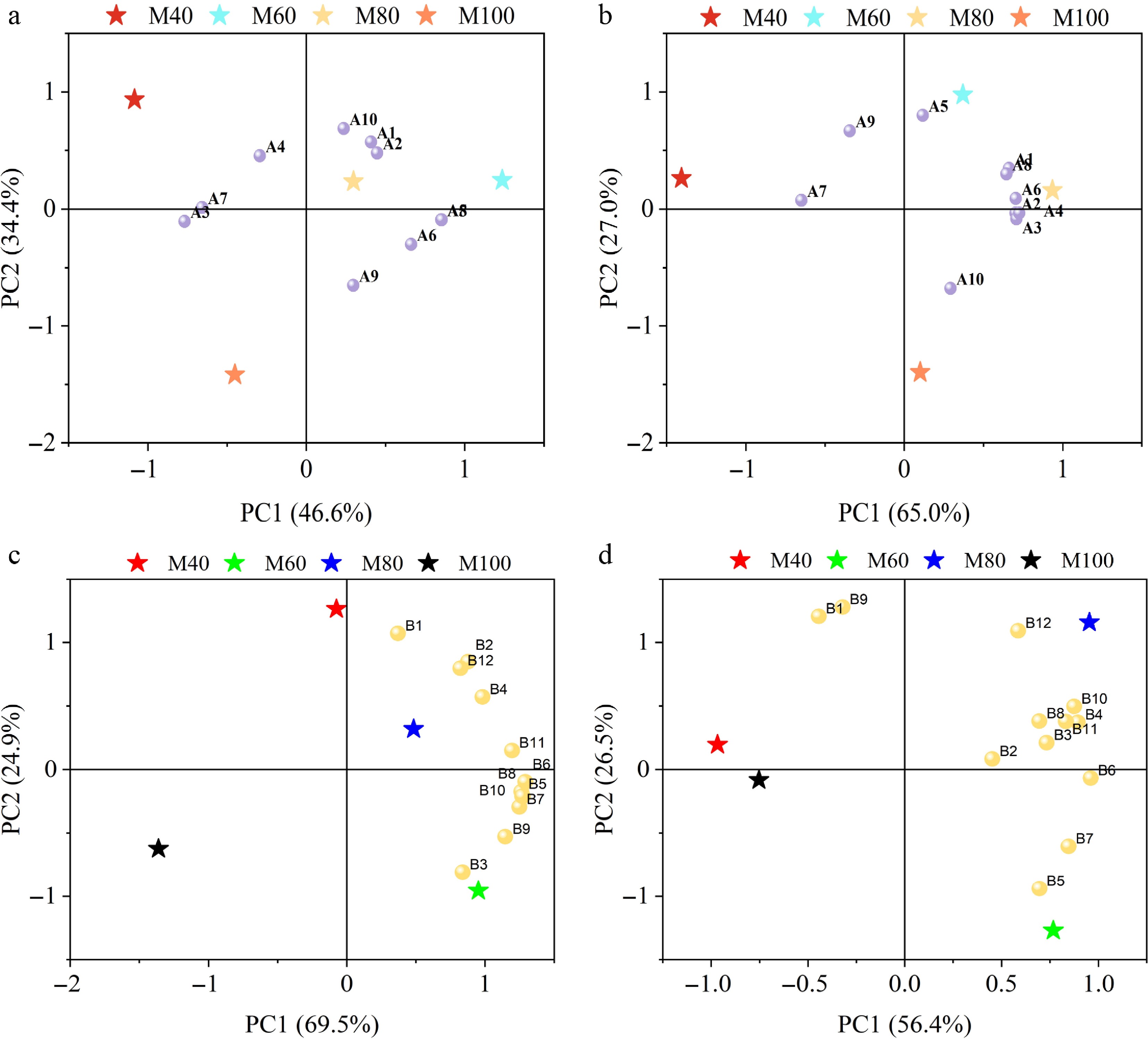
Figure 7.
Factor loading and score plots of 'Merlot' grape and wine quality under different canopy thicknesses. (a, b) represent the factor loading and score plots for 'Merlot' grapes in 2023 (a) and 2024 (b); (c, d) display the factor loading and score plots of 'Merlot' wine in 2023 (c) and 2024 (d).
The results showed that the first principal component (PC1) explained 46.59% and 65.01% of the total variance in 2023 and 2024, respectively. PC1 was significantly positively correlated with eight quality indices, including soluble solids, total acids, flavan-3-ols, and anthocyanins, but was negatively correlated with total phenols, total flavonoids, tannins, and total monomeric phenols (Fig. 7a, b). This indicates that PC1 primarily reflects the comprehensive physicochemical characteristics of grape berries. The second principal component (PC2) accounted for 34.43% and 27.03% of the total variance, with marked differences between the two vintages in terms of trait interpretation (Fig. 7a, b). Nonetheless, the two-component model explained more than 80% of the variation, thereby providing a robust and simplified analytical framework for the comprehensive evaluation of 'Merlot' grape quality. According to the comprehensive scores derived from PCA (Table 1), slight differences in treatment ranking were observed between the two years. Overall, canopy thicknesses of 60–80 cm consistently improved the integrated quality of 'Merlot' grapes, whereas the thinner (40 cm) and denser (100 cm) canopies yielded comparatively less favorable outcomes.
Table 1. Comprehensive quality evaluation of 'Merlot' grape and wine under different canopy thickness.
Year Treatment PC1 PC2 Comprehensive
scoreComprehensive
ranking'Merlot' grape 2023 M40 −1.08 0.94 −0.49 3 M60 1.24 0.25 0.95 1 M80 0.30 0.24 0.28 2 M100 −0.45 −1.42 −0.73 4 2024 M40 −1.41 0.26 −0.92 4 M60 0.37 0.98 0.55 2 M80 0.94 0.16 0.71 1 M100 0.10 −1.40 −0.34 3 'Merlot' wine 2023 M40 −0.07 1.26 0.28 3 M60 0.95 −0.96 0.45 1 M80 0.48 0.32 0.44 2 M100 −1.36 −0.62 −1.17 4 2024 M40 −0.97 0.20 −0.60 4 M60 0.77 −1.27 0.12 2 M80 0.95 1.16 1.02 1 M100 −0.75 −0.08 −0.54 3 Similarly, PCA was applied to reduce the dimensionality of 12 key quality indicators of 'Merlot' wine (pH, alcohol content, total phenols, total flavonoids, etc.) (Fig. 7c, d and Supplementary Table S8). Based on eigenvalues > 1, two PCs were extracted, with cumulative variance contributions of 94.45% in 2023 and 82.82% in 2024 (Supplementary Table S8). PC1 accounted for 69.52% and 56.36% of the total variance in 2023 and 2024, respectively. PC1 was significantly positively correlated with eight quality attributes such as alcohol content, volatile acidity, total phenols, and total flavonoids, while showing significant negative correlations with pH and tannin content (Fig. 7c, d and Supplementary Table S8). This indicates that PC1 primarily reflects the comprehensive physicochemical characteristics of wine. The PC2 accounted for 24.93% and 26.46% of the variance in the two vintages. PC2 was positively associated with pH, volatile acidity, tannins, monomeric phenol content, and aroma, but negatively correlated with total flavonoids, flavan-3-ols, and anthocyanins. Together, the two components explained more than 80% of the total variance, providing a robust and simplified framework for the comprehensive evaluation of wine quality (Fig. 7c, d and Table 1).
Therefore, for mechanized pruning operations in this region, we recommend strictly controlling canopy thickness between 60 and 80 cm to achieve standardized, repeatable practices that enhance both grape and wine quality. This simple, quantifiable objective provides a practical pathway for achieving large-scale, high-quality 'Merlot' grape production under local conditions.
-
The progressive reduction in leaf area under canopy thinning was consistent with reported declines in photosynthetic capacity in managed vineyards[18], which directly reduces the total photosynthetic area available for light interception and assimilate production. The observed decrease in berry-zone temperature with increasing canopy thickness aligns with previous studies demonstrating that canopy architecture, as well as row spacing and orientation, interacts with the environment to impact canopy temperature[18]. This finding has practical implications for vineyard management. Therefore, in high-temperature areas, shaping and pruning the canopies to adjust thickness is essential for regulating microclimate and preventing heat damage to fruits and wine, as denser canopies provide better thermal buffering. The higher relative humidity under the densest canopy (M100) is consistent with Kraus et al.[19], who reported that complex canopy architecture with more leaves showed a 3-percentage-point higher humidity and a 0.9 °C lower mean temperature. Denser canopies reduce air circulation and increase transpiration from leaves, leading to higher local humidity in the berry zone. The unimodal pattern of PAR during peak sunlight hours under M40 indicates that thinner canopies allow maximum light penetration to the fruit zone. The differential Pn responses among treatments suggest that intermediate canopy thickness may optimize light-use efficiency under fluctuating field conditions. This is consistent with previous reports that balanced canopy density enhances photoassimilate allocation to berries[20], as it balances light interception for photosynthesis and avoids excessive shading or light stress.
Impacts of canopy thickness on the basic quality
-
In grapes, the lack of significant effects of canopy thickness on most fruit morphological characteristics suggests that the shape and size of the 'Merlot' grape fruit are relatively stable under different canopy management practices. This stability may be attributed to the strong genetic control of fruit morphological traits, which are less sensitive to microclimatic changes induced by canopy thinning. The variation in soluble solids and total acid content among treatments can be explained by the leaf-area-to-fruit-weight ratio, a key factor determining berry sugar accumulation[21]. The lowest sugar content in M40 is consistent with this principle, as the reduced leaf area in M40 limits the photosynthetic production and translocation of sugars to berries. In wine, the negative correlation between alcohol content and canopy thickness is likely due to the reduced sugar accumulation in berries under thinner canopies, as alcohol is synthesized from berry sugars during fermentation. This aligns with Smart[1], who reported that wine alcohol and acidity are primarily driven by microclimates caused by various canopy management practices. In addition, the lowest volatile acidity in M100 and the highest in M80 indicate that excessive canopy thickness suppresses volatile-acid formation, which is consistent with previous results that excessive shading suppresses organic-acid synthesis[22]. Other practices such as late shoot pruning (LSP) have also been shown to have a positive impact on wine quality[23]. Similarly, mechanical defoliation inhibits sugar accumulation in berries, ultimately resulting in wines with lower alcohol content, while total polyphenol content remains unaffected[24]. The superior quality profile of M60–M80 treatments highlights the importance of intermediate canopy thickness in optimizing grape and wine quality, as it balances sugar accumulation, acid metabolism, and microbial activity.
Regulation of total phenolic content in grape berries by canopy thickness
-
The density-dependent regulation of phenolic metabolism observed in this study reflects the complex interaction between light exposure and microclimatic conditions mediated by canopy thickness. An 80 cm canopy generally promoted the accumulation of light-sensitive phenolics (total phenols and flavonoids), consistent with UV-mediated protective biosynthesis[25,26]. An intermediate canopy thickness allows sufficient UV radiation to reach the fruit while avoiding excessive light stress. In contrast, M60 favored flavan-3-ol accumulation, which may be more strongly associated with microclimate stabilization than with direct light-driven synthesis[25,27]. Notably, excessive canopy density (M100) suppressed overall phenolic accumulation, consistent with the reduced flavonoid levels typically observed in shaded berries[26,28], which might be because shading reduces the expression of genes involved in phenolic biosynthesis, such as those encoding phenylalanine ammonia-lyase (PAL) and chalcone synthase (CHS). The biphasic pattern of total phenols with canopy thickness (peaking under M60) is consistent with photophysiological principles; denser canopies (M100) typically suppress flavonoid biosynthesis due to reduced solar radiation and increased humidity[29]. The interannual variability in the optimal canopy configuration of anthocyanins and tannins suggests that these phenolic subclasses are more sensitive to climatic fluctuations than other phenolics. Similarly, west canopy treatment had higher color intensity, anthocyanins, and polyphenols due to more negative potentials in the canopy stimulating the synthesis of phenolic compounds[30]. These findings corroborate previous reports that leaf removal (a form of canopy thinning) improves freshness and flavor in wine[20]. The stability of the M60 treatment in enhancing phenolic richness across both years highlights its potential as an optimal canopy management strategy for 'Merlot' grapes, as it buffers interannual climatic variability and consistently produces wines with high phenolic quality. This stability is likely attributed to the balanced microclimate (light, temperature, and humidity) provided by M60, which optimizes phenolic biosynthesis in berries and subsequent extraction into wine.
Regulation of monomeric anthocyanins and non-anthocyanin phenolics by canopy thickness
-
The acyl-specific optimization of anthocyanins reflects the microclimatic differences mediated by canopy thickness that M60 provides a more stable light environment for glucoside and acetylated glucoside accumulation, whereas M80's buffered microclimate favors coumaroylated anthocyanin retention. Our findings align with Tarara et al.[31], who discovered that the concentrations of acylated anthocyanins in 'Merlot' berries increase under shaded conditions but decrease under high-temperature conditions. The latter may affect the acyltransferase enzymes involved in the anthocyanin biosynthetic pathway. In wine, the higher content of monosaccharide glycosides under M60 is consistent with Rustioni et al.[32], who also demonstrated the different derivatives of anthocyanins under sun-exposed and shaded conditions. Downey et al.[27] speculated that higher temperatures may shift grapes' anthocyanin profile from nonacylated to coumaroyl-glucosides, regardless of light exposure. The pattern of increasing then decreasing concentrations of malvidin-3-O-glucoside and malvidin-3-O-acetylglucoside across treatments indicates that a moderate canopy thickness (60–80 cm) is optimal for promoting these key anthocyanins, thereby contributing to improved wine color stability. These compounds have previously been reported in other varieties of wine[33], confirming their importance in wine quality. The significant enrichment of coumaroylated anthocyanins derived from malvidin and petunidin. Notably, such accumulation patterns have been clearly established as characteristic indicators of warm-climate conditions[34]. The complex interannual variation in compounds such as malvidin acetylglucoside and peonidin caffeoylglucoside further confirms that their biosynthesis is regulated by multiple interacting factors, including canopy thickness and climatic conditions[26]. It is precisely the specific accumulation and combination of these compounds that together give rise to the diversity of grape flavors[35].
For non-anthocyanin phenolics, our data showed phenolic acids accumulated most strongly under a 60 cm canopy. In a previous study, Quartacci et al.[36] reported that leaf removal could increase the concentrations of phenolic acids in berries without altering their composition. For quercetin accumulation, the results showed that M40 enhanced the amount, consistent with reports that quercetin derivatives are highly light-responsive[37]. Meanwhile, grapes exposed to more light in the canopy tend to have higher flavonol levels[25], which is also associated with increased expression of the gene encoding flavonol synthase in grape skins[28]. Recent studies have demonstrated that pruning play a crucial role in regulating phenolic metabolism in other berries. For instance, in apples (Malus domestica), anthocyanin content was found to decrease compared with nonpruned controls[38]. In some blueberry cultivars, heavy pruning (60% canopy removal) was found to reduce anthocyanin content[39]. Similarly, structural factors in the vineyard—including wider row spacing, higher canopy density, vigorous plant growth, and precision irrigation methods—may alter temperature and humidity conditions, ultimately affecting fruit quality[40,41].
Collectively, these studies indicate that balanced light, temperature, and crop load are decisive for simultaneous optimization of grape chemistry and wine attributes. In the present two-year trial, a medium-density canopy (60–80 cm) consistently provided the best compromise between light interception, ventilation, and nutrient distribution, translating into superior fruit composition (sugar, acidity, and phenolics) and higher wine anthocyanin and tannin profiles.
-
Our findings demonstrate that a canopy thickness of 60–80 cm represents an optimal range for balancing light interception, temperature regulation, and ventilation. At this range, the canopy creates a gradient shading effect, with the middle canopy layers supporting secondary metabolism. This structural configuration provides favorable conditions for the biosynthesis of phenolic compounds and the development of grape and wine quality. The results suggest that the effect of canopy thickness on phenolic accumulation arises from the combined influence of microclimatic regulation and vine physiological capacity, highlighting canopy space optimization as a key viticultural practice for enhancing grape and wine quality.
-
The authors confirm their contributions to the paper as follows: study conception and design and draft manuscript preparation: Wang Q, Xu Q, Fu J, Zhao W; data collection: Zhang L, Bian L, Yu X, Wang J, Zhang Z; analysis and interpretation of results: Luo J, Meng J, Zhang F; draft manuscript preparation: Xu Y, Xu T. All authors reviewed the results and approved the final version of the manuscript.
-
All data generated or analyzed during this study are included in this published article and its supplementary information files.
-
The authors declare that they have no conflict of interest.
-
accompanies this paper online at: https://doi.org/10.48130/frures-0026-0028.
-
# Authors contributed equally: Qiqi Wang, Qian Xu
- Supplementary Table S1 MS characteristics and elution time parameters of monomeric anthocyanins.
- Supplementary Table S2 HPLC identification of non-anthocyanin monomeric phenolic compounds.
- Supplementary Table S3 Effect of different leaf canopy thickness on monomeric anthocyanins in 'Merlot' grapes (mg·L−1).
- Supplementary Table S4 Effect of different leaf canopy thickness on monomeric anthocyanins in 'Merlot' wine (mg·L−1).
- Supplementary Table S5 Effect of different leaf curtain thickness on non-anthocyanins monomeric phenolic compounds in 'Merlot' grapes (mg·L−1).
- Supplementary Table S6 Effect of different leaf canopy thickness on non-anthocyanins monomeric phenolic compounds in 'Merlot' wine (mg·L−1).
- Supplementary Table S7 Factor loadings and contribution rates of 'Merlot' grape quality under different canopy thicknesses.
- Supplementary Table S8 Factor loadings and contribution rates of 'Merlot' wine quality under different canopy thicknesses.
- Supplementary Fig. S1 Dynamic changes at the 'Merlot' grape fruiting zone under different leaf canopy thicknesses.
- Supplementary Fig. S2 Effect of different canopy thickness on basic physicochemical indexes of 'Merlot' grape.
- Supplementary Fig. S3 Effect of different canopy thickness on Brix and acid in 'Merlot' grape.
- Supplementary Fig. S4 Effect of different canopy thicknesses on the basic quality of 'Merlot' wine.
- Copyright: © 2026 by the author(s). Published by Maximum Academic Press, Fayetteville, GA. This article is an open access article distributed under Creative Commons Attribution License (CC BY 4.0), visit https://creativecommons.org/licenses/by/4.0/.
-
About this article
Cite this article
Wang Q, Xu Q, Fu J, Zhao W, Zhang L, et al. 2026. Effects of canopy thickness regulated by mechanical summer pruning on phenolic compounds in 'Merlot' grapes and wine. Fruit Research 6: e033 doi: 10.48130/frures-0026-0028 

Effects of canopy thickness regulated by mechanical summer pruning on phenolic compounds in 'Merlot' grapes and wine
- Received: 05 May 2026
- Revised: 26 May 2026
- Accepted: 01 June 2026
- Published online: 26 August 2026
Abstract: Summer pruning is essential for promoting fruit production, effectively managing growth, and ensuring a successful harvest. This study investigates the effects of canopy thickness regulation on the composition and content of phenolic compounds in 'Merlot' grape berries and wine. Conducted over two consecutive growing seasons in the northern foothills of the Tianshan Mountains in Xinjiang, Northwest China, four canopy thickness treatments were established (40, 60, 80, and 100 cm). The results demonstrate that canopy thickness can significantly affect the microenvironment and photosynthesis, and that moderate canopy thickness (60–80 cm) notably enhanced the levels of total phenols, total flavonoids, flavan-3-ols, and anthocyanins/non-anthocyanin monomeric phenolic compounds in both berries and wines, yielding the best results in comprehensive quality evaluations. This comprehensive analysis suggests that maintaining a mechanized pruning canopy thickness of 60–80 cm optimizes 'Merlot' grape performance, thereby providing a foundation for precision canopy management in wine grape cultivation in arid and semiarid regions.