












-
Wireless Power Transfer (WPT) technology offers greater safety and flexibility compared to traditional contact-based power supplies, leading to its extensive application in areas such as household appliances[1], medical implants[2], industrial robots[3], and new energy vehicles[4]. However, with the increasing complexity of application scenarios, complex topologies like WPT systems with multiple transmitters or receivers are becoming increasingly common[5]. Coupled with inherent system nonlinearities, this trend leads to a significant increase in the order of constructed system models, greater modeling difficulty, and increasingly complex dynamic behaviors of the system. In this context, constructing more accurate low-order models has become a crucial prerequisite for studying the dynamic behaviors of complex WPT systems[6].
Traditional modeling methods of the WPT system, such as the generalized state-space averaging method[7], the state-space method[8], and the coupled-mode theory[9] all face the challenges of high model order. This results in computationally intensive and inefficient model solving, hindering the analysis of system dynamics. Furthermore, the accuracy of models for WPT systems is directly influenced by the characteristics of core components like capacitors and inductors. The traditional modeling methods typically equate these components to integer-order linear elements. In reality, inductors and capacitors, as energy storage elements with memory properties, exhibit significant nonlinearity during actual operation[10]. Additionally, resistors also display nonlinear variations due to changes in operating temperature. However, these nonlinear characteristics of components are often neglected in traditional WPT system modeling, leading to a significant discrepancy between theoretical models and actual systems, and consequently failing to accurately reflect the real physical behavior of the system. Meanwhile, fractional-order calculus theory can precisely describe the memory characteristics of components like capacitors and inductors, providing a new perspective for constructing a high-precision model of the system. The fractional-order characteristics of capacitors and inductors in an LβCα parallel resonant circuit were investigated[11]. Fractional-order capacitors and inductors were introduced into the modeling of the WPT systems, elucidating the underlying mechanisms[12]. The impact of fractional order on transmission efficiency and power of the system was further analyzed, providing preliminary evidence for the potential of fractional-order models in improving modeling accuracy[13]. However, the fractional-order modeling in the aforementioned studies[12,13] focuses only on simple WPT systems, while research on the modeling of complex WPT systems remains relatively scarce.
Furthermore, as topologies of WPT systems become increasingly complex, nonlinearities lead to more intricate dynamic behaviors (such as period-doubling bifurcation, quasi-periodic oscillation, and chaos). These complex dynamic behaviors directly affect transmission efficiency and operational stability of the system. To date, research on the chaotic dynamic behaviors of complex WPT systems (such as WPT systems with multiple receivers) remains relatively limited. In particular, effective methods for identifying the critical parameter values that trigger transition of the system from a stable state to a chaotic state are lacking. Past research methods primarily relied on the maximum Lyapunov exponent[14], correlation dimension[15], and spectral entropy[16]. These methods exhibit significant limitations when analyzing complex WPT systems. For instance, while the maximum Lyapunov exponent can determine the presence of chaos, it is insensitive to minute changes, and its calculation is susceptible to data length and noise. Correlation dimension can characterize the geometric complexity of attractors, but results may be uncertain during system transition states. Spectral entropy is sensitive to signal non-stationarity but, when used alone, struggles to reliably distinguish deterministic chaos from random processes with broad spectra. Moreover, these chaos estimation methods are often affected by factors such as noise interference and parameter sensitivity, making it difficult to accurately characterize complex intrinsic relationships within nonlinear systems, and lacking adaptive capabilities. Therefore, further research on chaotic dynamic behaviors of complex WPT systems is warranted.
In summary, this paper focuses on multi-receiver WPT systems. To address the problems of high-order complexity hindering analysis and low model accuracy, fractional-order calculus theory and modeling theory of interconnected systems are employed to construct a fractional-order, low-order, nonlinear model for multi-receiver WPT systems. Simultaneously, a chaos critical parameter identification method based on a deep learning-weighted chaos state estimation model is proposed. This method enables high-precision identification of the chaos critical values for multiple key parameters, such as the fractional order, mutual inductance, and load. This provides a new approach for multi-parameter collaborative identification and dynamic behavior analysis in multi-receiver WPT systems.
-
The structure of multi-receiver WPT system is shown in Fig. 1. This system consists of one transmitter and n receivers, and analyzing its dynamic behavior requires describing it using high-order differential equations. Therefore, based on circuit theory and fractional-order calculus theory, while considering the fractional-order characteristics of capacitors and inductors, as well as the nonlinearities of capacitance, inductance, and resistance, the system model is constructed as shown in Eq. (1).
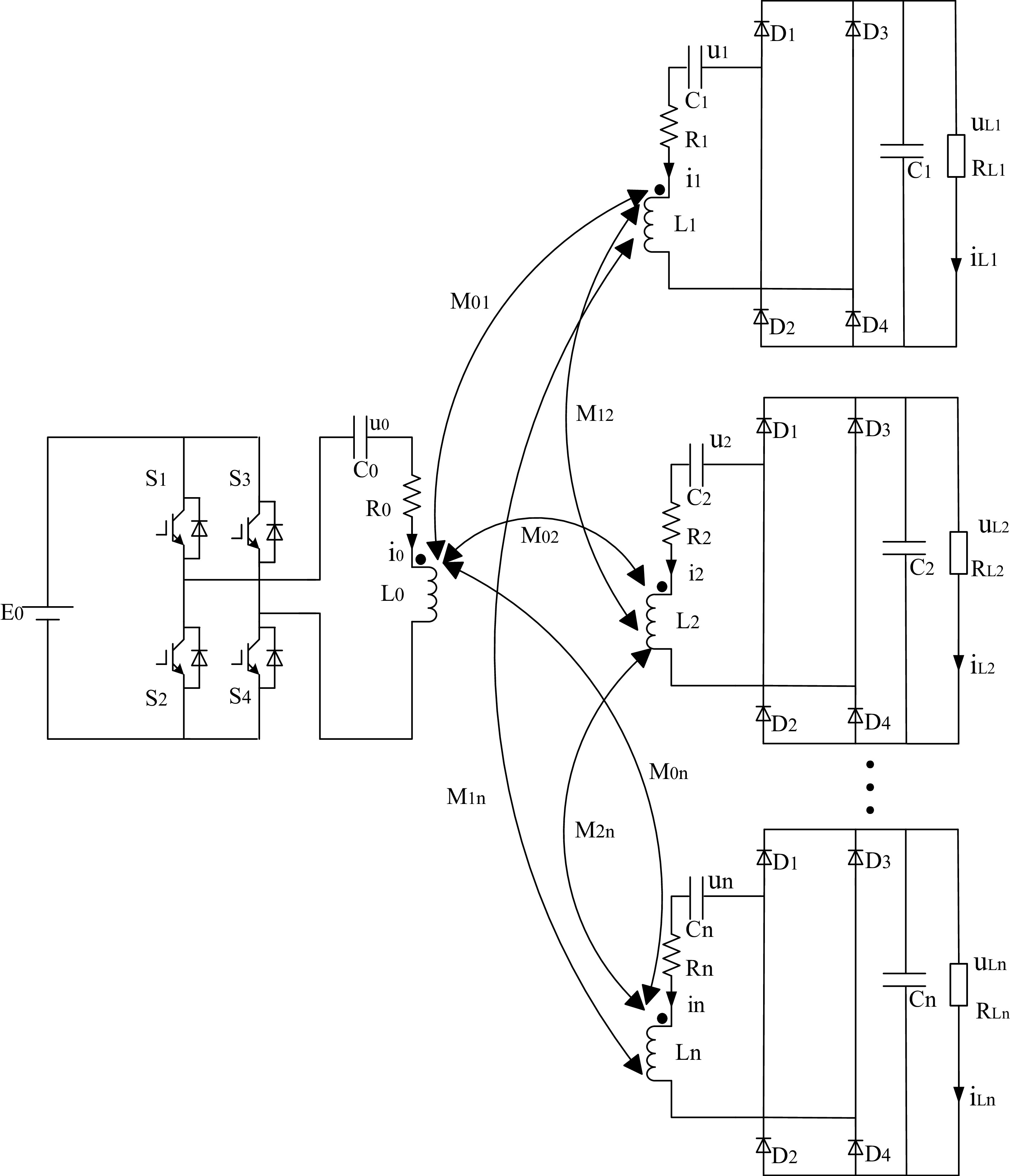
Figure 1.
WPT system with multiple receivers.
$ \left\{\begin{aligned} & s(t)E_{DC}=u_0(t)+i_0(t)R'_0+L'_0D^{\alpha}i_0(t)+\sum\nolimits_{j=1}^nM_{0j}D^{\alpha}i_j(t) \\ & 0=L'_1D^{\alpha}i_1(t)+M_{01}D^{\alpha}i_0(t)+i_1(R'_1+R'_{L1})+u_1+\sum\nolimits_{j=2}^nM_{1j}D^{\alpha}i_j(t) \\ & \vdots \\ & 0=L'_nD^{\alpha}i_n(t)+M_{0n}D^{\alpha}i_0(t)+i_1(R'_n+R'_{Ln})+u_n+\sum\nolimits_{j=1}^{n-1}M_{nj}D^{\alpha}i_j(t) \\ & C'_0D^{\alpha}u_0(t)=i_0 \\ & C'_1D^{\alpha}u_1(t)=i_1 \\ & \vdots \\ & C'_nD^{\alpha}u_n(t)=i_n\end{aligned}\right. $ (1) where
$ {L}'_{i}={L}_{i}(1+{k}_{1i}i_{i}^{2}) $ $ {C}'_{i}={C}_{i}(1+ {k}_{2i}u_{i}^{2}) $ $ {R}'_{i}={R}_{i}(1+{k}_{3i}i_{i}^{2}) $ $ {D}^{\alpha }(*) $ From Eq. (1), the model is of a high order, specifically, 2(n + 1)-order, making direct analysis rather difficult. Based on this, the model needs to be improved.
For the ith subsystem, its mutual inductance term is
$ \displaystyle\sum \limits_{j=1,j\neq i}^{n}{M}_{ij}{D}^{\alpha }{i}_{j}(t) $ $ {u}_{Lj}(t)={L}'_{j}{D}^{\alpha }{i}_{j}\left(t\right) $ $ \sum\nolimits_{j=1,j\ne i}^nM_{ij}D^{\alpha}i_j(t)=\sum\nolimits_{j=1,j\ne i}^n\dfrac{M_{ij}}{L'_j}u_{Lj}(t)i=0,1,2,\cdots,n $ (2) Furthermore, since WPT systems typically operate in the resonant state, according to circuit theory, it can be inferred that:
$ {u}_{Lj}(t)=-{u}_{j}(t) $ (3) Additionally, according to the reciprocity theorem, it follows that:
$ {M}_{ij}={M}_{ji} $ (4) Finally, by combining the above system of Eqs (1)−(4), and applying the concept of decomposition, the original high-order model (Eq. [1]) is transformed into an (n + 1) low-order model as follows:
$ \begin{split}&\begin{cases} {D}^{\alpha }{i}_{0}(t)=\dfrac{1}{{L}'_{0}}s(t){E}_{DC}-\dfrac{1}{{L}'_{0}}{u}_{0}(t)-\dfrac{{R}'_{0}}{{L}'_{0}}{i}_{0}(t)+\displaystyle\sum \limits_{j=1}^{n}\dfrac{{M}_{0j}}{{L}'_{0}{L}'_{j}}{{u}_{j}(t)}\\ {D}^{\alpha }{u}_{0}(t)=\dfrac{1}{{C}'_{0}}{i}_{0}(t) \end{cases} \\ &\begin{cases} {D}^{\alpha }{i}_{1}(t)=-\dfrac{{R}'_{1}+{R}'_{L1}}{{L}'_{1}}{i}_{1}-\dfrac{1}{{L}'_{1}}{u}_{1}+\displaystyle\sum \limits_{j=0,j\neq 1}^{n}\dfrac{{M}_{1j}}{{L}'_{1}{L}'_{j}}{u}_{j}(t)\\ {D}^{\alpha }{u}_{1}(t)=\dfrac{1}{{C}'_{1}}{i}_{1}(t) \end{cases} \\ & \vdots \\ &\begin{cases} {D}^{\alpha }{i}_{n}(t)=-\dfrac{{R}'_{n}+{R}'_{Ln}}{{L}'_{n}}{i}_{n}-\dfrac{1}{{L}'_{n}}{u}_{n}+\displaystyle\sum \limits_{j=0}^{n}\dfrac{{M}_{nj}}{{L}'_{n}{L}'_{j}}{u}_{j}(t)\\ {D}^{\alpha }{u}_{n}(t)=\dfrac{1}{{C}'_{n}}{i}_{n}(t) \end{cases} \end{split} $ (5) Let
$ {x}_{i}={\left({u}_{i},{i}_{i}\right)}^{\mathrm{T}} $ $ {D}^{\alpha }{x}_{i}={A}_{i}{x}_{i}+{B}_{i}v+{f}_{i} $ (6) where,
$ {A}_{i}=\left[\begin{array}{cc}0&\dfrac{1}{{{{C}'}}_{i}}\\-\dfrac{1}{{{{L}'}}_{i}}&-\dfrac{{{{R}'}}_{i}+{{{R}'}}_{Li}}{{{{L}'}}_{i}}\end{array}\right] $ $ {B}_{0}=\left[\begin{array}{c}0\\\dfrac{1}{{{{L}'}}_{0}}\end{array}\right] $ $ {B}_{i(i\neq 0)}=\left[\begin{array}{l}0\\0\end{array}\right] $ $v\left(t\right)= $ $ s(t){E}_{DC} $ $ f_i=\left[\begin{array}{c}0 \\ \displaystyle\sum_{j=0,j\ne i}^n\dfrac{M_{ij}}{L'_iL'_j}u_j\end{array}\right] $ $ i=0,1, 2,\cdots ,n $ The modeling method proposed above decomposes a system of order 2(n + 1) into (n + 1) second-order subsystems, significantly reducing the system order and achieving the decoupling of a high-order coupled system into low-order subsystems. Meanwhile, by considering the nonlinearities of capacitance, inductance, and load resistance, as well as the fractional-order characteristics of capacitance and inductance, the accuracy of the system modeling is further enhanced. This provides an easily analyzable, low-order, high-precision model for studying the chaotic dynamic behaviors of multi-receiver WPT systems.
-
Analyzing the dynamic behavior of WPT systems is a complex process, as traditional chaos indicators often struggle to accurately characterize the chaotic state of the system. To enable precise investigation of the chaotic dynamic behavior of the system, this paper proposes a weighted fusion of three chaos evaluation methods—the maximum Lyapunov exponent, correlation dimension, and spectral entropy—into a weighted chaos state estimation model. Furthermore, to enhance identification accuracy and robustness, a deep learning algorithm is introduced to construct a deep chaos feature learning network, enabling high-precision and adaptive parameter identification for the system. The constructed weighted chaos state estimation model is detailed as follows:
-
The maximum Lyapunov exponent (MLE) is one of the core concepts for describing the dynamic characteristics of nonlinear systems, used to identify chaotic motion in nonlinear systems. Commonly employed algorithms for calculating the MLE include the Wolf method, the small data set method, the two-point direct estimation method, the Rosenstein algorithm, and the Benettin-Brambilla-Ardito algorithm. Among these, the Wolf algorithm computes the MLE based on the exponential divergence rate of adjacent trajectories, and it is widely adopted due to its theoretical rigor, computational efficiency, and strong applicability in engineering. Therefore, this paper designs an improved Wolf algorithm with adaptive parameter selection, which effectively enhances computational efficiency and enables more accurate calculations for noise-contaminated data. The specific design is as follows:
First, a weighted Euclidean distance is employed to reduce sensitivity to noise:
$ d\left({X}_{i},{X}_{j}\right)=\sqrt{\sum \limits_{k=0}^{m}\dfrac{{S}_{k}}{\displaystyle \sum \limits_{l=0}^{m}{S}_{l}}{\left({x}_{i,k}-{x}_{j,k}\right)}^{2}} $ (7) where d(Xi, Xj) denotes the weighted Euclidean distance between the ith and jth state vectors; m denotes the dimension of the phase space; xi,k denotes the kth dimensional component of the ith state vector;
$ {S}_{k}=\sigma _{s,k}^{2}/\sigma _{n,k}^{2} $ $ {S}_{l}=\sigma _{s,l}^{2}/\sigma _{n,l}^{2} $ $ \sigma _{s,k}^{2} $ $ \sigma _{n,k}^{2} $ Next, let the reference trajectory point be Xi and the candidate neighboring point be Xj. The directional evolution angle between them must satisfy:
$ \theta =\arccos \left(\dfrac{{v}_{i}\cdot {v}_{j}}{\left|\left|{v}_{i}\right|\right|\cdot \left|\left|{v}_{j}\right|\right|}\right)\leq {\theta }_{\max } $ (8) where
$ {v}_{i}={X}_{i+1}-{X}_{i},{v}_{j}={X}_{j+1}-{X}_{j} $ Next, during the process of trajectory evolution tracking (the path of the system state in phase space over time), when the current inter-trajectory distance exceeds the applied re-normalization threshold, the local exponent is recorded, and a new neighboring point is reselected. The threshold is adaptively adjusted according to the following formula:
$ {\varepsilon }_{1}={\varepsilon }_{0}\cdot \left[1+\gamma \left(\dfrac{\ln \left({d}_{n}/{d}_{n-1}\right)}{\Delta t\cdot {\lambda }_{g}}-1\right)\right] $ (9) where ɛ0 denotes the re-normalization threshold before updating, ɛ1 denotes the re-normalization threshold after updating, λg denotes the global Lyapunov exponent, dn denotes the trajectory distance at time tn, and γ denotes the adjustment coefficient.
According to Eqs (7)–(9), the improved maximum Lyapunov exponent λMLE is given by:
$ {\lambda }_{\mathrm{MLE}}=\dfrac{1}{{t}_{1}-{t}_{0}}\sum \limits_{n=1}^{N}\ln \left(\dfrac{{d}_{1,n}}{{d}_{0,n}}\right) $ (10) where λMLE denotes the improved maximum Lyapunov exponent; tn and t1 denote the initial and final times, respectively; N denotes the number of segments; d0,n and d1,n denote the initial and final trajectory distances of the nth segment, respectively.
The improved Wolf algorithm offers significant advantages over the conventional Wolf algorithm. First, by introducing weighted Euclidean distance, different weights are assigned based on the power ratio of information to noise in each dimension, enhancing the accuracy of distance measurement. Second, neighboring trajectory points are filtered using a directional evolution angle threshold, excluding invalid points caused by noise or deviations from the attractor, thereby ensuring consistency in tracking direction. Third, the re-normalization threshold is dynamically adjusted to adapt to scale variations during system evolution, avoiding error accumulation due to a fixed threshold. Finally, the separation rate is computed segmentally and globally averaged in logarithmic form, effectively suppressing random fluctuations from single calculations. Through these improvements, the robustness, adaptability, and accuracy of the maximum Lyapunov exponent calculation are significantly enhanced.
Correlation Dimension estimation
-
The Correlation Dimension is a metric used to describe the dynamic complexity of a system, particularly in nonlinear dynamics and chaos theory. Here, the Correlation Dimension is introduced to analyze chaotic phenomena in the system, as detailed below:
$ C\left(r\right)=\dfrac{1}{N\left(N-1\right)}\sum \limits_{i=1}^{N}\sum \limits_{j=1,j\neq i}^{N}\Theta \left(r-\left|\left|{y}_{i}-{y}_{j}\right|\right|\right) $ (11) where C(r) denotes the correlation integral; r denotes the distance scale; N is the total number of reconstructed state points; and yi and yj denote distinct state points after phase space reconstruction.
The formula for calculating the correlation dimension is given by:
$ {D}_{2}=\underset{r\rightarrow 0}{\lim }\dfrac{\ln C\left(r\right)}{\ln r} $ (12) Spectral entropy calculation
-
Spectral entropy is used to measure the complexity and randomness of a signal in the frequency domain. It can be applied to detect the complexity and randomness of system signals, thereby assisting in determining whether the system is in a chaotic state when combined with other criteria:
$ P\left(f\right)=\left|F\left(u_i\left(t\right)\right)\right|^2\ $ (13) where F(*) denotes the Fourier transform operator; and P(f) denotes the power spectral density.
$ p\left(f\right)=\dfrac{P\left(f\right)}{\displaystyle \int_{0}^{\mathrm{\infty }}P\left(f\right)df} $ (14) where p(f) denotes the normalized power spectrum.
The formula for calculating spectral entropy is given by:
$ {S}_{f}=-\int_{0}^{\mathrm{\infty }}p\left(f\right)\ln p\left(f\right)df $ (15) Since employing the aforementioned single model to estimate the chaotic state of a system exhibits significant limitations—only reflecting a specific aspect of the chaotic characteristics of the system and demonstrating weak anti-interference capability—the estimation error tends to be large. For instance, a system may exhibit a positive maximum Lyapunov exponent while having a relatively low correlation dimension. To overcome these shortcomings and achieve an accurate assessment of the chaotic state of the system, this paper integrates the three chaos estimation models mentioned above—namely, the maximum Lyapunov exponent, correlation dimension, and spectral entropy—to propose a weighted chaos state estimation model. By performing a weighted fusion of these three estimation models, this approach mitigates the limitations inherent in any single model, and enhances the accuracy of chaotic state estimation. The design of the weighted chaos state estimation model is as follows:
$ \chi ={\omega }_{1}\tanh \left(10\left| \lambda \right| \right)+{\omega }_{2}\dfrac{{D}_{2}-{D}_{\min }}{{D}_{\max }-{D}_{\min }}+{\omega }_{3}{S}_{f} $ (16) where ω1, ω2, and ω3 denote weighting coefficients, satisfying ω1 + ω2 + ω3 = 1.
The above weighted chaos state estimation model performs compression and saturation processing on the maximum Lyapunov exponent using the tanh function, linearly normalizes the correlation dimension to adjust its scale, and directly utilizes the spectral entropy within a reasonable range. This enables the fusion of multi-feature information and overcomes the limitations of relying on a single indicator.
Design of a deep learning algorithm
-
While the weighted chaos state estimation model has somewhat mitigated the limitations of single indicators and improved anti-interference capability, it remains essentially a linear weighting method. This makes it difficult to characterize the nonlinear relationships inherent in WPT systems, and limitations persist in the study of system dynamic behavior. Moreover, its weighting coefficients rely on empirical determination, leading to insufficient accuracy and a lack of adaptive capability. To address these issues, a deep learning algorithm is introduced to construct a deep chaos feature learning network, enabling intelligent detection of chaotic critical states. The specific steps are as follows:
First, construct the network input feature vector:
$ T={\left[\tilde{\lambda },\tilde{D},{\tilde{S}}_{f},{\varOmega }\right]}^{T}\in {\mathbb{R}}^{d} $ (17) where T denotes the input feature vector, d denotes the total dimension of the feature vector, and Ω denotes the supplementary statistical feature vector.
Next, the network adopts a dual-branch parallel structure, extracting spatial features and temporal features from the input data through a convolutional neural network, and a recurrent neural network, respectively. Adaptive fusion is achieved via an attention mechanism. Considering that the input consists of multi-feature vectors, an improved multilayer perceptron architecture is employed, which includes a feature interaction layer, and a deep nonlinear transformation layer.
Subsequently, the constructed multilayer perceptron features are fused and multi-task learning is implemented:
$ {H}_{f}=\phi \left({W}_{f}\left[{H}_{c};{H}_{l};{H}_{a}\right]+{b}_{f}\right) $ (18) where Hf denotes the fused feature; Wf denotes the weight matrix of the fusion feature layer; Hc denotes the convolutional feature; Hl denotes the temporal feature; Ha denotes the attention feature; and bf denotes the bias vector of the fusion feature layer.
Finally, while constructing the above fused features, the deep chaos feature learning network performs both chaos state classification and critical point regression.
For chaos state classification, the binary cross-entropy loss is used:
$ {\mathit{\Gamma }}_{c}=-\dfrac{1}{{N}_{n}}\sum \limits_{n=1}^{{N}_{n}}\left[{y}_{n}\log \left({X}_{c,n}\right)+\left(1-{y}_{n}\right)\log \left(1-{X}_{c,n}\right)\right] $ (19) where Γc denotes the binary cross-entropy loss; Nn denotes the total number of samples; and Xc,n denotes the chaotic state probability predicted by the deep learning network for the nth sample.
For critical parameter regression, the mean squared error loss is used:
$ {\mathit{\Gamma }}_{s}=\dfrac{1}{{N}_{n}}\sum \limits_{n=1}^{{N}_{n}}\left({X}_{s,n}-{\hat{X}}_{s,n}\right)^{2} $ (20) where Γs denotes the mean squared error loss for critical parameter regression; and Xs,n denotes the predicted result of the critical value for the target parameter, which could be the fractional order, mutual inductance coefficient, load parameter, etc.
Critical regression loss:
$ {\mathit{\Gamma }}_{l}=\dfrac{1}{N}\sum \limits_{n=1}^{N}\left|\left|\dfrac{\partial {X}_{c,n}}{\partial {\alpha }_{n}}\right|\right| $ (21) where Γl denotes the critical regression loss; an denotes the currently scanned system parameter; and N denotes the total number of samples.
After completing chaos state classification and critical point regression, a multi-objective joint optimization framework is constructed, incorporating an uncertainty term to achieve multi-objective optimization and uncertainty estimation. During the joint training of classification and regression tasks, due to the large number of model parameters and the limited trajectory data of nonlinear systems available for training, there is a risk of overfitting. To constrain model complexity, enhance generalization capability, and obtain smoother, more reliable solutions, this paper introduces a Structural Risk Minimization (SRM) strategy based on weight decay. Specifically, a norm penalty term on the model parameters Θ is added to the loss function, which together with the original multi-task loss, constitutes the objective function Γ to be optimized. The constructed multi-objective loss function is as follows:
$ \mathit{\Gamma }={\omega }_{1}{\mathit{\Gamma }}_{c}+{\omega }_{2}{\mathit{\Gamma }}_{s}+{\omega }_{3}{\mathit{\Gamma }}_{l}+\eta \left|\left|\Theta \right|\right|_{2}^{2} $ (22) where ω1, ω2, and ω3 denote task weighting coefficients; η denotes the regularization coefficient; and Θ denotes the model parameters.
Subsequently, based on Eqs (17)−(22), a comprehensive evaluation function for the system's chaotic critical point is constructed as Eq. (23). This function is used to determine whether a reliable critical point can be identified:
$ Y=\sigma \left({X}_{c}-{X}_{th}\right)\cdot \sigma \left({U}_{th}-U\right)\cdot \sigma \left(\left| \nabla {X}_{c}\right| -{\Delta }_{th}\right) $ (23) where σ denotes a smooth step function;
$ \left| \nabla {X}_{c}\right| =\left| d{X}_{c}/dx\right| $ Finally, the critical point confirmation constraint is given by:
$ x_{c}^{*}=\left\{{x}_{t}|Y \gt 0.5\wedge \left| {x}_{t}-{\hat{x}}_{c}\right| \lt \varepsilon \right\} $ (24) where
$ x_{c}^{*} $ $ {x}_{t} $ $ {\hat{x}}_{c} $ The aforementioned system identification process is illustrated in the following Fig. 2:
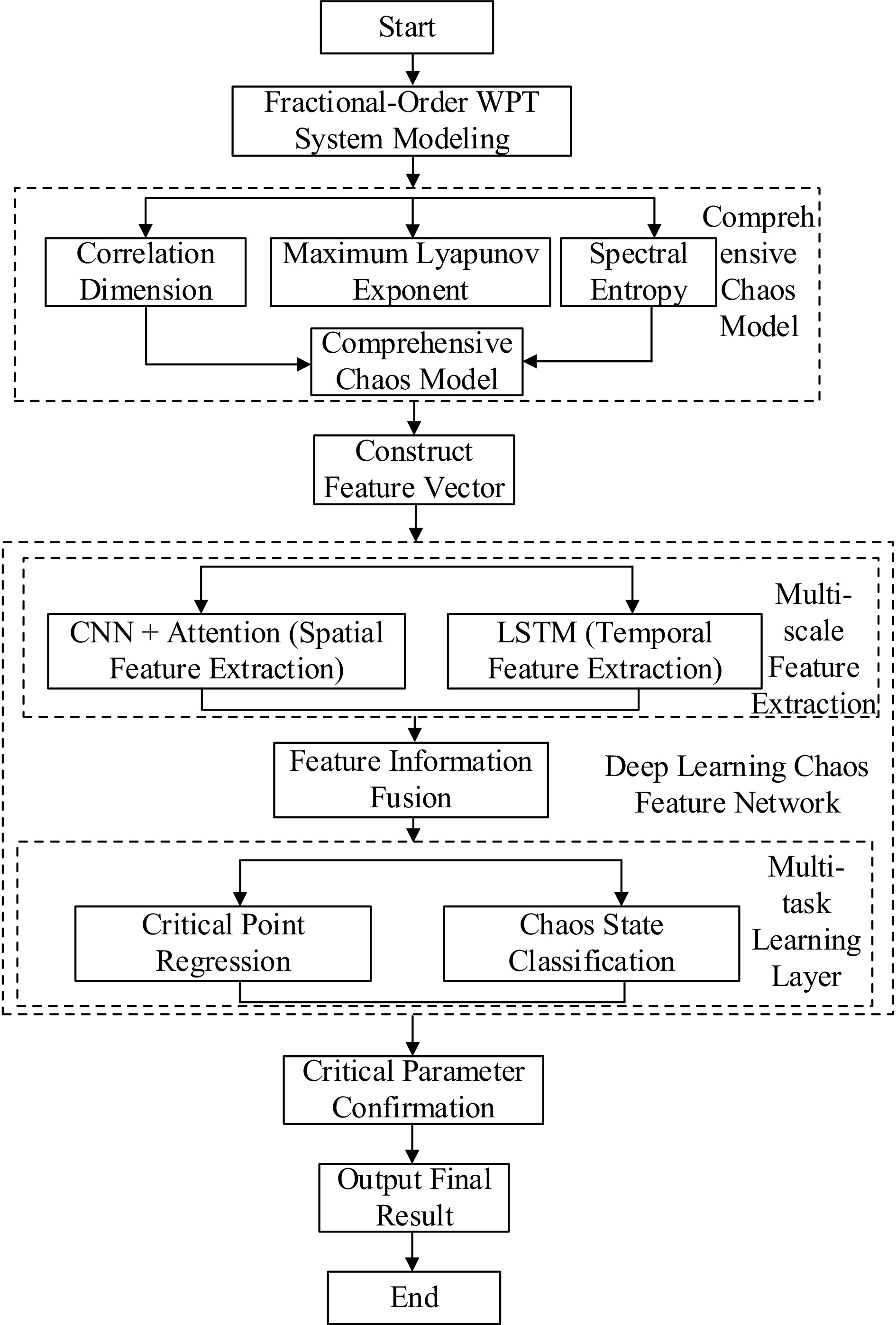
Figure 2.
Flowchart of system chaotic critical parameter identification.
-
To verify the superiority of the constructed fractional-order multi-receiver WPT system model and analyze its chaotic dynamic behavior, a single-transmitter triple-receiver WPT system is considered as an example. The relevant parameters of the system are configured as follows:
EDC = 100 V, f = 85 kHz, L0 = 1,100 μH, C0 = 10 nF, R0 = 0.8 Ω, L1 = 1,200 μH, C1 = 12 nF, RL1 = RL2 = RL3 = 10 Ω, L2 = 900 μH, C2 = 10 nF, R2 = 0.8 Ω, L3 = 1,100 μH, C3 = 18 nF, R3 = 0.8 Ω, M01 = M02 = M03 = 150 μH.
Furthermore, to determine the nonlinear coefficients, the parameters of the components during normal operation are first measured. Then, using the quadratic nonlinear model established above as a framework, a least squares fitting algorithm is applied to search for data that optimally approximates the measured parameters with the model curve.
Finally, based on the degree of match between the above nonlinear model and the actual operational data, the nonlinear coefficients are obtained as k11 = k12 = k13 = 0.2,k21 = k22 = k23 = 0.06, k31 = k32 = k33 = 0.3.
Based on the previously constructed chaos critical parameter identification method using the deep learning-weighted chaos state estimation model, the critical order identification is first performed for the triple-receiver fractional-order WPT system. The identification reveals that the critical fractional-order value is α = 0.791. The state trajectories and phase trajectories of each subsystem within the system are shown in Figs 3−10, respectively.
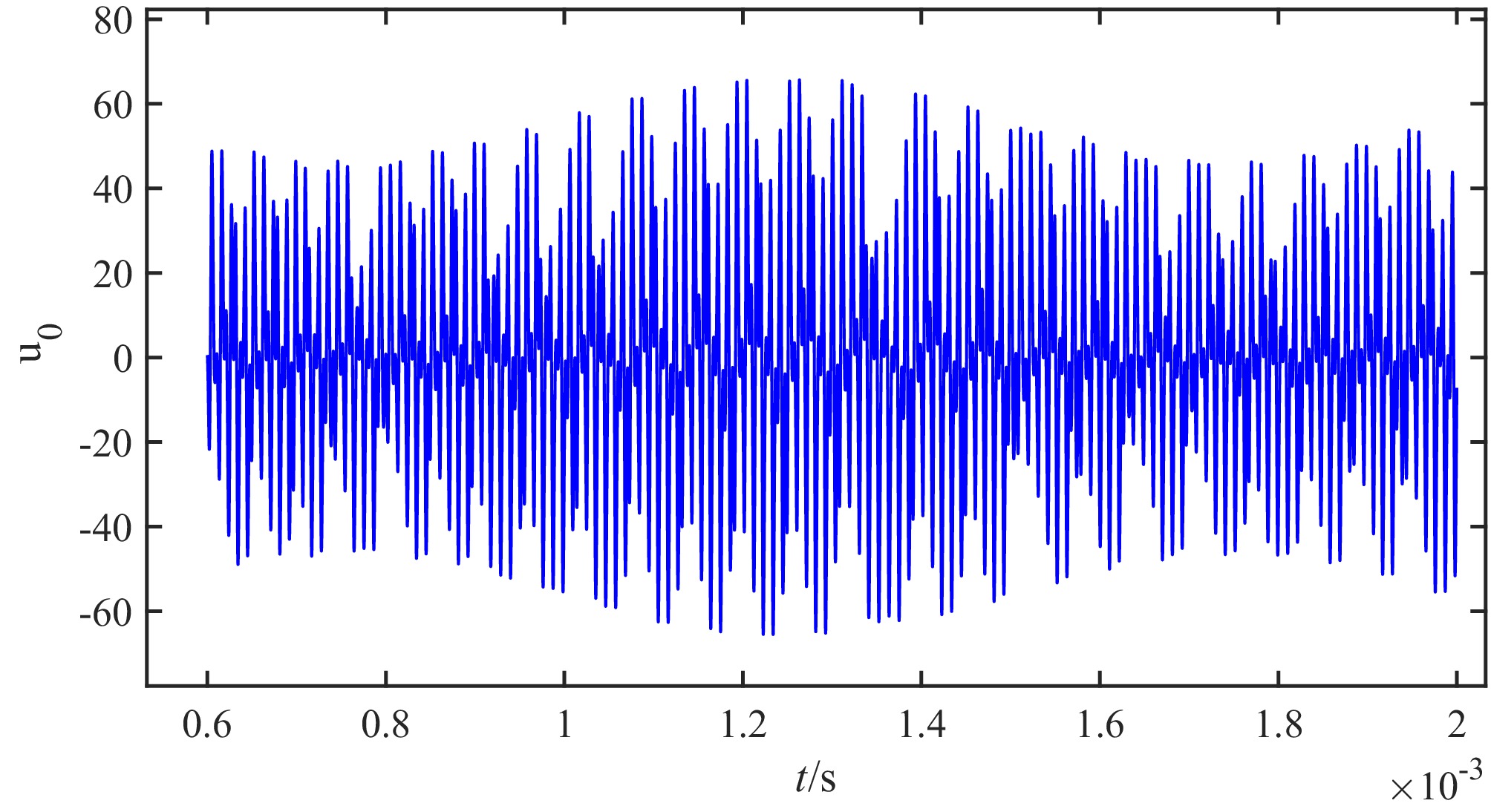
Figure 3.
Voltage state response of the transmitter.
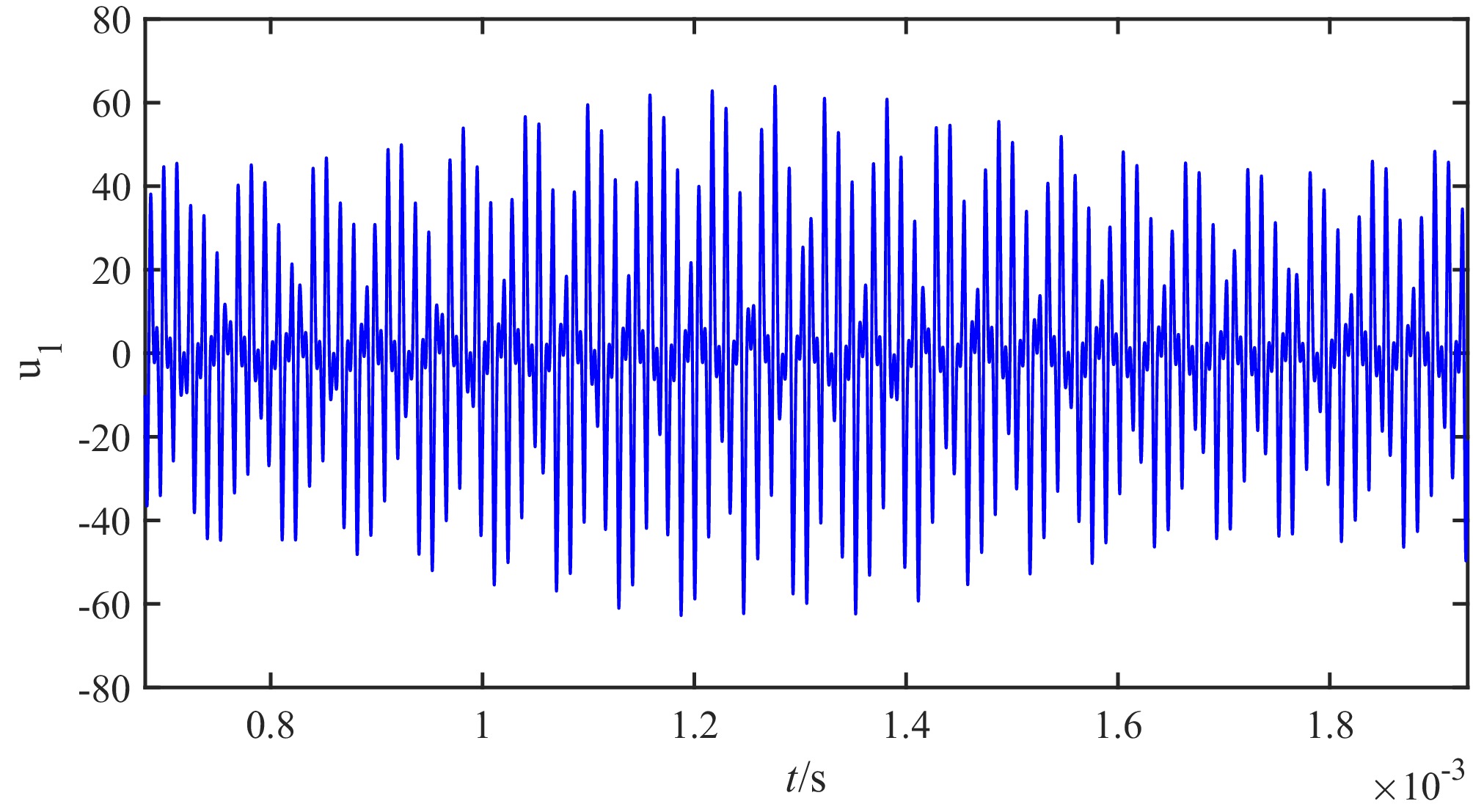
Figure 4.
Voltage state response of receiver 1.
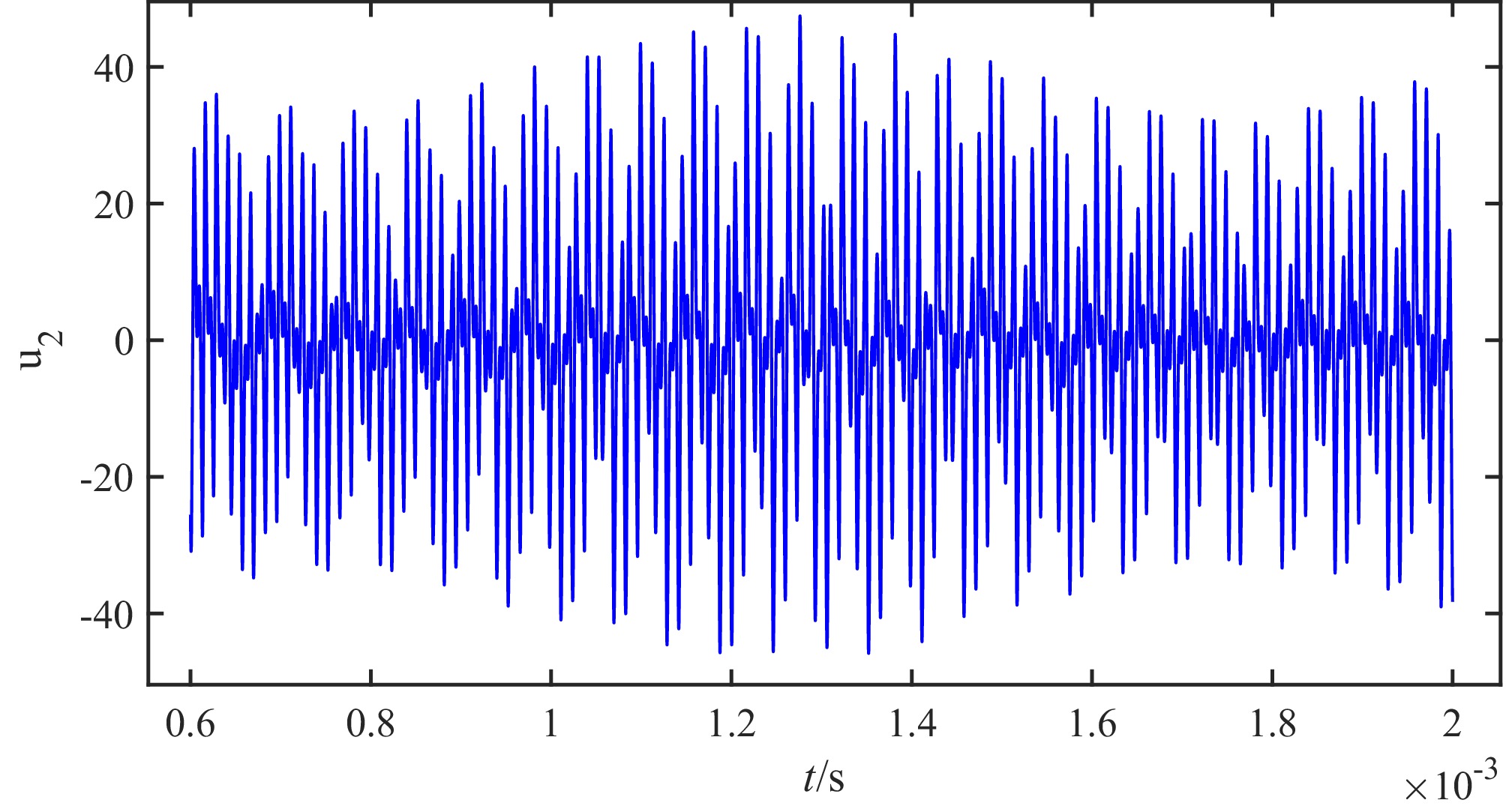
Figure 5.
Voltage state response of receiver 2.
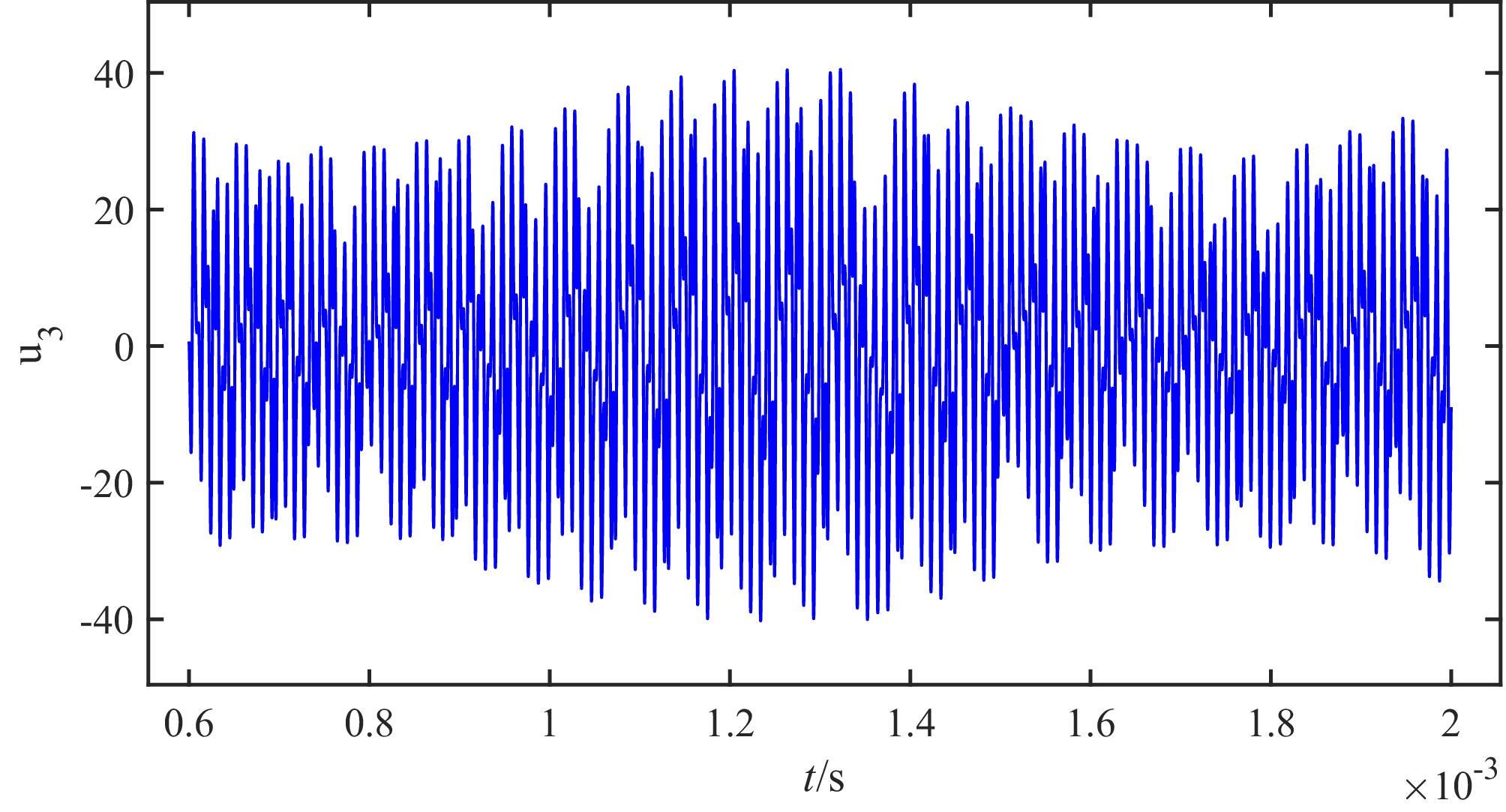
Figure 6.
Voltage state response of receiver 3.
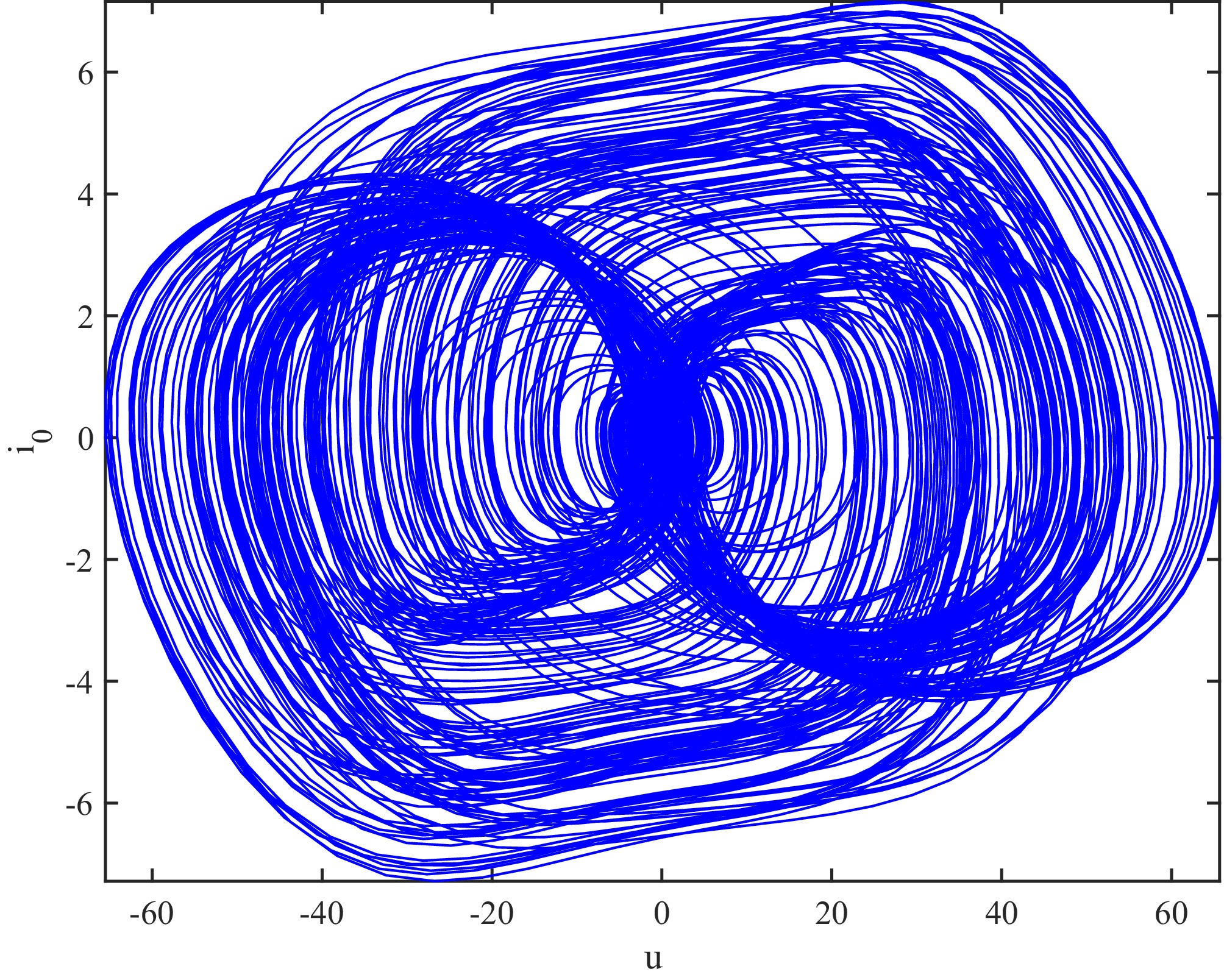
Figure 7.
Phase trajectory of the transmitter.
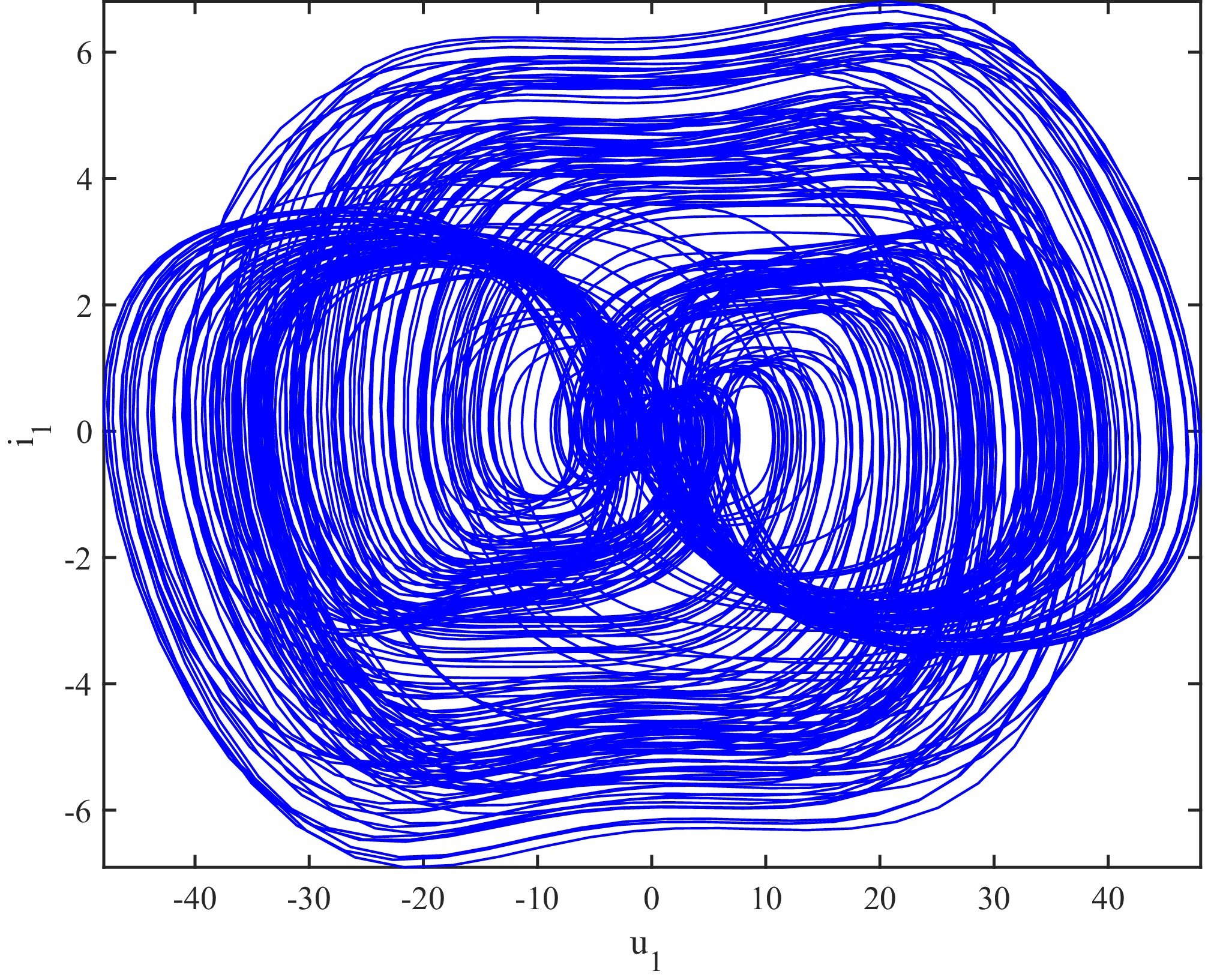
Figure 8.
Phase trajectory of receiver 1.
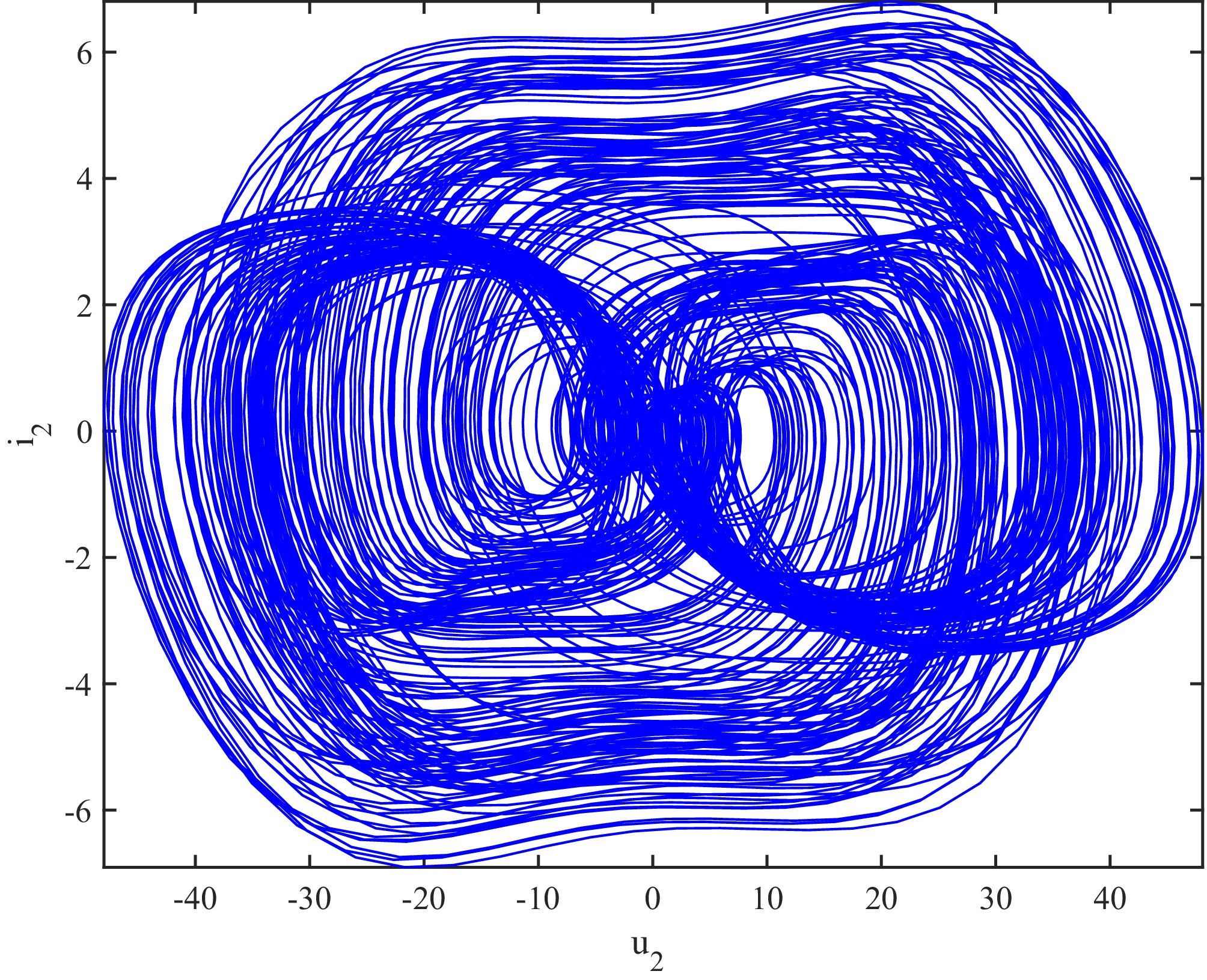
Figure 9.
Phase trajectory of receiver 2.
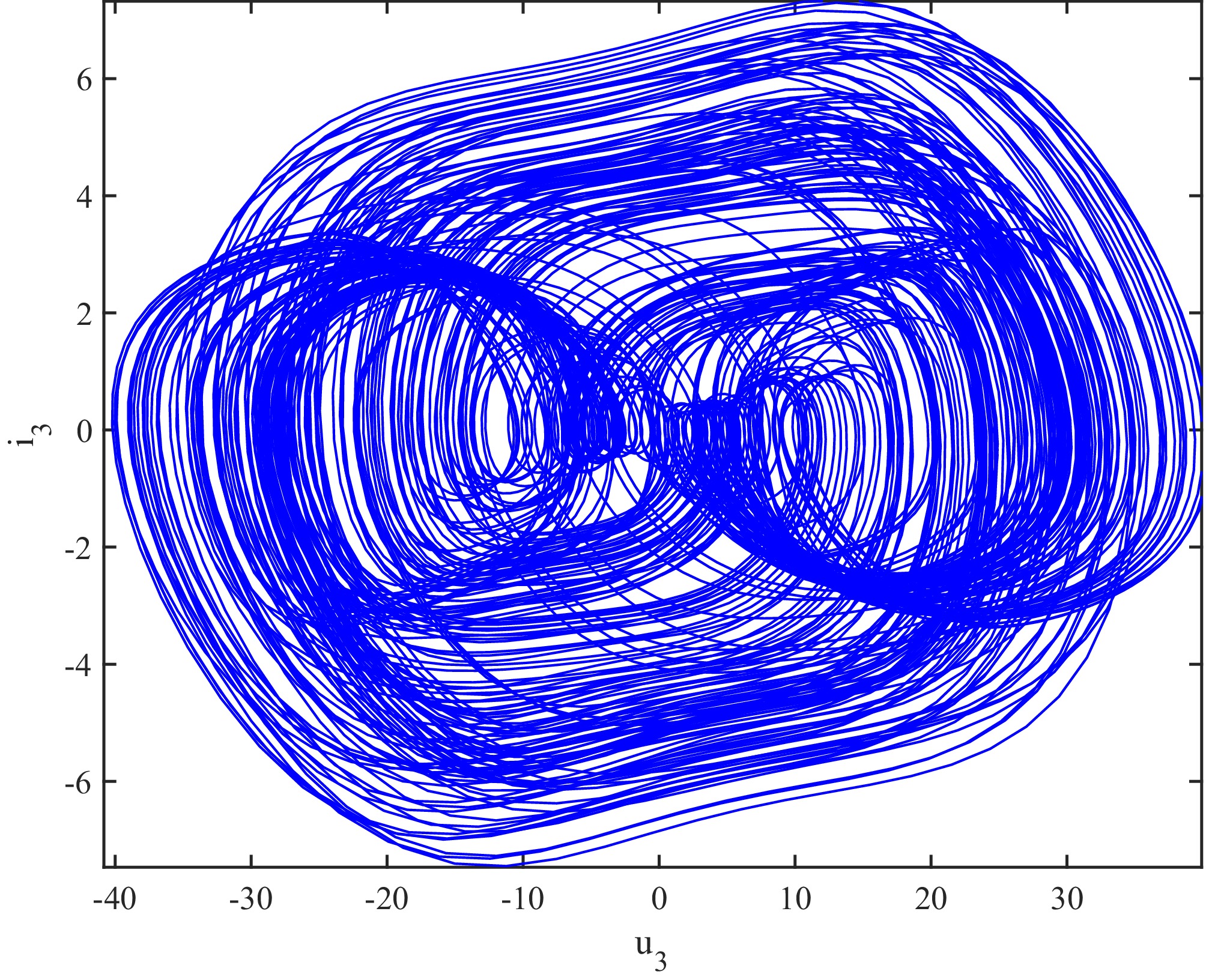
Figure 10.
Phase trajectory of receiver 3.
From Figs 3−10, it can be observed that when the fractional order α = 0.791, the system enters a chaotic state. The phase trajectory diagrams exhibit complex, non-periodic oscillatory behavior in voltage and current states, reflecting the strong interaction between magnetic field coupling and nonlinear parameters. In contrast, the integer-order model fails to capture this chaotic phenomenon in advance, as similar behavior only emerges when the order is 1. This highlights the superiority of the fractional-order model in describing system dynamics, as it identifies the chaotic critical point at a lower order, thereby enhancing the accuracy of the system model. Thus, the proposed deep learning-based weighted chaos state estimation model for chaotic critical parameter identification can precisely determine the critical fractional order at which the WPT system enters a chaotic state. This method effectively addresses the challenge of accurately determining the chaotic order in fractional-order system dynamic behavior analysis, providing a reliable theoretical tool for studying chaotic dynamics in complex WPT systems. To thoroughly validate the effectiveness of the proposed identification algorithm, further exploration of other key factors inducing chaos in the system is conducted. Here, mutual inductance coefficients and load are selected as the parameters for identification.
First, setting α = 0.75, the phase diagrams of the triple-receiver fractional-order WPT systems are obtained through simulation, as shown in Figs 11−14. These figures reveal that each subsystem exhibits quasi-periodic oscillations under the initial conditions.
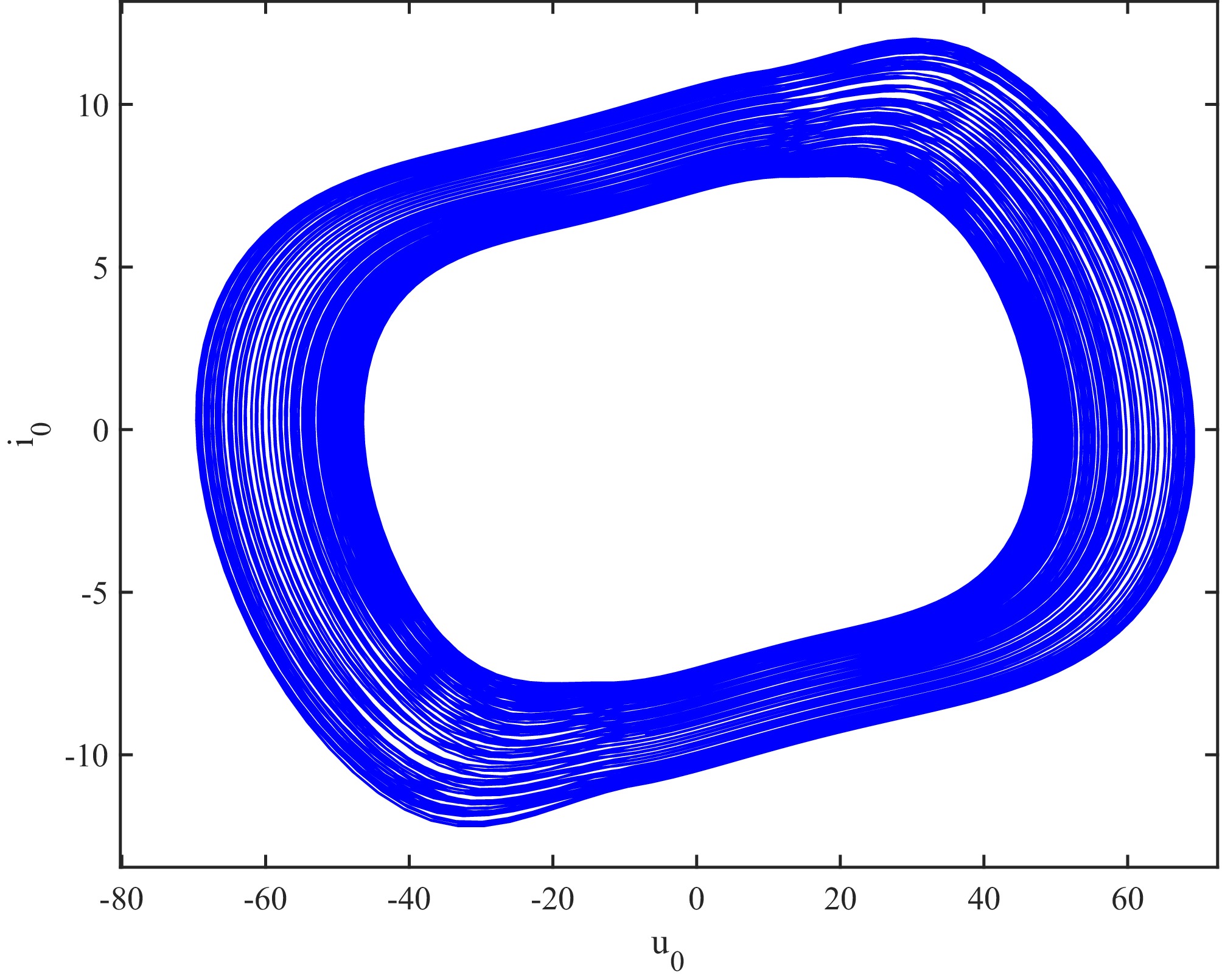
Figure 11.
Phase trajectory of the transmitter.
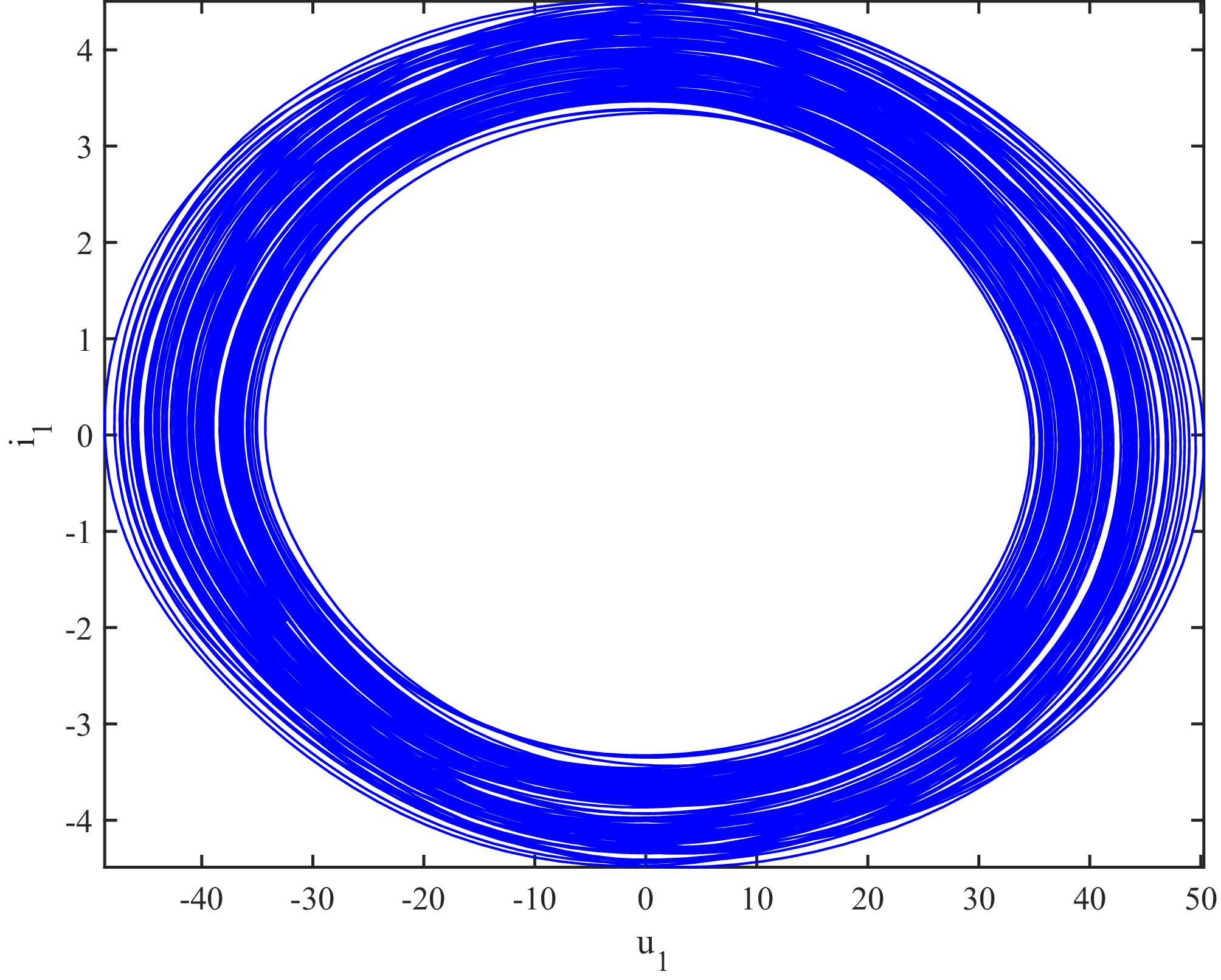
Figure 12.
Phase trajectory of subsystem 1.
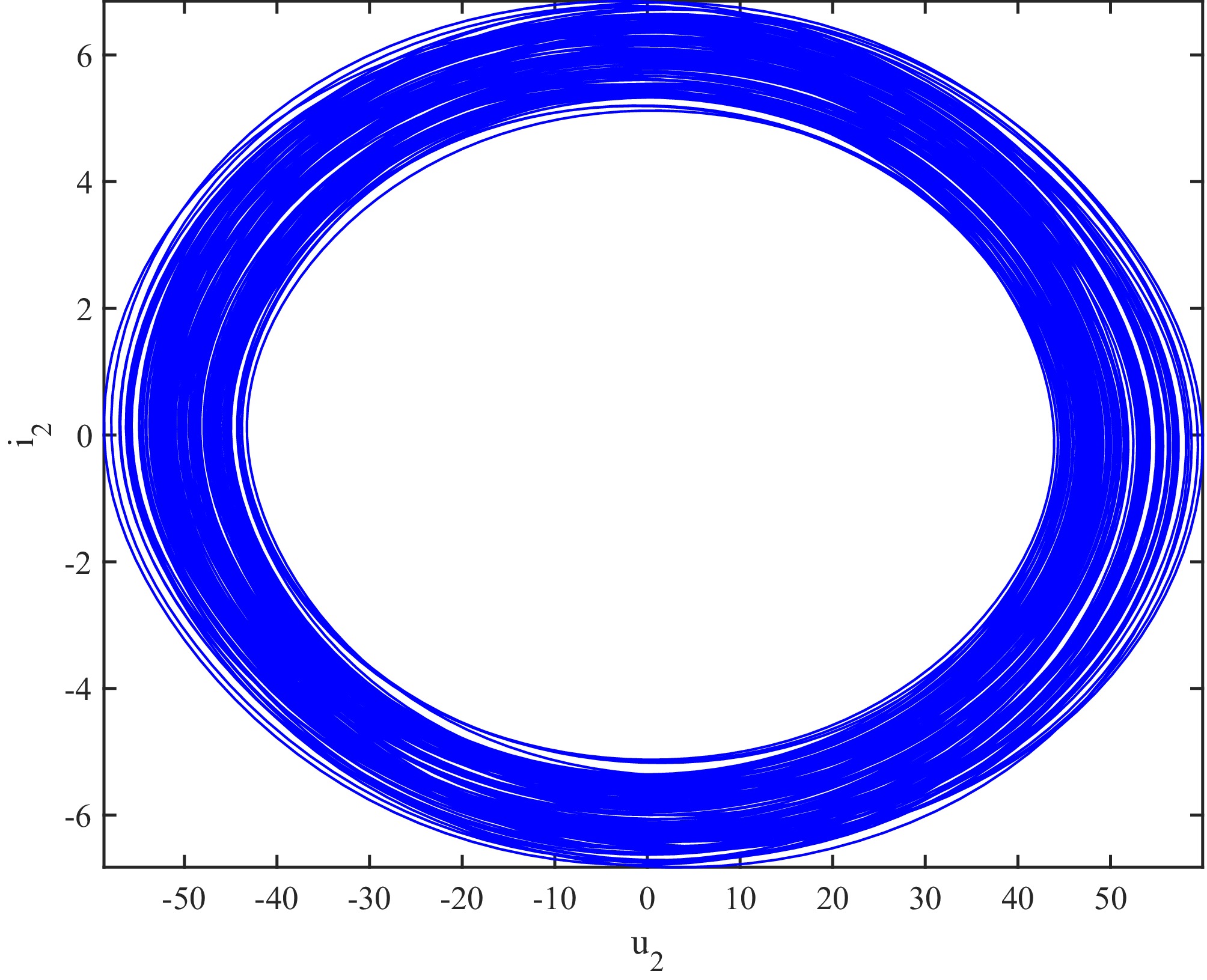
Figure 13.
Phase trajectory of subsystem 2.
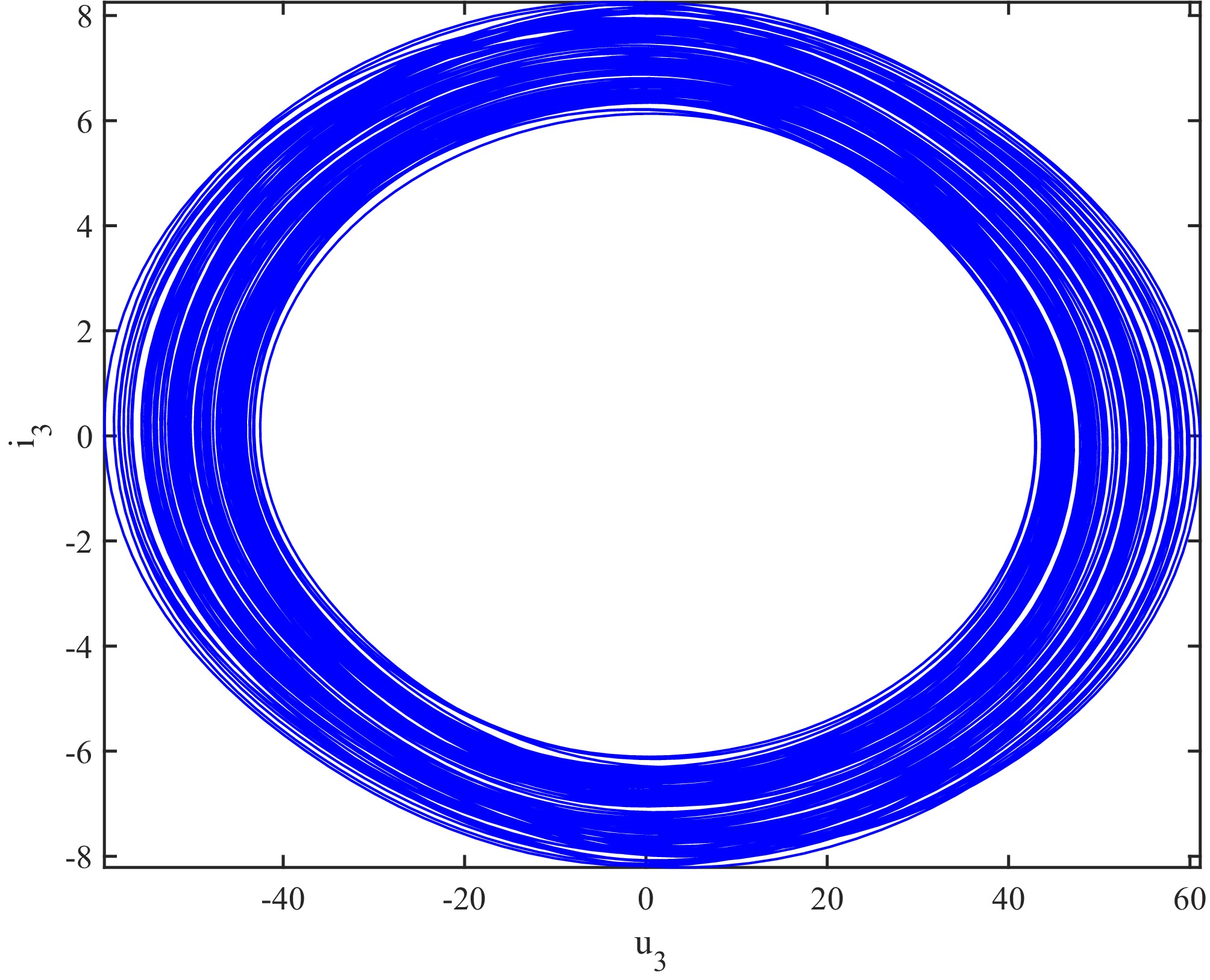
Figure 14.
Phase trajectory of subsystem 3.
Next, using the proposed chaos critical parameter identification algorithm, the self-coupling mutual inductance coefficients M01,M02, and M03 are identified while keeping the aforementioned fractional order fixed. The identification results indicate that the system enters a chaotic state when the mutual inductance coefficients are M01 = M02 = M03 = 251 μH. The corresponding phase trajectories of each subsystem are shown in Figs 15−18, respectively.
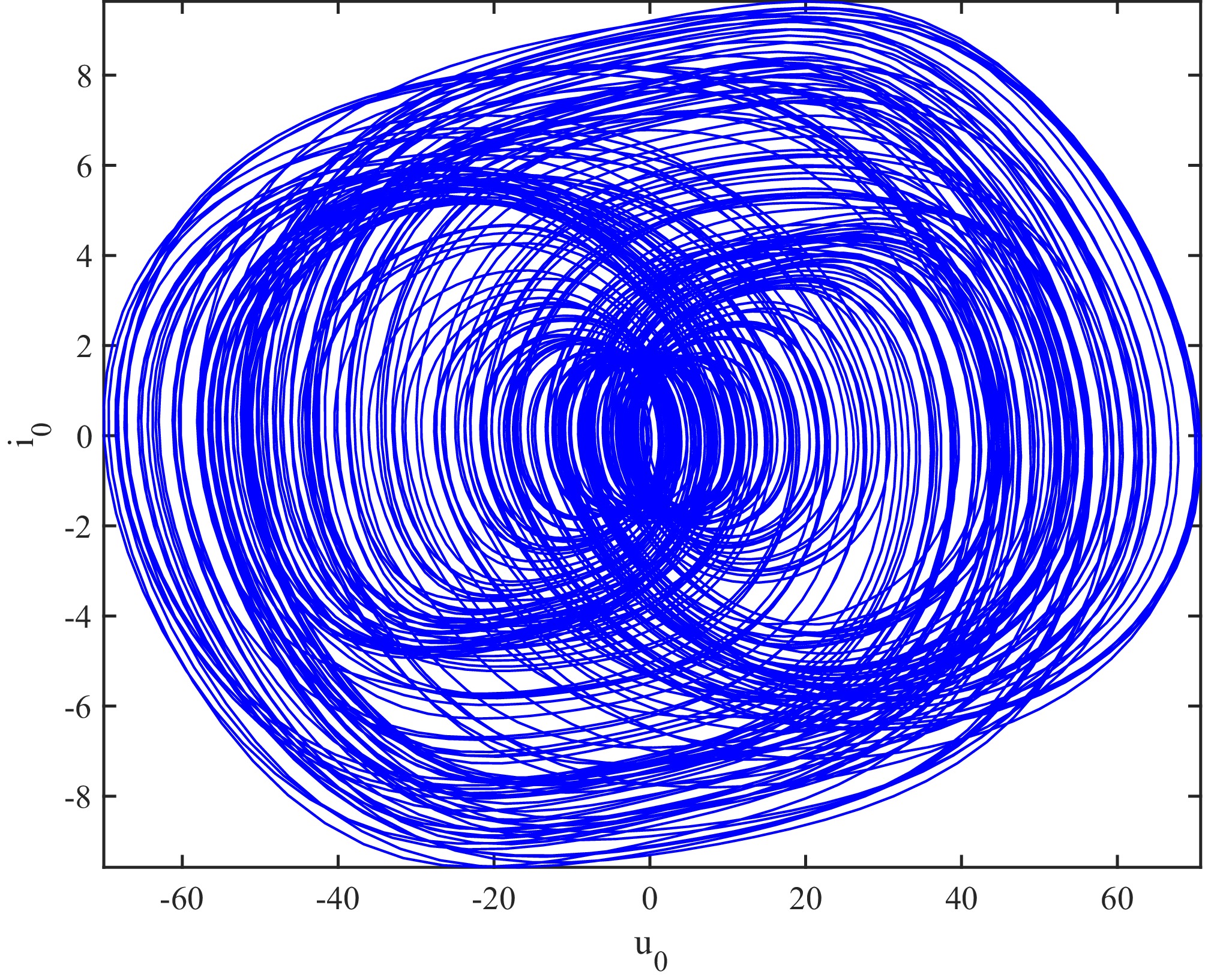
Figure 15.
Phase trajectory of the transmitter with mutual inductance variation.
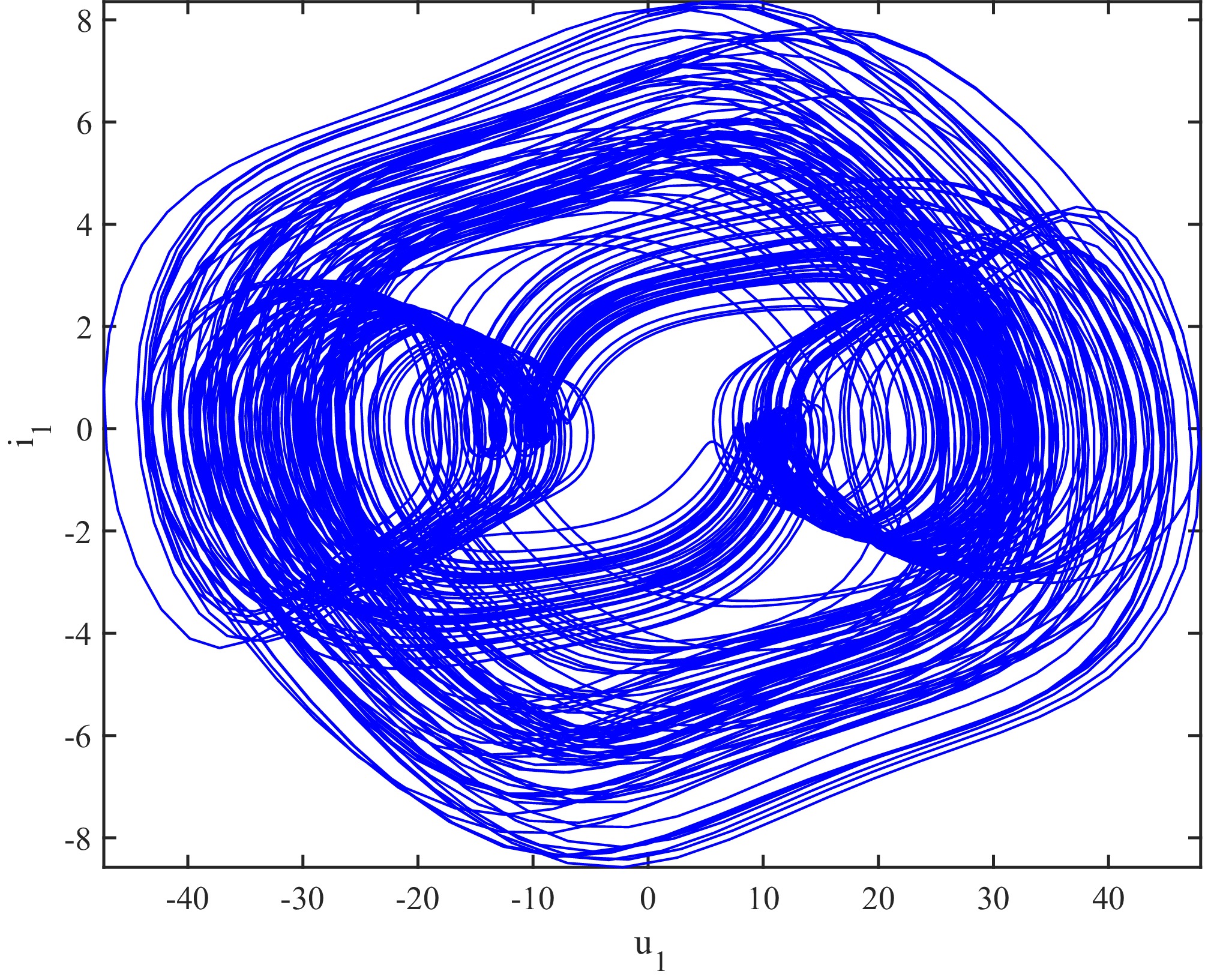
Figure 16.
Phase trajectory of receiver 1 with mutual inductance variation.
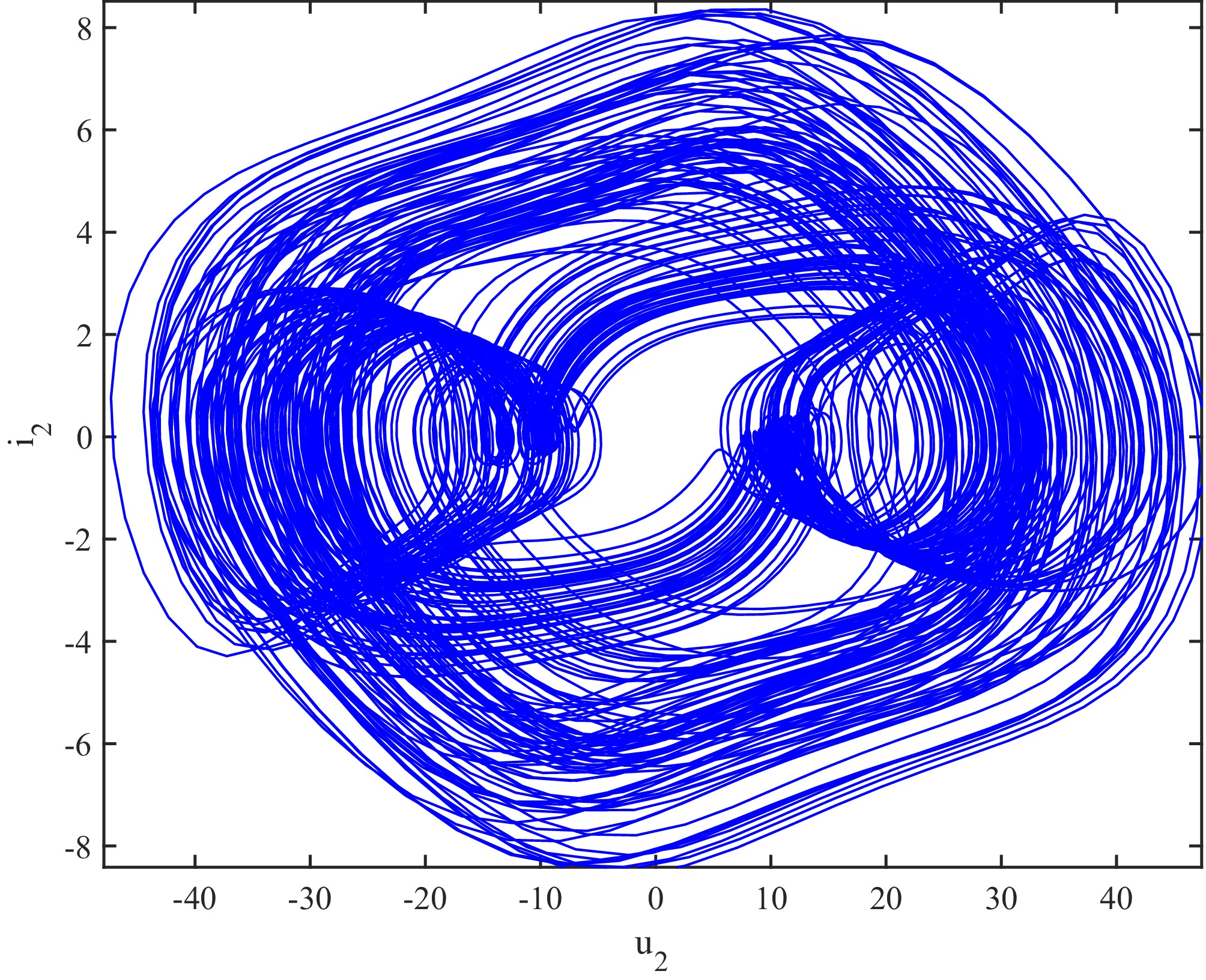
Figure 17.
Phase trajectory of receiver 2 with mutual inductance variation.
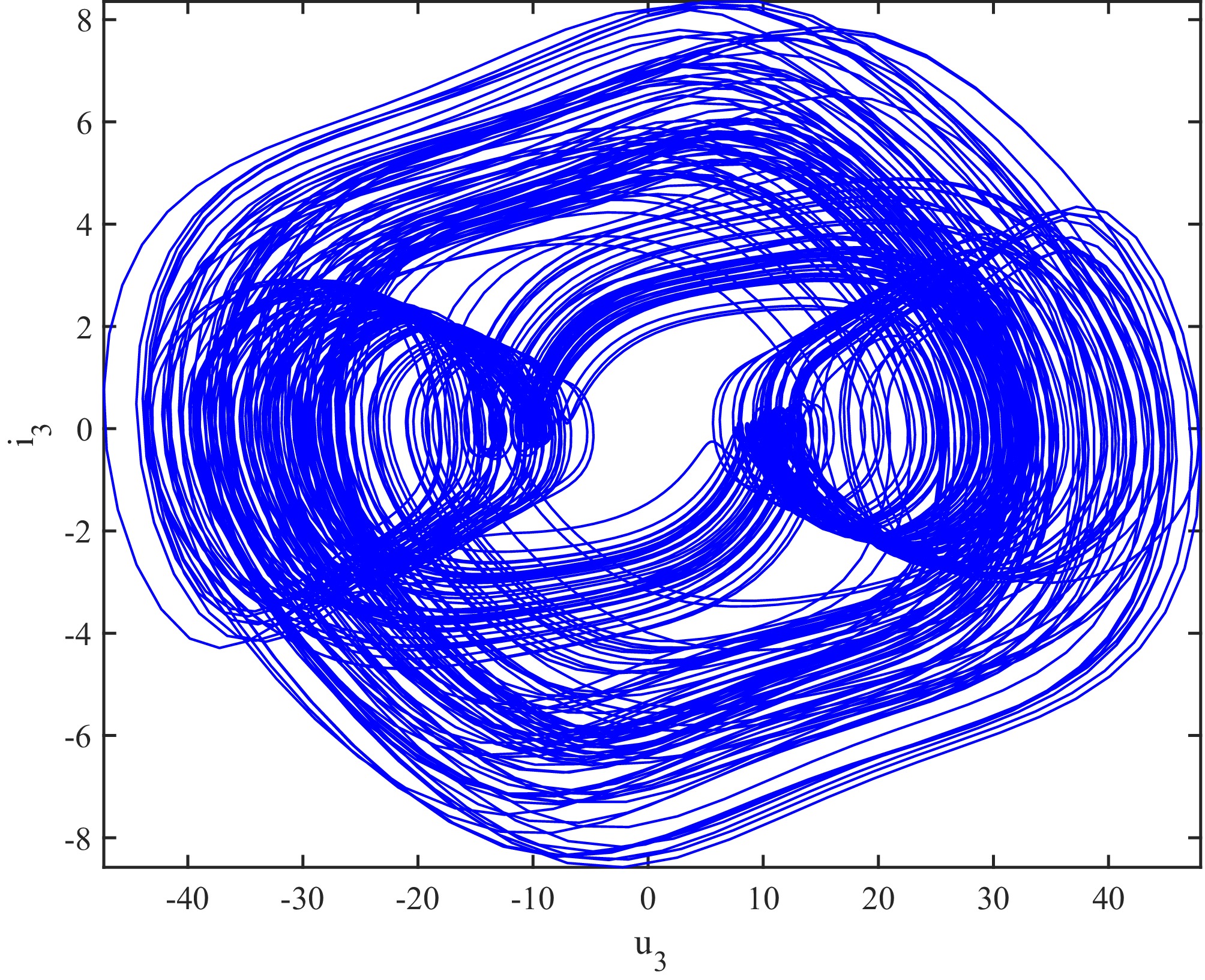
Figure 18.
Phase trajectory of receiver 3 with mutual inductance variation.
From Figs 15−18, it can be observed that as the mutual inductance increases, the dynamic behavior of the system changes. The phase trajectories of each subsystem transition from the original quasi-periodic oscillation state into a chaotic state. This phenomenon indicates that the mutual inductance coefficient, as a key parameter reflecting the energy coupling strength between coils enhances magnetic field coupling when its value increases. This intensifies the nonlinearity of the system, thereby triggering chaotic behavior. This result confirms the critical role of the mutual inductance coefficient in regulating the dynamic characteristics of WPT systems, providing important insights for system stability analysis and parameter optimization.
Finally, under the conditions of fixed fractional order and mutual inductance coefficients, the same parameter identification method is applied to identify the critical point of the load resistance. When the load resistance reaches R = 45 Ω, the system enters a chaotic state. The corresponding phase trajectories of each subsystem are shown in Figs 19−22, respectively.
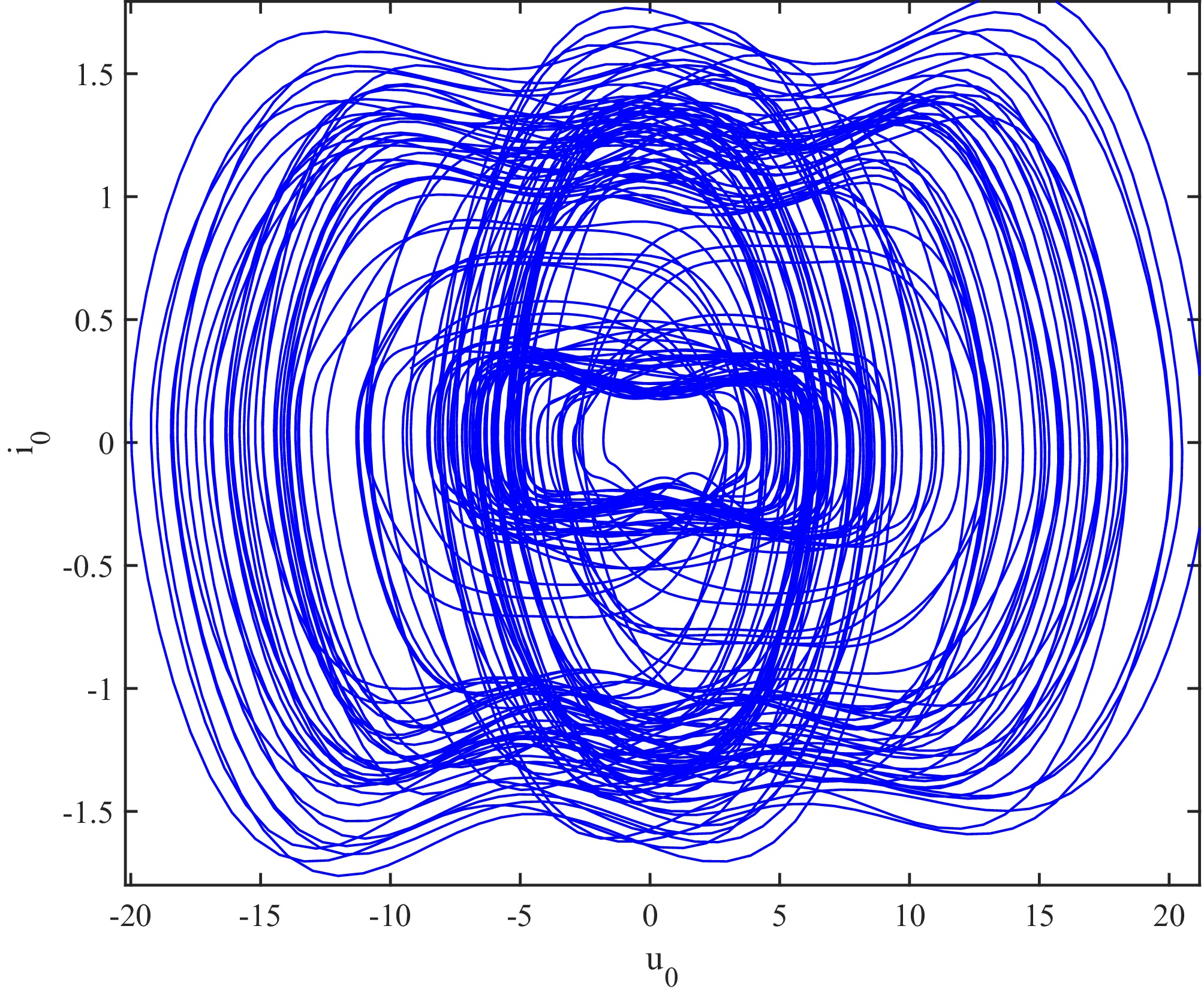
Figure 19.
Phase trajectory of the transmitter with load variation.
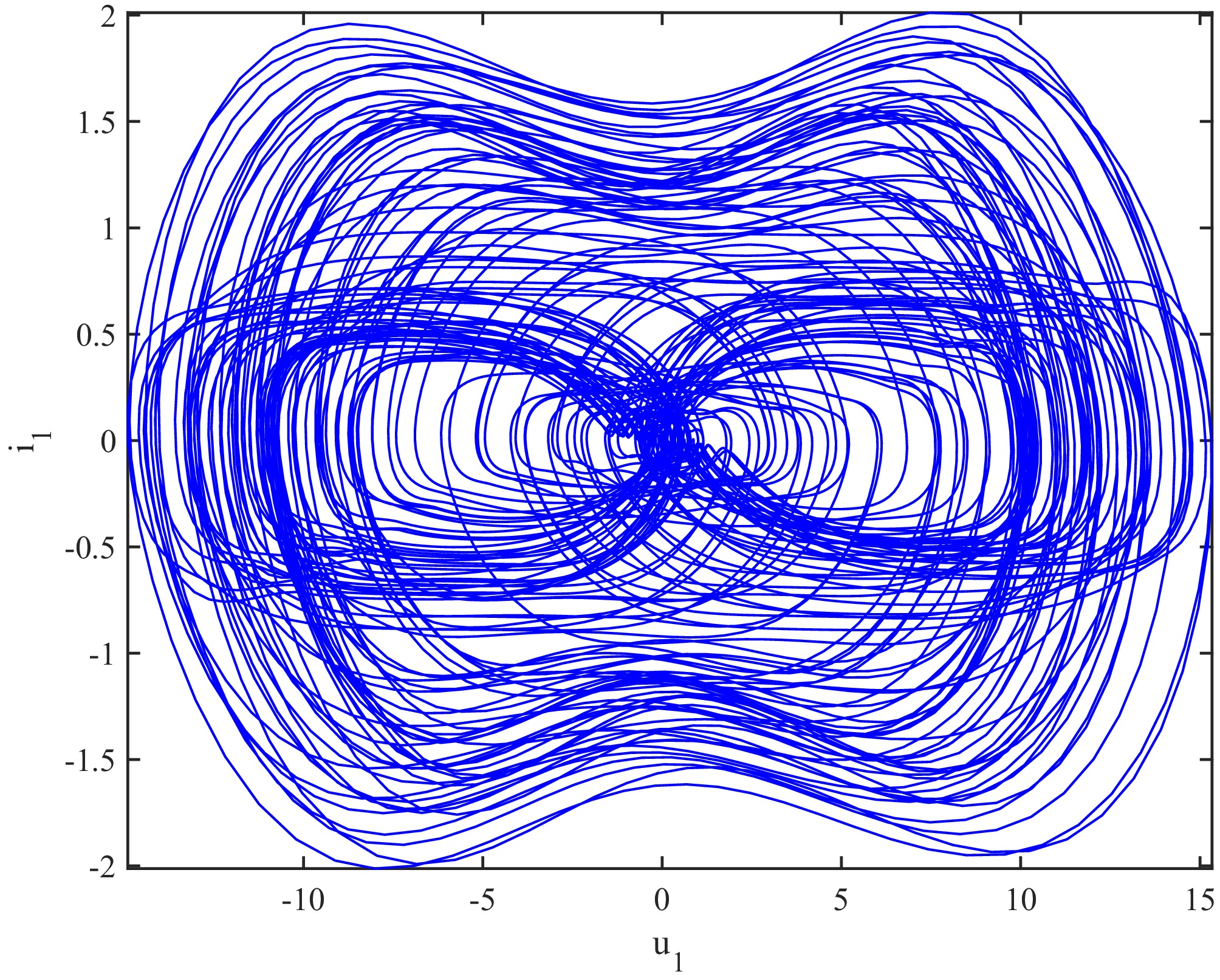
Figure 20.
Phase trajectory of receiver 1 with load variation.
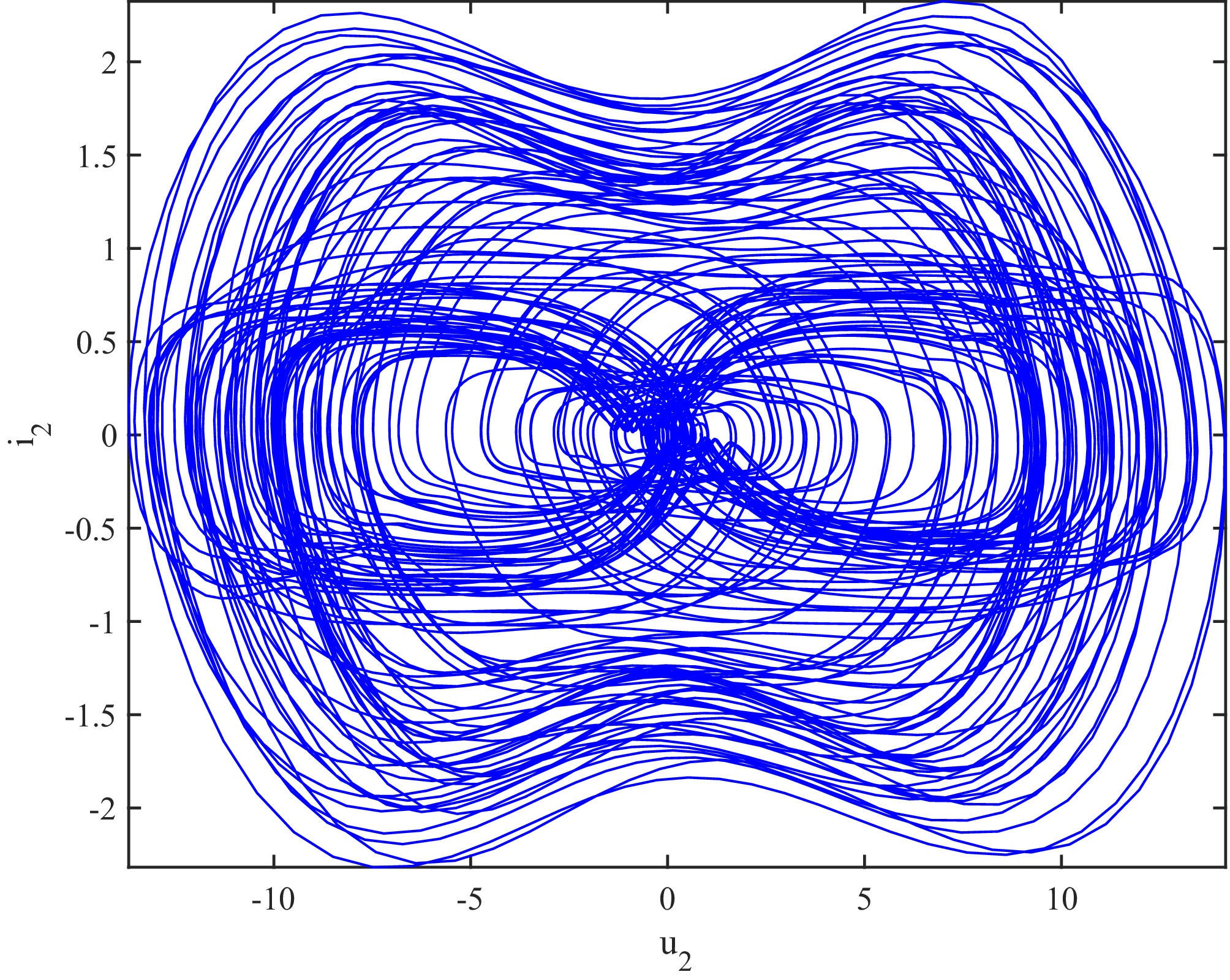
Figure 21.
Phase trajectory of receiver 2 with load variation.
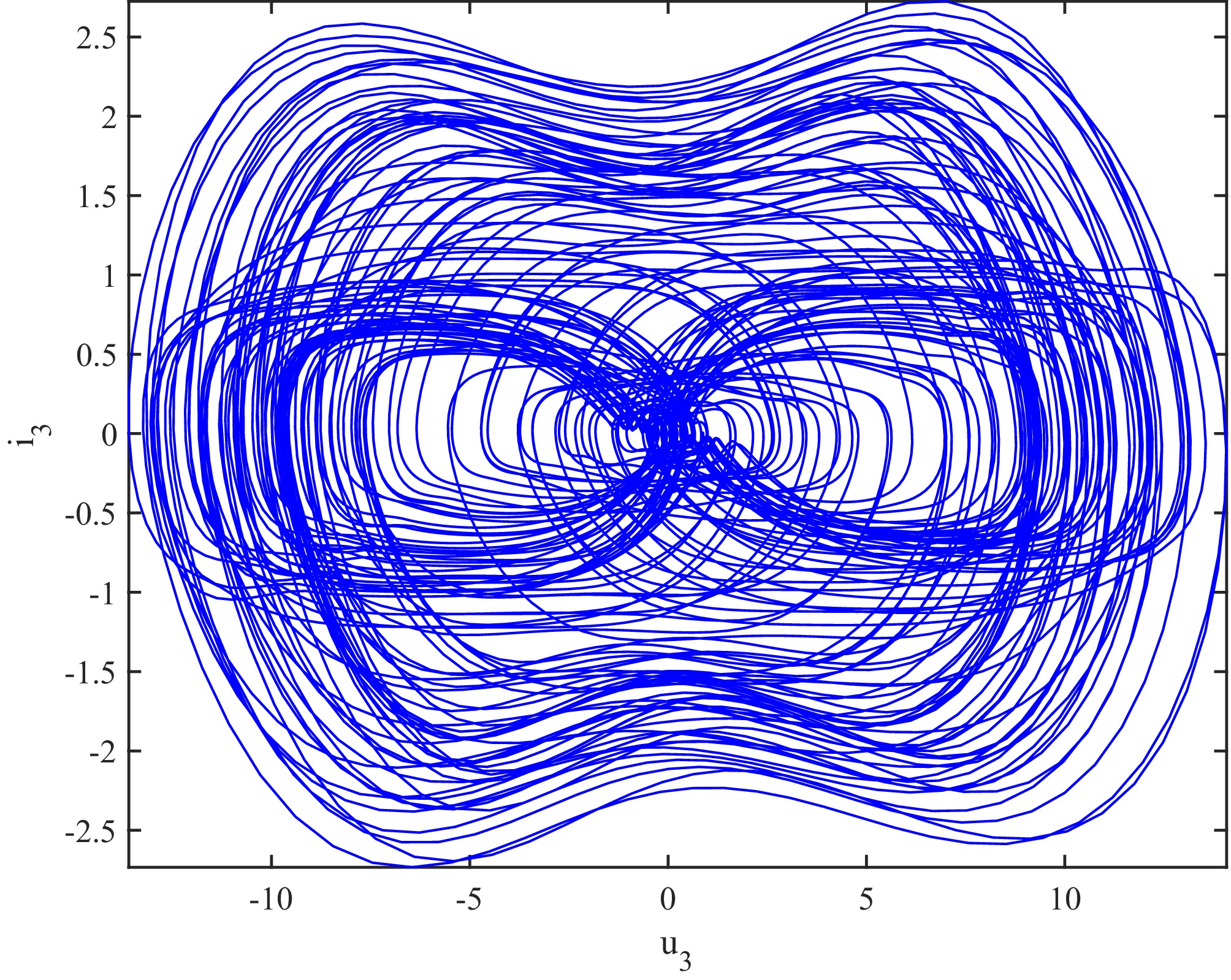
Figure 22.
Phase trajectory of receiver 3 with load variation.
From Figs 19−22, it can be seen that when the load parameter reaches the identified critical value, the phase trajectories of each subsystem change, and the system enters a chaotic state. This indicates that altering the load parameter can also induce chaotic phenomena in the system. In summary, changes in system order, mutual inductance, and load can all lead to chaotic behavior in the system. Moreover, these results fully demonstrate the effectiveness of the proposed chaotic critical parameter identification algorithm.
-
This paper addressed the challenges of low modeling accuracy, high model order, and difficulty in precisely identifying chaotic critical parameters in multi-receiver wireless power transfer systems. A fractional-order nonlinear model for multi-receiver WPT systems was constructed, and a chaotic critical parameter identification method based on a deep learning-weighted chaos state estimation model was proposed. The chaotic dynamic behavior of the system was also analyzed. Simulation results not only confirm the rationality of the proposed model in terms of order reduction and improved system accuracy, but also validate the effectiveness of the proposed chaotic critical parameter identification algorithm. Additionally, the key parameters influencing the emergence of chaotic phenomena in the system are identified. This provides an important reference for further research into other dynamic behaviors of the system.
-
The authors confirm contribution to the paper as follows: study conception and design: Yu Z, Lei Y; data collection: Yu Z, Liu Z, Dai X; software validation: Yu Z, Lei Y; analysis and interpretation of results: Yu Z, Lei Y, Sun Y, Dai X; draft manuscript preparation: Yu Z, Lei Y; supervision: Sun Y, Liu Z, Dai X. All authors reviewed the results and approved the final version of the manuscript.
-
The datasets generated during and/or analyzed during the current study are available from the corresponding author on reasonable request.
-
The authors declare that they have no conflict of interest.
- Copyright: © 2026 by the author(s). Published by Maximum Academic Press, Fayetteville, GA. This article is an open access article distributed under Creative Commons Attribution License (CC BY 4.0), visit https://creativecommons.org/licenses/by/4.0/.
-
About this article
Cite this article
Yu Z, Lei Y, Sun Y, Dai X, Liu Z. 2026. Chaotic critical identification and dynamic analysis of fractional-order wireless power transfer systems. Wireless Power Transfer 13: e025 doi: 10.48130/wpt-0026-0016 

Chaotic critical identification and dynamic analysis of fractional-order wireless power transfer systems
- Received: 19 January 2026
- Revised: 09 March 2026
- Accepted: 20 March 2026
- Published online: 04 September 2026
Abstract: In response to the challenges of high-order models, low accuracy, and difficulty in accurately analyzing the dynamic behavior faced by wireless power transfer (WPT) systems with complex topologies, this paper proposes a high-precision, low-order model for WPT systems with multiple receivers, and an accurate method for identifying their chaotic critical parameters. First, by introducing fractional-order differential operators and applying modeling theory of interconnected systems, a fractional-order, low-order state-space model for multi-receiver WPT systems is constructed. Then, considering the nonlinearity of system parameters, the corresponding nonlinear model is established. On this basis, a chaotic critical parameter identification method based on deep learning with weighted chaotic state estimation is proposed. The proposed method can adaptively identify critical parameters that affect the chaotic dynamics of the system, such as the fractional order, mutual inductance, and load. Finally, the chaotic dynamics of a single-transmitter, multi-receiver WPT system are analyzed as an example. The results demonstrate that the constructed fractional-order model is more accurate in describing the chaotic dynamics of the WPT system, and the effectiveness of the proposed identification method is also verified.