











-
Germination is the whole set of natural physiological processes occurring in a seed, resulting in the growth and development of a young plant. Germination breaks the dormant state of the seed by triggering biochemical reactions to occur in the presence of moisture, oxygen, appropriate temperature, and light conditions[1,2]. It revives the seed's metabolism when the seed's own endogenous enzymes are activated or newly synthesized, leading to catabolism and degradation of seed reserve nutrients mobilized to support early growth of the sprout. These hydrolytic enzymes (amylases, proteases, and lipases) help in the breakdown of macromolecules (starches, proteins, and lipids) into smaller and more usable forms, including simple sugars, amino acids, and free fatty acids for seedling growth. Therefore, germination improves the nutritional value of grains by increasing nutrient bioavailability, enhancing phytochemical content (such as phenolics, γ-aminobutyric acid, and vitamins), and reducing antinutritional factors (such as phytic acid and tannins), essential materials for functional food development[1,3−5].
Rice (Oryza sativa L.) is a staple food across many regions of the world, especially in East, South, and Southeast Asia. Although rice is low in protein and lacks a complete amino acid profile, it is still essential for human health. Unpolished rice has a higher nutritional value than white rice because its outer bran layer and germ preserve beneficial compounds such as dietary fiber, B-vitamins, minerals, and bioactive compounds, while these substances in white rice are reduced or lost during milling or polishing[6]. Ravichanthiran et al.[7] have demonstrated that the phytochemical compounds of unpolished rice, such as phenolic and flavonoid compounds, vitamin E (tocopherols and tocotrienols), γ-oryzanol, and γ-aminobutyric acid, can contribute to health benefits including antidiabetic, cardioprotective, anticancer, and antioxidant properties. The nutritional and functional characteristics of unpolished rice could be enhanced under germination[8]. After germination, a substantial increase in levels of crude proteins, free sugars, dietary fiber, ash, minerals, total phenolics, and antioxidant activity, B-complex vitamins, vitamin E, γ-oryzanol, and γ-aminobutyric acid in unpolished rice has been observed[9,10]. Germination is also a successful and effective method for decreasing phytic acid levels in unpolished rice, an anti-nutrient that limits mineral bioavailability[11]. In addition, germinated unpolished rice may contribute to multiple functional and therapeutic properties related to hyperglycemia, immune function, blood pressure, arteriosclerosis, cancer inhibition, diabetes, and Alzheimer's disease[12]. As a result, germinated unpolished rice is increasingly regarded as a functional food because it has potential health benefits, improves digestion, and contains increased bioactive compounds such as γ-aminobutyric acid compared to ungerminated colored rice.
Mung bean (Vigna radiata [L.] R. Wilczek), a small oval-shaped green legume, is widely used as a staple in Asian cuisines and in both savory and sweet recipes. It contains high amounts of carbohydrates, proteins, fiber, vitamins, minerals, and relatively low concentrations of several types of antinutritional compounds, including tannins, phytic acid, trypsin inhibitors, etc.[13]. Germinated mung beans were also found to contain increased amounts of crude proteins and certain essential amino acids, such as leucine and phenylalanine, higher levels of phenolic and flavonoid compounds with high antioxidant capacity, and greater accumulation of γ-aminobutyric acid[2,14−16]. Furthermore, Kemal et al.[17] mentioned that germination of mung beans reduces anti-nutrients that help improve the absorption of minerals and protein digestibility. Therefore, the germinated mung bean flour is also a potential material for enhancing nutritional, functional, and sensory characteristics of food products[18].
Cookies are baked cereal products traditionally made from wheat flour with a crisp texture, very low moisture content, and high sugar and fat contents[19]. However, many wheat-related disorders, including celiac disease, non-celiac gluten sensitivity, and wheat allergy, are now common[20]. A gluten-free cookie is an alternative to a traditional cookie with negligible gluten content. Some studies have developed new gluten-free cookie formulations by using non-gluten flours such as rice flour, maize, sorghum, pearl millet, and their blends[21]; eight individual legume, cereal, and pseudocereal flours[22]; cooked, germinated, and germinated/steam-blanched pinto bean flours[23]; germinated mung bean flour combined with rice flour[18]; and germinated brown rice flour with potato starch[24]. The nutritional and health benefits of gluten-free cookies are closely related to specific non-gluten ingredients used because different substitutes can provide different levels of protein, fiber, minerals, and antioxidants[25]. Even though different approaches using various non-gluten ingredients as substitutes have been explored, researchers are still trying to develop new ingredients for making gluten-free cookies to mimic the functional role of wheat flour[26]. Although germinated unpolished rice flour is rich in bioactive compounds and provides desirable starch functionality, its protein content is relatively low. In contrast, germinated mung bean flour is rich in protein, dietary fiber, and bioactive compounds, but its incorporation may affect dough behavior and sensory characteristics. Therefore, blending these two germinated flours could potentially provide complementary nutritional and functional properties for gluten-free cookie development. Previous studies have mainly focused on the incorporation of germinated mung bean flour into formulations containing non-germinated white rice flour[18] or the use of individual germinated flours in gluten-free bakery products[24]. However, limited information is available regarding the combined use of germinated mung bean flour and germinated unpolished rice flour, in which both flour sources are germinated. Compared with white rice flour, germinated unpolished rice flour retains the bran layer and contains higher levels of dietary fiber, minerals, and bioactive compounds, which may substantially influence flour functionality, dough behavior, and cookie quality. In addition, the effects of different blending ratios of these two germinated flours on the physicochemical, nutritional, textural, and sensory properties of gluten-free cookies remain unclear. Therefore, the objectives of this study were to evaluate the physicochemical and nutritional properties of gluten-free cookies made from the blending of germinated mung bean flour and germinated unpolished rice flour at different ratios, and to determine which suitable combination produced the desired overall cookie quality.
-
Red rice (Oryza sativa var. India), verified by the National Institute for Food Control (3962/PKN–VKNQG) of Vietnam, was supplied by Ben Tre granary, Vietnam. Mung bean (Vigna radiata [L.] R. Wilczek) named DX108 was obtained from the Legumes Research and Development Center, Field Crops Research Institute, Vietnam Academy of Agricultural Sciences. All seeds were clean, firm, mature, uniform in size, and free of insects or molds. Wheat flour, steviol glycosides, butter, and salt used for cookie preparation were bought from a local market in Ho Chi Minh City, Vietnam. All chemicals and solvents used for sample analyses were of analytical reagent grade and were purchased from Merck Co. (Darmstadt, Germany).
Germination of rice grains and mung bean seeds
-
The red rice grains and mung bean seeds were germinated according to the method of Hung et al.[2] with some modifications. The grains or seeds were initially sorted and cleaned thoroughly with water to eliminate any impurities. Then they were soaked in distilled water at 35 °C for 4 h. After draining out the water, soaked grains or seeds were distributed evenly on trays, covered with moist tissues, and incubated in dark conditions at 30 °C and 85% relative humidity for 24 h to germinate. Water was sprayed on trays every 12 h to ensure that there was sufficient moisture for germination. After germination, the grains or seeds were dried using a forced-air convection drying oven at 55 °C for 5−6 h to achieve a target moisture content of about 12%. The dried germinated grains or seeds were milled and passed through a 65-mesh sieve to obtain the fine flour. The resulting flours were stored in an airtight zip-lock bag at ambient temperature until further use.
Determination of pasting properties of flours
-
The pasting properties of blended germinated mung bean and rice flours were analyzed using a Brabender Micro-Visco Amylograph[27]. The test cycle involved heating from 50 °C to 95 °C in 282 s, holding at 95 °C for 150 s, and subsequently cooling back to 50 °C. Each test cycle began with mixing at a high paddle speed of 960 rpm for 10 s before switching to continuous stirring at 160 rpm for the remainder of the analysis. The test samples consisted of 3.0 g of composite flour combined with enough distilled water to make a suspension of 15% flour concentration (w/v) in an aluminum canister. The amount of blended flour and water was adjusted slightly to provide a constant moisture level because the moisture content of the flour varied between batches. Pasting parameters, including pasting temperature (PT), peak viscosity (PV), final viscosity (FV), breakdown viscosity (BD), and setback viscosity (SB), were automatically recorded by the instrument software.
Determination of Swelling Index and water solubility of flours
-
Swelling Index (SI) and water solubility (WS) of the flour gel were determined based on the method of Hung et al.[27] with modifications. A total of 1 g of flour sample was suspended in 20 mL of distilled water in a centrifuge tube and stirred gently. The mixture was placed in a water bath at 90 °C for 15 min. The cooked paste was cooled with ice to room temperature before being centrifuged at 4 °C for 4,500 × g for 10 min. After centrifugation, the supernatant was discarded, and the dry solid was recovered. SI and WS calculations were based on the following equations:
$ {\mathrm{SI}} ({\mathrm{g/g}}) = \dfrac{\text{Weight of sediment}}{\text{Weight of flour sample}} $ $ {\mathrm{WS}} (\text{%}, {\mathrm{dry}}\; {\mathrm{basis}}) = \dfrac{\text{Weight of dissolved solids in supernatant}}{\text{Weight of flour sample}} \times 100 $ Cookie preparation
-
The cookie formulations are presented in Table 1. Composite flours consisting of germinated red rice flour (GRF) and germinated mung bean flour (GMF) were prepared at different ratios of 100:0 (GRF), 62.5:37.5 (GR-GMF1), 50:50 (GR-GMF2), and 37.5:62.5 (GR-GMF3) for the production of gluten-free cookies. The corresponding cookie samples were designated as GRC (cookies made from 100% germinated red rice flour), GR-GMC1, GR-GMC2, and GR-GMC3 for cookies prepared from GRF and GMF blends at ratios of 62.5:37.5, 50:50, and 37.5:62.5, respectively. Cookies prepared using 100% wheat flour were used as the control sample and designated as WC. Each blended flour was weighed separately and combined with 0.5 g of salt in a medium bowl. In another bowl, 25 g of butter and 28 g of steviol glycosides were homogenized to make a cream. Steviol glycosides were used as a reduced-calorie sweetener and were kept constant in all formulations to minimize the influence of sweetener variation on cookie quality attributes. Then the premixed flour was mixed with the above cream and 30 g of water to form a smooth dough using a mixer at 60 rpm for 3 min. The dough was wrapped in plastic wrap and refrigerated for 30 min. After chilling, it was rolled into a 3–5 mm sheet using a rolling pin. A 4-cm diameter round mold was then used to create a standardized shape for cookies. The shaped dough pieces were placed on the baking tray and baked in a preheated oven at a temperature in the range of 160–200 °C for 8–12 min. After baking, the cookies were allowed to cool to 30 °C before being placed in airtight bags and stored at room temperature for further analyses.
Table 1. Formulation of cookie ingredients.
Ingredients Cookie WC GRC GR-GMC1 GR-GMC2 GR-GMC3 Wheat flour (g) 100 0 0 0 0 Germinated red rice flour (g) 0 100 62.5 50 37.5 Germinated mung bean flour (g) 0 0 37.5 50 62.5 Steviol glycosides (g) 28 28 28 28 28 Butter (g) 25 25 25 25 25 Water (g) 30 30 30 30 30 Salt (g) 0.5 0.5 0.5 0.5 0.5 1 WC, cookies made from wheat flour; GRC, cookies made from germinated red rice flour; GR-GMC1, GR-GMC2, and GR-GMC3, cookies made from blended germinated red rice and germinated mung bean flours at ratios of 62.5:37.5, 50:50, and 37.5:62.5, respectively. Proximate analysis of cookies
-
The moisture, ash, protein, and lipid contents of each sample were determined in accordance with the AACC-approved methods 44-15.02, 08-01.01, 46-10.01, and 30-10.01, respectively[28]. The crude protein content of cookies was measured by the Kjeldahl digestion system with the nitrogen conversion factor of 6.25, while the lipid content was determined using the Soxhlet extraction apparatus. The amount of crude fiber was analyzed based on the AOAC 978.10. The percentage of total carbohydrate in each sample was estimated by difference as 100% minus the sum of protein, fat, ash, fiber, and moisture percentages.
Physical properties of cookies
-
Physical properties of cookies, including diameter, thickness, and spread ratio, were measured. The diameter was measured by arranging six randomly chosen cookies edge-to-edge and taking an average width measurement from those cookies. The thickness was determined by stacking the six cookies on top of each other and measuring the average thickness of the cookies. The spread ratio was estimated by dividing the diameter by the thickness.
Textural analysis of cookies
-
Each developed cookie sample (WFC, GRC, GR-GMC1, GR-GMC2, and GR-GMC3) was evaluated for textural characteristics by using a texture analyzer to measure its breaking strength. An individual cookie sample was placed on the platform with support from two points. The test was performed at a crosshead speed of 50 mm/min using a cylindrical blade probe (3.14 mm diameter and 1 cm length) attached to the moving crosshead of the instrument. This setup simulated the evaluation of hardness by consumers holding the cookies in their hands and breaking by bending. The peak force recorded on the force vs distance curve showed the breaking strength for the cookies.
Color analysis of cookies
-
Surface color of cookie samples (WFC, GRC, GR-GMC1, GR-GMC2, and GR-GMC3) was measured using a color scale CIELAB (Hunter Lab Associates Inc.). The L* value indicated the lightness of the cookies with values from 0 (black) to 100 (white). The a* value represented the red-green coordinate in which the positive value (+a) was redness and the negative value (–a) was greenness. The b* value showed the yellow-blue coordinate, where the positive value (+b) was yellowness, and the negative value (–b) was blueness. The instrument was calibrated with a standard white plate before measurement.
Sensory evaluation of cookies
-
A total of 50 untrained panelists comprising both males and females were selected for the sensory evaluation of cookies to assess consumer acceptability of the developed products. The panelists were instructed to evaluate the samples for appearance, taste, aroma, texture, and overall acceptability using a 9-point hedonic test. This scale ranged from 1 (extremely dislike) to 9 (extremely like) for each attribute. The five cookie samples coded with 3-digit numbers were presented to each participant on a tray along with purified drinking water and a scorecard. The sample orders were randomized and served randomly. Water was used to rinse the mouth between samples. The test session was conducted at room temperature in the sensory laboratory.
Statistical analysis
-
All results were presented as mean ± standard deviation of triplicate experiments. The data obtained were analyzed by Analysis of Variance (ANOVA) using the Statistical Package for the Social Sciences (SPSS) software. Significant differences among mean values were established at p ≤ 0.05.
-
Pasting properties describe the change in viscosity of single or blended flours during heating or cooling under controlled conditions. These properties are important for determining the texture, mouthfeel, and stability of cereal-based products, especially cookies. Pasting properties of wheat flour (WF), germinated rice flour (GRF), and composite flours containing increasing levels of germinated mung bean flour (GMF) are shown in Table 2. WF exhibited a significantly lower PT (60.2 °C) than GRF (67.0 °C), suggesting that starch gelatinization in GRF systems required more thermal energy than WF. The incorporation of GMF further elevated the PT of GRF-based systems, from GRF to GR-GMF3, reaching values above 70 °C. This trend was consistent with the findings of Loikaeo[29], who reported lower PT values in WF compared with GRF and GMF. The higher PT observed in germinated and composite flours might be attributed to the presence of non-starch components, particularly soluble proteins and dietary fibers, which may limit water accessibility and interact with starch granules, thereby delaying gelatinization[30].
Table 2. Pasting properties of blended germinated rice and germinated mung bean flours.1,2,3
Samples PT ( °C) PV (BU) FV (BU) BD (BU) SB (BU) WF 60.2 ± 0.1d 910 ± 5a 1416 ± 30a 395 ± 6a 680 ± 13a GRF 67.0 ± 0.2c 559 ± 10b 666 ± 12b 342 ± 8b 452 ± 4b GR-GMF1 69.3 ± 0.1b 498 ± 13c 613 ± 5c 280 ± 10c 399 ± 3c GR-GMF2 70.6 ± 0.1a 572 ± 7b 675 ± 7b 300 ± 13c 445 ± 8b GR-GMF3 70.7 ± 0.2a 573 ± 3b 664 ± 7b 308 ± 8c 449 ± 7b 1 WF, wheat flour; GRF, germinated red rice flour; GR-GMF1, GR-GMF2, and GR-GMF3, blended germinated rice and germinated mung bean flours at ratio of 62.5:37.5; 50:50, and 37.5:62.5, respectively. 2 PT, Pasting temperature (°C); PV, peak viscosity (BU); FV, final viscosity (BU); BD, breakdown (BU); SB, setback (BU). 3 Mean values within a column followed by different letters were significantly different (p < 0.05). On the other hand, WF showed markedly higher peak viscosity (PV), final viscosity (FV), breakdown (BD), and setback (SB) values than GRF, reflecting substantial differences in starch functionality between WF and the germinated flour systems. Similar reductions in viscosity parameters have been reported in germinated cereal-based systems[31,32]. The substantial decline in PV and FV in GRF suggested a weakened swelling capacity and lower paste viscosity, which might be associated with enzymatic degradation of starch commonly reported in germinated grains. Previous studies have reported that endogenous α-amylases in germinated grains hydrolyze starch polymers into dextrins and simple sugars, thereby reducing molecular integrity and limiting viscosity development[33]. Furthermore, the lower BD value observed in GRF indicated improved resistance to shear and thermal disintegration compared to WF. The decrease in BD might be associated with partial hydrolysis of starch granules commonly observed in germinated grains, which reduced granule swelling and susceptibility to rupture under heating and shear conditions. The reduced SB also implied a diminished tendency for starch retrogradation, which may be associated with shortened amylose chains reported in germinated grains.
With an increasing amount of GMF, all composite samples maintained significantly lower PV and FV values than WF, confirming their reduced paste thickening capacity relative to WF. Although GR-GMF2 and GR-GMF3 showed slightly higher PV and FV than GR-GMF1, their values remained comparable to GRF, indicating that the incorporation of GMF did not markedly disrupt the pasting behavior of GRF, maintaining both swelling and gel-forming characteristics. This behavior might be explained by the effects of starch dilution combined with the higher protein content of mung bean flour, which competed for water and restricted starch granule expansion. BD values further decreased in GR-GMF formulations and were slightly lower than GRF, suggesting enhanced thermal and mechanical stability of the composite pastes. The lower BD values may be related to restricted starch granule swelling caused by the higher protein and fiber contents of germinated mung bean flour, which limited granule disruption during heating and shear. In addition, protein–starch interactions may have contributed to reinforcing the paste matrix under thermal processing conditions[31]. SB values remained significantly lower than WF and comparable to GRF, indicating limited retrogradation. The reduced SB might be associated with limited amylose reassociation due to starch modification during germination and interference from legume-derived proteins[32].
Swelling index and water solubility of blended germinated rice and germinated mung bean flours
-
Figure 1 illustrates the swelling index (SI) of wheat flour (WF), germinated rice flour (GRF), and composite flours containing increasing levels of germinated mung bean flour (GMF). No significant difference in SI was observed between WF and GRF. However, the incorporation of GMF led to numerically higher SI values compared with WF, although the differences among GR-GMF formulations were not statistically significant. This pattern suggested that the inclusion of GMF contributed to enhanced water uptake capacity in the blended systems. Moongngarm et al.[34] similarly reported that germinated legume flours exhibited improved hydration properties due to increased availability of polar functional groups. This increase in SI might be associated with structural modifications reported in germinated flours, including enzymatic hydrolysis of polysaccharides and proteins and the exposure of additional hydrophilic groups capable of binding water[35]. Moreover, the relatively higher protein and dietary fiber contents of mung bean flour likely provided additional water-binding sites, thereby promoting matrix hydration. The enhanced SI of composite flours could be advantageous in food applications requiring high water retention, such as bakery and other processed products, where improved hydration contributes to desirable texture and product yield[36].
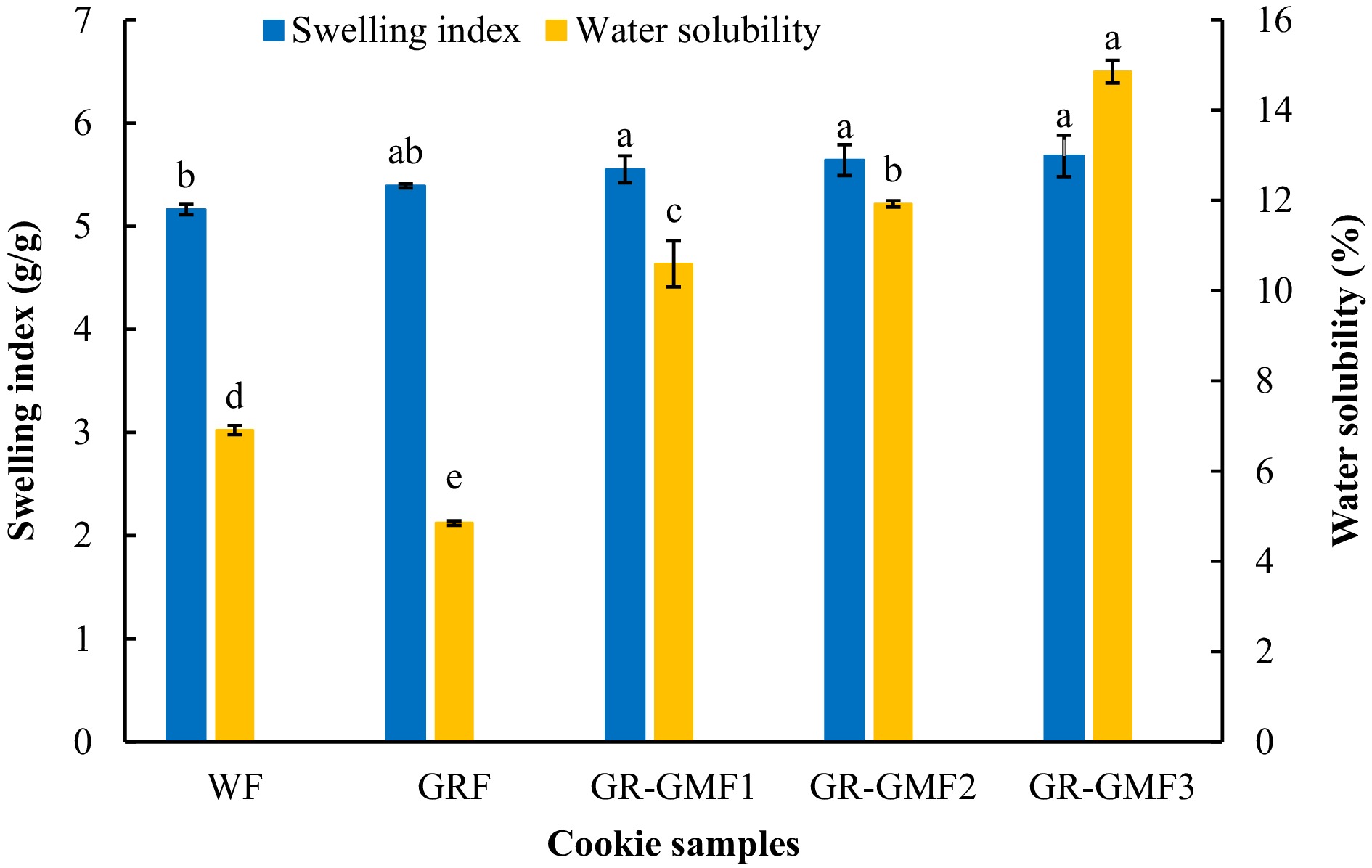
Figure 1.
Swelling index (g/g) and water solubility (%, dry basis) of blended germinated red rice and germinated mung bean flours.1WF, wheat flour; GRF, germinated red rice flour; GR-GMF1, GR-GMF2, and GR-GMF3, blended germinated rice and germinated mung bean flours at ratio of 62.5:37.5; 50:50, and 37.5:62.5, respectively.2Mean values within samples followed by different letters were significantly different (p < 0.05).
Water solubility (WS) reflects the proportion of soluble solids released from flour components into the aqueous phase. Figure 1 also presents the water solubility of wheat flour (WF), germinated rice flour (GRF), and composite flours containing increasing levels of germinated mung bean flour (GMF). WF exhibited higher WS than GRF, whereas the incorporation of GMF markedly increased WS in the composite samples. A progressive rise was observed with increasing GMF substitution, with GR-GMF3 showing the highest solubility (14.85%). Similar findings were reported by Liu et al.[31], who observed enhanced solubility in mung bean flours subjected to extended germination. The increase in WS with increasing GMF incorporation might be attributed to the higher content of soluble proteins and low-molecular-weight compounds in germinated mung bean flour. Previous studies have reported that enzymatic hydrolysis of starch and proteins during germination generates soluble sugars, peptides, and other low-molecular-weight compounds that readily dissolve in water[35]. Furthermore, legume proteins generally exhibit greater solubility than cereal proteins due to their structural and compositional characteristics[37], which might account for the higher solubility observed in GR-GMF formulations compared with WF and GRF.
Effect of baking temperature and time on aroma and appearance of cookies
-
The effect of baking temperature and time on the aroma and appearance of cookies is presented in Table 3. At a relatively low baking temperature of 160 °C, extending the baking time from 8 to 12 min gradually enhanced aroma intensity from slightly pleasant to more fragrant. However, even after 12 min, the cookies remained underdeveloped and slightly sticky, indicating insufficient moisture removal and incomplete structural setting at this temperature. At 180 °C, a clearer progression in quality attributes was observed, reflecting a more favorable balance between aroma development and structural formation. While samples baked for 8 and 10 min were still moist, those baked for 12 min exhibited a pronounced buttery aroma, dry texture, uniform expansion, and desirable crispness. These changes suggested that an appropriate combination of temperature and time promoted optimal Maillard reactions and caramelization[38], while allowing adequate heat transfer for moisture evaporation. Prolonged exposure within this moderate temperature range likely enhances the formation of volatile flavor compounds during the early and intermediate stages of the Maillard reaction[39]. In contrast, baking at 200 °C accelerated aroma formation and surface dehydration, but product quality declined with extended baking time. Cookies baked at 200 °C for 10 min were comparable to those baked at 180 °C for 12 min but displayed a darker surface color, likely due to intensified melanoidin formation at advanced stages of the Maillard reaction[39]. Further extension to 12 min at 200 °C resulted in undesirable sensory characteristics, including burnt off-odors. This deterioration may be associated with excessive thermal degradation and increased formation of compounds such as furans[38]. Moreover, excessive heat exposure might promote the generation of potentially harmful compounds, including acrylamide and furans, thereby negatively affecting both sensory and safety attributes[39]. Overall, both baking temperature and time critically influenced aroma development and visual quality. Among the tested conditions, baking at 180 °C for 12 min yielded the most acceptable sensory and structural characteristics. Among the tested conditions, baking at 180 °C for 12 min was selected for subsequent analyses because it provided the most acceptable combination of aroma, texture, and appearance based on preliminary qualitative evaluation.
Table 3. Effect of baking temperature and time on aroma and appearance of cookies.
Baking temperature (oC) Time (min) Aroma Observation 160 8 Slightly pleasant smell Cookies are moist, not dry yet 10 Slightly fragrant Cookies are still moist 12 Fragrant Cookies are not dry evenly, still sticky in hands 180 8 Slightly fragrant Cookies are still moist, have a little puff, and are not dry, soft, or sticky 10 Fragrant Cookies are slightly moist, slightly soft, and dry on the surface 12 Fragrant buttery flavor Cookies are dry, evenly puffed, and crispy 200 8 Fragrant Cookies are still moist, less puffy, and slightly soft 10 Fragrant buttery flavor Cookies are dry, evenly puffed, with a slightly dark color 12 Smells bad Cookies are dry, very dark in color Proximate analysis of cookies made from blended germinated rice and germinated mung bean flours
-
The proximate composition (dry basis) of cookies formulated with wheat flour (WF), germinated rice flour (GRF), and blended germinated rice and germinated mung bean flours (GR-GMF) is presented in Table 4. WC exhibited significantly higher moisture content than gluten-free formulations. This might be attributed to the presence of gluten proteins, which form a viscoelastic network capable of entrapping and retaining water during baking[40]. Within gluten-free samples, increasing the proportion of GMF resulted in a progressive rise in moisture content. A similar trend was reported by Yen et al.[18] in cookies enriched with GMF. Chung et al.[41] suggested that macromolecular degradation during germination increases osmotic pressure and water-binding capacity, thereby enhancing moisture retention. Additionally, compositional modifications in protein, starch, and fiber may increase structural heterogeneity, influencing water distribution and evaporation during baking[41].
Table 4. Proximate composition of cookies made from blended germinated red rice and germinated mung bean flours (w/w).1,2
Sample Moisture content (%) Protein (%, d.b) Lipid (% d.b) Ash (%, d.b) Fiber (%, d.b) Total carbohydrate (%, d.b) WC 5.90 ± 0.13a 9.25 ± 0.48c 12.53 ± 0.44b 0.98 ± 0.02e 0.98 ± 0.03d 76.26 ± 0.81a GRC 2.89 ± 0.02e 7.06 ± 0.10d 14.18 ± 0.42a 1.49 ± 0.01d 1.97 ± 0.04c 75.30 ± 0.50a GR-GMC1 3.42 ± 0.02d 10.73 ± 0.53b 15.32 ± 0.45a 1.97 ± 0.02c 2.23 ± 0.16bc 69.75 ± 0.29b GR-GMC2 3.87 ± 0.01c 12.66 ± 0.56a 14.39 ± 0.05a 2.16 ± 0.27b 2.69 ± 0.19b 68.10 ± 0.67bc GR-GMC3 4.23 ± 0.25b 13.42 ± 0.36a 14.10 ± 0.71a 2.81 ± 0.27a 2.99 ± 0.02a 66.67 ± 0.10c 1 WC, cookies made from wheat flour; GRC, cookies made from germinated red rice flour; GR-GMC1, GR-GMC2, and GR-GMC3, cookies made from blended germinated red rice and germinated mung bean flours at ratios of 62.5:37.5, 50:50, and 37.5:62.5, respectively. 2 Mean values within a column followed by different letters were significantly different (p < 0.05). WC exhibited significantly higher protein content but lower ash and fiber levels than GRC. The incorporation of GMF into gluten-free formulations further increased protein, ash, and fiber contents in all composite samples. This trend was consistent with the compositional characteristics of blended flours containing higher proportions of GMF, which were known to be rich in these nutrients[18]. Similar enrichment effects have also been reported in bakery products formulated with germinated legumes[42]. GMF has been shown to possess elevated protein and fiber contents compared with conventionally processed legumes[17], while slight increases in mineral content during germination have also been documented[43]. In addition, previous studies have reported higher protein and fiber contents in germinated unpolished rice compared with ungerminated rice[10], which may partially explain the compositional characteristics observed in GR-GMC.
Lipids play an important role in flavor development and textural properties of baked products, potentially contributing to improved sensory quality. As shown in Table 4, WC exhibited the lowest lipid content among all investigated cookies, whereas no significant differences were observed among the gluten-free cookies. This might be associated with the intrinsic lipid content of GRF and GMF[18,24]. In contrast, both WC and GRC showed higher total carbohydrate contents than GR-GMC. The carbohydrate content decreased significantly with increasing levels of GMF. El-Adawy et al.[44] reported that starch and reducing sugars in mung beans decline during germination due to their utilization as energy sources for metabolic activation. Overall, substituting WF with blended GRF and GMF substantially modified the macronutrient profile of cookies, increasing protein, mineral, lipid, and fiber contents while reducing total carbohydrates. These compositional changes highlight the potential of GRF–GMF composite formulations to enhance the proximate nutritional composition of gluten-free cookies, particularly in terms of protein, fiber, and ash contents.
Color analysis, physical properties, and textural analysis of cookies made from blended germinated rice and germinated mung bean flours
-
Figure 2 presents the appearance of cookies prepared from wheat flour (WC), germinated red rice flour (GRC), and blended germinated red rice and germinated mung bean flours (GR-GMC). WC exhibited the lightest color and smoothest surface appearance, which is typical of conventional wheat-based cookies. In contrast, GRC showed a markedly darker brown color, likely due to the presence of bran pigments and intensified Maillard reactions associated with germinated flour components. The incorporation of GMF slightly modified the appearance of the cookies. As the proportion of GMF increased from GR-GMC1 to GR-GMC3, the cookies exhibited progressively lighter brown tones compared with GRC, while maintaining a relatively rough surface texture characteristic of gluten-free formulations. These visual observations were consistent with the instrumental color measurements presented in Table 5.
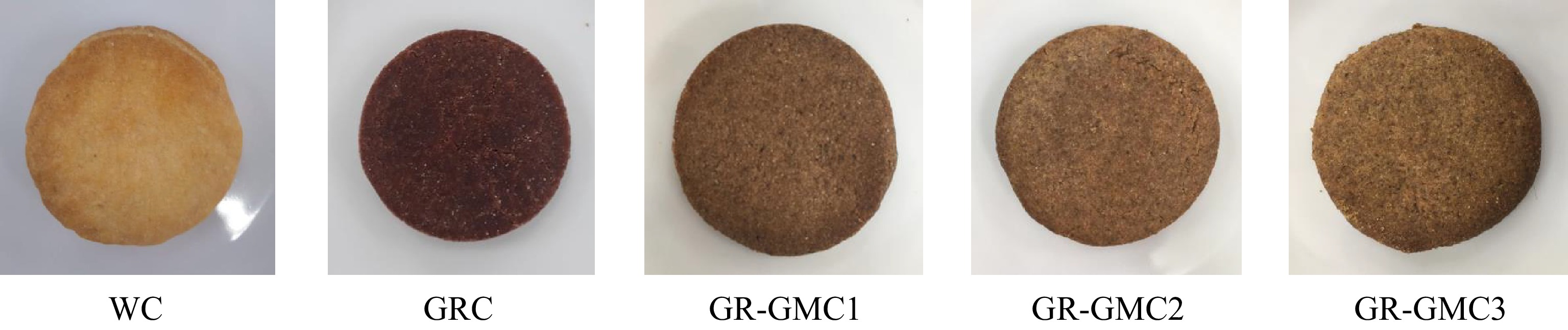
Figure 2.
Appearance of cookies made from blended germinated red rice and germinated mung bean flours. WC, cookies made from wheat flour; GRC, cookies made from germinated red rice flour; GR-GMC1, GR-GMC2, and GR-GMC3, cookies made from blended germinated red rice and germinated mung bean flours at ratios of 62.5:37.5, 50:50, and 37.5:62.5, respectively.
Table 5. Color analysis, physical characteristics, and textural analysis of cookies made from blended germinated red rice and germinated mung bean flours.1,2
Samples Color analysis Physical characteristics Hardness (N) L a* b* Diameter (cm) Thickness (cm) Spread ratio WC 58.28 ± 0.02a 10.28 ± 0.11a 34.21 ± 0.16a 3.92 ± 0.07c 0.81 ± 0.02a 4.87 ± 0.23d 44.0 ± 6.2a GRC 8.09 ± 0.14e 4.31 ± 0.54c 4.39 ± 0.33e 4.34 ± 0.01b 0.76 ± 0.02ab 5.69 ± 0.10c 38.4 ± 5.5a GR-GMC1 16.05 ± 0.37d 7.21 ± 0.13b 10.62 ± 0.14d 4.47 ± 0.02a 0.75 ± 0.06b 5.96 ± 0.55bc 24.1 ± 3.2b GR-GMC2 18.52 ± 0.12c 7.43 ± 0.17b 12.32 ± 0.21c 4.50 ± 0.01a 0.74 ± 0.01b 6.08 ± 0.08b 21.0 ± 2.7b GR-GMC3 19.97 ± 0.39b 7.73 ± 0.11b 13.35 ± 0.29b 4.52 ± 0.04a 0.67 ± 0.01c 6.73 ± 0.04a 19.1 ± 1.3b 1 WC, cookies made from wheat flour; GRC, cookies made from germinated red rice flour; GR-GMC1, GR-GMC2, and GR-GMC3, cookies made from blended germinated red rice and germinated mung bean flours at ratios of 62.5:37.5, 50:50, and 37.5:62.5, respectively. 2 Mean values within a column followed by different letters were significantly different (p < 0.05). Color is an important physical parameter affecting the visual quality and consumer acceptance of bakery products. The color characteristics of cookies formulated with wheat flour (WF), germinated rice flour (GRF), and blended germinated rice and germinated mung bean flours (GR-GMF) are presented in Table 5. GRC exhibited significantly lower L*, a*, and b* values than WC, indicating a darker and less yellow appearance. Similar observations have been reported in previous studies where bakery products prepared from germinated flours showed reduced lightness compared with conventional wheat-based products[23,42]. The reduced lightness of GRC might be associated with the intrinsic pigments present in the bran and germ layers of red rice, which remained in GRF and contributed to a darker color compared with refined WF[26]. In addition, biochemical transformations occurring during germination might further influence the color formation in the final baked products. Germination promotes enzymatic hydrolysis of starch and proteins, leading to increased levels of reducing sugars and free amino acids[45]. These compounds served as key precursors in Maillard reactions and caramelization during baking, resulting in the formation of red pigments and consequently darker cookies[41]. When GMF was incorporated into the formulation, a gradual increase in L*, a*, and b* values was observed from GR-GMC1 to GR-GMC3. This trend indicated that increasing the proportion of GMF partially lightened the color of the cookies compared with GRC. The dilution of darker pigments from GRF by GMF might contribute to this effect. However, the color values of GR-GMC remained lower than those of WC, suggesting that the influence of germinated flours on color development was still predominant. Furthermore, phenolic compounds present in germinated legumes might undergo oxidative reactions catalyzed by polyphenol oxidase, leading to the formation of red pigments that could also affect the overall color of the product[43].
Diameter, thickness, and spread ratio are important indicators of dough behavior during baking and are presented in Table 5. GRC exhibited a significantly larger diameter and spread ratio than WC, while showing slightly reduced thickness. Similar observations were reported by Chung et al.[41], who found that replacing WF with rice flour increased cookie spread. This difference may be primarily attributed to the absence of gluten in germinated rice flour[41]. In wheat-based dough, gluten proteins formed a viscoelastic network that increased dough viscosity and helped maintain the structural integrity of cookies during baking. In contrast, dough prepared from gluten-free flours tended to flow more readily when heated, resulting in greater lateral expansion and consequently a higher spread ratio. The incorporation of GMF further influenced the physical properties of the cookies. As the proportion of GMF increased from GR-GMC1 to GR-GMC3, cookie diameter and spread ratio gradually increased, whereas thickness decreased. The increase in spread ratio may be associated with compositional differences in the blended flours. Previous studies have shown that flour components such as protein, sugar, fiber, and fat play important roles in determining cookie spread behavior[46]. The protein content of legume flours has also been reported to significantly affect the spread ratio of bean-based cookies[47]. In addition, higher fat and fiber contents may contribute to increased cookie spread during baking[24,41]. The higher protein and dietary fiber contents contributed by GMF may alter water distribution within the dough system by competing with starch for available water. This competition can delay starch gelatinization and reduce dough viscosity during baking, thereby allowing greater dough flow and lateral expansion. Furthermore, biochemical changes occurring during germination might also contribute to the observed trend. During germination, enzymatic degradation of starch increased the formation of simple sugars, which could dissolve in the dough system and influence starch gelatinization and dough viscosity during baking[46]. The resulting reduction in dough viscosity promoted lateral dough flow, leading to a higher spread ratio and consequently a thinner cookie structure. As a result, cookies containing higher levels of GMF showed reduced thickness compared with both WC and GRC.
The hardness values of cookies are presented in Table 5. No significant difference in hardness was observed between WC and GRC. However, the GR-GMC exhibited markedly lower hardness values than both WC and GRC, indicating a softer texture when GMF was incorporated into the formulation. Similar reductions in hardness have been reported in cookies prepared from rice flour and GMF compared with wheat-based cookies[18]. This observation was also consistent with the findings of Bolarinwa et al.[24], who reported that germination significantly softened the texture of cookies prepared from germinated grains. The softer texture of GR-GMC might be related to their higher spread ratio and thinner structure observed in the physical characteristics. The reduction in hardness might be associated with the absence of gluten in the GRF and GR-GMF formulations. In wheat-based cookies, gluten proteins contributed to the formation of a cohesive dough matrix that strengthened the structure of the baked product. In contrast, gluten-free formulations lacked this viscoelastic network, resulting in a weaker structure and consequently softer cookies[41]. In addition, the compositional characteristics of germinated mung bean flour might further contribute to the softer texture. Legume flours typically contain relatively high protein levels, which can modify the interactions between starch and protein within the dough system. Dietary fiber may interrupt the continuity of the starch network and reduce structural compactness of the baked product, while proteins from germinated mung bean flour may interfere with starch reassociation during baking and cooling. These effects can weaken the internal structure of cookies and contribute to reduced hardness. Similar mechanisms have been discussed in gluten-free bakery systems enriched with legume flours[48,49]. Furthermore, previous studies have suggested that enzymatic degradation of starch and protein macromolecules during germination may weaken the structural matrix formed during baking, thereby contributing to a softer cookie texture[41].
Sensory evaluation of cookies made from blended germinated rice and germinated mung bean flours
-
The sensory evaluation of cookies made from wheat flour, germinated rice flour, and blends of germinated rice and germinated mung bean flours using a 9-point hedonic scale is presented in Table 6. Significant differences were observed among the samples in terms of appearance, taste, aroma, texture, and overall acceptability (p < 0.05), indicating that flour type and blending ratio markedly influenced the sensory perception of panelists. Regarding appearance, cookies prepared from blended germinated flours received higher scores than WC and GRC. GR-GMC3 showed the highest appearance score, followed by GR-GMC1 and GR-GMC2. The improved appearance may be related to the darker color and higher spread ratio of these cookies, which could enhance visual appeal to consumers. Taste scores showed a decreasing trend with increasing proportions of GMF. GRC received the highest taste score, whereas GR-GMC3 showed the lowest value. The reduction in taste preference at higher levels of GMF might be associated with the presence of phenolic compounds that could impart a slightly bitter taste[50]. The bitterness might be associated with phenolic compounds, and previous studies have reported increased phenolic contents in germinated legumes[15]. In addition, higher proportions of GMF may also contribute to a more pronounced beany flavor, which is commonly associated with legume-based ingredients and may negatively affect consumer preference[51]. Aroma scores were generally high for most samples, although GR-GMC3 exhibited a noticeably lower aroma score compared with the other formulations. A similar decrease in flavor perception has been reported in food products enriched with GMF[51]. In terms of texture, GR-GMC2 obtained the highest score, suggesting that a balanced proportion of GRF and GMF produced a more desirable texture. This observation was consistent with the instrumental texture results, where moderate incorporation of GMF contributed to a softer cookie structure. Overall acceptability scores were highest for GR-GMC2 and GR-GMC3, indicating that cookies prepared with blended germinated flours were well accepted by the panelists. Although higher levels of GMF slightly reduced taste and aroma scores, improvements in appearance and texture appeared to play a more important role in overall consumer preference. Among the formulations, GR-GMC2 presented the most balanced sensory profile, combining attractive appearance, acceptable taste and aroma, and a desirable texture.
Table 6. Sensory evaluation of cookies made from blended germinated red rice and germinated mung bean flours.1,2
Samples Appearance Taste Aroma Texture Overall acceptability WC 6.90 ± 0.05c 6.75 ± 0.05ab 8.40 ± 0.10a 6.40 ± 0.09c 6.80 ± 0.07b GRC 6.70 ± 0.05c 6.78 ± 0.06a 8.00 ± 0.02c 6.77 ± 0.10b 6.60 ± 0.10c GR-GMC1 8.10 ± 0.07ab 6.43 ± 0.05b 8.30 ± 0.20ab 6.80 ± 0.15b 6.80 ± 0.03b GR-GMC2 8.02 ± 0.04b 6.21 ± 0.02c 8.20 ± 0.18b 8.00 ± 0.10a 8.20 ± 0.15a GR-GMC3 8.20 ± 0.04a 6.09 ± 0.18c 6.90 ± 0.04d 6.40 ± 0.09c 8.00 ± 0.09a 1 WC, cookies made from wheat flour; GRC, cookies made from germinated red rice flour; GR-GMC1, GR-GMC2, and GR-GMC3, cookies made from blended germinated red rice and germinated mung bean flours at ratios of 62.5:37.5, 50:50, and 37.5:62.5, respectively. 2 Mean values within a column followed by different letters were significantly different (p < 0.05). -
This study evaluated the physicochemical and sensory properties of cookies prepared using germinated rice flour (GRF) and germinated mung bean flour (GMF). The results demonstrated that both baking conditions and flour composition played important roles in determining the final product quality. Among the tested conditions, baking at 180 °C for 12 min was selected for subsequent analyses because it provided acceptable aroma, texture, and visual appearance. Substitution of WF with GRF and the subsequent incorporation of GMF significantly modified the physical and sensory characteristics of cookies. Compared with WC, cookies prepared from GRF and GRF–GMF composite flours exhibited darker color, higher spread ratio, and softer texture, while increasing the proportion of GMF further promoted cookie spread and reduced hardness. Sensory evaluation indicated that cookies made from blended germinated flours were generally well accepted by panelists, with GR-GMC2 (50:50 GRF to GMF) showing the most balanced sensory profile and the highest overall acceptability. A limitation of the present study is that ungerminated red rice flour and ungerminated mung bean flour were not included as control samples, and germination indicators such as sprout length, amylase activity, and reducing sugar content were not determined. Therefore, the specific effects and effectiveness of germination could not be directly verified. Future studies should incorporate ungerminated controls and germination-related indicators to provide a more comprehensive evaluation of germination and its relationship with flour functionality and cookie quality. Overall, the results demonstrated the feasibility of using GRF–GMF composite flours for the development of gluten-free cookies with higher protein and fiber contents and desirable sensory characteristics.
-
The authors confirm their contributions to the paper as follows: conceptualization, data curation, formal analysis, methodology, validation, writing − original draft: Duy NT, Nguyen TL; conceptualization, data curation, investigation, methodology, resources, validation, writing − original draft, writing − review and editing: Tien NNT; conceptualization, funding acquisition, investigation, methodology, project administration, resources, supervision, validation, writing − review and editing: Hung PV. All authors reviewed the results and approved the final version of the manuscript.
-
The data generated during this study are included in the published article, and further inquiries can be directed to the corresponding author.
-
The authors declare that there is no conflict of interest related to the publication of this article.
-
# Authors contributed equally: Nguyen Tan Duy, Truong Le Nguyen
- Copyright: © 2026 by the author(s). Published by Maximum Academic Press on behalf of Nanjing Agricultural University. This article is an open access article distributed under Creative Commons Attribution License (CC BY 4.0), visit https://creativecommons.org/licenses/by/4.0/.
-
About this article
Cite this article
Duy NT, Nguyen TL, Tien NNT, Hung PV. 2026. Physicochemical properties and cookie quality of germinated mung bean-rice flour blends. Food Materials Research 6: e015 doi: 10.48130/fmr-0026-0015 

Physicochemical properties and cookie quality of germinated mung bean-rice flour blends
- Received: 09 March 2026
- Revised: 11 June 2026
- Accepted: 01 July 2026
- Published online: 04 September 2026
Abstract: Germination has been widely applied to improve the nutritional and functional properties of cereal and legume flours. This study utilized germinated rice and mung bean flour blends for producing gluten-free cookies under suitable baking conditions, and the physical, functional, and sensory properties of the resulting cookies were subsequently analyzed. The blended germinated flours exhibited markedly lower pasting viscosities than wheat flour, whereas the solubility of the blended germinated flours increased with increasing amounts of germinated mung bean flour. Baking at 180 °C for 12 min produced cookies with desirable aroma, texture, and appearance among the tested conditions. Cookies made from germinated rice flour were darker and bigger compared to wheat-based cookies. A higher spread ratio (5.69) and a lower hardness (38.4 N) in germinated rice cookies compared to wheat cookies (4.87 and 44.0 N, respectively) were found. The incorporation of germinated mung bean flour with germinated rice flour further enhanced the protein content from 7.06% to 13.42% and fiber content from 1.97% to 2.99%, while promoting greater cookie spread and a softer texture. Sensory evaluation indicated that cookies made from blended germinated flours were well accepted. Among the tested formulations, cookies prepared with a 50:50 ratio of germinated rice flour and germinated mung bean flour exhibited the most balanced sensory profile and the highest overall acceptability (8.20/9.00). These findings suggested that the combination of germinated rice flour and germinated mung bean flour can be used to develop gluten-free cookies with enhanced protein and fiber contents, improved quality, and good consumer acceptance.
-
Key words:
- Cookie making /
- Germination /
- Mung bean /
- Physicochemical properties /
- Red rice