












-
The boreal forests, distributed primarily between 50° and 65° N across Europe, Asia, and North America, constitute the second-largest forest biome on Earth, covering approximately 11% of the terrestrial land surface and nearly one-third of the world's forests[1]. As one of the largest terrestrial carbon reservoirs, boreal forests play a disproportionate role in regulating the global carbon cycle, storing a substantial proportion of the world's soil carbon and contributing significantly to the global forest carbon sink[2]. Their importance extends beyond carbon sequestration through photosynthesis, as the long-term climate benefits of boreal forests are ultimately governed by the fate of assimilated carbon, including its storage in terrestrial ecosystems and lateral transfer to inland waters.
In cold, often waterlogged conditions typical of the boreal region, microbial decomposition is constrained by low temperatures[3]. As a result, plant litter decomposes slowly, allowing organic matter to accumulate, much of which is eventually preserved as soil organic carbon (SOC) or leached into soils as dissolved organic carbon[4]. Simultaneously, a substantial proportion of net primary productivity (NPP) is allocated belowground through root systems, where exudates supply labile organic carbon to the rhizosphere, stimulate microbial activity, support mycorrhizal networks, and influence soil carbon turnover[5]. Subsequently, part of this terrestrial carbon is mobilized via hydrological pathways and exported to inland waters, thereby linking terrestrial carbon storage to aquatic carbon cycling. Together, these processes determine the fate of assimilated carbon by partitioning it between long-term storage in terrestrial ecosystems and lateral export to inland waters. However, this balance is increasingly threatened by climate change, land-use change, and wildfire, which can alter soil carbon decomposition and modify the mobilization and export of carbon to aquatic ecosystems[6].
The lateral transfer of terrestrial carbon connects boreal forests with inland waters, where carbon is transported primarily as dissolved organic carbon (DOC), dissolved inorganic carbon (DIC), and particulate organic carbon (POC). Once exported, these carbon forms may be transformed through microbial and photochemical processes, buried in aquatic sediments, emitted to the atmosphere as CO2 or CH4, or transported downstream, thereby influencing regional carbon budgets and the long-term balance between terrestrial carbon storage and atmospheric emissions.
Despite extensive research on vertical carbon exchange between terrestrial ecosystems and the atmosphere, lateral carbon transport between terrestrial and aquatic ecosystems remains less understood[7]. From a terrestrial perspective, the export of DOC, DIC, and POC to inland waters represents a lateral carbon leak from the terrestrial carbon sink. These lateral carbon fluxes can account for approximately 4%–28% of annual NEP in boreal headwater catchments[8,9], indicating that they are sufficiently large to bias estimates of the terrestrial carbon sink if neglected. However, this leak does not represent an immediate loss of carbon to the atmosphere. Rather, it redistributes terrestrially fixed carbon into aquatic ecosystems, where carbon may be mineralized and emitted as CO2 or CH4, buried in sediments, transformed through microbial and photochemical processes, or transported downstream to larger rivers, estuaries, and ultimately the ocean. Consequently, accurately quantifying this lateral carbon leak and its downstream fate is essential for understanding the complete land–water carbon continuum and improving predictions of boreal carbon cycling under a changing climate.
Previous reviews have largely focused on terrestrial carbon sequestration, aquatic carbon processing, or individual carbon forms independently. A synthesis integrating carbon production, stabilization, lateral transport, and downstream fate across the land–water interface remains lacking. In this review, we synthesize current knowledge of the boreal land–water carbon continuum by tracing carbon from its initial uptake from the atmosphere, through its transformation and stabilization within terrestrial ecosystems, to its lateral transport into inland waters in multiple organic and inorganic forms. We further examine how climate-driven environmental changes modify the magnitude, pathways, and chemical composition of lateral carbon fluxes and discuss their implications for the future strength of the boreal carbon sink. Finally, we highlight key knowledge gaps and propose future research priorities, emphasizing the need for coordinated long-term observation networks and improved integration of lateral carbon dynamics into Earth system models (ESMs). Figure 1 illustrates the conceptual framework and scope of this review.
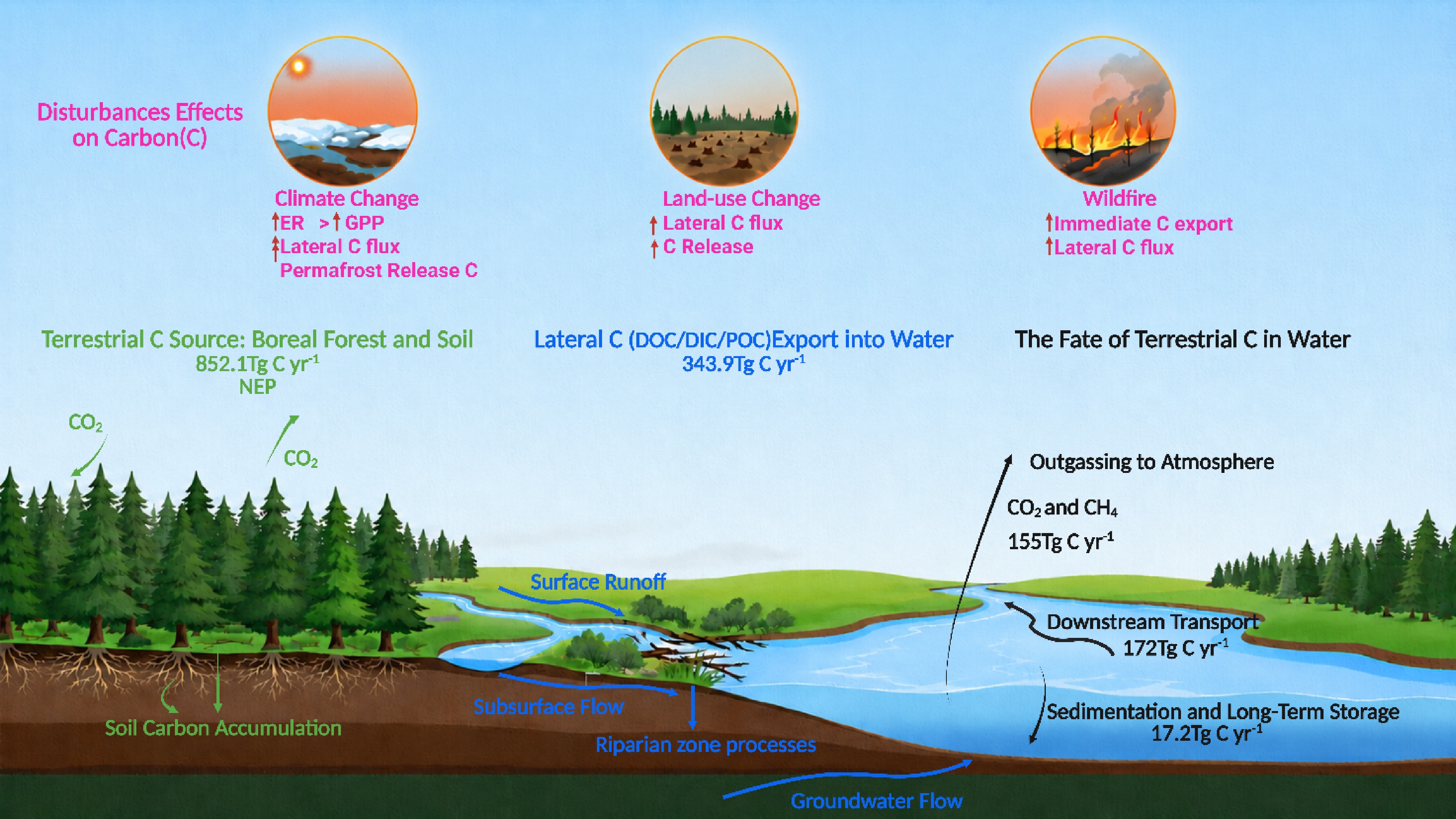
Figure 1.
A conceptual framework of this review scope. The quantity value of NEP and lateral carbon flux is calculated according to Liu et al.[9], and the outgassing value is calculated according to Jonsson et al., who stated that 45% of terrestrial export was evaded as CO2, and 50% was transported to the sea based on a boreal catchment[10]. NEP, net ecosystem productivity, represents carbon retention or storage in the ecosystems; ER, ecosystem respiration, represents carbon emissions to the atmosphere; GPP, gross primary production.
-
Terrestrial carbon entering boreal lakes and streams is broadly classified into organic and inorganic carbon. Terrestrial organic carbon, such as POC and DOC, leaches from soils and vegetation[11]. Terrestrial inorganic carbon primarily enters as DIC, originating from root and microbial respiration, soil CO2 dissolution, and the weathering of silicate and carbonate minerals, with additional contributions from carbonate-rich sediments[7]. DOC refers to organic carbon that can be filtered through 0.45 μm pore size filters[12], whereas POC consists of larger organic particles retained on the filter. In contrast, DIC comprises inorganic carbon species, primarily carbon dioxide (CO2), bicarbonate (HCO3−), and carbonate (CO32−), which are dissolved in water.
In boreal watersheds, soil-derived DOC is the main form of terrestrial carbon entering aquatic ecosystems[13]. POC export, typically contributing less than 10% of DOC concentrations, shows strong spatial and temporal variability, which is largely driven by stormflow and other episodic disturbance events[13]. DIC is the most abundant carbon form in rivers and streams, mostly added by groundwater. However, in the headwater streams, most DIC originates from soil-respirated CO2 produced by root and microbial respiration[13]. Notably, in boreal ecosystems, the terrestrial carbon pool is dominated by inputs from organic-rich soils and extensive peatlands. Additionally, in some regions, permafrost thaw mobilizes large amounts of dissolved and particulate carbon, contributing to inland waters. The major sources and transport pathways are summarized in Table 1.
Table 1. Summary of lateral carbon flux corresponding to dominant sources and transport pathways in boreal ecosystems.
Lateral carbon flux Sources Transport pathway DOC (40.9 Tg C yr−1) Forest floor/understory/permafrost Surface runoff/preferential flow Organic-rich topsoil/peatland *Subsurface flow Riparian zone processes Riparian zone groundwater POC (0.6–409 Tg C yr−1) Forest floor/understory/soil/riparian zone Surface runoff/preferential flow DIC (0–197.7 Tg C yr−1) Soil respiration CO2/groundwater derived Carbon Groundwater The values of lateral carbon fluxes are calculated through the related fluxes and their relationships from Liu et al.[9] estimating model, and * represents the major pathway of DOC transport. Forest floors, podzolic soils, and boreal peatland
-
Forest floors and podzolic soils supply significant DOC through the leaching of organic horizons, with the magnitude of mobilization varying. In the boreal forest zone, vegetation type determines litter quality, decomposition rates, organic horizon thickness, and the chemical composition of DOC, all of which shape terrestrial carbon sources reaching streams and lakes[14]. In conifer-dominated forests (e.g., spruce, fir, pine), slow-decomposing needle litter forms thick, organic-rich soil horizons, which accumulate substantial aromatic DOC that is readily mobilized by hydrological processes. In contrast, deciduous or mixed forests (e.g., birch, aspen) have faster-decomposing litter that creates thinner organic layers, resulting in lower DOC accumulation and contributing carbon that is less aromatic and generally more labile. Although peatlands remain the dominant DOC source at the catchment scale, differences in forest vegetation still shape the magnitude and chemistry of DOC reaching streams. Across these vegetation types, carbon moving from forest soils into streams is further influenced by podzolic soil processes, which modify DOC through sorption and metal-organic interactions typical of conifer-dominated landscapes.
Boreal peatlands are particularly important, acting as major contributors of DOC to surface waters due to their high-water tables and strong hydrological connectivity with streams, and they account for the majority of global peatland DOC export, approximately 58% of these global fluxes[15]. Peatlands also supply POC, especially during snowmelt, when older peat particles are mobilized[16]. Anaerobic zones produce CO2, CH4, and DIC, which move via porewater through soil.
Bryophytes
-
In boreal forests, bryophytes form a complete ground vegetation cover, mainly consisting of moss species such as Pleurozium schreberi, Hylocomium splendens, or Sphagnum spp[17]. Bryophytes serve not only as a major source of DOC, also, but they can also mediate lateral carbon exports through their thermal properties and very high water-holding capacities[17], influencing both chemical and biological processes in soils. The loss of bryophytes reduces decomposition rates, and soil nitrogen availability further reduces soil carbon accumulation. In addition, different bryophyte species show variable meditation of carbon flux; for example, Molinia caerulea make peatland ecosystems more active in gas emissions (CO2 and CH4) and changes how these processes respond to temperature, while Sphagnum systems are more stable and store more carbon in DOC form[18].
Special areas, such as permafrost and managed areas
-
In permafrost affected areas, seasonal thaw deepens active soil layers and mobilizes both microbially derived DOC and older POC, increasing the terrestrial carbon supplied to downstream waters. Thaw also mobilizes older POC and DIC via groundwater and newly formed flow paths. Snowmelt DOC originates from recently decomposed organic soil matter and is typically younger carbon compared to POC. In a managed boreal region, forests, mires, lakes, and streams collectively act as diverse reservoirs and emitters of CO2, CH4, DOC, and DIC[19].
-
Carbon transport from land into water is highly connected with hydrological conditions[3]. Organic carbon derived from soils and peatlands is mobilized and transferred to inland waters primarily through water flow pathways. Seasonal dynamics, particularly snowmelt and heavy rain events, play a critical role in regulating both the magnitude and timing of carbon export[13].
Carbon transport can be broadly categorized into surface and subsurface pathways. Surface pathways include carbon and litter movement by surface runoff (overland flow) and carbon delivery via throughfall[13]. Subsurface pathways occur along soil horizons through vertical percolation, lateral soil flow, and groundwater exchange. This carbon flux with water movement is shown in Fig. 2 with blue routes.
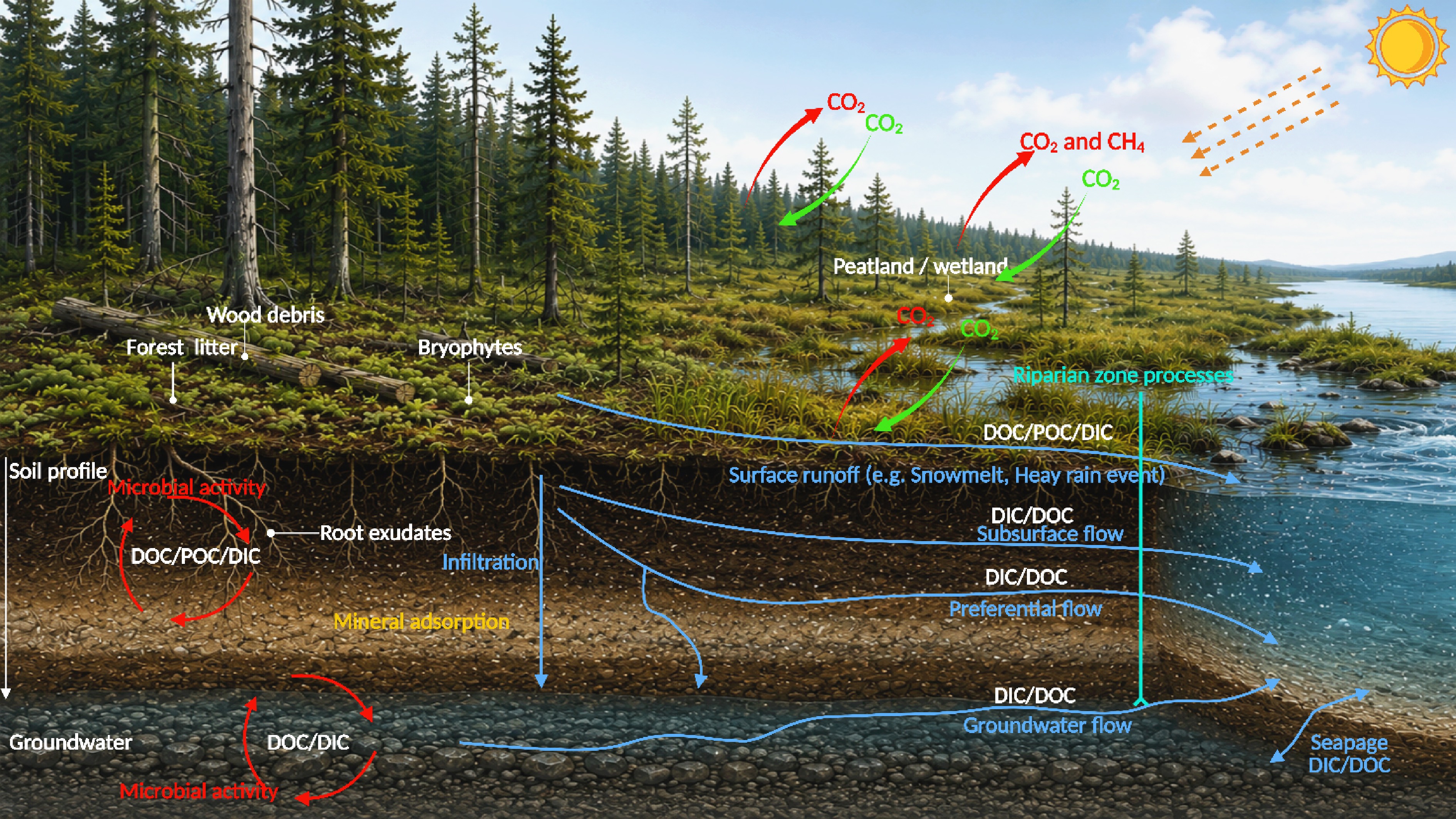
Figure 2.
Main carbon processes in terrestrial ecosystems and the pathways from land to water. These fluxes are adapted from Llanos-Paez et al.[20]. Blue arrows represent carbon flux transported into waters highly connected with water movement, green arrows represent fixed carbon in ecosystems, and red arrows mean outgassing to the atmosphere; red circles represent carbon process occurrences such as microbial activities and photochemical reactions.
Surface runoff
-
Surface runoff is an episodic yet important pathway for lateral carbon transport from land to water[11], particularly during snowmelt and high-flow events. During these periods, limited soil infiltration and high-water inputs generate overland or near-surface flow, which can rapidly mobilize DOC from litter layers and topsoil. High surface runoff can produce a 'flushing effect'[3], intensifying the transport of large amounts of plant litter and soil carbon in both particulate and dissolved forms. DOC exported during high-flow events is generally characterized by lower molecular weight, more aliphatic, and more bioavailable compared to DOC at low-flow periods[21], with less time for transformations and mineralization before reaching aquatic ecosystems[22]. During high runoff events, the relative importance of forest sources with more labile carbon increases, due to the dilution of DOC in wetland areas in the boreal forest zone[23]. Compared to subsurface flow, surface runoff is generated and becomes an important component of catchment response under wet conditions. This phenomenon occurs when the soil is partially saturated due to antecedent wetness or when rainfall exceeds the soil's infiltration capacity[24].
Subsurface flow
-
In boreal forest and peatland systems, subsurface flow is the primary pathway for DOC transport from soil to aquatic environments. Water infiltrates into the soil's organic horizons and moves vertically and laterally through the soil profile, transporting DOC derived from soil organic matter decomposition. Water flow within soil is controlled by soil type and horizon interfaces[3], which can slow vertical percolation and promote lateral movement within organic-rich layers. This shallow subsurface flow maintains strong hydrological connectivity between soils and streams, especially during wet conditions.
As water goes through various subsurface environments, travel time and routing play a significant role in hydrological and biogeochemical processes, which include transport, accumulation, and mobilization of organic carbon[25]. Water travel time and routing are determined by hydrological conditions and soil properties, such as soil texture, soil minerals, microorganisms, aluminosilicate clay minerals, and metal content. Additionally, groundwater flow rather than percolation is related to transit; for example, water can spend considerable time in unsaturated zones during dry conditions, and longer travel times are often associated with groundwater discharge during winter[25].
A higher amount of DOC is translocated to greater depth via preferential flow paths, with higher abundance in fine-textured soils[26]. This preferential flow occurs through macropores and other heterogeneous features in soils, with rapid transfer of events such as spring snowmelt and heavy summer rain[23]. Moreover, DOC is dominant in groundwater when the water table rises and reaches the soil horizon with high organic content during the high flow period[27].
In general, as DOC moves through soil horizons within matrix flow, the DOC retention and composition vary due to physicochemical and biological processes with the selective interactions among water and multiple essential soil properties[28]. We believe mostly surface-derived DOC is removed before reaching the saturated zone in forests. In the observations of Shen et al.[28], up to 90% of surface-derived DOC is removed. Consequently, groundwater typically contains lower DOC concentrations and is dominated by DIC. However, DOC export to streams is largely derived from near-surface organic horizons, highlighting the importance of shallow subsurface flow paths in boreal carbon export.
Riparian zone processes
-
A riparian zone is the interface between terrestrial and aquatic ecosystems, regulating carbon transfer. In boreal catchments, riparian soils often serve as a dominant source area for DOC, especially in headwater riparian zones[29]. A relatively narrow, hydrologically active layer within the riparian profile can contribute disproportionately to DOC export. Additionally, DIC transport and transformation occur due to groundwater exchange[27], and a quick DIC loss happens in riparian zones due to efficient CO2 degassing. Riparian soil types, hydrological conditions, and vegetation types affect carbon exchanges in riparian ecosystems. Meanwhile, the riparian zone serves as an important accumulation area for plant litter, receiving inputs both from riparian vegetation and litterfall, and from material transported by runoff. These litter inputs can enhance microbial and detrital diversity, shaping the structure of associated microbial communities. Additionally, land-use changes can alter riparian zone processes such as decomposition rates[14].
The unique functions of the boreal riparian zone are high groundwater levels, a dynamic redox potential, the buildup of soil organic matter, and diverse vegetation[30], which are strongly influenced by forestry practices, such as riparian thinning and reduction or removal of buffer strips. Removal or thinning of riparian vegetation reduces terrestrial-derived organic carbon inputs while increasing hydrological connectivity and DOC export from soils. Meanwhile, these practices can increase temperature, incident light conditions, and suspended sediments, which can shift the carbon dynamics from predominantly terrestrial inputs toward more in-stream production, while also accelerating carbon turnover and CO2 emission. A wider riparian zone can prevent the propagation of clear-cut effects downstream, while the buffer widths in many boreal forests (< 15 m) may still be insufficient[31].
Methods for quantifying lateral carbon fluxes
-
Several models have been developed to quantify lateral carbon fluxes, with most focusing primarily on DOC. Biogeochemical Reactive Transport-Flux-Penn State Integrated Hydrological Model (BioRT-Flux-PIHM)[32] simulated DOC production, transport, and export at the catchment scale by integrating hydrology, reactive transport, and biogeochemical processes. An Integrated Catchments model for Carbon (INCA-C) models lateral DOC flux[33] and successfully reproduces seasonal and interannual DOC dynamics in two Canadian forested headwater catchments[33]. Also, this process-based model includes DIC, though its information is quite simple. SWAT-IR, an improved Soil and Water Assessment Tool (SWAT), extends DOC modeling in non-perennial rivers under flow intermittency conditions[20], accounting for drying-rewetting cycles, though this model underestimates peak DOC concentrations. Overall, these models emphasize DOC, while DIC and POC processes are either simplified or insufficiently evaluated.
Stable carbon isotope analysis (δ13C) can be used to trace the sources and transformation of lateral carbon flux by measuring the isotope composition of DOC, POC, and DIC in soils, groundwater, and stream water. Different carbon pools (e.g., plant-derived organic matter, soil organic carbon, and atmospheric or geogenic CO2) have distinct δ13C signatures that are largely conserved during transport, allowing identification of carbon origins and processes such as mineralization[34]. δ13C values of stream DOC and POC showed that these carbon are mainly derived from biogenic soil organic carbon, particularly from organic-rich upper soil horizons and wetlands[34]. However, DIC sources are more complex and include soil respiration, DOC mineralization, atmospheric exchange, and weathering. However, δ13CDIC can also be altered by CO2 evasion, photosynthesis, biodegradation, and photodegradation, which may obscure source signals. Therefore, δ13C tracing should be combined with hydrological information, carbon concentrations, pCO2, and seasonal sampling for more reliable interpretation.
Unlike laboratory measurements, remote sensing cannot directly measure lateral carbon. However, connections can be built between the spectrum and DOC or DOM, since evidence shows that high concentrations of DOM/DOC absorb strongly in the blue and ultraviolet parts of the spectrum[35]. Thus, satellite and airborne sensors therefore help map the spatial distribution of browning and DOC. Satellites can extend observations from sampled lakes to unsampled lakes when calibrated against in situ DOC. Thus, with remote sensing, upscaling is possible. For example, Griffin et al.[36] applied different satellite sensors to estimate and illustrate the spatial pattern and long-term annual variations of DOC in boreal aquatic systems. However, the remote sensing method is limited by ice, cloud, and snow cover, as well as by the narrow riparian corridor, due to light availability; it is necessary to work in conjunction with in situ biochemistry and hydrology measurements.
Together, by combining these three methods, the gap between in situ scale and regional scale assessments can be bridged. Thus, the uncertainty that currently exists in boreal carbon-climate feedback can also be reduced.
-
As mentioned earlier, water acts as a primary lateral carbon pathway among Earth's main reservoirs, facilitating its flow through the connected continuum of the atmosphere, soils, inland waters, oceans, and sediments. Inland waters, in particular, function as highly efficient bioreactors that rapidly process terrestrial organic matter under conditions favorable for microbial metabolism. When terrestrial carbon enters inland water in boreal regions, it can undergo various pathways: it may be transformed and mineralized within the water column, released to the atmosphere as CO2 or CH4, transported downstream, or buried in sediments for the long term[7]. The relative contribution of these pathways is strongly influenced by biological activity, light availability, hydrological dynamics, and water residence time. Conversely, longer water residence times and low oxygen conditions in sediments promote carbon stabilization and burial, representing a potential long-term sink. These processes highlight the dynamic interactions between land and water carbon in boreal ecosystems, where the equilibrium of carbon retention and emission is influenced by physical movement and biogeochemical changes. The fate of terrestrial-derived carbon in aquatic ecosystems linked with terrestrial sources is shown in Fig. 3.
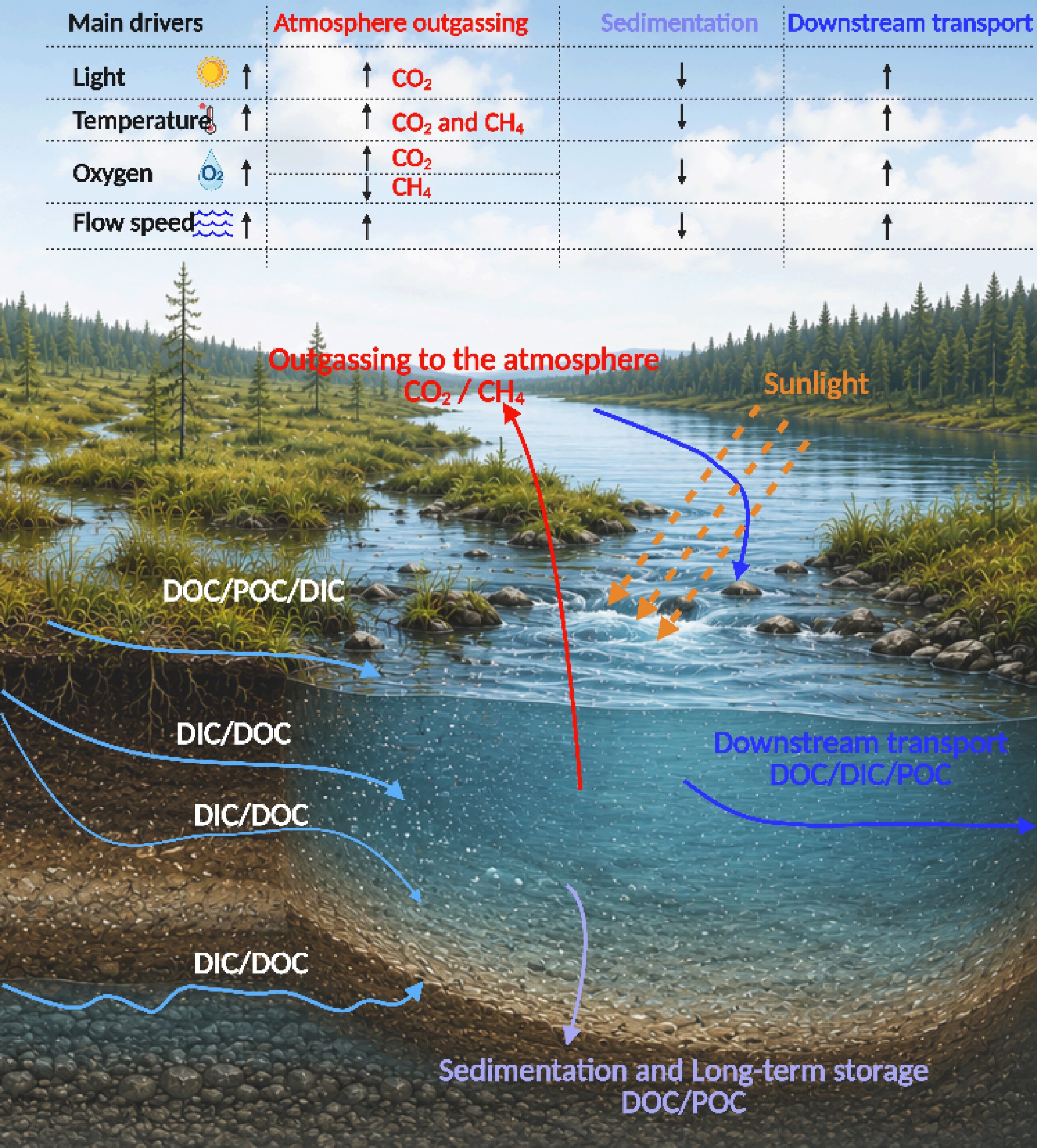
Figure 3.
Ultimate fates of terrestrial-derived carbon in aquatic systems with main drivers. Text represents terrestrial-derived carbon sources and forms; shallow blue arrows represent lateral carbon transport highly connected with hydrological conditions. These terrestrial carbons follow three fates: outgassing to the atmosphere, burial as sediment, and downstream transport, depending on the different temperature, light, oxygen, and flow speed.
Transformation and mineralization
Microbial mineralization
-
Microbial processes are a dominant control on the fate of terrigenous organic carbon in inland waters[37]. Heterotrophic bacteria and archaea metabolize DOC and POC, converting organic carbon into microbial biomass and respiring a substantial fraction as CO2. The rate and extent of microbial mineralization depend strongly on the chemical composition and bioavailability of the incoming organic matter. Labile DOC compounds, such as carbohydrates and amino acids, are rapidly consumed, whereas aromatic, high-molecular-weight compounds derived from lignin and humic substances are more resistant to degradation. Building on this framework, Fasching et al.[38] demonstrated that terrestrial inputs of chromophoric and humic DOC constitute an important carbon source in headwater streams. Once this DOM enters stream ecosystems, it undergoes microbial degradation but with low carbon use efficiency, leading to a large fraction being respired as CO2. As a result, these terrestrial DOC inputs can contribute to CO2 emissions from streams even without photochemical processing.
POC typically requires physical fragmentation or enzymatic hydrolysis before microbial uptake. In streams and rivers, turbulence and frequent particle–microbe interactions can enhance POC degradation, whereas in lakes POC often settles rapidly to sediments, reducing its exposure to aerobic decomposition in the water column[39]. Microbial processing not only reduces the total amount of terrestrial carbon but also alters its quality, often transforming complex molecules into smaller, more bioavailable compounds that can be further degraded downstream.
Photochemical reaction
-
Photochemical reactions are key drivers of organic matter transformation in aquatic systems, regulating exchanges between POC and DOC[40]. Upon absorption of solar radiation, natural organic matter experiences various light-driven reactions that change its chemical composition, molecular size, and environmental interaction reactivity. These transformations strongly influence carbon cycling, nutrient mobility, and pollutant dynamics by modifying organic matter solubility, toxicity, and bioavailability.
Photodissolution is a central pathway through which sunlight converts POC into DOC. A wide range of particulate substrates exhibit substantial POC losses under irradiation, with 50%–70% of this loss commonly recovered as DOC[41]. The chemical composition of this photoreleased DOC varies depending on the source material but generally consists mainly of humic-like molecules, with varying amounts of protein-like components[42]. Photodissolution is driven by both direct photolysis, where photons interact with particle surfaces, and indirect pathways involving reactive oxygen species (ROS) such as hydroxyl radicals and singlet oxygen[43]. Iron-associated reactions further enhance photodissolution, as iron-organic complexes absorb light efficiently and yield ROS that promote organic carbon breakdown. Beyond carbon release, photodissolution also releases dissolved nitrogen and phosphorus, making it a significant nutrient source in shallow or turbid environments[44].
DOC is very reactive when exposed to sunlight, leading to fragmentation, oxidation, and eventual mineralization. Exposure to UV and visible radiation breaks down high molecular weight DOM into smaller, more labile compounds that support bacterial metabolism. Continued exposure can lead to mineralization, producing DIC, CO2, and CO, which represent major photochemical losses of organic carbon from surface waters[45]. ROS significantly accelerates these reactions by oxidizing aromatic structures, cleaving dissolved polymers, and generating intermediates such as carboxylic acids and aldehydes[46]. Photochemical changes to DOC also alter its optical properties and influence its interactions with contaminants and metals, thereby affecting its solubility and transport.
Outgassing to the atmosphere
-
A large fraction of terrestrial carbon entering inland waters is finally returned to the atmosphere as CO2[47]. During transport, DOC is partially oxidized through photodegradation and microbial respiration, causing rapid 'C degassing' even in upstream headwater reaches[48]. DIC is further influenced by hydrolysis and gas exchange at the water–air interface[13].
Gao et al.[47] highlighted that inland waters emit about 1.00 Pg C yr−1 as CO2, a flux larger than sedimentary burial and comparable to carbon delivered to the estuary. Field studies show that CO2 evasion varies widely across systems, with high emissions observed in plateau lakes, tropical rivers, eutrophic lakes, and large river networks such as the Yangtze and African inland waters. Boreal rivers and streams represent another globally significant hotspot of CO2 evasion. Because boreal landscapes are dominated by wetlands, peat soils, and organic-rich podzols, large amounts of soil-derived CO2 and DOC are flushed directly into running waters. Weyhenmeyer et al.[49] analyzed 22,664 water samples and found median pCO2 values of 1,176 µatm in boreal streams, with upper values exceeding 20,000 µatm, indicating extreme supersaturation. Wallin et al.[50] further demonstrated that in a Swedish boreal catchment, CO2 evasion from streams exceeded all lateral C export downstream, representing 53% of total aquatic carbon fluxes, with 72% of emissions occurring in first- and second-order streams.
Spatial patterns in CO2 evasion are strongly shaped by hydrological and biogeochemical controls. For instance, DOC and DON concentrations, water temperature, pH and alkalinity, and salinity gradients all modulate pCO2 and gas exchange. Rapid-flowing and turbulent water environments, including waterfalls, riffles, and turbulent channel sections, exhibit higher gas transfer velocities, whereas stratified lakes often accumulate CO2 in bottom waters before seasonal turnover releases it to the atmosphere[49].
Climate change accelerates CO2 outgassing through warming-induced increases in microbial respiration, reduced CO2 solubility, and more frequent extreme rainfall events that mobilize pulses of DOC and nutrients[51]. Anthropogenic pressures, including dam construction, land-use change, wastewater discharge, and sediment mining, alter water residence time, sediment dynamics, and carbon processing, thereby modifying regional outgassing patterns. Despite substantial progress, Gao et al.[47] emphasized that global estimates remain uncertain due to major spatiotemporal data gaps, reliance on heterogeneous methods, and the need for improved pCO2 measurements across diverse inland water systems.
In addition to CO2, inland waters are significant sources of CH4, a greenhouse gas with a global warming potential far exceeding that of CO2 on a per-molecule basis. CH4 is produced primarily through microbial methanogenesis under anoxic conditions, such as in lake and reservoir sediments, wetlands, and flooded soils. Terrestrial organic carbon deposited in sediments provides an important substrate for CH4 production. CH4 is emitted to the atmosphere via diffusive fluxes, ebullition (bubble release), and plant-mediated transport in vegetated systems. Recent studies indicate that ebullition can dominate methane emissions in shallow aquatic systems, in some cases accounting for major total fluxes[52]. However, its highly episodic nature and strong spatial and temporal variability make it difficult to measure, resulting in large uncertainties and likely underestimation in current methane budgets[53]. Although CH4 emissions are often smaller in mass than CO2 emissions, their climatic significance is substantial. Shallow lakes, reservoirs, and wetlands receiving high organic matter inputs are particularly important sources of methane in the boreal ecosystem[54].
Sedimentation and long-term storage
-
Not all terrestrial carbon entering aquatic systems is rapidly mineralized. A portion of DOC and POC is removed from the water column through sedimentation and subsequently buried in bottom sediments, representing a long-term carbon sink[55]. Globally, inland waters bury around 0.20 Pg C yr−1, removing carbon from rapid cycling as particulate and dissolved forms settle into sediments[47]. The efficiency of this long-term storage depends on hydrodynamics, watershed erosion, and lake or reservoir morphology, which influence both sediment delivery and deposition rates[47].
In boreal ecosystems with high lake densities, sedimentation plays an even more prominent role in carbon sequestration. Modern boreal lakes show five-fold increases in sediment C accumulation compared with Holocene levels, driven by higher terrestrial organic carbon loading linked to land-use change[56]. This pattern is consistent across boreal catchments where lakes receive substantial organic inputs from forest and peatland soils, shaping both DOC and POC concentrations and burial potential[57]. Lake morphometry further regulates burial efficiency: small, deep lakes exhibit the highest efficiency (5%–62%) due to shorter oxygen exposure times for settling material, limiting sediment mineralization[58].
Biome-scale modeling reinforces the importance of boreal lake sediments as carbon sinks, estimating burial at 1.1 Tg C yr−1, reflecting the cumulative influence of the region's lake-rich landscape[59]. Climate change and hydrological shifts, such as warming, altered runoff, and land-use driven increases in terrestrial organic carbon loading, and modify the balance between emissions and burial, yet sedimentation consistently contributes to long-term carbon retention even in systems with substantial CO2 evasion[60].
Downstream transport
-
Downstream transport is a key mechanism governing the fate of terrestrial carbon within inland waters. In headwater streams and small rivers, short water residence times restrict the duration that organic carbon remains in the system, reducing opportunities for extensive biogeochemical processing and favoring its rapid downstream movement. Because flow velocities are high and water parcels move quickly through these networks, much of the terrestrial DOC and POC entering headwaters is transported further along the aquatic continuum before it can be substantially altered. This conveyor-like behavior positions streams and rivers as efficient connectors that shuttle carbon from terrestrial soils toward larger, slower-moving water bodies[39].
As water progresses downstream into larger rivers and into networks with more complex hydrology, transport dynamics become increasingly structured by discharge patterns, channel morphology, and mixing regimes. Variability in hydrological connectivity strongly influences how quickly terrestrial carbon moves through the system[61]. In such environments, transport pathways govern not only how much carbon reaches downstream lakes, reservoirs, or coastal waters, but also the partitioning among dissolved, particulate, and colloidal forms as carbon is physically routed through channels and floodplains[39].
Downstream transport thus plays a pivotal role in shaping the carbon fate across the aquatic continuum. By controlling the speed and direction of carbon movement, hydrological transport determines the degree to which carbon is later exposed to processing in slower, downstream environments such as lakes and reservoirs. At the landscape scale, the balance between rapid conveyance in headwaters and prolonged retention downstream governs how much terrestrial carbon ultimately reaches marine systems, is transformed along the way, or remains stored in inland waters.
-
Disturbances are critical modulators of lateral carbon fluxes in boreal ecosystems, influencing the export of DOC, DIC, and POC from terrestrial landscapes to aquatic systems. Among the most influential disturbances are climate change, land use changes, and wildfires, all of which alter vegetation, soils, hydrology, and carbon mobilization pathways.
Climate change
-
Climate change exerts particularly strong control over lateral carbon fluxes in boreal ecosystems, where cold climates, carbon-rich soils, peatlands, and widespread permafrost make the landscape highly sensitive to warming. Rising temperatures increase microbial activity and accelerate soil organic matter decomposition, enhancing DOC production and mobilization from boreal forest floors and peatlands. In the northern boreal and sub-Arctic zones, permafrost thaw is one of the most transformative climate-driven mechanisms, exposing long-sequestered carbon to hydrological flow paths and greatly increasing the potential for lateral export to streams, rivers, and lakes[62]. As active layers deepen and the thermokarst process fragments permafrost terrain, hydrological connectivity increases, enabling larger fluxes of DOC, POC, and DIC to be transported downslope into aquatic systems. Extreme climatic events (e.g., drought, early snowmelt, and heavy rainfall) further modulate boreal carbon export by altering soil moisture, water table height, and flow routing, either enhancing DOC flushing or suppressing transport depending on local hydrological conditions.
Altered precipitation patterns and hydrologic regimes strongly influence boreal browning trends, reflecting increasing terrestrial DOC delivery to inland waters[63]. In high-latitude peatland-rich regions, increasing precipitation and permafrost destruction can degrade peat structure, destabilize large SOC stocks, and promote DOC release[64]. Elevated atmospheric CO2 has also been proposed as a driver of increasing DOC export from boreal peatlands through stimulation of primary productivity, although Freeman et al.[65] cautioned that warming, increased discharge, or precipitation changes alone cannot fully explain DOC trends. Concurrently, boreal ecosystems have experienced a marked 'greening' driven by warming, CO2 fertilization, nitrogen deposition, and reduced grazing or harvesting. This greening increases vegetation biomass and soil organic inputs, potentially enhancing DOC production and altering its chemical character[66]. Increased litterfall and root exudation in expanding boreal forests introduce fresh, more labile carbon into soils, making it more susceptible to leaching and lateral transfer[63].
Collectively, climate-driven warming, shifting hydrology, permafrost degradation, elevated CO2, and increased terrestrial productivity interact to intensify the lateral movement of terrestrial carbon in boreal ecosystems. The boreal biome, with its immense carbon reservoirs and high land–water connectivity, is therefore among the regions where climate change most strongly amplifies lateral carbon export, which further restructures both terrestrial carbon budgets and the functioning of downstream aquatic systems.
Land-use changes
-
Land-use change in boreal ecosystems, such as reforestation, forest management, agricultural expansion, and the drainage and restoration of peatlands[67], has been widely shown to influence terrestrial carbon inputs, the routing of carbon transport from land to streams, and biogeochemical carbon processing within aquatic systems[67].
Changes in land-use types directly affect primary production and the accumulation of the terrestrial organic carbon pool. Transitions among agriculture, forest, and peatland land use types, as well as forest management practices such as replantation, clear-cutting, thinning, changes in grazing pressure, and historical slash-and-burn practice[68], alter vegetation coverage and species composition, directly changing the quantity and quality of carbon. In addition, more aromatic carbon has been observed in unplanted soils compared to vegetated soils[69], and large-molecular-weight carbon is more common in forest soils than in agricultural soils. The changes promote carbon processes between terrestrial-aquatic ecosystems; for example, more carbon may be released directly into the atmosphere during the transition.
Land-use changes also significantly alter hydrological processes, including surface runoff, groundwater recharge, infiltration, and interception, and affect the quality and quantity of carbon delivered to inland waters[70], thereby influencing the transport of DOC, POC, DIC, and plant litter to inland waters, as well as the transformation and mineralization. For example, agricultural practice, such as tillage disrupt the physical structure of organic–mineral aggregates, releasing mineral soil with large stable organic carbon into topsoil, altering the infiltration rate and soil moisture. The expansion of cultivation and decline of wood shrubs decrease groundwater[71], and urbanization generally increases surface runoff and reduces infiltration[72]. Besides, changes in hydrological processes, as well as removing vegetation cover, increase the potential for soil erosion.
Moreover, land-use changes also affect the soil microbiome[73] due to changes in surrounding environments, such as food sources, pH, temperature, hydrological condition. Moreover, land-use changes also change the adsorption and flocculation of soil organic carbon, such as soil liming, which changes Ca2+ concentration.
Furthermore, peatlands are known as the largest natural source of CH4. However, around 60% of pristine peatlands have been altered for agricultural, forestry, peat extraction, and road construction, with many drained by ditches[74]. Drainage lowers water tables, exposes peat to rapid oxic decomposition, converts stored carbon to CO2 and dissolved compounds[74], and decreases CH4 emissions[75]. Additionally, land-use changes may cause extreme temperatures and precipitation, depending on the regions and intensity. The effects of land-use changes on carbon linkage between terrestrial and aquatic ecosystems are coupled with the effects of climate change in general.
Wildfire
-
Wildfire represents a natural yet increasingly intensified disturbance in boreal ecosystems, with profound implications for both terrestrial and aquatic carbon dynamics. Fires produce immediate impacts such as vegetation loss, canopy removal, and habitat disruption, but they also induce persistent alterations in hydrological functioning, including changes in infiltration, evapotranspiration, and runoff regimes[76]. Post-fire landscapes frequently experience elevated water yields and amplified peak flows for years following disturbance due to reduced transpiration and altered soil hydraulic properties. These hydrological changes often coincide with elevated sediment and nutrient delivery to streams, ultimately affecting water quality and increasing drinking-water treatment challenges[77].
These physical and biogeochemical disturbances strongly influence lateral carbon exports from boreal soils to aquatic ecosystems. Enhanced hydrological connectivity, soil erosion, and deeper flowpaths in burned catchments mobilize greater quantities of DOC into streams. In boreal forests, recent evidence shows that wildfire can elevate stream DOC concentrations by nearly 30% late in the growing season[78], reflecting the combined effects of increased overland flow, altered soil horizons, and the leaching of fire-derived organic matter. At the same time, wildfire alters the chemical composition of exported DOC: burned catchments exhibit 55% more black-carbon-like compounds and significantly more aromatic, thermodynamically reactive molecules[78]. Similar compositional shifts, toward higher aromaticity, molecular weight, and pyrogenic signatures, have been observed in soils following low-intensity burns, where DOC becomes more recalcitrant and enriched in 13C due to the formation of new pyrogenic carbon pools[79]. While many studies report DOC increases after fire, others highlight substantial variation across ecosystems: in some peatlands, hydrogeological conditions exert stronger control on DOC dynamics than fire itself, with DOC concentrations showing little post-fire change despite increased aromaticity[80]. Stream-network studies also show spatial averaging effects, where wildfire signals are prominent in headwaters but diminish at higher stream orders and under certain seasonal wetness conditions.
Together, these shifts in hydrology, carbon quantity, and quality have substantial implications for boreal carbon budgets and long-term ecosystem trajectories. Recurrent or high-severity fires reduce soil carbon stocks and can significantly alter DOM composition for years post-fire, with burn severity strongly influencing DOC export pathways and the timing of flushing events from peatlands. Fire-altered DOM, although more aromatic and often less bioavailable, may remain energetically favorable for microbial metabolism once transported to aquatic environments, suggesting that lateral fluxes may accelerate the mineralization of terrestrial carbon[78]. Furthermore, climate warming amplifies fire frequency, extent, and severity, increasing the likelihood of deep-burning peat fires and persistent alterations to hydrology, soil carbon pools, and downstream water quality. These processes reinforce a positive feedback loop in which more frequent fires enhance carbon loss and alter terrestrial–aquatic connectivity. Collectively, this evidence highlights the necessity of incorporating lateral carbon fluxes into carbon accounting frameworks, recognizing that wildfire influences not only atmospheric emissions but also the long-term export, transformation, and fate of carbon transported through boreal watersheds.
Summarily, these disturbances can enhance lateral carbon fluxes (e.g., DOC, POC, and DIC transport) by altering soil structure, increasing organic matter mobilization, and modifying hydrological pathways. In contrast, the influence of these disturbances on vertical carbon fluxes, including CO2 and CH4 exchange between ecosystems and the atmosphere, is primarily controlled by vegetation productivity and ecosystem respiration, and thus responds directly to changes in temperature, plant functional traits, and growing season dynamics. A comparison of the effects between lateral and vertical carbon flux is shown in Table 2.
Table 2. Comparison of disturbance effects on lateral and vertical carbon flux.
Disturbance Flux pathway Key mechanism (some examples) Ref. Climate change (warming) DOC ↑ ·Shortened snowpack duration, enhancing DOC mobilization and export Bowering et al.[81] POC ↑ ·Shortened snow seasons, enhanced soil erosion, increased terrestrial litter transport
·Permafrost degradation enhanced winter POC transportStrååt et al.[82]
Liu et al.[83]DIC ↑ ·Increased soil respiration, increased DIC in groundwater Liang et al.[84]
Öquist et al.[85]CO2 ↑ ·Increasing soil respiration could elevate the atmospheric CO2 concentration Liang et al.[84] CH4 ↑ ·Increased acetate production and methanogenesis Yuan et al.[86] Land-use change DOC ↑ ·Forest harvest and site preparation increased DOC by enhancing runoff, groundwater level, and soil organic matter decomposition Schelker et al.[87] POC ↑ ·Forest harvest and soil disturbance increased soil erosion, further increasing POC Hatten et al.[88] DIC ↔ ·Peatland drainage did not affect lateral DIC due to increased runoff Rantakari et al.[89] CO2 ↑ ·Forestry drainage lowered the water table, increased respiration rates, and reduced net CO2 uptake Laine et al.[75] CH4 ↓ ·Lower water tables suppressed methanogenesis and reduced CH4 emission Laine et al.[75] Wildfire DOC↑ ·DOM appeared less bioavailable for microbial degradation
·Post-wildfire enhances surface runoff during intense precipitationMatula et al.[78]
Polack et al.[76]POC↑ ·Fire caused erosion and hydrological change Hatten et al.[88] DIC↓ ·Lower DIC input from altered pathways and post-fire biogeochemical changes Richardson et al.[90] CO2↑ ·Reduced photosynthetic carbon uptake, and transiently enhanced ecosystem respiration Hermesdorf et al.[91] CH4↓ ·Methanogenesis was limited following fire Davidson et al.[92] ↑ represents an increase, ↓ represents a decrease, ↔ represents no change. DOC, POC, DIC represent lateral carbon flux from land to water; CO2 and CH4 represent vertical carbon flux from terrestrial ecosystem to atmosphere. We present some cases to interpret the effects of disturbance, not covering every situation. -
Previous research on lateral carbon cycling has substantially revised our understanding of terrestrial carbon budgets by demonstrating that inland waters receive, transform, store, and release considerable amounts of terrestrial-derived carbon. However, major uncertainties remain regarding the transformation and ultimate fate of exported carbon and its role in regional and global carbon budgets[93], as observations are unevenly distributed among regions, aquatic systems, and carbon forms[7]. Additionally, an incomplete understanding of the carbon sources and quality that enter inland waters, as well as a lack of understanding of these carbon transformation processes across spatial and temporal scales.
Current studies primarily quantify lateral carbon export as DOC, POC, and DIC, whereas comparatively less attention has been paid to their sources, chemical composition, bioavailability, and subsequent transformation within inland waters, which determines the reactivity of this carbon. Increasing evidence suggests these carbon properties, rather than carbon quantity alone, largely determine the fate of this carbon in waters[94]. However, many essential biogeochemical mechanisms are missing from most predictive models in our current understanding of high-latitude carbon dynamics[95]. Although analytical approaches such as optical indices, stable isotopes, and ultrahigh-resolution mass spectrometry have greatly advanced the characterization of organic matter, these measurements remain poorly integrated into regional carbon budgets and predictive models.
Meanwhile, seasonal and event-driven lateral carbon dynamics remain inadequately represented, particularly in boreal regions. Most observations are collected during the growing season, whereas hydrologically active periods such as spring freshet, freeze-thaw transitions, winter baseflow and extreme precipitation events remain comparatively underrepresented. These periods frequently dominate annual carbon mobilization by altering hydrological connectivity, carbon source areas and the relative proportions of DOC and DIC exported from catchments[96]. Consequently, annual carbon budgets derived from seasonal observations may overlook the timing, composition and transformation of exported carbon. Quantifying the influence of hydrological 'hot moment' on carbon mobilization and processing therefore remains a critical challenge for predicting future carbon cycling under climate change.
Additionally, bridging the scaling gap of carbon processes across the terrestrial-aquatic continuum remains one of the challenges in lateral carbon research. Most mechanistic studies are conducted at catchment or headwater scales, whereas regional carbon assessments and Earth System Models (ESMs) require integration across heterogeneous river networks and landscapes. Because hydrological connectivity, water residence time, and aquatic metabolism vary systematically across spatial scales, process rates derived from individual sites cannot be directly extrapolated to catchments or larger regions[97].
Moreover, the high-latitude boreal area, an important historical carbon sink, is now undergoing rapid transformation due to climate warming. Evidence shows that the carbon sink in Canadian boreal ecosystems has exhibited signs of transition to a carbon source since the 1980s[98], further increasing uncertainty in the regional and global carbon cycle. Therefore, the interactive effects of climate change and ecosystem disturbance on lateral carbon fate should be well understood. Climate warming altered precipitation regimes, permafrost thaw, wildfire, peatland drainage, and forest management simultaneously influence terrestrial carbon production, hydrological pathways, and aquatic carbon processing. Although these drivers have often been investigated individually, their combined effects on carbon quality, transformation efficiency and long-term carbon fate remain poorly constrained. As we know, a lack of long-term observation obscures the actual size of the boreal carbon sink and complicates efforts to calibrate models predicting how ecosystems will respond to climate warming[99]. Continuous long-term monitoring is critical, since boreal ecosystems exhibit significant annual variation, in which a single extreme weather event can release as much carbon as multiple typical years.
Future direction
-
To address these existing gaps, future research requires a sequential but iterative roadmap linking observations, process understanding, catchment modelling, and coupling with ESMs. First, integrated observation systems should simultaneously quantify vertical and lateral carbon fluxes across terrestrial, aquatic and atmospheric compartments by year scale. Beyond measurements of DOC, POC and DIC concentrations, future monitoring should incorporate carbon quality, age, and reactivity together with hydrological connectivity and aquatic metabolism to constrain the mechanisms controlling carbon fate. Programs such as the Integrated Carbon Observation System (ICOS) (
www.icos-cp.eu/data-services/about-data-portal ), the Field Observatory Network (FiON), and FLUXNET (https://fluxnet.org/data/fluxnet2015-dataset/ ) highlight the need for real-time data processing and allocation, enabling the incorporation of high-frequency sensor data into modeling[1], and this data assimilation process involves continuously updating models with new field measurements, enabling 'iterative forecasting' that allows for quicker bias detection and a better understanding of carbon-climate feedbacks[100].Second, future studies should strengthen process understanding by explicitly linking terrestrial carbon production with soil carbon mobilization, groundwater transport, river network routing, and aquatic carbon transformation. Based on the observations of carbon quality and biogeochemical characteristics, particular attention should be given to quantifying the partitioning of exported carbon among atmospheric CO2 and CH4 emissions, sediment burial, and downstream transport, with an understanding of mechanistic processes under contrasting climatic disturbance conditions.
Third, process-based catchment models should evolve from representing lateral carbon transport as a terrestrial loss term to explicitly simulating the complete terrestrial-aquatic carbon cascade. Future models should couple vegetation productivity, soil carbon turnover, hydrological transport, river-network routing, aquatic biogeochemical processing, and carbon storage within a mass-conserving framework. Representing DOC, POC, and DIC as chemically and functionally distinct carbon pools, rather than bulk carbon fluxes, will improve predictions of carbon transformation and catchment-scale carbon balances.
Finally, ESMs should integrate inland waters as active components of the terrestrial carbon cycle instead of passive conduits linking land and oceans. Dynamic coupling among terrestrial productivity, hydrology, river networks and aquatic biogeochemistry will allow lateral carbon transport, aquatic carbon processing and greenhouse gas emissions to be represented consistently across spatial scales. Such integration is essential for reducing uncertainties in terrestrial carbon sinks and improving projections of climate carbon feedback.
Collectively, these priorities define a transition from quantifying carbon exports to understanding carbon fate in waters. The terrestrial-aquatic carbon research should therefore focus not only on how much carbon leaves land to waters, but also on what carbon is exported, how efficiently it is transformed, and where it is ultimately retained or released. Addressing these questions will provide the mechanistic foundation required for robust prediction of regional and global carbon cycling under future environmental change.
-
This review synthesized current understanding of the mechanisms governing carbon capture and stabilization in boreal ecosystems, with a particular focus on the role of lateral carbon pathways, including DOC, POC, and DIC, yet often underrepresented sources of carbon loss from the terrestrial carbon sink. We further examine the fate of terrestrially derived carbon following its transfer to aquatic systems, where it can undergo biogeochemical transformation and mineralization, be emitted to the atmosphere as CO2 and CH4, be deposited and sequestered in sediments over long timescales, or be transported downstream through hydrological networks.
Our synthesis also highlights the strong influence of environmental disturbances, such as climate change, land use changes, and wildfire, which substantially enhance lateral carbon exports. These disturbances alter precipitation regimes, temperature, plant traits, and soil microbial dynamics, thereby modifying the production, mobilization, and transport of lateral carbon fluxes.
Despite increasing recognition of their importance, these processes remain insufficiently constrained. We therefore emphasize the need for coordinated long-term observation networks to capture the coupled terrestrial-aquatic biogeochemical dynamics across spatial and temporal scales. Integrating these processes into ecosystem and Earth System Models is essential for improving estimates of carbon budgets and for more accurately projecting carbon-climate feedback in boreal regions undergoing environmental change. Collectively, resolving uncertainties in lateral carbon flux is crucial for constraining the boreal carbon budget and assessing its role in future mitigation.
-
During the preparation of this manuscript, the authors used ChatGPT (OpenAI) and Copilot for language refinement and clarity improvement, and to generate a boreal ecosystem image as a background picture in Figs 1, 2, and 3. The authors reviewed and edited the output and took full responsibility for the content of the manuscript.
-
The authors confirm contributions to the paper as follows: study conception and design: Zhu T, Chen L, Zhu X; literature survey: Zhu T, Chen L; draft manuscript preparation: Zhu T, Chen L, Zhu X; manuscript revision: Zhu T, Zhu X; supervision: Zhu X. All authors reviewed the results and approved the final version of the manuscript.
-
All data used in this study were extracted from previously published articles; no new data were generated or analyzed in this study.
-
The authors declare that they have no conflict of interest.
- Copyright: © 2026 by the author(s). Published by Maximum Academic Press, Fayetteville, GA. This article is an open access article distributed under Creative Commons Attribution License (CC BY 4.0), visit https://creativecommons.org/licenses/by/4.0/.
-
About this article
Cite this article
Zhu T, Chen L, Zhu X. 2026. Land–water carbon linkages in boreal ecosystems. Forestry Research Advances 1: e012 doi: 10.48130/fra-0026-0010 

Land–water carbon linkages in boreal ecosystems
- Received: 25 March 2026
- Revised: 12 August 2026
- Accepted: 14 August 2026
- Published online: 10 September 2026
Abstract: The boreal forest biome is the second-largest forest system and a critical regulator of the global carbon cycle, storing approximately 50% of global soil carbon and representing 20% of the global forest carbon sink. While much research emphasizes vertical carbon exchange between the atmosphere and the canopy, this review synthesizes current understanding of the boreal carbon continuum, particularly the lateral carbon transfer from land to water. This lateral carbon transport can be as large as the annual carbon storage in soil. This review aims to clarify the mechanisms behind carbon capture and stabilization, while to understand how lateral carbon pathways, including dissolved organic carbon (DOC), particulate organic carbon (POC), and dissolved inorganic carbon (DIC), serve as a key 'leak' in the terrestrial carbon sink, with DOC and DIC accounting for more than 4%–28% of annual net ecosystem productivity (NEP) in boreal headwater catchments. We also discuss the potential fates of terrestrially derived carbon within aquatic systems, including biogeochemical transformation and mineralization, outgassing as CO2 and CH4, deposition and long-term storage in sediments, and downstream transport through hydrological networks. Furthermore, we highlight that disturbances such as climate change, land-use changes, and wildfire significantly accelerate lateral carbon exports. These disturbances reshape the individual or interaction effects by changing precipitation, temperature, plant traits, and the soil microbial environment, which influence lateral carbon production, transportation, and mobilization. Finally, we underscore the critical importance of establishing long-term observation networks to capture the coupled biogeochemical processes linking terrestrial and aquatic systems, and to integrate these linkages into Earth System Models to better evaluate the future climate-mitigation potential of the boreal biome.
-
Key words:
- Boreal ecosystem /
- Lateral carbon flux /
- Hydrology /
- DOC /
- POC /
- DIC /
- Disturbances