













-
Dioecy occurs in approximately 5%–6% of angiosperm species, spanning 43% of families[1], and is geographically widespread[2]. Dioecious plants play crucial roles in preventing self-fertilization, enhancing genetic diversity, and maintaining the stability of ecosystems' structure and function[3–4]. For example, typical dioecious taxa such as Populus, Salix, Hippophae and Ginkgo are important constructive species and pioneer species in the temperate and boreal forests of China, and are widely employed in ecological restoration projects such as riparian protection and vegetation reconstruction in arid, semi-arid and other ecologically vulnerable regions[5]. The classical reproductive cost hypothesis (RCH) posits that through differential reproductive investments between sexes, females must produce seeds and fruits and therefore bear higher reproductive costs, whereas males produce only pollen; consequently, females are expected to be more vulnerable under resource-limited environmental stress[6]. This is manifested as substantial differences in morphology, physiology, and molecular regulation between female and male individuals under environmental stress in many dioecious plants[7−12], and these differences arise from sexual dimorphism.
The intensification of drought events and continuous increases in air temperature have constituted salient features of global climate change since the mid-20th century, and the warming–drying trend is projected to persist and expand in the future[13,14]. Moreover, warming is accelerating drought severity globally, driving droughts toward more frequent, with compound drought–heatwave events surging nonlinearly[15,16]. Temperature and water availability are critical environmental determinants of plants' growth, development, and survival. High temperature and drought stress triggered by global warming enhance transpiration, suppress photosynthesis, alter carbon metabolism, and exacerbate carbon–water imbalance in plants[17−20], ultimately leading to declines in vegetation cover and degradation of ecosystem services[21−23]. For dioecious woody plants, the superimposition of increasing drought frequency and intensity on rising temperatures may further amplify intersexual differences in stress adaptation, exacerbate spatial segregation of the sexes, and even induce inbreeding depression[4,24], thereby threatening populations' persistence and ecosystem stability[24,25]. Notably, female-biased sex ratios have been documented in natural populations of certain dioecious taxa, including Salix[26−30], a demographic pattern that may partly arise from differential stress tolerance and mortality between the sexes under climate change[24]. The current understanding of sex-specific responses remains fragmented by a taxonomic bias toward Populus, a predominant focus on single stressors, and the inability of the RCH to explain female advantages under warming or in nontree life forms. Despite growing recognition that stress type governs sexual dimorphism[9], the questions whether the eco-physiological mechanisms underlying this sex ratio skew are universal and whether they can be extrapolated to other taxa and stress scenarios remain poorly understood.
To address these gaps, we conducted a systematic literature search of the Web of Science Core Collection (1999–2026), extracting 100 measurements from 44 species (23 trees, 14 shrubs and 7 herbs). Using a standardized coding and vote-counting approach, we synthesized sex-specific responses to warming, drought, and combined warming–drought stress across life forms. Our objectives were to (i) determine whether the direction of sex-specific advantages shifts predictably across stress types, (ii) test whether life form modulates these patterns independently of taxonomic identity and (iii) delineate the applicability boundary of the RCH by contrasting resource-limiting and non-resource-limiting scenarios. Ultimately, we propose an integrative framework in which stress type and life form interactively determine sexual dimorphism, providing a theoretical basis for predicting dioecious plant population dynamics and informing sex-specific management in climate-adaptive forestry and ecological restoration.
-
In June 2026, a systematic literature search was conducted through the Web of Science Core Collection, covering all publication years available in the database (1981–2026). After screening, the final database included studies published between 1999 and 2026. Three complementary searches were performed: (i) ("dioecious" OR "sexual dimorphism" OR "gender-specific") AND ("drought" OR "water stress"), which retrieved 188 records; (ii) ("dioecious" OR "sexual dimorphism" OR "gender-specific") AND ("warming" OR "elevated temperature"), which retrieved 64 records; and (iii) ("dioecious" OR "sexual dimorphism" OR "gender-specific") AND ("warming" OR "elevated temperature") AND ("drought" OR "water stress"), which retrieved 19 records.
The three searches yielded 271 records in total. After removal of 38 duplicates (records shared among the three searches), 233 unique records were screened by title and abstract against the inclusion criteria, and 145 were excluded for the following reasons: Not a dioecious plant study or no explicit sex differentiation; no warming, drought, or combined warming and drought stress treatment or quantifiable drought/warming-related environmental contrast; no usable sex-specific physiological, growth or fitness response data (e.g., studies reporting only sex ratios, phenology, reproductive biology, genetic diversity or sex-determination mechanisms); or reviews. In total, 88 studies met all criteria and were included in the final database, contributing 100 measurements from 44 species.
Inclusion criteria and database composition
-
The inclusion criteria were as follows: (1) the study organism was a dioecious plant; (2) the experimental design included explicit sex differentiation and at least one environmental stress treatment (warming, drought, or a combination of warming and drought stress); and (3) quantifiable sex-specific physiological or growth response data were reported. We gathered relevant information for each study, including latitude and longitude, species and experimental methods (Fig. 1; Supplementary Tables S1 and S2). After screening, the final database for analysis comprised 100 measurements from 44 species, covering the years from 1999 to 2026, including 23 tree species (Acer negundo, Ailanthus altissima, Amphipterygium adstringens, Araucaria araucana, Austrocedrus chilensis, Fraxinus mandshurica, Ginkgo biloba, Ilex aquifolium, Juniperus thurifera, Litsea cubeba, Morus alba, Pistacia terebinthus, Podocarpus matudae, Populus cathayana, Populus deltoides, Populus euphratica, Populus tomentosa, Populus tremula, Populus tremuloides, Populus × euramericana, Populus yunnanensis, Taxus baccata and Torreya grandis), 14 shrub species (Chamaerops humilis, Corema album, Hippophae rhamnoides, H. rhamnoides subsp. sinensis, Pistacia lentiscus, Rhamnus alaternus, Salix arctica, Salix glauca, Salix myrsinifolia, Salix myrtillacea, Salix paraplesia, Salix rehderiana, Salix variegata and Thymelaea velutina) and 7 herbaceous species (Antennaria dioica, Buchloe dactyloides, Hesperochloa kingii, Oxyria sinensis, Rumex acetosella, Spinacia oleracea and Urtica dioica). A summary of the number of dioecious plant species in the database by life form and stress type is given in Supplementary Table S1, and the full database, with the direction of sex-specific responses coded for each measurement, is provided in Supplementary Table S2.
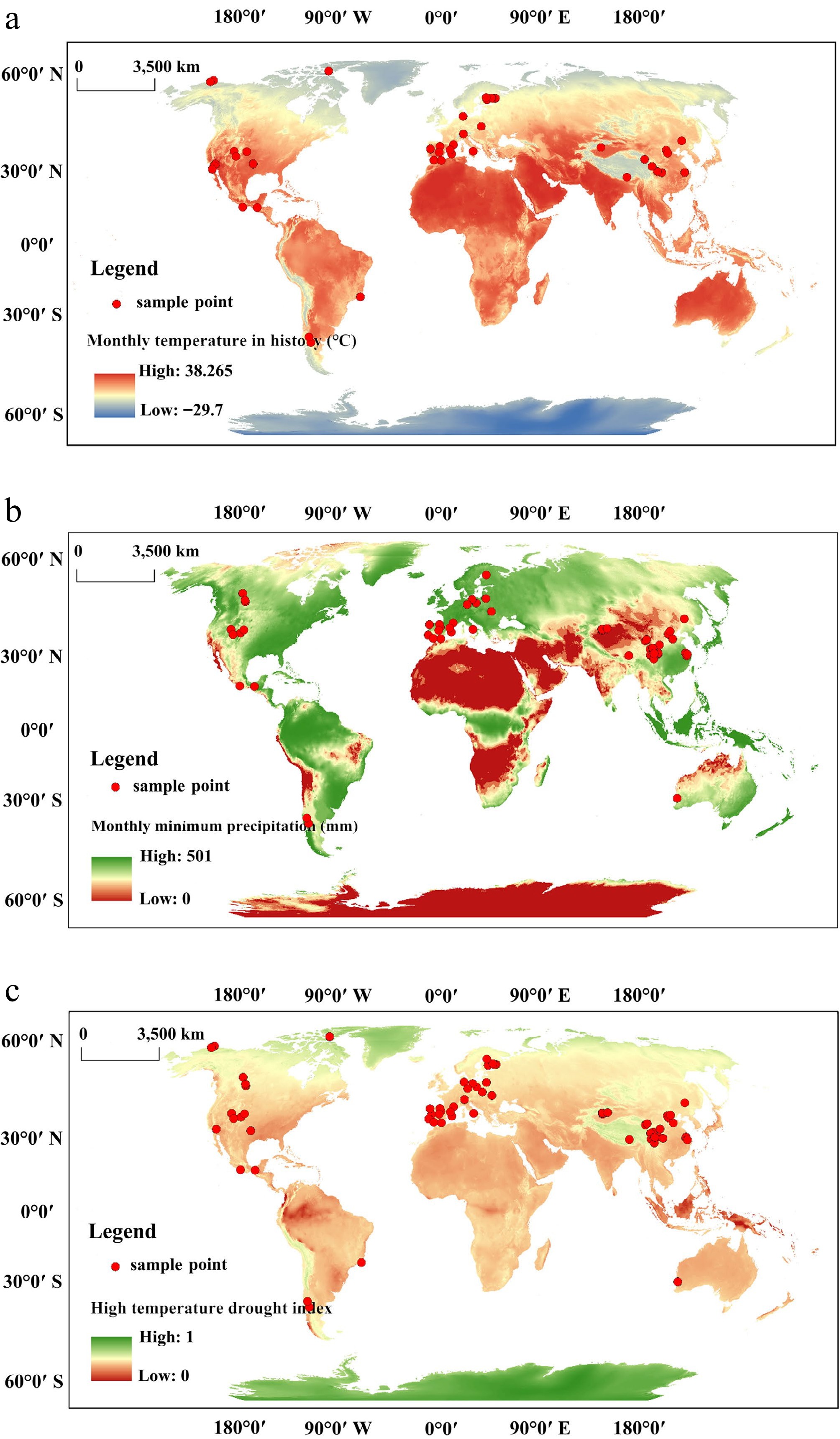
Figure 1.
Geographic distribution of experimental and observational study sites investigating sexual dimorphism in dioecious plants' responses to warming, drought, and combined warming and drought stress across global terrestrial ecosystems. Background climate data represent (a) monthly temperature (historical) (°C) and (b) monthly minimum precipitation (mm) and (c) high temperature drought index calculated from monthly temperature and precipitation data. Red dots indicate sample points.
Data extraction and synthesis
-
Extracted variables included the species, life form (tree, shrub or herb), stress type (warming only, drought only or combined stress), measured parameters (growth parameters, photosynthetic parameters, hydraulic traits, antioxidant enzyme activities, secondary metabolites, microbial communities, etc.) and the direction of sex-specific response (female advantage, male advantage or no significant difference). To facilitate comparative analysis, the response directions of female and male plants to warming alone, drought alone and their combined stress were uniformly categorized as "female advantage" (females exhibited superior performance in specific traits), "male advantage" or "no significant difference". Because the primary studies differed widely in their experimental design, the intensity and duration of stress, plants' developmental stage and measured traits, we therefore adopted a standardized vote-counting approach. For each life form × stress type category, we tallied the number of measurements showing female advantage, male advantage or no significant difference, and report these tallies together with the number of underlying species and studies (Figs 2, 3; Supplementary Table S2).
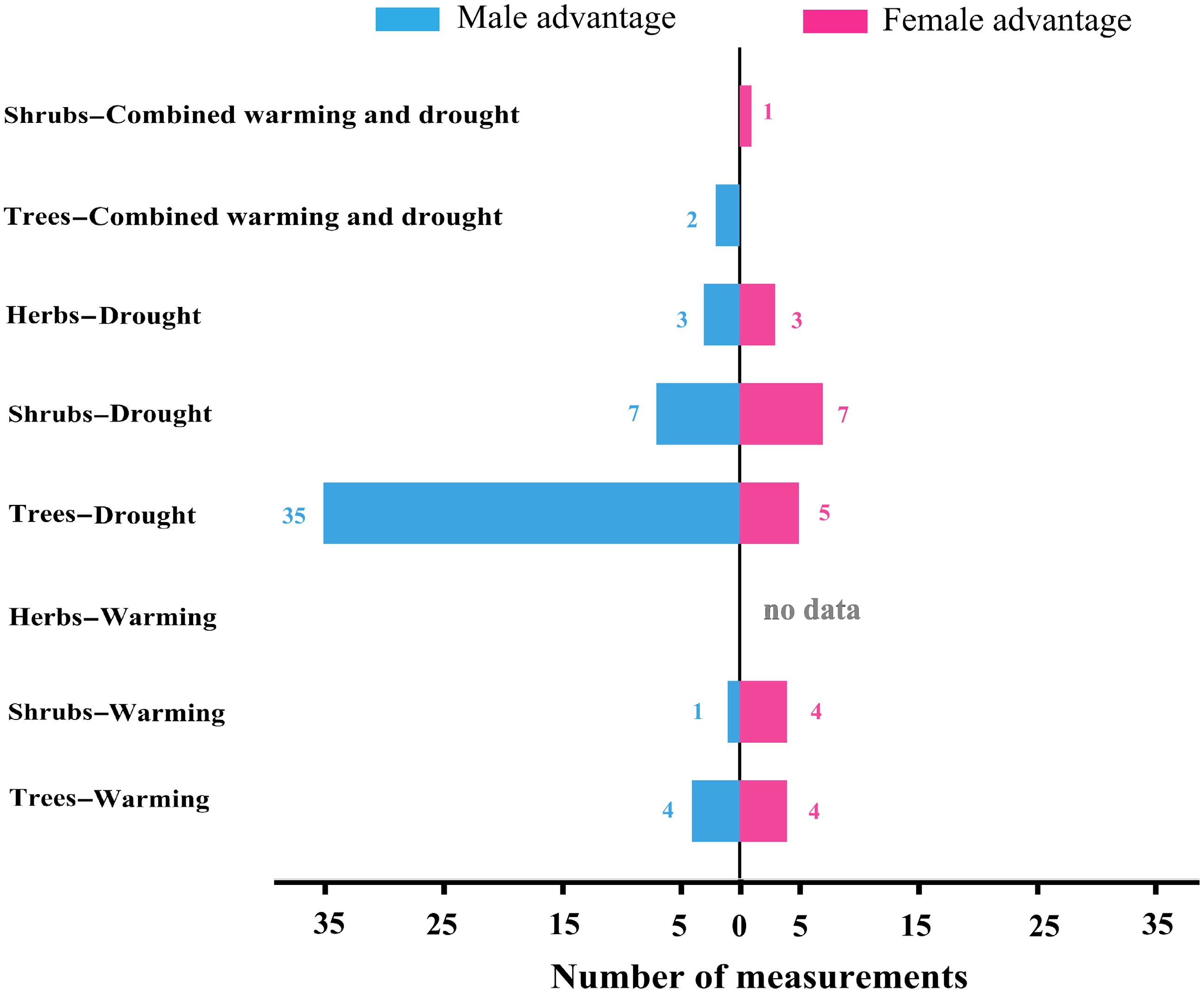
Figure 2.
Vote-counting summary of the direction of sex-specific responses across the three life forms (trees, shrubs herbs) and three stress types (warming alone, drought alone or combined warming and drought). Bars extending to the left (blue) and right (pink) of the central axis indicate the number of measurements showing male advantage and female advantage, respectively, for each life form × stress type combination. The numerals beside the bars give the exact counts. "No data" indicates that no eligible herbaceous warming study was retrieved.
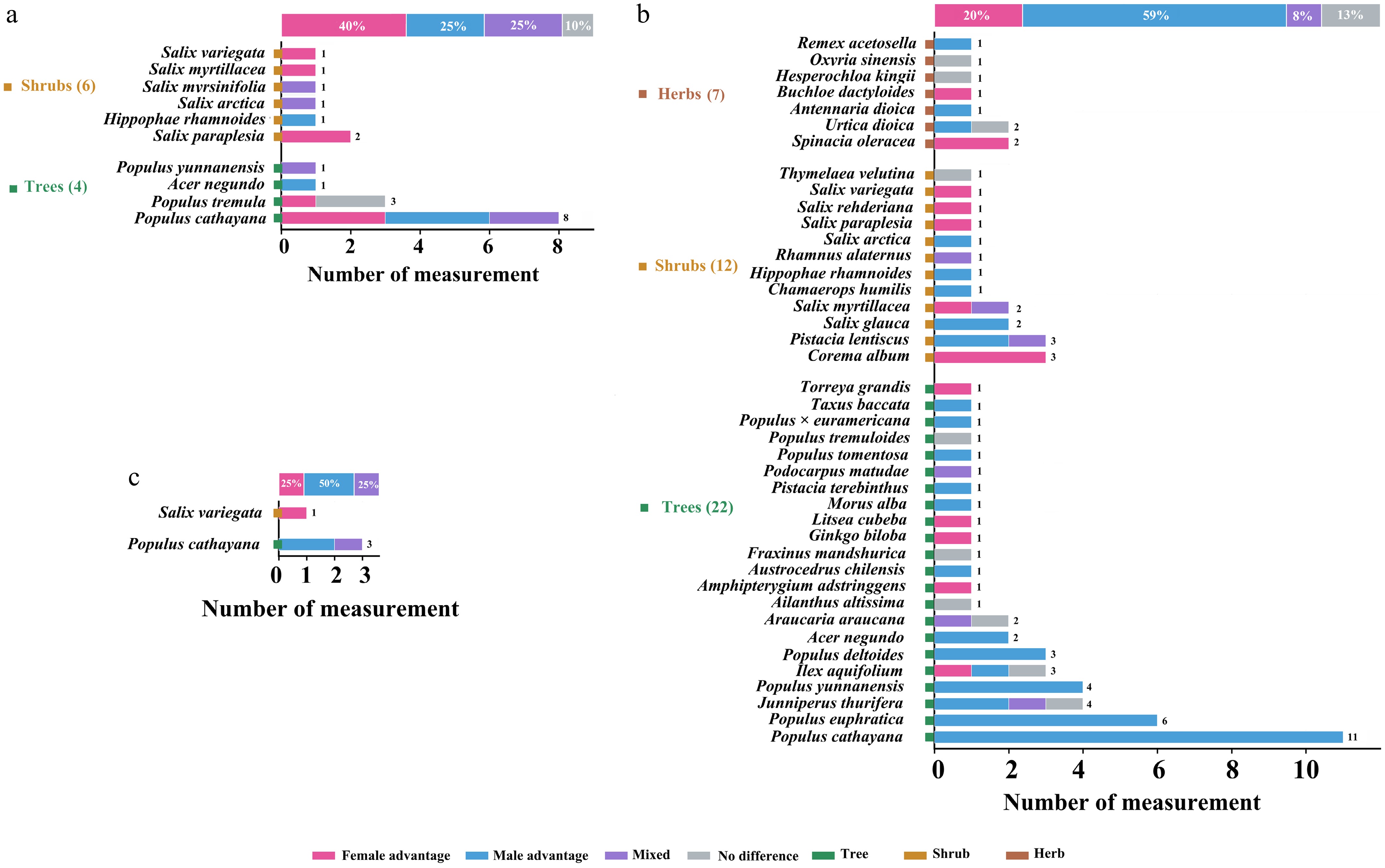
Figure 3.
Species-level synthesis of the direction of sex-specific responses under (a) drought alone, (b) warming alone and (c) combined warming and drought stress. Each horizontal stacked bar represents one species, with the segments' colors denoting the number of measurements coded as female advantage (pink), male advantage (blue), mixed (purple) or no significant difference (grey); the total number of measurements per species is shown at the end of each bar. Colored squares group species by life form (green, trees; orange, shrubs; brown, herbs), and the percentage bars above Panels (a) and (b) and within Panel (c) summarize the overall proportion of measurements in each response category for the corresponding stress type.
-
The final database encompasses 100 measurements from 44 dioecious plant species reported in 88 studies published between 1999 and 2026, comprising 23 tree, 14 shrub, and 7 herbaceous species (Supplementary Table S1; Fig. 2). Most measurements addressed sex-specific responses under drought stress alone (41 species, 76 measurements), followed by warming stress alone (10 species, 20 measurements), whereas the combined effects of warming and drought have been investigated in only two species to date (the tree P. cathayana and the shrub S. variegata; no herbaceous species) (Supplementary Table S1). Vote-counting of the response direction (Figs 2, 3; Supplementary Table S1) revealed that, under warming alone, female advantage and male advantage were equally frequent in trees, whereas shrubs showed a clear female predominance; no eligible herbaceous warming study was retrieved. Overall, 40% of warming measurements indicated a female advantage, 25% a male advantage, 25% mixed responses, and 10% no significant difference (Fig. 3a). Under drought alone, male advantage predominated strongly among trees' measurements (35 male advantage vs. 5 female advantage), shrubs' measurements were evenly split between female and male advantage, and herbs' measurements were balanced between the two directions; across all drought measurements, 59% indicated male advantage, 20% female advantage, 8% mixed responses and 13% no significant difference (Fig. 3b). Under combined warming and drought stress, two of three tree measurements indicated greater female impairment (male advantage) and the remaining one was mixed, whereas the single shrub measurement showed a female advantage (Figs 2, 3c).
Sex-specific responses to warming stress only
-
Under warming stress only, sex-specific responses in dioecious plants exhibit pronounced life form-dependent and taxon-dependent divergence (Figs 2, 3a; Supplementary Fig. S1; Supplementary Table S2). Among trees, species within the genus Populus display marked sexual dimorphism, with the direction of advantage depending on the trait considered. Under experimental warming, female P. cathayana exhibited significantly higher net photosynthetic rate, growth and aboveground allocation of biomass, carbon, and nitrogen than males[10,31]. In P. tremula, females grew larger than males under elevated temperature[32], although long-term warming combined with elevated CO2 revealed no significant main effect of sex on growth, with differences manifested primarily in secondary metabolite allocation, with females accumulating more low-molecular-weight phenolics and males accumulating more condensed tannins[33]. In contrast, several tree measurements reported a male advantage under warming: Warming reduced herbivore-induced defense (salicortin, condensed tannins, defensive enzyme activities) more strongly in female than in male P. cathayana, leading to higher leaf herbivory in females[34]; males showed better biomass accumulation, water use efficiency and carbon balance than females under intrasexual competition at elevated temperatures and CO2[35]. Winter warming delayed bud burst more strongly in males than in females of P. cathayana, thereby synchronizing the sexes[36], and elevated temperature modified source-to-sink transitions and carbon–nitrogen allocation in a sex-specific manner without a consistent overall advantage[37,38]. Notably, in the riparian tree A. negundo, field warming favored males over females, suggesting that the female advantage observed in poplars under warming cannot be generalized across tree genera[5].
Female shrubs demonstrate more consistent growth and photosynthetic advantages under warming only (Figs 2, 3a; Supplementary Fig. S1; Supplementary Table S2). In S. paraplesia, artificial warming (+4 °C) significantly promoted seedling growth, with females showing markedly greater increases than males through sugar signaling and flavonoid accumulation[39]. Acetic-acid-mediated enhancement of high-temperature resilience was likewise more pronounced in females of S. myrtillacea[40], and extreme high-temperature experiments confirmed that female S. variegata maintained a higher net photosynthetic rate, chlorophyll content and plant height than males under thermal stress[7]. By contrast, warming inhibited the growth of female H. rhamnoides subsp. sinensis more strongly than that of males, indicating male advantage in this shrub genus[41]. In S. arctica, open-top-chamber warming enhanced female net assimilation in dry habitats but depressed it in wet habitats, revealing strong habitat dependence[42], whereas in S. myrsinifolia, warming mainly drove sex-specific phenolic allocation, with females accumulating more chlorogenic acid and males accumulating more luteolin, without a clear growth advantage[43]. So far, the only published herbaceous warming experiment reported higher Photosystem II thermostability in males of the sorrel R. thyrsiflorus[44].
Sex-specific responses to drought stress alone
-
Under drought stress alone, sex-specific responses in dioecious plants exhibit marked life-form-dependent and taxon-specific divergence (Figs 2, 3b; Supplementary Fig. S2; Supplementary Table S2). Among trees, species within the genus Populus consistently demonstrate a male advantage across a broad range of species and experimental contexts: Male P. cathayana exhibited higher net photosynthetic rate, stomatal conductance and antioxidant enzyme activities, together with less growth inhibition, membrane lipid peroxidation and nutrient resorption impairment than females under drought, as confirmed by pot experiments, reciprocal grafting, rhizosphere-process analyses and studies of stem xylem traits[45−48]. Comparative studies also revealed that this male-biased drought tolerance is widespread within the genus, spanning P. yunnanensis, P. deltoides, P. tomentosa, artificially bred P. × euramericana hybrids and P. euphratica. Males generally outperform females in photosynthesis, biomass accumulation, defense and hydraulic safety, whereas females tend to exhibit reduced defensive compounds, heightened herbivore susceptibility and greater vulnerability to cavitation and carbon starvation[49−58]. In P. tremuloides, by contrast, sexes did not differ in seedling growth under drought, with only a male advantage in intrinsic water use efficiency[59]. This male advantage paradigm extends beyond Populus to several other trees. Male-biased populations of A. negundo occupy drought-prone habitats, reflecting male superiority in water use efficiency from leaf gas exchange to tree ring scales[60,61]. Young females of T. baccata, J. thurifera and I. aquifolium are more sensitive to summer drought and increasing aridity[62−65]. Females of A. chilensis were overrepresented among drought-affected dying trees[66]. Enhanced ultraviolet (UV)-B aggravated drought effects more in female than in male M. alba saplings[67]. Finally, a multidecadal tree ring study including P. terebinthus, I. aquifolium, J. thurifera and A. altissima found no consistent sex differences in radial growth or water use efficiency under natural drought conditions[68]. However, an important and consistent exception emerges in several non-Populus taxa: Female I. aquifolium exhibited greater growth and higher carbon isotope discrimination under xeric conditions[69]; female G. biloba, T. grandis and L. cubeba displayed superior photosynthetic capacity, antioxidant enzyme activity and osmotic adjustment under drought[70−72]; and, in the tropical dry forest tree A. adstringens, female trees possessed wood anatomical–hydraulic features conferring better drought adaptation and water transport safety than males[73]. Several long-term tree-ring studies further revealed that sex-specific climate sensitivity can be weak, unstable through time, or absent: no sex differences in radial growth or δ13C were detected in I. aquifolium, J. thurifera, and A. altissima; climate-growth responses and wood-density fluctuations differed between sexes but were temporally unstable or site-dependent in F. mandshurica, J. thurifera, and A. araucana; and resilience to extreme drought events was independent of sex in dioecious trees such as A. araucana and neotropical podocarps[63,64,68,74−76].
Shrubs display highly species-specific responses without a consistent genus-level pattern: Male S. glauca adopt a conservative drought avoidance strategy[77,78], and male S. arctica shrubs dominate xeric, drought-prone microsites[26], whereas female S. paraplesia, S. rehderiana and S. variegata show stronger antioxidant capacity, water acquisition and carbon gain advantages under drought[7,30,79]. In S. myrtillacea, drought–low-temperature stress memory enhanced resistance in both sexes through different growth–defense trade-offs[80]. Female C. album maintained less negative water potentials than males during drought through compensatory belowground mechanisms, particularly in the most arid populations[81,82]. Conversely, male H. rhamnoides and P. lentiscus gained advantages through conservative water-use strategies, higher photosynthetic capacity and better photoprotection under summer drought[83,84], although a recent wood–leaf hydraulic coordination analysis of P. lentiscus and R. alaternus revealed a more nuanced pattern in which females achieved higher net photosynthesis and males adopted safer hydraulic architectures[85]. No of sex effect on ecophysiological performance was detected in T. velutina across contrasting habitats[86].
Herbaceous species show balanced and mechanism-diverse responses: Males of the perennial forb R. acetosella maintained green leaf area through low transpiration and conservative water consumption[87]; male A. dioica specimens grew faster than females under drought in mycorrhizal experiments[88]; and female U. dioica suffered stronger lipid peroxidation than males under severe combined drought and nutrient deficiency[89]. By contrast, female S. oleracea gained advantages under intermittent drought through compensatory mechanisms including foliar water uptake and the maintenance of surface water storage[90], and female B. dactyloides exhibited stronger drought resistance and post-drought recovery than males[91]. No significant sex differences under water deficit were found in H. kingii or among the sexual dimorphs of O. sinensis[92,93].
Sex-specific responses to combined warming and drought stress
-
The combined warming and drought stress typically exerts inhibitory effects on dioecious plants that far exceed those of either single stressor, but evidence remains restricted to two species (Figs 2, 3c; Supplementary Table S2). In the tree P. cathayana, female individuals consistently suffer more severe negative consequences. Under combined warming and drought stress, females exhibited significantly greater reductions in plant height, total biomass, net photosynthetic rate, and stomatal conductance than males, accompanied by markedly elevated leaf abscisic acid (ABA) and malondialdehyde (MDA) contents, indicating intensified oxidative stress and water deficit responses[10]. A summer warming field experiment further demonstrated that when warming coincided with limited soil water availability, the growth and physiology of females were constrained mainly by soil moisture, whereas male performance was mainly related to temperature, implying greater female sensitivity to combined heat and water deficit[31]. During the nongrowing season, significant sex × watering × temperature interactions for δ13C and nonstructural carbohydrates indicated that sexual dimorphism in P. cathayana increases along combined warming–drought gradients, with drought reducing bud fresh mass and carbohydrate accumulation more strongly in females[36]. In contrast, in the shrub S. variegata, also a member of the Salicaceae, females showed significantly higher net photosynthetic rate, chlorophyll content, aboveground biomass, and leaf nonstructural carbohydrate allocation than males under combined heat–drought stress, a response pattern diametrically opposed to that observed in poplars[7]. These contrasting patterns indicate that even within the same family, the direction of sex-specific responses to combined warming and drought stress is genus-specific and life-form-specific and cannot be simply extrapolated. Responses to combined stress in non-Populus trees and in herbs remain entirely unexplored.
-
Extending prior evidence that environmental stress type governs sexual dimorphism in dioecious plants[9], this review systematically compares sex-specific responses to warming stress, drought stress and combined warming and drought stress. By extending our focus across life forms (trees, shrubs and herbs) for the first time, we revealed an integrative framework in which the life form and stress type interactively determine the direction of sex-specific advantages. To intuitively illustrate the core differences in the responses of dioecious plants to three stress scenarios, a conceptual framework is presented in Fig. 4. The diagram summarizes the inherent strategic differences between female and male plants as follows. Females tend towards high growth and high photosynthesis but hydraulic vulnerability, whereas males adopt an adaptive strategy of conservative water use and high embolism resistance. Building on this, Supplementary Figs S1 and S2 further presents the specific features of sex-specific responses by stress type. Under warming alone, females of Salicaceae show more pronounced gains in growth and photosynthesis, whereas males exhibit advantages in induced defense, competitive ability and hydraulic safety in several tree taxa. Under drought alone, males dominate in most tree species owing to their high water use efficiency and antioxidant capacity, whereas females of several non-Populus trees and of many shrubs and herbs maintain advantages through compensatory mechanisms. Under combined warming and drought stress, females of the only tree studied to date are most severely affected, showing large declines in growth and photosynthesis as well as high accumulation of ABA and MDA. The diagram systematically reveals the diverse adaptive pathways ranging from males' conservative water use to females' compensation mechanisms, providing an intuitive reference framework for the subsequent life-form-based discussion.
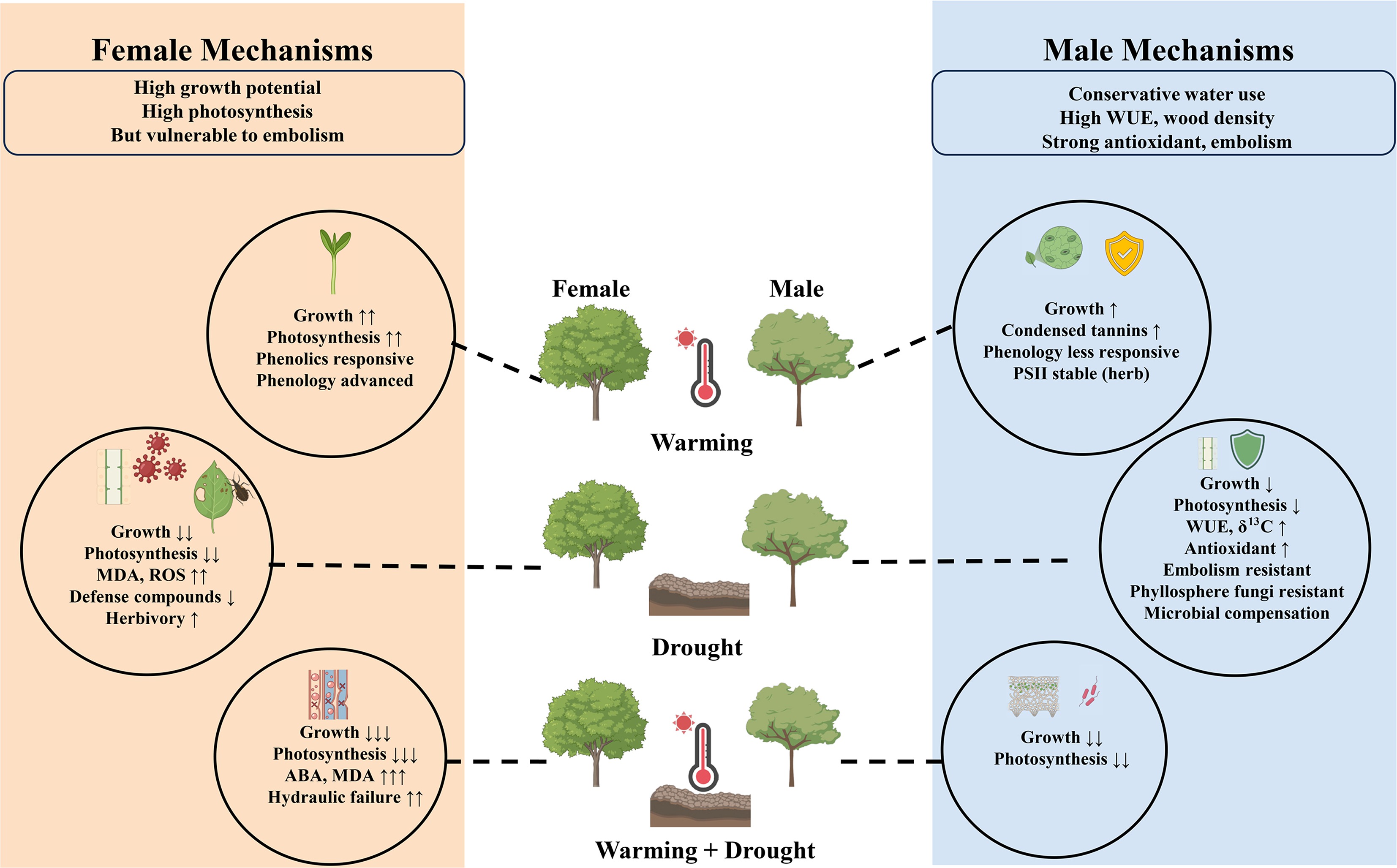
Figure 4.
Conceptual diagram of sex-specific responses of dioecious plants to warming alone, drought alone, and combined warming and drought stress. The diagram integrates the core strategic differences between sexes (see legend) and summarizes the dominant response patterns across the three stress scenarios.
Early research focused mainly on the genus Populus under drought stress alone. By comparing the growth, photosynthetic and hydraulic traits of male and female plants, the classic paradigm of "males are more drought-tolerant" was gradually established. Males have higher water use efficiency, lower xylem embolism vulnerability and stronger antioxidant defense capacity, whereas females exhibit physiological inhibition and aggravated membrane lipid peroxidation even under mild drought[45,48]. The expanded database assembled here confirms the robustness of this paradigm. Male advantage under drought was reported in 35 of 49 tree measurements, spanning seven Populus taxa (P. cathayana, P. yunnanensis, P. deltoides, P. euphratica, P. tomentosa and P. tremuloides) and several non-Populus trees, including A. negundo, T. baccata, J. thurifera, A. chilensis, M. alba and P. terebinthus[60,62,63,66−67]. This finding was further validated in P. euphratica and H. rhamnoides, supporting the generality of the conservative water use–high embolism resistance strategy in woody males[56,83]. However, as the study taxa expanded beyond Populus, this male advantage paradigm was repeatedly challenged: Females of G. biloba, T. grandis, L. cubeba and I. aquifolium maintain higher photosynthetic rates, chlorophyll content and growth under drought[69−72], and females of the tropical tree A. adstringens possess hydraulic architectures conferring greater drought resistance than males[73]. However, P. lentiscus exhibits an intermediate pattern with a male advantage in photoprotection and a female advantage in carbon gain and instantaneous water use efficiency[84,85]. Notably, several multidecadal tree ring studies found no stable sex differences in growth or water-use efficiency[68,74,75], suggesting that short-term pot experiments may overestimate the magnitude of sexual dimorphism expressed under natural conditions. These contradictions indicate that sex-specific responses are not determined solely by reproductive costs but are co-regulated by the life form, phylogenetic background and local adaptation.
The RCH predicts female vulnerability under resource-limited stress because of their higher reproductive investment[6]. Our synthesis confirms this prediction under drought, where male Populus species consistently exhibit conservative water-use strategies and higher embolism resistance, whereas females suffer greater photosynthetic inhibition and oxidative damage[45,48,56]. However, this male-dominant paradigm is repeatedly challenged beyond Populus: Females of G. biloba, T. grandis, L. cubeba and I. aquifolium maintain higher photosynthetic capacity and growth under drought[69−72], whereas the tropical tree A. adstringens possesses female-biased hydraulic architectures conferring greater drought safety[73]. These contradictions indicate that sex-specific responses are co-regulated by the phylogenetic background and local adaptation, not solely by reproductive costs. Under warming, females of Salicaceae frequently outperform males in photosynthesis and growth[10,39], directly contradicting the RCH's expectations. The RCH[94,95] posits that females are carbon/water-limited whereas male pollen production is nitrogen-demanding. We speculate that this is likely because the carbon/water strategies of females are more susceptible to drought stress. However, females have a competitive advantage under warming.
Vote-counting analysis reveals a clear stress-type × life-form interaction (Fig. 5). Under drought alone, male advantage predominates in trees (35 of 49 measurements), particularly within Populus, through conservative water-use strategies and high embolism resistance. Shrubs show evenly split responses, whereas herbs display balanced patterns, with females gaining advantages through compensatory mechanisms such as foliar water uptake and surface water storage[90,91]. Under warming alone, female Salicaceae exhibit photosynthetic and growth advantages, yet this pattern is trait- and taxon-dependent rather than universal, as males gain advantages in induced defense[34] and competitive ability[35], and field warming favored A. negundo males[5]. Under combined warming and drought stress, the synergistic effect far exceeds the impacts of single stressors. In the only tree species examined, P. cathayana females suffer severe physiological damage[10,31], whereas the shrub S. variegata maintains a female advantage[7]. These contrasting patterns within Salicaceae indicate that responses to combined stress are genus-specific and cannot be extrapolated across taxa. These findings carry direct implications for climate-adaptive forestry. In water-limited regions, male-biased planting of Populus and Hippophae may enhance plantations' survival through conservative water-use strategies. Where combined heat–drought events are projected to intensify, increasing the male proportions in Populus plantations may buffer productivity losses. Conversely, in willow-dominated riparian restoration, increasing the proportion of females would likely support biomass accumulation and ecosystem functioning. Sex ratio monitoring should be incorporated as an early warning indicator of maladaptation, with mixed-sex planting prioritized where reproductive sustainability is the management goal. Beyond the aforementioned advances, three critical gaps persist. First, research remains heavily concentrated on Populus and temperate trees; tropical and subtropical taxa are critically under-represented. Second, most experiments adopt short-term (< 1 year), single-site designs, whereas long-term tree ring studies report weaker or unstable sex differences, suggesting that short-term pot experiments may overestimate sexual dimorphism under natural conditions. Third, apparent conflicts among studies—such as male drought tolerance in Populus versus female drought tolerance in Salix—cannot be resolved by current frameworks. An integrative analytical framework incorporating phylogenetic background, microbial interactions and local adaptation history is urgently needed. Future research should prioritize long-term, multifactorial field experiments across tropical and subtropical dioecious taxa, and integrate phylogenetic and microbial perspectives to refine predictive models under global climate change.
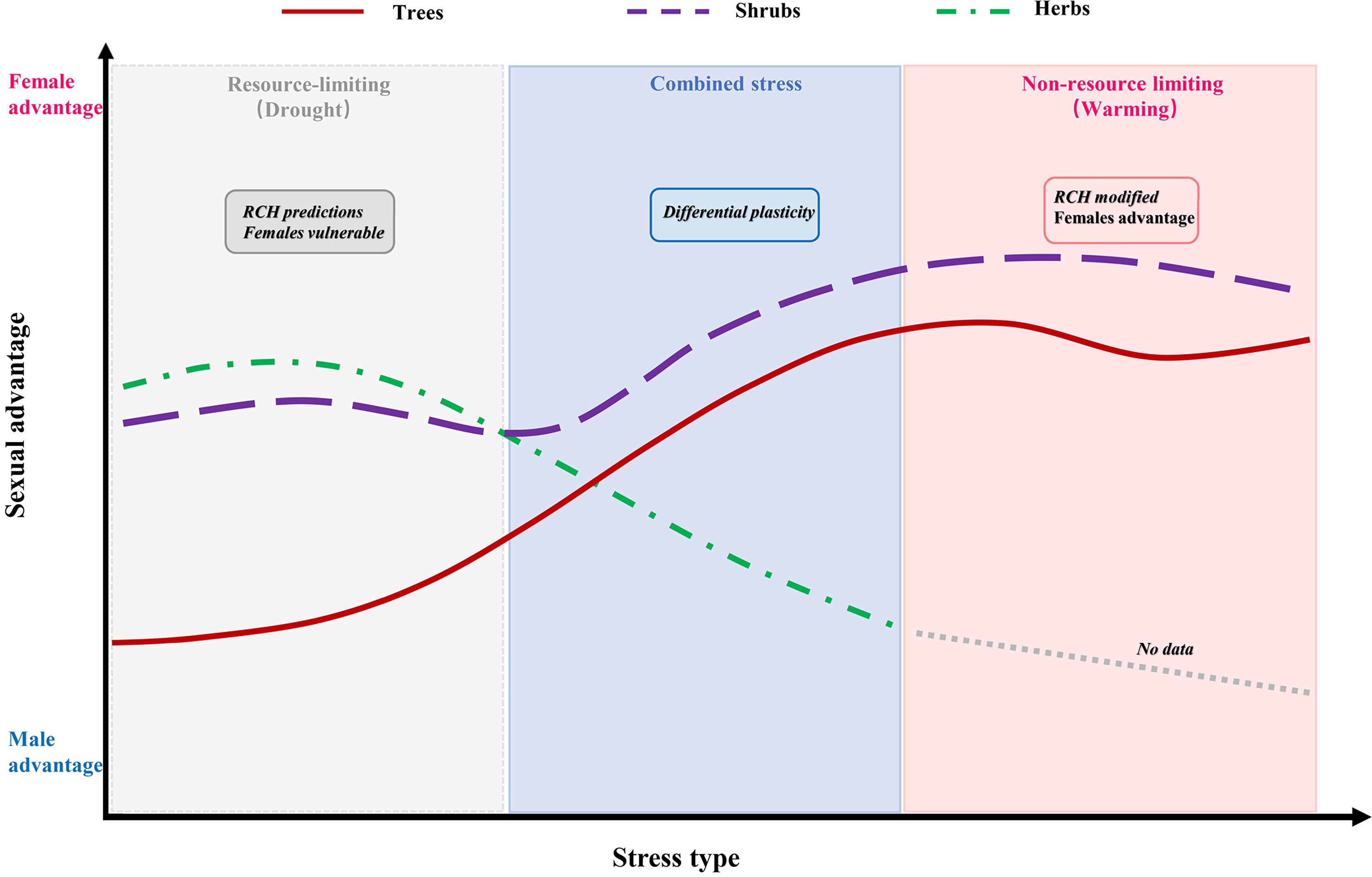
Figure 5.
An integrative framework depicting how the coupling of stress type, resource currency specialization, and life history strategy determines the direction of sex-specific advantages in dioecious plants, revealing the applicability boundary of the RCH.
-
First, dioecious plants generally exhibit significant sex-specific responses, and these responses are highly dependent on the type of stress. Under drought, the male conservative water use strategy prevails in most tree species, whereas under warming, the female photosynthetic gain strategy is more prominent in Salicaceae but is trait- and taxon-dependent in other taxa. Second, life form is an important factor modulating the direction of sex-specific responses to environmental stresses. In trees, males have advantages under drought, shrubs are evenly split between female and male advantage, and in herbaceous plants, females often benefit from compensatory mechanisms (e.g., foliar water uptake, surface water storage, high nitrogen use efficiency), whereas males of perennial forbs adopt conservative water use. Third, the synergistic effect of combined warming and drought stress is much greater than that of single stresses, and in the tree species examined to date, it almost invariably causes more severe physiological damage to females (e.g., photosynthetic inhibition, membrane lipid peroxidation, hydraulic failure). The sole available shrub study documented a contrasting female-biased pattern, indicating that the direction of sex-specific responses to combined warming and drought stress is contingent upon both the species and life form rather than being universal. Expanding the taxonomic, life form, and climatic coverage of combined stress experiments remains the most urgent priority for this field.
-
During the preparation of this work, the authors used DeepSeek (https://chat.deepseek.com/) for language refinement and formatting assistance. The authors reviewed and edited all content produced with the assistance of this tool, verified its accuracy and take full responsibility for the integrity and originality of the final manuscript. This work represents the authors' own intellectual contribution, and no artificial intelligence tool is credited as an author.
-
The authors confirm their contributions to the paper as follows: study conception and design: Liao J; data collection: Zhou Z, Yang R, Zhao J; analysis and interpretation of results: Liao J; draft manuscript preparation: Liao J, Liu X, Ren W. All authors reviewed the results and approved the final version of the manuscript.
-
All data analyzed during this study are included in this published article.
-
The authors declare no conflicts of interest.
-
This accompanies this paper online at https://doi.org/10.48130/fra-0026-0011.
- Supplementary Table S1 Number of dioecious species (number of measurements in parentheses) in the final database, classified by life form and stress type.
- Supplementary Table S2 The final database of 88 studies (100 measurements, 44 species, 1981–2026) on sex-specific responses of dioecious plants to warming, drought, and combined warming and drought stress.
- Supplementary Fig. S1 Conceptual diagram of sex‑specific responses of dioecious plants to single warming condition.
- Supplementary Fig. S2 Conceptual diagram of sex‑specific responses of dioecious plants to single drought condition.
- Copyright: © 2026 by the author(s). Published by Maximum Academic Press, Fayetteville, GA. This article is an open access article distributed under Creative Commons Attribution License (CC BY 4.0), visit https://creativecommons.org/licenses/by/4.0/.
-
About this article
Cite this article
Liao J, Liu X, Zhou Z, Yang R, Ren W, et al. 2026. Sex-specific responses of dioecious plants to warming, drought and combined warming and drought stress. Forestry Research Advances 1: e013 doi: 10.48130/fra-0026-0011 

Sex-specific responses of dioecious plants to warming, drought and combined warming and drought stress
- Received: 16 June 2026
- Revised: 03 August 2026
- Accepted: 18 August 2026
- Published online: 24 September 2026
Abstract: Dioecious plants play crucial roles in terrestrial ecosystems. Based on a systematic literature search of the Web of Science Core Collection covering publications from 1999 to 2026, this review synthesizes 100 measurements from 44 dioecious species (23 trees, 14 shrubs and 7 herbs), reported in 88 studies, to examine the sex-specific responses of trees, shrubs and herbs to warming, drought and combined warming and drought stress. The results were as follows. (1) Under warming alone, Salicaceae females generally outperform males in photosynthesis and growth, whereas males gain advantages in defense and hydraulic safety; no herb data were retrieved. (2) Under drought alone, male advantage predominates in trees (35 of 49 measurements), particularly Populus, through conservative water-use strategies and high embolism resistance; conversely, female superiority occurs in several non-Populus trees and some shrubs, although other shrubs favor males; herbs show balanced patterns, with females compensating via foliar water uptake. (3) Preliminary evidence suggests that under combined warming and drought, synergistic effects exceed single stressors: Populus females suffer severe inhibition, whereas Salix females maintain superiority, indicating genus-specific responses. Overall, sex-specific responses are fundamentally shaped by stress type and life form, with combined stress particularly impairing female trees. Future studies should prioritize long-term multifactorial field experiments across tropical and subtropical taxa, and integrate phylogenetic, microbial and local adaptation perspectives to refine predictions.
-
Key words:
- Sexual dimorphism /
- Warming stress /
- Drought stress /
- Life form