












-
As global climate change intensifies, long-distance migratory birds increasingly face challenges across the annual cycle. This pressure is particularly pronounced in winter, when low ambient temperatures, short day length, and reduced food availability can simultaneously limit foraging opportunities while increasing thermoregulatory costs. These constraints are particularly severe in passerines, which generally have high body temperatures and elevated mass-specific metabolic rates compared with non-passerine birds of similar body mass[1−3]. In cold environments, small birds commonly exhibit seasonal increases in basal metabolic rate (BMR) and summit metabolic rate (Msum), reflecting enhanced thermogenic capacity and cold tolerance during winter[4]. Severe conditions experienced during the wintering season can affect migration and subsequent breeding performance of birds[5]. Understanding how migratory passerines manage energy reserves in winter is essential for interpreting both overwinter survival and year-round population dynamics.
At the individual level, a central mechanism of winter energy management is the regulation of energy reserves, particularly fat stores. Fat stores provide an energy buffer against temporary food shortages, adverse weather, and long winter nights, thereby reducing the risk of starvation and hypothermia[6,7]. However, carrying excessive reserves may also impose costs, including increased flight costs, reduced escape performance, or greater exposure to predators through increased foraging time. Thus, winter body mass and fat reserves are generally expected to reflect an adaptive compromise between starvation risk and mass-dependent costs, as proposed by optimal body mass theory[6−8]. This framework predicts that birds should not simply maximize fat stores throughout winter, but should adjust reserves flexibly according to changing environmental conditions and perceived risk. Empirical studies increasingly show that such regulation can occur over short temporal scales. Wintering birds may reduce body mass during milder winters, suggesting that lower thermoregulatory demand can relax the need for reserve accumulation[9]. Conversely, short-term cooling, snowfall, or reduced food accessibility can promote increased energy reserves, as observed in wintering Snow Buntings (Plectrophenax nivalis)[10]. Experimental and seasonal studies also indicate that body mass, metabolic rate, and energy intake can respond to ambient temperature and photoperiod, as shown in Chinese Hwameis (Garrulax canorus)[11]. Even where food supply appears relatively stable, avian fat reserves may remain sensitive to local environmental variation[12]. These studies suggest that winter body condition should be examined not only as a seasonal trait, but also as a dynamic response to short-term abiotic and biotic conditions.
At the population level, studies of avian sex ratios and their relationships with behavior, demography, and other life-history traits can improve our understanding of bird ecology[13]. In many migratory birds, males and females differ in winter distribution, habitat use, resource access, and dominance relationships, resulting in sexual segregation during the non-breeding season[14−16]. Sex-related differences in body size and morphology may further influence energetic requirements and cold tolerance; within species, the larger sex may experience lower mass-specific heat loss and therefore lower relative thermoregulatory costs in cold environments[17]. Such differences may translate into sex-specific associations between morphology, body condition, and survival. For example, during winters with heavy snowfall, bill morphology has been shown to predict overwinter survival in females but not in males[18]. These findings suggest that winter population composition and sex-related morphological differences may provide important clues to winter ecology and energy-reserve regulation.
Although avian winter energetics has received increasing attention, most studies have been conducted in temperate and boreal regions, where prolonged cold, snow cover, and fluctuating food availability dominate winter conditions. Humid subtropical monsoon regions are milder and wetter, potentially imposing different energetic constraints on overwintering birds. Yet winter energy management in small migratory passerines in these environments remains poorly understood, limiting the generality of patterns derived from colder systems. The Red-flanked Bluetail provides a suitable model for addressing this gap because it regularly winters in subtropical forests of Southwestern China. This small, long-distance migratory passerine breeds across Northern Europe and Asia to Northeastern China, and winters mainly in Southern China, Japan, and Southeast Asia[19]. The species is also sexually dimorphic and shows delayed plumage maturation: males aged two years or older have bright blue plumage, whereas females and 1-year-old males are olive-brown until the males acquire adult plumage in their second breeding season[20]. This phenotype-sex-age mismatch also provides an opportunity to test whether female-plumaged males and females differ in morphology or body condition during the non-breeding season. Nevertheless, quantitative information on its winter ecology remains limited, particularly regarding winter sex ratio, male age/plumage composition, and whether males and females differ in winter distribution or habitat use across the wintering range.
In this study, we investigated overwintering Red-flanked Bluetails in Dujiangyan, Southwestern China, to describe their local winter sex ratio and examine their short-term regulation of energy reserves. Specifically, we aimed to: (1) describe the sex ratio in wintering Red-flanked Bluetails by combining plumage-based phenotypic assessment with molecular sex identification, and test whether females and female-plumaged males differ in morphology; (2) use fat reserves as an index of body condition to examine seasonal and short-term variation in relation to abiotic conditions and biotic factors during the overwintering period. By focusing on a humid subtropical wintering region, this study provides evidence for how a long-distance migratory passerine regulates body condition outside the better-studied temperate and boreal wintering systems.
-
This study was conducted at Hutu Ranch (30.868449° N, 103.495669° E; ca. 1,100 m a.s.l.), located in the rear mountain area of Qingcheng Mountain, Dujiangyan City, Sichuan Province, Southwestern China. The study site is located in subtropical evergreen broad-leaved forest under a subtropical monsoon humid climate and forms part of one of the world's top 25 biodiversity hotspots[21].
Fieldwork was conducted from early November 2022 to mid-March 2023, but no Red-flanked Bluetails were captured after 1 March 2023. Therefore, only data collected between 6 November 2022 and 1 March 2023 were included in the analyses. Within this analytical period, the onset of winter was defined as the first date on which the daily mean temperature remained below 10 °C for at least 1 week. Based on local temperature trends, the study period was divided into five stages: prewinter (6 November 2022–28 November 2022), cold wave (29 November 2022–1 December 2022), early winter (2 December 2022–13 January 2023), midwinter (14 January 2023–28 January 2023), and late winter (29 January 2023–1 March 2023).
Field sampling and measurements
Environmental and food resource measurements
-
Fine-scale climatic data, including temperature and humidity, were recorded using a COS-03-X data logger (Shandong Renke Control Technology Co., Ltd.). The logger was placed in a shaded, sheltered location and set to record data automatically every 10 min.
To quantify seasonal variation in bird food availability, ground arthropod biomass was estimated using pitfall trapping as a proxy for invertebrate food resources. Five 10 m × 10 m quadrats were established in the study area. Within each quadrat, 15 pitfall traps (containers partially filled with ethanol) were installed flush with the ground surface. Trapped arthropods were collected weekly, with the biomass collected during each weekly sampling interval converted into a mean daily ground-arthropod biomass index and assigned to the dates covered by that interval. In the laboratory, samples were washed, dried, and weighed to the nearest 0.001 g, and the total arthropod biomass in each quadrat was used as an index of ground invertebrate food availability.
Bird capture and individual measurements
-
Red-flanked Bluetails were captured using mist nets, and each individual was fitted with a uniquely numbered ring at first capture. A total of 12–15 mist nets were operated during the study period, including two net types (15 m × 4 m and 8 m × 3 m), both with a mesh size of 1.5 cm × 1.5 cm. Mist-netting was conducted daily from 08:00 to 18:00, and nets were checked at least once per hour to minimize injury and mortality.
After capture and ringing, morphological traits, body mass, and fat score were recorded for each individual. Eight morphological traits were measured with digital calipers (± 0.01 mm): body length, bill length, beak crack length, tarsus length, tail length, flattened wing chord length, second secondary feather length, and third primary feather length. Body mass was measured using a digital balance (± 0.01 g). Visual fat score was assessed according to subcutaneous fat deposits in the furcular and abdominal regions following Kaiser's songbird fat-scoring system[22].
Sex determination
-
Sex was first determined from external plumage characters whenever possible, particularly in adult males with bright blue plumage. For olive-brown individuals whose sex could not be reliably identified based on morphology, blood samples were collected from the brachial vein and stored in absolute ethanol for subsequent molecular sex identification.
Genomic DNA was extracted using an Animal Genomic DNA Kit (Mei5 Biotech Co., Ltd., Beijing, China). PCR amplification was conducted using the primer pairs sex1'/sex2[23] and ATP5A1[24], following the protocols described in the original studies. Sex was assigned only when the two primer systems produced concordant results.
Statistical analyses
Morphological comparisons
-
After molecular sex identification, the composition of the wintering Red-flanked Bluetail population at Hutu Ranch was summarized. To test for morphological differences between females and female-plumaged males, the eight morphological traits were compared between the two groups using independent-samples t-tests when assumptions of normality and homogeneity of variance were met, and Mann–Whitney U-tests otherwise.
Validation of body condition indices
-
Because actual fat reserves are difficult to measure directly, a range of surrogate indices are commonly used for indirect assessment, including body mass, fat score, ratio indices of body condition, and residuals of body mass. However, the suitability of these indices for reflecting fat reserves may vary among species and populations[25].
Accordingly, we first evaluated the validity of candidate body condition indices for this species. Unexpectedly dead individuals (n = 9) were dissected, and fat deposits in the furcular and abdominal regions were measured. The sum of these two measurements was defined as fat mass (± 0.001 g), and fat percentage was calculated as fat mass divided by body mass. Fat mass and fat percentage were used as response variables in ordinary least squares (OLS) regression models to evaluate the relationships between actual fat reserves and candidate body condition indices. The validity of each index was assessed primarily by R2 and p-values (Supplementary Table S1).
Comparisons of morphometric traits and candidate body-condition indices were used to characterize morphological variation among sampled individuals and to identify an appropriate proxy for fat reserves, respectively, rather than to assess energy-reserve regulation directly.
Seasonal variation in body condition indices
-
To examine the dynamics of body condition during winter, we used ordinary least squares (OLS) regression to assess the relationship between the selected body condition indices and ordinal date, and further compared body condition indices among different winter stages.
Based on the results of the analysis of ordinal date and comparisons among winter stages, fat score was selected as the response variable for subsequent analyses of predictor variables.
Modeling predictors of fat score residuals
-
Before constructing the predictor models, we considered two potential sources of variation in fat score: structural body size and daily capture time. Structural size was considered because larger birds may store more fat[25], and it was summarized by a principal component analysis (PCA) of eight morphological traits, with the first principal component (PC1) used as an integrated index of body size (see Supplementary Table S2 for PCA results). Daily capture time was considered because preliminary analysis showed that it was positively associated with fat score. Previous stopover studies have shown that body mass can change rapidly within a day, mainly owing to recent food intake and short-term fuel deposition, whereas fat mass and visual fat scores generally reflect slower and coarser changes in stored energy reserves[26−29]. Accordingly, fat score was adjusted for capture time to reduce potential sampling bias in observed fat scores, rather than to infer rapid within-day fat accumulation. Because fat score showed a stronger relationship with measured fat reserves than body mass in our validation analysis, we used residuals from the regression of fat score on daily capture time as the response variable in subsequent analyses.
Predictor variables were classified into two categories: abiotic and biotic factors. Abiotic factors included fine-scale local temperature, humidity, and snowfall events, whereas biotic factors included ground arthropod biomass, sex, and capture status (detailed descriptions of all predictor variables are provided in Supplementary Table S3). Sex and capture status were included as record-level biotic covariates in the multiple linear regression analyses. Sex was coded as a binary categorical variable, with females assigned a value of 0 and males assigned a value of 1. Capture status was coded as an ordinal capture-history variable, with 0 indicating the first capture, 1 indicating the first recapture, 2 indicating the second recapture, 3 indicating the third recapture, and so forth. Thus, the coefficient of sex represents the difference in fat score residuals between males and females, whereas the coefficient of capture status reflects the association between fat score residuals and capture-history order after the effects of other predictors were accounted for. Previous studies have shown that incorporating weather variables at multiple temporal scales can substantially improve the explanatory power of regression models for fat score residuals[30,31]. Accordingly, to better quantify the immediate, short-term cumulative, and lagged effects of predictors on avian fat reserves, we considered three temporal scales: the day of capture, the 3-d average prior to capture, and the 7-d average prior to capture. Temporal averaging was applied only to time-varying predictors, including temperature, humidity, snowfall-related variables, and ground arthropod biomass. In contrast, sex and capture status were retained as record-level covariates in all three model sets and were not averaged across the 3- or 7-d windows. We then used multiple linear regression models to evaluate the effects of these predictor variables on fat score residuals.
All predictor variables were standardized using the standardize function in the arm package[32], which rescales non-binary numeric predictors to have a mean of 0 and a standard deviation of 0.5, and centers binary predictors to have a mean of 0 and a unit difference between categories. For each temporal scale, all potential predictors were first included in a global model. Multicollinearity was then assessed using variance inflation factors (VIF), and predictors were sequentially removed until all remaining variables had VIF values < 10 (a commonly used threshold for excluding severe multicollinearity in ecological regression analyses[33]), thereby finalizing the global model. All possible submodels were subsequently generated, and Akaike information criterion (AIC) values were calculated for ranking. Model averaging was performed by retaining and averaging models with ΔAIC < 2 to obtain the optimal model. Finally, standardized regression coefficients for each factor in the optimal models were summarized and presented. All statistical analyses were conducted in R v4.2.1, with model selection performed using the dredge and model.avg functions in the MuMIn package[34].
-
A total of 94 capture events were recorded during the study period, including 61 first captures and 33 recaptures. Owing to sample loss or variation in DNA extraction quality, 12 olive-brown-plumaged individuals could not be sexed. In total, sex was successfully determined for 49 individuals (detailed dates of initial captures and recaptures are shown in Fig. 1). The overall sex ratio was calculated using all sexed individuals, including both olive-brown individuals and brightly colored males. Among these individuals, females accounted for 41% (n = 20) and males for 59% (n = 29). Among the 29 males, one was a third-calendar-year-or-older (≥ 3-year-old) male with definitive blue plumage, one was a second-calendar-year (2-year-old) male with intermediate blue plumage, and the remaining 27 were olive-brown yearling males. Thus, blue-plumaged older males were rare in the sampled wintering population, whereas most males were externally similar to females (Fig. 2).
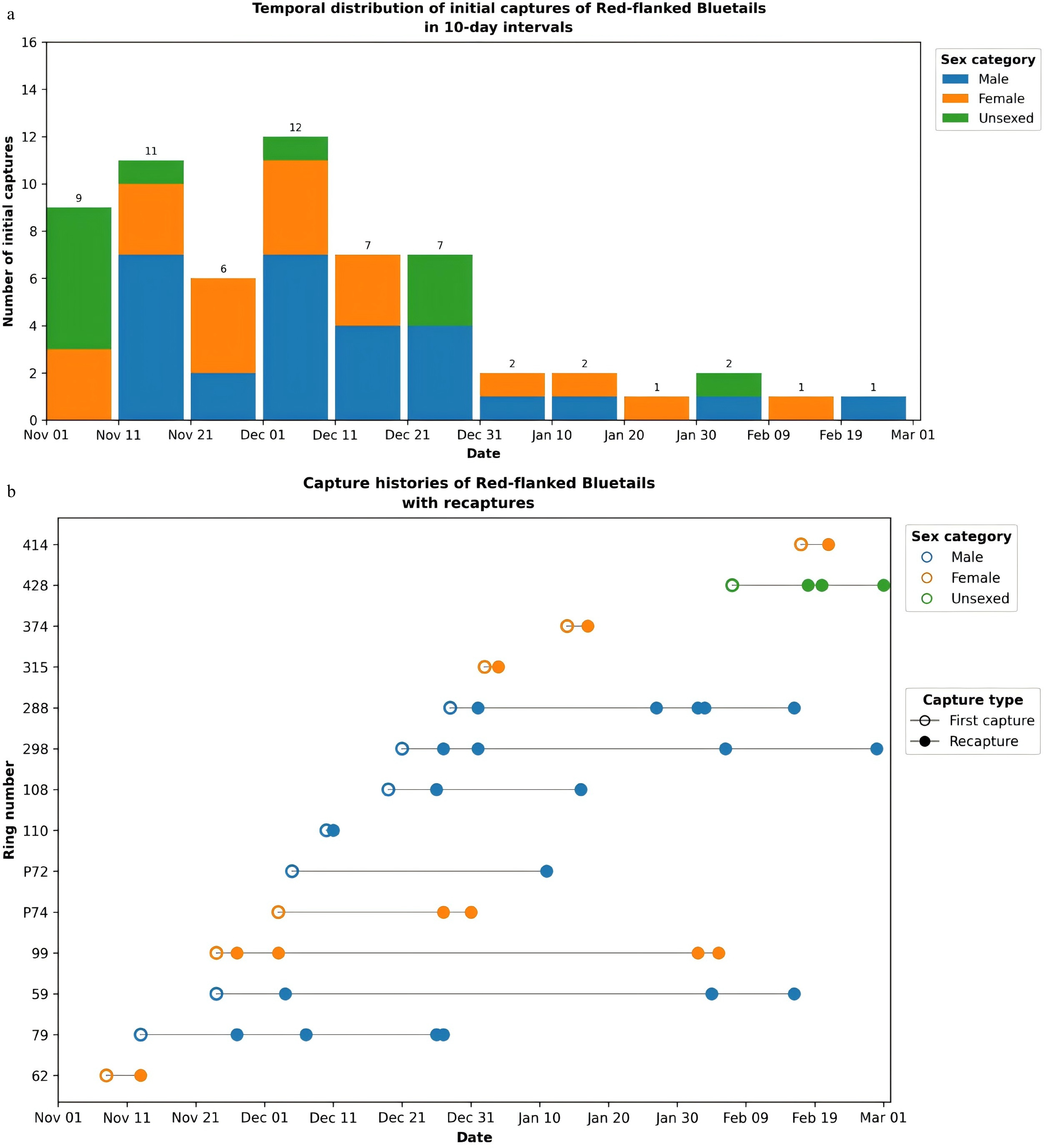
Figure 1.
Temporal distribution of Red-flanked Bluetail captures during the study period. (a) The distribution of initial captures of males, females, and unsexed individuals grouped into 10-day intervals. (b) Capture histories of individuals with recaptures. Each horizontal line represents one ringed individual.
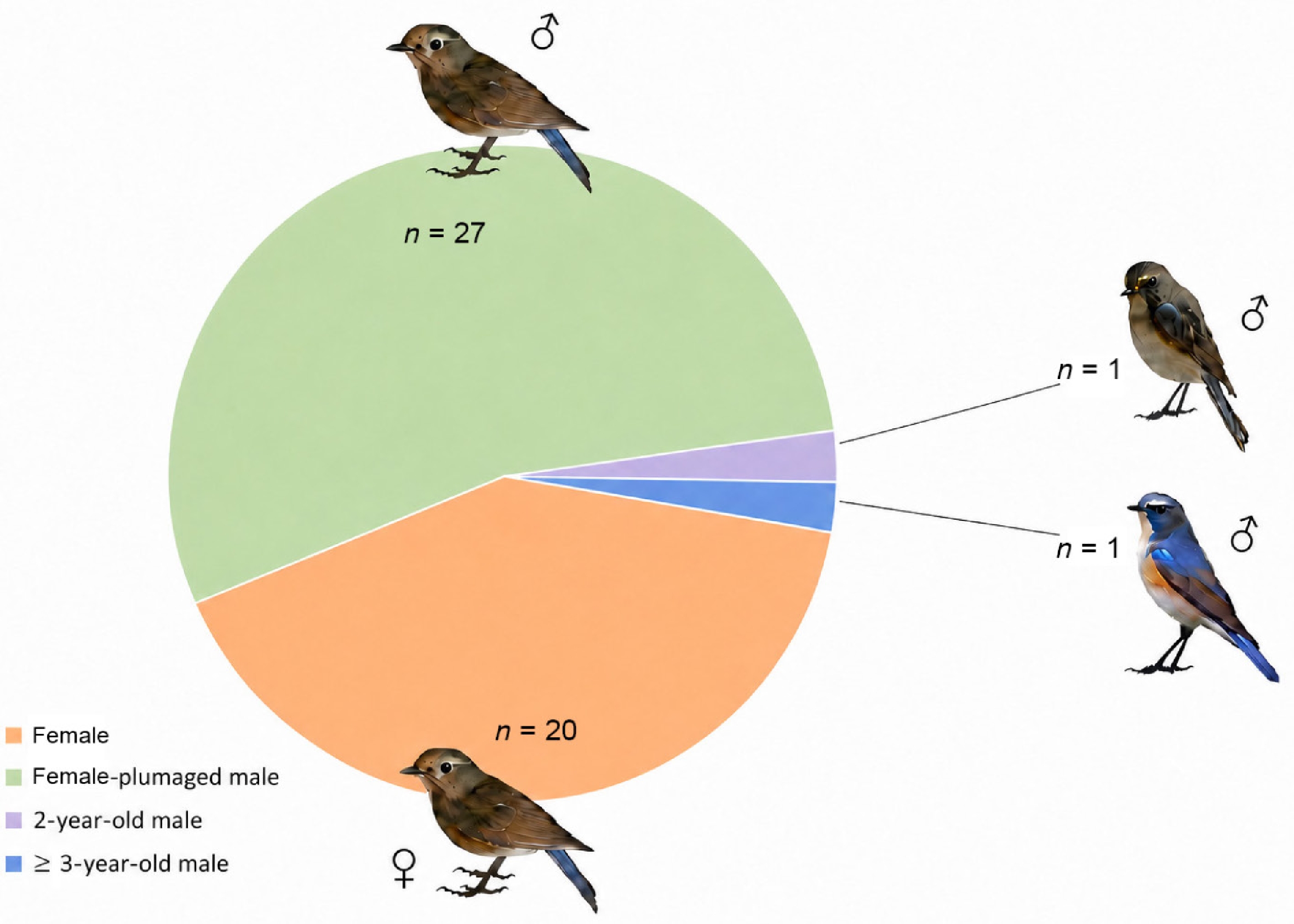
Figure 2.
The composition of wintering Red-flanked Bluetails in Dujiangyan based on morphological and molecular identification.
Comparisons of morphological traits between females and female-plumaged males showed that the two groups were broadly similar in overall morphology, with only second secondary feather length (p < 0.01) and third primary feather length (p < 0.05) being significantly greater in female-plumaged males than in females. No significant differences were detected in body length, bill length, beak crack length, tarsus length, tail length, or flattened wing chord length between the two groups (Supplementary Table S4). Overall, these results indicate limited morphological divergence between females and female-plumaged males. Therefore, in the subsequent body-condition analyses, sex was not treated as a primary grouping factor but was retained only as a covariate.
Body condition change pattern during winter
-
The validation test indicated that body condition indices differed in their ability to reflect actual fat reserves. Among the tested indices, the ratio of body mass to bill length plus tarsus length (R2 = 0.8299, p < 0.001) showed the strongest relationship with fat reserves, followed by fat score (R2 = 0.7206, p < 0.01) and body mass (R2 = 0.5925, p < 0.05). Therefore, these three indices were retained as surrogate measures of body condition for subsequent analyses (detailed information in Supplementary Table S1).
Regression analyses revealed that body condition indices responded differently to ordinal day. Both body mass (β = 0.011 ± 0.004, p < 0.01) and fat score (β = 0.012 ± 0.004, p < 0.01) increased significantly with ordinal day (Fig. 3a, b), indicating a gradual improvement in body condition over the wintering period. In contrast, the effect of ordinal day on the body mass ratio was weak and not statistically significant (β = 0.0002 ± 0.0001, p = 0.0897).
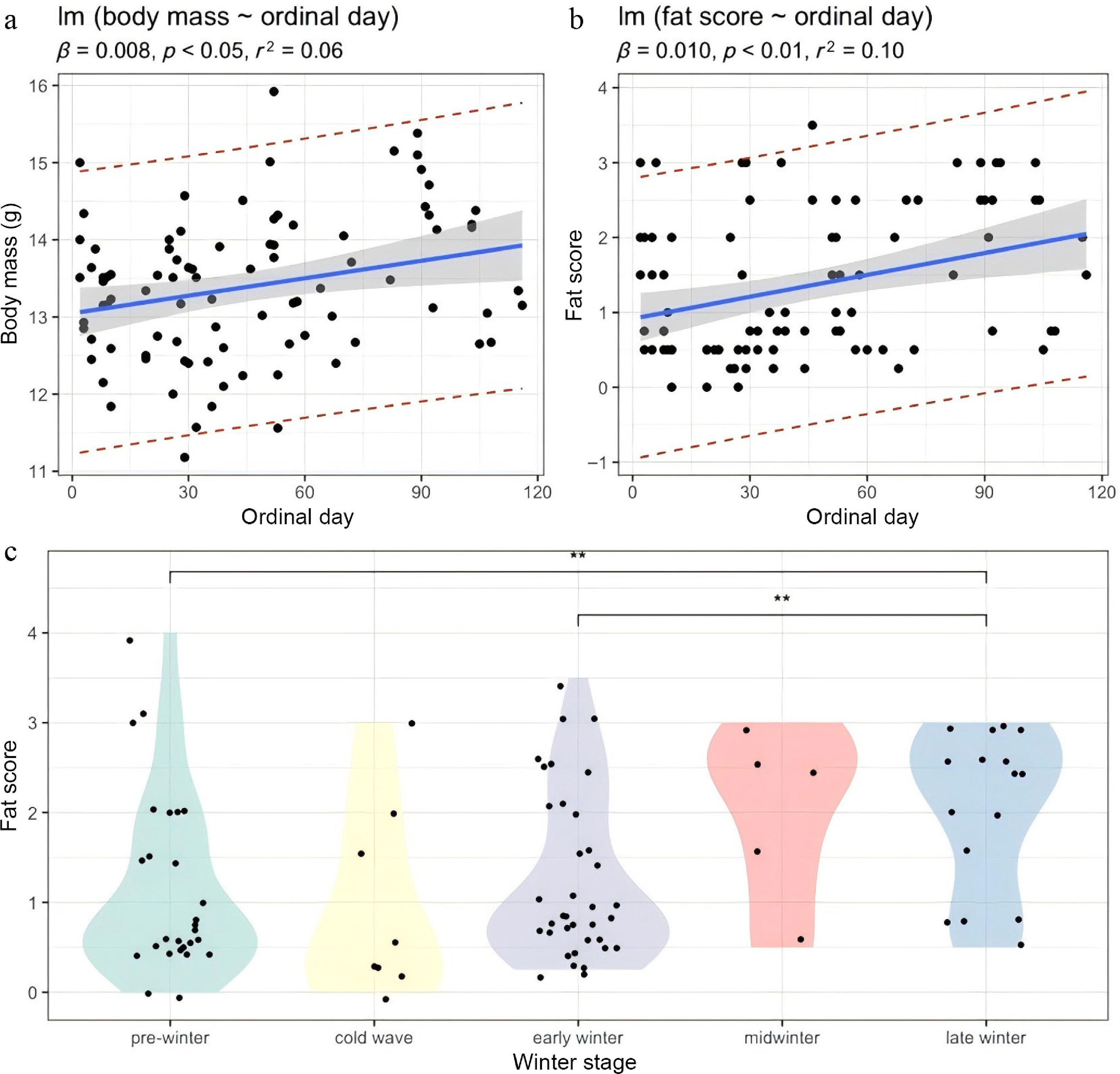
Figure 3.
The regression relationship between ordinal day and (a) body mass, and (b) fat score, respectively. (c) The comparison of fat scores among different winter stages, in which late winter had a significantly higher fat reserve compared with pre- and early winter. Significance code: ** p < 0.01.
Further comparisons among winter stages revealed that only fat score differed significantly among stages. Specifically, fat score was significantly higher in late winter than in prewinter (p = 0.0028) and early winter (p = 0.0079) (Kruskal–Wallis test followed by two-sided Wilcoxon rank-sum tests; Fig. 3c). By contrast, neither body mass nor the body mass ratio varied significantly among winter stages (ANOVA, all p > 0.05).
Abiotic and biotic factors associated with body condition
-
Preliminary analysis showed that daily capture time was positively associated with fat score (β = 1.2844, p = 0.007). Therefore, to reduce potential capture-time-related bias in observed fat scores, fat score residuals adjusted for capture time were used as the response variable in the predictor models.
For abiotic factors, local climatic conditions showed clear temporal variation. Daily temperature declined sharply during the cold wave and remained relatively low through early winter and midwinter, before increasing again in late winter (Fig. 4a). Humidity also fluctuated markedly across the study period, with a relatively dry period occurring around late January to early February (Fig. 4b). Against this climatic background, temperature, humidity, and snowfall events showed different effects on fat score residuals across three timescales (Fig. 5a–c). Temperature-related variables showed contrasting effects across models: on the capture day, maximum daily temperature (Tmax) and daily temperature range (Tran) had positive effects on fat score residuals (Fig. 5a). By contrast, in the 7-d pre-capture model, mean maximum temperature (MTmax) showed a negative association with fat score residuals, whereas mean temperature range (MTran) remained positively associated (Fig. 5c). Humidity-related variables consistently showed negative effects across all three models, including minimum humidity (Hmin) on the capture day, and mean minimum humidity (MHmin) and mean maximum humidity (MHmax) in the 3- and 7-d pre-capture models. Snowfall events occurred only twice during the winter, each lasting no more than 3-d, and had a significant negative effect only on the capture day (Fig. 5a).
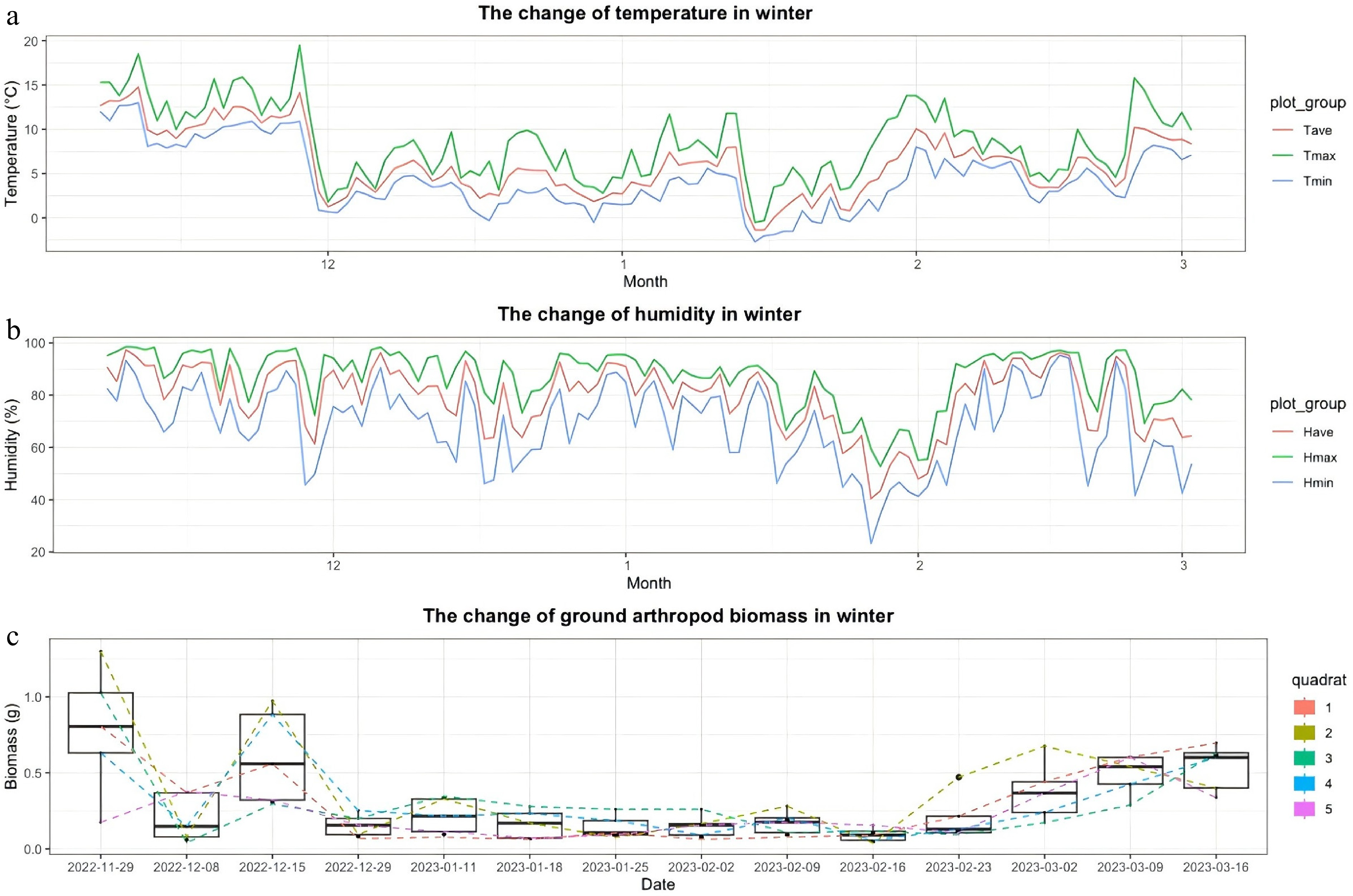
Figure 4.
Dynamic changes in (a) temperature, (b) humidity, and (c) ground arthropod biomass during winter.
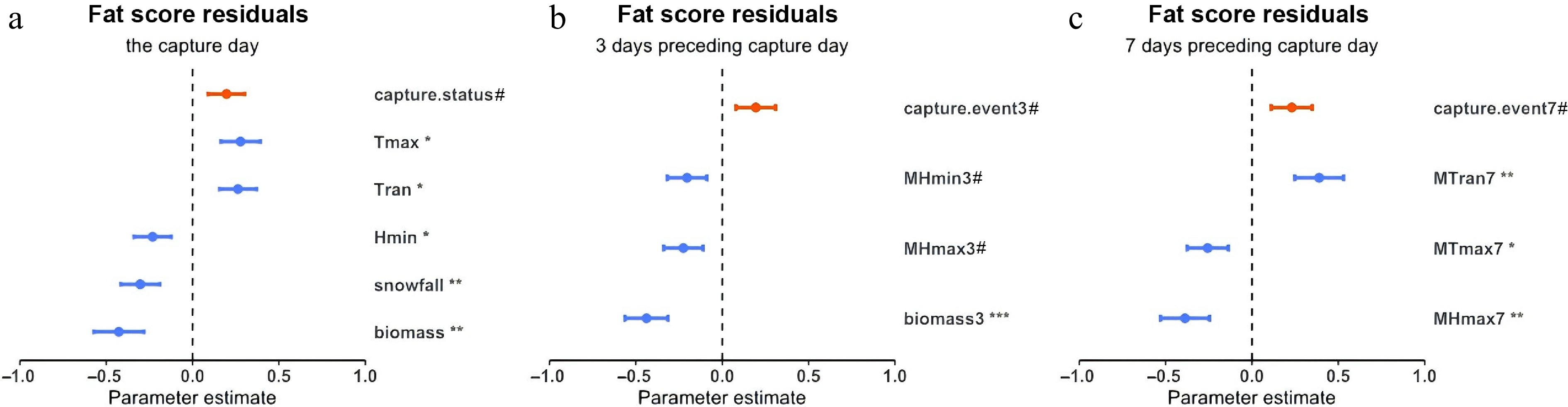
Figure 5.
Standardized regression coefficient estimates from model-averaged multiple linear regression models explaining variation in fat score residuals. Fat score residuals were obtained after removing the effect of daily capture time from fat score. The x-axis represents standardized regression coefficient estimates; positive values indicate positive associations with fat score residuals, whereas negative values indicate negative associations. Panels show models based on predictors measured on (a) the capture day, (b) the mean values during the 3-d preceding capture, and (c) the mean values during the 7-d preceding capture. Only predictors retained in the optimal model-averaged results are shown; therefore, the number of predictors differs among panels. The figure includes retained predictors regardless of whether their individual coefficients reached statistical significance. Bars represent 95% confidence intervals. Red bars indicate biotic factors, and blue bars indicate abiotic factors. Significance codes: *** p < 0.001; ** p < 0.01; * p < 0.05; p < 0.10.
For biotic factors, ground arthropod biomass generally decreased after early winter and remained low through much of midwinter, followed by a partial increase toward late winter (Fig. 4c). Ground arthropod biomass, sex, and capture status were then considered as biotic predictors of fat score residuals. Ground arthropod biomass showed significant negative effects on the capture day and in the 3-d preceding capture (Fig. 5a, b), indicating that birds stored more fat when food availability decreased. Sex showed little influence on body condition change, so no clear conclusion could be drawn from the optimal model. Meanwhile, capture status showed positive effects on fat score residuals in all models (Fig. 5a–c), indicating that individuals with previous capture histories tended to have greater fat reserves.
-
Among the sexed individuals in the overwintering population of Red-flanked Bluetails at Hutu Ranch, the overall sex ratio was male-biased, with males accounting for 59% of sexed individuals. Previous work on wintering Red-flanked Bluetails in central China also found that blue-plumaged males were rare, whereas the sex ratio among olive-brown individuals was slightly male-biased[35]. Nevertheless, because both studies were conducted at local wintering sites, these results should be interpreted as local sex-ratio and male plumage-age composition patterns rather than as evidence for a general pattern across the entire wintering range. Within this local context, the slightly male-biased sex ratio may be related to the limited morphological differentiation between the sexes. Under the 'body size hypothesis' for winter sexual segregation, morphologically similar individuals are expected to use similar habitats and experience comparable environmental conditions[36]. In our study, females and female-plumaged males differed little in most morphological traits, with only slight differences in the feather lengths of the second secondary and third primary. Although these differences may influence flight performance or thermoregulation[4,11], they are unlikely to reflect substantial ecological divergence. In addition, sex was not a significant predictor of variation in body condition, further suggesting that females and female-plumaged males experienced similar environmental pressures during winter. Therefore, the slightly male-biased sex ratio among olive-brown individuals may, at least in part, reflect the high degree of similarity between the sexes in morphology and body-condition dynamics.
In contrast, ≥ 2-year-old males accounted for a much smaller proportion of the overwintering population than first-year olive-brown males, suggesting age-related differences in population composition. One possible explanation is the potential cost of bright blue plumage, as conspicuous plumage may increase detectability, although whether this consistently results in higher predation risk remains unresolved[35]. Age-related physiological decline may also contribute by reducing locomotor performance and predator evasion ability[37,38]. In addition, age-related habitat segregation cannot be excluded, with individuals of different age classes potentially occupying different habitats because of differences in social status, experience, or tolerance of environmental conditions, thereby alleviating intraspecific competition during the non-breeding season[39]. Therefore, future studies could combine coordinated surveys across multiple wintering sites with analyses of microhabitat characteristics, food availability, and individual age to better evaluate these patterns and assess the factors shaping age and sex structure in overwintering Red-flanked Bluetails. In addition, future work could record covert feather characteristics and upper mandible coloration, while also incorporating reflectance spectroscopy to detect hidden differences among externally similar individuals[40], thereby further improving our understanding of these patterns.
Abiotic factors drive scale-dependent variation in winter fat reserves
-
Based on mist-netting and ringing conducted throughout the winter, our results suggest that variation in fat score was associated with several local abiotic factors, including temperature, humidity, and snowfall events. Temperature showed scale-dependent associations with fat reserves. On the day of capture, higher maximum temperature may indicate more favorable short-term conditions under which birds were able to maintain higher fat reserves. However, in the model of the 7-d preceding capture, the effect of MTmax reversed, and birds tended to have lower fat reserves during warmer periods. Mean temperature range (MTran), which reflects temperature variability over a given period, was positively associated with fat score residuals, suggesting that birds tended to maintain higher fat reserves under more variable thermal conditions. Such scale-dependent patterns likely reflect differences in the temporal dynamics of environmental effects on energy management. Previous studies have shown that small passerines can adjust fat reserves rapidly in response to short-term weather fluctuations, while longer-term conditions may influence overall energy balance and reserve regulation[10,31]. On a daily scale, warmer and more favorable weather may facilitate foraging efficiency and allow individuals to accumulate or maintain higher fat reserves. In contrast, over longer periods, sustained warmer conditions may reduce thermoregulatory demands and thus lower the need for maintaining large energy stores. This interpretation is consistent with optimal body mass theory, which predicts that birds regulate fat reserves in response to changing starvation risk and environmental conditions rather than maximizing them indiscriminately[6,7,41].
All humidity-related factors were found to have constantly negative effects on fat score residuals in all three models. This result accords with previous studies on Snow Buntings[10] and Black-capped Chickadees (Poecile atricapillus)[42]. Humid air may increase heat loss through evaporative cooling of water condensing on the body; hence, periods of higher humidity could lead to higher daily energy expenditure and lower fat reserves[42]. However, because we did not measure metabolic rate or plumage properties directly, the mechanism underlying the humidity effect cannot be resolved from the present study. At minimum, our results suggest that humidity may be an ecologically relevant, but often overlooked, correlate of winter body condition in birds inhabiting humid subtropical forests.
According to studies in North America, snowfall can be a very important predictor of birds' fat reserves, because its occurrence is usually accompanied by extreme cold weather and food limitation. Small birds in winter tended to reserve more fat under the influence of long-term snowfall[10,43]. However, the snowfall event in this study showed not only a negative effect on fat score residuals but also on capture day. This contrasting result might be explained by the much milder winter climate in the subtropical forest here. In the Dujiangyan region, snowfall events wouldn't last more than 1 week under normal circumstances. And even on snowy days, the mean daily temperature seldom falls below 0 °C; the ground and botany won't get fully covered by snow. Hence, the cold stress and starvation risk triggered by a snowfall event in Dujiangyan only showed an effect on the exact day but wouldn't last as long as the studies in high-latitude harsh winters.
Biotic factors reflect short-term food limitation and individual history effects on fat reserves
-
In this study, ground arthropod biomass, sex, and capture status were treated as biotic factors potentially associated with variation in fat reserves. Dynamic changes in ground arthropod biomass were negatively associated with fat reserves over relatively short timescales, including both the capture day and the 3-d preceding capture. This pattern suggests that Red-flanked Bluetails tended to maintain lower fat reserves when ground-active arthropod availability was relatively high, whereas they carried greater energy stores when this short-term prey index declined. Such a response is consistent with the starvation-predation trade-off framework, under which birds are not expected to increase fat reserves indiscriminately, but rather to adjust their energy stores according to current foraging conditions, starvation risk, and predation risk[12,41]. The fact that this relationship was detected only at short temporal scales further suggests that Red-flanked Bluetails may respond relatively rapidly to local variation in food resources. However, species accounts indicate that the diet of Red-flanked Bluetails remains poorly quantified but is generally thought to consist mainly of invertebrates, especially insects, with fruit and seeds also taken outside the breeding season[19,44]. Therefore, arthropod biomass captured by pitfall traps may partly overlap with the animal prey spectrum of bluetails and may reflect variation in local ground-foraging conditions. Future studies could further combine arthropod sampling, diet analysis, direct foraging observations, and explicit tests of weather–arthropod relationships to clarify how weather-driven changes in prey availability influence energy-reserve dynamics.
Sex was not retained as a significant predictor in any of the models, suggesting that no clear sex-related difference in winter fat storage was detected in the sampled Red-flanked Bluetails. However, this result should be interpreted cautiously, because the limited sample size and the low number of ≥ 2-year-old adult males may have reduced the statistical power to detect such differences. Future studies should increase sample size and achieve a more balanced representation of age and sex classes in order to assess more accurately whether winter fat reserves differ between the sexes.
By contrast, capture status showed a positive relationship with fat score residuals in all three models, indicating that individuals with a previous capture history tended to have greater fat reserves. One possible explanation is that birds perceive capture as a temporary interruption to foraging and subsequently compensate by maintaining higher energy stores. This interpretation is consistent with a previous study of Great Tits (Parus major), in which body mass increased significantly after capture, and the effect persisted for up to 1 week[45]. An alternative explanation is that previously captured individuals may have remained within the study area for longer periods, allowing them to become more familiar with local microhabitats and food patches and thereby forage more efficiently and maintain higher fat reserves. This possibility is consistent with studies of wintering passerines showing that individuals may exhibit high winter site fidelity at the territory scale[46], that winter habitat use and body condition can vary with sex, age, and body size[47], and that some individuals may have priority of access to food resources[48]. However, the present study does not demonstrate that capture itself directly caused the increase in fat reserves, and alternative explanations, such as individual differences in behavior, trappability, or habitat use, cannot be excluded.
-
The winter energy regulation of the Red-flanked Bluetail in humid subtropical forests is a system characterized by structured winter population composition and flexible regulation of fat reserves. Within this system, olive-brown individuals dominate the wintering population, whereas older males in definitive plumage are rare, and females and female-plumaged males show only limited morphological divergence. At the same time, body condition showed an overall improvement through winter, while fat reserves are dynamically adjusted in response to short-term variation in temperature, humidity, snowfall, and food availability. This flexible regulation of fat reserves represents an important ecological adaptation that allows small migratory passerines to cope with fluctuating winter conditions in a humid subtropical monsoon climate. In addition, recaptured individuals consistently exhibited higher fat reserves, indicating that capture status was associated with variation in winter body condition. Overall, these findings improve our understanding of how small passerines overwinter in subtropical forests and underscore the need to account for field-induced effects in ornithological studies. However, because the study was limited to a single site and winter, these patterns should be regarded as a local, season-specific baseline. Future multi-year and multi-site studies incorporating repeated individual sampling are needed to assess their consistency and determine how environmental variability influences energy-reserve regulation across winters.
We are grateful to all participants involved in field surveys and data collection who made this study possible. We sincerely thank Ms. Wu, Mr. Zhu, and Mr. Gou at Hutu Ranch for their assistance and logistical support during fieldwork. We also thank the Dujiangyan Station of Giant Panda National Park for permission and support for field sampling.
-
All birds were captured using mist nets and handled in accordance with the National Wildlife Conservation Law of the People’s Republic of China. Permission for field sampling was obtained from the Forestry Department of Chengdu and the Dujiangyan Station of Giant Panda National Park. Tissue collection followed protocols approved by the Animal Experimental and Medical Ethics Committee of the College of Life Sciences, Sichuan University (approval no. 20201208001).
-
The authors confirm their contributions to the paper as follows: formal analysis: He R, Peng K, Zhang J; writing − original draft: He R, Peng K, Zhang J; writing − review and editing: He R, Zhang J, Feng K, Zhang S, Wu Y; data curation: Peng K, Zheng X; investigation: Peng K, Feng K, Zhang S, Yang Z, Hu Z, Zheng X, Gou A; conceptualization, funding acquisition, project administration: Wu Y. All authors reviewed the results and approved the final version of the manuscript.
-
The data supporting the findings of this study are available from the corresponding author upon reasonable request.
-
The authors declare that they have no known competing financial interests or personal relationships that could have appeared to influence the work reported in this paper.
-
accompanies this paper online at: https://doi.org/10.48130/jzser-0026-0008.
-
# Authors contributed equally: Rui He, Kexin Peng
- Supplementary Table S1 The evaluation of ordinary least squares (OLS) regression relationship between fat mass and fat percentage with different body condition indices.
- Supplementary Table S2 Results of the principal component analysis (PCA) based on eight morphological traits of female and female-plumaged male Red-flanked Bluetails.
- Supplementary Table S3 Description of predictor variables used in the regression analyses.
- Supplementary Table S4 The summary of morphological traits of olive-brown plumaged Red-flanked Bluetails with determined sex.
- Copyright © 2026 by the author(s). Journal of Zoological Systematics and Evolutionary Research published by Maximum Academic Press on behalf of John Wiley & Sons Ltd. This is an open access article under the terms of the Creative Commons Attribution License, which permits use, distribution and reproduction in any medium, provided the original work is properly cited.
-
About this article
Cite this article
He R, Peng K, Zhang J, Feng K, Zhang S, et al. 2026. Sex ratio and short-term regulation of energy reserves in wintering Red-flanked Bluetails (Tarsiger cyanurus) in Southwest China. Journal of Zoological Systematics and Evolutionary Research 2026: e011 doi: 10.48130/jzser-0026-0008 

Sex ratio and short-term regulation of energy reserves in wintering Red-flanked Bluetails (Tarsiger cyanurus) in Southwest China
- Received: 20 May 2026
- Revised: 13 July 2026
- Accepted: 04 August 2026
- Published online: 14 September 2026
Journal of Zoological Systematics and Evolutionary Research
2026,
Article number: e011 (2026)
|
Cite this article
Abstract: Wintering conditions strongly influence the survival and subsequent reproductive performance of long-distance migratory birds, yet winter energy management in humid subtropical regions remains poorly understood. We investigated the winter sex ratio and short-term regulation of energy reserves in the Red-flanked Bluetail (Tarsiger cyanurus), a sexually dimorphic migratory passerine with delayed plumage maturation, in Dujiangyan, Southwestern China. From November 2022 to March 2023, we combined mist-netting, morphological measurements, molecular sexing, body-condition validation, and analyses of abiotic and biotic correlates of fat reserves. We recorded 94 capture events, including 61 initial captures and 33 recaptures. Among 49 sexed individuals, females accounted for 41% and males for 59%, with most males being olive-brown yearlings and only a few showing blue adult plumage. Females and female-plumaged males exhibited limited morphological divergence. Among candidate body-condition indices, the ratio of body mass to bill length plus tarsus length best reflected fat reserves. Body mass and fat score showed overall positive associations with ordinal day, and stage-wise comparisons indicated that fat scores were higher in late winter than in prewinter and early winter. Fat reserves were associated with multiple environmental factors: humidity showed a consistently negative relationship, snowfall had a short-term negative effect, and temperature showed scale-dependent effects, with positive associations on the capture day but negative associations over longer (7-d) timescales. Ground arthropod biomass was negatively associated with fat reserves over short timescales, while recaptured individuals consistently showed higher fat reserves than non-recaptured individuals. These findings suggest that Red-flanked Bluetails flexibly adjust winter fat storage in response to environmental variation and provide a local baseline for understanding energy-reserve regulation in wintering small passerines in subtropical forests.
-
Key words:
- Tarsiger cyanurus /
- Fat reserves /
- Sex ratio /
- Environmental variation /
- Humid subtropical forests