











-
The contribution of the gut microbiota to colorectal cancer (CRC) is increasingly supported by both epidemiological and mechanistic studies. However, for many cancer-associated microorganisms, causal mechanisms remain incompletely defined[1−5]. ETBF is one of the most mechanistically tractable examples because its pathogenic effects depend largely on BFT, also known as fragilysin[6]. BFT induces E-cadherin cleavage, epithelial barrier disruption, β-catenin activation, and inflammatory responses, including tumor-promoting Th17 immunity[6−8]. Yet the initiating event of intoxication-how BFT recognizes epithelial cells and gains access to E-cadherin has remained elusive. Previous studies of other bacterial toxins have demonstrated that specific host receptors can determine toxin recognition and cellular targeting, thereby shaping downstream toxin activity. For example, Clostridium perfringens enterotoxin (CPE) binds claudin-3 and claudin-4 to disrupt epithelial integrity through pore formation, whereas Clostridioides difficile toxin B (TcdB) utilizes frizzled receptors (FZD), particularly FZD1, FZD2, and FZD7, to mediate toxin recognition and activity in colonic epithelial cells[9,10]. Together, these examples underscore host-receptor engagement as a key determinant of bacterial toxin specificity and action, highlighting the importance of identifying the epithelial receptor that directs BFT targeting.
White & Wang et al.[11] have solved this enduring question by identifying claudin-4 as the primary receptor for BFT. Using an elegant genome-wide CRISPR knockout screen based on preservation of surface E-cadherin rather than conventional cell survival, the authors identified claudin-4 as the dominant determinant of BFT sensitivity. Genetic disruption of claudin-4 markedly reduced toxin binding, E-cadherin cleavage, epithelial barrier disruption, and cellular intoxication, whereas re-expression restored susceptibility. These findings shift the field from viewing BFT toxicity as a poorly understood host-pathogen interaction to a mechanistically defined process initiated by claudin-4-mediated toxin recognition (Fig. 1).
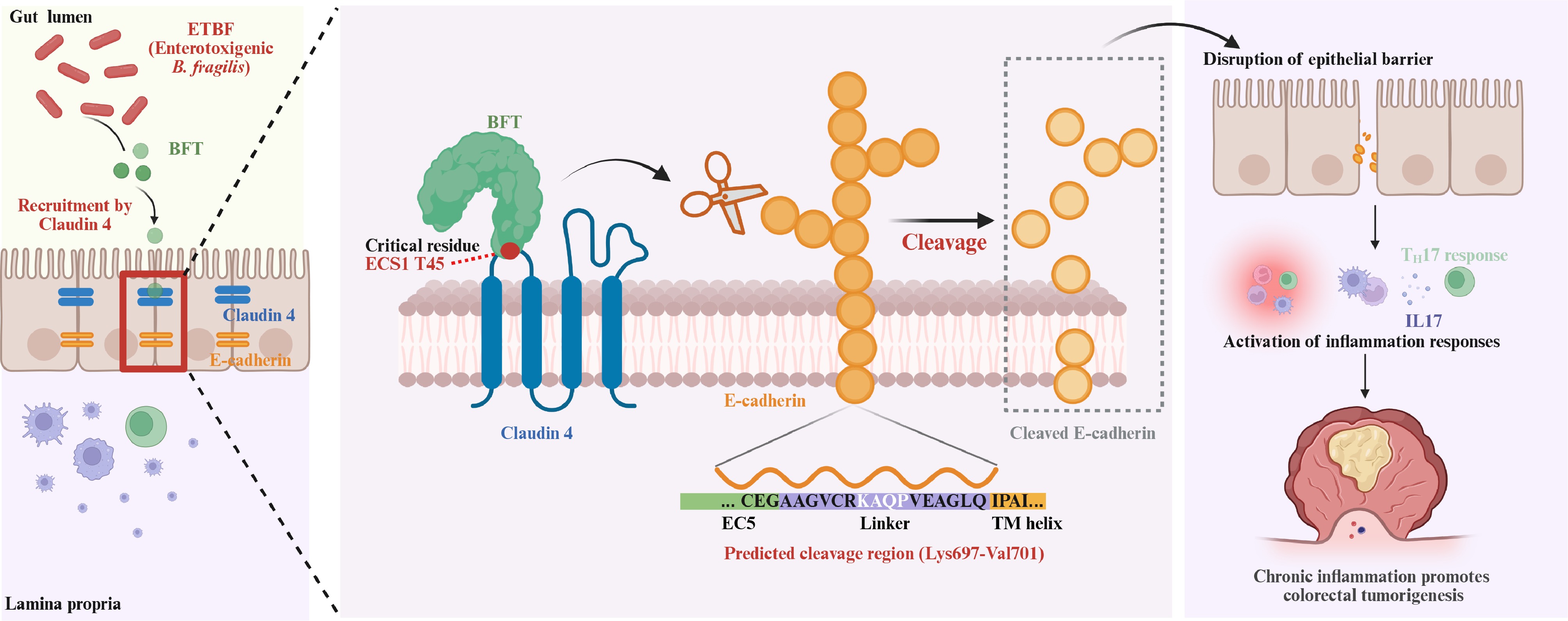
Figure 1.
Schematic diagram of BFT-claudin-4-mediated epithelial barrier disruption. Enterotoxigenic Bacteroides fragilis (ETBF) secretes B. fragilis toxin (BFT) into the gut lumen. BFT is recruited to colonic epithelial cells through binding to claudin-4 (CLDN4), a tight junction protein. The extracellular region of CLDN4 mediates toxin recognition, with residue T45 within ECS1 acting as a critical determinant for stable BFT binding. Upon CLDN4 engagement, BFT, a metalloprotease, is then positioned near membrane-associated E-cadherin and cleaves its extracellular domain. AlphaFold 3-based modelling predicts that the E-cadherin membrane-proximal linker region, particularly residues Lys697-Val701 near the extracellular domain 5-transmembrane helix junction, is threaded into the BFT active site. Cleavage of E-cadherin disrupts adherens junction integrity, weakens the epithelial barrier, and promotes inflammatory responses, including Th17-associated cytokine signaling. Sustained epithelial barrier damage and inflammation may ultimately contribute to colorectal tumorigenesis (created with
BioRender.com ).An important nuance is that claudin-4 functions as the principal receptor, whereas claudin-3 appears to serve as a lower-affinity auxiliary receptor. Although claudin-3 contributed modestly to toxin responsiveness, combined loss of claudin-4 and claudin-3 produced substantially greater resistance than the lack of claudin-4 alone. While receptor redundancy may enhance toxin robustness, the clear functional hierarchy is centered on claudin-4.
-
The most important conceptual advance of this study is not merely the identification of a toxin receptor, but the discovery of a receptor-guided mechanism of bacterial proteolysis. Claudin-4 functions not simply as a docking site for BFT but as a spatial organizer that enables productive cleavage of E-cadherin at the epithelial cell surface[11].
Several observations support this model. BFT failed to bind stably to claudin-4-deficient cells, whereas re-expression of claudin-4 restored toxin binding. More importantly, E-cadherin expression alone was insufficient to support efficient BFT-mediated proteolysis. Only when claudin-4 was co-expressed did robust E-cadherin cleavage occur. Thus, substrate availability alone cannot explain toxin activity. Instead, BFT requires a receptor-defined membrane environment that positions its catalytic domain in proximity to the membrane-proximal E-cadherin cleavage site.
This study helps resolve a key paradox in the field. Although BFT shares structural similarity with mammalian ADAM-family metalloproteases[12], previous studies struggled to demonstrate efficient cleavage of isolated E-cadherin by BFT[8,13]. The current work suggests that BFT behaves less like a freely diffusible protease and more like a receptor-guided bacterial sheddase, a protease that cleaves cell-surface proteins in a spatially restricted manner, whose activity is spatially controlled by host-cell receptors. In this regard, claudin-4 serves as a microbial docking platform that converts BFT from a soluble bacterial protease into a highly localized epithelial junction disruptor.
This study further provides mechanistic insights into receptor specificity. Mutational analyses identified threonine-45 within the first extracellular segment of claudin-4 as a critical determinant of toxin binding and activity. Together with AlphaFold-based structural modelling, these findings suggest a specific receptor-toxin interface that may ultimately be exploited for therapeutic intervention[11,14]. More broadly, this work raises the possibility that receptor-guided proteolysis may represent a general strategy employed by microbial proteases to achieve substrate selectivity within complex host environments.
-
Identification of claudin-4 as a functional receptor raises the possibility of targeting toxin-receptor engagement rather than metalloprotease activity itself. This is therapeutically attractive because broad metalloprotease inhibitors can interfere with host proteases and have historically faced toxicity and selectivity challenges[15]. By contrast, disrupting the BFT-claudin-4 interaction may provide a more selective anti-toxin strategy.
White & Wang et al.[11] provide compelling proof-of-principle evidence for this strategy using a soluble claudin-4 analogue CLN4sol as a decoy receptor. CLN4sol blocked BFT-mediated E-cadherin degradation in epithelial cells and attenuated epithelial injury in a mouse caecal injection model. These findings establish the BFT-claudin-4 interface as a potentially druggable host-pathogen interaction.
Importantly, receptor blockade represents a fundamentally different therapeutic philosophy from conventional antimicrobial approaches. Rather than eliminating ETBF and potentially disrupting the broader intestinal microbiota, targeting BFT-claudin-4 interactions would selectively suppress a disease-promoting virulence mechanism. Such anti-virulence approaches are increasingly attractive because they may impose less selective pressure for antimicrobial resistance while preserving microbial ecosystem stability.
Nevertheless, several translational challenges remain. First, the in vivo model tests acute toxin injury rather than chronic ETBF colonization or ETBF-driven tumorigenesis. Second, a claudin-based decoy would need to remain stable in the intestinal lumen and reach sufficient local concentrations at the epithelial surface. Finally, since claudins regulate epithelial barrier architecture, therapeutic blockade must prevent toxin binding without perturbing physiological functions of claudins[16].
A key safety consideration is that claudin-4 is not restricted to the intestinal epithelium. In the lung, claudin-4 contributes to alveolar epithelial barrier function and fluid homeostasis[17]. Although claudin-4 knockout mice show surprisingly normal development, they exhibit increased susceptibility to lung injury[18]. Consistently, claudin-4 is induced during acute lung injury and has been associated with preserved alveolar fluid clearance in human lungs[19]. These findings suggest that systemic claudin-4 blockade could carry pulmonary safety risks, particularly under inflammatory or mechanical stress conditions. Therefore, future BFT-claudin-4-targeted therapies should ideally be designed as intestine-restricted, luminally acting agents that neutralize toxin binding without broadly disrupting claudin-4 function in extra-intestinal tissues.
-
This study opens several important directions. A major priority is to determine how receptor-guided proteolysis operates under physiological conditions and whether its spatial constraints help explain inter-individual differences in susceptibility to ETBF-associated disease. E-cadherin is most accessible at adherens junctions and the basolateral membrane, whereas the apical-to-lateral access of ETBF is hampered. How apically secreted BFT accesses E-cadherin remains unresolved. Local tight junction defects, epithelial cell extrusion sites, or deeper mucosal bacterial niches may create routes for toxin exposure, but this requires direct visualization in physiologically colonized tissues. This spatial mismatch may also provide a framework for understanding why ETBF colonization does not uniformly translate into disease. ETBF is detected in a substantial proportion of healthy individuals, yet only a subset develops colorectal neoplasia. A possible explanation is that BFT exposure alone is insufficient and must coincide with a permissive epithelial condition in which claudin-4 is accessible and barrier integrity is compromised. Disease susceptibility may therefore reflect the convergence of microbial toxin exposure with a permissive host and ecological context, shaped by claudin-4 abundance and accessibility, epithelial barrier status, host genetics and immunity, and the surrounding microbial community. Elucidating why the same ETBF colonization leads to different disease outcomes across individuals may be critical for identifying susceptible populations and advancing the precision application of BFT-claudin-4-targeted therapies.
Beyond this physiological question, the molecular architecture of the receptor and substrate interactions remains incompletely defined. The predicted BFT-claudin-4 interface does not fully explain the functional importance of residues such as T45, while the partial compensatory activity of claudin-3 raises the possibility that additional claudins or co-receptors contribute to toxin recognition under specific physiological or pathological conditions[11,16]. High-resolution structural studies, proximity labeling, and systematic genetic screens may help define the full receptor complex. A related question is whether E-cadherin is the only physiological substrate of BFT. Although the Lys697-Ala703 peptide result supports E-cadherin as a direct substrate, the inability of membrane-proximal linker mutations to completely abolish cleavage suggests that BFT may tolerate alternative local sequences or secondary substrates[11]. If claudin binding positions BFT as a bacterial analogue of a membrane sheddase, other junctional or signaling proteins could be cleaved and contribute to inflammation or tumorigenesis.
These mechanistic questions ultimately converge on the need for validation in human tissues and chronic disease models. Most mechanistic evidence currently derives from transformed epithelial cell lines and in vitro experimental systems. Whether the claudin-4-BFT interaction observed in transformed epithelial cell lines faithfully reflects toxin recognition in the human colon is unknown. Direct visualization of native BFT-claudin-4-E-cadherin complexes in situ, ideally across normal, inflamed, and neoplastic intestinal tissues, would provide a critical next step toward validating the receptor-guided proteolysis model in human disease.
In conclusion, White & Wang et al.[11] identify claudin-4 as the previously unknown receptor for BFT and establish a receptor-guided mechanism of bacterial proteolysis linking microbial toxin recognition to epithelial barrier disruption and pro-carcinogenic inflammation. Beyond resolving a central question in ETBF biology, this work provides a conceptual framework for understanding how microbial proteases achieve substrate specificity in host tissues. From a therapeutic standpoint, disrupting specific toxin-host receptor interactions offers an anti-virulence strategy that may neutralize pathogenic activity without broadly eliminating commensal microorganisms or inhibiting physiologically important host proteases. More broadly, analogous receptor-dependent mechanisms may extend beyond BFT to other microbiota-derived proteases and secreted effectors. Defining such effector-receptor relationships may help explain why the same microorganism can coexist harmlessly with some hosts yet contribute to disease in others, with implications extending across the broader host-microbiota field.
-
Not applicable.
-
The authors confirm their contributions to the paper as follows: study conception, manuscript revision, and supervision: Luo Y, Gonzalez FJ; draft manuscript preparation, figure creation: Tong D, Zheng W. All authors reviewed the results and approved the final version of the manuscript.
-
Data sharing is not applicable to this commentary, as no datasets were generated or analyzed.
-
The authors declare that they have no conflict of interest. The contribution of the NIH author was made as part of his official duties as an NIH federal employee, is in compliance with agency policy requirements, and is considered a work of the United States Government. However, the findings and conclusions presented in this paper are those of the author and do not necessarily reflect the views of the NIH or the US Department of Health and Human Services.
-
#Authors contributed equally: Danni Tong, Weiwei Zheng
- Copyright: © 2026 by the author(s). Published by Maximum Academic Press on behalf of China Pharmaceutical University. This article is an open access article distributed under Creative Commons Attribution License (CC BY 4.0), visit https://creativecommons.org/licenses/by/4.0/.
-
About this article
Cite this article
Tong D, Zheng W, Gonzalez FJ, Luo Y. 2026. Receptor-guided proteolysis at the host-gut microbiota interface: insights from the Bacteroides fragilis toxin-claudin-4 axis. Targetome 2(5): e046 doi: 10.48130/targetome-0026-0046 

Receptor-guided proteolysis at the host-gut microbiota interface: insights from the Bacteroides fragilis toxin-claudin-4 axis
- Received: 26 June 2026
- Revised: 20 August 2026
- Accepted: 27 August 2026
- Published online: 14 September 2026
Abstract: Enterotoxigenic Bacteroides fragilis (ETBF) is a colorectal cancer-associated bacterium whose pathogenicity depends largely on B. fragilis toxin (BFT), a secreted metalloprotease that cleaves E-cadherin and disrupts epithelial barrier integrity. Despite decades of investigation, the epithelial receptor for BFT has remained unknown. White & Wang et al. recently identified claudin-4 as the long-sought receptor for BFT and demonstrated that claudin-4 binding enables BFT-mediated cleavage of cell-surface E-cadherin. This work establishes a receptor-guided bacterial proteolysis mechanism linking toxin recognition, epithelial junctional injury, and pro-carcinogenic inflammation. Importantly, a soluble claudin-4 analogue attenuates BFT-induced epithelial damage in vitro and in vivo, highlighting the therapeutic potential of targeting host-pathogen interactions rather than bacterial viability itself. Nevertheless, how luminal BFT accesses basolateral junctions, whether additional receptor components participate in toxin recognition, and how the BFT-claudin-4 axis contributes to chronic ETBF-associated tumorigenesis remain unresolved. Addressing these questions may facilitate the development of precision anti-virulence therapies for ETBF-mediated diarrheal disease, sepsis, and colorectal cancer.