











-
Over 7,500 named varieties of apples (Malus × domestica Borkh.) are recognized, most growing in temperate regions of the world[1]. Fruit production is highly dependent on blooming time, an integrated physiological output of environmental signals and highly heritable genetic cues[2]. One of the major limitations to wider apple cultivation in tropical or subtropical (T-ST) locales is the lack of chilling hours, defined loosely as the hours of cumulative time spent at 0–7.2 °C. Most commercial apple varieties require over 800 h of chilling before they proceed to breaking dormancy, resuming vegetative growth, and advancing to flowering.
Nevertheless, a suite of varieties has been identified that emerge from dormancy earlier in the spring, some after as few as 50 chilling hours. Genetic control of this response is of interest for several reasons. The apple is a prized fruit, and tropical cultivation has opened new industries in several equatorial countries, where businesses like Tamu Tamu Tanzania (
www.tamutamutanzania.com ) produce apple trees to drive local production of fresh fruit and added-value products in equatorial Africa. Countries in more moderate T-ST climates benefit from apple as a high-value crop, as demonstrated by the breeding programs in Israel that have defined the core of the low-chill apple germplasm. Trials throughout the 1960s to 1980s attempted to spur an industry in Florida, USA[3], and current efforts progress in the heat of southern California.Other opportunities have emerged with the wider popularity of farmers' markets and specialty stores. There is tremendous flavor and color variation that is not represented in commercial germplasm, mostly because retail varieties must exceed expectations for disease tolerance, size, shipping, and storage, rather than flavor and aroma. Small farms, direct-to-consumer sales, and U-picks in warmer temperate or subtropical regions may benefit from a widened set of varieties that bring novel flavors, colors, and aromas in the form of a familiar fruit.
The purpose of this review is to rekindle awareness in low-chill apple genetics as a tool to deal with both potential crises and opportunities, as well as to consolidate a reference for the current state of the molecular mechanisms that underlie control of the low-chill response (LCR). The goal is to re-seed interest in the development of new varieties to meet future growers' needs and consumer demands. In the industrialized world, large farms can find benefit in diversification, while small farms realize the demand for consumer-direct sales of noncommodity variations of popular produce. In the developing world, farmers seek reliable crops for cultivation, with opportunities in value-added products. All of this is happening against a backdrop of shifting climate patterns, along with their coincident challenges in pest and pathogen spread. It is an appropriate juncture to revisit the current state of T-ST production, and the varieties and molecular mechanisms that may be the foundation of future elite cultivars.
-
It is important to draw a distinction between dormancy and vernalization. Dormancy is the cold and photoperiod-induced state of growth arrest, where all organs and primordia are in place but not growing. Exposure to cold temperatures leads to decreased cell division, differentiation and elongation inhibitors, leading to cessation of seasonal growth. Vernalization is a program of meristematic differentiation, where cold accumulation connects with genetic factors to remodel the plastic cells of the meristem to shift from vegetative primordia to floral structures when appropriate.
In woody perennials, budbreak releases the year's vegetative growth and the flowers that will lead to fruit production. Seasonal dormancy may be broken into two distinct phases, endodormancy and ecodormancy, which proceed according to the combination of the prevailing environmental conditions and genetics. Endodormancy is defined as temporary phase of meristematic growth cessation and lower physiological activity in response to decreased photoperiod and temperature[4]. This state is an adaptive response important for survival through the cold and freezing temperatures of winter. This phase of dormancy is established in autumn, as days become shorter and temperatures trend cooler. In apples, endodormancy is driven primarily by temperature as opposed to photoperiod, another seasonal cue[5]. Endodormancy is maintained epigenetically by the repressive activity of proteins that remodel chromatin, limiting the expression of proteins that activate the genes associated with budbreak. In apple, these genes are typically involved in hormone metabolism or signaling, lipid composition, and redox state, among others[6]. The molecular mechanisms will be discussed later in this work. Endodormancy depth is controlled by a combination of factors, genetic, environmental, and physiological. Apple dormancy has been described as shallow/light, intermediate, or deep dormancy, which correlate with their chilling requirements prior to budbreak. Light dormancy cultivars like 'Anna' or 'Castel Gala' show limited bud growth arrest during winter[7,8].
Satisfaction of the chilling requirement of endodormancy boosts the expression of genes associated with budbreak and flowering, leading to a state of dormancy known as ecodormancy. Ecodormancy is a state where the buds are competent to advance, yet require an environmental cue to spring forward. Specifically, buds interpret ambient temperature in terms of heat units, accumulating prompts of warmer weather that excite the hormone and metabolic pathways leading to budbreak. Any genetic factors that decrease the constraints of endodormancy or ecodormancy could advance the time of budbreak.
The timing of dormancy release is critical in warmer production regions. In areas with occasional freezes, an early budbreak may lead to loss of flowers and young fruits after an especially cold springtime night below freezing. At the same time, a late flowering time may push fruit development into summer heat, which can negatively affect fruit quality or tree health in some cultivars. In either case, inappropriate flowering may evade synchrony with pollinators or cross-pollinating trees, so precise timing of dormancy release is critical to production.
-
An understanding of the genetics and mechanisms responsible for control of apple's LCR will become increasingly relevant as climate change decreases the cumulative chilling hours in apple-growing regions[9]. Apple orchards are a long-term investment that remain in production for about 25 years[10]. Changes in chilling hours impact established orchards. For instance, Oukabli et al. charted the number of hours below 7.2 °C at the apple-growing Institut National de la Recherche Agronomique (INRA), Regional Agricultural Research Center of Meknes, Morocco[11]. The trendline clearly showed mean chilling hours changing from approximately 1,000 to about 600 from 1969 to 1999, with extremes from 1,150 h in 1972 and 280 in 1995. Warmer springs in some growing regions induce early budbreak (e.g., in 2013–2016) only to have the flowers and young fruit destroyed by late spring freezes in places like New York State or Austria[12−14]. Other instances of warmer temperatures challenging apple production have been noted[15,16].
Aside from effects on endodormancy and ecodormancy, increased temperatures affect fruit set and fruit size[15,17,18]. Sugiura et al.[19] examined records that measured acids, soluble solids, firmness, and watercore incidence in 'Fuji' and 'Tsugaru' apples in Japan from the 1970s to 2010. In addition to higher temperatures, the associated increases in carbon dioxide levels also may affect apple quality through changes in respiration[15,20]. The results clearly showed that changes in temperature correlated with flavor differences and texture of the fruit. Warming climates increase insect and disease pressure, competition with weeds, summer heat stress, and extremes in drought or rainfall[13]. It was also noted that although the number of frost/freeze days are declining, warmer winters can spur earlier flowering during a time when frost can still occur, injuring young fruits and flowers[17].
Inadequate chilling compromises both vegetative and floral budbreak, with longer periods of flowering and uneven fruit set[21], along with lower yields and increased disease presentation[22,23]. In many areas of the world, challenges to cultivation have forced production regions to higher altitudes, higher latitudes, or localized microclimates to attain favorable chilling conditions[22−24]. Korean apple orchards have been shifting to higher elevations or planting heat-tolerant cultivars, as warmer temperatures are affecting fruit set through poor pollen germination or pollen tube elongation[25].
In other cases, apple farmers have completely abandoned the crop, switching instead to peaches (Prunus persica), as in the Kazuno City region of Japan, or other horticultural crops, as in India[22,26]. As climates continue to warm and temperate regions achieve fewer chill hours, low-chill apple germplasm may become a valuable source of genetics to integrate into future breeding efforts.
-
There is increasing evidence of LCR apple production in tropical regions. 'Tropical' cultivation refers to plantings between the Tropic of Cancer (23.5° N) and the Tropic of Capricorn (23.5° S). The term 'subtropical' is less well defined, but generally refers to the range between the tropics and 35° north or south, or as discussed by Lyrene[27], a region 'colder than the tropics but warmer than the temperate zone.' Literature review and internet searches for this work revealed sources indicating significant interest in tropical/subtropical apple cultivation in places including Pakistan, India, Madagascar, Morocco, Ethiopia, Egypt, Nigeria, Uganda, Tanzania, South Africa, Brazil, Mexico, Chile, Argentina, New Zealand and Australia. Several of these areas cultivate apples in highland regions to find sufficient chilling temperatures[28].
Several varieties have shown evidence of T-ST success, such as 'Anabela' in Brazil[29], 'Afri Blush' and 'Afri Coral' in South Africa[30], 'Cripps Red' in Australia[31], and 'Dorsett Golden', originally identified in the Bahamas[3]. Some of the low-chill cultivars originally bred in a specific region perform well in other countries, such as the 'Fuji' apple developed in Japan in 1930s that performs well in India[32]. A sport of 'Gala' known as 'Castel Gala' broke buds in response to few chilling hours, relative to 'Royal Gala', a standard chill variety[33]. In tropical, semi-arid regions of Brazil, the cultivar 'Eva' can produce in approximately 130 d if not allowed to enter endodormancy[34]. Areas of Indonesia produce apples on almost 3,000 ha[35]. The variety 'HRMN-99' is productive in low-chill areas of India, and has potential to drive new economic opportunities in places like Nepal[36].
'Anna' has been a standard for apples grown in tropical and subtropical regions. This cultivar is grown in Colombia at elevation, still with minimal chill. These trees are managed to sidestep endodormancy by restricting water, defoliating leaves, and tying down branches. The trees are induced into two harvest cycles per year, and continuous production has been noted, especially with the use of budbreaking treatments[37].
-
There is a reasonable argument against the need to cultivate T-ST apples. The best commercial varieties are bred for long-term storage and may be produced in temperate areas that lack T-ST challenges like heat, drought, and a variety of unrelenting pests and pathogens[35,38,39]. T-ST production also faces the hurdles of local preferences for other traditional fruit crops that are exclusive to T-ST areas, and face limited logistical export access to high apple consumption areas. However, there is substantial opportunity for T-ST adaptation, including production for local markets, and even some counter-seasonal production[27].
In lowland T-ST environments, apple varieties from higher latitudes have problems associated with shallow dormancy, late or erratic budbreak; issues with fertility; and aberrant floral bud development[11]. In times of inadequate chilling, reproductive spurs emerge as vegetative shoots in many varieties including 'Golden Delicious' and 'Starking Delicious'[11], leading to lower yields. Low-latitude areas are also prone to sporadic rainfall patterns that require cultivars that can survive both periods of drought and water-saturated soils, yet this is mostly a requirement for pairing resilient, resistant scions with appropriate rootstocks[40]. Attempts were made to develop LCR apple cultivation in places like Florida starting in 1966, with over 2,000 trees planted in the Miami area[3], yet disease pressures, pests, and summer heat proved to limit a viable commercial enterprise.
The disease and pest challenges of the T-ST environment have been a priority for many breeding programs. For the most part, they are the same as those affecting temperate apple production, only amplified by heat, humidity, and the susceptibility of trees to the associated stresses. The primary issue is fire blight (Erwinia amylovora), a bacterial disease of rosaceous pome fruits that has led to efforts to develop molecular markers that correlate with resistance/tolerance for variety improvement[41].
One of the other main drawbacks of LCR apples in T-ST areas are related to ethylene. One issue is preharvest fruit drop, which leads producers to harvest smaller, unripe apples or incorporate treatments that inhibit ethylene synthesis[42]. 'Anna' apples have been noted for poor coloration in some regions, which then may be induced by the use of ethephon to enhance ethylene production[43]. However, ethylene also has been shown to induce fruit drop, so foliar applications of ethylene inhibitors like Aminoethoxyvinylglycine (AVG) are used to retain fruit. Postharvest, 'Anna' has been shown to deteriorate faster than most commercial apples. Ethylene inhibitors[44], chitosan, salicylate and antioxidants[45], calcium, and heat[46] have been used to increase the postharvest firmness of 'Anna' under T-ST conditions. Anecdotal notes on nursery websites indicate that if one 'Anna' apple decays, then all others rapidly decay as well, in line with published research.
The problem for T-ST variety improvement is that traditional breeding takes time. Low yield, loss of flavor, and decreased pest resistance are the other challenges which can result with traditional breeding methods aiming to develop cultivars with the optimum chilling hour requirements for specific regions[47]. Although the current low-chill apple cultivars are acceptable for low-chill environments, genetic improvement will require an understanding of the molecular mechanisms that contribute to the response[48]. There is a significant body of literature that describes molecular and hormonal control of the dormancy and vernalization responses in the Rosaceae family and in apple itself. These pathways define a broad slate of gene candidates that likely contribute to the LCR response.
-
Some low-chill apples have been described in the peer-reviewed literature or detailed in published cultivar releases. However, the vast majority predate such formalities. Information may be gleaned from online sources, primarily from nursery information and growers' experience. For the purposes of this review, the best consensus of information is reported, with the caveat that it is not always validated by experimental evidence and peer review. It also is important to note that many of these varieties predate availability of applied chemical crop protection strategies, so they were inadvertently selected for durable disease resistance, making them attractive for contemporary production and breeding efforts. Table 1 lists a subset of the varieties recognized for LCR, where information about their pedigree and development is available. Table 2 lists a set of popular cultivars with a slightly higher chilling requirements.
Table 1. Varieties described as 'ultra-low chill' (300 chilling hours minimum or fewer).
Genotype Origin Parental lines Susceptibilities Estimated chilling hours 'Anna' Israel 'Red Hadassiya' × 'Golden Delicious' U 250–300 'Beverly Hills' USA 'Melba' × 'Early McIntosh' F, PM 300 'Big River' USA Unknown U 250–400 'Dorsett Golden' Bahamas Seedling U 250–300 'Ein Shemer' Israel 'Zabidani' × 'Golden Delicious' U 200–300 'Elsa Sweet' USA Unknown U 200–300 'HRMN-99' India Seedling U *Unknown 'Julieta' Brazil 'Anna' × 'Mollie's Delicious' U 300–450 'Joy's Apple' USA Unknown U 200–300 'Lady Williams' Australia 'Rokewood' × 'Granny Smith' PM, S 200–300 'Pettingill' USA Seedling U 300 'Shell of Alabama' USA Seedling U 200-400 'Tropical Beauty' South Africa Seedling U 100 'Tropic Sweet' USA 'NJ38' × 'Anna' S 300–400 'Vered' Israel 'Calville St. Sauveur' × unnamed local seedling F, S, PM 100–200 'Winter Banana' USA Seedling CAR, S 300–400 Winter Cox' USA Unknown U 250–300 CAR, cedar apple rust; F, fire blight; PM, powdery mildew; S, scab; U, unknown; * While the estimated chilling hour range is unknown, the cultivar has been successfully grown in low-chill areas of the country (500 chilling hours or fewer). Table 2. Apples reported to break dormancy in response to 300–500 chilling hours.
Apple name Place of origin Apple origins Susceptibilities Estimate range of chilling hours 'Caricia' Brazil 'Anna' × 'Prima' U 350–450 'Chenango Strawberry' USA Seedling F 400 'Cripps Pink' Australia 'Golden Delicious' × 'Lady Williams' CAR, F, PM, S 400–500 'Cripps Red' Australia 'Golden Delicious' × 'Lady Williams' F, PM, S 400–500 'Cauley' USA Seedling F 400–500 'Eva' Brazil 'Anna' × 'Gala' U 330–350 'Fuji' Japan 'Red Delicious' × 'Ralls Janet' CAR, F 400–500 'Gala' New Zealand 'Kidd's Orange Red' × 'Golden Delicious' C, CAR, F, PM, S 400–500 'Gordon' USA Seedling U 400 'Granny Smith' Australia Seedling F, PM, S 400–500 'Hawaii' USA 'Golden Delicious' × 'Gravenstein' S *Unknown 'Maayan' Israel ('Calville St. Sauveur' × 'Damascus') × 'Delicious' U 450 'Michal' Israel ('Calville St. Sauveur' × 'Damascus') × 'Delicious' U 425 'Mollie's Delicious' USA ('Golden Delicious' × 'Edgewood') × ('Red Gravenstein' × 'Close') C 450–500 'Princesa' Brazil 'NJ56' × 'Anna' U 350–450 'Red Astrachan' Russia Seedling C, S *Unknown 'Reverend Morgan' USA Seedling U *Unknown 'San Jacinto' USA Seedling U *Unknown 'Summer Champion' USA Seedling CAR, S *Unknown 'White Winter Pearmain' USA Seedling S 400 C, canker; CAR, cedar apple rust; F, fire blight; PM, powdery mildew; S, scab; U, unknown; * While the estimated chilling hour range is unknown, the cultivar has been successfully grown in low-chill areas of the country (500 chilling hours or fewer). -
Extensive breeding efforts of low-chill apple cultivars ran throughout the early 1900s in Israel, selecting for trees that produced in its low-chill Mediterranean climate. Abba Stein was a prolific apple breeder at Kibbutz Ein Shemer in Doar Na Shomron, Israel, who prioritized low chilling requirements and heat tolerance in his selections. His most well-known cultivar, 'Anna', resulted from a cross between 'Red Hadassiya' and 'Golden Delicious'[49], and was released in 1956. Anna's low chilling requirement of 250–300 h makes it attractive for growth in the subtropics and tropical regions[37]. 'Anna' also produces in June–July in the northern hemisphere, setting fruit before the summer heat and intense sun.
'Cauley'
-
An esteemed southern apple, 'Cauley' was rediscovered in 1919 on the property of John Cauley near Grenada, Mississippi, though records suggest it was known as 'Colley' as early as 1860. Trees bloom late and develop abundant fruit spurs, with limbs that bend but rarely break under heavy crops. The large to very large fruit (often over 0.5 kg) ranges from light green or yellow with a red blush to nearly solid red, with crisp, slightly yellow flesh of mild, subacid flavor. It is resistant to scab and bitter rot, and increasingly tolerant of fire blight with age. The apple is prized for its fresh eating, cooking, drying, and shipping qualities. Harvest comes in late summer, typically from August into September, making it a standout for warm southern orchards.
'Dorsett Golden' (Golden Dorsett)
-
The popular origin story suggests that this apple tree grew from a chance seedling planted by Mrs. Irene Dorsett of Nassau, New Providence Island, in the Bahamas[3]. She allegedly planted the seeds from a 'Golden Delicious' apple, leading to this low-chill variety. Evaluation of its flowering and dormancy characteristics fail to corroborate the story, suggesting that this variety is likely a product of the Israeli breeding program[3], a hypothesis bolstered by analysis of its molecular markers, showing that it clusters with other Abba Stein breeding program genotypes[50]. Later examination of single-nucleotide polymorphisms (SNPs) suggest that 'Dorsett Golden' is an offspring of 'Anna' and an unknown parent, and is homozygous for the LCR phenotype[51].
'Ein Shemer'
-
This variety was another selection by Abba Stein in the 1950s, a cross between 'Golden Delicious' and the Israeli variety 'Zabidani'. 'Ein Shemer' is well adapted to warmer climates, with a low chilling requirement and rapid growth rate. This genotype is self-fertile and has been grown in Israel commercially and in the southern United States since 1967. It has a subacid flavor, crisp texture and intermediate size, and produces in June–July.
'HRMN-99'
-
Developed by Hariman Sharma of Bilaspur, Himachal Pradesh, originating from backyard seedlings discovered in 1998, the selection proved capable of fruiting in warm, low-chill conditions where traditional apples fail. Apples may be harvested by June, producing medium-sized yellow–red fruit with sweet flavor and a crisp bite. It is notable for its resistance to scab disease and reliable yields of about one quintal per mature tree, but it has a very short shelf life of roughly 10–12 d. It shows exceptional adaptability across tropical and subtropical regions of India. Multilocation trials confirm its low-chill adaptability, and it continues to inspire farmers seeking apples for warmer climates.
'Julieta'
-
Bred in Brazil from a 1979 cross of 'Anna' and 'Mollie's Delicious', this early-season apple combines high productivity with excellent flavor. Trees are moderately to vigorously growing, with open branching and large leaves reminiscent of 'Mollie's Delicious', and they flower and set fruit abundantly on spurs and one-year-old shoots. It has a requirement of 300–450 chilling hours, allowing budbreak soon after defoliation when conditions are favourable, though cooler sites improve consistency. Fruits are large, brightly coloured, and notably flavourful for such an early harvest, making it well suited for fresh markets and short-distance transport when promptly refrigerated. Resistant to apple leaf spot and showing low incidence of powdery mildew, scab, and mites, it does require careful thinning and post-harvest care to prevent cankers.
'Maayan'
-
Introduced in 1967 by breeder Chanan Oppenheimer of Rehovot, Israel, this striking apple arose from a cross of ('Calville St. Sauveur' × 'Damascus') and 'Delicious'. Medium-sized and oblong, it displays a yellow base almost entirely overlaid with bright red and dotted with small pale russet lenticels. The yellow flesh is firm, juicy, and aromatic with a pleasingly sharp flavor. Trees are moderately vigorous spur bearers, precocious in bearing, and well adapted to hot summers and mild winters.
'Michal'
-
An apple variety from Israel, bred by Chanan Oppenheimer from a cross between ('Calville St. Sauveur' × 'Damascus') and 'Delicious'. Introduced in 1967, this variety is considered precocious and grows well in areas with long summer heat and mild winters. The apples are medium-sized, with firm flesh and a sweet, sharp flavor that is similar to 'Jonathan'.
'San Jacinto'
-
An exceptionally early-season apple, 'San Jacinto' originated in Georgia before 1900 and later was named as a variety in Texas. Well suited to warm regions, it has long been praised as one of the best apples for north Texas, New Mexico, and Kansas. The fruit is large and oblong to slightly conical, with pale yellow skin washed in deep orange–red and streaked with darker red that nearly covers the surface. Its crisp, yellow flesh is juicy and refreshing. It ripens from July into August, making it a great option for early-summer harvests in hot climates.
'Reverend Morgan'
-
This apple originated in Houston, Texas, in 1972 and was named for Rev. Herman T. Morgan, the Methodist minister who first identified the genotype. Believed to be a seedling of 'Granny Smith', it shows notable resistance to common apple diseases and thrives in the heat of US Department of Agriculture (USDA) Zone 9 and other warm southern climates. The medium to large fruit is round to conical, with pale green skin washed in pinkish red and dotted with large whitish specks. Its crisp, fine-grained flesh is juicy and mildly subacid, offering a refreshing balance of sweetness and tang. First propagated commercially in 1983 by Jim Lawson of Georgia, it ripens in August and remains a reliable choice for fresh eating and regional orchards across the South.
'Shell of Alabama'
-
Originating in Escambia County, Alabama in the late 1800s, this apple was developed by orchardist Greene Shell (b. 1841) to thrive in the region's warm, low-chill climate. Requiring minimal chilling hours[52], it blooms and ripens alongside 'Anna' and 'Dorsett Golden', making it an excellent companion for these southern varieties. The fruit is crisp and somewhat tart with a balanced flavor suited to both fresh eating and cooking, and it matures in mid-summer when few other apples are ready. Its adaptability and vigor make it a superior alternative to older low-chill selections such as 'Ein Shemer'.
'Summer Champion'
-
Discovered around 1921 in the home orchard of J. W. Kincaid near Weatherford, Texas, this early-ripening apple was first known as 'Kincaid', then 'Holland', before Stark Bro's Nursery popularized the name 'Summer Champion' in the 1930s. Medium to large, round and slightly conical, the fruit has yellow skin richly striped with pink and red, and dotted with tiny specks. Its light yellow flesh is crisp, juicy, and pleasantly subacid, offering refreshing flavor in the heat of summer. Although the trees can be susceptible to fire blight, their reliable crops keep 'Summer Champion' a favorite for fresh eating and local markets throughout the South. It ripens in August.
'Vered'
-
'Vered' is another variety from Israel, bred by Chanan Oppenheimer in 1939 and released as a variety in 1953. It is the product of 'Calville St. Sauveur' and an unnamed local seedling, and has been reported to produce good quality fruit in northern Florida[53].
'White Winter Pearmain'
-
An old apple of uncertain origin, this variety was carried west to Indiana by saddlebag in the early 1800s. Widely propagated across the South through the late 19th century, it earned praise for dependable crops and exceptional flavor. The medium to large fruit is round to slightly oblong and gently conical, with smooth waxy skin that ripens from greenish to pale yellow, sometimes showing a faint blush or bronze cast. Its fine-grained flesh is white to pale yellow, tender, juicy, and aromatic, offering a subacid to mildly sweet taste. Harvested from September into October, it stores well and remains a benchmark for rich dessert quality in heirloom orchards. It produces dependably in low-chill areas.
-
It has not escaped our notice that a significant number of the low-chill varieties feature 'Golden Delicious' as a parent or grandparent. This lineage would make perfect sense if 'Golden Delicious' was an LCR variety, but 'Golden Delicious' has a chilling requirement of 800–1,000 h[54]. We also know that the LCR is a dominant phenotype, so if it comes from 'Golden Delicious', it must be suppressed epistatically in that genotype.
Examination of the progeny of 'Golden Delicious' offers few clues. There is a clear range of variation within low-chill germplasm, with genotypes like 'Dorsett Golden' and 'Anna' requiring only minimal chilling (150–250 h), and some are into the 300–500-h range. Similar results were seen in progeny against LCR material in Israeli apple breeding programs[55], suggesting any low-chill genetic element(s) inherited from 'Golden Delicious' would likely be subject control by multiple genes. A cursory analysis of the 'Golden Delicious' genome does not offer any hints of mutations in the genes known to exert such a penetrant effect on dormancy or the flowering response. At least one LCR genotype, 'Shell of Alabama' (Southern Alabama, USA, 1860s) predates 'Golden Delicious' (a chance seedling from West Virginia, USA, in 1891), suggesting there are at least several mechanisms contributing to the extreme LCR common to 'Anna', 'Dorsett Golden', and 'Shell of Alabama'.
Analysis of progeny from 'Anna' and 'Golden Delicious' crosses shows a range of variation in flowering time, suggesting high heterozygosity and several additional loci contributing to dormancy control and vernalization[54]. Further analysis of the low-chill mechanisms and their relationship to 'Golden Delicious' may be inferred from analysis of the candidate genes or whole genomes from other low-chill genotypes.
-
The following sections describe the molecular and hormonal control of bud development, dormancy, and emergence from dormancy. The flowering response is the convergence of the outputs of vernalization and release from dormancy. Genetic variation in any of these carefully regulated pathways may underlie the LCR or, more likely, a suite of changes in the contributing pathways likely explains the vast differences observed in chilling requirements. The typical adaptations are a decrease in the number of chilling hours required to satisfy minimal chilling needs (endodormancy), followed by a heat-hour requirement (ecodormancy) to ensure budbreak past a late spring freeze[56]. Endodormancy may be divided into shallow and deep endodormancy, as defined by buds' response to chemical budbreaking treatments[57].
-
A number of pathways directly influence differentiation in developing fruit tree buds, each having positive and negative limbs that tune the shift in meristem identity[58]. Typically, six main pathways influence this process in trees: The photoperiod, vernalization, gibberellic acid, ambient temperature, age-related pathways, and autonomous pathways[59]. Multiple research tracks suggest that apple is most dependent on vernalization as a major pathway dictating floral bud development, with minimal reliance on photoperiod[5,60]. However, axial bud differentiation begins several weeks after bloom or growth cessation after peak daylength, and progresses for 9–10 months through late summer and autumn[61], when minimal chilling hours are experienced, suggesting that other pathways must influence the process. Other factors such as cool temperatures and crop load also slow the timing of floral bud initiation[62], so other factors shape the process.
At the molecular level, this process is shaped by signaling through pathways that ultimately coalesces in expression of the florigen FT (FLOWERING LOCUS T)[63]. This motile signal ultimately alters gene expression in the shoot apical meristem (SAM), driving floral bud initiation[64]. FT's effects are opposed by TERMINAL FLOWER1 (TFL1), a similar protein that antagonizes FT's influence in the SAM. The transcription factor basic leucine zipper (FD) specifies the location of flowering and physically interacts with promoters of floral differentiation genes to either induce (with FT) or repress (with TFL1) initiation[65]. During seasonal long-day conditions, the FT protein is produced in the phloem companion cells of mature leaves, then mobilizes to act in meristematic tissues[66,67].
Plant hormones orchestrate effects at the cellular level. As a general rule in woody crops, the onset of dormancy is independent of the bud set and triggered by the short-day mediated abscisic acid (ABA) production in early fall when daylength decreases below the critical length[68]. The increase in ABA levels activates the synthesis and deposition of callose in the plasmodesmata of cells in the buds, forming callosic plugs or dormancy sphincters[69]. Communication between cells is repressed, as phytohormones and other solutes fail to be transported through these channels. Although ABA is important in dormancy induction, evidence also indicates that it facilitates bud set after dormancy induction, and helps to develop the scales that encapsulate the buds[70].
-
There are several genes that exert a significant influence on dormancy depth, summarized in Fig. 1. A major influence in rosaceous crops was identified in studies of the evergrowing (evg) peach mutant[71]. This genotype fails to enter winter dormancy on the terminal buds. It is a recessive trait, continually producing vegetative growth, sidestepping normal seasonal growth cessation[72]. The genetic lesion resides in a cluster of genes encoding MADS-box DNA-binding proteins, and was narrowed down to MADS6, which serves as a negative regulator of dormancy[73]. Mutations in this gene lead to the evg phenotype.
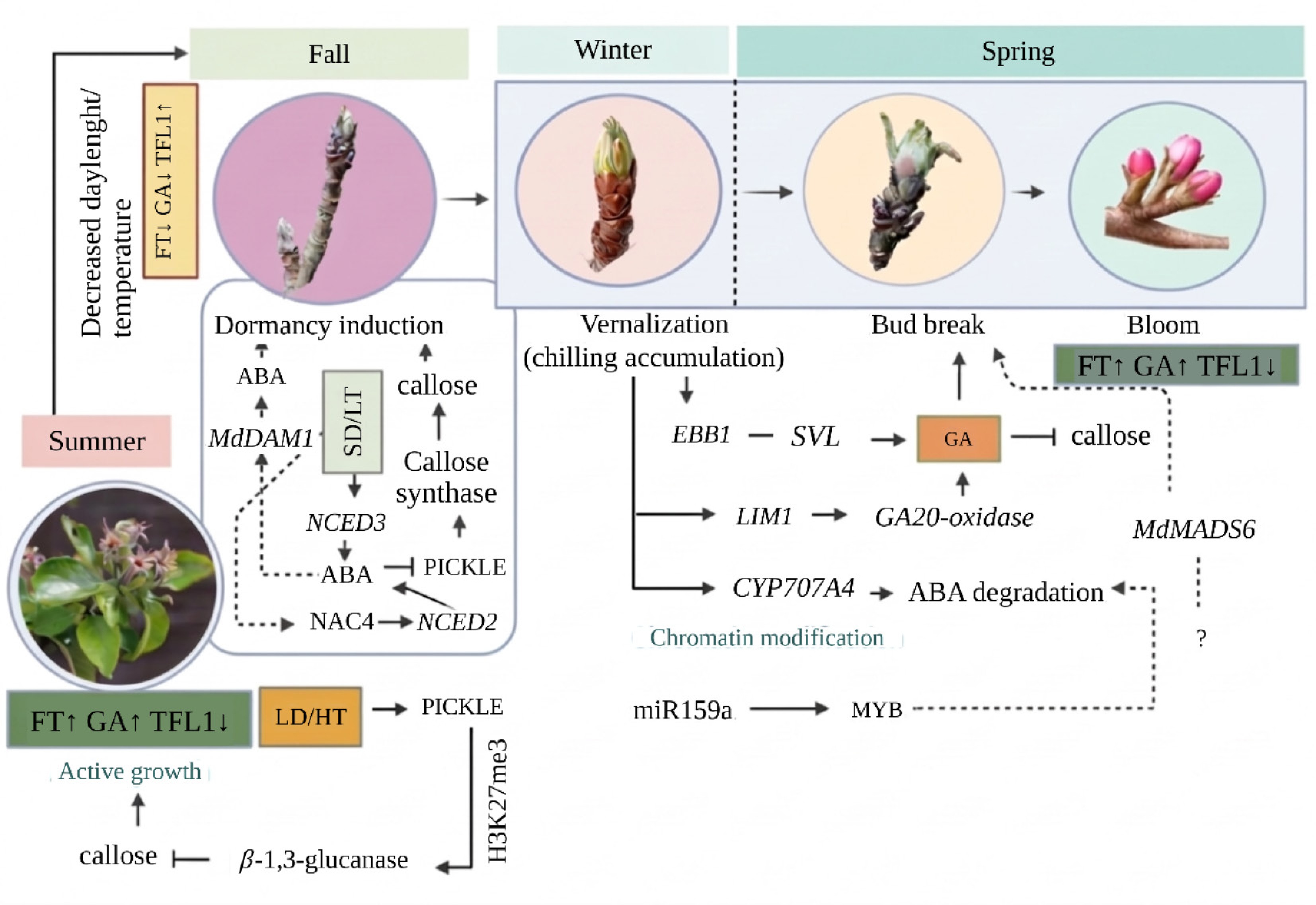
Figure 1.
The molecular control of seasonal bud development. As days get shorter after the start of astronomical summer, axial buds develop and potentially differentiate. A number of genes shape bud identity during dormancy in autumn, and growth arrests until adequate chill hours are sensed (endodormancy). Following adequate exposure to chill, heat units accumulate (ecodormancy) to activate pathways associated with budbreak. Lesions in any of the complex nodes of these integrated processes may affect dormancy and/or budbreak. Inset photo credits: Darren Turpin (
orchardnotes.com )A similar mechanism has been shown to underlie the LCR apple germplasm, with MdDAM1–MdDAM4 identified as orthologs of the peach DAM cluster[74]. In particular, Moser et al. elegantly identified the MADS-box gene MdDAM1 as the central effector of dormancy control. MdDAM1 transcripts were significantly lower in abundance in 'Anna' and 'Dorsett Golden' compared with 'Golden Delicious'. RNAi was used in 'Pinova' (800 chilling hours) to repress the native transcript, phenocopying the evg phenotype through winter months. A similar study in 'Royal Gala' used RNAi to repress transcripts corresponding to multiple DAM/SVP genes, leading to profound early dormancy release[75]. Overexpression of MdDAM1 resulted in extended dormancy[76]. These data show that MdDAM1 alone is both necessary and sufficient to confer dormancy in apple, and is a central regulator influencing dormancy.
MdDAM1, in conjunction with other DAM genes, regulates endodormancy through maintaining high ABA levels in the dormant buds in other rosaceous crops[77,78]. Specifically in apple, a low-chill cultivar ('Cripps Pink') and a high-chill cultivar ('Honeycrisp') were analyzed for ABA responses during dormancy[79]. 'Honeycrisp' possessed higher steady-state ABA levels throughout dormancy compared with 'Cripps Pink', consistent with the higher accumulation of 9-cis-epoxycarotenoid dioxygenase (MdNCED) transcripts encoding ABA biosynthetic genes. As the chilling requirement was met, transcripts accumulated from the ABA catabolic gene MdCYP707A2, with a parallel decrease in the transcripts of biosynthetic genes[80] and ABA itself[79]. In 'Golden Delicious', a relatively high-chill apple cultivar, ABA levels are high during endodormancy and decrease during budbreak[81]. During the transition from endodormancy to ecodormancy, the micro-RNA miR159a is induced, targeting MYB transcription factors that help override ABA-induced inhibition, leading to budbreak[80]. These findings are consistent with work showing activation of ABA degradation breaks dormancy in apple embryos[82]. However, there is no evidence that the cold directly affects ABA levels in dormancy or that its accumulation during endodormancy and disappearance into ecodormancy are controlled by another mechanism.
It has been well-established that cold-season growth cessation is regulated by physical changes in chromatin that constrain repressors of bud growth and development. Specifically in apples, histone modification provides a mechanistic link between ABA and the DAM genes[83]. Changes in the methylation state of H3K4me3 and H3K27me3 underlie the expression of all DAMs in during progression of dormancy and budbreak, control ABA biosynthesis[84]. The expression of biosynthetic genes like the 9-cis-epoxycarotenoid dioxygenase genes MdNCED1 and MdNCED2 define committed steps to ABA synthesis and are regulated by DAM1 in apple seedlings[85]. MdDAM1 and MdDAM4 complex with other transcription factors to regulate MdNCED genes, which control ABA levels and progression through endodormancy[86]. ABA levels are also modulated by other factors, such as MdNAC4, a factor that positively influences dormancy initiation in apple by forcing leaf senescence by elevating the expression of MdNCED2[87]. SHORT VEGETATIVE PHASE (SVP) also works in coordination with DAMs once the plants enter dormancy and maintain the repression of vegetative growth by blocking the biosynthesis of gibberellic acid (GA)[86,88].
-
Endodormancy is maintained until chilling hours are satisfied. As chill accumulates, ABA is degraded, and growth-promoting genes are epigenetically de-repressed. The role of other influential genes is limited in apple, but have been studied individually in different fruit tree species. For example, while DORMANCY-ASSOCIATED MADS-BOX (DAM) proteins are known for maintaining dormancy, another MADS-box factor, low-temperature-induced MADS-box 1 (LIM1), acts as an upstream activator of the GA20-oxidase promoter under low temperatures[89]. However, it is not clear if LIM1 is activated after the chilling hours are satisfied or it is part of the chill acquisition memory circuit.
ABA degradation is important to release bud dormancy, and genes like cytochrome-like CYP707A4 catabolize the ABA in buds by producing ABA 8'-hydroxylase enzymes[90,91]. Little is known about the activation pathways of CYP707A4 gene. However, there is direct evidence from studies of seed dormancy that show that chilling affects the methylation status of ABA catabolic genes[92−94]. Two histone methylation markers, H3K4me3 (activator) and H3K27me3 (repressor), work antagonistically in regulation of seed dormancy[95,96] and may represent components of the memory circuit of chill accumulation in bud dormancy as well.
The EARLY BUD-BREAK 1 (EBB1) gene belongs to the APETALA2/Ethylene-Responsive Factor (AP2/ERF) family of transcription factors. They are regulated by low temperatures and epigenetic factors, and act as a repressor of SHORT VEGETATIVE PHASE-LIKE (SVL) in budbreak pathway in poplar (Populus spp.)[97]. EBB1 transcripts accumulate in response to the accumulation of chilling hours, and coincident changes in chromatin status coincide with the activation of meristematic cell division in the dormant vegetative and floral buds[98,99]. GA production in buds is also activated by EBB1 when the plants continue seasonal growth[100]. The decrease in ABA and increase in GA leads to dormancy release. During the transition to budbreak from paradormancy, GA signals initiate breakdown of plasmodesmata callose blockage through the activation of genes encoding 1,3-β-glucanases[101]. Auxin and cytokinin ratios also regulate axial bud shoot elongation after breaking dormancy, with auxins repressing elongation via apical dominance, while the process is stimulated by cytokinins[102,103].
Applying what is known from apple and other rosaceous crops, the core of endodormancy and subsequent budbreak are modulated by an integration of transcriptional regulators (like DAM/SVP) that influence hormonal signals (primarily ABA and GA), modified by stress-responsive pathways and other hormones (auxins and cytokinins). ABA induces the expression of DAM/SVP genes, which primarily act by repressing GA production and FT/FT-like genes. A decline in ABA leads to a decline in DAM/SVP accumulation, leading to higher activity from GA catabolic enzymes that increase GA levels that activate emergence from dormancy.
Taken together, the genes underlying these mechanisms are attractive targets for further study with the aim of variety improvement. Clearly, mechanisms that affect hormone levels via their synthesis, transport, accumulation, signaling, or metabolism are all plausible contributors to the LCR. Candidates include signaling intermediates, as well as the processes that constrain gene expression epigenetically. All will be of particular interest as more genomic resources are accumulated in low-chill apple varieties.
-
The newfound interest in low-chill apples is happening with the rapid expansion of genomic resources and new breeding techniques that are poised to accelerate the development of improved varieties for T-ST environments. The low-chill apple germplasm stands as a genetic repository for traits that may facilitate genetic improvement for new T-ST environments. The fact that so many varieties arise from different geographical regions and over more than a century of time suggests that multiple mechanisms and a plethora of alleles will be available to shape the development of future varieties. A comprehensive understanding of dormancy in rosaceous crops, including apple, may hasten the identification of candidate genes and alleles that govern the process, potentially along with modifiers that are apple-specific. The development of populations with segregating degrees of dormancy will provide an excellent opportunity for genomic selection and further define the roles of influential alleles. Converting allelic variants into molecular markers around the causal genes will ultimately speed the incorporation of dormancy-related alleles into new productive varieties for the tropics and subtropics. Many noncommercial varieties are recognized for their superior disease resistance, yet they lack other commercial qualities like size, ability to be stored, or good postharvest performance. Introduction of causal alleles into these varieties may yield cultivars that match the needs of production and warming weather patterns. The newest technologies using site-directed nucleases, such as Clustered Regularly Interspaced Short Palindromic Repeat (CRISPR)-associated protein 9 (Cas9) or prime editing, may be used to introduce precise mutations to key regulatory genes to mimic the lesions that alter dormancy depth, providing a means of retaining the high commercial qualities of existing germplasm while adapting them to warmer winters. The current task is to assess a broad range of existing varieties recognized for fruit quality, disease resistance, and productivity and to test them in challenging climates. Those that survive the challenge with minimal management will be prime candidates for further genetic improvement using genomics-assisted breeding and installed mutations through site-directed nucleases.
Overall, a well-described set of cultivars, an increasing understanding of the genetic mechanisms of dormancy control and flowering, and new tools for rapid genetic improvement are coming together to meet both the opportunity and crisis. The next decade will undoubtedly see a more comprehensive genomic description of low-chill germplasm, facilitating rapid genetic improvements that will help growers expand into new areas as and cope with the warming seasons in existing growing regions.
The authors thank Kevin Hauser and Larry Stephenson for useful conversations and additional guidance. This work was performed with funding for graduate students from the University of Florida Horticultural Sciences Department.
-
The authors confirm their contributions to the paper as follows: provided detailed first drafts of the mechanisms: Hussain M; provided descriptions of low-chill germplasm: Rivera J; finalized the manuscript: Folta KM. All authors reviewed the results and approved the final version of the manuscript.
-
This review article contains no new data from our program.
-
The authors declare that they have no conflict of interest.
- Copyright: © 2026 by the author(s). Published by Maximum Academic Press, Fayetteville, GA. This article is an open access article distributed under Creative Commons Attribution License (CC BY 4.0), visit https://creativecommons.org/licenses/by/4.0/.
-
About this article
Cite this article
Hussain M, Rivera J, Folta KM. 2026. Low-chill apples: genetics of crisis and opportunity in a valuable fruit crop. Fruit Research 6: e041 doi: 10.48130/frures-0026-0036 

Low-chill apples: genetics of crisis and opportunity in a valuable fruit crop
- Received: 01 June 2026
- Revised: 17 July 2026
- Accepted: 05 August 2026
- Published online: 16 September 2026
Abstract: The apple (Malus × domestica Borkh.) is considered a temperate crop species, originating in the mountains of Kazakhstan and typically cultivated at higher latitudes. Exposure to an annual period of cold temperatures is required to ensure sufficient dormancy and the proper timing of budbreak and flowering. But the desire for apples in tropical, subtropical, and other regions with insufficient chilling led to the selection of genotypes that flower and produce fruit with minimal cold exposure. This review examines the origins and current cultivation of low-chill apple varieties and an accounting of the molecular mechanisms that influence dormancy and budbreak. The current gaps in our understanding are described, along with new discoveries in apple and translation of findings from other rosaceous crops. An inventory and description of the current low-chill genotypes is presented, along with the molecular mechanisms that govern the emergence from dormancy. The challenge now is to merge what is known from phenological assessments of low-chill germplasm with the molecular mechanisms that have been defined. This foundation serves as a starting point for genetic improvements that may help meet climate-based challenges while developing new opportunities for tropical/subtropical agriculture, along with new markets for this popular fruit.
-
Key words:
- Apple /
- Low chill /
- Dormancy /
- Climate change