












-
The economic yield of sweetpotato (Ipomoea batatas) is entirely dependent on the formation and expansion of storage roots (SRs), a complex developmental event that transitions from primary growth to secondary and tertiary growth, relying on the unique activity of the sub-vascular cambium, achieved through the rapid proliferation and volume expansion of parenchyma cells[1]. The physical basis for cell expansion is the relaxation and remodeling of the cell wall. In recent years, cell wall function genes, such as expansin (EXP) and xyloglucan endotransglucosylase/hydrolase (XTH) genes, have been confirmed to be involved in the expansion of sweetpotato SRs[2,3,4], but systematic studies on the upstream transcriptional regulatory families are still relatively scarce.
The NAC transcription factor family is a unique class of transcription factors in plants[5], named for the conserved NAC domain at the N-terminus of its members. Souer et al. and Aida et al.[6,7] first discovered and studied this family in petunia and Arabidopsis thaliana. Finding that the N-terminus of the NAM gene in petunia and the ATAF1, ATAF2, and CUC2 genes in A. thaliana all contain a highly conserved amino acid sequence, this conserved region has been named the NAC domain. To date, researchers have identified NAC gene family members in major crops, including 151 in rice[8], 148 in maize[9], 152 in soybean[10], and 91 in sweetpotato[11]. NAC transcription factors are also important plant-specific regulators that are extensively involved in the response to multiple abiotic stresses[12].
The NAC family is widely involved in plant growth and development as well as plant-organ development[13,14], in which IbNAC22 directly binds and activates the key starch synthesis gene IbGBSSI and cooperatively regulates SR starch accumulation and enlargement with cofactors[15]. In cassava, MeNAC family members are specifically expressed during root expansion[16]. In radish, RsNAC genes regulate the expansion of the main root and xylem development, directly determining the yield of fleshy roots[17]. These studies confirm that NAC transcription factors are core regulatory factors in the development of storage organs in SR and bulbous crops and furthermore have the potential to be target genes for improving the yield traits of sweetpotato. Additionally, the NAC family is widely involved in other growth and development processes as well as hormone signal responses[18]. For example, rice OsNAC10 regulates root cell development[19]; overexpression of the apple MdNAC1 gene can reduce plant height[20]; the expression of A. thaliana AtNAC18 is jointly regulated by developmental signals and environmental/hormone signals[21].
In recent years, the NAC gene family has been systematically identified in major crops, but research on the NAC family in sweetpotato is still lagging. Sweetpotato is a hexaploid crop with a complex genome, and its evolutionary history involves a polyploidization process from diploid to tetraploid and then to hexaploid species[22]. Although the functions of some NAC genes have been preliminarily reported, systematic identification, evolutionary analysis, and functional studies of the NAC gene family in sweetpotato during the process of root expansion are still scarce. Moreover, there are many 'sweetpotato' species, from wild types to local species to modern cultivated species, and there are significant differences in their root expansion capabilities. The molecular basis behind these differences, especially the species-specific expression patterns of the NAC gene family, remains unclear.
Based on this, this study selected four 'sweetpotato' species as experimental materials, with differences in ploidy and domestication status (wild relatives, cultivated variety). Through genome-wide identification and bioinformatic analysis, the evolutionary characteristics, protein domains, and chromosomal distribution of the NAC gene family were systematically analyzed. At the same time, the expression dynamics of the sweetpotato NAC gene family during SR expansion and the interspecies differences were revealed, and key candidate genes involved in regulating SR development were screened. The results will provide a theoretical basis and important gene resources for further clarifying the molecular regulatory network of SR expansion in sweetpotato.
-
The four materials are Ipomoea trifida 2x Y22[22], wild I. batatas 4x multiple hybrid Y428B[22], wild I. batatas 6x Y601 (the NARO genebank (gene.affrc.go.jp), as well as some scholars, refers to tetraploid and hexaploid I. trifida as wild I. batatas)[22], and cultivated sweetpotato Nancy Hall (NH). The genomes of these four materials were assembled by our group and can be obtained from NGDC (
https://ngdc.cncb.ac.cn ). The accessions are PRJCA015454, PRJCA015460, and PRJCA054709.The protein sequences of Y22, Y428B, Y601, and NH were scanned as queries for BLASTP searches (E-value < 1 × 10⁻⁵) against A. thaliana protein sequences obtained from TAIR (
www.arabidopsis.org/ ). Second, the candidate sequences were filtered using the Hidden Markov Model (HMM) profile of the NAC domain obtained from the Pfam database (https://pfam.xfam.org/ ). Third, the remaining protein sequences were further verified using the Conserved Domain Database (CDD) of NCBI (www.ncbi.nlm.nih.gov/cdd/ ) to confirm the presence of the intact NAC domain. Only sequences containing a complete NAC domain were retained as NAC family members. Protein characteristics were calculated using TBtools-II[23] with default parameters.Physicochemical property analysis
-
The physicochemical properties of the four species were analyzed using ExPASy ProtParam (
https://web.expasy.org/protparam/ ), including the number of amino acids, molecular weight, isoelectric point, instability index, and hydrophobicity.Protein domain and conserved motif analysis
-
Protein domain analysis was performed using the Conserved Domain Database (CDD) on the NCBI website, and the results were visualized. Conserved motif analysis was conducted using the Simple MEME Wrapper function in TBtools-II(v2.481)[23], with the maximum number of motifs set to 20, the motif width set to a range of 6–50 amino acids, and all other parameters kept at their default settings.
Chromosome location analysis
-
The position information of the NAC gene family members was obtained from the genome GFF3 annotation file and uploaded to MapChart in TBtools-II(v2.481)[23] to accurately locate each gene on the 'sweetpotato' chromosomes.
Collinearity analysis
-
Collinearity analysis was performed on the genomes of the four 'sweetpotato' varieties (Y22, Y428B, Y601, and NH) using TBtools-II (v2.481)[23] to identify homologous NAC gene pairs and achieve visualization.
Plant materials and sampling
-
Among these four materials, Y428B mainly produces pencil roots and fails to undergo SR thickening. Following the established paradigm for sweetpotato SR development, we sampled the other three materials (NH, Y22, and Y601) at the adventitious root (AR, S0), initial storage root (ISR, S1), young storage root (YSR, S2), and mature storage root (MSR, S3) stages according the reference[24]. For Y428B, the corresponding pencil roots were harvested at the same time points as S1–S3, with the S0 stage also included. Three biological replicates were collected for each time point. All samples were immediately snap-frozen in liquid nitrogen and stored at −80 °C. The collected materials were subsequently submitted to Novogene Co., Ltd. (Tianjin, China) (
https://cn.novogene.com ) for RNA-seq and to Wuhan Metware Biotechnology Co., Ltd (Wuhan,China) (www.metware.cn ) for 4D-DIA proteome test, and the detailed experimental methods and procedures are described in the reference[25].Analysis of expression characteristics of the NAC family
-
Based on the gene expression level data obtained from transcriptome sequencing of various samples, the expression profiles of NAC family members in four developmental stages (S0–S3) and four species were extracted. The expression heat map was drawn using the TBtools-II(v2.481) software to visually display the spatiotemporal expression patterns of different members. According to the expression abundance and dynamic change trends, NAC genes that are significantly upregulated during SR thickening or showed specifically high expression in fibrous roots (negative regulation candidates) were screened as candidate key regulatory factors. Further, combined with the differences in SR thickening phenotypes across four species, the expression divergence characteristics of NAC family members between NH and wild species were compared, and the correlation between interspecific expression differences and SR thickening capacity/fibrous root development was analyzed.
In this study, the selection of NAC genes for expression profiling was performed by covering representative subfamilies of the 'sweetpotato' NAC family, prioritizing genes with significant expression changes during SR development with a threshold of |log2FC| ≥ 1 and p < 0.05, and preferentially retaining genes with high basal expression in SRs based on transcriptomic data to ensure biological relevance to root expansion. On this basis, representative NAC genes were further selected according to their striking expression dynamics across developmental stages and different ploidy species, with only genes possessing complete and accurately annotated promoter sequences included to guarantee the reliability of subsequent cis-element analysis.
Analysis of cis-acting elements in the promoter region
-
The 2,000 bp promoter sequences upstream of the start codon of the expressed genes were retrieved from the four 'sweetpotato' genomes. Subsequently, the cis-acting regulatory elements present in these promoter regions were analyzed using the PlantCARE online tools (
https://bioinformatics.psb.ugent.be/webtools/plantcare/html/ ).Data statistical analysis
-
The data were analyzed by variance analysis using SPSS22.0 software, and the least significant difference method (LSD) was used for the significance test of differences.
-
To distinguish the four materials, we prefixed their gene/protein IDs with Itr2x (I. trifida 2x Y22), Iba4x (I. batatas 4x Y428B), Ibw6x (wild I. batatas 6x Y601), and Iba6x (cultivated sweetpotato NH). Through genome-wide screening and conserved domain validation, 134, 142, 132, and 126 NAC family members were identified in the Y22, Y428B, Y601, and NH, respectively (Supplementary Table S1). The physicochemical properties exhibited both commonalities and variations. The amino acid counts ranged from 99 to 756, molecular weights spanned 11.74–86.29 kDa, and isoelectric points (pI) varied between 4.26 and 10.14. In all species, the number of acidic proteins (pI < 7) exceeded that of basic proteins (pI > 7), with basic proteins accounting for 32.8%–37.1% of the total. The instability index ranged from 27.05 to 69.80. Each species contained 40–41 stable proteins (instability index < 40), while unstable proteins (instability index > 40) constituted a higher proportion, reaching 65.7%–71.3%. In terms of hydrophilicity, all NAC proteins from NH, Y22, and Y601 showed negative hydrophilicity values (ranging from –1.247 to –0.007), indicating that they are hydrophilic. As shown in Supplementary Table S1, among the 142 NAC proteins from Y428B, 141 had negative values (from –1.247 to –0.296), accounting for 99.30% of the total, while only one protein, Iba4xNAC004, had a positive value (0.612). Overall, the NAC proteins in these species remain predominantly hydrophilic.
Phylogenetic analysis and subfamily classification of the NAC family
-
Multiple sequence alignment was performed for NAC proteins from A. thaliana (105 NAC members), the IbNAC proteins identified by Guo et al.[12], and the four materials (Y22, Y428B, Y601, and NH), followed by construction of a phylogenetic tree using IQ-TREE2 software (Fig. 1). With reference to the classification system for A. thaliana NAC proteins established by Guo et al.[12] and Ooka et al.[26], the NAC proteins (126–142) from each material were categorized into 19 subfamilies (e.g., TIP, ANAC011, AtNAC3, ONAC022, ANAC084, IbNAC045, ANAC063, OsNAC7, NAC2, ATAF, NAC1, IbNAC011, IbNAC025, ONAC001, NAP, NAM, TERN, IbNAC061, and XND1); exceptions are ANAC006 and ANAC023.
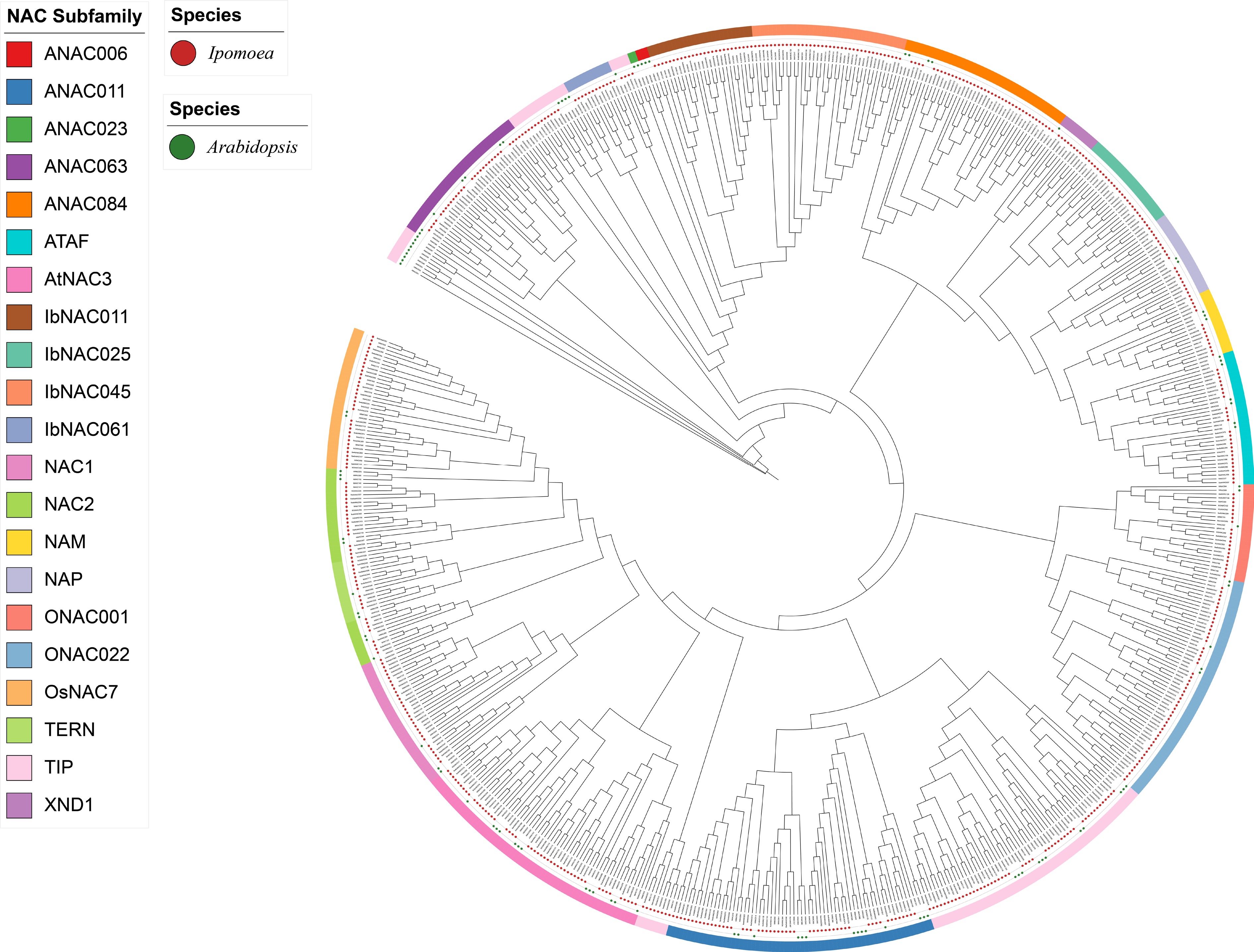
Figure 1.
Phylogenetic tree of the NAC gene family. Phylogenetic trees illustrate the evolutionary relationships between NAC family members in four 'sweetpotatoes', A. thaliana, and the published sweetpotato IbNAC proteins. All NAC sequences were categorized into 21 distinct subgroups, with each color-coded region representing a single subgroup. In the diagram, 'At' denotes A. thaliana, 'Itr2x' refers to Y22, 'Iba4x' represents Y428B, 'Ibw6x' indicates Y601, 'Iba6x' corresponds to NH, and 'IbNAC' represents the published sweetpotato. The names of the respective subfamilies are displayed in the lower-left corner of the figure.
Notably, within the IbNAC025 and TERN subfamilies, the member counts did not vary among the four species. The TIP subfamily contained the largest total number of NAC proteins (50 members), forming the core component of the sweetpotato NAC family. In contrast, the 20th and 21st subfamilies (ANAC006 and ANAC023) harbored no identified NAC members and were therefore excluded.
Analysis of conserved motifs and domains in NAC gene families
-
Motif analysis of these sequences was performed using the Simple MEME Wrapper tool in TBtools-II(v2.481), with the number of motifs set to 20 and the motif length ranging from 6 to 50 amino acids. As shown in the results (Fig. 2b), the motif compositions among different proteins are largely conserved. Combined with the results of the protein domain analysis, motifs 3, 6, 2, 8, 4, 1, and 5 are likely to represent the conserved motifs of the NAM domain. In most members, the arrangement patterns of motifs are consistent and occur at high frequency (e.g., the consecutive arrangement of Motif3 + 6 + 2 + 8 + 4 + 1 + 5). Some proteins also possess less conserved motifs, implying that the functions of this gene family may be diverse.
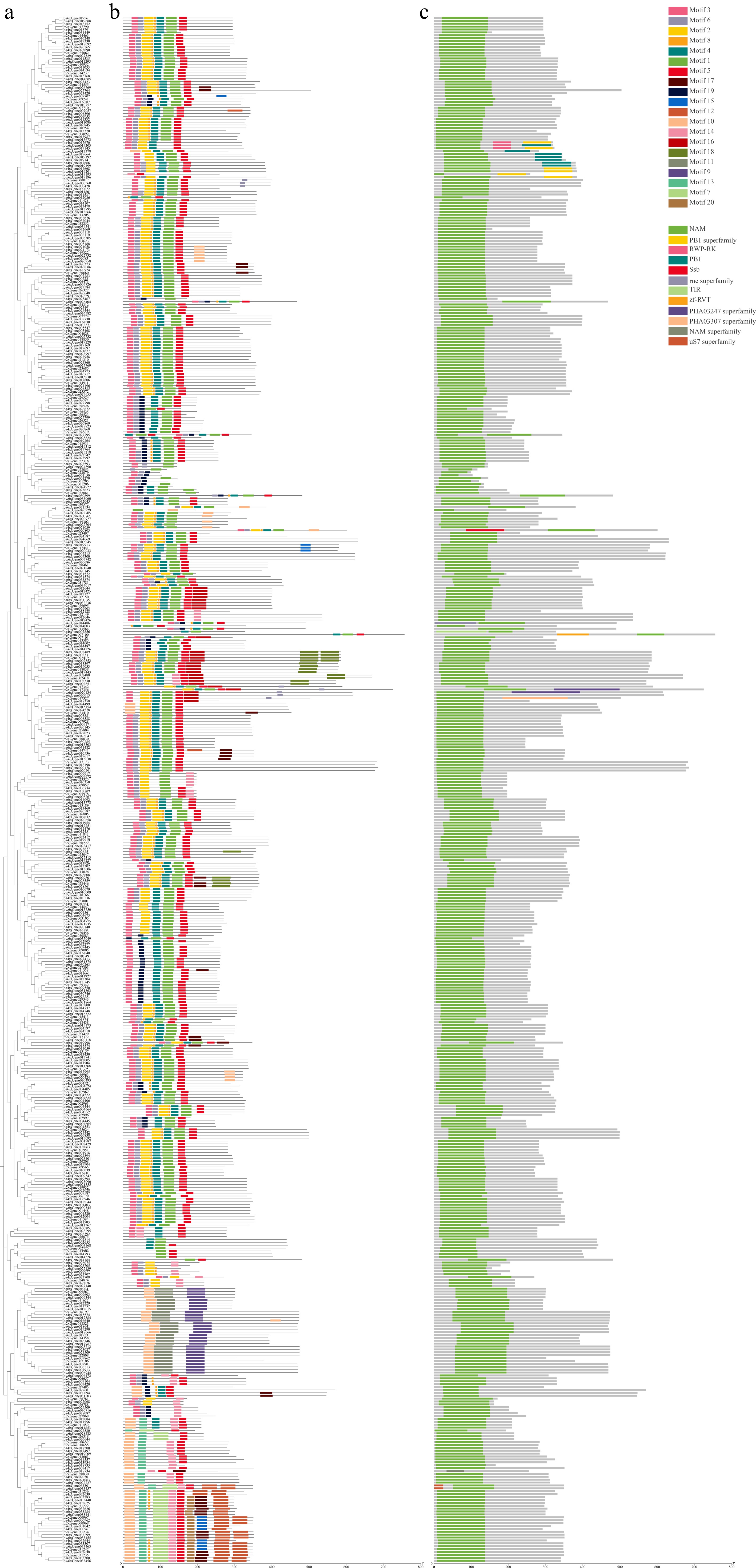
Figure 2.
Protein domain and motif analysis of NAC members: (a) Phylogenetic classification of NAC members in four 'sweetpotato' species; (b) distribution patterns of 20 conserved motifs in NAC proteins, represented by distinct color-coded boxes; (c) schematic diagram of the domain architecture of the target proteins. In the diagram, solid rectangles in different colors represent distinct conserved protein domains or superfamilies.
Protein domain analysis was performed using the NCBI Conserved Domain Database (CDD). As shown in the results (Fig. 2c), the domain architectures of these proteins are relatively conserved: they all contain the NAM domain, which is consistent with the characteristic domain feature of the NAC gene family. In addition, some proteins also possess other domains, implying that these proteins may have distinct functions.
Chromosomal localization analysis of NAC gene family members
-
Chromosomal localization analysis (Fig. 3) revealed that the NAC gene family members of four 'sweetpotato' species, are all unevenly distributed across 15 chromosomes, and the distribution patterns among different species exhibit high collinearity and conservation: The NAC genes of the four species were unevenly distributed across the 15 chromosomes, but most of them were relatively clustered on a few chromosomes. For example, in Y601 (Fig. 3c), NAC genes were more abundantly distributed on chromosomes 5, 6, and 8. In addition, tandem duplicate genes were identified in each species. For instance, in Y601, 12 pairs of tandem duplicate genes were found, including Ibw6xNAC005 (Ibw6xGene002851) and Ibw6xNAC006 (Ibw6xGene002852) (Fig. 3c and Supplementary Table S1).
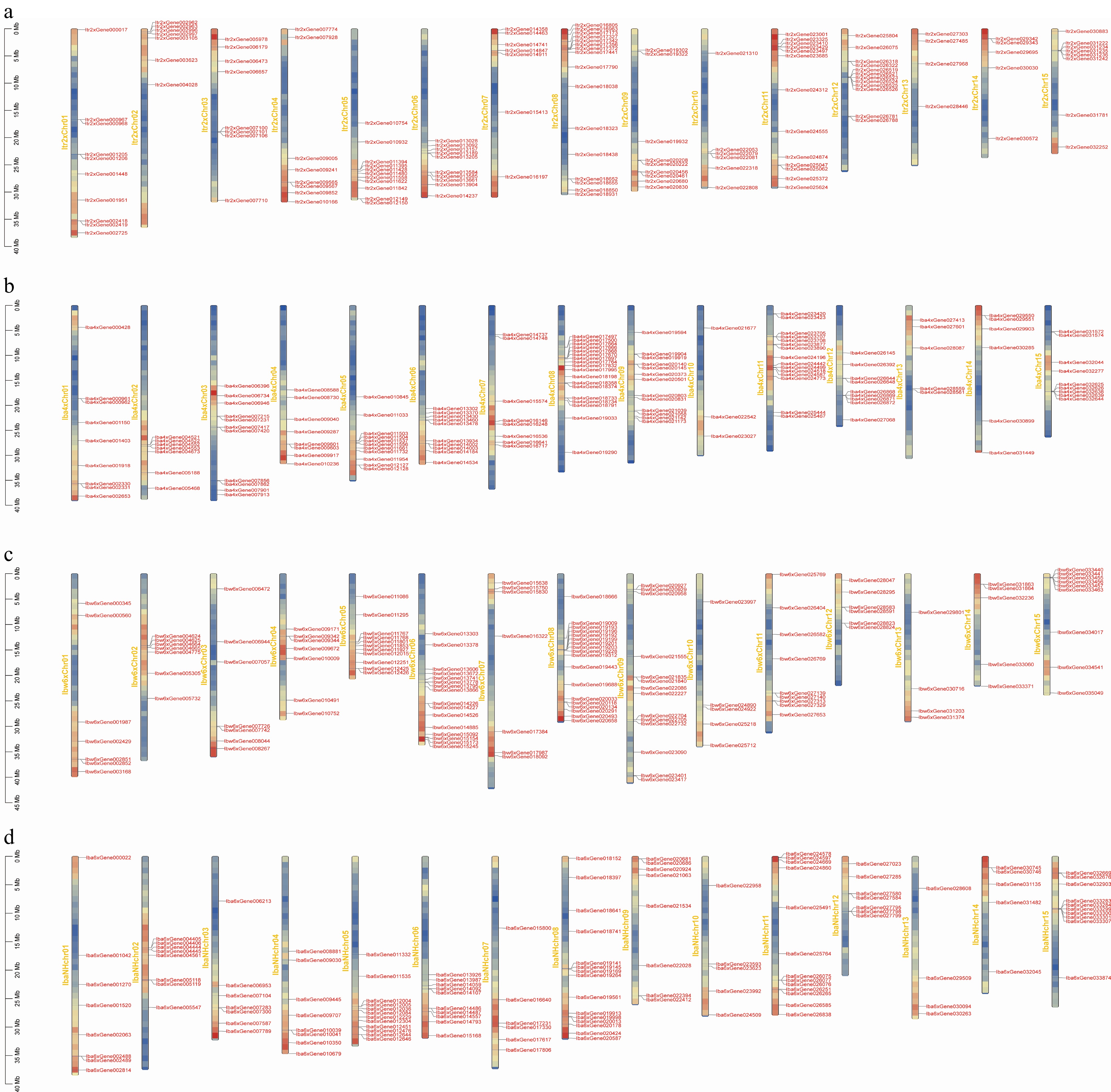
Figure 3.
Chromosomal localization of NAC genes in the (a) Y22, (b) Y428B, (c) Y601, and (d) NH. The correspondence between gene IDs and gene names is listed in Supplementary Table S1.
Interspecies synteny analysis of the NAC gene family
-
To further elucidate the evolutionary relationships within the NAC gene family, we performed synteny analysis of NAC genes between four genomes (Fig. 4). In the three genome comparisons—Y22–Y428B, Y428B–Y601, and Y601–NH—we identified 292 collinear gene pairs among the 534 NAC genes, and 391 NAC genes (73.2%) were involved in collinear relationships in at least one genome comparison. The numbers of NAC genes involved in collinearity in each genome were as follows: 92 (68.7%) in Y22, 108 (76.1%) in Y428B, 105 (79.5%) in Y601, and 86 (68.3%) in NH.
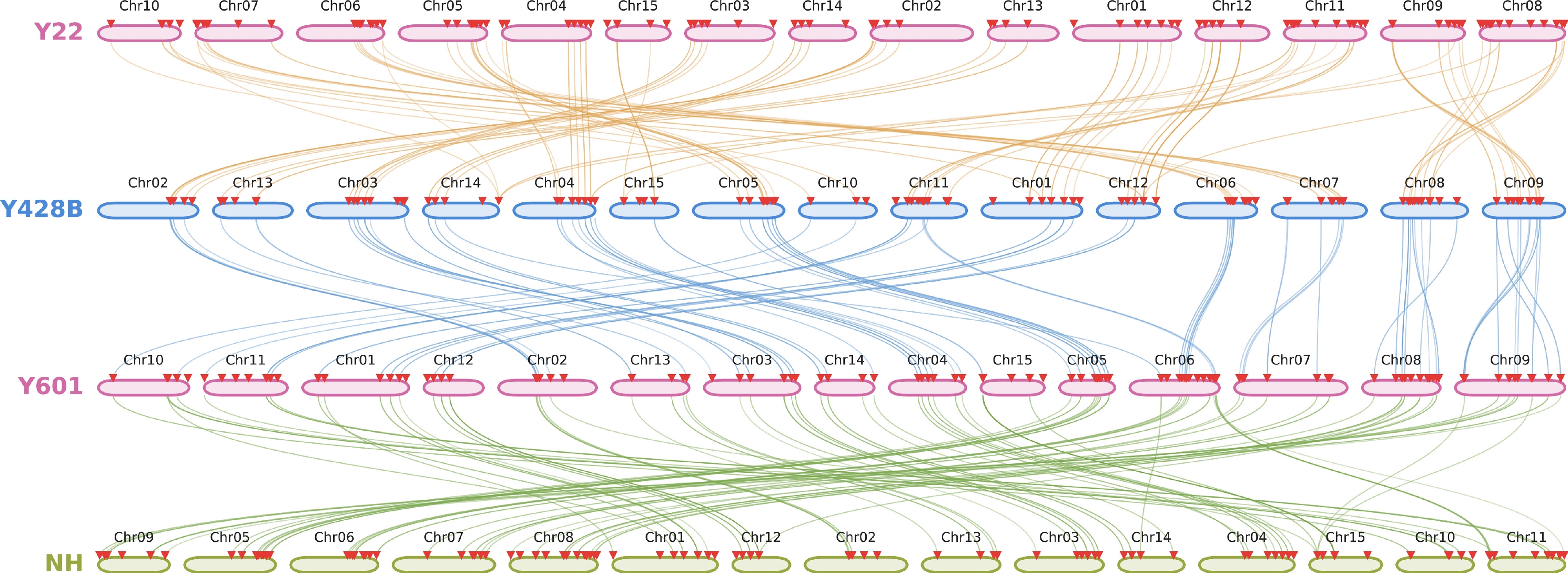
Figure 4.
Interspecies collinearity analysis of NAC gene families. The syntenic relationships of NAC family genes across four 'sweetpotato' species. The connecting lines in different colors represent homologous gene pairs exhibiting synteny between distinct species.
Synteny analysis revealed multiple types of collinear relationships among NAC genes across four species. Among the three genome comparisons, we identified 247 one-to-one collinear gene pairs, 21 one-to-two gene pairs, and 1 one-to-three gene pair; we also detected 11 two-to-one and 5 three-to-one collinear gene pairs. These patterns are likely attributable to gene expansion and contraction during the evolution of the NAC gene family, maybe because both I. trifida and sweetpotato have undergone whole-genome duplication/triplication (WGD/WGT) events in their evolutionary history[24,27,28]. Further analysis showed that 83 genes were classified as derived from WGD or segmental duplication, and 59 were derived from tandem duplication.
Notably, we identified 65 collinear transmission paths spanning all four genomes, 42 of which represented strict one-to-one orthologous relationships. For example, Itr2xGene023325 in Y22 was collinear with its ortholog Iba4xGene009917 in Y428B (100.0% sequence identity), which was in turn collinear with the homolog Ibw6xGene009672 in Y601 (100.0% sequence identity), and ultimately with the homolog Iba6xGene010350 in NH (100.0% sequence identity). These complex collinear relationships indicate that the four species are closely related evolutionarily.
Gene and protein expression analysis during SR development
-
Analysis of transcriptome heatmaps across the four 'sweetpotato' species revealed that the NAC gene family exhibits distinct expression pattern divergence during SR development, allowing classification into three major categories: upregulated expression, downregulated expression, and no expression at any developmental stage (FPKM value 0.00) (Fig. 5). In the three SR-forming species, NH, Y22, and Y601 (Fig. 5a, c, d), a considerable number of NAC genes maintained low expression at the S0 stage and were significantly upregulated from S1 to S3 (e.g., Itr2xNAC077 significantly upregulated from 64.37 at S0 to 142.08 at S3; Ibw6xNAC032 upregulated from 9.50 to 456.83), which are typical representatives of these upregulated genes. Meanwhile, another group of NAC genes were highly expressed at the S0 stage and exhibited a smooth gradient of downregulation along with the SR developmental process. In contrast, the non-SR-forming Y428B displayed a markedly different expression profile (Fig. 5b): most of its NAC genes had extremely high transcript levels at S0 (e.g., Iba4xNAC028 and Iba4xNAC005), which dropped sharply at S1 and remained at low levels thereafter, with very few genes showing the gradual S0–S3 upregulation observed in the swelling types. Collectively, these expression differences suggest that the timely and sustained activation of specific NAC genes from S1 to S3 is a key molecular feature associated with SR thickening, whereas the early suppression of such genes in Y428B may contribute to the developmental arrest and lignification of its stele parenchyma cells and thus forming pencil roots.
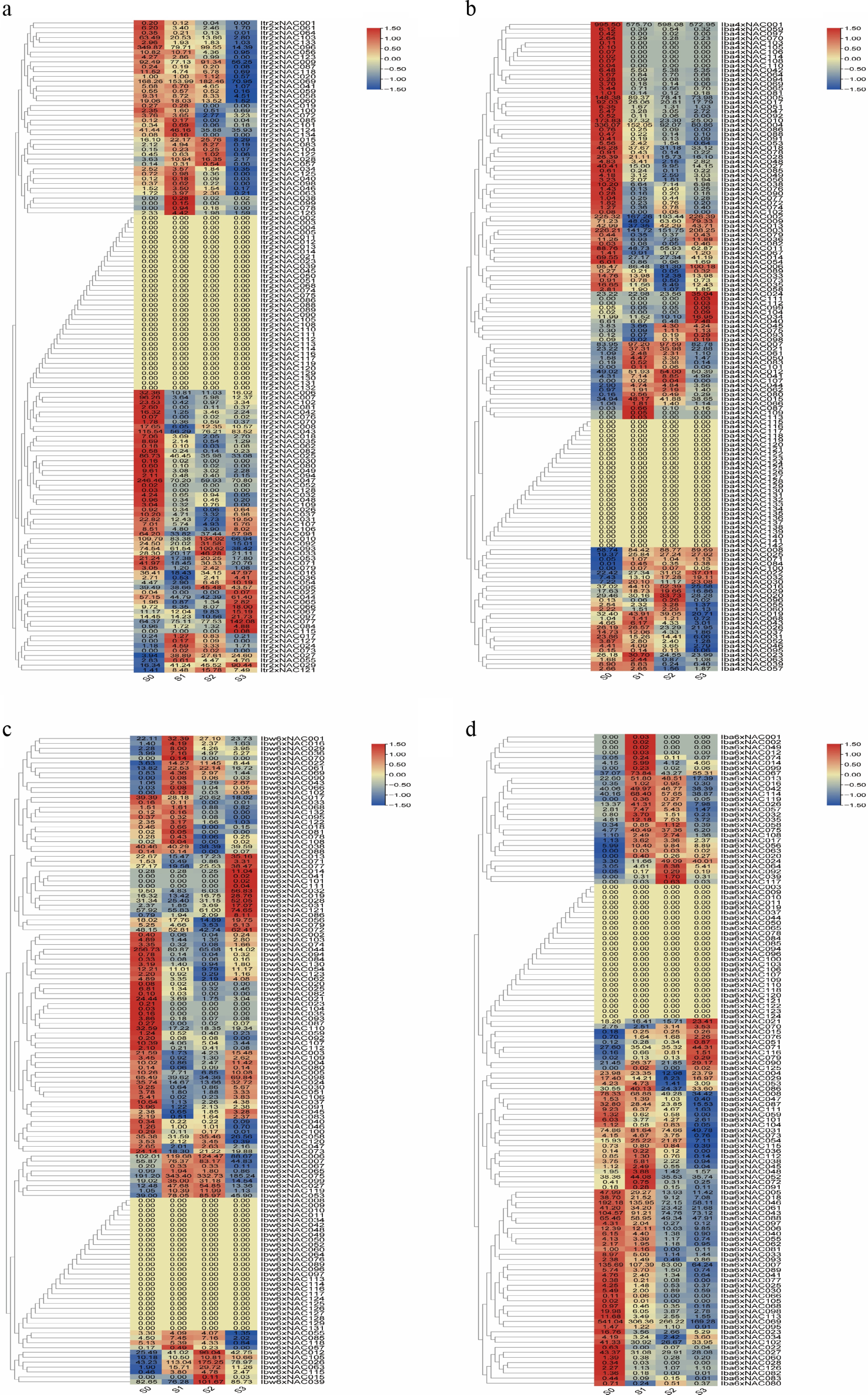
Figure 5.
Heatmap of NAC gene expression during SR development. The four panels correspond to different species: (a) Y22, (b) Y428B, (c) Y601, and (d) NH. As illustrated in the right panel, genes originating from identical subgroups are categorized together. The heatmap was generated using TBtools-II. The expression matrix was normalized by Z-score per row, and only rows were clustered while columns were not clustered.
For protein expression, we detected 15 NAC proteins at the MSR stage, indicating that not all NAC proteins are involved in SR development (Fig. 6); instead, they were selectively utilized. In NH, four NAC proteins were detected, with expression values ranging from 0.18 to 0.41. Among them, Iba6xNAC042 exhibited the highest expression (0.41), followed by Iba6xNAC069 (0.37) and Iba6xNAC090 (0.29), whereas Iba6xNAC007 showed the lowest expression (0.18). In Y22, Itr2xNAC069 was the most highly expressed protein, with an expression level of 0.75; Itr2xNAC044 showed low-to-moderate expression (0.35); and Itr2xNAC009 had the lowest expression (0.05), representing a 15.7-fold difference from the highest expressed protein. In Y601, Ibw6xNAC022 was the dominant protein, reaching an expression level of 2.96; the remaining four proteins were all expressed at low levels, with Ibw6xNAC055 being the lowest (0.11), followed by Ibw6xNAC038 (0.14), Ibw6xNAC006 (0.27), and Ibw6xNAC075 (0.41), all below 0.5. Phylogenetic analysis showed that Itr2xNAC069, Ibw6xNAC022, and Iba4xNAC028 clustered in the same clade (Fig. 1), suggesting that these three proteins shared high sequence similarity and were relatively conserved across the three species. Given that the roots of Y428B were predominantly pencil roots and that Iba4xNAC028 expression reached 10.47, we speculated that it might be a key NAC protein responsible for the pencil root phenotype of Y428B. Y22 and Y601 were able to form small SRs 2–3 cm in diameter, but their swelling capacity was much lower than that of cultivated sweetpotato NH. We therefore speculate that the high expression of Ibw6xNAC022 and Itr2xNAC069 was unfavorable for SR swelling.
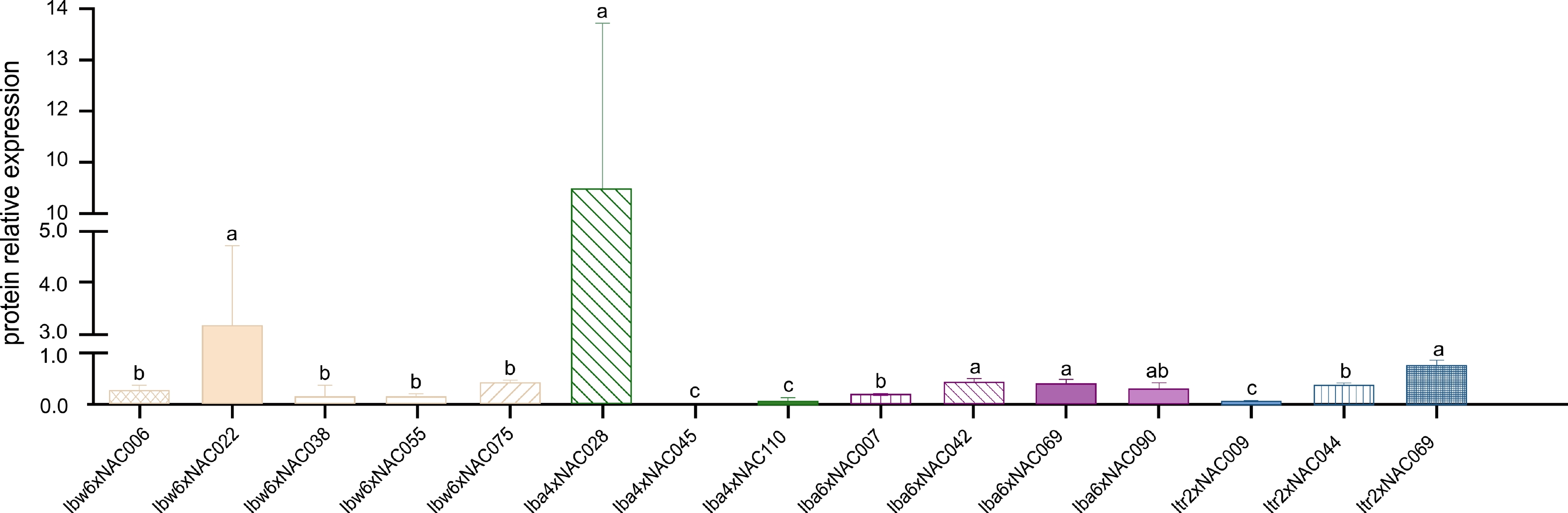
Figure 6.
NAC protein expression at the MSR stage. The bar chart illustrates the NAC protein expression levels of genes in Y601, Y428B, NH, and Y22. The vertical axis represents relative protein expression values, while the horizontal axis indicates the corresponding NAC protein names. Columns of different colors denote different materials. The lowercase letters above the bar chart indicate the LSD significance test for differences.
Distribution characteristics of hormone-responsive elements in the promoter regions of NAC family genes
-
To further investigate the potential regulatory mechanisms of the NAC genes detected at the protein level in MSR, we analyzed the promoter regions of the former detected 15 genes for cis-acting elements associated with hormone responses. As shown in Fig. 7, among these 15 genes, abscisic acid (ABA)-responsive elements (ABRE) and methyl jasmonate (MeJA)-responsive elements (TGACG-motif/CGTCA-motif) reached the highest frequency and the broadest distribution. Gibberellin (GA)-responsive elements (GARE-motif, TATC-box, P-box) also proved widely present, whereas salicylic acid (SA)-responsive elements (TCA-element) and auxin (IAA)-responsive elements (AuxRR-core, TGA-element) were detected in only a subset of genes with relatively low copy numbers. Notably, the majority of genes (e.g., Itr2xNAC009, Itr2xNAC044, Ibw6xNAC006, Iba6xNAC007) contained responsive elements for ABA, MeJA, GA, as well as either SA or IAA. Some genes harbored two distinct types of hormone-responsive elements. In contrast, Iba4xNAC028 contained a SA-responsive element (TCA-element:1) exclusively; Iba4xNAC045 had ABA-, GA-, and auxin-responsive elements but lacked MeJA and SA elements. Remarkably, Iba4xNAC110 contained the highest number of ABA-responsive elements (ABRE:12), while also incorporating MeJA-, GA-, and SA-responsive elements. Overall, these results suggest that the 15 MSR-stage NAC genes are likely predominantly regulated by ABA, MeJA, and GA signaling, while SA and IAA may play more gene-specific roles.
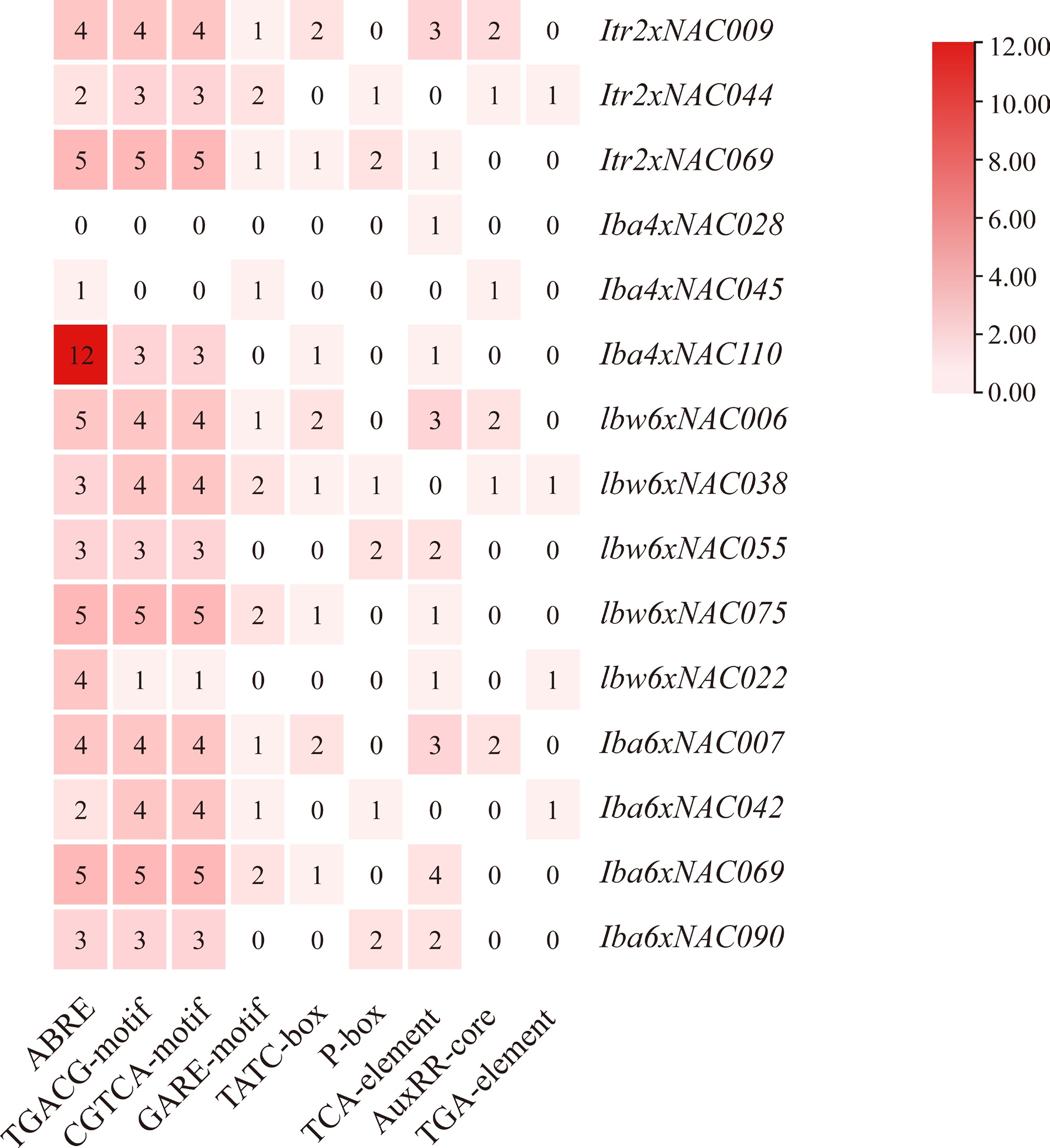
Figure 7.
Heatmap of the hormone response elements in the promoter regions of 15 genes. ABRE, abscisic acid response element; TGACG-motif/CGTCA-motif, jasmonic acid methyl ester response element; GARE-motif/TATC-box/P-box, gibberellin response element; TCA element, salicylic acid response element; AuxRR-core/TGA-element, auxin response element. The numbers indicate the copy number of the element in the promoter region.
-
NAC transcription factors constitute a class of plant-specific regulatory proteins that play pivotal roles in plant growth and development, organ formation, and responses to biotic and abiotic stresses[29]. In this study, four 'sweetpotato' species with different ploidy and domestication backgrounds were selected to systematically identify NAC family members. Y22 (I. trifida 2x), Y428B (wild I. batatas 4x), and Y601 (wild I. batatas 6x) are closely evolutionarily related to the sweetpotato[22]. These four species represent a progressive trajectory from wild diploid progenitor to wild tetraploid/hexaploid in Ipomoea and finally to cultivated hexaploid sweetpotato, providing an ideal system for investigating the evolutionary dynamics of the NAC family during polyploidization and domestication, but also providing valuable genetic resources and a theoretical basis for dissecting the molecular regulatory mechanisms underlying SR enlargement. These findings will offer promising candidate genes and scientific insights for genetic improvement and molecular breeding of yield traits in sweetpotato.
In terms of root architecture, Y428B produces pencil roots characterized by a stele lignified and cortical parenchyma cells that accumulate starch but have limited swelling capacity, whereas NH develops typical SRs with a massively expanded stele containing numerous parenchyma cells for starch storage. Members of the ANAC011 subfamily exhibited the most pronounced expression divergence between pencil root and SR materials. In Y428B, which forms pencil roots[22], the transcriptional level of Iba4xNAC028 at S0 was 26.39, which was relatively elevated compared with most other NAC genes in this species, although not the highest overall (Figs 1 and 5b). Notably, its protein abundance in the MSR was 10.47 (Fig. 6), indicating a marked discrepancy between transcript and protein levels. In contrast, in NH (SR), no such extreme transcriptional upregulation was observed for this subfamily member. At the protein level, the accumulation of Iba4xNAC028 in Y428B did not show a proportional correspondence with its transcript abundance, suggesting post-transcriptional regulation or translational repression specifically occurring in the lignified root context[30,31]. This transcript-protein decoupling may be a mechanistic feature associated with maintaining the pencil root fate; by restricting the accumulation of functional Iba4xNAC028 protein, the root may avoid activating downstream programs that would otherwise promote stele expansion and parenchyma proliferation. In contrast, other ANAC011 members (e.g., Ibw6xNAC022) exhibited moderate-to-high protein accumulation across SR materials, implying their role as constitutive activators that may promote SR development.
Integrating transcriptomic and proteomic data, we propose a possible two-mode regulatory model for ANAC011 subfamily members in sweetpotato root development: (i) In pencil roots (Y428B), the transcript-protein discrepancy observed for Iba4xNAC028 (transcript S0 = 26.39, protein = 10.47) suggests that this gene may be subject to post-transcriptional regulation, and its function likely relies more on transient transcriptional activation than on stable protein accumulation. (ii) In SR-forming species (NH, Y22, and Y601), other ANAC011 members (e.g., Ibw6xNAC022) achieve stable protein accumulation and likely function as transcriptional activators of downstream genes involved in cell wall remodeling (e.g., expansins or XTHs[32]) and starch biosynthesis, thereby promoting stele expansion and storage compound deposition. This model is consistent with previous reports in Arabidopsis and rice, where NAC transcription factors regulate secondary cell wall biosynthesis and root development[33,34]. The differential regulatory modes observed between pencil-root and SR-forming materials provide a novel evolutionary perspective on how NAC subfamilies have been co-opted to modulate divergent root architectures in 'sweetpotato' species.
Hormone response element analysis revealed that ABA and MeJA cis-elements were the most prevalent among the 15 screened genes, implying their broad involvement in abiotic and biotic stress responses during sweetpotato SR expansion, a process often accompanied by mechanical stress, water fluctuation, and pathogen invasion[35]. Notably, the promoters of high-protein-accumulating NAM subfamily members (e.g., Ibw6xNAC022) were enriched in ABA, MeJA, and GA elements, consistent with their roles in expansion regulation, while Iba4xNAC028 contained only SA elements and lacked ABA/MeJA elements[36,37]. Genes containing both GA and IAA elements (e.g., Itr2xNAC009, Ibw6xNAC006) may coordinate vascular differentiation and sink organ establishment by mediating cell division and elongation, while genes containing both ABA and GA elements likely function in stress-induced expansion regulation, responding to environmental signals during root swelling[38,39]. Notably, Iba4xNAC110 possessed the highest number of ABA response elements[40] (ABRE: 12) alongside MeJA, GA, and SA elements, suggesting that this gene may occupy a central regulatory position in ABA-mediated stress responses, potentially regulating downstream genes associated with cell expansion and secondary wall synthesis via ABA signaling pathways under mechanical or hydration stress. These genes provide valuable candidate targets for elucidating the molecular mechanisms underlying SR expansion. Future studies should integrate spatiotemporal expression profiling, hormone treatment assays, and transgenic functional validation to delineate their specific roles.
-
In conclusion, a total of 134, 142, 132, and 126 NAC genes were identified in Y22, Y428B, Y601, and NH, respectively, and they were grouped into 19 subfamilies. These genes are unevenly distributed across 15 chromosomes of their respective genomes, and collinearity analysis revealed that they are closely related. Transcriptomic and proteomic analyses reveal that elevated expression of Iba4xNAC028 may correlate with pencil root formation, whereas high levels of Ibw6xNAC022 and Itr2xNAC069 may be associated with reduced SR swelling. Promoter region analysis of 15 protein-detected genes further highlights that ABA and MeJA may be key hormonal signals in SR enlargement. These findings provide candidate genes for functional validation and breeding toward yield improvement.
-
During the preparation of this manuscript, the authors used DeepSeek (Date: 2026-08-25) for language polishing and grammatical correction. The authors reviewed and edited all content produced with the assistance of this tool, verified its accuracy, and take full responsibility for the integrity and originality of the final manuscript. This work represents the authors' own intellectual contribution, and no AI tool is credited as an author.
-
The authors confirm their contributions to the paper as follows: study conception and data collection: Jian W, Li M; analysis and interpretation of results: Yang Y, Li T, Wu D; draft manuscript preparation: Yang Y, Li T, Wu D, Zhu Y; manuscript revision: Li M, Gomez-Jimenez MC. All authors reviewed the results and approved the final version of the manuscript.
-
The datasets generated during and/or analyzed during the current study are available from the corresponding author upon reasonable request.
-
The authors declare no conflict of interest.
-
accompanies this paper online at: https://doi.org/10.48130/ph-0026-0022.
- Supplementary Table S1 Basic information of NAC transcription factor family members in NH, Y22, Y428B, and Y601.
- Copyright: © 2026 by the author(s). Published by Maximum Academic Press on behalf of Chongqing University. This article is an open access article distributed under Creative Commons Attribution License (CC BY 4.0), visit https://creativecommons.org/licenses/by/4.0/.
-
About this article
Cite this article
Yang Y, Li T, Wu D, Gomez-Jimenez MC, Zhu Y, et al. 2026. Genome-wide identification of NAC transcription factors in four 'sweetpotato' species and its transcriptomic and proteomic analysis during storage root development. Plant Hormones 2: e024 doi: 10.48130/ph-0026-0022 

Genome-wide identification of NAC transcription factors in four 'sweetpotato' species and its transcriptomic and proteomic analysis during storage root development
- Received: 07 May 2026
- Revised: 19 July 2026
- Accepted: 10 August 2026
- Published online: 29 September 2026
Abstract: NAC transcription factors are plant-specific regulators involved in growth, development, and stress responses, but their roles in sweetpotato storage root (SR) enlargement remain largely unknown. In this work, we identified 134, 142, 132, and 126 NAC members in diploid Ipomoea trifida Y22, wild tetraploid I. batatas Y428B, wild hexaploid I. batatas Y601, and cultivated sweetpotato 'Nancy Hall' (NH), respectively, and classified them into 19 subfamilies. These genes are unevenly distributed across 15 chromosomes of their respective genomes. We conducted a comprehensive analysis of their physical and chemical properties, as well as the structures of their genes and proteins. The collinearity analysis revealed that among all NAC genes, we identified 292 pairs of genes that were highly correlated. Gene expression profiling showed that in SR-forming species (Y22, Y601, and NH), many NAC genes are progressively upregulated during SR development, whereas in pencil root (Y428B), most NAC genes exhibit high expression in adventitious roots that sharply declines thereafter, with few showing the gradual upregulation observed in swelling types. Proteomic analysis (4D-DIA) detected 3–5 NAC proteins at the mature SR stage, further supporting the transcript-protein decoupling. The high expression of Iba4xNAC028 may promote pencil root formation in Y428B, while the high expression of Ibw6xNAC022 and Itr2xNAC069 may be unfavorable for SR swelling. Promoter cis-element analysis of the 15 protein-detected NAC genes indicated enrichment of ABA-, MeJA-, and GA-responsive elements, with ABA and MeJA being the most prevalent, implying their involvement in SR enlargement and stress responses via hormone signaling cross-talk. This study enhances our understanding of the expression regulation of the NAC family in sweetpotato and its wild relatives, and provides candidate genes for future functional validation and molecular breeding.
-
Key words:
- Sweetpotato /
- Wild relatives /
- NAC gene /
- Storage root /
- Pencil root, Multi-omics /
- ABA /
- MeJA