












-
Intelligent packaging technology has emerged as a key research focus, driven by growing consumer demand for food safety and quality, particularly in preservation and freshness monitoring. As a novel class of packaging materials, intelligent packaging films change color in response to pH variations within the food environment. This capability allows real-time, visual detection of food's freshness, providing immediate quality information to consumers, which can reduce food waste and enhance safety. Given their natural, eco-friendly, and user-friendly characteristics, intelligent packaging systems based on natural ingredients have significant market potential and social value.
Anthocyanins, a class of natural pigments, are particularly promising for this application. They possess notable antioxidant and antibacterial properties, and also exhibit distinct and pH-dependent color changes, making them ideal active components for intelligent films[1−3]. These pigments are highly sensitive to pH shifts and volatile amines produced during food spoilage. Numerous studies have confirmed that anthocyanin-based films display clear color gradients within short timeframes, and these changes correlate well with key spoilage indicators, such as total volatile basic nitrogen (TVB-N) and total viable bacterial counts[4,5]. These films can meet the growing consumer and industrial demand for natural, safe, and sustainable packaging solutions by providing a visual freshness indicator.
The rationale for advancing research on anthocyanin-based films lies in their inherent safety, environmental benefits, and functional efficacy. The core responsive components, anthocyanins, are sourced from edible plants like red cabbage, blueberry, and purple sweet potato, ensuring a high degree of safety[6,7]. Furthermore, anthocyanins can be extracted from food processing by-products, enhancing the raw materials' sustainability. The film matrix typically consists of biodegradable polymers, such as starch, chitosan, gelatin, or polyvinyl alcohol, thereby alleviating the burden on the environment after disposal[8]. The combination of natural active compounds and eco-friendly matrices avoids the potential risks associated with synthetic chemical indicators.
From a practical standpoint, these films offer considerable operational convenience. Their color response is visually intuitive, enabling consumers and retailers to assess food quality instantly without specialized knowledge, thereby achieving on-the-spot detection[9]. In terms of production, their fabrication relies on well-established, scalable techniques such as solution casting and electrospinning[10]. The stability and response speed of anthocyanin-based films under different storage conditions can be improved by blending anthocyanins with materials like gelatin, Fe2+, or oxidized chitin nanocrystals, or by fabricating them into nanofiber membranes via electrospinning[11,12]. After the addition of Fe2+, the bathochromic shift in the λmax of red cabbage anthocyanins was 90 nm at pH 7 and 110 nm at pH 5.7. This shifted the color of the anthocyanins from reddish-purple to blue-green, whereas the structural form of the anthocyanins remained unchanged, with no transformation from the neutral quinonoidal base to the anionic quinonoidal base. As a result, the blue chelate formed exhibited high stability. Their monitoring accuracy generally surpasses that of traditional physical or single-parameter chemical methods. Additionally, the potential to recover anthocyanins from industrial by-products can help lower the raw materials' costs[13]. The balance of cost-effectiveness and ease of use supports their broad applicability in fresh food-related e-commerce, cold-chain logistics, and retail, addressing the practical limitations of conventional detection methods[14].
Overall, aligning with the rising consumer emphasis on health and sustainability, the development of intelligent packaging from natural ingredients like anthocyanins offers a compelling research direction. This approach carries significant commercial promise, along with broad social value.
-
Examples of pH indicator films that utilize anthocyanin-rich extracts are presented in Supplementary Table S1.
Sources and structural characteristics
-
Anthocyanins are a class of water-soluble natural pigments belonging to the flavonoid family, widely distributed in higher plants. They are predominantly found in the cell sap of flowers, fruits, leaves, and roots, where they contribute not only to vibrant coloration but also to biological functions such as antioxidant activity, free radical scavenging, and antimicrobial effects. A key characteristic of anthocyanins is their pronounced pH-dependent color shift. They appear red under acidic conditions, turn purple in neutral environments, and exhibit blue or even green hues in alkaline media. This sensitive chromatic transition, which forms the basis for their application in intelligent pH-responsive packaging, arises from reversible changes in their intramolecular conjugated structure.
The fundamental chemical framework of anthocyanins consists of a flavonoid skeleton comprising two benzene rings (A- and B-rings) bridged by an oxygen-containing heterocycle (C-ring), as shown in Fig. 1. Structural diversity among anthocyanins arises from variations in the type, number, and position of the substituents on the B-ring, giving rise to different anthocyanidin types. Commonly occurring anthocyanidins include cyanidin, delphinidin, pelargonidin, peonidin, petunidin, and malvidin[15−17]. In nature, anthocyanins predominantly exist in glycosylated forms, where one or more sugar moieties are attached to the anthocyanidin aglycone core via glycosidic bonds. The identity, number, and linkage position of these sugar units further modulate the physicochemical properties and biological functions of anthocyanins[18]. Anthocyanins exhibit varying pH-responsive sensitivities caused by structural differences. The pH-responsive properties of anthocyanidins are summarized in Table 1.
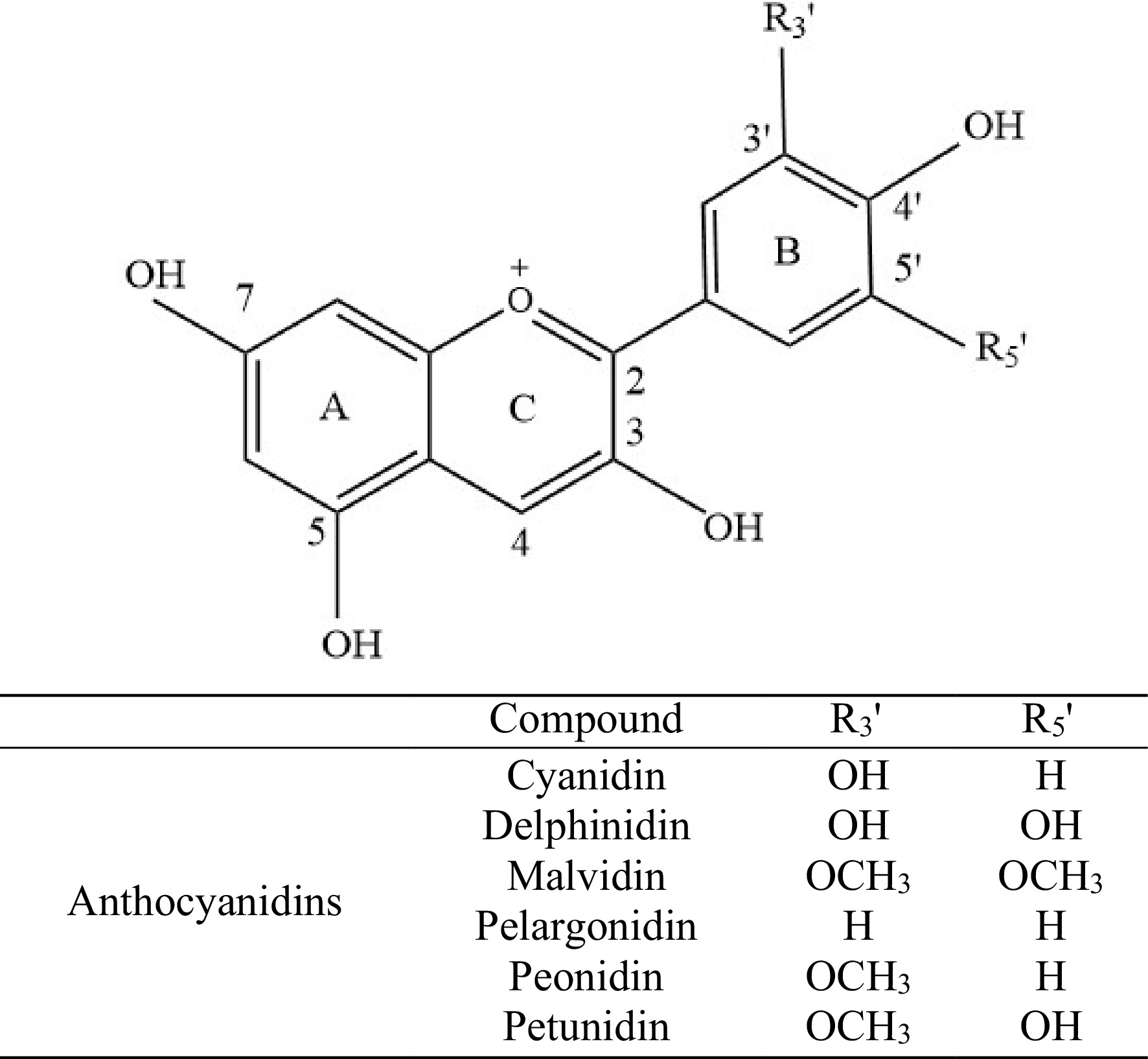
Figure 1.
Chemical structures of anthocyanidins.
Table 1. The pH-responsive properties of anthocyanidins.
Anthocyanidins pH response range pH response sensitivity Stability Application Cyanidin pH 2–8 Somewhat strong in solution; high sensitivity after film formation Stable in solution and after film formation Monitoring food spoilage Delphinidin pH 5.5 shows a significant blue shift Highest in solution; significantly decreases after film formation Worst in solution; significantly improved after film formation Neutral/weakly alkaline systems Malvidin pH 1–4 Not sensitive to weak alkalinity in solution; least sensitivity change after film formation Stable Monitoring of spoilage of highly acidic foods, such as juice and kimchi Pelargonidin pH 3–6 Slightly decreases after film formation High stability Long-term and stable intelligent packaging Peonidin pH 4.5–7 Somewhat strong after film formation Better than delphinidin Sensitive and durable packaging film Petunidin pH 4–6 The lowest sensitivity after film formation Strongest Long-term color retention; only provides slight indications Properties of anthocyanins
Light and thermal stability
-
Anthocyanins exhibit relatively low stability under light and thermal exposure. When subjected to light, especially ultraviolet radiation, anthocyanin molecules absorb energy and transition to excited states, initiating photochemical reactions such as isomerization and degradation. The photodegradation products primarily include phenolic acids, aldehydes, and ketones, which reduce the anthocyanin content and alter their coloration[19].
Regarding thermal stability, the degradation rate of anthocyanins increases with temperature. Elevated temperature disrupts chemical bonds within the anthocyanin structure, leading to processes such as ring opening and isomerization of the flavylium cation. These structural changes result in color fading or loss, accompanied by diminished antioxidant activity. Two representative thermal degradation pathways of cyanidin-3-glucoside under conditions of pH 1 and pH 3.5 are illustrated in Fig. 2[20].
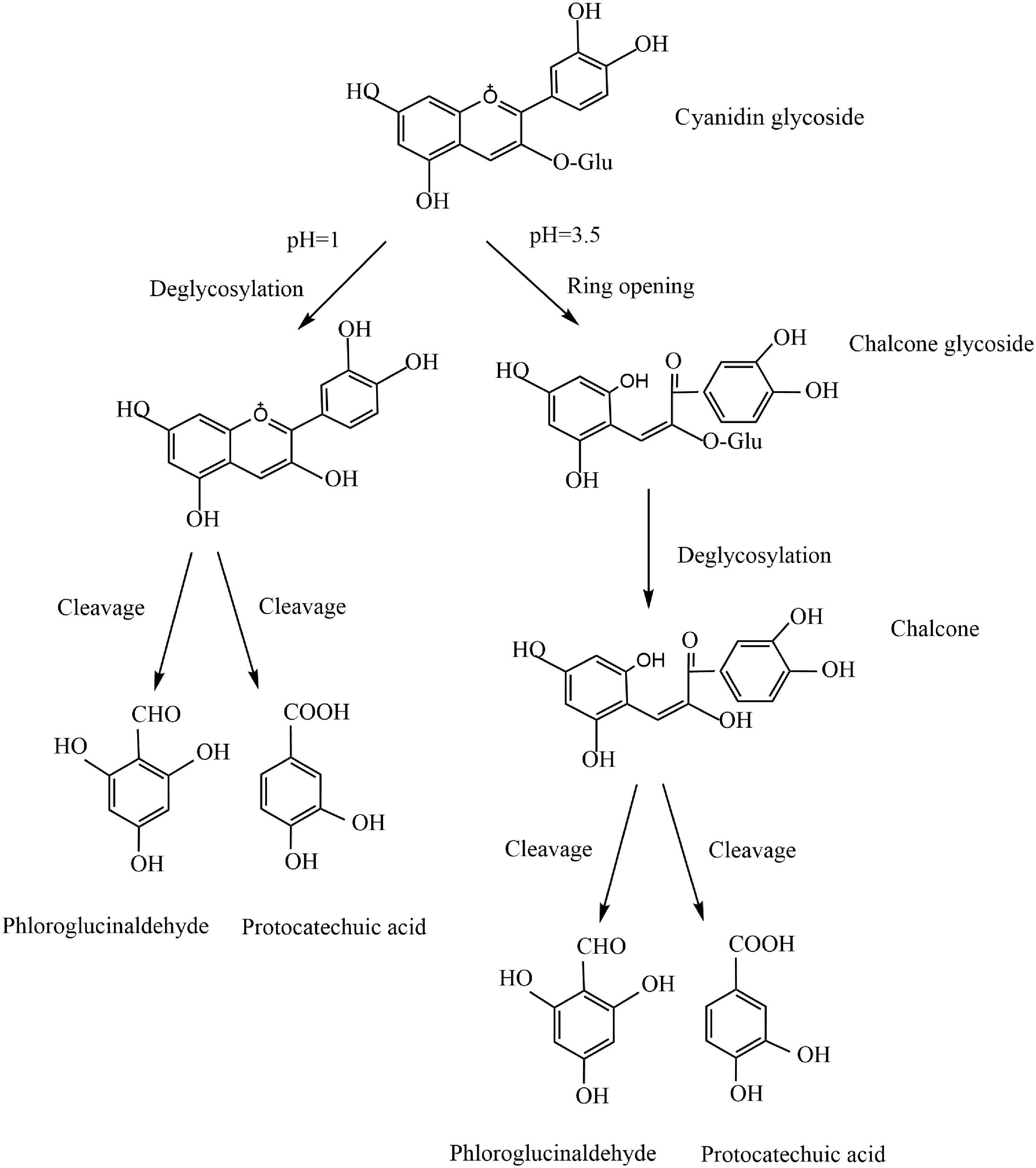
Figure 2.
Two thermal degradation pathways of cyaninin-3-glucoside at pH = l and pH = 3.5[20].
pH sensitivity
-
A key characteristic of anthocyanins is their ability to change color in response to variations in environmental pH, as summarized in Table 2. Under highly acidic conditions (pH < 3), anthocyanins predominantly exist as red flavylium cations (Fig. 3). In this form, the benzene and pyran rings form an extended conjugated system that absorbs light in the blue–green region of the visible spectrum, imparting a red color. As the pH increases to 4–6, protonation leads to the formation of colorless carbinol pseudobase and chalcone structures, gradually reducing the color intensity. In neutral to weakly alkaline environments (pH 7–8), anthocyanins mainly adopt the blue quinonoidal base form, in which further extension of the conjugated system shifts absorption toward longer wavelengths, resulting in a blue appearance. At higher pH values (pH > 8), deprotonation of the quinonoidal base yields corresponding anions, which can further alter or deepen the color[21].
Table 2. Color changes of blueberry anthocyanins at different pH levels.
pH 1 2 3 4 5 6 7 8 9 10 11 12 13 14 Color 


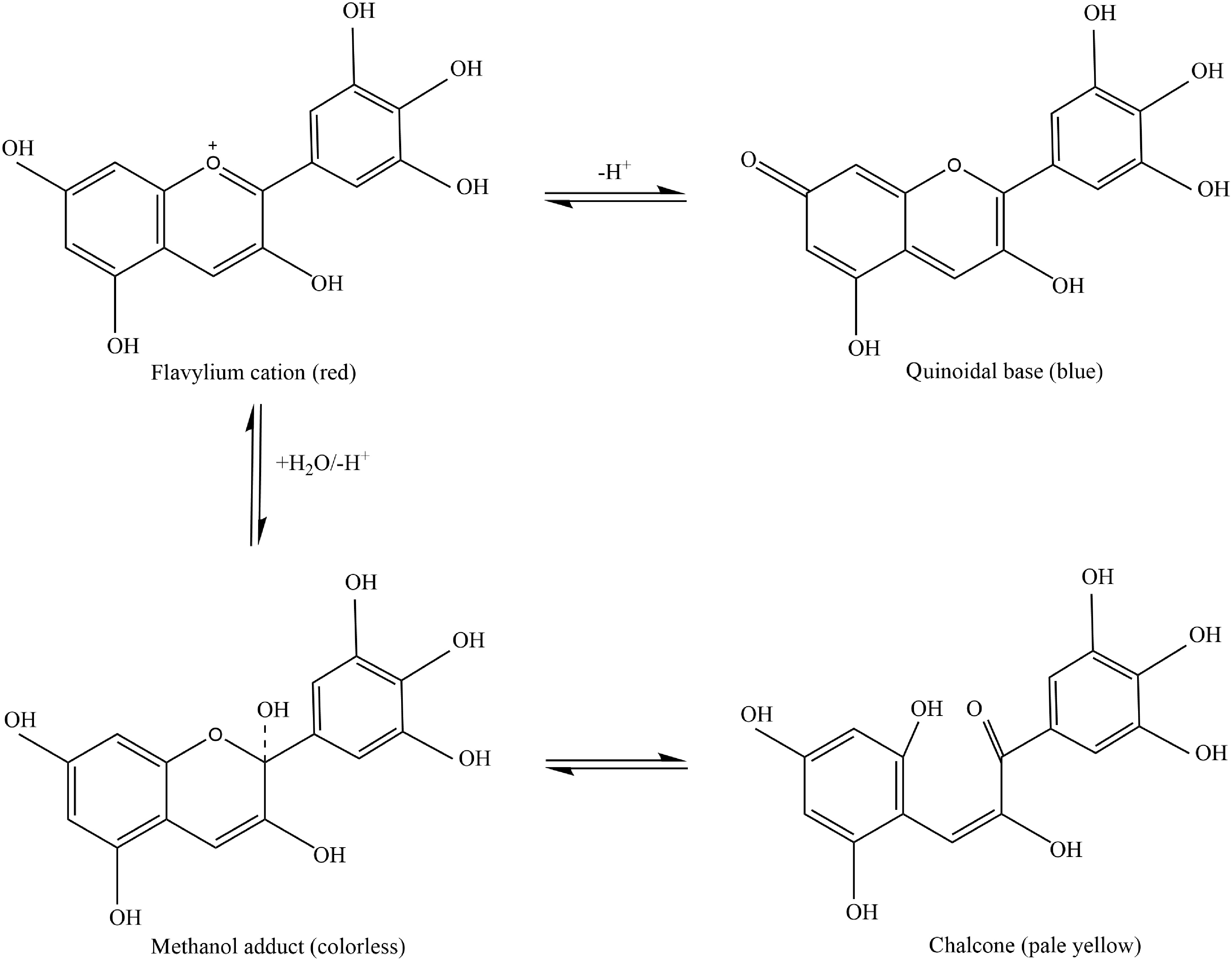
Figure 3.
Structural changes of anthocyanins at different pH values.
This property makes them highly suitable for applications such as monitoring food's freshness and as acid–base indicators[22]. In intelligent packaging systems, color changes in anthocyanin-based films can visually reflect internal pH shifts, providing a real-time indicator of food's freshness. The feasibility of this approach has been demonstrated by incorporating anthocyanin-rich materials into biodegradable films. Blueberry processing by-products have been used in cornstarch-based films to develop pH-responsive systems, with studies focusing on their effects on mechanical properties, pH sensitivity, and antioxidant activity[23]. Similarly, sago starch films supplemented with a 1.5% torch ginger anthocyanin extract exhibited optimal performance, displaying a clear color gradient across pH 2–10[24]. These results confirm that anthocyanin-enriched materials can effectively impart pH-sensitive functionality to biopolymer film matrices.
Chitosan molecular chains, which are rich in protonated amino groups, carry a high-density positive charge under weak acid to neutral conditions. Electrostatic interactions with anthocyanins modulate their dissociation equilibrium, apparent pKa, and pH-responsive behavior. The positive charge of chitosan selectively attracts and stabilizes the negatively charged quinoidal base and chalcone while repelling the positively charged flavylium cation. This drives the structural equilibrium (flavylium cation
$\rightleftharpoons $ Antioxidant activity
-
The potent antioxidant activity of anthocyanins is primarily attributed to the abundance of phenolic hydroxyl groups in their molecular structure. These groups can donate hydrogen atoms to neutralize free radicals, thereby terminating radical chain reactions. Common free radicals, including the superoxide anion (O2−), the hydroxyl radical (OH), and the 1,1-diphenyl-2-picrylhydrazyl radical (DPPH), can be scavenged by anthocyanins[25]. The antioxidant capacity is strongly influenced by the molecular structure. A higher number of hydroxyl groups generally enhances activity, whereas methoxy groups may modulate this effect to some extent. In food systems, anthocyanins can help delay lipid oxidation, inhibit pigment degradation and browning, and consequently extend shelf life. Within biological contexts, they can alleviate oxidative stress-induced damage to cells and tissues, and offer protective effects against the development and progression of oxidative damage-related diseases, such as cardiovascular disorders, cancer, and neurodegenerative conditions[26].
-
Anthocyanins undergo structural transformations in response to pH variations, resulting in distinct color changes. Leveraging this property, they can be incorporated into suitable film-forming materials, such as chitosan, gelatin, or sodium alginate, to create indicator films. These matrix materials provide essential support and immobilization for the anthocyanins, ensuring that the film possesses adequate mechanical strength and stability. When exposed to different pH conditions, the anthocyanin-based films exhibit visible color shifts, enabling real-time visual pH detection. To further optimize performance, additives such as crosslinking agents and plasticizers are often included. Crosslinkers reinforce the film's network and enhance its stability, whereas plasticizers improve flexibility for easier handling and practical application.
Composition
Polysaccharide-based substrates
-
Polysaccharides, including sodium alginate, carboxymethyl cellulose, chitosan, konjac glucomannan, agar, and starch derivatives, are widely used as film substrates because of their edibility and film-forming properties. Their performance can be enhanced through ionic crosslinking (Ca2+/Zn2+) and polyelectrolyte complexation (alginate/chitosan), although excessive crosslinking may reduce moisture in the microenvironment and potentially hinder the migration of biogenic amines, thus affecting the indicator's sensitivity[27]. Recent studies have also focused on optimizing composite formulations. Specific ratios of sodium carboxymethyl cellulose, alginate, and chitosan have been found to yield films with balanced tensile strength, water vapor permeability, and elongation at breakage[28].
Anthocyanins extracted from various plant sources, such as purple tomatoes, mulberries, butterfly pea flower, and blueberry pomace, have been effectively incorporated into polysaccharide matrices to develop intelligent colorimetric films. These systems enable real-time monitoring of the freshness monitoring of foods like fish, milk, and fruits through visible pH-responsive color changes[29−32]. Functional enhancements are often achieved by combining anthocyanins with other active components. The addition of turmeric essential oil or chitosan nanoparticles has been reported to improve their antioxidant capacity, mechanical strength, and antibacterial performance. The incorporation of agricultural by-products such as blueberry pomace not only introduces pH sensitivity but also strengthens the film and supports sustainable resource use[31,33,34].
The field is evolving toward multifunctional systems that integrate freshness indicators with active preservation. Recent advances include hydrogel films with a high moisture-retention capacity to reduce water loss from fruit and inhibit microbial growth. The mechanical properties, barrier properties, and biocompatibility of the edible films can be improved by formulating them with chitosan nanoparticles[35,36]. Overall, natural polysaccharides serve as a versatile and sustainable platform for developing next-generation intelligent packaging, combining real-time monitoring with antioxidant, antibacterial, and physical preservation functions.
Protein and peptide-based substrates
-
Protein-based materials, such as gelatin, whey protein isolate, and fish scale collagen, are widely used as substrates for intelligent films, which can enhance the films' toughness. The inherent buffering capacity of protein also contributes to color stability by mitigating pH drift. Proteins can form hydrogen bonds and hydrophobic interactions with anthocyanins, and can protect anthocyanins from oxygen, moisture, and light. Thus, protein-based materials can preserve the stability of anthocyanins and ensure reliable pH-responsive performance in smart packaging. Composite systems, such as gelatin–alginate, have been developed to improve the mechanical properties including flexibility, tensile strength, and tear resistance, which enhances films' durability during handling and use[37,38].
Recent studies have demonstrated the successful integration of proteins with anthocyanins for practical monitoring applications. Colorimetric nanofiber films based on ethylcellulose/gelatin and purple sweet potato anthocyanins exhibited sensitive visual responses to pH changes during the spoilage of pork[39]. Similarly, a pH-sensitive film based on gelatin and a butterfly pea flower anthocyanin extract was applied to monitor the freshness of beef[40]. The antioxidant and mechanical properties of cassia gum films were significantly improved by incorporating self-assembled crystal structures from Sophora japonica extract[41]. Additionally, zein/gellan gum carrying anthocyanins was systematically evaluated as a stable natural pH indicator for monitoring food[42].
In summary, protein can provide a versatile matrix for smart films by improving mechanical robustness, supporting color stability, and enabling effective anthocyanin protection. Through the design of composite systems and optimized formulations, protein-based intelligent films achieve stable indicator performance and sensitive pH-responsive behavior. These advances highlight their strong potential for real-time monitoring offreshness in foods such as meat, seafood, and other perishable products.
Comparison of polysaccharide and protein/peptide film substrates
-
Polysaccharides feature dense polar functional groups, such as hydroxyl, carboxyl, and amino moieties, along their molecular chains. These groups engage in strong interactions with the phenolic hydroxyl and glycosidic bonds of anthocyanins, primarily via hydrogen bonding and electrostatic forces. Certain polysaccharides (e.g., chitosan) can further reinforce this binding through covalent conjugation. Such multifaceted interactions facilitate the formation of compact three-dimensional networks, achieving double immobilization of anthocyanins: Physical encapsulation shields against external stressors (light, heat, oxygen), whereas chemical anchoring restricts molecular migration and loss. This synergistically inhibits photodegradation, thermal degradation, and pH-induced fading, thereby significantly extending the color stability and functional durability of the film[43]. Moreover, distinct differences in chain rigidity and flexibility among polysaccharides enable tailored modulation of the key properties of a film, including its gas/water vapor barrier performance, mechanical strength, and pH response sensitivity. Polysaccharide matrices generally exhibit broad pH-responsive ranges. For instance, chitosan supports a response across a wide range (pH 2–13), whereas pectin is optimally suited for pH 3–7 (acidic to neutral). Their high sensitivity and distinct color transitions allow precise alignment with pH fluctuations during food storage and transport. From an application standpoint, polysaccharide matrices are particularly suited to scenarios demanding high stability, wide pH responsiveness, strong antibacterial activity, and low cost, such as real-time monitoring of freshness and extended preservation packaging for meat, seafood, and produce. Specifically, chitosan, combining robust antimicrobial effects with broad pH adaptability, is ideal for monitoring high-pH food. Starch, owing to its abundant availability, low production cost, and ease of processing, is well suited for low-cost, short-turnaround food packaging. Blending strategies ensure good anthocyanin compatibility and a sustained pH-responsive chromatic response. Pectin, with its superior gelation and water retention, is preferable for packaging and tracking the freshness of high-moisture foods such as jams and fruit juices[44].
Proteins and peptides are structurally characterized by abundant amino, carboxyl, and amide groups, along with numerous hydrophobic amino acid residues. These features enable diverse binding modes with anthocyanins, including hydrogen bonds, hydrophobic interactions, ionic bonds, and π-π stacking. Notably, proline-rich proteins, such as gelatin, exhibit high affinity for anthocyanins, rapidly forming stable complexes that effectively suppress anthocyanins' self-aggregation and retard oxidative degradation, thereby preserving their chromogenic function. However, excessive covalent interaction between peptides and anthocyanins may disrupt the anthocyanin chromophore, leading to diminished color expression and weakened pH responsiveness, which is a key limitation of protein/peptide matrices[45]. Furthermore, relative to their polysaccharide counterparts, protein/peptide matrices generally display inferior mechanical strength and thermal stability. Gelatin suffers from poor thermoplasticity, softening, and melting above 30 °C, which compromises the film's integrity. Soy protein is prone to thermal denaturation, increasing the film's brittleness and reducing its mechanical performance. In addition, these matrices remain highly hydrophilic, though marginally less so than most polysaccharides, and thus fail to meet high-barrier packaging requirements. Moisture absorption readily disrupts the film's structure and induces anthocyanin leakage. Certain proteins (e.g., keratin) present poor solubility, processing difficulties, and elevated production costs, hindering their large-scale adoption. Moreover, protein/peptide matrices are strongly influenced by their isoelectric points: Near these pH values, the film's stability deteriorates sharply, with shrinkage and cracking further aggravating anthocyanin loss. Additionally, plant-derived proteins like soy protein possess intrinsic coloration that reduces the film's transparency and interferes with visual pH-responsive color changes, compromising intuitive freshness monitoring. In terms of responsiveness, protein/peptide matrices exhibit narrow pH-sensitive ranges, mostly confined to pH 4–8 because of isoelectric constraints, coupled with low sensitivity. The chromogenic response is often obscured by the protein structure itself, thus limiting their applicable scenarios. Overall, protein/peptide matrices are better aligned with applications demanding high flexibility, transparency, excellent biocompatibility, and edibility, such as monitoring the freshness of dairy products and refrigerated meat, as well as edible packaging. Specifically, gelatin, with its superior film-forming ability and flexibility, is well suited for flexible packaging and low-temperature food surveillance. Soy protein, owing to its plant origin, broad availability, and relatively low cost, meets the packaging needs of vegan and plant-based food products, in line with current green and health-conscious consumer trends[46].
Preparation method
Solution casting method
-
The solution casting method is widely used for fabricating anthocyanin-based intelligent pH-responsive packaging films. Its fundamental principle involves dissolving anthocyanins and a polymer matrix in a suitable solvent to form a homogeneous solution. Through stirring or sonication, anthocyanins are uniformly dispersed within the polymer solution. The mixture is then poured into a mold and dried under controlled temperature and humidity conditions. During drying, evaporation of the solvent promotes the aggregation of polymer molecules, resulting in a continuous film structure that exhibits pH-responsive color-changing behavior.
This technique has been effectively utilized to develop functional intelligent films. For instance, a pH/NH3-sensitive film was fabricated by incorporating a blueberry anthocyanin extract into a fucoidan and chitosan matrix via solution casting. The addition of anthocyanins modified the structural network and crystalline arrangement of the film through electrostatic interactions, significantly enhancing its sensitivity to variations in ammonia and pH[47]. In another study, the content of a dried hibiscus petal anthocyanin extract was found to influence the pH responsiveness of the film, its antioxidant and antibacterial activities, and its physical and mechanical properties[48]. Similarly, pH-responsive smart films based on a chitosan/methylcellulose matrix integrated with ripe fruit anthocyanins of Phyllanthus reticulatus were developed using this method. The results indicated that the smart films thus prepared could be utilized for quality assurance as well as extending the shelf life of marine food products[49].
Research indicates that the solution casting method enables the uniform dispersion of anthocyanins within biopolymer matrices such as chitosan, sodium alginate, or pectin. Interactions including electrostatic forces and hydrogen bonding contribute to the formation of a cohesive film network. The resulting intelligent films exhibit sensitive, reversible colorimetric responses to pH and ammonia, alongside functional properties such as antioxidant capacity. Owing to these features, solution-cast anthocyanin-based films show considerable promise for real-time monitoring of food's freshness and represent a significant direction in the development of eco-friendly and intelligent packaging systems.
Electrospinning method
-
Electrospinning is a technique that utilizes electrostatic forces to draw polymer solutions or melts into nanoscale fibers. It offers distinct advantages for fabricating intelligent pH-sensing packaging materials based on anthocyanins, primarily because of its ability to produce fibrous membranes with a high specific surface area and high porosity[50]. The process typically involves loading a polymer solution containing anthocyanins into a syringe with a capillary needle. Upon applying a high voltage to the needle tip, the surface charge density of the solution increases until the electrostatic force overcomes its surface tension, forming a Taylor cone and ejecting a thin jet. The jet is stretched and accelerated in the electric field while the solvent rapidly evaporates, resulting in the deposition of a nanofibrous membrane on a collector[14].
The nanofibrous structure significantly enhances the interaction between anthocyanins and the environment, improving the sensitivity of the pH-responsive color change. Moreover, this structure effectively supports the functional performance of any incorporated bioactive compounds, such as anthocyanins and tea polyphenols, enhancing the film's antibacterial and antioxidant activities. For instance, nanofiber membranes fabricated from polylactic acid, quaternized chitosan, and blueberry anthocyanins have demonstrated significant inhibition of Staphylococcus aureus and Escherichia coli, and exhibited clear color changes at different pH levels, making them suitable as indicator labels for monitoring food's freshness[51]. Similarly, electrospun polyvinyl alcohol/ethyl cellulose membranes incorporating tea polyphenols have shown improved gas permeability, mechanical strength, and bioactive effects, which help delay food oxidation and spoilage[52]. Furthermore, protein-based electrospun nanosensors have been optimized to rapidly detect spoilage-related chemicals in fish, enabling real-time monitoring of freshness[53].
Despite its advantages, electrospinning faces several challenges that limit its widespread industrial application. These include the high equipment costs, relatively complex processing conditions, and low production output. Current research continues to focus on optimizing the technique to overcome these limitations as well as further improving the responsiveness, stability, and functionality of electrospun intelligent packaging materials.
-
The spoilage of meat during storage and transportation involves microbial growth and metabolic activities, which alter its surface pH through the production of acidic or alkaline compounds. Anthocyanin-based intelligent pH indicator films respond to these changes with visible color transitions, providing a direct visual cue for freshness. Typically, the film appears red under the acidic conditions of fresh meat and shifts toward blue or green as spoilage increases the alkalinity. This colorimetric response allows for real-time nondestructive assessments of freshness by both consumers and supply chain agents. Studies have established strong correlations (r > 0.9) between the CIE Lab color parameters (L*, a*, b*) of these films and key spoilage indicators, such as TVB-N, pH, and total viable bacterial counts. Among these parameters, the a (redness) value exhibited the highest sensitivity, enabling effective discrimination among distinct freshness stages. Furthermore, when combined with antimicrobial agents, these films can actively inhibit Gram-negative and Gram-positive bacteria and delay lipid oxidation, thereby extending shelf life. For instance, in a simulated pork preservation study, a composite film incorporating Zeolitic imidazolate framework-8 (ZIF-8) and anthocyanins prolonged shelf life from 3–4 d to 6 d, as verified by electronic nose analysis[54].
Recent research has focused on developing films using diverse biodegradable matrices and anthocyanin sources to enhance functionality and applicability. Composite systems based on polymers, such as agar–starch, cornstarch with modified Pickering emulsions, and multilayer structures of polyvinyl alcohol, sodium alginate, zein, and chitosan have been engineered to improve mechanical strength, barrier properties, and pH responsiveness[55−57]. As meat spoilage progresses, films incorporating anthocyanins from purple sweet potato, purple corncob, or black rice demonstrate distinct color transitions from red/pink to blue-green/yellow, effectively differentiating fresh, moderately fresh, and spoiled states[55,56,58]. Performance can be further enhanced through anthocyanin stabilization techniques, such as chemical modification with mandelic acid, and by combining the components with pigment blending or high-loading methods like acrolein-assisted immobilization on chitosan, which increase sensitivity and color stability[59−61]. Additionally, sustainable formulations using cassava starch or pectin/chitosan composites have served as promising indicators of freshness during chilled storage, with notable color changes corresponding to spoilage phases[58].
In summary, anthocyanin-based intelligent films offer real-time visual monitoring of freshness via pH-sensitive color changes that are strongly correlated with spoilage metrics. The integration of antibacterial components effectively reduces the microbial load and oxidative deterioration, significantly prolonging the shelf life of products such as pork and chicken. Systems that merge precise indication with enhanced preservation have demonstrated considerable potential for practical application in intelligent meat packaging. Future developments are expected to focus on optimizing films' sensitivity, stability, and scalability for industrial adoption.
Intelligent indicator films for aquatic products
-
The spoilage of seafood, driven by microbial growth and endogenous metabolism, is accompanied by distinct biochemical changes, including a rise in pH and the release of volatile basic nitrogen compounds such as trimethylamine (TMA) and ammonia. Intelligent packaging films incorporating pH-sensitive anthocyanins can visually respond to these alterations through measurable color changes. For instance, the pH of fresh shrimp typically ranges from 6.0 to 6.5 but increases during spoilage, causing an anthocyanin-based film to shift gradually from red or purple (indicating freshness) to blue or green (signaling spoilage). This provides a straightforward, visual tool for assessing freshness. Furthermore, the color parameters of these films often show a strong correlation with established spoilage indices like TVB-N, enabling quantitative monitoring. Such correlations have been successfully established for products like tilapia and perch, facilitating potential evaluations of freshness through digital image analysis via smartphones[62].
Recent research has focused on developing composite films using various biopolymer matrices, such as starch/polyvinyl alcohol (PVA), sodium alginate/pectin, and cellulose nanocrystals, infused with anthocyanin extracts from sources like Vaccinium vitis-idaea, rose, and purple sweet potato[63−65]. These films demonstrate a broad pH response range and pronounced color transitions, correlating well with pH and TVB-N levels during the spoilage of shrimp, grass carp, and other aquatic products. Specific formulations have been optimized for performance. Films containing red cabbage anthocyanins in a cellulose-based matrix exhibited improved elongation at breakage and a rapid response to alkaline pH, which is advantageous for packaging applications[65]. Beyond their indicator function, many of these composite systems are engineered with additional functionalities. By combining anthocyanins with matrices like chitosan, or incorporating nanoparticles such as nano-ZnO, the antibacterial activity of the films against common pathogens like Staphylococcus aureus and Escherichia coli was improved, along with mechanical strength and water vapor barrier properties[13,66]. This dual functionality not only enables real-time visual monitoring but also actively retards microbial spoilage, extending the shelf life of the packaged product.
In summary, anthocyanin-based intelligent films offer a promising approach for aquatic product packaging by accurately translating spoilage-related chemical changes into visible color signals. Their ability to monitor freshness in real time is complemented by the integration of active components, providing antibacterial and barrier effects at the same time. Advances in material design, including the use of nanocellulose matrices and optimized anthocyanin concentrations, contribute to improved mechanical and responsive properties[65]. The synergy between the indicator and preservation functions represents a significant advancement toward intelligent packaging systems, which are capable of both monitoring quality and prolonging shelf life. The anthocyanin-based intelligent pH indicator films have considerable potential for commercial application in the seafood industry.
Other applications
-
In the transformation of the food industry toward precision preservation and visual quality control, anthocyanin-based intelligent packaging films have demonstrated core value beyond monitoring meat and aquatic products. By optimizing matrix formulations, innovating modification techniques, and expanding the anthocyanin sources, researchers have developed tailored intelligent films that address category-specific freshness monitoring challenges, while offering versatile solutions for cross-scenario food quality management.
Recent studies have illustrated this expansion through various material designs. A gelatin-based film was enhanced with anthocyanins from purple cabbage, chondroitin sulfate, and tannic acid, improving both its indicator performance and practical stability for monitoring freshness[67]. Similarly, a starch/polyvinyl alcohol film incorporated black goji berry anthocyanins, gaining pH-responsive capability, whereas nanocomposite reinforcement improved the film's physical properties and the anthocyanins' stability[68]. Embedding jaboticaba peel anthocyanins into a biopolymer matrix produced a pH-sensing film with thermal stability up to 200 °C, which reduced moisture content and lowered water vapor permeability[69]. This film showed clear color changes after 8 days in milk spoilage tests and performed well in simulated alcoholic and high-fat environments, indicating suitability for dairy and similar products. Further innovation included a microencapsulated red cabbage anthocyanin extract within packaging materials, which improved stability, antioxidant capacity, and shelf life extension for freshness-sensitive foods[70].
These advances have successfully broadened applications from meat and seafood to dairy, high-fat foods, and beyond, demonstrating considerable potential for precise quality monitoring across food categories. This progress provides solid technical support for the development of a diversified and responsive intelligent packaging system.
-
Anthocyanins undergo stepwise structural transitions with pH variation, accompanied by a continuous hue shift from red to purple to blue to green, although the total pigment content remains largely unchanged. This rapid, progressive color change is synchronous with the accumulation of alkaline compounds during food spoilage, exhibiting a continuous and directional hue shift that is irreversible and closely correlated with food quality. The smart film displays a uniform color change without distinct interfaces or pigment diffusion traces, and the matrix structure remains intact, with only a phase shift in color.
Leaching of anthocyanins from the film matrix into food or aqueous environments reduces the pigment concentration within the film, manifesting as increased lightness, decreased saturation, and overall fading to pale white, although the hue remains essentially unchanged. This phenomenon is strongly correlated with ambient humidity and time, occurring rapidly under high-humidity conditions, with an initially rapid fading followed by gradual stabilization, and it is asynchronous with food's pH or the progression of spoilage. Even without significant deterioration of the food, the film may turn white and transparent because of high humidity alone, accompanied by marked swelling, softening, tackiness, structural loosening, and partial dissolution. Such leaching not only reduces the film's anthocyanin retention and functional stability but may also cause food discoloration, impair its sensory quality, and raise safety concerns, representing a key bottleneck limiting the large-scale application of anthocyanins in high-moisture foods. To effectively inhibit anthocyanin leaching in high-moisture environments, current research has developed a series of feasible strategies focusing on enhancing interactions, optimizing the matrix structure, and constructing physical barriers.
Strengthening the interactions between the matrix and anthocyanins is the most direct and effective approach. Through hydrogen bonding, electrostatic interactions, hydrophobic forces, or even covalent bonding, anthocyanin molecules can be stably anchored within polysaccharide or protein networks, reducing the migration capacity of free pigments and thus lowering leaching risk without significantly altering the matrix structure. Appropriate molecular interactions not only improve the pigment binding fastness but also preserve the pH-responsive properties and antioxidant activity of anthocyanins, making this strategy applicable to various systems such as gels, edible films, and coatings.
Li et al.[71] developed an easy and green method to synthesize nanocarriers from chondroitin sulfate and whey protein isolate, constructing nanocomplexes with cavity structures via hydrogen bonding and electrostatic interactions. These nanocarriers encapsulate and stably immobilize anthocyanins, effectively enhancing their stability under different environments (e.g., high humidity, varied pH) while exhibiting good biocompatibility. This work provides new theoretical and practical insights for the combined application of protein–polysaccharide composite matrices with anthocyanins and for inhibiting anthocyanin leaching, aligning with the safe application requirements of anthocyanins in the food sector. A colorimetric indicator film was prepared using the natural exopolysaccharide riclin and anthocyanins as the core materials, focusing on the interaction mechanism (primarily hydrogen bonding) between them[72]. This interaction enables stable immobilization of anthocyanins within the film matrix, effectively suppressing their leaching and migration under high-humidity conditions. The composite film also exhibits favorable pH responsiveness and biocompatibility, enabling accurate monitoring of food's freshness during storage through intuitive color changes. This work offers new technical strategies and practical evidence for the fabrication of natural polysaccharide-based anthocyanin indicator films and for monitoring food freshness, aligning with the development trends of degradable and green food packaging.
Matrix crosslinking and structural densification are also widely used to inhibit leaching. Reducing the degree of swelling and porosity of the matrix under high-moisture conditions compresses the diffusion pathways of anthocyanins. Incorporating nanofillers (e.g., nanocellulose, layered silicates) further prolongs the transport paths of water and pigment molecules, enhancing their mechanical and barrier properties while significantly delaying anthocyanin leaching. A zein/chitosan matrix was fabricated by incorporating black wolfberry anthocyanins and cinnamon essential oil in a Pickering emulsion, which reinforced multiple physical crosslinks (hydrogen bonding, electrostatic, hydrophobic interactions) within the system, leading to film densification[73]. This substantially improved the mechanical, barrier, and stability properties, while imparting pH-responsive color change and sustained antibacterial/antioxidant release functions, and was successfully applied in intelligent preservation packaging of salmon. A pH-sensitive film was developed using gelatin/chitosan/nanocellulose as the matrix and incorporated hawthorn anthocyanins[74]. The anthocyanins enhanced intermolecular crosslinking among polymer chains via hydrogen bonding and electrostatic interactions, promoting film densification and improving the mechanical and barrier properties. The film also exhibited sensitive pH responsiveness, enabling visual monitoring of freshness in shrimp.
Moderate hydrophobic modification can also mitigate leaching at the source. Esterification, alkylation, or the incorporation of hydrophobic components such as beeswax, lipids, or essential oils reduces the matrix's hydrophilicity and water absorption, minimizing any swelling and dissolution caused by water permeation, thereby improving anthocyanin retention under high-humidity conditions. Loukri et al.[75] prepared edible chitosan–citric acid active packaging films loaded with cornelian cherry pomace extract. The core approach involved covalent physical dual crosslinking between citric acid and the extract, densifying the film's structure. Moderate hydrophobic modification further reduced the film's swelling, suppressing the leaching of active components from the extract at the source, while synergistically enhancing its mechanical, barrier, and antioxidant stability, optimizing the application efficacy of edible active packaging. Chitosan/gelatin blend films and bilayer films were compared, both incorporating lauroyl arginate ethyl (LAE) as an antimicrobial agent[76]. Moderate hydrophobic modification reduced the film's swelling and structural loosening, mitigating leaching of LAE at the source; moreover, the auxiliary improvements in mechanical, barrier, and antimicrobial stability enhanced its suitability for food packaging.
In practical applications, the selection of appropriate technical strategies should be based on the food system's characteristics, water activity, processing conditions, and safety requirements. These strategies must suppress leaching while maximally preserving the functional properties of anthocyanins, thereby advancing their reliable application in intelligent packaging, active foods, and biodegradable materials.
-
Anthocyanin-based intelligent pH indicator films represent an emerging technology with considerable potential for food preservation and real-time monitoring of freshness. However, several challenges currently limit their widespread adoption. The stability and durability of anthocyanins can be compromised under varying environmental conditions, including light and temperature, affecting their long-term reliability. Additionally, the production costs remain high, accurate quantification of spoilage is difficult, and scalable manufacturing processes are not yet fully established. Most studies to date remain at the laboratory scale, lacking validation in real food supply chains, which calls for further assessment of their safety and practical efficacy. Future efforts should focus on enhancing anthocyanins' stability through chemical modification or composite materials, developing cost-effective production methods, and conducting more field trials to verify their performance in commercial settings. Integration with other smart technologies could also enable more precise quality monitoring. Through interdisciplinary innovation, anthocyanin-based intelligent packaging is poised to play an increasingly significant role in supporting food safety and sustainable industry practices.
-
The authors confirm contributions to the paper as follows: study conception and design: Adel Ashour A, Tan H, Jiao X; data collection: Zhang L, Zhang C, Yun X; draft manuscript preparation: Zhang L, Jiao X; manuscript review: Wang X. All authors reviewed the results and approved the final version of the manuscript.
-
The datasets generated during and/or analyzed during the current study are available from the corresponding author on reasonable request.
-
The authors declare that they have no conflict of interest.
-
This accompanies this paper online at: https://doi.org/10.48130/fia-0026-0039.
- Supplementary Table S1 Impact of diverse anthocyanins sources on the performance of pH indicator films
- Copyright: © 2026 by the author(s). Published by Maximum Academic Press on behalf of China Agricultural University, Zhejiang University and Shenyang Agricultural University. This article is an open access article distributed under Creative Commons Attribution License (CC BY 4.0), visit https://creativecommons.org/licenses/by/4.0/.
-
About this article
Cite this article
Zhang L, Zhang C, Yun X, Adel Ashour A, Wang X, et al. 2026. Research progress on anthocyanin-based intelligent pH indicator films. Food Innovation and Advances 5(3): 492−502 doi: 10.48130/fia-0026-0039 

Research progress on anthocyanin-based intelligent pH indicator films
- Received: 15 December 2025
- Revised: 17 June 2026
- Accepted: 28 July 2026
- Published online: 29 September 2026
Abstract: With the continuous consumer demands for the improvement of food safety, quality, and freshness preservation, food packaging technology is rapidly evolving. Although traditional packaging materials have barrier and protective functions, they lack the capability for real-time monitoring of food quality and transmitting information. Intelligent packaging, as a novel technological system, not only ensures food safety but also enables intuitive monitoring of food quality. Natural pigments represented by anthocyanins have become a cutting-edge direction in research into intelligent packaging films because of their remarkable pH sensitivity and multiple biological activities. This paper systematically reviews the chemical structure and physicochemical properties of anthocyanins, and the selection of substrate materials and film-forming mechanisms for intelligent packaging films. The functional characteristics and application examples of anthocyanin-based intelligent pH indicator films in meat products, aquatic products, fruits, vegetables, and dairy products are discussed. In light of research from the past five years, the advantages of being eco-friendly and enabling visual monitoring of food's freshness, and the limitations of poor stability and susceptibility to environmental interference of anthocyanin-based intelligent packaging films are analyzed in this review. Future development trends are presented, aiming to provide a reference for subsequent research and industrial applications.
-
Key words:
- Anthocyanins /
- pH indicator films /
- Intelligent packaging /
- Food preservation