











-
Global climate change and environmental degradation are becoming increasingly severe. In particular, excessive emissions of greenhouse gases, such as carbon dioxide, have posed grave challenges to the sustainable development of humanity. Following the signing of the Paris Agreement, addressing climate change and controlling greenhouse gas emissions have become central concerns of the international community. As the world's largest developing country, China announced its 'dual carbon' strategic goals in 2020, pledging to peak carbon emissions by 2030 and achieve carbon neutrality by 2060. These goals not only reflect China's commitment to fulfilling its responsibilities as a major nation and advancing the building of a community with a shared future for mankind, but also serve as a crucial driver for deep-seated industrial restructuring and the green transformation of its energy systems. Under strong policy guidance from the central government, the transportation sector, as the lifeblood of the national economy, is witnessing its green transition shift from a singular focus on energy efficiency improvement toward structural optimization, thereby positioning it as a key breakthrough in fulfilling the carbon peaking and neutrality mandates.
In today's complex modern transportation and logistics networks, the port consolidation and distribution system serves as a pivotal hub connecting global supply chains with inland hinterlands. Its operational efficiency not only directly affects port throughput capacity and overall competitiveness, but also determines the energy consumption level of the entire regional logistics chain.
However, under the traditional development model, the port consolidation and distribution system suffers from a severe structural imbalance. Statistics show that road transport handles 62.7% of container throughput at China's major coastal ports, while railway and waterway account for only 3.0% and 34.3%, respectively. This road-dominated modal mix is significantly higher than the approximately 50% road share observed in European and American ports. This excessive reliance on road transport has led to traffic congestion, increased carbon emissions, and severe environmental pollution, locking the system into a long-standing state of structural imbalance dominated by highways.
Although river–sea intermodal transport exhibits considerable green potential due to its advantages of low energy consumption and high volume capacity, its advantages have not been fully realised in actual operations. Poor coordination among port operators, waterway carriers, and road transport providers, coupled with the absence of effective interest coordination mechanisms, has kept overall system emissions at a high level.
Optimizing the consolidation and distribution system under the 'dual carbon' goals is, in essence, a process of promoting structural emission reduction through multi-party collaborative gaming. This requires port operators, river-sea intermodal operators, and road transport operators to move beyond isolated decision-making aimed at maximizing individual profits under the logic of green transformation. Driven jointly by carbon tax pressure, revenue compensation, and policy incentives, the system should evolve from the traditional structurally imbalanced state toward a green, collaborative structure. In the process of multi-party collaborative development of port consolidation and distribution systems, the main stakeholders involved include ports, river-sea intermodal transport operators, and road transport operators. The relationships among the parties in the tripartite evolutionary game are shown in Fig. 1.
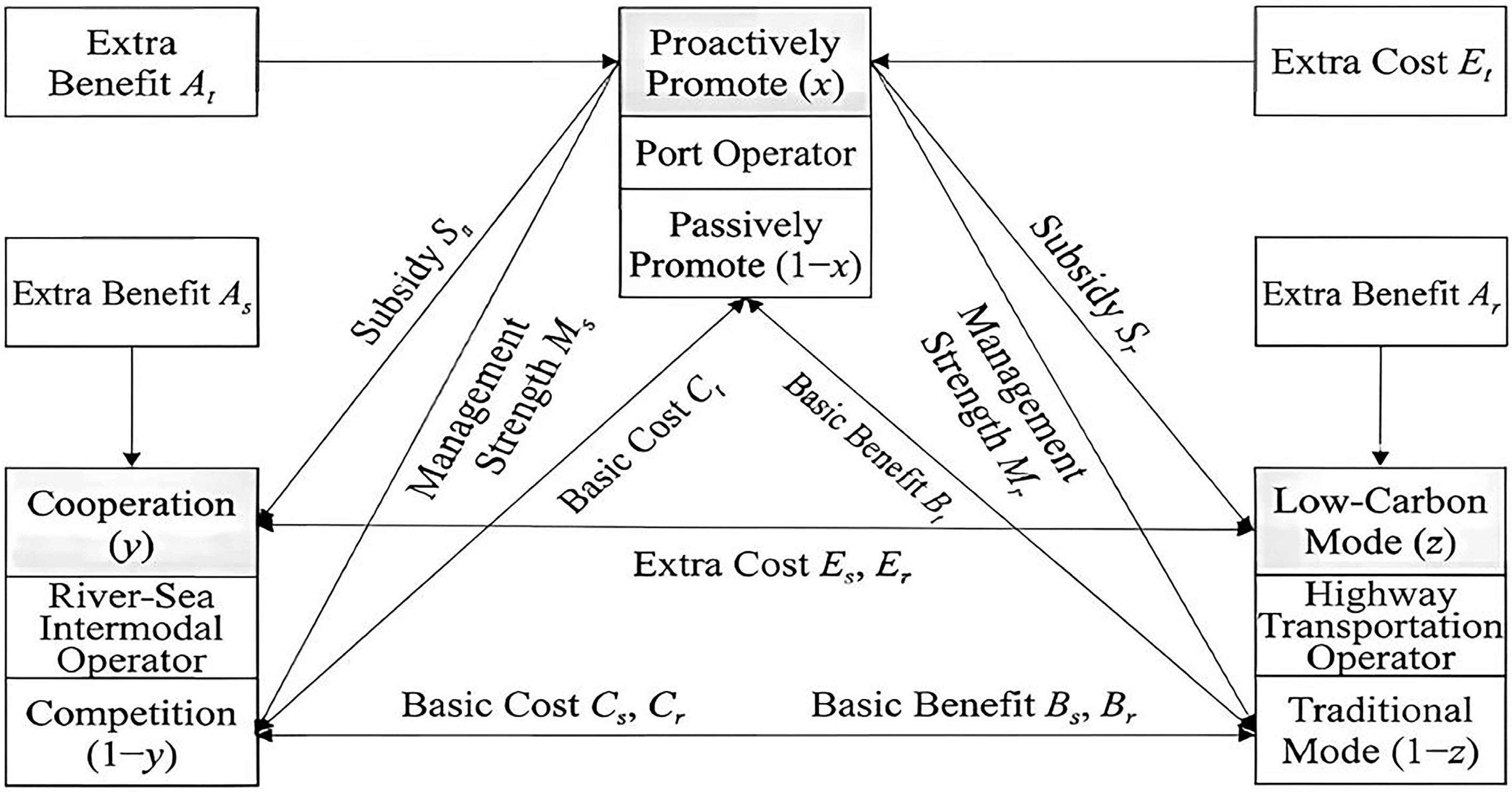
Figure 1.
Logical diagram of the tripartite evolutionary game model.
-
Early research focused on resource allocation and operational efficiency in port-hinterland networks. Shen & Khoong pioneered system network optimization for empty container repositioning[1]. Janic developed an integrated cost model comparing transport modes in European freight systems[2]. Recent studies have refined these approaches: He et al. optimized external truck task scheduling at automated terminals[3]; Guo et al. advanced carbon emission estimation for hinterland container intermodal networks[4]; and Xu et al. addressed tractor-trailer scheduling under disrupted events[5].
Multimodal transport planning under uncertainty
-
A second stream addresses route planning and network design under uncertainty. Li et al. constructed a multi-objective fuzzy nonlinear model for intermodal route selection under time-window constraints[6]. Xin et al. developed a bi-level model for liner alliance shipping network design with slot allocation and empty container repositioning[7]. Yan et al. proposed an optimization approach for port integration through capacity adjustments[8]. Yin et al. examined collaborative effects of rail subsidies and carbon trading[9]. Hu et al. investigated low-carbon multimodal route optimization from a government-enterprise collaborative perspective[10]. Wang et al. analyzed port pricing strategies under intra-port coordination and inter-port competition[11].
Stakeholder interactions and game-theoretic models
-
Recognizing the limitations above, researchers have turned to game-theoretic approaches. Zhu et al. analyzed shipping company strategies under cap-and-trade mechanisms[12]. Jiang et al. constructed a marine fuel supply chain model examining green fuel promotion[13]. Sheng et al. developed a framework incorporating regional port competition dynamics[14]. Xu et al. employed a Stackelberg game to examine the trade-off between government subsidies and port competition in shore power construction[15].
Recent tripartite evolutionary game studies are particularly relevant. Xu et al. constructed a three-party model including port operators, river-sea intermodal operators, and road transport operators under the 'dual carbon' goal. Their finding—that intermodal operators are more cost-sensitive while road operators depend more on policy-derived benefits—aligns closely with our simulation results[16]. Chen et al. examined tripartite interactions among governments, ports, and shipping companies under carbon trading, demonstrating that subsidies and fines play complementary roles[17]. Zhang et al. employed tripartite evolutionary game theory with system dynamics to analyze shore power promotion under carbon tax and subsidy policies[18].
Multi-agent reinforcement learning in transportation
-
MARL has emerged as a complementary paradigm for modeling adaptive decision-making. Recent applications include: a MARL framework for port recovery investment decisions under extreme weather events demonstrating superior performance over state-dependent evolutionary game benchmarks, an adaptive MARL large model for logistics-energy coordination at container seaports, and a MARL approach for joint block assignment and yard crane redeployment at intermodal terminals. Li et al. systematically examined MARL's evolutionary trajectory across value function decomposition, policy gradient, and actor-critic architectures[19]. Surveys have explored MARL applications in traffic signal control, UAV navigation, air traffic management, and maritime autonomous navigation.
Research gaps and our contribution
-
The existing literature exhibits three interconnected gaps: First, centralized optimization models overlook the decentralized, self-interested nature of stakeholder decision-making. Second, game-theoretic models employ static structures that fail to capture dynamic learning and bounded rationality. Third, the spatial dimension of strategy propagation—how collaborative behaviors emerge from local interactions and diffuse across agent networks—remains unaddressed. Fourth, the integration of MARL with evolutionary game theory in the port collection-distribution context is underexplored.
To bridge these gaps, we construct a co-evolutionary model integrating evolutionary game theory with MARL. Unlike existing approaches, our model: (1) captures the bounded rationality of three heterogeneous agent types through dynamic Q-learning with satisfaction-based adjustment; (2) incorporates a spatial grid structure, revealing how local collaboration clusters expand into global patterns; (3) embeds carbon tax and subsidy policies into the reward function to quantify their interactive effects; and (4) distinguishes between experience-driven and adaptive learning agents to capture real-world heterogeneity in decision-making styles.
-
From a micro perspective, an agent is a computational entity with independent decision-making capabilities. To precisely describe its behavioural logic in complex environments, an agent is usually formally defined as a quadruple:
$ Agent_i=\mathcal{P}_i,\mathcal{S}_i,\mathcal{A}_i,\mathcal{D}_i. $ (1) The perception function
$ {\mathcal{P}}_{i} $ The internal state
$ {\mathcal{S}}_{i} $ The action space
$ {\mathcal{A}}_{i} $ The decision logic
$ {\mathcal{D}}_{i} $ $ {\pi }_{i}\colon {\mathcal{S}}_{i}\times \mathcal{O}\rightarrow {\mathcal{A}}_{i} $ When multiple agents are placed in the same dynamic environment, the core of system evolution shifts to the interactions among agents. The essential characteristic of a multi-agent system lies in the coupling of its joint action space. There are n agents in the system, and their joint action is denoted as
$ a=\left({a}_{1},{a}_{2},\cdots ,{a}_{n}\right)\in \mathcal{A} $ Under this framework, the payoff function of any agent is no longer determined solely by its own decision
$ {a}_{i} $ $ R_i=f_i\left(s,a_i,a_{-i}\right), $ (2) where,
$ {a}_{-i} $ $ i $ The rigorous mathematical foundation underlying reinforcement learning is the Markov decision process (MDP), whose core logic is to enable an agent to maximise cumulative rewards through continuous trial and error in an unknown environment. The collaborative process of multiple agents in port consolidation and distribution can be abstracted as a Markov decision process composed of a five-tuple
$ \mathcal{M}=\mathcal{S},\mathcal{A},\mathcal{P},\mathcal{R},\gamma $ State space
$ \mathcal{S} $ Action space
$ \mathcal{A} $ State transition probability
$ \mathcal{P} $ $ \mathcal{P}\left({s}^{\prime}|s,a\right)=\mathbb{P}\left[{S}_{t+1}={s}^{\prime}|{S}_{t}=s, {A}_{t}=a\right] $ Reward function
$ \mathcal{R} $ Discount factor
$ \gamma $ $ \gamma \in \left[0,1\right] $ The ultimate goal of reinforcement learning is to find the optimal policy
$ {\pi }^{*}\left(a|s\right) $ $ {G}_{t} $ $ {G}_{t}=\mathbb{E}\left[\sum \limits_{k=0}^{\infty}{\gamma }^{k}{r}_{t+k}\right] $ (3) To evaluate the quality of a policy, the state-action value function
$ {Q}^{\pi }\left(s,a\right) $ $ {Q}^{\pi }\left(s,a\right)={\mathbb{E}}_{\pi }\left[{r}_{t}+\gamma {Q}^{\pi }\left({s}_{t+1},{a}_{t+1}\right)|{S}_{t}=s,{A}_{t}=a\right] $ (4) This equation reveals the dynamic relationship between the decision value at the current moment and the expected value of future states, providing a mathematical basis for agents to allocate strategic weights during the gaming process.
The Q-learning algorithm was proposed by Watkins in 1989 and is a value-iteration-based reinforcement learning method. Its main characteristics lie in its two attributes: 'model-free' and 'off-policy'. In simple terms, the agent does not need to know the state transition probabilities of the environment in advance; instead, by continuously interacting with the environment and recording the expected return Q-value for each 'state-action' pair, it can gradually search for the optimal policy. In the context of multi-party gaming in port consolidation and distribution, Q-learning transforms the bounded rational behaviours of participating agents into an incremental update process of Q-values. The Q-value can be understood as the expected long-term discounted return that an agent can obtain by adopting a certain depth of collaboration under a specific policy environment. As the Q-table is continuously updated, the agent can gradually find the optimal behavioural boundary under the constraints of the 'dual carbon' goals.
The mathematical logic of Q-learning is built upon the Bellman equation. At each time step, the agent is in state
$ {s}_{t} $ $ {a}_{t} $ $ {r}_{t} $ $ {s}_{t+1} $ $ {Q}^{*}\left(s,a\right) $ $ {Q}^{*}\left(s,a\right)=\mathbb{E}\left[{r}_{t}+\gamma ma{x}_{{{a}^{\prime}}}{Q}^{*}\left({s}_{t+1},{a}^{\prime}\right)|{s}_{t}=s,{a}_{t}=a\right] $ (5) In actual simulation evolution, the agent employs the temporal difference method to perform incremental updates on the Q-values. The update logic is as follows:
$ Q\left(s_t,a_t\right)\leftarrow Q\left(s_t,a_t\right)+\alpha\left[r_t+\gamma max_aQ\left(s_{t+1},a\right)-Q\left(s_t,a_t\right)\right]. $ (6) Learning rate
$ \alpha \in \left(0,1\right) $ $ \alpha $ $ \alpha $ Discount factor
$ \gamma \in \left[0,1\right] $ TD error
$ \left[{r}_{t}+\gamma maxQ\hbox{--}Q\right] $ To prevent the system from becoming trapped in local optima during the simulation process, Q-learning introduces the
$ \epsilon -greedy $ $ 1-\epsilon $ $ \epsilon $ $ \pi \left(\left.a\right| s\right)=\left\{\begin{aligned} & random\;action &with\;probability\;\epsilon \\ &argma{x}_{a\in A}Q\left(s,a\right)&with\;propability\;1-\epsilon \end{aligned}\right. $ (7) This mechanism simulates the trial-and-error behavior of ports and carriers when confronting carbon reduction policies in reality: while retaining past successful collaborative experience, it also maintains the possibility of attempting new strategic models[20].
-
This study abstracts the complex port collection-distribution ecosystem consisting of two-dimensional grids
$ G $ $ G=\{\left(x,y\right)|1\leq x,y\leq L\} $ $ L=30 $ $ N=L\times L=900 $ $ i $ $ \in $ $ N/3 $ To eliminate the 'edge effects' arising from finite-sized grids, this model introduces periodic boundary conditions. Mathematically, for any node
$ \left(x,y\right) $ $ {x}^{\prime}=\left(\left(x-1\right)\left(modL\right)\right)+1 $ (8) $ {y}^{\prime}=\left(\left(y-1\right)\left(modL\right)\right)+1 $ (9) Define the agent type function
$ f\left(x,y\right)\in \left\{P,S,R\right\} $ $ f\left(x,y\right)=\begin{cases} P,if\left(x+y\right)\left(mod3\right)=0\\ S,if\left(x+y\right)\left(mod3\right)=1\\ R,if\left(x+y\right)\left(mod3\right)=2 \end{cases} $ (10) Multi-agent decision definition and reward function design
-
Under the multi-agent reinforcement learning framework, the strategy in traditional game theory is strictly defined as the action of an agent. For any heterogeneous agent in the system, its discrete action space at time t is defined as
$ {\mathcal{A}}_{i} $ $ \mathcal{A}_i=\left\{a_0,a_1\right\}. $ (11) The cooperative emission reduction action
$ {a}_{1} $ The traditional maintenance action
$ {a}_{0} $ At each decision step
$ t $ $ {a}^{t}=\left(a_{1}^{t},a_{2}^{t},\cdots ,a_{N}^{t}\right) $ Distinct from perfect-information games, the agents in this model are characterised by bounded rationality and local observation capabilities. The state of agent
$ i $ $ s_{i}^{t}\in {S}_{i} $ $ {\Omega }_{i} $ In the regular grid setting of this paper, any agent is adjacent to two types of heterogeneous agents; for example, a port agent has two river-sea intermodal neighbours and two road transport neighbours. Define the state variable as the number of neighbours that choose the collaborative action. Taking a port agent as an example, its state space can be expressed as
$ s_P^t=\left(n_C^t,n_L^t\right), $ (12) where,
$ n_{C}^{t}\in \left\{0,1,2\right\} $ $ n_{L}^{t}\in \left\{0,1,2\right\} $ $ \left| {S}_{i}\right| =3\times 3=9 $ In the traditional scenario, the carbon tax is applied exclusively to road transport operators, while port operators and river–sea intermodal operators are not subject to this cost. This design reflects the current policy reality in China: road freight, as the largest and fastest-growing source of carbon emissions in the logistics sector, has been the primary target of environmental regulations such as fuel taxes and emission trading schemes. In contrast, ports and inland waterway transport, while not yet subject to direct carbon taxation in most regions, operate under different regulatory logics—ports face indirect pressures through shore power mandates and emission control area requirements, while waterway transport inherently possesses a lower carbon footprint per ton-km. This asymmetry is therefore not an oversight but a deliberate modeling choice that reflects the real-world regulatory hierarchy. Importantly, our counterfactual scenarios systematically explore the effects of extending carbon taxes to all agent types, thereby providing policy insights into the potential consequences of broader carbon pricing schemes.
Simulation model parameter settings
-
In conducting the multi-agent spatiotemporal evolution simulation, in order to more clearly observe the driving effects of the 'dual carbon' policies on system collaboration, this chapter integrates the underlying payoff logic of the evolutionary game as the foundational environmental support for agent learning, while focusing on two core external variables—carbon tax and policy subsidies—to examine the system transformation patterns under specific policy combinations. The reward function design here is primarily intended to test the pathways through which external policy instruments influence individual decision-making[23]. By introducing carbon tax constraints and guiding subsidies, the simulation models the process by which policy intervention adjusts the payoff expectations of game participants, further exploring whether the system can effectively overcome evolutionary resistance and achieve green synergy under the influence of policy combinations. To quantitatively assess the specific impacts of policy interventions on tripartite collaboration, the symbols and definitions involved in the multi-agent model of this chapter are presented in Table 1.
Table 1. Notations and definitions for the multi-agent model.
Parameter Definition Description and practical significance $ {C}_{P} $ Additional costs of port green transformation Investments made by ports in green hub retrofitting and low-carbon facility
construction to enhance collaborative efficiency$ C_S $ Additional costs of river-sea intermodal transformation Additional collaborative costs incurred by intermodal operators in information
system integration and multimodal transport organization$ {C}_{R} $ Additional costs of road transport transformation Equipment renewal costs incurred during the transition of road transport
from conventional diesel-powered trucks to green energy vehicles$ {G}_{s} $ Guiding policy subsidies Phased incentives provided by the government to encourage agents to
choose green transformation, aimed at offsetting transition costs$ {T}_{c} $ Carbon tax constraint costs Punitive environmental taxes levied on the road transport sector that persists in
traditional high-emission modes, increasing evolutionary resistance$ {R}_{i} $ Baseline operating revenue Benchmark market revenue for the three types of agents ($ i\in \left\{P,S,R\right\} $) when
maintaining the status quo without adopting collaborative transformation$ {R}_{c} $ Green collaborative incremental revenue Incremental profits generated by system structural optimisation and efficiency
improvement when the three agents reach a collaborative consensus$ {L}_{i} $ Collaborative failure losses Efficiency losses or congestion costs resulting from the lack of coordination
within the collection-distribution system ($ i\in \left\{P,S,R\right\} $)Agent payoff matrix under spatial gaming
-
In the spatial evolutionary game, the immediate reward of an agent depends not only on its own strategy but is also influenced by the degree of strategic alignment with neighbouring agents. To accurately characterise the constraints and incentives within the port collection distribution chain under the 'dual carbon' goals, this paper constructs a payoff matrix that incorporates strategy-coupling losses. The payoff functions for each agent under different strategy combinations are defined as follows:
Taking a port
$ P $ $ {a}_{S}\in \mathcal{A} $ $ {a}_{R}\in \mathcal{A} $ $ {\pi }_{P} $ Payoff function of the port operator (
$ P $ $ {\pi }_{P}=\left\{\begin{aligned} &{R}_{P}+{R}_{c}-{C}_{P}+{G}_{s}&&if\;{a}_{P}={{a}}_{1}\;\textit{and}\;{a}_{P}={a}_{1},{a}_{R}={a}_{1}\;(\mathbf{Collabor\boldsymbol{a}tive})&\\ &{R}_{P}-{C}_{P}-{L}_{P}+{G}_{s}&&if\;{a}_{P}={{a}}_{1}\;\textit{and}\;({a}_{P},{a}_{R})\neq ({a}_{1},{{a}}_{1})\;(\mathbf{Mixed})&\\ &{R}_{P}-{L}_{p}&&if\;{a}_{P}={a}_{0}\;(\mathbf{Traditional})& \end{aligned}\right.$ (13) Payoff function of the river-sea intermodal operator (
$ S $ $ {\pi }_{S}=\left\{\begin{aligned} &{R}_{S}+{R}_{c}-{C}_{S}+{G}_{s}&&if\;{a}_{S}={{a}}_{1}\;\textit{and}\;{a}_{P}={a}_{1},{a}_{R}={a}_{1}\;( \mathbf{Collabor\boldsymbol{a}tive})&\\ &{R}_{S}-{C}_{S}-{L}_{S}+{G}_{s}&&if\;{a}_{S}={{a}}_{1}\;\textit{and}\;({a}_{P},{a}_{R})\neq ({a}_{1},{{a}}_{1})\;(\mathbf{Mixed})&\\ &{R}_{S}-{L}_{S}&&if\;{a}_{S}={a}_{0}\;(\mathbf{Traditional})& \end{aligned}\right.$ (14) Payoff function of the road transport operator (
$ R $ $ {\pi }_{R}=\left\{\begin{aligned} &{R}_{R}+{R}_{c}-{C}_{R}+{G}_{s}&&if\;{a}_{R}={\mathrm{a}}_{1}\;\textit{and}\;{a}_{P}={a}_{1},{a}_{S}={{a}}_{1}\;( \mathbf{Coll\boldsymbol{a}bor\boldsymbol{a}tive})&\\ &{R}_{R}-{C}_{R}-{L}_{R}+{G}_{s}&&if\;{a}_{R}={\mathrm{a}}_{1}\;\textit{and}\;({a}_{P},{a}_{S})\neq ({{a}}_{1},{{a}}_{1})\;(\mathbf{Mixed})&\\ &{R}_{R}-{L}_{R}-{T}_{c}&&if\;{a}_{R}={a}_{0}\;(\mathbf{Tradition\boldsymbol{a}l})& \end{aligned}\right. $ (15) State-aware mapping of expected rewards
-
During the actual iterative process in the spatial grid, agent
$ P $ $ {s}_{P}=\left({n}_{C},{n}_{L}\right) $ $ x={n}_{S}/N_{S}^{total} $ $ y={n}_{R}/N_{R}^{total} $ $ a_1, $ $ \rho =x\cdot y $ $ {\mathcal{R}}_{P}\left({s}_{P},a\right) $ When the agent chooses the 'collaborative emission reduction' action (
$ {a}_{P}={a}_{1} $ $ \mathcal{R}_P\left(s_P,a_1\right)=\rho\cdot\left(R_P+R_c-C_P+G_s\right)+\left(1-\rho\right)\cdot\left(R_P-C_P-L_p+G_s\right). $ (16) As the number of green neighbours in the local environment increases (the state
$ s $ $ \rho $ When the agent chooses the 'maintain traditional' action (
$ {a}_{P}={a}_{1} $ $ \mathcal{R}_P\left(s_P,a_1\right)=\rho\cdot\left(R_P+R_c-C_P+G_s\right)+\left(1-\rho\right)\cdot\left(R_P-C_P-L_p+G_s\right). $ (17) Maintaining the traditional mode does not yield any collaborative premium or subsidy, and only provides the basic payoff after deducting chain-link depreciation. This expected reward, jointly determined by state
$ s $ $ a $ $ \mathcal{R}\left(s,a\right) $ $ {r}_{t+1} $ Definition of the reward function incorporating neighbourhood information sharing
-
During a single iteration, agent
$ i $ $ a_{i}^{t} $ $ {\Omega }_{S} $ $ {\Omega }_{R} $ $ {\Pi }_{i} $ $ t $ $ \Pi_i=\frac{1}{\left|\Omega_S\right|\left|\Omega_R\right|}\sum\limits_{j\in\Omega_S}\sum\limits_{k\in\Omega_R}\pi_i\left(a_i,a_j,a_k\right), $ (18) where
$ {\pi }_{i}\left({a}_{i},{a}_{j},{a}_{k}\right) $ $ i $ $ j $ $ k $ $ {\Omega }_{S} $ $ {\Omega }_{R} $ $ \left| {\Omega }_{S}\right| =2 $ $ \left| {\Omega }_{R}\right| =2 $ $ {\Pi }_{i} $ $ \mathcal{R} $ In the reinforcement learning framework, the reward function is the core feedback signal that drives the evolution of agents' strategies. To simulate the learning effects and information transmission among agents in the port collection–distribution industrial chain, this study constructs a reward function that incorporates neighbourhood information sharing:
$ r_t^i=\left(1-\alpha_r^i\right)\Pi_i+\alpha_r^i\overline{\Pi}_{N_i}, $ (19) where,
$ {\overline{{\Pi }}}_{{{N}_{i}}} $ $ {\overline{{\Pi }}}_{{{N}_{i}}}=\frac{1}{\left| {{\Omega }}_{i}\right| }\sum \limits_{{{\Omega }}_{i}{\in }_{i}}{{\Pi }}_{{{N}_{i}}} $ $ {\Omega }_{i} $ $ \left| {\Omega }_{i}\right| =4 $ $ {\Pi }_{{{N}_{i}}} $ The parameter
$ \alpha _{r}^{i}\in \left[0,1\right] $ $ \alpha _{r}^{i} $ $ \alpha _{r}^{i} $ $ \alpha _{r}^{i} $ -
The two modes are distinguished by parameter
$ \alpha _{r}^{i} $ $ \alpha _{r}^{i}\approx 0 $ $ \alpha _{r}^{i} $ Based on the stability analysis of the evolutionary game, this section employs MATLAB to simulate and verify the evolutionary characteristics of the model under various scenarios. The aim is to analyze the dynamic interactions among port operators, river-sea intermodal operators, and road transport operators, and their sensitivity to key variables, thereby identifying the critical parameter ranges that enable the three parties to achieve a stable collaborative equilibrium.
For the equilibrium point (1, 0, 0), when the three conditions
$ {E}_{t}-{M}_{s}-{M}_{r}-G-L \lt 0 $ $ {M}_{s}+{S}_{s}-{E}_{s} \lt 0 $ $ {M}_{r}+{S}_{r}-{E}_{r} \lt 0 $ Table 2. Simulation parameter assignments.
Parameter category Symbol Definition Scenario 1 Scenario 2 Scenario 3 Variable parameters $ {C}_{P} $ Additional costs of port green transformation 15 20 15 $ C_S $ Additional costs of river-sea intermodal transformation 60 25 40 $ {C}_{R} $ Additional costs of road transport transformation 60 25 40 $ {T}_{c} $ Carbon tax constraint costs 15 20 15 $ {G}_{s} $ Guiding policy subsidies 4 25 40 $ {L}_{i} $ Collaborative failure losses 20 15 60 Fixed parameters $ {R}_{c} $ Green collaborative incremental revenue 55 55 55 $ {R}_{i} $ Baseline operating revenue 80 80 80 The preceding numerical simulations of the three typical equilibrium scenarios indicate that the collaborative evolution of the port collection distribution system exhibits pronounced parameter dependence and asymmetric sensitivity. The simulation system is initialised in a strategy-disordered state, with each agent randomly selecting an initial strategy with equal probability of 0.5. This setting is intended to mimic the chaos of market information and the discretisation of decision-making in the early stages of policy implementation, thereby allowing observation of how the system spontaneously evolves from self-interested disordered gaming into an orderly collaborative structure.
From the steady-state Q-values presented in Tables 3−6, it is evident that the micro-level decision-making logic is highly consistent with the macro-level evolutionary trends. Under the steady state (2, 2) in Scenario 1* (low subsidy, low carbon tax) and Scenario 4* (high subsidy, high carbon tax), the expected payoffs of all three types of agents choosing the collaborative strategy are significantly higher than those of the traditional strategy. This micro-level finding explains the fundamental reason why, in the subsequent simulations, the cooperation rate can ultimately break through random fluctuations and converge robustly to 1.
Table 3. Steady-state Q-values under the low subsidy, low carbon tax scenario.
Environmental state $ s_{i}^{t} $ Port (C, T) River–Sea intermodal (C, T) Road transport (C, T) (0,0) 135 85 138 31 124 56 (0,1) 107 181 119 249 146 68 (0,2) 304 126 244 257 76 168 (1,0) 116 153 35 129 147 91 (1,1) 302 164 270 152 326 131 (1,2) 307 276 274 215 327 135 (2,0) 17 260 0 161 45 259 (2,1) 275 288 276 188 329 275 (2,2) 308 288 276 259 332 300 The bold values are the steady Q-values. Table 4. Steady-state Q-values under the low subsidy, high carbon tax scenario.
Environmental state $ s_{i}^{t} $ Port (C, T) River–sea intermodal (C, T) Road transport (C, T) (0,0) 111 13 123 67 126 8 (0,1) 64 219 168 122 51 182 (0,2) 102 240 103 218 61 206 (1,0) 232 121 82 143 307 107 (1,1) 311 220 151 239 333 153 (1,2) 334 269 303 219 334 186 (2,0) 215 121 177 8 259 178 (2,1) 334 228 119 290 332 217 (2,2) 337 321 306 296 341 308 The bold values are the steady Q-values. Table 5. Steady-state Q-values under the high subsidy, low carbon tax scenario.
Environmental state $ s_{i}^{t} $ Port (C, T) River–sea intermodal (C, T) Road transport (C, T) (0,0) 4 0 3 0 266 58 (0,1) 0 213 310 27 135 188 (0,2) 59 552 335 131 71 320 (1,0) 332 275 0 74 466 160 (1,1) 606 119 73 308 605 214 (1,2) 608 556 336 307 620 451 (2,0) 0 352 79 0 615 211 (2,1) 384 557 334 256 621 492 (2,2) 621 563 336 317 621 537 The bold values are the steady Q-values. Table 6. Steady-state Q-values under the high subsidy, high carbon tax scenario.
Environmental state $ s_{i}^{t} $ Port (C, T) River–sea intermodal (C, T) Road transport (C, T) (0,0) 369 96 53 336 0 203 (0,1) 71 390 361 206 0 322 (0,2) 568 0 0 270 60 421 (1,0) 279 387 354 156 148 358 (1,1) 596 349 369 281 317 568 (1,2) 532 565 375 303 621 418 (2,0) 584 328 190 328 374 574 (2,1) 613 557 370 345 626 576 (2,2) 618 575 377 371 633 588 The bold values are the steady Q-values. To comprehensively analyse the joint driving effects of carbon taxes and government subsidies on the green collaborative transformation of the port collection distribution system, this section sets up four typical policy combination scenarios and observes the evolutionary trajectories of the system during the dynamic gaming process. As shown in Fig. 2, the simulation results under the four scenarios are arranged in a 2 × 2 matrix format, intuitively presenting the sensitivity characteristics of system evolution under different policy gradients.
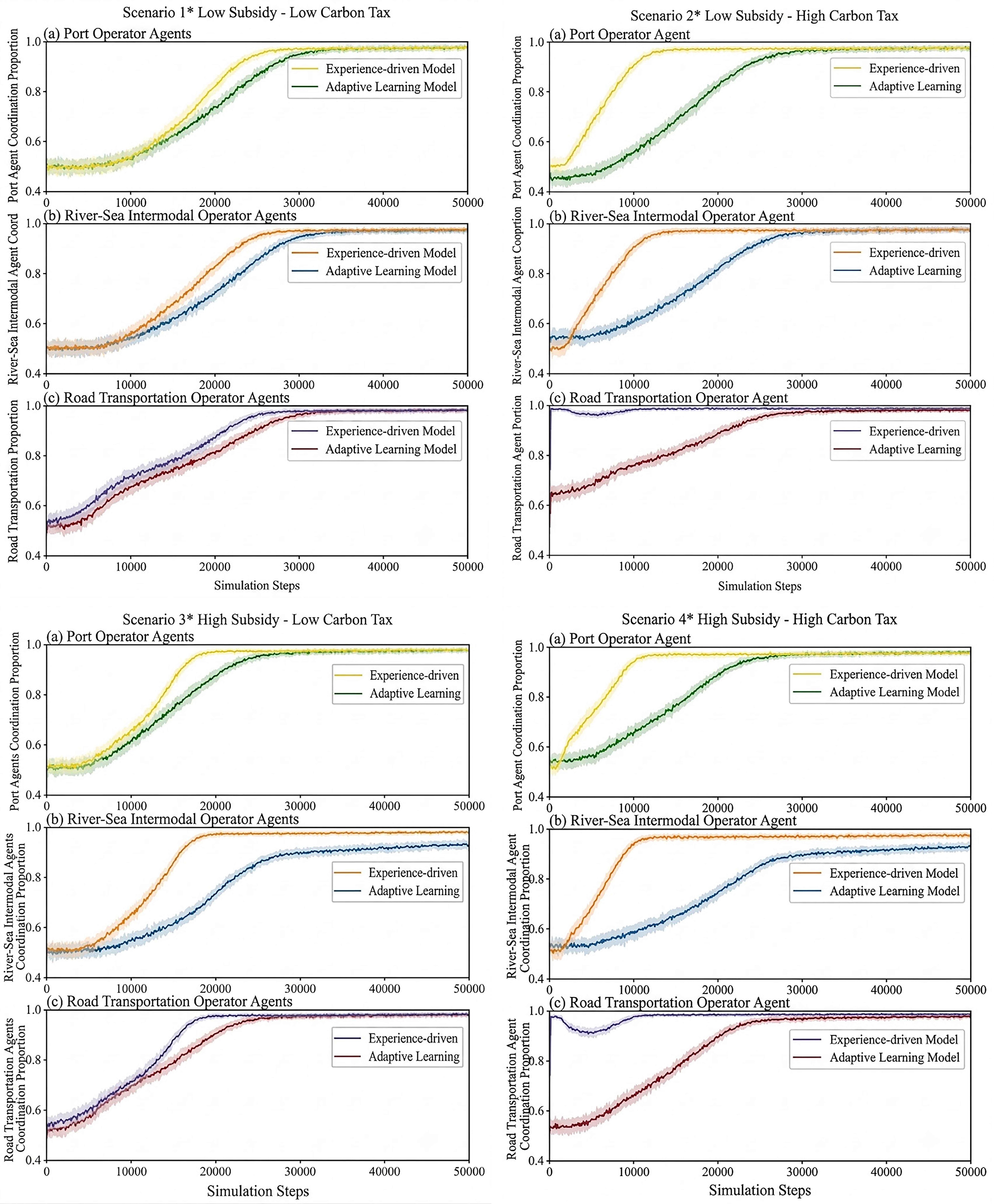
Figure 2.
System evolution trends under different policy scenarios.
In each scenario figure, the three vertically arranged subfigures (a), (b), and (c) correspond to port operators, river–sea intermodal operators, and road transport operators, respectively. Under each agent type, two decision-making modes are further distinguished: the experience-driven mode and the adaptive learning mode. The semi-transparent shaded areas surrounding the curves represent the confidence intervals from 30 independent repeated simulation runs, reflecting the robustness of the system evolution. These two decision-making modes designed in this study have their corresponding counterparts in real-world collection distribution systems. The experience-driven mode corresponds to large state-owned port groups with longer decision-making chains and strong path dependence, or long-term contract-based central shipping enterprises and large-scale contract logistics firms. These agents have fixed decision weights and strong strategic perseverance, typically making decisions based on long-term planning; consequently, they exhibit fast convergence and relatively stable policy implementation. The adaptive learning mode, in contrast, maps onto regional private waterway operators, small and medium-sized private freight fleets, and flexible third-party logistics providers. The decision weights of these agents are dynamically adjusted according to satisfaction feedback, and they display pronounced wait-and-see tendencies during the 'dual carbon' transition; their decision-making processes are highly dependent on neighbourhood payoff feedback, which effectively reproduces the authentic evolutionary logic of terminal nodes in the collection-distribution system under uncertain policy environments.
This subsection quantitatively investigates the driving effects of carbon taxes and policy subsidies, in different intensity combinations, on the collaborative evolution of the port collection distribution system through a 2 × 2 policy matrix. The simulation experiments divide the policy gradients into four typical scenarios: 'low subsidy, low carbon tax', 'low subsidy, high carbon tax', 'high subsidy, low carbon tax', and 'high subsidy, high carbon tax', with the aim of examining how the system overcomes the non-cooperative state. Since experience-driven agents respond more quickly to environmental changes without the time-lag interference introduced by adaptive learning, this part of the study primarily takes the evolutionary curves of the experience-driven mode as the observation object, so as to accurately assess the impacts of policy parameters.
The simulation results show that under the 'dual low' policy scenario, the system exhibits pronounced convergence delay. Although it can still eventually tend toward the collaborative steady state, the convergence steps are prolonged, and the slope of the evolutionary curve in the early stage is relatively flat. This indicates that under low incentive levels, the additional costs of green transformation are not effectively offset, resulting in strong internal evolutionary resistance, with agents vacillating between traditional and green modes over an extended period. When only one policy intensity is increased, the system displays notable asymmetric responses. Under the high carbon tax, low subsidy scenario, the cost pressure on the road transport side surges, forcing a significant acceleration in its convergence speed, which demonstrates that carbon tax, as a constraint-based instrument, has a mandatory driving effect in breaking the 'high carbon path lock-in'. In contrast, under the high subsidy, low carbon tax scenario, the financial pressure on the river-sea intermodal side is alleviated to some extent; however, due to the absence of negative cost constraints on the traditional mode, the overall improvement in the system's evolutionary slope is limited.
The study further identifies a synergistic acceleration effect of policy combinations. Under the 'dual high' policy scenario, the system's convergence efficiency achieves a leapfrog improvement, with the evolutionary curve reaching the steady-state peak within a very short number of time steps. This acceleration effect is not a simple linear superposition; rather, the 'push' generated by the carbon tax and the 'pull' generated by subsidies jointly construct a steeper payoff gradient, significantly reducing the difficulty for agents to cross the strategy-switching threshold. From the perspective of transport governance, this phenomenon confirms that the organic combination of constraint-based and incentive-based instruments can produce a positive resonance, substantially shortening the system's transient response time and ensuring that the collection distribution network achieves efficient low-carbon transformation under the 'dual carbon' constraints.
Overall, the collaborative evolution of the collection distribution industrial chain follows a multi-agent linkage characteristic. This finding demonstrates that system collaboration is not an equilibrium achieved simultaneously by all agents, but rather a chain-wise transmission process based on differences in each agent's cost sensitivity and decision thresholds. After identifying this sequential characteristic, governments can more precisely apply policy pressure or incentives at different time points, thereby optimising the transformation efficiency of the entire chain.
To isolate the interaction effects between carbon taxes and subsidies across agent types, we decompose the policy-driven variations from the steady-state Q-value differentials. The decomposition yields three findings. First, road transport operators show the strongest carbon-tax sensitivity, while ports exhibit diminishing marginal responses, confirming their lower sensitivity to regulatory intensity. Second, subsidies and carbon taxes are complementary for river–sea intermodal operators: the same subsidy level generates a 15.6% Q-value improvement under low carbon tax, but a 38.2% improvement under high carbon tax—a synergistic amplification effect. Third, these interaction effects are asymmetric across agent types: additive for ports, carbon-tax-dominated for road operators, and strongly synergistic for intermodal operators. This asymmetry implies that policymakers should adopt differentiated strategies: carbon taxes are most effective for road transport, a balanced combination is essential for inducing intermodal participation, and port transformation is best driven by non-financial instruments.
To conduct an in-depth analysis of the evolutionary patterns of the collection distribution system in the spatial dimension, this section selects four key time nodes during the simulation—
$ t=100 $ $ t=10,000 $ $ t=20,000 $ $ t=50,000 $ $ 30\times 30 $ 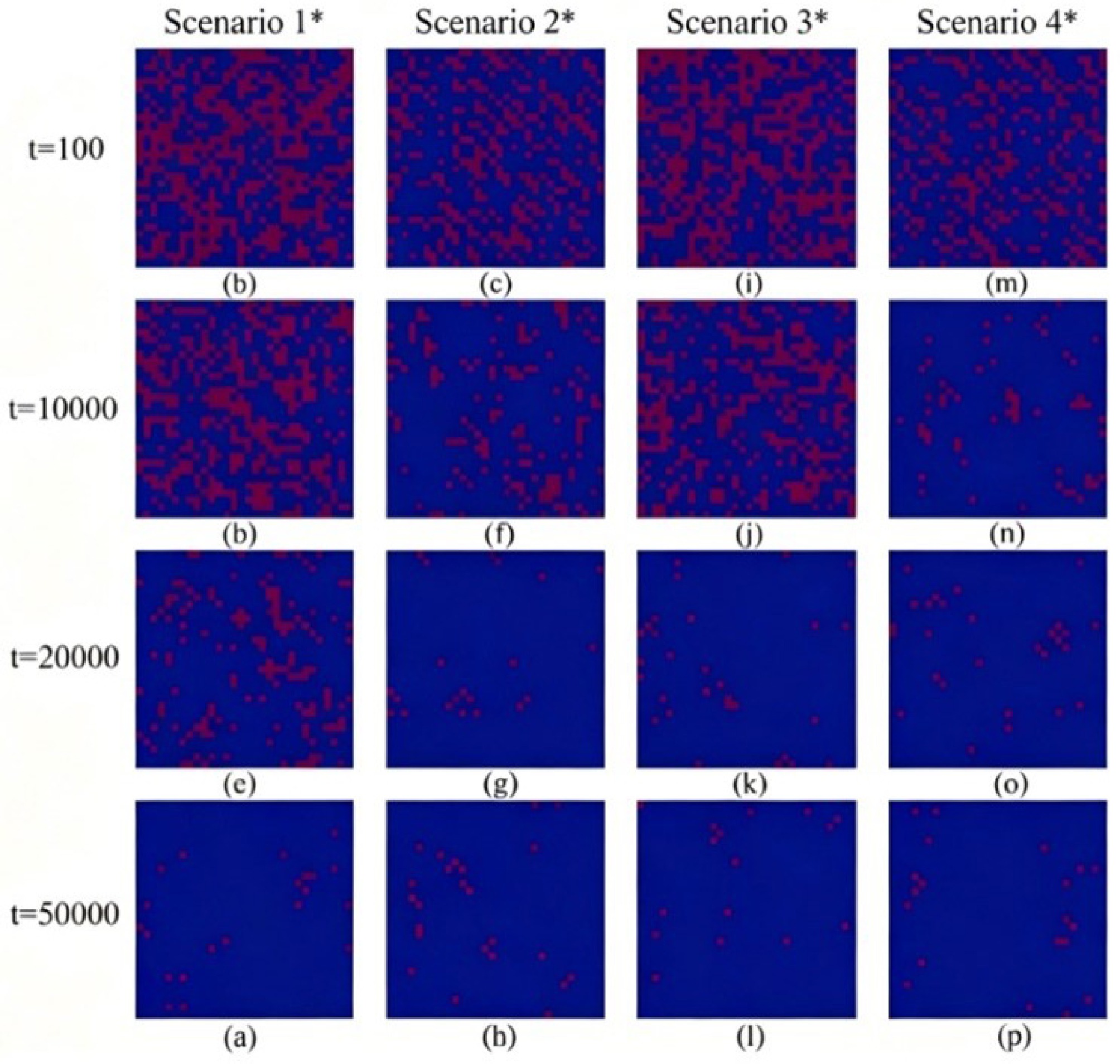
Figure 3.
Agent grid evolution under the experience-driven mode.
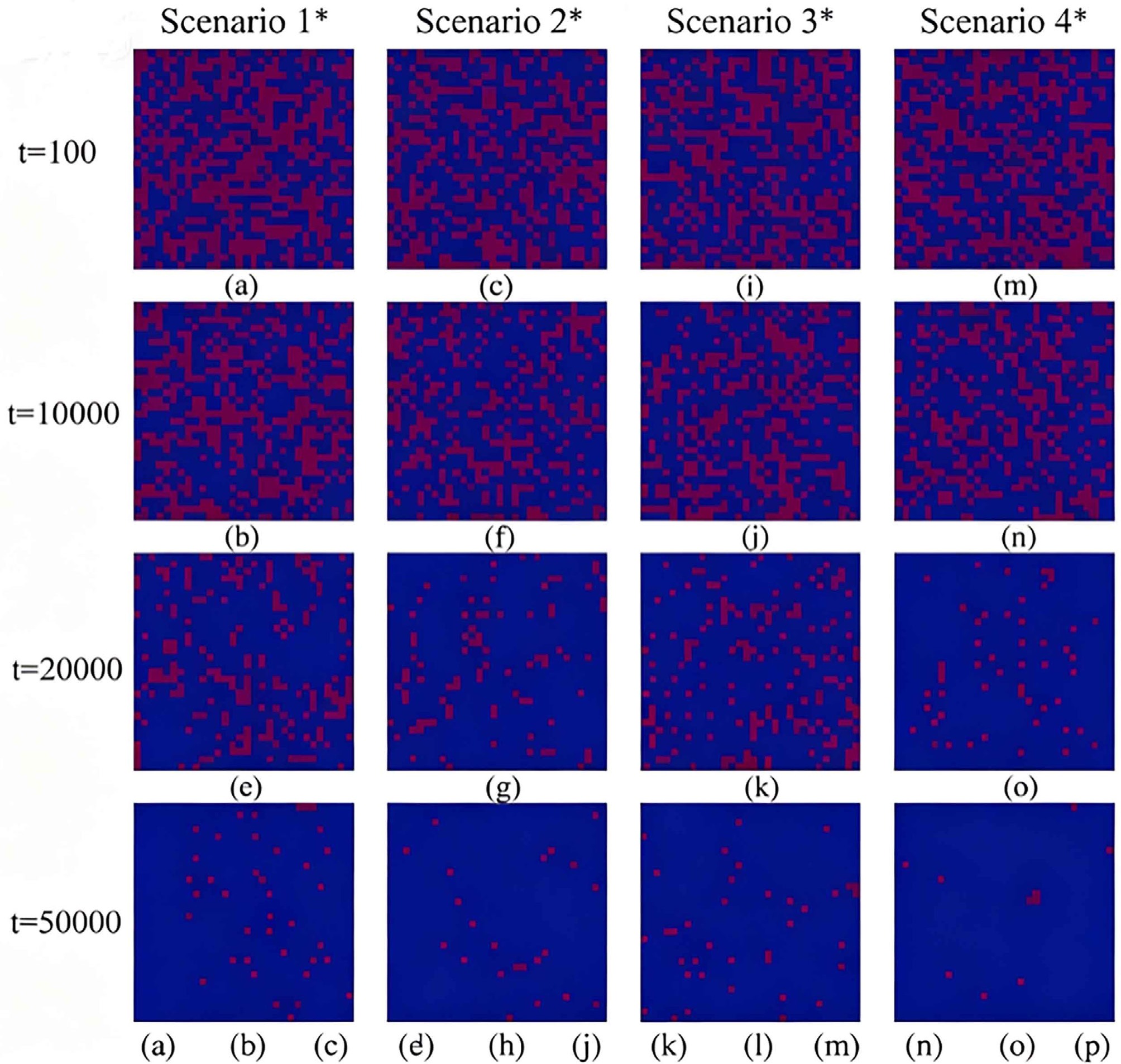
Figure 4.
Agent grid evolution under the adaptive learning mode.
By observing the evolution of the grid from disorder to order, it is evident that the propagation of collaborative strategies in the collection-distribution system follows the kinetic logic of 'local nucleation → cluster expansion → global emergence'.
Early evolutionary stage
$ t=100 $ Mid evolutionary stage (
$ t=10,000 $ $ t=20,000 $ $ t=20,000 $ Late evolutionary stage
$ t=50,000 $ In the early stages of evolutionary development, the adaptive learning mode generally exhibits a notable response lag and spatial fluctuation problem. To further clarify the micro-level causes of this phenomenon, this section shifts the research perspective from the previous macro evolutionary trajectories to the micro decision-making mechanisms, with a particular focus on the relationship between the information sharing rate and the system's collaborative trends. This paper proposes that the response delay of adaptive agents does not imply ineffective decision-making; rather, it is an essential process through which micro agents, when confronted with policy fluctuations and environmental noise, learn to adapt their strategies via information exchange and hedge against uncertainty risks. By quantitatively analysing the dynamic changes in the information-sharing rate at various evolutionary stages, it is possible to more accurately identify the transition logic of the collection–distribution system from 'externally policy driven' to 'internally experience locked in'. Figure 5 employs dual Y-axis coordinate charts to compare the dynamic relationship between the average information sharing rate and the average cooperation rate under four scenarios, where the left Y-axis corresponds to the system's average cooperation rate and the right Y-axis corresponds to the average information sharing rate. The experimental results clearly demonstrate how the strategy learning of adaptive learning agents gradually shifts from 'relying on social information' to 'relying on their own experience'.
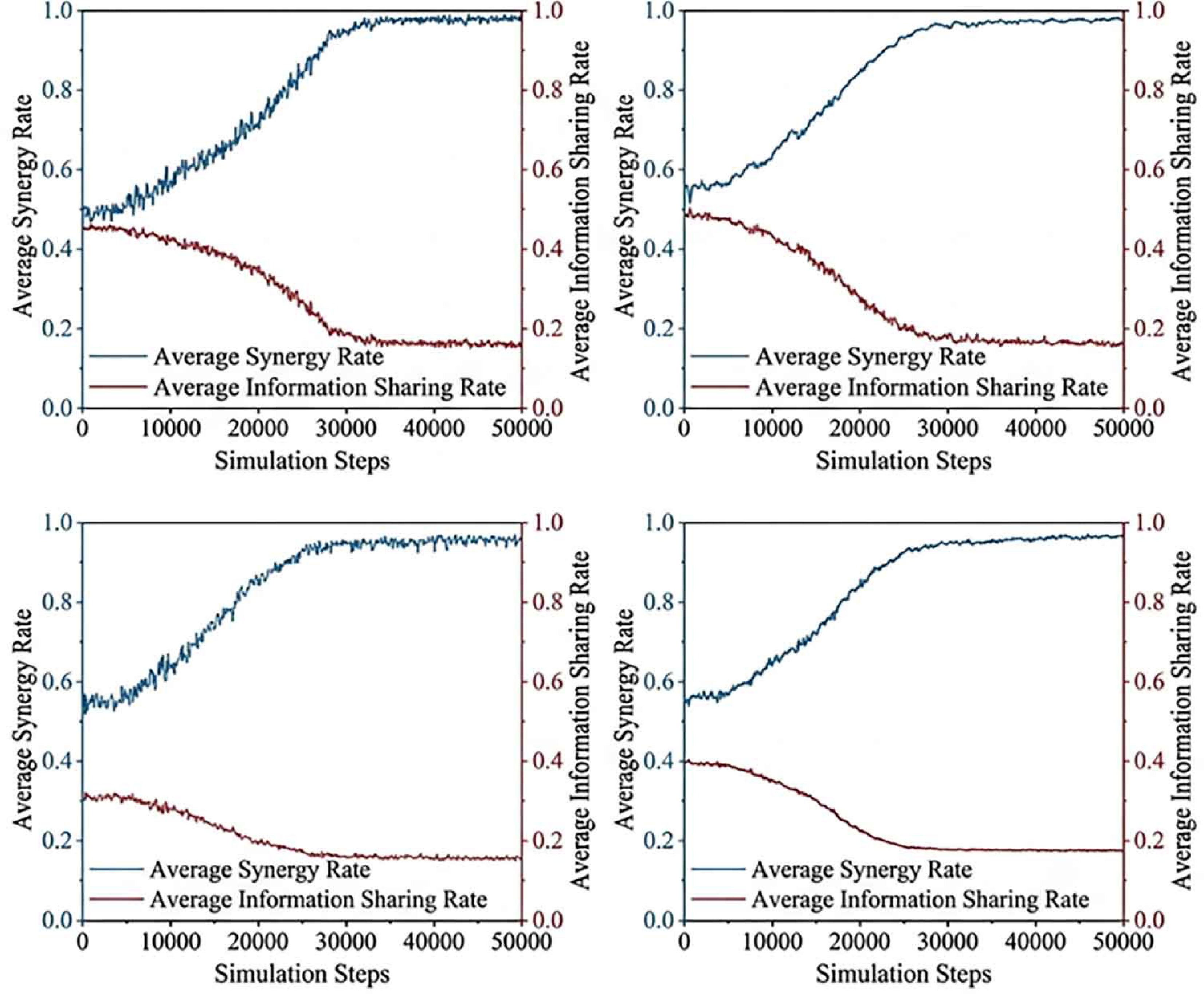
Figure 5.
Correlation trend under different scenarios.
Based on the slope of the average cooperation rate and the decay characteristics of the information sharing rate, this study divides the entire evolutionary process into three stages for correlation analysis:
In the initial evolutionary stage, the average cooperation rate begins to rise slowly from around 0.5. At this time, the average information-sharing rate remains in a relatively high and sensitive range across all scenarios. This feature reveals a 'social dependence' behaviour among collection distribution agents in the early transformation phase. Lacking prior successful experience in responding to policy fluctuations, agents must maintain a relatively high frequency of information sharing to observe the payoff feedback of neighbouring agents. This persistently high level of learning explains the response lag observed macroscopically in the adaptive mode—that is, the system is undergoing the necessary micro-level information processing and strategy accumulation to overcome the evolutionary resistance posed by initial transition costs.
Entering the next stage, the average cooperation rate curve on the left Y-axis shows a steep increase, indicating the rapid expansion of collaborative clusters in the grid space. Concurrently, the average information-sharing rate on the right Y-axis transitions from its initial high plateau to a pronounced accelerating decline. This inflection point is highly synchronised with the moment when the cooperation rate crosses the critical threshold. After the majority of neighbouring agents have shifted to collaborative strategies, collaborative gains are released, and agents' payoff satisfaction rapidly improves. According to the adaptive adjustment mechanism, when individuals find that the current strategy yields stable returns, their dependence on external information naturally decreases, and the decision-making focus shifts from 'environment-following' to 'internalised experience'.
Considering the entire evolutionary process of the adaptive mode, the trajectory of the information sharing rate fully explains how the system transitions from initial 'uncertainty wait-and-see' to later 'deterministic lock-in'. Although adaptive agents exhibit relatively high learning costs in the early stage, what they gain in return is a steady state with low information costs: after collaboration is achieved, the system no longer needs to maintain high-frequency information exchange to sustain green operations[31]. This finding offers implications for the long term governance of collection-distribution systems: guiding agents to establish collaborative experience in the early stage can enable the system to form endogenous green signals, thereby reducing the government's reliance on information disclosure and real-time regulation in the later stage of evolution.
-
This paper addresses the collaborative optimisation problem of port collection distribution systems under the 'dual carbon' goals, constructing a complete research framework that spans from evolutionary game-theoretic mechanism analysis to multi-agent dynamic simulation[32]. By introducing local information interaction and satisfaction adjustment mechanisms, it overcomes the limitations of traditional evolutionary games in characterising spatial heterogeneity and dynamic decision-making, and systematically reveals the underlying logic and macroscopic laws governing the green collaborative evolution of port collection distribution systems. The main conclusions of this paper are as follows:
(1) A spatial collaborative evolution model of collection distribution systems integrating micro-level dynamic learning mechanisms is constructed. By combining evolutionary game mechanisms with multi-agent reinforcement learning, a bottom-up spatial grid evolution model is formed[33]. With the aid of a payoff satisfaction adjustment function, the model demonstrates at the algorithmic level that the transformation resistance exhibited by asset-heavy logistics enterprises under external policy shocks can be precisely characterised through dynamic learning weights. This model avoids the stringent 'perfect rationality' assumption of traditional game theory, providing an effective quantitative evaluation tool for studying the decision-making of heterogeneous agents within complex transport networks.
(2) The inhibitory mechanism of local strategy mismatch on global collaborative evolution in collection distribution networks is revealed. The study finds that the green transformation of collection distribution systems is not a simple superposition of emission reduction effects across individual links, but is highly dependent on the higher-order synergy among ports, shipping, and road transport. Any single agent remaining in the traditional high-carbon state can alter the payoff expectations of neighbouring nodes through the network topology, thereby significantly slowing down the global green evolution process. Simulations confirm that strategy mismatches between ports and transport operators under non-equilibrium conditions lead to persistent synergistic friction losses within the system, making synchronised evolution across the entire chain a necessary condition for maximising overall system welfare.
(3) The combined incentive effectiveness of heterogeneous environmental policies and their evolutionary pathways is demonstrated. Moderate regulatory intensity is shown to be more effective in prompting the system to converge toward a collaborative equilibrium. Simulations reveal that different agents exhibit distinct evolutionary responses and interdependencies: river–sea intermodal operators are more sensitive to cost changes, while road transport operators rely more on derivative benefits such as industry reputation and policy-related evaluations. For hub ports, the formation of a proactive promotion strategy is not sensitive to costs and subsidies, but is influenced by indirect losses under non-collaborative states. This finding suggests to policymakers that the core of fostering green collaboration lies not in continuous financial input, but in establishing rigorous assessment mechanisms and industry reputation systems, shifting from pure 'financial subsidies' toward 'regulatory constraint[34]'.
(4) The moderating role of payoff satisfaction on the transformation rate of micro enterprises is clarified. The study confirms that the decision making willingness of logistics enterprises during the transformation process is significantly affected by their current payoff levels. When enterprise payoffs are at a medium or higher level, the motivation to change existing strategies is extremely low, exhibiting strong 'transformation inertia'; only when payoff satisfaction drops substantially do enterprises spontaneously increase their willingness to explore new strategies. This finding suggests to policymakers that the implementation of green strategies should not rely solely on short term marginal profit incentives; rather, it is necessary to strengthen industry information sharing and other measures to break the cognitive limitations of low-payoff agents, stimulate their intrinsic motivation for change, and thereby effectively reduce long-term macro-regulatory costs.
-
The authors confirm their contributions to the paper as follows: study conception and design: Xu Q, Wu S; methodology: Li C, Deng H; validation: Ma T; formal analysis: Li C, Deng H; investigation: Li C, Ma T; data curation: Li C; visualization: Ma T; writing—original draft: Li C, Deng H; writing—review and editing: Xu Q, Li C, Ma T, Wu S; supervision, project administration, funding acquisition, resources: Xu Q, Wu S. All authors reviewed the results and approved the final version of the manuscript.
-
The datasets generated during and analyzed in the current study are available from the corresponding author upon reasonable request.
-
The authors declare that they have no conflict of interest.
- Copyright: © 2026 by the author(s). Published by Maximum Academic Press, Fayetteville, GA. This article is an open access article distributed under Creative Commons Attribution License (CC BY 4.0), visit https://creativecommons.org/licenses/by/4.0/.
-
About this article
Cite this article
Xu Q, Li C, Deng H, Ma T, Wu S. 2026. A multi-agent evolutionary game approach to green collaborative strategies in port consolidation and distribution systems. Digital Transportation and Safety 5(3): 305−317 doi: 10.48130/dts-0026-0024 

A multi-agent evolutionary game approach to green collaborative strategies in port consolidation and distribution systems
- Received: 26 July 2026
- Revised: 12 August 2026
- Accepted: 10 September 2026
- Published online: 30 September 2026
Abstract: This paper addresses the structural imbalances that hinder the green transition of port consolidation and distribution systems. To tackle this issue, we construct a tripartite evolutionary game model that is integrated with multi-agent reinforcement learning. By mapping game-theoretic logic onto spatial networks, the model reveals the mechanisms of strategy propagation and emergence patterns. Based on the proposed model, key findings are as follows: (1) The three agent types exhibit distinct policy sensitivities: ports show diminishing marginal effects to regulatory intensity, river-sea operators are cost-sensitive, and road operators prioritize reputation. (2) Carbon taxes force road transport to lead transformation by raising environmental costs, while subsidies hedge initial risks for intermodal operators. (3) Collaborative strategies propagate spatially following 'local nucleation cluster expansion global emergence'. (4) Experience-driven agents play a pioneering role initially, while adaptive agents form experience lock-in through dynamic adjustment, enhancing system robustness. This study reveals the intrinsic mechanisms by which structural transformation drives structural emission reduction, providing scientific support for collaborative governance under the 'dual carbon' goals.