












-
Garlic (Allium sativum L.) is the most important bulb crop of the monocotyledonous Alliaceae family. It is the second most widely used spice or condiment in the world, after onion[1]. It is cultivated on more than 1.55 million ha worldwide, with a productivity of 17.19 t·ha−1. China is a world leader in area (0.83 million ha) and production (20.8 million t), accounting for over 80% of the world production. India is the second largest garlic producer, after China. However, its productivity is much lower (8.04 t·ha−1) than the world average of almost 17.19 t·ha−1[2]. Moreover, the productivity of the Northwest Himalayas (2.65 t·ha−1) is even lower than the national productivity of 8.04 t·ha−1[2,3].
The bulb yield of hard-neck (long-day) garlic cultivars in temperate areas is almost twice that of varieties that are not long-day. The cultivar VL Lahsun 2 (hard neck) was developed and released in 2012 by the ICAR-Vivekananda Parvatiya Krishi Anusandhan Sansthan (VPKAS), Almora, India, for the temperate region of the Northwest Himalayas[4]. It is a high-yielding (17–24 t·ha–1) cultivar and is resistant to major diseases, such as purple blotch and stemphylium blight, making it suitable for cultivation in the area. It also has a large diameter bulb (4–5 cm polar diameter and 5–6 cm equatorial diameter), high TSS (37.3º Brix), and good storability[5]. The large size of the clove makes it easier to shell, which increases preference and leads to better prices than smaller cloves.
Despite the development and release of high-yielding long-day garlic cultivars (VL Lahsun 2, Agrifound Parvati, Agrifound Parvati 2, and CITH-G-3) for the hilly regions of the Northwestern Himalayan states of India for decades[5−7], the average productivity of garlic in the region is still very low (2.65 t·ha–1). Due to the non-availability of adequate planting materials for hard-neck garlic, farmers in the hilly regions of the Northwest Himalayas are forced to grow local or subtropical types, resulting in very low crop productivity. Poor multiplication (7–12 times) and high seed rate (~2 t·ha–1) of long-day garlic cultivars are persistent constraints in providing quality planting material in the Northwest Himalayas. Moreover, inadequate storage infrastructure and high humidity during storage lead to poor garlic bulb storability in the region. To overcome these persistent constraints and offer a more resilient propagation source, an alternative propagation method using bulbils (small, undivided aerial bulbs) formed on the scapes of hard-neck garlic has been proposed. As vegetative clones of the parent plant, bulbils enable rapid stock multiplication[8,9], are free from soil-borne pests and diseases, exhibit higher vigour, and show reduced virus transmission (e.g., lower mosaic virus levels from mite vectors) compared to cloves[10].
However, conventional bulbil propagation requires at least two consecutive plantings to produce marketable bulbs, which limits its adoption[11,12]. During the first season (October–May), the planted bulbils develop into small, unmarketable single-clove bulbs weighing only 4–7 g. These small bulbs were harvested and stored for approximately 4 months (June–September). In the second season (October–May), the stored bulbs were replanted, eventually yielding marketable multi-cloved bulbs weighing 30–50 g. This lengthy process, which takes two full growing seasons and requires careful storage in between, renders the bulbil-based method impractical for resource-poor hill farmers in the Northwestern Himalayan region. Optimising bulbil size and fertiliser level is essential for successful bulbil-based multiplication, as supported by prior research. Bulbil size decisively influences garlic multiplication efficiency; larger bulbils (e.g., those > 0.2 g) contain greater physiological reserves, which are strongly correlated with superior bulbil germination and overall seedling vigour[13]. Potassium application, particularly at 200 kg K ha−1, significantly enhances carbohydrate translocation and bulb development, leading to increased plant height, bulb diameter, number of cloves per bulb, total yield, and improved clove production and propagation potential[14]. Recognising that the conventional two-season process for bulbil-based garlic propagation limits its practical adoption, this study hypothesised that an accelerated, commercially viable, single-season production cycle could be established by determining the optimal bulbil size, pre-sowing treatment, and potassium fertiliser level. This approach aims to make garlic cultivation more practical, efficient, economically accessible, and sustainable in high-elevation areas.
-
Bulbils of the garlic cultivar 'VL Lahsun 2' (a long-day variety released by ICAR-Vivekananda Parvatiya Krishi Anusandhan Sansthan, Almora, suited for high-altitude regions such as the Uttarakhand hills) were harvested during 2020–2021, grown from September to May at the High Altitude Test Site (HATS), ICAR-VPKAS, Mukteshwar, Nainital (coordinates: 29°28′46.9″ N, 79°38′48.4″ E; elevation ~2,250 m amsl). The site has a cool temperate agro-climatic regime characterised by severe winters from December to February. During this period, average high temperatures range from 11 to 14 °C, while average low temperatures range from 1 to 6 °C, with nighttime temperatures often dropping below freezing. The humidity levels are moderate, ranging from 60% to 70%, along with occasional light to moderate snowfall, primarily occurring in December and January. Summers, which last from March to June, are mild and pleasant in the region. The average high temperatures during this season range from 16 to 24 °C, with lows between 5 and 19 °C, and temperatures rarely exceed 27 °C. Humidity is lower before the monsoon season, ranging from 43% to 55% from March to May. Additionally, the day length is longer, averaging approximately 13–14 h.
Experimental design
-
All field experiments were conducted in a randomised block design from 2021 to 2024 at the ICAR-Vivekananda Parvatiya Krishi Anusandhan Sansthan (ICAR-VPKAS), Hawalbagh, Almora, Uttarakhand (coordinates: 29°36′ N, 79°40′ E; elevation 1,250 m amsl). The site features a typical subtemperate climate, characterised by severely cold winters (December–February: average highs ~15–18 °C, lows ~3–8 °C, occasionally dropping below freezing with frost) and mild to moderately warm summers (March–June: highs ~20–28 °C, rarely exceeding 30–32 °C, with dry pre-monsoon conditions followed by monsoon onset). The experimental soil was sandy clay loam, with a bulk density of 1.36 Mg·m−3, porosity of 52.3%, organic carbon of 0.88%, pH of 6.5, and available nutrients of N 282 kg·ha−1, P 12.1 kg·ha−1, and K 164 kg·ha−1. Overall, the soil showed balanced to medium fertility for primary nutrients, with no extreme deficiencies.
Nursery bed preparation
-
Nursery beds were prepared as raised beds elevated 15 cm above ground level to promote good aeration and prevent water stagnation in the soil. This helps enhance seedling growth and reduce the risk of disease. Each bed measured 2 m long by 1 m wide. Fifteen days before sowing, 10 kg of well-rotted farmyard manure (on a fresh weight basis) was thoroughly mixed into the soil of each 2 m2 bed to improve soil fertility and its structure. Just before sowing, the following fertilisers were added to the soil per square meter: 40 g urea, 11 g di-ammonium phosphate (DAP), and 33 g muriate of potash (MOP). The beds received light daily irrigation to maintain consistent moisture for germination and early plant growth. Before transplanting, the seedlings were dipped in a Bavistin solution (2 g·L−1 in water) for 5–10 min as a preventive fungicidal treatment to reduce the risk of soil-borne diseases during their establishment in the main field.
Effect of bulbil size on bulbil-derived seedling growth
-
To determine the appropriate bulbil size for promoting vigorous seedling (bulbil-derived seedling) development, bulbils harvested from the hard-neck garlic variety VL Lahsun 2 were classified into three weight categories: large (> 0.1 g), medium (0.075–0.1 g), and small (< 0.075 g). These graded bulbils were sown in nursery beds from September to November 2021 at the ICAR-Vivekananda Parvatiya Krishi Anusandhan Sansthan (VPKAS) Experimental Farm in Hawalbagh, Almora (coordinates: 29°36′ N, 79°40′ E; elevation: 1,250 m above sea level). During the nursery period, the experimental site recorded the following average monthly temperatures:
• September: maximum 31.1 °C, minimum 18.0 °C
• October: maximum 29.7 °C, minimum 8.9 °C
• November: maximum 23.8 °C, minimum 1.4 °C
Seedling growth was assessed by randomly selecting 25 seedlings per treatment and measuring their length at 75 and 90 d after sowing (DAS) to evaluate the influence of initial bulbil size on early growth under high-altitude conditions.
Effect of pre-sowing treatment on bulbil-derived seedling emergence
-
To evaluate the effects of pre-sowing treatments on bulbils' germination, bulbils of the hard-neck garlic variety VL Lahsun 2 were used. Bulbils, each weighing over 0.1 g, were identified as the most effective size for planting material. Three different pre-sowing treatments were tested: dry sowing (without soaking, serving as the control), soaking in plain water for 24 h, and soaking in plain water for 48 h. The trial was conducted from September to November 2022 at the ICAR-Vivekananda Parvatiya Krishi Anusandhan Sansthan (VPKAS) Experimental Farm in Hawalbagh, Almora. This experimental site is located at 29°36′ N, 79°40′ E, with an elevation of 1,250 m above sea level. During the nursery period, the site recorded the following average monthly temperatures:
• September: maximum 29.9 °C, minimum 17.3 °C
• October: maximum 27.7 °C, minimum 10.3 °C
• November: maximum 24.0 °C, minimum 4.0 °C
A total of 100 treated bulbils were sown in prepared nursery beds, and seedling emergence (percentage of emerged seedlings with visible shoots above the soil surface) was recorded 15, 20, and 30 d after sowing (DAS). This experiment aimed to determine whether simple water soaking could accelerate initial germination and improve stand establishment, supporting the broader objective of shortening the garlic production cycle to a single growing season under high-altitude conditions.
Effect of fertilizer doses on bulb production using clove and bulbil-derived seedlings as planting material
-
The application of potassium fertiliser promotes the transfer of N, P, and K from the stem and leaf to the bulb, thereby increasing garlic production[15]. The yield of garlic increases with increasing potassium fertiliser, where K application at 200 kg·ha−1 was suitable for obtaining maximum yield[14]. In view of the above findings, the present study was designed to compare the performance of two planting materials, traditional cloves (sown directly) and nursery-raised bulbil-derived seedlings of hard-neck garlic (VL Lahsun 2), with varying levels of potassium fertilisation (0, 50, 75, and 100 kg K2O ha−1). This study aimed to assess the influence of varying potassium doses on the performance of these planting materials in terms of marketable bulb yield, particularly under high-altitude Himalayan conditions.
Bulbil-derived seedling preparation
-
Bulbils weighing > 0.1 g were soaked in plain water for 48 h to promote germination. The seeds were then sown in nursery beds from September to November 2023 at the ICAR-Vivekananda Parvatiya Krishi Anusandhan Sansthan (VPKAS) Experimental Farm in Hawalbagh, Almora. The average maximum and minimum monthly temperatures during this period were as follows: September recorded a maximum of 29.0 °C and a minimum of 19.1 °C; October had a maximum of 27.0 °C and a minimum of 11.0 °C; and November experienced temperatures of 23.7 °C (maximum) and 5.2 °C (minimum) in 2023.
Field establishment
-
Cloves (3.0–3.5 g·clove−1) were directly planted on October 15, 2023, and healthy, uniform bulbil-derived seedlings (90 d old, seedling length 10–15 cm) were transplanted to the main field on December 15, 2023. Both planting materials were established at a spacing of 15 × 10 cm in a 4 m2 plot with a plant population of 266 plants. All treatments received uniform applications of N, P, sulfur, and farmyard manure (FYM) at rates of 100, 50, 25 kg, and 10 t·ha−1, respectively.
The crops were grown until maturity by the end of May 2024, using standard agricultural practices. The average monthly day lengths were as follows: 10 h 15 min in December, 10 h 30 min in January, 11 h 14 min in February, 11 h 55 min in March, 12 h 48 min in April, and more than 13 h 25 min in May 2024. These conditions reflect cool, short-day winters that favour bulb initiation and good plant growth in long-day garlic, followed by mild summers and lengthening days that support bulb enlargement and maturation.
Data collection
-
A total of 100 bulbils per treatment were sown to estimate the mean bulbil germination percentage, and 25 seedlings per treatment were randomly selected and measured to determine the mean seedling length. Yield parameters, including individual bulb weight and marketable bulb yield, were recorded on a per-plot basis (4 m2; 266 plants per plot) 15 d after harvest, following standard curing and drying procedures. The trial was designed to identify the optimal bulbil size, pre-sowing treatment, and K fertilisation rate for maximising bulb production from vigorous bulbil-derived seedlings used as planting material, thereby supporting the goal of achieving single-season cultivation of long-day garlic under high-altitude Himalayan conditions.
Statistical analysis
-
The field experiments were laid out in a randomised block design (RBD) with three replicates in experiments 3.2 and 3.3, whereas experiment 3.1 used four replicates per treatment. All data were subjected to analysis of variance (ANOVA) using the OPSTAT statistical software package (CCS HAU, Hisar, India). Treatment means were compared and separated using Fisher's least significant difference (LSD) test at a 5% probability level (p < 0.05)[16]. All experimental values presented in the data tables and figures are expressed as mean ± standard deviation (n = 3), and statistical significance among treatments is denoted using lowercase alphabetical letters.
-
This experiment was conducted using a randomised block design with four replicates to determine the effect of bulbil size on bulbil-derived seedling growth. Bulbils weighing > 0.1 g consistently produced the longest healthy bulbil-derived seedlings among the three grades of bulbils from the hard-neck garlic cultivar 'VL Lahsun 2'. Specifically, the longest bulbil-derived seedlings measured 12.6 cm at 75 d and 13.9 cm at 90 d after sowing (Table 1; Fig. 1). These findings indicate a positive association between bulbil size and subsequent seedling growth, with bulbils weighing > 0.1 g producing the most vigorous seedlings and demonstrating greater suitability for transplantation.
Table 1. Effect of bulbil weight and days intervals on seedling length (cm).
Bulbil weight 75 DAS 90 DAS Mean (bulbil size) > 0.1 g 12.6 ± 0.32b 13.9 ± 0.47a 13.25 ± 0.9a 0.075–0.1 g 9.4 ± 0.34d 11 ± 0.47c 10.2 ± 1.1b < 0.075 g 7.8 ± 0.34f 8.3 ± 0.29e 8.05 ± 0.4c Mean (seedling age) 9.9 ± 2.4b 11.1 ± 2.8a Initial bulbil weight influenced garlic seedlings at 75 and 90 d after sowing (DAS). Data points represent the mean ± SD (n = 4). Different lowercase letters indicate statistically significant differences among treatments at p < 0.05, based on Fisher's LSD test. 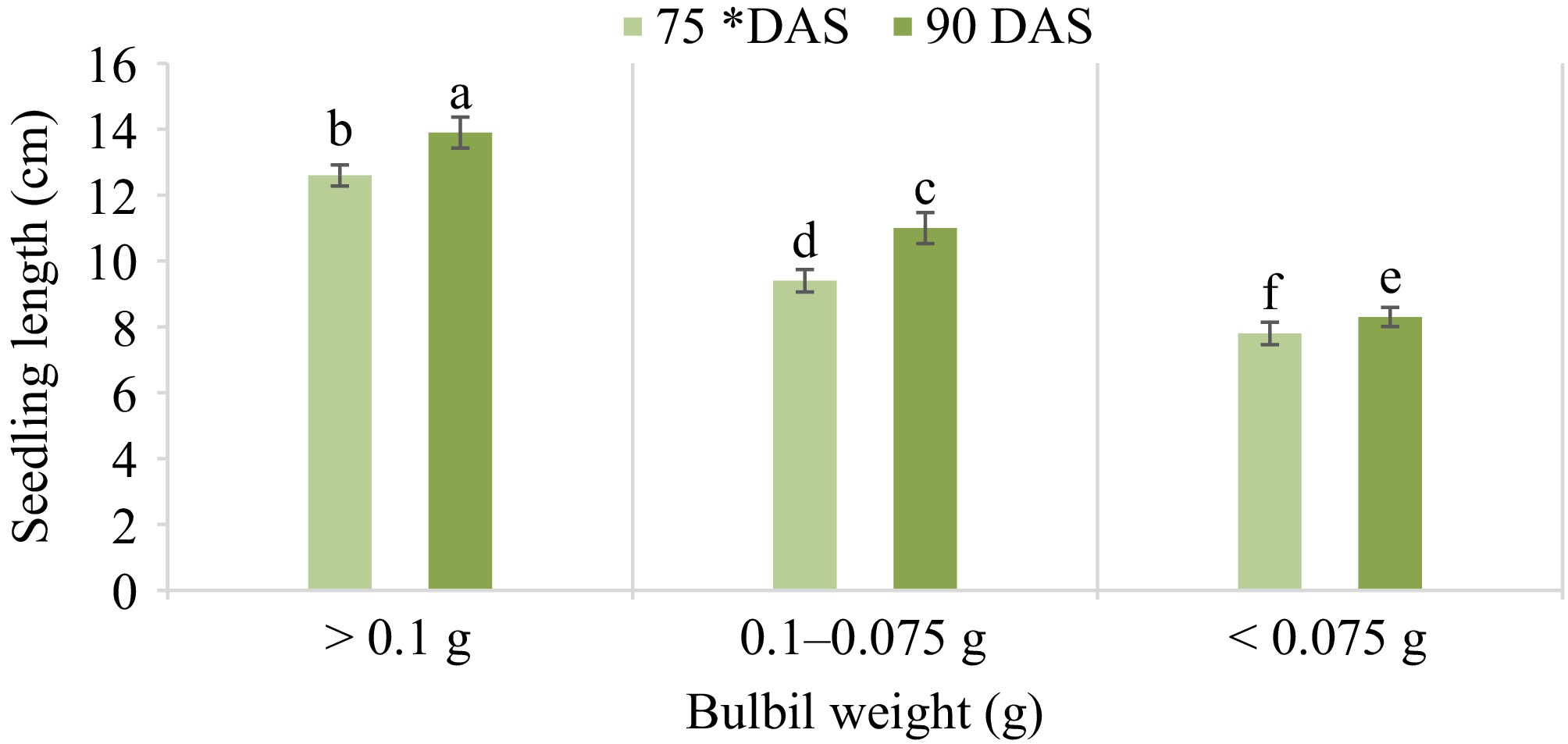
Figure 1.
Growth performance of bulbil-derived garlic seedlings as influenced by initial bulbil weight categories at 75 and 90 d after sowing (DAS). Data points represent the mean ± SD (n = 4). Different lowercase letters indicate statistically significant differences among treatments at p < 0.05, based on Fisher's least significant difference test. * DAS, Days after sowing
Effect of pre-sowing treatment on bulbil-derived seedling emergence
-
In a later experiment investigating the effect of pre-sowing treatment on bulbil germination, a randomised block design with three replicates showed that soaking bulbils in water for 48 h resulted in the highest germination rates at all time points. At 15, 20, and 30 d after sowing, the germination rates were 45.3%, 68.3%, and 88.8%, respectively (Table 2). This experiment demonstrated the efficacy of water-soaking pre-sowing treatments and their potential to significantly accelerate the sprouting process. The gradual increase in the germination rate suggests that soaking for 48 h improves bulbil sprouting conditions, leading to a higher initial plant establishment rate and consistent germination. According to these results, pre-sowing procedures, such as soaking, are crucial for enhancing the effectiveness of propagation systems based on bulbils (Fig. 2).
Table 2. Effect of pre-sowing treatment and days intervals on bulbil germination.
Pre-sowing treatment Percent germination at 15 DAS* Percent germination at 20 DAS Percent germination at 30 DAS Mean Bulbils (48 h soaking in water) 45.3 ± 3.06e 68.3 ± 5.86c 88.8 ± 4.73a 67.4 ± 21.7a Bulbils (24 h soaking in water) 25.5 ± 1.32g 58.0 ± 3.46d 78.0 ± 3.00b 53.8 ± 26.5b Bulbils (no soaking) 8.3 ± 1.15h 35.8 ± 2.93f 65.3 ± 2.52c 36.5 ± 28.5c Mean 26.4 ± 18.5c 54.1 ± 16.6b 77.3 ± 11.7a Garlic bulbil germination at 15, 20, and 30 d after sowing was affected by pre-sowing hydration treatments. Data points represent the mean ± SD (n = 3). Different lowercase letters indicate statistically significant differences among treatments at p < 0.05, based on Fisher's LSD test. * DAS: days after sowing. 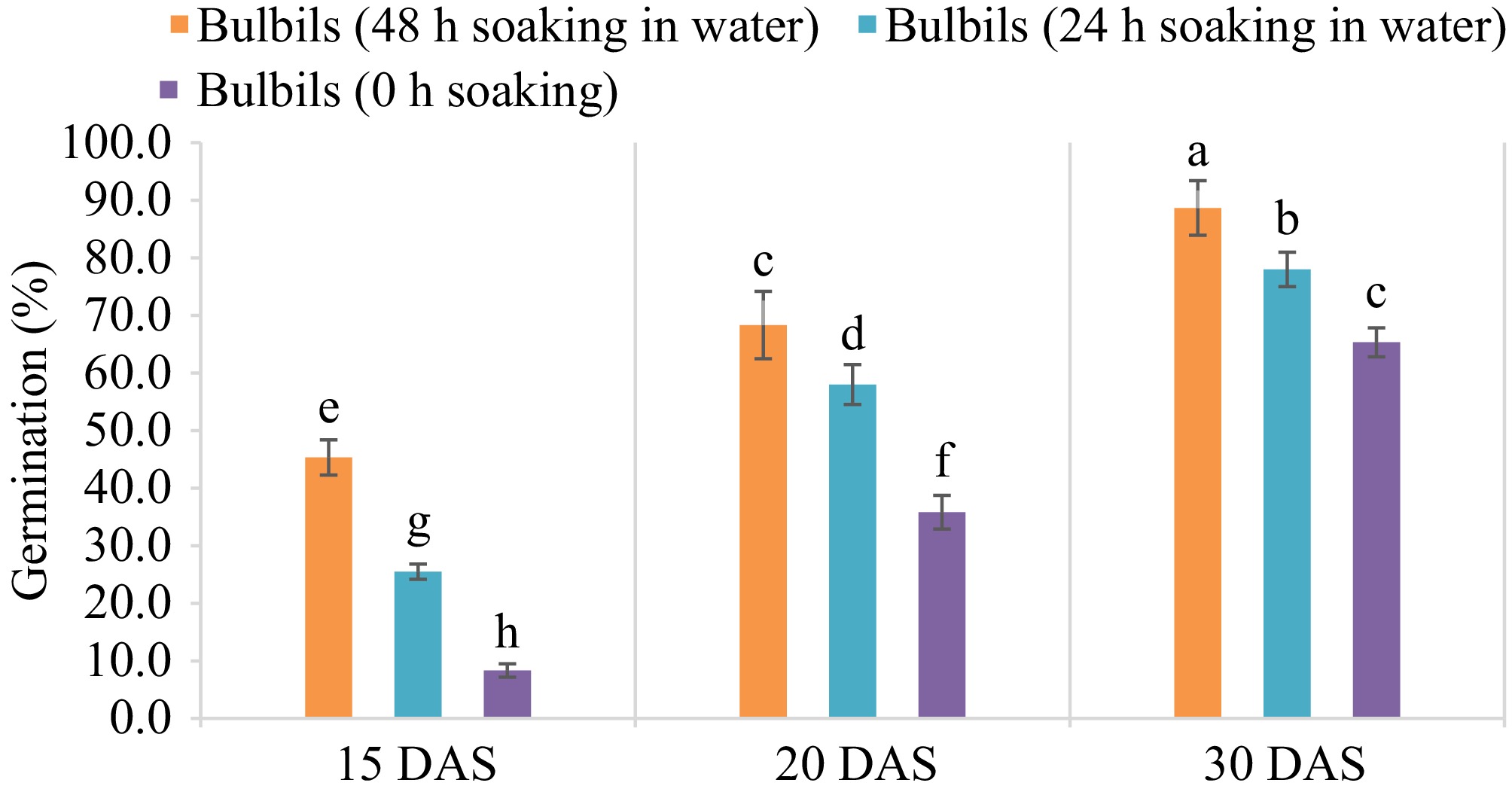
Figure 2.
Germination dynamics of garlic bulbils at 15, 20, and 30 d after sowing (DAS) as affected by pre-sowing hydration treatment. Data points represent the mean ± SD (n = 3). 0 h (no soaking), 24 h (24 h soaking in water), and 48 h (48 h soaking in water). Different lowercase letters indicate significant differences (p < 0.05).
Effect of potassium doses on bulb production using clove and bulbil-derived seedlings as planting material
-
The third experiment was conducted to compare bulbil-derived seedlings with conventional clove planting material in a randomised block design with three replicates, focusing on the effects of different potassium levels on bulb production (Figs 3, 4). The findings demonstrated that a yield of 17.7 t of marketable bulbs (those with diameters greater than 2.5 cm) per ha and an average bulb weight (35.9 g) were obtained when bulbil-derived seedlings were transplanted with a higher level (100 kg K2O ha–1) of potassium along with 100:50:25 N : P : S plus 10 t of farmyard manure (FYM per ha). These figures are statistically comparable when the same level of fertiliser (100:50:100:25 N : P : K : S kg·ha–1 + 10 t FYM ha–1) is applied to the conventional planting material, that is, clove (Tables 3, 4). These results showed that bulbil-derived seedlings (bulbil-derived seedlings) can produce marketable bulbs comparable to those from conventional planting materials (cloves) when paired with proper fertiliser management.
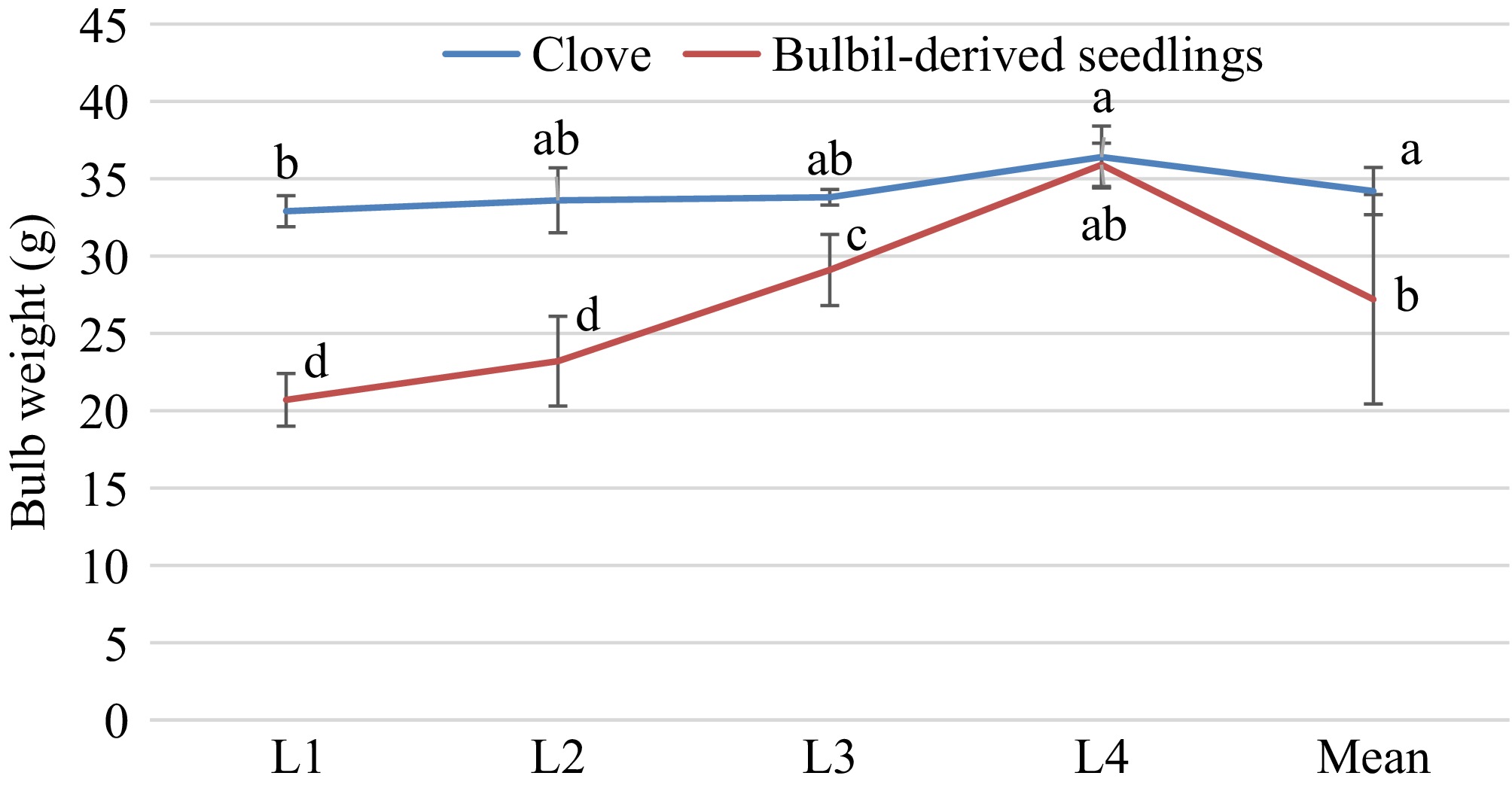
Figure 3.
Interactive effects of planting materials (conventional cloves vs bulbil-derived seedlings) and K fertilizer application levels on average garlic bulb weight (g). Data points represent the mean ± SD (n = 3). Potassium levels: L1 (0), L2 (50), L3 (75), and L4 (100 kg·ha–1) were applied against a uniform basal nutrient dressing. Different letters indicate significant differences in interactions (p < 0.05).
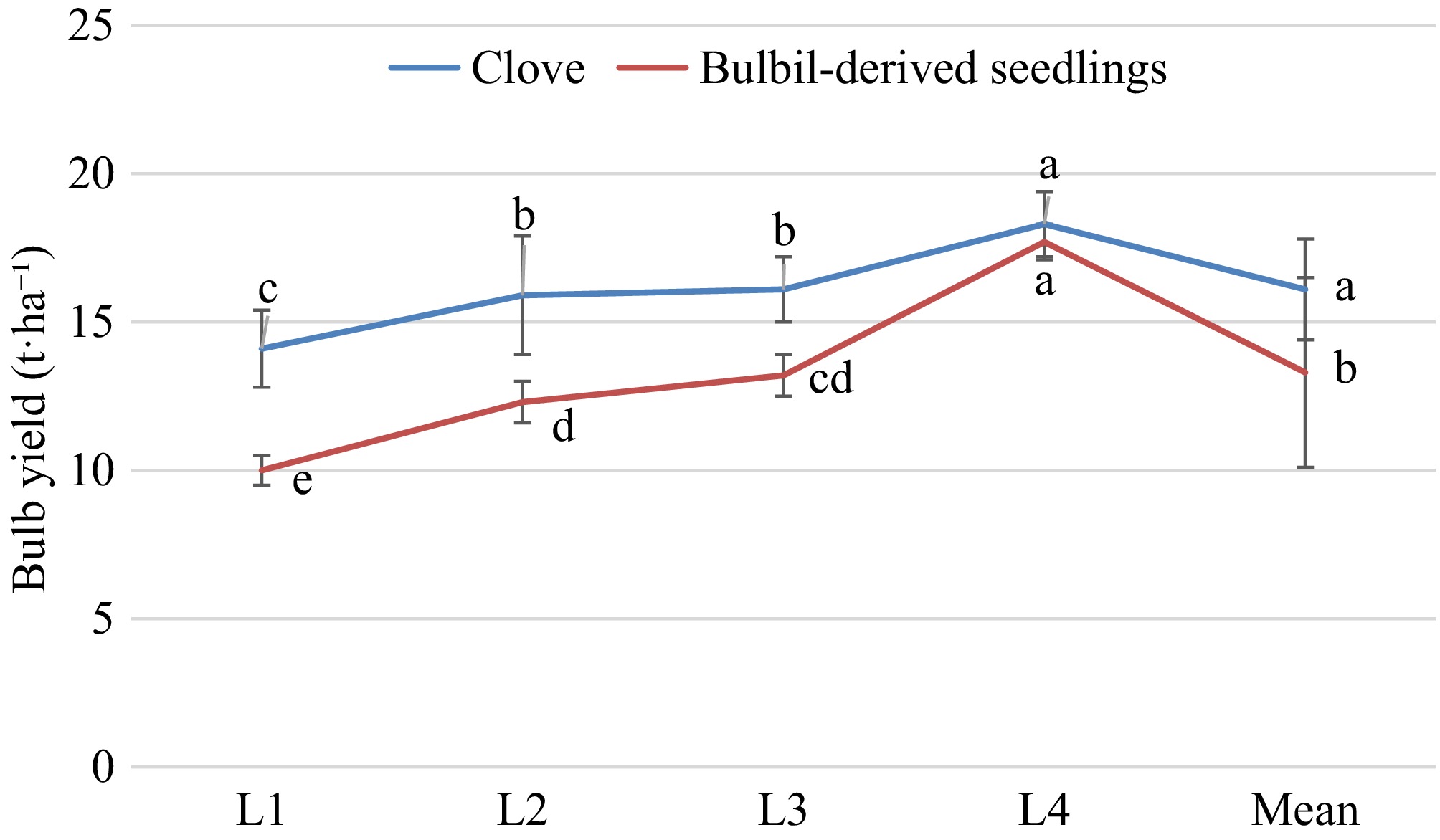
Figure 4.
Marketable garlic bulb yield (t·ha−1) as affected by the interaction between different planting materials and potassium fertiliser rates. Data points represent means ± SD (n = 3). For treatment definitions and baseline fertiliser details, see the footnotes in Fig. 3. Lowercase letters represent statistical differences at p < 0.05 using Fisher's LSD test.
Table 3. Effect of planting materials and potassium levels on bulb weight.
Planting materials Potassium levels Mean L1 L2 L3 L4 Clove 32.9 ± 1.0b 33.6 ± 2.1ab 33.8 ± 0.5ab 36.4 ± 2.0a 34.2 ± 1.53a Bulbil-derived seedlings 20.7 ± 1.7d 23.2 ± 2.9d 29.1 ± 2.3c 35.9 ± 1.4ab 27.2 ± 6.77b Mean 26.8 ± 8.63c 28.4 ± 7.35c 31.4 ± 3.32b 36.1 ± 0.35a Potassium levels: L1 (0), L2 (50), L3 (75), and L4 (100 kg·ha–1). Data points represent the mean ± SD (n = 3). Different lowercase letters indicate statistically significant differences among treatments at p < 0.05, based on Fisher's LSD test. Table 4. Effect of planting materials and potassium levels on bulb yield.
Planting materials Potassium levels Mean L1 L2 L3 L4 Clove 14.1 ± 1.3c 15.9 ± 2.0b 16.1 ± 1.1b 18.3 ± 1.1a 16.1 ± 1.7a Bulbil-derived seedlings 10.0 ± 0.5e 12.3 ± 0.7d 13.2 ± 0.7cd 17.7 ± 0.6a 13.3 ± 3.2b Mean 12.1 ± 2.9c 14.1 ± 2.5b 14.7 ± 2.1b 18.0 ± 0.4a Potassium levels: L1 (0), L2 (50), L3 (75), and L4 (100 kg·ha–1). Data points represent the mean ± SD (n = 3). Different lowercase letters indicate statistically significant differences among treatments at p < 0.05, based on Fisher's LSD test. The experiment also revealed a significant effect of planting materials (PM) and potassium levels (L1 to L4), as well as their interaction, on marketable bulb yield and average bulb weight. Clove-derived planting material produced significantly higher bulb yields with heavier bulbs (16.1 t·ha−1 and 34.2 g) compared to bulbil-derived seedlings (13.3 t·ha−1 and 27.2 g). Marketable bulb yield and average bulb weight increased progressively with higher potassium application in both planting materials (Tables 3, 4).
In the garlic variety 'VL Lahsun 2' (a promising long-day type developed by ICAR-VPKAS, Almora, known for its high yield potential, quality bulbs, purple blotch resistance, and suitability to mid-to high-hill regions of the Northwestern Himalayas), an optimised propagation and nutrient management protocol demonstrated excellent performance. Specifically, bulbils weighing more than 0.1 g were found to be highly effective when subjected to pre-sowing soaking in water for 48 h. This simple hydration treatment significantly enhanced vigour and promoted the early germination of the resulting bulbil-derived seedlings (young garlic plants raised from bulbils). Subsequently, transplanting these 90-d-old bulbil-derived seedlings under an integrated nutrient supply regime, comprising 100 kg K2O ha−1, along with 100:50:25 kg N : P : S ha−1 and 10 t·ha−1 farmyard manure (FYM), produced a marketable bulb yield of 17.67 t·ha−1. Importantly, this yield was statistically at par (p > 0.05) with the 18.3 t·ha−1 yield obtained from the conventional method of planting cloves under an identical nutrient application schedule.
These findings highlight a viable, resource-efficient alternative for propagating 'VL Lahsun 2' using bulbils, which can achieve marketable yields comparable to traditional clove-based planting, while potentially offering advantages in seed multiplication, cost reduction, and adaptation to hilly terrains where seed availability may be limited.
-
Garlic (Allium sativum L.) is almost exclusively propagated through vegetative planting materials, primarily cloves, resulting in the gradual accumulation of systemic pathogens and viruses over successive cropping cycles. Viruses such as onion yellow dwarf virus (OYDV) and leek yellow stripe virus (LYSV) are widely reported in garlic-growing regions worldwide and significantly reduce bulb yield and quality. Because cloves originate from infected mother bulbs, viral infection tends to persist and spread within the planting material, making the development of alternative seed multiplication strategies an important priority in garlic production systems. Recent studies have highlighted that aerial bulbils produced in the inflorescence of hard-neck garlic may provide an alternative propagation source with several agronomic advantages, including higher multiplication rates and reduced exposure to soil-borne pathogens[1]. However, conventional bulbil propagation typically requires two or more growing seasons to produce marketable bulbs, which has limited its large-scale adoption in commercial production[11,12]. However, disease incidence was not directly measured in any of the three experiments conducted in this study. The present study investigated the role of bulbil size, pre-sowing treatments, and potassium fertilisation in improving the efficiency of bulbil-based propagation. We demonstrated that bulbil-derived seedlings can successfully produce marketable bulbs within a single growing season (Supplementary Fig. S1a, S1b). Among the different bulbil size classes evaluated, bulbils weighing > 0.1 g produced the most vigorous seedlings suitable for transplantation. Larger bulbils generally contain greater carbohydrate reserves and more developed embryonic tissues, which contribute to improved sprouting, seedling establishment, and early vegetative growth. Similar observations have been reported in several Allium species, where larger propagules consistently result in higher plant vigour and improved yield performance[12,17]. Nurzyńska-Wierdak[18] and Sopha et al.[19] also reported that larger bulbils enhance vegetative growth and bulb formation in garlic, which supports the findings of the present study. The positive relationship between bulbil weight and seedling vigour highlights the importance of bulbil grading as a practical management strategy for improving propagation efficiency.
Bulbil formation in hard-neck garlic is a complex developmental process influenced by environmental and physiological factors, particularly the interactions among photoperiod, temperature, vernalisation, and endogenous plant hormones. Hard-neck garlic produces a flowering scape that terminates in an inflorescence containing aerial bulbils. Long-day conditions and cool temperatures promote scape emergence and bulbil differentiation, which explains the widespread adaptation of hard-neck garlic cultivars to temperate and high-altitude regions[20]. Studies have shown that cytokinins and gibberellins are involved in scape elongation and reproductive development, whereas carbohydrate allocation from photosynthetic tissues supports bulbil growth and maturation[21]. Understanding these physiological mechanisms is important for optimising bulbil production and utilisation in garlic-seed systems.
The present study also demonstrated that soaking bulbils in water for 48 h significantly improved germination and early seedling establishment in the following year. Although soaking treatments have been more commonly studied for garlic cloves[22], similar mechanisms are likely to operate in bulbils. Hydration treatments soften the protective outer tissues, promote water uptake, and activate metabolic processes associated with germination. Sabra & Mohamed[23] reported that soaking garlic cloves for 12–24 h enhances sprouting and early plant growth by stimulating enzymatic and metabolic activation. The longer soaking duration required for bulbils observed in the present study may reflect the thicker protective layers surrounding aerial bulbils, which can delay water penetration and germination under untreated conditions. Therefore, pre-sowing hydration treatments appear to be a simple yet effective method for improving bulbil sprouting efficiency.
Nutrient management, particularly potassium fertilisation, also played a crucial role in determining marketable bulb yield in both clove- and bulbil-derived plants. The present results indicate that higher potassium levels (100 kg K2O ha−1) significantly enhanced bulb yield. Similar findings have been reported by previous studies[13,15,24], which observed that increasing potassium fertilisation significantly improved garlic bulb yield and quality. Potassium regulates several key physiological processes, including photosynthesis, carbohydrate translocation, osmotic regulation, and enzyme activation[14]. In bulb crops, such as garlic, efficient potassium nutrition facilitates the movement of assimilates from leaves to developing bulbs, thereby promoting bulb enlargement and clove formation.
Bulbil-based propagation has important implications for improving the health and sustainability of garlic seeds, beyond agronomic performance. Bulbils develop aerially within the inflorescence and are not in direct contact with the soil, which may reduce the transmission of certain soil-borne pathogens compared with conventional clove planting. However, it is important to note that bulbils are not inherently virus-free. Recent research has shown that viruses can be translocated from the mother plant to developing bulbils through vascular connections during inflorescence development[25]. Therefore, bulbil propagation should ideally be integrated with virus elimination techniques, such as meristem culture, thermotherapy, or tissue culture-based sanitation, to produce completely virus-free planting material[25−27].
Additionally, a single garlic plant can produce hundreds of bulbils, resulting in a much higher multiplication ratio than clove propagation. These characteristics make bulbils particularly attractive for the rapid multiplication of elite germplasm and seed stock production. Despite these advantages, the most significant limitation of traditional bulbil propagation is the long production cycle required to obtain fully developed bulbs, which takes 2 years[11]. This extended propagation period reduces the attractiveness of bulbil planting for farmers operating annual cropping systems. The accelerated propagation approach developed in this study addresses this limitation by introducing a nursery-based seedling stage before field transplantation. By producing 90-day-old bulbil-derived seedlings in a nursery and subsequently transplanting them into the field, the crop can complete its bulbing cycle within a single season. This method effectively shortens the propagation period. When combined with optimised agronomic practices, such as bulbil grading, pre-sowing hydration, and balanced nutrient management, bulbil propagation can contribute to the development of more sustainable garlic seed systems in resource-limited hill-farming environments. This bulbil-based approach holds substantial potential for adoption in other hilly regions worldwide with similar agro-climatic conditions. However, minor modifications in nursery raising and transplant timing may be required to match the agro-climatic conditions during the growing period, achieve similar results, and enhance the adoption of this technique across diverse temperate hard-neck garlic-growing zones. Hence, the adoption of this approach is limited to temperate regions where hard-neck (long-day) garlic is cultivated and produces profuse bulbils.
-
This study presents an efficient accelerated propagation method for the hard-neck garlic cultivar VL Lahsun 2, adapted to the Northwestern Himalayan region, using nursery-raised bulbil-derived seedlings (90-d-old bulbil-derived seedlings) as planting material. This approach enables the production of marketable bulbs within a single growing season, consisting of 3 months of nursery seedling development, followed by approximately 5 months of field growth after transplanting. By eliminating the intermediate storage stage and the need for a second planting season, this method reduces dependence on cloves and offers a practical alternative for rapid seed multiplication, particularly for resource-limited farmers in the region. Although the results are promising under Himalayan conditions, further multi-location trials across different agro-climatic regions and garlic cultivars are necessary to validate the broader applicability of this technology in other regions. The bulbil-based accelerated propagation method for hard-neck garlic should be combined with virus elimination techniques to produce high-quality, virus-free planting materials in large quantities. This will enhance the effectiveness of this approach in hilly areas. Overall, this study provides a practical framework and foundation for future seed system innovation in garlic by promoting bulbil-based propagation as a sustainable and cost-effective alternative to the conventional clove planting of hard-neck garlic.
We extend our appreciation to the Indian Council of Agricultural Research (ICAR), New Delhi, for its financial support (Project No. VL/CID/08) in conducting this study. We would also like to express our sincere gratitude to Shankar Lal, O P Vidyarthi, and Manoj Bhatt (ICAR-VPKAS, Almora) for their invaluable technical assistance and support throughout this study. Their expertise was instrumental in the successful execution of this study.
-
The authors confirm their contributions to this study as follows: study conception, methodology, data curation, experiment design: Hedau NK; performing the analytical measurements and investigations: Chaudhari GV, Ram H; visualisation and formal analysis: Pandey BM, Mishra KK; statistical analysis: Dev R; draft manuscript preparation: Hedau NK, Dev R; manuscript review and editing: Pattanayak A, Kant L. All authors reviewed the results and approved the final version of the manuscript.
-
All data generated or analysed during this study are included in this published article and its supplementary information files.
-
The authors declare that they have no conflict of interest.
-
accompanies this paper online at: https://doi.org/10.48130/tihort-0026-0016.
- Supplementary Fig. S1 (a) Conventional method using cloves as planting materials. (b) Novel method: Growing through bulbils.
- Copyright: © 2026 by the author(s). Published by Maximum Academic Press, Fayetteville, GA. This article is an open access article distributed under Creative Commons Attribution License (CC BY 4.0), visit https://creativecommons.org/licenses/by/4.0/.
-
About this article
Cite this article
Hedau NK, Chaudhari GV, Ram H, Dev R, Pandey BM, et al. 2026. A novel bulbil-based seed multiplication technology for breaking barriers in hard-neck garlic cultivation. Technology in Horticulture 6: e022 doi: 10.48130/tihort-0026-0016 

A novel bulbil-based seed multiplication technology for breaking barriers in hard-neck garlic cultivation
- Received: 22 November 2025
- Revised: 19 June 2026
- Accepted: 14 July 2026
- Published online: 19 October 2026
Abstract: Bulbil-mediated propagation in hard-neck garlic represents a major advance in cultivation in the Northwest Himalayas, enabling soil-borne infection-free clonal multiplication, with multiplication rates exceeding those of conventional clove-based methods. This approach enhances long-term yield potential, revitalises garlic planting material, and reduces storage and transportation costs, offering significant promise for hill environments. Three field trials were conducted following a randomised block design over two seasons to determine the best bulbil size, pre-sowing treatment for early germination, optimum nursery growth, and optimum potassium dosage for maximum marketable bulb yield. Bulbils of 'VL Lahsun 2' weighing > 0.1 g, when soaked in water for 48 h, proved most effective for producing vigorous, early-emerging bulbil-derived seedlings. Transplanting 90-day-old bulbil-derived seedlings with 100 kg K2O along with 100:50:25 kg N : P : S ha−1 plus 10 t FYM ha−1 yielded 17.67 t·ha−1 marketable bulb yield, which was statistically comparable (p > 0.05) to the 18.3 t·ha−1 obtained from conventional clove planting under the same nutrient regime. This method reduces planting material requirements and lowers overall cultivation costs by approximately 50% (primarily through savings in seed material and reduced land preparation). This bulbil-based approach holds substantial potential for adoption in other temperate or hilly regions worldwide with similar agro-climatic conditions.