







Search
2026 Volume 19
Article Contents
MINI REVIEW   Open Access    

A novel insight into CREs, TF binding, CRE–CRE interactions, and the potential driving force of de novo methylation in plants

More Information
  • Cis-regulatory elements (CREs) regulate the amplitude of gene expression, specificity, and dynamics through transcription factor (TF) binding. Many CREs, especially in the transgene state, exhibit epigenetic instability and are frequently susceptible to de novo DNA methylation by RNA-directed DNA methylation (RdDM), a process initiated by Pol V transcript-derived 24-nucleotide small interfering RNAs (siRNAs). The mechanisms that control transgene methylation and the associated regulatory factors remain unresolved. Recent studies have advanced understanding of the regulatory mechanisms underlying transgene-state-dependent de novo methylation. This review traces the progression of research on transgene methylation, with particular focus on recent evidence indicating that enhancer–promoter interactions act as a regulatory force driving de novo methylation of transgenes. The implications of these findings are discussed in the context of the hypermethylation commonly observed in duplicated genes, tandem-arranged transgenes, repetitive genomic regions, and repetitive enhancers or promoters in paramutagenic alleles, where such interactions are inevitable. Furthermore, the potential role of CRE interaction-induced CRE methylation as an epigenetic defense mechanism against aberrant transcription is also discussed.
  • 加载中
  • [1] Marand AP, Zhang T, Zhu B, Jiang J. 2017. Towards genome-wide prediction and characterization of enhancers in plants. Biochimica et Biophysica Acta (BBA) - Gene Regulatory Mechanisms 1860:131−139 doi: 10.1016/j.bbagrm.2016.06.006

    CrossRef   Google Scholar

    [2] Weber B, Zicola J, Oka R, Stam M. 2016. Plant enhancers: a call for discovery. Trends in Plant Science 21:974−987 doi: 10.1016/j.tplants.2016.07.013

    CrossRef   Google Scholar

    [3] de Smet C, Lurquin C, Lethé B, Martelange V, Boon T. 1999. DNA methylation is the primary silencing mechanism for a set of germ line- and tumor-specific genes with a CpG-rich promoter. Molecular and Cellular Biology 19:7327−7335 doi: 10.1128/mcb.19.11.7327

    CrossRef   Google Scholar

    [4] Jin Z, Liu Y. 2018. DNA methylation in human diseases. Genes & Diseases 5:1−8 doi: 10.1016/j.gendis.2018.01.002

    CrossRef   Google Scholar

    [5] Quadrana L, Almeida J, Asís R, Duffy T, Dominguez PG, et al. 2014. Natural occurring epialleles determine vitamin E accumulation in tomato fruits. Nature Communications 5:3027 doi: 10.1038/ncomms5027

    CrossRef   Google Scholar

    [6] Manning K, Tör M, Poole M, Hong Y, Thompson AJ, et al. 2006. A naturally occurring epigenetic mutation in a gene encoding an SBP-box transcription factor inhibits tomato fruit ripening. Nature Genetics 38:948−952 doi: 10.1038/ng1841

    CrossRef   Google Scholar

    [7] Soppe WJJ, Jacobsen SE, Alonso-Blanco C, Jackson JP, Kakutani T, et al. 2000. The late flowering phenotype of fwa mutants is caused by gain-of-function epigenetic alleles of a homeodomain gene. Molecular Cell 6:791−802 doi: 10.1016/S1097-2765(05)00090-0

    CrossRef   Google Scholar

    [8] Tan F, Lu Y, Jiang W, Wu T, Zhang R, et al. 2018. DDM1 represses noncoding RNA expression and RNA-directed DNA methylation in heterochromatin. Plant Physiology 177:1187−1197 doi: 10.1104/pp.18.00352

    CrossRef   Google Scholar

    [9] Weigel D, Colot V. 2012. Epialleles in plant evolution. Genome Biology 13:249 doi: 10.1186/gb-2012-13-10-249

    CrossRef   Google Scholar

    [10] Finer S, Holland ML, Nanty L, Rakyan VK. 2011. The hunt for the epiallele. Environmental and Molecular Mutagenesis 52:1−11 doi: 10.1002/em.20590

    CrossRef   Google Scholar

    [11] Elmayan T, Vaucheret H. 1996. Expression of single copies of a strongly expressed 35S transgene can be silenced post-transcriptionally. The Plant Journal 9:787−797 doi: 10.1046/j.1365-313X.1996.9060787.x

    CrossRef   Google Scholar

    [12] Flavell RB. 1994. Inactivation of gene-expression in plants as a consequence of specific sequence duplication. Proceedings of the National Academy of Sciences of the United States of America 91:3490−3496 doi: 10.1073/pnas.91.9.3490

    CrossRef   Google Scholar

    [13] Henikoff S, Comai L. 1998. Trans-sensing effects: the ups and downs of being together. Cell 93:329−332 doi: 10.1016/S0092-8674(00)81161-7

    CrossRef   Google Scholar

    [14] Sasaki T, Lee TF, Liao WW, Naumann U, Liao JL, et al. 2014. Distinct and concurrent pathways of Pol II- and Pol IV-dependent siRNA biogenesis at a repetitive trans-silencer locus in Arabidopsis thaliana. The Plant Journal 79:127−138 doi: 10.1111/tpj.12545

    CrossRef   Google Scholar

    [15] Busch MA, Bomblies K, Weigel D. 1999. Activation of a floral homeotic gene in Arabidopsis. Science 285:585−587 doi: 10.1126/science.285.5427.585

    CrossRef   Google Scholar

    [16] Liu Z, Liu Z. 2008. The second intron of AGAMOUS drives carpel- and stamen-specific expression sufficient to induce complete sterility in Arabidopsis. Plant Cell Reports 27:855−863 doi: 10.1007/s00299-008-0511-3

    CrossRef   Google Scholar

    [17] Yang Y, Liu J, Singer SD, Yan G, Bennet DR, et al. 2024. Ectopic enhancer−enhancer interactions as causal forces driving RNA-directed DNA methylation in gene regulatory regions. Plant Biotechnology Journal 22:3121−3134 doi: 10.1111/pbi.14435

    CrossRef   Google Scholar

    [18] Law JA, Jacobsen SE. 2010. Establishing, maintaining and modifying DNA methylation patterns in plants and animals. Nature Reviews Genetics 11:204−220 doi: 10.1038/nrg2719

    CrossRef   Google Scholar

    [19] Matzke MA, Mosher RA. 2014. RNA-directed DNA methylation: an epigenetic pathway of increasing complexity. Nature Reviews Genetics 15:394−408 doi: 10.1038/nrg3683

    CrossRef   Google Scholar

    [20] Zhang H, Lang Z, Zhu JK. 2018. Dynamics and function of DNA methylation in plants. Nature Reviews Molecular Cell Biology 19:489−506 doi: 10.1038/s41580-018-0016-z

    CrossRef   Google Scholar

    [21] Smith ZD, Hetzel S, Meissner A. 2025. DNA methylation in mammalian development and disease. Nature Reviews Genetics 26:7−30 doi: 10.1038/s41576-024-00760-8

    CrossRef   Google Scholar

    [22] Blevins T, Podicheti R, Mishra V, Marasco M, Wang J, et al. 2015. Identification of Pol IV and RDR2-dependent precursors of 24 nt siRNAs guiding de novo DNA methylation in Arabidopsis. eLife 4:e09591 doi: 10.7554/eLife.09591

    CrossRef   Google Scholar

    [23] Li S, Vandivier LE, Tu B, Gao L, Won SY, et al. 2015. Detection of Pol IV/RDR2-dependent transcripts at the genomic scale in Arabidopsis reveals features and regulation of siRNA biogenesis. Genome Research 25:235−245 doi: 10.1101/gr.182238.114

    CrossRef   Google Scholar

    [24] Zhai J, Bischof S, Wang H, Feng S, Lee TF, et al. 2015. A one precursor one siRNA model for Pol IV-dependent siRNA biogenesis. Cell 163:445−455 doi: 10.1016/j.cell.2015.09.032

    CrossRef   Google Scholar

    [25] Wierzbicki AT, Haag JR, Pikaard CS. 2008. Noncoding transcription by RNA polymerase Pol IVb/Pol V mediates transcriptional silencing of overlapping and adjacent genes. Cell 135:635−648 doi: 10.1016/j.cell.2008.09.035

    CrossRef   Google Scholar

    [26] Zhong X, Du J, Hale CJ, Gallego-Bartolome J, Feng S, et al. 2014. Molecular mechanism of action of plant DRM de novo DNA methyltransferases. Cell 157:1050−1060 doi: 10.1016/j.cell.2014.03.056

    CrossRef   Google Scholar

    [27] Henderson IR, Zhang X, Lu C, Johnson L, Meyers BC, et al. 2006. Dissecting Arabidopsis thaliana DICER function in small RNA processing, gene silencing and DNA methylation patterning. Nature Genetics 38:721−725 doi: 10.1038/ng1804

    CrossRef   Google Scholar

    [28] Hayashi K, Yoshida H. 2009. Refunctionalization of the ancient rice blast disease resistance gene Pit by the recruitment of a retrotransposon as a promoter. The Plant Journal 57:413−425 doi: 10.1111/j.1365-313X.2008.03694.x

    CrossRef   Google Scholar

    [29] Hirsch CD, Springer NM. 2017. Transposable element influences on gene expression in plants. Biochimica et Biophysica Acta (BBA) - Gene Regulatory Mechanisms 1860:157−165 doi: 10.1016/j.bbagrm.2016.05.010

    CrossRef   Google Scholar

    [30] Hollister JD, Gaut BS. 2009. Epigenetic silencing of transposable elements: a trade-off between reduced transposition and deleterious effects on neighboring gene expression. Genome Research 19:1419−1428 doi: 10.1101/gr.091678.109

    CrossRef   Google Scholar

    [31] Wen Z, Yang Y, Zhang J, Wang X, Singer S, et al. 2014. Highly interactive nature of flower-specific enhancers and promoters, and its potential impact on tissue-specific expression and engineering of multiple genes or agronomic traits. Plant Biotechnology Journal 12:951−962 doi: 10.1111/pbi.12203

    CrossRef   Google Scholar

    [32] Matzke AJM, Matzke MA. 1998. Position effects and epigenetic silencing of plant transgenes. Current Opinion in Plant Biology 1:142−148 doi: 10.1016/S1369-5266(98)80016-2

    CrossRef   Google Scholar

    [33] Gudynaite-Savitch L, Johnson DA, Miki BL. 2009. Strategies to mitigate transgene-promoter interactions. Plant Biotechnology Journal 7:472−485 doi: 10.1111/j.1467-7652.2009.00416.x

    CrossRef   Google Scholar

    [34] Kashkush K, Khasdan V. 2007. Large-scale survey of cytosine methylation of retrotransposons and the impact of readout transcription from long terminal repeats on expression of adjacent rice genes. Genetics 177:1975−1985 doi: 10.1534/genetics.107.080234

    CrossRef   Google Scholar

    [35] Kashkush K, Feldman M, Levy AA. 2003. Transcriptional activation of retrotransposons alters the expression of adjacent genes in wheat. Nature Genetics 33:102−106 doi: 10.1038/ng1063

    CrossRef   Google Scholar

    [36] Bender J, Fink GR. 1995. Epigenetic control of an endogenous gene family is revealed by a novel blue fluorescent mutant of Arabidopsis. Cell 83:725−734 doi: 10.1016/0092-8674(95)90185-X

    CrossRef   Google Scholar

    [37] Hollick JB. 2017. Paramutation and related phenomena in diverse species. Nature Reviews Genetics 18:5−23 doi: 10.1038/nrg.2016.115

    CrossRef   Google Scholar

    [38] Martienssen RA. 2003. Maintenance of heterochromatin by RNA interference of tandem repeats. Nature Genetics 35:213−214 doi: 10.1038/ng1252

    CrossRef   Google Scholar

    [39] Panavas T, Weir J, Walker EL. 1999. The structure and paramutagenicity of the R-marbled haplotype of Zea mays. Genetics 153:979−991 doi: 10.1093/genetics/153.2.979

    CrossRef   Google Scholar

    [40] Stam M, Belele C, Dorweiler JE, Chandler VL. 2002. Differential chromatin structure within a tandem array 100 kb upstream of the maize b1 locus is associated with paramutation. Genes & Development 16:1906−1918 doi: 10.1101/gad.1006702

    CrossRef   Google Scholar

    [41] Arteaga-Vazquez M, Sidorenko L, Rabanal FA, Shrivistava R, Nobuta K, et al. 2010. RNA-mediated trans-communication can establish paramutation at the b1 locus in maize. Proceedings of the National Academy of Sciences of the United States of America 107:12986−12991 doi: 10.1073/pnas.1007972107

    CrossRef   Google Scholar

    [42] Alleman M, Sidorenko L, McGinnis K, Seshadri V, Dorweiler JE, et al. 2006. An RNA-dependent RNA polymerase is required for paramutation in maize. Nature 442:295−298 doi: 10.1038/nature04884

    CrossRef   Google Scholar

    [43] Belele CL, Sidorenko L, Stam M, Bader R, Arteaga-Vazquez MA, et al. 2013. Specific tandem repeats are sufficient for paramutation-induced trans-generational silencing. PLoS Genetics 9:e1003773 doi: 10.1371/journal.pgen.1003773

    CrossRef   Google Scholar

    [44] Haring M, Bader R, Louwers M, Schwabe A, van Driel R, et al. 2010. The role of DNA methylation, nucleosome occupancy and histone modifications in paramutation. The Plant Journal 63:366−378 doi: 10.1111/j.1365-313X.2010.04245.x

    CrossRef   Google Scholar

    [45] Yang JH, Hansen AS. 2024. Enhancer selectivity in space and time: from enhancer–promoter interactions to promoter activation. Nature Reviews Molecular Cell Biology 25:574−591 doi: 10.1038/s41580-024-00710-6

    CrossRef   Google Scholar

    [46] Ricci WA, Lu Z, Ji L, Marand AP, Ethridge CL, et al. 2019. Widespread long-range cis-regulatory elements in the maize genome. Nature Plants 5:1237−1249 doi: 10.1038/s41477-019-0547-0

    CrossRef   Google Scholar

    [47] Zhao L, Wang S, Cao Z, Ouyang W, Zhang Q, et al. 2019. Chromatin loops associated with active genes and heterochromatin shape rice genome architecture for transcriptional regulation. Nature Communications 10:3640 doi: 10.1038/s41467-019-11535-9

    CrossRef   Google Scholar

    [48] Lohmann JU, Hong RL, Hobe M, Busch MA, Parcy F, et al. 2001. A molecular link between stem cell regulation and floral patterning in Arabidopsis. Cell 105:793−803 doi: 10.1016/S0092-8674(01)00384-1

    CrossRef   Google Scholar

    [49] Singer SD, Cox KD, Liu Z. 2010. Both the constitutive Cauliflower Mosaic Virus 35S and tissue-specific AGAMOUS enhancers activate transcription autonomously in Arabidopsis thaliana. Plant Molecular Biology 74:293−305 doi: 10.1007/s11103-010-9673-9

    CrossRef   Google Scholar

    [50] Liu H, Jiang L, Wen Z, Yang Y, Singer S, et al. 2022. Rice RS2-9, which is bound by transcription factor OSH1, blocks enhancer–promoter interactions in plants. The Plant Journal 109:541−554 doi: 10.1111/tpj.15574

    CrossRef   Google Scholar

    [51] Jiang L, Liu Y, Wen Z, Yang Y, Singer SD, et al. 2022. CW198 acts as a genetic insulator to block enhancer−promoter interaction in plants. Transgenic Research 31(6):647−660 doi: 10.1007/s11248-022-00326-6

    CrossRef   Google Scholar

    [52] Hily JM, Singer S, Yang Y, Liu Z. 2009. A transformation booster sequence (TBS) from Petunia hybrida functions as an enhancer-blocking insulator in Arabidopsis thaliana. Plant Cell Reports 28:1095−1104 doi: 10.1007/s00299-009-0700-854

    CrossRef   Google Scholar

    [53] Singer S, Hily JM, Liu Z. 2010. A 1-kb bacteriophage lambda fragment functions as an insulator to effectively block enhancer−promoter interactions in Arabidopsis thaliana. Plant Molecular Biology Reporter 28:69−76 doi: 10.1007/s11105-009-0122-3

    CrossRef   Google Scholar

    [54] Yang Y, Singer S, Liu Z. 2011. Evaluation and comparison of the insulation efficiency of three enhancer-blocking insulators in plants. Plant Cell, Tissue and Organ Culture (PCTOC) 105(3):405−414 doi: 10.1007/s11240-010-9880-8

    CrossRef   Google Scholar

  • Cite this article

    Liu H, Ahmad B, Zhang D, Liu Z. 2026. A novel insight into CREs, TF binding, CRE–CRE interactions, and the potential driving force of de novo methylation in plants. Epigenetics Insights 19: e013 doi: 10.48130/epi-0026-0010
    Liu H, Ahmad B, Zhang D, Liu Z. 2026. A novel insight into CREs, TF binding, CRE–CRE interactions, and the potential driving force of de novo methylation in plants. Epigenetics Insights 19: e013 doi: 10.48130/epi-0026-0010

Figures(1)

Article Metrics

Article views(313) PDF downloads(75)

Other Articles By Authors

MINI REVIEW   Open Access    

A novel insight into CREs, TF binding, CRE–CRE interactions, and the potential driving force of de novo methylation in plants

Epigenetics Insights  19,  Article number: e013  (2026)  |  Cite this article

Abstract: Cis-regulatory elements (CREs) regulate the amplitude of gene expression, specificity, and dynamics through transcription factor (TF) binding. Many CREs, especially in the transgene state, exhibit epigenetic instability and are frequently susceptible to de novo DNA methylation by RNA-directed DNA methylation (RdDM), a process initiated by Pol V transcript-derived 24-nucleotide small interfering RNAs (siRNAs). The mechanisms that control transgene methylation and the associated regulatory factors remain unresolved. Recent studies have advanced understanding of the regulatory mechanisms underlying transgene-state-dependent de novo methylation. This review traces the progression of research on transgene methylation, with particular focus on recent evidence indicating that enhancer–promoter interactions act as a regulatory force driving de novo methylation of transgenes. The implications of these findings are discussed in the context of the hypermethylation commonly observed in duplicated genes, tandem-arranged transgenes, repetitive genomic regions, and repetitive enhancers or promoters in paramutagenic alleles, where such interactions are inevitable. Furthermore, the potential role of CRE interaction-induced CRE methylation as an epigenetic defense mechanism against aberrant transcription is also discussed.

  • Cis-regulatory elements (CREs), such as promoters and enhancers, primarily serve as key elements controlling the amplitude of expression, tissue- and cell-specificity, and the environment-responsive dynamics of cognate genes[1,2]. This regulation contributes to phenotypic variation and functional evolution and is mainly dependent on bound protein factors or transcription factors (TFs) that directly or indirectly drive transcription activity, as disruptions or alterations of TF binding activities or specificities often leads to erasure/distortion of the trajectory or activity of expression, resulting in serious biological consequences (e.g., disease, failed development, fatality, etc.), which have been well documented in humans[3,4] and plants[5,6].

  • CREs are generally epigenetically stable, yet some undergo spontaneous DNA methylation in response to specific biotic or abiotic stresses. This methylation can modify TF binding, thereby directly impacting gene expression and resulting phenotypes[7,8]. Over evolutionary timescales, many de novo methylation events become fixed, allowing them to be inherited through mitosis and meiosis across generations. Such fixation can lead to permanent genomic modifications and the formation of stable epialleles in both plants[9] and mammals[10]. In plants, methylation is particularly common in transgenic CREs, especially when these elements are arranged in tandem within composite transgenes[11−14]. For example, the enhancer (AGe) of the Arabidopsis thaliana AGAMOUS (AG) gene, which specifies the identity of male and female floral organs and directs carpel- and stamen-specific expression[15,16], is highly susceptible to de novo methylation in transgenic contexts. This occurs in over 40% of cases, leading to co-silencing of endogenous AGe and the appearance of mutant floral phenotypes[17]. Transgene state-dependent de novo methylation is not exclusive to AGe but can also affect other enhancers and promoters[17].

  • Detailed analyses reveal that de novo methylation is associated with ectopic transcription of noncoding RNAs (ncRNAs) in the transgenic AGe, a process suppressed in the endogenous AGe genomic region[17]. These ncRNAs serve as precursors or substrates to produce 24-nucleotide small interfering RNAs (siRNAs)[17], which direct RNA-directed DNA methylation (RdDM) to cytosine residues[18−20]. Collectively, these findings indicate that transgene-specific de novo methylation likely depends on the RdDM pathway. Unlike the de novo methylation mechanism in mammalian cells, which primarily depends on DNA methyltransferase 3A and 3B (DNMT3A and DNMT3B) and potentially unmethylated H3K4[18,21], de novo methylation in plants is mediated by a complex RdDM pathway. This pathway is initiated by 24-nucleotide siRNAs produced by the plant-specific RNA polymerase IV from RNA transcripts[22−24]. The 24-nt siRNAs associate with ARGONAUTE (AGO) 4 and AGO6 complexes. Through sequence homology, these AGO complexes interact with long noncoding RNAs (lncRNAs) transcribed by RNA polymerase V[25]. This interaction facilitates the recruitment of additional protein factors, including REARRANGED METHYLTRANSFERASE 2 (DRM2), a homolog of mammalian DNMT3, to RdDM target sites[26]. Guided by the 24-nt siRNAs, the AGO–DRM2 complex methylates cytosines in CG, CHG, and CHH sequence contexts, where H denotes A, T, or C[27]. Genetic analyses indicate that all components essential for the RdDM pathway are also required for de novo methylation of the AGe transgene[17]. These findings confirm that the RdDM pathway mediates the methylation observed in CRE transgenes.

  • A central question concerns the mechanisms by which the transcription of RdDM-potent ncRNAs is ectopically activated outside their typical contexts or within a transgene context. Specifically, it is important to determine which regulatory mechanisms drive ncRNA transcription in transgenic CREs inserted into the genome. One hypothesis is that isolated or transgenic CREs may lack the genomic context that normally represses ncRNA transcription at gene loci, thereby permitting transcriptional activation. However, the observation that the mutant flower phenotype occurs in only 40% of AGe lines does not support this hypothesis. Previous studies have demonstrated that transgenic or transposon CREs can interact robustly with nearby CREs in the genome, as evidenced by the altered expression levels of reporter or target genes[28−35]. Such CRE–CRE interactions may contribute to the ectopic activation of ncRNA transcription from transgenic CREs, adjacent CREs, or both. Supporting this hypothesis, the placement of a highly interactive CaMV35S enhancer (35Se) adjacent to AGe within the transgene cassette led to a 50% increase in mutant flower production[17]. This increase correlated with at least a twofold rise in ncRNA transcription levels[17], indicating that enhanced ncRNA transcription likely underlies the increased production of mutant flowers. Further evidence is provided by the insertion of the same 35Se element 3–5 kb upstream of AGe in the genome, which activates siRNA/ncRNA production and induces de novo methylation, along with the production of mutant flowers[17], phenomena typically suppressed in plant genomes. Collectively, these findings indicate that the interaction between 35Se and AGe in the genome drives ectopic activation of ncRNA transcription and ultimately RdDM at AGe.

  • Identifying the enhancer–enhancer interactions involved in the activation of RdDM-potent ncRNAs may provide new insights into hypermethylation, which preferentially occurs in tandemly oriented transgenes, duplicate genes, enhancers, and repetitive genomes enriched with transposable elements[7,12,36−40]. These genomic features commonly share duplicated CREs. One of the examples is paramutation in maize (Zea mays), which constitutes a distinct silencing mechanism that targets specific loci, such as the b1 locus. The underlying cause of this paramutation has remained unresolved for decades. The b1 locus regulates red pigment production, and pigment intensity is strongly influenced by the number of copies of the enhancers. For example, tandemly duplicated enhancers (up to six copies) result in intense dark red pigmentation, whereas a single enhancer does not[37,40,41]. Interestingly, maize plants with tandemly duplicated enhancers frequently undergo paramutation, characterized by methylation of the b1 gene and a marked reduction in color intensity. In contrast, plants with only one enhancer copy do not exhibit this effect[41]. The dependence of paramutation on enhancer duplication is linked to the ectopic activation of ncRNA transcription, the production of siRNAs, and de novo methylation within these tandemly duplicated enhancers[40,41]. This process requires components of the canonical RdDM pathway[40−44]. Therefore, the induction of RdDM and paramutation at the b1 locus, which depends on the arrangement of duplicate enhancers, appears to share a mechanistic basis with RdDM activation mediated by the 35Se–AGe interaction (Fig. 1). These findings suggest that the methylation susceptibility of duplicated genes and repetitive transposons in genomes may arise from similar mechanisms, specifically the interaction between CREs.
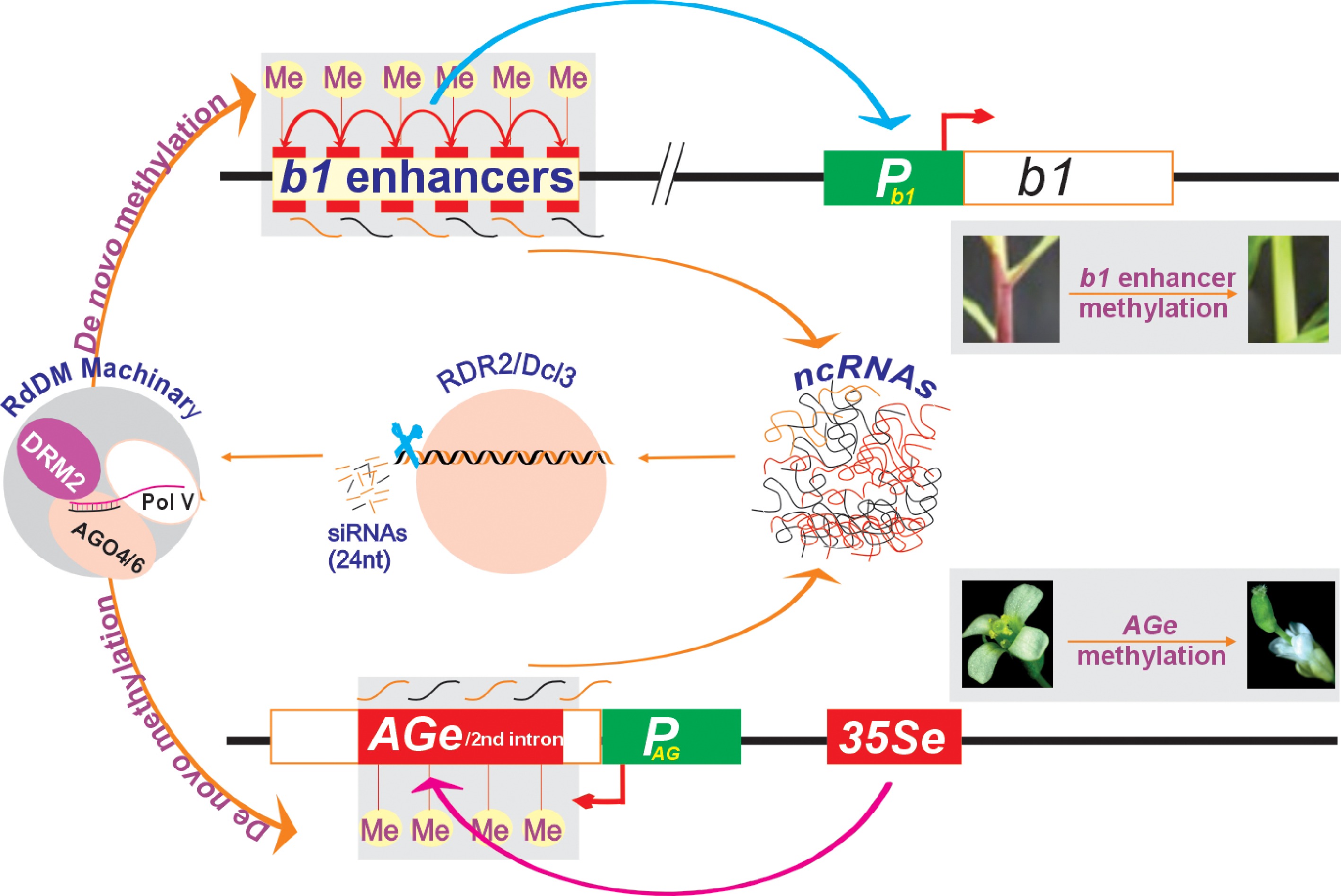
    Figure 1. 

    The proposed CRE–CRE interaction-driven de novo methylation mechanism involves either the insertion of the 35S enhancer (35Se) near the AGAMOUS (AG) locus in A. thaliana[17] or the spontaneous duplication of six 841-bp enhancer copies approximately 100 kilobases downstream of the booster 1 (b1) locus in maize (Zea mays), which results in a dark red sheath phenotype[37,40−43]. In A. thaliana, 35Se interacts with the distal AG enhancer (AGe), while in maize, the duplicated b1 enhancers interact with each other. These interactions, through mechanisms that remain unclear, initiate ectopic transcription of ncRNAs. These RNAs are subsequently processed via the 24-nucleotide siRNA biogenesis pathway. The RDR2–DCL3 complex converts single-stranded ncRNAs into double-stranded RNAs, which are then cleaved into 24-nucleotide siRNAs. These siRNAs promote RNA-directed DNA methylation (RdDM), resulting in de novo methylation at the AGe and tandem b1 enhancers. This methylation event silences transcription of AG and b1, leading to mutant flowers in A. thaliana and a shift from dark red to green coloration in maize stems.

    The mechanisms by which interactions between CREs trigger ectopic transcription of RdDM-potent ncRNAs remain unresolved. Both long-range and short-range interactions between enhancers, as well as between enhancers and promoters, coordinate gene regulatory activity in mammalian cells[45] and plants[46,47]. These interactions depend on TFs that mediate communication between regulatory elements. In plants, the 35Se enhancer, which is bound by multiple TFs, promotes robust and constitutive expression in both vegetative and floral tissues. This enhancer can interact with diverse promoters, resulting in broad enhancement of constitutive promoters or activation of tissue-specific promoters in otherwise inactive tissues. For example, the AGe enhancer is specific to male and female organ tissues, and its floral organ-specific expression depends on the binding of flower-regulated TFs such as AP1, AP2, AP3, and LFY[14,17,48,49]. When the 35Se element is present adjacent to AGe, AGe's regulatory activity in floral tissue is ectopically activated in vegetative tissues, including leaves, stems, and roots[50]. This observation suggests that TFs binding to 35Se may interact with those binding to AGe and ectopically activate AGe's regulatory functions in these tissues. However, the observation that activation or enhancement of ncRNA transcription in AGe by 35Se occurs exclusively in flowers and not in leaves[17], indicates that 35Se-mediated activation of ncRNA transcription in AGe is mechanistically distinct from 35Se-mediated alteration of AGe's regulatory activity. This finding suggests that AGe-bound TFs are required for ncRNA transcription. Although a comprehensive analysis is lacking, it is plausible that these TFs, when interacting with 35Se-bound TFs, alter the configuration of their complex in a way that genome defense systems recognize as a compromised regulatory signal. This recognition may trigger ectopic activation or aberrant ncRNA transcription, leading to the production of 24-nucleotide siRNAs and ultimately de novo methylation and suppression of multifunctional gene transcription. Alternatively, such TF–TF interactions may induce conformational changes that increase the accessibility of AGe chromatin to Polymerase IV (Pol IV), thereby priming the RdDM pathway. It is also possible that these interactions could override anti-RdDM mechanisms present in native genomic contexts or within TF complexes in AGe. Further investigation is required to elucidate the precise mechanisms underlying these phenomena.

  • The discovery that interactions between CREs can activate RdDM uncovers a previously unknown regulatory mechanism responsible for de novo methylation of transgenes. This finding clarifies why hypermethylation often occurs in duplicated genes, enhancers, transgenes, and transposon-rich genomic regions, where CRE interactions are common. The result has practical implications. Alterations in CRE activity caused by CRE–CRE interactions can be controlled by inserting an enhancer-blocking insulator between CREs in the plant genome[50−54]. Introducing such insulators may reduce ectopic de novo methylation in transgenic enhancer or promoter regions. Therefore, identifying CRE–CRE interaction-activated ncRNA transcription and de novo methylation offers a strategy to prevent transcriptional gene silencing in transgenic plants and to maintain engineered traits.

    • The study did not involve human participants or animal subjects, so no ethical approval was required.

    • The authors confirm their contributions to the paper as follows: study conception and design: Liu Z, Zhang D; manuscript drafting: Liu Z, Zhang D, Liu H; literature curation: Liu H, Ahmad B. All authors reviewed and approved the final version of the manuscript.

    • Data sharing is not applicable to this article because no datasets were generated or analyzed during the research. All data cited in this paper were reported in previously published articles.

    • The authors state that there are no conflicts of interest.

    • Copyright: © 2026 by the author(s). Published by Maximum Academic Press, Fayetteville, GA. This article is an open access article distributed under Creative Commons Attribution License (CC BY 4.0), visit https://creativecommons.org/licenses/by/4.0/.
Figure (1)  References (54)
  • About this article
    Cite this article
    Liu H, Ahmad B, Zhang D, Liu Z. 2026. A novel insight into CREs, TF binding, CRE–CRE interactions, and the potential driving force of de novo methylation in plants. Epigenetics Insights 19: e013 doi: 10.48130/epi-0026-0010
    Liu H, Ahmad B, Zhang D, Liu Z. 2026. A novel insight into CREs, TF binding, CRE–CRE interactions, and the potential driving force of de novo methylation in plants. Epigenetics Insights 19: e013 doi: 10.48130/epi-0026-0010

  • Catalog

      /

      DownLoad:  Full-Size Img  PowerPoint
      Return
      Return