










-
To date, perovskite solar cells (PSCs) have witnessed remarkable progress due to their high defect tolerance, balanced electron and hole mobility, and tunable bandgap of perovskite materials[1−4]. Among them, inverted PSCs (p-i-n type) have achieved a power conversion efficiency (PCE) exceeding 27%[5], which is related to the improvement of the perovskite buried interface by using self-assembled monolayers (SAMs) as hole transport layers (HTLs)[6−9]. SAM molecules offer numerous advantages, including low parasitic absorption, minimal material consumption, and compatibility with green solvent processing[10]. Generally, SAM materials featuring carbazole as the terminal group and phosphonic acid as the anchoring group, such as 2PACz ([2-(9H-carbazol-9-yl)ethyl]phosphonic acid) and Me-4PACz ([4-(3,6-dimethyl-9H-carbazol-9-yl)butyl]phosphonic acid), are now well established and widely used in laboratory research and industrial manufacturing[11,12]. They construct efficient hole transport channels, establish favorable interfacial contact, and effectively minimize non-radiative recombination. Me-4PACz, in particular, has emerged as the most used SAM for the fabrication of high-efficiency PSCs[2,13].
However, due to π–π interactions between carbazole groups, this type of SAM self-aggregates in solution. The terminal structures fold inward to form a core, which commonly deposits on substrates as micellar particles[14−16]. This results in disorderly stacking of SAM molecules on the substrate surface, preventing full coverage and the formation of an ideal, uniform, and dense monolayer. This behavior often leads to direct contact between the perovskite layer and the substrate, which influences perovskite crystal growth while increasing defects at the buried interface and generating a considerable amount of non-radiative recombination, resulting in inferior device performance and long-term stability[10,17]. To address this issue, current approaches include developing novel SAMs by modifying the terminal groups to achieve a more suitable dipole moment, enabling ordered arrangement on the substrate and better energy level alignment with the perovskite layer[7,18,19]. However, this approach requires difficult chemical synthesis processes. In addition, co-assembly techniques previously used in dye-sensitized solar cells have been adopted[20]. Zhao et al. employed a molecule comprising Br linked to different alkyl chains and phosphonic acid[21], which was post-processed for Me-4PACz to form a dense and uniform HTL while passivating the buried perovskite interface. Liu et al. used a specific ratio of multi-aromatic 4,4′,4″-tribenzene carboxylic acid (NA) in Me-4PACz to promote an ordered arrangement of SAMs on the substrate and obtain more complete coverage[13]. Furthermore, Zhao et al. adopted a 'SAM-in-matrix' strategy to integrate Me-4PACz into (pentafluorophenyl)borane (BCF)[22], resulting in an HTL with enhanced performance. These co-adsorption strategies typically employ molecules that are straightforward to synthesize and exhibit high reproducibility, indicating promising prospects for future commercial applications.
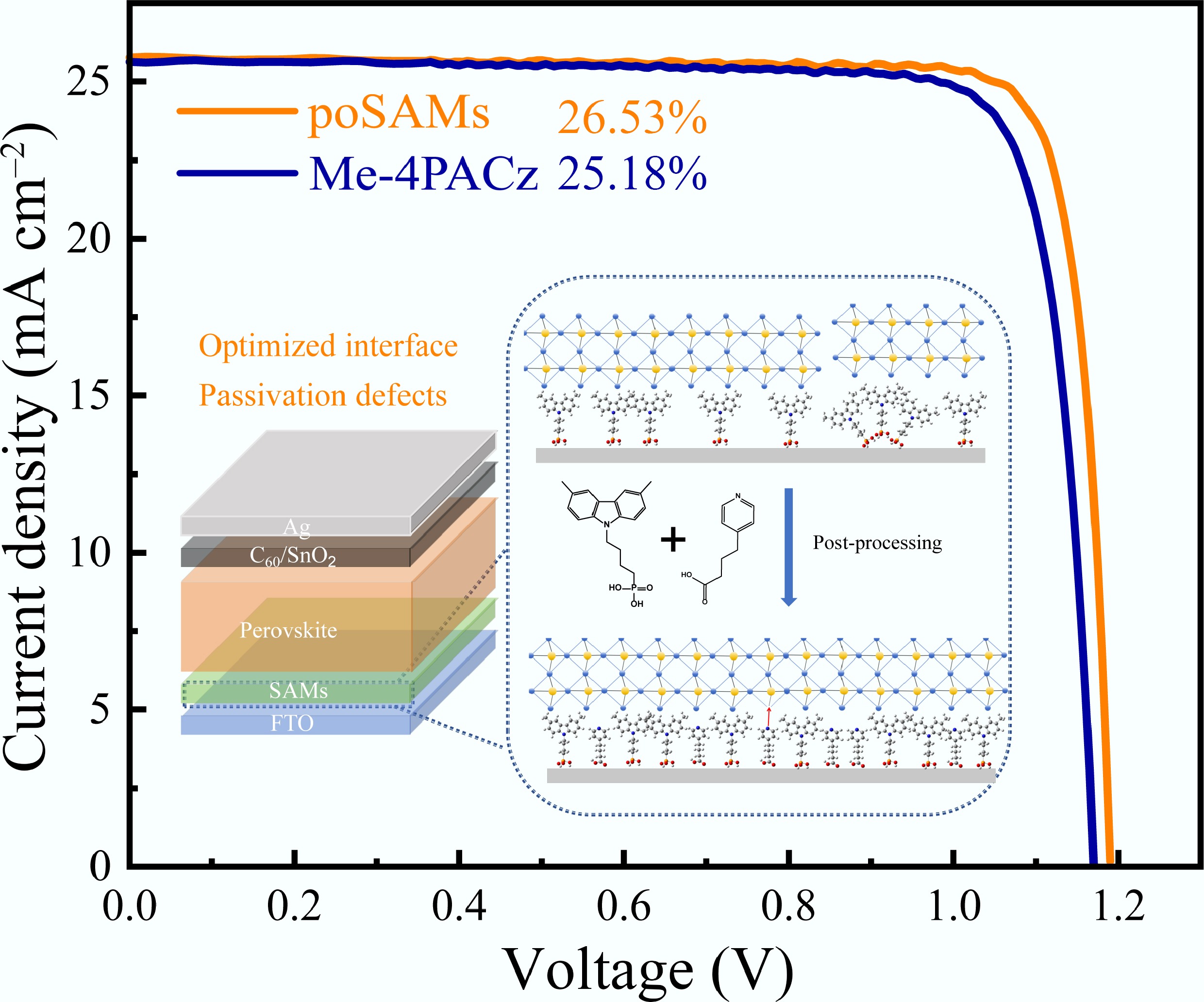
Here, inspired by the superior passivation effect of pyridine groups on the surface of perovskite[23,24], 4-(4-Pyridyl)butyric acid (4PBA), which contains both a pyridine group and a carboxylic acid moiety, was used to treat the substrate. The carboxylic acid on 4PBA anchors onto the FTO surface, filling gaps left by Me-4PACz and avoiding a Schottky contact between the perovskite layer and the substrate. Meanwhile, the lone electron pair on the nitrogen atom of the pyridine group forms a Lewis acid-base pair with Pb2+, providing passivation effects that improve perovskite crystallinity, reduce defects at the buried interface, and suppress non-radiative recombination. Additionally, it improves the energy level alignment of the HTL and hole extraction capability. Ultimately, the device using Me-4PACz + 4PBA achieved a notable PCE of 26.53%. It also demonstrated remarkable stability, preserving 95% of its initial efficiency after 2,000 h.
-
Figure 1a illustrates the sequential deposition process of Me-4PACz and 4PBA (termed poSAMs). Subsequent to the deposition of Me-4PACz, 4PBA was applied to fill the voids left uncovered by Me-4PACz, followed by an ethanol rinse to remove residual 4PBA molecules from the surface (after ethanol rinsing, both the RMS roughness and the AFM height of the surface decreased, as shown in Supplementary Fig. S1). This led to the formation of a dense monolayer, which enhanced interfacial contact with the bottom surface of the perovskite (Fig. 1b). The electrostatic potential distribution on the 4PBA surface reveals that the nitrogen atom in the pyridine group shows a red region (Fig. 1c), indicating a pronounced negative charge distribution and electron-donating capability. This facilitates Lewis acid-base coordination with Pb2+[25], thereby reducing deep-level defects at the interface and suppressing non-radiative recombination. Moreover, 4PBA has a significantly larger dipole moment (3.75 D) compared to Me-4PACz (1.66 D), which is beneficial for regulating the surface energy levels of the HTL. Furthermore, DFT calculations indicate that the HOMO energy level of 4PBA is −7.29 eV, significantly lower than that of Me-4PACz at −5.43 eV (Supplementary Fig. S2).
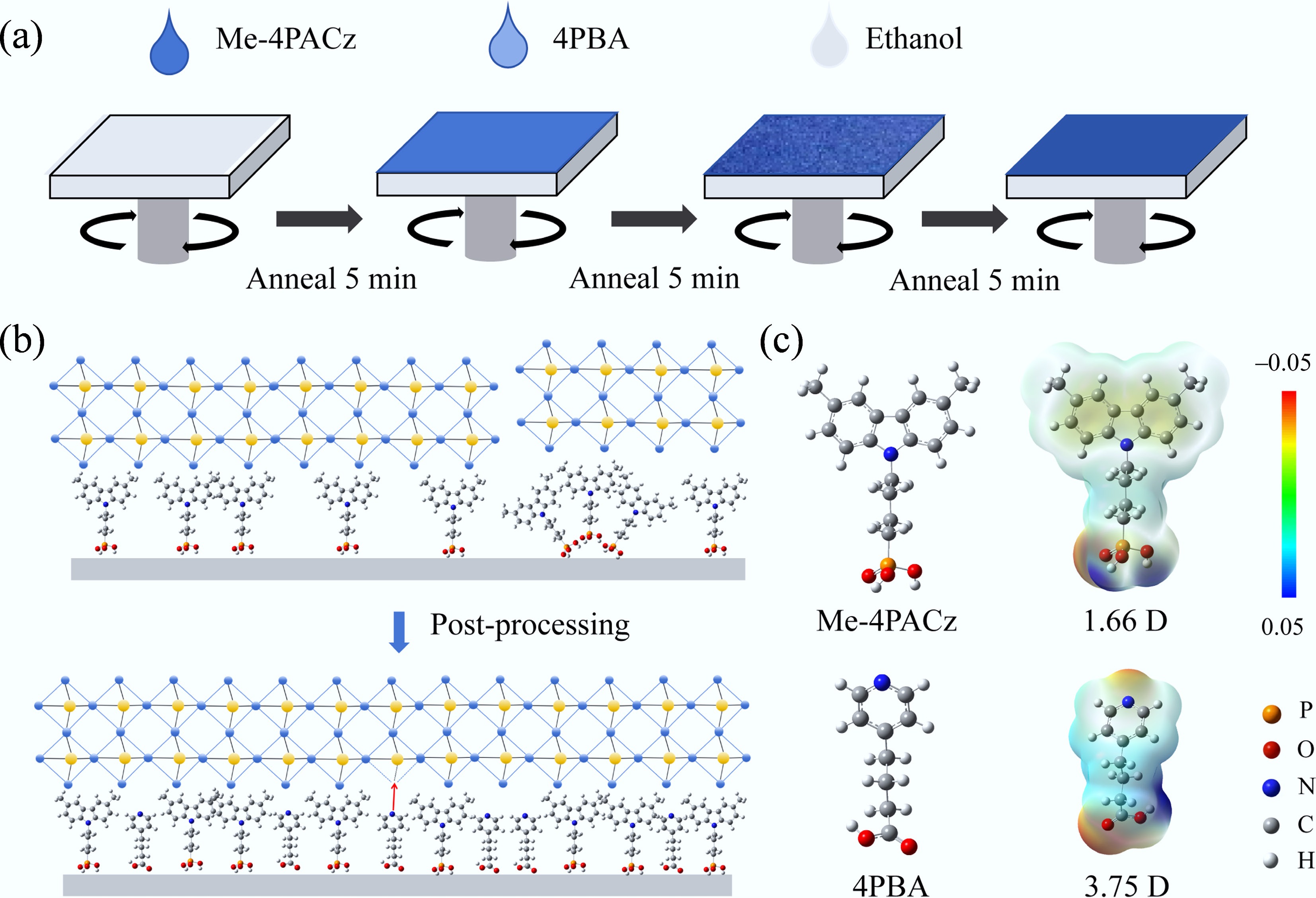
Figure 1.
(a) The schematic representation of the poSAMs deposition process; (b) the mechanism of the 4PBA post-assembly strategy; (c) the molecular structure and electrostatic potential distribution of Me-4PACz and 4PBA.
Atomic force microscopy (AFM) measurements revealed that the Me-4PACz film treated with 4PBA exhibited a reduction in root mean square (RMS) roughness from 11.26 to 10.02 nm relative to the film deposited only with Me-4PACz (Fig. 2a). The change in surface morphology resulted in improved wettability of the perovskite precursor solution. The comparison of contact angles of the perovskite precursor solution on SAM layers, both with and without post-treatment, indicated that the contact angle on FTO/Me-4PACz was 37°, while it decreased to 23° on FTO/poSAMs (Fig. 2b). The enhanced wettability facilitates a more uniform distribution of the perovskite precursor on the SAM layer[7,15], which is advantageous for the formation of compact perovskite crystals and minimizes pinholes at the buried interface. Kelvin probe force microscopy (KPFM) images show that the average contact potential difference (CPD) decreases from approximately −331 mV on FTO/Me-4PACz to about −369 mV on FTO/poSAMs (Fig. 2c, d), indicating a downward shift in the Fermi level (Ef). This enhances the p-type characteristics of the HTL, facilitates hole extraction and transport at the interface, and thereby elevates the open-circuit voltage (Voc) of the fabricated devices. In addition, the full width at half maximum (FWHM) of the CPD distribution decreased from 16 mV for FTO/Me-4PACz to 11 mV for FTO/poSAMs (Fig. 2e), suggesting improved uniformity of the surface potential[11,26]. Conductive atomic force microscopy (C-AFM) images revealed that the post-treated poSAM films exhibit a more uniform current distribution (Fig. 2f), indicating a reduction in uncovered regions on the FTO substrate. Moreover, the treated film exhibited a higher electrical conductivity, which promotes efficient hole transport and mitigates charge accumulation between the Me-4PACz and the perovskite layer.
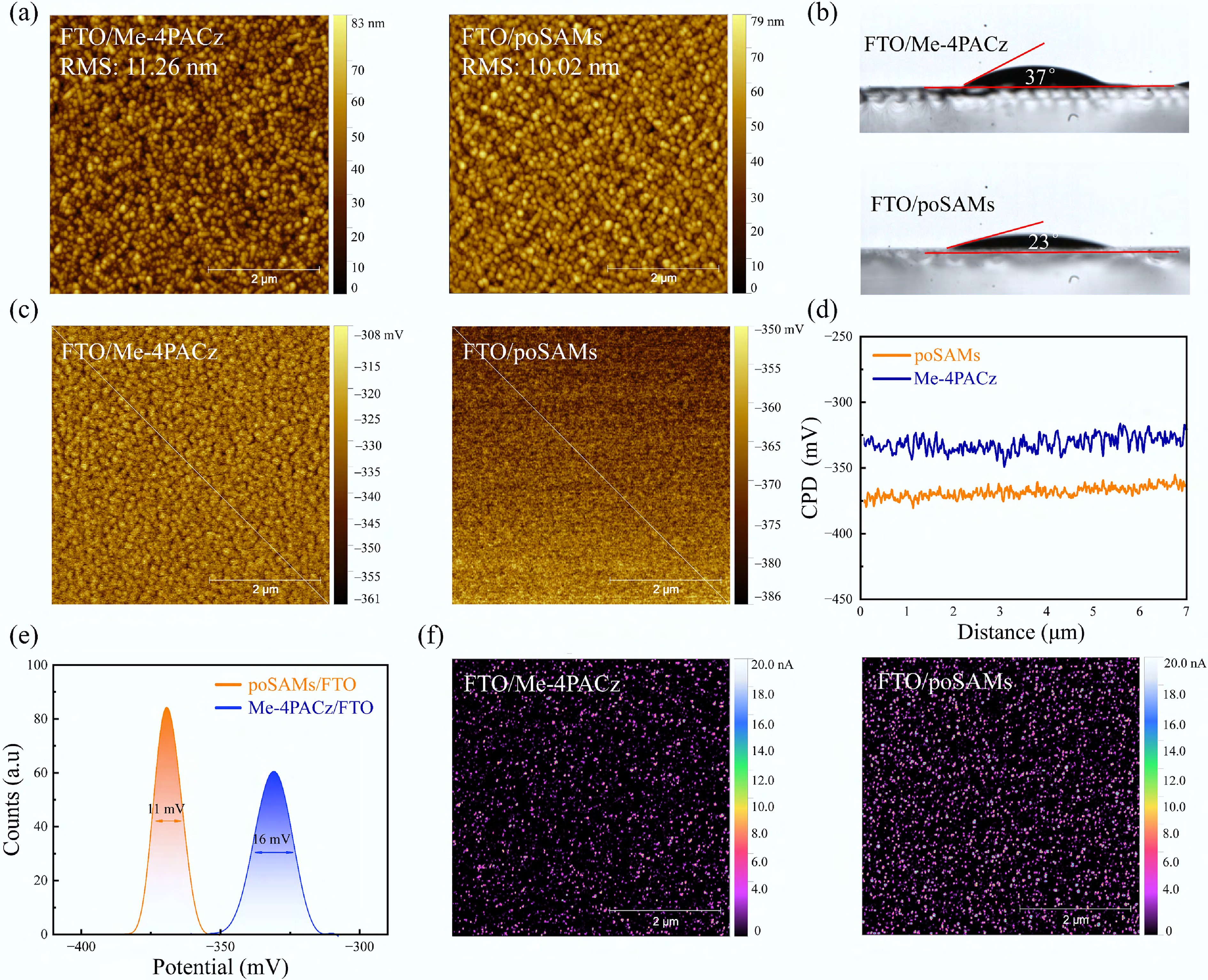
Figure 2.
(a) AFM height images of the FTO substrates covered by Me-4PACz and poSAMs; (b) contact angle of perovskite precursor with FTO/SAMs substrates; (c) KPFM images; (d) curves of FTO anchoring with SAMs, and the related (e) FWHM plot; (f) c-AFM images of Me-4PACz and poSAMs deposited on the FTO substrate.
As determined by ultraviolet photoelectron spectroscopy (UPS) measurements (Supplementary Fig. S3), post-treatment with 4PBA results in an increase in the work function from 4.85 to 4.92 eV, and a shift in the highest occupied molecular orbital (HOMO) energy level from −5.56 to −5.64 eV, in comparison to FTO/Me-4PACz. The energy levels at the poSAMs surface are more consistent with the measured −5.71 eV at the buried perovskite interface (Fig. 3a). The aligned energy levels increase hole mobility at the interface, thereby suppressing non-radiative recombination. Meanwhile, the increased work function enhances the p-type conductivity at the interface, minimizing the Voc loss of the device and consequently improving PCE[12,27,28].
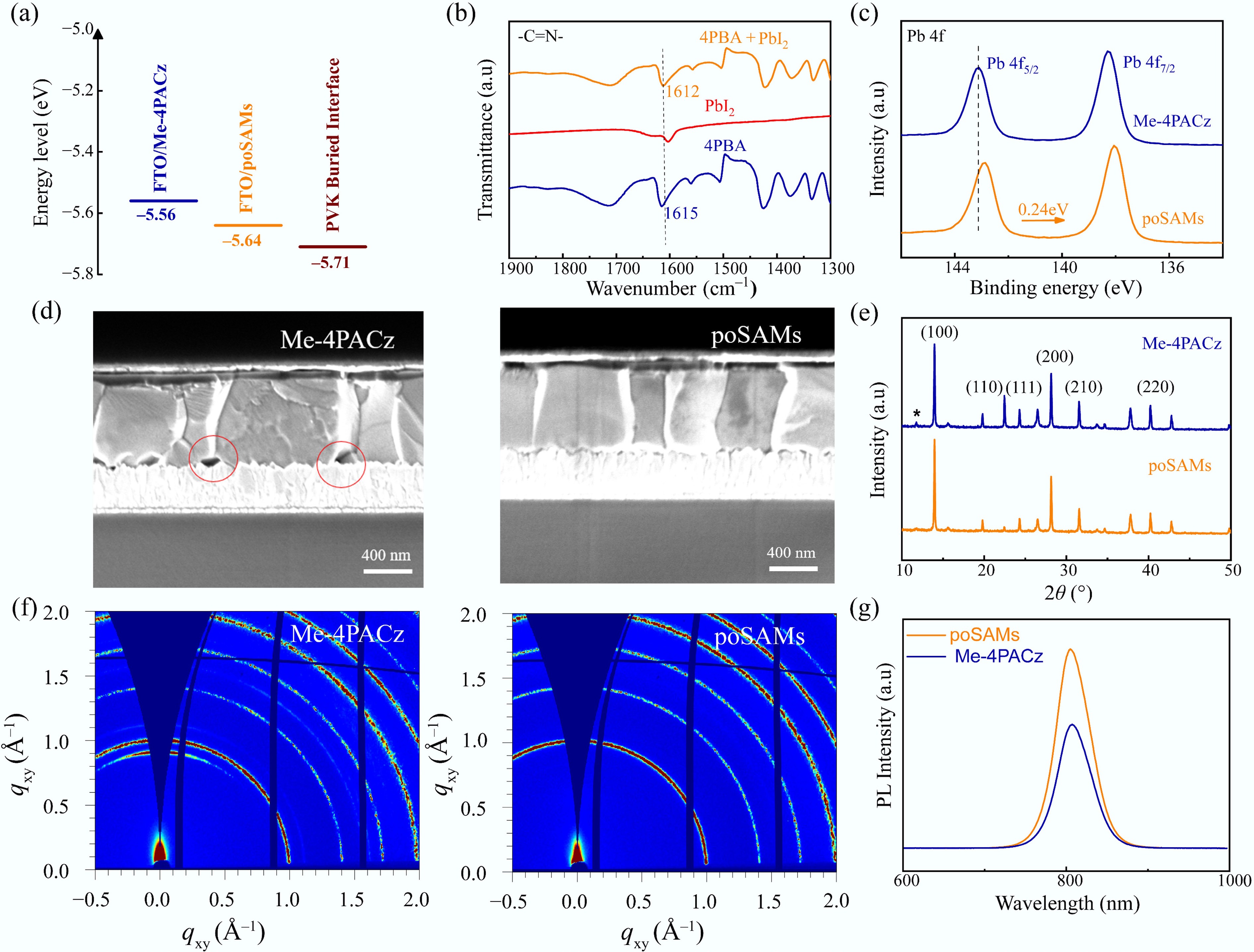
Figure 3.
(a) Energy level diagram illustrating the different SAMs and the perovskite layer; (b) FTIR analysis of 4PBA + PbI2, PbI2, and 4PBA; (c) Pb 4f regions in the XPS spectra for the perovskite films deposited on different SAM substrates; (d) cross-sectional SEM images of the device with different SAMs; (e) XRD patterns and (f) GIWAXS images of the perovskite film deposited on different SAMs substrates; (g) PL spectra of the perovskite film deposited on different SAM substrates.
Given the established electron-donating capability of the nitrogen atom in the pyridine group, density functional theory (DFT) calculations indicated that the binding energies of Me-4PACz and 4PBA on perovskite are −0.45 and −0.87 eV, respectively (Supplementary Fig. S4). The enhanced interfacial interaction energy of 4PBA with perovskite demonstrates its more effective binding at the buried interface compared to Me-4PACz[29]. This prevents the formation of a Schottky contact between the perovskite and the exposed regions of the FTO substrate not covered by Me-4PACz, thereby mitigating the generation of non-radiative recombination centers at the buried interface[22,30]. The projected density of states (PDOS) analysis further indicates that the nitrogen atom in the pyridine ring plays a key role in defect passivation (Supplementary Fig. S5). The deep-level trap states originate from interfacial defects and iodine vacancies on the perovskite surface resulting from the breaking of Pb-I bonds. This demonstrates that after treatment with 4PBA, the lone electron pair on the nitrogen atom of pyridine stabilizes Pb2+, thereby passivating the deep-level defects and further suppressing non-radiative recombination of charge carriers[31].
Fourier transform infrared (FTIR) spectroscopy elucidates this interaction process (Fig. 3b). Upon mixing 4PBA with PbI2 powder, the C=N stretching vibration peak of 4PBA shifts from its original position at 1,615 cm−1 to a lower wavenumber of 1,612 cm−1. The observed redshift indicates a transfer of electron density to Pb2+, confirming the interaction between 4PBA and PbI2[32], which is consistent with the computational findings. X-ray photoelectron spectroscopy (XPS) spectra reveal that after the co-treatment with 4PBA, the Pb 4f peak exhibited a shift towards lower binding energy of 0.24 eV (Fig. 3c), while the I 3d peak shifted by 0.17 eV (Supplementary Fig. S6) compared to Me-4PACz. The shift of the Pb 4f peak indicates an increased electron cloud density around Pb atoms due to coordination with the pyridine nitrogen[33,34], confirming the passivation effect. The simultaneous shift of the I 3d peak can be attributed to the Fermi level shift at the buried interface induced by the 4PBA treatment, which is consistent with the UPS results[35].
The enhanced uniformity of poSAMs, combined with the passivation effect of 4PBA, leads to a significant improvement in the crystallinity of the perovskite. Scanning electron microscopy (SEM) images of the buried interface (Supplementary Fig. S7a) and cross-sectional SEM images (Fig. 3d) of perovskite films on different SAM substrates reveal that the perovskite on poSAMs exhibited larger and more uniform grain sizes, resulting in enhanced contact with the HTL. Furthermore, the upper surface of the FTO/poSAMs/perovskite exhibited improved morphology devoid of discernible pinholes (Supplementary Fig. S7b), as confirmed by the X-ray diffraction (XRD) patterns. The intensities of the (100) and (200) peaks of poSAMs/perovskite were enhanced compared to those of the Me-4PACz/perovskite (Fig. 3e), indicating improved crystallographic orientation of the perovskite on the poSAMs substrate[36]. Moreover, the peak at 12.6° in the Me-4PACz/perovskite, associated with PbI2, disappeared after the post-treatment, indicating the removal of residual PbI2 at the buried interface, which is attributed to the coordination effect of 4PBA[37,38]. As shown in Fig. 3f, grazing-incidence wide-angle X-ray scattering (GIWAXS) indicates that the poSAMs/perovskite exhibited increased diffraction ring intensity at qxy = 1 Å−1, indicative of the (100) plane of the perovskite phase, but no discernible diffraction ring was observed at qxy = 0.91 Å−1, where PbI2 diffraction is present. Steady-state photoluminescence (PL, Fig. 3g) and time-resolved photoluminescence (TRPL, Supplementary Fig. S8a) measurements were performed to study carrier dynamics at the interface. The perovskite film deposited on the FTO/poSAMs/perovskite substrate exhibited higher PL intensity and photoluminescence quantum yield (PLQY) value, and a longer average carrier lifetime compared to the FTO/Me-4PACz/perovskite; the average carrier lifetime increased from 280.54 to 381.50 ns (Supplementary Fig. S8; Supplementary Table S1). Additionally, PL mapping images showed higher intensity and spatially uniform PL distribution compared to the control group in Supplementary Fig. S9. These results demonstrated an enhancement in both the crystallinity and uniformity of the perovskite film on the poSAMs substrate, accompanied by suppressed non-radiative recombination at the interface[39].
As shown in Fig. 4a, we fabricated p-i-n-structure PSCs comprising FTO/SAMs/Cs0.05MA0.1FA0.85PbI3/PDAI + 3MTPAI/C60/SnO2/Ag on different substrates, where MA is methylammonium, FA is formamidinium, PDAI is 1,3-propanediammonium iodide, 3MTPAI is 3-(methylthio)propylammonium iodide, and C60 is Fullerene. Figure 4b shows the current density-voltage (J-V) curves of the champion devices for the Me-4PACz-based and poSAMs-based PSCs. The poSAMs-based PSC achieved a PCE of 26.53%, a Voc of 1.19 V, a short-circuit current density (Jsc) of 25.77 mA cm−2, and a fill factor (FF) of 86.45%, exceeding the Me-4PACz-based device, which delivered a PCE of 25.18%, a Voc of 1.17 V, a Jsc of 25.63 mA cm−2, and an FF of 83.93%. The enhancement in device performance is attributed to the increase in both Voc and FF, resulting from mitigating defects between the HTL and perovskite layers, suppressing non-radiative recombination of charge carriers, and improving the crystallinity of the perovskite layer. Figure 4c shows the external quantum efficiency (EQE) spectrum of Me-4PACz and the poSAMs-based devices. The integrated current density of the poSAMs device was 24.90 mA cm−2, which closely matches the Jsc obtained from the J-V curve. Additionally, we fabricated 25 devices for each substrate type to evaluate reproducibility. The statistical distributions of their photovoltaic parameters are shown in Fig. 4d and Supplementary Fig. S10. The forward and reverse scan J-V curves of the champion devices are provided in Supplementary Fig. S11 and Supplementary Table S2. The poSAMs devices achieved an average PCE of 25.98%, which is higher than that of Me-4PACz devices with an average PCE of 24.33% (Supplementary Table S3). Moreover, the PCE values for the poSAMs devices exhibited a smaller fluctuation range and a more concentrated distribution compared to the Me-4PACz devices, indicating improved reproducibility. We also evaluated the stability of devices with different substrates by measuring the stabilized PCE at the maximum power point (MPP). As shown in Fig. 4e, the poSAMs device achieved a stabilized PCE of 26.36%, which is higher than the 24.84% value for the Me-4PACz device, indicating superior photo-thermal stability.
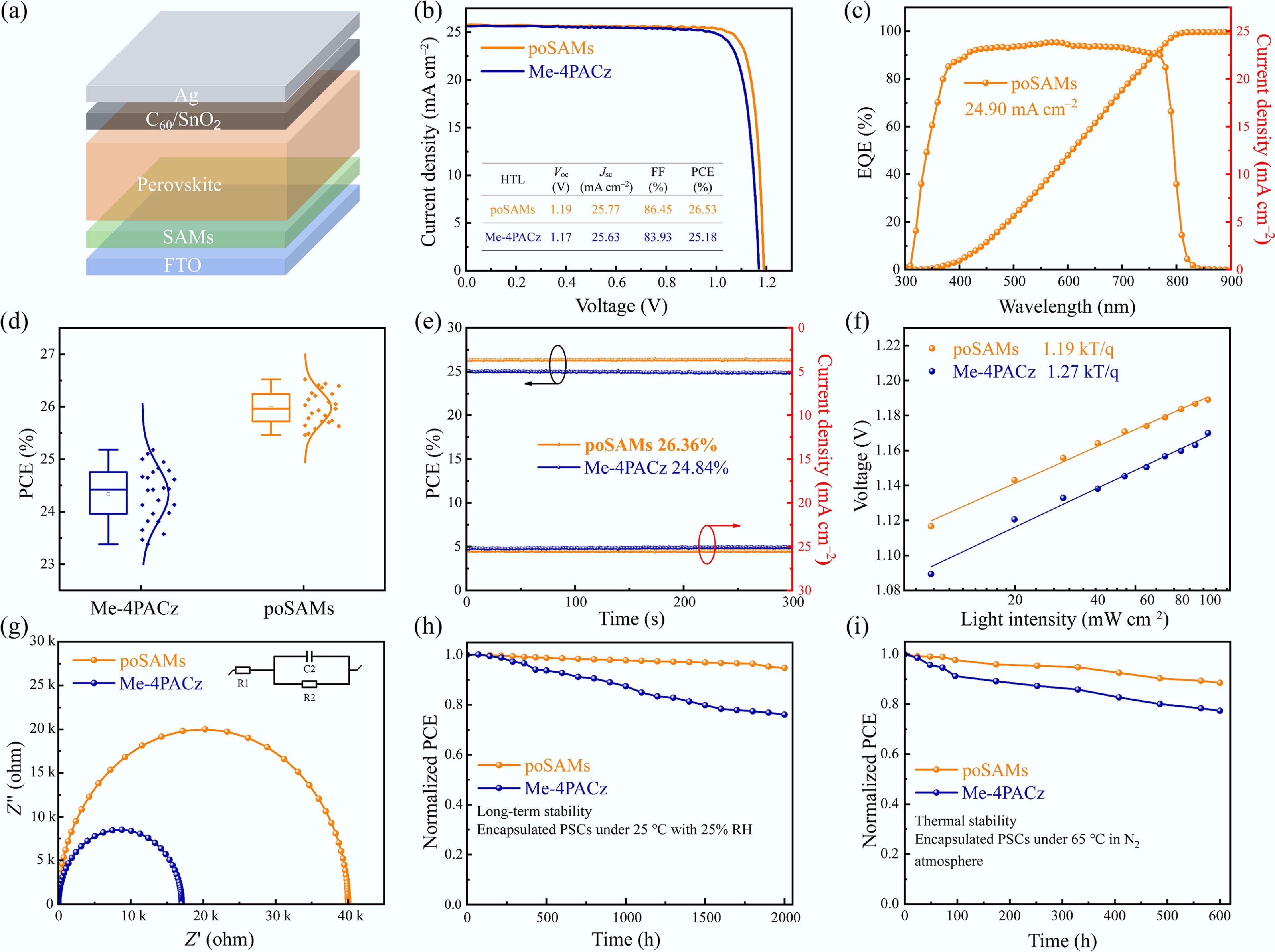
Figure 4.
(a) The architecture of the inverted device; (b) the J-V curves of Me-4PACz- and poSAMs-based PSCs; (c) the EQE spectrum of poSAMs-based PSC; (d) the statistical PCE, (e) MPP tracking; (f) Voc vs light intensity; (g) EIS of Me-4PACz and poSAMs-based PSCs; (h) long-term stability; and (i) thermal stability of encapsulated Me-4PACz and poSAMs-based devices.
We conducted further investigation into the mechanisms underlying the improved optoelectronic performance of devices treated with 4PBA. First, we measured the ideality factor (nid) of devices based on different HTL layers (Fig. 4f). The poSAMs device exhibited a nid value of 1.19 kBT/q, which is lower than the 1.27 kBT/q value for the Me-4PACz device. This indicates that the 4PBA post-treatment effectively reduces non-radiative recombination of charge carriers at the SAM/perovskite interface. Furthermore, as shown in the dark J-V curves (Supplementary Fig. S12), the poSAMs device exhibited lower leakage current under reverse bias, demonstrating reduced interfacial defects and the mitigation of non-radiative recombination centers[40]. Moreover, the electrochemical impedance spectroscopy (EIS) of the Me-4PACz device exhibited a series resistance of 5.26 Ω and a recombination resistance of 17,034 Ω (Fig. 4g). In contrast, the poSAMs device showed a series resistance of 5.05 Ω and a recombination resistance of 40,011 Ω. The lower series resistance of the poSAMs device suggested reduced charge transport losses, while its higher recombination resistance indicated enhanced suppression of non-radiative recombination at the poSAMs/perovskite interface compared to the Me-4PACz device, which is beneficial for improving both the FF and Voc in devices[41]. Additionally, the Mott–Schottky curves (Supplementary Fig. S13) revealed that the built-in potential of the poSAMs-based device (0.89 V) surpasses that of the Me-4PACz-based device (0.80 V), demonstrating that the poSAMs device exhibits a higher driving force for charge separation, hence inhibiting non-radiative recombination[42,43]. To further confirm the improved interfacial contact between the HTL after 4PBA post-treatment and the perovskite layer, we fabricated hole-only devices to analyze the trap state density (Ntrap) at the interface between the HTL and the perovskite layer. The Ntrap values for the Me-4PACz and poSAMs-based devices, derived from the trap-filled limit voltage (VTFL), were determined to be 3.90 × 10¹⁵ and 2.02 × 1015 cm−3, respectively (Supplementary Fig. S14), indicating a decrease in the defect density of the entire perovskite film, including both the bulk and the interface[44]. Combined with the PDOS calculation results, this reduction can be attributed to the passivation of interfacial defects.
For PSCs, to truly progress towards industrial applications, stability is a crucial factor. The stability of encapsulated PSC devices on different substrates was further evaluated under diverse environmental conditions. After 2,000 h, the poSAMs device at 25 °C and 25% relative humidity (RH) retained 95% of its initial efficiency (Fig. 4h), outperforming the Me-4PACz device (76%), demonstrating superior long-term stability. Similarly, after a 600-h heating test at 65 °C in a nitrogen atmosphere, the poSAMs device demonstrated outstanding thermal stability, retaining 88% of its initial efficiency (Fig. 4i). In comparison, the Me-4PACz device maintained 65% of its initial efficiency. In addition, the poSAMs device performed better in humidity at 60% RH and 25 °C, retaining ~89% of its initial efficiency after 600 h, compared to 79% for the Me-4PACz device (Supplementary Fig. S15). The enhanced humidity and thermal stability might be attributed to improved interfacial contact and enhanced perovskite crystallinity[25,45]. All devices for the above three stability tests were stored in the dark. To further evaluate the operational durability under practical conditions, we conducted continuous maximum power point tracking (MPPT) of encapsulated devices at 85 °C in a nitrogen atmosphere. As shown in Supplementary Fig. S16, after 300 h of continuous MPP operation under 1-sun illumination, the poSAMs-based device retained 92.4% of its initial efficiency, significantly outperforming the Me-4PACz-based control device, which retained only 83.7%. Notably, the Me-4PACz device exhibited a larger PCE drop that persisted over a longer duration throughout the test, whereas the poSAMs device stabilized within a shorter time.
-
In summary, we designed a small-molecule compound, 4PBA, for the post-treatment of Me-4PACz. This approach achieves a more uniform and compact HTL, improved wettability, and superior interfacial contact with the perovskite layer, thereby preventing direct Schottky contact between the perovskite and FTO. Moreover, 4PBA effectively reduces defects at the buried perovskite interface, providing passivation that enhances perovskite crystallinity, suppresses non-radiative recombination of charge carriers, and extends carrier lifetime. These improvements significantly boosted the optoelectronic performance of the poSAMs devices. Ultimately, the champion poSAMs devices achieved a PCE of 26.53%, representing a notable increase compared with the 25.18% value for the Me-4PACz device, while also exhibiting enhanced performance in multiple stability tests. This manuscript presents a novel technique for SAM engineering, illustrating a pathway towards enhanced device performance for commercialization.
We gratefully acknowledge the Discipline Platform of Clean Energy Generation and Grid Integration, Hohai University, the Qingdao Institute of Bioenergy and Bioprocess Technology, and the Shanghai Synchrotron Radiation Facility for providing analytical and testing support for this experiment.
-
It accompanies this paper at: https://doi.org/10.48130/scm-0026-0030.
-
Not applicable.
-
The authors confirm their contributions to the paper as follows: Hanqing Yang: fabricated and tested efficient devices, curated the data, and wrote the original draft; Mingyuan Han: performed the relevant tests, including XPS, UPS, FTIR, and SEM; Ziqiang Su: performed a series of related characterizations including AFM, KPFM, and CAFM; Xuepeng Liu: designed the molecules; Zedong Lin, Wenyong Feng: carried out DFT calculations for molecular structure optimization, energy levels, and ESP, as well as molecular dynamics calculations of the adsorption process; Botong Li: carried out the relevant measurements, including contact angle, PL, and TRPL; Hanqing Yang, Mingyuan Han, Xuepeng Liu, Ziqiang Su, Botong Li, Li Tao, Zedong Lin, Wenyong Feng, Zhipeng Shao, Guanglei Cui, Songyuan Dai, Xingyu Gao, Yong Ding: contributed to the data analysis and commented on the manuscript; Li Tao, Zhipeng Shao, Guanglei Cui, Songyuan Dai, Xingyu Gao, Yong Ding: conceived the research project and supervised different parts of the work. All authors reviewed the results and approved the final version of the manuscript.
-
The datasets generated and/or analyzed during the current study are available from the corresponding author upon reasonable request.
-
The authors declare that they have no known competing financial interests or personal relationships that could have appeared to influence the work reported in this paper.
-
# Authors contributed equally: Hanqing Yang, Mingyuan Han
Full list of author information is available at the end of the article. - The supplementary files can be downloaded from here.
- Copyright: © 2026 by the author(s). Published by Maximum Academic Press, Fayetteville, GA. This article is an open access article distributed under Creative Commons Attribution License (CC BY 4.0), visit https://creativecommons.org/licenses/by/4.0/.
-
About this article
Cite this article
Yang H, Han M, Liu X, Su Z, Li B, et al. 2026. Multifunctional pyridine-based small molecule post-treatment of self-assembled monolayer for high-performance perovskite solar cells. Sustainable Carbon Materials 2: e035 doi: 10.48130/scm-0026-0030 

Multifunctional pyridine-based small molecule post-treatment of self-assembled monolayer for high-performance perovskite solar cells
- Received: 08 June 2026
- Revised: 18 July 2026
- Accepted: 11 August 2026
- Published online: 16 November 2026
Abstract: The application of a self-assembled hole-transport monolayer has significantly improved the performance of perovskite solar cells (PSCs). However, the commercially available high-performance Me-4PACz still faces challenges such as insufficient substrate coverage, weak interaction with perovskite, and energy level mismatch. In this study, a small molecule (4PBA), which contains an acetic acid anchoring group and a pyridine group at the end, was employed to post-treat Me-4PACz. This study revealed that treating the substrate with 4PBA resulted in a smoother surface, more uniform current distribution, and improved wetting properties for the perovskite precursor solution. The substrates treated with 4PBA exhibited deeper HOMO energy levels, leading to improved energy alignment between the substrate and the perovskite. Moreover, the pyridine group exhibits higher coordination with lead ions in the perovskite, resulting in better perovskite crystallization and interfacial contact. Ultimately, PSCs based on the 4PBA post-treatment achieved an efficiency exceeding 26%, along with significantly enhanced stability.
-
Key words:
- Perovskite solar cell;
- Self-assembled monolayer;
- Pyridine;
- Post-treat;
- Coordination