









-
Plant architecture is a key agronomic trait that strongly influences crop productivity, cultivation management, and ornamental value[1]. It is determined by multiple characteristics, including plant height, branching pattern, inflorescence architecture, and leaf angle. Among these traits, lateral branching plays a central role in shaping overall plant architecture by affecting light interception, spatial distribution, and reproductive development. For gramineous crops, effective tillering (the formation of lateral branches at the base of the stem) determines the number of panicles and directly affects the yield, while reducing ineffective tillering is conducive to the rational use of nutrients[2−4]. While branching is a key yield determinant in cereal crops, its role in ornamental species is primarily focused on canopy compactness and aesthetic value. For ornamentals, branching has an important impact on visual effects[5]. Branching is an important feature of plant architecture, as well as the result of axillary bud initiation and bud growth, and has a decisive effect on the seed yield of cash crops[6,7]. As an important plant architecture index, the leaf angle directly affects the distribution of light and CO2 in the canopy and the light energy utilization of the population, which further affects the process of plant growth and development, physiological characteristics, and finally affects the yield[8−11]. Branch development of plants is a very important link in the growth process, and the number and angle of branches are important factors in determining crop plant architecture, and are also related to crop development, yield, and cultivation mode[12]. The branching characteristics of plants are influenced by many factors, including plant nutrition, growth and development stage, endogenous hormones, environment, epigenetic factors, and transcription factors[13,14].
Among the various endogenous signals, strigolactones (SLs) have emerged as a class of novel phytohormones that primarily inhibit axillary bud outgrowth. Strigolactones were initially isolated from the root exudates of cotton (Gossypium hirsutum)[15,16]. To date, numerous natural strigolactones (SLs) have been identified in plants. Based on their structural characteristics, natural SLs are generally classified into canonical and non-canonical strigolactones. Canonical SLs mainly include strigol- and orobanchol-type compounds, whereas non-canonical SLs possess structural variations in the core SL scaffold[17−19]. SLs are a novel plant hormone that inhibits the growth and development of lateral buds and regulates plant branching[20,21]. The D14-MAX2-D53 signaling module serves as the core mechanism for SL perception and signal transduction. Rice D14 homologous genes, such as Arabidopsis D14, petunia DAD2, and pea RMS3, encode a hydrolase that hydrolyzes SLs[22,23]. D14 is an atypical hormone receptor that plays a key role in the SL signaling pathway. It is a substrate specifically recognized by leucine-rich repeat F-box protein MAX2/D3, which leads to ubiquitination and degradation of the substrate[24,25]. The D14 gene has been functionally analyzed in many plants[26,27]. The d53 and d14 mutants have similar phenotypes of dwarfing and multiple tillers, and through the analysis of multiple branching mutants in Arabidopsis, rice, pea, and other model plants, remarkable progress has been made in the molecular mechanism of SLs' regulation of plant branching.
The SL pathway suppressor SMAX1-LIKE in Arabidopsis thaliana and the F-box protein MAX2 (the homologous protein in rice is D3) are involved in SL-mediated plant branching regulation. SLs can enhance the interaction of D14 with MAX2 and D53, while MAX2 can remove the inhibition of D53 on the SL signaling pathway through ubiquitination and degradation of D53, thus activating the expression of downstream genes and regulating normal plant branching[28,29]. The sld14 mutant obtained by CRISPR/Cas9 technology showed decreased plant height and root biomass, increased branching, and changed leaf shape compared with wild-type plants. At the same time, the mutant leaves were light green, chlorophyll and carotenoid contents were decreased, chloroplast structure was abnormal, and photosynthesis was weakened. The results indicated that the SL receptor gene SlD14 not only modulates the development of roots, stems, branches, and leaves, but also plays a role in regulating photosynthetic pigment accumulation and photosynthetic capacity[30].
To investigate the molecular basis underlying axillary shoot emergence in tomato, we comparatively analyzed plant architecture traits between 10 determinate and 10 indeterminate tomato cultivars and identified lateral branching as a major factor contributing to architectural variation. Integrated analyses of branching phenotypes, SlD14 expression patterns, and promoter cis-regulatory element composition revealed that differential expression of SlD14, a key receptor in SL signaling, was closely associated with axillary bud outgrowth, suggesting that misregulation of SlD14 contributes to the emergence of axillary shoots in tomato. To further validate its biological function, CRISPR/Cas9-mediated gene editing was employed to generate two homozygous sld14 mutants in the indeterminate tomato cultivar 34#. Phenotypic characterization demonstrated that disruption of SlD14 significantly promoted axillary shoot emergence and elongation, leading to excessive branching accompanied by reduced plant height and altered leaf angle. Furthermore, transcriptome sequencing analysis revealed that altered SlD14 expression triggered extensive transcriptional reprogramming in multiple phytohormone signaling pathways, particularly auxin, gibberellin, and brassinosteroid-related genes. Collectively, these findings demonstrate that misregulation of SlD14 disrupts hormonal homeostasis and promotes axillary shoot emergence, thereby reshaping tomato plant architecture.
-
In this study, 20 experimental tomato materials with determinate and indeterminate growth characteristics were generated by our research group. The following 10 determinate tomato varieties were used: 'Barbara Tomato' (BL), 'Dwarf Red Bell' (AR), 'Tomato Pink Bird' (F), 'Balconi Yellow' (BK), 'Canary' (J), 'Yellow Cherry Tomato' (HY), 'Tomato Redbird' (R), 'Dwarf Red Bell' (AH), 'Red Pearl Tomato' (RZ), and 'Micro Tom' (MT). Ten indeterminate tomato varieties; laboratory codes 104#, 30#, 34#, 353#, 36#, 114#, 334#, 49#, 331#, and 17#, were used with 10 biological replicates each. Transgenic experiments were carried out with background materials of the tomato variety laboratory code 34#. The seeds were disinfected in 75% alcohol for 1 min, disinfected in 8% sodium hypochlorite solution for 15 min, washed with high-temperature sterilized water five times, and planted on MS medium supplemented with 0.7% AGAR. The cotyledons were fully developed, transplanted into a matrix of vermiculite mixed with nutrient soil (2:1), and cultured in the plant culture room. The day and night temperatures of the growth chamber were 25/22 °C, the light duration was 16 h, the dark duration was 8 h, and the light intensity was 275 μmol·m−2·s−1. Once the plants grew to the five-leaf stage, the fifth compound leaf was frozen in liquid nitrogen and stored for real-time fluorescence quantitative PCR (RT‒qPCR) analysis to determine the tissue expression specificity of SlD14 at the transcript level.
Subcellular localization
-
The full-length coding sequence (CDS) of SlD14 without the stop codon was amplified and cloned into the pGWB405 vector to generate the SlD14-GFP fusion construct. The GFP vector was used as the empty-vector control. The recombinant plasmids were introduced into Agrobacterium tumefaciens strain GV3101 and transiently expressed in Nicotiana benthamiana leaves by agroinfiltration. The bacterial suspension was infiltrated into the leaves of 4–6-week-old N. benthamiana plants using a needleless syringe. After infiltration, the plants were maintained under normal growth conditions for 48–72 h. GFP fluorescence was observed using a confocal laser scanning microscope (Zeiss LSM880) to determine the subcellular localization of SlD14. At least three independent biological replicates were performed for each construct.
Construction of the SlD14 CRISPR vector and genetic transformation of tomato
-
The knockout vector was constructed using the CRISPR/Cas9 gene editing system. pG3K-U6SC was used in this study. After cloning and assembling the CRISPR expression cassette, the resulting products were transformed into Escherichia coli (heat shock method), verified by primers U6-29p-F and U6-29p-R; positive colonies were screened and sequenced, and the extracted plasmids were subsequently transformed into A. tumefaciens LA4404 harboring the helper plasmids pVS1-VIR2 (electric shock method)[31]. The primers used in the present study were synthesized by Tsingke Biological Co., Ltd. (Qingdao, China).
The tomato cultivar 34#, as described above, was used as the wild-type background for genetic transformation. The wild-type seeds were sown and disinfected on a sterile table, and the seeds with full particles were evenly sown on MS medium, with 25 seeds per bottle. After dark treatment for 3 d, the seeds were germinated and were placed in the culture room with unchanged parameters. When the cotyledons fully developed, the middle part of the cotyledon was cut as the explant, and the explants were placed on the medium with the axial side down for 2 d in the dark at 28 °C. Afterwards, the activated Agrobacterium solution was prepared, Agrobacterium infection was carried out on a superclean table, and then co-culture, differentiation culture, and rooting culture were carried out. For verification of the tomato transgenic lines, the CTAB method was used for DNA extraction; expression cassette primers were used to verify whether the expression cassette was transferred, and the gene fragment primers SlD14-T1-F and SlD14-T2-R were used to verify whether gene editing was successful. If there was no significant difference, sequencing was performed for verification.
RNA extraction and RT-qPCR analysis
-
Total RNA was extracted by the TRIzol method; the RNA concentration was measured by a spectrophotometer, and the integrity of the RNA was detected by agarose gel electrophoresis. cDNA was extracted using the HiScript II 1st Strand cDNA Synthesis Kit (+g DNA wiper) DNA kit. The reverse transcription products were detected by PCR, and RT‒qPCR analysis was performed using a ChamQTM Universal SYBR® qPCR Master Mix (Vazyme) Kit (Nanjing Vazyme Biological Co., Ltd.). The operation was carried out according to the instructions of the 2−ΔΔCᴛ method for data analysis[32].
Measurement of physiological parameters
-
The physiological indices of 80-d-old determinate tomato, indeterminate-growth tomato, and 60-d-old WT and transgenic lines were determined. The number of lateral branches and nodes was counted, and the length of lateral branches and nodes, leaf length, and leaf width were measured with a straight ruler. Plant height, stem diameter, plant width, leaf angle, opening angle, drooping angle, and leaf area were measured using ImageJ software after the fixed camera took photos, using the default parameters.
SlD14 promoter cloning and sequencing
-
Genomic DNA was extracted from 20 tomato cultivars using the cetyltrimethylammonium bromide (CTAB) method. The SlD14 promoter regions were amplified from genomic DNA and cloned into the pAbAi vector. Recombinant plasmids were sequenced using Sanger sequencing with multiple sequencing primers, and the resulting sequence reads were assembled to obtain the complete SlD14 promoter sequences for each cultivar.
Protein extraction and western blot analysis
-
Total proteins were extracted from young leaves of wild-type (WT) and sld14 mutant plants using a protein extraction buffer supplemented with a protease inhibitor cocktail. Equal amounts of total protein were separated by SDS-PAGE and transferred onto a PVDF membrane. The membrane was blocked with 5% skim milk in TBST for 1 h at room temperature and then incubated overnight at 4 °C with a SlD14-specific primary antibody (PhytoAB, Cat. PHY8025A). After washing three times with TBST, the membrane was incubated with a secondary antibody for 1 h at room temperature. Following three washes with TBST, the protein signals were detected using an enhanced chemiluminescence (ECL) detection system.
Transcriptome analysis
-
RNA was extracted from the stem tips of wild-type and SlD14 knockout mutant tomato lines sld14 cr-1 and sld14 cr-2 at 40 d of age, and transcriptome analysis was performed. There were three groups with three biological replicates per group, and a total of nine samples were sequenced by RNA-Seq. Transcriptome sequencing and analysis were performed by Lingen Biotechnology, Inc. (
www.biozeron.com ). Gene annotations and channels were downloaded (https://mapman.gabipd.org/home ).Data analysis
-
The mapping software and data processing software used in this study included Microsoft Excel and the R language. The statistical software DPS7.05[33] and Duncan's test were used to analyze the significance of differences in the obtained data, and different letters indicate significant differences (p < 0.05).
-
Twenty tomato cultivars, including 10 determinate and 10 indeterminate types, exhibited extensive natural variation in plant architecture. At the whole-plant level, these germplasms displayed highly diverse phenotypic patterns, particularly in lateral shoot development and leaf morphology (Fig. 1a−c; Supplementary Figs. S1 and S2). Quantitative analyses further confirmed these observations, revealing significant differences (p < 0.05) among the 20 cultivars in key architectural traits, including lateral branch length, number of lateral branches, internode length, and node number (Fig. 1d−g; Supplementary Fig. S3). It is noteworthy that certain cultivars (e.g., 'BL') exhibited strong branching capacity, whereas others (e.g., '17' and '30') showed almost complete suppression of lateral branch formation. In addition, pronounced variation in internode elongation was also observed across cultivars. Collectively, the wide-ranging differences in branching patterns and stem development indicate substantial genetic diversity underlying tomato plant architecture in these materials.
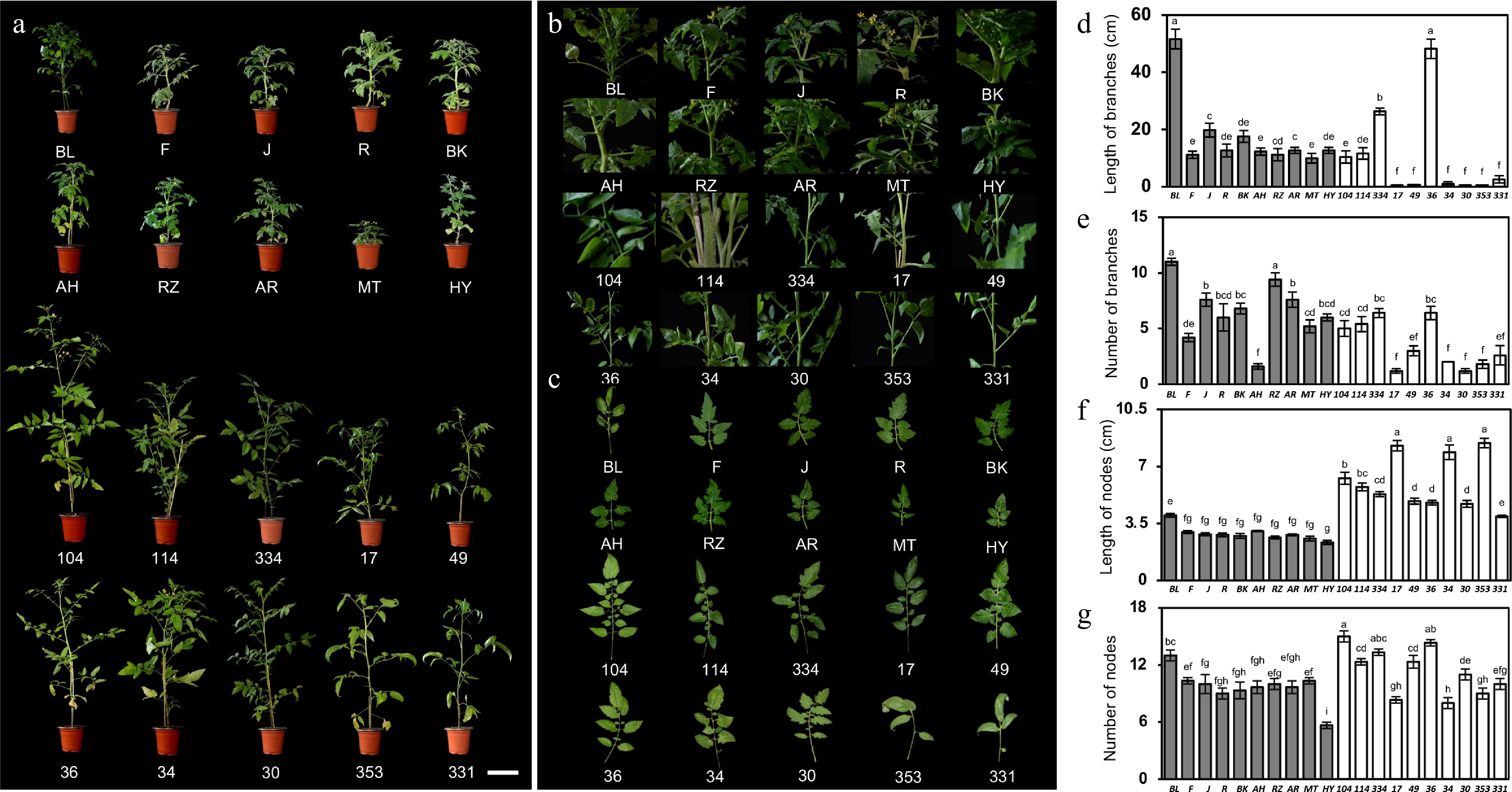
Figure 1.
Variation in lateral branch and internode traits among 20 tomato cultivars. (a) Overall morphology of 20 tomato varieties: Scale bar = 10 cm. (b) Lateral branch development phenoarchitecture of 20 tomato species. (c) Leaf development phenoarchitecture of 20 tomato species. Quantitative analysis of branch and internode traits: (d) branch length, (e) number of branches, (f) internode length, and (g) number of internodes. Data are presented as mean ± SE. Different lowercase letters above the bars indicate significant differences among accessions according to Duncan's multiple range test (p < 0.05).
Differences in leaf architecture between determinate and indeterminate tomato growth types
-
Leaf angles at the 3rd, 5th, and 7th nodes in the lower, middle, and upper canopy were measured after plants reached a stable growth stage. As shown in Supplementary Fig. S4, determinate-type tomato cultivars exhibited consistently larger leaf angles than indeterminate growth types across all canopy positions. Similar trends were observed for leaf opening angle and leaf drooping angle (Supplementary Fig. S4). Across canopy positions, drooping angle showed a gradual decrease from lower to upper nodes, but this positional pattern was consistent in both growth types. Overall, determinate tomato cultivars displayed a flatter leaf architecture compared with indeterminate growth tomatoes.
Phenotypic and transcriptional characterization of SlD14 reveals its association with tomato plant architecture variation
-
To elucidate the role of SlD14 in regulating tomato plant architecture, we integrated phenotypic evaluation, transcriptional profiling, promoter cis-regulatory analysis, and trait correlation across 20 tomato accessions (Fig. 2). Significant natural variation in SlD14 transcript abundance was detected by RT-qPCR, with accession '49' exhibiting the highest expression and 'J' and '34' showing the lowest levels (Fig. 2a). This variation in expression was closely associated with differences in axillary shoot development, particularly branch initiation timing, which ranged from approximately 30 to over 70 d among accessions (Fig. 2b), indicating a potential relationship between SlD14 activity and the regulation of bud outgrowth dynamics. Correlation analysis further revealed that SlD14 expression was significantly and negatively correlated with the number of lateral branches (NOB), as well as upper leaf opening angle (UOA) and upper leaf drooping angle (UDA) (Fig. 2c), whereas no significant correlations were observed with general growth-related traits such as stem diameter (SD), leaf width (LW), or leaf area (LA). These results suggest that SlD14 is more specifically involved in the regulation of branching architecture and leaf spatial configuration rather than overall vegetative biomass accumulation. To investigate the potential regulatory basis of this expression divergence, promoter analysis of the approximately 2 kb upstream region of SlD14 across all accessions revealed a largely conserved cis-regulatory architecture enriched in light-, ABA-, MeJA-, auxin-responsive, and meristem-associated elements (Fig. 2d), indicating that sequence variations leading to the loss of several cis-regulatory motifs were detected in some accessions, suggesting expression divergence may result from subtle promoter variation rather than extensive structural differences (Fig. 2d). Collectively, these findings demonstrate that natural variation in SlD14 expression is closely associated with differences in axillary branching and leaf angle traits, supporting its role in shaping tomato plant architecture.
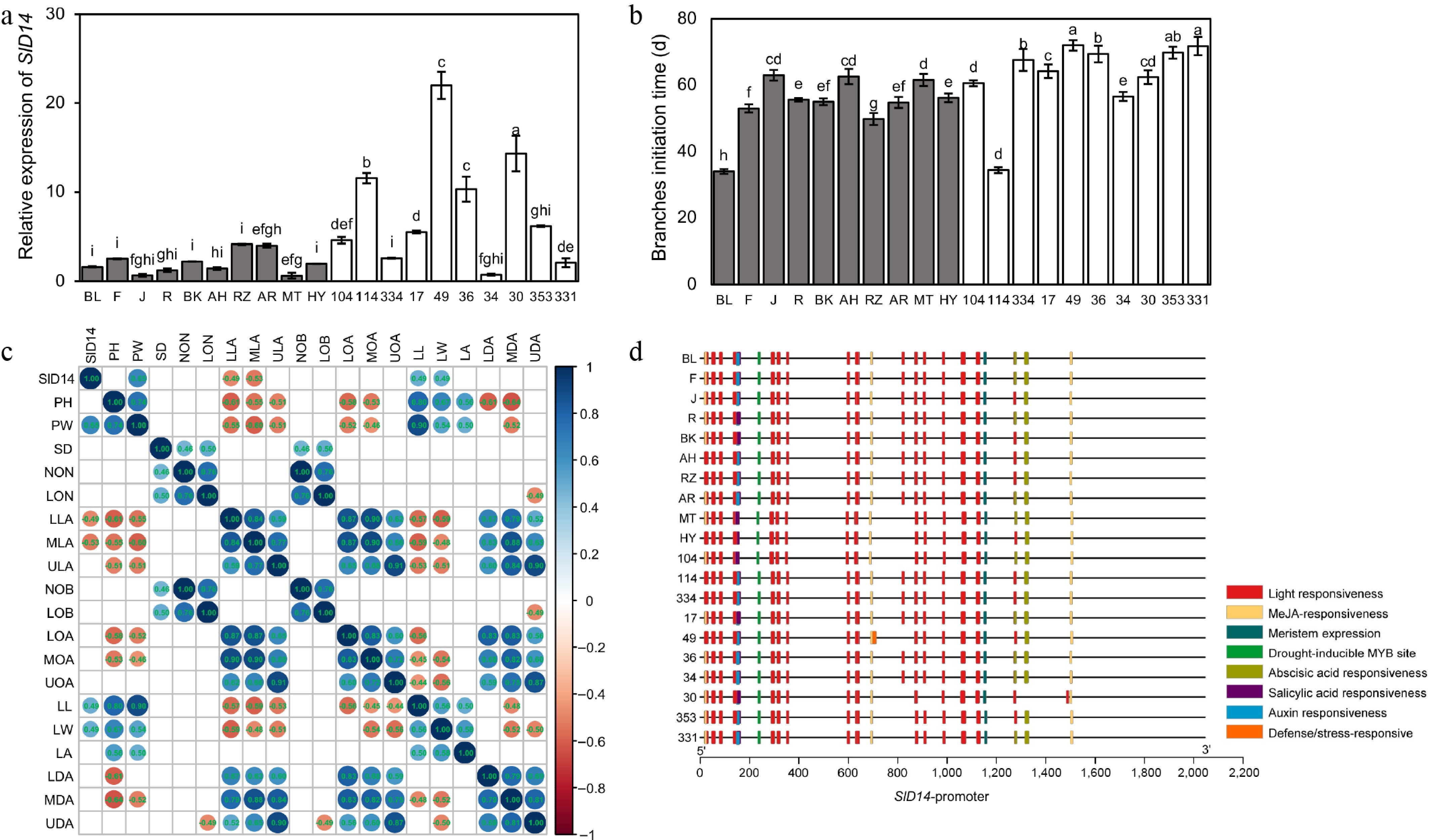
Figure 2.
Expression and promoter analysis of SlD14 and integrated analysis of SlD14 expression and plant growth traits. (a) Relative expression of SlD14 in all 20 tomato varieties. Data are presented as mean ± SE. Different lowercase letters above the bars indicate significant differences among accessions according to Duncan's multiple range test (p < 0.05). (b) Variation in branch initiation time (d) among 20 tomato cultivars. (c) Correlation analysis between SlD14 expression and plant architecture-related traits in 20 tomato plants. The following data were collected: plant height (PH), plant width (PW), number of nodes (NON), length of nodes (LON), stem diameter (SD), number of lateral branches (NOB), length of lateral branches (LOB), upper, middle, and lower leaf angles (ULA, MLA, LLA), upper, middle, and lower opening angle (UOA, MOA, LOA), upper, middle, and lower drooping angles (UDA, MDA, LDA), leaf length (LL), leaf width (LW), and leaf area (LA). (d) Analysis of cis-regulatory elements in the SlD14 promoters of the 20 cultivars Supplementary Table S1.
Subcellular localization and tissue-specific expression analysis of SlD14
-
We analyzed the tissue-specific expression of SlD14 in tomato using RT-qPCR. The gene was expressed in all examined tissues, including root, stem, leaf, and shoot apex, with the highest expression levels detected in the shoot apex and leaves, while relatively lower expression was observed in the roots (Fig. 3a). To investigate the subcellular localization of the SlD14 protein, we generated a SlD14-GFP fusion construct and transiently expressed it in the abaxial epidermal cells of N. benthamiana leaves. As shown in Fig. 3b, the fluorescence signal of the SlD14-GFP fusion protein was observed in both the cytoplasm and the nucleus, indicating dual subcellular localization. In contrast, free GFP used as a control was distributed uniformly throughout the cell (Fig. 3b).
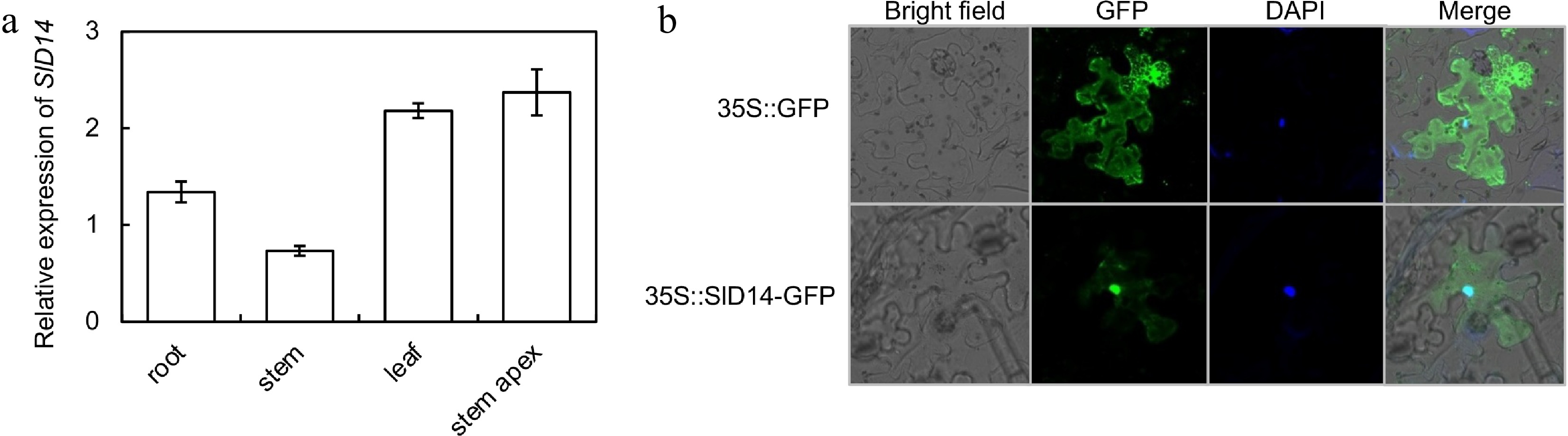
Figure 3.
Expression patterns and subcellular localization of SlD14 in tomato. (a) SlD14 expression in different tomato tissues. Data are presented as mean ± SE. (b) Subcellular localization of 35S::SlD14-GFP in abaxial epidermal cells of tobacco leaves, with 35S::GFP alone as a control.
CRISPR/Cas9-mediated mutagenesis and functional characterization of SlD14 in tomato
-
To obtain material with loss of function in tomato SlD14 mutants, we designed two targets for the SlD14 gene via CRISPR/Cas9 gene-editing technology (Fig. 4a). The tomato cultivar 34#, as described above, was used as the wild-type background for genetic transformation. We produced more than 10 heterozygous mutants from the T0 generation through LBA4404-Agrobacterium-mediated tomato genetic transformation. After screening in the T1 generation, two mutant lines were selected in the T2 generation. The lines were named sld14 cr-1 and sld14 cr-2, respectively. The sequencing results showed that sld14 cr-1 had a 2 bp deletion in Target 1 and a 3 bp deletion and a 2 bp substitution in Target 2, resulting in a frameshift mutation. This leads to early termination of protein transcription. There is a 1 bp insertion in Target1 of the sld14 cr-2 line and a 1 bp substitution and a 1 bp deletion in Target 2 (Fig. 4a), which also leads to a frameshift mutation and early termination of protein transcription, resulting in loss of function of the SlD14 protein. In addition, a SlD14-specific antibody was used to detect SlD14 protein accumulation, and the SlD14 protein signal was markedly reduced or undetectable in the mutant lines compared with the WT, further confirming the loss-of-function of SlD14 (Fig. 4c). We examined the selected transgenic lines for the presence of Cas9 by genomic PCR and assessed potential off-target mutations (Supplementary Fig. S5). These analyses confirmed that the transgenic plants used in this study were free of the Cas9 transgene/protein and showed no detectable edits at the predicted off-target loci. Meanwhile, we detected the gene expression of SlD14 in the WT and mutant lines, and the results showed that the expression of SlD14 in the mutant lines was lower than that in the WT (Fig. 4b).
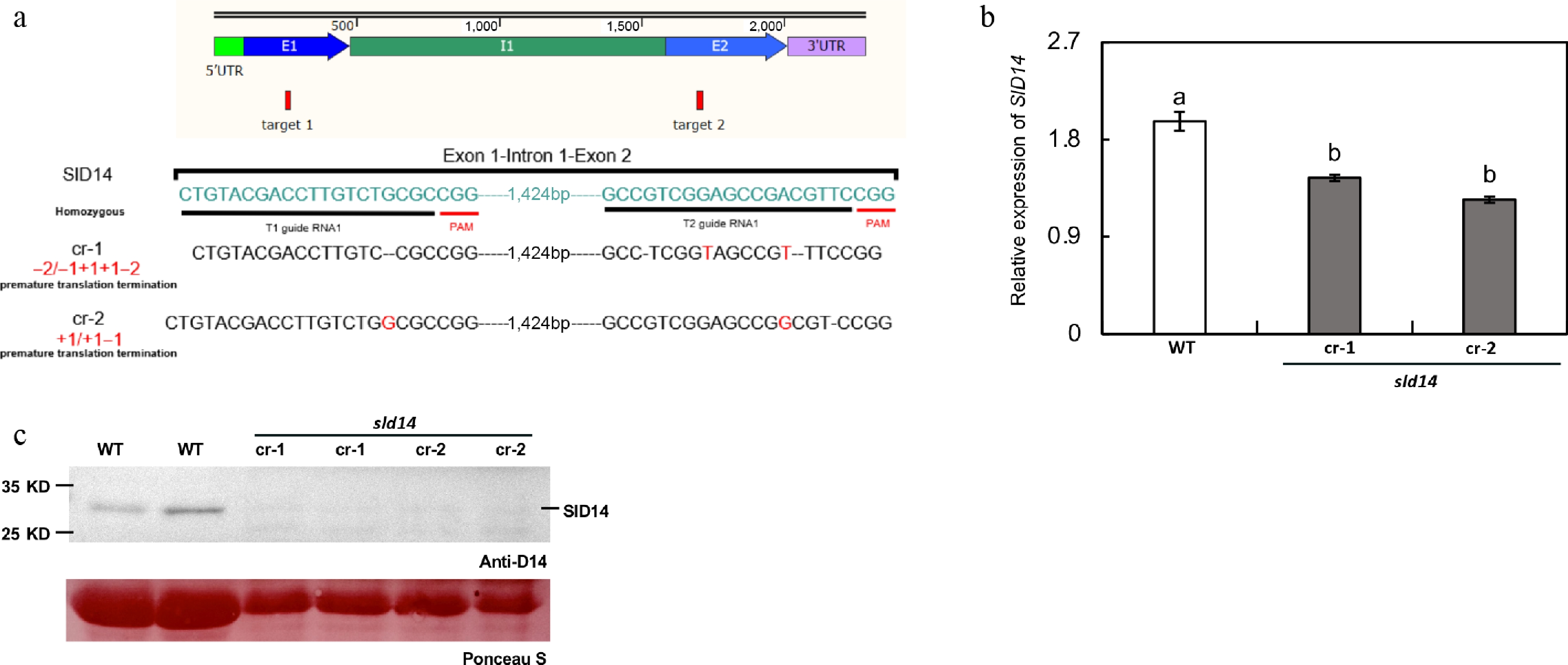
Figure 4.
Sequence and expression analysis of SlD14 in CRISPR/Cas9 knockout tomato lines. (a) Alignment of SlD14 sequences from wild-type (WT) and transgenic knockout lines, highlighting insertions, deletions, and other mutations. Differences from the WT sequence are indicated in red. (b) Relative expression levels of SlD14 in WT and knockout lines. (c) Western blot analysis of SlD14 protein levels in WT, sld14 cr-1, and sld14 cr-2 plants using a SlD14-specific antibody. Data are presented as mean ± SE. Different lowercase letters above the bars indicate significant differences among accessions according to Duncan's multiple range test (p < 0.05).
SlD14 knockout alters tomato plant architecture
-
At 60 d after transplantation, the sld14 knockout mutants (cr-1 and cr-2) exhibited obvious architectural alterations compared with wild-type (WT) plants, including reduced plant size and enhanced branching (Fig. 5a, f, k). Quantitative analysis showed that plant height was significantly decreased in the sld14 mutants relative to WT plants (Fig. 5b), while no significant difference in node number was detected among the genotypes (Fig. 5c). In contrast, internode length was markedly reduced in the mutant lines (Fig. 5d), indicating that the dwarf phenotype mainly resulted from shortened internodes rather than reduced node formation. Plant width was also significantly lower in sld14 plants than in WT plants (Fig. 5e). Moreover, stem diameter was significantly increased in the mutant lines (Fig. 5h), suggesting enhanced stem thickening following SlD14 disruption. Branching-related traits were strongly affected by SlD14 knockout, as both the number and length of lateral branches were significantly higher in the mutants than in WT plants (Fig. 5j, l). In addition, the mutants displayed significantly reduced leaf length and leaf area compared with WT plants (Fig. 5m, o), whereas leaf width showed no significant difference among the genotypes (Fig. 5n). Together, these results demonstrate that SlD14 plays an essential role in regulating tomato plant architecture, particularly in controlling plant height, internode elongation, and lateral branching.
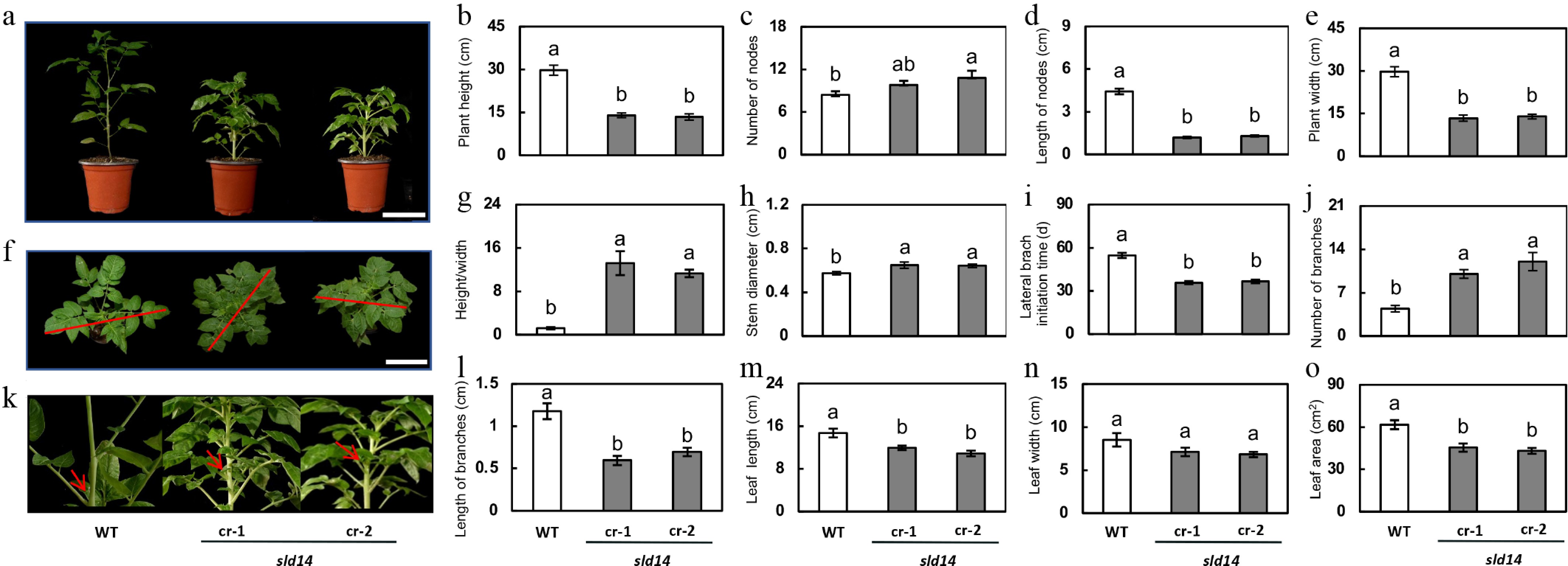
Figure 5.
Morphology of 60-day-old SlD14 knockout and WT tomato seedlings. Morphology of 60-day-old SlD14 knockout (sld14) and wild-type (WT) tomato seedlings, shown in (a) front view, (f) top view, and (k) branching pattern, illustrating clear differences in overall architecture; scale bar = 10 cm. Red arrows indicate the positions of lateral buds or branches. (b) Plant height, (c) number of nodes, (d) length of nodes, (e) plant width, (g) plant height/width ratio, (h) stem diameter, (i) lateral branch initiation time, (j) number of lateral branches, (l) length of lateral branches, (m) leaf length, (n) leaf width, and (o) leaf area of WT and SlD14 mutant lines (sld14 cr-1 and cr-2). Data are presented as mean ± SE. Different lowercase letters above the bars indicate significant differences among accessions according to Duncan's multiple range test (p < 0.05).
SlD14 regulates the development of plant leaf angles in tomato
-
The two SlD14 mutant lines exhibited significant changes in leaf architecture compared with WT plants. Leaf angle measurements at the 3rd, 5th, and 7th nodes showed that mutants consistently displayed larger leaf angles across all canopy positions, with increases of 13.3%, 9.5%, and 30.9% in the lower, middle, and upper leaves, respectively, relative to WT. Consistent with this trend, leaf opening angle showed a position-dependent response: no significant difference was detected in the lower leaves, whereas significant increases were observed in the middle and upper leaves, by 25% and 45%, respectively (Supplementary Fig. S6). A similar pattern was also found for leaf drooping angle, which showed only a minor, non-significant increase of 6.5% in the lower leaves but significant increases of 36% and 45% in the middle and upper canopy, respectively. Overall, SlD14 disruption primarily affected leaf angle traits in the middle and upper canopy, resulting in a more horizontally expanded leaf architecture compared with WT plants.
RNA-seq analysis of SlD14 mutants and WT plants
-
To investigate the molecular mechanisms underlying the altered architecture of sld14 mutants, comparative transcriptome analyses were performed between the two independent knockout lines and WT plants (Fig. 6; Supplementary Fig. S7). KEGG enrichment analysis revealed that the differentially expressed genes (DEGs) in both sld14 cr-1 and sld14 cr-2 were significantly enriched in multiple pathways, including biosynthesis of secondary metabolites, metabolic pathways, flavonoid biosynthesis, diterpenoid biosynthesis, phenylpropanoid biosynthesis, and plant hormone signal transduction (Fig. 6a, b). In addition, pathways related to plant–pathogen interaction, nucleocytoplasmic transport, and lipid metabolism were also significantly enriched in the mutant lines (Fig. 6a, b), indicating that disruption of SlD14 broadly affected cellular metabolism and signaling processes. Hormone-related expression profiling further demonstrated that numerous genes associated with gibberellin (GA), brassinosteroid (BR), abscisic acid (ABA), jasmonic acid (JA), and auxin (IAA) biosynthesis or signaling were differentially expressed in the sld14 mutants compared with WT plants (Fig. 6c). Moreover, genes involved in salicylic acid (SA) and ethylene (ETH) pathways also displayed obvious transcriptional changes in the mutants (Fig. 6d). To further validate the transcriptome results, the expression patterns of four representative hormone-related genes, SAUR32-like, BES1/BZR1 homolog protein 2, gibberellin 2-oxidase 5 (GA2ox5), and gibberellin 2-oxidase 1 (GA2ox1), were examined by RT-qPCR. The RT-qPCR results were consistent with the transcriptome data, supporting the reliability of the RNA-seq analysis (Fig. 6e–h). Collectively, these results suggest that SlD14 regulates tomato plant architecture through extensive modulation of hormone signaling pathways and secondary metabolic processes.
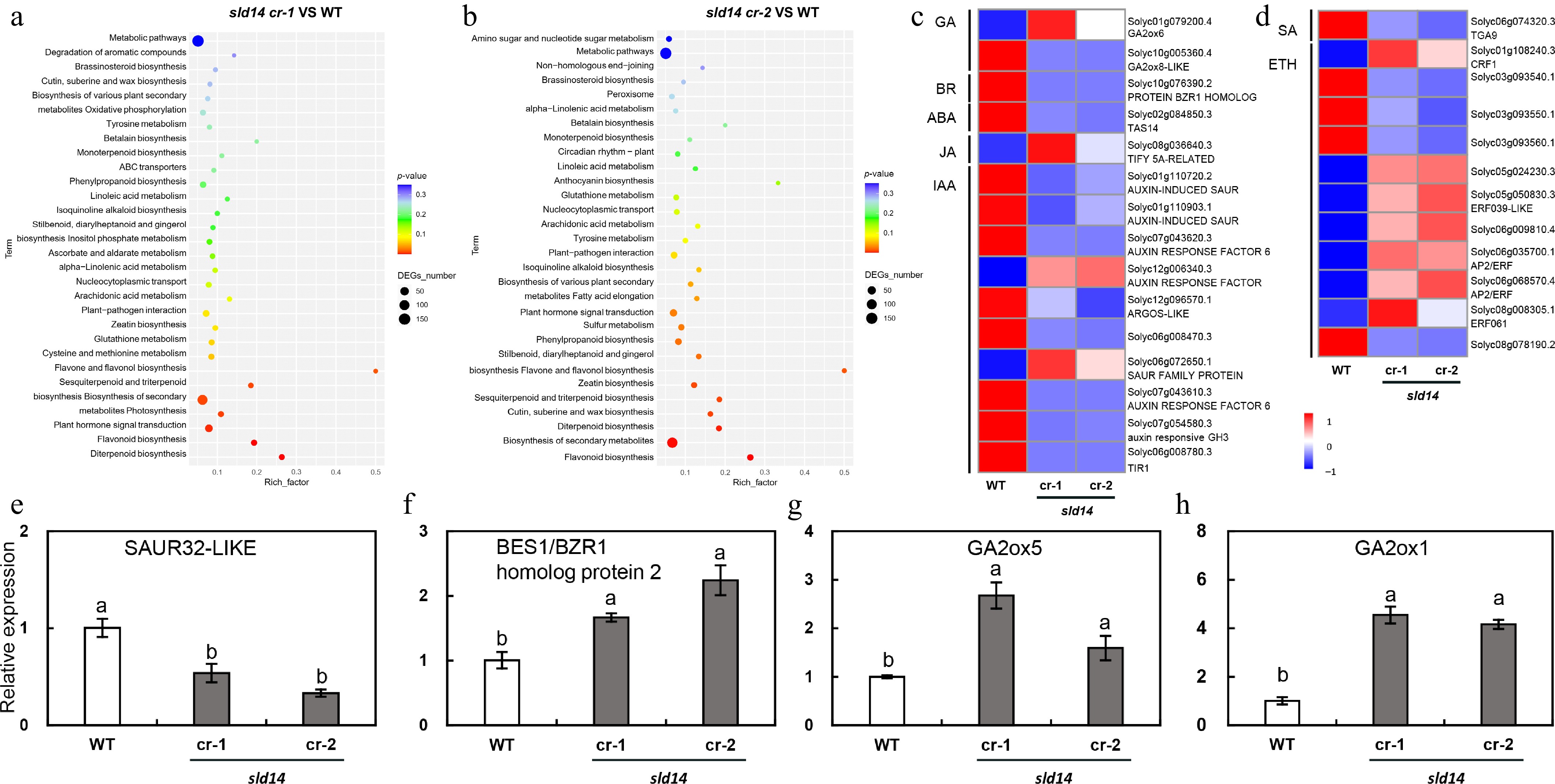
Figure 6.
RNA-seq analysis of the SlD14 mutants and WT plants. (a), (b) KEGG analysis revealed that the biosynthesis of secondary metabolites, plant hormone signaling pathways, metabolic pathways, plant‒pathogen interaction pathways, karyotoplasmic transport, and phenylpropanoid biosynthesis were significantly enriched in both groups. (c), (d) The expression analysis of DEGs related to the synthesis of auxin, jasmonic acid, gibberellin, abscisic acid, brassinosteroid, salicylic acid, and ethylene. (e)–(h) Relative expression levels of SAUR32-like, BES1/BZR1 homolog protein 2, GA2ox5, and GA2ox1 in WT, sld14 cr-1, and sld14 cr-2 plants, as determined by RT-qPCR. Data are presented as mean ± SD. Different lowercase letters above the bars indicate significant differences among accessions according to Duncan's multiple range test (p < 0.05).
-
Plant architecture is a complex quantitative trait determined by the coordinated regulation of stem elongation, branching dynamics, and leaf spatial configuration. In this study, substantial variation in SlD14 transcript abundance exists among diverse tomato germplasms. Interestingly, promoter analysis revealed that the upstream regulatory region of SlD14 is highly conserved and enriched with multiple hormone-responsive and light-responsive cis-elements, suggesting that expression divergence is likely driven by subtle regulatory modulation rather than major promoter structural variation. This observation implies that upstream transcription factors, epigenetic modifications, or environmental signaling pathways may contribute to the differential expression of SlD14 among tomato accessions. Notably, most determinate cultivars exhibited relatively lower SlD14 expression than indeterminate cultivars, implying a potential association between reduced SlD14 activity and the establishment of compact growth habits in tomato. Because branching architecture and leaf angle are critical determinants of cultivation suitability, planting density adaptation, and ornamental value, natural variation in SlD14 expression may represent an important genetic resource for tomato breeding. Moderate manipulation of SlD14 activity could therefore provide a strategy to optimize canopy structure, improve planting density adaptation, and enhance determinate traits in tomato.
SlD14 encodes the strigolactone (SL) receptor, which functions as a core component of SL signaling to suppress axillary bud outgrowth and regulate shoot architecture. Consistent with this role, strong negative correlations between SlD14 expression and lateral branch number, as well as upper leaf opening and drooping angles, indicate that variation in SlD14 transcript abundance is closely linked to natural architectural differentiation. Modulation of SLs' perception capacity, rather than complete pathway disruption, may underlie the phenotypic diversification between determinate and indeterminate growth types. Collectively, these observations indicate that fine-tuning SlD14 transcript levels is an important mechanism for reshaping tomato canopy architecture. Reduced SlD14 expression in determinate cultivars may weaken SLs-mediated suppression of axillary bud outgrowth, thereby contributing to the compact and highly branched growth pattern characteristic of determinate tomatoes.
Functional analysis further demonstrated that SlD14 regulates multiple developmental processes beyond branch suppression. In addition to enhanced branching, sld14 mutants exhibited significant reductions in plant height, internode length, plant width, and leaf angle, indicating that SlD14 coordinately regulates overall plant morphology. Importantly, node number was not significantly altered in the mutants, suggesting that the dwarf phenotype primarily resulted from inhibition of internode elongation rather than reduced node initiation. Similar phenotypic effects have been reported in SL-deficient or SL-insensitive mutants in rice, Arabidopsis, and pea, where impaired SL signaling leads to compact plant architecture and excessive tillering or branching[34]. The increased stem diameter observed in the mutants may reflect altered carbon allocation or compensatory radial growth caused by reduced vertical elongation. Moreover, the reduction in leaf angle observed in sld14 plants suggests that SlD14 also participates in regulating leaf spatial configuration, which may ultimately influence light interception efficiency and canopy structure. Together, these results demonstrate that SlD14 coordinately controls shoot branching, stem elongation, and leaf architecture to shape tomato plant architecture.
To further elucidate the molecular basis underlying these phenotypic changes, transcriptome analysis revealed that SlD14 functions as an important regulatory hub integrating multiple hormone signaling pathways. Transcriptomic analysis revealed that SlD14 participates in multiple hormonal pathways and mediates complex hormonal crosstalk to fine-tune tomato architecture. SL signaling has been proposed to restrict bud activation by modulating auxin canalization and sink strength[35,36]. SLs and IAA interact in regulating plant branching[37]. Our observation of the hyper-branching phenotype in sld14 mutants reinforces this model within the context of tomato development. The pronounced branching phenotype in sld14 mutants supports the hypothesis that intact SlD14-mediated signaling is required to maintain apical dominance in tomato. In addition, internode length decreased markedly in the mutants, suggesting that SlD14 influences not only meristematic activity but also cell elongation processes. Therefore, the reduced plant height in sld14 mutants is unlikely to be solely a secondary consequence of altered branching competition but likely reflects direct or indirect regulation of elongation growth. Additionally, the increased stem diameter in mutants may indicate compensatory changes in vascular development or altered carbon allocation under enhanced branching pressure.
Transcriptomic analysis also suggested that gibberellin (GA) and brassinosteroid (BR) pathways may participate in SlD14-mediated architectural regulation. GA negatively regulates the expression of transcription factors OSH1 and TB1 in rice, and these two genes regulate the occurrence of meristem and the growth of lateral buds, respectively, so GA can suppress tillering[38,39]. The significant upregulation of SlGA2ox, a key gene involved in GA catabolism, suggests that mutation of SlD14 may reduce bioactive GA accumulation, which may contribute to the altered branching pattern[40,41]. Brassinosteroids (BRs) are essential plant hormones that regulate diverse aspects of plant growth and development, including cell elongation, reproductive development, and senescence[42,43]. In this study, we found that the SlD14 mutation can cause downregulation of BES1/BZR1 expression. This suggests that SlD14 may influence tomato branching architecture through modulation of BR signal transduction. The decrease in the expression of BRI1-EMS-suppressor (BES1), the positive regulator of BR signaling, and its homologous gene can significantly inhibit the multi-branch phenotype of max2 mutants[6].
To our knowledge, this study provides one of the first systematic analyses linking natural variation in SlD14 expression with architectural divergence between determinate and indeterminate tomato germplasms. Optimizing plant architecture is a major objective in modern tomato breeding because compact growth habits, appropriate branching patterns, and suitable leaf angle are closely associated with high-density cultivation, mechanized cultivation, and ornamental quality. The phenotypic characteristics of sld14 mutants observed in this study, including enhanced lateral branching and reduced plant stature, suggest that SlD14 represents a valuable candidate gene for molecular breeding. Precise regulation of SlD14 expression in commercial tomato cultivars may facilitate optimizing branch architecture and canopy openness, thereby improving canopy light distribution and potentially contributing to yield stability. Future studies focusing on natural allele mining, promoter engineering, and the interaction networks of SlD14 will further facilitate its application in tomato architectural improvement and breeding programs.
-
In summary, we systematically characterized the role of SlD14 in regulating tomato plant architecture. By analyzing 20 tomato accessions, we found that natural variation in SlD14 expression is closely associated with differences in branching traits and leaf spatial configuration, particularly in lateral branch number, branch initiation timing, and leaf angle- related traits. Through CRISPR/Cas9-mediated knockout of SlD14, we further demonstrated that loss of its function leads to a compact plant architecture characterized by reduced plant height and internode length, increased lateral branching, and altered leaf morphology, including decreased leaf angle. In addition, transcriptome analysis revealed that these phenotypic changes are accompanied by extensive transcriptional reprogramming, especially in plant hormone signaling pathways and secondary metabolism. Taken together, these results indicate that SlD14 plays a central role in coordinating axillary branching and canopy architecture by integrating hormonal and developmental signals, thereby shaping overall tomato plant growth form.
-
The authors confirm their contributions to the paper as follows: conceptualization, methodology: Han Y, Sun F, Bao Z, Ma F; writing – original draft: Han Y, Sun F, Bao Z, Ma F; editing – original draft: Sun F, Bao Z, Ma F; validation: Han Y, Sun F, Bao Z, Ma F, Wang G; investigation: Han Y, Sun F, Bao Z, Ma F, Wang G, Qin X. All authors reviewed the results and approved the final version of the manuscript.
-
The original contributions presented in the study are included in the article; further inquiries can be directed to the corresponding authors.
-
The authors declare that they have no conflict of interest.
-
accompanies this paper online at: https://doi.org/10.48130/vegres-0026-0032.
-
# Authors contributed equally: Yan Han, Fengze Sun
- The supplementary files can be downloaded from here.
- Copyright: © 2026 by the author(s). Published by Maximum Academic Press, Fayetteville, GA. This article is an open access article distributed under Creative Commons Attribution License (CC BY 4.0), visit https://creativecommons.org/licenses/by/4.0/.
-
About this article
Cite this article
Han Y, Sun F, Wang G, Qin X, Ma F, et al. 2026. Misregulation of strigolactones receptor DWARF14 leads to altered plant architecture in tomato. Vegetable Research 6: e039 doi: 10.48130/vegres-0026-0032 

Misregulation of strigolactones receptor DWARF14 leads to altered plant architecture in tomato
- Received: 01 June 2026
- Revised: 26 August 2026
- Accepted: 17 September 2026
- Published online: 17 November 2026
Abstract: The strigolactone (SL) receptor DWARF14 (D14) is a key negative regulator of shoot branching; however, its contribution to architectural variation in tomato remains unclear. In this study, a comprehensive analysis integrating axillary bud phenotypes, SlD14 expression levels, and promoter cis-regulatory element structures was conducted using 10 determinate and 10 indeterminate tomato cultivars. The results revealed a close association between SlD14 expression and variation in axillary bud development, suggesting a potential role for SlD14 in regulating tomato branching architecture. Tissue-specific expression analysis revealed that SlD14 was predominantly expressed in the shoot apex and stem tissues, while subcellular localization assays showed that SlD14 was mainly localized in the nucleus and cytoplasm. To further validate its biological function, CRISPR/Cas9-mediated sld14 knockout mutants were generated in tomato. Loss of SlD14 function significantly promoted the emergence and elongation of axillary shoots, resulting in a highly branched phenotype characterized by reduced plant height, enlarged leaf angle, and altered plant architecture. Transcriptome analysis further revealed that altered SlD14 expression caused extensive transcriptional reprogramming of multiple phytohormone signaling pathways, particularly auxin-responsive genes (SAUR, AUX, and ARF), gibberellin metabolism-related genes (GA2ox), and brassinosteroid signaling components (BES1/BZR1). Collectively, these findings demonstrate that precise regulation of SlD14 is essential for maintaining axillary bud dormancy and apical dominance, and that its misregulation disrupts hormonal homeostasis, leading to enhanced axillary shoot outgrowth. This study provides new molecular insights into tomato architectural variation and identifies SlD14 as a promising target for breeding improved plant architecture.
-
Key words:
- DWARF14;
- Tomato;
- Strigolactones;
- Plant architecture;
- Lateral branches;
- Leaf angle