












-
In recent years, chicken meat has been increasingly favored by consumers for its high protein, low fat, low calorie, and low cholesterol characteristics. The conventional structure of animal feed formulations is predominantly based on corn and soybean meal. Soybean meal is recognized as a high-quality plant protein source, extensively utilized in feed due to its high protein content, well-balanced amino acids, and comprehensive nutritional elements[1]. The insufficiency of protein resources is a universal issue, particularly in China, where the yield of soybean meal is low and the demand is substantial[2−4]. Due to changes in the structure of livestock and poultry farming and the influence of soybean meal prices on the international market, the technologies for reducing and substituting soybean meal are effective means to solve the shortage of soybean meal resources[5,6]. Consequently, reducing feed cost, reducing external dependency on soybean meal, and improving the utilization rate of dietary protein has become an important research focus.
Implementing low-protein diet technology is an effective means to reduce the consumption of soybean meal. Low protein diet is a technique that reduces dietary crude protein levels by 2%−4% based on the ideal amino acid pattern and by supplementing essential amino acids[7]. Consistent with most studies, feeding a diet with reduced protein levels slightly affects the growth performance of broilers[8]. Similarly, low-protein diets can lead to a decrease in growth and breast muscle weight in broilers[9]. Incorporating synthetic amino acids into low-protein diets can markedly enhance the feed conversion rate in laying hens[10]. Supplementing amino acids can improve the body weight and feed conversion rate in broilers under low protein conditions[11]. In addition to indispensable amino acids, branched-chain amino acids are crucial in broiler diets; their supplementation in low-protein diets can prevent compromised growth performance[12].
Another way to reduce the amount of soybean meal used is to use unconventional protein feed. Alternatives to soybean meal must offer the benefits of high protein content and adequate amino acid profiles. Plant-derived proteins have been increasingly studied. Among these, rapeseed meal, cottonseed meal, peanut meal, and sesame meal have become primary subjects of research[13,14]. Rapeseed meal, with its 38% crude protein and rich amino acid content, has been broadly applied in animal production. Replacing soybean meal with a mixture of rapeseed meal and sunflower meal did not adversely affect production performance in aged laying hens[15]. Cottonseed meal could replace up to 90% of soybean meal in broiler diets without compromising production outcomes[14]. Peanut meal and flaxseed meal could effectively substitute soybean meal in broiler diets, particularly when combined with exogenous enzymes, without negatively affecting production performance[16].
The presence of numerous anti-nutrient factors in miscellaneous meals also restrict their application in livestock and poultry diets[17,18]. There are many ways to eliminate anti-nutrient factors, among which enzyme preparations are widely added to animal diets because they are considered to be a safe, environmentally friendly, and efficient. The addition of non-starch polysaccharide enzymes to a diet containing rapeseed meal could improve carbohydrate digestibility by facilitating the breakdown of non-starch polysaccharides[19]. The addition of compound enzymes to broiler diets containing cottonseed meal could enhance nutrient utilization[14]. Phytase supplementation not only benefited growth performance but also promoted the health of the small intestine in nursery pigs[20]. Xylanase could effectively reduce digestive viscosity, regulate intestinal flora, improve nutrient digestibility, and augment the growth performance of broilers[21].
The shortage of protein feed resources in livestock and poultry diets is a widespread problem. Soybean meal is a good source of protein feed, but its price is greatly affected by the international market, the rise in soybean meal prices leads to an increase in feed costs, resulting in the decline of breeding income and restricting the development of animal husbandry. Therefore, the purpose of this study was to explore whether the low protein diet and miscellaneous meal diet combination with enzyme preparation can be used in Langshan chickens to reduce the amount of soybean meal, and their effects on the growth performance and intestinal health of Langshan chickens.
-
The experiment was conducted at the Langshan Chicken breeding farm in Nantong, Jiangsu Province, China. A total of 288 30-d-old healthy Langshan cocks were randomly divided into six experimental groups with eight replicates per group and six chickens per replicate according to initial body weight. The trial lasted 56 d and was divided into two phases, the first stage is from 30 d old to 58 d old and the second stage is from 59 d old to 86 d old, during which feed and water were freely consumed. During the first week of the Langshan chicken rearing period, the temperature was maintained at 33−35 °C with a humidity of 65%−75%. The temperature was reduced by 3 °C per week, and the humidity was reduced by 5% per week. After day 28 of the rearing period, the temperature was lowered to room temperature (no lower than 18 °C in winter), and the humidity was reduced to 45%−55%. Table 1 presents the treatment methods and specifics for the six diets utilized in the study. The diets were designed in accordance with the nutritional requirements standards for slow-growing yellow-feathered broilers. The diets comprised the following: a control corn-soybean diet (CON), the same corn-soybean diet with the addition of a compound enzyme (CON + E), a low protein diet with a protein level two percentage points lower than the control (LP), the low protein diet supplemented with the compound enzyme (LP + E), a corn-soybean-miscellaneous meal diet (CSM), and the corn-soybean-miscellaneous meal diet supplemented with a compound enzyme (CSM + E). The phytase enzyme ≥ 5,000 U/g and multigrain - miscellaneous meal enzymes (Xylanase ≥ 25,000 U/g, β-mannanase ≥ 2,500 U/g, β-glucanase ≥ 5,000 U/g, cellulase ≥ 2,000 U/g, protease ≥ 12,000 U/g, α-amylase ≥ 1,250 U/g) used in the diets were provided by Jiangsu Yinong Biological Co., Ltd. (Suqian, Jiangsu, China).
Table 1. Ingredients and nutrient composition of experimental diets.
Ingredients2 (%) 30−58 d 59−86 d1 CON CON + E LP LP + E CSM CSM + E CON CON + E LP LP + E CSM CSM + E Corn 69.68 69.63 76.51 76.46 69.09 69.04 77.80 77.75 79.99 79.94 76.6 76.55 Soybean meal 25.50 25.50 18.73 18.73 12.40 12.40 18.04 18.04 10.37 10.37 8.00 8.00 Rapeseed meal 0.00 0.00 0.00 0.00 4.30 4.30 0.00 0.00 0.00 0.00 5.00 5.00 Cottonseed meal 0.00 0.00 0.00 0.00 4.00 4.00 0.00 0.00 0.00 0.00 3.00 3.00 Peanut meal 0.00 0.00 0.00 0.00 4.00 4.00 0.00 0.00 0.00 0.00 2.00 2.00 Bran 0.00 0.00 0.00 0.00 0.00 0.00 0.00 0.00 5.00 5.00 0.00 0.00 Soybean oil 0.90 0.90 0.20 0.20 1.90 1.90 0.90 0.90 0.70 0.70 1.90 1.90 Dicalcium phosphate 2.00 2.00 2.00 2.00 1.90 1.90 0.91 0.91 0.90 0.90 0.85 0.85 Limestone 1.00 1.00 1.05 1.05 1.05 1.05 1.40 1.40 1.45 1.45 1.40 1.40 L-lysinežHCl 0.18 0.18 0.37 0.37 0.34 0.34 0.23 0.23 0.43 0.43 0.35 0.35 DL-methionine 0.11 0.11 0.14 0.14 0.13 0.13 0.09 0.09 0.13 0.13 0.10 0.10 Threonine 0.00 0.00 0.11 0.11 0.08 0.08 0.00 0.00 0.12 0.12 0.05 0.05 Tryptophan 0.00 0.00 0.03 0.03 0.02 0.02 0.00 0.00 0.03 0.03 0.01 0.01 Isoleucine 0.00 0.00 0.12 0.12 0.10 0.10 0.00 0.00 0.13 0.13 0.08 0.08 Valine 0.00 0.00 0.11 0.11 0.06 0.06 0.00 0.00 0.12 0.12 0.03 0.03 Salt 0.30 0.30 0.30 0.30 0.30 0.30 0.30 0.30 0.30 0.30 0.30 0.30 50% Choline chloride 0.10 0.10 0.10 0.10 0.10 0.10 0.10 0.10 0.10 0.10 0.10 0.10 Compound enzymes3 0.00 0.05 0.00 0.05 0.00 0.05 0.00 0.05 0.00 0.05 0.00 0.05 Vitamin premix4 0.03 0.03 0.03 0.03 0.03 0.03 0.03 0.03 0.03 0.03 0.03 0.03 Mineral premix5 0.20 0.20 0.20 0.20 0.20 0.20 0.20 0.20 0.20 0.20 0.20 0.20 Total 100 100 100 100 100 100 100 100 100 100 100 100 Calculated nutrients Metabolizable energy (MJ/kg) 12.31 12.31 12.31 12.31 12.33 12.33 12.67 12.67 12.68 12.68 12.67 12.67 Crude protein6 17.34 17.23 15.47 15.66 17.76 17.42 15.25 15.22 13.39 13.10 15.22 15.00 Lysine 0.93 0.93 0.93 0.93 0.93 0.93 0.81 0.81 0.81 0.81 0.81 0.81 Methionine 0.39 0.39 0.39 0.39 0.40 0.40 0.34 0.34 0.34 0.34 0.34 0.34 Threonine 0.69 0.69 0.69 0.69 0.69 0.69 0.57 0.57 0.57 0.57 0.57 0.57 Tryptophan 0.19 0.19 0.19 0.19 0.19 0.19 0.15 0.15 0.15 0.15 0.15 0.15 Leucine 1.50 1.50 1.33 1.33 1.36 1.36 1.32 1.32 1.13 1.13 1.23 1.23 Isoleucine 0.68 0.68 0.68 0.68 0.68 0.68 0.55 0.55 0.55 0.55 0.56 0.56 Valine 0.79 0.79 0.79 0.79 0.79 0.79 0.67 0.67 0.67 0.67 0.66 0.66 Phenylalanine 0.85 0.85 0.72 0.72 0.79 0.79 0.72 0.72 0.58 0.58 0.67 0.67 Calcium 0.90 0.90 0.90 0.90 0.90 0.90 0.77 0.77 0.77 0.77 0.77 0.77 Non-phytic acid phosphorus 0.40 0.40 0.40 0.40 0.40 0.40 0.22 0.22 0.22 0.22 0.22 0.22 1 CON, corn soybean meal; CON + E, corn soybean meal with enzyme; LP, low protein meal; LP + E, low protein meal with enzyme; CSM, corn soybean miscellaneous meal; CSM + E, corn soybean miscellaneous meal with enzyme. 2 Crude protein level of soybean meal: 44.2%; Crude protein level of rapeseed meal: 38.6%; Crude protein level of cottonseed meal: 47%; Crude protein level of peanut meal: 47.8%. 3 Compound enzymes per gram provide xylanase ≥ 25,000 U, β-mannanase ≥ 2,500 U, β-glucanase ≥ 5,000 U, cellulase ≥ 2,000 U, protease ≥ 12,000 U, α-amylase ≥ 1,250 U, phytase ≥ 5,000 U. 4 Vitamin premix provided per kilogram of diet: vitamin A, 12,000 IU; vitamin D3, 2,500 IU; vitamin E, 30 IU; menadione, 1.3 mg; thiamine, 2.2 mg; riboflavin, 6 mg; nicotinamide, 50 mg; D-pantothenic acid, 12 mg; pyidoxine·HCl, 4 mg; biotin, 0.04 mg; folic acid, 1.25 mg; vitamin B12, 0.02 mg. 5 Mineral premix provided per kilogram of diet: iron, 80 mg; copper, 10 mg; manganese, 80 mg; zinc, 75 mg; iodine, 0.35 mg; selenium, 0.15 mg. 6 Crude protein: The crude protein level was measured in each treatment group. Growth performance and sample collection
-
At 30, 58, and 86 d, the body weight and remaining feed amount of the chickens were weighed per replicate, and then the average daily gain (ADG), average daily feed intake (ADFI), and feed-to-gain ratio (F/G) were calculated. Representative dietary samples were collected. And at 56 to 58 d of age and 84 to 86 d of age and 100 g of representative feces were collected per repeat per day, fixed with 10% dilute sulfuric acid, and stored at −20 °C. At 58 and 86 d, the samples were slaughtered, and the jejunal intestine segments were preserved in 4% paraformaldehyde fixative solution, and the jejunal chyme and jejunal mucosa were preserved in a frozen tube at −80 °C for further analysis.
Apparent metabolizablity of nutrients
-
All treated diets and collected fecal samples were dried in an oven (9075A, Shanghai Yiheng Scientific Instrument Co., Ltd., China) at 65 °C. The dried sample is then ground and passed through a 40-mesh sieve. Then, all treated diets and fecal samples’ dry matter, crude protein, ether extract, crude fiber, crude ash, non-nitrogen extract, and acid insoluble ash were analyzed according to AOAC International (2016) analytical methods[22]. Diet and fecal samples were analyzed as dry matter (AOAC 934.01). The crude protein (AOAC 976.05) was determined by the Kjeldahl nitrogen analyzer (Kjeltec9 Analyser, Foss Denmark). Ether extraction method was used to determine the Ether extraction (AOAC 920.39). The crude fiber (AOAC 962.09) was measured by an automatic fiber analyzer (200 Fiber Analyzer, Ankom, Germany). The Ash (AOAC 942.05) was determined in a Muffle furnace (SX2-4-10N, Shanghai Yiheng Scientific Instrument Co., Ltd., China) at 550 °C. The nitrogen-free extract (965.17) is the difference of 100% nutrient content in the feed minus the percentage content of water, crude ash, crude protein, ether extract, and crude fiber. Acid insoluble ash determination by 550 °C Muffle furnace (SX2-4-10N, Shanghai Yiheng Scientific Instrument Co., Ltd., China).
$ \mathrm{Apparent\; nutrient\; metabolizablity\; (\text{%})=100\text{%}-\dfrac{(A\times C)}{(B\times D)}\times100\text{%}} $ where, A is the acid-insoluble ash content in the feed, B is the content of a certain nutrient component in feed, C is the acid-insoluble ash content in feces, and D is the content of a certain nutrient component in feces.
Morphometric measures of the small intestine
-
The jejunum segments fixed with 4% paraformaldehyde were dehydrated with high-concentration alcohol, and then washed with xylene for transparent treatment. The transparent tissue block was immersed in melted paraffin wax after solidification and cut into 4 μm slices, which were pasted onto slides. The samples were then dewaxed with xylene, stained with hematoxylin-eosin, dehydrated with alcohol again after dyeing, and made transparent with xylene. The morphology was observed after sealing with a cover glass. The sample section was enlarged 20 times under an optical microscope (Olympus BX51, Olympus Optical Co. Ltd) and then photographed. Villus height (VH, linear distance from base to apex), and crypt depth (CD, depth from epithelial surface to base) were measured using Image J software (National Institutes of Health), and VH/CD was calculated. Ten villus heights and crypt depths were counted and averaged for each sample.
Digestive enzyme activity of jejunum digesta
-
The samples of jejunal chyme were accurately weighed, the protease and amylase tissue homogenates were prepared according to the ratio of weight (g) : volume (ml) = 1:9, and the lipase tissue homogenates were prepared according to the ratio of weight (g) : volume (ml) = 1:4, and then the activities of amylase(C016-1-1), lipase(A054-1-1), and protease(A080-3-1) were detected using a detection kit. Then, the supernatant of 10% protease and amylase tissue homogenate was diluted 300 times, the supernatant of 20% lipase tissue homogenate was diluted 400 times, and the protein content was determined with the micro-protein concentration determination kit (C503061, Sangon Bio Co., Ltd., Shanghai, China) using the BCA method.
RNA purification and real-time quantitative PCR analysis
-
The sample of jejunum mucosa was measured at 30 mg. The total mRNA of jejunum mucosa was extracted with RNAiso Plus reagent (Dalian Takara Biotechnology Co., Ltd., Dalian, China). The mRNA is then reverse-transcribed into cDNA using a kit (Dalian Takara Biotechnology Co., Ltd.). Fluorescence quantitative experiments were performed using SYBR Premix Ex Taq on QuantStudio 7 Flex machine (Applied Biosystems, Waltham, MA, USA). Table 2 shows the primers of jejunal mucosal barrier protein genes and jejunal amino acid transporter genes. Similar to the study by Rath et al., 18S was normalized as an internal reference gene, and 2−ΔΔCᴛ was used to calculate mRNA relative expression[23].
Table 2. Primer sequences for real-time quantitative PCR analysis.
Genes1 GenBank numbers Primer sequences (5'-3') Product lengths (bp) ZO-1 XM_015278981.2 F: CTTCAGGTGTTTCTCTTCCTCCTC R: CTGTCCTTTTCATGGCTGGATC 133 Occludin XM_025144248.1 F: TCATCGCCTCCATCGTCTAC R: TCTTACTGCGCGTCTTCTGG 240 Claudin1 NM_001013611.2 F: GACCAGGTGAAGAAGATGCGGATG R: CGAGCCACTCTGTTGCCATACC 107 SLC1A1 XM_046936555 F: CTCTACGAGGCAGTAGCAGC R: AGCGCTCAGAACAATCACCA 162 SLC7A1 XM_046908303 F: TCTATGTACTGGCTGGGGCT R: TTCCACCCCGTAATGAAGGC 199 SLC7A5 NM_001030579.3 F: GGTATGATGTGGCTGCGTTA R: AGAAACAAGCAAGCCAGGAT 98 SLC7A7 XM_040665181.2 F: CACAAGCGAAAAACTGCGGA R: ACATTCCACCAAGAGCCCAG 167 SLC15A1 NM_204365.2 F: GCCCCATGGCTGCAAAAAG R: GCTCGCATGCCATAGTAGGA 127 SLC38A1 NM_001199603.3 F: TGAGCAGGTTTTCGGTACCC R: TCCACGTACCATGCCGAAAA 165 18S XM_040648653.2 F: TAGAGGGACAAGTGGCGTTC R: GGCGTAGGGTAGACACAACC 121 1 ZO-1, zonula occludens-1; SLC1A1, solute carrier family 1 member 1; SLC7A1, solute carrier family 7 member 1; SLC7A5, solute carrier family 7 member 5; SLC7A7, solute carrier family 7 member 7; SLC15A1, solute carrier family 15 member 1; SLC38A1, solute carrier family 38 member 1. Statistical analysis
-
The general linear model analysis method (version 27.0, SPSS Inc., USA) in SPSS27.0 program was used to analyze the main effects of diet type and compound enzyme preparations and their interactions. Data were analyzed by two-factor analysis of variance, and p < 0.05 was considered statistically significant. When the interaction is significant, multiple comparisons between the means are performed using Duncan's multiple range test with a probability of 5%. The significance was p < 0.05, and the data were expressed as mean and standard error.
-
The results of growth performance are shown in Table 3. In the first stage of the experiment, enzyme supplementation significantly increased the ADFI (p < 0.05). LP and CSM can significantly reduce the F/G compared with CON, and CSM can significantly reduce the F/G compared with LP (p < 0.05). No significant effect on the growth performance of the second stage in all treatment groups (p > 0.05) was observed. CSM can significantly decrease the F/G compared with CON and increase ADG compared with LP during the whole experiment (p < 0.05). No significant interaction between diet type and complex enzyme preparations supplementation was observed (p > 0.05).
Table 3. Effects of low protein diet and miscellaneous meal diet and enzyme supplementation on the growth performance of Langshan chickens.
Items2 30−58 d 59−86 d 30−86 d1 ADG
(g/bird/d)ADFI
(g/bird/d)F/G
(g/g)ADG
(g/bird/d)ADFI
(g/bird/d)F/G
(g/g)30d BW
(g/bird)87d BW
(g/bird)ADG
(g/bird/d)ADFI
(g/bird/d)F/G
(g/g)CON 20.11 61.60 3.06 19.14 84.03 4.41 313.59 1398.05 19.63 72.82 3.72 CON + E 20.06 62.86 3.13 19.87 85.82 4.35 313.56 1412.08 19.97 74.32 3.73 LP 19.84 59.55 3.00 18.75 83.20 4.47 308.15 1385.38 19.29 72.17 3.75 LP + E 20.61 62.58 3.04 18.62 83.97 4.54 310.76 1396.55 19.62 73.28 3.74 CSM 20.45 59.04 2.89 20.28 85.13 4.22 301.03 1424.10 20.36 72.09 3.55 CSM + E 21.24 61.36 2.89 21.06 88.31 4.23 309.11 1489.56 21.14 74.96 3.56 SEM 0.41 1.22 0.02 0.79 1.90 0.13 4.00 30.94 0.52 1.28 0.06 Main effect Diet CON 20.09 62.21 3.10a 19.51 84.92 4.38 313.58 1405.06 19.80ab 73.57 3.72a LP 20.22 61.07 3.02b 18.68 83.59 4.50 309.46 1390.96 19.45b 72.73 3.75a CSM 20.85 60.20 2.89c 20.67 86.72 4.23 305.07 1456.83 20.75a 73.52 3.55b Enzyme − 20.13 60.06b 2.98 19.39 84.12 4.37 307.59 1402.51 19.76 72.36 3.67 + 20.64 62.26a 3.02 19.85 86.03 4.38 311.15 1432.73 20.24 74.19 3.68 p Value Diet 0.164 0.281 0.001 0.052 0.293 0.118 0.134 0.101 0.046 0.774 0.005 Enzyme 0.142 0.037 0.078 0.482 0.243 0.919 0.300 0.247 0.267 0.098 0.936 Diet × Enzyme 0.518 0.766 0.356 0.812 0.830 0.879 0.611 0.628 0.886 0.783 0.984 1 BW, Body weight; ADG, Average daily gain; ADFI, Average daily feed intake; F/G, feed to gain ratio. 2 CON, corn soybean meal; CON + E, corn soybean meal with enzyme; LP, low protein meal; LP + E, low protein meal with enzyme; CSM, corn soybean miscellaneous meal; CSM + E, corn soybean miscellaneous meal with enzyme. Effect of low protein diet and miscellaneous meal diet and enzyme supplementation on apparent metabolizablity
-
The apparent metabolizablity results are shown in Table 4. In the first stage, compared with the corn-soybean meal diet, the corn-soybean miscellaneous meal diet significantly decreased the crude protein metabolizablity (p < 0.05), the low protein diet significantly increased the crude ash metabolizablity (p < 0.05), and the low protein diet and corn-soybean miscellaneous meal diet significantly increased the crude fiber metabolizablity (p < 0.05). Low protein diet significantly decreased the metabolizablity of ether extract, corn-soybean miscellaneous meal diet significantly increased the metabolizablity of ether extract (p < 0.05), the supplementation of compound enzyme preparations can significantly increased the metabolizablity of crude protein and ether extract (p < 0.05). The apparent metabolizablity of dry matter and nitrogen free extract was significantly influenced by dietary type and enzyme. Compared with the CON group, the dry matter metabolizablity of CON + E, LP, LP + E, and CSM + E groups was significantly increased (p < 0.05), and the nitrogen-free extract metabolizablity of the LP group was extremely significantly increased (p < 0.01).
Table 4. Effects of low protein diet and miscellaneous diet and enzyme supplementation on the apparent metabolizablity of Langshan chickens.
Items2 56−58 d1 84−86 d DM (%) CP (%) EE (%) CF (%) NFE (%) Ash (%) DM (%) CP (%) EE (%) CF (%) NFE (%) Ash (%) CON 67.54c 35.79 74.26 24.68 83.58bc 16.24 73.38 41.77 68.61 26.71 87.20 18.95b CON + E 70.76b 41.44 77.58 24.26 85.13b 23.33 75.57 43.62 71.44 27.48 89.37 24.16a LP 72.85a 39.23 70.72 28.66 87.08a 21.22 74.59 39.48 75.41 25.35 88.30 19.34b LP + E 71.29ab 41.13 71.47 28.53 84.40b 24.85 75.17 42.53 73.45 24.52 87.96 18.09b CSM 66.04c 31.59 77.80 26.11 82.13c 17.24 75.30 38.76 80.60 23.91 90.04 19.13b CSM + E 69.72b 35.72 83.52 28.31 85.33ab 21.36 76.65 41.59 78.39 28.03 90.97 19.65b SEM 0.55 1.32 1.42 0.86 0.60 0.93 0.54 1.19 1.38 1.04 0.60 0.81 Main effects Diet CON 69.15b 38.62a 75.92b 24.47c 84.35b 19.78b 74.48b 42.69 70.02c 27.10 88.29b 21.56a LP 72.07a 40.18a 71.10c 28.59a 85.74a 23.03a 74.88ab 41.01 74.43b 24.93 88.13b 18.71b CSM 67.88c 33.65b 80.66a 27.21b 83.73b 19.30b 75.98a 40.18 79.50a 25.97 90.51a 19.39b Enzyme − 68.81b 35.54b 74.26 26.48 84.26 18.23b 74.42b 40.00b 74.87 25.32 88.52 19.14 + 70.59a 39.43a 77.52 27.03 84.95 23.18a 75.80a 42.58a 74.43 26.68 89.44 20.63 p Value Diet < 0.001 < 0.001 < 0.001 < 0.001 0.009 0.001 0.030 0.146 < 0.001 0.144 < 0.001 0.004 Enzyme < 0.001 0.001 0.012 0.461 0.186 < 0.001 0.005 0.018 0.720 0.129 0.073 0.033 Diet × Enzyme < 0.001 0.397 0.275 0.293 < 0.001 0.172 0.366 0.884 0.184 0.074 0.135 0.001 1 CP, Crude protein; DM, Dry matter; CF, Coarse fibre; EE, Ether extract; NFE, Nitrogen free extract. 2 CON, corn soybean meal; CON + E, corn soybean meal with enzyme; LP, low protein meal; LP + E, low protein meal with enzyme; CSM, corn soybean miscellaneous meal; CSM + E, corn soybean miscellaneous meal with enzyme.The data are presented as Mean (n = 8). abc Means with no common superscript in the same column are significantly different (p < 0.05). In the second stage, compared with the corn-soybean meal diet, the metabolizablity of ether extract of low protein diet was significantly increased (p < 0.05), and the apparent metabolizablity of dry matter, ether extract and nitrogen-free extract of corn-soybean miscellaneous meal diet was significantly increased (p < 0.05). The metabolizablity of crude protein in the group with compound enzyme preparations was significantly higher than that without compound enzyme preparation (p < 0.05). There was a significant interaction between diet and compound enzyme preparations on metabolizablity of crude ash. Compared with the CON group, the metabolizablity of crude ash in the CON + E group was significantly increased (p < 0.01).
Effect of low protein diet and miscellaneous meal diet and enzyme supplementation on intestinal morphology of jejunum
-
The morphological results of the jejunum are detailed in Table 5. A low protein diet and corn-soybean miscellaneous meal diet significantly increased the VH of jejunum at 58 d and the low-protein diet significantly increased the VH/CD at 86 d compared with corn-soybean meal diet (p < 0.05).
Table 5. Effects of low protein diet and miscellaneous diet and enzyme supplementation on the intestinal morphology of jejunum in Langshan chickens.
Items2 58 d 86 d1 VH (μm) CD (μm) VH/CD VH (μm) CD (μm) VH/CD CON 946.47 239.91 4.50 977.67 222.11 4.16 CON + E 974.95 243.19 4.75 1228.90 250.10 4.89 LP 1081.78 219.15 4.78 1123.83 240.69 4.93 LP + E 1154.69 234.00 5.24 1208.70 220.65 5.43 CSM 1195.47 253.22 4.71 1027.88 227.86 4.35 CSM + E 1262.63 254.69 4.92 1139.02 251.47 4.50 SEM 57.49 12.65 0.33 52.58 12.71 0.27 Main effect Diet CON 960.71b 241.55 4.62 1103.29 236.11 4.52b LP 1118.23a 226.57 5.01 1166.27 230.67 5.18a CSM 1229.05a 253.96 4.82 1083.45 239.67 4.42b Enzyme − 1074.57 237.43 4.66 1043.13b 230.22 4.48 + 1130.75 243.96 4.97 1192.21a 240.74 4.94 p Value Diet 0.001 0.160 0.556 0.296 0.787 0.041 Enzyme 0.273 0.568 0.296 0.002 0.332 0.078 Diet × Enzyme 0.926 0.873 0.922 0.273 0.144 0.639 1 VH, Villus height CD, Crypt depth; VH:CD, Villus height to Crypt depth ratio. 2 CON, corn soybean meal; CON + E, corn soybean meal with enzyme; LP, low protein meal; LP + E, low protein meal with enzyme; CSM, corn soybean miscellaneous meal; CSM + E, corn soybean miscellaneous meal with enzyme. The data are presented as Mean (n = 8). ab Means with no common superscript in the same column are significantly different (p < 0.05). The addition of compound enzyme preparation can significantly increase the VH of the jejunum of 86 d Langshan chickens (p < 0.05). There was no significant interaction between different diets and compound enzyme preparations on jejunum morphology (p > 0.05).
Effect of low protein diet and miscellaneous meal diet and enzyme supplementation on digestive enzyme activities of jejunum digesta
-
Table 6 shows the results of jejunal digestive enzyme activity. Adding compound enzyme preparation significantly increased the amylase activity of jejunal digesta of 58 d Langshan chickens (p < 0.05).
Table 6. Effects of low protein diet and miscellaneous diet and enzyme supplementation on the digestive enzyme activities of jejunum digesta in Langshan chickens.
Items1 58 d 86 d Amylase U/mg prot Lipase U/g prot Protease U/mg prot Amylase U/mg prot Lipase U/g prot Protease U/mg prot CON 44.78 724.48 17.89 76.88 634.86 15.04 CON + E 53.16 728.93 19.76 94.08 635.92 17.17 LP 45.59 684.26 13.65 92.20 572.46 15.47 LP + E 52.95 718.66 16.63 123.92 641.53 16.70 CSM 39.06 674.53 12.73 87.35 464.99 8.57 CSM + E 46.45 683.26 14.39 120.99 524.48 9.31 SEM 4.00 72.64 2.55 17.45 65.11 2.46 Main effect Diet CON 48.97 726.70 18.83 85.48 635.39 16.10a LP 49.27 701.46 15.14 108.06 607.00 16.09a CSM 42.76 678.89 13.56 104.17 494.73 8.94b Enzyme − 43.15b 694.42 14.76 85.48 557.44 13.03 + 50.85a 710.28 16.93 113.00 600.64 14.39 p Value Diet 0.221 0.836 0.201 0.447 0.102 0.022 Enzyme 0.029 0.806 0.373 0.085 0.431 0.546 Diet × Enzyme 0.991 0.978 0.969 0.893 0.864 0.968 1 CON, corn soybean meal; CON + E, corn soybean meal with enzyme; LP, low protein meal; LP + E, low protein meal with enzyme; CSM, corn soybean miscellaneous meal; CSM + E, corn soybean miscellaneous meal with enzyme. The data are presented as Mean (n = 8). ab Means with no common superscript in the same column are significantly different (p < 0.05). The corn-soybean miscellaneous meal diet significantly decreased the protease activity of jejunal chyme of 86 d jejunal compared with corn-soybean meal diet (p < 0.05). There was no significant interaction between different diets and the addition of compound enzyme preparations on digestive enzyme activities of jejunal chyme (p > 0.05).
Effect of low protein diet and miscellaneous meal diet and enzyme supplementation on jejunal barrier gene expression
-
Figure 1 shows the expressions of jejunal barrier protein genes. Dietary type and enzyme preparation have a significant interaction effect on gene expression of ZO-1, occludin, and claudin1 in 58 d jejunum of Langshan chickens. Compared with CON, the expression of ZO-1 gene in jejunum of Langshan chickens significantly decreased (p < 0.01) in CON + E, LP, LP + E, and CSM + E, the expression of occludin gene in jejunum of Langshan chickens significantly decreased (p < 0.01) in CON + E, LP, LP + E, CSM, and CSM + E. LP + E and CSM significantly increased the expression level of the claudin1 gene in the jejunum, and LP significantly decreased the expression level of the claudin1 gene in the jejunum (p < 0.01).
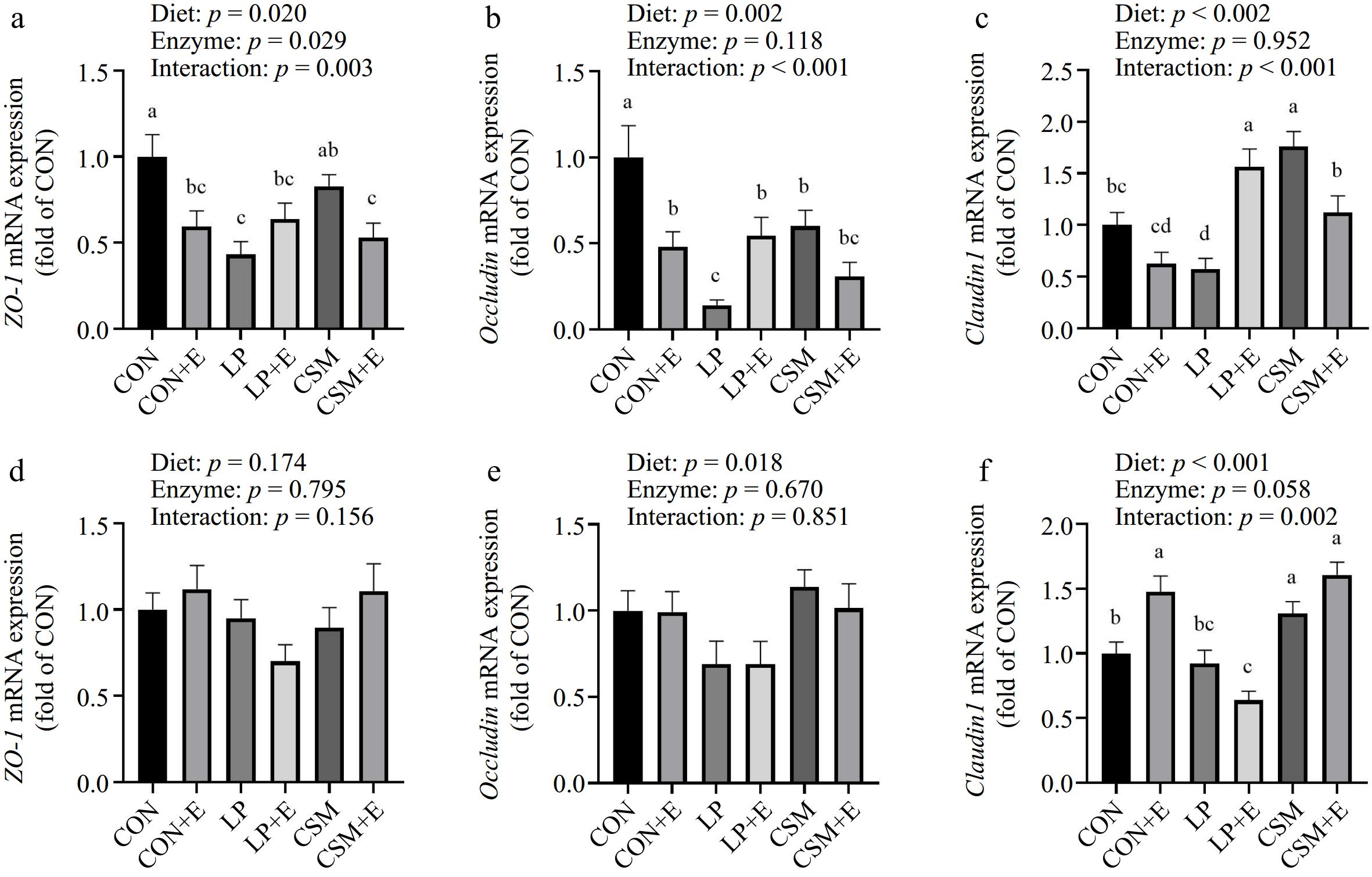
Figure 1.
Effects of low protein diet and miscellaneous meal diet and enzyme supplementation on jejunal barrier proteins gene expressions of Langshan chickens. (a)−(c) Are the expression levels of jejunum barrier proteins gene at 58 d, (d)−(f) are the expression levels of jejunum barrier proteins gene at 86 d. Data are represented as mean ± SE (n = 8). a−c Different letters indicate significant difference among the CON, CON + E, LP, LP + E, CSM, and CSM + E groups. CON, corn soybean meal; CON + E, corn soybean meal with enzyme; LP, low protein meal; LP + E, low protein meal with enzyme; CSM, corn soybean miscellaneous meal; CSM + E, corn soybean miscellaneous meal with enzyme.
Dietary type and enzyme preparation had significant interaction on claudin1 in 86 d jejunum of Langshan chickens. Compared with CON group, CON + E, CSM, and CSM + E groups could significantly increase the expression level of claudin1 gene in jejunum of Langshan chickens (p < 0.01), the LP + E group could significantly decrease the expression level of claudin1 gene in jejunum of Langshan chickens (p < 0.01).
Effect of low protein diet and miscellaneous meal diet and enzyme supplementation on jejunal amino acid transporter gene expression
-
The expressions of amino acid transporter genes in the jejunum of Langshan chickens are shown in Fig. 2. The type of diet and the compound enzyme preparation interact to affect the expression levels of jejunal amino acid transporter genes SLC1A1, SLC7A1, SLC7A7, SLC15A1, and SLC38A1 in Langshan chickens at 58 d. Compared with CON, SLC1A1 gene expression in the LP group was significantly decreased (p < 0.05), and SLC7A5 gene expression in LP + E and CSM groups was significantly higher than that in CON group (p < 0.01). The expression level of SLC7A7 gene in CSM was extremely significantly increased (p < 0.01), the expression level of SLC15A1 gene in CSM and CSM + E was extremely significantly decreased (p < 0.05), and the expression level of SLC7A7 gene in CSM + E was extremely significantly increased (p < 0.01). The expression level of SLC7A7 gene in CSM and CSM + E was significantly decreased (p < 0.05), and the expression level of SLC38A1 gene in LP and CSM + E groups was significantly lower than that in CON group (p < 0.05).
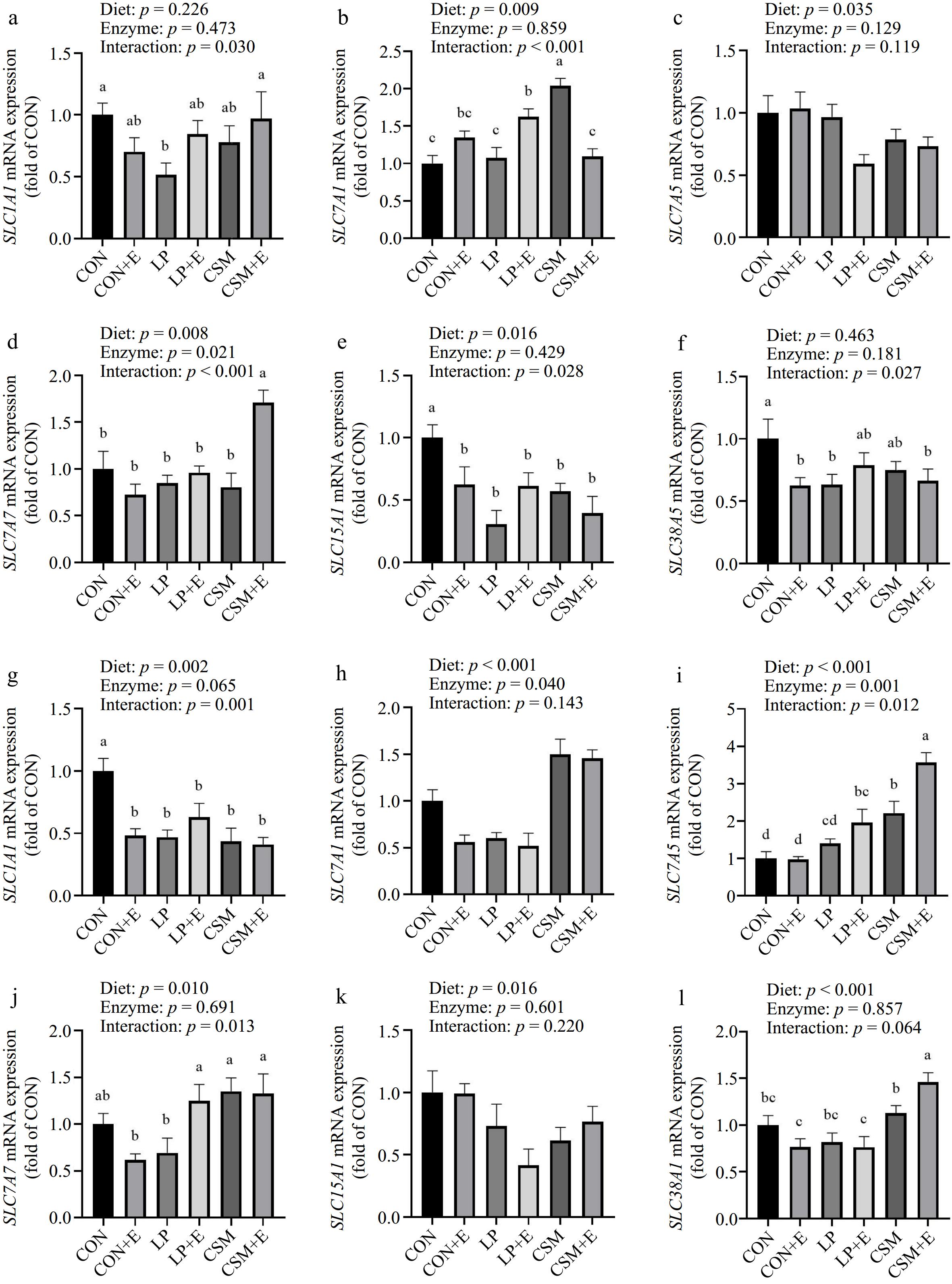
Figure 2.
Effects of low protein diet and miscellaneous meal diet and enzyme supplementation on jejunal amino acid transporters gene expressions of Langshan chickens. (a)−(f) Are the expression levels of jejunal amino acid transporters gene at 58 d, and (g)−(l) are the expression levels of jejunal amino acid transporters gene at 86 d. Data were represented as mean ± SE (n = 8). a−c Different letters indicate significant difference among the CON, CON + E, LP, LP + E, CSM, and CSM + E groups. CON, corn soybean meal; CON + E, corn soybean meal with enzyme; LP, low protein meal; LP + E, low protein meal with enzyme; CSM, corn soybean miscellaneous meal; CSM + E, corn soybean miscellaneous meal with enzyme.
The expression levels of amino acid transporter genes SLC1A1, SLC7A5 and SLC7A7 in 86 d jejunum of Langshan chickens were influenced by dietary type and complex enzyme. Compared with CON, CSM + E, LP, LP + E, CSM, and CSM + E significantly down-regulated SLC1A1 gene expression in jejunum of Langshan chickens (p < 0.01), LP + E, CSM, and CSM + E significantly increased SLC7A5 gene expression (p < 0.05). CON + E, and LP significantly offset SLC7A7 gene expression (p < 0.05).
-
The outcomes of this study suggest that a low-protein diet, compared to a traditional corn-soybean meal diet, resulted in a modest reduction in the growth performance of broilers, although the difference was not statistically significant. The results align with Van Harn et al. 's observation that a 3% reduction in dietary crude protein level has no adverse effect on growth performance[24]. The low-protein diet, while reducing overall protein content, still provides the essential amino acids necessary for broiler growth and development. Previous research has shown that adding protease and xylanase to low-protein diets can enhance broiler growth performance[25−27], and this experiment confirms those results.
Nutrient apparent metabolizablity, a key metric for assessing the digestive and absorptive capacity of broilers' diets, improved with the addition of compound enzyme preparations, as Marchal et al. suggested[28]. In this experiment, we observed that the apparent metabolizablity of crude protein and dry matter in the early miscellaneous meal diet and crude ash nutrients in the late diet were significantly decreased compared with that in the corn-soybean meal diet. As Manyeual et al. and Amerah et al. showed, rapeseed protein is difficult to digest in broilers, which may be related to the chemical composition of rapeseed meal[29,30]. Zhang et al. reported that exogenous active substances can be added to ensure maximum growth of broilers fed rapeseed meal[31]. This experiment observed similar improvements in metabolizablity after adding compound enzyme preparations to the diets.
The small intestine is the main place for the digestion and absorption of nutrients, and the mucosal barrier of the small intestine can prevent the entry of foreign harmful substances. Its morphology, including villus height, crypt depth, and villus-to-crypt ratio, indicates broiler intestinal health[32,33]. Intestinal integrity is influenced by dietary factors, especially the addition of enzymes[34]. This study's results align with Macelline et al., showing significant increases in villus height and crypt depth when broilers are fed a low-protein diet, likely due to the balanced amino acid ratio, which promotes intestinal development[35]. The current experiment also observed increased jejunal villus height and crypt depth with the corn-soybean-miscellaneous meal diet, which is consistent with Drazbo et al., who found that rapeseed meal can enhance duodenal villus height and the jejunal ratio of villus to crypt[36]. Similar to Hussain et al., who did not find improvement in intestinal integrity when dietary exogenous enzymes were added, the results of this experiment did not find that the addition of compound enzyme preparation could affect the integrity of jejunum[37].
In this study, low-protein diets showed a tendency to increase amylase activity, with slightly decreased lipase and protease activities, while the corn-soybean-miscellaneous meal diet showed decreased digestive enzyme activities. The supplementation of compound enzyme preparations improved jejunal chyme digestive enzyme activity, as also noted by Zhang et al., who found that β-mannanase supplementation at different metabolizable energy levels effectively supported jejunal chymus lipase activity[38].
ZO-1, occludin, and claudin1, which are key proteins regulating intestinal tight junctions in broilers, can be weakened when dietary protein is reduced, increasing intestinal permeability[39,40]. This study found that dietary protein reduction significantly decreased the expression of these proteins, a finding supported by Barekatain et al[41]. The first stage of the experiment also showed decreased jejunal barrier gene expression in Langshan chickens fed the corn-soybean-miscellaneous meal diet, likely due to the gastrointestinal tract of broiler chickens is not fully developed and the obstruction of intestinal mucosal barrier function caused by anti-nutrient factors interfering with the metabolic activities of intestinal microorganisms. Cowieson et al. confirmed that increased exogenous proteases can reduce the anti-nutritional effects of various protein sources, thereby improving tight junction integrity and mucin to enhance intestinal health, a view reflected in this experiment[42].
Amino acids, the building blocks of proteins, play a vital role in energy provision and metabolism and require specific carriers for transmembrane transport[43,44]. This experiment found that the gene expressions of SLC1A1, SLC7A1, SLC7A7, SLC15A1, and SLC38A1 in the jejunum of Langshan chickens fed a low-protein diet were down-regulated, potentially due to insufficient amino acid content. The research by Liu et al. indicates that when the peptide content in the diet is high, the expression level of Pept1 in the small intestine increases[45]. In this experiment, it might be due to the insufficient amino acid and peptide content in the low-protein diet that the expression level of amino acid transporters decreased. Park et al. found that dietary protease supplementation in broilers can increase the expression of amino acid transporter genes in the small intestine, possibly related to peptides and amino acids absorption[46]. The gene expression of SLC1A1, SLC7A5, SLC7A7, SLC15A1, and SLC38A1 in Langshan chickens fed the corn-soybean-miscellaneous diet also decreased, Ajao & Olukosi found that the expression levels of EAAT and CAT1 were also significantly down-regulated in low-protein diets containing soluble dry corn distillers[47]. However, amino acid and peptide gene expressions were down-regulated at 58 d with enzyme addition but up-regulated at 86 d, possibly due to varying amino acid and peptide requirements at different growth stages.
-
In conclusion, a low protein diet and miscellaneous meal diet do not adversely affect the growth performance of Langshan chickens, but reduce the apparent metabolizablity and intestinal health to a certain extent. Although the miscellaneous meal diet decreased the apparent metabolizablity of protein, compound enzyme supplementation significantly increased the metabolizablity of crude protein and crude ash. In addition, a low protein diet and miscellaneous meal diet improved intestinal morphology by increasing villus height and the ratio of villus height to crypt depth, and compound enzyme supplementation can further enhance these effects. Although the miscellaneous meal diet decreased the protease activity of jejunum chyme, compound enzyme supplementation can increase the amylase activity and helped to improve digestive function. These results indicate that low protein diet and miscellaneous meal diet can effectively improve the digestive performance and intestinal health of Langshan chickens with the reasonable addition of enzyme preparations.
This study was supported by the Jiangsu Agriculture Science and Technology Innovation Fund (CX (23)1016).
-
The experimental protocols were approved by the Institutional Animal Care and Use Committee of the Nanjing Agricultural University, Nanjing, China (Identification NJAULLSC2023175, approval date: 2024/1/1). The research followed the 'Replacement, Reduction, and Refinement' principles to minimize harm to animals. This article provides details on the housing conditions, care, and pain management for the animals, ensuring that the impact on the animals is minimized during the experiment.
-
The authors confirm contribution to the paper as follows: study conception and design: Gao F; data collection, analysis and interpretation of results, draft manuscript preparation: Yu C; manuscript revision: Gao F, Zhang L, Xing T, Zhao L. All authors read, edited, and approved the final manuscript.
-
The original contributions presented in this study are included in the article. Further inquiries can be directed to the corresponding author.
-
The authors declare that they have no conflict of interest.
- Copyright: © 2025 by the author(s). Published by Maximum Academic Press on behalf of Nanjing Agricultural University. This article is an open access article distributed under Creative Commons Attribution License (CC BY 4.0), visit https://creativecommons.org/licenses/by/4.0/.
-
About this article
Cite this article
Yu C, Zhang L, Xing T, Zhao L, Gao F. 2025. Effects of reduction or replacement of soybean meal and a combination of compound enzyme preparations supplementation on growth performance and intestinal health of Langshan chickens. Animal Advances 2: e018 doi: 10.48130/animadv-0025-0016 

Effects of reduction or replacement of soybean meal and a combination of compound enzyme preparations supplementation on growth performance and intestinal health of Langshan chickens
- Received: 07 February 2025
- Revised: 30 March 2025
- Accepted: 07 April 2025
- Published online: 04 July 2025
Abstract: The present study assessed the effects of low protein and alternative protein diets with compound enzyme preparations supplementation on the growth performance and intestinal health of Langshan chickens. A total of 288 Langshan roosters at the age of 30 d were selected, and six diets were prepared according to 3 × 2 factor test: the corn-soybean meal, corn-soybean meal with enzymes, low protein meal, low protein meal with enzymes, corn-soybean-miscellaneous meal, and corn-soybean-miscellaneous meal with enzymes. The experiment lasted for 56 d. Over the entire experiment, the corn-soybean-miscellaneous diet significantly increased average daily gain and significantly reduced the feed-to-gain ratio (p < 0.05). The corn-soybean miscellaneous meal diet significantly decreased the apparent digestibility of protein (p < 0.05), while enzyme supplementation significantly increased the digestibility of crude protein and crude ash (p < 0.05). Intestinal morphology showed that low protein and corn-soybean-miscellaneous meal diets increased the villus height of birds at 58 d of age (p < 0.05). Enzyme-supplemented diets significantly increased amylase activity in the jejunal digesta of broilers at 58 d of age (p < 0.05). Corn-soybean-miscellaneous diet significantly decreased protease activity compared with those fed with corn-soybean meal (p < 0.05). There were significant interactions on mRNA expressions in intestinal tight barriers and amino acid transporters by diet type and enzyme supplementation. A low protein diet and corn-soybean miscellaneous meal diet could destroy the intestinal barrier and reduce amino acid transporter gene expression levels, which could be improved after adding enzyme preparations.