








Search
2025 Volume 1
Article Contents
REVIEW   Open Access    

Machine learning-enabled optimization of biochar resource utilization and carbon mitigation pathways: mechanisms and challenges

  • Full list of author information is available at the end of the article.

  • Received: 13 June 2025
    Revised: 10 August 2025
    Accepted: 27 August 2025
    Published online: 11 September 2025
    Biochar X  1 Article number: e002 (2025)  |  Cite this article
  • Biochar enables effective waste valorization and long-term carbon sequestration.

    Machine learning boosts efficiency in biochar design, modification, and assessment.

    Integrating ML with LCA enhances climate benefits and supports green innovation.

  • As an environmentally friendly and carbon-rich material, biochar holds significant application potential in waste valorization, water pollution remediation, and carbon sequestration. In recent years, machine learning has emerged as a powerful data-driven tool and is being increasingly applied in biochar research. This review systematically summarizes the fundamental concepts, preparation methods, and key application areas of biochar, with a particular focus on recent advances in its roles in carbon footprint reduction and resource utilization. The applications of machine learning in process optimization, material design, and life cycle assessment are thoroughly discussed. Moreover, the challenges related to data acquisition, model interpretability, and interdisciplinary collaboration are critically analyzed. Importantly, the review highlights that biochar application can reduce total greenhouse gas emissions by 20%–70%, with carbon sequestration rates reaching up to 90% depending on feedstock and pyrolysis conditions. Machine learning models such as random forest and deep neural networks have achieved prediction accuracies exceeding 90% in forecasting biochar yield, surface area, and adsorption capacity, significantly improving design efficiency and environmental performance. Looking ahead, the integration of advanced techniques such as deep learning, multi-objective optimization, and self-supervised learning is expected to further enhance the environmental benefits and intelligent design of biochar, thereby offering strong technical support for global climate mitigation and the circular economy development.
    Graphical Abstract
  • 加载中
  • [1] Nataly Echevarria Huaman R, Tian XJ. 2014. Energy related CO2 emissions and the progress on CCS projects: a review. Renewable and Sustainable Energy Reviews 31:368−385 doi: 10.1016/j.rser.2013.12.002

    CrossRef   Google Scholar

    [2] Lee CT, Mohammad Rozali NE, Van Fan Y, Klemeš JJ, Towprayoon S. 2018. Low-carbon emission development in asia: energy sector, waste management and environmental management system. Clean Technologies and Environmental Policy 20:443−449 doi: 10.1007/s10098-018-1512-8

    CrossRef   Google Scholar

    [3] Luo L, Wang J, Lv J, Liu Z, Sun T, et al. 2023. Carbon sequestration strategies in soil using biochar: advances, challenges, and opportunities. Environmental Science & Technology 57:11357−11372 doi: 10.1021/acs.est.3c02620

    CrossRef   Google Scholar

    [4] Mrunalini K, Behera B, Jayaraman S, Abhilash PC, Dubey PK, et al. 2022. Nature-based solutions in soil restoration for improving agricultural productivity. Land Degradation & Development 33:1269−1289 doi: 10.1002/ldr.4207

    CrossRef   Google Scholar

    [5] Aquije C, Schmidt HP, Draper K, Joseph S, Ladd B. 2022. Low tech biochar production could be a highly effective nature-based solution for climate change mitigation in the developing world. Plant and Soil 479:77−83 doi: 10.1007/s11104-021-05159-6

    CrossRef   Google Scholar

    [6] Xu Q, Zhang T, Niu Y, Mukherjee S, Abou-Elwafa SF, et al. 2024. A comprehensive review on agricultural waste utilization through sustainable conversion techniques, with a focus on the additives effect on the fate of phosphorus and toxic elements during composting process. Science of the Total Environment 942:173567 doi: 10.1016/j.scitotenv.2024.173567

    CrossRef   Google Scholar

    [7] Jakubus M, Černe M, Palčić I, Pasković I, Ban SG, et al. 2025. The application of sewage sludge-derived compost or biochar as a nature-based solution (NBS) for healthier soil. Sustainability 17:1630 doi: 10.3390/su17041630

    CrossRef   Google Scholar

    [8] Nan Q, Speth DR, Qin Y, Chi W, Milucka J, et al. 2025. Biochar application using recycled annual self straw reduces long-term greenhouse gas emissions from paddy fields with economic benefits. Nature Food 6:456−65 doi: 10.1038/s43016-025-01124-z

    CrossRef   Google Scholar

    [9] Shaheen SM, Natasha, Mosa A, El-Naggar A, Faysal Hossain M, et al. 2022. Manganese oxide-modified biochar: Production, characterization and applications for the removal of pollutants from aqueous environments - a review. Bioresource Technology 346:126581 doi: 10.1016/j.biortech.2021.126581

    CrossRef   Google Scholar

    [10] Subramanian P, Pakkiyam S, Pandian K, Chinnathambi S, Jayaraman M. 2025. Preparation and modification of prosopis juliflora biochar and pb (II) removal from aqueous solutions. Biomass Conversion and Biorefinery 15:421−435 doi: 10.1007/s13399-024-05575-5

    CrossRef   Google Scholar

    [11] Wei X, Luo M, Wang T, Yu S, Dong Y, et al. 2025. Preparation of biochar composite graphene oxide for the removal of boron in simulated fracturing flowback fluid. Arabian Journal for Science and Engineering 50:123−132 doi: 10.1007/s13369-024-09126-y

    CrossRef   Google Scholar

    [12] Fakhar A, Galgo SJC, Canatoy RC, Rafique M, Sarfraz R, et al. 2025. Advancing modified biochar for sustainable agriculture: a comprehensive review on characterization, analysis, and soil performance. Biochar 7:8 doi: 10.1007/s42773-024-00397-0

    CrossRef   Google Scholar

    [13] Woolf D, Amonette JE, Street-Perrott FA, Lehmann J, Joseph S. 2010. Sustainable biochar to mitigate global climate change. Nature Communications 1:56 doi: 10.1038/ncomms1053

    CrossRef   Google Scholar

    [14] Huang Y, Luo Y, Wu C, Xue S, Chen H, et al. 2025. Synergistic multi-metal stabilization of lead–zinc smelting contaminated soil by Ochrobactrum EEELCW01-loaded iron-modified biochar: performance and long-term efficacy. Biochar 7:58 doi: 10.1007/s42773-025-00441-7

    CrossRef   Google Scholar

    [15] Bano A, Aziz MK, Prasad B, Ravi R, Shah MP, et al. 2025. The multifaceted power of biochar: A review on its role in pollution control, sustainable agriculture, and circular economy. Environmental Chemistry and Ecotoxicology 7:286−304 doi: 10.1016/j.enceco.2025.01.004

    CrossRef   Google Scholar

    [16] Waheed A, Xu H, Qiao X, Aili A, Yiremaikebayi Y, et al. 2025. Biochar in sustainable agriculture and climate mitigation: mechanisms, challenges, and applications in the circular bioeconomy. Biomass and Bioenergy 193:107531 doi: 10.1016/j.biombioe.2024.107531

    CrossRef   Google Scholar

    [17] Zhou S, Yang X, Tran TK, Shen J, An C. 2025. Paving the way for biochar production, supply chain, and applications toward a sustainable future. Cleaner Waste Systems 10:100227 doi: 10.1016/j.clwas.2025.100227

    CrossRef   Google Scholar

    [18] Zhang T, Manafi Khajeh Pasha A, Mohammad Sajadi S, Jasim DJ, Nasajpour-Esfahani N, et al. 2024. Optimization of thermophysical properties of nanofluids using a hybrid procedure based on machine learning, multi-objective optimization, and multi-criteria decision-making. Chemical Engineering Journal 485:150059 doi: 10.1016/j.cej.2024.150059

    CrossRef   Google Scholar

    [19] Xie G, Zhu C, Li C, Fan Z, Wang B. 2025. Predicting the adsorption of ammonia nitrogen by biochar in water bodies using machine learning strategies: Model optimization and analysis of key characteristic variables. Environmental Research 267:120618 doi: 10.1016/j.envres.2024.120618

    CrossRef   Google Scholar

    [20] Gou J, Sajid GH, Sabri MM, El-Meligy M, El Hindi K, et al. 2025. Optimizing biochar yield and composition prediction with ensemble machine learning models for sustainable production. Ain Shams Engineering Journal 16:103209 doi: 10.1016/j.asej.2024.103209

    CrossRef   Google Scholar

    [21] Uppalapati S, Paramasivam P, Kilari N, Chohan JS, Kanti PK, et al. 2025. Precision biochar yield forecasting employing random forest and XGBoost with Taylor diagram visualization. Scientific Reports 15:7105 doi: 10.1038/s41598-025-91450-w

    CrossRef   Google Scholar

    [22] Li J, Chen Y, Wang C, Chen H, Gao Y, et al. 2025. Optimizing biochar for carbon sequestration: a synergistic approach using machine learning and natural language processing. Biochar 7:20 doi: 10.1007/s42773-024-00424-0

    CrossRef   Google Scholar

    [23] Ye P, Guo B, Qin H, Wang C, Liu Y, et al. 2025. The state-of-the-art review on biochar as green additives in cementitious composites: Performance, applications, machine learning predictions, and environmental and economic implications. Biochar 7:21 doi: 10.1007/s42773-024-00423-1

    CrossRef   Google Scholar

    [24] Yin R, Li X, Ning Y, Hu Q, Mao Y, et al. 2025. Machine learning unveils the role of biochar application in enhancing tea yield by mitigating soil acidification in tea plantations. Science of the Total Environment 965:178597 doi: 10.1016/j.scitotenv.2025.178597

    CrossRef   Google Scholar

    [25] Zhang Y, Lei B, Mahdaviarab A, Wang X, Liu Z. 2025. Robust biochar yield and composition prediction via uncertainty-aware ResNet-based autoencoder. Biochar 7:61 doi: 10.1007/s42773-025-00446-2

    CrossRef   Google Scholar

    [26] Yadav S, Rajput P, Balasubramanian P, Liu C, Li F, Zhang P. 2025. Machine learning-driven prediction of biochar adsorption capacity for effective removal of congo red dye. Carbon Research 4:11 doi: 10.1007/s44246-024-00168-3

    CrossRef   Google Scholar

    [27] Wang R, Zhang S, Chen H, He Z, Cao G, et al. 2023. Enhancing biochar-based nonradical persulfate activation using data-driven techniques. Environmental Science & Technology 57:4050−4059 doi: 10.1021/acs.est.2c07073

    CrossRef   Google Scholar

    [28] Zhang W, Chen R, Li J, Huang T, Wu B, et al. 2023. Synthesis optimization and adsorption modeling of biochar for pollutant removal via machine learning. Biochar 5:25 doi: 10.1007/s42773-023-00225-x

    CrossRef   Google Scholar

    [29] Zhang P, Zhang T, Zhang J, Liu H, Chicaiza-Ortiz C, et al. 2024. A machine learning assisted prediction of potential biochar and its applications in anaerobic digestion for valuable chemicals and energy recovery from organic waste. Carbon Neutrality 3:2 doi: 10.1007/s43979-023-00078-0

    CrossRef   Google Scholar

    [30] Hemati Matin N, Jalali M, Antoniadis V, Shaheen SM, Wang J, et al. 2020. Almond and walnut shell-derived biochars affect sorption-desorption, fractionation, and release of phosphorus in two different soils. Chemosphere 241:124888 doi: 10.1016/j.chemosphere.2019.124888

    CrossRef   Google Scholar

    [31] Zhang Y, Zhang T. 2022. Biowaste valorization to produce advance carbon material-hydrochar for potential application of Cr (VI) and Cd (II) adsorption in wastewater: A review. Water 14:3675 doi: 10.3390/w14223675

    CrossRef   Google Scholar

    [32] Xie S, Zhang T, Mishra A, Tiwari A, Bolan NS. 2022. Assessment of catalytic thermal hydrolysis of swine manure slurry as liquid fertilizer: Insights into nutrients and metals. Frontiers in Environmental Science 10:1005290 doi: 10.3389/fenvs.2022.1005290

    CrossRef   Google Scholar

    [33] Ahmed SF, Mehejabin F, Chowdhury AA, Almomani F, Khan NA, et al. 2024. Biochar produced from waste-based feedstocks: mechanisms, affecting factors, economy, utilization, challenges, and prospects. GCB Bioenergy 16:e13175 doi: 10.1111/gcbb.13175

    CrossRef   Google Scholar

    [34] Gabhane JW, Bhange VP, Patil PD, Bankar ST, Kumar S. 2020. Recent trends in biochar production methods and its application as a soil health conditioner: a review. SN Applied Sciences 2:1307 doi: 10.1007/s42452-020-3121-5

    CrossRef   Google Scholar

    [35] Ali A, Shaheen SM, Guo D, Li Y, Xiao R, et al. 2020. Apricot shell- and apple tree-derived biochar affect the fractionation and bioavailability of Zn and Cd as well as the microbial activity in smelter contaminated soil. Environmental Pollution 264:114773 doi: 10.1016/j.envpol.2020.114773

    CrossRef   Google Scholar

    [36] Afshar M, Mofatteh S. 2024. Biochar for a sustainable future: Environmentally friendly production and diverse applications. Results in Engineering 23:102433 doi: 10.1016/j.rineng.2024.102433

    CrossRef   Google Scholar

    [37] Wang Y, Hu Y, Zhao X, Wang S, Xing G. 2013. Comparisons of biochar properties from wood material and crop residues at different temperatures and residence times. Energy & Fuels 27:5890−5899 doi: 10.1021/ef400972z

    CrossRef   Google Scholar

    [38] Liu WJ, Jiang H, Yu HQ. 2015. Development of biochar-based functional materials: toward a sustainable platform carbon material. Chemical Reviews 115:12251−12285 doi: 10.1021/acs.chemrev.5b00195

    CrossRef   Google Scholar

    [39] Xu J, Liu J, Ling P, Zhang X, Xu K, et al. 2020. Raman spectroscopy of biochar from the pyrolysis of three typical Chinese biomasses: a novel method for rapidly evaluating the biochar property. Energy 202:117644 doi: 10.1016/j.energy.2020.117644

    CrossRef   Google Scholar

    [40] He D, Luo Y, Zhu B. 2024. Feedstock and pyrolysis temperature influence biochar properties and its interactions with soil substances: Insights from a DFT calculation. Science of the Total Environment 922:171259 doi: 10.1016/j.scitotenv.2024.171259

    CrossRef   Google Scholar

    [41] Dayoub EB, Tóth Z, Soós G, Anda A. 2024. Chemical and physical properties of selected biochar types and a few application methods in agriculture. Agronomy 14:2540 doi: 10.3390/agronomy14112540

    CrossRef   Google Scholar

    [42] Mašek O, Buss W, Roy-Poirier A, Lowe W, Peters C, et al. 2018. Consistency of biochar properties over time and production scales: a characterisation of standard materials. Journal of Analytical and Applied Pyrolysis 132:200−210 doi: 10.1016/j.jaap.2018.02.020

    CrossRef   Google Scholar

    [43] Yu D, Niu J, Zhong L, Chen K, Wang G, et al. 2022. Biochar raw material selection and application in the food chain: a review. Science of the Total Environment 836:155571 doi: 10.1016/j.scitotenv.2022.155571

    CrossRef   Google Scholar

    [44] Kuryntseva P, Karamova K, Galitskaya P, Selivanovskaya S, Evtugyn G. 2023. Biochar functions in soil depending on feedstock and pyrolyzation properties with particular emphasis on biological properties. Agriculture 13:2003 doi: 10.3390/agriculture13102003

    CrossRef   Google Scholar

    [45] Saletnik B, Zaguła G, Bajcar M, Tarapatskyy M, Bobula G, et al. 2019. Biochar as a multifunctional component of the environment—a review. Applied Sciences 9:1139 doi: 10.3390/app9061139

    CrossRef   Google Scholar

    [46] Wang Z, Wei N, Yang F, Hanikai D, Li S, et al. 2024. The effect of remediation of soil co-contaminated by Cu and Cd in a semi-arid area with sewage sludge-derived biochar. Sustainability 16:4961 doi: 10.3390/su16124961

    CrossRef   Google Scholar

    [47] Vavrincová L, Pipíška M, Urbanová J, Frišták V, Horník M, et al. 2024. Sewage sludge biochar as a sustainable and water-safe substrate additive for extensive green roofs. Sustainable Chemistry and Pharmacy 39:101604 doi: 10.1016/j.scp.2024.101604

    CrossRef   Google Scholar

    [48] Geng Y, Qin P, Lu Y, Sun Y, Zhang J, et al. 2025. Comparative effects of biochars from different feedstocks on the desiccation process of loess. Bulletin of Engineering Geology and the Environment 84:137 doi: 10.1007/s10064-025-04153-x

    CrossRef   Google Scholar

    [49] Rago YP, Surroop D, Mohee R. 2018. Assessing the potential of biofuel (biochar) production from food wastes through thermal treatment. Bioresource Technology 248:258−264 doi: 10.1016/j.biortech.2017.06.108

    CrossRef   Google Scholar

    [50] Liu J, Huang S, Chen K, Wang T, Mei M, et al. 2020. Preparation of biochar from food waste digestate: pyrolysis behavior and product properties. Bioresource Technology 302:122841 doi: 10.1016/j.biortech.2020.122841

    CrossRef   Google Scholar

    [51] Igalavithana AD, Choi SW, Dissanayake PD, Shang J, Wang CH, et al. 2020. Gasification biochar from biowaste (food waste and wood waste) for effective CO2 adsorption. Journal of Hazardous Materials 391:121147 doi: 10.1016/j.jhazmat.2019.121147

    CrossRef   Google Scholar

    [52] Yadav S, Singh D. 2023. Assessment of biochar developed via torrefaction of food waste as feedstock for steam gasification to produce hydrogen rich gas. Carbon Research 2:34 doi: 10.1007/s44246-023-00065-1

    CrossRef   Google Scholar

    [53] Zhou J, Deng Q, Chen Q, Chu B, Li Y, et al. 2024. Waste-green infrastructure nexus: green roof promotion by digestate and digestate biochar from food waste. Bioresource Technology 402:130845 doi: 10.1016/j.biortech.2024.130845

    CrossRef   Google Scholar

    [54] Pradhan S, Parthasarathy P, MacKey HR, Al-Ansari T, McKay G. 2024. Food waste biochar: a sustainable solution for agriculture application and soil–water remediation. Carbon Research 3:41 doi: 10.1007/s44246-024-00123-2

    CrossRef   Google Scholar

    [55] Pradhan S, Parthasarathy P, MacKey HR, Al-Ansari T, McKay G. 2024. Optimization of peapod peel biochar amendment for sustainable agriculture by surface response methodology towards water-food-environment nexus. Chemical Engineering Journal 498:155243 doi: 10.1016/j.cej.2024.155243

    CrossRef   Google Scholar

    [56] Tomczyk A, Sokołowska Z, Boguta P. 2020. Biochar physicochemical properties: pyrolysis temperature and feedstock kind effects. Reviews in Environmental Science and Bio/Technology 19:191−215 doi: 10.1007/s11157-020-09523-3

    CrossRef   Google Scholar

    [57] Ginebra M, Muñoz C, Calvelo-Pereira R, Doussoulin M, Zagal E. 2022. Biochar impacts on soil chemical properties, greenhouse gas emissions and forage productivity: a field experiment. Science of the Total Environment 806:150465 doi: 10.1016/j.scitotenv.2021.150465

    CrossRef   Google Scholar

    [58] He Y, Zhao X, Zhu S, Yuan L, Li X, et al. 2023. Conversion of swine manure into biochar for soil amendment: efficacy and underlying mechanism of dissipating antibiotic resistance genes. Science of the Total Environment 871:162046 doi: 10.1016/j.scitotenv.2023.162046

    CrossRef   Google Scholar

    [59] Li Y, Kumar Awasthi M, Sindhu R, Binod P, Zhang Z, et al. 2023. Biochar preparation and evaluation of its effect in composting mechanism: a review. Bioresource Technology 384:129329 doi: 10.1016/j.biortech.2023.129329

    CrossRef   Google Scholar

    [60] Pan X, Gu Z, Chen W, Li Q. 2021. Preparation of biochar and biochar composites and their application in a fenton-like process for wastewater decontamination: a review. Science of the Total Environment 754:142104 doi: 10.1016/j.scitotenv.2020.142104

    CrossRef   Google Scholar

    [61] Qambrani NA, Rahman MM, Won S, Shim S, Ra C. 2017. Biochar properties and eco-friendly applications for climate change mitigation, waste management, and wastewater treatment: a review. Renewable and Sustainable Energy Reviews 79:255−273 doi: 10.1016/j.rser.2017.05.057

    CrossRef   Google Scholar

    [62] Wang L, Ok YS, Tsang DCW, Alessi DS, Rinklebe J, et al. 2020. New trends in biochar pyrolysis and modification strategies: Feedstock, pyrolysis conditions, sustainability concerns and implications for soil amendment. Soil Use and Management 36:358−386 doi: 10.1111/sum.12592

    CrossRef   Google Scholar

    [63] Mkhwanazi Z, Isa YM. 2023. Production of biocoal from wastewater sludge and sugarcane bagasse using hydrothermal carbonization. Biofuels, Bioproducts and Biorefining 17:389−402 doi: 10.1002/bbb.2447

    CrossRef   Google Scholar

    [64] Yan T, Zhang T, Wang S, Andrea K, Peng H, et al. 2023. Multivariate and multi-interface insights into carbon and energy recovery and conversion characteristics of hydrothermal carbonization of biomass waste from duck farm. Waste Management 170:154−165 doi: 10.1016/j.wasman.2023.08.009

    CrossRef   Google Scholar

    [65] Zhang Z, Yan T, Zhang T, Zhang Z, Wang W, et al. 2024. Volatile fatty acid release and metal ion concentration in hydrothermal carbonization liquid. Journal of Analytical and Applied Pyrolysis 183:106815 doi: 10.1016/j.jaap.2024.106815

    CrossRef   Google Scholar

    [66] Özçimen D, İnan B, Koçer AT, Bostyn S, Gökalp İ. 2022. Hydrothermal carbonization processes applied to wet organic waste streams. International Journal of Energy Research 46:16109−16126 doi: 10.1002/er.8304

    CrossRef   Google Scholar

    [67] Khalaf N, Leahy Jj, Kwapinski W. 2023. Phosphorus recovery from hydrothermal carbonization of organic waste: A review. Journal of Chemical Technology & Biotechnology 98:2365−2377 doi: 10.1002/jctb.7475

    CrossRef   Google Scholar

    [68] Ge X, Zhang T. 2023. Changes in inorganic and organic matters in processed water from hydrothermal-treated biogas slurry. Materials Science for Energy Technologies 6:145−157 doi: 10.1016/j.mset.2022.12.002

    CrossRef   Google Scholar

    [69] He X, Wang Y, Zhang Y, Wang C, Yu J, et al. 2023. The potential for livestock manure valorization and phosphorus recovery by hydrothermal technology - a critical review. Materials Science for Energy Technologies 6:94−104 doi: 10.1016/j.mset.2022.11.008

    CrossRef   Google Scholar

    [70] Su X, Zhang T, Zhao J, Mukherjee S, Alotaibi NM, et al. 2024. Phosphorus fraction in hydrochar from co-hydrothermal carbonization of swine manure and rice straw: an optimization analysis based on response surface methodology. Water 16:2208 doi: 10.3390/w16152208

    CrossRef   Google Scholar

    [71] Xie S, Zhang T, You S, Mukherjee S, Pu M, et al. 2025. Applied machine learning for predicting the properties and carbon and phosphorus fate of pristine and engineered hydrochar. Biochar 7:19 doi: 10.1007/s42773-024-00404-4

    CrossRef   Google Scholar

    [72] Dhull SB, Rose PK, Rani J, Goksen G, Bains A. 2024. Food waste to hydrochar: a potential approach towards the sustainable development goals, carbon neutrality, and circular economy. Chemical Engineering Journal 490:151609 doi: 10.1016/j.cej.2024.151609

    CrossRef   Google Scholar

    [73] Xie S, He X, Ali Alshehri M, Abou-Elwafa SF, Zhang T. 2024. Elevated effect of hydrothermal treatment on phosphorus transition between solid-liquid phase in swine manure. Results in Engineering 24:102887 doi: 10.1016/j.rineng.2024.102887

    CrossRef   Google Scholar

    [74] Ahmed MB, Zhou JL, Ngo HH, Guo W. 2016. Insight into biochar properties and its cost analysis. Biomass and Bioenergy 84:76−86 doi: 10.1016/j.biombioe.2015.11.002

    CrossRef   Google Scholar

    [75] Schimmelpfennig S, Glaser B. 2012. One step forward toward characterization: some important material properties to distinguish biochars. Journal of Environmental Quality 41:1001−1013 doi: 10.2134/jeq2011.0146

    CrossRef   Google Scholar

    [76] Nartey OD, Zhao B. 2014. Biochar preparation, characterization, and adsorptive capacity and its effect on bioavailability of contaminants: an overview. Advances in Materials Science and Engineering 2014:715398 doi: 10.1155/2014/715398

    CrossRef   Google Scholar

    [77] Liu G, Xu Q, Abou-Elwafa SF, Ali Alshehri M, Zhang T. 2024. Hydrothermal carbonization technology for wastewater treatment under the "Dual Carbon" goals: current status, trends, and challenges. Water 16:1749 doi: 10.3390/w16121749

    CrossRef   Google Scholar

    [78] Wang P, Wang S, Chen F, Zhang T, Kong W. 2024. Preparation of two types plant biochars and application in soil quality improvement. Science of the Total Environment 906:167334 doi: 10.1016/j.scitotenv.2023.167334

    CrossRef   Google Scholar

    [79] Manolikaki II, Mangolis A, Diamadopoulos E. 2016. The impact of biochars prepared from agricultural residues on phosphorus release and availability in two fertile soils. Journal of Environmental Management 181:536−543 doi: 10.1016/j.jenvman.2016.07.012

    CrossRef   Google Scholar

    [80] Madusari S, Jamari SS, Nordin NIAA, Bindar Y, Prakoso T, et al. 2023. Hybrid hydrothermal carbonization and ultrasound technology on oil palm biomass for hydrochar production. ChemBioEng Reviews 10:37−54 doi: 10.1002/cben.202200014

    CrossRef   Google Scholar

    [81] Wen H, Li J, Wang X, Mao W, He Y, et al. 2025. Comparative study on combustion characteristics of biomass digestate-derived pyrochar and hydrochar: Insights from structural composition and oxygen-containing groups. Fuel 389:134627 doi: 10.1016/j.fuel.2025.134627

    CrossRef   Google Scholar

    [82] Zhang X, Zheng H, Wu J, Chen W, Chen Y, et al. 2021. Physicochemical and adsorption properties of biochar from biomass-based pyrolytic polygeneration: effects of biomass species and temperature. Biochar 3:657−670 doi: 10.1007/s42773-021-00102-5

    CrossRef   Google Scholar

    [83] Yang J, Zhang Z, Wang J, Zhao X, Zhao Y, et al. 2023. Pyrolysis and hydrothermal carbonization of biowaste: A comparative review on the conversion pathways and potential applications of char product. Sustainable Chemistry and Pharmacy 33:101106 doi: 10.1016/j.scp.2023.101106

    CrossRef   Google Scholar

    [84] Yaashikaa PR, Kumar PS, Varjani S, Saravanan A. 2020. A critical review on the biochar production techniques, characterization, stability and applications for circular bioeconomy. Biotechnology Reports 28:e00570 doi: 10.1016/j.btre.2020.e00570

    CrossRef   Google Scholar

    [85] Tan XF, Zhu SS, Wang RP, Chen YD, Show PL, et al. 2021. Role of biochar surface characteristics in the adsorption of aromatic compounds: pore structure and functional groups. Chinese Chemical Letters 32:2939−2946 doi: 10.1016/j.cclet.2021.04.059

    CrossRef   Google Scholar

    [86] Elnour AY, Alghyamah AA, Shaikh HM, Poulose AM, Al-Zahrani SM, et al. 2019. Effect of pyrolysis temperature on biochar microstructural evolution, physicochemical characteristics, and its influence on biochar/polypropylene composites. Applied Sciences 9:1149 doi: 10.3390/app9061149

    CrossRef   Google Scholar

    [87] Srocke F, Han L, Dutilleul P, Xiao X, Smith DL, et al. 2021. Synchrotron X-ray microtomography and multifractal analysis for the characterization of pore structure and distribution in softwood pellet biochar. Biochar 3:671−686 doi: 10.1007/s42773-021-00104-3

    CrossRef   Google Scholar

    [88] Uday V, Harikrishnan PS, Deoli K, Zitouni F, Mahlknecht J, et al. 2022. Current trends in production, morphology, and real-world environmental applications of biochar for the promotion of sustainability. Bioresource Technology 359:127467 doi: 10.1016/j.biortech.2022.127467

    CrossRef   Google Scholar

    [89] Zhang J, Lü F, Zhang H, Shao L, Chen D, et al. 2015. Multiscale visualization of the structural and characteristic changes of sewage sludge biochar oriented towards potential agronomic and environmental implication. Scientific Reports 5:9406 doi: 10.1038/srep09406

    CrossRef   Google Scholar

    [90] Yi Y, Huang Z, Lu B, Xian J, Tsang EP, et al. 2020. Magnetic biochar for environmental remediation: a review. Bioresource Technology 298:122468 doi: 10.1016/j.biortech.2019.122468

    CrossRef   Google Scholar

    [91] Liu Z, Xu Z, Xu L, Buyong F, Chay TC, et al. 2022. Modified biochar: Synthesis and mechanism for removal of environmental heavy metals. Carbon Research 1:8 doi: 10.1007/s44246-022-00007-3

    CrossRef   Google Scholar

    [92] Wang L, Ok YS, Tsang DCW, Alessi DS, Rinklebe J, et al. 2022. Biochar composites: Emerging trends, field successes and sustainability implications. Soil Use and Management 38:14−38 doi: 10.1111/sum.12731

    CrossRef   Google Scholar

    [93] Qu J, Meng Q, Peng W, Shi J, Dong Z, et al. 2023. Application of functionalized biochar for adsorption of organic pollutants from environmental media: Synthesis strategies, removal mechanisms and outlook. Journal of Cleaner Production 423:138690 doi: 10.1016/j.jclepro.2023.138690

    CrossRef   Google Scholar

    [94] Yameen MZ, Naqvi SR, Juchelková D, Khan MNA. 2024. Harnessing the power of functionalized biochar: progress, challenges, and future perspectives in energy, water treatment, and environmental sustainability. Biochar 6:25 doi: 10.1007/s42773-024-00316-3

    CrossRef   Google Scholar

    [95] Yang Y, Li G, Yue X, Zhang K, Zhang Z, et al. 2024. Advances in biochar composites for environmental sustainability. Advanced Composites and Hybrid Materials 8:74 doi: 10.1007/s42114-024-01181-1

    CrossRef   Google Scholar

    [96] Hamid Y, Liu L, Usman M, Naidu R, Haris M, et al. 2022. Functionalized biochars: Synthesis, characterization, and applications for removing trace elements from water. Journal of Hazardous Materials 437:129337 doi: 10.1016/j.jhazmat.2022.129337

    CrossRef   Google Scholar

    [97] Wang J, Wang S. 2019. Preparation, modification and environmental application of biochar: a review. Journal of Cleaner Production 227:1002−1022 doi: 10.1016/j.jclepro.2019.04.282

    CrossRef   Google Scholar

    [98] Dai L, Lu Q, Zhou H, Shen F, Liu Z, et al. 2021. Tuning oxygenated functional groups on biochar for water pollution control: a critical review. Journal of Hazardous Materials 420:126547 doi: 10.1016/j.jhazmat.2021.126547

    CrossRef   Google Scholar

    [99] Premchand P, Demichelis F, Galletti C, Chiaramonti D, Bensaid S, et al. 2024. Enhancing biochar production: a technical analysis of the combined influence of chemical activation (KOH and NaOH) and pyrolysis atmospheres (N2/CO2) on yields and properties of rice husk-derived biochar. Journal of Environmental Management 370:123034 doi: 10.1016/j.jenvman.2024.123034

    CrossRef   Google Scholar

    [100] Venkatachalam CD, Sekar S, Sengottian M, Ravichandran SR, Bhuvaneshwaran P. 2023. A critical review of the production, activation, and morphological characteristic study on functionalized biochar. Journal of Energy Storage 67:107525 doi: 10.1016/j.est.2023.107525

    CrossRef   Google Scholar

    [101] Xie Q, Yang X, Xu K, Chen Z, Sarkar B, et al. 2020. Conversion of biochar to sulfonated solid acid catalysts for spiramycin hydrolysis: Insights into the sulfonation process. Environmental Research 188:109887 doi: 10.1016/j.envres.2020.109887

    CrossRef   Google Scholar

    [102] Xiong X, Yu IKM, Chen SS, Tsang DCW, Cao L, et al. 2018. Sulfonated biochar as acid catalyst for sugar hydrolysis and dehydration. Catalysis Today 314:52−61 doi: 10.1016/j.cattod.2018.02.034

    CrossRef   Google Scholar

    [103] Bouafina K, Belferdi F, Bouremmad F. 2025. Sulfonated biochar derived from eucalyptus bark as natural catalyst in the biginelli reaction. Russian Journal of General Chemistry 95:663−670 doi: 10.1134/S1070363224613048

    CrossRef   Google Scholar

    [104] Zhang J, Zhang X, Li X, Song Z, Shao J, et al. 2024. Prediction of CO2 adsorption of biochar under KOH activation via machine learning. Carbon Capture Science & Technology 13:100309 doi: 10.1016/j.ccst.2024.100309

    CrossRef   Google Scholar

    [105] Liu QH, Qiu YH, Yang ZM. 2025. KOH activation increased biochar's capacity to regulate electron transfer and promote methanogenesis. Energy 322:135650 doi: 10.1016/j.energy.2025.135650

    CrossRef   Google Scholar

    [106] Xu X, Zheng Y, Gao B, Cao X. 2019. N-doped biochar synthesized by a facile ball-milling method for enhanced sorption of CO2 and reactive red. Chemical Engineering Journal 368:564−572 doi: 10.1016/j.cej.2019.02.165

    CrossRef   Google Scholar

    [107] Zhang J, Huang D, Shao J, Zhang X, Yang H, et al. 2022. Activation-free synthesis of nitrogen-doped biochar for enhanced adsorption of CO2. Journal of Cleaner Production 355:131642 doi: 10.1016/j.jclepro.2022.131642

    CrossRef   Google Scholar

    [108] Guy Laurent Zanli BL, Tang W, Chen J. 2022. N-doped and activated porous biochar derived from cocoa shell for removing norfloxacin from aqueous solution: Performance assessment and mechanism insight. Environmental Research 214:113951 doi: 10.1016/j.envres.2022.113951

    CrossRef   Google Scholar

    [109] Zhao J, Jiang Y, Chen X, Wang C, Nan H. 2025. Unlocking the potential of element-doped biochar: from tailored synthesis to multifunctional applications in environment and energy. Biochar 7:77 doi: 10.1007/s42773-025-00467-x

    CrossRef   Google Scholar

    [110] Rana P, Soni V, Sharma S, Poonia K, Patial S, et al. 2025. Harnessing nitrogen doped magnetic biochar for efficient antibiotic adsorption and degradation. Journal of Industrial and Engineering Chemistry 148:174−195 doi: 10.1016/j.jiec.2025.01.025

    CrossRef   Google Scholar

    [111] Yao Y, Liu X, Hu H, Tang Y, Hu H, et al. 2022. Synthesis and characterization of iron-nitrogen-doped biochar catalysts for organic pollutant removal and hexavalent chromium reduction. Journal of Colloid and Interface Science 610:334−346 doi: 10.1016/j.jcis.2021.11.187

    CrossRef   Google Scholar

    [112] Sun Y, Yu IKM, Tsang DCW, Cao X, Lin D, et al. 2019. Multifunctional iron-biochar composites for the removal of potentially toxic elements, inherent cations, and hetero-chloride from hydraulic fracturing wastewater. Environment International 124:521−532 doi: 10.1016/j.envint.2019.01.047

    CrossRef   Google Scholar

    [113] Zhang P, O'Connor D, Wang Y, Jiang L, Xia T, et al. 2020. A green biochar/iron oxide composite for methylene blue removal. Journal of Hazardous Materials 384:121286 doi: 10.1016/j.jhazmat.2019.121286

    CrossRef   Google Scholar

    [114] Inyang M, Gao B, Zimmerman A, Zhang M, Chen H. 2014. Synthesis, characterization, and dye sorption ability of carbon nanotube–biochar nanocomposites. Chemical Engineering Journal 236:39−46 doi: 10.1016/j.cej.2013.09.074

    CrossRef   Google Scholar

    [115] Atinafu DG, Wi S, Yun BY, Kim S. 2021. Engineering biochar with multiwalled carbon nanotube for efficient phase change material encapsulation and thermal energy storage. Energy 216:119294 doi: 10.1016/j.energy.2020.119294

    CrossRef   Google Scholar

    [116] Rachitha P, Kyathegowdana Lakshmana Gowda N, Sagar N, Sunayana N, Uzma M, et al. 2023. Risk management, regulatory aspects, environmental challenges and future perspectives of functionalized carbon nanostructures. In Handbook of Functionalized Carbon Nanostructures: From Synthesis Methods to Applications, eds. Barhoum A, Deshmukh K. Cham: Springer International Publishing. pp. 1−41 10.1007/978-3-031-14955-9_74-1
    [117] Luo D, Wang L, Nan H, Cao Y, Wang H, et al. 2023. Phosphorus adsorption by functionalized biochar: A review. Environmental Chemistry Letters 21:497−524 doi: 10.1007/s10311-022-01519-5

    CrossRef   Google Scholar

    [118] Oral B, Coşgun A, Günay ME, Yıldırım R. 2024. Machine learning-based exploration of biochar for environmental management and remediation. Journal of Environmental Management 360:121162 doi: 10.1016/j.jenvman.2024.121162

    CrossRef   Google Scholar

    [119] Coşgun A, Oral B, Günay ME, Yıldırım R. 2024. Machine learning–based analysis of sustainable biochar production processes. BioEnergy Research 17:2311−2327 doi: 10.1007/s12155-024-10796-7

    CrossRef   Google Scholar

    [120] Babaahmadi V, Pourhosseini SEM, Norouzi O, Naderi HR. 2023. Designing 3D ternary hybrid composites composed of graphene, biochar and manganese dioxide as high-performance supercapacitor electrodes. Nanomaterials 13:1866 doi: 10.3390/nano13121866

    CrossRef   Google Scholar

    [121] Cheng A, He Y, Liu X, He C. 2024. Honeycomb-like biochar framework coupled with Fe3O4/FeS nanoparticles as efficient heterogeneous fenton catalyst for phenol degradation. Journal of Environmental Sciences 136:390−399 doi: 10.1016/j.jes.2022.08.037

    CrossRef   Google Scholar

    [122] Wang Y, Zhu X, Feng D, Hodge AK, Hu L, et al. 2019. Biochar-supported FeS/Fe3O4 composite for catalyzed fenton-type degradation of ciprofloxacin. Catalysts 9:1062 doi: 10.3390/catal9121062

    CrossRef   Google Scholar

    [123] Li H, Tang M, Huang X, Wang L, Liu Q, et al. 2023. An efficient biochar adsorbent for CO2 capture: combined experimental and theoretical study on the promotion mechanism of N-doping. Chemical Engineering Journal 466:143095 doi: 10.1016/j.cej.2023.143095

    CrossRef   Google Scholar

    [124] Wu M, Lu J, Zhang Y, Ling Z, Lu R, et al. 2025. Chitosan hydrogel membrane embedded by metal-modified biochars for slow-release fertilizers. International Journal of Biological Macromolecules 306:141296 doi: 10.1016/j.ijbiomac.2025.141296

    CrossRef   Google Scholar

    [125] Chen Q, Zhang Y, Xia H, Liu R, Wang H. 2024. Fabrication of two novel amino-functionalized and starch-coated CuFe2O4-modified magnetic biochar composites and their application in removing Pb2+ and Cd2+ from wastewater. International Journal of Biological Macromolecules 258:128973 doi: 10.1016/j.ijbiomac.2023.128973

    CrossRef   Google Scholar

    [126] Osman AI, Fawzy S, Farghali M, El-Azazy M, Elgarahy AM, et al. 2022. Biochar for agronomy, animal farming, anaerobic digestion, composting, water treatment, soil remediation, construction, energy storage, and carbon sequestration: a review. Environmental Chemistry Letters 20:2385−2485 doi: 10.1007/s10311-022-01424-x

    CrossRef   Google Scholar

    [127] Yuan P, Wang J, Pan Y, Shen B, Wu C. 2019. Review of biochar for the management of contaminated soil: preparation, application and prospect. The Science of the Total Environment 659:473−490 doi: 10.1016/j.scitotenv.2018.12.400

    CrossRef   Google Scholar

    [128] He M, Xu Z, Hou D, Gao B, Cao X, et al. 2022. Waste-derived biochar for water pollution control and sustainable development. Nature Reviews Earth & Environment 3:444−460 doi: 10.1038/s43017-022-00306-8

    CrossRef   Google Scholar

    [129] Sizmur T, Fresno T, Akgül G, Frost H, Moreno-Jiménez E. 2017. Biochar modification to enhance sorption of inorganics from water. Bioresource Technology 246:34−47 doi: 10.1016/j.biortech.2017.07.082

    CrossRef   Google Scholar

    [130] Murtaza G, Ahmed Z, Valipour M, Ali I, Usman M, et al. 2024. Recent trends and economic significance of modified/functionalized biochars for remediation of environmental pollutants. Scientific Reports 14:217 doi: 10.1038/s41598-023-50623-1

    CrossRef   Google Scholar

    [131] Hao H, Jing YD, Ju WL, Shen L, Cao YQ. 2017. Different types of biochar: effect of aging on the Cu(II) adsorption behavior. Desalination and Water Treatment 95:227−233 doi: 10.5004/dwt.2017.21524

    CrossRef   Google Scholar

    [132] Li X, Wang C, Zhang J, Liu J, Liu B, et al. 2020. Preparation and application of magnetic biochar in water treatment: a critical review. Science of The Total Environment 711:134847 doi: 10.1016/j.scitotenv.2019.134847

    CrossRef   Google Scholar

    [133] Cha JS, Park SH, Jung SC, Ryu C, Jeon JK, et al. 2016. Production and utilization of biochar: a review. Journal of Industrial and Engineering Chemistry 40:1−15 doi: 10.1016/j.jiec.2016.06.002

    CrossRef   Google Scholar

    [134] Kong F, Liu J, Xiang Z, Fan W, Liu J, et al. 2024. Degradation of water pollutants by biochar combined with advanced oxidation: A systematic review. Water 16:875 doi: 10.3390/w16060875

    CrossRef   Google Scholar

    [135] Kamali M, Appels L, Kwon EE, Aminabhavi TM, Dewil R. 2021. Biochar in water and wastewater treatment - a sustainability assessment. Chemical Engineering Journal 420:129946 doi: 10.1016/j.cej.2021.129946

    CrossRef   Google Scholar

    [136] Jiang T, Wang B, Gao B, Cheng N, Feng Q, et al. 2023. Degradation of organic pollutants from water by biochar-assisted advanced oxidation processes: mechanisms and applications. Journal of Hazardous Materials 442:130075 doi: 10.1016/j.jhazmat.2022.130075

    CrossRef   Google Scholar

    [137] Vasseghian Y, Nadagouda MM, Aminabhavi TM. 2024. Biochar-enhanced bioremediation of eutrophic waters impacted by algal blooms. Journal of Environmental Management 367:122044 doi: 10.1016/j.jenvman.2024.122044

    CrossRef   Google Scholar

    [138] Kończak M, Huber M. 2022. Application of the engineered sewage sludge-derived biochar to minimize water eutrophication by removal of ammonium and phosphate ions from water. Journal of Cleaner Production 331:129994 doi: 10.1016/j.jclepro.2021.129994

    CrossRef   Google Scholar

    [139] Wang Z, Sedighi M, Lea-Langton A. 2020. Filtration of microplastic spheres by biochar: removal efficiency and immobilisation mechanisms. Water Research 184:116165 doi: 10.1016/j.watres.2020.116165

    CrossRef   Google Scholar

    [140] Ganie ZA, Khandelwal N, Tiwari E, Singh N, Darbha GK. 2021. Biochar-facilitated remediation of nanoplastic contaminated water: Effect of pyrolysis temperature induced surface modifications. Journal of Hazardous Materials 417:126096 doi: 10.1016/j.jhazmat.2021.126096

    CrossRef   Google Scholar

    [141] Wan Z, Sun Y, Tsang DCW, Yu IKM, Fan J, et al. 2019. A sustainable biochar catalyst synergized with copper heteroatoms and CO2 for singlet oxygenation and electron transfer routes. Green Chemistry 21:4800−4814 doi: 10.1039/C9GC01843C

    CrossRef   Google Scholar

    [142] Anfar Z, Zbair M, Ait Ahsiane H, Jada A, El Alem N. 2020. Microwave assisted green synthesis of Fe2O3/biochar for ultrasonic removal of nonsteroidal anti-inflammatory pharmaceuticals. RSC Advances 10:11371−11380 doi: 10.1039/D0RA00617C

    CrossRef   Google Scholar

    [143] Negi M, Thankachan V, Rajeev A, Vairamuthu M, Arundhathi S, et al. 2025. Clean and green bamboo magic: recent advances in heavy metal removal from water by bamboo adsorbents. Water 17:454 doi: 10.3390/w17030454

    CrossRef   Google Scholar

    [144] Yang Q, Wang X, Luo W, Sun J, Xu Q, et al. 2018. Effectiveness and mechanisms of phosphate adsorption on iron-modified biochars derived from waste activated sludge. Bioresource Technology 247:537−544 doi: 10.1016/j.biortech.2017.09.136

    CrossRef   Google Scholar

    [145] Saeed T, Yasmin N, Sun G, Hasnat A. 2019. The use of biochar and crushed mortar in treatment wetlands to enhance the removal of nutrients from sewage. Environmental Science and Pollution Research 26:586−599 doi: 10.1007/s11356-018-3637-z

    CrossRef   Google Scholar

    [146] Zhao L, Sun ZF, Pan XW, Tan JY, Yang SS, et al. 2023. Sewage sludge derived biochar for environmental improvement: advances, challenges, and solutions. Water Research X 18:100167 doi: 10.1016/j.wroa.2023.100167

    CrossRef   Google Scholar

    [147] Zhang Y, He M, Wang L, Yan J, Ma B, et al. 2022. Biochar as construction materials for achieving carbon neutrality. Biochar 4:59 doi: 10.1007/s42773-022-00182-x

    CrossRef   Google Scholar

    [148] Barbhuiya S, Bhusan Das B, Kanavaris F. 2024. Biochar-concrete: a comprehensive review of properties, production and sustainability. Case Studies in Construction Materials 20:e02859 doi: 10.1016/j.cscm.2024.e02859

    CrossRef   Google Scholar

    [149] Zhao Z, El-Naggar A, Kau J, Olson C, Tomlinson D, et al. 2024. Biochar affects compressive strength of portland cement composites: a meta-analysis. Biochar 6:21 doi: 10.1007/s42773-024-00309-2

    CrossRef   Google Scholar

    [150] Papadopoulou K, Ainali NM, Mašek O, Bikiaris DN. 2024. Biochar as a UV stabilizer: its impact on the photostability of poly(butylene succinate) biocomposites. Polymers 16:3080 doi: 10.3390/polym16213080

    CrossRef   Google Scholar

    [151] Vernardou D, Psaltakis G, Tsubota T, Katsarakis N, Kalderis D. 2024. Challenges and perspectives of biochar anodes for lithium-ion batteries. Future Batteries 4:100011 doi: 10.1016/j.fub.2024.100011

    CrossRef   Google Scholar

    [152] Ahmad Bhat S, Kuriqi A, Dar MUD, Bhat O, Sammen SS, et al. 2022. Application of biochar for improving physical, chemical, and hydrological soil properties: a systematic review. Sustainability 14:11104 doi: 10.3390/su141711104

    CrossRef   Google Scholar

    [153] Shaheen SM, Mosa A, Natasha, Arockiam Jeyasundar PGS, Hassan NEE, et al. 2023. Pros and cons of biochar to soil potentially toxic element mobilization and phytoavailability: Environmental implications. Earth Systems and Environment 7:321−345 doi: 10.1007/s41748-022-00336-8

    CrossRef   Google Scholar

    [154] Ndede EO, Kurebito S, Idowu O, Tokunari T, Jindo K. 2022. The potential of biochar to enhance the water retention properties of sandy agricultural soils. Agronomy 12:311 doi: 10.3390/agronomy12020311

    CrossRef   Google Scholar

    [155] Leng L, Huang H. 2018. An overview of the effect of pyrolysis process parameters on biochar stability. Bioresource Technology 270:627−642 doi: 10.1016/j.biortech.2018.09.030

    CrossRef   Google Scholar

    [156] Nan H, Mašek O, Yang F, Xu X, Qiu H, et al. 2022. Minerals: A missing role for enhanced biochar carbon sequestration from the thermal conversion of biomass to the application in soil. Earth-Science Reviews 234:104215 doi: 10.1016/j.earscirev.2022.104215

    CrossRef   Google Scholar

    [157] Sun Y, Wang X, Yang C, Xin X, Zheng J, et al. 2024. Effects of biochar on gaseous carbon and nitrogen emissions in paddy fields: a review. Agronomy 14:1461 doi: 10.3390/agronomy14071461

    CrossRef   Google Scholar

    [158] Wang N, Chang ZZ, Xue XM, Yu JG, Shi XX, et al. 2017. Biochar decreases nitrogen oxide and enhances methane emissions via altering microbial community composition of anaerobic paddy soil. The Science of the Total Environment 581−582:689−696 doi: 10.1016/j.scitotenv.2016.12.181

    CrossRef   Google Scholar

    [159] Zhang J, Ge X, Qiu X, Liu L, Mulder J, Duan L. 2024. Estimation of carbon sequestration potential and air quality impacts of biochar production from straw in China. Environmental Pollution 363:125304 doi: 10.1016/j.envpol.2024.125304

    CrossRef   Google Scholar

    [160] Xu D, Cao J, Li Y, Howard A, Yu K. 2019. Effect of pyrolysis temperature on characteristics of biochars derived from different feedstocks: a case study on ammonium adsorption capacity. Waste Management 87:652−660 doi: 10.1016/j.wasman.2019.02.049

    CrossRef   Google Scholar

    [161] Mohamed BA, Ruan R, Bilal M, Khan NA, Awasthi MK, et al. 2023. Co-pyrolysis of sewage sludge and biomass for stabilizing heavy metals and reducing biochar toxicity: a review. Environmental Chemistry Letters 21:1231−1250 doi: 10.1007/s10311-022-01542-6

    CrossRef   Google Scholar

    [162] Nakić D, Posavčić H, Licht K, Vouk D. 2025. Application of novel biochar derived from experimental sewage sludge gasification as an adsorbent for heavy metals removal. Sustainability 17:997 doi: 10.3390/su17030997

    CrossRef   Google Scholar

    [163] Ganesan A, Rezazgui O, Langlois S, Boussabbeh C, Barnabé S. 2025. Pyrolytic conversion of construction, renovation, and demolition (CRD) wood wastes in Québec to biochar: production, characterization, and identifying relevant stability indices for carbon sequestration. Science of the Total Environment 965:178650 doi: 10.1016/j.scitotenv.2025.178650

    CrossRef   Google Scholar

    [164] Kubaczyński A, Walkiewicz A, Pytlak A, Grządziel J, Gałązka A, Brzezińska M. 2022. Biochar dose determines methane uptake and methanotroph abundance in Haplic Luvisol. Science of the Total Environment 806:151259 doi: 10.1016/j.scitotenv.2021.151259

    CrossRef   Google Scholar

    [165] Li X, Shimizu N. 2023. Biochar-promoted methane production and mitigation of acidification during thermophilic anaerobic co-digestion of food waste with crude glycerol: comparison with re-inoculation. Sustainable Environment Research 33:4 doi: 10.1186/s42834-023-00167-w

    CrossRef   Google Scholar

    [166] Shi S, Ochedi FO, Yu J, Liu Y. 2021. Porous biochars derived from microalgae pyrolysis for CO2 adsorption. Energy & Fuels 35:7646−7656 doi: 10.1021/acs.energyfuels.0c04091

    CrossRef   Google Scholar

    [167] Mondal AK, Hinkley C, Krishnan L, Ravi N, Akter F, et al. 2024. Macroalgae-based biochar: Preparation and characterization of physicochemical properties for potential applications. RSC Sustainability 2:1828−1836 doi: 10.1039/D4SU00008K

    CrossRef   Google Scholar

    [168] Agyarko-Mintah E, Cowie A, Singh BP, Joseph S, Van Zwieten L, et al. 2017. Biochar increases nitrogen retention and lowers greenhouse gas emissions when added to composting poultry litter. Waste Management 61:138−149 doi: 10.1016/j.wasman.2016.11.027

    CrossRef   Google Scholar

    [169] Keskinen R, Hyväluoma J, Sohlo L, Help H, Rasa K. 2019. Fertilizer and soil conditioner value of broiler manure biochars. Biochar 1:259−270 doi: 10.1007/s42773-019-00020-7

    CrossRef   Google Scholar

    [170] Lefebvre D, Fawzy S, Aquije CA, Osman AI, Draper KT, et al. 2023. Biomass residue to carbon dioxide removal: quantifying the global impact of biochar. Biochar 5:65 doi: 10.1007/s42773-023-00258-2

    CrossRef   Google Scholar

    [171] Xia F, Zhang Z, Zhang Q, Huang H, Zhao X. 2024. Life cycle assessment of greenhouse gas emissions for various feedstocks-based biochars as soil amendment. The Science of the Total Environment 911:168734 doi: 10.1016/j.scitotenv.2023.168734

    CrossRef   Google Scholar

    [172] He D, Ma H, Hu D, Wang X, Dong Z, et al. 2024. Biochar for sustainable agriculture: Improved soil carbon storage and reduced emissions on cropland. Journal of Environmental Management 371:123147 doi: 10.1016/j.jenvman.2024.123147

    CrossRef   Google Scholar

    [173] Liu X, Lu D, Zhang A, Liu Q, Jiang G. 2022. Data-driven machine learning in environmental pollution: gains and problems. Environmental Science & Technology 56:2124−2133 doi: 10.1021/acs.est.1c06157

    CrossRef   Google Scholar

    [174] Zhang C, Felix CB, Chen WH, Zhang Y. 2024. Supervised and unsupervised machine learning for elemental changes evaluation of torrefied biochars. Energy 312:133672 doi: 10.1016/j.energy.2024.133672

    CrossRef   Google Scholar

    [175] Hai A, Bharath G, Patah MFA, Daud WMAW, K R, et al. 2023. Machine learning models for the prediction of total yield and specific surface area of biochar derived from agricultural biomass by pyrolysis. Environmental Technology & Innovation 30:103071 doi: 10.1016/j.eti.2023.103071

    CrossRef   Google Scholar

    [176] Nguyen VG, Sharma P, Ağbulut Ü, Le HS, Truong TH, et al. 2024. Machine learning for the management of biochar yield and properties of biomass sources for sustainable energy. Biofuels, Bioproducts and Biorefining 18:567−593 doi: 10.1002/bbb.2596

    CrossRef   Google Scholar

    [177] Okolie JA, Savage S, Ogbaga CC, Gunes B. 2022. Assessing the potential of machine learning methods to study the removal of pharmaceuticals from wastewater using biochar or activated carbon. Total Environment Research Themes 1−2:100001 doi: 10.1016/j.totert.2022.100001

    CrossRef   Google Scholar

    [178] Wei X, Liu Y, Shen L, Lu Z, Ai Y, et al. 2024. Machine learning insights in predicting heavy metals interaction with biochar. Biochar 6:10 doi: 10.1007/s42773-024-00304-7

    CrossRef   Google Scholar

    [179] Song Y, Huang Z, Jin M, Liu Z, Wang X, et al. 2024. Machine learning prediction of biochar physicochemical properties based on biomass characteristics and pyrolysis conditions. Journal of Analytical and Applied Pyrolysis 181:106596 doi: 10.1016/j.jaap.2024.106596

    CrossRef   Google Scholar

    [180] Li Y, Gupta R, You S. 2022. Machine learning assisted prediction of biochar yield and composition via pyrolysis of biomass. Bioresource Technology 359:127511 doi: 10.1016/j.biortech.2022.127511

    CrossRef   Google Scholar

    [181] Kandpal S, Tagade A, Sawarkar AN. 2024. Critical insights into ensemble learning with decision trees for the prediction of biochar yield and higher heating value from pyrolysis of biomass. Bioresource Technology 411:131321 doi: 10.1016/j.biortech.2024.131321

    CrossRef   Google Scholar

    [182] Hassan R, Behtouei Z, Baghban A. 2025. Advanced machine learning for precise prediction of biochar's heavy metal sorption efficiency. Journal of Hazardous Materials Advances 18:100739 doi: 10.1016/j.hazadv.2025.100739

    CrossRef   Google Scholar

    [183] Cao H, Xin Y, Yuan Q. 2016. Prediction of biochar yield from cattle manure pyrolysis via least squares support vector machine intelligent approach. Bioresource Technology 202:158−164 doi: 10.1016/j.biortech.2015.12.024

    CrossRef   Google Scholar

    [184] Bong HK, Selvarajoo A, Arumugasamy SK. 2022. Stability of biochar derived from banana peel through pyrolysis as alternative source of nutrient in soil: feedforward neural network modelling study. Environmental Monitoring and Assessment 194:70 doi: 10.1007/s10661-021-09691-x

    CrossRef   Google Scholar

    [185] Wang Y, Xu L, Li J, Ren Z, Liu W, et al. 2024. Multi-output neural network model for predicting biochar yield and composition. Science of the Total Environment 945:173942 doi: 10.1016/j.scitotenv.2024.173942

    CrossRef   Google Scholar

    [186] Xie H, Zhou X, Zhang Y, Yan W. 2025. Prediction of biochar characteristics and optimization of pyrolysis process by response surface methodology combined with artificial neural network. Biomass Conversion and Biorefinery 15:4745−4757 doi: 10.1007/s13399-023-05194-6

    CrossRef   Google Scholar

    [187] Likas A, Vlassis N, Verbeek JJ. 2003. The global k-means clustering algorithm. Pattern Recognition 36:451−461 doi: 10.1016/S0031-3203(02)00060-2

    CrossRef   Google Scholar

    [188] Celebi ME, Kingravi HA, Vela PA. 2013. A comparative study of efficient initialization methods for the k-means clustering algorithm. Expert Systems with Applications 40:200−210 doi: 10.1016/j.eswa.2012.07.021

    CrossRef   Google Scholar

    [189] Yuan C, Yang H. 2019. Research on K-value selection method of K-means clustering algorithm. J 2:226−235 doi: 10.3390/j2020016

    CrossRef   Google Scholar

    [190] Paula AJ, Ferreira OP, Souza Filho AG, Filho FN, Andrade CE, et al. 2022. Machine learning and natural language processing enable a data-oriented experimental design approach for producing biochar and hydrochar from biomass. Chemistry of Materials 34:979−990 doi: 10.1021/acs.chemmater.1c02961

    CrossRef   Google Scholar

    [191] Zhao L, Cao X, Wang Q, Yang F, Xu S. 2013. Mineral constituents profile of biochar derived from diversified waste biomasses: Implications for agricultural applications. Journal of Environmental Quality 42:545−552 doi: 10.2134/jeq2012.0232

    CrossRef   Google Scholar

    [192] Dai Z, Li R, Muhammad N, Brookes PC, Wang H, et al. 2014. Principle component and hierarchical cluster analysis of soil properties following biochar incorporation. Soil Science Society of America Journal 78:205−213 doi: 10.2136/sssaj2013.05.0199

    CrossRef   Google Scholar

    [193] Clemente JS, Beauchemin S, Thibault Y, MacKinnon T, Smith D. 2018. Differentiating inorganics in biochars produced at commercial scale using principal component analysis. ACS Omega 3:6931−6944 doi: 10.1021/acsomega.8b00523

    CrossRef   Google Scholar

    [194] Beattie JR, Esmonde-White FWL. 2021. Exploration of principal component analysis: Deriving principal component analysis visually using spectra. Applied Spectroscopy 75:361−375 doi: 10.1177/0003702820987847

    CrossRef   Google Scholar

    [195] Liu J, Kang H, Tao W, Li H, He D, et al. 2023. A spatial distribution – principal component analysis (SD-PCA) model to assess pollution of heavy metals in soil. Science of the Total Environment 859:160112 doi: 10.1016/j.scitotenv.2022.160112

    CrossRef   Google Scholar

    [196] Garnier P, Viquerat J, Rabault J, Larcher A, Kuhnle A, et al. 2021. A review on deep reinforcement learning for fluid mechanics. Computers & Fluids 225:104973 doi: 10.1016/j.compfluid.2021.104973

    CrossRef   Google Scholar

    [197] Ladosz P, Weng L, Kim M, Oh H. 2022. Exploration in deep reinforcement learning: a survey. Information Fusion 85:1−22 doi: 10.1016/j.inffus.2022.03.003

    CrossRef   Google Scholar

    [198] Ahmed SF, Alam MSB, Hassan M, Rozbu MR, Ishtiak T, et al. 2023. Deep learning modelling techniques: current progress, applications, advantages, and challenges. Artificial Intelligence Review 56:13521−13617 doi: 10.1007/s10462-023-10466-8

    CrossRef   Google Scholar

    [199] Faridi IK, Tsotsas E, Kharaghani A. 2024. Advancing process control in fluidized bed biomass gasification using model-based deep reinforcement learning. Processes 12:254 doi: 10.3390/pr12020254

    CrossRef   Google Scholar

    [200] Canese L, Cardarilli GC, Di Nunzio L, Fazzolari R, Giardino D, et al. 2021. Multi-agent reinforcement learning: a review of challenges and applications. Applied Sciences 11:4948 doi: 10.3390/app11114948

    CrossRef   Google Scholar

    [201] Krzywanski J, Sosnowski M, Grabowska K, Zylka A, Lasek L, et al. 2024. Advanced computational methods for modeling, prediction and optimization—a review. Materials 17:3521 doi: 10.3390/ma17143521

    CrossRef   Google Scholar

    [202] Hu K, Li M, Song Z, Xu K, Xia Q, et al. 2024. A review of research on reinforcement learning algorithms for multi-agents. Neurocomputing 599:128068 doi: 10.1016/j.neucom.2024.128068

    CrossRef   Google Scholar

    [203] Li Y, Gupta R, Li W, Fang Y, Toney J, et al. 2025. Machine learning-assisted life cycle assessment of biochar soil application. Journal of Cleaner Production 498:145109 doi: 10.1016/j.jclepro.2025.145109

    CrossRef   Google Scholar

    [204] Cheng F, Luo H, Colosi LM. 2020. Slow pyrolysis as a platform for negative emissions technology: An integration of machine learning models, life cycle assessment, and economic analysis. Energy Conversion and Management 223:113258 doi: 10.1016/j.enconman.2020.113258

    CrossRef   Google Scholar

    [205] Ozcan A, Kasif A, Sezgin IV, Catal C, Sanwal M, et al. 2024. Deep learning-based modelling of pyrolysis. Cluster Computing 27:1089−1108 doi: 10.1007/s10586-023-04096-6

    CrossRef   Google Scholar

    [206] Akinpelu DA, Adekoya OA, Oladoye PO, Ogbaga CC, Okolie JA. 2023. Machine learning applications in biomass pyrolysis: From biorefinery to end-of-life product management. Digital Chemical Engineering 8:100103 doi: 10.1016/j.dche.2023.100103

    CrossRef   Google Scholar

    [207] Chen Y, Zou Z, Jin X, Wang J, Tan K. 2024. Biochar-enhanced concrete mixes: Pioneering multi-objective optimization. Journal of Building Engineering 88:109263 doi: 10.1016/j.jobe.2024.109263

    CrossRef   Google Scholar

    [208] Dashti A, Raji M, Riasat Harami H, Zhou JL, Asghari M. 2023. Biochar performance evaluation for heavy metals removal from industrial wastewater based on machine learning: application for environmental protection. Separation and Purification Technology 312:123399 doi: 10.1016/j.seppur.2023.123399

    CrossRef   Google Scholar

    [209] Chen C, Liang R, Wang J, Ge Y, Tao J, et al. 2024. Simulation and optimization of co-pyrolysis biochar using data enhanced interpretable machine learning and particle swarm algorithm. Biomass and Bioenergy 182:107111 doi: 10.1016/j.biombioe.2024.107111

    CrossRef   Google Scholar

    [210] Supraja KV, Kachroo H, Viswanathan G, Verma VK, Behera B, et al. 2023. Biochar production and its environmental applications: recent developments and machine learning insights. Bioresource Technology 387:129634 doi: 10.1016/j.biortech.2023.129634

    CrossRef   Google Scholar

    [211] Shi H, Zhang L, Pan D, Wang G. 2024. Deep reinforcement learning-based process control in biodiesel production. Processes 12:2885 doi: 10.3390/pr12122885

    CrossRef   Google Scholar

    [212] Heidenreich JN, Gorji MB, Mohr D. 2023. Modeling structure-property relationships with convolutional neural networks: yield surface prediction based on microstructure images. International Journal of Plasticity 163:103506 doi: 10.1016/j.ijplas.2022.103506

    CrossRef   Google Scholar

    [213] Chen C, Hu Y, Ge Y, Tao J, Yan B, et al. 2025. Integrated learning framework for enhanced specific surface area, pore size, and pore volume prediction of biochar. Bioresource Technology 424:132279 doi: 10.1016/j.biortech.2025.132279

    CrossRef   Google Scholar

    [214] Khan M, Ullah Z, Mašek O, Raza Naqvi S, Nouman Aslam Khan M. 2022. Artificial neural networks for the prediction of biochar yield: a comparative study of metaheuristic algorithms. Bioresource Technology 355:127215 doi: 10.1016/j.biortech.2022.127215

    CrossRef   Google Scholar

    [215] Yin M, Zhang X, Li F, Yan X, Zhou X, et al. 2024. Multitask deep learning enabling a synergy for cadmium and methane mitigation with biochar amendments in paddy soils. Environmental Science & Technology 58:1771−1782 doi: 10.1021/acs.est.3c07568

    CrossRef   Google Scholar

    [216] Leng L, Zheng H, Shen T, Wu Z, Xiong T, et al. 2025. Engineering biochar from biomass pyrolysis for effective adsorption of heavy metal: an innovative machine learning approach. Separation and Purification Technology 361:131592 doi: 10.1016/j.seppur.2025.131592

    CrossRef   Google Scholar

    [217] Cahyana D, Jang HJ. 2025. Addressing data handling shortcomings in machine learning studies on biochar for heavy metal remediation. Journal of Hazardous Materials 491:137887 doi: 10.1016/j.jhazmat.2025.137887

    CrossRef   Google Scholar

    [218] Mahdi Z, Hanandeh AE, Pratt C. 2025. Nonlinear modeling and machine learning techniques are needed for accurate prediction of contaminant sorption. International Journal of Environmental Science and Technology 22:10103−10127 doi: 10.1007/s13762-024-06280-6

    CrossRef   Google Scholar

    [219] Pascarella AE, Coppola A, Marrone S, Chirone R, Sansone C, et al. 2025. Critical assessment of machine learning prediction of biomass pyrolysis. Fuel 394:135000 doi: 10.1016/j.fuel.2025.135000

    CrossRef   Google Scholar

    [220] Hao P, Fu H, Ma S, Xue W, Xiong S, et al. 2025. MgO-embedded S-doped porous biochar composites for efficient removal Cd(II) and Pb(II) in water: DFT studies and mechanistic insights. Separation and Purification Technology 363:132079 doi: 10.1016/j.seppur.2025.132079

    CrossRef   Google Scholar

    [221] Huang Q, Zhang Q, Zhao S, Zhang C, Guan H, et al. 2025. Efficient recovery of rare metal lanthanum from water by MOF-modified biochar: DFT calculation and dynamic adsorption. Biochar 7:29 doi: 10.1007/s42773-024-00419-x

    CrossRef   Google Scholar

    [222] Li H, Tang M, Wang L, Liu Q, Yao F, et al. 2024. Molecular simulation combined with DFT calculation guided heteroatom-doped biochar rational design for highly selective and efficient CO2 capture. Chemical Engineering Journal 481:148362 doi: 10.1016/j.cej.2023.148362

    CrossRef   Google Scholar

    [223] Zhang Y, Yan J, Ren Z, Lu C, Xie H. 2025. Molecular dynamics simulation of thermal properties and morphological stability of biochar-based composite phase change materials. International Journal of Heat and Mass Transfer 251:127354 doi: 10.1016/j.ijheatmasstransfer.2025.127354

    CrossRef   Google Scholar

  • Cite this article

    Jiang Y, Xie S, Abou-Elwafa SF, Mukherjee S, Singh RK, et al. 2025. Machine learning-enabled optimization of biochar resource utilization and carbon mitigation pathways: mechanisms and challenges. Biochar X 1: e002 doi: 10.48130/bchax-0025-0003
    Jiang Y, Xie S, Abou-Elwafa SF, Mukherjee S, Singh RK, et al. 2025. Machine learning-enabled optimization of biochar resource utilization and carbon mitigation pathways: mechanisms and challenges. Biochar X 1: e002 doi: 10.48130/bchax-0025-0003

Figures(7)  /  Tables(6)

Article Metrics

Article views(2823) PDF downloads(1022)

Review   Open Access    

Machine learning-enabled optimization of biochar resource utilization and carbon mitigation pathways: mechanisms and challenges

Biochar X  1 Article number: e002  (2025)  |  Cite this article

Abstract: As an environmentally friendly and carbon-rich material, biochar holds significant application potential in waste valorization, water pollution remediation, and carbon sequestration. In recent years, machine learning has emerged as a powerful data-driven tool and is being increasingly applied in biochar research. This review systematically summarizes the fundamental concepts, preparation methods, and key application areas of biochar, with a particular focus on recent advances in its roles in carbon footprint reduction and resource utilization. The applications of machine learning in process optimization, material design, and life cycle assessment are thoroughly discussed. Moreover, the challenges related to data acquisition, model interpretability, and interdisciplinary collaboration are critically analyzed. Importantly, the review highlights that biochar application can reduce total greenhouse gas emissions by 20%–70%, with carbon sequestration rates reaching up to 90% depending on feedstock and pyrolysis conditions. Machine learning models such as random forest and deep neural networks have achieved prediction accuracies exceeding 90% in forecasting biochar yield, surface area, and adsorption capacity, significantly improving design efficiency and environmental performance. Looking ahead, the integration of advanced techniques such as deep learning, multi-objective optimization, and self-supervised learning is expected to further enhance the environmental benefits and intelligent design of biochar, thereby offering strong technical support for global climate mitigation and the circular economy development.

    • With the escalating challenges of global climate change and the overexploitation of natural resources, the search for sustainable carbon reduction solutions has become one of the most pressing issues facing the international community[1]. Traditional carbon reduction approaches such as Carbon Capture and Storage (CCS) are capable of mitigating greenhouse gas emissions to some extent, yet they face challenges including high costs, significant technical complexities, and uncertainties associated with long-term storage safety and scalability[2,3]. Consequently, a growing number of researchers are shifting focus toward Nature-based Solutions (NbS), particularly through the rational utilization of organic waste resources to achieve the dual objectives of greenhouse gas mitigation and environmental remediation[48].

      Biochar, as a significant natural carbon sink material, has garnered widespread attention due to its unique structure and multifunctional properties[9,10]. Biochar is a black solid material produced through the pyrolysis of organic waste (such as agricultural and forestry residues, municipal solid waste, etc) under oxygen-limited conditions, which converts organic matter into stable carbon[11,12]. The main characteristics of biochar include its ability to sequester carbon over the long term, improve soil quality, enhance water and nutrient retention, and reduce greenhouse gas emissions such as carbon dioxide and methane[13]. These multifunctional properties have led to its widespread application across various fields, including agricultural soil enhancement, wastewater treatment, pollution remediation, and energy production[14].

      Despite its significant environmental benefits and economic potential, the practical application of biochar faces several challenges[15]. For example, the production efficiency, product performance, and environmental impacts of biochar vary significantly depending on the feedstock types, production conditions, and application methods[16]. Conventional biochar production and application technologies often rely on empirical knowledge and iterative experimentation, resulting in suboptimal resource utilization efficiency, while the carbon footprint and environmental impacts of production processes have not been systematically optimized[12]. Therefore, there is an urgent need to adopt more scientific and precise approaches to enhance the performance and application efficacy of biochar, thereby facilitating its widespread adoption in climate change mitigation and sustainable agricultural development[17].

      With the rapid advancement of data science and artificial intelligence (AI) technologies, machine learning (ML) has emerged as a robust tool for data analysis and process optimization[18], increasingly recognized as a critical enabler for enhancing the functionality and performance of biochar systems[19]. ML can help researchers identify the underlying patterns and relationships through the analysis of large amounts of experimental data, enabling intelligent optimization of biochar production processes[20,21]. In the research and development of biochar, ML not only accelerates the screening of material characteristics and performance but also optimizes production conditions and feedstock selection through predictive models, further enhancing its carbon sequestration efficiency, and soil remediation capabilities[22]. Furthermore, ML can establish precise predictive models linking biochar to its environmental impacts, thereby providing policymakers with scientific evidence to optimize biochar application strategies under diverse environmental conditions[23,24].

      Driven by cutting-edge technologies such as self-supervised learning, federated learning, and multiscale modeling, the research, development, and application of biochar are advancing in increasingly intelligent and precise directions[25,26]. Self-supervised learning facilitates the optimization of biochar production parameters by automatically generating labels and enhancing learning efficiency[27]; federated learning enables data sharing and collaboration among research institutions while preserving data privacy, thereby enhancing model accuracy and adaptability[28]; and multiscale modeling, by accounting for factors across multiple scales from microscopic to macroscopic, enables comprehensive analysis of biochar's behavior and efficacy, thereby providing theoretical support for its cross-domain applications[29].

      This paper aims to systematically review the latest research advancements in multifunctional optimization and carbon footprint reduction of biochar, with a focused discussion on how machine learning technologies enhance the resource utilization and environmental benefits of biochar. First, we will revisit the fundamental properties and application areas of biochar, and elaborate on the applications of machine learning in biochar performance optimization, intelligent control of production processes, and carbon emission reduction assessment. Next, the paper will analyze the application potential and challenges of various machine learning algorithms—such as supervised learning, self-supervised learning, deep learning, and reinforcement learning—in biochar research and development. Finally, we will outline future trends in biochar research and technological development, propose sustainable development pathways for the multifunctionality and intelligent optimization of biochar materials driven by machine learning, and discuss the technical, data-related, and policy challenges in achieving these goals.

    • Biochar is a carbonaceous porous solid material produced through thermochemical conversion methods such as pyrolysis and hydrothermal carbonization (HTC) under oxygen-limited or anaerobic conditions, using biomass feedstocks including agricultural waste, forestry residues, sludge, and food waste[3033]. As summarized in Table 1 regarding feedstock-property correlations, biochar derived from different raw materials exhibits significant variations in key parameters such as specific surface area, pore structure, and surface functional groups. Distinct from conventional charcoal, biochar typically possesses a highly aromatic carbon matrix, which confers long-term environmental stability. The production of biochar not only aids in reducing organic waste accumulation but also mitigates climate change through carbon sequestration, while simultaneously enhancing soil fertility and promoting sustainable resource utilization[34,35]. The specific properties of biochar are influenced by multiple factors, including the type of biomass feedstock, pretreatment methods, pyrolysis temperature, heating rate, and reaction atmosphere. The combined effects of these factors ultimately result in significant variations in the physicochemical characteristics of biochar produced under different conditions[36].

      Table 1.  Effects of different raw materials on biochar properties

      Feedstock type Carbon content Ash content Surface area
      (m2/g)
      Pore size
      (nm)
      pH Porosity CEC
      (cmol/kg)
      Bulk density
      (g/cm3)
      Ref.
      Wood 75%−85% 2%−5% 300−600 2−10 7−9 65%−75% 15−40 0.25−0.40 [3741]
      Crop residues 60%−75% 5%−15% 100−400 5−20 6−8 55%−65% 20−30 0.30−0.50 [3844]
      Sludge 30%−50% 20%−40% 50−200 10−50 5−7 40%−55% 4−35 0.45−1.50 [38,4548]
      Food waste 40%−60% 10%−30% 50−150 15−40 4−6 50%−65% 15−25 0.35−0.60 [4955]
      Animal manure 35%−55% 25%−45% 80−250 5−30 7−10 45%−60% 15−140 0.30−0.50 [48,5659]

      The preparation methods of biochar mainly include pyrolysis and hydrothermal carbonization, each of which has distinct reaction mechanisms and application advantages[39]. Pyrolysis is currently the most common method for biochar preparation. Under oxygen-limited conditions, biomass is heated to 300–800 °C to undergo thermal decomposition, generating biochar, gases (such as syngas), and bio-oil[60]. Based on the heating rate and temperature, pyrolysis can be classified into slow pyrolysis and fast pyrolysis. Slow pyrolysis, characterized by a lower heating rate (< 10 °C/min) and longer residence time, enhances biochar yield and improves its carbon sequestration capacity. In contrast, fast pyrolysis employs a higher heating rate (> 100 °C/min) and is primarily used for bio-oil production, resulting in lower biochar yield[61]. In recent years, some improved pyrolysis technologies (such as atmosphere-regulated pyrolysis, catalytic pyrolysis, etc.) have been developed to optimize the pore structure, surface chemical functional groups, and adsorption properties of biochar[62]. The process characteristics and performance comparison of the two preparation methods are shown in Fig. 1 and Table 2, facilitating a more systematic understanding of their applicable scenarios and potential value.
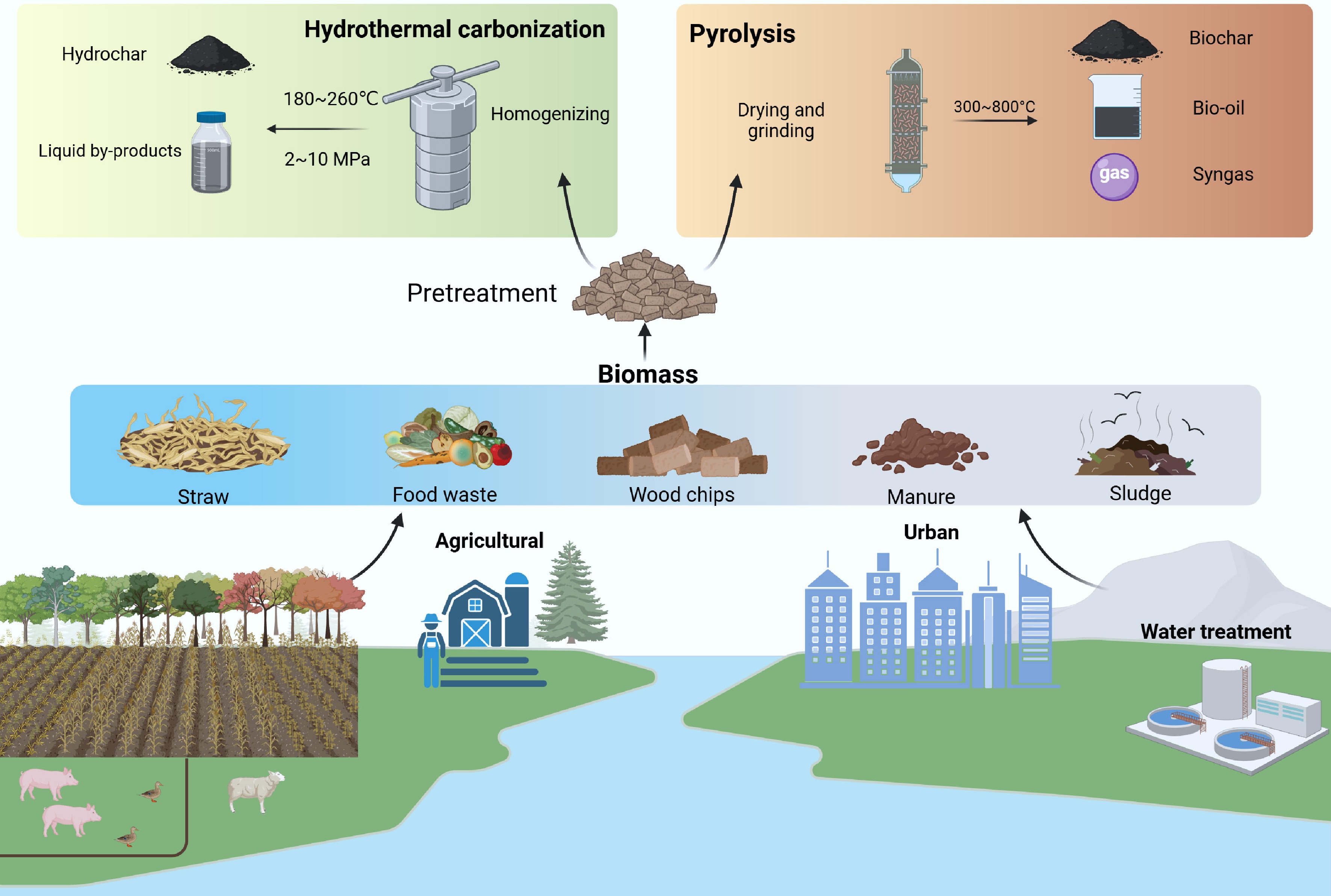
      Figure 1. 

      Comparison of two preparation processes of biochar.

      Hydrothermal Carbonization (HTC) serves as another crucial method for biochar preparation, particularly suitable for high-moisture-content biomass such as sewage sludge, food waste, and crop residues[6365]. Under sealed high-pressure conditions (180–250 °C), biomass undergoes hydrolysis, dehydration, condensation, and other reactions in the aqueous phase, ultimately forming carbon-rich solids (HTC biochar) and liquid by-products[6671]. Since the HTC process occurs at relatively low temperatures, the resulting biochar has a lower degree of aromatization but contains more polar functional groups (e.g., carboxyl and hydroxyl groups), enabling it to exhibit higher activity in pollutant adsorption and catalytic degradation[72]. In addition, HTC biochar typically has a higher oxygen content and lower ash content, which gives it broad application potential in environmental remediation, water pollution control, and energy storage[73]. In the future, by combining nanotechnology, activation modification, and other technical approaches, the microstructure and functional properties of biochar can be further optimized to meet the application demands across diverse fields.

      Table 2.  Two methods of biochar preparation

      Parameter Pyrolysis Hydrothermal carbonization Ref.
      Temperature range 300–800 °C 180–250 °C [7476]
      Reaction environment Oxygen-limited or anaerobic High-temperature, high-pressure water [60,76]
      Main products Biochar, syngas, bio-oil Hydrochar, liquid by-products [60,76]
      By-products Gases (CO2, H2, CH4), tar Soluble organic compounds, acidic substances [34,77]
      Biochar properties High carbon content, stable structure, highly porous High carbon content, stable structure, highly porous [78]
      Suitable feedstock Woody biomass, agricultural waste, sludge High-moisture biomass (food waste, sewage sludge, animal wastes) [66,79]
      Advantages High carbon sequestration efficiency, stable biochar Suitable for wet biomass, no drying needed, rich in functional groups [63,66,67,80]
      Disadvantages Requires high temperatures, energy-intensive Lower carbon sequestration, less stable biochar [63,80]

      The preparation methods of biochar directly affects its surface structure, functional groups, specific surface area, and other properties[81]. The biochar prepared by pyrolysis typically possesses higher carbon content and a larger specific surface area, whereas biochar produced through hydrothermal carbonization exhibits stronger hydrophilicity and more oxygen-containing functional groups, rendering it suitable for functional applications such as environmental remediation[82,83].

    • The structural characteristics of biochar are fundamental determinants of its performance and application[84]. Specific surface area, pore structure, surface functional groups, and elemental composition directly govern its effectiveness in soil amelioration, pollutant adsorption, and carbon sequestration[56,85].

      The microstructure of biochar is primarily characterized by a highly developed pore system, endowing it with a large specific surface area and high adsorption capacity, as illustrated in Fig. 2. This pore structure is jointly determined by the cell walls of the raw materials and the cracks formed during the pyrolysis process; moreover, higher pyrolysis temperatures generally lead to better pore development[86,87]. In addition, the surface of biochar is typically rich in various oxygen-containing functional groups (such as hydroxyl, carboxyl, carbonyl, and phenolic hydroxyl groups), which not only enhance the interactions between biochar and pollutants but also determine its hydrophilicity, ion exchange capacity, and catalytic activity. Owing to these properties, biochar exhibits significant application potential in fields such as water pollution control, soil remediation, air purification, and energy storage. For instance, in water treatment processes, biochar can remove heavy metals, antibiotics, pesticide residues, and organic pollutants through mechanisms like physical adsorption, electrostatic interactions, and complexation[61].
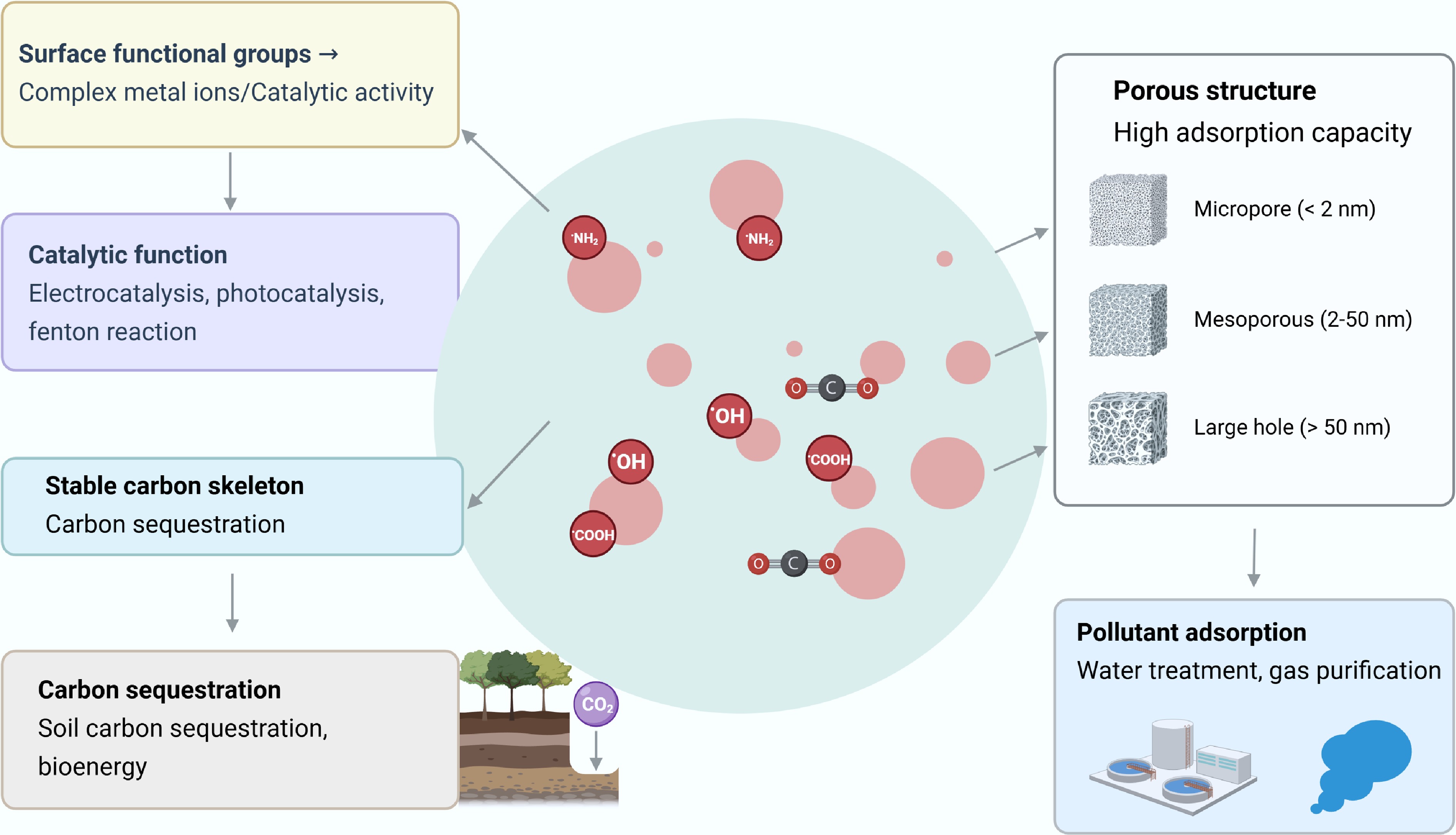
      Figure 2. 

      Microstructure and function of biochar.

      In terms of chemical composition, biochar primarily consists of carbon (C), hydrogen (H), oxygen (O), nitrogen (N), and certain inorganic minerals. The specific content of these elements depends on the feedstock composition and production process[33,88]. Generally, as the pyrolysis temperature increases, the C content in biochar increases, while the contents of H and O decrease, leading to a higher degree of aromaticity and enhanced thermal stability, along with a reduction in polar functional groups. Biochars produced at lower pyrolysis temperatures retain more O-containing functional groups, making them suitable for soil improvement and pollutant adsorption. In contrast, high-temperature biochars, due to their higher crystallinity and stability, are more appropriate for C sequestration and energy storage applications[89]. Additionally, some biochars are rich in mineral elements such as potassium (K), calcium (Ca), magnesium (Mg), and phosphorus (P), which can serve as soil amendments to enhance nutrient availability. In recent years, researchers have further optimized biochar performance through methods such as metal doping, oxidation, and acid-base modification, expanding its applications in catalysis, energy storage, and environmental remediation[90,91].

    • To further enhance the functionality of biochar, researchers have developed various functionalization and composite strategies[9295]. These strategies not only enhance the adsorption performance, catalytic capacity, and water purification efficiency of biochar but also confer additional functionalities related to environmental remediation and energy utilization[94,96].

      Functionalization refers to the introduction of specific functional groups or the alteration of pore structure on the surface of biochar through chemical modification or physical treatment methods, to improve its performance[96]. Common functionalization methods include acid-based treatment, redox reactions, and high-temperature plasma treatment, as shown in Table 3. For example, acid treatment can introduce more carboxyl functional groups on the surface of biochar, enhancing its adsorption capacity for metal ions and organic pollutants; while alkali treatment helps increase the alkalinity of biochar, thereby improving its adsorption effect on acidic pollutants[97]. Oxidation treatment can introduce oxidative functional groups (such as carboxyl and hydroxyl groups), further enhancing the water solubility and ion exchange capacity of biochar[98].

      Table 3.  Effects of different biochar modification methods on its properties

      Modification method Change in surface area Functional group changes Application field Ref.
      CO2 activation 50%–100% Increased carboxyl, phenol groups Water pollution treatment [99,100]
      Fe3+ doping 20%–60% Increased catalytic active sites Catalytic degradation of pollutants [92]
      Sulfonation 10%–40% Increased SO3H groups Acidic catalysis [101103]
      KOH activation 80%–150% Enhanced hydroxyl, carbonyl groups CO2 capture, energy storage [104,105]
      N-doping 20%–80% Introduced amine, pyridinic-N Electrochemical catalysis [106110]

      Composite strategies involve combining biochar with other materials, such as inorganic minerals, nanomaterials, and activated carbon, to enhance its multifunctionality and properties[111]. Through such combinations, the overall performance of biochar in environmental remediation, catalytic degradation, and energy conversion can be improved. For example, combining biochar with iron-based materials can enhance its catalytic ability in pollutant removal[112]; combining biochar with plant extracts can increase its adsorption capacity for heavy metals and improve its effectiveness in agricultural soil improvement[113]. In addition, biochar-based composite materials also show great application potential in areas such as water treatment and exhaust gas purification.

    • With the development of science and technology, biochar research has gradually expanded from traditional directions such as carbon sequestration and soil amendment to the development and application of high-performance materials. In recent years, significant progress has been made in the design of novel biochar materials. For example, by introducing carbon-based materials such as graphene and carbon nanotubes, biochar can be endowed with higher electrical conductivity and catalytic activity[114,115]. In addition, nanostructure regulation techniques have been widely applied to adjust pore size, specific surface area, and surface defect structure, thereby enhancing the application potential of biochar in energy storage, electrocatalysis, and environmental remediation. For instance, hierarchical porous biochar can simultaneously possess the high adsorption capacity of micropores and the macromolecular transport capacity of mesopores, thus improving its performance in pollutant removal and energy storage devices[116]. The properties and specific applications of related novel composite materials are shown in Table 4. Moreover, functional modification has become an important direction in biochar research. Methods such as sulfonation, nitrogen doping, and metal loading can further improve the catalytic degradation capacity, ion exchange capacity, and electrochemical stability of biochar[96,117]. In the future, with the integration of machine learning technology, researchers can more precisely regulate the nanostructure and surface chemical properties of biochar through big data analysis and intelligent optimization algorithms, thereby developing more efficient and environmentally friendly biochar materials and promoting their wide application in fields such as energy, environment, and agriculture[118,119].

      Table 4.  Performance and applications of novel biochar composite materials

      Composite type Specific surface area (m2/g) Functional properties Application scenarios Performance improvement Ref.
      Graphene-biochar 800–1,200 High conductivity, catalytic activity Supercapacitors, electrocatalysis 200%–300% [120]
      Fe3O4-loaded biochar 300–500 Magnetic recovery, redox capacity Heavy metal adsorption, Fenton reaction 150%–200% [121,122]
      N-doped porous biochar 600–900 High nitrogen content, alkaline sites CO2 capture, Soil pH regulation 80%–120% [107,123]
      Chitosan-biochar membrane 50–150 Antibacterial property, biodegradability Water treatment 90%–130% [124]
      Fe/Cu bimetallic-loaded biochar 200–400 Bimetallic synergistic adsorption,
      magnetic recovery
      High-efficiency Pb2+/Cd2+ adsorption 400%–500% [125]
    • To quantitatively assess the research trends and thematic evolution in the field of biochar and its integration with machine learning and sustainability, a bibliometric analysis was conducted using the Web of Science Core Collection (Clarivate Analytics). The data source was the Science Citation Index Expanded (SCI-Expanded, 1990–present), and the publication period was limited to 2020–2025 to reflect recent advancements. The search strategy applied to in the Web of Science Core Collection was: TS = ('biochar' AND 'machine learning') OR ('biochar materials') OR ('sustainable development'), targeting recent developments at the intersection of biochar technology, data-driven modeling, and sustainability.

      From the retrieved dataset, a total of 4,339 unique keywords were identified. To ensure analytical clarity and reduce noise from infrequent terms, the minimum co-occurrence threshold was set at 10 occurrences per keyword. Under this criterion, 162 keywords met the threshold. To enhance the interpretability of the network visualization, the top 50 keywords with the highest total link strength were selected for further analysis. A keyword co-occurrence network was then constructed using VOSviewer, where each node represents a keyword, with node size corresponding to its frequency and link thickness indicating the strength of co-occurrence between keyword pairs. Cluster colors were assigned automatically based on a modularity optimization algorithm, revealing the major thematic groupings within the field.

      As shown in Fig. 3, the resulting clusters represent the major research directions and knowledge domains in this field:
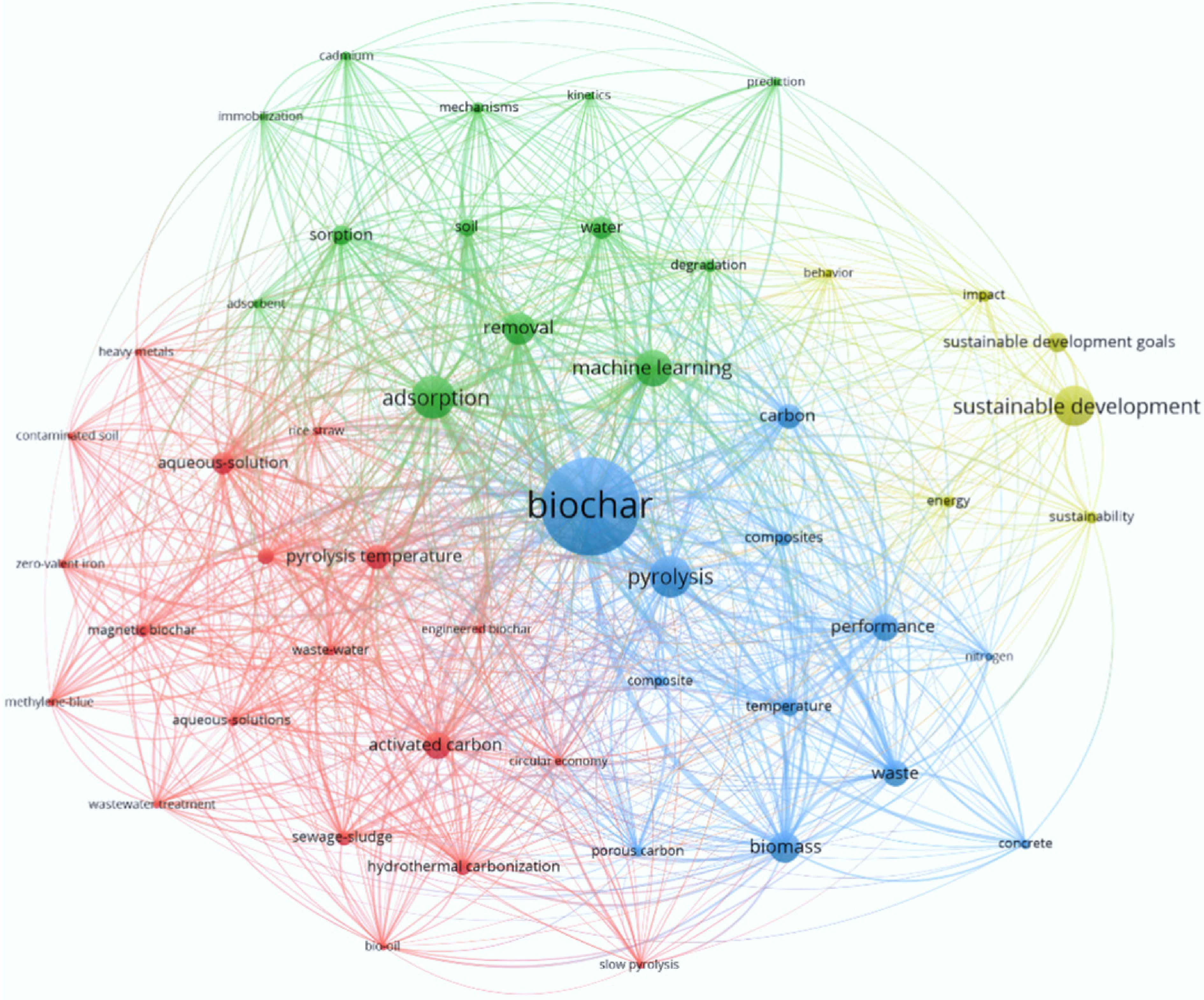
      Figure 3. 

      Keyword co-occurrence network (2020–2025) visualized using VOSviewer. Node size represents keyword frequency; line thickness indicates co-occurrence strength. Colors denote thematic clusters: red (remediation & engineered biochar), green (adsorption & modeling), blue (material synthesis), yellow (sustainability & policy).

      Cluster 1 (Red): Environmental remediation and engineered biochar

      This cluster includes keywords such as 'wastewater treatment', 'activated carbon', 'magnetic biochar', and 'pollutant removal', highlighting the widespread application of engineered biochar materials in environmental pollution control, especially in water treatment.

      Cluster 2 (Green): Adsorption mechanisms and data-driven modeling

      Comprising keywords like 'adsorption', 'removal', 'kinetics', 'machine learning', and 'prediction', this cluster reflects an increasing integration of mechanistic studies with predictive algorithms for performance optimization.

      Cluster 3 (Blue): Biochar production and physicochemical properties

      This cluster is dominated by terms such as 'pyrolysis', 'biomass', 'porous carbon', and 'material properties', focusing on biochar synthesis techniques, feedstock characteristics, and structure–function relationships.

      Cluster 4 (Yellow): Sustainability and systems-level integration

      Featuring keywords like 'sustainable development', 'energy', and 'sustainability goals', this cluster highlights the strategic importance of biochar in supporting global environmental targets and long-term sustainable development goals (SDGs).

      This bibliometric analysis illustrates a significant expansion of biochar research from traditional production and material characterization toward integrated, interdisciplinary approaches that leverage artificial intelligence and sustainability science. The emergence of terms such as 'machine learning', 'optimization', and 'life cycle assessment' underscores the field's transition toward intelligent design, system-level evaluation, and policy relevance.

    • With the in-depth exploration of biochar's structural and functional properties, it has demonstrated broad application prospects in resource utilization. Benefiting from its well-developed porous structure, high specific surface areas, diverse surface functional groups, and environmentally friendly carbon-based properties, biochar enables efficient utilization across multiple domains, including water pollution control, solid waste resource recovery, and soil remediation, facilitating the synergistic achievement of ecological environment governance and carbon emission reduction goals[126,127].

    • Biochar demonstrates excellent adsorption capacity and remediation potential in water pollution control, and is widely applied in removing various pollutants, including heavy metals, organic pollutants, nutrient pollution (e.g., N and P), and other contaminants.

      The remediation of water pollution by biochar primarily relies on mechanisms such as physical adsorption, chemical adsorption, complexation, ion exchange, and co-precipitation[128]. As shown in Fig. 4, the application efficiency of biochar in water pollution control is closely related to its underlying mechanisms of action. For heavy metal pollution (e.g., Pb2+, Cd2+, Cr3+), biochar achieves high removal rates (typically 70%–95%) primarily through ion exchange and surface complexation, whereby abundant oxygen-containing functional groups—such as carboxyl and hydroxyl groups—form stable complexes with metal ions[98,129132]. In the case of organic pollutants (e.g., antibiotics, pesticides, dyes), adsorption efficiencies of 60%–85% are often obtained via π–π interactions and hydrophobic effects facilitated by the aromatic carbon structure and porous morphology of biochar[133136]. For nutrient pollution leading to eutrophication, biochar can remove 50%–75% of phosphates and nitrogen oxides through physical adsorption and precipitation processes, thereby preventing algal blooms and improving water quality[135,137,138]. In addition, its porous structure effectively captures microplastics (e.g., polyethylene, polypropylene) with efficiencies reaching 95%–99% via hydrophobic interactions and pore entrapment[139,140]. For pharmaceutical contaminants such as ibuprofen and carbamazepine, functionalized biochars can achieve 75%–88% degradation through adsorption combined with catalytic activation, with the redox-active sites (e.g., Fe3+, quinone groups) promoting radical oxidation (•OH, SO4) reactions[141,142]. Overall, the synergistic contribution of high specific surface area, abundant functional groups, alkaline surface properties, and redox capacity enables biochar to act not only as an adsorbent but also as a reactive medium for pollutant transformation and degradation, significantly reducing contaminant loads in aquatic environments.
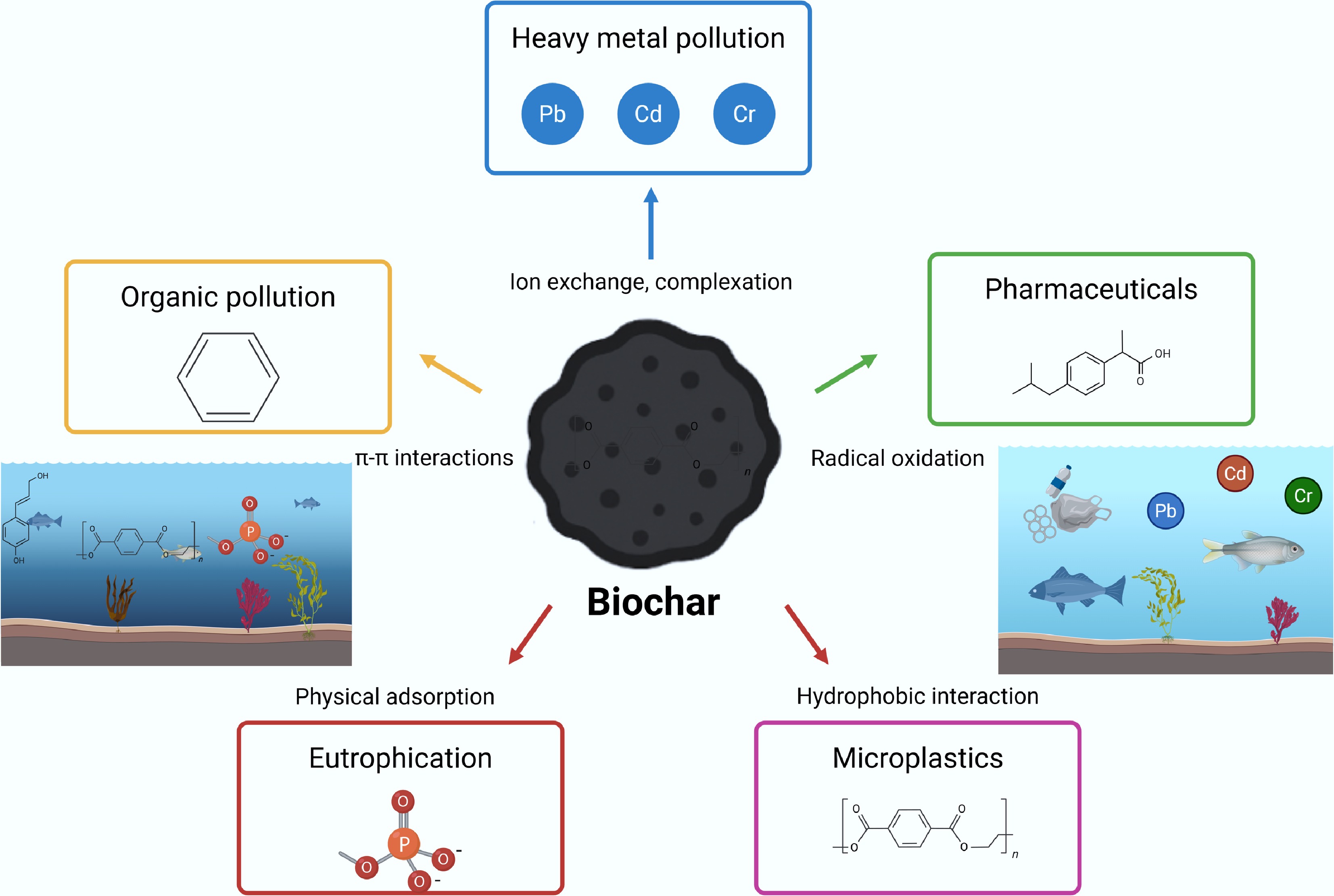
      Figure 4. 

      Application of biochar in water pollution control.

      Research shows that bamboo-derived biochar prepared at a pyrolysis temperature of around 500 °C exhibits high-efficiency performance in adsorbing heavy metals such as lead (Pb2+) and cadmium (Cd2+), with a maximum adsorption capacity exceeding 150 mg/g[143]. In practical applications, the addition of iron-modified biochar to phosphorus-contaminated water bodies significantly reduces total phosphorus concentration and delays algae blooms[144]. Furthermore, biochar rich in oxygen-containing functional groups produced via hydrothermal methods demonstrates effective removal of antibiotics (e.g., tetracycline) and organic pesticide residues. Case studies have also indicated that biochar can serve as a filler material in constructed wetland systems, synergizing with microbial interactions to achieve sustained water purification[145].

    • Guided by the 'Reduction-Resource Recovery-Harmless Treatment' concept, biochar has gradually become one of the critical technical pathways for solid waste treatment and functional material substitution.

      On one hand, biochar can serve as an adsorbent for pollution control in solid wastes such as municipal sludge, food processing residues, and livestock waste. During the adsorption process, it reduces the release of hazardous substances and enhances overall resource utilization efficiency[146]. On the other hand, biochar itself can act as a structural reinforcement agent or additive for constructing novel composite materials, replacing traditional high-energy-consumption and non-renewable materials, thereby expanding its applications in construction materials, geotechnical materials, and energy storage materials[147].

      For example, incorporating an appropriate amount of biochar into cement and concrete preparation processes enhances the material's pore structure regulation capability and crack resistance while achieving carbon sequestration[148,149]; adding biochar to agricultural film materials improves their UV resistance and biodegradability[150]; furthermore, introducing biochar into lithium-ion battery anode materials is expected to enhance conductivity and cycling stability, providing green material alternatives for clean energy systems[151].

    • Although biochar exhibits certain effectiveness in improving soil physicochemical properties, its role in soil physical improvement typically serves as a supplementary function compared to its applications in pollution remediation and material substitution.

      The addition of biochar can reduce soil bulk density, enhance aggregate structure stability and water retention capacity, thereby improving soil aeration and moisture retention, particularly showing notable effects in sandy soils and degraded soils[152,153]. Its porous structure facilitates microbial colonization, promoting the restoration of soil ecological functions. However, these improvement effects are constrained by multiple factors, including feedstock type, application rate, and soil type, resulting in region-specific adaptability and time-dependent efficacy that require careful evaluation in practical contexts[154].

    • As a carbon-rich material, biochar demonstrates significant potential in carbon footprint control and climate change mitigation. Its primary carbon reduction effects can be attributed to two aspects: first, its inherent high stability enables long-term sequestration of organic carbon retained during pyrolysis; second, it indirectly reduces greenhouse gas emissions through a series of physicochemical and biological processes in environmental media. The stability of biochar mainly originates from its high aromaticity and low-polarity structure. Particularly under high-temperature pyrolysis conditions, the carbon structure tends to become graphitized, endowing it with strong resistance to decomposition, allowing it to persist stably in the environment over timescales of decades to centuries[155]. In soils, biochar typically exists in free states, mineral-bound states, or embedded within aggregate structures, with these physical and chemical barriers further enhancing carbon sequestration efficiency[156]. Even after undergoing an 'aging' process, its core structure remains stable, maintaining undiminished contributions to carbon sequestration.

      Meanwhile, biochar can significantly reduce emissions of major greenhouse gases by regulating and N cycling processes. In agricultural systems, its application reduces CO2 emission sources through two pathways: first, by delaying carbon release via solid carbon storage forms, and second, by replacing waste natural decomposition or open burning pathways through the pyrolysis process itself, thereby reducing carbon emission loads[3]. In environments such as paddy fields, sludge, or organic waste incorporation, biochar optimizes microbial community structure and improves aeration conditions, thereby inhibiting methanogenesis and reducing CH4 emissions. Additionally, its adsorption capacity for ammonium nitrogen and nitrate nitrogen helps mitigate N2O release during denitrification processes, achieving dual benefits of nutrient retention and emission reduction[157,158]. As analyzed in Table 5 regarding feedstock-performance correlations, studies demonstrate that after biochar application, total greenhouse gas emissions in agricultural systems can decrease to varying degrees, with reduction rates ranging from 20% to 70% depending on feedstock type, application methods, and soil environmental conditions.

      Table 5.  Correlation between biochar feedstock types and carbon sequestration-emission reduction efficiency

      Feedstock type Pyrolysis
      temperature (°C)
      Carbon
      sequestration rate
      Total GHG emission reduction rate Key mechanisms Ref.
      Crop residues 400–600 60%–75% 40%–60% Inhibition of denitrification enzyme activity; NH4+ adsorption [159,160]
      Municipal sludge 300–500 40%–50% 30%–50% Heavy metal immobilization; NO3 adsorption; pH regulation [161,162]
      Wood waste 500–700 85%–90% 20%–40% Landfill diversion; Physical barrier formation to delay decomposition [163]
      Food waste 250–400 30%–45% 25%–45% Promotion of methanotroph proliferation; C/N ratio adjustment [164,165]
      Algal biomass 500–700 75%–85% 40%–60% High-temperature stabilized carbon structure, promotes soil carbon-fixing microbial communities [166,167]
      Poultry manure 300–500 50%–60% 35%–50% Reduces N2O emissions, adsorbs NH3 [168,169]

      However, it is important to note that in some cases, increased GHG emissions have been observed during biochar production and application, particularly when low-efficiency pyrolysis systems, wet feedstocks, or improper handling conditions are used. In these instances, elevated emissions of CO2 and methane can occur due to incomplete pyrolysis or inefficient gas capture systems. These emissions can offset the positive environmental impact of biochar, particularly if suboptimal pyrolysis temperature and residence time result in the release of volatile gases.

      Several key factors contribute to increased emissions:

      • Feedstock quality: the use of wet or high-volatile feedstocks can lead to incomplete carbonization and increased methane release during pyrolysis.

      • Inefficient pyrolysis conditions: low-temperature or poorly controlled pyrolysis processes may fail to fully carbonize the biomass, resulting in higher CO2 and methane emissions.

      • Post-production handling: improper storage or transportation conditions, particularly with high moisture content, may also contribute to GHG emissions after biochar production.

      To mitigate these negative impacts, several strategies can be adopted:

      • Optimization of pyrolysis processes to ensure complete carbonization and minimize emissions.

      • Selection of dry, high-carbon feedstocks that are less likely to produce methane during pyrolysis.

      • Improvement of pyrolysis system efficiency, such as through the use of closed-loop systems that capture and recycle gases.

      From a global perspective, biochar demonstrates considerable carbon reduction potential. Based on current estimates of globally available agricultural waste annually, converting approximately 10% of it into biochar and applying it scientifically could achieve an annual greenhouse gas reduction of about 0.3–0.6 Gt CO2 equivalent, accounting for roughly 1%–2% of total global anthropogenic emissions[170]. This pathway holds particular implementation feasibility and synergistic benefits in developing countries and agriculture-dominated regions. To accurately quantify biochar's carbon effects, recent studies widely employ life cycle assessment (LCA) methods to systematically analyze its carbon budget across the entire process—from feedstock acquisition and production to final application—supplemented with agricultural greenhouse gas simulation models (e.g., DNDC, DayCent) and global carbon sequestration models (e.g., CBal, BiocharPlus), enabling multi-scale, multi-scenario assessments of emission reduction benefits[171]. These models not only provide a basis for policymaking and pathway optimization but also reveal biochar's strategic value as a 'Nature-based Climate Solution', offering strong support for achieving global carbon neutrality goals[172].

    • Machine learning is a data-driven modeling approach, and in the field of biochar research, it is primarily divided into three categories: supervised learning, unsupervised learning, and reinforcement learning, with the classification framework as shown in Fig. 5. Supervised Learning is the most common machine learning method, mainly used for predicting the physicochemical properties of biochar and optimizing production processes. Supervised learning models are trained by input data and corresponding labels to establish mapping relationships between input variables and target variables[173]. For example, algorithms such as Random Forest (RF), Support Vector Machine (SVM), and Deep Neural Network (DNN) can predict biochar yield, specific surface area, and pore size distribution under specific pyrolysis conditions for different biomass feedstocks. These models effectively reduce experimental costs and enhance the controllability of biochar materials[174,175]. Furthermore, supervised learning is widely applied to predict biochar's pollutant adsorption capacity, aiding researchers in optimizing its environmental remediation performance.
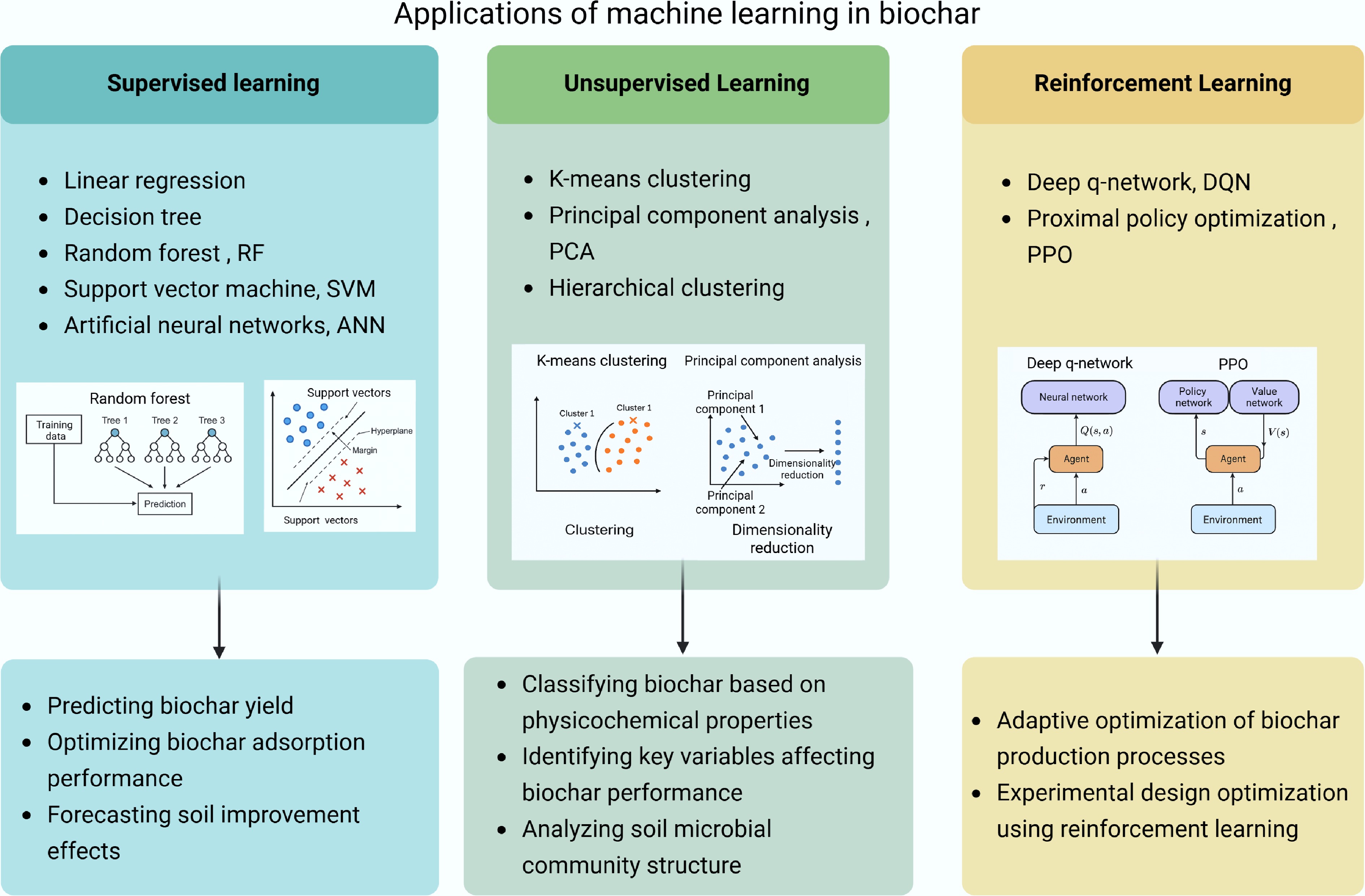
      Figure 5. 

      Machine learning classification and its application to biochar.

      Unsupervised Learning is primarily used for data pattern recognition and classification in biochar research, commonly applied to analyze the characteristics of different biomass feedstocks and their pyrolysis products[176,177]. For example, methods such as K-Means Clustering (K-Means) and Principal Component Analysis (PCA) can classify various biochar samples to identify key factors influencing biochar performance. Unsupervised learning can also analyze degradation patterns of biochar during long-term applications, assessing its stability in soil improvement and carbon sequestration. Reinforcement Learning (RL), which learns through interactions between agents and environments, is suitable for optimizing biochar preparation processes[177]. In biochar production, reinforcement learning can automatically adjust experimental parameters such as pyrolysis temperature, reaction time, and catalyst dosage to achieve optimal material performance. In the future, with the continuous advancement of machine learning technologies, the integrated application of supervised learning, unsupervised learning, and reinforcement learning will provide more efficient solutions for intelligent design and precise regulation of biochar.

    • Machine learning plays a significant role in the design of biochar materials, enabling efficient analysis of the complex relationships between feedstock properties, process parameters, and end-product performance, thereby guiding optimized design[178]. Different biomass feedstocks (e.g., wood, crop straw, sewage sludge) under varying pyrolysis conditions produce biochar with distinct porous structures, surface chemical properties, and adsorption capacities. As shown in Fig. 6, supervised learning methods such as Random Forest (RF) and Support Vector Machine (SVM) have been widely applied in predictive modeling and optimization. RF models can accurately predict biochar yield and key physicochemical properties—such as specific surface area, pore size distribution, and carbon content—based on feedstock characteristics and pyrolysis parameters, while effectively reducing overfitting and handling noisy datasets[175,179182]. SVM has been successfully used to optimize adsorption performance, particularly for heavy metal removal, leveraging its ability to model complex nonlinear relationships in small datasets[178,179,182,183].
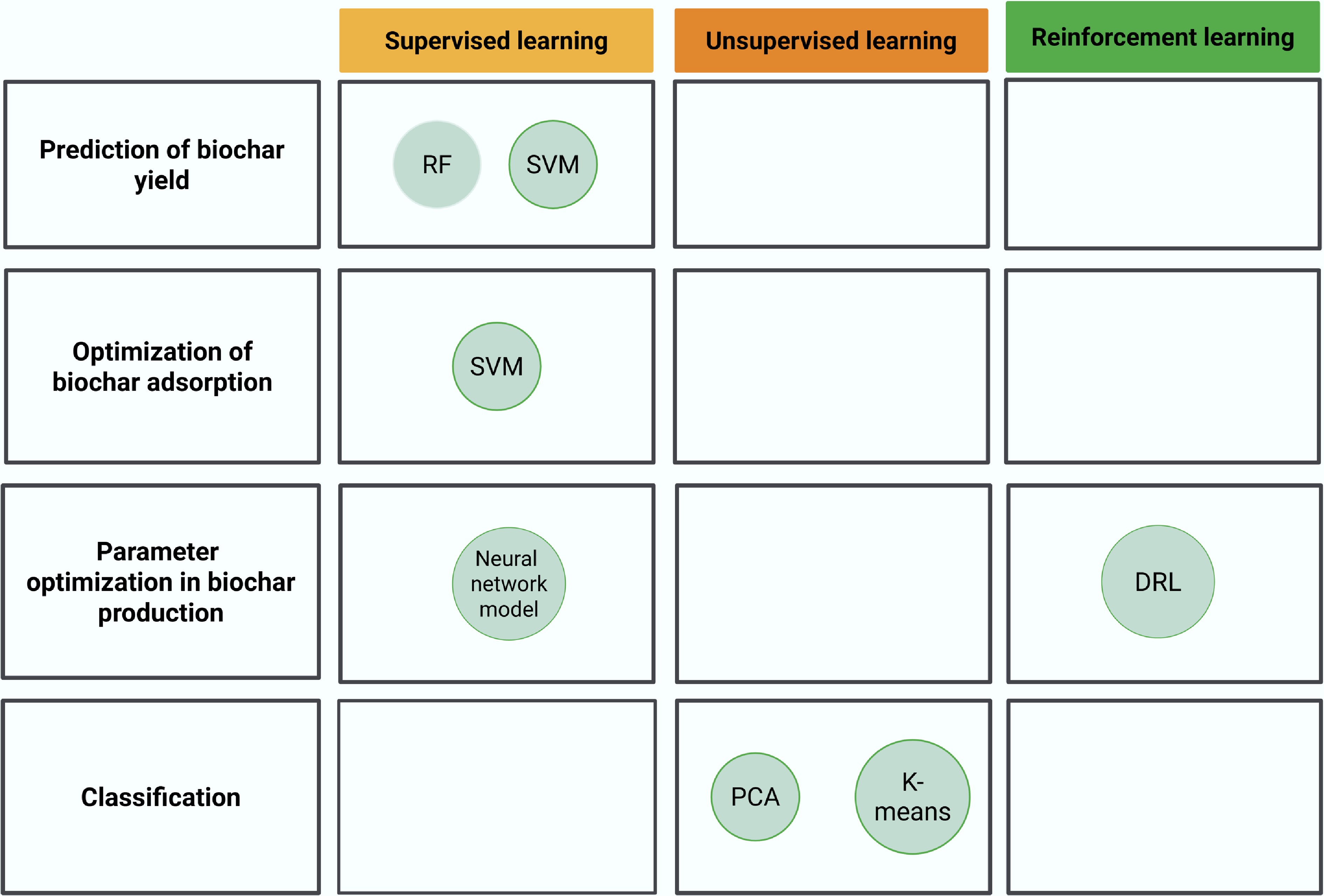
      Figure 6. 

      Applications of machine learning algorithms in biochar research.

      Process parameter optimization has also benefited from the application of artificial neural networks (NN), which can learn complex nonlinear patterns and flexibly handle diverse input variables, thereby enabling fine-tuning of pyrolysis conditions for targeted biochar characteristics[179,182,184186]. In the realm of unsupervised learning, clustering algorithms such as K-means have been applied to classify biochars based on their physicochemical attributes, facilitating rapid identification of material categories and potential applications[174,187190]. Dimensionality reduction techniques like principal component analysis (PCA) further assist in identifying key factors influencing biochar performance, improving data interpretability while minimizing information redundancy[191195].

      In addition, reinforcement learning (RL) has emerged as a promising tool for adaptive process optimization and automation. Deep reinforcement learning (DRL) enables real-time control of biochar production by dynamically adjusting operational parameters in response to feedback signals[176,196199], while multi-agent RL has been explored for autonomous experimental design, accelerating the discovery of optimal synthesis pathways[200202]. Overall, the integration of these algorithms—ranging from supervised to unsupervised and reinforcement learning—provides a comprehensive toolkit for predictive modeling, optimization, classification, and adaptive control, ultimately enhancing the efficiency, reproducibility, and performance of biochar materials in environmental remediation, energy storage, and sustainable agricultural applications.

    • The life cycle analysis of biochar encompasses a closed-loop process of 'feedstock–production–application–assessment–feedback'. First, agricultural, forestry, and urban organic wastes are collected and preprocessed to form standardized feedstocks. Subsequently, preparation is completed by regulating parameters through pyrolysis or hydrothermal carbonization processes. Next, transportation routes are optimized, and functional modifications are applied based on requirements such as soil remediation or water treatment. Following this, dynamic assessment is performed by quantifying full-chain energy consumption, carbon emissions, and pollution control efficiency. Finally, the results are fed back into feedstock selection and process optimization, establishing a sustainable system that integrates 'resource cycling—environmental benefits', with its phased workflow illustrated in Fig. 7.
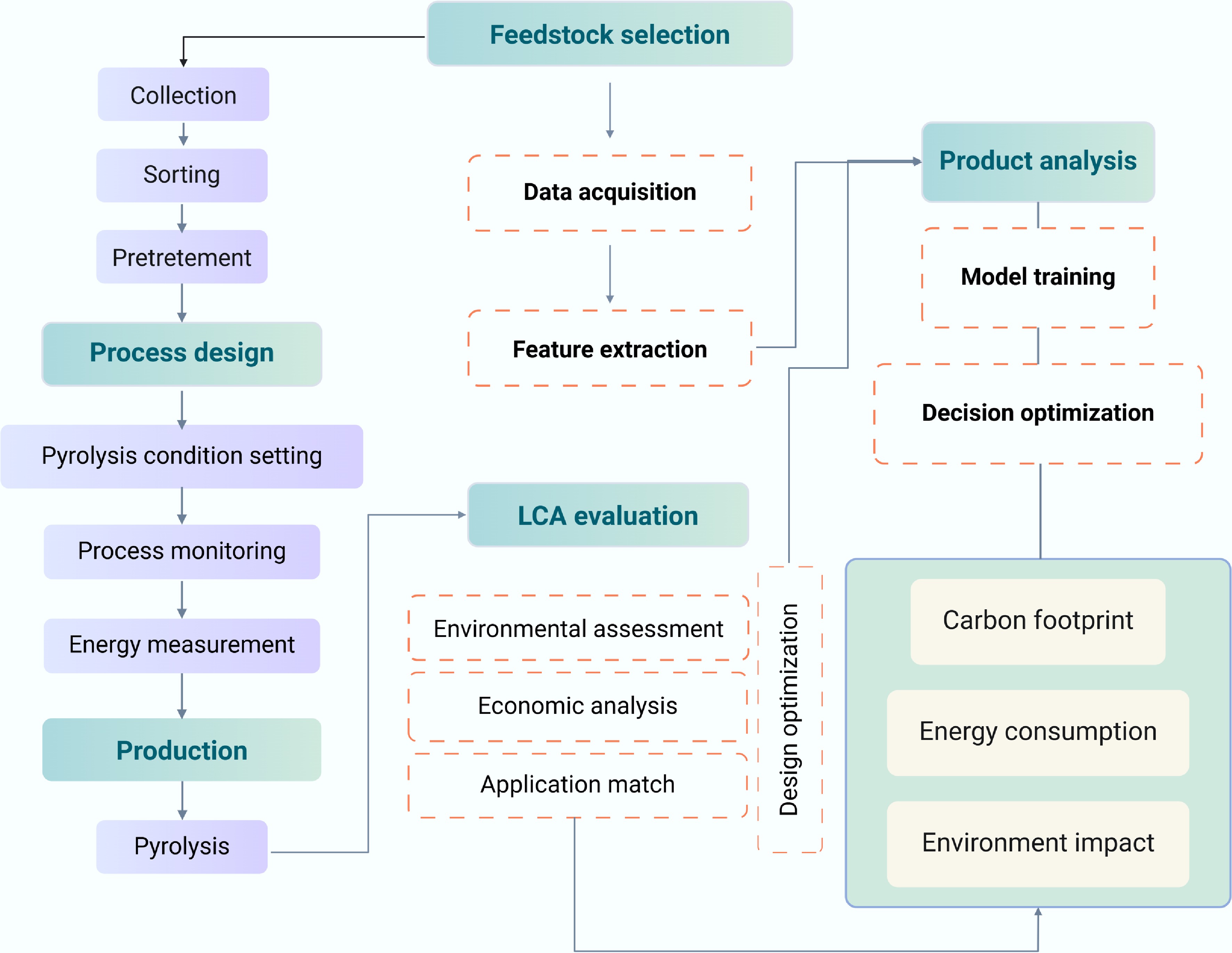
      Figure 7. 

      Machine learning-based biochar life cycle analysis (LCA) phased flow diagram.

      Life cycle analysis (LCA) is a critical tool for assessing the environmental impacts of biochar, and the integration of machine learning can enhance the accuracy and efficiency of LCA. In terms of environmental impact assessment, machine learning can predict energy consumption, carbon footprint, and pollutant emissions during biochar production, aiding researchers in optimizing production processes to reduce environmental burdens[176]. For example, using regression models or deep learning algorithms, carbon emissions under different feedstocks and pyrolysis conditions can be predicted based on historical data, enabling the formulation of greener production strategies[203,204]. Regarding sustainability indicator development, machine learning can integrate multi-source data to establish a comprehensive sustainability evaluation system for biochar. Through cluster analysis, principal component analysis (PCA), and other methods, key factors influencing biochar sustainability can be identified, and scientifically sound indicator systems can be constructed[191]. In terms of optimization decision support, machine learning algorithms can be applied to optimize the entire biochar supply chain, including feedstock selection, process parameter optimization, and product application scenario matching. For instance, genetic algorithms and reinforcement learning can be employed to develop intelligent optimization models, achieving dynamic optimization of the biochar supply chain and improving resource utilization efficiency.

    • In recent years, significant progress has been made in the application of deep learning and multi-objective optimization algorithms in biochar research. Deep learning techniques, such as Convolutional Neural Networks (CNN) and Recurrent Neural Networks (RNN), can predict the microstructure, specific surface area, and pore size distribution of biochar formed from different biomass feedstocks under specific pyrolysis conditions by analyzing large-scale experimental data and scanning electron microscopy (SEM) images, thereby improving the precision of biochar material design[205,206]. Building on this, multi-objective optimization algorithms can balance key performance indicators such as adsorption capacity, mechanical strength, and carbon sequestration efficiency in high-dimensional parameter spaces, achieving comprehensive optimization of biochar performance[186,207]. For example, in water pollution control applications, researchers have employed genetic algorithms and particle swarm optimization to identify optimal preparation conditions, improving pollutant removal rates while reducing production costs[28,208]. Typical applications are summarized in Table 6. In addition, an intelligent optimization framework integrating deep learning and optimization algorithms is gradually emerging, combining experimental data and computational simulation to enable real-time prediction and dynamic optimization of biochar performance[176,209]. With the advancement of computing power and the expansion of data resources, the integration of deep learning and multi-objective optimization will further drive the intelligent design of biochar, providing more efficient solutions for its application in environmental remediation, energy storage, and sustainable agriculture.

      Table 6.  Typical applications of deep learning and multi-objective optimization in biochar research

      Method type Application direction Representative applications Technical advantages Ref.
      CNN Image structure recognition Predicting specific surface area and pore size Extracts microstructural image features [212]
      RNN Dynamic data modeling Analyzing performance variations during pyrolysis Adapts to time-series data [206]
      Multi-objective optimization Comprehensive performance optimization Simultaneously optimizing yield, adsorption rate,
      and energy consumption
      Collaborative optimization with high efficiency [213]
      GA/PSO Rapid process optimization Identifying optimal pyrolysis temperature and modifier dosage Broad search range & rapid convergence [214]
      MTDL (Multi-task
      deep learning)
      Multi-objective collaborative optimization Simultaneously optimizing biochar's adsorption
      of cadmium (Cd) and methane (CH4) emission reduction efficiency
      Cross-task parameter sharing, maximization of synergistic effects [215]

      Notably, recent studies have applied machine learning methods to the lifecycle assessment (LCA) framework of biochar to achieve efficient prediction and management of carbon footprints and environmental impacts. For example, some studies have developed a carbon emission prediction system that integrates random forest models with LCA databases, enabling precise estimation of greenhouse gas emissions under different feedstocks and pyrolysis conditions, with prediction accuracy exceeding 90% and significantly reducing analysis time[204,210]. Other research has employed a deep reinforcement learning (DRL) framework to simulate the dynamic interaction between the pyrolysis process and LCA feedback, thereby gradually optimizing biochar production pathways to minimize greenhouse gas emissions across the entire lifecycle[211]. These cases demonstrate that machine learning shows promising prospects and practical value in LCA modeling, with the potential to provide strong data support for low-carbon design of biochar, environmental policy evaluation, and decision-making support.

      Researchers have utilized machine learning to construct sustainability evaluation systems for biochar, enabling a more comprehensive quantification of its environmental, economic, and social impacts. For instance, based on supervised learning algorithms such as Support Vector Machines (SVM) and Random Forest (RF), researchers can predict the environmental impacts of different biochar production methods and develop dynamic, visualized evaluation models to assist policymakers in formulating more scientifically grounded sustainability strategies[216]. In addition, with the growing demand for closed-loop supply chain optimization, the application of machine learning in supply chain management has attracted increasing attention. Algorithms such as reinforcement learning and Bayesian optimization can be employed to optimize various stages of the biochar supply chain, including production, transportation, storage, and end-use, thereby enhancing resource utilization, reducing carbon footprints, and achieving more efficient waste-to-resource pathways[25]. In the future, as the integration of machine learning and sustainability research deepens, the biochar industry is expected to move toward greater intelligence and greenness, offering new technological support for global carbon neutrality goals and ecological sustainability.

    • Despite the significant promise shown by machine learning (ML) in biochar research, several limitations remain. First, ML model performance is highly dependent on the quality of input data. Incomplete, noisy, or fragmented datasets can introduce significant bias into predictions[217]. Second, although many deep learning models deliver high accuracy, their 'black-box' nature leads to poor interpretability, making it difficult for researchers to understand how individual parameters influence biochar properties. Additionally, training and optimizing complex ML models—particularly for high-dimensional, multivariate data—requires substantial computational resources, which can limit their scalability and widespread use in biochar applications[218].

    • The success of ML models depends heavily on access to large-scale, high-quality, and standardized datasets. However, biochar data acquisition is often hindered by discrepancies in experimental protocols, feedstock types, and measurement techniques across different studies. These inconsistencies complicate data integration and reduce the reproducibility of ML models. Moreover, intellectual property concerns and data privacy issues often restrict open sharing of experimental datasets, thereby limiting model generalization[219]. To address this, future efforts should prioritize the establishment of unified data processing protocols, standardized reporting formats, and secure data-sharing platforms to ensure data consistency and promote high-quality model training.

    • Biochar research spans multiple domains, including materials science, environmental engineering, agronomy, and data science. Effective integration of ML requires researchers to either possess interdisciplinary knowledge or collaborate closely with experts in computer science and artificial intelligence. Interdisciplinary collaboration can accelerate the development of innovative modeling approaches and bridge the gap between theoretical model design and practical applications. Furthermore, assessing the sustainability and societal benefits of biochar calls for integration with ecology, economics, and policy research. Such cooperation will not only support the development of unified biochar databases but also drive holistic strategies for efficient biomass utilization and sustainable development.

    • In the future, biochar research will increasingly benefit from advanced machine learning methods, driven by continuous improvements in computational power and algorithm optimization. Emerging technologies such as self-supervised learning and federated learning are expected to enhance model generalization in data-scarce or distributed environments. Molecular dynamics (MD) simulations and density functional theory (DFT) calculations will continue to play a key role in understanding biochar's microstructure and performance, while the integration of these methods with machine learning will facilitate multi-scale modeling, allowing accurate predictions from the molecular scale to macroscopic behavior[40,220223]. These combined approaches will be pivotal in optimizing biochar materials, enabling more precise and efficient design. In the context of sustainability-driven design, intelligent optimization algorithms will also be applied across the entire life cycle of biochar, including feedstock selection, production, environmental impact minimization, and supply chain management. The fusion of machine learning and experimental research will ultimately drive biochar studies toward a more efficient and sustainable development pathway.

    • This review provides a comprehensive overview of the multifunctional applications of biochar in resource utilization and carbon footprint control, emphasizing its roles in structural regulation, pollution remediation, and greenhouse gas mitigation. By comparing pyrolysis and hydrothermal carbonization techniques, it discusses how feedstock characteristics and process parameters significantly influence biochar properties and examines recent advances in functionalization and composite strategies to enhance environmental performance. Building on this, the review focuses on the application potential of machine learning technologies in biochar material design, performance prediction, process optimization, and life cycle analysis, showcasing their key roles in improving research efficiency, accelerating material screening, and enabling intelligent decision-making.

      However, the application of machine learning in the biochar field still faces challenges such as poor model interpretability, low data standardization, and insufficient interdisciplinary collaboration. To achieve large-scale deployment of biochar and contribute to global carbon neutrality goals, it is necessary to strengthen foundational data infrastructure, build unified open-access databases, and promote deep integration among materials science, environmental engineering, and artificial intelligence. In summary, the synergistic development of biochar and machine learning holds considerable promise for supporting waste resource utilization, maximizing carbon reduction benefits, and laying the technological foundation for building a green, low-carbon, and circular bioeconomy.

      • The authors confirm their contributions to the paper as follows: study conception and design, manuscript review: Jiang Y, Xie S, Abou-Elwafa SF, Mukherjee S, Singh RK, Tran HT, Shi J, Trindade H, Zhang T, Chen Q; Material preparation, data collection, and analysis: Jiang Y, Xie S, Zhang T; draft manuscript preparation: Jiang Y. All authors reviewed the results and approved the final version of the manuscript.

      • Data sharing is not applicable to this article, as no datasets were generated or analyzed during the current study.

      • The research was sustained by a grant from the National Key Research and Development Program of China 'Intergovernmental Cooperation in International Science and Technology Innovation' (Grant No. 2023YFE0104700), and the National Natural Science Foundation of China (Grant No. 31401944).

      • The authors declare that there is no conflict of interest.

      • Biochar enables effective waste valorization and long-term carbon sequestration.

        Machine learning boosts efficiency in biochar design, modification, and assessment.

        Integrating ML with LCA enhances climate benefits and supports green innovation.

      • Full list of author information is available at the end of the article.

      • Copyright: © 2025 by the author(s). Published by Maximum Academic Press, Fayetteville, GA. This article is an open access article distributed under Creative Commons Attribution License (CC BY 4.0), visit https://creativecommons.org/licenses/by/4.0/.
    Figure (7)  Table (6) References (223)
  • About this article
    Cite this article
    Jiang Y, Xie S, Abou-Elwafa SF, Mukherjee S, Singh RK, et al. 2025. Machine learning-enabled optimization of biochar resource utilization and carbon mitigation pathways: mechanisms and challenges. Biochar X 1: e002 doi: 10.48130/bchax-0025-0003
    Jiang Y, Xie S, Abou-Elwafa SF, Mukherjee S, Singh RK, et al. 2025. Machine learning-enabled optimization of biochar resource utilization and carbon mitigation pathways: mechanisms and challenges. Biochar X 1: e002 doi: 10.48130/bchax-0025-0003

Catalog

    /

    DownLoad:  Full-Size Img  PowerPoint
    Return
    Return