







Search
2025 Volume 5
Article Contents
REVIEW   Open Access    

Exploiting sugar-rich feedstocks for sustainable polyhydroxyalkanoate production

  • # Authors contributed equally: Varucha Misra, Ashutosh Kumar Mall

More Information
  • Plastic pollution is an international issue, with petrochemical plastics promoting waste build-up, aquatic ecosystem impairment, and microplastic pollution. Polyhydroxyalkanoates (PHAs) have gained a lot of attention as an alternative material owing to their similar mechanical characteristics to traditional plastics, together with biodegradability and ecological inertness. These bacterial biopolymers, which are polymerized by bacteria like Cupriavidus necator and Bacillus megaterium as intracellular carbon and energy stores, can be made from biotic feedstocks, aligning with circular economy and sustainability objectives. The main limitation to mass adoption is high production price, which is generally determined by substrate cost. Sugar-rich feedstocks such as sugarcane molasses, beet molasses, and corn syrup have the potential to cut costs by 30%–40% relative to glucose-based fermentation. The use of agro-industrial by-products not only reduces raw material expenses but also favours waste valorization as well as local economic advantages. The efficiency of production is greatly influenced by process parameters and feedstock properties, wherein optimization of pH, dissolved oxygen, and carbon-to-nitrogen ratios greatly improves yield and polymer quality. Additionally, PHAs blends and composites with enhanced thermal, mechanical, and barrier properties present suitable solutions for packaging and allied applications. With growing consumer consciousness and regulatory demands, PHAs from sugar feedstocks offer both economic and ecological benefits. Engineered microbial strains and inexpensive downstream processing are future work priorities for scalable and sustainable production. The present review examines the viability of using sugar-rich substrates as economically viable feedstocks to produce PHAs and their role in the development of sustainable bioplastics.
  • 加载中
  • [1] Blettler MCM, Mitchell C. 2021. Dangerous traps: macroplastic encounters affecting freshwater and terrestrial wildlife. Science of The Total Environment 798:149317 doi: 10.1016/j.scitotenv.2021.149317

    CrossRef   Google Scholar

    [2] Santimano MC, Prabhu NN, Garg S. 2009. PHA production using low-cost agro-industrial wastes by Bacillus sp. strain COL1/A6. Research Journal of Microbiology 4:89−96 doi: 10.3923/jm.2009.89.96

    CrossRef   Google Scholar

    [3] Quintero-Silva MJ, Suárez-Rodríguez SJ, Gamboa-Suárez MA, Blanco-Tirado C, Combariza MY. 2024. Polyhydroxyalkanoates production from cacao fruit liquid residues using a native Bacillus megaterium strain: preliminary study. Journal of Polymers and the Environment 32:1289−303 doi: 10.1007/s10924-023-03018-2

    CrossRef   Google Scholar

    [4] Bhatia SK. 2025. Research progress on the synthesis, modification, and applications of microbial biopolymers. Polymers 17(15):2053 doi: 10.3390/polym17152053

    CrossRef   Google Scholar

    [5] Rehm BHA. 2010. Bacterial polymers: biosynthesis, modifications and applications. Nature Reviews Microbiology 8:578−92 doi: 10.1038/nrmicro2354

    CrossRef   Google Scholar

    [6] López-Cuellar MR, Alba-Flores J, Gracida Rodríguez JN, Pérez-Guevara F. 2011. Production of polyhydroxyalkanoates (PHAs) with canola oil as carbon source. International Journal of Biological Macromolecules 48:74−80 doi: 10.1016/j.ijbiomac.2010.09.016

    CrossRef   Google Scholar

    [7] Shen XW, Yang Y, Jian J, Wu Q, Chen GQ. 2009. Production and characterization of homopolymer poly(3-hydroxyvalerate) (PHV) accumulated by wild type and recombinant Aeromonas hydrophila strain 4AK4. Bioresource Technology 100(18):4296−99 doi: 10.1016/j.biortech.2009.03.065

    CrossRef   Google Scholar

    [8] Bugnicourt E, Cinelli P, Lazzeri A, Alvarez V. 2014. Polyhydroxyalkanoate (PHA): review of synthesis, characteristics, processing and potential applications in packaging. Express Polymer Letters 8(11):791−808 doi: 10.3144/expresspolymlett.2014.82

    CrossRef   Google Scholar

    [9] Vigneswari S, Noor MSM, Amelia TSM, Balakrishnan K, Adnan A, et al. 2021. Recent advances in the biosynthesis of polyhydroxyalkanoates from lignocellulosic feedstocks. Life 11:807 doi: 10.3390/life11080807

    CrossRef   Google Scholar

    [10] Bellini S, Demichelis F, Tommasi T, Tarraran L, Fino D. 2024. Integrated biorefinery strategy for poly(3-hydroxybutyrate) accumulation in Cupriavidus necator DSM 545 using a sugar rich syrup from cereal waste and acetate from gas fermentation. Journal of Environmental Chemical Engineering 12:111661 doi: 10.1016/j.jece.2023.111661

    CrossRef   Google Scholar

    [11] Guzmán-Lagunes F, Wongsirichot P, Winterburn J, Guerrero Sanchez C, Montiel C. 2023. Polyhydroxyalkanoates production: a challenge for the plastic industry. Industrial & Engineering Chemistry Research 62(44):18133−58 doi: 10.1021/acs.iecr.2c04614

    CrossRef   Google Scholar

    [12] Sen KY, Baidurah S. 2021. Renewable biomass feedstocks for production of sustainable biodegradable polymer. Current Opinion in Green and Sustainable Chemistry 27:100412 doi: 10.1016/j.cogsc.2020.100412

    CrossRef   Google Scholar

    [13] Rosenboom JG, Langer R, Traverso G. 2022. Bioplastics for a circular economy. Nature Reviews Materials 7:117−37 doi: 10.1038/s41578-021-00407-8

    CrossRef   Google Scholar

    [14] Karp SG, Woiciechowski AL, Soccol VT, Soccol CR. 2013. Pretreatment strategies for delignification of sugarcane bagasse: a review. Brazilian Archives of Biology and Technology 56(4):679−89 doi: 10.1590/s1516-89132013000400019

    CrossRef   Google Scholar

    [15] Andhalkar VV, Ahorsu R, de Maria PD, Winterburn J, Medina F, et al. 2022. Valorization of lignocellulose by producing polyhydroxyalkanoates under circular bioeconomy premises: facts and challenges. ACS Sustainable Chemistry & Engineering 10(50):16459−75 doi: 10.1021/acssuschemeng.2c04925

    CrossRef   Google Scholar

    [16] Mozejko-Ciesielska J, Moraczewski K, Czaplicki S, Singh V. 2023. Production and characterization of polyhydroxyalkanoates by Halomonas alkaliantarctica utilizing dairy waste as feedstock. Scientific Reports 13:22289 doi: 10.1038/s41598-023-47489-8

    CrossRef   Google Scholar

    [17] Możejko-Ciesielska J, Ray S, Sankhyan S. 2023. Recent challenges and trends of polyhydroxyalkanoate production by extremophilic bacteria using renewable feedstocks. Polymers 15(22):4385 doi: 10.3390/polym15224385

    CrossRef   Google Scholar

    [18] Shin Y, Jung HJ, Oh J, Kim S, Lee Y, et al. 2024. Production of Polyhydroxybutyrate by halotolerant Halomonas cerina YK44 using sugarcane molasses and soybean flour in tap water. International Journal of Biological Macromolecules 279(4):135358 doi: 10.1016/j.ijbiomac.2024.135358

    CrossRef   Google Scholar

    [19] da Costa e Silva PE, Houllou LM. 2022. Obtainment of polyhydroxyalkanoates (PHAs) from microalgae supplemented with agro-industry residue corn steep liquor. Journal of Botany Research 5(1):138−40 doi: 10.36959/771/571

    CrossRef   Google Scholar

    [20] Chang Y, Zhao XQ, Zhang X, Jiao Y. 2025. Corn steep liquor as an efficient bioresource for functional components production by biotransformation technology. Foods 14(13):2158 doi: 10.3390/foods14132158

    CrossRef   Google Scholar

    [21] Nielsen C, Rahman A, Rehman AU, Walsh MK, Miller CD. 2017. Food waste conversion to microbial polyhydroxyalkanoates. Microbial Biotechnology 10(6):1338−52 doi: 10.1111/1751-7915.12776

    CrossRef   Google Scholar

    [22] Winnacker M. 2019. PHA production: a sustainable alternative to conventional plastics. Macromolecular Bioscience 19(3):1800415

    Google Scholar

    [23] Chen GQ, Hajnal I, Wu H, Lv L, Ye J. 2015. Engineering biosynthesis mechanisms for diversifying polyhydroxyalkanoates. Trends in Biotechnology 33(10):565−74 doi: 10.1016/j.tibtech.2015.07.007

    CrossRef   Google Scholar

    [24] Gutschmann B, Bock MCE, Jahns S, Neubauer P, Brigham CJ, et al. 2021. Untargeted metabolomics analysis of Ralstonia eutropha during plant oil cultivations reveals the presence of a fucose salvage pathway. Scientific Reports 11:14267 doi: 10.1038/s41598-021-93720-9

    CrossRef   Google Scholar

    [25] Lu X, Wang L, Yang Z, Lu H. 2013. Strategies of polyhydroxyalkanoates modification for the medical application in neural regeneration/nerve tissue engineering. Advances in Bioscience and Biotechnology 4:731−40 doi: 10.4236/abb.2013.46097

    CrossRef   Google Scholar

    [26] Riedel SL, Jahns S, Koenig S, Bock MCE, Brigham CJ, et al. 2015. Polyhydroxyalkanoates production with Ralstonia eutropha from low quality waste animal fats. Journal of Biotechnology 214:119−27 doi: 10.1016/j.jbiotec.2015.09.002

    CrossRef   Google Scholar

    [27] Slater S, Houmiel KL, Tran M, Mitsky TA, Taylor NB, et al. 1998. Multiple β-ketothiolases mediate poly(β-hydroxyalkanoate) copolymer synthesis in Ralstonia eutropha. Journal of Bacteriology 180:1979−87 doi: 10.1128/jb.180.8.1979-1987.1998

    CrossRef   Google Scholar

    [28] Xing Y, Bu LX, Wang K, Jiang JX. 2012. Pretreatment of furfural residues with alkaline peroxide to improve cellulose hydrolysis. Characterization of isolated lignin. Cellulose Chemistry and Technology 46(3−4):249−60

    Google Scholar

    [29] Hassan S, Ngo T, Ball AS. 2024. Valorisation of sugarcane bagasse for the sustainable production of polyhydroxyalkanoates. Sustainability 16(5):2200 doi: 10.3390/su16052200

    CrossRef   Google Scholar

    [30] Zytner P, Kumar D, Elsayed A, Mohanty A, Ramarao BV, et al. 2023. A review on polyhydroxyalkanoate (PHA) production through the use of lignocellulosic biomass. RSC Sustainability 1:2120−34 doi: 10.1039/D3SU00126A

    CrossRef   Google Scholar

    [31] Fabbri S, Owsianiak M, Hauschild MZ. 2023. Evaluation of sugar feedstocks for bio-based chemicals: a consequential, regionalized life cycle assessment. GCB Bioenergy 15:72−87 doi: 10.1111/gcbb.13009

    CrossRef   Google Scholar

    [32] Dalsasso RR, Pavan FA, Bordignon SE, de Aragão GMF, Poletto P. 2019. Polyhydroxybutyrate (PHB) production by Cupriavidus necator from sugarcane vinasse and molasses as mixed substrate. Process Biochemistry 85:12−18 doi: 10.1016/j.procbio.2019.07.007

    CrossRef   Google Scholar

    [33] Xu Z, Huang F. 2014. Pretreatment methods for bioethanol production. Applied Biochemistry and Biotechnology 174:43−62 doi: 10.1007/s12010-014-1015-y

    CrossRef   Google Scholar

    [34] Zhao X, Wen J, Chen H, Liu D. 2018. The fate of lignin during atmospheric acetic acid pretreatment of sugarcane bagasse and the impacts on cellulose enzymatic hydrolyzability for bioethanol production. Renewable Energy 128:200−9 doi: 10.1016/j.renene.2018.05.071

    CrossRef   Google Scholar

    [35] Mouho OMB, Doudjo S, Yan S, Konan ATS, Yao KB, et al. 2025. Strategies to enhance polyhydroxyalkanoate production from sugarcane molasses by Cupriavidus necator 11599. Open Journal of Applied Sciences 15(3):573−96 doi: 10.4236/ojapps.2025.153037

    CrossRef   Google Scholar

    [36] Naheed N, Jamil N. 2014. Optimization of biodegradable plastic production on sugar cane molasses in Enterobacter sp. SEL2. Brazilian Journal of Microbiology 45(2):417−26 doi: 10.1590/s1517-83822014000200008

    CrossRef   Google Scholar

    [37] Kiselev EG, Demidenko AV, Zhila NO, Shishatskaya EI, Volova TG. 2022. Sugar beet molasses as a potential C-substrate for PHA production by Cupriavidus necator. Bioengineering 9(4):154 doi: 10.3390/bioengineering9040154

    CrossRef   Google Scholar

    [38] Tyagi P, Saxena NK, Sharma A. 2018. Production of polyhydroxyalkanoates (PHA) from a non-lignocellulosic component of sugarcane bagasse: fueling a biobased economy. Biofuels, Bioproducts and Biorefining 12(4):536−41 doi: 10.1002/bbb.1879

    CrossRef   Google Scholar

    [39] Oyewole OA, Abdulmalik SU, Abubakar AO, Chimbekujwo KI, Obafemi YD, et al. 2024. Production of polyhydroxyalkanoate (PHA) by Pseudomonas aeruginosa (OL405443) using agrowastes as carbon source. Cleaner Materials 11:100217 doi: 10.1016/j.clema.2024.100217

    CrossRef   Google Scholar

    [40] Oladzad S, Fallah N, Mahboubi A, Afsham N, Taherzadeh MJ, et al. 2024. Comparison of acid and hydrothermal pretreatments of date waste for value creation. Scientific Reports 14:18056 doi: 10.1038/s41598-024-68879-6

    CrossRef   Google Scholar

    [41] Salgaonkar BB, Mani K, Braganca JM. 2013. Characterization of polyhydroxyalkanoates accumulated by a moderately halophilic salt pan isolate Bacillus megaterium strain H16. Journal of Applied Microbiology 114:1347−56 doi: 10.1111/jam.12135

    CrossRef   Google Scholar

    [42] Dietrich K, Dumont MJ, Del Rio LF, Orsat V. 2019. Sustainable PHA production in integrated lignocellulose biorefineries. New Biotechnology 49:161−68 doi: 10.1016/j.nbt.2018.11.004

    CrossRef   Google Scholar

    [43] Kovalcik A, Pernicova I, Obruca S, Szotkowski M, Enev V, et al. 2020. Grape winery waste as a promising feedstock for the production of polyhydroxyalkanoates and other value-added products. Food and Bioproducts Processing 124:1−10 doi: 10.1016/j.fbp.2020.08.003

    CrossRef   Google Scholar

    [44] Kumar P, Singh M, Mehariya S, Patel SKS, Lee JK, et al. 2014. Ecobiotechnological approach for exploiting the abilities of Bacillus to produce co-polymer of polyhydroxyalkanoate. Indian Journal of Microbiology 54(2):151−57 doi: 10.1007/s12088-014-0457-9

    CrossRef   Google Scholar

    [45] Kim JS, Lee YY, Kim TH. 2016. A review on alkaline pretreatment technology for bioconversion of lignocellulosic biomass. Bioresource Technology 199:42−48 doi: 10.1016/j.biortech.2015.08.085

    CrossRef   Google Scholar

    [46] Xu H, Li B, Mu X. 2016. Review of alkali-based pretreatment to enhance enzymatic saccharification for lignocellulosic biomass conversion. Industrial & Engineering Chemistry Research 55(32):8691−705 doi: 10.1021/acs.iecr.6b01907

    CrossRef   Google Scholar

    [47] Raud M, Krennhuber K, Jäger A, Kikas T. 2019. Nitrogen explosive decompression pre-treatment: an alternative to steam explosion. Energy 177:175−82 doi: 10.1016/j.energy.2019.04.071

    CrossRef   Google Scholar

    [48] Ayeni AO, Daramola MO. 2017. Lignocellulosic biomass waste beneficiation: evaluation of oxidative and non-oxidative pretreatment methodologies of South African corn cob. Journal of Environmental Chemical Engineering 5(2):1771−79 doi: 10.1016/j.jece.2017.03.019

    CrossRef   Google Scholar

    [49] Zhang N, Tao P, Lu Y, Nie S. 2019. Effect of lignin on the thermal stability of cellulose nanofibrils produced from bagasse pulp. Cellulose 26:7823−35 doi: 10.1007/s10570-019-02657-w

    CrossRef   Google Scholar

    [50] Yu N, Tan L, Sun ZY, Nishimura H, Takei S, et al. 2018. Bioethanol from sugarcane bagasse: focused on optimum of lignin content and reduction of enzyme addition. Waste Management 76:404−13 doi: 10.1016/j.wasman.2018.03.047

    CrossRef   Google Scholar

    [51] Lee WS, Chua ASM, Yeoh HK, Nittami T, Ngoh GC. 2015. Strategy for the biotransformation of fermented palm oil mill effluent into biodegradable polyhydroxyalkanoates by activated sludge. Chemical Engineering Journal 269:288−97 doi: 10.1016/j.cej.2015.01.103

    CrossRef   Google Scholar

    [52] Moxley K, Schmidt S. 2012. Isolation of a phenol-utilizing marine bacterium from Durban Harbour (South Africa) and its preliminary characterization as Marinobacter sp. KM2. Water Science and Technology 65(5):932−39 doi: 10.2166/wst.2012.940

    CrossRef   Google Scholar

    [53] Thring RW, Chornet E, Overend RP. 1990. Recovery of a solvolytic lignin: effects of spent liquor/acid volume ratio, acid concentration and temperature. Biomass 23:289−305 doi: 10.1016/0144-4565(90)90038-L

    CrossRef   Google Scholar

    [54] Sun Y, Cheng J. 2002. Hydrolysis of lignocellulosic materials for ethanol production: a review. Bioresource Technology 83:1−11 doi: 10.1016/S0960-8524(01)00212-7

    CrossRef   Google Scholar

    [55] Duff SJB, Murray WD. 1996. Bioconversion of forest products industry waste cellulosics to fuel ethanol: a review. Bioresource Technology 55:1−33 doi: 10.1016/0960-8524(95)00122-0

    CrossRef   Google Scholar

    [56] Schmatz AA, Salazar-Bryam AM, Contiero J, Sant'Anna C, Brienzo M. 2021. Pseudo-lignin content decreased with hemicellulose and lignin removal, improving cellulose accessibility, and enzymatic digestibility. BioEnergy Research 14:106−21 doi: 10.1007/s12155-020-10187-8

    CrossRef   Google Scholar

    [57] Zhang J, Xie J, Zhang H. 2021. Sodium hydroxide catalytic ethanol pretreatment and surfactant on the enzymatic saccharification of sugarcane bagasse. Bioresource Technology 319:124171 doi: 10.1016/j.biortech.2020.124171

    CrossRef   Google Scholar

    [58] Taherzadeh MJ, Karimi K. 2008. Pretreatment of lignocellulosic wastes to improve ethanol and biogas production: a review. International Journal of Molecular Sciences 9(9):1621−51 doi: 10.3390/ijms9091621

    CrossRef   Google Scholar

    [59] Ziegler-Devin I, Chrusciel L, Brosse N. 2021. Steam explosion pretreatment of lignocellulosic biomass: a mini-review of theorical and experimental approaches. Frontiers in Chemistry 9:705358 doi: 10.3389/fchem.2021.705358

    CrossRef   Google Scholar

    [60] Lam PS. 2011. Steam explosions of biomass to produce durable wood pellets. Thesis. University of British Columbia, Vancouver, Canada. 180 pp
    [61] Raud M, Olt J, Kikas T. 2016. N2 explosive decompression pretreatment of biomass for lignocellulosic ethanol production. Biomass and Bioenergy 90:1−6 doi: 10.1016/j.biombioe.2016.03.034

    CrossRef   Google Scholar

    [62] Silveira MHL, Chandel AK, Vanelli BA, Sacilotto KS, Cardoso EB. 2018. Production of hemicellulosic sugars from sugarcane bagasse via steam explosion employing industrially feasible conditions: pilot scale study. Bioresource Technology Reports 3:138−46 doi: 10.1016/j.biteb.2018.07.011

    CrossRef   Google Scholar

    [63] Zhang W, You Y, Lei F, Li P, Jiang J. 2018. Acetyl-assisted autohydrolysis of sugarcane bagasse for the production of xylo-oligosaccharides without additional chemicals. Bioresource Technology 265:387−93 doi: 10.1016/j.biortech.2018.06.039

    CrossRef   Google Scholar

    [64] Yan F, Tian S, Du K, Wang X. 2021. Effects of steam explosion pretreatment on the extraction of xylooligosaccharide from rice husk. BioResources 16(4):6910−20 doi: 10.15376/biores.16.4.6910-6920

    CrossRef   Google Scholar

    [65] Wan C, Li Y. 2012. Fungal pretreatment of lignocellulosic biomass. Biotechnology Advances 30(6):1447−57 doi: 10.1016/j.biotechadv.2012.03.003

    CrossRef   Google Scholar

    [66] Abu-Thabit NY, Pérez-Rivero C, Uwaezuoke OJ, Ngwuluka NC. 2022. From waste to wealth: upcycling of plastic and lignocellulosic wastes to PHAs. Journal of Chemical Technology & Biotechnology 97:3217−40 doi: 10.1002/jctb.6966

    CrossRef   Google Scholar

    [67] Østby H, Hansen LD, Horn SJ, Eijsink VGH, Várnai A. 2020. Enzymatic processing of lignocellulosic biomass: principles, recent advances and perspectives. Journal of Industrial Microbiology & Biotechnology 47(9):623−57 doi: 10.1007/s10295-020-02301-8

    CrossRef   Google Scholar

    [68] González-Rojo S, Díez-Antolínez R. 2023. Production of polyhydroxyalkanoates as a feasible alternative for an integrated multiproduct lignocellulosic biorefinery. Bioresource Technology 386:129493 doi: 10.1016/j.biortech.2023.129493

    CrossRef   Google Scholar

    [69] Yuan Q, Liu S, Ma MG, Ji XX, Choi SE, et al. 2021. The kinetics studies on hydrolysis of hemicellulose. Frontiers in Chemistry 9:781291 doi: 10.3389/fchem.2021.781291

    CrossRef   Google Scholar

    [70] Liu P, Zheng Y, Yuan Y, Han Y, Su T, et al. 2023. Upcycling of PET oligomers from chemical recycling processes to PHA by microbial co-cultivation. Waste Management 172:51−59 doi: 10.1016/j.wasman.2023.08.048

    CrossRef   Google Scholar

    [71] Sahu SS, Maiti SK. 2024. A circular economy approach to valorisation of lignocellulosic biomass-biochar and bioethanol production. In Biomass Energy for Sustainable Development, eds Shah MP, Kaur P. Boca Raton: CRC Press. pp. 335−54 doi: 10.1201/9781003406501-17
    [72] Chaudhry WN, Jamil N, Ali I, Ayaz MH, Hasnain S. 2011. Screening for polyhydroxyalkanoate (PHA)-producing bacterial strains and comparison of PHA production from various inexpensive carbon sources. Annals of Microbiology 61:623−29 doi: 10.1007/s13213-010-0181-6

    CrossRef   Google Scholar

    [73] Kulpreecha S, Boonruangthavorn A, Meksiriporn B, Thongchul N. 2009. Inexpensive fed-batch cultivation for high poly(3-hydroxybutyrate) production by a new isolate of Bacillus megaterium. Journal of Bioscience and Bioengineering 107(3):240−45 doi: 10.1016/j.jbiosc.2008.10.006

    CrossRef   Google Scholar

    [74] Baei MS, Najafpour GD, Younesi H, Tabandeh F, Eisazadeh H. 2009. Poly(3-hydroxybutyrate) synthesis by Cupriavidus necator DSMZ 545 utilizing various carbon sources. World Applied Sciences Journal 7:157−61

    Google Scholar

    [75] Sen KY, Hussin MH, Baidurah S. 2019. Biosynthesis of poly(3-hydroxybutyrate) (PHB) by Cupriavidus necator from various pretreated molasses as carbon source. Biocatalysis and Agricultural Biotechnology 17:51−59 doi: 10.1016/j.bcab.2018.11.006

    CrossRef   Google Scholar

    [76] Albuquerque MGE, Eiroa M, Torres C, Nunes BR, Reis MAM. 2007. Strategies for the development of a side stream process for polyhydroxyalkanoate (PHA) production from sugar cane molasses. Journal of Biotechnology 130:411−21 doi: 10.1016/j.jbiotec.2007.05.011

    CrossRef   Google Scholar

    [77] Gomaa EZ. 2014. Production of Polyhydroxyalkanoates (PHAs) by Bacillus subtilis and Escherichia coli grown on cane molasses fortified with ethanol. Brazilian Archives of Biology and Technology 57:145−54 doi: 10.1590/S1516-89132014000100020

    CrossRef   Google Scholar

    [78] Nair AM, Annamalai K, Kannan SK, Kuppusamy S. 2014. Utilization of sugarcane molasses for the production of polyhydroxyalkanoates using Bacillus subtilis. Malaya Journal of Biosciences 1(1):24−30

    Google Scholar

    [79] Gomez JGC, Méndez BS, Nikel PI, Pettinari MJ, Prieto MA, et al. 2012. Making green polymers even greener: towards sustainable production of polyhydroxyalkanoates from agroindustrial by-products. In Advances in Applied Biotechnology, ed. Petre M. UK: IntechOpen. pp. 41–62 doi: 10.5772/31847
    [80] Park SJ, Jang YA, Noh W, Oh YH, Lee H, et al. 2015. Metabolic engineering of Ralstonia eutropha for the production of polyhydroxyalkanoates from sucrose. Biotechnology and Bioengineering 112:638−43 doi: 10.1002/bit.25469

    CrossRef   Google Scholar

    [81] Jo SY, Sohn YJ, Park SY, Son J, Yoo JI, et al. 2021. Biosynthesis of polyhydroxyalkanoates from sugarcane molasses by recombinant Ralstonia eutropha strains. Korean Journal of Chemical Engineering 38:1452−59 doi: 10.1007/s11814-021-0783-7

    CrossRef   Google Scholar

    [82] Akaraonye E, Moreno C, Knowles JC, Keshavarz T, Roy I. 2012. Poly(3-hydroxybutyrate) production by Bacillus cereus SPV using sugarcane molasses as the main carbon source. Biotechnology Journal 7:293−303 doi: 10.1002/biot.201100122

    CrossRef   Google Scholar

    [83] Jiang Y, Song X, Gong L, Li P, Dai C, et al. 2008. High poly(β-hydroxybutyrate) production by Pseudomonas fluorescens A2a5 from inexpensive substrates. Enzyme and Microbial Technology 42(2):167−72 doi: 10.1016/j.enzmictec.2007.09.003

    CrossRef   Google Scholar

    [84] Zhang H, Obias V, Gonyer K, Dennis D. 1994. Production of polyhydroxyalkanoates in sucrose-utilizing recombinant Escherichia coli and Klebsiella strains. Applied and Environmental Microbiology 60:1198−205 doi: 10.1128/aem.60.4.1198-1205.1994

    CrossRef   Google Scholar

    [85] Bhattacharyya A, Pramanik A, Maji SK, Haldar S, Mukhopadhyay UK, et al. 2012. Utilization of vinasse for production of poly-3-(hydroxybutyrate-co-hydroxyvalerate) by Haloferax mediterranei. AMB Express 2:34 doi: 10.1186/2191-0855-2-34

    CrossRef   Google Scholar

    [86] Pramanik A, Mitra A, Arumugam M, Bhattacharyya A, Sadhukhan S, et al. 2012. Utilization of vinasse for the production of polyhydroxybutyrate by Haloarcula marismortui. Folia Microbiologica 57:71−79 doi: 10.1007/s12223-011-0092-3

    CrossRef   Google Scholar

    [87] Gouda MK, Swellam AE, Omar SH. 2001. Production of PHB by a Bacillus megaterium strain using sugarcane molasses and corn steep liquor as sole carbon and nitrogen sources. Microbiology Research 156:201−7 doi: 10.1078/0944-5013-00104

    CrossRef   Google Scholar

    [88] Page WJ. 1992. Production of polyhydroxyalkanoates by Azotobacter vinelandii UWD in beet molasses culture. FEMS Microbiology Reviews 9:149−57 doi: 10.1111/j.1574-6968.1992.tb05832.x

    CrossRef   Google Scholar

    [89] Bhattacharyya A, Saha J, Haldar S, Bhowmic A, Mukhopadhyay UK, et al. 2014. Production of poly-3-(hydroxybutyrate-co-hydroxyvalerate) by Haloferax mediterranei using rice-based ethanol stillage with simultaneous recovery and re-use of medium salts. Extremophiles 18:463−70 doi: 10.1007/s00792-013-0622-9

    CrossRef   Google Scholar

    [90] Lopes MSG, Gomez JGC, Taciro MK, Mendonça TT, Silva LF. 2014. Polyhydroxyalkanoate biosynthesis and simultaneous remotion of organic inhibitors from sugarcane bagasse hydrolysate by Burkholderia sp. Journal of Industrial Microbiology & Biotechnology 41:1353−63 doi: 10.1007/s10295-014-1485-5

    CrossRef   Google Scholar

    [91] Favaro L, Marina B, Rodriguez JEG, Morelli A, Ibraheem I, et al. 2019. Bacterial production of PHAs from lipid rich by-products. Applied Food Biotechnology 6:45−52 doi: 10.22037/afb.v6i1.22246

    CrossRef   Google Scholar

    [92] Yu J, Stahl H. 2008. Microbial utilization and biopolyester synthesis of bagasse hydrolysates. Bioresource Technology 99(17):8042−48 doi: 10.1016/j.biortech.2008.03.071

    CrossRef   Google Scholar

    [93] Bengtsson S, Pisco AR, Reis MAM, Lemos PC. 2010. Production of polyhydroxyalkanoates from fermented sugar cane molasses by a mixed culture enriched in glycogen accumulating organisms. Journal of Biotechnology 145:253−63 doi: 10.1016/j.jbiotec.2009.11.016

    CrossRef   Google Scholar

    [94] Chaijamrus S, Udpuay N. 2008. Production and characterization of polyhydroxybutyrate from molasses and corn steep liquor produced by Bacillus megaterium ATCC 6748. Agricultural Engineering International: CIGR Journal 10:1−12

    Google Scholar

    [95] Shivakumar S. 2012. Polyhydroxybutyrate (PHB) production using agro-industrial residue as substrate by Bacillus thuringiensis IAM 12077. International Journal of ChemTech Research 4(3):1158−62

    Google Scholar

    [96] Tripathi AD, Yadav A, Jha A, Srivastava SK. 2012. Utilizing of sugar refinery waste (cane molasses) for production of bio-plastic under submerged fermentation process. Journal of Polymers and the Environment 20:446−53 doi: 10.1007/s10924-011-0394-1

    CrossRef   Google Scholar

    [97] Castilla-Marroquí JD, Pacheco N, Herrera-Corredor JA, Hernández-Rosas F, Jiménez-Morales K, et al. 2024. Polyhydroxyalkanoates production by Bacillus thuringiensis HA1 using sugarcane molasses as carbon source. Revista Mexicana de Ingeniería Química 23:Bio24352 doi: 10.24275/rmiq/Bio24352

    CrossRef   Google Scholar

    [98] Razzaq S, Shahid S, Farooq R, Noreen S, Perveen S, et al. 2024. Sustainable Bioconversion of agricultural waste substrates into poly(3-Hydroxyhexanoate) (mcl-PHA) by Cupriavidus necator DSM 428. Biomass Conversion and Biorefinery 14:9429−39 doi: 10.1007/s13399-022-03194-6

    CrossRef   Google Scholar

    [99] Oehmen A, Pinto FV, Silva V, Albuquerque MGE, Reis MAM. 2014. The impact of pH control on the volumetric productivity of mixed culture PHA production from fermented molasses. Engineering in Life Sciences 14:143−52 doi: 10.1002/elsc.201200220

    CrossRef   Google Scholar

    [100] Beaulieu M, Beaulieu Y, Melinard J, Pandian S, Goulet J. 1995. Influence of ammonium salts and cane molasses on growth of Alcaligenes eutrophus and production of polyhydroxybutyrate. Applied and Environmental Microbiology 61:165−69 doi: 10.1128/aem.61.1.165-169.1995

    CrossRef   Google Scholar

    [101] Desouky SES, Ali Abdel-Rahman M, Azab MS, Esmael ME. 2017. Batch and fed batch production of polyhydroxyalkanoates from sugarcane molasses by Bacillus flexus Azu-A2. Journal of Innovations in Pharmaceutical and Biological Sciences 4(3):55−66

    Google Scholar

    [102] Misra V, Srivastava S, Mall AK. 2022. Sugar beet cultivation, management and processing. Singapore: Springer. xlvi, 1005 pp doi: 10.1007/978-981-19-2730-0
    [103] Wang B, Sharma-Shivappa RR, Olson JW, Khan SA. 2013. Production of polyhydroxybutyrate (PHB) by Alcaligenes latus using sugarbeet juice. Industrial Crops and Products 43:802−11 doi: 10.1016/j.indcrop.2012.08.011

    CrossRef   Google Scholar

    [104] Sarafidou M, Vittou O, Psaki O, Filippi K, Tsouko E, et al. 2024. Evaluation of alternative sugar beet pulp refining strategies for efficient pectin extraction and poly(3-hydroxybutyrate) production. Biochemical Engineering Journal 208:109368 doi: 10.1016/j.bej.2024.109368

    CrossRef   Google Scholar

    [105] Medjeber N, Abbouni B, Menasria T, Beddal A, Cherif N. 2015. Screening and production of polyhydroxyalcanoates by Bacillus megaterium by the using cane and beet molasses as carbon sources. Der Pharmacia Lettre 7(6):102−9

    Google Scholar

    [106] Zohri AE, Kamal El-Dean A, Abuo-Dobara M, Ali M, Bakr M, et al. 2019. Production of polyhydroxyalkanoate by local strain of Bacillus megaterium AUMC b 272 utilizing sugar beet waste water and molasses. Egyptian Sugar Journal 13:45−70 doi: 10.21608/esugj.2019.219350

    CrossRef   Google Scholar

    [107] Chen GQ, Page WJ. 1994. The effect of substrate on the molecular weight of poly-β-hydroxybutyrate produced by Azotobacter vinelandii UWD. Biotechnology Letters 16:155−60 doi: 10.1007/BF01021663

    CrossRef   Google Scholar

    [108] Kurt-Kızıldoğan A, Türe E, Okay S, Otur Ç. 2023. Improved production of poly(3-hydroxybutyrate) by extremely halophilic archaeon Haloarcula sp. TG1 by utilization of rCKT3eng-treated sugar beet pulp. Biomass Conversion and Biorefinery 13:10911−21 doi: 10.1007/s13399-021-02011-w

    CrossRef   Google Scholar

    [109] Kacanski M, Knoll L, Nussbaumer M, Neureiter M, Drosg B. 2023. Anaerobic acidification of pressed sugar beet pulp for mcl-polyhydroxyalkanoates fermentation. Process Biochemistry 131:235−43 doi: 10.1016/j.procbio.2023.06.019

    CrossRef   Google Scholar

    [110] Zhou K, Yu J, Ma Y, Cai L, Zheng L, et al. 2022. Corn steep liquor: green biological resources for bioindustry. Applied Biochemistry and Biotechnology 194:3280−95 doi: 10.1007/s12010-022-03904-w

    CrossRef   Google Scholar

    [111] Kim S, Dale B. 2005. Life cycle assessment study of biopolymers (polyhydroxyalkanoates) - derived from No-tilled corn (11 pp). The International Journal of Life Cycle Assessment 10:200−10 doi: 10.1065/lca2004.08.171

    CrossRef   Google Scholar

    [112] de Mello AFM, de Souza Vandenberghe LP, Machado CMB, Valladares-Diestra KK, de Carvalho JC, et al. 2023. Polyhydroxybutyrate production by Cupriavidus necator in a corn biorefinery concept. Bioresource Technology 370:128537 doi: 10.1016/j.biortech.2022.128537

    CrossRef   Google Scholar

    [113] Fonseca GG, Antonio RV. 2006. Polyhydroxyalkanoates production by recombinant Escherichia coli using low cost substrate. American Journal of Food Technology 2:12−20 doi: 10.3923/ajft.2007.12.20

    CrossRef   Google Scholar

    [114] Tian L, Li H, Song X, Ma L, Li ZJ. 2022. Production of polyhydroxyalkanoates by a novel strain of Photobacterium using soybean oil and corn starch. Journal of Environmental Chemical Engineering 10:108342 doi: 10.1016/j.jece.2022.108342

    CrossRef   Google Scholar

    [115] Vijayendra SVN, Rastogi NK, Shamala TR, Anil Kumar PK, Kshama L, et al. 2007. Optimization of polyhydroxybutyrate production by Bacillus sp. CFR 256 with corn steep liquor as a nitrogen source. Indian Journal of Microbiology 47:170−75 doi: 10.1007/s12088-007-0033-7

    CrossRef   Google Scholar

    [116] Stoica I, Petrovici AR, Silion M, Varganici CD, Dinica RO, et al. 2018. Corn cob hydrolyzates used for microbial biosynthesis of polyhydroxybutyrate. Cellulose Chemistry and Technology 52:65−67

    Google Scholar

    [117] Patel SS. 2014. Production of Polyhydroxybutyrate using agro-industrial waste by Psuedomonas aeruginosa. International Journal of Innovation of Scientific Research 3:107−10

    Google Scholar

    [118] Huang TY, Duan KJ, Huang SY, Chen CW. 2006. Production of polyhydroxyalkanoates from inexpensive extruded rice bran and starch by Haloferax mediterranei. Journal of Industrial Microbiology and Biotechnology 33:701−6 doi: 10.1007/s10295-006-0098-z

    CrossRef   Google Scholar

    [119] Sawant SS, Salunke BK, Kim BS. 2015. Degradation of corn stover by fungal cellulase cocktail for production of polyhydroxyalkanoates by moderate halophile Paracoccus sp. LL1. Bioresource Technology 194:247−55 doi: 10.1016/j.biortech.2015.07.019

    CrossRef   Google Scholar

    [120] Odeniyi OA, Adeola OJ. 2017. Production and characterization of polyhydroxyalkanoic acid from Bacillus thuringiensis using different carbon substrates. International Journal of Biological Macromolecules 104:407−13 doi: 10.1016/j.ijbiomac.2017.06.041

    CrossRef   Google Scholar

    [121] Chanprateep S. 2010. Current trends in biodegradable polyhydroxyalkanoates. Journal of Bioscience and Bioengineering 110:621−32 doi: 10.1016/j.jbiosc.2010.07.014

    CrossRef   Google Scholar

    [122] Gerngross TU. 1999. Can biotechnology move us toward a sustainable society? Nature Biotechnology 17:541−44 doi: 10.1038/9843

    CrossRef   Google Scholar

    [123] Rebocho AT, Pereira JR, Freitas F, Neves L, Alves VD, et al. 2019. Production of medium-chain length polyhydroxyalkanoates by Pseudomonas citronellolis grown in apple pulp waste. Applied Food Biotechnology 6:71−82 doi: 10.22037/afb.v6i1.21793

    CrossRef   Google Scholar

    [124] Rebocho AT, Pereira JR, Neves LA, Alves VD, Sevrin C, et al. 2020. Preparation and characterization of films based on a natural P(3HB)/mcl-PHA blend obtained through the co-culture of Cupriavidus necator and Pseudomonas citronellolis in apple pulp waste. Bioengineering 7:34 doi: 10.3390/bioengineering7020034

    CrossRef   Google Scholar

    [125] Maity S, Das S, Mohapatra S, Tripathi AD, Akthar J, et al. 2020. Growth associated polyhydroxybutyrate production by the novel Zobellellae tiwanensis strain DD5 from banana peels under submerged fermentation. International Journal of Biological Macromolecules 153:461−69 doi: 10.1016/j.ijbiomac.2020.03.004

    CrossRef   Google Scholar

    [126] Song JH, Jeon CO, Choi MH, Yoon SC, Park W. 2008. Polyhydroxyalkanoate (PHA) production using waste vegetable oil by Pseudomonas sp. strain DR2. Journal of Microbiology and Biotechnology 18(8):1408−15

    Google Scholar

    [127] Sathesh Prabu C, Murugesan AG. 2010. Effective utilization and management of coir industrial waste for the production of poly-β-hydroxybutyrate (PHB) using the bacterium Azotobacter beijerinickii. International Journal of Environmental Research 4(3):519−24

    Google Scholar

    [128] Lagunes FG. 2016. Synthesis of polyhydroxyalkanoates using orange juicing waste as feedstock. Thesis. The University of Manchester, UK. pp. 158
    [129] Ramadas NV, Soccol CR, Pandey A. 2010. A statistical approach for optimization of polyhydroxybutyrate production by Bacillus sphaericus NCIM 5149 under submerged fermentation using central composite design. Applied Biochemistry and Biotechnology 162:996−1007 doi: 10.1007/s12010-009-8807-5

    CrossRef   Google Scholar

    [130] Zhang Y, Sun W, Wang H, Geng A. 2013. Polyhydroxybutyrate production from oil palm empty fruit bunch using Bacillus megaterium R11. Bioresource Technology 147:307−14 doi: 10.1016/j.biortech.2013.08.029

    CrossRef   Google Scholar

    [131] Follonier S, Goyder MS, Silvestri AC, Crelier S, Kalman F, et al. 2014. Fruit pomace and waste frying oil as sustainable resources for the bioproduction of medium-chain-length polyhydroxyalkanoates. International Journal of Biological Macromolecules 71:42−52 doi: 10.1016/j.ijbiomac.2014.05.061

    CrossRef   Google Scholar

    [132] Umesh M, Sankar SA, Thazeem B. 2021. Fruit waste as sustainable resources for polyhydroxyalkanoate (PHA) production. In Bioplastics for Sustainable Development, eds Kuddus M, Roohi. Singapore: Springer. pp. 205−29 doi: 10.1007/978-981-16-1823-9_7
    [133] Qureshi AS, Khushk I, Naqvi SR, Simiar AA, Ali CH, et al. 2017. Fruit waste to energy through open fermentation. Energy Procedia 142:904−9 doi: 10.1016/j.egypro.2017.12.145

    CrossRef   Google Scholar

    [134] Choi IS, Lee YG, Khanal SK, Park BJ, Bae HJ. 2015. A low-energy, cost-effective approach to fruit and Citrus peel waste processing for bioethanol production. Applied Energy 140:65−74 doi: 10.1016/j.apenergy.2014.11.070

    CrossRef   Google Scholar

    [135] Longo A, Fanelli F, Villano M, Montemurro M, Rizzello CG. 2024. Bioplastic production from agri-food waste through the use of Haloferax mediterranei: a comprehensive initial overview. Microorganisms 12:1038 doi: 10.3390/microorganisms12061038

    CrossRef   Google Scholar

    [136] Atarés L, Chiralt A, González-Martínez C, Vargas M. 2024. Production of polyhydroxyalkanoates for biodegradable food packaging applications using Haloferax mediterranei and agrifood wastes. Foods 13(6):950 doi: 10.3390/foods13060950

    CrossRef   Google Scholar

    [137] Preethi K, Lakshmi M, Umesh M, Priynaka K, Thazeem B. 2017. Fruit peels: a potential substrate for acetic acid using Acetobacter aceti. International Journal of Applied Research 3(4):286−91

    Google Scholar

    [138] Umesh M, Basheer T. 2018. Microbe mediated bioconversion of fruit waste into value added products: microbes in fruit waste management. In Research Anthology on Food Waste Reduction and Alternative Diets for Food and Nutrition Security, eds Pathak VM, Navneet. 1st Edition. PA: IGI Global Hershey. pp. 57–78 doi: 10.4018/978-1-7998-5354-1.ch031
    [139] Castilho LR, Mitchell DA, Freire DMG. 2009. Production of polyhydroxyalkanoates (PHAs) from waste materials and by-products by submerged and solid-state fermentation. Bioresource Technology 100:5996−6009 doi: 10.1016/j.biortech.2009.03.088

    CrossRef   Google Scholar

    [140] Suwannasing W, Imai T, Kaewkannetra P. 2015. Potential utilization of pineapple waste streams for polyhydroxyalkanoates (PHAs) production via batch fermentation. Journal of Water and Environment Technology 13:335−47 doi: 10.2965/jwet.2015.335

    CrossRef   Google Scholar

    [141] Zahari MAKM, Abdullah SSS, Roslan AM, Ariffin H, Shirai Y, et al. 2014. Efficient utilization of oil palm frond for bio-based products and biorefinery. Journal of Cleaner Production 65:252−60 doi: 10.1016/j.jclepro.2013.10.007

    CrossRef   Google Scholar

    [142] Hafid HS, Nor'Aini AR, Mokhtar MN, Talib AT, Baharuddin AS, et al. 2017. Over production of fermentable sugar for bioethanol production from carbohydrate-rich Malaysian food waste via sequential acid-enzymatic hydrolysis pretreatment. Waste Management 67:95−105 doi: 10.1016/j.wasman.2017.05.017

    CrossRef   Google Scholar

    [143] Favaretto DPC, Rempel A, Lanzini JR, Silva ACM, Lazzari T, et al. 2023. Fruit residues as biomass for bioethanol production using enzymatic hydrolysis as pretreatment. World Journal of Microbiology and Biotechnology 39:144 doi: 10.1007/s11274-023-03588-2

    CrossRef   Google Scholar

    [144] Bhat R. 2021. Valorization of agri-food wastes and by-products: recent trends, innovations and sustainability challenges. Amsterdam: Elsevier. doi: 10.1016/C2020-0-01248-X
    [145] Yezza A, Halasz A, Levadoux W, Hawari J. 2007. Production of poly-β-hydroxybutyrate (PHB) by Alcaligenes latus from maple sap. Applied Microbiology and Biotechnology 77:269−74 doi: 10.1007/s00253-007-1158-7

    CrossRef   Google Scholar

    [146] Lokesh BE, Hamid ZAA, Arai T, Kosugi A, Murata Y, et al. 2012. Potential of oil palm trunk sap as a novel inexpensive renewable carbon feedstock for polyhydroxyalkanoate biosynthesis and as a bacterial growth medium. CLEAN – Soil, Air, Water 40(3):310−17 doi: 10.1002/clen.201000598

    CrossRef   Google Scholar

    [147] Talebian-Kiakalaieh A, Amin NAS, Mazaheri H. 2013. A review on novel processes of biodiesel production from waste cooking oil. Applied Energy 104:683−710 doi: 10.1016/j.apenergy.2012.11.061

    CrossRef   Google Scholar

    [148] Gundlapalli M, Ganesan S. 2025. Polyhydroxyalkanoates (PHAs): key challenges in production and sustainable strategies for cost reduction within a circular economy framework. Results in Engineering 26:105345 doi: 10.1016/j.rineng.2025.105345

    CrossRef   Google Scholar

    [149] Zhou W, Bergsma S, Colpa DI, Euverink GW, Krooneman J. 2023. Polyhydroxyalkanoates (PHAs) synthesis and degradation by microbes and applications towards a circular economy. Journal of Environmental Management 341:118033 doi: 10.1016/j.jenvman.2023.118033

    CrossRef   Google Scholar

    [150] Sabapathy PC, Devaraj S, Meixner K, Anburajan P, Kathirvel P, et al. 2020. Recent developments in Polyhydroxyalkanoates (PHAs) production –a review. Bioresource Technology 306:123132 doi: 10.1016/j.biortech.2020.123132

    CrossRef   Google Scholar

    [151] Koller M, Maršálek L, de Sousa Dias MM, Braunegg G. 2017. Producing microbial polyhydroxyalkanoate (PHA) biopolyesters in a sustainable manner. New Biotechnology 37:24−38 doi: 10.1016/j.nbt.2016.05.001

    CrossRef   Google Scholar

    [152] Koller M. 2018. A review on established and emerging fermentation schemes for microbial production of polyhydroxyalkanoate (PHA) biopolyesters. Fermentation 4:30 doi: 10.3390/fermentation4020030

    CrossRef   Google Scholar

    [153] Kourmentza C, Koutra E, Venetsaneas N, Kornaros M. 2017. Integrated biorefinery approach for the valorization of olive mill waste streams towards sustainable biofuels and bio-based products. In Microbial Applications, eds Kalia V, Kumar P. Vol. 1. Cham: Springer. pp. 211–38 doi: 10.1007/978-3-319-52666-9_10
    [154] Acharjee SA, Bharali P, Gogoi B, Sorhie V, Walling B, et al. 2023. PHA-based bioplastic: a potential alternative to address microplastic pollution. Water, Air, & Soil Pollution 234:21 doi: 10.1007/s11270-022-06029-2

    CrossRef   Google Scholar

    [155] Dietrich K, Dumont MJ, Del Rio LF, Orsat V. 2017. Producing PHAs in the bioeconomy—towards a sustainable bioplastic. Sustainable Production and Consumption 9:58−70 doi: 10.1016/j.spc.2016.09.001

    CrossRef   Google Scholar

    [156] Vidal F, van der Marel ER, Kerr RWF, McElroy C, Schroeder N, et al. 2024. Designing a circular carbon and plastics economy for a sustainable future. Nature 626:45−57 doi: 10.1038/s41586-023-06939-z

    CrossRef   Google Scholar

    [157] Iles A, Martin AN. 2013. Expanding bioplastics production: sustainable business innovation in the chemical industry. Journal of Cleaner Production 45:38−49 doi: 10.1016/j.jclepro.2012.05.008

    CrossRef   Google Scholar

    [158] Jayalath SU, de Alwis AP. 2025. PHA, the greenest plastic so far: advancing microbial synthesis, recovery, and sustainable applications for circularity. ACS Omega 10(30):32564−86 doi: 10.1021/acsomega.5c00684

    CrossRef   Google Scholar

    [159] Marciniak P, Możejko-Ciesielska J. 2021. What is new in the field of industrial wastes conversion into polyhydroxyalkanoates by bacteria? Polymers 13:1731 doi: 10.3390/polym13111731

    CrossRef   Google Scholar

    [160] Gomes Gradíssimo D, Pereira Xavier L, Valadares Santos A. 2020. Cyanobacterial polyhydroxyalkanoates: a sustainable alternative in circular economy. Molecules 25:4331 doi: 10.3390/molecules25184331

    CrossRef   Google Scholar

    [161] Singh SP, Jawaid M, Chandrasekar M, Senthilkumar K, Yadav B, et al. 2021. Sugarcane wastes into commercial products: processing methods, production optimization and challenges. Journal of Cleaner Production 328:129453 doi: 10.1016/j.jclepro.2021.129453

    CrossRef   Google Scholar

    [162] Khatami K, Perez-Zabaleta M, Owusu-Agyeman I, Cetecioglu Z. 2021. Waste to bioplastics: how close are we to sustainable polyhydroxyalkanoates production? Waste Management 119:374−88 doi: 10.1016/j.wasman.2020.10.008

    CrossRef   Google Scholar

    [163] Mohandessi M, Bandara K, Wan C. 2024. Green technologies for recovery of polyhydroxyalkanoates: opportunities and perspectives. Advances in Bioenergy 9:335−81 doi: 10.1016/bs.aibe.2024.03.003

    CrossRef   Google Scholar

    [164] Shen MY, Souvannasouk V, Saipa S, Chu CY, Tantranont N, et al. 2023. PHA Production from molasses using mixed microbial cultures: techno-economic feasibility analysis. Research Square:Preprint doi: 10.21203/rs.3.rs-3126814/v1

    CrossRef   Google Scholar

    [165] Elmowafy E, Abdal-Hay A, Skouras A, Tiboni M, Casettari L, et al. 2019. Polyhydroxyalkanoate (PHA): applications in drug delivery and tissue engineering. Expert Review of Medical Devices 16(6):467−82 doi: 10.1080/17434440.2019.1615439

    CrossRef   Google Scholar

    [166] Harrison STL, van Coller C, Smart M, Broadhurst J, Kotsiopoulos T, et al. 2023. Integrating ARD prevention and mine waste minimisation: soil fabrication from coal waste. Water Research Commission Report No. 2844/1/23. 140 pp
    [167] Lu J, Tappel RC, Nomura CT. 2009. Mini-review: biosynthesis of poly(hydroxyalkanoates). Polymer Reviews 49:226−48 doi: 10.1080/15583720903048243

    CrossRef   Google Scholar

    [168] Berson RE, Young JS, Kamer SN, Hanley TR. 2005. Detoxification of actual pretreated corn stover hydrolysate using activated carbon powder. Applied Biochemistry and Biotechnology 124:923−34 doi: 10.1385/ABAB:124:1-3:0923

    CrossRef   Google Scholar

    [169] Jankowska E, Duber A, Chwialkowska J, Stodolny M, Oleskowicz-Popiel P. 2018. Conversion of organic waste into volatile fatty acids – The influence of process operating parameters. Chemical Engineering Journal 345:395−403 doi: 10.1016/j.cej.2018.03.180

    CrossRef   Google Scholar

    [170] Zhou M, Yan B, Wong JWC, Zhang Y. 2018. Enhanced volatile fatty acids production from anaerobic fermentation of food waste: a mini-review focusing on acidogenic metabolic pathways. Bioresource Technology 248:68−78 doi: 10.1016/j.biortech.2017.06.121

    CrossRef   Google Scholar

    [171] Koller M, Mukherjee A. 2022. Polyhydroxyalkanoates (PHAs) – production, properties and biodegradable. In Biodegradable polymers in the circular plastics economy, eds Dusselier M, Lange JP. US: Wiley. doi: 10.1002/9783527827589.ch6
    [172] Anjum A, Zuber M, Zia KM, Noreen A, Anjum MN, et al. 2016. Microbial production of polyhydroxyalkanoates (PHAs) and its copolymers: a review of recent advancements. International Journal of Biological Macromolecules 89:161−74 doi: 10.1016/j.ijbiomac.2016.04.069

    CrossRef   Google Scholar

    [173] Camargo FA, Innocentini-Mei LH, Lemes AP, Moraes SG, Durán N. 2012. Processing and characterization of composites of poly(3-hydroxybutyrate-co-hydroxyvalerate) and lignin from sugar cane bagasse. Journal of Composite Materials 46:417−25 doi: 10.1177/0021998311418389

    CrossRef   Google Scholar

    [174] Sabapathy PC, Devaraj S, Anburajan P, Parvez A, Kathirvel P, et al. 2023. Active polyhydroxybutyrate (PHB)/sugarcane bagasse fiber-based anti-microbial green composite: material characterization and degradation studies. Applied Nanoscience 13:1187−99 doi: 10.1007/s13204-021-01972-8

    CrossRef   Google Scholar

    [175] Moshood TD, Nawanir G, Mahmud F, Mohamad F, Ahmad MH, et al. 2022. Green product innovation: a means towards achieving global sustainable product within biodegradable plastic industry. Journal of Cleaner Production 363:132506 doi: 10.1016/j.jclepro.2022.132506

    CrossRef   Google Scholar

    [176] Kiran GS, Lipton AN, Priyadharshini S, Anitha K, Suárez LEC, et al. 2014. Antiadhesive activity of poly-hydroxy butyrate biopolymer from a marine Brevibacterium casei MSI04 against shrimp pathogenic vibrios. Microbial Cell Factories 13:114 doi: 10.1186/s12934-014-0114-3

    CrossRef   Google Scholar

    [177] Babu PK, Maruthi Y, Pratao SV, Sudhakar K, Sadiku R, et al. 2013. Development and characterisation of polycaprolactone (pcl)/poly ((r)-3-hydroxybutyric acid) (PHB) blend microspheres for tamoxifen drug release studies. International Journal of Pharmacy and Pharmaceutical Sciences 7(9):95−100

    Google Scholar

    [178] Bioextrax. 2014. Cost-competitive and sustainable replacements for a circular future. https://bioextrax.com/ (Accessed on September 20, 2025)
    [179] Sintim HY, Bandopadhyay S, English ME, Bary A, Liquet y González JE, et al. 2021. Four years of continuous use of soil-biodegradable plastic mulch: impact on soil and groundwater quality. Geoderma 381:114665 doi: 10.1016/j.geoderma.2020.114665

    CrossRef   Google Scholar

    [180] Tocchetto RS, Benson RS, Dever M. 2001. Outdoor weathering evaluation of carbon-black-filled, biodegradable copolyester as substitute for traditionally used, carbon-black-filled, nonbiodegradable, high-density polyethylene mulch films. Journal of Polymers and the Environment 9:57−62 doi: 10.1023/A:1020248705596

    CrossRef   Google Scholar

    [181] Kasirajan S, Ngouajio M. 2012. Polyethylene and biodegradable mulches for agricultural applications: a review. Agronomy for Sustainable Development 32:501−29 doi: 10.1007/s13593-011-0068-3

    CrossRef   Google Scholar

    [182] Rekhi P, Goswami M, Ramakrishna S, Debnath M. 2022. Polyhydroxyalkanoates biopolymers toward decarbonizing economy and sustainable future. Critical Reviews in Biotechnology 42:668−92 doi: 10.1080/07388551.2021.1960265

    CrossRef   Google Scholar

    [183] El-malek FA, Farag A, Omar S, Khairy H. 2020. Polyhydroxyalkanoates (PHA) from Halomonas pacifica ASL10 and Halomonas salifodiane ASL11 isolated from Mariout salt lakes. International Journal of Biological Macromolecules 161:1318−28 doi: 10.1016/j.ijbiomac.2020.07.258

    CrossRef   Google Scholar

    [184] Oviyya KR, Nithyalkshmi B. 2024. Polyhroxyalkanoates (PHAs): a comprehensive review of life cycle assessment, environmental impacts, and satiable development. International Journal of Research Publication and Reviews 5(10):3061−67

    Google Scholar

    [185] Koch M, Spierling S, Venkatachalam V, Endres HJ, Owsianiak M, et al. 2023. Comparative assessment of environmental impacts of 1st generation (corn feedstock) and 3rd generation (carbon dioxide feedstock) PHA production pathways using life cycle assessment. Science of The Total Environment 863:160991 doi: 10.1016/j.scitotenv.2022.160991

    CrossRef   Google Scholar

    [186] Lorini L, Martinelli A, Capuani G, Frison N, Reis M, et al. 2021. Characterization of polyhydroxyalkanoates produced at pilot scale from different organic wastes. Frontiers in Bioengineering and Biotechnology 9:628719 doi: 10.3389/fbioe.2021.628719

    CrossRef   Google Scholar

    [187] Cywar RM, Rorrer NA, Hoyt CB, Beckham GT, Chen EYX. 2022. Bio-based polymers with performance-advantaged properties. Nature Reviews Materials 7:83−103 doi: 10.1038/s41578-021-00363-3

    CrossRef   Google Scholar

    [188] Burgess SK, Leisen JE, Kraftschik BE, Mubarak CR, Kriegel RM, et al. 2014. Chain mobility, thermal, and mechanical properties of poly(ethylene furanoate) compared to poly(ethylene terephthalate). Macromolecules 47(4):1383−91 doi: 10.1021/ma5000199

    CrossRef   Google Scholar

    [189] Eerhart AJJE, Faaij APC, Patel MK. 2012. Replacing fossil based PET with biobased PEF; process analysis, energy and GHG balance. Energy & Environmental Science 5:6407−22 doi: 10.1039/C2EE02480B

    CrossRef   Google Scholar

    [190] Knoop RJI, Vogelzang W, van Haveren J, van Es DS. 2013. High molecular weight poly(ethylene-2,5-furanoate); critical aspects in synthesis and mechanical property determination. Journal of Polymer Science Part A: Polymer Chemistry 51:4191−99 doi: 10.1002/pola.26833

    CrossRef   Google Scholar

    [191] Galbis JA, de Gracia García-Martín M, de Paz MV, Galbis E. 2016. Synthetic polymers from sugar-based monomers. Chemical Reviews 116(3):1600−36 doi: 10.1021/acs.chemrev.5b00242

    CrossRef   Google Scholar

    [192] Gregory GL, López-Vidal EM, Buchard A. 2017. Polymers from sugars: cyclic monomer synthesis, ring-opening polymerisation, material properties and applications. Chemical Communications 53:2198−217 doi: 10.1039/C6CC09578J

    CrossRef   Google Scholar

    [193] Guo M, Wang Y, Li Z, Xu J, Chen Q, et al. 2024. Influence of polyol impurities on the transesterification kinetics, molecular structures and properties of isosorbide polycarbonate. Polymer Chemistry 15(15):4204−20 doi: 10.1039/D4PY00840E

    CrossRef   Google Scholar

    [194] Manker LP, Hedou MA, Broggi C, Jones MJ, Kortsen K, et al. 2024. Performance polyamides built on a sustainable carbohydrate core. Nature Sustainability 7:640−51 doi: 10.1038/s41893-024-01298-7

    CrossRef   Google Scholar

    [195] Ecole Polytechnique Fédérale de Lausanne. 2024. Revolutionizing plastics: How sugar based polyamides could save our planet. https://scitechdaily.com/revolutionizing-plastics-how-sugar-based-polyamides-could-save-our-planet/
    [196] Sanders JH, Cunniffe J, Carrejo E, Burke C, Reynolds AM, et al. 2024. Biobased polyethylene furanoate: production processes, sustainability, and techno-economics. Advanced Sustainable Systems 8(11):2400074 doi: 10.1002/adsu.202400074

    CrossRef   Google Scholar

    [197] Desai Y, Jariwala S, Gupta RK. 2023. Bio-based polyurethanes and their applications. Polyurethanes: Preparation, Properties, and Applications, ed. Gupta RK. Volume 2. US: American Chemical Society. pp. 1−14 doi: 10.1021/bk-2023-1453.ch001
    [198] Stubbs CJ, Worch JC, Prydderch H, Wang Z, Mathers RT, et al. 2022. Sugar-based polymers with stereochemistry-dependent degradability and mechanical properties. Journal of the American Chemical Society 144:1243−50 doi: 10.1021/jacs.1c10278

    CrossRef   Google Scholar

    [199] Shibata M, Ishigami N, Shibita A. 2017. Synthesis of sugar alcohol-derived water-soluble polyamines by the thiol-ene reaction and their utilization as hardeners of water-soluble bio-based epoxy resins. Reactive and Functional Polymers 118:35−41 doi: 10.1016/j.reactfunctpolym.2017.07.003

    CrossRef   Google Scholar

    [200] Marotta A, Ambrogi V, Cerruti P, Mija A. 2018. Green approaches in the synthesis of furan-based diepoxy monomers. RSC Advances 8(29):16330−35 doi: 10.1039/C8RA02739K

    CrossRef   Google Scholar

    [201] Gonçalves FAMM, Santos M, Cernadas T, Ferreira P, Alves P. 2022. Advances in the development of biobased epoxy resins: insight into more sustainable materials and future applications. International Materials Reviews 67(2):119−49 doi: 10.1080/09506608.2021.1915936

    CrossRef   Google Scholar

    [202] Capretti M, Giammaria V, Santulli C, Boria S, Del Bianco G. 2023. Use of bio-epoxies and their effect on the performance of polymer composites: a critical review. Polymers 15(24):4733 doi: 10.3390/polym15244733

    CrossRef   Google Scholar

    [203] Eroglu MS, Oner ET, Mutlu EC, Bostan MS. 2017. Sugar based biopolymers in nanomedicine; new emerging era for cancer imaging and therapy. Current Topics in Medicinal Chemistry 17:1507−20 doi: 10.2174/1568026616666161222101703

    CrossRef   Google Scholar

    [204] Wang J, Wang D, Zhang Y, Dong J. 2021. Synthesis and biopharmaceutical applications of sugar-based polymers: new advances and future prospects. ACS Biomaterials Science & Engineering 7(3):963−82 doi: 10.1021/acsbiomaterials.0c01710

    CrossRef   Google Scholar

    [205] Wroblewska A, Zych A, Thiyagarajan S, Dudenko D, van Es D, et al. 2015. Towards sugar-derived polyamides as environmentally friendly materials. Polymer Chemistry 6(22):4133−43 doi: 10.1039/C5PY00521C

    CrossRef   Google Scholar

    [206] Bu SH, Cho W, Lee C, Ham G, Yang B, et al. 2024. Mechanochemical engineering and supramolecular reconstruction of MoS2 nanosheets with C60-γCD complexes for enhanced photocatalytic and piezoelectric performances. Chemical Engineering Journal 502:157688 doi: 10.1016/j.cej.2024.157688

    CrossRef   Google Scholar

    [207] Gyeonbuk D. 2025. Sugar derived catalyst boosts plastic recycling and hydrogen production. https://techxplore.com/news/2025-02-sugar-derived-catalyst-boosts-plastic.html
    [208] Wang H, Xu F, Zhang Z, Feng M, Jiang M, et al. 2023. Bio-based polycarbonates: progress and prospects. RSC Sustainability 1:2162−79 doi: 10.1039/d3su00248a

    CrossRef   Google Scholar

    [209] Vicente D, Proença DN, Morais PV. 2023. The role of bacterial polyhydroalkanoate (PHA) in a sustainable future: a review on the biological diversity. International Journal of Environmental Research and Public Health 20(4):2959 doi: 10.3390/ijerph20042959

    CrossRef   Google Scholar

    [210] Werker A, Lorini L, Villano M, Valentino F, Majone M. 2022. Modelling mixed microbial culture polyhydroxyalkanoate accumulation bioprocess towards novel methods for polymer production using dilute volatile fatty acid rich feedstocks. Bioengineering 9:125 doi: 10.3390/bioengineering9030125

    CrossRef   Google Scholar

    [211] Emaimo AJ, Olkhov AA, Iordanskii AL, Vetcher AA. 2022. Polyhydroxyalkanoates composites and blends: improved properties and new applications. Journal of Composites Science 6(7):206 doi: 10.3390/jcs6070206

    CrossRef   Google Scholar

    [212] Kumar R, Verma A, Shome A, Sinha R, Sinha S, et al. 2021. Impacts of plastic pollution on ecosystem services, sustainable development goals, and need to focus on circular economy and policy interventions. Sustainability 13(17):9963 doi: 10.3390/su13179963

    CrossRef   Google Scholar

  • Cite this article

    Misra V, Mall AK. 2025. Exploiting sugar-rich feedstocks for sustainable polyhydroxyalkanoate production. Circular Agricultural Systems 5: e015 doi: 10.48130/cas-0025-0012
    Misra V, Mall AK. 2025. Exploiting sugar-rich feedstocks for sustainable polyhydroxyalkanoate production. Circular Agricultural Systems 5: e015 doi: 10.48130/cas-0025-0012

Figures(6)  /  Tables(3)

Article Metrics

Article views(54) PDF downloads(40)

Other Articles By Authors

REVIEW   Open Access    

Exploiting sugar-rich feedstocks for sustainable polyhydroxyalkanoate production

Circular Agricultural Systems  5 Article number: e015  (2025)  |  Cite this article

Abstract: Plastic pollution is an international issue, with petrochemical plastics promoting waste build-up, aquatic ecosystem impairment, and microplastic pollution. Polyhydroxyalkanoates (PHAs) have gained a lot of attention as an alternative material owing to their similar mechanical characteristics to traditional plastics, together with biodegradability and ecological inertness. These bacterial biopolymers, which are polymerized by bacteria like Cupriavidus necator and Bacillus megaterium as intracellular carbon and energy stores, can be made from biotic feedstocks, aligning with circular economy and sustainability objectives. The main limitation to mass adoption is high production price, which is generally determined by substrate cost. Sugar-rich feedstocks such as sugarcane molasses, beet molasses, and corn syrup have the potential to cut costs by 30%–40% relative to glucose-based fermentation. The use of agro-industrial by-products not only reduces raw material expenses but also favours waste valorization as well as local economic advantages. The efficiency of production is greatly influenced by process parameters and feedstock properties, wherein optimization of pH, dissolved oxygen, and carbon-to-nitrogen ratios greatly improves yield and polymer quality. Additionally, PHAs blends and composites with enhanced thermal, mechanical, and barrier properties present suitable solutions for packaging and allied applications. With growing consumer consciousness and regulatory demands, PHAs from sugar feedstocks offer both economic and ecological benefits. Engineered microbial strains and inexpensive downstream processing are future work priorities for scalable and sustainable production. The present review examines the viability of using sugar-rich substrates as economically viable feedstocks to produce PHAs and their role in the development of sustainable bioplastics.

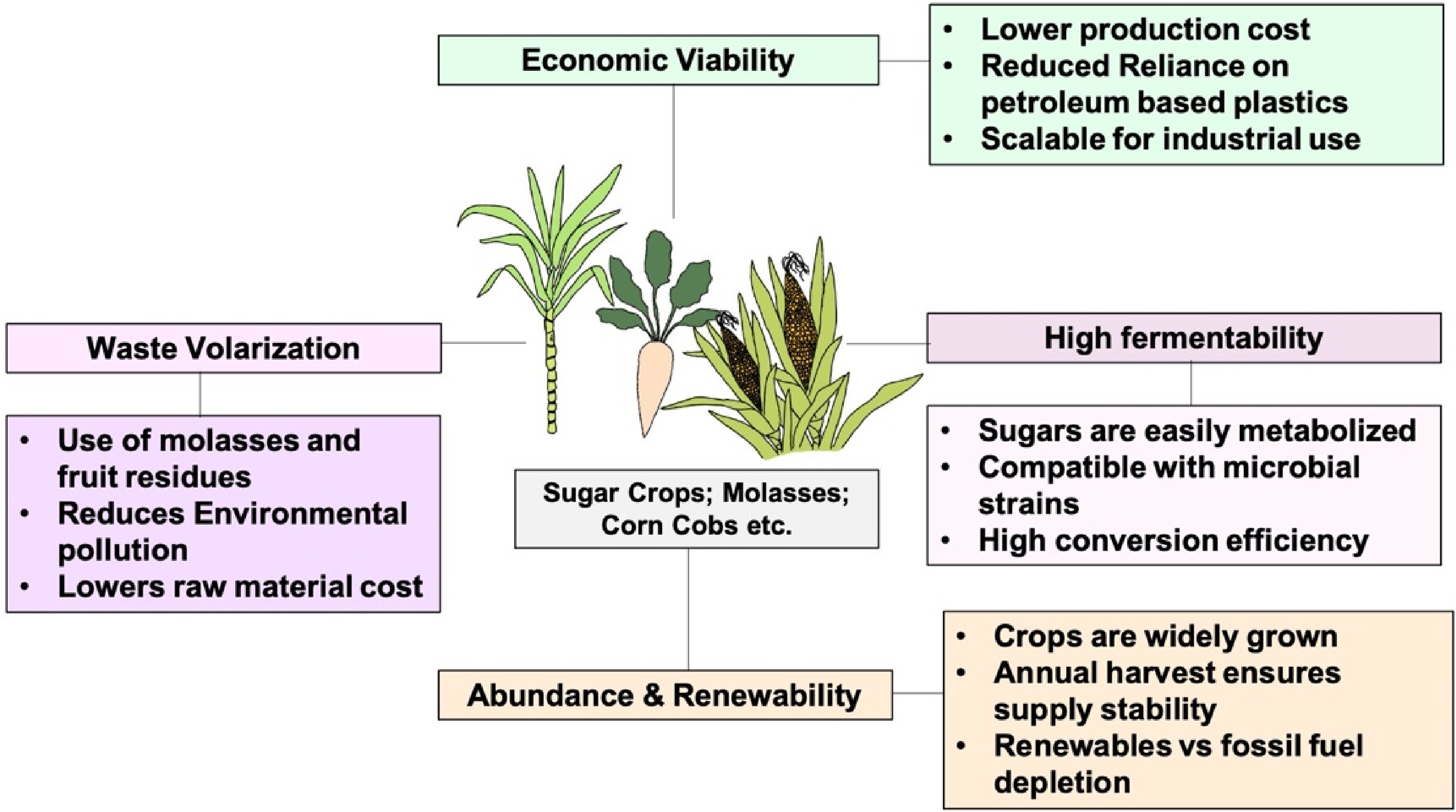
    • Environmental pollution and plastic waste have emerged as urgent issues of global importance, fuelled by many years of excessive consumption and overproduction[1]. Although petrochemical plastics are prized for their resistance and versatility, their longevity presents severe waste disposal issues, disturbing ecosystems and greenhouse gas emissions in the manufacturing process[2,3]. As a green substitute, polyhydroxyalkanoates (PHAs) have attracted significant interest because they are biodegradable, biocompatible, and possess mechanical properties akin to polypropylene[4]. PHAs are produced by bacteria naturally as intracellular carbon and energy storage materials under carbon-rich but nutrient-limiting conditions, and provide functional and environmental benefits[5,6]. Conventional PHA production has typically relied on pure carbon substrates such as glucose, sucrose, maltose, starch, fatty acids, methanol, and alkanes[7]. However, carbon feedstocks alone account for nearly 50% of total production costs[8], making economical alternatives essential for industrial-scale feasibility. First-generation sugar-based feedstocks such as sugarcane, corn sugar, whey, palm oil, and vegetable oils have been extensively studied but are problematic for food security and food and energy market competition[9]. While potent as substrates, their congruence with world food demands makes large-scale utilization not sustainable. On the other hand, sugar-based agro-industrial residues present a more promising avenue. Waste streams like sugarcane bagasse, molasses of cane and beet, corn steep liquor, and fruit peels carry high concentrations of fermentable sugars that are compatible for microbial conversion into PHAs by organisms like Cupriavidus necator and Bacillus megaterium[10,11]. This use of by-products minimizes reliance on food crops, reduces substrate expense, and supports circular economy principles through valorizing waste. In addition, their structural variability allows them to have extensive applications, from packaging, textiles, and animal feed supplements to biomedical applications such as implants and drug delivery. Generally, renewable waste feedstocks are economically and environmentally friendly, facilitating sustainable PHAs production. Their incorporation not only enhances degradable plastics but also helps in conserving resources and minimizing environmental deterioration[12,13].

      This review aims to highlight the application of sugar-rich feedstocks in the sustainable production of PHAs as biobased plastics.

    • Efficiency in PHAs biosynthesis varies with feedstock content, sugar type, and conditions of fermentation. Conveniently metabolizable substrates such as molasses, fruit juices, and corn steep liquor result in high yields in Cupriavidus necator and Bacillus megaterium. Lignocellulosic residues, however, need to be pre-treated, and results are determined by microbial tolerance to degradation by-products[12]. Furthermore, several studies revealed that pre-treatment is considered as an energy-sensitive and costly step as it converts lignocellulosic biomass into fermentable sugars. The recalcitrant nature of biomass, having tough lignin, requires significant energy to break it down[14,15]. Microbial metabolism and biosynthesis of PHAs are highly dependent on sugar composition. Strains capable of utilizing mixed sugars broadly ferment well, while limited strains are poor. Inhibitory substances like organic acids, phenolics, and salts found in molasses or fruit waste can inhibit growth, and detoxification or microbial acclimation is needed. Optimal sugar concentration is crucial—suboptimal levels limit biomass, while excess may lead to osmotic stress or catabolite repression. Fermentation conditions such as pH, aeration, temperature, oxygen transfer, and C/N ratio control polymer accumulation, with nitrogen deficiency and carbon excess favouring PHAs storage. Fed-batch operations are frequently employed to maintain maximum sugar concentration[16,17]. Strain choice also matters. Effective strains degrade several sugars, are resistant to inhibitors, and store high levels of PHAs. Bacillus subtilis, B. cereus, Alcaligenes sp., and Pseudomonas aeruginosa break down sucrose, glucose, and fructose, while B. megaterium can accommodate molasses variation. Tolerant strains such as Bacillus sp. BM37, Paracoccus sp., Halomonas, and C. necator perform well on sugar-rich residues[1821].

    • This pathway entails the conversion of substrates such as sugars or amino acids into acetyl-CoA, which is then followed by three consecutive enzyme-catalyzed reactions. The reversible condensation of acetyl CoA into acetoacetyl-CoA is catalyzed by B-Ketothiolase (PhbA). The intermediate is subsequently reduced by acetoacetyl-CoA reductase (PhbB) into d-(-)-3-hydroxybutyryl-CoA, which requires NADPH. The polymerization is then catalyzed by P(3-HB) synthase (PhbC)[22]. Later on, the cycle is closed by acetoacetyl-CoA synthetase (AACS), which reconstitutes acetoacetyl-CoA and converts to acetyl-CoA, which then can feed into the citric acid cycle[23].

    • Bacteria such as Ralstonia eutropha (also known as Cupriavidus necator) have extracellular lipases and possibly extracellular polysaccharides that help in the formation of stable emulsions when cultivated on plant oils, thus making fatty acids more bioavailable[24,25]. During β-oxidation, enoyl-CoA molecules are either directed towards the PHAs precursor (R)-3-hydroxyacyl-CoA through an (R)-specific enoyl-CoA hydratase (PhaJ), or 3-ketoacyl-CoA molecules are converted to (R)-3-hydroxyacyl-CoA via a β-ketoacyl-ACP reductase (FabG).

    • The second route is through the 3-hydroxyacyl-ACP-CoA transferase (PhaG) enzyme conversion of the fatty acid biosynthesis intermediate (R)-3-hydroxyacyl-ACP into (R)-3-hydroxyacyl-CoA[26]. Another well studied route is the utilization of propionic acid to produce (R)-3-hydroxyvaleryl-CoA. After the uptake of propionic acid, acyl-CoA synthetase catalyzes its conversion to propionyl-CoA. Aside from two molecules of acetyl-CoA, PhaA can also condense acetyl-CoA with propionyl-CoA to give ketovaleryl-CoA (Fig. 1). However, this reaction is mainly performed by two other 3-ketothiolase named BktB[27]. Ketovaleryl-CoA is eventually reduced to (R)-3-hydroxyvaleryl-CoA by PhaB.

      Figure 1. 

      PHAs production from sugar based feedstocks.

    • Lignocellulosic biomass, which consists of cellulose, hemicellulose, and lignin, is inherently resistant to microbial breakdown and, therefore, pre-treatment is an essential process for effective sugar production and subsequent PHAs production (Fig. 2). Efficient pre-treatment increases cellulose exposure, allowing as much as 90% of reducing sugars to be liberated for fermentation[28]. This mechanism is central to reducing production costs by maximizing sugar release, consequently enhancing yield, and economic viability of PHAs[29,30]. The increased fermentability of sugar-containing feedstocks is a result of their sucrose, glucose, and fructose, which are easily metabolized by PHAs-producing microorganisms like Cupriavidus necator and Bacillus megaterium with very high productivities[29,31,32]. For agro-industrial residues like sugarcane bagasse, pre-treatment plays a significant role in lignin removal, cellulose decrystallization, and solubilization of hemicellulose, enhancing porosity and enzymatic accessibility[33,34]. In contrast, sugarcane molasses, even if sucrose-rich, contains phenolics, heavy metals, and nitrogenous compounds that repress microbial growth, and PHA biosynthesis. Additionally, the majority of PHAs-producing strains do not have glycosyl hydrolases to metabolize sucrose directly, necessitating hydrolysis into glucose and fructose, and minimizing inhibitory compounds[35,36]. Depending on the application of acidic, alkaline, or enzymatic hydrolysis, additional impurities can occur, which have a detrimental effect on microbial efficiency[32]. Parallel challenges are found in beet molasses and fruit peels, whose pre-treatment guarantees the release of fermentable sugars, a balance of nutrients, and neutralization of inhibitors[37]. Generally, tailoring pre-treatment to the characteristics of each feedstock is required for the development of low-cost agro-industrial residues into consistent, sustainable substrates for industrially scaled PHAs production.

      Figure 2. 

      Different types of pre-treatment of lignocellulosic biomass.

    • Acid pre-treatment is one of the most common approaches to enhance the hydrolysis efficiency of lignocellulosic biomass (Fig. 2). Dilute acid pre-treatment, in general carried out with 0.05%–5% acid solutions at 160–220 °C, for time periods ranging from seconds to several hours, solubilizes mainly hemicellulose and breaks lignin–polysaccharide bonds, thus increasing cellulose access to hydrolytic enzymes. It is a process of breakage of hemicellulose and amorphous cellulose into fermentable sugars, and optimization of process parameters needs to be carried out with care to achieve a high sugar yield while limiting the formation of inhibitory by-products. Acid hydrolysis is a conventional method of releasing fermentable sugars from the lignocellulosic structure in sugarcane bagasse processing, which is followed by mechanical washing and water leaching, for the removal of fine debris and surface waxes. Further staged dehydration reduces impurities before fermentation[38]. Unless efficiently removed, such impurities inhibit microbial metabolism and polymer biosynthesis, eventually lowering PHAs yield and overall process performance. Therefore, efficient substrate purification is of great importance in valorizing agro-industrial residues. Bagasse possesses the greatest promise, yielding 5.86 mg/mL PHAs[39]. Feedstock properties also determine treatment severity. Sugar-dominant, lignin-deficient feedstocks can tolerate mild conditions, whereas lignin-dominant materials are treated with severe conditions. Oladzad et al.[40] illustrated that DPC structural recalcitrance drives bioprocess yields. Hydrothermal and dilute acid pre-treatment (0.5% v/v H2SO4) at 80–140 °C for 60–90 min enhanced carbohydrate accessibility, and enzymatic hydrolysis was best performed at 120 °C for 90 min. This treatment enhanced total sugars by 55.02% with less inhibitors, and follow-up anaerobic digestion enhanced hydrogen, ethanol, and volatile fatty acids production by 59.75%, reiterating the significance of pre-treatment in bioprocessing efficacy. Concentrated acid pre-treatment, though efficient at milder conditions, is constrained by equipment corrosion and inhibitory lignin precipitates. The most common chemical used is sulfuric acid, whereas hydrochloric, phosphoric, and nitric acids are alternatives. Zhao et al.[34] described that 2% H2SO4 at 121 °C for 2 h obtained 85% solubilization of hemicellulose, and 16% lignin reduction. Dilute acid procedures are still favoured due to ease and economy[41,42], even though they create inhibitors like furfural, HMF, acetic acid, and phenolics, which negatively impact microbial fermentation as well as PHAs productivity[43,44]. Generally, dilute acid pre-treatment is seen to be the most efficient and scalable process of bagasse pre-treatment for PHAs production.

    • Alkaline pre-treatment, typically utilizing sodium hydroxide (NaOH), calcium hydroxide (Ca(OH)2), potassium hydroxide (KOH), or ammonia (NH3) is prevalently applied to enhance the digestibility of lignocellulosic biomass through selective lignin removal (Fig. 2). Adjustments of process conditions, such as alkali concentration, temperature (generally below 100 °C), and incubation time, can be made depending on feedstock composition and lignin levels. Low-lignin biomass is subjected to milder treatment, whereas high-lignin feedstocks need more concentrated alkali, or increased exposure time for effective delignification[45,46]. The pre-treatment has the added advantage of increasing the accessibility of cellulose while retaining fermentable sugars and generating fewer inhibitors than acid-based methods[47]. Some recent developments include oxidative alkaline systems, e.g., NaOH with hydrogen peroxide (H2O2), which enhance lignin degradation and efficiency in sugar conversion[48,49]. Yu et al.[50], for instance, indicated that treatment with 1% NaOH at 120 °C for 10 min eliminated 67.5% of the lignin in sugarcane bagasse, and NaOH–H2O2 blends further improved enzymatic digestibility. Whilst these benefits exist, one serious disadvantage of alkaline pre-treatment is that a considerable proportion of hemicellulose is still bound in the residual solids, and so is less available for sugar release than with dilute acid treatments. As a result, additional hemicellulolytic enzymes such as xylanase are usually added during subsequent hydrolysis to maximise overall carbohydrate recovery[51]. Generally, alkaline pre-treatment is still an economical and effective method for bagasse valorization, especially with the addition of enzymatic means for total carbohydrate utilization.

    • Organosolv pre-treatment utilizes organic solvents, with or without water and catalysts, to break down lignocellulosic biomass by splitting α- and β-aryl ether cross-linkages in lignin. Organosolv pre-treatment dissolves and ruptures lignin (Fig. 2), hence enhancing cellulose and hemicellulose susceptibility to enzymatic hydrolysis and, ultimately, sugar release for PHAs production[52]. Though water-soluble lignin residues are inhibitors of enzymes, the process considerably enhances biomass digestibility and enables one to recover lignin of high purity for industrial uses. Solvents can vary from the low-boiling alcohols (methanol, ethanol), to boiling components like ethylene glycol, glycerol, dimethyl sulfoxide, and phenolics[53]. Reactions are commonly at 100–250 °C, with increased temperatures (185–210 °C) producing organic acids that decrease the requirement for external catalysts, although mineral or organic acids might be added to further promote delignification and xylose recovery[54]. Organosolv divides biomass into three streams: purified cellulose, aqueous hemicellulose, and dry lignin[55]. Experiments validate its efficacy for sugarcane bagasse, with 45.3% lignin and 72.5% hemicellulose removal with 50% ethanol at 121 °C[56], and 75.5% lignin removal with 60% ethanol, and 5% NaOH at 180 °C[57]. Effective recovery of solvent is necessary for economic feasibility[58].

    • Steam explosion is a green pre-treatment (Fig. 2) that utilizes high-pressure saturated steam (160–260 °C), and subsequent depression to break-down lignocellulosic biomass structure and enhance digestibility[59]. Two modes are predominant: batch, in which biomass is subjected to instant depressurization into a discharge vessel; and continuous, in which it is sent into a pressurized reactor through periodic opening of valves resulting in tiny explosions[60]. Whereas the operations vary, the two methods are based on explosive decompression with similar results. This process works best for sugarcane bagasse, allowing for fractionation and recovery of lignin, cellulose, and hemicellulose[61]. Silveira et al.[62] recorded 85% solubilization of hemicellulose in a 65 L reactor, whereas Zhang et al.[63] released 9.8 g/L xylose under hot water pre-treatment with acetyl support at 160 °C for 70 min. Moreover, steam explosion causes autohydrolysis, changing bagasse surface morphology and also enhancing enzymatic saccharification efficiency[64].

    • Biological pre-treatment is an eco-friendly process (Fig. 2) that employs certain cellulolytic and hemicellulolytic enzymes or microorganisms to break down lignocellulosic biomass[65]. This approach is less energy-intensive, and generates fewer inhibitory by-products than chemical and physical pre-treatment methods. However, its application in industries is constrained by the extended duration of biodegradation. Different microorganisms, such as fungi and bacteria, recovered from sources like soil and lignocellulosic residues, can be employed for the biological pre-treatment of feedstocks rich in sugars (Tables 1 & 2).

    • Hydrolysis pre-treatment of lignocellulosic biomass hydrolyzes hemicellulose and cellulose into fermentable sugar, and thereby enhances carbon supply for PHAs production. The enzymatic hydrolysis technique is used over acid treatment since it is eco-friendly, less inhibitor is produced, avoids corrosion issues, and provides near complete cellulose conversion with higher PHAs yield[66]. Enzymatic pre-treatment processes are tailored for sugar-rich feedstocks by adapting enzyme cocktails to the targeted carbohydrate content and accessibility of the substrate. In the case of sugarcane bagasse, molasses, or comparable feedstocks, the enzyme blend is designed to maximize fermentable sugar release while reducing inhibitory by-products[67]. Cellulase, composed of endoglucanases, exocellobiohydrolyases, and β-glucosidase, hydrolyzes cellulose to glucose[68]. Hemicellulose, being branched in nature, is hydrolyzed by enzymes like xylanases, arabinofuranosidase, and glucuronidase, releasing xylose, galactose, and arabinose[69]. Hydrolytic cellulases are formed by both bacteria (Streptomyces, Bacillus, Clostridium), and fungi (Trichoderma, Penicillium, Aspergillus)[70,71]. But due to slow microbial activity, commercial enzymes are normally employed for efficient hydrolysis.

    • Sugarcane, a tropical perennial grass, ranks among the most cultivated plants in the world for sugar production, and constitutes a very good feedstock for microbial fermentation as it contains a high amount of sucrose combined with fermentable sugars like glucose and fructose. Due to these properties, it presents a promising raw material to produce PHAs (Table 1). Its benefits are in the form of high hectare yields, low culture costs, and rich by-products like molasses and bagasse, which improve the feasibility for large-scale synthesis of PHAs. Sugarcane molasses, being a sugar-refining by-product consisting of almost 50% sugars along with growth-promoting nutrients, is universally known to be a low-cost substrate and is also focused on improving sustainability through waste valorization. Chaudhry et al.[72] showed that Pseudomonas species were able to accumulate 20%–36% PHAs from molasses, whereas Bacillus megaterium produced 72.7 g/L cell mass with 42% PHAs content when grown on molasses[73]. Cupriavidus necator (DSM 545) and Burkholderia sacchari strains have also been effectively used utilizing molasses or sugarcane juice[74,75]. As C. necator cannot directly ferment sucrose, molasses hydrolysis by chemical, enzymatic, or mixed treatments is necessary. The efficiency of fermentation is subject to optimized conditions such as temperature, pH, and nutrient levels that have a substantial impact on yields. Albuquerque et al.[76], for instance, documented that reactor pH changes volatile fatty acid composition, with impacts on PHAs copolymer ratios. Strain variation also has its importance, and Bacillus subtilis and Escherichia coli yield 54% and 47% PHAs, respectively, from molasses fermentation under pH 7 and 35 °C[77]. Bacillus cereus, Alcaligenes sp., and Pseudomonas aeruginosa are also commonly employed due to their high sucrose, glucose, and fructose fermentation in minimal medium conditions[18].

      Bioprocess advancements have enabled the use of sugar industry by-products, particularly molasses, for PHAs production. Low-grade molasses, a sucrose-rich syrup unsuitable for food, has shown promise as a cost-effective substrate[79]. Although production levels are not always competitive, several studies highlight its potential. Chaudhry et al.[72] documented Pseudomonas species utilizing molasses to produce PHAs with dry cell weight in the range of 7.02–12.53 g/L and with 20.63%–35.63% polymer content. Likewise, Kulpreecha et al.[73] showed Bacillus megaterium BA-019 grown on sugarcane molasses yielded 72.7 g/L cell weight with 42% PHB (the most common and well-characterized PHA), showing its potential for industrial-scale usage.

      Albuquerque et al.[76] introduced a three-step procedure through molasses fermentation to organic acids, PHAs accumulation, and batch fermentation and obtained 30% PHAs of cell dry weight (CDW). Enterobacter cloacae also used molasses efficiently by reducing production costs[78]. Recombinant approaches broadened molasses' versatility, such as Ralstonia eutropha recombinantly engineered with Mannheimia succiniciproducens sucrose genes, which promoted sucrose growth but with low yield[80], while Jo et al.[81] improved poly(3-hydroxybutyrate) [P(3HB)] and poly(3HB-co-lactate) production by recombinant R. eutropha expressing β-fructofuranosidase. Fermentations in the laboratory validated high yields, with Bacillus cereus SPV yielding 61% PHAs in flasks, and 51% in a 2 L fermenter[82], and Pseudomonas fluorescens A2a5 yielding 68.7% PHAs with 32 g/L biomass in a 5 L reactor[83]. Analogously, genetically engineered Klebsiella aerogenes containing R. eutropha genes had yields similar to wild strains, albeit with stability constraints[84].

      Vinasse, another acidic pH and high-organic load by-product of the sugar industry, also favours PHAs production if pre-treated to remove polyphenolic inhibitors. Haloarchaea like Haloarcula marismortui and H. mediterranei effectively converted vinasse into 4.5–19.7 g/L PHAs[85,86], with mixing vinasse and molasses favouring PHB accumulation up to 56%[32]. Strain and substrate concentration have a significant effect on yields, varying from 0.60 g/L PHB in Bacillus megaterium using 4% molasses[87] to 59% PHB in Azotobacter vinelandii UWD using 5% molasses[88]. Halophiles eschew sterile conditions and produce PHBV without precursors, and discharge of saline effluent is an issue, partially resolved by desalination measures[89].

      Sugarcane bagasse, a lignocellulosic sugar-processing by-product, is a rich feedstock for PHAs but must be pre-treated to release fermentable sugars and minimize inhibitors like furfural and acetic acid. Acid hydrolysis of bagasse at 120 °C allowed Burkholderia sp. to produce 3.26 g/L PHB[90], whereas Burkholderia cepacia grown on bagasse hydrolysate produced 53% CDW with 2.3 g/L 3HB[91]. In the same vein, Cupriavidus necator survived acid/heat-pre-treated bagasse hydrolysates upon inoculation at high density, yielding PHB at 57% CDW[92]. Tyagi et al.[38] proved that residual sugars in bagasse filtrate, optimally at 60% with yeast extract and salts at pH 7.0 ± 0.5, yielded 55% PHAs, proving the worth of non-lignocellulosic bagasse-derived media. Apart from PHB, co-polymer production has also been investigated; Lopes et al.[90] reported PHBV production when levulinic acid was supplemented during Burkholderia fermentations. Yu & Stahl[92] also demonstrated that toxicity in hydrolysates could be alleviated by dilution as well as inoculation with tolerant strains of C. necator. Bengtsson et al.[93] further reported a Tg of −10.3 and −14 °C for the PHAs produced from 53%–63% mol 3HV from molasses and synthetic VFA solutions, respectively. Taken together, these results establish that sugarcane bagasse, besides its traditional applications as fuel for boilers and raw material for papermaking, can be used as a cheap carbon source for sustainable PHAs production.

      Table 1.  Production of PHAs from sugarcane by-products.

      By-product Concentration of
      raw material
      Initial treatment of raw material Microbe utilized with
      inoculum concentration
      PHAs yield (%) Ref.
      Molasses 80 g/L Acidic treatment Cupriavidus necator 11599 75.64 [35]
      Molasses 2−10 Not mentioned Enterobacter sp. SEL2 47.4−92.1 [36]
      Cane molasses + ammonium sulphate 20 g/L Not mentioned Bacillus megaterium BA-019 49.9−55.5 [73]
      Cane molasses + urea 20 g/L Not mentioned Bacillus megaterium BA-019 49.9–55.5 [73]
      Molasses 1% Alkaline/acidic pre-treatment; Hydrothermal pre-treatment Cupriavidus necator (DSM 545 strain); 40 mL 27.20 [75]
      Molasses Not mentioned Not mentioned Bacillus subtilis 62.2 [77]
      Molasses Not mentioned Not mentioned Escherichia coli 58.7 [77]
      Molasses 2%−10%
      (at even intervals)
      Sulfuric acid treatment and Tricalcium phosphate treatment B. subtilis (2 mL) 21.09−54.1 [77]
      Molasses 2–10 Tricalcium phosphate treatment B. subtilis (2 mL) 21.1−54.1 [77]
      Molasses 2−10 Tricalcium phosphate treatment E. coli 21.1−54.1 [77]
      Molasses 0−8 Acidic treatment Enterobacter cloacae 36.0–51.8 [78]
      Molasses Acidic treatment Enterobacter cloacae (2–16) 44.2–53.7 [78]
      Molasses 2−10 Not mentioned Bacillus cereus SPV 61.1 [82]
      Molasses + corn steep liquor 2%−5% Not mentioned Bacillus megaterium 18.3−49.12 [87]
      Molasses + corn steep liquor 4 or
      1%−6%, 0%−6%
      Pretreated with activated
      charcoal (1:1) for 2 h
      Bacillus megaterium ATCC 6748 35 [93]
      Molasses + corn steep liquor 4% (w/w); 4% (v/v) 43
      Molasses 1% Not mentioned Bacillus thuringiensis IAM12077 23.81 [95]
      Bagasse 1% Bacillus thuringiensis IAM12077 9.68 [95]
      Molasses 10 and 40.0 g/L Acidic treatment Pseudomonases aregunoisa NCIM No. 2948 62.44 [96]
      Molasses Sulfuric acid treatment Bacillus thurigenisis HA1 61.6 [97]
      Cupriavidus necator DSM 428 24.33 [98]
      Mixed microbial culture 57.5 [99]
      Molasses 0.0–0.5 g/L Not mentioned Alcaligenes eutrophus DSM 545 18–26 [100]
      Molasses 2–10 Not mentioned Bacillus flexus strain AZU-A2 88.0 [101]
    • Sugar beet, a temperate root crop, is one of the most concentrated sources of sucrose that can be tapped for microbial fermentation and production of PHAs[102]. The juice of sugar beet has been utilized as a substrate for Azotobacter lactus, resulting in a 66% yield of PHAs against 80% using pure sucrose[103]. Sugar beet pulp has also been used as a carbon source, with pulp sugars sustaining Paraburkholderia sacchari to yield 62.2 g/L PHB with 53.1% content, a yield of 0.27 g/g, and productivity of 1.7 g/(L·h)[104]. Like sugarcane, sugar beet molasses, a residual effluent of processing with 50%–60% fermentable sugars, and other organics, is nutrient-dense and inexpensive for PHAs production (Table 2)[88]. Microorganisms like Pseudomonas putida, Bacillus megaterium, and Cupriavidus necator B-10646 utilize beet-derived substrates effectively[37]. Molasses hydrolysis with β-fructofuranosidase supported C. necator in converting 88.9% sucrose to hexoses, which resulted in 80–85 g/L biomass and polymer compositions close to 80%, while copolymer P(3HB-co-3HV) was formed from precursors such as propionate and valerate. Azotobacter vinelandii UWD produced copolymers having β-hydroxyvalerate through β-oxidation processes. Beet molasses has stimulatory compounds, presumably amino-N compounds, that enhance PHAs accumulation over biomass growth, with trace peptone addition further enhancing yields[37,105]. Sugar beet wastewater has also been used as an inexpensive medium, with 4.05 g/L PHAs (41.79% biomass) production with 6% molasses and ammonium oxalate, illustrating dual advantage of polymer production and COD elimination[106]. Together, sugar beet and residues offer an environmentally friendly, economically feasible pathway towards industrial PHAs production.

      Table 2.  Production of PHAs from sugar beet by-products.

      By-product Concentration of
      raw material
      Initial treatment of
      raw material
      Microbe utilized with inoculum concentration PHA yield (%) Ref.
      Beet molasses 40% Acid and enzymatic
      hydrolysis
      Cupriavidus necator B-10646 wild strain 80 [37]
      Beet molasses 5% w/v Not mentioned Azotobacter cinelandii UWD 75–85 [88]
      Beet juice 1 L Not mentioned Alcaligenes latus (ATCC 29714) 38.66 [103]
      Cane molasses + beet molasses 3% Not mentioned Bacillus megaterium strain L9 41 [105]
      Beet molasses + sugar beet waste water 1%–15%
      (with odd intervals)
      Not mentioned Bacillus megaterium AUMC b 272 27.20–32.92 [106]
      Beet molasses 5% w/v Not mentioned Azotobacter vinelandii UWD (4% w/v) 65–73 [107]
      Sugar beet pulp 6% Recombinant endoglucanase (rCKT3eng) Haloarcula sp. TG1 17.8 [108]
      Pressed sugar beet pulp Not mentioned Acidification Pseudomonas citronellolis 38 [109]
      Pseudomonas putida KT2440 31
    • Corn and its derivatives are cheap and available feedstocks for the production of PHAs (Table 3). Corn syrup, obtained as a result of starch hydrolysis, is mostly glucose, offering an inexpensive and reliable source of carbon for microbial fermentation, whereas corn steep liquor (CSL), a wet-milled by-product, is rich in nutrients and increases polymer yields[110]. Other corn-derived substrates, such as grain, stover, oil, and gluten, have also been tested for the synthesis of PHAs[111]. While dextrose from corn grain is available as a reliable feedstock, its utilization competes with use in foods. Microbial fermentations via strains like Bacillus megaterium convert corn syrup sugars to PHAs effectively, and yields can be enhanced by optimizing aeration, temperature, and nutrient ratios. de Mello et al.[112] obtained 62% PHB accumulation (11.64 g/L, 0.162 g/L·h), which was raised to 70% (14.17 g/L, 0.197 g/L·h) in an 8-L bioreactor with milled corn hydrolysate and crude glycerol using Cupriavidus necator. Chaijamrus & Udpuay[94] produced 43% PHB with 4% molasses and 4% CSL. Recombinant E. coli carrying PHAs synthase genes stored PHAs from hydrolyzed corn starch, soybean oil, and cheese whey by using β-oxidation inhibitors such as acrylic acid[113]. Photobacterium sp. TLY01 gave 53.89 g/L PHB on corn starch and glycerol[114] and Bacillus sp. CFR 256 on CSL 8.20 g/L PHAs (51.2% biomass) in 72 h[115]. Acid-hydrolyzed corn cobs yielded 35.84 g/L reducing sugars, sustaining Bacillus sp. BM 37 to yield 36.2% PHB[116], although Pseudomonas aeruginosa resulted in only 0.38% PHB[117]. Moreover, Halomonas mediterranei produced PHAs from extruded corn starch and rice bran[118].

      Table 3.  Comparison of PHAs yield through different sugar rich feedstocks utilizing various microbial strains.

      Other sugar rich feedstocks Concentration/weight of
      raw material
      Initial treatment of
      raw material
      Microbe utilized with inoculum concentration PHA yield (%) Ref.
      Hydrolyzed citrus pulp Not mentioned Dilute acid hydrolysis Bacillus sp. strain COL1/A6 54.6 [2]
      Corn cob hydrolyzate 0.2, 0.5, and 1 g Acid hydrolysis Bacillus spp. BM 37 36.16 [119]
      Apple pulp waste 1:3 v/v deionized water Not mentioned Pseudomonas citronellolis NRRL B-2504 30 [123]
      Apple pulp waste 1:3 v/v deionized water Not mentioned Co-culture of Cupriavidus necator DSM 428 and Pseudomonas citronellolis NRRL B-2504 52 [124]
      Apple pulp waste 1:3 v/v deionized water Not mentioned Co-culture of Cupriavidus necator DSM 428 and Pseudomonas citronellolis NRRL B-2504 48 [124]
      Banana peels 20 g Not mentioned Zobellella sp. DD5 34.38 [125]
      Corn oil waste 20–50 mg Acidic treatment Pseudomonas sp. strain DR2 Up to 37.34 [126]
      Coir pith 3% Hydrolysis Azotobacter beijerinickii 48.9 [127]
      Ground orange juicing waste 10 mL Gas chromatography Cupriavidus necator H16 73 [128]
      Jackfruit seed hydrolysate 0.2 mL Enzymatic hydrolysis Bacillus sphaericus NCIM 5149 49 [129]
      Oil palm empty fruit bunch Not mentioned Enzymatic hydrolysis B. megaterium R11 51.6 [130]
      Apricots 10 g Enzymatic hydrolysis Pseudomonas resinovorans 1.4 [131]

      Corn stover hydrolysates also worked well, with Paracoccus sp. LL1 producing 9.71 g/L with 72.4% PHAs accumulation[119]. Corn bran hydrolysates were poor performers[120]. CSL and milk whey were used as co-substrates by E. coli strains that exhibited good P(3HB) yields, with K1060 performing the best. Commercially, Metabolix Inc. opened a 50,000-ton/yr PHAs plant in Iowa in 2010 from corn syrup[121]. However, extensive dependence on first-generation corn feedstocks is not sustainable. Farming of corn is costly from an environmental viewpoint, and life-cycle analyses indicate PHAs from corn do not lessen eutrophication or smog impacts compared to petrochemical plastics[122,111]. Future sustainability is contingent on combining enhanced PHAs fermentation technologies with sustainable production of corn.

    • Fruit and juice processing wastes are plentiful sugar-containing feedstocks ideal for the production of PHAs[132]. They harbour fermentable sugars like glucose, fructose, and sucrose[133,134], and comprise apple pomace, grape must, orange peels, mango pulp, and pineapple juice. Their valorization not only solves waste issues but also minimizes the environmental impact of fruit processing operations. Microorganisms like Haloferax mediterranei and Pseudomonas aeruginosa are shown to be able to produce PHAs from such wastes[135,136]. The operation generally includes pre-treatment and hydrolysis to break down fermentable sugars for easy microbial accessibility[137]. Despite this, inhibitory metabolites like phenolics can prevent growth and biosynthesis, the effects of which can be reversed by detoxification or microbial consortia[138]. Solid-state and submerged fermentation are both viable, although better yields are typically obtained under submerged systems[139]. Record yields are 56% PHB from pineapple juice[140], and 75% PHAs from oil palm frond juice[141] (Table 3). Pre-treatment processes like enzymatic hydrolysis or acid treatment enhances yields[142,143]. Seasonal and spatial availability of fruits guarantees a renewable feedstock, while waste conversion to resource supports circular economy principles and sustainable development objectives[144].

    • Sugar maple syrup and sap, as unconventional ones, are promising sugar-dense feedstocks for PHAs production. Maple sap has high sucrose content, while syrup, its concentration, has even higher sugar content, which makes both candidates for microbial fermentation[145]. Although less is known about them, their high concentration, and purity of sugars offer potential for effective PHAs synthesis. Yezza et al.[145] used maple sap and Alcaligenes latus to synthesize poly-β-hydroxybutyrate (PHB) to attain yields of up to 78% dry weight of cells. The PHB produced had chemical, thermal, and spectroscopic properties that were similar to commercial sucrose-derived PHB. Lokesh et al.[146] also found that sap from felled oil palm trunks (OPT), which contained 5.5% w/v fermentable sugar, was a cheap renewable source of carbon. With a termite gut isolate, Bacillus megaterium MC1 yielded 3.28 g/L of P(3HB), which is equivalent to 30 wt% of cell dry weight. Talebian-Kiakalaieh et al.[147] showed that Burkholderia cepacia ATCC 17759 was able to grow on sugar maple hydrolysate and produce 51% 3-hydroxybutyrate. The seasonal nature of maple sap and syrup availability brings with it opportunities and challenges for PHAs production. Utilizing these substrates can increase the economic worth of the maple industry, and offer renewable substitutes to traditional sugar feedstocks for bioplastic production.

    • Scaling up laboratory results in the production of PHAs to industrial processes encounters serious economic, technical, and regulatory challenges. The cost-determining carbon substrates still contribute 30%–67% of the costs of production, and whereas laboratory work frequently employs pure glucose or sucrose, industrial viability hinges on the incorporation of low-cost, waste-derived feedstocks[30,148]. These residues are however accompanied by variability in sugar content, inhibitory substances, and nutrient imbalance, all contributing to decreased microbial efficiency and process stability. Industrial fermentation poses an added problem, where aeration, pH, temperature, and agitation are difficult to maintain uniformly in large-scale bioreactors, tending to result in metabolic diversion and decreased yields. Cost-saving measures like mixed microbial cultures, or open fermentation systems invite competition from unwanted microbes and degradation of PHAs. Sugar feedstocks such as molasses, bagasse, and vinasse have inconsistent composition and inhibitors and need uniform, low-cost pre-treatment to deliver consistent quality (Fig. 3). Non-optimized processes lower sugar yield and increase expense. Scale-up is confronted by oxygen transfer, mixing, and heat issues in achieving high-cell-density titres. Feedstock availability, waste valorization, regulation, and supply-chain integration complicate matters. PHA recovery is energy- and solvent-hungry, usually offsetting upstream expense, although new greener processes are untested at scale[149].
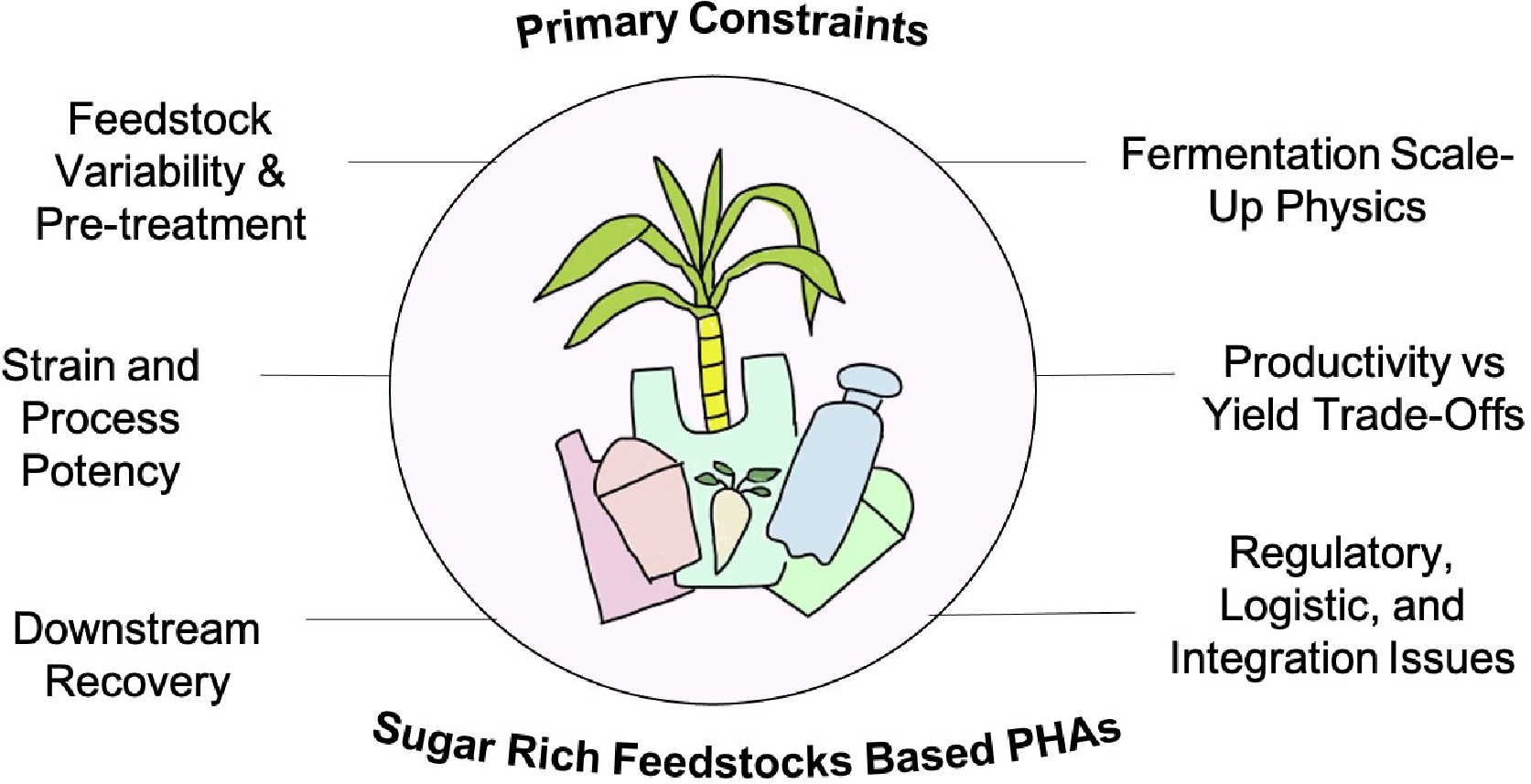
      Figure 3. 

      Primary bottlenecks in PHAs production from sugar rich feedstocks.

      Downstream recovery exacerbates these problems; whereas solvent-based extraction is effective on a small scale, it is expensive, environmentally stressful, and less effective in bulk. Industrial purification hence requires new solutions that reconcile efficiency with sustainability. Lastly, ensuring product quality, safety, and environmental compliance is more challenging in the case of non-food-grade waste-based substrates. The elimination of such obstacles is critical for the commercialization of PHAs from potential laboratory materials to practicable industrial bioplastics[17,30].

    • PHAs have attracted considerable interest as eco-friendly substitutes for petrochemical plastics based on their similar material properties as well as their important environmental advantages[150]. Derived from sugar-based biomass, PHAs are biodegradable and can be degraded by microbes to water and carbon dioxide without leaving toxic residues[151,152]. In contrast to traditional plastics that last for centuries and result in plastic and microplastic pollution, PHAs biodegrade innocuously, lessening long-term environmental risks. Their application lowers landfilling, water pollution, and environmental persistence[153]. In addition, PHAs are not toxic and do not release toxic chemicals or microplastics upon decomposition[154]. Life-cycle analyses reveal that PHAs require lower energy and lower greenhouse gas emissions than traditional plastics. For example, the substitution of an equal weight of high-density polyethylene with PHA can save 2.9 kg of CO2 emissions, and 15 kg of emissions relative to polystyrene[155]. Such properties render PHAs an eco-friendly option for bioplastic manufacture and green material uses.

      The sustainable source of PHAs from sugarcane, corn syrup, and similar carbohydrate-based feedstocks enhances the environmental status of PHAs by minimizing fossil fuel use and carbon footprints. Governments and industries seeking sustainable alternatives acknowledge PHAs as aligned with the principles of the circular economy, promoting resource efficiency and environmental care[156,157,13]. These benefits (Fig. 4) notwithstanding, economic limitations restrict their global adoption. High production expense, dictated in part by feedstock cost and accessibility, continues to be a stumbling block. Though sugarcane, corn syrup, and crop residues can be used as carbon substrates for microbial fermentation[152], challenges with food–feed competition, yield stability, and transport economics raise the cost of operations. Large-scale production entails technical limitations, especially fermentation and downstream processing, where big bioreactors need optimal oxygenation, pH regulation, and stable microbial growth to ensure productivity[158]. Downstream purification and separation are still costly, ranging from 30%–50% of overall costs[159]. Even though PHA prices have fallen from USD${\$} $9.50/kg in 2002, to USD${\$} $2.62/kg in 2019[160], petroplastics are still cheaper and prevalent. Using sugar-derived by-products, like molasses and fruit waste from processing, provides cost-saving opportunities, and reduces environmental pollution[161,162,136]. Technological innovation, such as engineered microbial hosts, increased intracellular storage, and valorization of non-traditional waste-derived feeds, further enhances economic viability[163,164]. Therefore, although PHAs pose an environmental necessity, cost issues remain but regulatory demands and growing demands in packaging, agriculture, and in biomedical applications highlight their promise as renewable bioplastics[8,165,156].

      Figure 4. 

      Advantages of sugar based feedstocks for PHAs production.

    • The conversion of agricultural residues and waste to value is increasingly being recognized (Fig. 5), as it de-prioritizes waste management infrastructure while recovering by-products as valuable resources in a closed loop[166]. PHAs play an important role by reducing plastic litter, improving resource efficiency, preventing climate change, and promoting circular economy measures[149]. Feedstocks like sugarcane bagasse, fruit peels, and molasses contribute carbon sources for microbial fermentation, lowering the dependence on virgin raw materials. Organic content in these wastes can be transformed into sugars and volatile fatty acids (VFAs) by anaerobic treatments[167]. But pre-treatment processes, although required to enhance accessibility, may increase expenditure and produce inhibitory compounds like furfural that lower PHAs yields[168]. Process parameter optimization and prevention of acidogenic inhibition are important to successful waste-to-PHAs conversion[169,170]. The major industrial uses of PHAs are in the packaging industry; e.g., poly(3-hydroxybutyrate-co-3-hydroxyvalerate) (BIOPOL®) was used in shampoo bottles and cups[171], while poly(3-hydroxybutyrate-co-3-hydroxyhexanoate) (PHBH, Nodax™) is used in carpets and biodegradable bags[172]. Blending PHAs with natural fibres, such as sugarcane bagasse-reinforced PHB and PHBV composites, also found to have good mechanical and biodegradable properties[173,174]. In biomedical applications, PHAs find applications in drug delivery, implants, and tissue engineering[174,175]. PHB also possesses antimicrobial activity, inhibiting Vibrio infection in shrimp[176]. Some commercial activities involve Bio-on in Italy, which synthesizes PHAs polymers from sugar beet[177,155], and Bioextrax, which is producing PHAs from sugar beet feedstocks[178].
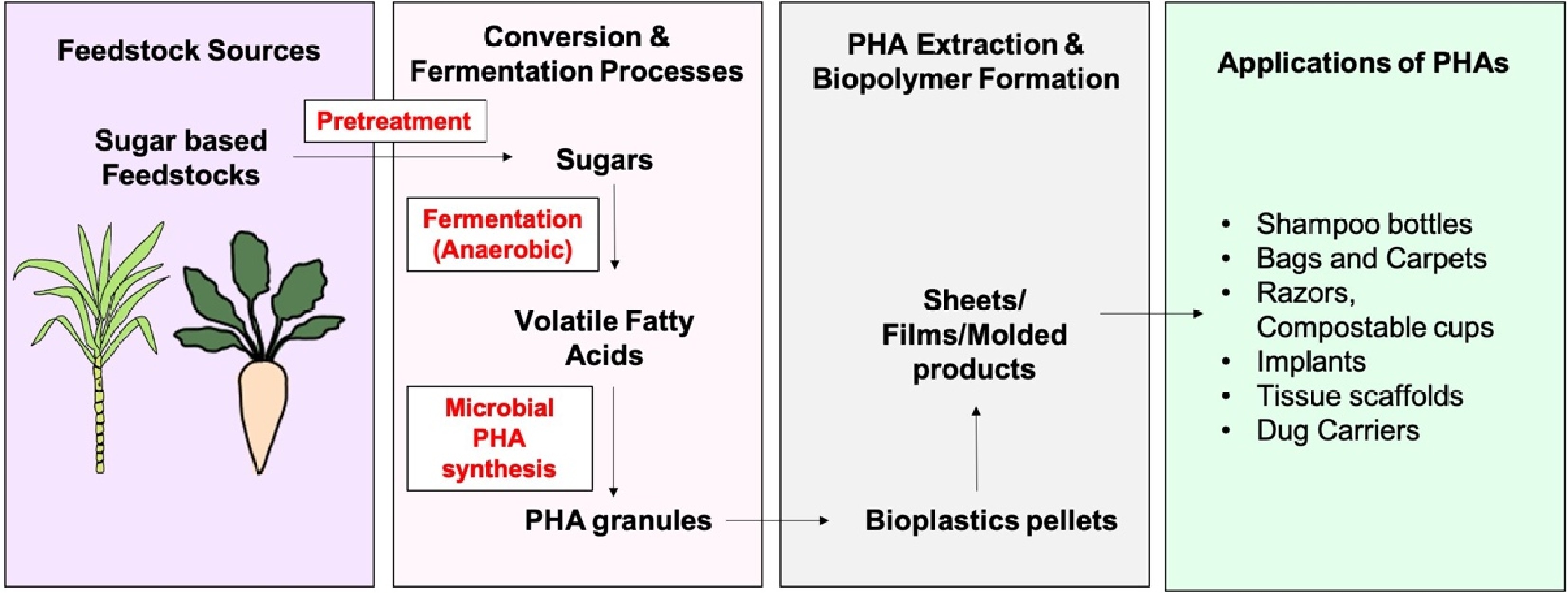
      Figure 5. 

      Circular route of PHAs bioplastic production from sugar based feedstocks and its applications.

      Agriculture is another prospective area. PHAs as mulches also help to improve water retention in the soil, minimize contamination, and increase yield[179]. In contrast to polluting polyethylene mulches that end up in landfills[180], degradable PHAs offer sustainable options[181]. They are best suited for films and coatings due to their low oxygen permeability, but their potential future applications can be PHAs-based growth bags. These bags reduce toxicity, minimize root deformities, and stimulate healthier plant development[182,183]. Due to their biodegradability and environmental friendliness, PHAs are suitable candidates for industrial and agricultural uses[149].

    • LCA is an extensive approach employed to assess the environmental effects of products, materials, or services throughout their life cycle, from the acquisition of raw materials to production, transportation, use, and waste. LCA is essential in researching PHAs, which are finding their way as eco-friendly substitutes to traditional plastics that remain in the environment as they are non-biodegradable[184]. PHAs, with origins in renewable sugar-based feedstocks, provide biodegradability, diversity, and lower dependence on fossil fuels, becoming central to sustainable material manufacture[22]. The majority of LCAs have turned their attention to the first-generation sugar feedstocks of corn glucose, sugarcane molasses, and sugar beet residues, considering environmental benefits and process hotspots, such as the energy-hungry chloroform-based extraction of PHAs. Interest is increasingly developing in second-generation waste-derived sugar substrates such as lignocellulosic hydrolysates, residues of food processing, and organic materials from wastewater, although few reports exist[185]. PHAs production from sugar sources continues to be expensive (USD${\$} $3–12/kg), with the feedstock contributing to about 50% of expenses[30]. Sugarcane sucrose is very promising, with prices ranging as low as USD${\$} $3.02/kg, 22.56 MJ/kg energy requirement, and a conversion rate of 0.2–0.4 g PHAs/g sugar, less than PLA (0.5 g/g). Sugar-derived PHAs have carbon intensities of 1.5–3.0 kg CO2-eq/kg, less than PLA (2.0–3.5) and PE (2.5–6.0), but land use is still an issue[184].

    • PHAs produced from sugar feedstocks have adjustable mechanical properties, however these properties tend to vary from typical petrochemical plastics such as polyethylene (PE) and polypropylene (PP)[186]. Homopolymers like PHB have high crystallinity (40%–70%), are rigid and brittle, with tensile strengths of 15 to 43 MPa, Young's modulus of 1–3.5 GPa, and elongation at break of 1%–15%, being susceptible to cracking when subjected to stress. Their hardness and restricted ductility are different from those of PE, PP, and other petroplastics. Monomer structure, chain length, and crystallinity are the factors controlling mechanical response, and these factors are further influenced by copolymerization or microbial fermentation to create medium-chain-length PHAs with softer and more flexible properties. Though less durable and thermally stable than high-performance petroplastics, these PHAs can retain favourable barrier properties, processability, and biodegradability. Thus playing a role in packaging, disposable items, and biomedical devices. Though copolymerization or blending strategies can enhance the flexibility and lower brittleness in sugar-rich feedstock-based PHA, the level of mechanical reliability as achieved in traditional plastics has not yet been attained. Since PHAs offer multifunctional biodegradable substitutes with added advantage towards eco-friendly product but its mechanical profiles need to be considered while using for specific applications[186].

    • Polymers from sugar are a new generation of bioplastics with performance and environmental benefits compared to petroleum-based plastics[187]. Polyethylene furanoate (PEF), a product of 2,5-furandicarboxylic acid (FDCA) derived from sugar, has a thermal behaviour comparable to polyethylene terephthalate (PET) but with ~10-fold reduced oxygen permeability (~0.0107 vs 0.114 barrer), thus best suited for food packaging[188]. Nonetheless, its application under pressurized conditions is limited by such disadvantages as brittleness and poor strain-hardening[189,190]. Sugars from biomass comprise of monosaccharides, disaccharides, and sugar alcohols, which are renewable, biodegradable, and versatile platforms for recyclable, high-performance polymers (Fig. 6) that overcome fossil-plastic limitations such as depletion of resources, environmental pollution, and carbon emissions[191,192].
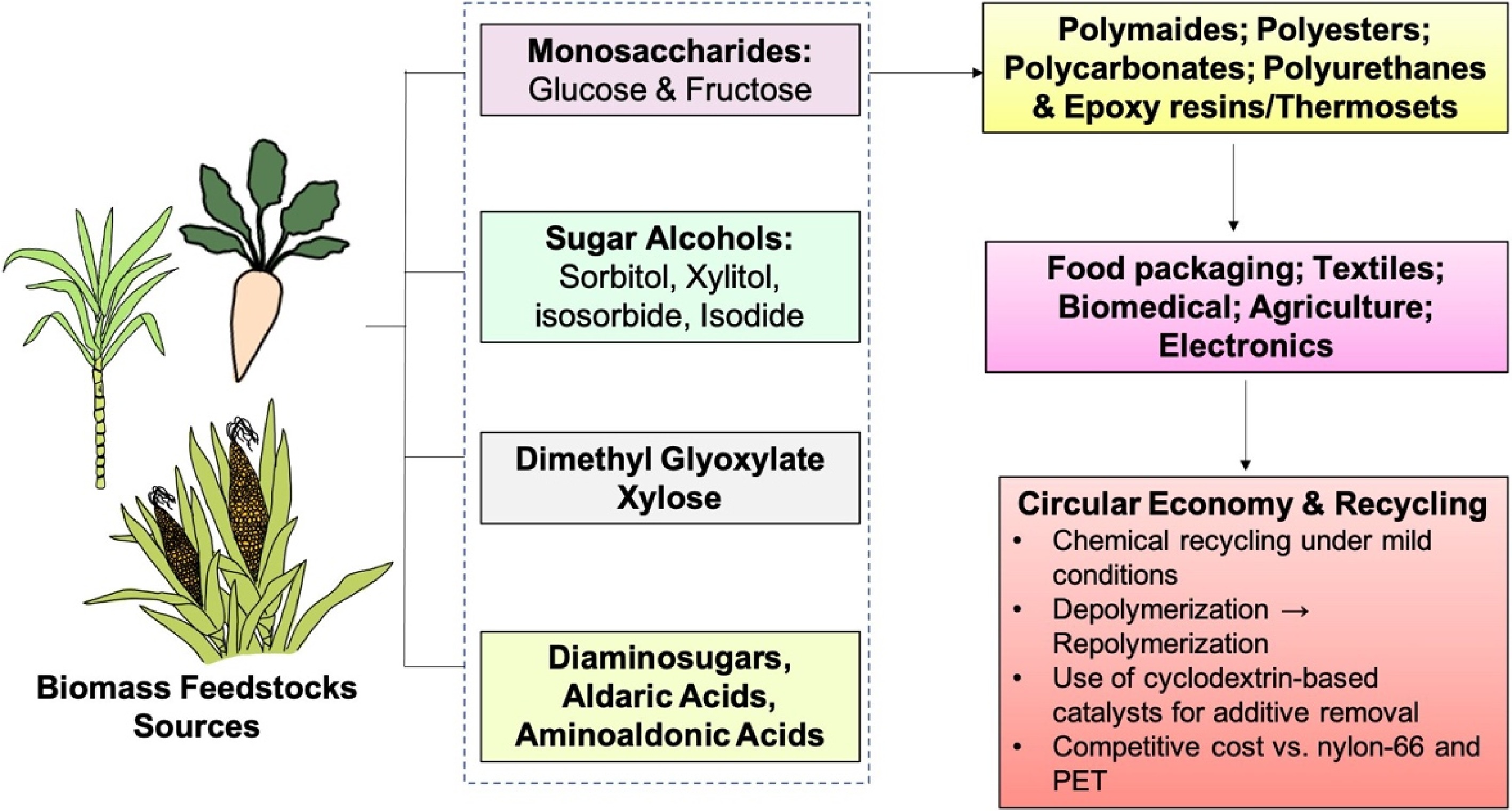
      Figure 6. 

      Sugars based feedstock to smart materials.

      Polyamides from diaminosugars, aldaric acids, and aminoaldonic acids have superior thermal and mechanical properties[191]. Polyamides from isosorbide possess tensile strength and thermal stability equivalent to or superior to typical nylons[193]. EPFL scientists accomplished catalyst-free conversion of xylose dimethyl glyoxylate into polyamides with 97% atom economy without harmful additives and maintaining toughness over recycling cycles[194]. Techno-economic studies indicate production costs are competitive with conventional nylons[195]. 2,5-Furandicarboxylic acid (FDCA) from fructose is employed for the manufacture of polyethylene furanoate (PEF), having improved gas barrier properties compared to PET[196]. Sugar alcohols xylitol and sorbitol act as monomers for biodegradable polyurethanes and polycarbonates, imparting flexibility[197]. Isoidide- and isomannide-derived polymers synthesized at Duke University and the University of Birmingham exhibit tunable mechanical properties that vary from rubbery extensibility to nylon-like toughness because of stereochemical diversity[198].

      Sugar monomers like sorbitol, glucose, and isosorbide have been combined with epoxy resins and thermosets to improve thermal stability and toughness[199]. Sugared furans offer petroleum-free renewable thermoset alternatives[200], and dynamic covalent chemistries allow for vitrimer-type thermosets with recyclability and re-shapability for use in the automobile and electronic industries[201,202]. Chemical modifications such as acetalization and etherification enable tuning of hydrophobicity, crystallinity, and rates of degradation. Their biocompatibility facilitates medical applications, and sugar polymers are able to condense into nanoparticles, micelles, and hydrogels for controlled drug delivery, including colon-specific release[203,204].

      Cost and scalability are issues, but enzymatic and microbial production of sugar-based monomers, coupled with sugar biorefineries, increases feasibility. Recyclability tests show maintained tensile strength, and chemical recyclability under mild conditions[205]. Firms such as Bloom Biorenewables, a spin-off from EPFL, are working towards commercial-scale production. Sugar-based catalysts such as cyclodextrins improve upcycling and recycling by eliminating additives, maximizing yield and purity[206,207]. Generally, sugar-derived polymers such as polyamides, polyesters, polycarbonates, and epoxy resins provide adjustable functionality, recyclability, and compliance with circular economy doctrine, making them ideal for packaging, biomedical, and high-performance applications with prospects for sustainable reform of the plastics sector[208].

    • The application of PHAs have been reported in several areas, from daily use to specialized uses like in biomedicals. Research opportunities in PHAs production have been gaining speed with advancements in genome engineering techniques. Discovering alternative carbon sources is key to maintaining sustainable production methods. With the characteristics of renewability, abundance, microbial compatibility, cost-effectiveness, and eco-friendly, the sugar rich feedstock have become essential for the sustainable and efficient production of PHAs with higher yields. These sugar-based substrates can significantly reduce the carbon footprint of PHAs compared to petroleum based substrates. Moreover, these also support the circular economy perspective by the creation of value-added products. The integration of these feedstocks in PHAs production processes through biotechnological tools have also impacted the existing agricultural practices and utilization of infrastructures in such processes. This shift results in more sustainable bioplastic manufacturing, compared to traditional ones. Additionally, since these feedstocks are obtained from waste/by-products of sugar-based crops, they are easily available in sufficient quantity, thus reducing the dependency on imported raw materials and supporting local economies. PHA production from these feedstocks is a positive and practical approach for the problem of plastic pollution and resource depletion, leading towards the attainment of sustainable development goals.

      Though challenges still remain, the development in science has created further opportunities for the exploration of genetically engineered microbes in tailoring the properties of PHAs properties in several different fields such as packaging, biomedical devices, and agricultural films[209]. Another opportunity will be seen in the investigation of mixed culture fermentation systems and new bioreactor designs to maximize PHAs production from different feedstocks, such as agricultural waste and food waste in favour of waste valourization and circular economy approaches[210]. PHAs blends and composites with superior mechanical, thermal, and barrier properties also provide alternatives for environmental friendly plastics against conventional plastics. This will be driven by consumer and regulatory demand[211]. Interdisciplinary interactions and positive actions among academia, industry, and policy makers towards the adoption of these PHAs through these feedstocks will help in commercializing a green alternative product, reducing plastic pollution and promoting circular economy[212].

      • Not applicable.

      • The authors confirm their contributions to the paper as follows: conceptualization, original writing, review and editing: Misra V, Mall AK. All authors reviewed the results and approved the final version of the manuscript.

      • All data and information discussed are derived from previously published literature, which has been appropriately cited within the manuscript. No new datasets were created or analyzed during the preparation of this article.

      • The authors declare that they have no conflict of interest.

      • # Authors contributed equally: Varucha Misra, Ashutosh Kumar Mall

      • Copyright: © 2025 by the author(s). Published by Maximum Academic Press, Fayetteville, GA. This article is an open access article distributed under Creative Commons Attribution License (CC BY 4.0), visit https://creativecommons.org/licenses/by/4.0/.
    Figure (6)  Table (3) References (212)
  • About this article
    Cite this article
    Misra V, Mall AK. 2025. Exploiting sugar-rich feedstocks for sustainable polyhydroxyalkanoate production. Circular Agricultural Systems 5: e015 doi: 10.48130/cas-0025-0012
    Misra V, Mall AK. 2025. Exploiting sugar-rich feedstocks for sustainable polyhydroxyalkanoate production. Circular Agricultural Systems 5: e015 doi: 10.48130/cas-0025-0012

Catalog

    /

    DownLoad:  Full-Size Img  PowerPoint
    Return
    Return