









Search
2025 Volume 18
Article Contents
REVIEW   Open Access    

Metabolic control of DNA replication: beyond biosynthetic and bioenergetic needs

  • # Authors contributed equally: Kejian Dong, Jiayao Pei

More Information
  • Both genome duplication and cell metabolism are fundamentally important for organismal growth and homeostasis. Defects in DNA replication and metabolic programming are often associated with various human diseases, such as cancer. In addition to links between these two cellular activities revealed in early studies, remarkable advances in recent years have extended our understanding of how DNA replication is coordinated with metabolic changes in cells, especially in biomass production, energy supply, and redox balance. Novel functions of metabolic intermediates and enzymes in the control of DNA replication have attracted considerable attention. Here, we review the current knowledge of metabolic cues involved in DNA replication and discuss the underlying mechanisms, with a focus on direct impact on replication fork function and stability.
  • 加载中
  • [1] Fragkos M, Ganier O, Coulombe P, Méchali M. 2015. DNA replication origin activation in space and time. Nature Reviews Molecular Cell Biology 16:360−74 doi: 10.1038/nrm4002

    CrossRef   Google Scholar

    [2] Matthews HK, Bertoli C, de Bruin RAM. 2022. Cell cycle control in cancer. Nature Reviews Molecular Cell Biology 23:74−88 doi: 10.1038/s41580-021-00404-3

    CrossRef   Google Scholar

    [3] Fei L, Xu H. 2018. Role of MCM2−7 protein phosphorylation in human cancer cells. Cell & Bioscience 8:43 doi: 10.1186/s13578-018-0242-2

    CrossRef   Google Scholar

    [4] Bellelli R, Boulton SJ. 2021. Spotlight on the replisome: aetiology of DNA replication-associated genetic diseases. Trends in Genetics 37:317−36 doi: 10.1016/j.tig.2020.09.008

    CrossRef   Google Scholar

    [5] Andrs M, Stoy H, Boleslavska B, Chappidi N, Kanagaraj R, et al. 2023. Excessive reactive oxygen species induce transcription-dependent replication stress. Nature Communications 14:1791 doi: 10.1038/s41467-023-37341-y

    CrossRef   Google Scholar

    [6] Li N, Gao N, Zhai Y. 2023. DDK promotes DNA replication initiation: mechanistic and structural insights. Current Opinion in Structural Biology 78:102504 doi: 10.1016/j.sbi.2022.102504

    CrossRef   Google Scholar

    [7] Saldivar JC, Cortez D, Cimprich KA. 2017. The essential kinase ATR: ensuring faithful duplication of a challenging genome. Nature Reviews Molecular Cell Biology 18:622−36 doi: 10.1038/nrm.2017.67

    CrossRef   Google Scholar

    [8] Song H, Guo Z, Xie K, Liu X, Yang X, et al. 2025. Crotonylation of MCM6 enhances chemotherapeutics sensitivity of breast cancer via inducing DNA replication stress. Cell Proliferation 58:e13759 doi: 10.1111/cpr.13759

    CrossRef   Google Scholar

    [9] Kirova DG, Judasova K, Vorhauser J, Zerjatke T, Leung JK, et al. 2022. A ROS-dependent mechanism promotes CDK2 phosphorylation to drive progression through S phase. Developmental Cell 57:1712−1727.E9 doi: 10.1016/j.devcel.2022.06.008

    CrossRef   Google Scholar

    [10] Enomoto T, Tanuma S, Yamada MA. 1981. ATP requirement for the processes of DNA replication in isolated HeLa cell nuclei. Journal of Biochemistry 89:801−7 doi: 10.1093/oxfordjournals.jbchem.a133262

    CrossRef   Google Scholar

    [11] Somyajit K, Gupta R, Sedlackova H, Neelsen KJ, Ochs F, et al. 2017. Redox-sensitive alteration of replisome architecture safeguards genome integrity. Science 358:797−802 doi: 10.1126/science.aao3172

    CrossRef   Google Scholar

    [12] Li X, Qian X, Jiang H, Xia Y, Zheng Y, et al. 2018. Nuclear PGK1 alleviates ADP-dependent inhibition of CDC7 to promote DNA replication. Molecular Cell 72:650−660.E8 doi: 10.1016/j.molcel.2018.09.007

    CrossRef   Google Scholar

    [13] Juan CA, Pérez de la Lastra JM, Plou FJ, Pérez-Lebeña E. 2021. The chemistry of reactive oxygen species (ROS) revisited: outlining their role in biological macromolecules (DNA, lipids and proteins) and induced pathologies. International Journal of Molecular Sciences 22:4642 doi: 10.3390/ijms22094642

    CrossRef   Google Scholar

    [14] Guertin DA, Wellen KE. 2023. Acetyl-CoA metabolism in cancer. Nature Reviews Cancer 23:156−72 doi: 10.1038/s41568-022-00543-5

    CrossRef   Google Scholar

    [15] Pan C, Li B, Simon MC. 2021. Moonlighting functions of metabolic enzymes and metabolites in cancer. Molecular Cell 81:3760−74 doi: 10.1016/j.molcel.2021.08.031

    CrossRef   Google Scholar

    [16] Pai CC, Hsu KF, Durley SC, Keszthelyi A, Kearsey SE, et al. 2019. An essential role for dNTP homeostasis following CDK-induced replication stress. Journal of Cell Science 132:jcs226969 doi: 10.1242/jcs.226969

    CrossRef   Google Scholar

    [17] Buckland RJ, Watt DL, Chittoor B, Nilsson AK, Kunkel TA, et al. 2014. Increased and imbalanced dNTP pools symmetrically promote both leading and lagging strand replication infidelity. PLoS Genetics 10:e1004846 doi: 10.1371/journal.pgen.1004846

    CrossRef   Google Scholar

    [18] Bhat KP, Cortez D. 2018. RPA and RAD51: fork reversal, fork protection, and genome stability. Nature Structural & Molecular Biology 25:446−53 doi: 10.1038/s41594-018-0075-z

    CrossRef   Google Scholar

    [19] Blackford AN, Jackson SP. 2017. ATM, ATR, and DNA-PK: the trinity at the heart of the DNA damage response. Molecular Cell 66:801−17 doi: 10.1016/j.molcel.2017.05.015

    CrossRef   Google Scholar

    [20] Gupta N, Huang TT, Horibata S, Lee JM. 2022. Cell cycle checkpoints and beyond: exploiting the ATR/CHK1/WEE1 pathway for the treatment of PARP inhibitor-resistant cancer. Pharmacological Research 178:106162 doi: 10.1016/j.phrs.2022.106162

    CrossRef   Google Scholar

    [21] Petermann E, Woodcock M, Helleday T. 2010. Chk1 promotes replication fork progression by controlling replication initiation. Proceedings of the National Academy of Sciences of the United States of America 107:16090−95 doi: 10.1073/pnas.1005031107

    CrossRef   Google Scholar

    [22] Katsuno Y, Suzuki A, Sugimura K, Okumura K, Zineldeen DH, et al. 2009. Cyclin A-Cdk1 regulates the origin firing program in mammalian cells. Proceedings of the National Academy of Sciences of the United States of America 106:3184−89 doi: 10.1073/pnas.0809350106

    CrossRef   Google Scholar

    [23] Toledo LI, Altmeyer M, Rask MB, Lukas C, Larsen DH, et al. 2013. ATR prohibits replication catastrophe by preventing global exhaustion of RPA. Cell 155:1088−103 doi: 10.1016/j.cell.2013.10.043

    CrossRef   Google Scholar

    [24] Chabes A, Stillman B. 2007. Constitutively high dNTP concentration inhibits cell cycle progression and the DNA damage checkpoint in yeast Saccharomyces cerevisiae. Proceedings of the National Academy of Sciences of the United States of America 104:1183−88 doi: 10.1073/pnas.0610585104

    CrossRef   Google Scholar

    [25] Waters LS, Minesinger BK, Wiltrout ME, D'Souza S, Woodruff RV, et al. 2016. Eukaryotic translesion polymerases and their roles and regulation in DNA damage tolerance. Microbiology and Molecular Biology Reviews 73(1):134−54 doi: 10.1128/MMBR.00034-08

    CrossRef   Google Scholar

    [26] Sabouri N, Viberg J, Goyal DK, Johansson E, Chabes A. 2008. Evidence for lesion bypass by yeast replicative DNA polymerases during DNA damage. Nucleic Acids Research 36:5660−67 doi: 10.1093/nar/gkn555

    CrossRef   Google Scholar

    [27] Lis ET, O'Neill BM, Gil-Lamaignere C, Chin JK, Romesberg FE. 2008. Identification of pathways controlling DNA damage induced mutation in Saccharomyces cerevisiae. DNA Repair 7:801−10 doi: 10.1016/j.dnarep.2008.02.007

    CrossRef   Google Scholar

    [28] Harada Y, Mizote Y, Suzuki T, Hirayama A, Ikeda S, et al. 2023. Metabolic clogging of mannose triggers dNTP loss and genomic instability in human cancer cells. eLife 12:e83870 doi: 10.7554/eLife.83870

    CrossRef   Google Scholar

    [29] Charbon G, Mendoza-Chamizo B, Campion C, Li X, Jensen PR, et al. 2021. Energy starvation induces a cell cycle arrest in Escherichia coli by triggering degradation of the DnaA initiator protein. Frontiers in Molecular Biosciences 8:629953 doi: 10.3389/fmolb.2021.629953

    CrossRef   Google Scholar

    [30] Coster G, Frigola J, Beuron F, Morris EP, Diffley JFX. 2014. Origin licensing requires ATP binding and hydrolysis by the MCM replicative helicase. Molecular Cell 55:666−77 doi: 10.1016/j.molcel.2014.06.034

    CrossRef   Google Scholar

    [31] Klemm RD, Bell SP. 2001. ATP bound to the origin recognition complex is important for preRC formation. Proceedings of the National Academy of Sciences of the United States of America 98:8361−67 doi: 10.1073/pnas.131006898

    CrossRef   Google Scholar

    [32] Kawakami H, Katayama T. 2010. DnaA, ORC, and Cdc6: similarity beyond the domains of life and diversity. Biochemistry and Cell Biology 88:49−62 doi: 10.1139/O09-154

    CrossRef   Google Scholar

    [33] Martin IV, MacNeill SA. 2002. ATP-dependent DNA ligases. Genome Biology 3:reviews3005.1 doi: 10.1186/gb-2002-3-4-reviews3005

    CrossRef   Google Scholar

    [34] Hardie DG, Ross FA, Hawley SA. 2012. AMPK: a nutrient and energy sensor that maintains energy homeostasis. Nature Reviews Molecular Cell Biology 13:251−62 doi: 10.1038/nrm3311

    CrossRef   Google Scholar

    [35] Li S, Lavagnino Z, Lemacon D, Kong L, Ustione A, et al. 2019. Ca2+-stimulated AMPK-dependent phosphorylation of Exo1 protects stressed replication forks from aberrant resection. Molecular Cell 74:1123−1137.E6 doi: 10.1016/j.molcel.2019.04.003

    CrossRef   Google Scholar

    [36] Kim SH, Kim SC, Ku JL. 2017. Metformin increases chemo-sensitivity via gene downregulation encoding DNA replication proteins in 5-Fu resistant colorectal cancer cells. Oncotarget 8:56546−57 doi: 10.18632/oncotarget.17798

    CrossRef   Google Scholar

    [37] Somyajit K, Spies J, Coscia F, Kirik U, Rask MB, et al. 2021. Homology-directed repair protects the replicating genome from metabolic assaults. Developmental Cell 56:461−477.E7 doi: 10.1016/j.devcel.2021.01.011

    CrossRef   Google Scholar

    [38] Chen Z, Odstrcil EA, Tu BP, McKnight SL. 2007. Restriction of DNA replication to the reductive phase of the metabolic cycle protects genome integrity. Science 316:1916−19 doi: 10.1126/science.1140958

    CrossRef   Google Scholar

    [39] Guo Z, Kozlov S, Lavin MF, Person MD, Paull TT. 2010. ATM activation by oxidative stress. Science 330:517−21 doi: 10.1126/science.1192912

    CrossRef   Google Scholar

    [40] Sies H, Jones DP. 2020. Reactive oxygen species (ROS) as pleiotropic physiological signalling agents. Nature Reviews Molecular Cell Biology 21:363−83 doi: 10.1038/s41580-020-0230-3

    CrossRef   Google Scholar

    [41] Valko M, Leibfritz D, Moncol J, Cronin MTD, Mazur M, et al. 2007. Free radicals and antioxidants in normal physiological functions and human disease. International Journal of Biochemistry & Cell Biology 39:44−84 doi: 10.1016/j.biocel.2006.07.001

    CrossRef   Google Scholar

    [42] Pavlova NN, Thompson CB. 2016. The emerging hallmarks of cancer metabolism. Cell Metabolism 23:27−47 doi: 10.1016/j.cmet.2015.12.006

    CrossRef   Google Scholar

    [43] Baker SA, Rutter J. 2023. Metabolites as signalling molecules. Nature Reviews Molecular Cell Biology 24:355−74 doi: 10.1038/s41580-022-00572-w

    CrossRef   Google Scholar

    [44] Trejo-Solís C, Serrano-García N, Castillo-Rodríguez RA, Robledo-Cadena DX, Jimenez-Farfan D, et al. 2024. Metabolic dysregulation of tricarboxylic acid cycle and oxidative phosphorylation in glioblastoma. Reviews in the Neurosciences 35:813−38 doi: 10.1515/revneuro-2024-0054

    CrossRef   Google Scholar

    [45] Li M, Rehman AU, Liu Y, Chen K, Lu S. 2021. Dual roles of ATP-binding site in protein kinases: orthosteric inhibition and allosteric regulation. Advances in Protein Chemistry and Structural Biology 124:87−119 doi: 10.1016/bs.apcsb.2020.09.005

    CrossRef   Google Scholar

    [46] He W, Li Q, Li X. 2023. Acetyl-CoA regulates lipid metabolism and histone acetylation modification in cancer. Biochimica et Biophysica Acta (BBA) − Reviews on Cancer 1878:188837 doi: 10.1016/j.bbcan.2022.188837

    CrossRef   Google Scholar

    [47] Lan R, Wang Q. 2020. Deciphering structure, function and mechanism of lysine acetyltransferase HBO1 in protein acetylation, transcription regulation, DNA replication and its oncogenic properties in cancer. Cellular and Molecular Life Sciences 77:637−49 doi: 10.1007/s00018-019-03296-x

    CrossRef   Google Scholar

    [48] Chen G, Luo Y, Warncke K, Sun Y, Yu DS, et al. 2019. Acetylation regulates ribonucleotide reductase activity and cancer cell growth. Nature Communications 10:3213 doi: 10.1038/s41467-019-11214-9

    CrossRef   Google Scholar

    [49] Unnikrishnan A, Gafken PR, Tsukiyama T. 2010. Dynamic changes in histone acetylation regulate origins of DNA replication. Nature Structural & Molecular Biology 17:430−37 doi: 10.1038/nsmb.1780

    CrossRef   Google Scholar

    [50] Miotto B, Struhl K. 2010. HBO1 histone acetylase activity is essential for DNA replication licensing and inhibited by geminin. Molecular Cell 37:57−66 doi: 10.1016/j.molcel.2009.12.012

    CrossRef   Google Scholar

    [51] Feng Y, Vlassis A, Roques C, Lalonde M, González-Aguilera C, et al. 2016. BRPF3-HBO1 regulates replication origin activation and histone H3K14 acetylation. The EMBO Journal 35:176−92 doi: 10.15252/embj.201591293

    CrossRef   Google Scholar

    [52] Li Q, Zhou H, Wurtele H, Davies B, Horazdovsky B, et al. 2008. Acetylation of histone H3 lysine 56 regulates replication-coupled nucleosome assembly. Cell 134:244−55 doi: 10.1016/j.cell.2008.06.018

    CrossRef   Google Scholar

    [53] Das C, Lucia MS, Hansen KC, Tyler JK. 2009. CBP/p300-mediated acetylation of histone H3 on lysine 56. Nature 459:113−17 doi: 10.1038/nature07861

    CrossRef   Google Scholar

    [54] Fatoba ST, Tognetti S, Berto M, Leo E, Mulvey CM, et al. 2013. Human SIRT1 regulates DNA binding and stability of the Mcm10 DNA replication factor via deacetylation. Nucleic Acids Research 41:4065−79 doi: 10.1093/nar/gkt131

    CrossRef   Google Scholar

    [55] Cazzalini O, Sommatis S, Tillhon M, Dutto I, Bachi A, et al. 2014. CBP and p300 acetylate PCNA to link its degradation with nucleotide excision repair synthesis. Nucleic Acids Research 42:8433−48 doi: 10.1093/nar/gku533

    CrossRef   Google Scholar

    [56] Zhang WJ, Zhou Y, Zhang Y, Su YH, Xu T. 2023. Protein phosphorylation: a molecular switch in plant signaling. Cell Reports 42:112729 doi: 10.1016/j.celrep.2023.112729

    CrossRef   Google Scholar

    [57] Singh B, Wu PJ. 2019. Regulation of the program of DNA replication by CDK: new findings and perspectives. Current Genetics 65:79−85 doi: 10.1007/s00294-018-0860-6

    CrossRef   Google Scholar

    [58] Masai H, Taniyama C, Ogino K, Matsui E, Kakusho N, et al. 2006. Phosphorylation of MCM4 by Cdc7 kinase facilitates its interaction with Cdc45 on the chromatin. Journal of Biological Chemistry 281:39249−61 doi: 10.1074/jbc.M608935200

    CrossRef   Google Scholar

    [59] Wang X, Liu L, Chen M, Quan Y, Zhang J, et al. 2024. S-CDK-regulated bipartite interaction of Mcm10 with MCM is essential for DNA replication. Frontiers in Cell and Developmental Biology 12:1420033 doi: 10.3389/fcell.2024.1420033

    CrossRef   Google Scholar

    [60] Chadha GS, Gambus A, Gillespie PJ, Blow JJ. 2016. Xenopus Mcm10 is a CDK-substrate required for replication fork stability. Cell Cycle 15:2183−95 doi: 10.1080/15384101.2016.1199305

    CrossRef   Google Scholar

    [61] Tanaka S, Umemori T, Hirai K, Muramatsu S, Kamimura Y, et al. 2007. CDK-dependent phosphorylation of Sld2 and Sld3 initiates DNA replication in budding yeast. Nature 445:328−32 doi: 10.1038/nature05465

    CrossRef   Google Scholar

    [62] Dhingra N, Bruck I, Smith S, Ning B, Kaplan DL. 2015. Dpb11 protein helps control assembly of the Cdc45·Mcm2-7·GINS replication fork helicase. Journal of Biological Chemistry 290:7586−601 doi: 10.1074/jbc.M115.640383

    CrossRef   Google Scholar

    [63] Barnieh FM, Morais GR, Loadman PM, Falconer RA, El-Khamisy SF. 2024. Hypoxia-responsive prodrug of ATR inhibitor, AZD6738, selectively eradicates treatment-resistant cancer cells. Advanced Science 11:e2403831 doi: 10.1002/advs.202403831

    CrossRef   Google Scholar

    [64] Chen Y, Poon RYC. 2008. The multiple checkpoint functions of CHK1 and CHK2 in maintenance of genome stability. Frontiers in Bioscience 13:5016−29 doi: 10.2741/3060

    CrossRef   Google Scholar

    [65] Dai X, Ren T, Zhang Y, Nan N. 2021. Methylation multiplicity and its clinical values in cancer. Expert Reviews in Molecular Medicine 23:e2 doi: 10.1017/erm.2021.4

    CrossRef   Google Scholar

    [66] Yazar V, Ruf WP, Knehr A, Günther K, Ammerpohl O, et al. 2023. DNA methylation analysis in monozygotic twins discordant for ALS in blood cells. Epigenetics Insights 16:25168657231172159 doi: 10.1177/25168657231172159

    CrossRef   Google Scholar

    [67] Maleknia M, Ahmadirad N, Golab F, Katebi Y, Haj Mohamad Ebrahim Ketabforoush A. 2023. DNA methylation in cancer: epigenetic view of dietary and lifestyle factors. Epigenetics Insights 16:1−11 doi: 10.1177/25168657231199893

    CrossRef   Google Scholar

    [68] Bhat KP, Ümit Kaniskan H, Jin J, Gozani O. 2021. Epigenetics and beyond: targeting writers of protein lysine methylation to treat disease. Nature Reviews Drug Discovery 20:265−86 doi: 10.1038/s41573-020-00108-x

    CrossRef   Google Scholar

    [69] Mattei AL, Bailly N, Meissner A. 2022. DNA methylation: a historical perspective. Trends Genetics 38:676−707 doi: 10.1016/j.tig.2022.03.010

    CrossRef   Google Scholar

    [70] Estève PO, Chin HG, Smallwood A, Feehery GR, Gangisetty O, et al. 2006. Direct interaction between DNMT1 and G9a coordinates DNA and histone methylation during replication. Genes & Development 20:3089−103 doi: 10.1101/gad.1463706

    CrossRef   Google Scholar

    [71] Unterberger A, Andrews SD, Weaver ICG, Szyf M. 2006. DNA methyltransferase 1 knockdown activates a replication stress checkpoint. Molecular and Cellular Biology 26:7575−86 doi: 10.1128/MCB.01887-05

    CrossRef   Google Scholar

    [72] Pryde F, Jain D, Kerr A, Curley R, Mariotti FR, et al. 2009. H3 K36 methylation helps determine the timing of Cdc45 association with replication origins. PLoS One 4:e5882 doi: 10.1371/journal.pone.0005882

    CrossRef   Google Scholar

    [73] Tardat M, Brustel J, Kirsh O, Lefevbre C, Callanan M, et al. 2010. The histone H4 Lys 20 methyltransferase PR-Set7 regulates replication origins in mammalian cells. Nature Cell Biology 12:1086−93 doi: 10.1038/ncb2113

    CrossRef   Google Scholar

    [74] A P, Xu X, Wang C, Yang J, Wang S, et al. 2018. EZH2 promotes DNA replication by stabilizing interaction of POLδ and PCNA via methylation-mediated PCNA trimerization. Epigenetics & Chromatin 11:44 doi: 10.1186/s13072-018-0213-1

    CrossRef   Google Scholar

    [75] Du Q, Smith GC, Luu PL, Ferguson JM, Armstrong NJ, et al. 2021. DNA methylation is required to maintain both DNA replication timing precision and 3D genome organization integrity. Cell Reports 36:109722 doi: 10.1016/j.celrep.2021.109722

    CrossRef   Google Scholar

    [76] Takebayashi SI, Ryba T, Wimbish K, Hayakawa T, Sakaue M, et al. 2021. The temporal order of DNA replication shaped by mammalian DNA methyltransferases. Cells 10:266 doi: 10.3390/cells10020266

    CrossRef   Google Scholar

    [77] Kuo AJ, Song J, Cheung P, Ishibe-Murakami S, Yamazoe S, et al. 2012. The BAH domain of ORC1 links H4K20me2 to DNA replication licensing and Meier−Gorlin syndrome. Nature 484:115−9 doi: 10.1038/nature10956

    CrossRef   Google Scholar

    [78] Morales MM, Pratt MR. 2024. The post-translational modification O-GlcNAc is a sensor and regulator of metabolism. Open Biology 14:240209 doi: 10.1098/rsob.240209

    CrossRef   Google Scholar

    [79] Yang X, Qian K. 2017. Protein O-GlcNAcylation: emerging mechanisms and functions. Nature Reviews Molecular Cell Biology 18:452−65 doi: 10.1038/nrm.2017.22

    CrossRef   Google Scholar

    [80] Forma E, Jóźwiak P, Bryś M, Krześlak A. 2014. The potential role of O-GlcNAc modification in cancer epigenetics. Cellular & Molecular Biology Letters 19:438−60 doi: 10.2478/s11658-014-0204-6

    CrossRef   Google Scholar

    [81] Banerjee PS, Lagerlöf O, Hart GW. 2016. Roles of O-GlcNAc in chronic diseases of aging. Molecular Aspects of Medicine 51:1−15 doi: 10.1016/j.mam.2016.05.005

    CrossRef   Google Scholar

    [82] Xu S, Tong M, Suttapitugsakul S, Wu R. 2022. Spatial and temporal proteomics reveals the distinct distributions and dynamics of O-GlcNAcylated proteins. Cell Reports 39:110946 doi: 10.1016/j.celrep.2022.110946

    CrossRef   Google Scholar

    [83] Zou Y, Pei J, Long H, Lan L, Dong K, et al. 2023. H4S47 O-GlcNAcylation regulates the activation of mammalian replication origins. Nature Structural & Molecular Biology 30:800−11 doi: 10.1038/s41594-023-00998-6

    CrossRef   Google Scholar

    [84] Hayakawa K, Hirosawa M, Tani R, Yoneda C, Tanaka S, et al. 2017. H2A O-GlcNAcylation at serine 40 functions genomic protection in association with acetylated H2AZ or γH2AX. Epigenetics & Chromatin 10:51 doi: 10.1186/s13072-017-0157-x

    CrossRef   Google Scholar

    [85] Xu Q, Yang C, Du Y, Chen Y, Liu H, et al. 2014. AMPK regulates histone H2B O-GlcNAcylation. Nucleic Acids Research 42:5594−604 doi: 10.1093/nar/gku236

    CrossRef   Google Scholar

    [86] Sakabe K, Wang Z, Hart GW. 2010. β-N-acetylglucosamine (O-GlcNAc) is part of the histone code. Proceedings of the National Academy of Sciences of the United States of America 107:19915−20 doi: 10.1073/pnas.1009023107

    CrossRef   Google Scholar

    [87] Leturcq M, Mortuaire M, Hardivillé S, Schulz C, Lefebvre T, et al. 2018. O-GlcNAc transferase associates with the MCM2−7 complex and its silencing destabilizes MCM−MCM interactions. Cellular and Molecular Life Sciences 75:4321−39 doi: 10.1007/s00018-018-2874-0

    CrossRef   Google Scholar

    [88] Gamper AM, Rofougaran R, Watkins SC, Greenberger JS, Beumer JH, et al. 2013. ATR kinase activation in G1 phase facilitates the repair of ionizing radiation-induced DNA damage. Nucleic Acids Research 41:10334−44 doi: 10.1093/nar/gkt833

    CrossRef   Google Scholar

    [89] Zhao J, Shao G, Lu X, Lv Z, Dong MQ, et al. 2024. O-GlcNAcylation of RPA2 at S4/S8 antagonizes phosphorylation and regulates checkpoint activation during replication stress. Journal of Biological Chemistry 300:107956 doi: 10.1016/j.jbc.2024.107956

    CrossRef   Google Scholar

    [90] Guo D, Meng Y, Zhao G, Wu Q, Lu Z. 2025. Moonlighting functions of glucose metabolic enzymes and metabolites in cancer. Nature Reviews Cancer 25:426−46 doi: 10.1038/s41568-025-00800-3

    CrossRef   Google Scholar

    [91] Xu D, Shao F, Bian X, Meng Y, Liang T, et al. 2021. The evolving landscape of noncanonical functions of metabolic enzymes in cancer and other pathologies. Cell Metabolism 33:33−50 doi: 10.1016/j.cmet.2020.12.015

    CrossRef   Google Scholar

    [92] Lu Z, Hunter T. 2018. Metabolic kinases moonlighting as protein kinases. Trends in Biochemical Sciences 43:301−10 doi: 10.1016/j.tibs.2018.01.006

    CrossRef   Google Scholar

    [93] Fornalewicz K, Wieczorek A, Węgrzyn G, Łyżeń R. 2017. Silencing of the pentose phosphate pathway genes influences DNA replication in human fibroblasts. Gene 635:33−38 doi: 10.1016/j.gene.2017.09.005

    CrossRef   Google Scholar

    [94] Konieczna A, Szczepańska A, Sawiuk K, Węgrzyn G, Łyżeń R. 2015. Effects of partial silencing of genes coding for enzymes involved in glycolysis and tricarboxylic acid cycle on the enterance of human fibroblasts to the S phase. BMC Cell Biology 16:16 doi: 10.1186/s12860-015-0062-8

    CrossRef   Google Scholar

    [95] Saatchi F, Kirchmaier AL. 2019. Tolerance of DNA replication stress is promoted by fumarate through modulation of histone demethylation and enhancement of replicative intermediate processing in Saccharomyces cerevisiae. Genetics 212:631−54 doi: 10.1534/genetics.119.302238

    CrossRef   Google Scholar

    [96] Schvartzman JM, Forsyth G, Walch H, Chatila W, Taglialatela A, et al. 2023. Oncogenic IDH mutations increase heterochromatin-related replication stress without impacting homologous recombination. Molecular Cell 83:2347−2356.E8 doi: 10.1016/j.molcel.2023.05.026

    CrossRef   Google Scholar

    [97] Sutendra G, Kinnaird A, Dromparis P, Paulin R, Stenson TH, et al. 2014. A nuclear pyruvate dehydrogenase complex is important for the generation of acetyl-CoA and histone acetylation. Cell 158:84−97 doi: 10.1016/j.cell.2014.04.046

    CrossRef   Google Scholar

    [98] Zheng L, Roeder RG, Luo Y. 2003. S phase activation of the histone H2B promoter by OCA-S, a coactivator complex that contains GAPDH as a key component. Cell 114:255−66 doi: 10.1016/S0092-8674(03)00552-X

    CrossRef   Google Scholar

    [99] Dai RP, Yu FX, Goh SR, Chng HW, Tan YL, et al. 2008. Histone 2B (H2B) expression is confined to a proper NAD+/NADH redox status. Journal of Biological Chemistry 283:26894−901 doi: 10.1074/jbc.M804307200

    CrossRef   Google Scholar

    [100] Stein A, Firshein W. 2000. Probable identification of a membrane-associated repressor of Bacillus subtilis DNA replication as the E2 subunit of the pyruvate dehydrogenase complex. Journal of Bacteriology 182:2119−24 doi: 10.1128/JB.182.8.2119-2124.2000

    CrossRef   Google Scholar

    [101] Chen J, Zhang J, Zhu Y, Zhu Y, Pang J, et al. 2025. Focal adhesion kinase/Src family kinase axis-mediated tyrosine phosphorylation of metabolic enzymes facilitates tumor metastasis. Signal Transduction and Targeted Therapy 10:280 doi: 10.1038/s41392-025-02395-5

    CrossRef   Google Scholar

    [102] Soultanas P, Janniere L. 2023. The metabolic control of DNA replication: mechanism and function. Open Biology 13:230220 doi: 10.1098/rsob.230220

    CrossRef   Google Scholar

    [103] Laffan J, Firshein W. 1987. Membrane protein binding to the origin region of Bacillus subtilis. Journal of Bacteriology 169:4135−40 doi: 10.1128/jb.169.9.4135-4140.1987

    CrossRef   Google Scholar

    [104] Broxmeyer HE. 1979. Report on the 1978 annual meeting of the International Society of Experimental Hematology. Leukemia Research 3:109−16 doi: 10.1016/0145-2126(79)90008-0

    CrossRef   Google Scholar

    [105] Noirot-Gros MF, Dervyn E, Wu LJ, Mervelet P, Errington J, et al. 2002. An expanded view of bacterial DNA replication. Proceedings of the National Academy of Sciences of the United States of America 99:8342−47 doi: 10.1073/pnas.122040799

    CrossRef   Google Scholar

    [106] Grosse F, Nasheuer HP, Scholtissek S, Schomburg U. 1986. Lactate dehydrogenase and glyceraldehyde-phosphate dehydrogenase are single-stranded DNA-binding proteins that affect the DNA-polymerase-alpha-primase complex. European Journal of Biochemistry 160:459−67 doi: 10.1111/j.1432-1033.1986.tb10062.x

    CrossRef   Google Scholar

    [107] Popanda O, Fox G, Thielmann HW. 1998. Modulation of DNA polymerases alpha, delta and epsilon by lactate dehydrogenase and 3-phosphoglycerate kinase. Biochimica et Biophysica Acta 1397:102−17 doi: 10.1016/S0167-4781(97)00229-7

    CrossRef   Google Scholar

    [108] Rhee SG. 2016. Overview on peroxiredoxin. Molecules and Cells 39:1−5 doi: 10.14348/molcells.2016.2368

    CrossRef   Google Scholar

    [109] Nyström T, Yang J, Molin M. 2012. Peroxiredoxins, gerontogenes linking aging to genome instability and cancer. Genes & Development 26:2001−8 doi: 10.1101/gad.200006.112

    CrossRef   Google Scholar

    [110] Wang A, Zou Y, Liu S, Zhang X, Li T, et al. 2024. Comprehensive multiscale analysis of lactate metabolic dynamics in vitro and in vivo using highly responsive biosensors. Nature Protocols 19:1311−47 doi: 10.1038/s41596-023-00948-y

    CrossRef   Google Scholar

    [111] Zhao Y, Hu Q, Cheng F, Su N, Wang A, et al. 2015. SoNar, a highly responsive NAD+/NADH sensor, allows high-throughput metabolic screening of anti-tumor agents. Cell Metabolism 21:777−89 doi: 10.1016/j.cmet.2015.04.009

    CrossRef   Google Scholar

    [112] Zhao Y, Wang A, Zou Y, Su N, Loscalzo J, et al. 2016. In vivo monitoring of cellular energy metabolism using SoNar, a highly responsive sensor for NAD+/NADH redox state. Nature Protocols 11:1345−59 doi: 10.1038/nprot.2016.074

    CrossRef   Google Scholar

    [113] Moretti FA, Giardino G, Attenborough TCH, Gkazi AS, Margetts BK, et al. 2021. Metabolite and thymocyte development defects in ADA-SCID mice receiving enzyme replacement therapy. Scientific Reports 11:23221 doi: 10.1038/s41598-021-02572-w

    CrossRef   Google Scholar

    [114] Lee N, Russell N, Ganeshaguru K, Jackson BFA, Piga A, et al. 1984. Mechanisms of deoxyadenosine toxicity in human lymphoid cells in vitro: relevance to the therapeutic use of inhibitors of adenosine deaminase. British Journal of Haematology 56:107−19 doi: 10.1111/j.1365-2141.1984.tb01276.x

    CrossRef   Google Scholar

    [115] Whitmore KV, Gaspar HB. 2016. Adenosine deaminase deficiency – more than just an immunodeficiency. Frontiers in Immunology 7:314 doi: 10.3389/fimmu.2016.00314

    CrossRef   Google Scholar

    [116] Munk SHN, Merchut-Maya JM, Adelantado Rubio A, Hall A, Pappas G, et al. 2023. NAD+ regulates nucleotide metabolism and genomic DNA replication. Nature Cell Biology 25:1774−86 doi: 10.1038/s41556-023-01280-z

    CrossRef   Google Scholar

  • Cite this article

    Dong K, Pei J, Liu J, Li Y, Wang Y, et al. 2025. Metabolic control of DNA replication: beyond biosynthetic and bioenergetic needs. Epigenetics Insights 18: e016 doi: 10.48130/epi-0025-0015
    Dong K, Pei J, Liu J, Li Y, Wang Y, et al. 2025. Metabolic control of DNA replication: beyond biosynthetic and bioenergetic needs. Epigenetics Insights 18: e016 doi: 10.48130/epi-0025-0015

Figures(2)  /  Tables(2)

Article Metrics

Article views(464) PDF downloads(222)

REVIEW   Open Access    

Metabolic control of DNA replication: beyond biosynthetic and bioenergetic needs

Epigenetics Insights  18 Article number: e016  (2025)  |  Cite this article

Abstract: Both genome duplication and cell metabolism are fundamentally important for organismal growth and homeostasis. Defects in DNA replication and metabolic programming are often associated with various human diseases, such as cancer. In addition to links between these two cellular activities revealed in early studies, remarkable advances in recent years have extended our understanding of how DNA replication is coordinated with metabolic changes in cells, especially in biomass production, energy supply, and redox balance. Novel functions of metabolic intermediates and enzymes in the control of DNA replication have attracted considerable attention. Here, we review the current knowledge of metabolic cues involved in DNA replication and discuss the underlying mechanisms, with a focus on direct impact on replication fork function and stability.

    • In eukaryotes, the entire genome must be faithfully duplicated and propagated in each cell division cycle[13]. Defects in DNA replication can cause genomic mutations and chromosomal aberrations and lead to genome instability. Inherited mutations in key replication genes have also been linked to a range of genetic conditions characterized by developmental abnormalities and reduced organismal growth[2,4,5].

      DNA replication is a highly regulated process, which begins with the loading of ORCs (Origin recognition complex) at replication origins. Afterwards, CDT1 (Chromatin licensing and DNA replication factor 1), CDC6 (Cell division control protein 6), MCM2-7 (Minichromosome maintenance 2-7), CDC45 (Cell division control protein 45), GINS (Go, ichi, ni, and san), Treslin (TOPBP1-interacting replication-stimulating protein), and RECQL4 (ATP-dependent DNA helicase Q4) are sequentially recruited[1,6,7]. Upon the phosphorylation of key components, such as MCMs, by CDK (Cyclin-dependent kinase) and DDK (Dbf4-dependent kinase), the CMG (CDC45-MCM-GINS) helicase is activated to unwind DNA[1,6,8]. As DNA replication is initiated, additional factors, including RPA (Replication protein A), PCNA (Proliferating cell nuclear antigen), and DNA polymerases, are recruited, resulting in a large protein complex usually referred to as the replisome that drives replication fork progression[1,6].

      Genomic DNA is replicated in a dynamically changing environment and has to be coordinated with cellular metabolism (Fig. 1). Alterations in cell metabolism that impinge on biomass production, energy supply, and redox balance can often affect DNA replication[9,10]. For instance, nucleotide deficiency triggers ATR (Ataxia-telangiectasia-mutated and rad3-related) checkpoint activation, which in turn maintains fork stability and constrains new origin firing[7]. More recent studies revealed that metabolic intermediates and enzymes could regulate DNA replication in a more direct manner[11,12]. Here, we review connections of DNA replication with cellular metabolism and discuss recent insights into the metabolic control of DNA replication, with a focus on mechanisms directly regulating replication fork function and stability.
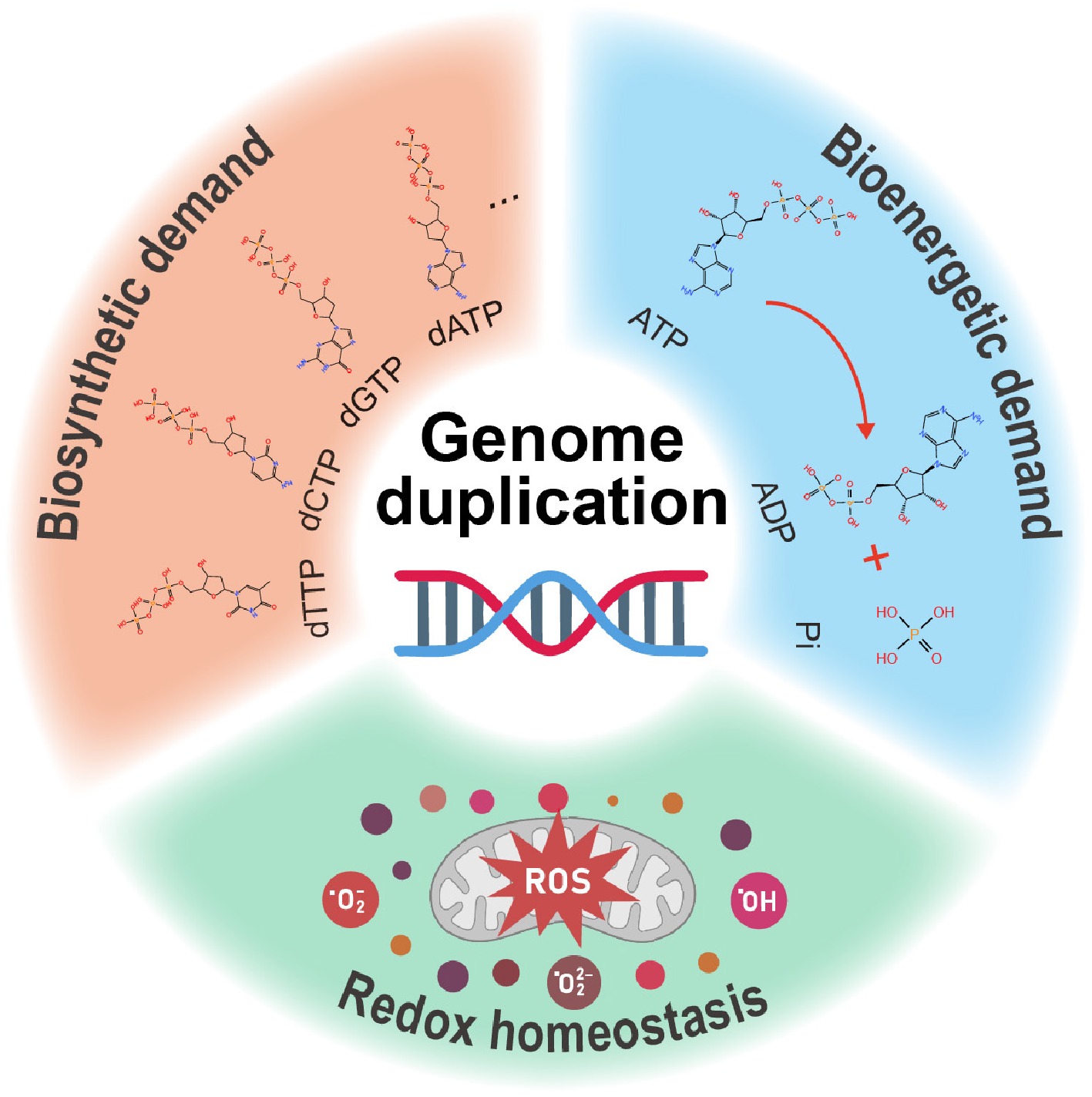
      Figure 1. 

      DNA replication is coordinated with cell metabolism. (1) Biosynthetic demand: the biosynthesis of macromolecules is important for DNA replication. In particular, dNTP, including dTTP, dCTP, dGTP, and dATP, which serve as basic building blocks, are much in demand; (2) Bioenergetic demand: energy supply is also indispensable for DNA replication. For instance, changes in ATP level can affect DNA replication; (3) Redox homeostasis: hydrogen peroxide (H2O2), hydroxyl radical (·OH), and superoxide anion (·O2) that are the main resources of ROS can influence DNA replication in different manners.

    • The biosynthesis of macromolecules is fundamentally important for almost every biological process and molecular event[1315]. As basic building blocks of DNA architecture, dNTP (Deoxynucleotide triphosphate) is in high demand during genome duplication[16,17]. As one of the best characterized conditions that compromise DNA replication and genome stability, depletion of the intracellular dNTP pool by HU (Hydroxyurea) that inhibits RNR (Ribonucleotide reductase) leads to the uncoupling between replicative helicase MCM2-7 and DNA polymerases[7,18,19]. As a consequence, ssDNA (Single-stranded DNA) coated by RPA is exposed, activating the ATR signaling cascade, the so-called replication checkpoint[2,20]. Once ATR is activated, it can directly phosphorylate key replication factors, such as RPA2 (Ser4/Ser8, Thr21 or Ser33), to protect fork stability[18,20]. In parallel, ATR catalyzes the phosphorylation of CHK1 (Checkpoint kinase 1), a master kinase that can phosphorylate and activate multiple factors required for replication initiation and elongation[21]. For example, CHK1 phosphorylates CDC25 (Cell division control protein 25) and WEE1 (Wee1-like protein kinase) to repress CDK1/2 activity and limit origin activation and fork progression[18,22,23].

      Excessive dNTP can also be harmful to DNA replication. Extravagant dNTP in S. cerevisiae impaired replication origin firing by hindering CDC45 recruitment[24]. Also, excessive dNTP could increase genomic mutations through inducing Polδ and Polε replacement by TLS (Translesion DNA synthesis) polymerases, such as REV1, Polη, and Polζ[2527]. In addition, an imbalanced dNTP supply might also be deleterious. For instance, an imbalanced dNTP pool caused by the overexpression of RNR mutant (rnr1-Y285A) in yeast resulted in a 13-fold higher mutation frequency than that in the wild type[17]. These findings demonstrated a critical role of macromolecule biosynthesis, particularly dNTP, in DNA replication (Fig. 1).

    • Energy production also seems indispensable for DNA replication[10,28,29]. Especially, changes in the energy currency, ATP, can influence DNA replication in multiple ways. In E. coli, DNA replication initiator DnaA (ORCs in mammals) was sensitive to cellular ATP level. Depletion of ATP led to DnaA degradation as well as a reduction in replication efficiency[29]. In eukaryotic cells, increased ATP levels accelerated DNA replication and promoted S phase progression[10,30]. A more recent work showed that ATP-binding to CDC7 (Cell division cycle 7-related protein kinase), the catalytic subunit of DDK, could unleash its activity to promote CDC45 recruitment and MCM2 S53 phosphorylation for replication initiation[3]. Other than CDC7, many key replication regulators, such as ORCs, CDC6, MCMs, and Lig1 (DNA ligase 1) are also ATP-dependent[3033]. For instance, there is an ATP-binding domain at the interface between each pair of MCM subunits of the MCM heterohexamer. ATP-binding is not only important for the stabilization of MCM hexamer and double hexamers but also required for the release of CDT1[30].

      In addition, AMPK (AMP-activated protein kinase), the master regulator of energy homeostasis[34], was also indicated to be important for DNA replication[3436]. AMPK activation, induced by low glucose or metformin, impaired DNA replication and arrested cell cycle at the G1/S border[36]. In response to replication stress, such as HU or Aph (Aphidicolin), AMPK catalyzed the phosphorylation of Exo1 (Exonuclease 1) at S746 to prevent its recruitment to stalled replication forks, and thus avoid unscheduled resection[35]. Together, these findings highlight the dynamic coordination of DNA replication with changes in the bioenergetic state (Fig. 1).

    • Accumulating evidence shows that redox homeostasis is important for DNA replication[11,13,37] (Fig. 1). In S. cerevisiae, an oscillation between oxidative and reductive state has been well characterized[38]. Adding H2O2 to boost ROS during the reductive phase of the yeast metabolic cycle, where DNA replication takes place, accelerated replication efficiency but increased genomic mutations[38]. In eukaryotes, ROS accumulation appeared to be associated with increases in transcription-replication conflicts, R-loop generation, and fork reversal[5]. For example, ROS-induced ATM (Ataxia telangiectasia mutated) oxidation at C2991 could mediate its dimerization and autophosphorylation[39], and in turn triggered MRE11 (Meiotic recombination 11)-dependent nascent DNA digestion at replication forks[37]. Intriguingly, reduction of mitochondrial ROS also jeopardized DNA replication[9]. Upon antioxidant MitoTEMPO treatment or PDC (Pyruvate dehydrogenase complex) depletion to block pyruvate production that directly supports the TCA (Tricarboxylic acid) cycle, and the ETC (Electron transport chain), mitochondrial ROS level was significantly decreased, resulting in decreased replication efficiency and reduced PCNA foci number[9]. Intracellular ROS can either function as a signaling molecule or trigger oxidative stress, depending on its level, that oscillates from nanomolar to micromolar, even under normal physiological conditions[40,41]. A threshold mechanism, which guarantees a proper amount of ROS acquired during DNA replication, might be able to reconcile the seemingly contradictory observations, but remains to be explored.

      Moreover, CDK2 could also respond to changes in ROS during the S phase. Clearance of mitochondrial ROS by MitoTEMPO or mutating C177, the oxidation site in CDK2, compromised CDK2 activity and impaired DNA replication[9]. A more recent study revealed that fluctuations in ROS level could also be 'sensed' through an alternative mechanism. In brief, upon ROS accumulation, PRDX2 (Peroxiredoxin 2) disassociated from the replication fork and impaired TIMELESS-TIPIN binding, resulting in a significant slowdown in fork progression[11]. Despite these findings, connections between redox homeostasis and DNA replication, as well as more direct links beyond biomass production, energy supply, and redox balance, remain to be further investigated.

    • Metabolic intermediates are fundamentally important for almost every cellular process and activity[4244]. In different situations, they may act as allosteric activators or repressors to manipulate protein functions[45]. Also, they could function as donor molecules and influence protein structure and function by supporting the establishment of distinct PTMs (Post-translational modifications), such as acetylation, phosphorylation, methylation, and O-GlcNAcylation (Fig. 2).
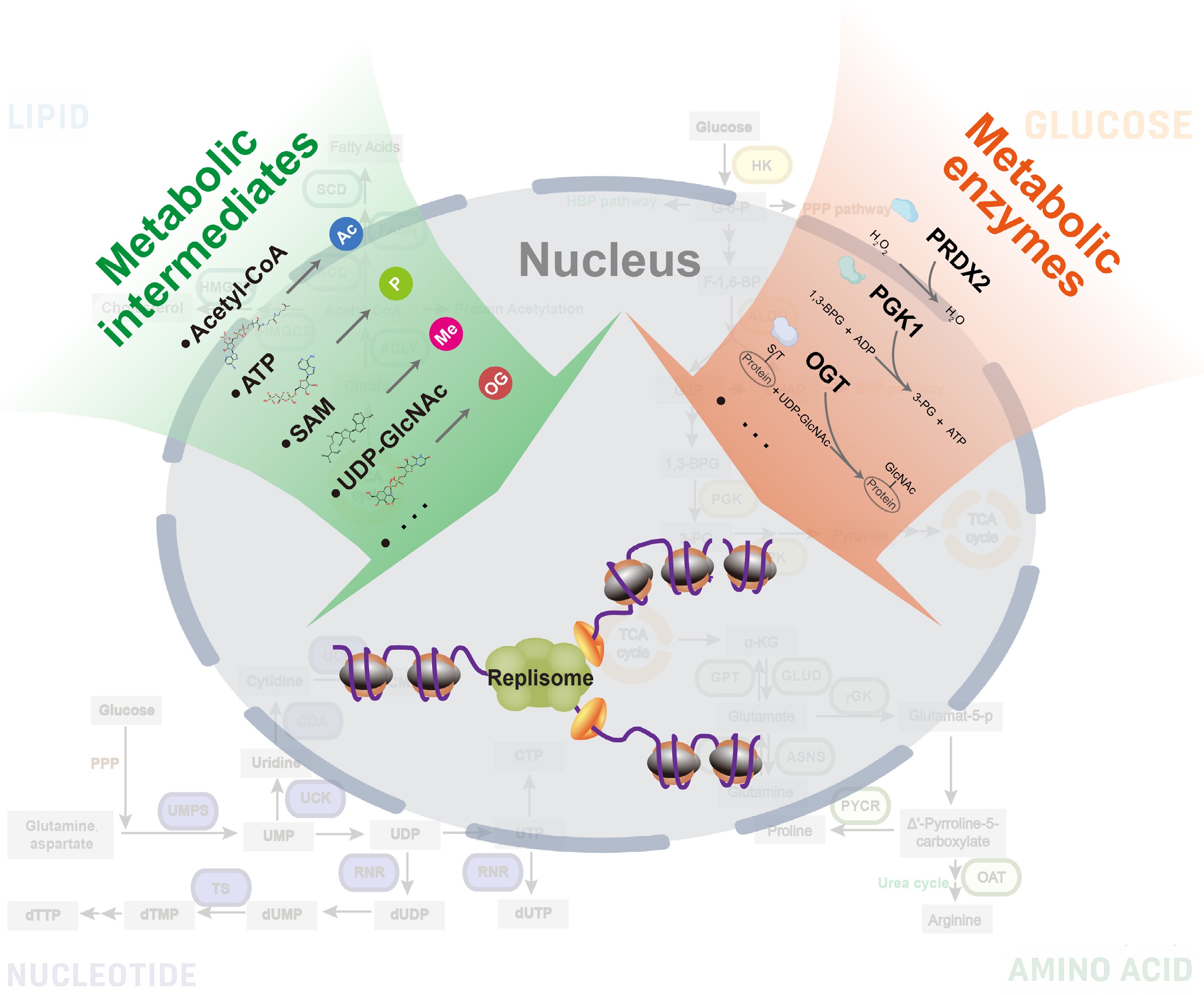
      Figure 2. 

      Metabolic regulation of DNA replication. (1) Metabolic intermediates: small molecules, such as acetyl-CoA, ATP, SAM, and UDP-GlcNAc, function as donors and support the establishment of PTMs on key factors to regulate DNA replication; (2) Metabolic enzymes: classic enzymes that control metabolic reactions may enter the nucleus and regulate fork function/stability directly.

    • Acetyl-CoA, which is usually produced via glucose and fatty acid metabolism, is the sole acetyl group donor for acetylation[14,46]. Notably, acetylation on both histones and non-histones has been shown to be important for DNA replication[47,48]. In yeast, acetylation at H3 K9/14 and H4 K5/8/12 near ARSs (Autonomously replicating sequences) appeared to be indispensable for DNA replication[49]. Mutating these lysines to arginines significantly impaired origin activation and S phase progression[49]. In HeLa cells, upregulation of H4 acetylation by histone acetyltransferase HBO1 (Histone acetyltransferase binding to ORC1) facilitated origin licensing, while artificial tethering of catalytically disabled HBO1 to origins dampened MCM2-7 loading[50]. In line with this observation, HBO1 in complex with scaffold protein BRPF3 (Bromodomain and PHD finger containing 3) promoted H3K14 acetylation and improved origin activation[51]. Moreover, acetylation of H3 at K56 by Rtt109 (p300 in mammals) also played a critical role in DNA replication, particularly for new histone deposition and nucleosome assembly[52,53].

      Interestingly, acetylation of key components in the replisome is also at play during DNA replication[54,55]. Acetylation of MCM10 at multiple sites (K312 and K390 in the internal domain, K683/K745/K761/K768 in the C-terminal domain) by p300 facilitated its unloading from chromatin and thus negatively regulated origin activation and fork progression[54]. Moreover, acetylation of PCNA at K13/K14/K20/K77/K80 also appeared to be important. Mutating these sites (5KR) to abolish acetylation compromised PCNA binding on DNA, causing an impairment in DNA replication and hypersensitivity to UV[55]. Together, acetyl-CoA can directly regulate DNA replication by facilitating acetylation on histones and key components of the replication machinery.

    • ATP is the donor molecule fueling phosphorylation on diverse proteins[56]. Extensive investigations have demonstrated that phosphorylation on replication factors is necessary for the control of DNA replication[6,57]. For instance, phosphorylation of MCM2 at S40, S53, and S108 by DDK is a prerequisite for its recruitment to chromatin[3]. MCM4 phosphorylation at S6 and T7 could promote its interaction with CDC45 to initiate DNA replication[58]. MCM10 phosphorylation at S66 and S630 respectively, enhanced its interaction with MCM2 and replisome stability[59,60]. Moreover, phosphorylation of GINS, precisely on sld2 and sld3 subunits, by S-CDK (CDK2 in mammals) improved the assembly of the functional CMG helicase during DNA replication[61,62].

      Besides, phosphorylation is also involved in cellular responses to replication stress[7,19]. Upon replication stress, ATR, the master kinase governing the DNA replication checkpoint, was activated and phosphorylated at T1989[63]. Subsequently, a chain of events driven by the phosphorylation of different downstream effectors, including CHK1 (S317 and S345), CDC25A (S124 and S76), RPA2 (Ser33, Ser4/Ser8 and Thr21), and H2AX (Ser139), was launched to maintain fork stability and genome integrity[7,20,63,64]. Collectively, phosphorylation is not only important for unperturbed DNA replication, but also plays a critical role in the control of replication stress response.

    • Methylation of DNA, RNA, and proteins is widely involved in the regulation of diverse cellular processes and molecular events[6568]. Its donor molecule is SAM (S-adenosylmethionine), synthesized from methionine and ATP by MAT (Methionine-adenosyltransferase)[69]. During DNA replication, both DNA methylation and histone/non-histone methylation appear to be indispensable[7074]. Genome-wide analyses, such as Repli-seq and Hi-C (High-throughput/resolution chromosome conformation capture), demonstrated that the absence of DNA methylation in human cells disrupted replication timing and altered 3D genome organization[75]. In mESCs (Mouse embryonic stem cells), DNA hypomethylation due to DNMT1 (DNA methyltransferase 1), DNMT3A (DNA methyltransferase 3A), and DNMT3B (DNA methyltransferase 3B) triple deletion delayed replication timing in pericentromeric heterochromatic domains[76]. Furthermore, knocking down DNMT1 in human cells triggered ATR-CHK1 activation and arrested S phase progression[71].

      In addition to DNA methylation, both histone and non-histone methylation are important for DNA replication. For example, H3K36me improved CDC45 recruitment to promote replication initiation in S. cerevisiae[72] . In human cells, H4K20me1 and H4K20me2 are crucial for ORCs recruitment, aiding origin licensing and activation[73,77]. Besides, methylation of PCNA at K110 promoted its trimerization and, in turn, stabilized polδ association at the replication fork during DNA replication[74]. Together, methylation is required for the control of DNA replication.

    • UDP-N-acetyl-D-glucosamine (UDP-GlcNAc), mainly produced via HBP (Hexosamine biosynthesis pathway), is the donor molecule of O-GlcNAc modification (Fig. 2), which is reversibly controlled by OGT (O-GlcNAc transferase) and OGA (O-GlcNAcase)[7880]. Because the synthesis of UDP-GlcNAc is tightly associated with glucose, fatty acid, amino acid, and nucleotide metabolism, O-GlcNAcylation is widely recognized as a 'nutrient sensor'[78,79,81]. Over the past few decades, more than 5,000 proteins bearing O-GlcNAcylation have been characterized[79]. They were shown to be involved in the control of a growing list of biological processes, such as signaling transduction, gene transcription, metabolic rewiring, and cell cycle progression[79,80,82].

      As for DNA replication, a panel of O-GlcNAcylated proteins has been shown to be critical (Table 1). For instance, H4S47 O-GlcNAcylation promoted the activation of the MCM complex and origin firing by facilitating DDK recruitment. Once H4S47 was mutated, the coordination between DNA replication and nutrient supply, especially glucose and glutamine, was disrupted[83]. This indicated that H4S47 O-GlcNAcylation might be a key linking genome duplication to the dynamically changing environment. Other than H4, H2A, H2B, and H3 could also carry O-GlcNAc modification[8486], but their role, if any, in DNA replication is still unclear. In addition to histones, MCM2, 3, 4, 5, 6, and 7 were also reported to bear O-GlcNAcylation[87]. Knockdown of OGT disturbed interactions between MCM subunits and impaired MCM association on chromatin[87]. A more recent study showed that RPA2 Ser4/Ser8, which are typically phosphorylated after DNA damage[88], could also be O-GlcNAcylated[89]. Upregulation of RPA2 O-GlcNAcylation by Thiamet-G, impaired CHK1 activation and S-G2 transition, suggesting an important role of RPA2 O-GlcNAcylation in DNA damage response[89] (Table 1). Unquestionably, more O-GlcNAcylated proteins and O-GlcNAcylation sites involved in the regulation of DNA replication and replication stress response will be discovered when technical breakthroughs in the detection of O-GlcNAcylation can be achieved in the future.

      Table 1.  O-GlcNAcylation on factors that are potentially involved in the control of DNA replication.

      Protein Site(s) Function Ref.
      Replisome components MCM2-7 Unknown Promotes MCMs loading on chromatin [87]
      FEN1 S352 Disrupts FEN1 interaction with PCNA, causing replication defect and DNA damage [93]
      AND-1 S575, S893 Promotes HR to protect genome stability [94]
      Histones H4 S47 Directs DDK recruitment to promote replication origin activation [83]
      H2A S40 Associate with γH2AX to promote genome stability [84]
      DNA damage repair factors PLK1 T291 Required for proper chromosome segregation and thus important for the maintenance of genome stability [98]
      H2AX S139 Antagonizes phosphorylation of S139 on H2AX to restrain DNA damage signaling and protect genome integrity [90]
      Polη T457 Promotes TLS synthesis [99]
      MRE11 Unknown Promotes MRE11 recruitment on chromatin to protect genome integrity [100]
      RPA2 S4, S8 Antagonizes RPA2 S4/8 phosphorylation and impairs Chk1 activation [89]
      MCM, minichromosome maintenance; FEN1, flap endonuclease 1; AND-1, acidic nucleoplasmic DNA-binding protein 1; PLK1, polo-like kinase 1; Polη, DNA polymerase eta; MRE11, meiotic recombination 11; RPA, replication protein A; HR, homologous recombination.

      Together, metabolic intermediates can serve as messengers coupling cell metabolism to DNA replication. Meanwhile, changes in the complex metabolic network reflected by alterations in variable PTMs may also profoundly impact both the epigenomic landscape and genomic function.

    • In recent years, mounting evidence has shown that metabolic enzymes possess previously unappreciated functions beyond the regulation of cell metabolism[15,90,91]. These functions, including transcriptional regulation, DNA damage repair, and signaling transduction, are frequently referred to as the 'moonlighting' functions[91,92]. Notably, their emerging roles in DNA replication have attracted increasing attention (Table 2).

      Table 2.  Metabolic enzymes potentially involved in the regulation of DNA replication.

      Metabolic enzyme Function in DNA replication Ref.
      PGK1 Binds to CDC7 and convert ADP to ATP for origin activation [12]
      PRDX2 Associates with TIMELESS-TIPIN at the replication fork to adjust fork speed [11]
      OGT Enriches on chromatin in S phase and modifies H4 S47 to promote origin activation [83]
      ACO2 Knockdown of ACO2 compromises DNA synthesis [94]
      HK2 Knockdown of HK2 compromises DNA synthesis [94]
      GAPDH Knockdown of GAPDH compromises DNA synthesis [94]
      PDC Localizes in the nucleus and regulates S phase entry [97]
      H6PD Knockdown of H6PD impairs DNA synthesis [93]
      RPE Knockdown of RPE impairs DNA synthesis [93]
      PRPS1 Knockdown of PRPS1 impairs DNA synthesis [93]
      ACLY Regulates nuclear acetyl-CoA concentration thereby regulating MCM2-7 and CDC45 transcription [101]
      FH Knockout of FH in S. cerevisiae leads to be sensitive to HU [95]
      IDH1/2 IDH1/2 mutants regulate DNA replication by contributing heterochromatin formation [96]
      PGK1, phosphoglycerate kinase 1; PRDX2, peroxiredoxin 2; OGT, O-GlcNAc transferase; ACO2, aconitate hydratase 2; HK2, hexokinase 2; GAPDH, glyceraldehyde-3-phosphate dehydrogenase; PDC, pyruvate dehydrogenase complex; H6PD, hexose-6-phosphate dehydrogenase; RPE, ribulose 5-phosphate epimerase; PRPS1, ribose-phosphate pyrophosphokinase 1; ACLY, ATP-citrate lyase; FH, fumarate hydratase; IDH, isocitrate dehydrogenase.

      Unbiased siRNA screen of metabolic enzymes from the pentose phosphate pathway demonstrated that downregulation of H6PD (Hexose-6-phosphate dehydrogenase), RPE (Ribulose 5-phosphate epimerase), or PRPS1 (Ribose-phosphate pyrophosphokinase 1) impaired DNA synthesis[93] (Table 2). Downregulation of metabolic enzymes that are responsible for glycolysis and TCA cycle, such as HK2 (Hexokinase 2), GAPDH (Glyceraldehyde-3-phosphate dehydrogenase), ACO2 (Aconitate hydratase 2), and FH (Fumarate hydratase), could also hinder DNA synthesis in human cells[94] (Table 2). In line with these observations, Fum1 (Fumarate hydratase in mammals)-dependent generation of fumarate competed with α-KG (α-ketoglutarate) to inhibit histone demethylase Jhd2 in S. cerevisiae. This stimulated H3K4me2/me3 accumulation, and eventually helped cells survive replication stress[95]. IDH1/2, which are also key enzymes controlling the TCA cycle, could also regulate DNA replication[96]. 2HG (2-hydroxyglutarate), generated by the oncogenic IDH1/2 mutant, inhibited dioxygenases to increase H3K9me2, a marker of facultative heterochromatin. As a consequence, replication fork progression in heterochromatic regions was slowed down, causing replication stress and DNA double-strand break[96]. Moreover, PDC could enter the nucleus and regulate S phase entry[97]. GAPDH and LDH (Lactate dehydrogenase) participated in the regulation of S phase-specific H2B transcription in human cells, and linked H2B expression to NAD+/NADH redox status[98100]. In addition, key enzymes in fatty acid metabolism were also indicated to be involved in the regulation of DNA replication. For instance, mutation of Y542 and Y652 in ACLY (ATP-citrate synthase) impaired its catalytic activity in human cells, causing reduced acetyl-CoA supply and compromised expression of MCM2-7 and CDC45, which both are essential components of the replication machinery[101] (Table 2).

      Evidence indicating a more direct connection between metabolic enzyme and DNA replication has already been revealed in earlier investigations[11,12,102]. PDH (Pyruvate dehydrogenase) was found to be associated with OriC, the sole replication origin in B. subtilis, and interacted with DnaG (DNA primase)[103105]. Depending on their concentrations in the reaction systems in vitro, purified LDH, GAPDH, and PGK1 (Phosphoglycerate kinase 1) could either stimulate or repress the activity of Polα, Polε, and Polδ[106,107]. More recently, PGK1 was demonstrated to modulate replication initiation, precisely origin activation, by converting ADP to ATP. It alleviated ADP-dependent inhibition of CDC7, the catalytic subunit of DDK, and unleashed its activity to phosphorylate MCM2 for origin activation[12] (Fig. 2, Table 2). The presence of PRDX2, a member of the peroxiredoxin family that controls ROS homeostasis[108,109], at the replication fork further substantiated the important role of metabolic enzyme(s) in DNA replication[11] (Fig. 2, Table 2). In brief, PRDX2 formed a decamer associating with TIMELESS-TIPIN complex at the replication fork. Due to the accumulation of intracellular ROS, PRDX2 was released from the replication fork and caused TIMELESS-TIPIN dissociation, resulting in a significant slowdown in replication fork progression. When PRDX2 was depleted, unprotected replication forks became more vulnerable to ROS stimuli, leading to DNA damage accumulation and therefore genome instability[11].

      Together, these findings depict important functions of metabolic enzymes for the control of DNA replication (Fig. 2). Compared to classic replication regulators, this additional layer of regulation by metabolic enzymes may, to some extent, have the privilege of orchestrating genomic DNA replication in a dynamically changing metabolic context.

    • Despite extensive investigations on metabolic reprogramming associated with biological and pathological processes, how DNA replication is interconnected with cell metabolism still remains elusive. In recent years, exciting findings on previously unappreciated functions of metabolic enzymes and PTMs in DNA replication have shed some light on the connection of DNA replication to its extracellular environment. Undeniably, technical limitations, such as the detection of highly dynamic metabolites in specific compartments in cells, are still the major barriers hindering advances in this field. Emerging revolutionary approaches, such as genetically encoded fluorescent biosensors, obviously hold great promise for overcoming these hurdles. In particular, powerful tools like FiLa for monitoring lactate in real time with spatial distribution, and SoNar/Frex for tracking subcellular NAD+/NADH ratio dynamics, will help us understand the metabolic control of DNA replication[110112].

      Metabolic reprogramming and uncontrolled DNA replication are hallmarks of cancer and are intertwined with each other in many pathological situations. In patients with ADA (Adenosine deaminase) deficiency autosomal recessive disorder of purine metabolism, ADA mutations caused abnormal accumulation of dATP (Deoxyadenosine triphosphate) in lymphocytes[113115]. An earlier study showing disrupted balance among the four types of dNTP and compromised DNA synthesis resulting from dATP upregulation indicates a strong connection between metabolic changes and DNA replication in this specific disorder[114]. Moreover, ALCL (ALK-positive anaplastic large cell lymphoma) and NECs (Neuroendocrine carcinomas) are characterized with upregulated NAMPT (Nicotinamide phosphoribosyltransferase), and acute NAD+ elevation, which can lead to pyrimidine depletion, purine accumulation, and eventually cause replication defects and genomic instability[116]. Targeting metabolic pathways and DNA replication is already proven to be effective for treating and preventing human diseases, such as cancer. Exploration of mechanism(s) linking DNA replication to cell metabolism can pave the way to develop integrative strategies for tackling human diseases, and may eventually achieve 'killing two birds with one stone'.

      • This work was supported by grants from the National Natural Science Foundation of China (Grant Nos 32470782 and 32070758 to YF). This work was also supported by the Shenzhen Medical Research Fund (B2402044 to YF), the Natural Science Foundation of Jilin province (20250102279JC to YF), the Research and Innovation Improvement Project for PhD Students (JJKH20250328BS to YF), Higher Education Teaching Reform Project of Jilin province (JJKH20240138YJG to YF), and Fundamental Research Funds for the Central Universities (2024135134006 to YF). We would like to thank Sung-Bau Lee (College of Pharmacy, Taipei Medical University), Jialin Liu (National Center for Protein Sciences, Beijing Institute of Lifeomics), and Yang Jiao (School of Physical Education, Northeast Normal University) for their advice.

      • An ethics statement is not applicable because this study is based exclusively on published literature and publicly available data.

      • The authors confirm contribution to the paper as follows: conception and design: Feng Y, Dong K, and Pei J; draft manuscript preparation: Feng Y, Dong K, and Pei J; review and/or editing of the manuscript: Liu J, Li Y, and Wang Y. All authors approved the final version of the manuscript.

      • The datasets generated during and/or analyzed in the current study are available from the corresponding author on reasonable request.

      • The authors declare that they have no conflict of interest.

      • # Authors contributed equally: Kejian Dong, Jiayao Pei

      • Copyright: © 2025 by the author(s). Published by Maximum Academic Press, Fayetteville, GA. This article is an open access article distributed under Creative Commons Attribution License (CC BY 4.0), visit https://creativecommons.org/licenses/by/4.0/.
    Figure (2)  Table (2) References (116)
  • About this article
    Cite this article
    Dong K, Pei J, Liu J, Li Y, Wang Y, et al. 2025. Metabolic control of DNA replication: beyond biosynthetic and bioenergetic needs. Epigenetics Insights 18: e016 doi: 10.48130/epi-0025-0015
    Dong K, Pei J, Liu J, Li Y, Wang Y, et al. 2025. Metabolic control of DNA replication: beyond biosynthetic and bioenergetic needs. Epigenetics Insights 18: e016 doi: 10.48130/epi-0025-0015

Catalog

    /

    DownLoad:  Full-Size Img  PowerPoint
    Return
    Return