











-
Tradescantia zebrina, commonly known as wandering Jew, 'Matali' in Mexico, or 'Shui Gui Cao' in China, is a traditionally consumed medicinal and edible plant in Latin America, the Caribbean, and Asia. Its leaves are commonly prepared as teas, decoctions, or cold beverages. In addition to its dietary use, the plant has been applied in traditional remedies for kidney and urinary problems, tuberculosis, cough, high blood pressure, intestinal inflammation, gastritis, conjunctivitis, and influenza[1−3]. Recent studies have identified its leaves as a source of phenolic acids, flavonoids, and anthocyanins, which contribute to antioxidant capacity and other bioactivities[4−6]. While the general antioxidant capacity of T. zebrina extracts has been explored using common chemical assays[7,8], no study has systematically evaluated their ability to scavenge physiologically relevant oxidants such as hydrogen peroxide (H2O2) and nitric oxide (NO), or to inhibit protein denaturation. For T. zebrina, the responses of these key indicators of antioxidant and anti-inflammatory potential following gastrointestinal (GI) digestion remain unexplored. This represents a knowledge gap for its development as a functional food ingredient.
Among extraction techniques, hot water extraction (HWE) and ultrasound-assisted extraction (UAE) are particularly favorable for food applications. HWE is simple, food-compatible, and widely used for preparing edible plant extracts. It relies on water as a safe solvent, making it particularly suitable for food applications where chemical residues must be avoided. HWE uses thermal diffusion to release both soluble and bound compounds[9,10]. UAE enhances mass transfer through ultrasonic cavitation, promoting cell wall disruption and improving solvent penetration; this improves the recovery of phenolics without harsh solvents[11]. While both methods have been individually applied to T. zebrina[4,7], a sequential hybrid approach (UAE + HWE, or HWE + UAE) has not been reported on the species. In other edible plants, such as black glutinous rice, hybrid UAE–HWE extraction has yielded higher phenolic recovery and stronger antioxidant activity than single-step methods[12]. Thus, it is hypothesized that this hybrid approach can maximize phytochemical yield and bioactivity in T. zebrina leaf extracts by combining the complementary actions of both techniques.
Evaluation of bioactivity retention after oral consumption requires simulation of GI conditions[13]. The standardized INFOGEST digestion protocol was employed in this study to address this, as it provides a physiologically relevant simulation of oral, gastric, and intestinal phases[14]. Unlike simple chemical assays, INFOGEST allows assessment of whether bioactive compounds may survive GI digestion to exert biological effects in vivo. To date, the potential of sequential hybrid extraction strategies and the gastrointestinal stability of T. zebrina bioactive compounds remain unexplored. Accordingly, the objectives of this study were: (1) to optimize extraction conditions for T. zebrina leaves using HWE, UAE, and sequential UAE–HWE methods, and to identify the most efficient strategy based on phytochemical yield and antioxidant activity; and (2) to evaluate the GI stability of phytochemicals, antioxidant activities, and anti-inflammatory potential in the optimized extract using the INFOGEST model.
-
Fresh leaves of T. zebrina were purchased from a local market in Kampar, Malaysia, on 8 March 2025. The leaves were oven-dried at 50 °C to a constant weight[4]. The dried leaves were pulverized into powder and stored at 4 °C until extraction. 2,2′-azino-bis(3-ethylbenzothiazoline-6-sulfonic acid) diammonium salt (ABTS) was purchased from Tokyo Chemical Industry; 2,2-diphenyl-1-picrylhydrazyl (DPPH) was purchased from Sigma-Aldrich; porcine bile extract and porcine pancreatin were purchased from Sigma Life Science; porcine pepsin was purchased from ChemSolv; phosphate buffered saline (PBS) was purchased from Oxoid; gallic acid and bovine serum albumin fraction V (BSA) were purchased from Merck; quercetin hydrate was purchased from Arcos Organics. Solid-phase extraction (SPE) cartridges Strata C18-E (sorbent mass: 500 mg; volume: 6 mL) were purchased from Phenomenex Inc. All other reagents used were of analytical grade.
Extraction
-
HWE was performed according to Ramos-Arcos et al.[7], while UAE was conducted following Feihrmann et al.[4], both with minor modifications. For both extraction methods, T. zebrina leaf powder was extracted with deionized water at a 3 g:100 mL ratio. In HWE, the mixture was incubated in a 90 °C water bath for 15, 30, or 60 min. In UAE, the mixture was incubated in a thermostatically-controlled ultrasound bath at 60 °C and 42 kHz for 5, 10, or 20 min. For convenience, extraction treatments are hereafter denoted as HWE-x and UAE-x, where x indicates the extraction duration (min). After incubation, all mixtures were centrifuged at 10,000 rpm for 15 min. The resulting supernatants were freeze-dried to obtain extract powders, which were stored at –20 °C for further use. Sequential hybrid extractions were performed in two ways: (i) HWE for 15 min followed by UAE for 20 min (designated as 'HWE-15 + UAE-20'), and (ii) UAE for 20 min followed by HWE for 15 min (designated as 'UAE-20 + HWE-15'). A control extract (HWE-0 + UAE-0) was prepared by mixing leaf powder in deionized water at the same 3 g:100 mL ratio as above without heating or sonication, then centrifuged, and the resulting supernatant was freeze-dried as described above.
Determination of phytochemical contents
-
Total phenolic content (TPC), total flavonoid content (TFC), and total anthocyanin content (TAC) were quantified using standard spectrophotometric assays. TPC was measured via the Folin-Ciocalteu method[15] and expressed as mg of gallic acid equivalent (GAE) per g of dry extract (standard curve: 0–100 mg/L). TFC was assessed using the aluminum chloride colorimetric method[15]. TFC is expressed as mg of quercetin equivalent (QE) per g of dry extract, based on a quercetin standard curve (0–500 µg/mL).
TAC was determined through a pH differentiation method[16]. Briefly, 200 µL of the sample was added to 800 µL of either 25 mM potassium chloride-hydrochloric acid buffer (pH 1.0) or 400 mM sodium acetate-acetic acid buffer (pH 4.5). The mixtures were allowed to stand in darkness for 15 min. The absorbance was measured at 510 and 700 nm for each solution, using water as a blank. The corrected absorbance of the sample was calculated as follows:
$ \mathrm{Corrected}\;\text{absorbance}\;\left({\mathrm{A}}_{\mathrm{c}}\right)=({{{\mathrm{A}}_{510}}-{{\mathrm{A}}_{700}})}_{\mathrm{pH}1.0}-({{{\mathrm{A}}_{510}}-{{\mathrm{A}}_{700}})}_{\mathrm{pH}4.5} $ (1) where, Ac represents corrected absorbance; A510 and A700 represent absorbances at 510 and 700 nm, respectively.
The concentration of anthocyanins, expressed as cyanidin-3-glucoside equivalent (CGE) in the assayed sample, was calculated:
$ \mathrm{CGE}\;\text{concentration}\;\left(\mathrm{mg}/\mathrm{L}\right)=\dfrac{{\mathrm{A}}_{\mathrm{c}}\times \mathrm{MW}\times \mathrm{DF}\times 1{,}000}{\varepsilon \times 1} $ (2) where, MW represents the molecular weight of cyanidin-3-glucoside (449.2 g/mol); DF represents the dilution factor; ε is the molar absorptivity (26,900 M−1cm−1). The calculated concentration (mg/L) was then converted and expressed as TAC, in μg of CGE per g of dry extract.
Determination of antioxidant activities
-
The scavenging activities against 2,2-diphenyl-1-picrylhydrazyl radical (DPPH•) and 2,2′-azino-bis(3-ethylbenzothiazoline-6-sulphonic acid) radical cation (ABTS•+) were assessed according to Chai & Wong[15]. For both assays, the scavenging activity was calculated as percentage inhibition relative to the control, and results were expressed as EC50 values (concentration required for 50% inhibition) derived from dose-response curves.
H2O2 scavenging activity was evaluated by combining an aliquot of the sample (200 μL) with 40 mM H2O2 (600 μL) and keeping it in darkness for 10 min. The scavenging activity was determined as a percentage inhibition relative to the control as previously described[17]. EC50 values were derived from dose-response curves.
NO scavenging activity was determined following Chai et al.[18], with slight modifications. Briefly, a sample (1,200 µL) was mixed with 300 µL of 5 mM sodium nitroprusside and then kept under a light source for 150 min. Next, an equal volume of the reaction mixture was reacted with an equal volume of Griess reagent for 10 min, and the absorbance was measured at 546 nm. The scavenging activity was calculated as a percentage inhibition relative to the control, as previously described[18]. EC50 values were derived from dose-response curves.
Ferric reducing antioxidant power (FRAP) was determined according to Chai & Wong[15]. FRAP value is expressed in µmol of Fe2+ equivalents per g of dry extract, which was calculated from a standard curve prepared from 0.0 to 0.4 mM ferrous sulfate heptahydrate.
Determination of the inhibition of albumin denaturation
-
Inhibition of albumin denaturation was assessed as described by Kpemissi et al.[19], with slight modifications. Briefly, 25 µL of the sample was mixed with 225 µL of 5% (w/v) BSA and incubated at 37 °C for 15 min. Then, the mixture was further incubated at 70 °C for 5 min. Absorbance was measured at 660 nm after adding 500 µL of PBS. The percentage inhibition on albumin denaturation was calculated as previously described[19]. EC50 values were derived from dose-response curves.
Simulated GI digestion: the INFOGEST method
-
Simulated GI digestion was carried out based on the INFOGEST 2.0 protocol[14], with slight modifications[20,21]. For GI digestion, only the UAE-20 + HWE-15 extract was investigated. For comparison, a 'GI blank' was also prepared by replacing the extract with deionized water.
For the oral phase, 5 mL of the sample was combined with 4 mL of 1.25 × simulated salivary fluid (SSF), 25 µL of 0.3 M CaCl2•2H2O, and 975 µL of water. The mixture was shaken at 37 °C and 125 rpm for 2 min. For the gastric phase, the oral mixture was added with 8 mL of 1.25 × simulated gastric fluid (SGF), followed by pH adjustment to 3.0. Next, 5 µL of 0.3 M CaCl2•2H2O and 500 µL of porcine pepsin (40,000 U/mL) were added to the mixture. Water was then added to a final volume of 20 mL, and the mixture was incubated at 37 °C and 125 rpm for 2 h. For the intestinal phase, the gastric mixture was combined with 12 mL of 1.25 × simulated intestinal fluid (SIF). The pH was adjusted to 7.0. Next, 40 µL of 0.3 M CaCl2•2H2O, 2.5 mL of porcine pancreatin (800 U/mL), and 1.5 mL of porcine bile extract (133.3 mM) were added to the mixture. Water was then added to a final volume of 40 mL. The mixture was incubated at 37 °C and 125 rpm for 2 h. Lastly, to terminate the reaction, the mixture was boiled at 100 °C for 5 min. The mixture was then freeze-dried to obtain a sample in powder form, which was stored at −20 °C for further use.
C18 SPE
-
C18 SPE was performed on post-INFOGEST samples to minimize interfering signals from the INFOGEST method, as digestive enzymes and bile salts are known to contribute background absorbance in colorimetric assays[22]. Briefly, the freeze-dried sample was reconstituted in water (10 mg/mL) and filtered (0.45 μm membrane). The SPE cartridge was conditioned with 6 mL of methanol and equilibrated with 6 mL of deionized water following the manufacturer's instructions. Two mL of the filtered sample was loaded, followed by washing with 6 mL of 5% (v/v) methanol. The flow-through was discarded. Next, 6 mL of 70% (v/v) methanol was used for elution. Methanol in the eluate was removed through rotary evaporation (337 mbar, 40 °C), followed by freeze-drying of the aqueous residue. The freeze-dried post-SPE fraction was reconstituted in water for subsequent biochemical assays.
Statistical analysis
-
All experiments were conducted in triplicate. Data collected are expressed as mean ± standard error. Statistical analyses were carried out using StatsKingdom (
http://statskingdom.com ). For comparisons among more than two groups, one-way ANOVA followed by Tukey's HSD multiple comparison tests was used to assess the significance of differences between means at p < 0.05. For two-group comparisons of EC50 values between the pre-GI extract and GI sample, EC50 values were log10-transformed and analyzed using Welch's t-test, with significance accepted at p < 0.05. Pearson correlation analysis was performed to examine the relationships between phytochemical contents and antioxidant activities. -
The phytochemical contents of nine T. zebrina extracts obtained using various extraction strategies are shown in Table 1. The sequential UAE-20 + HWE-15 treatment produced the highest TPC and shared similarly high TFC with HWE-15, while TAC was highest in the UAE-5 extract. TAC was mainly detected in UAE-based extracts but was undetectable in longer HWE treatments. In addition to phytochemical composition, the practical extraction efficiency of the nine extraction methods was observed. The extraction yields across the nine methods ranged from about 15% to 22%. HWE-15 + UAE-20 extraction produced the highest yield (22.2%), followed by UAE-20 + HWE-15 extraction (20.7%).
Table 1. Phytochemical contents of extracts obtained by HWE and UAE.
Extract TPC (mg GAE/g
dry extract)TFC (mg QE/g
dry extract)TAC (μg CGE/g
dry extract)HWE-15 7.08 ± 0.01a 63.78 ± 0.97a 13.92 ± 2.78a HWE-30 6.78 ± 0.01b 50.00 ± 0.19b n.d. HWE-60 6.25 ± 0.01c 46.22 ± 0.99c n.d. UAE-5 6.31 ± 0.00d 33.33 ± 0.51d 55.66 ± 2.78b UAE-10 6.33 ± 0.01d,e 35.22 ± 0.48d,e 36.18 ± 5.57c UAE-20 6.48 ± 0.01f 43.44 ± 0.29c,f 36.18 ± 2.78c,d Control (HWE-0 + UAE-0) 6.11 ± 0.01g 23.89 ± 0.59g n.d. HWE-15 + UAE-20 7.20 ± 0.01h 59.00 ± 0.39h 33.40 ± 0.00c,d,e UAE-20 + HWE-15 8.11 ± 0.01i 62.56 ± 0.29a,i 16.70 ± 0.00a,f HWE, hot water extraction; UAE, ultrasound-assisted extraction; HWE-x and UAE-x denote extraction treatments where x indicates duration (min); Control (HWE-0 + UAE-0), untreated sample (no heating or sonication); TPC, total phenolic content; TFC, total flavonoid content; TAC, total anthocyanin content; GAE, gallic acid equivalent; QE, quercetin equivalent; CGE, cyanidin-3-glucoside equivalent; n.d., undetectable. Data are presented as mean ± standard error (n = 3). Values with different superscript letters within a column differ significantly (p < 0.05, Tukey's HSD test). The antioxidant activities of the nine extracts were evaluated using DPPH• scavenging, ABTS•+ scavenging, and FRAP assays (Fig. 1). For the DPPH• and ABTS•+ scavenging activities, a lower EC50 value indicates higher antioxidant activity. The potency of the extracts was benchmarked against quercetin, a well-established antioxidant. The EC50 values for quercetin for the DPPH• and ABTS•+ scavenging activities were 4.928 ± 0.034 μg/mL and 5.550 ± 0.036 μg/mL, respectively. The relative DPPH• scavenging activities of the nine extracts, sorted in descending order, are: sequential hybrid extracts (EC50 0.587–0.675 mg/mL) > HWE (EC50 0.715–0.772 mg/mL) > UAE (EC50 0.843–1.053 mg/mL). Comparison of the EC50 for the ABTS•+ scavenging activities found that the differences between the activities of the HWE and UAE groups are less distinct than for the DPPH• scavenging activities. While HWE-15 clearly had greater activity than all three UAE extracts, UAE-10 and UAE-20 extracts showed greater activity than HWE-30 and HWE-60 extracts. Among the two extracts prepared from the sequential hybrid extraction methods, the UAE-20 + HWE-15 extract demonstrated the highest DPPH• and ABTS•+ scavenging activities, with EC50 values that are about 45% and 40% lower than those of the control extract, respectively. Based on FRAP values, similar to DPPH• scavenging activity, the nine extracts can be clearly sorted in descending order into three groups, namely: sequential hybrid extracts (90.24–90.66) > HWE (72.85–88.20) > UAE (60.00–65.90). Based on FRAP values, both the UAE-20 + HWE-15 and HWE-15 + UAE-20 extracts had similar antioxidant potency. Based on the results from all three assays depicted in Fig. 1, the UAE-20 + HWE-15 extract was markedly more potent than all other extracts (p < 0.05). Thus, based on its superior performance in yielding high phytochemical content (Table 1) and potent antioxidant activity (Fig. 1), the UAE-20 + HWE-15 extract was selected for the subsequent GI digestion study.
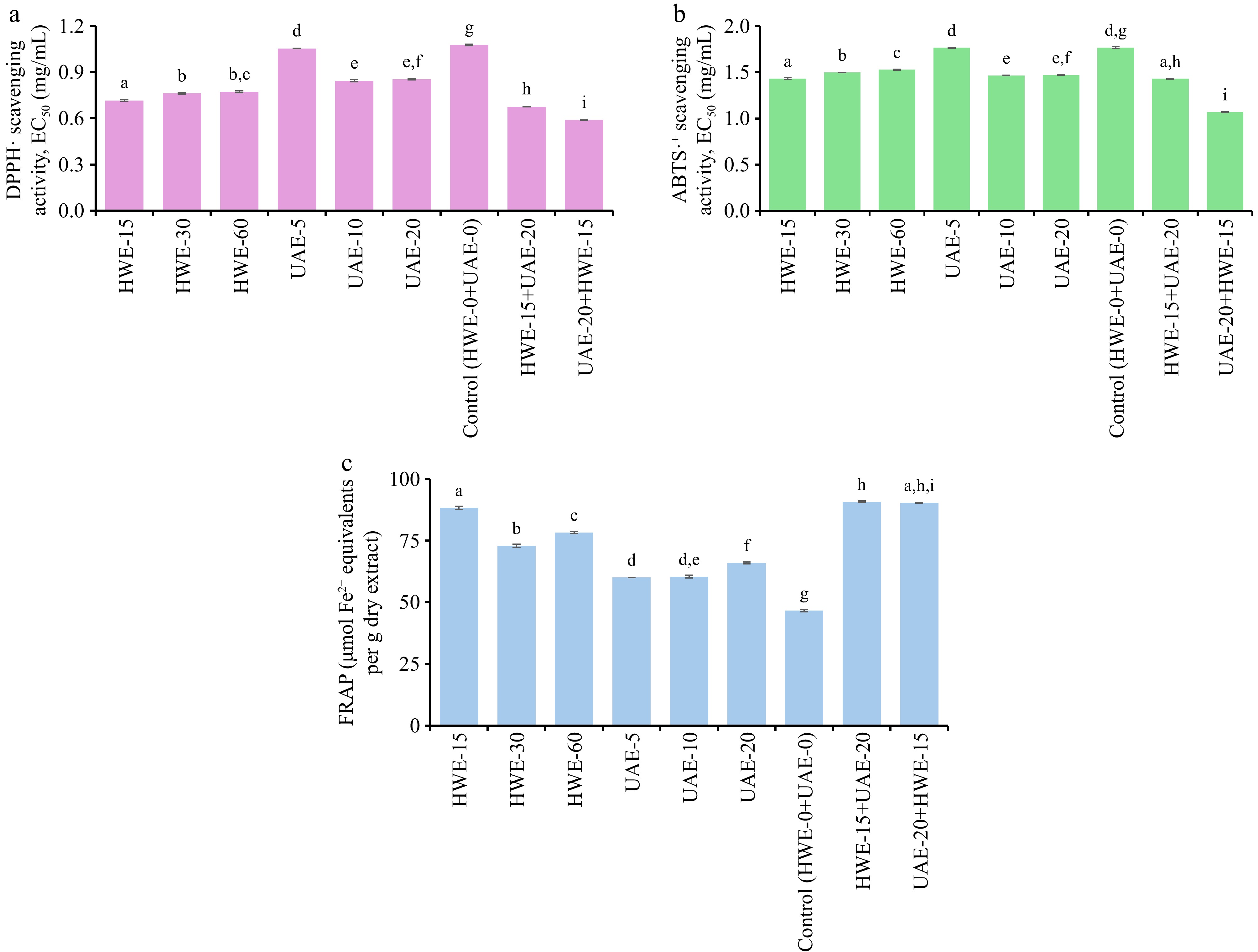
Figure 1.
Antioxidant activities of extracts obtained by different extraction treatments. (a) DPPH• scavenging activity (EC50 values). (b) ABTS•+ scavenging activity (EC50 values). (c) Ferric reducing antioxidant power (FRAP) values. Each bar represents mean ± standard error (n = 3). Values with different lowercase letters differ significantly (p < 0.05), as determined by Tukey's HSD multiple comparison test. Extract abbreviations are as defined in Table 1.
To investigate the relationship between phytochemical contents and antioxidant activity, Pearson correlation analysis was performed (Table 2). Both TPC and TFC were strongly and positively correlated with DPPH• scavenging (r = 0.8712 and 0.9125, respectively), ABTS•+ scavenging (r = 0.9035 and 0.7231, respectively), and FRAP values (r = 0.7962 and 0.9753, respectively; all p < 0.05). In contrast, TAC showed no significant correlation with any antioxidant activity (p > 0.05 for all).
Table 2. Pearson correlation coefficients between phytochemical contents and antioxidant activities of T. zebrina extracts.
Variable DPPH• (1/EC50) (r, p) ABTS•+ (1/EC50) (r, p) FRAP (r, p) TPC 0.8712 (p < 0.05) 0.9035 (p < 0.05) 0.7962 (p < 0.05) TFC 0.9125 (p < 0.05) 0.7231 (p < 0.05) 0.9753 (p < 0.05) TAC −0.2009 (p > 0.05) −0.0977 (p > 0.05) −0.1083 (p > 0.05) r values represent the strength of linear correlation, and p values indicate statistical significance. Following the INFOGEST-based simulated GI digestion procedure, the digestion product derived from the UAE-20 + HWE-15 extract was partially purified by using the SPE method to reduce INFOGEST-derived components that could potentially interfere with subsequent analyses. The methanolic fraction recovered from the SPE method, designated 'GI sample', was analyzed for its phytochemical contents and bioactivities. As shown in Table 3, despite being subjected to GI digestion, remaining TPC, TFC, and TAC were still detected. Notably, low but measurable levels of TPC and TFC were also detected in the GI blank after SPE. Among the three phytochemical parameters, TAC was the most stable after digestion, with its concentration (11.13 μg CGE per g sample) not differing statistically from the pre-digestion extract (16.70 μg CGE per g sample) (p > 0.05). In contrast, both TPC and TFC were markedly reduced after digestion (p < 0.05).
Table 3. Effects of simulated GI digestion on the phytochemical contents of UAE-20 + HWE-15 extract.
Treatment TPC (mg GAE/g
sample)TFC (mg QE/g
sample)TAC (μg CGE/g
sample)Pre-GI 8.11 ± 0.01a 62.56 ± 0.29a 16.70 ± 0.00a GI sample 3.28 ± 0.01b 6.44 ± 0.22b 11.13 ± 2.78a,b GI blank 1.71 ± 0.01c 3.44 ± 0.59c 0.00 ± 0.00c GI, gastrointestinal; Pre-GI, extract prior to GI digestion; GI sample, extract subjected to GI digestion, followed by SPE; GI blank, digestion control prepared without extract, followed by SPE. Other abbreviations are defined in Table 1. Data are presented as mean ± standard error (n = 3). Values with different superscript letters within a column differ significantly (p < 0.05, Tukey's HSD test). Following the analysis of phytochemical contents, the bioactivities of the UAE-20 + HWE-15 extract were evaluated after GI digestion. Overall, the antioxidant activities (Fig. 2a–d) and inhibition of albumin denaturation (Fig. 2e) were markedly reduced (p < 0.05). When compared with the pre-GI extract, the GI sample still exhibited dose-dependent responses, but at markedly lower levels. For example, at 3 mg/mL, the pre-GI extract had approximately 75% H2O2 scavenging activity, whereas the GI sample had about 42% (Fig. 2d). Similarly, the FRAP value of the GI sample decreased by 66% relative to the pre-GI extract (Fig. 2c).
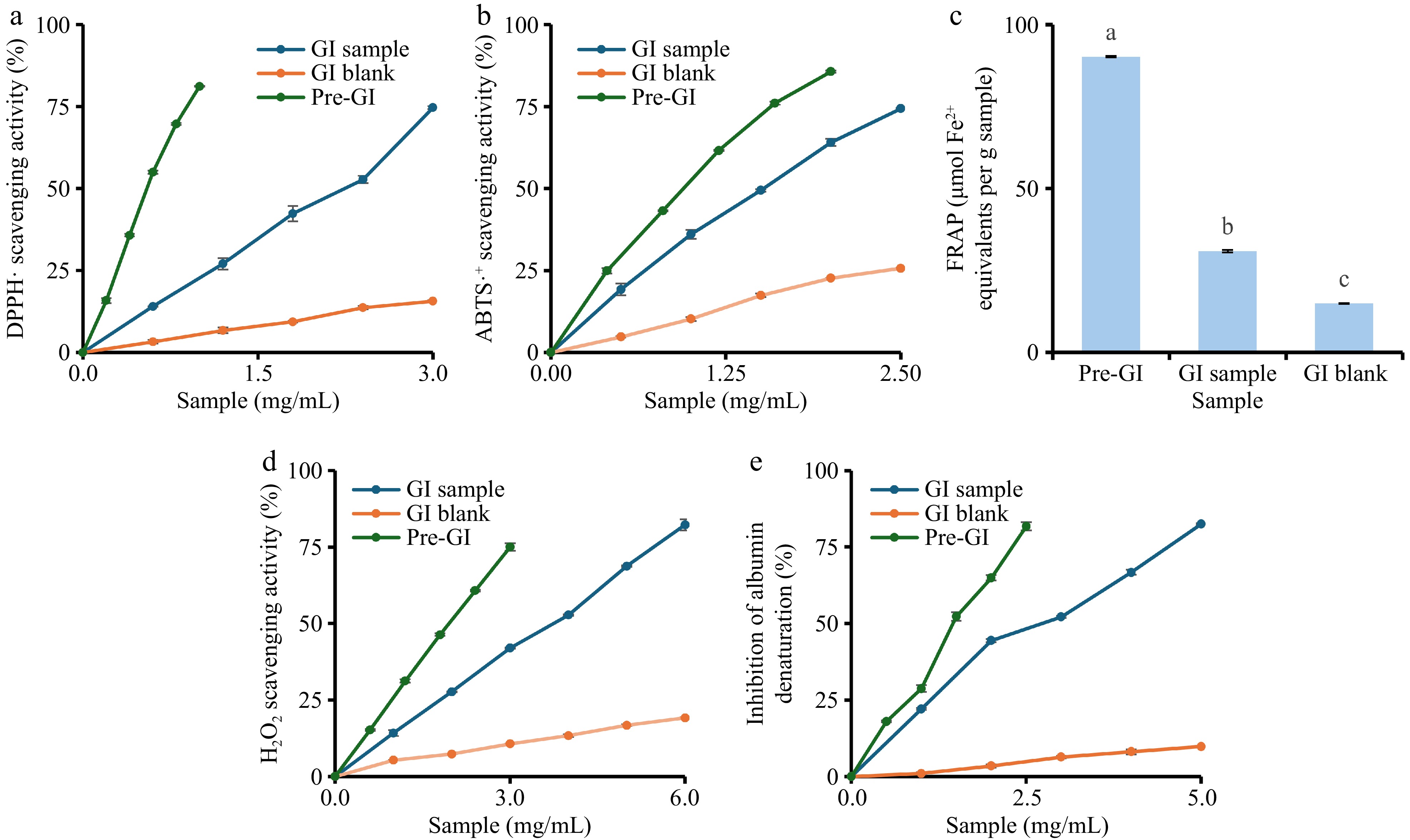
Figure 2.
Effects of simulated GI digestion on antioxidant activities and inhibition of albumin denaturation of UAE-20 + HWE-15 extract. (a) DPPH• scavenging activity. (b) ABTS•+ scavenging activity. (c) Ferric reducing antioxidant power (FRAP) values. (d) H2O2 scavenging activity. (e) Inhibition of albumin denaturation. Data are presented as mean ± standard error (n = 3). For (c), values with different lowercase letters differ significantly (p < 0.05), as determined by Tukey's HSD multiple comparison test. Sample abbreviations are as defined in Table 3.
Across all assays, the GI blank showed consistently low activity compared to the GI sample. For instance, at 3 mg/mL, the DPPH• scavenging activities of the GI sample and the GI blank were approximately 75% and 16%, respectively (Fig. 2a). Furthermore, at 5 mg/mL, the albumin denaturation inhibition was about 83% for the GI sample and about 10% for the GI blank (Fig. 2e). Due to the low activity and limited sample availability, EC50 values were not determined for the GI blank.
Weakened bioactivities of the UAE-20 + HWE-15 extract following GI digestion are indicated by the increased EC50 values across all assays, except for the FRAP assay (Table 4). For reference, the EC50 values of the positive controls used in each assay are also summarized in Table 4, which consistently exhibited greater activity, as indicated by lower EC50 values compared with both the pre-GI extract and GI sample, thereby confirming assay validity. DPPH• scavenging activity was the most markedly compromised antioxidant parameter, with a 261% increase in EC50 for the GI sample compared with the pre-GI extract. In contrast, the EC50 for the ABTS•+ scavenging activity of the GI sample only increased by 48% after GI digestion. The 85% increase in the EC50 for H2O2 scavenging activity of the GI sample was relatively moderate among the three parameters of radical scavenging activities. The EC50 for the inhibitory activity against albumin denaturation also increased by 91% in the GI sample.
Table 4. Effects of simulated GI digestion on the bioactivities of the UAE-20 + HWE-15 extract.
Bioactivities EC50 (mg/mL) EC50 (μg/mL) Pre-GI GI sample Positive control DPPH• scavenging activity 0.587 ± 0.000 2.118 ± 0.042 * Quercetin: 4.928 ± 0.034 ABTS•+ scavenging activity 1.069 ± 0.003 1.585 ± 0.001 * Quercetin: 5.550 ± 0.036 H2O2 scavenging activity 1.976 ± 0.005 3.658 ± 0.023 * Gallic acid: 276.119 ± 1.330 NO scavenging activity 6.655 ± 0.001 Not determined Ascorbic acid: 584.154 ± 1.277 Inhibition of albumin denaturation 1.527 ± 0.005 2.918 ± 0.023 * Quercetin: 355.319 ± 0.748 Abbreviations are as defined in Table 3. Data are mean ± standard error (n = 3). Statistical comparisons between pre-GI and GI samples were performed using Welch's t-test on log-transformed EC50 values. Significance is indicated as p < 0.05 (*). Positive controls were included as references for assay validation and were not subjected to statistical comparisons. For NO scavenging activity, the pre-GI extract showed an EC50 of 6.655 ± 0.001 mg/mL (Table 4). However, after GI digestion, both the GI sample and GI blank showed drastically reduced activities, with only 5.13% ± 0.47% and 2.67% ± 0.09% inhibition at 100 mg/mL, respectively. Owing to these low activities and the small difference between the GI sample and GI blank, EC50 was not further determined.
-
This study is the first to evaluate a sequential hybrid extraction strategy for T. zebrina leaves, building on single-step HWE and UAE methods. Among the six extracts tested, HWE-15 and UAE-20 were the most efficient individual treatments for maximizing phytochemical yield and antioxidant activity. TAC was lower than TPC and TFC, which reflects both the lower abundance of anthocyanins in T. zebrina leaves compared with other phytochemicals and their susceptibility to hydrolysis and oxidation during water extraction[23]. A similar pattern has been reported in water extracts of T. zebrina leaves[4] and kale[24]. These results indicate that UAE generally preserved anthocyanins better than HWE, consistent with the thermal sensitivity of these pigments[23]. Shorter HWE (15 min) yielded higher TPC, TFC, and TAC than longer durations. This implies the degradation of heat-labile phytochemicals during prolonged heating, a common observation and challenge in water extraction of phenolic-rich plants[25]. Furthermore, the lower TAC in the UAE-20 + HWE-15 extract compared with HWE-15 + UAE-20 likely reflects partial anthocyanin degradation during the subsequent heating step. Together, these findings pinpoint the necessity to balance extraction time and temperature to maximize the recovery of abundant phenolics and flavonoids, while minimizing the loss of heat-labile anthocyanins.
Building on these results, UAE and HWE were combined in sequential order, leading to the identification of UAE-20 + HWE-15 as the most effective strategy. This hybrid method produced the highest phytochemical content and strongest antioxidant activities (Table 1, Fig. 1), consistent with reports where sequential UAE–HWE outperformed single-step HWE or UAE extraction of pigmented rice[12], and hops (Humulus lupulus)[26]. This improvement is likely due to the complementary actions of UAE and HWE: ultrasonic cavitation promotes cell wall disruption and increases solvent penetration[27], whereas high-temperature water extraction enhances thermal diffusion and can facilitate the release of both soluble and bound phenolics[25].
Correlation analysis highlighted the role of phytochemicals in the antioxidant activity of the T. zebrina extracts. TPC and TFC were strongly associated with DPPH• and ABTS•+ scavenging activities as well as FRAP values (Table 2), confirming the role of phenolics and flavonoids as the key contributors of antioxidant activity in T. zebrina extracts. In contrast, TAC showed no statistically significant correlations with any antioxidant parameter (p > 0.05 for all). These findings are consistent with a recent study that, in aqueous plant extracts, antioxidant capacity was strongly associated with phenolic rather than anthocyanin contents[28].
Simulated GI digestion drastically reduced phytochemical contents of the UAE-20 + HWE-15 extract (Table 3). Low but measurable levels of TPC and TFC in the GI blank after SPE suggest that SPE cleanup did not fully eliminate interferences from digestive enzymes and bile salts. Similar background signals were also reported in INFOGEST digestion by others[22]. Nevertheless, the clearly higher values in the GI sample than in the GI blank indicate that the reductions observed after GI digestion reflect compound instability, rather than assay artifacts. Both TPC and TFC decreased substantially after GI digestion. This decline is plausibly largely driven by the transition from acidic gastric fluid to neutral intestinal fluid (pH 7.0). Under these conditions, phenolic hydroxyl groups may undergo deprotonation to form unstable phenolate ions, which are susceptible to rapid autoxidation, polymerization, and structural cleavage, eventually resulting in a loss of detectable phenolic and flavonoid content[29]. This is consistent with reports of their degradation in the intestinal phase under weakly alkaline, oxidative conditions[30]. Similar instability of flavonoids during GI digestion has been observed in grape seed and pomace extracts, although reported changes in phenolic contents vary across studies[20,31]. Crucially, the parallel decline in TPC, TFC, and antioxidant capacity post-GI digestion pinpoints that labile phenolic compounds are the key factors underlying the extract's bioactivity, and their degradation directly compromises its bioactivity. TAC appeared relatively more stable than TPC and TFC, but the correlation analysis suggested that their contribution to antioxidant activity was negligible. Thus, although the UAE-20 + HWE-15 extract was the richest in TPC and TFC, its limited GI stability may constrain its bioaccessibility.
In this study, initial screening of the T. zebrina water extracts was accomplished using widely applied antioxidant assays (DPPH•, ABTS•+, and FRAP) to efficiently identify the most potent extract. Once the optimized extract was selected, the scope of analysis was broadened to include additional assays, namely H2O2 and NO scavenging, as well as the inhibition of albumin denaturation, to evaluate its antioxidant and anti-inflammatory activities. Notably, these additional assays were performed on the optimized extract both before and after simulated GI digestion. This approach emphasized physiologically relevant assays, as H2O2 and NO scavenging more closely mimic in vivo oxidative stress compared with DPPH• and ABTS•+[32,33]. Furthermore, NO and albumin denaturation inhibition are both associated with anti-inflammatory potential[34]. Focusing these additional assays on the optimized extract allowed us to better characterize its functional relevance and stability under simulated GI conditions, without the need to replicate all tests across all initial extracts.
The marked decline in the bioactivities of UAE-20 + HWE-15 extract following the INFOGEST-simulated digestion (Fig. 2, Table 4) reflects the degradation of key antioxidant and anti-inflammatory compounds under physiologically relevant GI conditions. Specifically, the post-INFOGEST decline in TPC and TFC was associated with partial loss of H2O2, DPPH•, and ABTS•+ scavenging activities, FRAP, and inhibition of albumin denaturation. Strikingly, NO scavenging activity was nearly fully diminished post-digestion, with less than 6% inhibition even at 100 mg/mL. Importantly, the GI blank, which underwent the same INFOGEST protocol and SPE cleanup, consistently showed low background activity across all assays (Fig. 2), indicating that the observed losses in the GI sample are due to phytochemical instability under INFOGEST conditions, not matrix interference.
While UAE-20 + HWE-15 extract showed higher initial antioxidant and anti-inflammatory potential in the pre-GI digestion stage, the INFOGEST results reveal a limitation for its use in oral food products because most bioactivities, especially NO scavenging activity, were drastically reduced after GI digestion. Protective strategies such as encapsulation have been shown to enhance the stability and retention of polyphenols during simulated GI digestion[31,35]. Thus, in the context of developing the UAE-20 + HWE-15 extract as a food ingredient, such protective strategies are required to preserve the health-promoting potential of the extract during GI transit. Together, while this study successfully optimized extraction, it also highlights that future research should prioritize GI stability of the extract as a strategy to unlock its potential as a functional food ingredient.
This study has some limitations. The INFOGEST model, while providing valuable physiological relevance, remains an in vitro system that cannot fully capture the in vivo complexities of absorption, metabolism, and microbial transformation of bioactive compounds[14]. Furthermore, the antioxidant and anti-inflammatory assays employed are chemical models and do not reflect cellular or in vivo conditions. These assays provide only preliminary indications of bioactivity and do not reflect the full antioxidant and inflammatory mechanisms in living systems[34,36]. Future work should therefore focus on evaluating the bioaccessibility and bioactivity of the optimized UAE-20 + HWE-15 extract in more physiologically relevant models. This includes cellular assays to investigate antioxidant and anti-inflammatory mechanisms, as well as in vivo studies to confirm its efficacy. Additionally, Response Surface Methodology (RSM) may be applied to further refine the UAE-20 + HWE-15 extraction protocol. Specifically, future studies should apply RSM to mathematically model and optimize synergistic interactions between variables such as time, power, and solid-to-liquid ratio. Protective techniques like encapsulation can also be explored to enhance its GI stability[31,35].
-
This study optimized the extraction of bioactive phytochemicals from T. zebrina leaves and assessed their GI stability using the standardized INFOGEST model. The sequential hybrid method (UAE-20 + HWE-15) yielded the highest phenolic and flavonoid content and strongest antioxidant activity, outperforming single-step methods. INFOGEST revealed significant degradation of phenolics and flavonoids, leading to a substantial decline in in vitro antioxidant and preliminary anti-inflammatory potential and suggesting poor bioaccessibility after oral consumption. Therefore, while UAE-20 + HWE-15 is the optimal extraction strategy, its application as a functional food ingredient may require protective technologies to enhance phytochemical stability and preserve health benefits. Further research is needed to confirm these activities in cellular and animal systems.
The authors have no acknowledgments to declare.
-
The authors confirm contribution to the paper as follows: study conception and design: Wong FC, Manan FA, Chai TT; data collection: Lim WL; analysis and interpretation of results: Lim WL, Chai TT; draft manuscript preparation: Wong FC, Manan FA, Lim WL. All authors reviewed the results and approved the final version of the manuscript.
-
The datasets generated during and/or analyzed during the current study are available from the corresponding author upon reasonable request.
-
The authors declare that they have no conflict of interest.
- Copyright: © 2026 by the author(s). Published by Maximum Academic Press on behalf of China Agricultural University, Zhejiang University and Shenyang Agricultural University. This article is an open access article distributed under Creative Commons Attribution License (CC BY 4.0), visit https://creativecommons.org/licenses/by/4.0/.
-
About this article
Cite this article
Lim WL, Wong FC, Manan FA, Chai TT. 2026. Sequential ultrasound-hot water extraction of Tradescantia zebrina leaves: optimized bioactivities with limited gastrointestinal stability. Food Innovation and Advances 5(1): 37−44 doi: 10.48130/fia-0025-0054 

Sequential ultrasound-hot water extraction of Tradescantia zebrina leaves: optimized bioactivities with limited gastrointestinal stability
- Received: 12 September 2025
- Revised: 25 November 2025
- Accepted: 22 December 2025
- Published online: 27 January 2026
Abstract: Tradescantia zebrina is a leafy vegetable with potential as a functional food ingredient, but its optimal extraction and gastrointestinal (GI) stability require investigation. This study aimed to optimize phytochemical extraction from T. zebrina leaves using hot water extraction (HWE), ultrasound-assisted extraction (UAE), and sequential hybrid methods (UAE + HWE, HWE + UAE), and then evaluated the GI stability of the optimized extract using the INFOGEST model. Among nine extraction treatments, the sequential UAE-20 min followed by HWE-15 min (UAE-20 + HWE-15) yielded the highest total phenolic content (TPC, 8.11 mg GAE/g) and flavonoid content (TFC, 63 mg QE/g), along with the strongest antioxidant activities: 2,2-diphenyl-1-picrylhydrazyl (DPPH•) and 2,2′-azino-bis(3-ethylbenzothiazoline-6-sulphonic acid) radical cation (ABTS•+) scavenging, and Ferric reducing antioxidant power (FRAP). TPC and TFC correlated strongly with antioxidant parameters, while anthocyanin contents did not. Post-digestion analysis of the optimized extract, following solid-phase extraction cleanup, revealed marked reductions in the phenolic and flavonoid content (to 3.28 mg GAE/g and 6.44 mg QE/g, respectively) and a corresponding decline in DPPH•, ABTS•+, and H2O2 scavenging activities, FRAP, and anti-inflammatory (albumin denaturation inhibition) activities. Nitric oxide scavenging activity was nearly lost. These findings indicate that while the UAE-20 + HWE-15 method is optimal for extraction, the resulting bioactive compounds showed limited stability under simulated GI conditions, highlighting the need for strategies to preserve their activity for functional food applications. This highlights the need for protective strategies, like encapsulation, to preserve its efficacy for functional food applications.
-
Key words:
- Antioxidant /
- Anti-inflammatory /
- Functional food /
- Green extraction /
- INFOGEST /
- Phytochemicals