












-
Drying is a crucial process in numerous industries, including agriculture, food processing, pharmaceuticals, and materials science. Historically, drying methods have been based on empirical approaches that provide limited control over the parameters, resulting in inefficiencies and variations in product quality[1]. However, the advent of advanced technologies has led to a transformative shift towards smart drying systems that can optimize drying processes in a more controlled and efficient manner. Smart drying is defined as an integrated drying approach that combines real-time sensing, data processing, automation, and artificial intelligence (AI)-based decision-making to monitor, predict, and optimize drying conditions while maintaining product quality and reducing energy consumption[2]. Smart drying systems integrate various advanced technologies such as sensor networks, data analytics, and automation to monitor and adjust the drying process in real time[2]. A major challenge in producing dried food products with desirable characteristics, such as consistent shape, size, color, and texture, is the need for continuous real-time monitoring of their visual attributes[1]. The introduction of computer vision (CV) technology has transformed this aspect of the drying process. By applying sophisticated image processing techniques, CV provides accurate, real-time assessments of the products' appearance throughout drying, ensuring better control of quality parameters such as shape, texture, color, and size[3]. This advancement not only enhances the visual appeal of the final product but also ensures the retention of its nutritional value and taste.
Sensor networks are a critical component of smart drying systems, as they provide real-time data on temperature, humidity, and other vital parameters[4]. By continuously monitoring the variables that influence the drying process, sensor networks enable the system to operate with greater precision and accuracy. When changes in humidity or temperature occur, the system can automatically adjust the airflow or heating levels to maintain optimal drying conditions. Once the data have been collected, they are fed into advanced data analytics tools such as the statistical analysis system (SAS), matrix laboratory (MATLAB), and Python, which analyze and interpret the information. These tools apply various algorithms to optimize the drying process and minimize the likelihood of errors[5]. Their primary purpose is to ensure that the drying operation remains efficient, with minimal waste and consistently high output.
Furthermore, automation is a crucial aspect of smart drying systems[6]. Automated controls enable the system to function without continuous human input. This ensures more streamlined and stable operations, in which the drying system maintains consistent performance, thereby reducing the possibility of mistakes caused by human variability. In recent years, significant advancements have been made in the field of smart drying technologies. However, there is still considerable scope for further improvements, particularly when it comes to the industrial application of these technologies[4]. The current methods used for drying in many industries are often energy-intensive and inefficient, resulting in increased costs and longer processing times[7]. Furthermore, though the adoption of these smart drying technologies is gaining momentum in developed countries, the same cannot be said for many developing countries, where the adoption rate is still relatively low. In this review (Fig. 1), we will discuss the current state of smart drying technology and its application to various agricultural products. We will address the challenges associated with scaling up and achieving widespread adoption, as well as the future aspects that researchers need to explore. We hope that this discussion will trigger interest in smart drying, as numerous strides need to be taken to meet the growing demand for high-quality dried products for the ever-expanding global population.
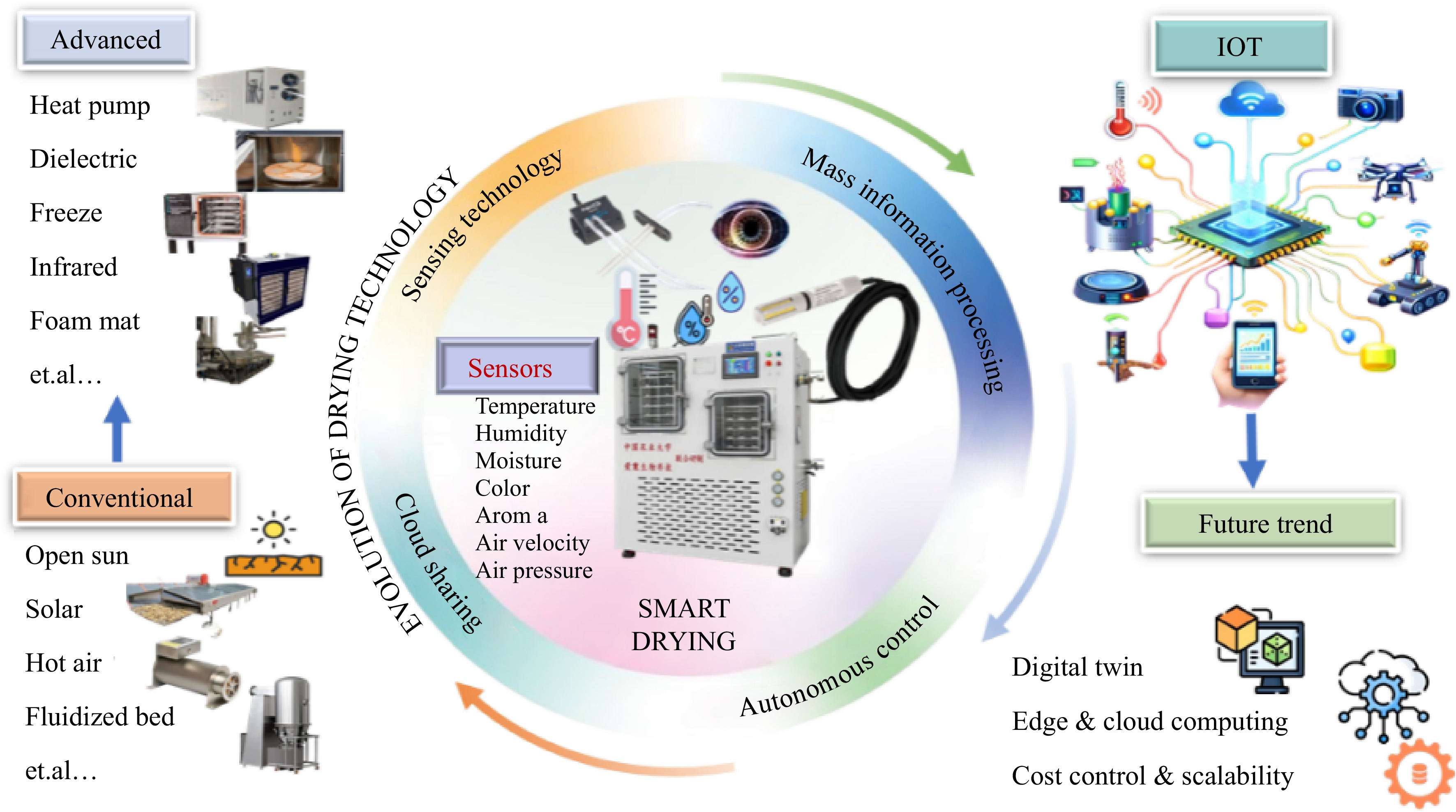
Figure 1.
Graphical abstract.
-
Drying methodologies have undergone notable transformations over the years, primarily driven by the need for efficient and environmentally sustainable processing techniques. Although traditional drying methodologies, such as sun drying and air drying, have enjoyed widespread utilization, they frequently prove to be sluggish and are susceptible to ambient conditions[8]. The advent of mechanical drying systems, encompassing tray dryers, hot air dryers, rotary dryers, and fluidized bed dryers, was a substantial leap forward in drying technology, affording enhanced regulation and efficacy. Nonetheless, conventional drying approaches exhibit certain constraints concerning uniformity, energy consumption, and product integrity[9]. Consequently, alternative drying techniques, such as heat pump drying, microwave drying, and freeze-drying, have been explored, offering expedited drying rates and the preservation of product attributes. Furthermore, drying with inert solids, contact sorption drying, dielectric drying, flash drying, fluidized bed and pulse fluid bed drying, foam mat drying, impingement stream drying, infrared drying, osmotic drying, pulse combustion drying, refractance window drying, slush and atmosphere freeze-drying, superheated steam drying, and hybrid drying have been devised and implemented in industrial drying operations, as shown in Fig. 2[10].
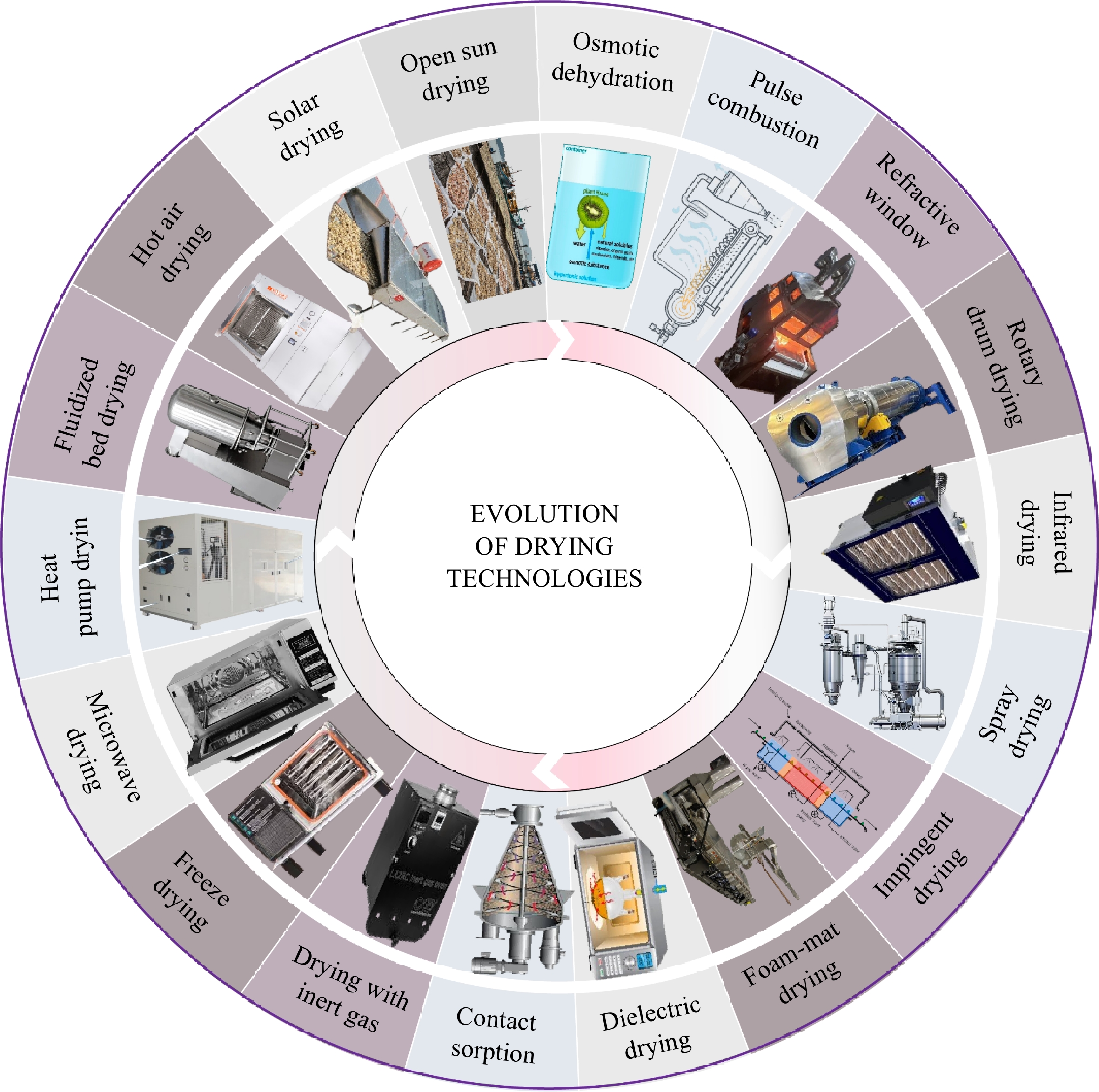
Figure 2.
Evolution of drying from conventional to advanced technologies.
Drying technologies have evolved from traditional methods such as sun drying and air drying, which are simple and low-cost but slow, weather-dependent, and prone to contamination or inconsistent product quality[8,10], to mechanical systems such as tray, hot air, rotary, and fluidized bed dryers, which provide better control over the process and industrial scalability but often suffer from high energy consumption, nonuniform drying, and possible quality degradation[9,11−13]. To overcome these limitations, advanced drying techniques have been developed, including heat pump drying, which improves energy efficiency and quality preservation under controlled temperatureand humidity conditions[14,15]; microwave and dielectric drying, which use electromagnetic energy for rapid internal heating but may cause uneven heating and require costly control systems[16,17]; and freeze-drying or slush/atmospheric freeze-drying, which preserve the products' structure and bioactivity through sublimation but are expensive and time-consuming[18−20]. Other specialized techniques, including drying with inert solids, contact sorption drying, flash drying, foam mat drying, impingement stream drying, infrared drying, osmotic drying, pulse combustion drying, refractance window drying, superheated steam drying, spray drying, and hybrid drying, have been introduced to address specific material and industrial needs by improving the drying rate, energy use, nutrient retention, surface heating, or products' stability[10,12,17,21−31]. The major drying technologies differ considerably in their suitability for specific products, energy requirements, quality retention capacity, and industrial scalability, as summarized in Table 1. However, because drying efficiency and final quality depend strongly on the coupled movement of heat and moisture within the material, recent studies emphasize that empirical approaches alone are insufficient, and that physics-based, hybrid, AI-assisted, and digital-twin-supported drying models are increasingly needed to optimize the drying kinetics, energy consumption, and product quality under dynamic processing conditions[4].
Table 1. Applications, advantages, and disadvantages of major drying methods.
Drying method Typical applications Advantages Disadvantages Ref. Sun drying Grains, fruits, vegetables, fish, herbs Low cost, simple, no specialized equipment, low energy demand Weather-dependent, slow, poor control, contamination risk, uneven quality [8, 10] Air drying Herbs, meat, fish, fruits, agricultural products Simple, energy-efficient, low operating cost Long drying time, inconsistent drying, risk of microbial growth [10] Tray drying Food products, pharmaceuticals, chemicals Versatile, easy operation, suitable for batch processing High energy use, possible uneven drying, requires careful airflow control [11] Hot-air drying Fruits, vegetables, grains, herbs Faster than natural drying, widely available, scalable Energy-intensive, nonuniform drying, shrinkage, possible nutrient/color degradation [11,12] Rotary drying Minerals, biomass, grains, agricultural materials High capacity, suitable for continuous industrial operation High initial cost, high energy consumption, less suitable for delicate products [11] Fluidized bed drying Grains, powders, granules, pharmaceuticals, chemicals Efficient heat and mass transfer, uniform drying, rapid processing Not suitable for large or fragile particles, energy-intensive [13] Heat pump drying Fruits, vegetables, wood, heat-sensitive foods Energy-efficient, controlled temperature and humidity, good quality retention High initial cost, technically complex, affected by ambient conditions [14,15] Microwave drying Foods, herbs, pharmaceuticals, ceramics Rapid drying, internal heating, good nutrient retention when controlled Uneven heating, hot spots, limited penetration depth, high cost of equipment [16,18,21] Freeze-drying Pharmaceuticals, fruits, biological materials, high-value foods Excellent quality retention, preserves the structure, flavor, nutrients and bioactivity Very expensive, long processing time, high energy demand [18,21] Drying with inert solids Heat-sensitive materials, pharmaceuticals, specialty products Efficient moisture removal, low thermal damage, relatively low energy demand Limited applications, solid disposal/regeneration issues [21] Contact-sorption drying Pharmaceuticals, specialty chemicals, heat-sensitive products Energy-efficient, suitable for low-temperature drying Requires sorbent regeneration, limited industrial scope [22] Dielectric drying Wood, textiles, polymers, thick materials Volumetric/internal heating, faster drying, improved uniformity in some materials Energy-intensive, costly equipment, requires precise control [17] Flash drying Starch, pigments, ceramics, powders, dairy materials Very rapid drying, short residence time, suitable for fine particles High energy consumption, unsuitable for large particles, dust handling issues [12] Foam mat drying Fruit juices, dairy products, flavorings, heat-sensitive liquids Fast drying, good retention of volatile compounds, useful for liquids and purees Requires foam to be prepared, the products' formulation affects stability [23] Impingement stream drying Paper, textiles, food products, surface drying operations High heat transfer rate, rapid drying Energy-intensive, possible surface damage [13] Infrared drying Food products, coatings, paints, thin-layer materials Rapid surface heating, energy-efficient for thin products, simple integration Limited penetration depth, surface overheating risk [24] Osmotic drying Fruits, vegetables, fish, semimoist foods Low energy demand, good color and nutrient retention, mild processing Long processing time, solute uptake, incomplete dehydration [25] Pulse combustion drying Chemicals, minerals, food powders Rapid drying, high thermal efficiency, intense heat transfer Complex system, high initial cost, noise/vibration concerns [26] Refractance window drying Fruit purees, herbs, pharmaceuticals, thin liquid foods Gentle drying, good nutrient and color retention, faster than freeze-drying Mainly suitable for thin products, requires a water film system [27] Slush/atmospheric freeze-drying Pharmaceuticals, biological samples, high-value foods Good structure preservation, uniform drying, high quality retention Expensive, slow, technically demanding [19] Superheated steam drying Foods, biomass, sludge, industrial materials Reduced oxidation, potential energy recovery, good heat transfer Complex control, condensation risk, not suitable for all products [10] Spray drying Milk powder, juices, flavors, pharmaceuticals, encapsulated products High production rate, continuous operation, controllable powder properties High temperature exposure, not ideal for all heat-sensitive compounds, costly equipment [20,28] Hybrid drying Fruits, vegetables, grains, herbs, high-value foods Combines strengths of multiple methods, improves efficiency and quality More complex design, higher cost, optimization required [12,29] Drying efficiency and product quality are strongly governed by the interaction between internal moisture diffusion and surface evaporation, a coupling that recent integrated analyses have shown must not be neglected to avoid inaccurate predictions of the drying kinetics, particularly under high-temperature and nonequilibrium conditions[32]. These findings underscore the limitations of purely empirical models and reinforce the need for physics-based or hybrid modeling frameworks in advanced drying systems. Building on this foundation, innovative methods enhance overall drying efficiency and sustainability, making them attractive for both industry and research, whereas tailored strategies address specific scenarios. For instance, freeze-drying is essential for preserving the integrity of perishable goods like fruits, meats, and pharmaceuticals by removing moisture under vacuum conditions[21]. Heat pump drying is ideal for situations where energy efficiency is paramount, such as in the drying of delicate fruits or vegetables, whereas microwave drying is suitable for the rapid drying of heat-sensitive materials, like herbs and pharmaceutical products[29,33]. Similarly, flash drying is applied in scenarios where rapid evaporation is necessary, such as in the processing of starch or dairy products, whereas spray drying offers several advantages, including high production rates, consistent product quality, and the ability to control the particles' size and morphology[28,34]. In parallel, current trends in technology underscore the transformative potential across disciplines. Artificial intelligence (AI) and digital twins are poised to revolutionize drying processes by optimizing efficiency, predicting outcomes, and enhancing control mechanisms. AI algorithms can analyze vast datasets to optimize the drying parameters dynamically, whereas digital twins simulate drying environments virtually, allowing for real-time adjustments and predictive maintenance[35,36]. These technologies promise to usher in a new era of precision drying, ensuring not only enhanced productivity but also reduced energy consumption and environmental impact.
-
The process of drying food is a complex and ever-changing phenomenon that involves heat and mass transfer, physical and chemical changes, and even biological activity. Unfortunately, ambient conditions can also affect the process, leading to inconsistent quality and sensory characteristics. Traditional measurement techniques are not sufficient to monitor and control the drying process in real time. Consequently, the drying industry faces fresh hurdles arising from heightened demands for process efficiency and product excellence. These challenges underscore a burgeoning necessity for refining control strategies. To address this, advanced control strategies capable of adapting to evolving drying conditions are imperative[37]. Advanced control strategies capable of adjusting to the dynamic conditions during drying are essential for multiobjective optimization. For instance, Zhang et al.[38] proposed a control that targets the dual goals of minimizing energy consumption and maximizing vitamin content, which used a three-layer feed-forward artificial neural network (ANN) model with a backpropagation algorithm. By utilizing data analytics and machine learning models, smart drying systems can adapt to changing conditions, optimize energy usage, and ensure consistent product quality[37].
Smart drying refers to an innovative approach that leverages modern technologies to optimize the drying process for various materials. By integrating advanced sensors, AI, and cloud-based systems, smart drying enhances the efficiency, quality, and energy consumption of traditional drying methods (as shown in Fig. 3). It consists of four key components:
i. Drying process sensing technology;
ii. Multidimensional heterogeneous mass information processing technology;
iii. Autonomous decision-making and self-optimizing control system;
iv. Cloud sharing of drying data, remote monitoring, and diagnosing the faults of drying equipment.
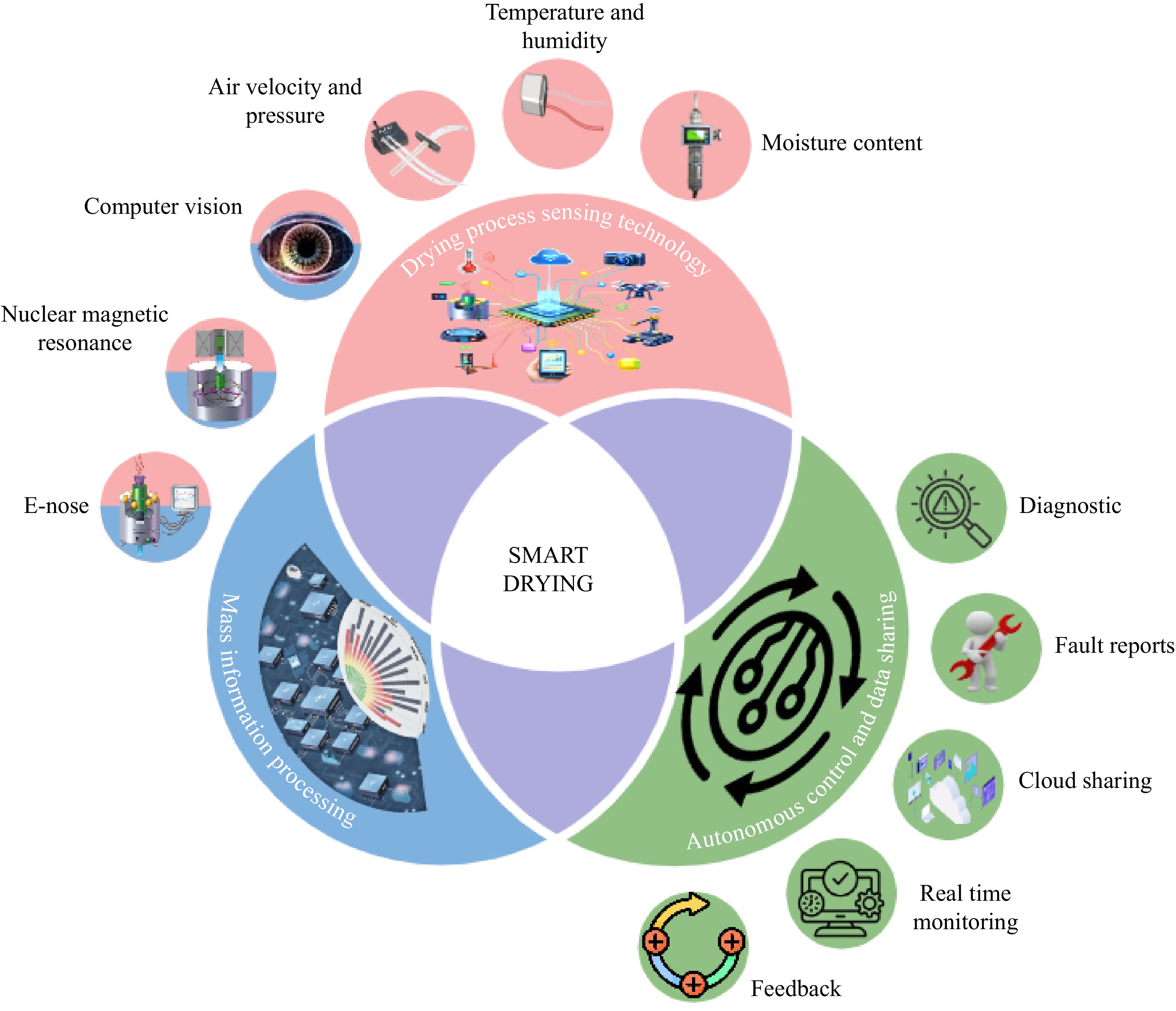
Figure 3.
The concept of smart drying.
Drying process sensing technology
-
Detecting and quantifying food quality attributes during the drying process poses significant challenges. Each type of food possesses unique characteristics, necessitating tailored sensing techniques. Various drying methods demand specific adaptations of these techniques, and certain methods may prove impractical because of their inherent limitations. Additionally, the sensing environment often entails high temperatures, pressures, humidity levels, or strong electromagnetic fields, further complicating the task. Moreover, adherence to food safety regulations may restrict the implementation of certain sensing technologies[39]. To overcome these limitations, smart drying systems use a variety of sensors to monitor parameters such as temperature, humidity, moisture content, aroma, and airflow. These sensors provide real-time data to control systems, allowing for precise adjustments to drying conditions. Quite a handful of these sensors have been widely integrated into drying systems, among which are CV, electronic noses (E-noses), hyperspectral imaging, nuclear magnetic resonance (NMR), near-infrared spectroscopy (NIR), and dielectric spectroscopy (DS)[39].
Moisture content
-
In drying processes for food products, pharmaceuticals, or industrial materials, maintaining the correct moisture content is crucial. Excess moisture can cause spoilage, microbial growth, and degrade product quality, whereas overdrying can increase energy consumption and harm the material's structure. Therefore, accurately detecting the moisture content is essential for achieving the optimal balance. For example, in the grain industry, moisture content is vital for determining the quality, grade, and price, and it affects the grain's appearance, such as its shape and color. The relationship between grain moisture content and its electrical properties has traditionally been used for quick moisture measurement in the grain trade. However, the accuracy of these electrical measurements is often affected by factors like kernel size, weight, and density, underscoring the need for reliable moisture detection methods to ensure consistent and high-quality drying. Among the emerging approaches, machine vision has attracted attention because moisture loss is often accompanied by measurable changes in the product's morphology, color, surface appearance, and mass-related features. On this basis, Wang et al.[40] demonstrated that machine vision features, especially when morphology, color, and weight were combined, could improve predictions of moisture in corn kernels, although broader validation across crop years and regions remains necessary. Similarly, You et al.[41] applied CV with one-dimensional (1D) convolutional neural network (CNN) modeling to Tencha drying and showed that the preprocessing Z-score improved predictive accuracy, enabling rapid visualization and reliable moisture monitoring for intelligent tea production. Liu et al.[42] further advanced this direction by integrating NIR spectroscopy with machine vision for processing green tea, where middle-level spectral–image data fusion and Support Vector Regression (SVR) modeling produced superior prediction performance compared with single-source data. Beyond optical and spectral approaches, Ouertani et al.[43] used X-ray attenuation combined with inverse heat and mass transfer modeling to determine the moisture profiles and transport properties in wood, showing that the spatial evolution of moisture and core moisture data provide more reliable estimates than the average drying kinetics alone. Overall, these studies indicate that combining imaging, spectroscopy, machine learning, and inverse modeling can improve real-time moisture monitoring, enhance drying control, and support the development of more intelligent and quality-oriented drying systems[40−43].
Current advances in moisture content detection have shifted from traditional electrical methods toward nondestructive, multisensor, and data-driven approaches. Techniques such as machine vision combined with morphological and color features, deep learning-based 1D-CNN models, and integrated NIR image fusion with chemometrics enable rapid, accurate, and real-time predictions of moisture in agricultural and food products. Meanwhile, advanced instrumental methods like X-ray attenuation coupled with inverse modeling provide detailed spatial moisture profiles and transport properties for complex materials like wood. Despite these innovations, key challenges persist: Sensors' accuracy is often influenced by the material's variability (e.g., kernel size, density); many methods remain at the laboratory scale or require extensive calibration; and integrating multisource data into robust, generalizable models is still nontrivial. Looking forward, the field is moving toward intelligent, adaptive monitoring systems that leverage AI, real-time data fusion, and portable sensor platforms. Future developments will likely focus on scalable, low-cost inline sensing, enhanced model interpretability and transferability across crops and conditions, and closed-loop control strategies that link moisture detection directly to automated drying optimization, paving the way for smarter, more efficient, and quality-driven drying processes across industries.
Drying temperature and humidity
-
Drying is a fundamental process in many industries, involving the removal of moisture from materials. Precise control of the drying temperature and humidity is crucial for several reasons. First, maintaining an optimal drying temperature ensures the preservation of product quality. It is a fact that overheating can degrade the material, leading to a loss of nutritional value in food products or compromised strength in textiles. Secondly, real-time monitoring and adjustment of the drying temperatures enhances the overall efficiency of the process, reducing downtime and increasing throughput. Furthermore, humidity influences the moisture content in the air, affecting the overall drying efficiency. Incorrect temperature and humidity levels can lead to underdrying or overdrying, resulting in product spoilage, quality degradation, and energy wastage. Hence, accurate detection and control of these parameters are essential for optimizing the drying process. Temperature and humidity monitoring studies show that smart drying systems are increasingly shifting toward sensor-assisted, automated, and adaptive control strategies. Cao et al.[44] developed a temperature-detection-assisted control system for microwave-assisted pulse-spouted vacuum drying of carrot cubes and found that a three-step temperature profile improved rehydration, color, and texture, although it required more energy and a longer drying time than constant-temperature drying. Wu et al.[45] further demonstrated that integrating the temperature, humidity, and airflow into a multiparameter control model improved energy efficiency, drying uniformity, and quality during continuous drying of corn kernels. At a smaller processing scale, Amelia et al.[46] designed a Smart Opak system using temperature–humidity sensors and Arduino-based control, achieving stable drying conditions with relatively low temperature and humidity errors. He et al.[47] showed that combining infrared temperature and humidity sensors with intelligent algorithms in a smart microwave oven improved the uniformity of reheating and defrosting and prevented no-load hazards. Similarly, Buonocore et al.[48] developed a Raspberry Pi-based monitoring system for drying figs, integrating temperature, humidity, weight, and imaging sensors to improve endpoint detection, microclimate control, drying consistency, and product quality. Overall, these studies indicate that real-time temperature and humidity sensing, when combined with multiparameter control, embedded systems, and intelligent algorithms, can improve drying precision, product quality, and process efficiency, although trade-offs involving energy use, the system's complexity, and scalability remain important considerations[44−48].
Significant progress has been made in monitoring the drying temperature and humidity through the integration of advanced sensors, real-time data processing, and intelligent control algorithms. Studies have demonstrated the implementation of multiparameter models and closed-loop systems using infrared/humidity sensors for precise environmental control, which enhances the uniformity of drying, product quality, and energy efficiency. Automated systems leveraging microcontrollers and sensor networks further enable stable drying conditions and endpoint detection. However, key challenges remain, including balancing improved product quality against increased energy consumption and extended drying times observed in advanced control strategies, ensuring sensors' accuracy and reliability under harsh industrial conditions, and managing the complexity and cost of implementing integrated smart systems. Future developments are expected to focus on adaptive, AI-driven control systems that dynamically optimize the temperature and humidity profiles in real-time, greater adoption of low-cost and wireless sensor networks for scalable monitoring, and the advancement of hybrid models that combine physical principles with machine learning to achieve more robust, efficient, and autonomous drying processes across diverse applications.
Air velocity and pressure
-
Air velocity and pressure are critical factors in the drying process. They influence the rate of moisture removal, the uniformity of drying, and energy efficiency. A high air velocity can enhance the drying rate by increasing the heat transfer coefficient, thereby speeding up the evaporation of moisture from the products' surface. Conversely, inadequate air velocity may lead to uneven drying, causing some areas to be overdried while others remain moist. Pressure plays a complementary role. In a drying system, maintaining the optimal air pressure ensures that the airflow is evenly distributed throughout the drying chamber. This uniform distribution prevents hotspots and ensures that all products receive consistent drying conditions. Moreover, pressure control can help minimize energy usage by reducing the work required by fans and blowers to maintain airflow. Freeze-drying is a critical process widely used in the pharmaceuticals, food processing, and dairy industries because of its ability to preserve product quality and extend shelf life. However, determining the endpoint of the drying stage is challenging, although it is essential for the process's efficiency and product quality. Wutthithanyawat et al.[49] showed that an internal model control approach could stabilize the drying temperature under fluctuating air velocity, thereby improving thermal regulation, energy use, and product quality during food drying. Jeyapradhap et al.[50] developed an Arduino-based velocity sensor device for detecting the endpoint of freeze-drying, showing that the vapor flow rate and mass flow rate decreased progressively as drying advanced, with an average deviation of only 4.4% from actual moisture removal, making the system an economical and accurate alternative to conventional temperature, Pirani gauge, or pressure-based methods. Ajisegiri et al.[51] extended this intelligent monitoring concept to grain storage by integrating temperature, humidity, pressure, CO2, acoustic sensors, Internet of Things (IoT) connectivity, and AI-based control in a 2-ton smart silo, enabling automatic regulation of airflow, heating, and fumigation to improve grain's storability and reduce spoilage. Overall, these studies show that integrating airflow, pressure, environmental sensing, and intelligent control can enhance drying efficiency, improve storage safety, support real-time decision-making, and reduce postharvest losses[49−51].
Recent advances in air velocity and pressure monitoring for drying processes emphasize the transition toward intelligent, integrated, and cost-effective sensing solutions. The development of model-based control systems (e.g., Internal Model Control [IMC]) enables adaptive regulation of thermal processes in response to variations in airflow, enhancing stability and efficiency. Low-cost, accurate velocity sensors coupled with microcontroller platforms now allow real-time endpoint detection in freeze-drying, outperforming traditional pressure-based methods in terms of both accuracy and economy. Furthermore, IoT-enabled smart systems integrate multisensor networks (including pressure, acoustic, and environmental sensors) with AI-driven control algorithms to actively regulate storage and drying environments, reduce spoilage, and optimize energy use. However, key challenges persist, including ensuring the long-term reliability of the sensors under industrial conditions, balancing measurement accuracy with the system's cost, and seamlessly integrating airflow and pressure data into holistic process control models. Future developments are likely to focus on the wider adoption of wireless and miniaturized sensors, the use of machine learning for predictive optimization of airflow and pressure, and the creation of more accessible, scalable monitoring platforms, particularly for small-scale and agricultural applications, paving the way for more responsive, efficient, and autonomous drying and storage systems.
Computer vision detection technology
-
CV/machine vision is an effective approach for analyzing the morphological changes in a material. Various methods for acquiring three-dimensional (3D) information include binocular stereo vision, laser triangulation, structured light 3D imaging, and the time-of-flight (TOF) method[52]. Machine vision applications in food drying initially focused on offline use, where additional systems were set up outside the drying chamber. These systems interrupted drying to extract materials for vision-based analysis before returning them to continue the process. Researchers have successfully monitored properties like color and moisture distribution using offline systems, contributing to the understanding of drying processes[49,53]. However, offline methods suffer from slow operation and interruption of the drying process, leading to gaps in data collection and potential differences in material states. To address these challenges, research has shifted towards online machine vision applications, particularly in traditional drying methods like hot air drying. Li et al.[54] and Seyedabadi et al.[55] highlighted that online monitoring systems facilitate real-time assessments of key quality attributes during drying, including wrinkling, shrinkage, and color variation. A typical vision-based monitoring setup comprises several integrated components. First, an illumination unit ensures consistent and adequate lighting conditions for image acquisition. Second, a camera or optical sensor captures visual data; depending on the device, this may generate either digital or analog signals. For analog outputs, a digitizer is incorporated as the third component to convert signals into a digital format suitable for computational analysis. The fourth component is a computer system that performs data processing and executes the analytical workflows. Finally, dedicated image-processing software is used to interpret the captured images and extract meaningful quantitative features that are relevant to the drying process[56]. Li et al.[57] emphasized the critical role of image segmentation in enabling reliable machine vision monitoring of shiitake mushrooms' morphology during hot air drying. Their approach centers on automatically partitioning the mushrooms' surface from the background to facilitate subsequent analysis of wrinkling and shrinkage. By applying a region-based segmentation strategy, the system consistently delineates objects' boundaries despite dynamic changes in their surface texture and shape. This robust separation underpins the accuracy of downstream measurements, as reflected in the reported minimal shrinkage error (0.07 ± 0.06). The study demonstrates that effective segmentation is essential for extracting stable geometric features under varying relative humidity (RH) control strategies, thereby validating segmentation as a foundational step for real-time, vision-supported drying analyses.
CV has advanced significantly in monitoring drying, evolving from offline, disruptive systems to integrated online setups that enable real-time, nondestructive assessment of key quality attributes like color, shrinkage, and surface morphology. Progress is marked by robust image acquisition systems (consistent illumination, digital sensors) and advanced processing algorithms—particularly region-based segmentation—which allow reliable feature extraction even under dynamic drying conditions. However, challenges remain, such as ensuring consistent imaging in harsh industrial environments (e.g., variable lighting, steam, dust), processing a high volume of image data in real time, and generalizing models across diverse products and scales. Future development will likely focus on embedding AI-driven vision systems directly into the drying equipment for closed-loop control, leveraging multimodal sensor fusion (e.g., combining CV with spectral data), and advancing lightweight, edge computing solutions to enable scalable, intelligent, and adaptive automation of the drying process.
Nuclear magnetic resonance
-
NMR is a powerful analytical technique that exploits the magnetic properties of atomic nuclei to provide detailed information about the molecular structure, dynamics, and interactions within a sample. In the context of smart drying technology, NMR plays a crucial role in understanding and optimizing the drying process for various materials, such as polymers, foods, pharmaceuticals, and agricultural products. One of the primary applications of NMR in smart drying technology is analyzing the moisture content[44]. NMR can accurately quantify the amount of moisture present in a sample by detecting the signals emitted by the hydrogen nuclei (protons) in water molecules[58]. This capability enables precise monitoring of the drying progress in real time, allowing for better control and optimization of drying parameters such as temperature, airflow, and humidity levels. Moreover, NMR can provide insights into the internal structure and composition of materials during the drying process[59]. For instance, in the case of polymers, NMR can indicate changes in molecular mobility and polymer chain dynamics as a function of moisture content and drying conditions[60]. This information is invaluable for developing efficient drying protocols that minimize damage to the material's structure and properties. Lv et al.[61] developed an apparatus that combines low-field NMR/magnetic resonance imaging (MRI) with microwave vacuum drying (MVD) for measuring the moisture content in agricultural products, specifically fresh corn kernels. The study focused on real-time measurement of the residual moisture content, moisture distribution, and the water's state (free, immobilized, and bound) during MVD. The NMR results revealed rapid decreases in free and immobilized water at the early stage of drying, whereas bound water decreased notably at the later stage. This research demonstrates the potential of NMR/MRI-based smart detection systems for online and real-time measurement of moisture-related parameters during drying processes in food products.
Near-infrared spectroscopy
-
NIRS is a powerful analytical technique that has found wide application in various fields, including agriculture, pharmaceuticals, food processing, and materials science. When it comes to smart drying technology, NIRS plays a pivotal role in enhancing the efficiency and precision of the drying process. In smart drying technology, NIRS is utilized for real-time monitoring and control of the drying process[62]. By measuring the absorption of near-infrared light by the material being dried, NIRS can provide valuable information about the moisture content, chemical composition, and structural changes occurring during the drying process. NIRS can be integrated into drying systems as an inline or online monitoring tool, providing real-time feedback to control parameters such as temperature, airflow, and humidity. By analyzing the spectral data obtained from NIRS, advanced algorithms can be used to optimize the drying conditions, ensuring uniform drying and minimizing energy consumption. Qu et al.[63] used a visible–near infrared (NIR) hyperspectral imaging system, operating in the range of 400–1,000 nm, to assess the moisture content in slices of grass carp across different freeze-drying periods. Partial least squares regression (PLSR) models were constructed based on both the original spectra and the pretreated spectra, with nine wavelengths selected using the regression coefficients. A simplified PLSR model built on these selected wavelengths demonstrated strong predictive performance. Further enhancement was achieved by applying weighted values derived from the regression coefficients to the selected wavelengths, resulting in an optimized PLSR model with improved predictive accuracy. This optimized model was utilized to generate a moisture content distribution map for the samples across various freeze-drying periods, highlighting the efficacy of NIR technology in analyzing and monitoring drying processes.
Hyperspectral monitoring technology
-
Hyperspectral imaging (HSI) is a powerful and versatile technique used in various fields, including remote sensing, medical imaging, and material analysis[64]. HSI is a modern type of imaging technique that captures images in hundreds or thousands of narrow spectral bands, instead of just a few broad wavelength bands. This method helps to provide highly detailed information about the chemical composition, physical properties, and spatial distribution of objects and materials[65]. Therefore, it can be a valuable tool in monitoring the partial distribution of moisture and other chemical compounds during drying experiments. HSI and multispectral imaging (MSI) devices have been successfully used in food analysis and operate within the visible–NIR region[56]. HSI can monitor both external and internal quality parameters, but has drawbacks like extended acquisition times and high computational demands. MSI devices provide benefits such as faster scan rates and suitability for online applications, but they lack flexibility. A chemometric approach is essential for signal preprocessing and data interpretation, regardless of the imaging device selected. HSI has been investigated for its ability to analyze various textural features such as hardness, gumminess, chewiness, and fracturability, expanding its applications in the food industry. However, the accuracy of predicting texture using HSI, especially towards the end of the drying process, may not be as good as it is for other parameters like moisture content. This limitation could be attributed to the shallow penetration depth of HSI into the subsurface regions of food materials. At the same time, structural changes occurring towards the end of the drying process may be closer to the core, further away from the specimen's surface. Additionally, HSI technology has been used to predict the chemical compositions of food materials during drying. For instance, anthocyanins, which are bioactive constituents with valuable pharmacological properties, have been predicted using HSI during ultrasound-assisted hot air drying of sweet potatoes. Models like multiple linear regression (MLR) proved suitable for the nondestructive measurement of anthocyanin content in sweet potatoes during drying[66].
Significant advances have been made in applying NMR, NIRS, and HSI for monitoring drying, enabling real-time, nondestructive, and spatially resolved analyses of moisture, composition, and structural changes. Low-field NMR/MRI systems now allow online tracking of the states and distribution of water during drying, whereas NIR and HSI (combined with chemometric models like PLSR and MLR) provide a rapid assessment of the moisture content and bioactive compounds across various products. However, these techniques face notable challenges: NMR equipment remains costly and complex for routine industrial use; NIR models require extensive calibration and are sensitive to heterogeneity in the samples; and HSI suffers from high computational demands, limited penetration depth, and slower acquisition speeds, restricting its real-time applicability. Looking forward, the integration of these spectroscopic and imaging tools with smart sensors and AI-driven analytics will likely drive the development of more compact, cost-effective, and automated online systems. Future trends also point toward multimodal data fusion, such as combining NMR, NIR, and HSI with other sensing technologies, for comprehensive control of the process, as well as the advancement of portable and inline platforms to support intelligent, adaptive drying optimization across food, pharmaceutical, and biomaterial applications.
E-nose detection technology
-
The E-nose represents an advanced technological apparatus renowned for its ability to discern and analyze a wide spectrum of odors and gases. Operating in a manner reminiscent of the human olfactory system, this sophisticated device finds extensive utility across multiple domains, including but not limited to the food industry, environmental surveillance, and medical diagnostics. Equipped with sensors adept at identifying the chemical composition of specific substances, the E-nose generates distinct patterns for comparative analysis against a comprehensive database[67]. Li et al.[57] integrated a zNose™ system with a microwave drying process for balsam pear, enabling real-time detection of the aroma volatiles and distinguishing desirable compounds, such as aldehydes and alcohols, from undesirable burning-related volatiles, thereby supporting aroma-preserving control over the process. Similarly, Wu et al.[68] used a PEN3 E-nose during microwave drying of celery stalks and showed that real-time monitoring of volatile compounds helped differentiate desirable aroma changes from burning signals, allowing better aroma retention than constant-temperature drying. In tea processing, Song et al.[69] combined E-nose analysis with gas chromatography–mass spectroscopy (GC-MS) to monitor the roasting of Tieguanyin oolong tea and reported that the E-nose distinguished different degrees of roasting with a classification accuracy above 98.44%, whereas chemical quality markers such as polyphenols and amino acids declined with increasing roasting intensity. Baltacioglu et al.[70] also demonstrated that low-cost Arduino-powered odor sensors, combined with machine learning and image-based classification, could monitor apple slice drying, predict the drying level with 85%–100% accuracy, and estimate quality attributes such as color, diameter, and thickness with high correlation coefficients. Overall, these studies indicate that E-nose systems, especially when combined with chemometrics, GC-MS validation, machine learning, and image analysis, can support real-time aroma monitoring, endpoint detection, quality prediction, and intelligent control in drying systems.
E-nose technology has advanced significantly in drying applications, enabling real-time, nondestructive monitoring and control of aroma profiles and volatile compounds. Key progress includes the integration of E-nose systems (e.g., zNose™, PEN3) with drying equipment for online detection, allowing dynamic adjustment of the drying parameters to preserve desirable aromas and prevent off-flavors, as demonstrated in microwave drying of balsam pear and celery. Moreover, an E-nose combined with machine learning (e.g., the teachable machine) and chemometrics (principal component analysis [PCA] and partial least squares [PLS]) has achieved high classification accuracy (up to 100%) in predicting drying stages and quality attributes such as color, size, and chemical composition in products like tea and apple slices. However, challenges remain, including the high cost and complexity of E-nose systems, sensors' drift and calibration requirements, limited robustness in harsh industrial environments, and the need for product-specific model training and large, annotated databases. Future developments are expected to focus on miniaturized, cost-effective multisensor arrays, deeper integration of AI and deep learning for enhanced pattern recognition and predictive control, the establishment of standardized aroma libraries and transferable models, and the incorporation of E-nose data into holistic smart drying platforms that combine olfactory, visual, and spectroscopic monitoring for fully automated, quality-driven drying processes.
As shown in Table 2, conventional sensors such as thermocouples and humidity probes provide reliable, low-cost point measurements and are well suited for routine process control. In contrast, advanced sensing techniques, including NIRS and HSI, enable nondestructive, spatially resolved monitoring of moisture and quality attributes; however, their industrial implementation is often constrained by higher costs, large data volumes, complex calibration requirements, and limited robustness under harsh drying conditions.
Table 2. Comparison of sensing technologies used in intelligent food drying systems.
Sensing technology Measured parameter(s) Operating principle Advantages Limitations Typical applications in drying Thermocouples/
Resistance Temperature Detectors (RTDs)Temperature Electrical resistance or thermoelectric effect High accuracy, low cost, fast response Point measurement; limited spatial resolution Air/product temperature monitoring, control feedback Capacitive humidity sensors Relative humidity Dielectric constant variation Compact, low power, real-time response Drift under high temperature and humidity Monitoring of the drying air's humidity Gravimetric load cells Mass loss Measurements of weight change Direct indication of moisture loss Not suitable for continuous industrial lines Drying kinetics analysis, laboratory-scale drying Electrical resistance/
impedance sensorsMoisture content Conductivity variation with moisture Simple, low cost Affected by temperature and composition Online moisture estimation NIRS Moisture, chemical composition Molecular vibration absorption Nondestructive, rapid, multiparameter High cost; calibration-dependent Inline monitoring of moisture and quality HSI Moisture distribution, color, texture Spectral–spatial imaging Spatially resolved, rich information Large data volume; high computational demand Surface moisture mapping, quality assessment Machine vision (red–green–blue [RGB]/
thermal imaging)Shrinkage, color, surface temperature Image-based feature extraction Noncontact, suitable for automation Sensitive to lighting and surface conditions Recognition of the drying stage, defect detection Gas sensors (volatile organic compound [VOC] sensors) Volatile compounds Chemical adsorption or electrochemical reaction Monitoring of quality and flavor Cross-sensitivity, calibration challenges Aroma preservation, endpoint detection Microwave sensors Internal moisture Dielectric property variation Penetrates the product; internal sensing Complexity of the equipment; safety concerns Bulk moisture monitoring in thick products Multidimensional heterogeneous mass information processing technology
-
To clarify the position of processing multidimensional heterogeneous mass information within smart drying, the four-element framework can be summarized as follows:
i. Intelligent sensing: Collecting real-time information on temperature, humidity, moisture, airflow, color, aroma, and the product structure;
ii. Multidimensional data processing: Converting heterogeneous sensor outputs into structured features, correlations, and predictive inputs;
iii. Autonomous decision-making and self-optimizing control: Using processed data to predict drying behavior and adjust the operating parameters;
iv. Cloud sharing, remote monitoring, and fault diagnosis: Enabling data storage, supervision of the equipment, predictive maintenance, and collaborative optimization.
Within this framework, multidimensional data processing serves as the bridge between sensing and control in smart drying by converting raw, heterogeneous sensor signals into structured knowledge for prediction, optimization, and real-time decision-making. It integrates data on the temperature, humidity, airflow, appearance, color, aroma, nutrient changes, drying rate, and energy consumption to reveal the relationships among drying conditions, product quality, and the process's efficiency. Tools such as MATLAB and Python support numerical transformation, visualization, calibration, feature extraction, PCA, wavelet analysis, image processing, normalization, and CNN-based modeling[71,72]. By training models with process inputs such as temperature, humidity, wind speed, and power, and linking them to outputs such as color, aroma, nutrient content, drying rate, and energy use, this layer enables the intelligent interpretation of drying behavior and provides the foundation for adaptive control and optimization[73].
You et al.[41] demonstrated that Tencha drying data from intelligent sensors and machine vision could be processed using MATLAB- and Python-based numerical transformation, feature extraction, PCA, wavelet analysis, and deep learning to correlate drying conditions with the moisture content, appearance, aroma, nutrients, drying rate, and energy consumption, thereby improving nondestructive moisture monitoring and process reproducibility. Similarly, He et al.[47] emphasized the role of numerical conversion, image quantization, normalization, PCA, wavelet transformation, and CNN modeling in transforming multisource drying data into actionable information for predicting product quality and energy-related responses. Yang et al.[74] further demonstrated that multi-sensor data fusion combined with a convolutional neural network (CNN) could enable real-time moisture content prediction during drying by integrating data from load, air-velocity, and temperature sensors together with tray position. The developed system achieved high prediction accuracy, demonstrating its potential for intelligent monitoring and optimization of agricultural drying processes. Sun et al.[75] advanced this approach by combining structured-light 3D sensing with infrared thermal imaging to relate the morphology of potato slices to temperature distribution during drying, using region of interest (ROI) extraction and Random Sample Consensus (RANSAC) registration to align the morphology and thermal data for shrinkage analysis and process optimization. Çelik et al.[76] showed that Adaptive Neuro-Fuzzy Inference System (ANFIS) modeling, based on capacitive moisture-related measurements, can accurately predict the capacitance and identify the optimal drying parameters for corn by combining neural network learning with fuzzy logic reasoning. Overall, these studies indicate that feature extraction, image–thermal registration, sensor fusion, CNNs, and neuro-fuzzy modeling are central to transforming complex drying data into reliable predictions and control decisions for intelligent, quality-driven drying systems
From a systems perspective, processing multidimensional heterogeneous mass information forms the informational foundation of smart drying. By enabling structured data flow from the intelligent perception layer (section "Drying process sensing technology") to autonomous decision-making (section "Autonomous decision making and self-optimizing control system"), this technology ensures that subsequent data-driven models are both physically meaningful and statistically robust. Furthermore, the extracted features and inferred relationships provide essential inputs for intelligent control and optimization strategies (section "Autonomous decision making and self-optimizing control system"), thereby realizing a closed-loop interaction among perception, cognition, decision-making, and control within the smart drying framework.
Autonomous decision-making and self-optimizing control systems
-
Autonomous decision-making and self-optimizing control systems form the decision layer of smart drying, converting sensor-derived and processed data into real-time control actions. By integrating machine vision, CNN-based feature extraction, deep learning, and optimization algorithms, these systems can dynamically adjust the drying temperature, humidity, airflow, and power to balance product quality, energy consumption, drying efficiency, and operational stability. Control strategies such as proportional–integral–differential (PID) control, model predictive control, and fuzzy logic regulate the drying conditions according to the sensors' feedback, whereas metaheuristic methods such as genetic algorithms and ant colony optimization improve the model's performance and identify the optimal operating conditions[71−73]. For example, Chen et al.[77] showed that adaptive fuzzy logic control improved green tea fixation using image-derived information by adjusting the pot temperature, preserving polyphenols, chlorophyll, and amino acids while enhancing the appearance, liquor color, aroma, taste, and residue quality. Overall, intelligent control systems enable closed-loop, quality-driven, and energy-efficient smart drying operations. Zhang et al.[78] developed a deep learning-based model predictive control (DL-MPC) strategy for industrial-scale paddy drying, in which long short-term memory (LSTM) networks were integrated with MPC to rapidly optimize drying parameters and maintain target moisture content under changing operating conditions. The proposed approach reduced computational demand while improving real-time control performance, highlighting the feasibility of AI-driven self-optimizing drying systems.
Smart drying uses machine learning algorithms, including decision trees, support vector machines, and artificial neural networks (ANNs), to optimize the drying parameters, reduce energy consumption, and improve product quality[79,80]. Because conventional mathematical models often struggle to describe nonlinear drying behavior under changing conditions, ANNs provide a flexible alternative for predicting moisture content, moisture ratio, color changes, and energy/exergy performance in different drying systems[81]. Since ANNs' performance depends strongly on optimized weights and thresholds, genetic algorithms are often used to improve training efficiency, accelerate convergence, and achieve more reliable global optimization of drying processes. Yang et al.[71] applied an ANN–genetic algorithm approach to optimize drying-assisted walnut breaking using the infrared temperature, air velocity, moisture content, and loading direction as input variables. The optimized model accurately predicted the drying time, energy consumption, kernel quality, and shell-breaking performance, with the best conditions identified as 54.9 °C as the infrared temperature, 3.66 m/s as the air velocity, 10.9% moisture content, and vertical loading direction. This combined ANN–genetic algorithm strategy improved prediction, process optimization, energy efficiency, and walnut processing performance, and may be useful for similar agricultural commodities.
Deep learning, a specialized area of machine learning, excels in capturing intricate data features and is widely utilized across various domains[72]. Specifically, the RexNet network, which uses two-dimensional (2D) CNN blocks for extracting deep features from images[41]. However, 2D-CNNs require a large amount of data and significant computational resources. One-dimensional CNNs have increasingly been integrated into deep learning for analyzing sequential data. Recent advances have demonstrated that deep learning models, including 1D-CNN and hybrid machine learning frameworks, can effectively extract complex features from drying data, enabling accurate moisture prediction, quality assessment, and intelligent process optimization in agricultural product drying systems[82,83]. You et al.[41] applied a 1D-CNN model to predict and visualize moisture content during Tencha drying using image-derived color features from red–green–blue (RGB), HSI, and Commission Internationale de l’Éclairage (CIE) Lab* spaces. After MinMax and Z-score preprocessing, the Z-score-based model achieved strong predictive performance, with prediction correlation coefficient (Rp) = 0.9548 and Residual Predictive Deviation (RPD) = 3.22. The generated moisture distribution heat maps enabled real-time visualization of the drying dynamics, supporting improved monitoring, control, production efficiency, and quality consistency in Tencha processing.
From the perspective of the smart drying conceptual framework, autonomous decision-making and self-optimizing control systems act as the central intelligence that links data cognition to physical regulation of the process. By integrating outputs from multidimensional information processing (section "Multi-dimensional heterogeneous mass information processing technology") with predictive models and control algorithms, this layer enables real-time, closed-loop optimization of drying operations. Furthermore, its interaction with adaptive execution mechanisms ensures that smart drying systems evolve from passive monitoring tools into proactive, self-learning systems capable of continuous improvements in performance.
Cloud sharing of drying data, remote monitoring, and diagnosis of drying equipment faults
-
Cloud sharing, remote monitoring, and fault diagnosis form the system integration layer of smart drying under the Industry 4.0 framework, extending drying systems from local automation to connected, data-driven operation. As shown in Fig. 4, real-time process data such as temperature, humidity, airflow, and pressure are continuously uploaded to cloud platforms for visualization, monitoring, decision support, and historical analysis[84]. Cloud connectivity enables remote supervision of drying performance, early detection of abnormalities, improved workplace safety, reduced downtime, and optimization of operating conditions for better energy efficiency and product quality[85,86]. Fault diagnosis further strengthens the equipment's reliability by using current and historical data to predict failures, generate alarms, identify the root causes, and support predictive maintenance[87]. The closed-loop workflow illustrated in Fig. 4 improves data sharing, collaborative troubleshooting, the stability of the process, and long-term optimization of smart drying operations.
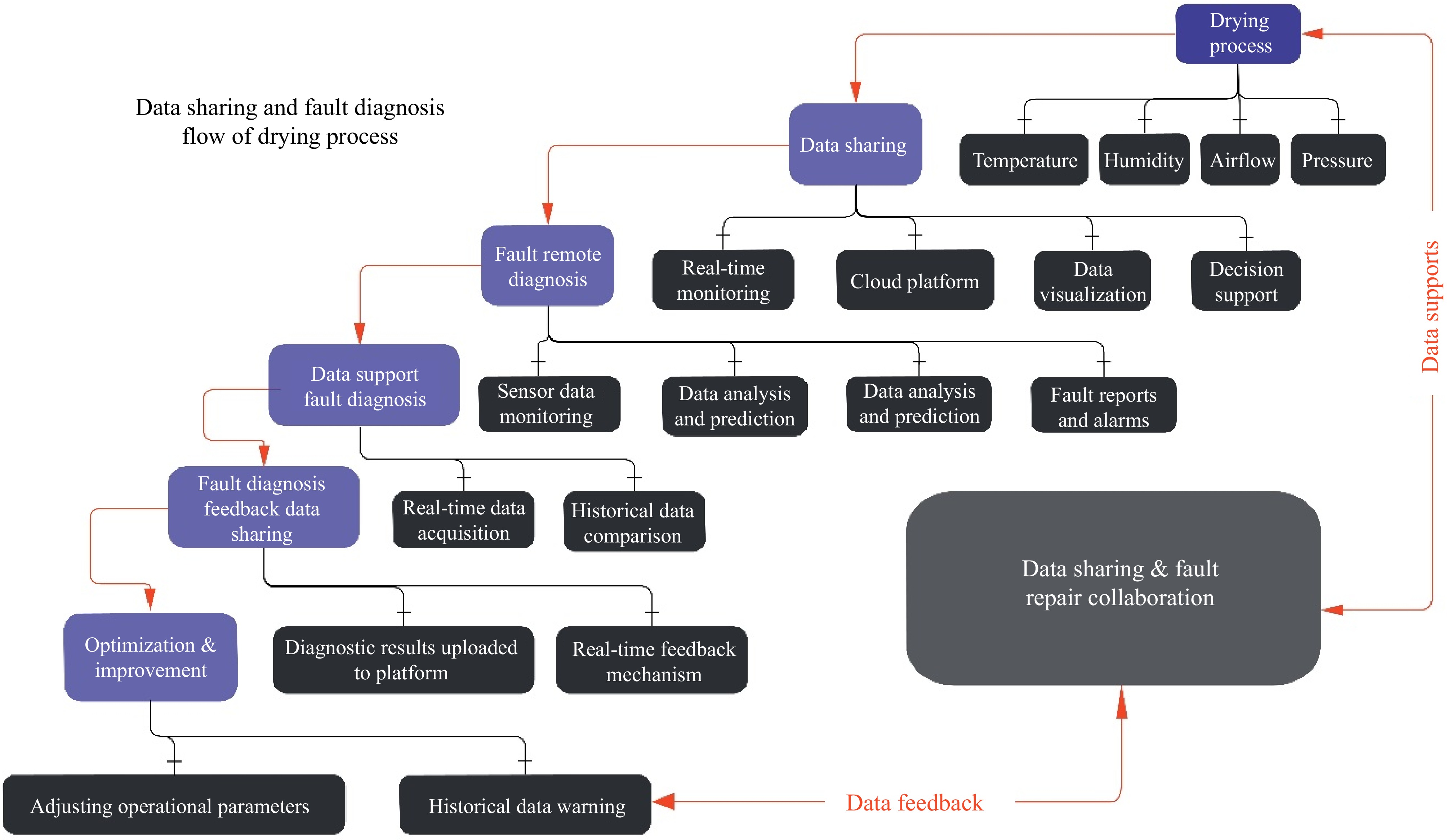
Figure 4.
Closed-loop workflow of data sharing and remote fault diagnosis in smart drying systems.
From a holistic perspective, cloud data sharing, remote monitoring, and fault diagnosis complete the smart drying framework by enabling system-level integration and continuous learning. By connecting real-time process execution (section "Autonomousdecision making and self-optimizing control system") with long-term data accumulation, historical analysis, and collaborative maintenance, this layer transforms smart drying systems into scalable, resilient, and self-improving industrial platforms. The closed-loop interaction among data acquisition, intelligent decision-making, and cloud-based feedback ensures improved transparency, earlier fault detection, reduced downtime, and sustained optimization of drying performance and product quality.
-
Recent advances in intelligent food drying systems have been comprehensively reviewed by Guo et al.[4], who highlighted the rapid integration of multisensor monitoring, data-driven modeling, and intelligent control strategies into modern drying technologies. Their review emphasized the use of real-time sensing (e.g., temperature, humidity, moisture, and image-based parameters), machine learning, and deep learning models for predicting the drying state, and model-based or AI-assisted control frameworks to improve energy efficiency, product quality, and the process's robustness. Despite these advances, several barriers still hinder large-scale industrial implementation, including sensors' reliability under harsh drying conditions, the challenges of data scarcity and integration, limited model generalization, and the absence of unified intelligent control platforms. Addressing these challenges while leveraging emerging digital technologies is essential for the development of adaptive, autonomous, and sustainable smart drying systems.
Technical challenges in intelligent drying systems
Sensors' durability and reliability in harsh drying environments
-
One of the most critical technical challenges in smart drying systems is the deployment of sensors capable of operating reliably under high temperature, high humidity, and highly nonlinear conditions. Conventional sensors often suffer from performance degradation caused by thermal stress, moisture ingress, corrosion, and signal drift, leading to reduced accuracy and shortened service life. Ensuring the long-term stability, robustness, and calibration reliability of sensors remains a major obstacle, particularly in continuous industrial drying operations.
Data interpretation and models' accuracy for nonlinear processes
-
Drying processes are inherently dynamic and nonlinear, with strong coupling among heat transfer, mass transfer, and structural changes in the material. Interpreting multisource sensor data in such environments requires advanced data analytics and modeling approaches. Although machine learning and deep learning models have demonstrated strong predictive capability, their performance is often limited by insufficient training data, variability in the raw materials, and weak generalization across different drying systems. Integrating physics-based knowledge with data-driven models is therefore essential to improve robustness, interpretability, and predictive accuracy. In this context, physics-informed neural networks (PINNs) offer a promising direction because they can embed governing the principles of heat and mass transfer directly into the neural network's training, thereby reducing dependence on large datasets while improving the models' interpretability, extrapolation capability, and reliability under complex drying conditions.
Data integration for developing digital twins
-
Digital twin-based drying systems rely on the seamless integration of heterogeneous data streams from sensors, IoT devices, and control units. In practice, inconsistencies in data formats, sampling rates, and communication protocols complicate real-time data fusion. Inaccurate or incomplete data can compromise the fidelity of the virtual model, leading to suboptimal control decisions. Continuous validation and updating of digital twin models against real operational data remain technically demanding but are critical for maintaining models' accuracy.
Economic and scalability challenges
-
From a sustainability perspective, the high energy demand and carbon footprint of conventional drying systems remain major barriers to their large-scale industrial adoption. Recent assessments of drying technologies for agricultural products emphasize that energy efficiency, lifecycle cost, and environmental impact must be considered simultaneously when scaling up drying operations[32,88]. These constraints underscore the importance of intelligent control strategies and system-level optimization in achieving economically viable and environmentally sustainable drying solutions.
Cost and system complexity
-
Despite their technical advantages, intelligent drying systems are often associated with high initial investment costs, including the cost of sensors, automation hardware, data infrastructure, and control platforms. For small- and medium-scale enterprises, these costs can be prohibitive. In addition, the system's complexity increases with the integration of multiple digital technologies, raising challenges related to that system's design, operation, and maintenance.
Scalability, interoperability, and legacy integration
-
Scaling smart drying solutions across different drying configurations, product types, and industrial environments presents significant challenges. Each system may involve unique equipment specifications and operating conditions, making standardized deployment difficult. Interoperability between digital twins, legacy control systems, and existing information technology infrastructure is often constrained by incompatible data standards and communication protocols, limiting widespread adoption.
Data management and cybersecurity
-
Effective cost control and scalability depend on robust data management strategies. The large volumes of data generated by sensors and digital twins must be stored, processed, and protected efficiently. As intelligent drying systems become increasingly networked, cybersecurity risks such as data breaches, unauthorized access, and model tampering pose serious threats to their operational reliability and industrial trust. Implementing secure, resilient data architectures is therefore essential for economic viability and long-term deployment.
Future trends and opportunities
-
Future smart drying should advance toward closed-loop intelligent control systems that combine real-time sensing, predictive modeling, optimization algorithms, and adaptive control. By continuously monitoring the drying conditions and product quality, these systems can use machine learning, deep learning, or physics-informed models to predict drying behavior, energy use, and quality changes. Recent reviews on drying berries have also emphasized that future drying technologies should move beyond single-parameter optimization toward integrated strategies combining pretreatment, intelligent monitoring, and precise control to preserve bioactive compounds while improving efficiency and product consistency[89]. The optimized parameters can then be automatically adjusted through control strategies such as PID, fuzzy logic, or model-predictive control.
Digital twins and sustainable drying
-
Digital twin technology offers transformative opportunities for smart drying by enabling real-time simulation, predictive optimization, and closed-loop control. Virtual experimentation allows manufacturers to test operating strategies, optimize energy use, and reduce product loss without physical trials. By improving energy efficiency and minimizing waste, digital twins contribute directly to sustainable and low-carbon drying processes.
Edge–AI integration and intelligent control
-
The integration of edge computing with AI-driven models enables real-time data processing and rapid decision-making directly at the equipment level. Edge–AI architectures reduce latency, enhance the system's autonomy, and improve fault diagnosis and adaptive control, particularly in complex and variable drying environments. Hybrid edge–cloud frameworks are expected to play a central role in next-generation intelligent drying systems.
Blockchain and transparent data sharing
-
Blockchain technology presents new opportunities for secure data sharing, traceability, and regulatory compliance in smart drying applications. For example, blockchain-enabled records could be used for tracking the provenance of premium dried products, such as specialty teas, medicinal herbs, dried fruits, or high-value functional ingredients, by securely documenting the raw material's origin, the drying conditions, quality control data, storage history, and distribution records across the supply chain[90]. By ensuring the integrity and transparency of the data across the drying value chain, blockchain-supported platforms can enhance trust among stakeholders while facilitating standardized data exchange for advanced analytics and the deployment of digital twins.
-
Smart drying technologies are transforming drying processes in agriculture, food processing, pharmaceuticals, and materials science by integrating advanced sensors, AI, automation, and cloud-based monitoring. This review has summarized the current status, major challenges, and future trends of smart drying, with emphasis on sensing technologies such as CV, E-noses, hyperspectral imaging, NMR, and NIRS. These tools enable real-time monitoring of key parameters, including temperature, humidity, moisture content, products' appearance, and aroma, thereby supporting more precise control of the drying conditions and improved product quality.
Recent advances in machine learning, deep learning, adaptive control, and remote monitoring further demonstrate the transition of drying systems from conventional operation toward intelligent, autonomous, and self-optimizing platforms. However, their large-scale implementation remains limited by the high equipment costs, the integration of complex systems, models' transferability, and the need for product-specific sensing and control strategies. Addressing these challenges will be essential for wider industrial adoption.
From an industrial perspective, smart drying can promote standardized, scalable, and energy-efficient production by reducing dependence on operators' experience, improving batch-to-batch consistency, minimizing energy waste, and supporting continuous or semicontinuous processing. Therefore, future development should focus not only on technological innovation but also on the equipment's affordability, standardization of processes, integration with existing production lines, and collaboration among researchers, industry stakeholders, and policymakers. Overall, smart drying provides a promising pathway for improving drying efficiency, product quality, sustainability, and industrial competitiveness.
This research is supported by the National Natural Science Foundation of China (No. 32372014) and the National Key Research and Development Program of China (2024YFD2101404).
-
The authors confirm their contributions to this study as follows: writing – original draft, investigation, visualization: Okaiyeto SA; conceptualization: Okaiyeto SA, Xiong FK, Xiao HW; writing – review and editing: Zhang JS, Niu XX, Guo JL, Liu ZB, Bai JW, Xiong FK, Lv WQ, Xiao HW; literature review: Okaiyeto SA, Niu XX; technical support: Guo JL, Bai JW, Lv WQ; supervision: Zhang JS, Xiong FK, Xiao HW; methodological guidance: Liu ZB; project administration: Xiao HW. All authors reviewed the results and approved the final version of the manuscript.
-
No new experimental data were generated or analyzed in this review. All information discussed in this article was obtained from previously published studies, which are cited appropriately in the manuscript.
-
The authors declare that they have no known competing financial interests or personal relationships that could have appeared to influence the work reported in this review.
- Copyright: © 2026 by the author(s). Published by Maximum Academic Press on behalf of China Agricultural University, Zhejiang University and Shenyang Agricultural University. This article is an open access article distributed under Creative Commons Attribution License (CC BY 4.0), visit https://creativecommons.org/licenses/by/4.0/.
-
About this article
Cite this article
Okaiyeto SA, Zhang JS, Niu XX, Guo JL, Liu ZB, et al. 2026. Smart drying: Current status, challenges, and future trends. Food Innovation and Advances 5(3): 468−482 doi: 10.48130/fia-0026-0035 

Smart drying: Current status, challenges, and future trends
- Received: 05 January 2026
- Revised: 11 May 2026
- Accepted: 21 May 2026
- Published online: 14 September 2026
Abstract: This review examines the evolving landscape of smart drying technologies, with an emphasis on recent advances, persistent challenges, and emerging trends. Conventional drying methods, such as sun and hot air drying, have gradually been replaced by advanced techniques, including drying via microwaving, freezing, and heat pumps, each offering specific benefits but also notable limitations related to energy efficiency, product quality, and process control. In response, smart drying technologies have emerged, integrating sensor systems, automation, and artificial intelligence to enable real-time monitoring and adaptive control of drying operations. This review synthesizes current developments in smart drying tools, including computer vision, electronic aroma sensing, hyperspectral imaging, nuclear magnetic resonance, and near-infrared spectroscopy, which enable the continuous assessment of critical parameters such as temperature, humidity, moisture distribution, and aroma evolution. The reported outcomes demonstrate improvements in drying efficiency, energy reduction, and preservation of product quality. However, their widespread adoption remains constrained by the high implementation costs and the need for customized sensing strategies tailored to diverse food matrices. Recent trends highlight the increasing application of machine learning and deep learning models for process-related prediction, optimization, and fault diagnosis, supported by adaptive control systems and cloud-based monitoring platforms. Overall, smart drying represents a transformative approach with substantial potential across the agriculture, food processing, pharmaceutical, and materials sectors. By critically synthesizing technological progress, the implementation barriers, and future development pathways, this review provides a strategic reference for researchers, policymakers, and industry stakeholders seeking to advance scalable, sustainable, and intelligent drying systems for industrial applications.
-
Key words:
- Smart Drying /
- Sensors /
- Artificial Intelligence /
- Post-harvest losses /
- Policymaking