











-
The supply of high-quality forage is crucial for the sustainable development of animal husbandry. Cultivated grasslands, such as alfalfa (Medicago sativa L.), play a pivotal role in sustaining forage availability while providing significant ecological benefits, including improved soil quality, and enhanced ecological restoration. Alfalfa is cultivated worldwide, covering an area of 35 million ha[1] due to its high biomass yield, crude protein content, and strong palatability. Alfalfa cultivation also contributes to improved soil fertility by increasing soil organic matter (SOM), and promoting soil and water conservation[2]. One major challenge in alfalfa cultivation is how to meet the nutritional requirements of alfalfa to sustain production. While alfalfa can obtain a significant portion of its nitrogen (N) requirement through biological N fixation (BNF)[3], the fixed N is not sufficient to entirely satisfy the growth need. For instance, BNF could contribute, on average, 65% of the total N requirement during alfalfa growth under irrigation in South Australia[3] and 51% in the rain-fed agricultural area on the Longdong Loess Plateau of China[4]. Additionally, at the seedling stage or after cutting, when the number of rhizobia is low, or the N-fixing capability is weak, alfalfa still needs to utilise a large amount of soil N[5]. Therefore, the management of N and other fertilizers is crucial to sustaining alfalfa production in practice, and optimizing these management strategies has garnered widespread attention.
Fertilizer application is an effective way to improve soil fertility and, consequently, an important strategy to sustain crop production. Fertilizer application not only increases nutrient availability in soils but also enhances crop growth and production through indirect nutrient interactions[6]. Optimized management strategies for N and other fertilizers have significantly boosted crop yields, such as rice[7], maize[8], and winter wheat[9], etc. Appropriate fertilizer application can substantially promote alfalfa growth, forage yield, and quality[10]. For instance, applying N fertilizer during the early growth stages of alfalfa establishment can enhance BNF[11], while phosphorus (P) fertilizer application promotes the accumulation of dry matter in the stem and leaves[10]. Potassium (K) fertilizer application increases alfalfa forage yield by regulating its physiological and biochemical activities[5]. However, the effect of K fertilizer is highly debatable, as no significant yield increase was observed in 29 of 40 field studies[12]. Organic fertilizers, such as manure, improve soil conditions, and promote alfalfa growth by increasing nutrient availability and facilitating microbial activities[13]. However, excessive fertilizer application may lead to environmental issues, such as soil and water pollution, and greenhouse gas emissions[14]. Inappropriate fertilizer application can result in nutrient imbalances[15], affecting crop growth and production. Therefore, the implementation of fertilizer application requires optimization to improve fertilizer use efficiency, reduce resource waste, and minimize environmental risks in alfalfa production.
Previous studies have focused primarily on single factors, such as fertilizer type or application rate, with limited consideration of the complex interactions among fertilizer management practices, climate, and soil conditions. Climate and soil conditions have substantial effects on the effectiveness of fertilizer application, either by directly influencing crop growth and thus nutrient absorption, or indirectly altering soil nutrient availability[16]. For instance, a recent study showed that precipitation can variously affect alfalfa production under contrasting fertilizer applications[17]. The positive effect of N fertilizer application on forage yield diminished at lower precipitation levels, while the application of P and K fertilizers enhanced yield resilience to precipitation variation[17]. Some practices commonly used by farmers, such as straw mulching and irrigation, have proven effective in regulating crop responses to fertilizer application[8,9]. Therefore, there is an urgent need for a comprehensive understanding of these interactions to optimize fertilizer management strategies in alfalfa production under various environmental conditions.
This study aimed to provide a comprehensive understanding of the effects of fertilizer application, considering fertilizer type, application rate, climate (i.e., temperature and precipitation), and soil conditions (e.g., soil type and initial nutrient content), on alfalfa production. A meta-analysis approach was employed to systematically integrate and compare data from peer-reviewed journal papers, revisiting the relationship between biomass accumulation in alfalfa and fertilizer application, and providing a novel perspective on optimizing fertilizer management strategies. The objectives of this study were to: (1) evaluate the overall effect of fertilizer application on biomass accumulation in alfalfa; (2) identify the effects of fertilizer type and application rate; and (3) assess the influence of climate and soil conditions on the effect of fertilizer application.
-
The Preferred Reporting Items for Systematic Reviews and Meta-analyses (PRISMA)[18] guidelines were used in this study (Fig. 1). The initial search was conducted using several keywords, including 'alfalfa', 'lucerne', 'Medicago sativa', 'fertilization', 'fertilizer', 'fertilizer application', 'yield', 'dry matter', and 'biomass', to collect records from key databases, including Web of Science (
www.webofscience.com ), and the Chinese National Knowledge Infrastructure (www.cnki.net ). An initial screening was then performed to exclude duplicate and ineligible records, and 1,628 records were initially obtained.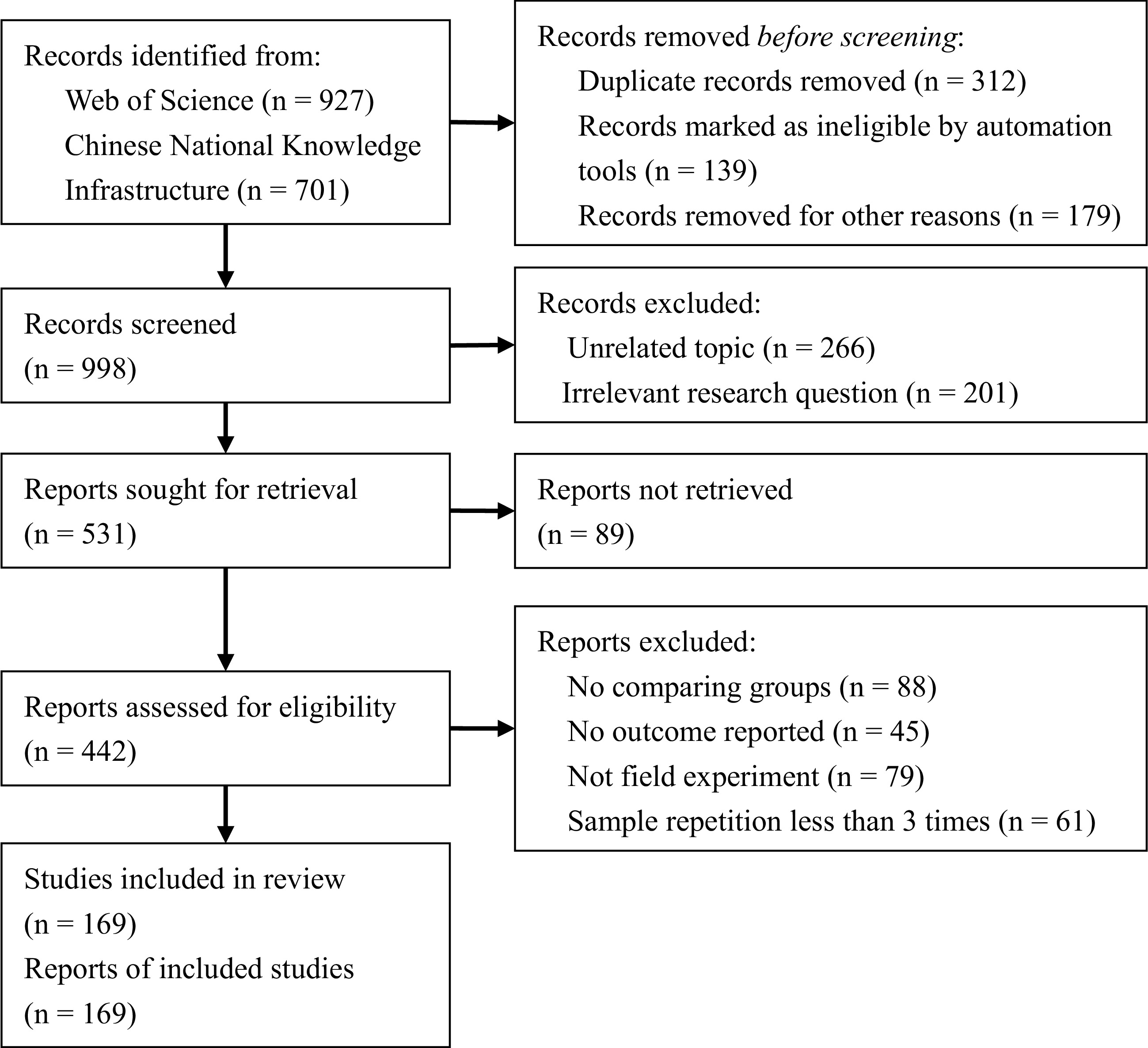
Figure 1.
PRISMA 2020 flow diagram.
Further screening on relevance and eligibility
-
Further screening was performed based on the title, abstract, and full text of the papers (Fig. 1). Three sub-steps were carried out at this stage. First, relevance was assessed by reviewing the title and abstract of each paper, and then records without relevance were excluded. Second, papers for which the full text could not be retrieved were excluded. Third, for the retrieved papers, the following criteria were applied to further screen irrelevant and ineligible papers: (1) studies involving modelling and pot trials under controlled conditions, as well as review papers, were excluded; (2) studies that reported the number of experimental replicates and mean values were included; and (3) studies with paired data, and the control and treatment groups were the no-fertilizer and fertilizer treatment groups, respectively, were included. Finally, 169 papers, spanning from 1957 to 2022, were selected for data collection.
Risk of publication bias
-
The risk of publication bias was minimized by adopting several strategies. The first was to assess the risk by analysing the results in the papers. The studies reported positive, negative, and null effects, suggesting that the bias during the publishing process due to denied submissions should be very low. Additionally, the authors made a concerted effort to collect as many records as possible, which further minimized the risk at this stage. Another strategy involved two authors independently performing the PRISMA procedure and comparing the records[18]. Both authors carried out the initial search and screening, as well as the subsequent screening. The consistency of the records obtained by both authors indicated a low risk of bias among published papers. The third strategy was to cross-screen the initial records. After the initial search and screening, the authors alternated in performing the further screening. This ensured the least risk of selection bias. An additional strategy, i.e., subgroup analysis[18], was employed to reduce the risk of information bias. The authors discussed the methods and divided each group into subgroups of various levels, which helped generate a more comprehensive conclusion.
Data collection
-
The data on mean and standard deviation for alfalfa biomass were collected from the included papers. Data represented as graphs in the papers were extracted using Web Plot Digitizer software[19]. If the standard deviation was not provided in the paper and could not be calculated using the confidence interval or standard error, 1/10th of the mean biomass accumulation was used to estimate the missing standard deviation[20]. A total of 1,595 pairs of experimental data were extracted for further analysis.
In this study, only the first cut of alfalfa was used because most studies described the first cut, and even if two or more cuts were performed, not all cuts were subjected to the same treatment. More importantly, biomass accumulation from the first cut alfalfa accounts for more than 50% of the total yield, or at least occupies a competitive proportion. Therefore, the performance of alfalfa in the first cut was analysed to represent the response of the annual total yield. Note that alfalfa yield refers to the dry weight of biomass. In addition, quality indices such as crude protein, acidic detergent fibre, and neutral detergent fibre, were not included in this paper. This decision helped focus the paper on a single topic and saved space. Another reason for omitting these traits was that they might rarely change in response to environmental variables and management strategies.
The information on climate (i.e., mean annual temperature [MAT] and precipitation [MAP]) and soil conditions (i.e., soil type, pH, organic matter [SOM], mineral N [SNm], available P [SAP], and available K [SAK]) was extracted with alfalfa yield. If the paper did not provide MAT and MAP, those data for the experimental site were obtained from the US National Centers for Environmental Information (
www.ncei.noaa.gov ). In cases where soil properties were not available in the studies, missing data were sourced from the Harmonized World Soil Database (www.fao.org/land-water/land/land-governance/land-resources-planning-toolbox/category/details/en/c/1028012 ). Note that all data were converted to standardized units.Meta-analysis performance
Calculation of effect value
-
The effect size (lnR)[21] was used to measure the effect of fertilizer application on biomass accumulation in alfalfa.
$ \ln R = \ln \left( {\dfrac{{Xe}}{{Xc}}} \right) = \ln Xe - \ln Xc $ (1) where, Xc and Xe are the mean values of the control and treatment groups, respectively. A zero lnR would mean no effect, while a negative or positive lnR value would mean a decrease or increase in biomass accumulation under fertilizer application treatment, respectively.
The variance (V) for each lnR was estimated using Eq. (2):
$ V = \dfrac{{S {e^2}}}{{NeX{e^2}}} + \dfrac{{S {c^2}}}{{NcX{c^2}}} $ (2) where, Sc and Se are the standard deviations of the control and treatment groups, respectively.
The mean effect size (
$\ln\bar R $ $\ln\bar R $ $ \ln \bar R = \dfrac{{\displaystyle\sum\limits_{i - 1}^k {{w_i}\ln {R_i}} }}{{\displaystyle\sum\limits_{i = 1}^k {{w_i}} }} $ (3) $ {w_i} = \dfrac{1}{{{v_i}}} $ (4) where, i is the ith treatment, wi is the weight of i, and k is the number of statistical studies.
When the 95% confidence interval does not overlap with zero, the treatment group is considered to represent a significant (p < 0.05) increase (> 0) or decrease (< 0) compared with the control group. Additionally, Q statistics were used to assess the heterogeneity of effect sizes[22]. The total heterogeneity (Qt) of effect sizes among studies was partitioned into within-group (Qw) and between-group (Qb) heterogeneity (Table 1). The Qb greater than a critical value indicates a significant difference (p < 0.05) between groups.
Table 1. List of variables and between-group heterogeneity (Qb) of effect sizes on biomass accumulation in the meta-analysis.
Variable Group Number of paired data Qb p MAT (°C) ≤ 10 1,031 45.73 < 0.001 > 10 564 MAP (mm) ≤ 400 850 37.82 < 0.001 > 400 745 Soil pH < 6.5 266 0.84 0.657 6.5−7.5 213 > 7.5 1,116 Soil type Clay 316 49.88 < 0.001 Silty loam 353 Loam 367 Sandy loam 559 SOM
(mg·kg−1)< 10 438 9.84 0.007 10−20 469 > 20 688 SNm
(mg·kg−1)< 50 909 27.43 < 0.001 50−100 501 > 100 185 SAP
(mg·kg−1)< 10 665 14.46 0.001 10−20 434 > 20 496 SAK
(mg·kg−1)< 100 617 35.32 < 0.001 100−200 687 > 200 291 Note: MAT, mean annual temperature; MAP, mean annual precipitation; SOM, soil organic matter; SNm, soil mineral nitrogen; SAP, soil available phosphorus; SAK, soil available potassium. The percent change (m, %) in biomass accumulation of alfalfa was computed to facilitate data interpretation:
$ m = \left[ {\exp (\ln \bar R) - 1} \right] \times 100{\text{%}} $ (5) Subgroup analysis and meta-regression analysis
-
To clarify the source and magnitude of heterogeneity and to analyse the effect of fertilizer application and the factors influencing this effect under different conditions, this study conducted subgroup and meta-regression analyses[18], based on climate and soil conditions (Table 1). Among fertilizer types, only N, P, K fertilizers, and manure were selected because these are the most studied and commonly used for alfalfa production. Cases combining the use of multiple fertilizers were not considered. Fertilizer application levels were divided according to standard experimental treatments for the convenience of analysis. Every 50 kg·ha−1 was used as an interval, with the minimum application rate being < 50 kg·ha−1, and the maximum application rate > 250 kg·ha−1. The values for application rates are the amount of pure N, P2O5, or K2O. The MAT was divided into ≤ 10 °C and > 10 °C. The MAP was divided into ≤ 400 and > 400 mm. Soil pH was categorized as < 6.5, 6.5−7.5, and > 7.5. Soil types were classified as clay, silty loam, loam, and sandy loam. The SOM was divided into < 10, 10−20, and > 20 g·kg−1. SNm contents were divided into < 50, 50−100, and > 100 mg·kg−1. SAP contents were divided into < 10, 10−20, and > 20 mg·kg−1. SAK contents were divided into < 100, 100−200, and > 200 mg·kg−1.
Statistical analysis
-
All data were statistically analysed using MetaWin 2.0. A random effects model was applied for data processing of the integrated analysis because it assumes a random error for each data point. This approach provides a larger confidence interval compared to the fixed effects model and is generally more reasonable than assuming all studies share a true effect value. Histograms of effect sizes were generated using IBM SPSS Statistics 26.0, and graphs were created using GraphPad Prism 9.3.0.
-
The effect size on biomass accumulation in the first cut alfalfa was found to follow a normal distribution curve (Fig. 2a). Overall, fertilizer application significantly increased (p < 0.05) biomass accumulation with
$\ln\bar R $ 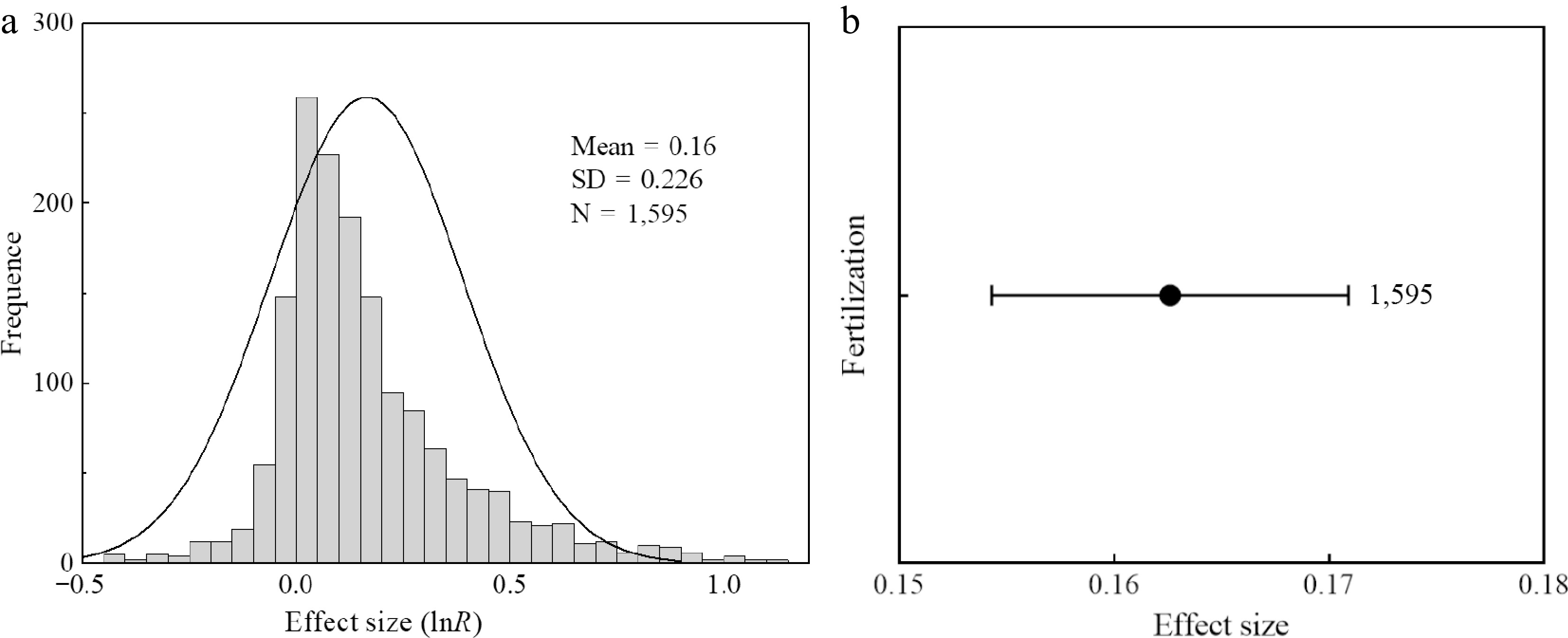
Figure 2.
(a) Distribution of the effect size and (b) the overall effect of fertilizer application on biomass accumulation in the first cut alfalfa. In (b), the number represents the sample size, and the point represents the mean value with the error bar showing the 95% confidence interval.
Effect of fertilizer type on biomass accumulation in alfalfa
-
Fertilizer application significantly increased biomass accumulation in the first cut alfalfa, regardless of fertilizer type (Fig. 3). Specifically, the applications of N, P, K fertilizers, and manure significantly increased biomass accumulation by 12.4%, 24.0%, 13.1%, and 38.0%, respectively. The increase resulting from manure application (
$\ln\bar R $ $\ln\bar R $ $\ln\bar R $ $\ln\bar R $ 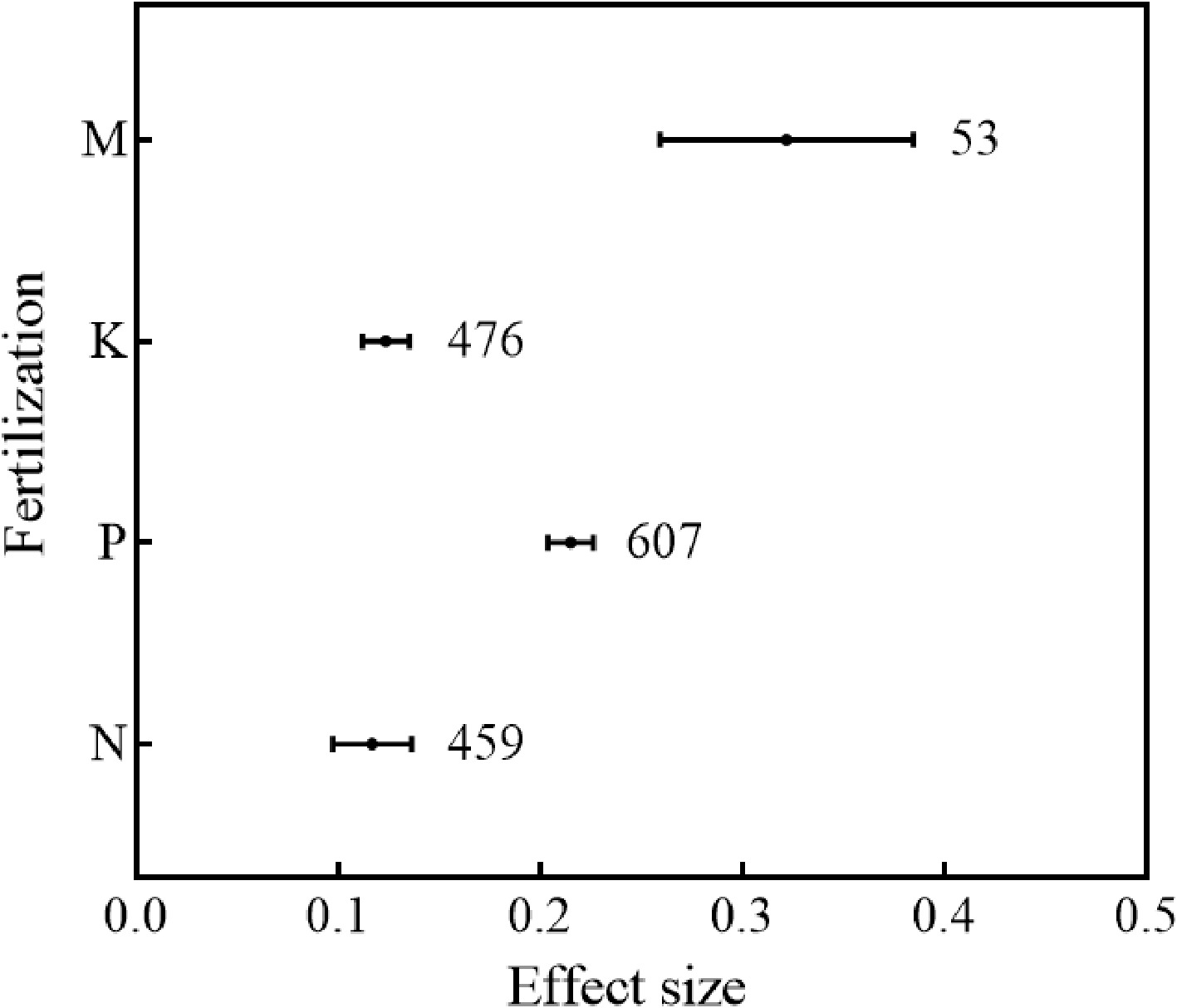
Figure 3.
Effects of applications of nitrogen (N), phosphorus (P), potassium (K) fertilizers, and manure (M) on biomass accumulation in the first cut alfalfa. The numbers represent the sample size, and the points represent the mean values with the error bars showing the 95% confidence intervals.
Effect of fertilizer application rate on biomass accumulation in alfalfa
-
N fertilizer application significantly increased (p < 0.05) biomass accumulation in the first cut alfalfa, except at application rates > 250 kg·ha−1 (Fig. 4a). No difference was detected (p > 0.05) in the increase at other application rates of N fertilizer. The linear regression analysis showed that increasing the application rate of N fertilizer tended to reduce the increase in biomass accumulation, although only 1% of the variation could be explained (Fig. 4b, p = 0.012). P fertilizer application significantly increased (p < 0.05) biomass accumulation in alfalfa irrespective of the application rate (Fig. 4c). Application rates > 250 kg·ha−1 of P fertilizer significantly increased biomass accumulation by 52.0%, which was greater (p < 0.05) than that at application rates < 200 kg·ha−1. The increase in biomass accumulation at application rates of 50-100 kg·ha−1 of P fertilizer was significantly lower (p < 0.05) than those at application rates > 100 kg·ha−1. No difference was detected (p > 0.05) in the increase at application rates of 100–250 kg·ha−1 and < 50 kg·ha−1 of P fertilizer. The linear regression analysis showed that increasing the application rate of P fertilizer tended to promote biomass accumulation, although only 2% of the variation could be explained (Fig. 4d, p < 0.001). K fertilizer application increased biomass accumulation in alfalfa irrespective of the application rate (Fig. 4e, p < 0.05). At application rates of 200–250 kg·ha−1, K fertilizer application increased biomass accumulation by 22.3% (p < 0.05), which tended to be greater than those at other application rates. The increase in biomass accumulation at application rates < 50 kg·ha−1 of K fertilizer was significantly lower (p < 0.05) than those at application rates > 50 kg·ha−1. No difference was detected (p > 0.05) in the increase at application rates > 50 kg·ha−1 of K fertilizer. The linear regression analysis showed that increasing the application rate of K fertilizer tended to promote the increase in biomass accumulation, although only 1% of the variation could be explained (Fig. 4f, p = 0.016).
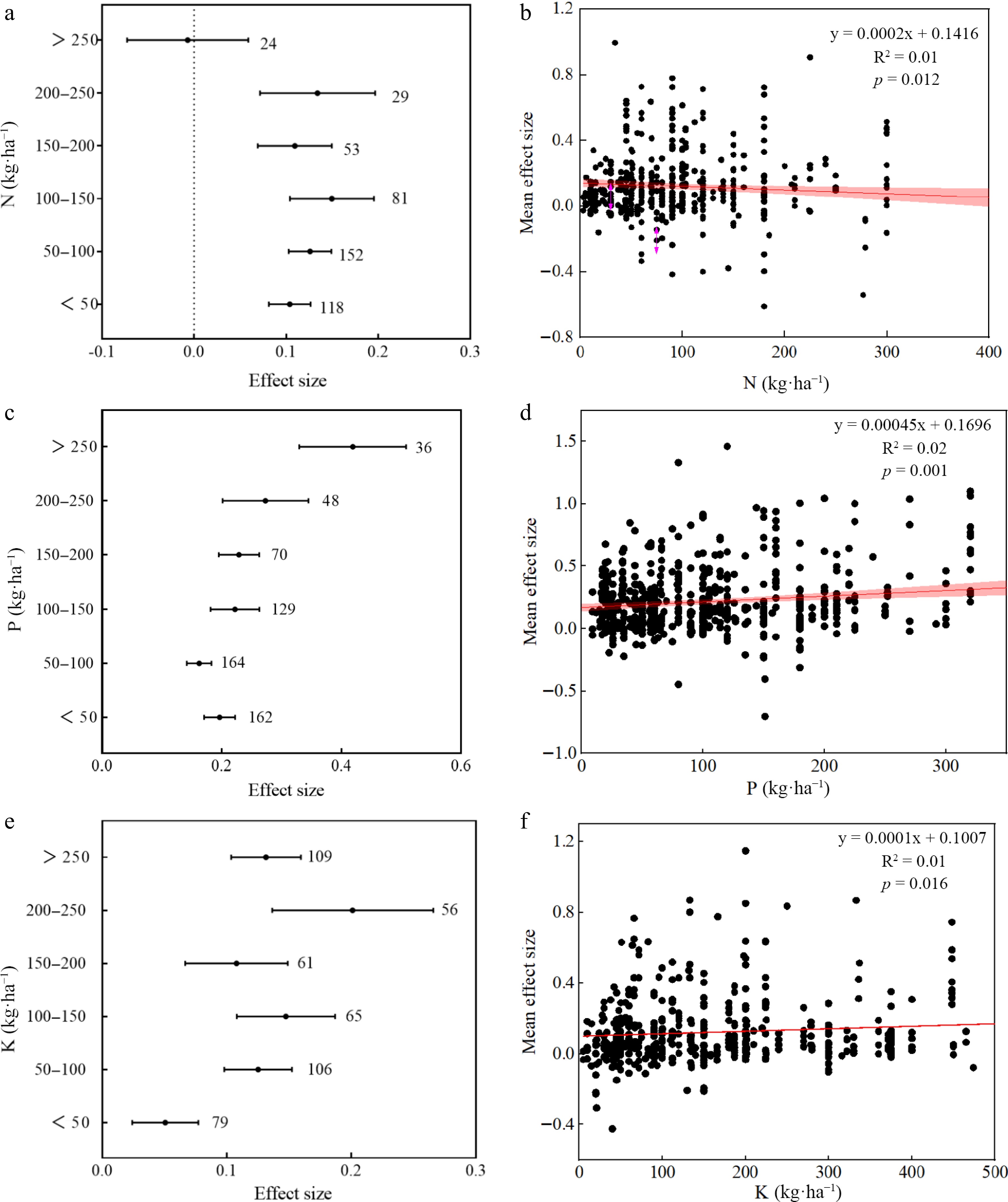
Figure 4.
Effects of (a) nitrogen (N), (c) phosphorus (P), and (e) potassium (K) fertilizers on biomass accumulation in the first cut alfalfa at different application rates, and linear regression analysis on mean effect size with applications of (b) N, (d) P, and (f) K fertilizers. In (a), (c), (e) the numbers represent the sample size, and the points represent the mean values with the error bars showing the 95% confidence intervals. In (b), (d), (f), the shaded area shows the 95% confidence intervals.
Effect of climate conditions on changes in biomass accumulation in alfalfa subjected to fertilizer application
-
The application of N and K fertilizers tended to improve biomass accumulation in the first cut alfalfa more effectively when MATs were ≤ 10 °C, and with a significant difference detected (p < 0.05) only for K fertilizer application (Fig. 5a). The application of P fertilizer and manure showed no significant difference (p > 0.05) between contrasting temperatures, although biomass accumulation tended to increase more in warmer environments. When MAP was ≤ 400 mm, the application of P and K fertilizers tended to increase biomass accumulation more effectively, while the application of N fertilizer and manure in wetter environments tended to perform more effectively (Fig. 5b).
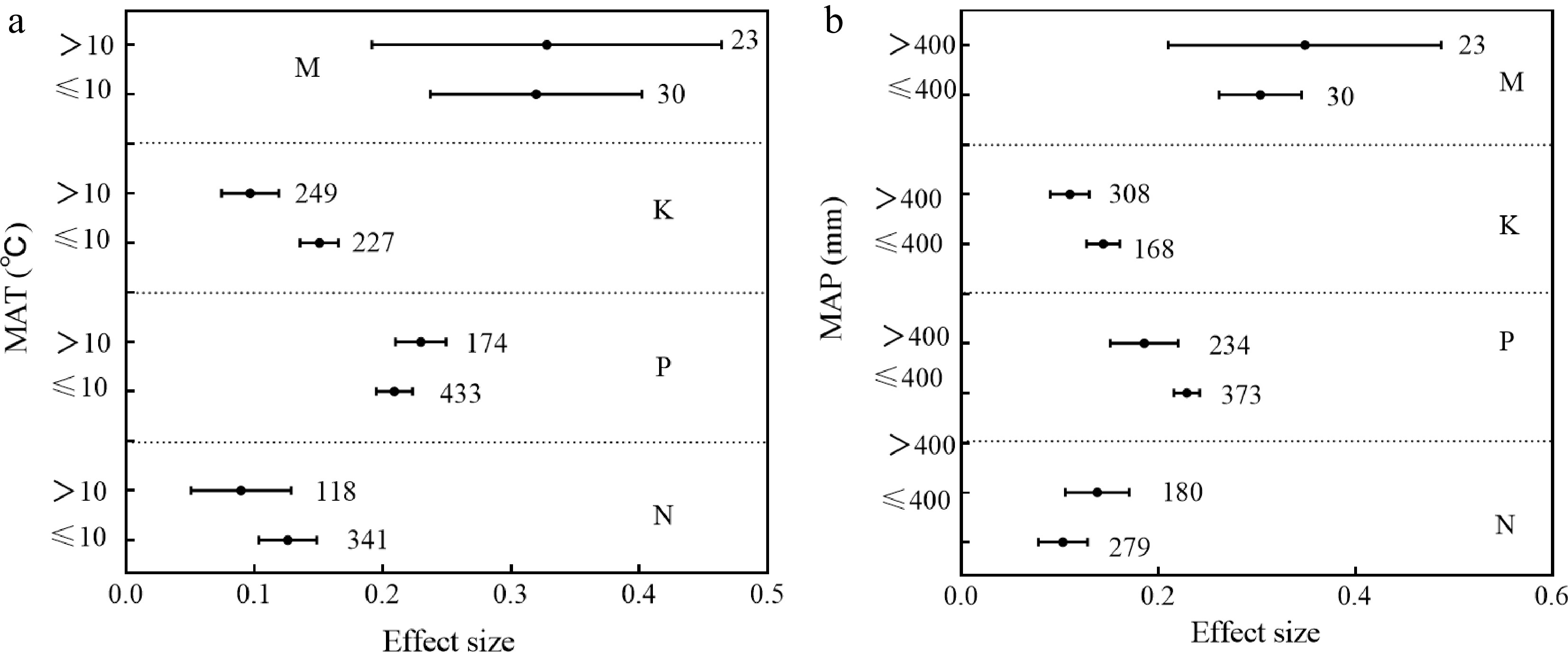
Figure 5.
Changes in the effects of various fertilizer applications on biomass accumulation in the first cut alfalfa under different levels of mean (a) annual temperature (MAT), and (b) precipitation (MAP). N: nitrogen fertilizer, P: phosphorus fertilizer, K: potassium fertilizer, M: manure. The numbers represent the sample size, and the points represent the mean values with the error bars showing the 95% confidence intervals.
Effect of soil condition on changes of biomass accumulation in alfalfa subjected to fertilizer application
-
Soil type had varying effects on the response of biomass accumulation in the first cut alfalfa to fertilizer application (Fig. 6a). Biomass accumulation increased more (p < 0.05) in response to P fertilizer application in loam soils than in other soil types. K fertilizer application increased biomass accumulation more (p < 0.05) in loamy soils than in clay soils, and performed better (p < 0.05) in silty loam soils than in sandy loam soils. There was no significant difference (p > 0.05) among soil types in regulating the effect of N fertilizer and manure applications on biomass accumulation.
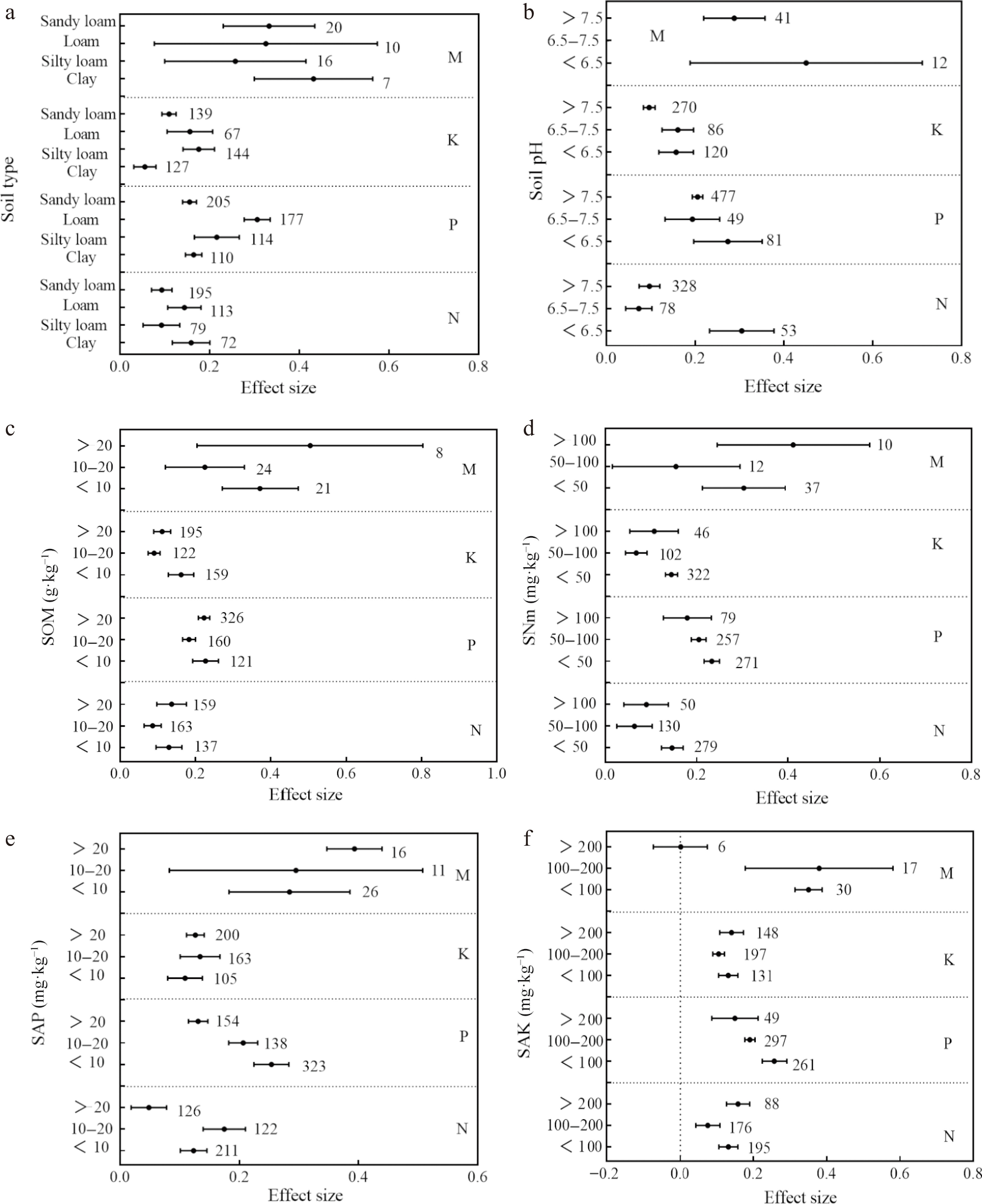
Figure 6.
Changes in the effects of various fertilizer applications on biomass accumulation in the first cut alfalfa under different levels of (a) soil type, (b) pH, (c) organic matter (SOM), (d) mineral nitrogen (SNm), (e) available phosphorus (SAP), and (f) available potassium (SAK). N: nitrogen fertilizer, P: phosphorus fertilizer, K: potassium fertilizer, M: manure. The numbers represent the sample size, and the points represent the mean values with the error bars showing the 95% confidence intervals.
Acidic soil pH tended to enhance the effect of fertilizer application on biomass accumulation in alfalfa at the first cut (Fig. 6b). N fertilizer application resulted in greater biomass accumulation (p < 0.05) in acidic soils (pH < 6.5) compared to neutral and alkaline soils. K fertilizer increased biomass accumulation more (p < 0.05) in soils with a pH < 7.5 than in soils with a pH > 7.5. In contrast, no significant differences (p > 0.05) were observed among soil pH levels when P fertilizer or manure were applied to change biomass accumulation.
The SOM exhibited a similar pattern in regulating the effect of the four fertilizers, with biomass accumulation in the first cut alfalfa increasing less at SOM contents of 10–20 g·kg−1 compared to other levels (Fig. 6c). However, few significant differences were detected except that K fertilizer application increased biomass accumulation more (p < 0.05) at SOM contents < 10 g·kg−1 than at 10–20 g·kg−1, and P fertilizer application was more effective (p < 0.05) at SOM contents > 20 g·kg−1 than at 10–20 g·kg−1.
The SNm had a significant effect on the response of biomass accumulation in alfalfa at the first cut to fertilizer application (Fig. 6d). As SNm contents increased, the effect of application of N, K fertilizers, and manure decreased and then increased, while the effect of P fertilizer application gradually decreased. However, a significant difference was observed (p < 0.05) only in the response to N and K fertilizer applications between SNm contents < 50 and 50–100 mg·kg−1.
The SAP exhibited a contrasting effect on the response of biomass accumulation in the first cut alfalfa to application of the four fertilizers (Fig. 6e). The biomass accumulation tended to increase more in response to N and K fertilizer applications at SAP contents of 10–20 mg·kg−1 than at other levels. The effect of manure application tended to be enhanced by increasing SAP content, while the effect of P fertilizer application was weakened. However, a significant difference was observed only in the response to N and P fertilizer applications, and with biomass accumulation increasing less (p < 0.05) at SAP contents > 20 mg·kg−1, compared to other levels.
The SAK had no significant effect on the response of biomass accumulation in alfalfa at the first cut to K fertilizer application, but had varying effects on those of other fertilizers (Fig. 6f). The biomass accumulation increased more (p < 0.05) in response to N fertilizer application at SAK contents >200 mg·kg−1 than at 100–200 mg·kg−1. For P fertilizer, biomass accumulation increased more (p < 0.05) at SAK contents < 100 mg·kg−1 than at other levels. When SAK contents were > 200 mg·kg−1, manure application did not improve biomass accumulation, which was significantly different (p < 0.05) from the results observed at SAK contents < 200 mg·kg−1.
-
Although BNF can supply a significant amount of N for alfalfa growth[3], the application of N and other fertilizers remains crucial for sustaining alfalfa production. This meta-analysis revealed that compared with no fertilizer application, fertilizer application substantially increased biomass accumulation in the first cut alfalfa by 17.7% overall (Fig. 2b). Moreover, the increase of biomass accumulation in alfalfa subjected to fertilizer application was influenced by various factors, including fertilizer type, application rate, climate, and soil conditions. These factors make it complex and difficult to determine a management strategy, which highlights the need for a comprehensive analysis on this issue, or more site-specific studies.
Variation in increasing biomass accumulation in the first cut alfalfa with fertilizer type
-
Since alfalfa is typically harvested multiple times per year for hay production or direct animal feeding, a large amount of soil nutrients are removed from the grassland along with the forage. Therefore, soil nutrient depletion becomes a limiting factor for alfalfa growth and production. Fertilizer application plays a critical role in sustaining and promoting alfalfa yield by increasing soil nutrient availability. This study revealed that the application of N, P, K fertilizers, and manure significantly increased biomass accumulation by 12.4%, 24.0%, 13.1%, and 38.0%, respectively (Fig. 3). This highlights the contrasting effectiveness of different fertilizers on alfalfa growth and production.
Even though alfalfa can obtain a significant portion of its required N through BNF during growth, N fertilizer application is still necessary when soil nitrate N content falls below 15 ppm or SOM content is below 15 g·kg−1[23]. In this study, N fertilizer application increased biomass accumulation in the first cut alfalfa, but the effectiveness of N fertilizer application was the lowest among the four fertilizers (Fig. 3). N fertilizer application not only enhances plant growth by increasing soil N availability, but it also increases the demand for P and other nutrients[24]. Soil acidification due to N enrichment can help release P from fixed forms, increasing soil P availability[25]. There may be two reasons explaining the restricted increase in biomass accumulation after N fertilizer application. The antagonistic effect of increased soil N availability on BNF[26] may reduce the effectiveness of N fertilizer application. Soil acidification resulting from long-term excessive use of N fertilizer[27] restricts nutrient absorption and, consequently, plant growth. In contrast, P fertilizer application increased biomass accumulation in alfalfa the most among three chemical fertilizers (Fig. 3). It promotes the formation of alfalfa branches, roots, and inflorescences, as well as dry matter accumulation[28]. P fertilizer application helps increase rhizobium number, nodulation rate, N-fixing enzyme activity, and consequently BNF[29,30]. Unlike N and P, K in plants is involved mainly in maintaining osmotic potential and cell integrity, and activating enzymes to sustain normal functions[31]. With adequate K availability in soils and/or after K fertilizer application, a stable K concentration in plants contributes a lot to alfalfa growth, stress resistance, and overwintering[5]. In addition, considering the maintenance of internal homeostasis, increased plant nutrients after fertilizer applications may stimulate the absorption of other nutrients to balance nutrient stoichiometry[32], which is a vital mechanism for promoting alfalfa growth.
Manure application provides a comprehensive and balanced nutrient source for alfalfa, with lasting effects[33]. Additionally, manure is rich in organic colloids, which can improve soil structure[33] and enzyme activity, further enhancing soil fertility. Manure application may promote nutrient absorption and assimilation more efficiently than chemical fertilizer application[34]. Compared to manure, chemical fertilizers (i.e., N, P, and K fertilizers) mainly release an individual nutrient, exhibiting a simpler effect on soil nutrient availability. Moreover, the application of N, P, or K fertilizer alone may lead to a relative limitation of other nutrients to the growth[15]. Therefore, manure should be prioritized for alfalfa production, particularly in areas where manure sources from grass-fed livestock are available. Further research should consider the combination of manure and chemical fertilizers, which was not addressed in this study due to current data limitations.
Variation in increasing biomass accumulation in the first cut alfalfa with the application rate of chemical fertilizer
-
N and other fertilizers have long been supplied to sustain agricultural production, and inappropriate utilisation has led to low use efficiency, high resource input, fertilizer waste, and environmental risk. Therefore, optimizing application rate is a critical concern in fertilizer management. In this study, no differences were detected in increasing biomass accumulation among application rates < 250 kg·ha−1 of N fertilizer (Fig. 4a). Several reasons may explain why there were no differences among application rates: lower sensitivity to fertilizer due to fixed N through BNF[3], enhanced antagonistic effect of increasing soil mineral N on BNF[26], and soil acidification effect from N fertilizer application, which reduces the absorption of N and other nutrients[27]. However, excessive application of N fertilizer leads to severely imbalanced soil nutrient availability[15], and a more acidic environment[27], which significantly reduces nutrient absorption. Additionally, soil acidification can also inhibit mycorrhizal activity, thus impairing P mineralization and availability[35]. Therefore, N fertilizer application at rates > 250 kg·ha−1 did not increase biomass accumulation of alfalfa in this study (Fig. 4a), and there was even a decreasing trend of the effect of N fertilizer application as the application rate increased (Fig. 4b).
In this study, biomass accumulation of the first cut alfalfa tended to increase with the increasing application rate of P fertilizer (Fig. 4c and d). P fertilizer application promotes root growth, improves root nodule infestation capacity[30], increases the number of effective root nodules, and enhances BNF[29], significantly boosting alfalfa yield. However, the available portion of P fertilizer is readily fixed by soil particles after P fertilizer application[25], making it less effective than expected. Therefore, increased application rate may enhance the accessibility of available P in soils, promoting growth.
Since K is relatively abundant in most soils and readily recyclable within the plant, it is not a limiting factor in most cases[36]. This is likely why the increase in biomass accumulation in alfalfa barely changed among application rates > 50 kg·ha−1 of K fertilizer (Fig. 4e). However, variation in the effect was also detected, e.g., a relatively high increase at application rates of 200–250 kg·ha−1 (Fig. 4e). This was partly attributed to the significant effect of K fertilizer application in colder environments (Fig. 5a) and the vital role of K in helping plants' resistance to low temperatures[37]. Additionally, lower application rates (i.e., < 50 kg·ha−1 in this study) of K fertilizer may not significantly alter soil K levels, resulting in a weak efficacy in increasing yield.
This revisited approach revealed that fertilizer application mostly increased biomass accumulation in alfalfa, but few differences were detected among application rates for the three chemical fertilizers. It suggests that very high application rates have limits in improving alfalfa production. This may help correct farmers' fertilizer application practices. Considering the higher yield increase, lower fertilizer input, and environmental risk, the ranges of application rates for N, P, and K fertilizers were recommended to be 100–150 kg·ha−1 in alfalfa production. These values are a bit lower than those reported for other crops[8,9]. Several reasons would have contributed to this difference. Traditional crop production focuses mainly on grain and differs significantly from alfalfa production, which may have influenced farmers' practice in fertilizer application. The utilisation of N and other nutrients also varies greatly between legumes and cereal crops. Alfalfa is a perennial legume and may employ different strategies for nutrient utilisation compared to annual crops. Therefore, further research, including site-specific studies and accurate soil nutrient balance analysis, is needed to determine better application rates of these fertilizers.
Variation in increasing biomass accumulation in the first cut alfalfa with fertilizer application under different climate conditions
-
Previous studies have suggested that climate factors may regulate the effect of fertilizer application on plant growth and production[38,39]. This meta-analysis revealed that MAT and MAP had limited effects on increasing biomass accumulation in alfalfa with fertilizer application (Fig. 5). Alfalfa may strongly adapt to the corresponding climate in relatively large areas. Therefore, the growth and production would remain relatively stable in the specific regions. There is a broad temperature range, from 5 to 35 °C, for alfalfa growth and production, suggesting that regional temperature is not a limiting factor. However, there were some signs that increasing biomass accumulation with application of P fertilizer and manure was more effective at MATs > 10 °C than at MATs < 10 °C, while the opposite trend was observed with N and K fertilizers (Fig. 5a). High temperature may favour the release of P from fixed forms[25]. The enzymes involved in releasing nutrients from N fertilizer and manure should prefer either low or high temperatures to maximize the activity[40,41]. A significant difference between the two MAT levels was detected only under K fertilizer application, and the effect was more pronounced at MATs < 10 °C (Fig. 5a). Considering the primary role of K in maintaining normal cell function[31], high K concentration makes the plant more tolerant to lower temperatures, thus sustaining growth and production.
Alfalfa varieties and cultivars show strong adaptability to precipitation ranging from 300 to 800 mm, and some have great tolerance to mild drought. In areas with low MAP, irrigation is generally applied to sustain alfalfa production. These would lead to few differences in biomass accumulation with fertilizer application between the two MAP levels, although the release of nutrients from fertilizers is affected by soil water availability[42]. However, application of P and K fertilizers tended to increase biomass accumulation in alfalfa more effectively under MAP < 400 mm than under MAP > 400 mm, while N fertilizer and manure performed better under higher MAP (Fig. 5b). High MAP is thought to result in greater P loss than facilitating P release from fixed forms and P fertilizer[43]. This also presents a challenge for K fertilizer since K moves more smoothly through the soil‒plant continuum than other nutrients. In addition, cationic K plays a more dominant role under drought conditions than in wetter environments due to its active role in maintaining cell function[31]. In contrast, a wetter environment favours the growth and function of soil microorganisms, facilitating nutrient release from manure[44]. For N fertilizer, high MAP not only facilitates the release, but also promotes the availability of other nutrients (e.g., P) in soils to balance soil nutrient availability[32].
Variation in increasing biomass accumulation in the first cut alfalfa with fertilizer application under different soil conditions
-
Soil conditions affect the supply of soil nutrients, water mobility, and soil biological activity, regulating the key processes of fertilizer turnover[45]. This meta-analysis revealed that soil type, pH, and nutrient conditions, such as SOM, SNm, SAP, and SAK, were important factors affecting the impact of fertilizer application on biomass accumulation in alfalfa (Fig. 6). P fertilizer application resulted in a greater increase of biomass accumulation in loamy soils than in other soil types (Fig. 6a). Loamy soils are generally more fertile, looser, and more permeable, and have better drainage and moisture conditions, which is more favourable for alfalfa growth[46]. This is also why K fertilizer application led to a lower increase in clay soils than in loamy soils (Fig. 6a). Clay soils have much finer particles and more nutrient adsorption sites but poorer water permeability[47], making K fertilizer less accessible to crop roots.
Soil pH determines an essential environmental condition for soil nutrient transformations, with N in alkaline soils being more susceptible to losses through ammonia volatilization, nitrification, and other processes[48]. Therefore, N fertilizer application increased biomass accumulation more effectively at pH < 6.5 than at other levels (Fig. 6b). In contrast, K fertilizer application performed better in neutral and acidic soils (Fig. 6b), possibly due to the low sensitivity of crops to relatively adequate K availability in alkaline soils[37].
The SOM and soil N are essential indicators of soil fertility[49], and are critical for enhancing alfalfa growth. The lowest increase in biomass accumulation with application of all four fertilizers tended to occur at medium levels of SOM and SNm (Fig. 6c and d). Soil microorganisms are involved in SOM decomposition and humus formation[50], and are essential indicators of soil quality or health[51]. Soils with relatively high levels of SOM and SNm can provide suitable living conditions for soil microorganisms[52], promoting nutrient transformation and absorption, and consequently biomass accumulation. The application of N and P fertilizers increased biomass accumulation in alfalfa less at higher levels of SAP (> 20 mg·kg−1, Fig. 6e). The reason why N fertilizer performed worse is unclear, but P fertilizer application might have led to a more severe imbalance in soil nutrient availability due to excessive P levels[25]. Manure performed worse at SAK contents > 200 mg·kg−1 than at SAK contents < 200 mg·kg−1 (Fig. 6f). A higher SAK content may not be conducive to the release of nutrients from fertilizers, possibly due to soil alkalinity and ion toxicity[53].
-
This meta-analysis revisited published papers and revealed that compared with no fertilizer application, fertilizer application significantly increased biomass accumulation in the first cut alfalfa by 17.7% overall, but few differences were detected among application rates for N, P, and K fertilizers. The recommended ranges for the application rates of the three chemical fertilizers were 100–150 kg·ha–1 considering alfalfa yield, fertilizer input, and environmental risk. The MAT and MAP had limited effects on increasing biomass accumulation with fertilizer application, and these effects varied among the four fertilizers. Although soil conditions had limited regulatory effects on increasing biomass accumulation with fertilizer application, they performed differently with each fertilizer. This study provides valuable insights for optimizing fertilizer management strategies in alfalfa production by taking into account various environmental conditions. It should be noted that the recommended ranges for fertilizer application rates had weak explanatory power and thus should not be over-promoted in practice unless a more optimal range is determined. Future research should focus on the prolonged effect of fertilizer application, fertilizer type and/or site-specific variation, helping provide guidance for the sustainable utilisation of alfalfa grassland under diverse environments.
This work was supported by the National Key Research and Development Program of China (2022YFD1300801), the National Natural Science Foundation of China (32171679), and the China Agriculture Research System of the Ministry of Finance and the Ministry of Agriculture and Rural Affairs (CARS-34). We acknowledge the help from Dr. Yuan Li, Dr. Le Mu, Ms. Xiaojuan Wu, and Ms. Wanping Wu for discussion in writing the draft.
-
The authors confirm contributions to the paper as follows: study conceptualization and design, data analysis, paper writing and revision: Ben Z, Yang H; data collection: Ben Z; financial support and administration: Yang H. Both authors reviewed the results and approved the final version.
-
The datasets generated during and/or analysed during the current study are available from the corresponding author upon reasonable request.
-
The authors declare that they have no conflict of interest.
- Copyright: © 2025 by the author(s). Published by Maximum Academic Press, Fayetteville, GA. This article is an open access article distributed under Creative Commons Attribution License (CC BY 4.0), visit https://creativecommons.org/licenses/by/4.0/.
-
About this article
Cite this article
Ben Z, Yang H. 2025. Revisiting the effect of fertilizer application on biomass accumulation in alfalfa: roles of fertilizer type, application rate, and environmental condition. Grass Research 5: e028 doi: 10.48130/grares-0025-0025 

Revisiting the effect of fertilizer application on biomass accumulation in alfalfa: roles of fertilizer type, application rate, and environmental condition
- Received: 28 April 2025
- Revised: 11 September 2025
- Accepted: 17 September 2025
- Published online: 05 November 2025
Abstract: An insufficient supply of high-quality forage is a critical factor constraining the development of the livestock industry. Cultivated grasslands, such as alfalfa (Medicago sativa L.), play a vital role in addressing this issue. Fertilizer application is an effective strategy for sustaining alfalfa production; however, optimizing management practices is essential for alfalfa to adapt to variable environmental conditions. In this study, 169 published papers encompassing 1,595 pairs of experimental data spanning from 1957 to 2022 were compiled. A meta-analysis was conducted to evaluate the effect of fertilizer application on biomass accumulation in alfalfa at the first cut, considering fertilizer type, application rate, and environmental factors. Compared with no fertilizer application, fertilizer application significantly increased biomass accumulation in the first cut alfalfa by 17.7% overall. The applications of nitrogen, phosphorus, potassium fertilizers, and manure significantly increased biomass accumulation by 12.4%, 24.0%, 13.1%, and 38.0%, respectively, compared to no fertilizer application. Few differences were detected in improving alfalfa production among the application rates of the three chemical fertilizers. The recommended ranges for application rates of the three chemical fertilizers were 100–150 kg·ha−1. Mean annual temperature, and mean annual precipitation had limited effects on increasing biomass accumulation with fertilizer application, which varied among the four fertilizers. Soil conditions exhibited various regulatory effects on biomass accumulation in response to application of the four fertilizers. These findings provide valuable insights to help optimize fertilizer management strategies in alfalfa production by considering environmental conditions. Future research should focus on the prolonged effect of fertilizer application, fertilizer type and/or site-specific variation, and provide guidance for the sustainable utilisation of alfalfa grassland under diverse environments.
-
Key words:
- Alfalfa /
- Fertilizer application /
- Environmental factor /
- Biomass accumulation