












-
Anthaxia (Haplanthaxia) proteus Saunders, 1873 and A. (H.) psittacina Heyden, 1887 are morphologically highly similar species that are widely distributed in East Asia and the Russian Far East, and this similarity has caused long-standing confusion in their identification and classification[1−4]. According to the current classification, A. proteus (type locality: Japan, no specific locality) is known from Japan and Taiwan, China, whereas A. psittacina (type locality: Suyfun, Amur River, Russian Far East) is distributed across China, Korea, and Russia (East Siberia and the Far East). Additionally, the subspecies A. psittacina nigrifrons Bílý & Svoboda, 2001, occurs in Hunan, China[3−8] (Fig. 1).
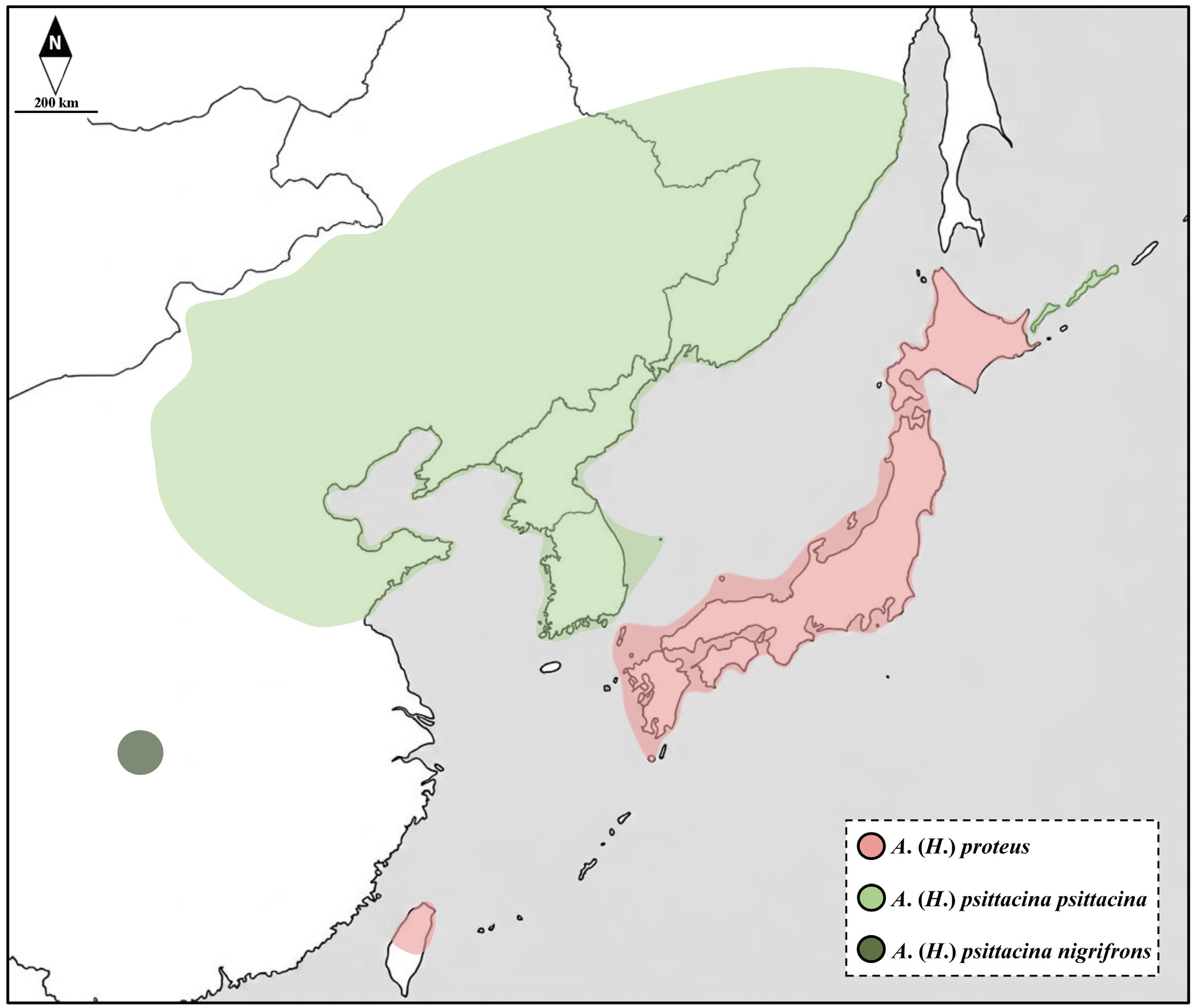
Figure 1.
Distribution map of Anthaxia proteus and A. psittacina. The map was taken from Snazzy Maps (
https://snazzymaps.com ) and edited using Adobe Photoshop 21.2.0 (Adobe Systems Inc.).The two species share identical ecological traits. Adults emerge in May and remain active until August, visiting various flowers, including those of Castanea (Fagaceae)[4,9,10] (Fig. 2). Pinus spp. are their only known host plants[2,4,10,11].
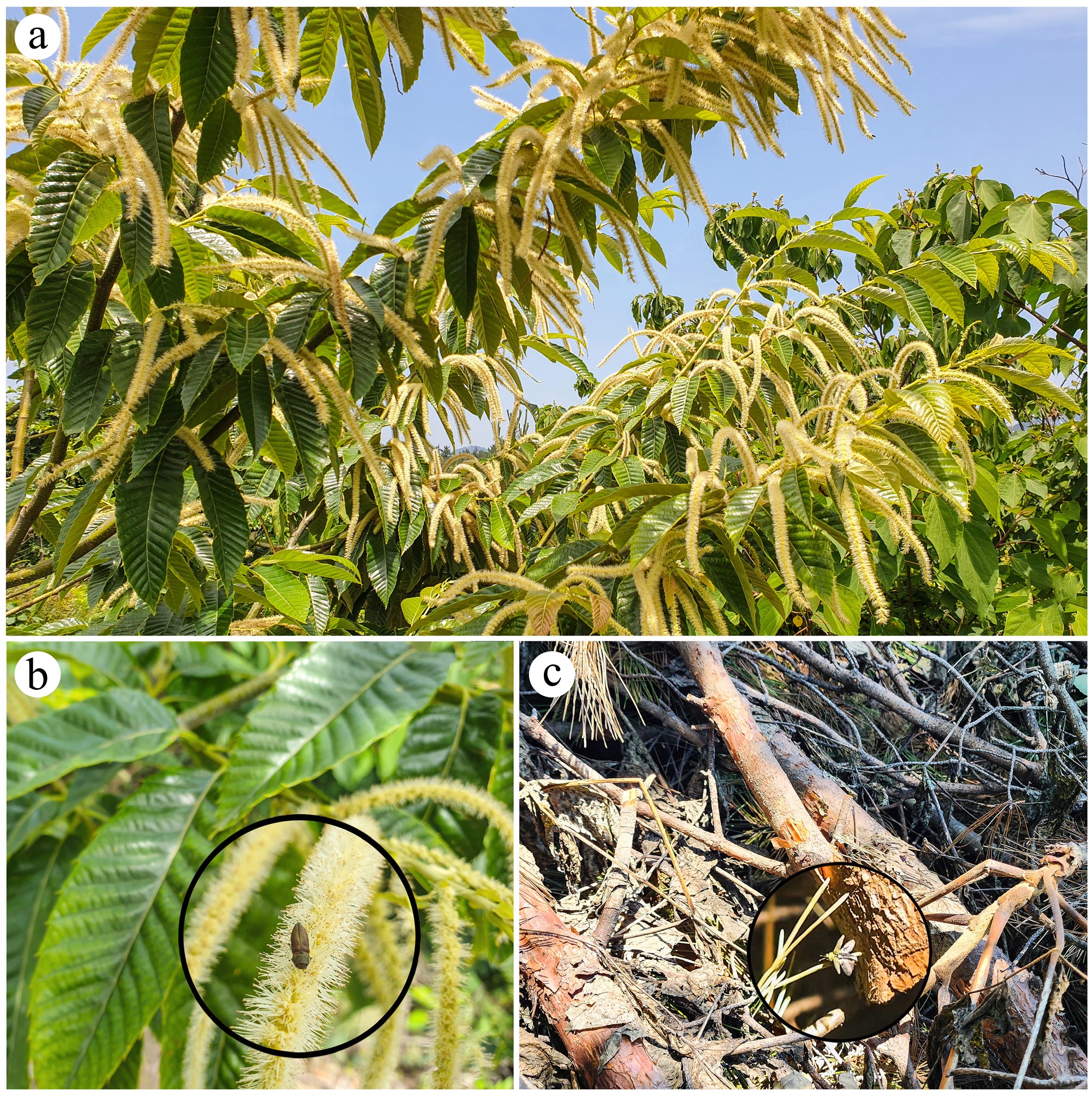
Figure 2.
Ecology of Anthaxia proteus: (a) Habitat. (b) Adult on flowers of Castanea (Fagaceae). (c) Female adult flying to pine branches for oviposition.
The taxonomic status of A. psittacina was first revised by Bílý[2], who treated it as a subspecies of A. proteus based on morphological comparisons. In total, 225 specimens were examined, including 21 specimens from the Russian Far East (including the holotype of A. psittacina), 16 from Korea, seven from northeastern China, one from Taiwan, China, and 180 from Japan (including the holotype of A. proteus). Later, Bílý & Svoboda[3] restored A. psittacina to specific rank using extensive material from East and South China (the number of specimens not specified), and subsequently described A. psittacina nigrifrons Bílý & Svoboda, 2001 as a subspecies. In the same work, A. angulaticollis Kurosawa, 1956 from Taiwan, China was synonymized with A. proteus, since the dark coloration, angulate pronotal margins, and slightly caudiform elytra were considered to fall within the range of intraspecific variation of A. proteus.
Bílý & Svoboda[3] also proposed diagnostic characters to distinguish A. proteus from A. psittacina, as well as A. psittacina nigrifrons from the nominotypical subspecies. All diagnostic character states are summarized in Table 1.
Table 1. Diagnostic characters for A. proteus, A. psittacina, and A. psittacina nigrifrons based on Bílý & Svoboda[3].
Character A. proteus A. psittacina A. psittacina nigrifrons Coloration Sexual dichromatism well developed: male golden green to blue-green, often darker centrally on pronotum; female head black, pronotum black with blue-green margins, elytra green-brown with narrow green basal and sutural stripes; ventral side black Sexual dichromatism usually undeveloped: both sexes golden-green to brown-green with green frons; exceptionally female entirely brown or almost black Sexual dichromatism developed: male frons blue-green, vertex black; female head entirely black; pronotum black with blue-green anterior and lateral margins; elytra black-green in both sexes Head Frons distinctly convex and depressed medially Frons less convex Frons almost flat with very indistinct medial depression Pronotum More enlarged anteriorly, widest at anterior half; lateral pronotal margins regularly rounded or moderately angulated, often slightly incurved before posterior angles; pronotal spot absent Less enlarged anteriorly, widest at midlength; lateral pronotal margins regularly rounded and distinctly incurved before posterior angles; pronotal spot absent Less enlarged anteriorly; lateral pronotal margins more distinctly incurved before posterior angles than nominotypical subspecies; pronotal spot present in both sexes Elytra More acuminate apically; lateral margins straight before apex or slightly caudiform Less acuminate apically; lateral margins slightly rounded before apex More slender than nominotypical subspecies Aedeagus Shorter; parameres more enlarged laterally Longer; parameres more slender Slightly different from nominotypical subspecies However, despite successive taxonomic revisions and the proposed diagnostic characters based on extensive materials from various localities, the distinction between A. proteus and A. psittacina remains ambiguous, leading to persistent taxonomic confusion[4]. In Korea, both scientific names have been recorded together in national insect checklists and faunistic studies[12−24]. Accordingly, an integrative taxonomic approach combining morphological re-examination and molecular analyses was adopted to clarify their taxonomic relationship and determine whether the two taxa represent distinct species.
-
Samples were collected by sweeping the flowers of Castanea (Fagaceae) and by visual searches of adults flying to pine branches (Pinus spp.) for oviposition (Fig. 2).
Collected specimens were individually preserved in 99% ethanol. After DNA extraction, specimens were either dried and mounted as voucher specimens or preserved in ethanol as wet specimens; genitalia were stored separately in microtubes containing glycerin.
For morphological examination, all samples with newly generated sequences, along with additional dried specimens from museum and private collections, were examined. A total of 135 individuals (88 from Korea, 39 from Japan, four from China, and four from Russia) were assessed. External morphological characters and genitalia were examined under a stereoscopic microscope (Olympus SZX16, Tokyo, Japan) and a compound microscope (Olympus BX50, Tokyo, Japan). Male genitalia were dissected from the last abdominal segment using forceps.
Measurements were taken as follows: body length (BL) from the anterior margin of the vertex to the apex of the elytra; body width (BW) at the widest point; pronotum length (PL) along the median line from the base of the scutellum to the medial point of the anterior margin; pronotum width (PW) at the widest point; paramere length (PaL) from the base to apex; paramere width (PaW) at the widest point.
The acronyms of depositories cited or used throughout the text are as follows: BMNH (The Natural History Museum, London, United Kingdom), DEI (Deutsches Entomologisches Institut im ZALF, Müncheberg, Germany), JLCK (Jun-Gu Lee collection, Wonju, Republic of Korea), KNU (Kyungpook National University, Daegu, Republic of Korea), NMPC (National Museum, Prague, Czech Republic), NSMT (National Science Museum (Natural History), Tokyo, Japan), OMNH (Osaka Museum of Natural History, Osaka, Japan), and YTJ (Yutaka Tamadera collection, Kyoto, Japan).
Photography and image processing
-
Photographs of specimens were taken with a Michrome 16 CMOS camera (Tucsen, Fujian, China) or an Olympus OMD EM10 Mark III digital camera, and the images were edited using Adobe Photoshop (Adobe Systems, USA). Specimens used for dorsal and ventral illustrations were not necessarily the same individuals.
Verification of distribution records
-
Historical distribution records were evaluated based on whether the literature provided explicit specimen locality data. Literature lacking such collection data was excluded from the formal Distribution section and was treated separately as Unverified historical literature.
DNA extraction, amplification, and sequencing
-
Total genomic DNA was extracted from the bodies of specimens using the QIAquick DNeasy Tissue Kit (QIAGEN, Hilden, Germany), following the manufacturer’s protocol. DNA sequence data were obtained from two gene regions for each specimen, totaling 1,636 bp: a 658 bp fragment of the mitochondrial protein-coding gene cytochrome c oxidase subunit I (COI) and a 978 bp fragment of the nuclear ribosomal gene 28S.
PCR amplifications for the two loci (COI, 28S) were performed in a 25 μL reaction containing 1 × PCR buffer, 0.2 mM dNTPs, 0.4 μM of each primer, 0.5 units of Taq DNA polymerase (TaKaRa, Shiga, Japan), and 1 μL of extracted genomic DNA. The PCR conditions and primers used for sequencing are listed in Supplementary File 1, Primer seqeunces and PCR conditions sheets. PCR products were purified and sequenced at Macrogen (Daejeon, Korea). Raw sequences were assembled using BioEdit[25]. All sequences generated in this study are deposited in the GenBank database, and the corresponding accession numbers can be found in Supplementary File 1, Sample data sheet.
Sequence alignment, phylogenetic analyses, and genetic distances
-
COI sequences were aligned using the ClustalW algorithm in MEGA 12[26]. For 28S rDNA, alignments were performed using MAFFT[27] with the Q-INS-i option, which accounts for the secondary structure of rRNA. Poorly aligned regions were subsequently removed using a modified Gblocks method[28] implemented in Mesquite v4.01[29].
Newly generated COI and 28S sequences from the collected specimens, along with publicly available sequences of Anthaxia species obtained from the NCBI GenBank database, were used for phylogenetic analysis and pairwise distance calculation. The detailed information of the final matrix is provided in Supplementary File 1, Public data sheet.
Phylogenetic relationships were inferred using both maximum likelihood (ML) and Bayesian inference (BI) methods. For ML analysis, W-IQ-TREE[30] was employed. Best-fit substitution models were selected via ModelFinder[31] based on the Bayesian Information Criterion (BIC), identified as GTR + F + I + G4 for COI and TPM3u + F + I + G4 for 28S rDNA. Branch support was estimated with 1,000 replicates of ultrafast bootstrap[32]. Bayesian inference (BI) analyses were conducted using MrBayes v3.2.7a[33]. For both COI and 28S rDNA datasets, the GTR + I + G model was applied with all parameters unlinked across partitions. The MCMC simulation ran for 10,000,000 generations, sampling every 1,000 generations with a 25% burn-in. Convergence was rigorously confirmed by the average standard deviation of split frequencies (COI: 0.003017, 28S: 0.002931), potential scale reduction factors (PSRF ≤ 1.014), and effective sample sizes (ESS > 200) for all parameters (verified via Tracer v1.7.2). All final phylogenetic trees were visualized in FigTree v1.4.4[34]. Additionally, pairwise genetic distances were calculated using the Kimura 2-parameter (K2P) model in MEGA 12[26].
-
As a result of re-examining the morphological diagnostic characters proposed by Bílý & Svoboda[3] to distinguish A. proteus and A. psittacina, the four major characters they identified were found to be shared by both species, and none of them clearly separated the two taxa (Figs 3−5).
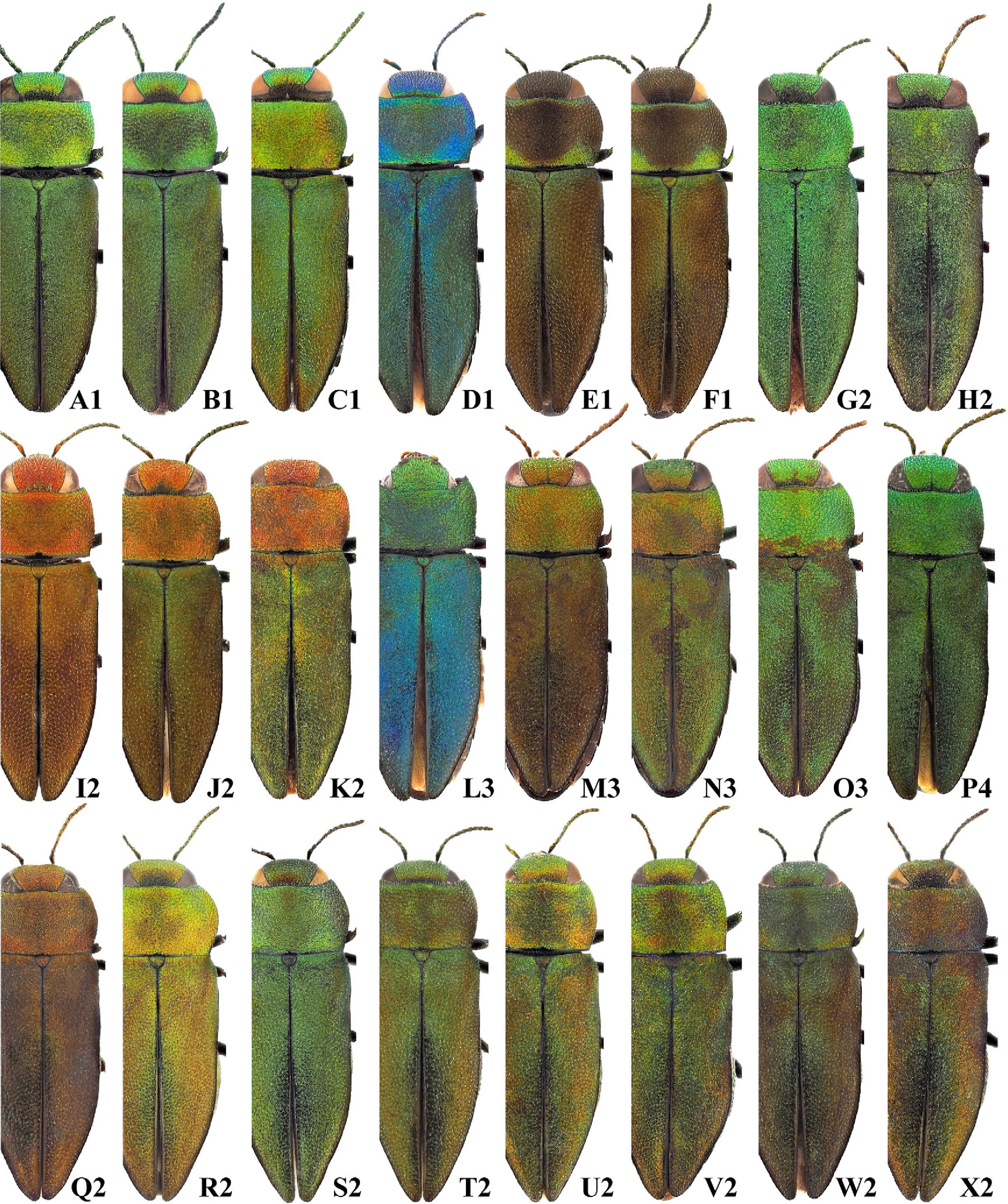
Figure 3.
Morphological variations of A. proteus and A. psittacina (dorsal view of habitus). (A)–(F) A. proteus. (A)–(D) Males. (E), (F) Females. (G)–(X) A. psittacina. (G)–(P) Males. (Q)–(X) Females. Numbers refer to collection localities: 1. Japan; 2. Korea; 3. China; 4. Russia.
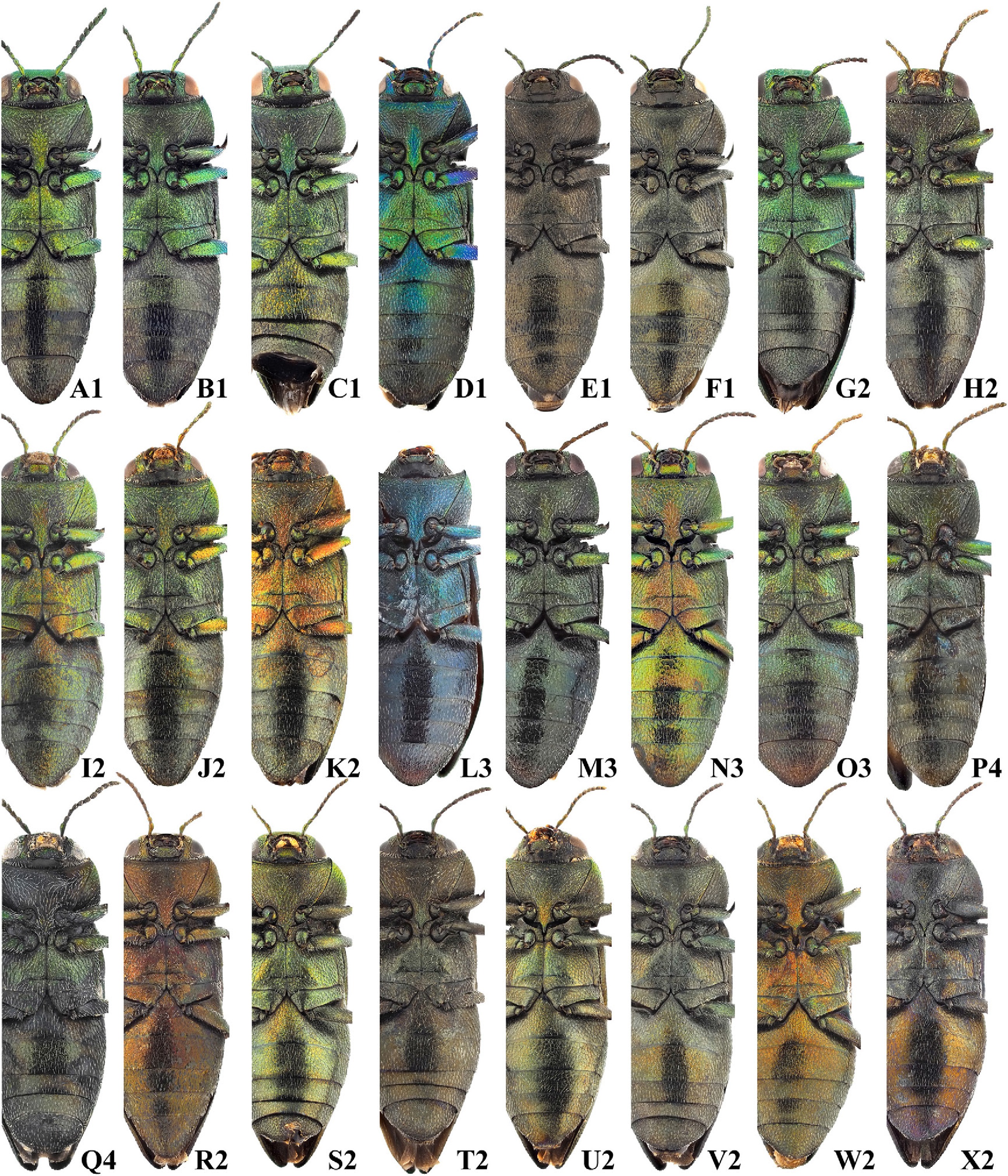
Figure 4.
Morphological variations of A. proteus and A. psittacina (ventral view of habitus). (A)–(F) A. proteus. (A)–(D) males. (E), (F) Females. (G)–(X) A. psittacina. (G)–(Q) Males. (R)–(X) Females. Numbers refer to collection localities: 1. Japan; 2. Korea; 3. China; 4. Russia.
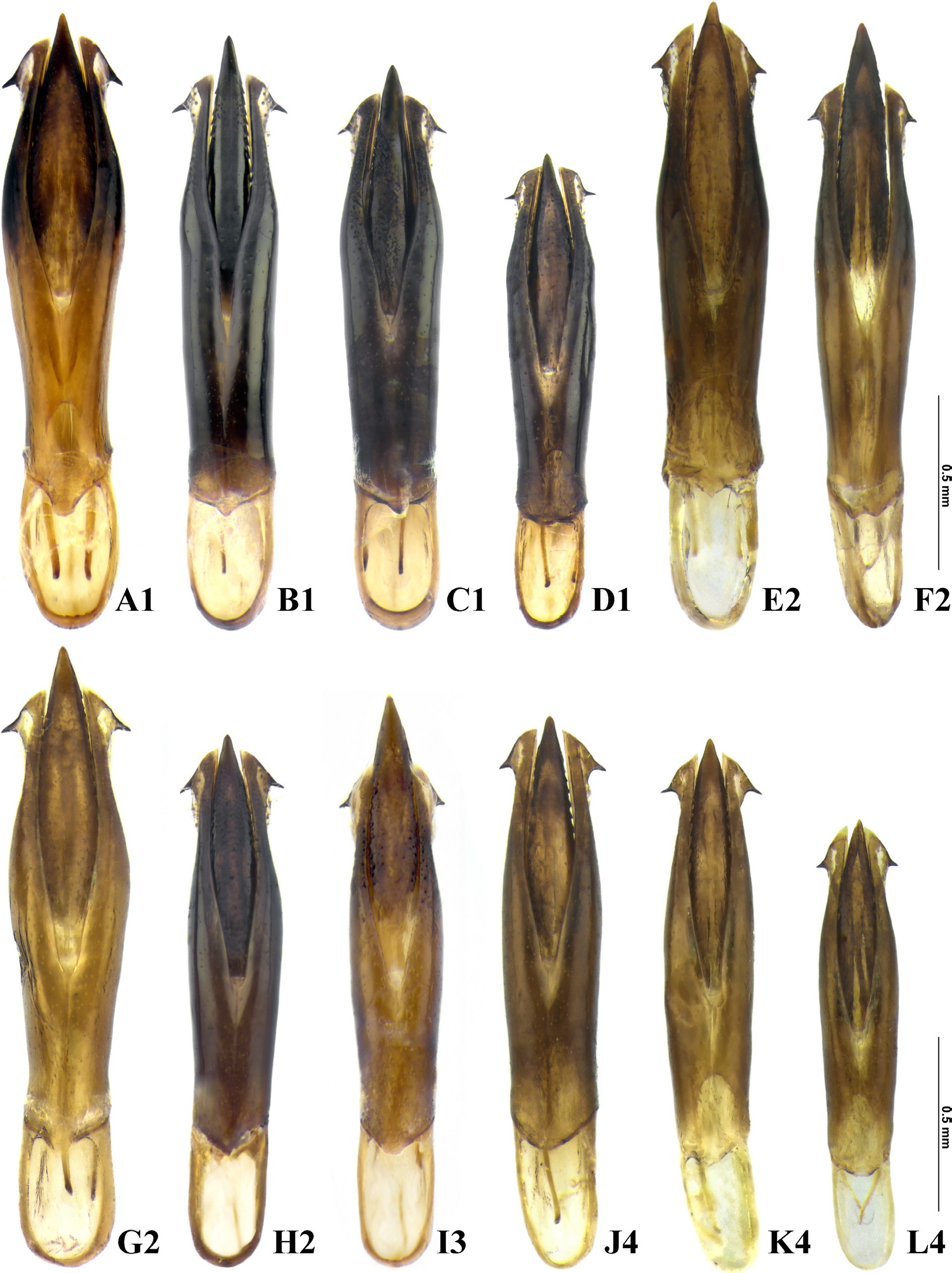
Figure 5.
Morphological variations of A. proteus and A. psittacina (male genitalia). (A)–(D) A. proteus. (E)–(L) A. psittacina. Numbers refer to collection localities: 1. Japan; 2. Korea; 3. China; 4. Russia.
The pronotal shape, described as more anteriorly expanded and widest at the anterior half in A. proteus and less expanded and widest at midlength in A. psittacina, was found to vary between the two taxa and even among individuals of the same sex (Fig. 3). The lateral margins, characterized as regularly rounded or slightly or distinctly incurved before the posterior angles, showed no consistent difference between the taxa, and such variation occurred within both taxa and across sexes.
The elytral apex, described as more acuminate in A. proteus and less acuminate in A. psittacina, exhibited intermediate forms without any consistent pattern (Fig. 3). Similarly, variation in the lateral elytral margins, whether straight, slightly rounded, or weakly caudiform before the apex, occurred across specimens identified as either species.
In the head, the degree of convexity of the frons and the relative width of the vertex broadly overlapped and fell within a continuous range (Fig. 3).
Finally, the male genitalia, particularly the length and shape of the parameres, showed no clear differentiation between A. proteus (PaL/PaW: 4.67–5.41) and A. psittacina (PaL/PaW: 4.60–5.51) (Fig. 5). The entire length and the degree of paramere enlargement varied among individuals and between the two taxa.
In addition to those diagnostic characters proposed by Bílý & Svoboda[3], other morphological characters generally useful for species identification in buprestid beetles were compared here between the two taxa. The shape of the prosternal process also showed variation, with its lateral margins ranging from weakly to strongly protruded in both taxa (Fig. 4).
Molecular analyses
-
The phylogenetic analysis based on COI sequences revealed that A. proteus and A. psittacina formed a single, well-supported monophyletic clade. This relationship was consistently recovered in both ML and BI analyses, with a bootstrap support of 100% and a posterior probability of 1.00. All specimens of both taxa were intermixed within the same lineage without forming any distinct subclades (Fig. 6a). Other Anthaxia species included in the analysis were recovered as distinct and well-separated lineages, which is consistent with their current taxonomic status.
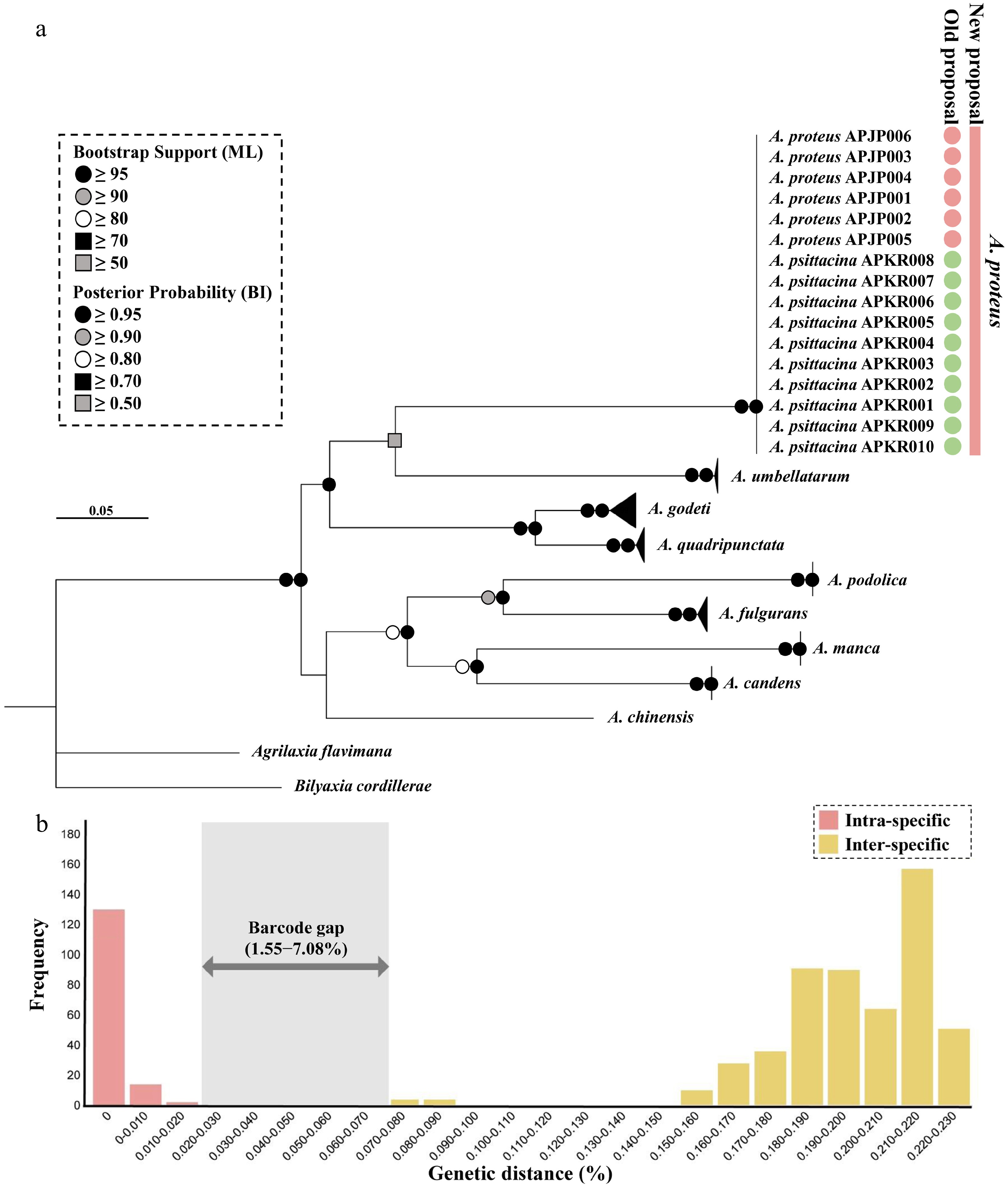
Figure 6.
Phylogenetic relationships and genetic distance distribution of Anthaxia species based on COI: (a) Maximum likelihood (ML) tree topology inferred from the COI. Support values are indicated by symbols at each node: the left side represents Bootstrap support (ML) and the right side represents Posterior Probability (BI). Only support values ≥ 50% (ML) or ≥ 0.50 (BI) are shown. Black circles indicate high support (ML ≥ 95%; BI ≥ 0.95), with other symbols following the thresholds defined in the legend box; (b) Distribution of intra- and inter-specific genetic distances (K2P) based on the COI barcoding region. The red bars represent intra-specific variation, while the yellow bars represent inter-specific distances. A distinct barcode gap (1.55%–7.08%) is highlighted by the gray shaded area.
These relationships were further supported by genetic distances calculated using the Kimura 2-parameter (K2P) model. Both COI and 28S datasets revealed no or very low genetic divergence between A. proteus and A. psittacina. Specifically, the COI sequences showed 0.00% divergence, and the 28S sequences showed a range from 0.00% to 0.31% (Supplementary File 1, COI and 28S pairwise distances sheets). In the overall COI dataset, intraspecific distances ranged from 0.00% to 1.55% (mean = 0.05%), while interspecific distances ranged from 7.08% to 22.30% (mean = 19.85%). This distribution exhibited a clear barcode gap without any overlap (Fig. 6b).
In contrast to the COI results, the 28S phylogenetic tree showed a different pattern of genetic differentiation. Although the two taxa remained closely related, they were separated into two clades, with moderate-to-low support values in both ML and BI analyses (Fig. 7).
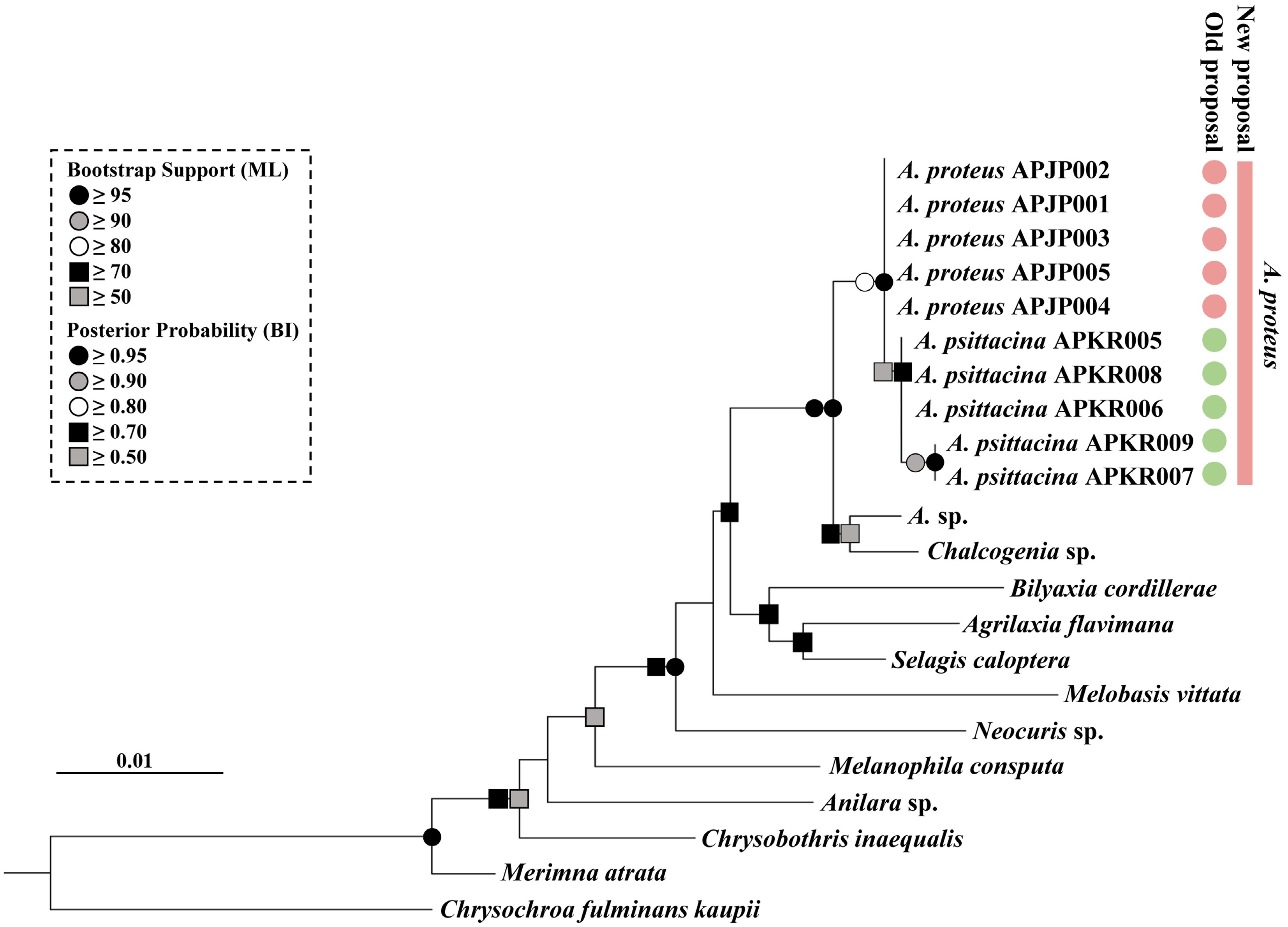
Figure 7.
Phylogenetic relationships of Anthaxia species based on 28S rDNA. Bayesian inference (BI) phylogram inferred from the 28S rDNA dataset. Support values are indicated by symbols at each node: the left side represents Bootstrap support (ML) and the right side represents Posterior Probability (BI). Only support values ≥ 50% (ML) or ≥ 0.50 (BI) are shown. Black circles indicate high support (ML ≥ 95%; BI ≥ 0.95), while other symbols correspond to the thresholds defined in the legend box.
Systematic accounts
-
Family Buprestidae Leach, 1815
Subfamily Buprestinae Leach, 1815
Tribe Anthaxiini Gory & Laporte, 1839
Genus Anthaxia Eschscholtz, 1829
Subgenus Haplanthaxia Reitter, 1911
Anthaxia (Haplanthaxia) proteus Saunders, 1873
proteus Saunders, 1873 (Anthaxia)
Saunders 1873[35]: 511 (description) – Kerremans 1885[36]: 138 (misquoted as 137 in Bellamy 2008[37]) (catalogue) – Schönfeldt 1887[38]: 112 (misquoted as 80 in Bellamy 2008[37]) (catalogue; Japan) – Kerremans 1892[39]: 126 (catalogue) – Kerremans 1900[40]: 71 (faunal records; Indomalayan) – Kerremans 1903[41]: 174 (catalogue) – Jakobson 1913[42]: 793 (catalogue; Russia and Europe) – Obenberger 1914[43]: 19 (revision; Holarctic) – Obenberger 1917[44]: 122 (monograph; Holarctic) – Obenberger 1926[45]: 646 (Palaearctic catalogue) – Obenberger 1930[46]: 517 (world catalogue) – Miwa & Chûjô 1936[47]: 8 (catalogue; Japan) – Kurosawa 1948[1]: 4 (notes; Japan) – Richter 1949[48]: 40 (Cratomerella; monograph; USSR) – Chûjô and Kurosawa 1950[49]: 5 (catalogue; Japan: Shikoku) – Kurosawa 1963[50]: 154 (iconography; Japan) – Kurosawa 1985[51]: 11 (iconography; Japan) – Bílý 1989[52]: 386 (subg. Haplanthaxia; revision; Taiwan, China) – Bílý 1993[2]: 179 (revision) – Bílý 1997[53]: 33, 106 (world catalogue) – Akiyama & Ohmomo 1997[54]: 18 (checklist; Japan) – Akiyama & Ohmomo 2000[55]: 222 (iconography) – Bílý & Svoboda 2001[3]: 39 (notes) – Bílý 2006[5]: 377 (Palaearctic catalogue) – Bellamy 2008[37]: 1453 (world catalogue) – Ohmomo & Fukutomi 2013[4]: 123, 179 (iconography; Japan) – Bílý 2016[6]: 508 (Palaearctic catalogue) – Bílý 2022[8]: 39, 162 (world catalogue).
= angulaticollis Kurosawa, 1956 (Anthaxia)
Kurosawa 1956[56]: 37 (description) – Bílý 1989[52]: 386 (subg. Haplanthaxia; revision; Taiwan, China) – Bílý 1993[2]: 180 (revision) – Bílý 1997[53]: 14, 45 (world catalogue) – Bílý & Svoboda 2001[3]: 39 (synonymized with proteus; notes) – Bílý 2006[5]: 375 (valid species; Palaearctic catalogue) – Bellamy 2008[37]: 1348 (valid species; world catalogue) – Bílý 2016[6]: 504 (valid species; Palaearctic catalogue) – Peng et al. 2021[7]: 206 (valid species; iconography; China) – Bílý 2022[8]: 39, 61 (syn. of proteus; world catalogue).
= matsumurai Miwa & Chûjô, 1935 (Anthaxia)
Miwa & Chûjô 1935[57]: 275 (var. of proteus; description) – Miwa & Chûjô 1936[47]: 8 (var. of proteus; cited as matsumurae; catalogue; Japan) – Kurosawa 1948[1]: 4 (variety of proteus; cited as matsumurae; notes; Japan) – Richter 1949[48]: 41 (var. of proteus; Cratomerella; monograph; USSR) – Chûjô and Kurosawa 1950[49]: 6 (var. of proteus; cited as matsumurae; Japan: Shikoku) – Bílý 1989[52]: 386 (synonymized with proteus; cited as matsumurae; revision; Taiwan, China) – Bílý 1993[2]: 179 (syn. of proteus; cited as matsumurae; revision) – Bílý 1997[53]: 33, 91 (var. of proteus; cited as matsumurae; world catalogue) – Bílý & Svoboda 2001[3]: 39 (syn. of proteus; notes) – Bellamy 2008[37]: 1454 (syn. of proteus; cited as matsumurae; world catalogue) – Ohmomo & Fukutomi 2013[4]: 179 (syn. of proteus; cited as matsumurae; iconography; Japan) – Bílý 2022[8]: 39, 136 (syn. of proteus; world catalogue).
Note: The name was originally published as 'matsumurai'[57], but the same authors later used the spelling 'matsumurae' in Miwa & Chûjô[47], an incorrect subsequent spelling (ICZN Art. 33.3) which was followed by many later authors.
= minuta Miwa & Chûjô, 1935 (Anthaxia)
Miwa & Chûjô 1935[57]: 275 (var. of proteus; description) – Miwa & Chûjô 1936[47]: 9 (var. of proteus; catalogue; Japan) – Kurosawa 1948[1]: 4 (synonymized with proteus; notes; Japan) – Richter 1949[48]: 40 (var. of proteus; Cratomerella; monograph; USSR) – Chûjô and Kurosawa 1950[49]: 6 (syn. of proteus; catalogue; Japan: Shikoku) – Bílý 1989[52]: 386 (synonymized with proteus; revision; Taiwan, China) – Bílý 1993[2]: 179 (syn. of proteus; revision) – Akiyama & Ohmomo 1997[54]: 18 (syn. of proteus; checklist; Japan) – Bílý 1997[53]: 33, 92 (syn. of proteus; world catalogue) – Bílý & Svoboda 2001[3]: 39 (syn. of proteus; notes) – Bellamy 2008[37]: 1454 (syn. of proteus; world catalogue) – Ohmomo & Fukutomi 2013[4]: 179 (syn. of proteus; iconography; Japan) – Bílý 2022[8]: 39, 140 (syn. of proteus; world catalogue).
Note: Kurosawa[1] treated Anthaxia proteus var. minuta as a junior synonym of A. proteus, although without the explicit notation 'syn. nov.'. Bílý[52] later synonymized the taxon independently, but in his subsequent works[2,53] he correctly attributed the synonymy to Kurosawa[1].
= nigrifrons Bílý & Svoboda, 2001 (Anthaxia) syn. nov.
Bílý & Svoboda 2001[3]: 40 (ssp. of psittacina; subg. Haplanthaxia; description; notes) – Bílý 2006[5]: 377 (Palaearctic catalogue) – Bellamy 2008[37]: 1455 (world catalogue) – Bílý 2016[6]: 508 (Palaearctic catalogue) – Peng et al. 2021[7]: 231 (iconography; China) – Bílý 2022[8]: 39, 146 (world catalogue).
= psittacina Heyden, 1887 (Anthaxia) syn. nov.
Heyden 1887[58]: 303 (description) – Kerremans 1892[39]: 126 (catalogue) – Kerremans 1903[41]: 177 (catalogue) – Jakobson 1913[42]: 791 (catalogue; Russia and Europe) – Obenberger 1914[43]: 19 (revision; Holarctic) – Obenberger 1917[44]: 121 (monograph; Holarctic) – Obenberger 1926[45]: 646 (Palaearctic catalogue) – Obenberger 1930[46]: 518 (world catalogue) – Miwa & Chûjô 1936[47]: 8 (catalogue; Japan) – Richter 1949[48]: 42 (Cratomerella; monograph; USSR) – Alexeev 1989[59]: 468 (key; Far East Russia) – Bílý 1993[2]: 180 (status changed to ssp. of proteus; subg. Haplanthaxia; revision) – Bílý 1997[53]: 33, 106 (world catalogue) – Bílý & Svoboda 2001[3]: 40 (restored to species rank; notes) – Bílý 2006[5]: 377 (Palaearctic catalogue) – Bellamy 2008[37]: 1455 (world catalogue) – Bílý 2016[6]: 508 (Palaearctic catalogue) – Peng et al. 2021[7]: 230 (iconography; China) – Bílý 2022[8]: 39, 163 (world catalogue) – Volkovitsh 2025[11]: 361 (catalogue; Far East Russia).
Morphological notes. Male and Female. BL: 3.00–5.50 mm, BW: 1.11–2.01 mm.
Coloration (Figs 3 and 4): Head and pronotum often greenish but variable as follows: red, orange, golden-green, green, blue-green, dark-green, brown-green, brown, dark brown, or almost black with green margins. Elytra usually showing the same color as the head and pronotum, but occasionally becoming other colors as shown in J2, K2, and L3 of Fig. 3. Ventral side of body darker or more blackish than dorsum, usually being red, golden-green, green, blue-green, dark-green, brown-green, brown, dark-brown, or almost black. Sexual dimorphism occurs at least in one Japanese population as follows: females more brownish or blackish on both dorsal and ventral sides than males, and pronotal margins distinctly green (E1, F1 in Figs 3 and 4).
Head (Fig. 3): Frons variably convex or almost straight when viewed from above.
Pronotum (Fig. 3): Lateral margins more or less rounded, but occasionally being strongly rounded (R2 in Fig. 3), rather angulated at widest point (S2 in Fig. 3), or subparallel-sided in basal 2/3 (L3, V2 in Fig. 3) or middle part (M3, P4 in Fig. 3), in basal part before posterior angles occasionally being a nearly straight line (G2, M3, O3, V2 in Fig. 3) or a slightly incurved line (A1, D1, H2 in Fig. 3); widest point often situated around middle but occasionally at near apical 1/4 (L3 in Fig. 3) or basal 1/3 (P4 in Fig. 3). PL: 0.64–1.09, PW: 1.05–1.95 mm.
Elytra (Fig. 3): Lateral margins parallel-sided from humeral prominence to apical 1/3 but occasionally slightly rounded (Q2, U2 in Fig. 3), and then converging to subapex; apices more or less acuminate.
Prosternal process (Fig. 4): Lateral margins weakly to strongly protruded behind procoxae; lateral projections acute to right angles, with apices usually acuminate but occasionally round (E1, G2, W2 in Fig. 4).
Male genitalia (Fig. 5): Short to long in both penis and tegmen; parameres slender to laterally expanded, with sides which are subparallel-sided to weakly widened from base to widest point, but occasionally strongly widened as shown in A1 and G2 of Fig. 5.
Type materials. Anthaxia proteus Saunders, 1873: Syntypes, BMNH (fide Bílý[8]); type locality from original description: 'Japan' (no additional locality data) (not examined).
Anthaxia angulaticollis Kurosawa, 1956: Holotype (♀), NSMT; labelled 'HORI FORMOSA VIII. 1943 T. SHINOHARA No. 390 HOLOTYPE Anthaxia angulaticollis Y. Kurosawa, 1956'; type locality from original description: 'Hori, Central Formosa' (= Taiwan, China) (examined).
Anthaxia proteus var. matsumurai Miwa & Chûjô, 1935: Syntypes, NSMT (fide Bílý[8]); type locality from original description: '本州 岐阜' (= Gifu Prefecture, Honshu, Japan) (not examined).
Anthaxia proteus var. minuta Miwa & Chûjô, 1935: Syntypes, NSMT (fide Bílý[8]); type locality from original description: '本州 岐阜' (= Gifu Prefecture, Honshu, Japan) (not examined).
Anthaxia proteus nigrifrons Bílý & Svoboda, 2001: Holotype (♂), NMPC (fide Bílý[8]); type locality from original description: 'China, Hunan prov., Zhang Jia Jie' (= Zhangjiajie, Hunan Province, China) (not examined).
Anthaxia psittacina Heyden, 1887: Syntypes (two specimens), DEI (fide Bílý[8]); type locality from original description: 'Amurensis Suyfun' (= Razdolnaya River, Amur basin, Primorsky Krai, Russian Far East) (not examined).
Materials examined. CHINA: [Jilin] 2♂2♀, Hunchun-shi, Yanbian, 21.VII.2010, J.W. Lee leg. (JLCK). JAPAN: Hokkaido — 1♂, Okusawa-suigenchi, Otaru-shi, 1.VII.2009, Y.-H. Kim leg. (JLCK). Honshu — [Wakayama] 3♂, Mt. Kooya, 9. VII. 1961, M. Goto leg. (OMNH); 1♂, Yunomata, Ryujin-mura, Tanabe-shi, 25.V.2024, Y. Tamadera leg. (YTJ). [Kyoto] 2♂2♀, Kiminoo, Mutsuyori-cho, Ayabe-shi (ex Abies firma, em. 19–23.V.2016) K. Tsuruta leg. (YTJ); 2♂2♀, Kyoto Botanical Garden, Sakyo-ku, 6.VI.2024, K. Katsube leg. (YTJ). [Fukui] 1♀, Aoi, Obama-shi, 26.VI.2024, Y. Tamadera leg. (YTJ). [Hyogo] 10♂, Inagawa-cho, Kawabe-gun, 4.VI.1967, M. Nakata leg. (OMNH). [Tottori] 2♂, Tottori-shi, 13.VI.1966, H. Aoki leg. (OMNH); 10♂, Tsuyutani, Ketaka, 15.VI.1941, H. Aoki leg. (OMNH). [Shiga] 2♂1♀, Makino-cho, 9.VI.2003, S. Shiyake leg. (OMNH). SOUTH KOREA: [Gyeonggi-do] 2♀, Mt. Gobongsan, 17.VI.2006, no collector name (KNU); 1♀, Mt. Goraesan, Geumdong-ri, Jije-myeon, Yangpyeong-gun, 9.VII.2010, S.J. Suh Coll. (KNU); 1♀, Wangdae-ri, Neungseo-myeon, Yeoju-gun, 12.VII.2010, S.J. Suh Coll (KNU). [Gangwon-do] 1 ex., Mt. Seolaksan, 9.VIII.1976, Y.J. Kwon leg. (KNU); 1♂1♀, same locality, 16.VI.1978, S.M. Lee Coll. (KNU); 1♂, same locality, 20.VII.1982, Y.J. Kwon leg. (KNU); 1♀, same locality, 1.VII.1984, Y.J. Kwon leg. (KNU); 2♀, Gajeong-ri, Nam-myeon, Chuncheon-si, 9.I.2005 (ex Pinus sp., em. 10.II.2005), J.-G. Lee leg. (JLCK); 1 ex., Daebawi, Seo-ri, Girin-myeon, Inje-gun, 19.VII.2013, Y.J. Kwon leg. (KNU); 1♂, Mt. Bangtaesan, Bangdong-ri, Girin-myeon, Inje-gun, 1.VII.2021, D. Kim leg. (KNU). [Chungcheongbuk-do] 2♀, Mt. Sobaeksan, 22.VII.1977, S.M. Lee Coll. (KNU). [Chungcheongnam-do] 2♀, Mt. Gyeryongsan, 22.VI.1980, Y.J. Kwon leg. (KNU). [Gyeongsangbuk-do] 9♂6♀, Mt. Hwanghaksan (Hwanghagsan), 2.VI.1978, S.M. Lee Coll. (KNU); 1♂, Ulleungdo Is., Do-dong, 8.VII.1978, S.M. Lee Coll. (KNU); 2♀, same locality, 9.VII.1978, S.M. Lee Coll. (KNU); 1 ex., Mt. Palgongsan, 24.VIII.1980, Y.J. Kwon leg. (KNU); 2 exs., same locality, 14.VI.1981, Y.J. Kwon leg. (KNU); 1 ex., same locality, 27.VI.1981, Y.J. Kwon leg. (KNU); 1 ex., Mt. Juwangsan, 19.VII.1981, Y.J. Kwon leg. (KNU); 4 exs., same locality, 27.VII.1984, Y.J. Kwon leg. (KNU); 2 exs., same locality, 20.VI.1985, Y.J. Kwon leg. (KNU); 1 ex., same locality, 29.VI.1985, Y.J. Kwon leg. (KNU); 2 exs., same locality, 11.VI.1998, Y.J. Kwon leg. (KNU); 1 ex., same locality (Chuwangsan), 15.V.1999, S.J. Suh Coll. (KNU); Ulleungdo Is., 18.VI.1983, Y.J. Kwon leg. (KNU); 1 ex., same locality, 16.VIII.1995, Y.J. Kwon leg. (KNU); 1 ex., same locality, 25.VI.2004, Y.J. Kwon leg. (KNU); 1♂3♀, Ipsil-ri, Oedong-eup, Gyeongju-si, 26.V.2007, E.Y. Huh leg. (KNU); 1♀, Uiseong-gun, 10.VI.2010, Y.J. Kwon leg. (KNU); 2 exs., Ulleungdo Is., Sa-dong, 15.VII.2011, J.M. Cha leg. (KNU); 2♂1♀, Baeginbong, Yangpo-ri, Janggi-myeon, Pohang-si, 25.V.2012, Y.J. Kwon leg. (KNU); 2♀, Mt. Ullyeonsan, Suha-ri, Subi-myeon, Yeongyang-gun, 9.VII.2014, Y.J. Kwon leg. (KNU). 4♀, Hajeong-ri, Guryongpo-eup, Nam-gu, Pohang-si, 9.VI.2022, D. Kim leg. (KNU). [Gyeongsangnam-do] 1 ex., Mt. Gajisan, 21.V.1980, Y.J. Kwon leg. (KNU); 1 ex., Mt. Cheonwhangsan, 8.VII.1980, Y.J. Kwon leg. (KNU); 1♀, Mt. Weonhyosan, 6.VI.1981, Y.J. Kwon leg. (KNU); 1♂, Mt. Waryongsan, 22.V.1999, S.J. Suh Coll. (KNU); 3♀, Mt. Sinbulsan, 30.VII.2003, Y.J. Kwon leg. (KNU); 2 exs., Gwan-ri, Jeongnyang-myeon, Hadong-gun, 2023.V.25, S.J. Suh Coll. [Jeollabuk-do] 1♂, Mt. Munsusan, 30.VIII.1997, Y.J. Kwon leg. (KNU). [Jeollanam-do] 1♂1♀, Baegildo Is., Dangin-ri, Gunoe-myeon, Wando-gun, 15.VI.2011, Y.J. Kwon leg. (KNU); 5♂, Imjado Is., Samdu-ri, Imja-myeon, Sinan-gun, 20.VI.2021, D. Kim leg. (KNU); 1♀, Jeopdo Is., Geumgap-ri, Euisin-myeon, Jindo-gun, 21.VIII.2021, D. Kim leg. (KNU). RUSSIA: [Far East] 3♂1♀, SE Ussuriysk, Gorno-Taezhnoe, 9.VII.2014, A. Napolov leg. (KNU).
Ecology. Adults emerge in May and remain active until August, visiting various flowers, including those from the families Apiaceae (Angelica), Fagaceae (Castanea), and Rosaceae (Sorbaria, Spiraea)[1,4,9,10,50,51,55,60]. They were most commonly observed at the flowers of Castanea (Fagaceae) (Fig. 2b), and were also seen visiting Erigeron annuus (Asteraceae), Albizia julibrissin (Fabaceae), and Cornus kousa (Cornaceae) in the present study. Female adults were observed flying to pine branches for oviposition (Fig. 2c). Larval development in pine trees (Pinus sp. and P. densiflora) was confirmed by specimen-based records and rearing observations in both this study and a previous study[4]. Abies firma represents a new larval host record. Pinus spp. and P. densiflora have also been reported as host plants in previous literature[2,11,50,54,59,61].
Although Quercus mongolica was listed as a larval host plant in Volkovitsh[60], the author later clarified that this was an inadvertent inclusion and that the correct host plant is P. densiflora, noting that the original source of this information is Alexeev[59] (M. G. Volkovitsh, pers. comm.). However, Volkovitsh et al.[10] pointed out that P. densiflora does not occur in the Sikhote-Alin State Nature Biosphere Reserve (SANR), suggesting that the species is more likely associated with another Pinus species or Abies species. In addition, Mallotus japonicus (Euphorbiaceae) was reported as a host plant by Chûjô and Kurosawa[49]; however, this record is regarded as an observation of adult visitation rather than larval development.
Distribution:
China: Mainland (Hunan, Northeast China, Northern China), Taiwan (Kurosawa[56]; Bílý[2,52]; Akiyama & Ohmomo[55]; Bílý & Svoboda[3]; This study).
Japan: Mainland (Hokkaido, Honshu, Shikoku, Kyushu), Tobishima Is., Sadogashima Is., Kammurijima Is., Dogo Is. (Oki Is.), Awajishima Is., Izu-Oshima Is., Shikanoshima Is., Tsushima Is., Okinoshima Is. (Kochi), Ikitsukijima Is., Yakushima Is., Kami-koshikijima Is., Shimo-koshikijima Is., Kuroshima Is. (Kagoshima), Kuchinoerabujima Is. (Saunders[35]; Miwa & Chûjô[57]; Kurosawa[1,62]; Chûjô & Kurosawa[49]; Tamu & Tsukamoto[63]; Fujita[64]; Nakane[65]; Bílý[2,52]; Takahashi[66]; Akiyama & Ohmomo[55]; Fujimoto[67]; Nakamine[68]; Ohmomo & Fukutomi[4]; Hayashi et al.[69]; Sakurai[70]; Kido[71]; Imasaka et al.[72]; Tamadera[73,74]; Hirokawa[75]; This study).
Korea: North, South, Ulleungdo Is., Baegildo Is., Imjado Is., Jeopdo Is. (Kim et al.[14]; Kim & Chang[15]; Bílý[2]; Kim & Kim[17]; Lim et al.[19]; This study).
Russia: East Siberia, Far East, Southern Kuril Is. (Heyden[58]; Fisher[76]; Richter[48]; Bílý[2]; Lafer[77]; Akiyama & Ohmomo[55]; Volkovitsh[60]; Volkovitsh et al.[10]; This study).
Unverified historical literature:
China: Kurosawa[1,50,51]; Chûjô & Kurosawa[49]; Bílý[5,6,53,74]; Lafer[77]; Bílý & Svoboda[3]; Hua[61]; Mühle[78]; Bellamy[37]; Volkovitsh[11,60]; Ohmomo & Fukutomi[4]; Jung[79]; Peng et al.[7]; Volkovitsh et al.[10].
Japan: Kerrmans[36,39,41]; Schönfeldt[38]; Jakobson[42]; Obenberger[44−46]; Miwa & Chûjô[47]; Richter[48]; Cho[12]; Kurosawa[50,51]; Bílý[5,6,8,53]; Akiyama & Ohmomo[54]; Bílý & Svoboda[3]; Hua[61]; Mühle[78]; Bellamy[37]; Hayashi & Kadowaki[80]; Fukutomi et al.[9].
Korea: Obenberger[46]; Miwa & Chûjô[47]; Richter[48]; Cho[12]; Kurosawa[1,50,51]; ZSK[81]; Ju[13]; Alexeev[59]; ESK and KSAE[16]; Bílý[5,6,8,53]; Akiyama & Ohmomo[54,55]; Lafer[77]; Bílý & Svoboda[3]; Hua[61]; Bellamy[37]; Volkovitsh[11,60]; Paek et al.[18]; Ohmomo & Fukutomi[4]; Ahn et al.[20]; Hong & Lee[21]; NIBR[22]; Jung[79]; Peng et al.[7]; KSAE & ESK[23]; Volkovitsh et al.[10]; Lee et al.[24]
Russia: Kerremans[39,41]; Obenberger[44−46]; Miwa & Chûjô[47]; Cho[12]; Kurosawa[50,51]; Volkovitsh & Alexeev[82]; Alexeev[59]; Bílý[5,6,8,53]; Akiyama & Ohmomo[54]; Bílý & Svoboda[3]; Hua[61]; Bellamy[37]; Ohmomo & Fukutomi[4]; Jung[79]; Peng et al.[7]; Volkovitsh[11].
Remarks. The record from India (Kashmir) is based on the original report by Kerremans[40], who cited the locality as 'Cachemire: vallée de Goorais, 7,000 pieds' (i.e., Gurez Valley, ca. 2,134 m a.s.l., Jammu and Kashmir, northern India). This record was subsequently repeated by Jakobson[42], Obenberger[44,46], Miwa & Chûjô[47], Richter[48], Chûjô & Kurosawa[49], Cho[12], and Bellamy[37]. However, Kerremans[40] provided only the locality name, lacking specimen data, and Richter[48] explicitly stated that the Kashmir record requires confirmation. Furthermore, although the Indian record was included in Bellamy[37], it has been subsequently omitted from major catalogues, including Bílý[6,8]. Consequently, the Indian record is excluded from the present distribution.
The record from Jeju Island reported by Jung[79] lacks a verifiable source, as the cited reference does not exist, and the basis for the distribution is unclear. This record is therefore excluded here.
-
Morphological re-examination revealed that the diagnostic characters previously used to distinguish the two taxa exhibit continuous variation among specimens identified as either A. proteus or A. psittacina. Specifically, the shapes of the pronotum, elytra, head, prosternal process, and male genitalia overlapped extensively between the two taxa, with none of these characters allowing reliable discrimination between them (Figs 3−5). These findings indicate that the previously reported morphological differences represent intraspecific variation rather than distinct interspecific boundaries.
Molecular evidence largely supports these morphological observations. The COI-based phylogenetic tree recovered all specimens of both taxa within a single, well-supported monophyletic clade with no genetic divergence (Fig. 6a). Pairwise genetic distances (K2P) calculated from COI and 28S further supported their conspecific status, showing extremely low to zero divergence between the two taxa (Supplementary File 1, COI and 28S pairwise distances sheets). Furthermore, the presence of a distinct barcode gap between intra- and interspecific distances supports the conclusion that they are conspecific (Fig. 6b). The taxonomic interpretations proposed in previous studies may have been influenced by reliance on variable external morphological characters without sufficient assessment of intraspecific variation.
Mitonuclear discordance and evolutionary implications
-
Despite its widespread use, relying solely on mitochondrial DNA (mtDNA) for species delimitation requires caution due to phenomena such as hybridization, introgression, and sex-biased dispersal[83,84]. Our results revealed that the two taxa formed a single clade with 0.00% divergence in the COI phylogenetic tree (Fig. 6), whereas they were divided into two clades with subtle genetic variation (0.00%–0.31%) in the nuclear 28S tree (Fig. 7), indicating mitonuclear discordance.
This discrepancy may be interpreted in light of the non-neutral evolution of the mitochondrial genome. As noted by Duran et al.[85], closely related taxa may exhibit limited divergence in mtDNA due to strong purifying selection, even when nuclear genes begin to accumulate genetic differences. In this study, such selection acting on the COI gene may explain the absence of mitochondrial divergence between the two taxa, potentially masking early signals of differentiation. In addition, recent studies in beetles have suggested that mitonuclear discordance may arise through complex evolutionary processes, including incomplete lineage sorting and introgression, under relatively loose mitonuclear interactions[86]. Therefore, the discordance observed between mitochondrial and nuclear markers should be interpreted cautiously, as it may reflect complex evolutionary histories in addition to potential taxonomic differentiation.
The divergence observed in the 28S tree may reflect regional differentiation following post-LGM (Last Glacial Maximum) geographical isolation. Because multi-copy rDNA arrays are known to evolve through concerted evolution and molecular drive mechanisms[87], slight regional differentiation in 28S sequences may arise even among closely related populations under geographical isolation. Geographical isolation between the Korean Peninsula and Japan may therefore have contributed to the subtle differentiation observed in the 28S data. Although the 28S clades received only moderate to low support, morphological characters, including male genitalia, showed continuous variation without distinct gaps. These findings suggest an early stage of genetic divergence without clear species-level differentiation.
Taxonomic treatment and future perspectives
-
The integrated evidence from molecular and morphological analyses indicates that Anthaxia proteus and A. psittacina do not exhibit sufficient differentiation to support their treatment as separate species at present. Although the 28S tree suggested an early stage of lineage divergence, the absence of a barcode gap in COI and the lack of discrete morphological differentiation, with key characters showing continuous variation, support their conspecific status.
This treatment is further extended to A. psittacina nigrifrons. Although molecular data for this taxon were unavailable, its taxonomic status was re-evaluated based on the original description and comparative morphological observations. Our assessment indicates that the diagnostic characters previously proposed for this taxon, including coloration, lateral margins of the pronotum, and male genitalia, fall within the range of variation observed in A. proteus materials examined in this study. As no stable morphological characters support its recognition as a distinct subspecies, we treat A. psittacina nigrifrons as a synonym of A. proteus, consistent with the synonymization of the nominotypical taxon. While the absence of molecular evidence for this subspecies remains a limitation, the present treatment is consistent with the principles of the International Code of Zoological Nomenclature (ICZN).
Consequently, the two taxa are regarded here as conspecific. Future studies employing additional nuclear markers and population-level genomic approaches may further clarify the evolutionary history and population structure of these buprestid beetles.
-
This study clarifies the long-standing taxonomic ambiguity between Anthaxia proteus and A. psittacina by integrating morphological and molecular evidence. Our results revealed mitonuclear discordance, with no divergence in COI (0.00%) but subtle variation in nuclear 28S (0.00%–0.31%). This pattern is consistent with a scenario of post-LGM geographical isolation, suggesting that these taxa are in the early stages of genetic divergence.
Since the observed genetic variation does not reach the species-level threshold and morphological characters, including male genitalia, show continuity rather than discrete gaps, we treat A. psittacina as a synonym of A. proteus. In addition, a re-evaluation of the original description and comparative morphological observations indicated that the diagnostic characters previously proposed for A. psittacina nigrifrons fall within the range of variation observed in A. proteus, and no stable characters support its recognition as a distinct subspecies. Accordingly, A. psittacina nigrifrons is also treated here as a synonym of A. proteus Saunders, 1873. These synonymies provide a stable taxonomic framework for future studies of Anthaxia species.
The first author expresses sincere gratitude to Shunpei Fujie and Rikio Matsumoto, curators at the Osaka Museum of Natural History (OMNH, Osaka, Japan), for their kind guidance and assistance with specimen examination. The author is also grateful to Dr. Mark G. Volkovitsh (Zoological Institute, Academy of Sciences, St. Petersburg, Russia; ZIN) for kindly providing clarification on the host plant information, which greatly improved the accuracy of this study. The author also sincerely thanks Prof. Sang Jae Suh (Kyungpook National University, Republic of Korea) for providing specimens from his collection. The second author thanks Kei Katsube (Kyoto Prefectural University) and Kenichi Tsuruta (Kyoto, Japan) for providing with valuable specimens and Shigeru Suzuki (Okayama, Japan) for providing with distributional information and literatures.
-
Not applicable.
-
The authors confirm contribution to the paper as follows: study conception and design: Kim D; data collection: Kim D, Tamadera Y, Lee JG; analysis and interpretation of results: Kim D, Tamadera Y, Lee JG; visualization: Kim D; draft manuscript preparation: Kim D; writing – review and editing: Kim D, Tamadera Y, Lee JG, Choi KS; supervision: Choi KS; project administration: Kim D. All authors reviewed the results and approved the final version of the manuscript.
-
All data generated or analyzed during this study are included in this published article and its supplementary information files. All sequences generated in this study have been deposited in the GenBank database, and the corresponding accession numbers are provided in Supplementary File 1.
-
The authors declare that they have no conflict of interest.
-
accompanies this paper online at: https://doi.org/10.48130/jzser-0026-0009.
- Supplementary File 1 Sample data, primer sequences, PCR conditions, public data, COI pairwise distances, and 28S pairwise distances.
- Copyright © 2026 by the author(s). Journal of Zoological Systematics and Evolutionary Research published by Maximum Academic Press on behalf of John Wiley & Sons Ltd. This is an open access article under the terms of the Creative Commons Attribution License, which permits use, distribution and reproduction in any medium, provided the original work is properly cited.
-
About this article
Cite this article
Kim D, Tamadera Y, Lee JG, Choi KS. 2026. Resolving the taxonomic confusion between Anthaxia proteus Saunders, 1873 and Anthaxia psittacina Heyden, 1887 (Coleoptera: Buprestidae: Buprestinae) through morphological re-examination and molecular analyses. Journal of Zoological Systematics and Evolutionary Research 2026: e008 doi: 10.48130/jzser-0026-0009 

Resolving the taxonomic confusion between Anthaxia proteus Saunders, 1873 and Anthaxia psittacina Heyden, 1887 (Coleoptera: Buprestidae: Buprestinae) through morphological re-examination and molecular analyses
- Received: 17 December 2025
- Revised: 30 June 2026
- Accepted: 08 July 2026
- Published online: 31 August 2026
Journal of Zoological Systematics and Evolutionary Research
2026,
Article number: e008 (2026)
|
Cite this article
Abstract: This study resolves the long-standing taxonomic confusion between Anthaxia proteus Saunders, 1873, and A. psittacina Heyden, 1887, through morphological re-examination and molecular analyses. Consequently, A. psittacina Heyden, 1887, syn. nov., and A. psittacina nigrifrons Bílý & Svoboda, 2001, syn. nov., are synonymized with A. proteus. Furthermore, a detailed nomenclatural history, distributional records, new larval host plant information, and morphological notes, including photographs illustrating morphological variation, are provided.
-
Key words:
- Anthaxiini /
- Integrative taxonomy /
- Phylogenetic analysis /
- New synonymy /
- East Asia