












-
Epistemic logic (EL)[1] has been extremely successful in modeling epistemic and doxastic attitudes of agents and groups in multi-agent systems, including distributed systems[2]. Dynamic epistemic logic (DEL)[3,4] upgrades EL by introducing model-transforming modalities called updates. Relational structures such as action models in Action Model Logic (AML) and arrow update models in the Generalized Arrow Update Logic (GAUL)[5] are used to represent the evolution of agents' uncertainty under information change in complex communication scenarios. GAUL and AML have proved to be equally update expressive[6]. Thus, without loss of generality, we use the term 'update models' to refer to either action models of AML or arrow update models of GAUL. In the update synthesis task, the aim is to (i) find whether there exists an update model that makes a given goal formula
$ \varphi $ $ \varphi $ Our paper is further motivated by two different yet intertwined issues:
● As argued by Artemov[10], in multi-agent settings, common knowledge of the model (CKM) is required by agents in order to compute higher-order beliefs of other agents. While his argument focuses on uncertainties about facts, it can also be extended to agents' uncertainty about attitudes of other agents. The underlying problem is that, in multi-agent Kripke models, there is an implicit ontological distinction between two kinds of possible worlds: (a) worlds that are actually possible (AP); and (b) worlds that are only virtually possible (VP). While the former worlds constitute, for a given agent, the arena in which the actual world might lie, the latter kind of worlds are considered only to the extent of computing other agents' beliefs. Artemov argues that without the CKM (comprising both APs and VPs), agents would not be able to compute such higher-order beliefs. Furthermore, avoiding the CKM assumption improves tolerance against local state corruption: upon receiving corrupted information from a faulty agent, a (correct) agent might only deem the local state of the sender as corrupted, instead of being forced to consider a larger part of the accessible Kripke model inconsistent.
● Update models do not naturally represent private agent-to-agent communication, as the product update operation typical of DEL is applied in principle to the full product of all the world-event pairs whose preconditions are matched[4]. In this sense, these updates are applied globally to the whole model, potentially leading to information leakage. The problem is also identified by Herzig, as 'it is not easy to come up with a meaningful notion of a speaker'[11], highlighting the fact that local communication might have (undesired) effects on a global model.
Our solution to both issues is to change the structure of the Kripke models under consideration. While Artemov proposes to avoid the CKM by changing the definition of truth for knowledge[10], we instead suggest a stratified Kripke model structure (more precisely, the kind of structures that will be introduced for privatization are directed acyclic graphs.), without changing any basic definitions: by stratifying a Kripke model into a pointed privatized Kripke model we detach each agent's view of the model from any other agent's view of it. In our stratified models, not only do we clearly distinguish between APs and VPs for any agent, but we also avoid the CKM assumption by letting each agent access only a limited and private part of it (a formal definition of privatization is provided in Section 4), without losing the ability to reason about higher-order beliefs of other agents of arbitrary depths. At the same time, while we do not solve the broader issue of agency identified by Herzig, we propose an alternative update operation called pointed updates, which does not apply to the full product of the Kripke model and the action model. In particular, we exploit the novel stratification method (and the distinction between APs and VPs) to discern when to form a world-event tuple and when not. In this sense, our updates are not applied to the whole model, as they are progressively applied only to those worlds that match a certain structure (other than a certain precondition). The proposed stratified structure complies with the crucial notion of a local view of an agent, typical of distributed systems, which is only a limited portion of the global view of the system, usually inaccessible to agents. The stratification not only represents the idea of each agent having a partial view of a Kripke model, but also distinguishes the actual world from any other worlds, by making it inaccessible. In other words, we endorse a fallibilistic assumption, that is, no agent can be sure that the global state of the system is captured in their limited view of it. Naturally, agents might have an accurate view of the system during execution, represented in our model by worlds propositionally equivalent to the actual world that are, however, accessible only in agents' (respective) private clusters.
The aim of this paper is to provide a novel action model synthesis mechanism for AML designed for enforcing private beliefs specified by a quantifier-free goal formula while preserving the consistency of agents' beliefs whenever possible. Our solution to the leak-free, consistent update synthesis task accounts for a limited range of goal formulas, restricted to deterministic belief increase only, i.e., to conjunctions of (positive) modal operators. This limitation is due to the fact that preserving minimality and consistency becomes highly problematic for unrestricted goal formulas: on the one hand, negations of belief operators might introduce ignorance, potentially contradicting previously held beliefs. On the other hand, disjunctions of modal operators have multiple realizations, making the update non-deterministic. Addressing the remaining cases (and their interactions) is left for future work.
Finally, the proposed update mechanism is generally more efficient with respect to AML and GAUL updates as it deletes all states not reachable from the actual world, making the growth in size of the model at worst linear in the size of the goal formula after one update and decreasing starting from the second update based on the same modal syntactic tree. By contrast, it is well known that repeated applications of AML and GAUL updates lead to the exponential growth of the model. It is also known that the model checking problem is PSPACE-complete[12].
A prominent approach for dealing dynamically with beliefs in Kripke terms is the Dynamic Belief Revision[13,14], where agents' conditional beliefs are expressed via a plausibility relation ranging over virtual states. This account, however, cannot represent truly private updates, as its models encode both plausibility and epistemic relations that would be revealed by the CKM assumption. In recent years, different answers to the limitations of the CKM assumption in the standard semantics for EL and DEL have been proposed, for example by changing accessibility relations[10] or by using belief bases as primitives[15,16]. Our approach, on the other hand, performs private, leakage-free consistent synthesis by structuring standard Kripke models into exclusively accessible parts that are not known to other agents, let alone commonly known.
Existing synthesis methods typically work in a language extended with quantifiers over updates, such as the Arbitrary Action Modal Logic[8] and Arbitrary Arrow Update Modal Logic[6]. While quantification over updates allows us to express the synthesis operation within the logical language, a major shortcoming, however, in particular with respect to the applications for distributed systems is that these update operations do not focus on issues of privatization and of minimal change. In addition, most existing synthesis methods do not address belief consistency preservation[6].
We start by giving a motivating example in Section 2, as well as introducing the basic definitions of DEL and the crucial new definition of pointed update. In Section 3 we propose a solution to the leak-free consistent update synthesis for a limited range of goal formulas and we show its fruitfulness by applying it to our motivating example. In Section 4, we illustrate the properties of the synthesized action models, in particular with respect to privatization properties, crucial for avoiding information leakage while preserving consistency. Finally, conclusions are provided in Section 5.
-
We use the standard doxastic multimodal language
$ \mathfrak{L} $ $ \varphi ::= p \mid\neg \varphi \mid (\varphi \wedge \varphi) \mid B_i \varphi $ where
$ i \in {\cal{A}}=\{1,\dots,n\} $ $ n>1 $ $ p \in {Prop} $ $ {Prop} $ $ B_i \varphi $ $ i $ $ \varphi $ $ \hat{B}_i := \lnot B_i \lnot $ Definition 1 (Kripke frame) A Kripke frame for the set of agents
$ {\cal{A}} $ $ \langle W, R\rangle $ $ W \ne \varnothing $ $ R = (R_1, \ldots, R_n) $ $ R_i \subseteq W \times W $ Unless specified otherwise, we assume
$ {\cal{KD}}45 $ ● transitivity: if
$ uR_i v $ $ vR_i w $ $ uR_i w $ ● euclideanity: if
$ uR_i v $ $ uR_i w $ $ vR_i w $ ● seriality: every state has an outgoing arrow for every
$ i \in {\cal{A}} $ These three frame properties correspond to the following axioms[17]:
● transitivity
$ \Leftrightarrow $ $ B_i \varphi \rightarrow B_iB_i \varphi $ ● euclideanity
$ \Leftrightarrow $ $ \neg B_i \varphi \rightarrow B_i \neg B_i \varphi $ ● seriality
$ \Leftrightarrow $ $ B_i \varphi \rightarrow \hat{B}_i \varphi $ Note that we generally do not assume the factivity of beliefs (
$ B_i \varphi \rightarrow \varphi $ $ u R_i u $ We introduce the standard definitions of DEL[4]:
Definition 2 (Pointed Kripke model) For a set of agents
$ {\cal{A}} $ $ {\cal{M}} = \langle S, R, V\rangle $ $ \langle S, R\rangle $ $ S $ $ V \colon {Prop} \to 2^S $ $ V(p)\subseteq S $ $ p \in {Prop} $ $ ({\cal{M}},w) $ $ w \in S $ Truth at world
$ w $ $ {\cal{M}} $ $ {\cal{M}}, w \vDash p $ $ w \in V(p) $ $ {\cal{M}}, w \vDash B_i \varphi $ $ {\cal{M}}, w' \vDash \varphi $ $ w'\in S $ $ w R_i w' $ $ \varphi $ $ w $ $ {\cal{M}},w \nvDash \varphi $ $ w $ Definition 3 (Pointed action model) For a set of agents
$ {\cal{A}} $ $ {\cal{U}} = \langle E, Q, \text{pre} \rangle $ $ \langle E, Q\rangle $ $ E $ $ \text{pre}: E \rightarrow {\cal{L}} $ $ \text{pre}(\beta)\in {\cal{L}} $ $ \beta \in E $ $ ({\cal{U}},\alpha) $ $ \alpha \in E $ Definition 4 (Product update) The (restricted modal) product update of a Kripke model
$ {\cal{M}} = \langle S,R,V \rangle $ $ {\cal{U}} = \langle E, Q, \text{pre} \rangle $ $ {\cal{M}} \otimes {\cal{U}} := \langle S',R',V' \rangle $ ●
$ S' := \{(v, \beta) \in S \times E \mid {\cal{M}}, v \vDash \text{pre}(\beta) \} $ ●
$ R'_i := \left\{\bigl((v, \beta),(u, \gamma)\bigr)\in S'\times S' \mid (v, u) \in R_i \text{ and } (\beta, \gamma) \in Q_i\right\} $ ●
$ V'(p) := \{(v, \beta) \in S' \mid v \in V(p)\} $ If
$ S' = \varnothing $ A product update provides the semantics for a communication scenario represented by a pointed action model
$ ({\cal{U}},\alpha) $ $ \varphi $ $ {\cal{U}} $ $ {\cal{M}}, w \vDash [{\cal{U}},\alpha] \varphi $ $ {\cal{M}} \otimes {\cal{U}}, (w,\alpha) \vDash \varphi $ $ (w,\alpha) \notin S' $ Definition 5 (Bisimulation [Kripke frames and Kripke models]) A bisimulation between Kripke frames
$ \langle W, R\rangle $ $ \langle W', R'\rangle $ ${ \cal{B}} \subseteq W \times W' $ $ v {\cal{B}} v' $ $ i \in {\cal{A}} $ ● Forth: if
$ v R_i u $ $ u'\in S' $ $ v' R_i'u' $ $ u {\cal{B}} u' $ ● Back: if
$ v' R_i' u' $ $ u \in S $ $ v R_i u $ $ u {\cal{B}} u' $ A bisimulation between Kripke models
$ {\cal{M}}=\langle S, R,V\rangle $ $ {\cal{M}}'=\langle S', R',V'\rangle $ $ {\cal{B}}\subseteq S \times S' $ $ \langle S, R\rangle $ $ \langle S', R'\rangle $ $ v {\cal{B}} v' $ $ p \in {Prop} $ ● Atoms:
$ v \in V(p) $ $ v' \in V'(p) $ Similarly a bisimulation between action models
$ {\cal{U}}=\langle E, Q, \text{pre}\rangle $ $ {\cal{U}}'=\langle E', Q', \text{pre}'\rangle $ $ {\cal{B}}\subseteq E \times E' $ $ \langle E, Q\rangle $ $ \langle E',Q'\rangle $ $ \alpha {\cal{B}} \alpha' $ ● Pre:
$ \text{pre}(\alpha) = \text{pre}'(\alpha') $ Two pointed Kripke models
$ ({\cal{M}}, v) $ $ ({\cal{M}}', v') $ $ ({\cal{U}}, \alpha) $ $ ({\cal{U}}', \alpha') $ $ {\cal{M}}, v\underline{\leftrightarrow} {\cal{M}}', v' $ $ {\cal{U}}, \alpha\underline{\leftrightarrow} {\cal{U}}', \alpha' $ $ {\cal{B}} $ $ {\cal{M}} $ $ {\cal{M}}' $ $ {\cal{U}} $ $ {\cal{U}}' $ $ v {\cal{B}} v' $ $ \alpha {\cal{B}} \alpha' $ Definition 6 (Modal Equivalence) Pointed Kripke models
$ ({\cal{M}}, v) $ $ ({\cal{M}}', v') $ $ {\cal{M}}, v \equiv {\cal{M}}', v' $ $ {\cal{M}}, v \vDash \varphi $ $ {\cal{M}}', v' \vDash \varphi $ $ \varphi $ Theorem 7: (Bisimilarity implies modal equivalence[18]) If
$ {\cal{M}}, v\underline{\leftrightarrow} {\cal{M}}', v' $ $ {\cal{M}}, v\equiv {\cal{M}}', v' $ 2.1. Motivational example
-
We illustrate our objective by means of the following example:
Example 8 (Balder–Loki–Thor example) Teenage brothers Balder, Loki, and Thor prepare for an exam that, as is commonly known among them, contains one question asking to decide whether
$ p $ $ \neg p $ $ \neg p $ $ {\cal{M}} $ $ p $ $ p $ $ b $ $ l $ $ t $ $ \varphi= B_b (B_t p \land B_l B_t p \land B_l p) $ (1) without either affecting Loki's or Thor's beliefs or making
$ B_b p $ Since ignorance of the correct answer is common belief in the initial model
$ {\cal{M}} $ $ \varphi $ $ B_t p \land B_l B_t p \land B_l p $ Instead, we propose an update method that stratifies the initial model
$ {\cal{M}} $ $ {\cal{M}}^U $ $ v $ $ -1 $ $ 1 $ $ {\cal{M}}^U, v \nvDash B_b p \lor B_b \neg p $ $ 2 $ $ {\cal{M}}^U, v \vDash B_b B_t p $ $ 3 $ $ {\cal{M}}^U, v \vDash B_b B_l p $ $ 4 $ $ {\cal{M}}^U, v \vDash B_bB_lB_t p $ $ {\cal{M}}^U, v \vDash \varphi $ $ b $ $ 3 $ $ -1 $ $ b $ $ 3 $ $ {\cal{M}}^U, v \vDash B_b B_l (\neg B_b p \land \neg B_b \neg p) $ $ b,l $ $ 2 $ $ 4 $ $ {\cal{M}}^U \vDash \neg B_b \bot \land \neg B_l \bot \land \neg B_t \bot $ $ M, v \vDash B_a \psi $ $ {\cal{M}}^U, v \vDash B_a \psi $ $ a \in \{l,t\} $ 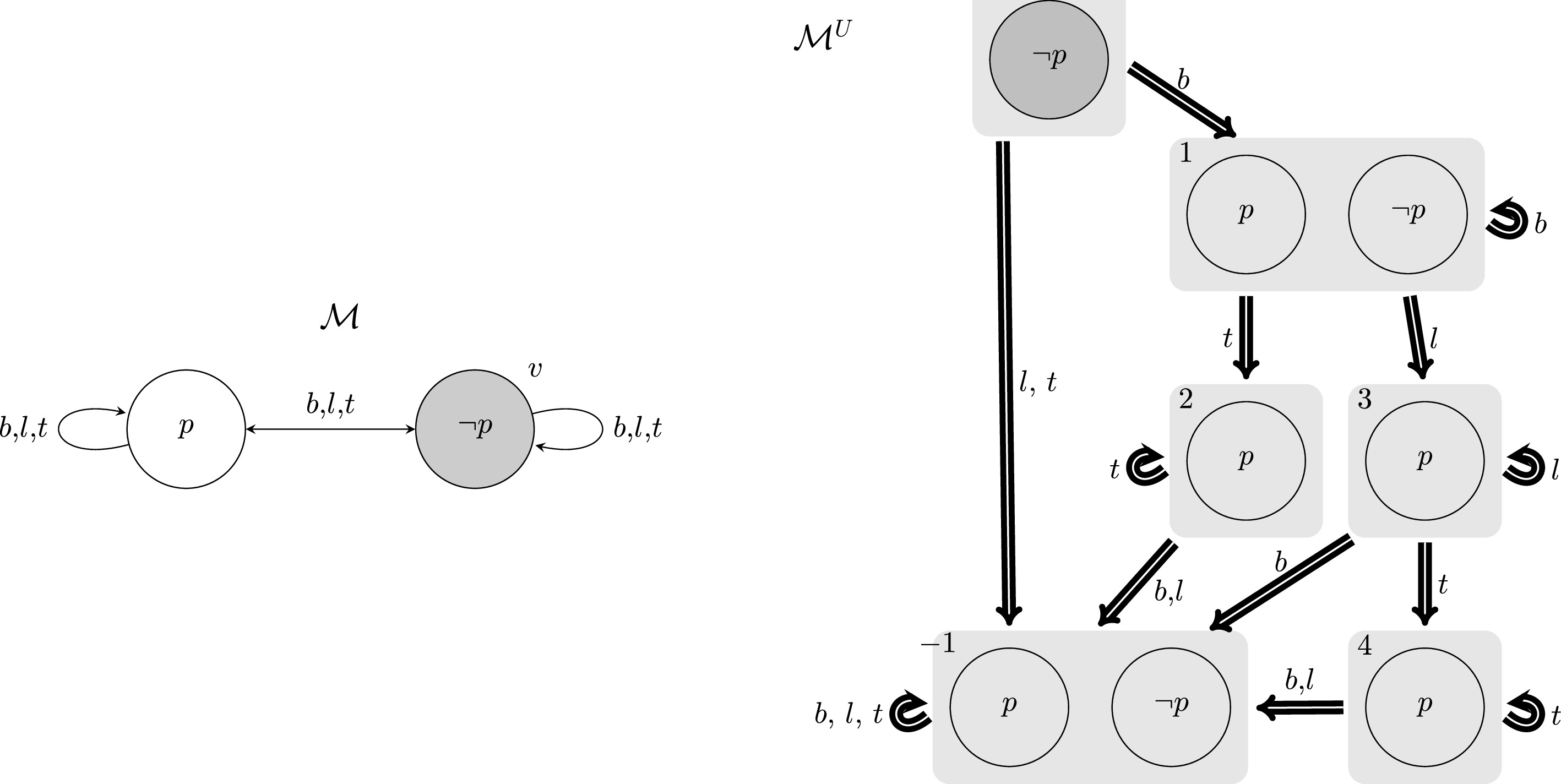
Figure 1.
Left: Initial pointed Kripke model $ {\cal{M}} $. Right: Updated model $ {\cal{M}}^U $ (the actual world $ v $ is dark gray). A formula $ \varphi $ within a circle representing a world means that $ \varphi $ is true in this world. A light-gray rectangle with $ n $ in the top left corner is the cluster that is numbered $ n $. A double arrow from such cluster $ n $ to cluster $ m $ represents a set of accessibility arrows with the same agent's label from every world of cluster $ n $ to every world of cluster $ m $.
In the following sections we will demonstrate how to synthesize an action model so that after the initial model
$ {\cal{M}} $ $ {\cal{M}}^U $ 2.2. Pointed updates
-
It is well known that repeatedly applying product updates for multi-round communication can cause an exponential blow up of the domain of the model, even for simple models and action models, see Figs 2–4. Indeed, every updated model has exactly one world where
$ p $ $ N $ $ {\cal{U}} $ $ 2N-1 $ 
Figure 2.
Left: Initial (pointed) Kripke model $ {\cal{M}} $ where agent $ a $ and $ b $ are uncertain about whether $ p $ or $ \lnot p $ is true. Right: (Pointed) action model $ {\cal{U}} $ for a private message $ p $ to $ a $: agent $ a $ learns $ p $, while $ b $ believes that nothing happened. A formula $ \varphi $ within a square representing an event $ \beta $ is the precondition for this event, i.e., $ \text{pre}(\beta) = \varphi $.
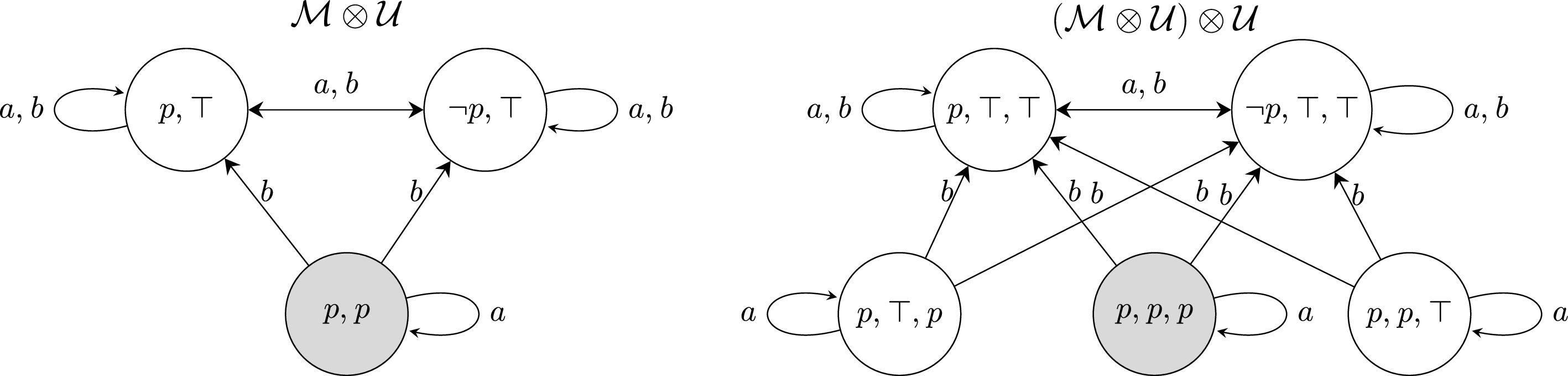
Figure 3.
Left: First product update $ {\cal{M}} \otimes {\cal{U}} $ of Kripke model $ {\cal{M}} $ with action model $ {\cal{U}} $. Right: Second product update $ ({\cal{M}} \otimes {\cal{U}}) \otimes {\cal{U}} $ with the same action model $ {\cal{U}} $. $ p $ is true in all worlds that start from $ p $ and false in all worlds that start from $ \lnot p $.
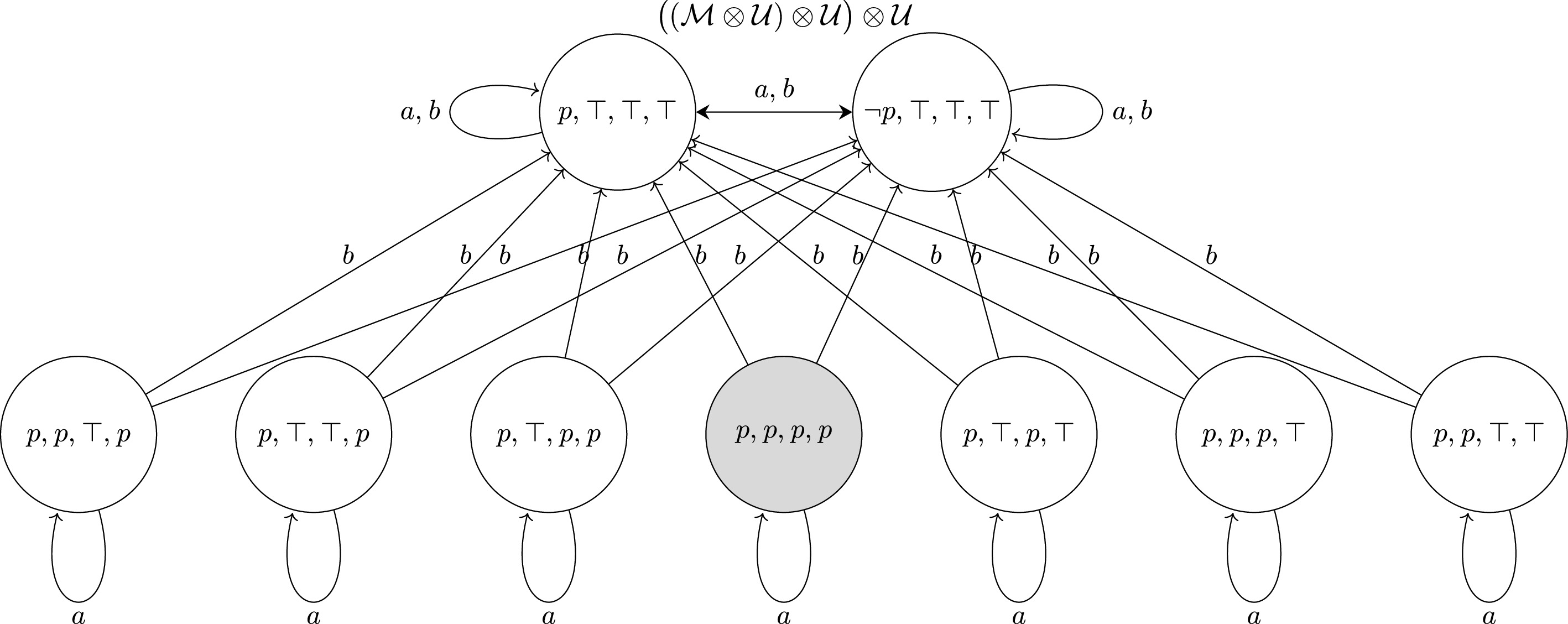
Figure 4.
Third product update $ \bigl(({\cal{M}} \otimes {\cal{U}})\otimes {\cal{U}}\bigr)\otimes {\cal{U}} $ with the same action model $ {\cal{U}} $.
The standard (often implicit) solution is to reduce the size of the resulting model by using bisimulation contraction[19], making the model smaller again. For example, bisimulation contraction deletes all worlds that are unreachable from the resulting actual world, resulting in a bisimilar and hence, modally equivalent[18], model.
To avoid this two-step procedure, we introduce the notion of pointed updates, which incorporates this world-removing operation formally and explicitly:
Definition 9 (Pointed update) Let
$ ({\cal{M}},w)=(\langle S, R, V\rangle, w) $ $ ({\cal{U}},\alpha) = (\langle E, Q, \text{pre}\rangle, \alpha) $ $ {\cal{M}}, w \vDash \text{pre}(\alpha) $ $ \bigl({\cal{M}}\odot {\cal{U}}, (w,\alpha)\bigr) $ $ {\cal{M}}\odot {\cal{U}} := \langle S^ {\cal{U}}, R^ {\cal{U}}, V^ {\cal{U}}\rangle $ $ T^ {\cal{U}} := \bigl\{(v,\beta) \in S \times E \mid {\cal{M}}, v \vDash \text{pre}(\beta)\bigr\} $ $ (w,\alpha) \in T^ {\cal{U}} $ ● The domain
$ S^ {\cal{U}} $ $ T^ {\cal{U}} $ $ (w,\alpha) $ if
$ (v,\beta) \in S^ {\cal{U}} $ $ (u,\gamma) \in T^ {\cal{U}} $ $ v R_i u $ $ \beta Q_i \gamma $ $ i $ $ (u,\gamma) \in S^ {\cal{U}} $ ●
$ R^ {\cal{U}}_i := \left\{\bigl((v, \beta),(u, \gamma)\bigr)\in S^ {\cal{U}}\times S^ {\cal{U}} \mid (v, u) \in R_i \text{ and } (\beta, \gamma) \in Q_i\right\} $ ●
$ V^ {\cal{U}}(p) := \left\{(v, \beta)\in S^ {\cal{U}} \mid v \in V(p)\right\} $ To show that pointed updates produce the same result as product updates but with smaller models, we use the notion of bisimulation.
Definition 10 (
$ G $ $ ({\cal{M}}, v) $ $ ({\cal{M}}', v') $ $ G $ $ G \subseteq {\cal{A}} $ $ {\cal{M}}, v \underline{\leftrightarrow}_G {\cal{M}}', v' $ $ a \in G $ ●
$ G $ $ v R_a u $ $ u'\in S' $ $ v' R_a'u' $ $ {\cal{M}},u\underline{\leftrightarrow} {\cal{M}},u' $ ●
$ G $ $ v' R_a' u' $ $ u \in S $ $ v R_a u $ $ {\cal{M}},u\underline{\leftrightarrow} {\cal{M}},u' $ The definition of
$ G $ Definition 11 (
$ G $ $ ({\cal{M}}, v) $ $ ({\cal{M}}', v') $ $ G $ $ G \subseteq {\cal{A}} $ $ {\cal{M}}, v \equiv_G {\cal{M}}', v' $ $ {\cal{M}}, v \vDash B_a \varphi $ $ {\cal{M}}', v' \vDash B_a \varphi $ $ \varphi $ $ a\in G $ Theorem 12: (
$ G $ $ G $ $ {\cal{M}}, v\underline{\leftrightarrow}_G {\cal{M}}', v' $ $ {\cal{M}}, v\equiv_G {\cal{M}}', v' $ Proof Because
$ G $ $ G $ $ {\cal{M}}, u \equiv {\cal{M}}', u' $ □ Theorem 13: (Product and pointed updates are bisimilar) Given a pointed Kripke model
$ ({\cal{M}},w) $ $ ({\cal{U}},\alpha) $ $ {\cal{M}},w \vDash \text{pre}(\alpha) $ $ {\cal{M}}\odot {\cal{U}}, (w,\alpha) \underline{\leftrightarrow} {\cal{M}}\otimes {\cal{U}}, (w,\alpha) $ Proof: Let
$ {\cal{M}}= \langle S, R, V\rangle $ $ {\cal{U}} = \langle E, Q, \text{pre}\rangle $ $ {\cal{M}}\odot {\cal{U}} = \langle S^ {\cal{U}}, R^ {\cal{U}}, V^ {\cal{U}}\rangle $ $ {\cal{M}} \otimes {\cal{U}} = \langle S',R',V' \rangle $ $ (w,\alpha) \in S^ {\cal{U}} \subseteq S' $ $ R^ {\cal{U}} = R'_{\upharpoonright (S^ {\cal{U}} \times S^ {\cal{U}})} $ $ V^ {\cal{U}} = V'_{\upharpoonright S^ {\cal{U}}} $ $ {\cal{B}} := \left\{\bigl((v,\beta),(v,\beta)\bigr) \mid (v,\beta) \in S^ {\cal{U}}\right\} $ □ Theorem 14: (Updates preserve bisimilarity) Given bisimilar pointed Kripke models
$ {\cal{M}},w\underline{\leftrightarrow} {\cal{M}}',w' $ $ {\cal{U}},\alpha\underline{\leftrightarrow} {\cal{U}}',\alpha' $ $ {\cal{M}},w \vDash \text{pre}(\alpha) $ $ {\cal{M}}\otimes {\cal{U}}, (w,\alpha) \underline{\leftrightarrow} {\cal{M}}'\otimes {\cal{U}}', (w',\alpha') $ $ {\cal{M}}\odot {\cal{U}}, (w,\alpha) \underline{\leftrightarrow} {\cal{M}}'\odot {\cal{U}}',$ $ (w',\alpha') $ $ G $ Proof: For product updates, the proof can be found in van Ditmarsch et al.[4]. For pointed updates, it then follows from Theorem 13. The statements for
$ G $ □ The advantage of pointed updates can be illustrated by the fact that, while repeated product updates of
$ {\cal{M}} $ $ {\cal{U}} $ $ \bigl(( {\cal{M}} \odot {\cal{U}}) \odot {\cal{U}}\bigr) \odot \dots \odot {\cal{U}} = {\cal{M}} \otimes {\cal{U}}. $ While bisimulation contraction[19] can shrink the model obtained by the product update operation, it needs to be invoked on the resulting model in a second step. In other words, first the model needs to be computed (with a potential exponential blowup) and then the bisimulation contraction runs on that model, making the operation computationally costly. On the other hand, the pointed update operation that we introduce runs only once and it produces a model which is no bigger than the one that would be obtained by the product update operation.
In the following section, we use this mechanism to solve the consistent update synthesis problem.
-
In this section, we propose a solution to the consistent update synthesis task for goal formulas
$ \varphi $ $ {\cal{U}}_ \varphi $ $ {\cal{U}}_ \varphi $ $ \varphi $ Definition 15 The set of target agents of a modal formula
$ \varphi $ $ \text{ta}(p) := \varnothing $ $ \text{ta}(\lnot \varphi) := \text{ta}(\varphi) $ $ \text{ta} (\varphi \land \psi) := \text{ta}(\varphi) \cup \text{ta}(\psi) $ $ \text{ta} (B_i \varphi) := \{i\} $ E.g.,
$ \text{ta}\bigl(B_b (B_t p \land B_l B_t p \land B_l p)\bigr) = \{b\} $ $ \text{ta}(B_t p \land B_l B_t p \land B_l p) = \{t,l\} $ Definition 16 (DBI goal formulas, DBI normal form) DBI goal formulas
$ \varphi $ $ \varphi ::= B_i \xi \mid B_i(\xi \wedge \varphi) \mid (\varphi \wedge \varphi) \mid B_i \varphi $ (2) where
$ \xi $ $ i \in {\cal{A}} $ $ \varphi $ $ B_i \xi $ $ B_i\varphi $ $ B_i(\xi \wedge \varphi) $ $ \varphi $ $ i \notin \text{ta}(\varphi) $ $ \varphi \wedge \psi $ $ \varphi $ $ \psi $ $ \text{ta}(\varphi) \cap \text{ta}(\psi) = \varnothing $ Lemma 17 For any DBI goal formula
$ \varphi $ $ \varphi' $ $ {\cal{K}}45 \vDash \varphi \equiv \varphi' $ Proof We conduct the proof by structural induction over DBI goal formula
$ \varphi $ Base case: As
$ \varphi = B_i \xi $ $ \xi $ $ \varphi $ Induction hypothesis: Given goal formula
$ \varphi $ $ \psi $ $ \psi' $ $ \psi $ Induction step:
● If
$ \varphi = B_i \psi $ $ \varphi = B_i (\xi \wedge \psi) $ $ \xi $ $ \psi' $ $ \psi $ $ B_i \psi' $ $ B_i (\xi \wedge \psi') $ $ i \in \text{ta}(\psi') $ $ \psi' = (B_i \psi") \wedge \tau $ $ i \not\in \text{ta}(\psi") $ $ i \not\in \text{ta}(\tau) $ $ \psi" $ $ \tau $ $ {\cal{K}}45 $ $ B_iB_i \theta \equiv B_i \theta $ $ B_i(\xi \land B_i \theta) \equiv B_i(\xi \land \theta) $ $ B_i\theta \land B_i \eta \equiv B_i(\theta \land \eta) $ $ B_i \psi \equiv B_i \psi' \equiv B_i (B_i \psi" \wedge \tau) \equiv B_iB_i \psi" \wedge B_i \tau \equiv B_i \psi" \wedge B_i \tau \equiv B_i (\psi" \wedge \tau) $ $ B_i (\xi \wedge \psi) \equiv B_i (\xi \wedge \psi') \equiv B_i (\xi \wedge B_i \psi" \wedge \tau) \equiv B_i (\xi \wedge B_i \psi") \wedge B_i \tau$ $\equiv B_i (\xi \wedge \psi") \wedge B_i \tau \equiv B_i (\xi \wedge \psi" \wedge \tau) $ $ B_i (\psi" \wedge \tau) $ $ B_i (\xi \wedge \psi" \wedge \tau) $ ● Else, if
$ \varphi = \varphi_1 \wedge \varphi_2 $ $ \varphi_1' $ $ \varphi_2' $ $ \varphi_1' $ $ \varphi_1 $ $ \varphi_2' $ $ \varphi_2 $ $ \text{ta}(\varphi_1') \cap \text{ta}(\varphi_2') = G \ne \varnothing $ $ \varphi_1' \wedge \varphi_2' $ $ \varphi $ $ \varphi_1' = \bigwedge\limits_{i \in G} B_i \psi_1^i \wedge \varphi_1" $ $ \varphi_2' = \bigwedge\limits_{i \in G} B_i \psi_2^i \wedge \varphi_2" $ $ \text{ta}(\varphi_1") \cap \text{ta}(\varphi_2") = \varnothing $ $ \varphi_1" $ $ \varphi_2" $ $ \psi_1^i $ $ \psi_2^i $ $ B_i\theta \land B_i \eta \equiv B_i(\theta \land \eta) $ $ \wedge $ $ \varphi_1' \wedge \varphi_2' \equiv \bigwedge\limits_{i \in G} (B_i \psi_1^i \wedge \varphi_1") \wedge \bigwedge\limits_{i \in G} (B_i \psi_2^i \wedge \varphi_2")$ $\equiv \bigwedge\limits_{i \in G} B_i (\psi_1^i \wedge \psi_2^i) \ \wedge \ \varphi_1" \wedge \varphi_2" $ In addition,
$ \bigwedge\limits_{i \in G} B_i (\psi_1^i \wedge \psi_2^i) \wedge \varphi_1" \wedge \varphi_2" $ □ Lemma 18 (
$ G $ $ {\cal{M}}, v\underline{\leftrightarrow}_G {\cal{M}}', v' $ $ \varphi $ $ \text{ta}(\varphi) \subseteq G $ $ {\cal{M}}, v \vDash \varphi $ $ {\cal{M}}', v' \vDash \varphi $ Proof It follows from Theorem 12 and the fact that
$ \varphi $ $ B_i \psi_i $ $ i \in \text{ta}(\varphi) \subseteq G $ □ Without loss of generality, from now on, we only consider formulas in DBI normal form. For instance, formula (1) is a DBI formula but not DBI normal. Its normal form would be
$ B_b\bigl(B_tp \land B_l(p \land B_t p)\bigr) $ $ \varphi $ $ ({\cal{U}}_ \varphi,0) $ $ ({\cal{M}}, w) $ $ {\cal{M}}\odot {\cal{U}}_ \varphi $ $ {\cal{M}}\odot {\cal{U}}_ \varphi, (w,0) \vDash \varphi $ $ ({\cal{M}}, w) $ $ \left({\cal{M}}\odot {\cal{U}}_ \varphi, (w,0)\right) $ $ \varphi $ $ \varphi $ $ j \notin \text{ta}(\varphi) $ $ j $ $ B_j $ $ \varphi $ $ j $ $ j $ Algorithms 1, 2, 3, and 4 show the construction of an action model for a consistent DBI update.
Table 1. $ {\text{SynthesizeActionModel}} (\varphi) $.
// initially add the model’s point 1: $ E^\varphi := \{0\} $ 2: for all $ i \in {\cal{A}} $ do 3: $ Q^\varphi_{i} := \varnothing $ 4: $ pre(0) := \top $ 5: $ {\text{CreateActionModel (}} \varphi $, $ \langle E^\varphi, R^\varphi, pre^\varphi \rangle $, $ {\text{0)}} $ 6: $ {\text{AddSink}} (\langle E^\varphi, Q^\varphi, pre^\varphi \rangle)$ 7: return $ (\langle E^\varphi, Q^\varphi, pre^\varphi\rangle, 0) $ Table 2. $ {\text{CreateActionModel}} (\varphi, \langle E^\varphi, Q^\varphi, pre^\varphi\rangle, u) $.
// $\langle E^\varphi, Q^\varphi, pre^\varphi\rangle$ are passed by reference 1: if $ \varphi = B_i \xi $ for propositional formula $ \xi $ then 2: $ u':=\text{ComputeAccState}(\langle E^{\varphi},Q^{\varphi},pre^{\varphi}\rangle, u,i) $ 3: $ pre^\varphi(u') := \xi $ 4: else if $ \varphi = B_i \varphi' $ then 5: $ u' := { \text{ComputeAccState}}(\langle E^\varphi, Q^\varphi, pre^\varphi\rangle, u, i) $ 6: $ { \text{CreateActionModel}}(\varphi', \langle E^\varphi, Q^\varphi, pre^\varphi\rangle, u') $ 7: else if $ \varphi = B_i (\xi \wedge \varphi') $ then 8: $ u':=\text{ComputeAccState}(\langle E^{\varphi},Q^{\varphi},pre^{\varphi}\rangle, u,i) $ 9: $ \text{CreateActionModel}(\varphi', \langle E^\varphi, Q^\varphi, pre^\varphi\rangle, u') $ 10: $ pre^\varphi(u') := \xi $ 11: else if $ \varphi = \varphi_1 \wedge \varphi_2 $ then 12: $ { \text{CreateActionModel}}(\varphi_1, \langle E^\varphi, Q^\varphi, pre^\varphi\rangle, u) $ 13: $ { \text{CreateActionModel}}(\varphi_2, \langle E^\varphi, Q^\varphi, pre^\varphi\rangle, u) $ Table 3. $ \text{ComputeAccState}(\left\langle E^{\varphi},Q^{\varphi},pre^{\varphi}\right\rangle, u,i) $.
// $\langle E^\varphi, Q^\varphi, pre^\varphi\rangle$ are passed by reference 1: create new state $ u' $ (s.t. $ u' \ne 0 $ and $ u' \ne -1 $) with $ \text{pre}^\varphi(u') = \top $ 2: $ E^\varphi := E^\varphi \cup \{u'\} $ 3: $ Q^\varphi_i := Q^\varphi_i \cup \{(u, u'), (u', u')\} $ 4: return $ u' $ Table 4. $ {\text{AddSink}} $($ \langle E^\varphi, Q^\varphi, pre^\varphi \rangle $).
1: create state $ -1 $, where $ pre^\varphi(-1) = \top $ 2: $ E^\varphi := E^\varphi \cup \{-1\} $ 3: for all $ i \in {\cal{A}} $ do 4: $ Q^\varphi_i := Q^\varphi_i \cup \{(-1, -1)\} $ 5: for all $ s \in E^\varphi $ do 6: for all $ i \in {\cal{A}} $ do 7: if $ (\forall s' \in E^\varphi)\ (s, s') \not\in Q^\varphi_i $ then 8: $ Q^\varphi_i := Q^\varphi_i \cup \{(s, -1)\} $ We illustrate this update synthesis method by applying it to Example 8:
Example 19 For the DBI normal form
$ \varphi=B_b(B_t p \land B_l(p \land B_t p)) $ $ ({\cal{U}}_{\varphi}, 0) $ $ ({\cal{M}},v) $ $ ({\cal{U}}_{\varphi}, 0) $ $ {\cal{M}}\odot {\cal{U}}_\varphi, (v,0) \vDash \varphi $ $ {\cal{M}}\odot {\cal{U}}_\varphi $ In addition, we claim that this update synthesis has been achieved with minimal change to agents' beliefs. Indeed, it is easy to prove using
$ G $ $ \begin{align} {\cal{M}},v&\equiv_{l,t} {\cal{M}}\odot {\cal{U}}_\varphi, (v,0) & {\cal{M}},v&\equiv_{b,l} {\cal{M}}\odot {\cal{U}}_\varphi, (u,2) \\ {\cal{M}},v&\equiv_{b} {\cal{M}}\odot {\cal{U}}_\varphi, (u,3) & {\cal{M}},v&\equiv_{b,l} {\cal{M}}\odot {\cal{U}}_\varphi, (u,4) \end{align} $ where
$ v $ $ u $ $ {\cal{M}} $ $ \equiv ).$ $ l $ $ t $ $ b $ $ l $ $ b $ $ b $ $ t $ $ b $ $ l $ $ l $ $ t $ $ b $ $ l $ $ \varphi $ 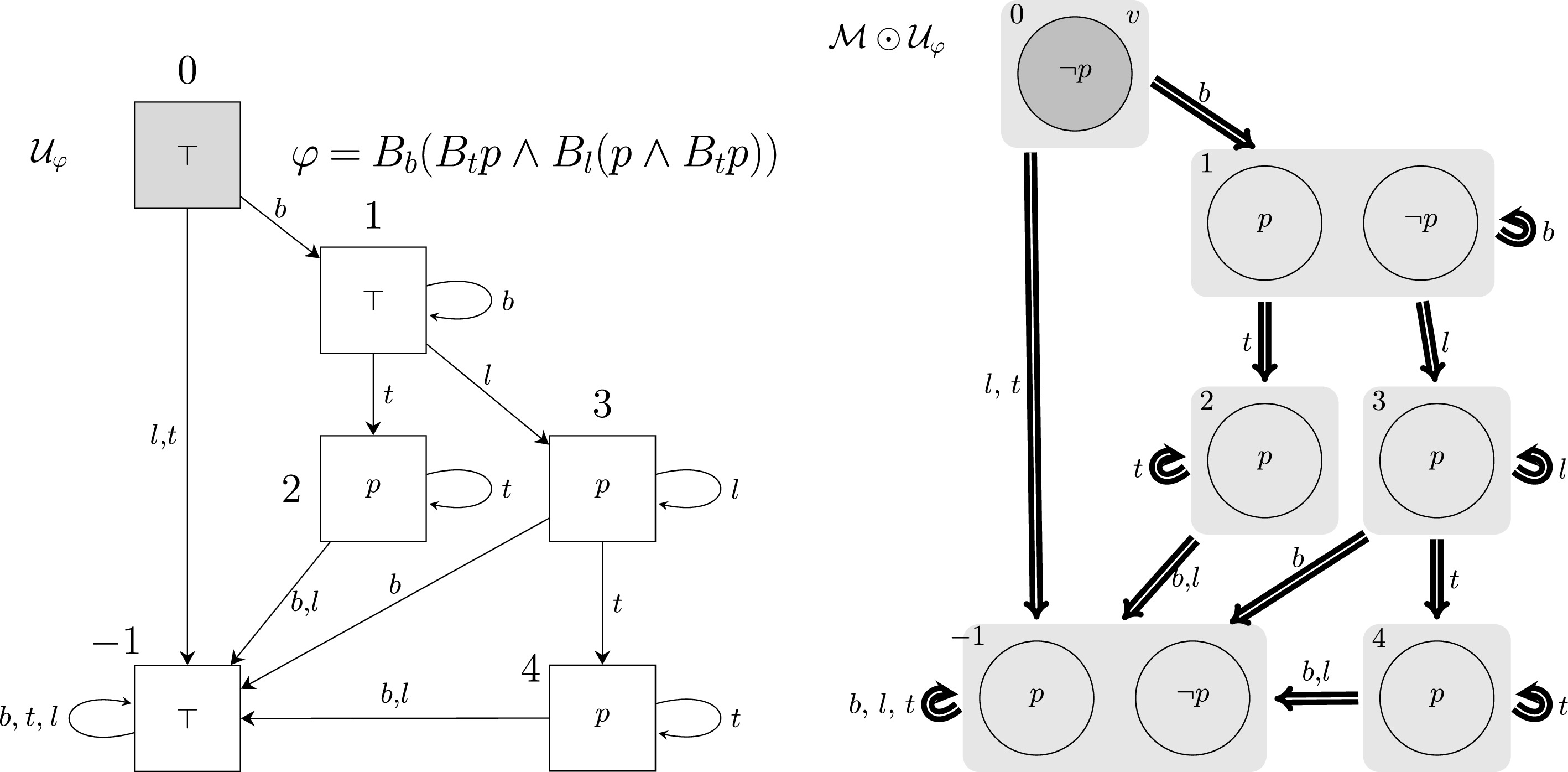
Figure 5.
Successful update synthesis $ {\cal{M}}\odot {\cal{U}}_\varphi, (v,0) \vDash \varphi $ by applying pointed update with pointed action model $ ({\cal{U}}_ \varphi,0) $ for DBI formula (1) from Example 8 to $ ({\cal{M}},v) $ from Fig. 1 (left).
We illustrate the advantage of using pointed updates over the product update operation using Example 8:
Example 20 Consider the same example but using the product update of standard DEL: The result of updating the initial model with the action model obtained from
$ \varphi $ $ {\cal{M}}\odot {\cal{U}}_\varphi $ $ p $ $ v $ 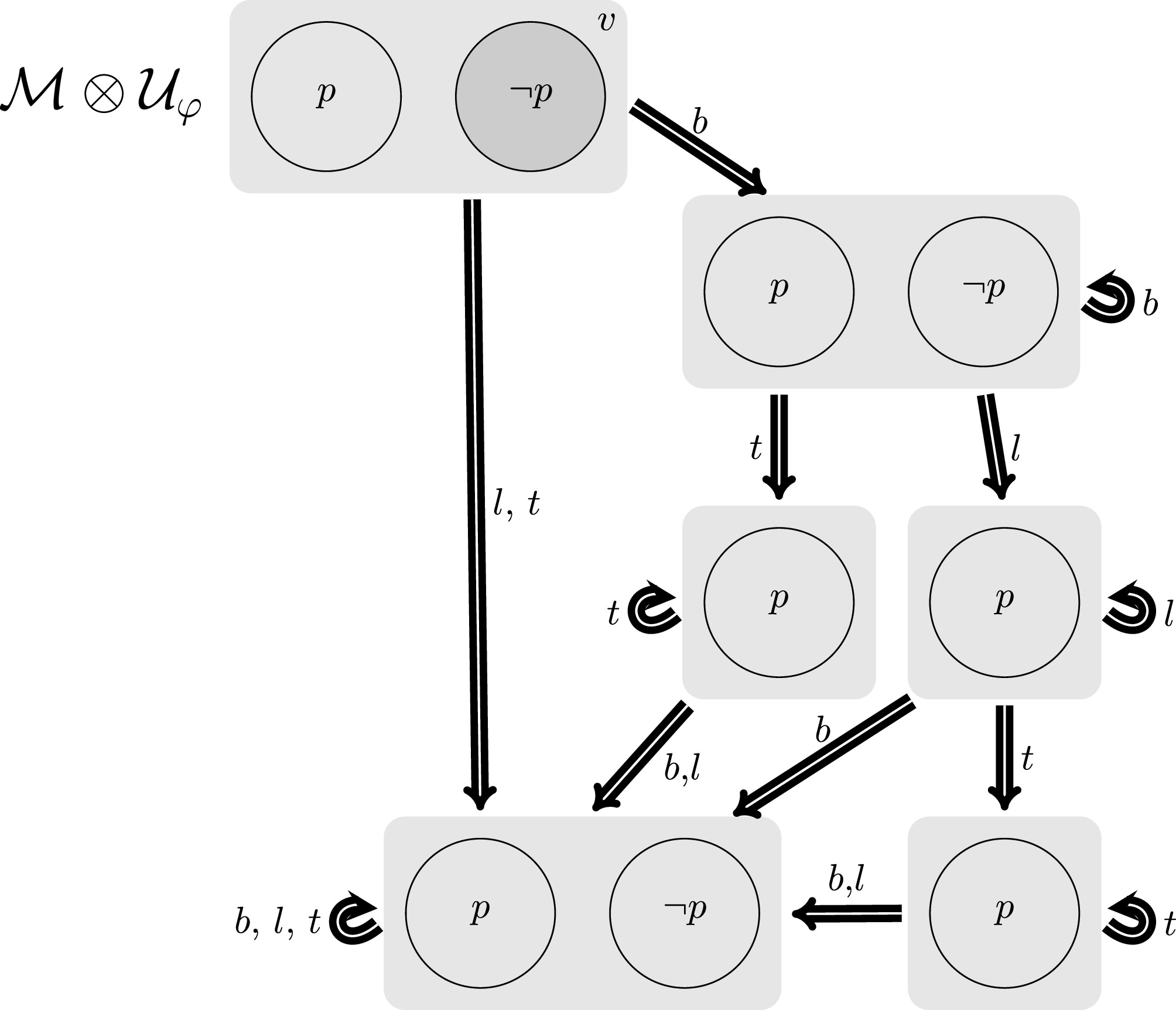
Figure 6.
Balder-Loki-Thor updated model using product updates $ {\cal{M}} \otimes {\cal{U}}_\varphi $.
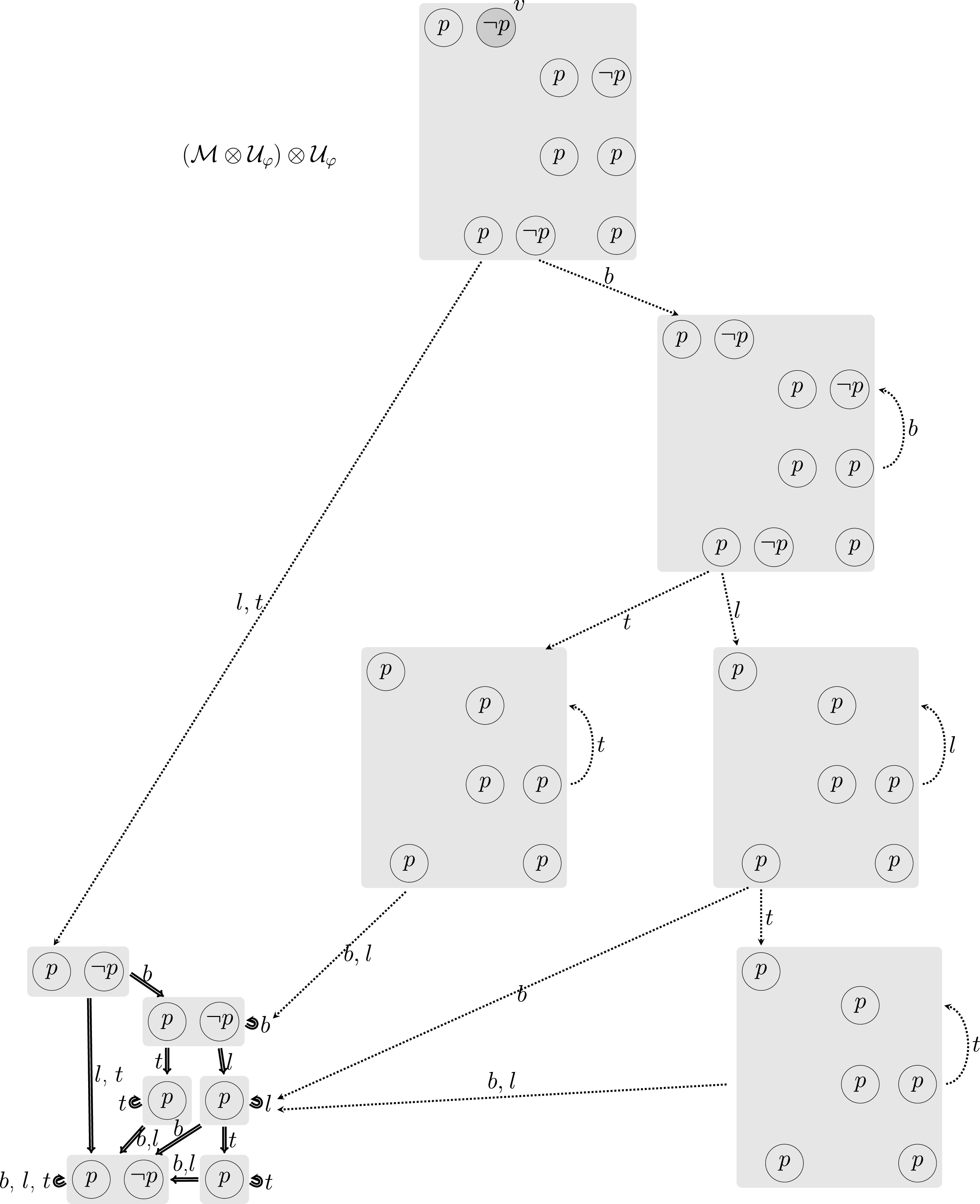
Figure 7.
Sketch of the result of the iterated product update operation $ ({\cal{M}} \otimes {\cal{U}}_\varphi) \otimes {\cal{U}}_\varphi $. Grey rectangles are a compact way to represent sub-models originating from worlds in the previous model. Dotted arrows are meant to capture the direction of the arrows and the agents involved. Unlike double arrows, they do not represent arrows from and to all worlds in the rectangle, but only from and to some of these worlds. We leave to the reader their identification. Finally, note that the sink is a copy of the previous model.
Let us now prove that
$ {\cal{U}}_ \varphi $ $ \varphi $ We will use the auxiliary fact that updates do not affect propositional formulas:
Lemma 21 (Propositional invariance) Let
$ (w,\alpha) $ $ {\cal{M}}\odot {\cal{U}} $ $ {\cal{M}} $ $ {\cal{U}} $ $ \xi $ $ {\cal{M}},w \vDash \xi \qquad\Longleftrightarrow\qquad {\cal{M}}\odot {\cal{U}}, (w,\alpha) \vDash \xi. $ (3) Proof For product updates
$ \otimes $ □ Definition 22 (
$ \varphi $ $ {\cal{U}} = \langle E, Q, \text{pre}\rangle $ $ \alpha \in E $ $ \varphi $ $ \varphi $ ● if
$ \varphi = B_i \xi $ $ \xi $ $ \beta \in E $ $ \alpha Q_i \beta $ $ \models \text{pre}(\beta) \rightarrow \xi $ ● else if
$ \varphi = B_i \psi $ $ \beta' \in E $ $ \alpha Q_i \beta $ $ \beta \in E $ $ \alpha Q_i \beta $ $ ({\cal{U}}, \beta) $ $ \psi $ ● else if
$ \varphi = B_i (\xi \wedge \psi) $ $ \xi $ $ \beta' \in E $ $ \alpha Q_i \beta $ $ \beta \in E $ $ \alpha Q_i \beta $ $ ({\cal{U}}, \beta) $ $ \psi $ $ \models \text{pre}(\beta) \rightarrow \xi $ ● else if
$ \varphi = \psi_1 \wedge \psi_2 $ $ ({\cal{U}}, \alpha) $ $ \psi_1 $ $ \psi_2 $ Lemma 23 (Update with
$ \varphi $ $ ({\cal{M}}, v) $ $ \varphi $ $ \varphi $ $ ({\cal{U}}, \alpha) $ $ {\cal{M}} \odot {\cal{U}} = \langle S', R', V' \rangle $ $ M,v \models \text{pre}(\alpha) $ $ {\cal{M}} \odot {\cal{U}}, (v, \alpha) \models \varphi $ (4) Proof We conduct the proof by induction over the recursive structure of
$ \varphi $ ● In the base case, when
$ \varphi = B_i \xi $ $ ({\cal{U}}, \alpha) $ $ \varphi $ $ (w, \beta) $ $ (v, \alpha) R'_i (w, \beta) $ $ {\cal{U}} \odot {\cal{M}}, (w, \beta) \models \xi $ $ {\cal{U}} \odot {\cal{M}}, (v, \alpha) \models B_i \xi $ $ B_i $ ● If
$ \varphi = B_i \psi $ $ i $ $ \beta $ $ \alpha $ $ ({\cal{U}}, \beta) $ $ \psi $ $ i $ $ (w, \beta) $ $ (v, \alpha) $ $ {\cal{M}} \odot {\cal{U}}, (w, \beta) \models \psi $ $ {\cal{U}} \odot {\cal{M}}, (v, \alpha) \models B_i \psi $ $ B_i $ ● If
$ \varphi = B_i (\xi \wedge \varphi) $ ● If
$ \varphi = \psi_1 \wedge \psi_2 $ $ ({\cal{U}}, \alpha) $ $ \psi_1 $ $ \psi_2 $ $ {\cal{U}} \odot {\cal{M}}, (v, \alpha) \models \psi_1 $ $ {\cal{U}} \odot {\cal{M}}, (v, \alpha) \models \psi_2 $ $ {\cal{U}} \odot {\cal{M}}, (v, \alpha) \models \psi_1 \wedge \psi_2 $ □ Lemma 24 (
$ {\cal{U}}_\varphi $ $ \varphi $ $ \varphi $ $ ({\cal{U}}_\varphi, 0) $ $ \varphi $ $ \text{pre}^\varphi(0) = \top $ Proof We start the proof by induction over the structure of
$ \varphi $ $ {\cal{U}}'_\varphi $ $ {\cal{U}}'_\varphi $ $ { \text{CreateActionModel}}(\varphi, {\cal{U}}, u) $ $ {\cal{U}} = \langle \{0\}, \varnothing, {\text{pre}} \rangle $ $ \text{pre}(0) = \top $ ● In the base case where
$ \varphi = B_i \xi $ $ {\cal{U}}'_\varphi $ $ \varphi $ $ i $ $ u' $ $ u $ $ \text{pre}^\varphi(u') = \xi $ ● If
$ \varphi = B_i \varphi' $ $ ({\cal{U}}'_\varphi, u') $ $ \varphi' $ $ \varphi $ $ i \not\in \text{ta}(\varphi') $ $ u' $ $ i $ $ u $ $ {\cal{U}}'_\varphi $ $ \varphi $ ● If
$ \varphi = B_i (\xi \wedge \varphi') $ ● If
$ \varphi = \varphi_1 \wedge \varphi_2 $ $ {\cal{U}}"_\varphi $ $ \varphi_1 $ $ \text{ta}(\varphi_1) \cap \text{ta}(\varphi_2) = \varnothing $ $ \varphi $ $ {\cal{U}}'_\varphi $ $ \varphi_2 $ $ \varphi_1 $ By the simple observation that no recursive calls of Algorithm 2 are made for existing states, therefore also not for state
$ 0 $ $ \text{pre}^\varphi(0) = \top $ □ Theorem 25: (Update synthesis success) For any DBI normal formula
$ \varphi $ $ ({\cal{M}},v) $ $ ({\cal{M}},v) $ $ ({\cal{U}}_ \varphi,0) $ $ {\cal{M}}\odot {\cal{U}}_ \varphi, (v,0) \vDash \varphi. $ (5) Proof Follows from Lemma 23 and Lemma 24.
□ The sequence of modal operators that one encounters, when traversing the syntax tree of formula
$ \varphi $ $ \varepsilon $ $ \varphi = B_i(B_j p \wedge B_r q) $ $ \varphi $ $ \{ \varepsilon, B_i, B_i B_j, B_i B_r\} $ To formulate statements about minimal change, we introduce the notion of independent formulas.
Definition 26 (Independent formulas) Let
$ \varphi $ $ {\cal{U}}_ \varphi=\langle E^ \varphi, Q^ \varphi, \text{pre}^ \varphi\rangle $ $ \theta $ $ \top $ $ \alpha_0 \in E^ \varphi $ $ B_{i_1}\dots B_{i_k} $ $ \theta $ $ \varepsilon $ $ k=0 $ $ \alpha_0 Q^ \varphi_{i_1}\alpha_1Q^ \varphi_{i_2}\alpha_2\dots\alpha_{k-1}Q^ \varphi_{i_k}\alpha_k $ $ \alpha_j \in E^ \varphi $ $ \text{pre}^ \varphi(\alpha_j)=\top $ $ 0\leq j\leq k $ $ \theta $ $ \varphi $ $ \top $ $ 0\in E^ \varphi $ $ \theta $ $ \varphi $ $ \varphi $ Example 27 For formula
$ \varphi=B_b\bigl(B_t p \land B_l(p \land B_tp)\bigr) $ $ \theta = \lnot B_b B_b p \lor B_t B_l p $ $ \varphi $ $ \varepsilon $ $ B_b $ $ B_bB_b $ $ B_t $ $ B_tB_l $ $ 0 $ $ 0Q^ \varphi_b4 $ $ 0Q^ \varphi_b4Q^ \varphi_b4 $ $ 0Q^ \varphi_t { }\mathop{-} 1 $ $ 0Q^ \varphi_t { }\mathop{-} 1 Q^ \varphi_l { }\mathop{-} 1 $ $ 0 $ $ 4 $ $ { }\mathop{-} 1 $ $ \top $ $ \eta = \lnot B_b B_t p $ $ \varphi $ $ B_bB_t $ $ 0Q^ \varphi_b4Q^ \varphi_t3 $ $ \text{pre}^ \varphi(3) =p\ne \top $ $ \theta $ $ \eta $ $ {\cal{M}},v $ $ ({\cal{U}}_ \varphi,0) $ $ \theta $ $ \eta $ $ {\cal{M}} \odot {\cal{U}}_ \varphi, (v,0) $ In other words, given a formula
$ \varphi $ $ \theta $ $ \varphi $ $ \theta $ $ U_\varphi $ $ \top $ $ \top $ $ U_\varphi $ $ \varphi $ Theorem 28 (Update synthesis minimality) If formula
$ \theta $ $ \varphi $ $ ({\cal{M}},v) $ $ {\cal{M}},v \vDash \theta \qquad \Longleftrightarrow \qquad {\cal{M}}\odot {\cal{U}}_ \varphi, (v,0) \vDash \theta. $ (6) Proof Let
$ {\cal{M}}=\langle S, R, V\rangle $ $ \theta $ $ \alpha \in E^ \varphi $ $ u \in S $ $ \theta $ $ \top $ $ \alpha $ $ {\cal{M}}, u \vDash \theta $ $ {\cal{M}}\odot {\cal{U}}_ \varphi, (u,\alpha) \vDash \theta $ $ \alpha=0 $ $ u=v $ $ \theta $ $ \top $ $ \alpha $ $ \text{pre}^ \varphi(\alpha) = \top $ $ \varepsilon $ $ ({\cal{M}},u) $ $ ({\cal{U}}_ \varphi,\alpha) $ $ u \in S $ $ \theta = B_i \eta $ $ \beta \in E^ \varphi $ $ \alpha Q_i^ \varphi\beta $ $ \text{pre}^ \varphi(\beta) = \top $ $ B_i $ $ \theta $ $ \eta $ $ \top $ $ \beta $ $ u \in S $ $ {\cal{M}},u\vDash \eta $ $ {\cal{M}}\odot {\cal{U}}_ \varphi, (u,\beta) \vDash \eta $ $ {\cal{M}}, u \nvDash B_i \eta $ $ {\cal{M}}, w \nvDash\eta $ $ uR_iw $ $ {\cal{M}}\odot {\cal{U}}_ \varphi, (w,\beta) \nvDash\eta $ $ {\cal{M}}\odot {\cal{U}}_ \varphi, (u,\alpha) \nvDash B_i\eta $ $ (u,\alpha)R^ \varphi_i(w,\gamma) $ $ u R_i w $ $ \gamma=\beta $ □ Corollary 29 Let
$ \varphi = \bigwedge_{j\in G}B_j\omega_j $ $ \varnothing \ne G \subseteq {\cal{A}} $ 1. If
$ i \notin \text{ta}(\varphi) $ $ i\notin G $ $ i $ $ {\cal{U}}_ \varphi $ $ {\cal{M}},v \vDash B_i \sigma $ $ {\cal{M}}\odot {\cal{U}}_ \varphi, (v,0) \vDash B_i \sigma $ $ \sigma $ $ ({\cal{M}},v) $ 2. If
$ i\in \text{ta}(\varphi) $ $ \omega_i = \bigwedge_{j\in H}B_j\pi_j $ $ i $ $ {\cal{U}}_ \varphi $ $ {\cal{M}},v \vDash B_i \chi $ $ {\cal{M}}\odot {\cal{U}}_ \varphi, (v,0) \vDash B_i \chi $ $ \chi $ $ ({\cal{M}},v) $ Theorem 30 (Update synthesis consistency preservation) Let
$ \varphi $ $ {\cal{U}}_ \varphi $ $ B_{i_1}\dots B_{i_k} $ $ i_j\ne i_{j+1} $ $ j $ $ ({\cal{M}},v) $ $ \begin{split}& {\cal{M}},v \vDash \hat{B}_{i_1}\Bigl( \text{pre}^ \varphi(\alpha_1) \land \hat{B}_{i_2}\left( \text{pre}^ \varphi(\alpha_2) \land \dots \hat{B}_{i_k} \text{pre}^ \varphi(\alpha_k)\right)\Bigr) \quad \Longleftrightarrow \\&\qquad {\cal{M}}\odot {\cal{U}}_ \varphi, (v,0) \nvDash B_{i_1}\dots B_{i_k} \bot \end{split} $ (7) for the unique sequence
$ 0 Q^ \varphi_{i_1}\alpha_1Q^ \varphi_{i_2}\alpha_2\dots Q^ \varphi_{i_k}\alpha_k $ $ \alpha_j \in E^ \varphi $ Proof Let
$ {\cal{M}}= \langle S, R, V\rangle $ $ {\cal{M}} \odot {\cal{U}}_ \varphi = \langle S^ \varphi, R^ \varphi, V^ \varphi\rangle $ $ ({\cal{M}},v) $ $ ({\cal{U}}_ \varphi,0) $ $ vR_{i_1}s_1R_{i_2}s_2\dots R_{i_k}s_k $ $ S $ $ {\cal{M}}, s_j \vDash \text{pre}^ \varphi(\alpha_j) $ $ j=1,\dots,k $ $ k $ $ (s_j,\alpha_j) \in S^ \varphi $ $ j=1,\dots,k $ $ (v,0)R^ \varphi_{i_1}(s_1,\alpha_1)R^ \varphi_{i_2}(s_2,\alpha_2)\dots R^ \varphi_{i_k}(s_k,\alpha_k) $ $ {\cal{M}}\odot {\cal{U}}_ \varphi, (s_k,\alpha_k) \nvDash \bot $ $ \alpha_j $ $ 0 Q^ \varphi_{i_1}\alpha_1Q^ \varphi_{i_2}\alpha_2\dots Q^ \varphi_{i_k}\alpha_k $ □ Corollary 31 Let
$ \varphi $ 1. If
$ \varphi $ $ i $ $ {\cal{U}}_ \varphi $ $ i $ $ {\cal{M}},v \nvDash B_i \bot $ $ {\cal{M}}\odot {\cal{U}}_ \varphi, (v,0) \nvDash B_{i} \bot $ $ ({\cal{M}},v) $ 2. If
$ \varphi = B_i\left(\xi \land \bigwedge_{k\in H} B_k \pi_k\right) \land \bigwedge_{j\in G} B_j \omega_j $ $ i \notin G $ $ \xi $ $ {\cal{U}}_ \varphi $ $ i $ $ i $ $ \xi $ $ {\cal{M}},v \vDash \hat{B}_i \xi $ $ {\cal{M}}\odot {\cal{U}}_ \varphi, (v,0) \nvDash B_{i} \bot $ $ ({\cal{M}},v) $ Definition 32 (Idempotence) We call an action model
$ ({\cal{U}}, \alpha) $ $ \bigl({\cal{M}} \odot {\cal{U}},\,\, (w,\alpha)\bigr) $ $ \Bigl(({\cal{M}} \odot {\cal{U}}) \odot {\cal{U}},\,\, \bigr((w,\alpha),\alpha\bigr)\Bigr) $ $ ({\cal{M}}, w) $ Theorem 33 For any DBI normal formula
$ \varphi $ $ ({\cal{M}}, v) $ $ {\cal{M}} \odot {\cal{U}}_\varphi, (v, 0) $ Proof The updates
$ {\cal{M}} \odot {\cal{U}}_\varphi, (v, 0) $ $ ({\cal{M}} \odot {\cal{U}}_\varphi) \odot {\cal{U}}_\varphi, ((v, 0), 0) $ Since
$ {\cal{U}}_\varphi $ $ 0 $ Ind. statement.: Given state
$ ((w, \alpha), \beta) $ $ ({\cal{M}} \odot {\cal{U}}_\varphi) \odot {\cal{U}}_\varphi $ $ \beta = \alpha $ Ind. hyp.: Given state
$ ((w, \alpha), \beta) $ $ ((w', \alpha'), \beta') $ Base case: Point
$ (v, 0) $ $ 0 $ $ 0 $ $ {\cal{U}}_\varphi $ Ind. step: Suppose by IH the inductive statement holds for state
$ ((w, \alpha), \alpha) $ $ i $ $ ((x, \beta), \gamma) $ $ \gamma \ne \beta $ $ i $ $ ({\cal{M}} \odot {\cal{U}}_\varphi) \odot {\cal{U}}_\varphi, ((v, 0), 0) $ $ {\cal{M}} \odot {\cal{U}}_\varphi, (v, 0) $ $ {\cal{U}}_\varphi $ $ ((w, \alpha), \alpha) {R_i^{ {\cal{U}}_\varphi}}^{ {\cal{U}}_\varphi} ((x, \beta), \gamma) $ $ (w, \alpha) R_i^{ {\cal{U}}_\varphi} (x, \beta) $ $ \varphi $ $ {\cal{U}}_\varphi $ $ j $ $ \beta $ $ i $ $ \alpha $ $ ((w, \alpha), \alpha) {R_i^{ {\cal{U}}_\varphi}}^{ {\cal{U}}_\varphi} ((x, \beta), \gamma) $ $ \gamma = \beta $ □ -
The minimality of the update synthesis method we have described relies on a particular structure of the action model used for the update. We call this structure privatized. In this section, we give an explicit definition and show why it serves the purpose of preserving beliefs whenever possible. We begin with the notion of modal syntactic tree, which represents the nesting of modalities within a formula as a tree and provides the basis of the formal definition of privatization. Note that the structure of the action model returned by Algorithm 1 (almost) exactly follows this tree structure already, so there was no need to introduce it explicitly.
Definition 34 (Modal syntactic tree) The modal syntactic tree
$ {\cal{T}}_{\varphi} $ $ \varphi $ $ \varphi $ $ \varphi $ Some examples of modal syntactic trees are provided in Fig. 8: In
$ {\cal{T}}_{B_i \xi} $ $ B_i $ $ {\cal{T}}_{B_i \varphi} $ $ {\cal{T}}_{B_i (\xi \wedge \varphi)} $ $ {\cal{T}}_{\varphi} $ $ B_i $ $ {\cal{T}}_{\varphi \wedge \psi} $ $ {\cal{T}}_{\varphi} $ $ {\cal{T}}_{\psi} $ 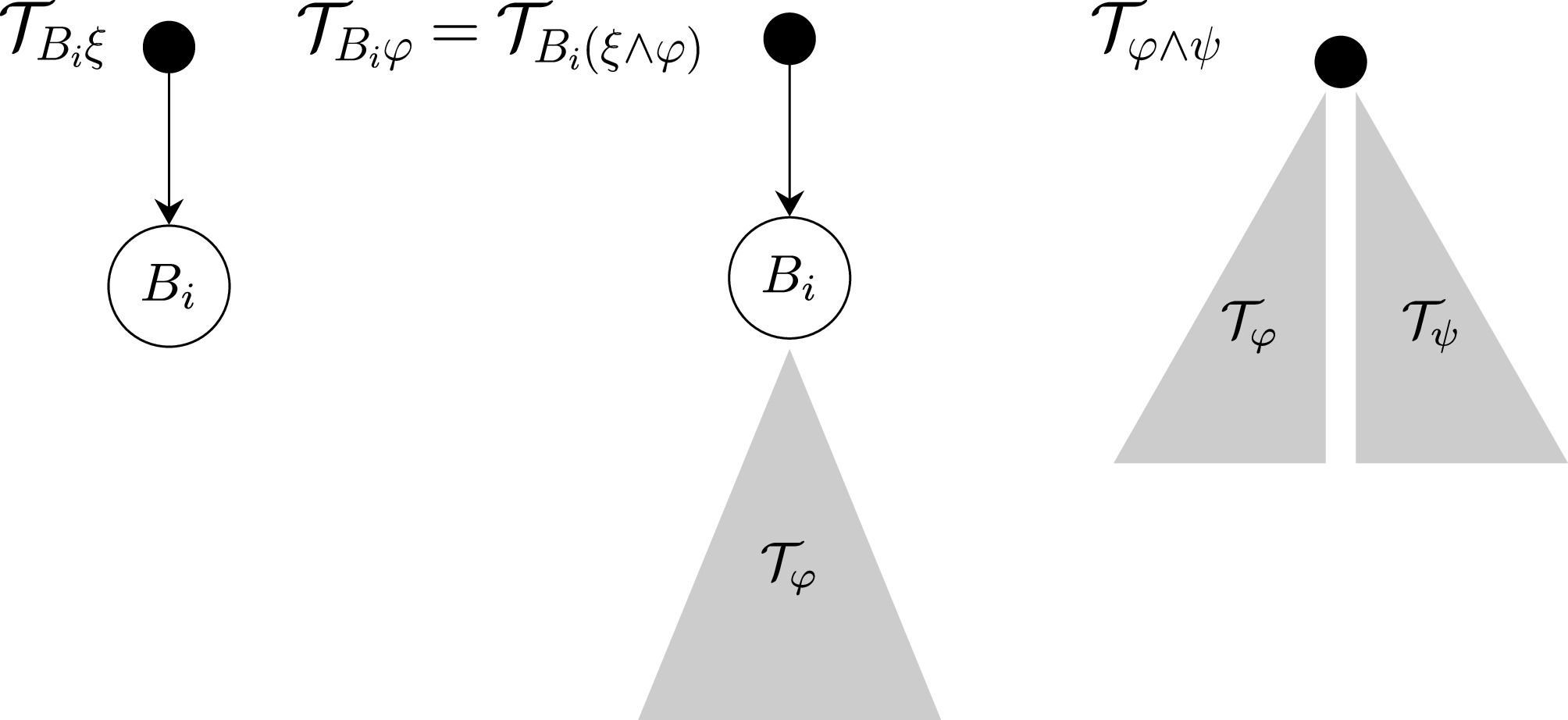
Figure 8.
Modal syntactic trees.
Definition 35 (Modal-syntactic-tree root paths) For formula
$ \varphi $ $ RootP(\varphi) $ $ \big((root, \alpha_1, i_1), \ldots, (\alpha_{l-1}, \alpha_l, i_l)\big) $ $ l\geq0 $ $ {\cal{T}}_{\varphi} $ $ i_k $ $ \alpha_k $ $ k=1,\dots,l $ Definition 36 (Kripke-frame root walks) For a pointed Kripke frame
$ (\langle S, R \rangle, w) $ $ RootW(\langle S, R \rangle, w) $ $ w $ $ RootW_{{\rm{nsr}}}(\langle S, R \rangle, w) $ $ RootW(\langle S, R \rangle, w) $ Definition 37 (Agent sequence) For a walk
$ \sigma = \bigl((\alpha_1, \alpha_2, i_1), \ldots, (\alpha_l, \alpha_{l+1}, i_l)\bigr) $ $ {AgSeq}({\sigma}) := (i_1, \dots, i_l) $ $ {AgSeq}(\varepsilon) := \varepsilon $ $ \Sigma $ $ {AgSeq}(\Sigma) $ The set of all agent sequences of length
$ l $ $ {\cal{A}}^l $ $ l $ $ {\cal{A}}^l_{ {\rm{nsr}}} $ We now define clusters and walk accessible parts of the model.
Definition 38 (Clusters and reachable states) For a Kripke frame
$ {\cal{F}} = \langle W, R \rangle $ $ w\in W $ $ (i_1, \ldots, i_l)\in {\cal{A}}^l $ $ C_{ {\cal{F}},w}^{i_1, i_2, \ldots, i_l} := \bigl\{u \in W \mid (\exists u_2, \ldots, u_l \in W)\ wR_{i_1}u_2R_{i_2} \ldots u_l R_{i_l} u \bigr\}. $ (8) In particular, for the empty sequence,
$ C_{ {\cal{F}},w}^{\varepsilon}= \{w\} $ $ {{R}}( {\cal{F}}, w) := \bigcup\limits_{l=0}^{\infty}\,\,\bigcup\limits_{{\rho} \in {\cal{A}}^l} C_{ {\cal{F}},w}^{{\rho}}. $ (9) For a set
$ W' \subseteq W $ $ {R}({\cal{F}}, W') := \bigcup_{w' \in W'} {R}({\cal{F}}, w') $ Definition 39 For action model
$ {\cal{U}} = \langle E, Q, pre\rangle $ $ u \in E $ $ u $ $ {\cal{U}}^u = \langle E^u, Q^u, pre^u\rangle $ $ \langle E, Q, pre\rangle $ $ u $ $ E^u = {R}({\cal{U}}, u) $ $ Q^u = Q_{\upharpoonright (E^u \times E^u)} $ $ V^u = V_{\upharpoonright E^u} $ Lemma 40 For DBI goal formula
$ \varphi $ $ \langle E, Q, pre\rangle $ $ u \in E $ $ \langle E^\varphi, Q^\varphi, pre^\varphi\rangle $ $ \text{CreateActionModel}(\varphi, \langle E, Q, pre\rangle, u) $ $ u $ $ \langle E^{\varphi^u}, Q^{\varphi^u}, pre^{\varphi^u}\rangle $ $ \varphi $ Proof We conduct the proof by structural induction over the DBI goal formula
$ \varphi $ Base case:
$ \varphi = B_i \xi $ $ \xi $ $ u $ $ u $ $ u' $ $ i $ $ u $ $ u' $ $ u' $ $ E^\varphi = \{u, u'\} $ $ Q_i^\varphi \supseteq \{(u, u'), (u', u')\} $ Induction hypothesis: Given goal formula
$ \varphi $ $ \varphi' $ $ u' \in E $ $ \langle E^\varphi, Q^\varphi, pre^\varphi\rangle $ $ { \text{CreateActionModel}}(\varphi, \langle E, Q, pre\rangle, u') $ $ u' $ $ \langle E^{\varphi^{u'}}, Q^{\varphi^{u'}}, pre^{\varphi^{u'}}\rangle $ $ \varphi' $ Induction step:
● If
$ \varphi = B_i \varphi' $ $ \varphi = B_i (\xi \wedge \varphi') $ $ \xi $ $ i $ $ u' $ $ u' $ $ \varphi' $ $ u' $ $ \langle E^{u'}, Q^{u'}, pre^{u'}\rangle $ $ \varphi' $ $ \langle E^{u}, Q^{u}, pre^{u}\rangle $ $ \varphi $ $ \langle E^{u}, Q^{u}, pre^{u}\rangle $ $ \langle E^{u'}, Q^{u'}, pre^{u'}\rangle $ ● Else if
$ \varphi = \varphi_1 \wedge \varphi_2 $ $ \langle E^{u}, Q^{u}, pre^{u}\rangle $ $ \varphi_1 $ $ \varphi_2 $ $ \varphi $ □ Theorem 41 The action model
$ \langle E^\varphi, Q^\varphi, pre^\varphi\rangle $ $ { \text{SynthesizeActionModel}}(\varphi) $ $ \varphi $ $ \varphi $ Proof Follows from Algorithm 1, Algorithm 4, and Lemma 40.
□ Definition 42 We define
$ \mathfrak{L}_{ {\rm{nsr}}{}} $ $ \mathfrak{L} $ $ \varphi \in \mathfrak{L}_{ {\rm{nsr}}{}} $ $ B_jB_i(p \wedge \hat{B}_i q)) $ Note that this restriction of the language does not affect any of the results in Section 3 because of the following obvious proposition.
Proposition 43 Every DBI formula is in
$ \mathfrak{L}_{ {\rm{nsr}}{}} $ Before we provide a formal definition of privatization we want to first give an informal definition and also clarify why we introduce two notions.
Given a formula
$ \varphi \in \mathfrak{L}_{ {\rm{nsr}}{}} $ $ \varphi $ $ \varphi $ $ \varphi $ The reason why we make a distinction between weak and strong privatization is that when applying a strongly privatized action model the resulting epistemic model need not necessarily be strongly but only weakly privatized, since whole clusters could get removed as a result of the update.
Definition 44 (Privatized) We call a pointed Kripke frame
$ ({\cal{F}}, w) = (\langle S, R \rangle, w) $ $ \varphi \in \mathfrak{L}_{ {\rm{nsr}}{}} $ $ \sigma \in RootP(\varphi) $ $ C^{{AgSeq}(\sigma)}_{ {\cal{F}}, w} \ne \varnothing \text{ and } \left(\forall \rho \in \bigcup\limits_{l=0}^{\infty} {\cal{A}}^l_{ {\rm{nsr}}} \setminus \{{AgSeq}(\sigma)\}\right)\ \left(C^{{AgSeq}(\sigma)}_{ {\cal{F}}, w} \cap C^{\rho}_{ {\cal{F}}, w}\right) = \varnothing. $ (10) Definition 45 (Weakly Privatized) Similarly we call a pointed Kripke frame
$ ({\cal{F}}, w) = (\langle S, R \rangle, w) $ $ \varphi \in \mathfrak{L}_{ {\rm{nsr}}{}} $ $ \sigma \in RootP(\varphi) $ $ \left(\forall \rho \in \bigcup\limits_{l=0}^{\infty} {\cal{A}}^l_{ {\rm{nsr}}} \setminus \{{AgSeq}(\sigma)\}\right)\ \left(C^{{AgSeq}(\sigma)}_{ {\cal{F}}, w} \cap C^{\rho}_{ {\cal{F}}, w}\right) = \varnothing. $ (11) Definition 46 (Walk accessibility) For a pointed Kripke frame
$ ({\cal{F}}, w) = (\langle W, R \rangle, w) $ $ {WAcc}_{{\rm{nsr}}}(u, {\cal{F}}, w) := \left\{\sigma \in RootW_{{\rm{nsr}}}( {\cal{F}}, w) \mid \pi_2 \pi_{|\sigma|}\sigma = u\right\} $ (12) to be the set of agent-alternating walks starting from
$ w $ $ u $ $ \pi_k $ $ k $ Walk accessibility yields an alternative equivalent definition of privatized frames:
Lemma 47 (Privatized alt.) A pointed Kripke frame
$ ({\cal{F}}, w) $ $ \varphi \in \mathfrak{L}_{ {\rm{nsr}}{}} $ $ \sigma \in RootP(\varphi) $ $ C_{ {\cal{F}}, w}^{{AgSeq}(\sigma)} \ne \varnothing\ {{and}}\ \left(\forall s \in C_{ {\cal{F}}, w}^{{AgSeq}(\sigma)}\right)\ \left|{AgSeq}\bigl( {WAcc}_{{\rm{nsr}}}(s, {\cal{F}}, w)\bigr)\right| = 1. $ (13) Proof: Follows from Defs. 37, 44, and 46.
□ Lemma 48 (Weakly privatized alt.) A pointed Kripke frame
$ ({\cal{F}}, w) $ $ \varphi \in \mathfrak{L}_{ {\rm{nsr}}{}} $ $ \sigma \in RootP(\varphi) $ $ \left(\forall s \in C_{ {\cal{F}}, w}^{{AgSeq}(\sigma)}\right)\ \left|{AgSeq}\bigl( {WAcc}_{{\rm{nsr}}}(s, {\cal{F}}, w)\bigr)\right| = 1. $ (14) Proof: Follows from Defs. 37, 45 and 46.
□ Theorem 49 For DBI formula
$ \varphi $ $ ({\cal{U}}_\varphi, 0) $ $ \varphi $ Proof by induction on the recursive construction of
$ \widetilde{ {\cal{U}}}_\varphi $ Ind. hyp.: Given DBI goal formula
$ \varphi $ $ \varphi' $ $ {\cal{U}} $ $ \text{ta}(\varphi') $ $ u' $ $ (\widetilde{ {\cal{U}}}_\varphi', u') $ $ { \text{CreateActionModel}}(\varphi', {\cal{U}}, u') $ $ \varphi' $ $ u' $ Base case: For formula
$ B_i \xi $ $ \xi $ $ {AgSeq}(RootP(B_i \xi)) = \{\varepsilon, (i)\} $ $ \widetilde{ {\cal{U}}}_{B_i \xi} $ $ m \notin \{0, -1\} $ $ i $ $ 0 $ $ 0 $ $ {AgSeq}({WAcc}_{{\rm{nsr}}}(m, \widetilde{ {\cal{U}}}_{B_i \xi}, 0)) = \{i\} $ $ 0 $ $ \varepsilon $ $ {AgSeq}({WAcc}_{{\rm{nsr}}}(0, \widetilde{ {\cal{U}}}_{B_i \xi}, 0)) = \{\varepsilon\} $ $ -1 $ $ \varepsilon $ $ (i) $ $ {AgSeq}(RootP(B_i \xi)) $ $ (\widetilde{ {\cal{U}}}_{B_i \xi}, 0) $ $ B_i \xi $ Ind. step: If
$ \varphi = B_i \psi $ $ \psi $ $ (\widetilde{ {\cal{U}}}_\psi, u') $ $ u' $ $ \psi $ $ i $ $ u' $ $ \widetilde{ {\cal{U}}}_\varphi = \widetilde{ {\cal{U}}}_\psi $ $ i \notin \text{ta}(\psi) $ $ i $ $ u $ $ u' $ $ u $ $ u' $ $ (\widetilde{ {\cal{U}}}_\varphi, u') $ $ (\widetilde{ {\cal{U}}}_\varphi, u) $ $ \varphi $ If
$ \varphi = B_i(\xi \wedge \psi) $ $ \xi $ $ \psi $ If
$ \varphi = \varphi_1 \wedge \varphi_2 $ $ \varphi_1 $ $ \varphi_2 $ $ (\widetilde{ {\cal{U}}}_{\varphi_1}, u) $ $ \varphi_1 $ $ \text{ta}(\varphi_1) \cap \text{ta}(\varphi_2) = \varnothing $ $ RootP(\varphi) = RootP(\varphi_1) \sqcup RootP(\varphi_2) $ $ (\widetilde{ {\cal{U}}}_\varphi, u) $ $ \varphi_2 $ $ \varphi_1 $ $ \varphi $ Since by the initial call of Algorithm 2 on line 5 in Algorithm 1
$ {\cal{U}} $ $ 0 $ $ \widetilde{ {\cal{U}}}_\varphi $ $ \widetilde{ {\cal{U}}}_\varphi $ $ \varphi $ $ j $ $ -1 $ $ j $ $ j $ $ {\cal{U}}_\varphi $ $ \varphi $ □ Lemma 50 Let the pointed update
$ \bigl({\cal{M}}\odot {\cal{U}},(w,\alpha)\bigr) $ $ ({\cal{M}},w) $ $ ({\cal{U}},\alpha) $ $ \rho \in \bigcup\limits_{l=0}^{\infty} {\cal{A}}^l $ $ (x, \beta) \in C^{\rho}_{ {\cal{M}} \odot {\cal{U}}, (w, \alpha)} \qquad \Longrightarrow \qquad \beta \in C^{\rho}_{U, \alpha}\ {{and}}\ x \in C^{\rho}_{ {\cal{M}}, w}. $ (15) Proof Let
$ {\cal{M}} = \langle S, R, V \rangle $ $ {\cal{U}} = \langle E, Q, pre \rangle $ $ {\cal{M}}\odot {\cal{U}} = \langle S', R', V'\rangle $ $ l = |\rho| $ Base case
$ l = 0 $ $ {\cal{A}}^0 = \{ \varepsilon\} $ Ind. step: Consider any agent sequence
$ \overline{\rho} = \rho \circ i $ $ l+1 $ $ (x, \beta) \in C^{\overline{\rho}}_{ {\cal{M}} \odot {\cal{U}}, (w, \alpha)} $ $ (v, \gamma) \in C^{\rho}_{ {\cal{M}} \odot {\cal{U}}, (w, \alpha)} $ $ (v, \gamma) R'_i (x, \beta) $ $ v R_i x $ $ \gamma Q_i \beta $ $ \rho $ $ l $ $ v \in C^{\rho}_{ {\cal{M}}, w} $ $ \gamma \in C^{\rho}_{ {\cal{U}}, \alpha} $ $ x \in C^{\overline{\rho}}_{ {\cal{M}}, w} $ $ \beta \in C^{\overline{\rho}}_{ {\cal{U}},\alpha} $ □ Theorem 51 For a pointed action model
$ ({\cal{U}}, \alpha) $ $ \varphi $ $ ({\cal{M}}, w) $ $ ({\cal{M}} \odot {\cal{U}}, (w, \alpha)) $ $ \varphi $ Proof Suppose by contradiction that the pointed action model
$ ({\cal{U}}, \alpha) $ $ \varphi $ $ ({\cal{M}}, v) $ $ ({\cal{M}} \odot {\cal{U}}, (w, \alpha)) $ $ \varphi $ $ \sigma \in RootP(\varphi) $ $ \rho \in \bigcup\limits^{\infty}_{l=0} {\cal{A}}^l_{nsr} \setminus {AgSeq}(\sigma) $ $ (x, \beta) \in C^{\rho}_{ {\cal{M}} \odot {\cal{U}}, (w, \alpha)} $ $ (x, \beta) \in C^{{AgSeq}(\sigma)}_{ {\cal{M}} \odot {\cal{U}}, (w, \alpha)} $ $ \beta \in C^{{AgSeq}(\sigma)}_{ {\cal{U}}, \alpha} $ $ \beta \in C^{\rho}_{ {\cal{U}}, \alpha} $ $ ({\cal{U}}, \alpha) $ $ \varphi $ $ C^{{AgSeq}(\sigma)}_{ {\cal{U}}, \alpha} \cap C^{\rho}_{ {\cal{U}}, \alpha} = \varnothing $ □ Theorem 52 For DBI formula
$ \varphi $ $ ({\cal{M}}, v) $ $ ({\cal{U}}_\varphi, 0) $ $ ({\cal{M}}, v) $ $ ({\cal{M}} \odot {\cal{U}}, (w, \alpha)) $ Proof Follows immediately from Theorems 25, 49, and 51.
□ -
We presented a way to synthesize a pointed action model for a limited range of goal formulas that: (i) makes the goal formula true in the resulting model; (ii) privatizes any Kripke model to which it is applied to, thus breaking the common knowledge of the model assumption and simulating totally private communication; (iii) preserves consistency whenever possible, marking a difference from, e.g., van Ditmarsch et al.[6]; and (iv) has minimal side effects, in the sense that it changes as few beliefs unspecified in the goal formula as possible. In addition, the synthesized pointed action models are combined with pointed Kripke models via the new pointed update operation, which does not apply to the whole model globally, but rather it respects the structure of the privatization introduced in the synthesis. Since the pointed update is a subset of the full product update operation, the proposed update mechanism is quite efficient: only the initial update increases the size of the model at worst linearly in the size of the goal formula, while all subsequent updates via goal formulas with the same belief structure (or substructure thereof) only decrease the model size. Compare this with the exponential blow up after iterated updates using the standard product updates.
Compared with existing synthesis methods our work presents the following advantages: the synthesis methods proposed in the literatures[6,8] do not focus on issues of privatization and of minimal change, which is a strong shortcoming when considering applications to distributed systems. Recall that the goal of the synthesis tasks is, given a goal formula
$ \varphi $ $ \varphi $ $ \varphi $ We aim at extending the update mechanism so as to allow a wider range of goal formulas, introducing negations of modal operators, which might introduce ignorance, and disjunctions of modal operators, which have multiple possible realizations, while preserving the properties of privatization, minimality and consistency. Furthermore, we plan to introduce group updates, such as public announcements, providing full granularity in the update design.
This research was supported by the Austrian Science Fund (FWF) through projects ByzDEL (Grant No. P 33600-N) and A Logical Framework for Graded Deontic Reasoning (10.55776/PAT2141924). We are grateful to Hans van Ditmarsch, Stephan Felber, Krisztina Fruzsa, Rojo Randrianomentsoa, Hugo Rincón Galeana, and Ulrich Schmid for multiple illuminating and inspiring discussions.
-
The autthors confirm their contributions to this study as follows: development of synthesis algorithms: Schlögl T; related research: Cignarale G; formal proofs: Schlögl T, Kuznets R; draft manuscript preparation: Cignarale G, Kuznets R. All authors reviewed the results and approved the final version of the manuscript.
-
Data sharing is not applicable to this article as no datasets were generated or analyzed during this work.
-
The authors declare that they have no conflict of interest.
- Copyright: © 2026 by the author(s). Published by Maximum Academic Press, Fayetteville, GA. This article is an open access article distributed under Creative Commons Attribution License (CC BY 4.0), visit https://creativecommons.org/licenses/by/4.0/.
-
About this article
Cite this article
Schlögl T, Kuznets R, Cignarale G. 2026. Consistent update synthesis via privatized beliefs. The Knowledge Engineering Review 41: e006 doi: 10.48130/ker-0026-0004 

Consistent update synthesis via privatized beliefs
- Received: 13 December 2024
- Revised: 08 November 2025
- Accepted: 09 March 2026
- Published online: 30 June 2026
Abstract: Dynamic Epistemic Logic (DEL) formalizes communication in the form of model-transforming updates. Private communication is key in distributed systems, as processes exchanging information about their private local state should not be detectable by others. This focus on privacy clashes with the standard DEL assumption that updates are applied to the whole Kripke model, which is commonly known by all agents, potentially leading to information leakage. The contribution of this paper is twofold: (I) To represent leak-free agent-to-agent communication, we introduce a way to synthesize an action model that stratifies a pointed Kripke model into private agent-clusters, each representing the local knowledge of the processes: Given a goal formula representing private communication, we provide a procedure to construct an action model that: (a) makes the goal formula true; (b) maintains consistency of agents' beliefs, if possible; and (c) ensures minimal change of 'unrelated' beliefs. (II) We introduce a new operation between pointed Kripke models and pointed action models called pointed updates that, unlike the product update operation of DEL, maintains only the subset of the world-event pairs that are reachable from the point, without unnecessarily blowing up the model size.
-
Key words:
- Dynamic epistemic logic /
- Kripke models /
- Synthesis /
- Belief revision