












-
Oil-bearing rose, a type of Rosa, has strongly fragrant flowers and is widely used for the extraction of rose essential oils. Rose essential oil (REO) is produced from oil-bearing roses by distillation. Due to its extremely low yield, natural REO is often called 'liquid gold'. Essential oils—a mixture of volatile organic compounds (VOCs)—are widely used in pharmaceutical, cosmetic, flavor, perfume, sanitary, and food industries for their antiviral, antibacterial, antifungal, anticancer, neuroprotective, psychophysiological, and anti-aging properties[1,2]. Recent studies have further demonstrated that the main aromatic constituents of REO, such as citronellol, geraniol, nerol, and phenylethyl alcohol, also possess significant anti-inflammatory and neuroprotective bioactivities, expanding its potential therapeutic applications[3,4]. Natural REOs are in high demand, but cultivation areas are limited, significantly restricting production. Expanding cultivation of oil-bearing roses is urgently needed[5].
As is well known, each rose genotype has advantages in different cultivation areas, and because of the influence of soil and climate factors, only some species or varieties are commercially grown. Currently, species such as Rosa × damascena, R. × centifolia, R. gallica L., R. × alba, R. rugosa, and their hybrid varieties are cultivated in certain regions and are mainly used for REO extraction in different regions[6−9]. For example, Bulgaria mainly cultivates R. × alba and R. × damascena, with small areas devoted to R. gallica and R. × centifolia[3,10]. Morocco cultivates R. × centifolia, while Turkey, Iran, Afghanistan, and Saudi Arabia grow R. × damascena. R. gallica is common in Northern regions like Russia, Ukraine, and Moldova due to its frost resistance. In China, R. × damascena and R. rugosa are widely planted with a wide variety of genotypes. Of these areas, Bulgarian REO is internationally recognized and standardized according to ISO9842[11]. Notably, Antonova-Nedeltcheva et al. recently characterized the VOC profiles of fresh R. alba L. blossoms using HS-SPME–GC/MS and identified more than 75 individual compounds[12], highlighting the absence of allergenic methyleugenol in white oil-bearing rose and positioning it as a promising alternative to R. damascena for perfumery and natural cosmetics. Thus, increasing the types of oil-bearing rose varieties is essential to expand the planting area.
Rosa rugosa is native to China and has been traditionally used in Chinese medicine[13]. R. rugosa and its varieties, including R. rugosa 'Feng Hua' (also known as R. rugosa 'Ping Yin'), R. rugosa 'Kui Shui', R. rugosa f. plena, and R. rugosa f. alba, are widely used for REO extraction or direct food production[8,14,15]. However, Chinese REOs are priced lower in international markets, and varieties producing high-quality essential oils still need to be developed. Li et al. analyzed the VOC diversity of 32 rose germplasm resources and found that the total VOC content ranged from 6.16 to 28.26 μg/g, with monoterpenoids and benzenoids/phenylpropanoids accounting for 93.53% of total VOCs; notably, Chinese cultivars such as R. rugosa 'Fenghua' showed higher aroma diversity but weaker sweet-aroma intensity compared to R. damascena, confirming the necessity of targeted breeding for fragrance improvement[16]. Genotype is a decisive factor in VOC profiles and floral aroma, which, in turn, influences REO yield and quality in a specific region. Thus, evaluation of rose flower VOC profiles with different genotypes is essential for breeding suitable oil-bearing roses[17]. Additionally, breeding technologies can be used to regulate VOC biosynthesis, boost production, and improve the quality of essential oil[18−20].
In recent years, significant progress has been achieved in both analytical methodologies and the understanding of VOC biosynthetic mechanisms in oil-bearing roses. Regarding analytical techniques, Wang et al. pioneered the combined use of headspace gas chromatography-ion mobility spectrometry (HS-GC-IMS) and purge-and-trap GC-MS (P&T-GC-MS) to investigate the volatile release patterns of R. damascena across different flowering stages[21], providing new perspectives on real-time aroma profiling. Behnamnia et al. employed SPME Arrow coupled with LC-MS/MS for the first comparative analysis of flavonoid and volatile compositions in nine Iranian damask rose cultivars[22], offering a novel platform for breeding evaluation. Lebkiri et al. applied GC/MS-MS to comprehensively characterize 57 volatile constituents from Moroccan R. damascena essential oil[23], revealing that agroecological factors such as soil potassium content and altitude strongly influence oxygenated monoterpene accumulation.
At the molecular level, breakthrough discoveries have been made regarding the biosynthetic pathways of rose volatile terpenes. Shang et al. assembled chromosome-level genomes for R. rugosa and R. multiflora and revealed that gene family expansions of 3-hydroxy-3-methylglutaryl-coenzyme A reductase (HMGR) and terpene synthases (TPSs) underlie terpene enrichment in rose scent, and they discovered a TPS-independent citronellol biosynthetic pathway[24]. Li et al. further elucidated the complexity of volatile terpene biosynthesis, demonstrating that NUDX1-mediated dephosphorylation of GPP constitutes a critical non-canonical step in β-citronellol production across diverse rose varieties[25]. Additionally, transcription factor MYB1 was found to positively regulate multiple scent-related genes in R. damascena[26], and a weighted gene co-expression network analysis (WGCNA) study linked 574 candidate genes to key fragrance compounds including geraniol, citronellol, and phenylethyl alcohol through terpenoid and phenylpropanoid pathways[27]. These findings provide valuable gene resources for the molecular breeding of fragrant roses.
Furthermore, the influence of environmental factors on rose VOC biosynthesis has received increasing attention. Charoimek et al. comprehensively reviewed the effects of abiotic stresses on Damask rose aroma, demonstrating that drought stress can enhance the essential oil content and the concentrations of key aroma compounds such as geraniol, citronellol, and eugenol, while salinity stress may stimulate the biosynthesis of citronellol and phenylethyl alcohol[4]. Xie et al. reported that chilling stress (6 °C) reduced total VOC emissions by 3.6- to 3.9-fold in edible roses and revealed that CHH-type DNA methylation changes in the promoter regions of scent biosynthesis genes (RhGDS, RhNUDX1, and RhPAR) are responsible for fragrance loss, highlighting the epigenetic regulation of floral scent under abiotic stress[28].
Despite these advances, systematic comparative analyses of VOC profiles and aromatic characteristics between Chinese and Worldwide oil-bearing rose genotypes remain limited. In this study, the VOC profiles and aromatic characteristics of Chinese and Worldwide oil-bearing rose genotypes were systematically compared using headspace solid-phase microextraction gas chromatography-mass spectrometry (HS-SPME-GC-MS). Petals at different development stages were collected for VOC determination, and their aroma characteristics were evaluated based on the VOC content of each genotype. Orthogonal Partial Least Squares Discriminant Analysis (OPLS-DA) and heatmap cluster analysis (HCA) enabled comparative analysis between Chinese and non-Chinese samples. Our aim was to assess phytochemical compositions and provide reference data for breeding high-yield essential oil varieties.
-
Seven oil-bearing roses were categorized into Chinese and Worldwide groups according to their origin. The Chinese group included three R. rugosa germplasm taxa (from China): R. rugosa 'Feng Hua' (FH), R. rugosa f. plena (RP), and R. rugosa f. alba (WGR). The Worldwide group comprised three R. × centifolia taxa: R. × centifolia 'de Grasse' (RG), R. × centifolia (RC), R. × centifolia 'Morocco' (RM), and one R. × damascena (RD) originating from Europe. The possible genetic relationship among the groups was proposed in Fig. 1 based on the reference[29]. All seven roses were cultivated at the National Center of China for Flower Improvement, Institute of Vegetables and Flowers, Chinese Academy of Agricultural Sciences, Beijing. Detailed sample group information, Latin names, horticultural classifications, planting locations, and aroma intensity are presented in Table 1. The floral development of roses can be categorized into five distinct stages: S1 (Budding Stage), S2 (Large Bud Stage), S3 (Initial Opening Stage), S4 (Half-Open Stage), and S5 (Full Bloom Stage). Here, we selected three stages, S3–S5, for our study (Fig. 1; Table 1). About 10 g of fresh petals at each development stage were collected in the morning (8–10 am). For each stage, two flowers per plant from 10 individual plants were pooled to form one biological replicate, then frozen in liquid nitrogen and stored at −80 °C for later analysis.
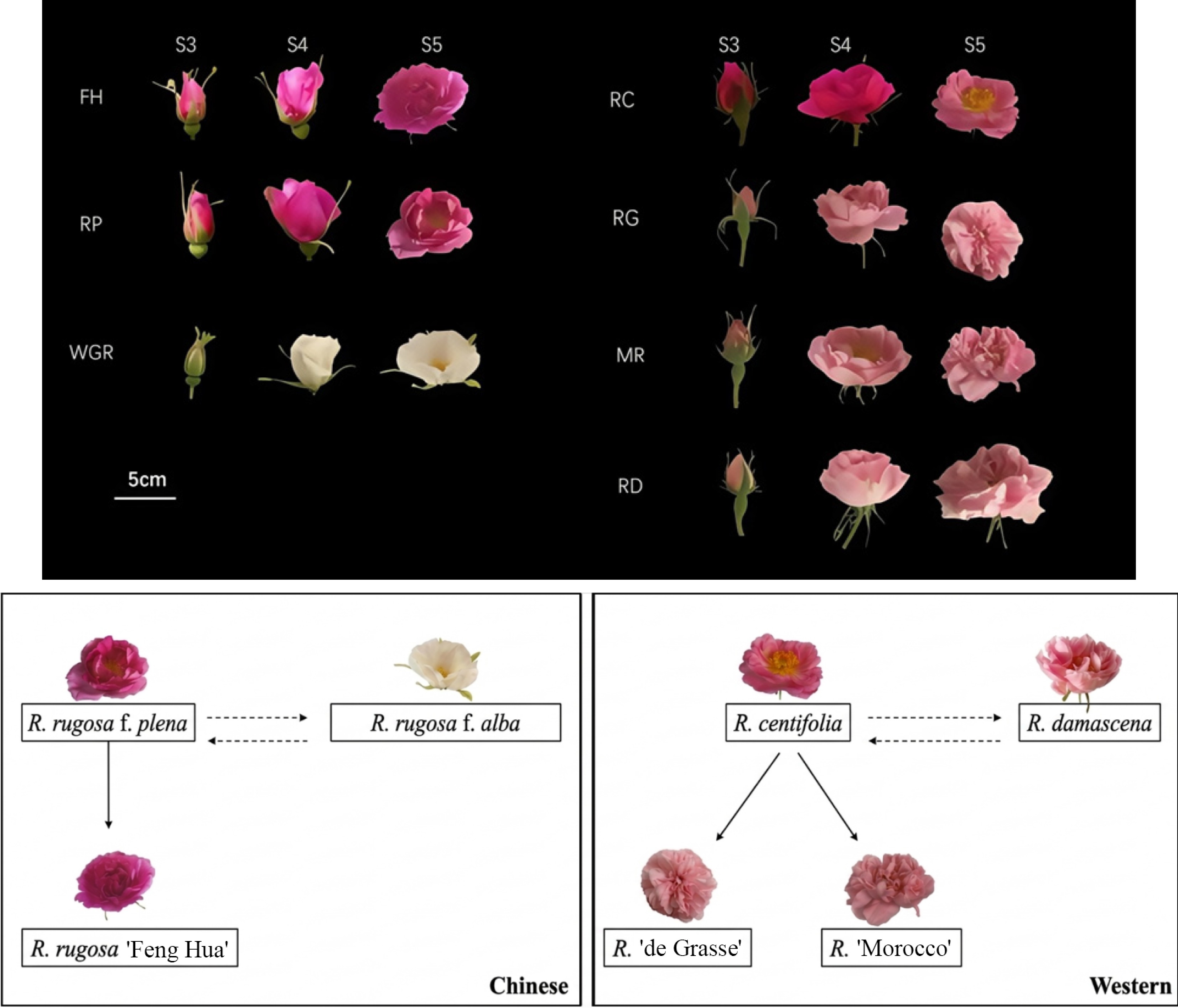
Figure 1.
Test material in different development stages and genetic relationship. S3 flower bud stage; S4 half-blooming stage; S5 full blooming stage.
Table 1. Test material Information of seven oil bearing roses.
Group Abbreviation Latin name Horticultural classification Location Aroma intensity Chinese FH Rosa rugosa 'Feng Hua' Hybrid rugosa Beijing, China +++ RP Rosa rugosa f. plena Wild species Beijing, China +++ WGR R. rugosa f. albo-plena Wild species Beijing, China ++ Worldwide RC Rosa centifolia Wild species Beijing, China +++ RG Rosa 'de Grasse' Hybrid centifolia Beijing, China ++ MR Rosa 'Morocco' Hybrid centifolia Beijing, China +++ RD Rosa damascena Hybrid species Beijing, China +++ The information in the table is obtained from Flora of China, Flora of Spice Plants in China (2020), ISO 9842:2003 Standard for Rose Essential Oil, and the aroma component analysis report from the Flower Research Institute of Yunnan Academy of Agricultural Sciences. The intensity of the fragrance is indicated by '+', representing the strength of the petal scent perceived by smell, '+++' for strong fragrance, and '++' for medium fragrance. Extraction and determination of floral components
-
Frozen fresh petal samples were ground into powder in liquid nitrogen, and 1.5 g of the sample was then transferred to a 20 mL headspace vial (Agilent Technologies, Palo Alto, CA, USA) supplemented with 1 μg of 2-octanol as an internal standard. The HS-SPME analysis was performed as previously described[20]. The bottle cap was tightened with a PTFE/silica gel septum and placed on an SPME sampling stand to equilibrate at 40 °C for 15 min. A SPME fiber (DVB/C-WR/PDMS/10, Agilent Technologies, Palo Alto, CA, USA) was inserted for 30 min at the same temperature, then immediately injected into the GC inlet for thermal desorption for 10 min[12].
The VOC compounds were analyzed by GC-MS (7890B-5977, Agilent Technologies, Palo Alto, CA, USA) equipped with a DB-WAX Column (30 m × 250 μm × 0.25 μm, Agilent Technologies, Palo Alto, CA, USA). The column temperature was 50 °C for 2 min, and then increased to 150 °C at 3 °C/min for 3 min. Subsequently, the temperature was increased to 230 °C at 5 °C/min for 10 min. The inlet temperature was set to 250 °C. Helium was used as the carrier gas with a 1 mL/min flow rate, and 0.2 uL was injected, and splited ration was set at 5:1. Electron impact (EI) ionisation mode at 70 eV was used for Mass spectra, and the ion source temperature was 200 °C.
Qualitative analysis of compounds
-
Aroma compounds were identified using MassHunter software in combination with the NIST 11 mass spectral library. Based on the library search results and retention index (RI), a match score exceeding 80% was considered sufficient for reliable identification. A C7–C30 alkane mixture was analyzed under identical chromatographic conditions. Among the 146 identified compounds, 50 lacked RI values and were marked as '–', which may be attributed to the absence of reference RI values in the NIST 11 database, elution outside the n-alkane reference range, insufficient spectral matching confidence or isomeric interference, or the lack of a CAS registry number for database retrieval. The retention index (RI) was calculated according to the method described by Van den Dool & Kratz[30].
The retention index (RI) was calculated using the Van den Dool and Kratz equation, where tR (x) represents the retention time of the target compound, and tR (n) and tR (n + 1) represent the retention times of the n-alkanes eluting immediately before and after the target compound, respectively:
$ \rm{R}I=100n+100\times t_R(n+1)−t_R(n)/t_R(x)-t_R(n) $ (1) Quantitative analysis of compounds
-
Quantitative calculations were performed based on the content of 2-octanol (internal standard). The relative quantification of aroma compound concentrations was calculated using the area normalization and internal standard methods. The latter quantitative analysis of each compound was performed according to the following Eq. (2), where C is the content, A is the peak area, VOC is the component to be determined, and std is the internal standard. For the correction factor, f' was set to 2, and the Cstd was 1 μg. Data are presented as the mean of at least three technical replicates; the final data are presented in ng/g, calculated as the value obtained from Eq. (2), multiplied by 1,000.
$ \mathit{C} _{ \mathit{voc} } = \mathit{f}' \times\, ( \mathit{A} _{ \mathit{voc} } {/} \mathit{A} _{ \mathit{std} } ) \,\times\, \mathit{C} _{ \mathit{std} } $ (2) Aroma evaluation of seven oil-bearing roses
-
Odor activity values (OAVs) were used to evaluate the contribution of aroma compounds in the sample. Aromatically active compounds had high OAVs (> 1) and usually significantly contributed to the aroma profile[31−33]. So here, we used OAVs to evaluate the aroma of seven oil-bearing roses. The OAVs were calculated for each VOC based on its odor threshold (OT), as shown in Table 2.
Table 2. Aroma evaluation of Seven oil bearing roses according to the content of VOCs.
No. Volatile compounds Oder description Threshold
(mg/m3)Odor activity values VIP1 values VIP2 values VIP3 values VIP4 values VIP5 values VIP6 values VIP7 values FH RP WGR RG RC MR RD 1 α-Pinene Woody, herbal 0.10000 860.03 0.00 0.00 0.00 1,211.61 4,382.62 1,957.03 0.12 1.13 1.14 1.39 0.09 2.58 0.36 2 γ-Muurolene Woody, herbal, spicy 0.02000 444.13 0.00 0.00 0.00 0.00 0.00 0.00 1.63 0.48 0.82 0.69 0.32 0.11 0.32 3 Geranyl acetate Rosy, floral, green 12.00000 98.53 31.45 9.90 21.38 6.53 16.96 46.16 0.01 0.16 0.99 0.23 0.84 0.50 1.47 4 Citronellol Sweet, floral, rosy, fruity, citrus, green 0.04650 58,133.57 24,638.40 19,671.26 27,046.79 13,379.56 24,982.87 46,904.79 1.22 0.21 0.55 0.38 1.01 0.16 0.95 5 Geraniol Sweet, floral, fruity, rosy, citrus 0.60000 1,907.98 1,625.49 1,924.30 2,516.21 918.61 4001.44 4,393.09 0.22 0.89 0.43 0.30 1.26 0.73 1.43 6 Acetic acid, 2-phenylethyl ester Sweet, floral, fruity, rosy, citrus 0.00670 4,299.21 0.00 0.00 180.57 0.00 0.00 0.00 1.62 0.38 1.01 0.59 0.30 0.03 0.27 7 Phenylethyl Alcohol Sweet, floral, rosy 0.00035 5,016,346.77 5,286,401.89 4,448,352.85 4,742,657.70 4,099,629.61 8,126,269.00 6,628,844.53 0.20 0.53 0.30 0.11 0.87 0.47 1.72 8 Methyleugenol Spicy 8.50000 29.24 12.38 14.06 2.27 0.00 0.96 4.69 2.38 0.46 0.68 1.07 1.10 0.65 0.57 9 Citronellyl acetate Floral, fruity, rosy, woody, green 1.00000 1,182.35 377.43 118.77 256.55 78.32 203.55 553.93 1.72 0.13 0.73 0.21 0.82 0.17 0.45 10 Geranial Citrus, lemon 0.01200 26,198.82 34,763.85 32,435.58 38,020.12 9,054.25 61,070.63 64,989.87 0.23 0.25 0.06 0.34 1.41 0.59 0.70 11 Neryl acetate Floral, fruity, rosy, citrus 20.00000 12.38 12.62 0.00 2.36 3.03 15.20 0.00 0.49 1.17 1.44 0.29 0.44 1.03 0.56 12 Nerol Sweet, floral 0.04900 23,535.94 18,082.95 18,152.96 27,166.78 18,120.38 41,560.11 44,353.05 0.06 0.80 0.55 0.28 1.16 0.69 1.25 13 Neral Sweet, citrus, lemon 0.00880 17,011.72 26,981.29 32,032.69 30,063.81 8,545.26 45,557.75 51,974.13 0.37 0.48 0.25 0.25 1.37 0.51 1.09 14 Acetic acid Spicy 0.15000 72.35 96.15 87.03 93.51 80.96 105.72 115.17 1.41 0.10 0.39 0.30 0.26 0.40 0.35 15 3-Carene Citrus, herbal, woody 9.30000 0.23 0.00 0.00 1.83 0.00 0.00 0.44 0.02 0.32 0.72 2.41 0.59 0.35 0.28 16 Hexadecane − 0.50000 0.00 0.00 0.00 33.04 0.00 33.06 40.03 0.42 0.89 1.17 1.79 0.87 0.93 1.40 17 Benzyl alcohol Sweet, floral, fruity 1.00000 72.34 103.33 225.82 135.88 125.05 187.14 283.22 0.55 0.88 0.84 0.03 0.82 0.15 1.18 18 β-Pinene Woody, spicy, minty 0.18000 143.40 250.86 285.32 0.00 52.73 247.34 59.20 0.27 1.09 1.62 1.95 0.81 1.27 1.21 19 Sabinene Woody, spicy, citrus, green 1.50000 0.00 0.00 0.00 0.00 8.26 4.52 6.55 0.37 0.43 0.85 0.17 0.73 0.11 0.95 20 (−)-cis-rose oxide Floral, green 0.00400 0.00 0.00 0.00 0.00 21,733.66 18,111.38 7,724.87 0.56 0.89 0.90 1.02 1.03 1.45 0.38 21 (−)-β-caryophyllene Woody, spicy 1.50000 0.00 0.00 0.00 0.00 44.61 13.02 0.00 0.46 0.40 0.44 0.67 2.39 0.42 0.46 22 Elemol Woody, spicy, rosy, green 0.00010 0.00 0.00 0.00 0.00 1,071,293.77 0.00 49,962.35 0.54 0.42 0.52 0.81 2.89 0.56 0.35 23 α-Phellandrene Mint 70.00000 0.08 0.00 0.05 0.00 0.00 0.04 0.03 0.82 1.02 0.67 0.31 0.67 0.57 0.26 24 Citronellal Sweet, floral, herbal, citrus 0.00044 322,811.39 49,207.15 63,672.08 58,063.06 21,705.20 56,348.52 73,861.14 1.78 0.53 0.35 0.39 0.77 0.11 0.04 25 Benzaldehyde Fruity 0.08500 175.90 223.56 339.72 83.76 118.32 52.35 310.55 0.26 0.27 1.83 1.02 0.58 0.61 0.35 26 Decanal Sweet, floral, citrus 0.00260 353.84 5550.30 0.00 0.00 275.50 0.00 0.00 0.21 3.21 0.09 0.52 0.44 0.12 0.37 27 β-Myrcene Spicy 0.04100 0.00 0.00 0.00 1837.74 1,318.62 2,399.43 3,942.38 0.88 1.46 1.41 0.67 0.15 0.66 2.16 28 D-Limonene Sweet, citrus 0.42400 19.74 73.87 0.00 75.96 51.58 108.09 88.89 0.84 0.30 1.27 0.31 0.43 0.96 0.82 29 Toluene Sweet 0.30000 0.00 0.00 0.00 0.00 9.37 0.00 0.00 0.31 0.19 0.30 0.59 1.67 0.26 0.48 30 γ-Terpinene Woody, lemon, herbal 2.50000 0.00 0.00 0.00 0.00 3.29 0.00 4.64 0.61 0.47 0.57 0.36 0.83 0.56 2.31 31 Isoeugenol methyl ether Spicy, floral, woody 1.60000 9.99 6.32 6.82 0.00 0.00 0.00 0.00 2.22 0.57 1.08 1.16 0.77 0.84 1.07 32 3-Methyl-2-(2-methyl-2-butenyl)-furan Green 0.08000 0.00 0.00 0.00 284.78 11.40 47.80 580.87 0.65 0.87 0.75 1.00 0.93 0.08 2.67 33 Humulene Woody 0.16000 0.00 0.00 0.00 0.00 51.01 0.00 8.55 0.56 0.53 0.63 0.82 2.82 0.56 0.03 VIP1 value means the VIP value of FH in OPLS-DA; VIP2 means the VIP value of RP in OPLS-DA; VIP3 means the VIP value of WGR in OPLS-DA; VIP4 means the VIP value of RG in OPLS-DA; VIP5 means the VIP value of RC in OPLS-DA; VIP6 means the VIP value of MR in OPLS-DA; VIP7 means the VIP value of RD in OPLS-DA. All thresholds are in air (mg/m3), and from www.thegoodscentscompany.com/allproc-1.html .Odor-active compounds were the main contributors to the scent tone of flowers, and VOCs could be divided into different scent tones based on their odor descriptions. Here, the aroma characteristics were evaluated by OAVs, and the proportions of various aroma compounds were calculated according to the total OAVs of aroma compounds. Then, the floral scents of seven roses were visualized according to the proportions of each scent note.
Sensory evaluation of floral fragrance
-
A panel of 15 trained evaluators (eight female, seven male, aged 22–45) was recruited from the research staff at the Institute of Vegetables and Flowers, Chinese Academy of Agricultural Sciences. Fresh flowers at the full blooming stage (S5) were evaluated between 9 and 11 am on the day of collection. For each evaluation, three flowers of the same genotype were placed in an odorless glass container covered with perforated parafilm. Panelists were asked to evaluate the following attributes: (1) overall aroma intensity, scored on a five-point scale (0 = no detectable scent, 1 = weak, 2 = moderate, 3 = strong, 4 = very strong). Evaluations were performed in a well-ventilated room at 22–25 °C; panelists rested for at least 2 min between samples and used coffee beans for olfactory resetting. Each sample was evaluated independently by all 15 panelists, and results are presented as mean scores ± SD. The aroma intensity ratings ('+++' for strong, '++' for moderate) are shown in Table 1 and represent a simplified summary of the sensory evaluation scores (strong: mean score ≥ 3.0; moderate: 2.0 ≤ mean score < 3.0; weak: mean score < 2.0).
Statistical analysis
-
All experimental data were obtained from at least three technical replicates and are presented as the mean ± standard deviation (SD). Differences among the seven rose varieties were assessed by one-way analysis of variance (ANOVA) using SPSS 21.0 (SPSS Inc., 2021). For multivariate statistical analysis, the dataset was imported into SIMCA 14.1 (Umetrics, Sweden) and Origin 2021 (OriginLab, USA). Principal component analysis (PCA) was applied to reduce data dimensionality and identify the principal components accounting for the majority of variance. Orthogonal partial least-squares discriminant analysis (OPLS-DA) was then performed to improve discrimination among the rose varieties. Model parameters, including R2 (explained variance) and Q2 (predictive variance), were optimized through iterative calculations to ensure model effectiveness and reliability. Key volatile compounds contributing to floral discrimination were identified based on OPLS-DA S-plot analysis, p-values, and variable importance in projection (VIP) values. Compounds with VIP values > 1 and p-values < 0.05 were considered significant markers for distinguishing rose varieties, thereby providing valuable insights into the unique aroma profile of each variety.
-
A total of 146 volatile organic compounds were detected from the petals of seven oil-bearing roses in three development stages using HS-SPME combined with GC-MS (Fig. 1a; Supplementary Table S1). According to the biosynthesis pathway, 146 components can be divided into terpenoids (73), phenylpropanoid/benzenoids (18), fatty acid derivatives (50), and others (5). The number of VOCs ordered is MR > RD > FH > RG > WGR > RC > RP; they are 74, 70, 68, 67, 66, 59, and 57 (Fig. 2a). Rosa rugosa f. plena (RP), R. rugosa f. albo-plena (WGR) and R. × centifolia (RC) were wild species, while R. rugosa 'Feng Hua' (FH), R. × centifolia 'Morocco' (MR), R. centifolia 'de Grasse' (RG), and R. × damascena (RD), were hybrid varieties that originated from R. × centifolia (Fig. 1b). Our results indicated that wild species produced fewer VOCs, and that hybridization can introduce more VOCs into rose flowers. What's more, our results also demonstrated that the number of VOCs increased with flower blooming (Fig. 3a).
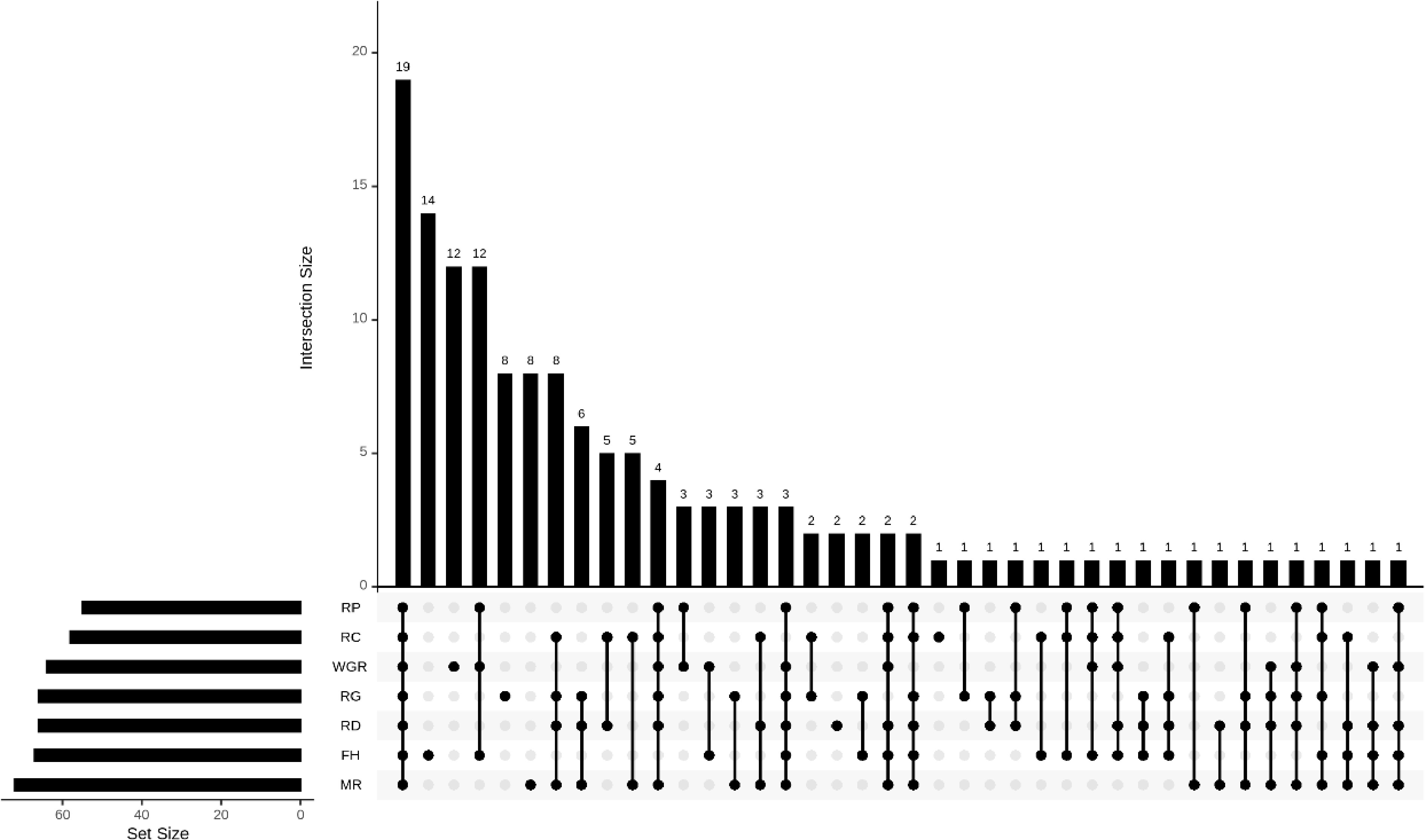
Figure 2.
Upset Venn analysis of detected VOCs in seven oil-bearing roses.
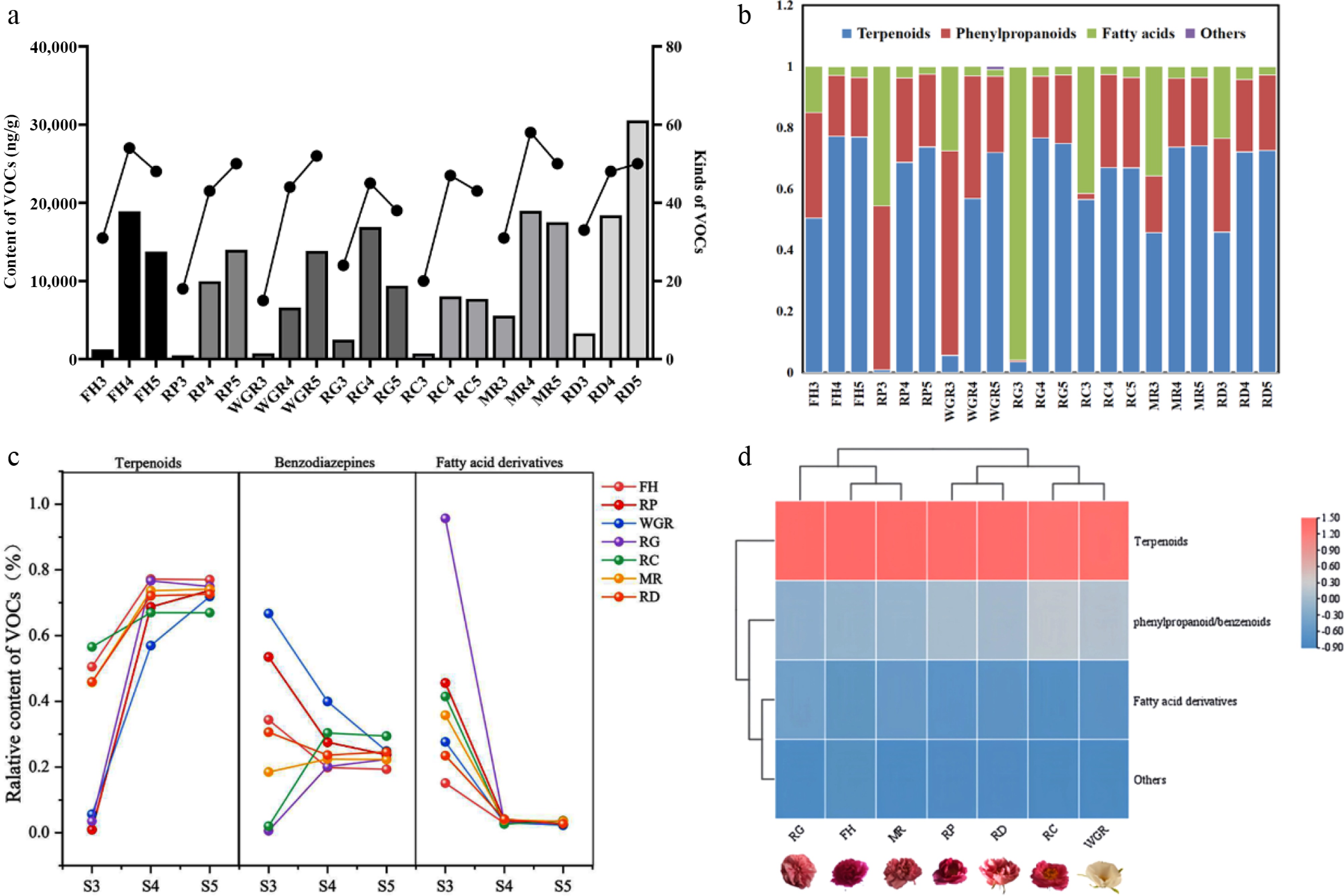
Figure 3.
The type and contents of detected VOCs in seven oil-bearing roses. (a) The quantity and content of total VOCs. (b) 100% stacked column in different biosynthesis pathways. (c) Content of VOCs in different biosynthesis pathways. (d) Heatmap clustering analysis of VOC content.
Seven roses shared 19 compounds, including tran-β-Ocimene, citronellal, citronellyl acetate, nerol, geranial, geranyl acetate, neral, geraniol, citronellol, isogeraniol, benzaldehyde, benzyl alcohol, phenylethyl alcohol, 1-hexanol, acetic acid, ocimene, perillene, and pentadecane (Fig. 2; Supplementary Table S2). The 19 shared compounds were classified into three groups: monoterpenes (12), phenylpropanoid/benzenoids (3), and fatty acid derivatives (4). Rosa rugosa f. plena (RP) had no special metabolite, R. rugosa 'Feng Hua' (FH) had the highest number of special metabolites (18), and the number of special compounds in R. rugosa f. albo-plena (WGR), R. × centifolia 'de Grasse' (RG), R. × centifolia (RC), R. centifolia 'Morocco' (MR), and R. × damascena (RD) was 14, 10, 4, 13, and 6, respectively. These results also showed that wild species had fewer specific VOCs, consistent with our previous supposition that VOCs can accumulate in hybrid offspring. Rosa rugosa f. plena (RP) may be the oldest wild species because it lacks specialized metabolism. However, more work is needed to support our proposal.
Altogether, our results also indicated that we can generate an excellent rose fragrance variety through hybridization. More VOCs can be introduced into the flower via hybrid events, but the inheritance law of VOCs in the flower is little known.
Quantitative analysis of floral compounds in seven oil-bearing roses
-
To obtain more information about the Chinese group and the Worldwide group, we calculated the content of each VOC using the internal standard method. The content of total VOCs was from 480.52 to 30,550.70 ng/g. The full blooming stage of RD had the highest content, and the budding stage of Rosa rugosa f. plena (RP) had the lowest content. The order of VOC content was RD > MR > FH > RG > RP > WGR > RC: it was 30.55, 18.96, 18.90, 16.90, 13.98, 13.86, and 8.02 ug/g, respectively (Fig. 3a; Supplementary Table S1). Citronellyl acetate, geranyl acetate, citronellol, geraniol, nerol, phenylethyl alcohol, and α-pinene were the major compounds in each sample (Fig. 4a; Supplementary Fig. S1). What's more, the content of total VOC increased with the number of VOCs, and the semi-budding blooming stages (S4) or full blooming stages (S5) showed the highest content of VOCs (Fig. 3a).
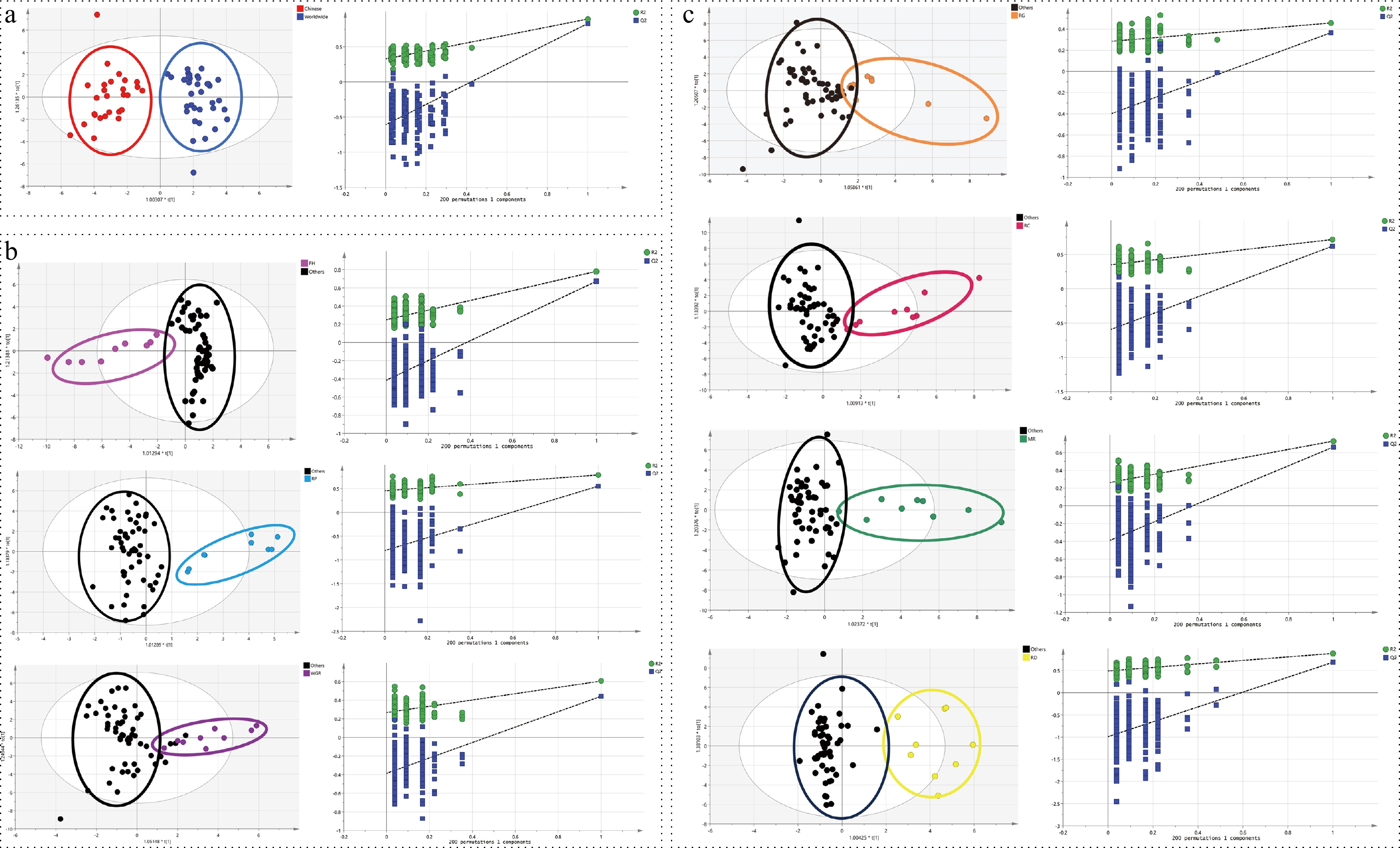
Figure 4.
OPLS-DA analysis of VOCs content. (a) OPLS-DA analysis between Chinese and Worldwide VOCs. (b) OPLS-DA analysis of Chinese VOCs. (c) OPLS-D analysis of Worldwide VOCs.
As mentioned above, VOCs can be divided into four metabolic pathways, and the major components in each sample are terpenoids, phenylpropanoids/benzenoids, and fatty acid derivatives[25]. So we calculated the contents of each metabolic pathway at different stages of flower development. The results showed that among the seven oil-bearing roses, except for a few cases in the S3 stage, terpenoids are the main components (Fig. 3b). The content of terpenoid VOCs increased with the flower-blooming stage, whereas that of fatty acid derivative VOCs decreased. In particular, the content of fatty acid derivative VOCs decreased sharply at the S4 and S5 stages of the seven roses (Fig. 3c), and the fatty acid derivative VOC profiles were divided into two clusters for the Chinese and European groups (Fig. 2b; Supplementary Fig. S1c). In the Chinese group, the major components of fatty acid derivatives were propanoic acid, 2-methyl-3-hydroxy-2,2,4-trimethylpentyl ester, while 9-nonadecene, pentadecane, heptadecane, and 8-heptadecene were the primary components in the European group (Fig. 2b; Supplementary Table S1; Supplementary Fig. S1b). Citronellyl acetate, geranyl acetate, citronellol, geraniol, and nerol were the main components in the terpenoid pathway (Fig. 2b; Supplementary Table S1; Supplementary Fig. S1c). The content of phenylpropanoid/benzenoid VOCs was increasing in the MR, RC, and RG samples, while it was decreasing in R. rugosa 'Feng Hua' (FH), R. rugosa f. plena (RP), R. rugosa f. albo-plena (WGR), and R. × damascena (RD) (Fig. 3c). Acetic acid, 2-phenylethyl ester, phenylethyl alcohol, and methyleugenol were the main compositions of phenylpropanoid/benzenoid VOCs (Fig. 2b; Supplementary Table S1; Supplementary Fig. S1b).
The components with a high content (> 1%) were selected to conduct a comparative analysis. A total of 56 volatile compounds were used to carry out hierarchical cluster analysis (HCA). The results showed that the composition of VOCs at S3 stages differed from that at the S4 and S5 stages (Fig. 2b; Supplementary Fig. S1). Especially, the contents of monoterpenes, including citronellol, geranyl acetate, geraniol, nerol, and α-pinene, were higher at the S4 and S5 stages than those at the S3 stage. However, the content of phenylethyl alcohol was higher at the S3 stage in Rosa rugosa f. plena (RP) and R. rugosa f. albo-plena (WGR), which implied that the wild species might biosynthesize more phenylethyl alcohol at early stages of flower development. Together with the taxonomic relationship of R. × centifolia 'Morocco' (MR), R. × centifolia (RC), and R. × centifolia 'de Grasse' (RG) (belonging to R. × centifolia, Table 1), we proposed that the phenylpropanoid/benzenoid metabolic pathway is different from other roses in the taxa of R. × centifolia rose varieties. The total content of fatty acid derivatives and VOCs was sharply decreased from the S3 stage to the S5 stage in the seven roses; especially, the contents of eicosane, pentadecane, and heptadecane showed significant changes between the S3 and S4 stages (Fig. 4a; Supplementary Fig. S1c). Why the flowers had a high ratio of fatty acid derivatives and low monoterpene levels in early flower development stages needs more work to discover the reasons.
Isolation and comparative analysis of identification marker VOCs in seven oil-bearing roses
-
Based on their origin and genetic relationships, the seven roses were divided into the Chinese group and the Worldwide group (Figs 4a, 5a; Table 1). It was also supported by Heatmap cluster analysis of VOC content in full blooming flowers that R. rugosa 'Feng Hua' (FH), R. rugosa f. plena (RP), and R. rugosa f. albo-plena (WGR) were separated from R. × centifolia 'de Grasse' (RG), R. × centifolia (RC), R. × centifolia 'Morocco' (MR), and R. × damascena (RD) (Fig. 3d). In order to further isolate the identification marker VOCs in each rose, we carried out Orthogonal Partial Least Squares Discriminant Analysis (OPLS-DA) analysis between the two groups based on VOC content. Results showed that seven roses can be separated by 16 VOCs (VIP > 1.0), including geraniol, nerol, α-farnesene, phenylethyl alcohol, 9-nonadecene, heptadecane, geranyl acetate, methyleugenol, citronellyl acetate, β-myrcene, α-pinene, propanoic acid, pentadecane, 2,2,4-trimethyl-1,3-pentanediol diisobutyrate, and 3-methyl-2-(2-methyl-2-butenyl)-furan (Fig. 4; Supplementary Table S3). The 16 compounds were classified into three pathways: terpenoids (8), phenylpropanoid/benzenoids (3), and fatty acid derivatives (5). Among these, nine VOCs were significantly different between the two groups (p < 0.05): α-farnesene, 9-nonadecene, heptadecane, methyleugenol, β-myrcene, α-pinene, 3-methyl-2-(2-methyl-2-butenyl)-furan, propanoic acid, pentadecane, and 2,2,4-trimethyl-1,3-pentanediol diisobutyrate (Fig. 6a; Table 2; Supplementary Table S3). These results also demonstrated that the nine VOCs might be important contributors to the aroma characteristics of the seven roses.
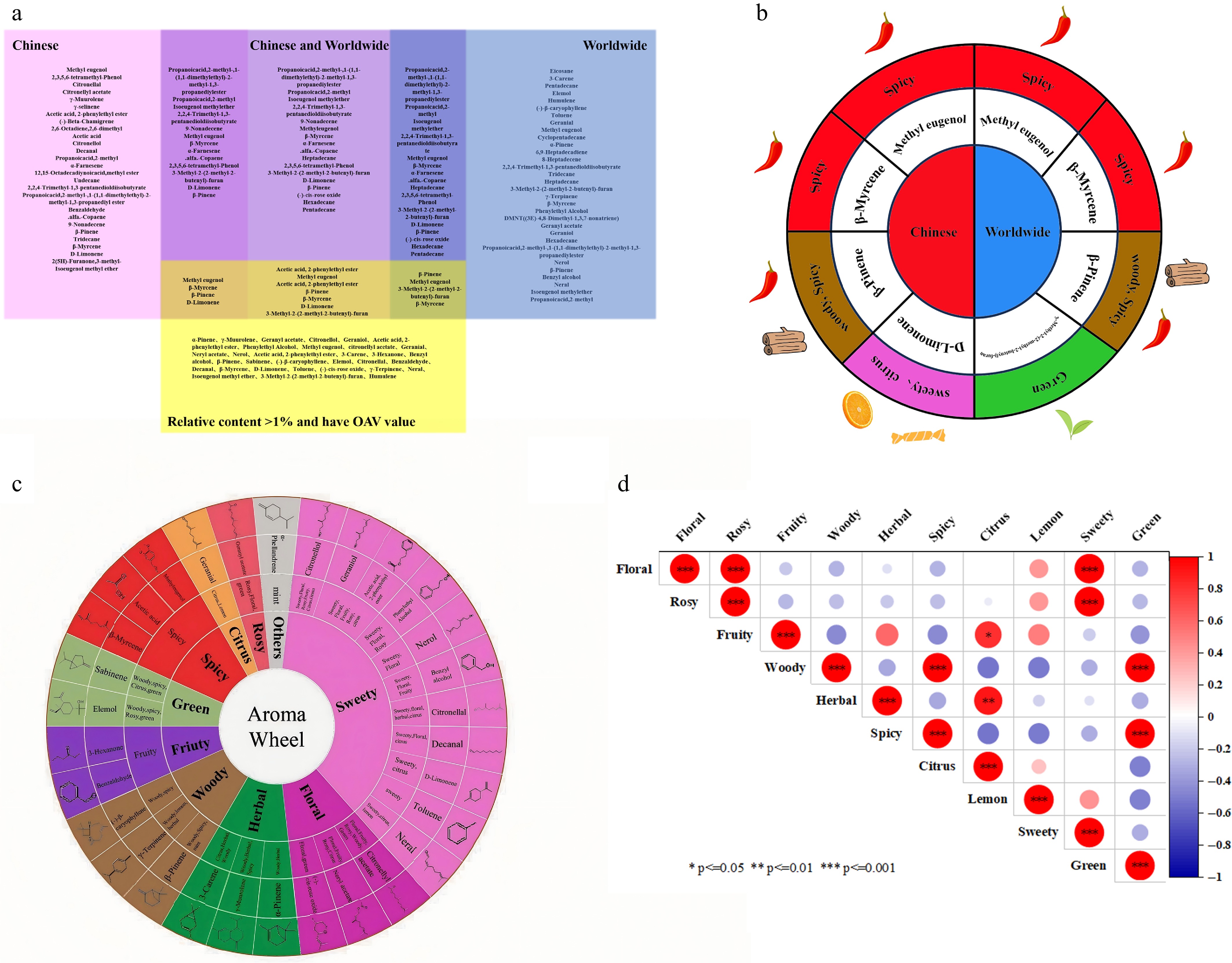
Figure 5.
Identificaiton of marker aroma VOCs for Chinese and Worldwide oil bearing roses. (a) The characteristic compounds of OPLS-DA in Chinese and Worldwide roses, intersected with substances that have a relative content greater than > 1% and possess OAV. (b) The characteristic compounds of OPLS-DA in Chinese and Worldwide roses. (c) Aroma wheel of common aromatic compounds. (d) Correlation analysis of ten notes in the seven roses.
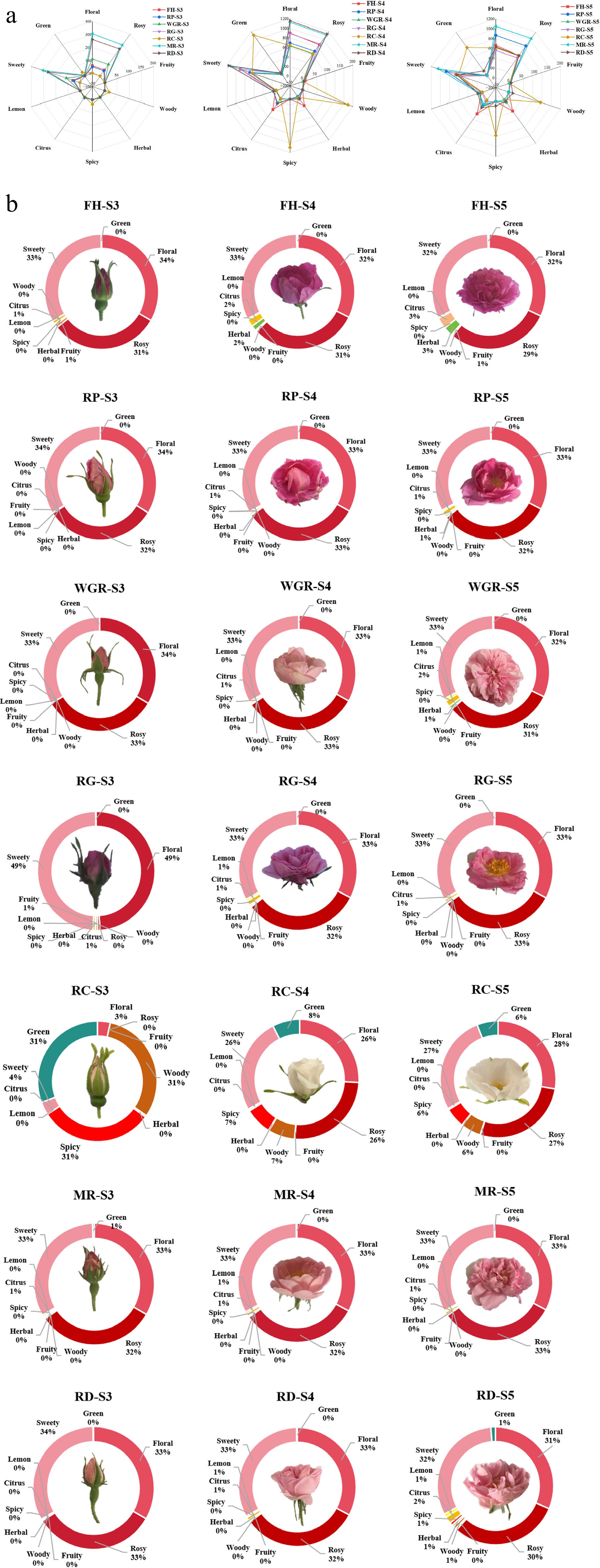
Figure 6.
Aroma profiles of seven oil-bearing roses according the content of VOCs. (a) Radar chart of seven material aroma type. (b) Proportion of fragrance notes in seven oil-bearing roses. (In [a], fragrance notes are described within a range of −50 to 200, excluding floral, rosy, and sweet).
To categorize the varieties of seven roses according to identification marker VOCs in each rose, we also performed OPLS-DA in each oil-bearing rose, and the results showed that the content of acetic acid, citronellol, citronellyl acetate, α-farnesene, and 2,3,5,6-tetramethylphenol can separate R. rugosa 'Feng Hua' (FH) from the six other roses (VIP > 1 and p < 0.05). The content of α-farnesene, propanoic acid, 2-methyl-1-(1,1-dimethylethyl)-2-methyl-1,3-propanediyl ester, 9-nonadecene, β-myrcene, and 2,2,4-trimethyl-1,3-pentanediol diisobutyrate can separate R. rugosa f. plena (RP) from the six other roses. The content of 9-nonadecene, β-myrcene, and methyleugenol in R. rugosa f. albo-plena (WGR) (Fig. 4b; Supplementary Table S4). Pentadecane, eicosane, heptadecane in R. × centifolia 'de Grasse' (RG), geraniol, geranial, elemol, neral, (−)-β-caryophyllene, humulene in R. × centifolia (RC), geraniol, α-pinene, heptadecane, geranial, 8-heptadecene, 9-nonadecene, neryl acetate, cyclopentadecane, 2,2,4-trimethyl-1,3-pentanediol diisobutyrate in R. × centifolia 'Morocco' (MR), phenylethyl alcohol, geranyl acetate, geraniol, 3-methyl-2-(2-methyl-2-butenyl)-furan, nerol, β-myrcene, and 9-nonadecene in RD can separate them from eachother. All these compounds can be used as chemical markers to distinguish them among seven roses (Figs 4, 5a; Supplementary Table S4). These results imply that chemical compounds in flower fragrances can be used for species or variety identification.
Aroma characteristics of seven oil-bearing roses
-
The aroma of seven roses differed according to human odor evaluation. Odor activity values (OAVs) reflected the compound's actual odor intensity in the sample and were widely used in aroma analysis of flowers[34]. In this study, aroma characteristics were evaluated using OAVs and aroma descriptions of each volatile compound. The VOC profiles showed remarkable differences among the seven oil-bearing roses; in particular, the high volatile compound content might also be responsible for the aroma differences among them. So we picked up the components with high content (> 1%) and selected a total of 56 volatile compounds for further analysis. Only 29 of 56 volatile compounds had olfactory thresholds; their odor thresholds are listed in Table 2, and their OAVs were calculated based on the content of each VOC.
Aroma profiles were evaluated for aroma intensity using OAVs at three flower development stages in seven roses (Fig. 6). A total of 29 VOCs were divided into 10 types of incense tone, including floral, rosy, sweet, green, fruity, woody, spicy, citrus, lemon, and herbal, according to odor description[31,32]. Floral, sweet, and rosy tones were the main incense tones in the seven roses; woody and spicy tones also existed at the S3 and S5 stages. The strong intensity of the floral tone was mainly caused by phenylethyl alcohol, geranyl acetate, citronellol, geraniol, acetic acid, 2-phenylethyl ester, citronellyl acetate, neryl acetate, nerol, benzyl alcohol, (−)-cis-rose oxide, citronellal, and decanal. Especially, (−)-cis-rose oxide was thought to be an important donor of floral and green tones in roses. The content of citronellol, geraniol, acetic acid, 2-phenylethyl ester, phenylethyl alcohol, citronellyl acetate, and neryl acetate mainly contributed to the rosy tone. The fruity tone was the result of citronellol, geraniol, 2-phenylethyl ester, phenylethyl alcohol, citronellyl acetate, and neryl acetate content. The sweet tone was mainly caused by the content of phenylethyl alcohol, citronellol, geraniol, geranyl acetate, acetic acid, 2-phenylethyl ester, citronellyl acetate, and nerol. Results of OAV analysis showed that different flower development stages had different aroma intensities. At the S3 stage (budding), RD, MR, RP, FH, and WGR showed a high intensity of sweet, floral, and rosy tones, and MR showed the strongest aroma, consistent with human olfaction. What's more, WGR also showed a strong woody and spicy tone, which may be mainly caused by the content of β-pinene and sabinene (Fig. 5b, c; Supplementary Table S5). RG and RC showed high fatty acid diversity and weak fragrance notes at this stage, suggesting that terpenoids and phenylpropanoid/benzenoid compounds played a major role in rose fragrance. At the S4 stage (semi-blooming), all seven roses showed strong intensity OAVs with sweet, floral, and rosy tones (Fig. 6d). At the S5 stage (full blooming), sweet, floral, and rosy were still the main aroma tones in the seven roses; however, RC and FH had two more tones in this stage. R. centifolia (RC) showed a high density of spicy and woody tones at the S3 and S5 stages, which was mainly caused by the high content of elemol, β-pinene, sabinene, and (−)-β-caryophyllene. R. rugosa 'Feng Hua' (FH) showed a higher proportion of herbal and citrus tones, which may be a result of the high content of citronellal (Fig. 6; Supplementary Table S5).
Among the nine significant marker compounds identified by OPLS-DA, methyleugenol, β-myrcene, and β-pinene deserve particular attention due to their direct contributions to the spicy and woody notes that differentiate oil-bearing rose genotypes. Methyleugenol, a phenylpropanoid with a characteristic clove-like spicy odor (threshold = 8.50 mg/m3), was significantly enriched in the Chinese group, particularly in FH (OAV = 190.27 at S4) and WGR (OAV = 14.06 at S5), whereas it was absent or negligible in MR (OAV = 0.96) and RC (undetected) (Table 2; Supplementary Table S5). Although the OAV of methyleugenol was relatively low compared to dominant floral-note compounds such as citronellol and phenylethyl alcohol, its distinctive spicy character is perceptually prominent even at low concentrations due to the cross-modal enhancement effect, whereby minor spicy notes become more noticeable against a predominantly floral background[33]. Furthermore, methyleugenol is classified as a potential allergen under EU Cosmetics Regulation (EC No. 1223/2009), making its content a critical quality parameter for REO intended for international markets. β-Myrcene, a monoterpene with a balsamic, spicy odor (threshold = 0.04 mg/m3), was exclusively detected in the Worldwide group at the S3 stage, with particularly high OAVs in RD (3,942.38), MR (2,399.43), and RC (1,318.62) (Table 2). Its presence contributed a distinctive spicy-green undertone to the bud-stage aroma of Worldwide genotypes, which was absent in the Chinese group. β-Pinene, sharing a woody-spicy-mint character (threshold = 0.18 mg/m3), showed a broader distribution across genotypes and stages, with the highest OAVs observed in RD (456.38 at S5), RC (424.68 at S5), and MR (311.66 at S4). In the Chinese group, β-pinene was detected only in WGR (OAV = 289.05 at S4), contributing to the woody-spicy note perceived by the sensory panel at this stage. The combined effects of β-myrcene and β-pinene accounted for the stronger spicy and woody tones observed in RC and RD at S3 and S5 stages, respectively (Fig. 6; Supplementary Table S5). Together, these three compounds formed a 'spicy-woody module' that was superimposed on the shared floral-rosy-sweety base aroma, creating the characteristic aromatic differentiation between Chinese and Worldwide oil-bearing roses.
To visualize the compound–aroma relationships of these non-floral marker VOCs, a bipartite association network was constructed for five representative OPLS-DA marker compounds and their corresponding scent notes (Supplementary Fig. S2). Among these, β-myrcene and methyleugenol showed the strongest associations with the spicy note, while β-pinene contributed simultaneously to spicy, woody, and sweet tones. D-Limonene was primarily linked to citrus and sweet notes, and 3-methyl-2-(2-methyl-2-butenyl)-furan (rosefuran) was exclusively associated with the green note. The line width reflects the relative contribution strength based on OAV proportions. This network highlights that the aromatic differentiation between Chinese and Worldwide oil-bearing roses is driven not by the dominant floral-rosy compounds shared across all genotypes, but by the differential accumulation of these secondary aroma contributors that modulate the spicy, woody, citrus, and green overtones.
To validate the OAV-based aroma evaluation, sensory intensity scores at the full blooming stage (S5) were compared with the total OAV values of the seven genotypes (Table 1). The sensory panel rated R. × damascena (RD) as having the highest aroma intensity (mean score 3.8 ± 0.3), followed by MR (3.5 ± 0.4) and FH (3.2 ± 0.5), consistent with their '+++' ratings and high total OAV values. R. rugosa f. alba (WGR) received the lowest intensity score (2.1 ± 0.6), corresponding to its '++' rating. Spearman's rank correlation analysis revealed a significant positive correlation between sensory intensity scores and total OAV values at S5 (rs = 0.89, p < 0.01), confirming the reliability of the OAV-based approach for characterizing the aroma strength of oil-bearing roses.
The proportion of 10 incense tones in each rose was calculated from their OVAs and the content of VOCs[17].
-
Flowers are fragrant, and their aroma character determines the commercial value of roses. Nowadays, Rosa × damascena, R. 'Morocco', and R. 'de Grasse' are used worldwide to extract essential oils, while R. rugosa 'Feng Hua' and R. 'Ku Shui' are used in China[8,9,11]. R. rugosa f. plena is an important breeding germplasm for Chinese rose, while R. centifolia and R. × damascena are key breeding germplasms for oil-bearing roses in the Western world. There are significant differences in chemical composition and aroma characteristics between Chinese and Western world oil-bearing roses. Here, the core breeding germplasms and mainly oil-bearing rose varieties are used to comparatively analyze the differences between Chinese and Worldwide oil-bearing roses.
Rose floral aromas, produced by several compounds such as geraniol, phenethyl alcohol, linalool, and rose oxide, are highly popular and widely used commercially, including in medicine, premium cosmetics, and tobacco products[3]. The OAV was the ratio of the compound's content to its olfactory threshold; it reflects the compound's actual odor intensity in the sample[31,32,34]. R. × damascena (RD) exhibited the strongest overall fragrance, with rosy, floral, and sweet as the dominant aroma notes, primarily driven by the exceptionally high OAVs of phenylethyl alcohol (19,598,176.67 at S5), citronellol (79,646.14 at S5), nerol (79,667.88 at S5), and geraniol (7,636.51 at S5) (Supplementary Table S5). However, R. × centifolia (RC) exhibited notably stronger woody and spicy notes, particularly at the S3 stage, driven by high OAVs of (−)-β-caryophyllene (50,838.33) and at the S4–S5 stages by β-pinene and humulene (Supplementary Table S5). R. rugosa f. plena (RP) showed a transient spicy note at the S3 stage contributed by β-myrcene (OAV = 1,997.65), but lacked substantial woody tones across developmental stages. R. rugosa f. alba (WGR) also displayed woody and spicy characteristics at S4, mainly attributed to β-pinene (OAV = 289.05) and sabinene (Fig. 5; Supplementary Table S5). R. rugosa 'Feng Hua' (FH) was characterized by more diverse aroma notes, including distinctive herbal and citrus tones resulting from the high OAV of citronellal (OAV = 322,811.39 at S5 as calculated from Table 2) and γ-muurolene (OAV = 1,332.39, woody/herbal/spicy at S3), as well as a spicy component from methyleugenol (OAV = 190.27 at S4). R. × damascena, R. 'Morocco', R. 'de Grasse', and R. rugosa 'Feng Hua', are the result of natural or artificial hybridization of roses during the 16th–18th century (Fig. 1). These results imply that old rose or cultivar species have abundant aroma notes and more specialized VOCs. Chinese rose R. rugosa 'Feng Hua' exhibits a weak fragrance but more diverse aroma notes. However, R. rugosa 'Feng Hua' has greater aroma diversity than R. rugosa f. plena and R. rugosa f. albo-plena. To quantify this aroma diversity, we compared the number of odor-active compounds (OAV > 1) and exclusive aroma compounds across all developmental stages. FH possessed 14 odor-active compounds, compared to 13 in both RP and WGR. Critically, FH harbored six exclusive high-OAV compounds absent in RP and WGR, including citronellal (OAV = 549,626.26 at S5), γ-muurolene (OAV = 1,332.39 at S3), α-pinene (OAV = 1,825.29 at S3), and methyleugenol (OAV = 190.27 at S4), which introduced distinctive herbal, citrus, and spicy characters (Table 2; Supplementary Table S5). In contrast, RP had four, and WGR had five exclusive compounds. FH also exhibited the richest early-stage aroma, with nine active compounds detected at S3, compared to five in RP and only two in WGR. Combined with its highest total VOC species (68) and unique metabolites (18) among the three Chinese genotypes (Fig. 2a), these results indicate that FH possesses broader aroma complexity through transgressive inheritance. These aroma diversity indicating greater transgressive inheritance. R. centifolia has the highest aroma diversity, and R. × damascena shows a close relationship with R. 'Morocco' and R. 'de Grasse'. Floral fragrance profiles showed that genotypes from the same geographical origin tended to cluster together, and hybrid varieties generally exhibited greater VOC diversity (FH: 68, RG: 67, MR: 74, RD: 70 compounds) and more unique metabolites than wild species (RP: 57, WGR: 66, RC: 59 compounds) (Fig. 2a), suggesting that hybridization events may contribute to the expansion of aroma complexity. However, further population-level studies with larger sample sizes are needed to confirm the inheritance patterns of floral scent traits, and more work is needed to explore the molecular mechanism[35,36].
Based on the VOC profiling, OPLS-DA marker analysis, and OAV evaluation results, we propose specific breeding strategies for fragrance improvement of oil-bearing roses. Regarding parental selection, R. × damascena (RD) exhibited the highest total VOC content (30.55 μg/g) and the greatest contents of citronellol (3,703.55 ng/g), geraniol (4,581.91 ng/g), geranyl acetate (4,302.81 ng/g), and nerol (3,903.73 ng/g) at the S5 stage, along with the highest corresponding OAVs (Supplementary Tables S1 and S6), confirming its superiority as a maternal parent for high-yield essential oil breeding. R. rugosa 'Feng Hua' (FH), despite moderate total VOC content (18.90 μg/g), possessed the highest number of unique metabolites (18 compounds) and exhibited the greatest aroma diversity, including distinctive citrus notes (citronellal OAV = 322,811.39) and herbal notes absent in most Worldwide genotypes (Supplementary Tables S5 and S6). Therefore, RD × FH is proposed as a priority cross combination to generate offspring combining high monoterpene yield with broad aroma complexity. R. × centifolia 'Morocco' (MR) could serve as an alternative parent, given its highest VOC number (74 compounds) and distinctively high (−)-cis-rose oxide OAV (18,111.38), a compound notably absent in the Chinese group.
Among the nine significant OPLS-DA marker compounds (p < 0.05; Supplementary Table S3), citronellol, geraniol, geranyl acetate, and nerol should be prioritized as positive selection targets for REO quality, as they consistently showed the highest OAVs across all genotypes (Supplementary Table S6). Conversely, methyl eugenol, which was significantly enriched in the Chinese group (FH: 299.63, WGR: 166.06 ng/g at S5) compared to the Worldwide group (RG: 30.14, MR: 7.72 ng/g) (Supplementary Table S1), should be subjected to negative selection in programs targeting international markets, given its classification as a potential allergen (EC Regulation No. 1223/2009). Additionally, fatty acid derivative markers such as 9-nonadecene (VIP = 1.76) and heptadecane (VIP = 1.24), detected primarily in the Worldwide group (e.g., 9-nonadecene: RD = 287.09 ng/g vs undetected in Chinese genotypes), may serve as chemotype markers for distinguishing progeny with Worldwide-type metabolism in hybrid populations.
Practically, we recommend a two-step breeding approach: (1) intergroup hybridization between Chinese and Worldwide germplasm to maximize transgressive segregation for VOC diversity, as supported by the higher VOC numbers observed in hybrid varieties (FH: 68, MR: 74, RD: 70) compared to wild species (RP: 57, RC: 59) (Fig. 2a); and (2) early-generation chemotype screening using the identified marker compounds, with preliminary selection thresholds of citronellol > 2,000, geraniol > 1,500, and methyl eugenol < 50 ng/g at S5, based on the range observed in our germplasm collection (Supplementary Table S1). Given that terpenoid content peaked at S4–S5 while fatty acid derivatives decreased sharply (Fig. 3c), breeding materials should be evaluated at the full blooming stage to ensure selection targets the commercially relevant aroma profile.
In this study, all seven rose genotypes were cultivated under standardized environmental conditions at the National Center of China for Flowers Improvement, Institute of Vegetables and Flowers, Chinese Academy of Agricultural Sciences, Beijing, China. Specifically, all plants were grown in the same soil type and subjected to the same fertilization regime, irrigation management, and climatic exposure. This uniform cultivation design was intended to minimize environmental confounding and enable direct comparisons among genotypes. However, we acknowledge that the use of a single experimental environment represents a limitation of the present study, particularly for genotypes of European origin. Lebkiri et al. showed that soil potassium content and altitude influence oxygenated monoterpene accumulation[23], and Charoimek et al. showed that drought stress can enhance essential oil content and concentrations of geraniol, citronellol, and eugenol[4]. Different origins, climates, and soil conditions may lead to differences in volatile substances of European varieties. Further multi-environment trials are therefore needed to determine whether, and to what extent, floral scent profiles are influenced by environmental conditions.
-
This study systematically characterized the volatile organic compound profiles and aroma properties of seven oil-bearing rose genotypes originating from China and Worldwide germplasm. A total of 146 VOCs were identified, mainly including terpenoids, phenylpropanoids/benzenoids, and fatty acid derivatives. Terpenoid compounds increased progressively during flower development, whereas fatty acid derivatives decreased markedly from the early opening stage to full bloom. Multivariate analyses, including HCA and OPLS-DA, clearly distinguished Chinese R. rugosa genotypes from Worldwide R. centifolia and R. × damascena genotypes, and identified several marker compounds, such as α-farnesene, 9-nonadecene, heptadecane, methyleugenol, β-myrcene, α-pinene, propanoic acid derivatives, pentadecane, and 2,2,4-trimethyl-1,3-pentanediol diisobutyrate. Aroma evaluation based on OAVs and sensory assessment showed that floral, rosy, and sweet notes were the dominant scent characteristics of all seven roses, while spicy, woody, citrus, and herbal notes contributed to genotype-specific aroma differentiation. R. × damascena exhibited the strongest overall fragrance and highest VOC content, whereas R. rugosa 'Feng Hua' showed greater aroma diversity among Chinese genotypes. These results demonstrate that both genetic background and flower developmental stage strongly influence VOC accumulation and aroma formation in oil-bearing roses. The identified characteristic compounds and aroma traits provide valuable references for germplasm evaluation, chemotype identification, and future breeding of high-quality fragrant rose cultivars.
-
The authors confirm their contributions to the paper as follows: experiment design, data analysis, revision, and editing: Kou Y; draft the manuscript and carried out the experiments: Li J, Zhang L, Xu J, Sun M; data analysis and figure creating: Li J; partly participating in the experiments and data analysis: Jia R, Zhao X, Lin G; experiments supervison, conception and design: Ge H, Yang S. All authors reviewed the results and approved the final version of the manuscript.
-
The datasets generated during and/or analyzed during the current study are available from the corresponding author on reasonable request.
-
This work received grant support from the National Key Research and Development Program of China (2024YFD1200503; 2021YFD1200200) and the National Natural Science Foundation of China (31672183).
-
The authors declare that they have no known competing financial interests or personal relationships that could have influenced the work reported in this paper.
-
accompanies this paper online at: https://doi.org/10.48130/opr-0026-0019.
-
# Authors contributed equally: Jiyuan Li, Jia Xu, Lei Zhang
- Supplementary Table S1 Compounds and contents of seven Rose petals in the full blooming stage.
- Supplementary Table S2 Upset venn analysis of seven samples in all development stages.
- Supplementary Table S3 OPLS-DA analysis between Chinese Group and Worldwide Group.
- Supplementary Table S4 OPLS-DA analysis of each sample.
- Supplementary Table S5 OAV-value of relative content > 1%.
- Supplementary Table S6 Aroma evaluation of Seven oil bearing roses according the content of VOCs.
- Supplementary Table S7 Aroma evaluation of Seven oil bearing roses according the content of VOCs.
- Supplementary Fig. S1 Heatmap Cluster Analysis of different biosynthesis pathway.
- Supplementary Fig. S2 Bipartite association network of five representative OPLS-DA marker compounds and their corresponding scent notes.
- Copyright: © 2026 by the author(s). Published by Maximum Academic Press, Fayetteville, GA. This article is an open access article distributed under Creative Commons Attribution License (CC BY 4.0), visit https://creativecommons.org/licenses/by/4.0/.
-
About this article
Cite this article
Kou Y, Li J, Xu J, Zhang L, Sun M, et al. 2026. Phytochemical compositions and aroma evaluation of seven oil-bearing roses originating from China and Worldwide. Ornamental Plant Research 6: e027 doi: 10.48130/opr-0026-0019 

Phytochemical compositions and aroma evaluation of seven oil-bearing roses originating from China and Worldwide
- Received: 23 February 2026
- Revised: 29 April 2026
- Accepted: 10 June 2026
- Published online: 28 July 2026
Abstract: Three taxa of R. rugosa (Chinese Group), three taxa of R. centifolia, and one R. × damascena (Worldwide Group) were used to detect their volatile organic compound (VOC) contents using headspace solid-phase microextraction coupled with gas chromatography-mass spectrometry. A total of 146 VOCs were detected, including 73 terpenoids, 18 phenylpropanoids/benzenoids, 50 fatty acid derivatives, and 5 other compounds. The contents of terpenoids were increasing with flower development, while the contents of fatty acid derivatives were decreasing. Heatmap cluster analysis (HCA) and Orthogonal Partial Least Squares Discriminant Analysis (OPLS-DA) revealed that seven roses can be divided into Chinese and Worldwide groups, and α-farnesene, 9-nonadecene, 3-methyl-2-(2-methyl-2-butenyl)-furan, heptadecane, methyleugenol, β-myrcene, α-pinene, propanoic acid, 2-methyl-,1-(1,1-dimethylethyl)-2-methyl-1,3-propanediyl ester, pentadecane, and 2,2,4-Trimethyl-1,3-pentanediol diisobutyrate were the marker compounds for two groups. Sensory and incense tone compound evaluation showed that the aromas were mainly composed of floral, rosy, and sweet notes. However, the aroma of seven roses had a stronger spicy, woody, and citrus note in buds (S3) or full-blooming flower stages (S5), which were mainly caused by high contents of methyleugenol, β-myrcene, and β-pinene. In this study, the VOC profile and aromatic characteristics of oil-bearing roses were systematically compared between Chinese and Worldwide genotypes using metabolic pathway analysis and aroma evaluation, providing a more comprehensive reference for fragrant rose breeding.
-
Key words:
- Oil-bearing rose /
- VOC profiles /
- Aroma evaluation /
- Essential oils