











-
As sessile organisms, plants cannot escape adverse conditions and must continuously balance two fundamental, energetically competing priorities: growth and reproduction vs defense and stress tolerance. This balance—often termed the growth–defense trade-off—has shaped plant evolution and remains a central challenge in modern crop science[1,2]. When stress signals dominate, resources flow toward the synthesis of defensive compounds, activation of reactive oxygen species (ROS) signaling, and the induction of systemic resistance pathways. These processes are energetically expensive and inevitably reduce the resources available for biomass accumulation, yield formation, and developmental progression[3,4]. Conversely, when growth programs dominate, investment in defense is limited, and the plant becomes more vulnerable to biotic and abiotic threats[5].
Classical frameworks of plant immunity—pattern-triggered immunity (PTI), effector-triggered immunity (ETI), systemic acquired resistance (SAR), and induced systemic resistance (ISR)—describe the mechanisms of defense activation with considerable molecular resolution[6,7]. Similarly, the roles of abscisic acid (ABA) in drought and osmotic stress responses are well characterized[8]. However, these frameworks predominantly analyze one side of the growth–immunity equation: the defense state. The regulatory logic of the opposing growth-dominant state—how it is established, maintained, and terminated, and how it interacts with immune configurations—remains comparatively undertheorized in current conceptual models[3,9].
A key limitation of existing frameworks is their fragmented treatment of growth and stress physiology as largely independent domains. In reality, immune responses mediated by SA, JA/ET, and ABA, and growth programs driven by auxins (AUX), gibberellins (GA), brassinosteroids (BR), cytokinins (CK), and the Target of Rapamycin (TOR) kinase, operate simultaneously and compete for the same metabolic and energy resources[9,10]. The lack of an integrated framework connecting these processes has direct consequences for agricultural practice: current biostimulant and crop protection strategies are often applied without consideration of the plant's actual physiological state, leading to variable and poorly reproducible outcomes[11,12].
Recent work has begun to close this conceptual gap. The TOR–SnRK1 module has been identified as a central molecular rheostat that integrates energy, nutrient, and hormonal signals to direct resources toward either growth or defense[13,14]. Epigenetic mechanisms, including histone modifications and non-coding RNAs, have been shown to establish physiological state memory that accelerates transitions between growth and defense configurations[15,16]. The root microbiome, acting through ISR and hormonal modulation, has emerged as an important regulator of this balance[17,18]. Together, these advances suggest that the plant's physiological state can be understood as a hypothetically multistable regulatory network, in which the growth-dominant and immune-dominant configurations represent putative discrete, self-sustaining attractors capable of transition-driven switching[9,19].
The present review synthesizes this emerging understanding into a coherent conceptual framework organized around the following objectives: (1) to define the growth-dominant state as a putative distinct regulatory attractor within a hypothetically multistable plant network; (2) to analyze the hormonal and metabolic mechanisms sustaining this state; (3) to characterize the molecular switches and regulatory cascades governing state transitions; (4) to critically evaluate the growth–immunity trade-off as a dynamic, context-dependent balance rather than a fixed constraint; (5) to re-examine the conceptual basis of biostimulant action in light of this framework; and (6) to introduce Regulatory Agronomy as an applied paradigm for state-guided crop management.
-
A conceptually productive way to understand plant adaptive physiology is to consider the plant as a putatively multistable dynamical system capable of occupying several discrete, self-sustaining physiological configurations—here termed conceptual regulatory attractors or dominant states[9,19]. This perspective, drawing on concepts from systems biology and dynamical systems theory, posits that the plant's signaling network is not linear but non-linear, characterized by feedback loops, threshold effects, and potentially bistable or multistable equilibria[19]. Four principal conceptual attractors can be identified within the SA–JA/ET–ABA–TOR network: the SA-dominant state; the JA/ET-dominant state; the ABA-dominant state; and the TOR-dependent growth-dominant state[9,10].
Each proposed attractor is maintained by positive feedback loops that reinforce its own activity: for example, TOR activation promotes sugar-dependent signaling through trehalose-6-phosphate (T6P), which further stimulates TOR and may suppress the opposing SnRK1 kinase, tending to consolidate the growth-dominant state[20,21]. Transitions between these putative attractors occur when environmental or metabolic signals shift critical regulatory nodes past hypothetical bifurcation thresholds, analogous to phase transitions in physical systems[9].
An important caveat must be underscored: the evidence base for strict mathematical multistability—discrete attractors with defined basins and bifurcation dynamics—in plant hormonal networks is still largely inferred from genetic epistasis experiments, hormone antagonism studies, and transcriptomic clustering, rather than from time-resolved quantitative modeling of full hormone networks[9,19,22]. Rigorous testing of the multistability hypothesis requires time-resolved, single-cell resolution measurement of hormone concentrations and kinase activities across state transitions, an experimental challenge that current technology is only beginning to address. Future work should combine hormone biosensor lines with live imaging to track state transitions in real time. The multistable attractor framework therefore provides a conceptually organizing principle rather than a mathematically proven description (Table 1).
Table 1. Summary of proposed regulatory attractor states: characteristic features, markers, and key primary references.
State Dominant hormonal features Energy status/TOR–SnRK1 Molecular markers Metabolic characteristics Key genes/key references SA-dominant (SAR/PTI/ETI) ↑SA; ↓AUX, GA, CK ↓TOR; ↑SnRK1; low ATP flux NPR1, PR1, ICS1, TGA factors ↑Phenolics, ↑lignin, ↓sugar allocation to growth NPR1, ICS1, SID2; Ngou et al.[6]; Khablak et al.[9] JA/ET-dominant (ISR/necrotrophic) ↑JA, ↑ET; ↓GA; DELLA stabilised Moderate ↓TOR; partial SnRK1 activation PDF1.2, MYC2, ERF1, JAZ proteins ↑Glucosinolates, ↑phytoalexins; ↓elongation COI1, MYC2, ERF1; Wasternack & Hause[7] ABA-dominant (IST/abiotic stress) ↑ABA; ↓CK, AUX ↓TOR (SnRK1-dep. and -indep.); ↑SnRK1 NCED3, RD29A, SnRK2.6, RAB18 ↑Proline, ABA catabolism; stomatal closure; ↓photosynthesis NCED3, PYR/PYL, SnRK2.6; Zhu[8] TOR-dependent
growth-dominant↑AUX, GA, BR, CK; ↓ABA, SA, JA ↑TOR (TORC1 active); ↓SnRK1; ↑T6P; high ATP TOR, S6K1/2, E2F, CYCD, BZR1, ARF ↑Sucrose, ↑amino acids, ↑NADPH; ↑anabolism; ↑ribosome biogenesis TOR, S6K, DELLA; De Vleesschauwer et al.[13] The growth–defense trade-off as a systemic property
-
The growth–defense trade-off has been recognized as a fundamental constraint in plant biology for several decades. Its mechanistic basis is resource competition: the synthesis of defensive compounds (phenolics, glucosinolates, alkaloids, phytoalexins, lignin), the operation of NADPH oxidase-dependent ROS signaling, and the maintenance of hormone-dependent immune programs collectively place substantial demands on cellular carbon, nitrogen, energy, and reducing equivalents—precisely the resources required for growth[1,2,5]. Classic evidence supporting this trade-off includes the constitutive activation of SA-dependent defenses in mutants such as Arabidopsis cpr1 and acd6, which show dwarf phenotypes despite genetic equivalence to wild-type in terms of growth potential[3].
However, the view of the growth–defense trade-off as a fixed, hard constraint has been progressively challenged. Several lines of evidence indicate that plants can, under optimal conditions, partially co-activate growth and basal immunity simultaneously, and that the depth of the trade-off depends strongly on environmental context, developmental stage, and the identity and intensity of the stressor[3,5]. In particular, the TOR–SnRK1 module has emerged as a regulatory rheostat—rather than a simple on/off switch—capable of fine-tuning the balance continuously rather than enforcing absolute mutual exclusion between growth and defense[13,14]. This revised understanding is consequential for agriculture: it implies that the trade-off can be deliberately managed rather than passively accepted, provided that the relevant regulatory nodes are targeted at the appropriate physiological phase[11].
-
A foundational conceptual shift underpinning the present framework is the reinterpretation of stress not as an external event that the plant passively experiences, but as a distinct internal regulatory state that the plant actively enters in response to perturbative signals[9,10]. Under this view, 'stress' is not defined by the nature of the external factor (drought, pathogen attack, temperature extremes) but by the dominant regulatory circuit engaged: SA-mediated resistance, JA/ET-mediated defense, ABA-mediated abiotic tolerance, or various combinations thereof[8,22]. This reframing has important consequences: it suggests that different stress states are not equivalent and require specifically tailored rather than generic interventions, and it implies that the transition from a stress state to recovery is itself an active, regulated process rather than a passive return to baseline[9] (Fig. 1).
From the perspective of hormonal signaling, each stress-dominant state is associated with a characteristic hormonal profile, transcriptional landscape, and metabolic trajectory. The SA-dominant state, activated by biotrophic pathogen perception via pattern recognition receptors, is defined by NPR1-mediated transcription of pathogenesis-related (PR) genes, systemic propagation of SA signals, and suppression of auxin-dependent growth programs through SA–AUX antagonism[6,22]. The JA/ET-dominant state, triggered by necrotrophic pathogens, herbivory, and mechanical damage, involves COI1–JAZ–MYC2-mediated transcriptional reprogramming and partial growth inhibition through DELLA stabilization[7,23]. The regulatory link between JA and TOR is important but not yet fully characterized: elevated JA signaling is associated with suppression of TOR activity, partly through DELLA stabilization and JAZ-dependent repression of growth transcription factors[7,13]. The ABA-dominant state, induced by drought, salinity, and osmotic stress, activates PYR/PYL–PP2C–SnRK2 cascades leading to stomatal closure, LEA protein accumulation, and osmoprotectant synthesis[8].
A critical common feature of all three stress-dominant states is the suppression of TOR kinase activity and the parallel activation of SnRK1. This metabolic shift redirects carbon and nitrogen resources from biosynthetic growth programs toward defensive metabolism, autophagy, and energy homeostasis under limiting conditions[13,14]. The suppression of TOR under biotic and abiotic stress is therefore not merely a consequence of resource limitation but an active, signaling-mediated event that reinforces the stress-dominant regulatory configuration and prevents premature re-entry into growth mode[13,24]. Understanding stress as an internally regulated state—rather than a passive response—opens the conceptual possibility of managing the duration, depth, and recovery trajectory of the stress configuration through targeted agronomic interventions[9,11].
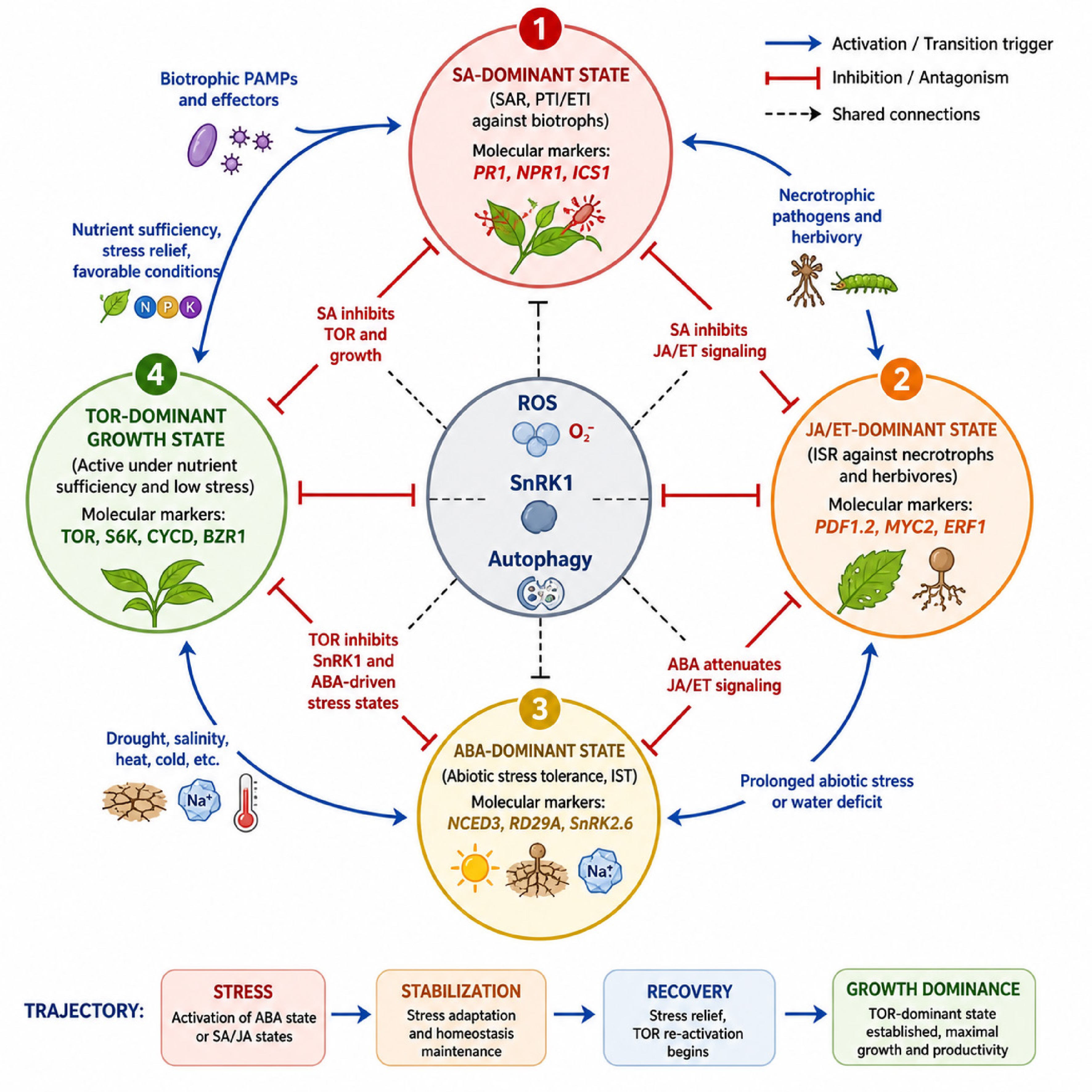
Figure 1.
The four-state multistable regulatory network of plant physiological states. A circular state diagram illustrating four interconnected and dynamically switching physiological attractor states in plants. (1) SA-dominant immune state (SAR; PTI/ETI against biotrophic pathogens) characterized by molecular markers PR1, NPR1, and ICS1, activated by biotrophic PAMPs and effector recognition. (2) JA/ET-dominant defense state (ISR against necrotrophs and herbivores) characterized by PDF1.2, MYC2, and ERF1, induced by necrotrophic infection and wounding. (3) ABA-dominant abiotic stress tolerance state (IST) marked by NCED3, RD29A, and SnRK2.6, activated under drought, salinity, and heat stress conditions. (4) TOR-dominant growth state, characterized by TOR, S6K, CYCD, and BZR1, prevailing under nutrient sufficiency and optimal environmental conditions. Transitions between states are indicated by directed arrows representing environmental and endogenous triggers, including pathogen-associated molecular patterns (PAMPs) inducing SA activation, drought and salinity triggering ABA signaling, and nutrient repletion promoting TOR-mediated growth recovery. Antagonistic regulatory interactions are depicted using blunt-ended inhibitory arrows, including SA–JA/ET antagonism, ABA-mediated suppression of SA signaling, and TOR-mediated inhibition of SnRK1- and stress-associated pathways. The overall system follows a dynamic trajectory of Stress → Stabilization → Recovery → Growth Dominance, passing through stress-adaptive states (ABA or SA/JA/ET) and returning to TOR-controlled growth under favorable conditions. A central regulatory hub integrates ROS signaling, SnRK1 energy sensing, and autophagy, acting as a shared coordination node across all four states. The inhibitory JA → TOR interaction is included based on available evidence, although the underlying molecular mechanism requires further clarification in primary studies[13].
-
The transition from a stress-dominant state to the growth-dominant state is not direct but proceeds through two intermediate phases that are frequently overlooked in both experimental models and agronomic practice: stabilization and recovery. The stabilization phase begins when the primary stress signal reaches or passes its peak intensity, and the plant has committed to a defensive configuration[9]. During this phase, the primary objective is not yet growth resumption but the normalization of cellular damage parameters: restoration of ROS/nitric oxide (NO) homeostasis within signaling ranges, maintenance of cell turgor and membrane integrity, stabilization of the energy charge (ATP/AMP ratio), and attenuation of potentially toxic secondary stress consequences such as ion accumulation under salinity or oxidative damage accumulation during drought[8,25].
Hormonally, the stabilization phase is characterized by sustained but declining ABA activity (ensuring continued water conservation and osmotic protection), initial attenuation of SA and JA/ET signaling (reducing the energetic cost of immune maintenance), and the gradual restoration of basal cytokinin and auxin levels that are necessary for meristematic competence[9,26]. Epigenetically, the stabilization phase is associated with the establishment of stress memory marks—particularly H3K4me3 activating modifications on previously stress-induced genes—that do not themselves reactivate immune programs but position the chromatin for faster re-activation should stress recur[15,27]. Autophagic activity remains elevated during stabilization, fulfilling its dual role of removing stress-damaged cellular components and recycling nitrogen and carbon for post-stress anabolic needs[28].
From an agronomic standpoint, the stabilization phase represents a period of particular vulnerability: the plant is metabolically committed to defensive reconfiguration and cannot efficiently utilize exogenously applied growth-promoting inputs regardless of their concentration. Application of nitrogen fertilizers, growth regulators, or TOR-stimulating biostimulants during stabilization may conflict with the plant's internal regulatory logic and yield unpredictable outcomes[11,12]. This helps explain the well-documented high variability in biostimulant efficacy across seasons and environments and underscores the practical value of state awareness in agronomic decision-making[12].
The recovery phase: re-engagement of growth programs
-
The recovery phase is initiated when cellular stress parameters normalize sufficiently to permit partial re-activation of TOR signaling. This transition is driven by multiple converging signals: the restoration of photosynthate supply to non-photosynthetic tissues (detected via T6P accumulation); the normalization of ABA concentrations (through CYP707A-mediated catabolism as water potential recovers); the restoration of nitrogen and mineral nutrient availability (sensed through TOR's interaction with RAG GTPase-like complexes); and the re-establishment of redox homeostasis that removes the SnRK1-activating signal from elevated AMP/ATP ratios[20,21,29].
During recovery, TOR activity progressively increases while SnRK1 is reciprocally suppressed. Ribosome biogenesis and mRNA translation, which were reduced during stress, are progressively restored. Cell cycle progression, arrested at the G1/S checkpoint under stress, resumes as CDK–CYCLIN complexes are reactivated by declining DELLA protein levels and increasing GA concentrations[30,31]. Autophagy, still active during early recovery to remove residual stress-damaged components, is progressively attenuated as TOR activity rises and inhibits the ATG1/ATG13 autophagy initiation complex[28].
The rate and completeness of recovery depends critically on prior stress memory: plants that have experienced previous stress cycles recover faster and with lower threshold stimuli, due to the epigenetic priming established during prior stabilization phases[15,16]. This metabolic and epigenetic stress memory—manifested as faster stomatal re-opening, earlier TOR reactivation, and pre-positioned chromatin marks on growth genes—represents a form of systemic adaptive plasticity that has direct agronomic significance[15]. Importantly, the recovery phase is the appropriate window for the application of TOR-stimulating biostimulants, growth regulators, and nitrogen-rich fertilizers: only at this point is the plant's internal regulatory network positioned to productively channel these inputs into yield-relevant growth processes[9,11] (Fig. 2).
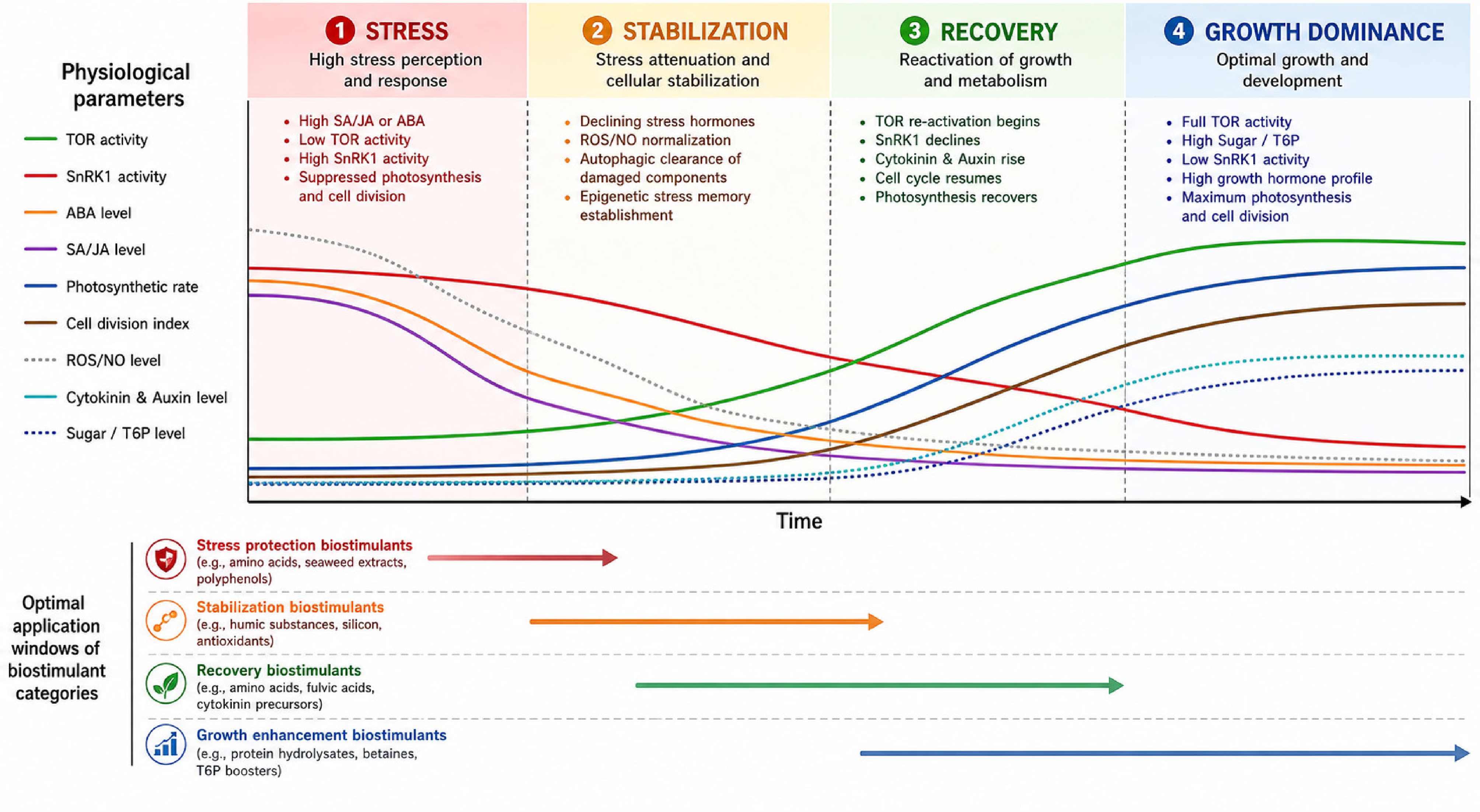
Figure 2.
The Stress–Stabilization–Recovery–Growth Dominance trajectory. A time-axis schematic illustrating the dynamic transition of key physiological and signaling parameters in plants, including TOR kinase activity, SnRK1 activity, ABA and SA/JA hormone levels, photosynthetic rate, and cell division index, across four sequential adaptive phases. During phase 1 (Stress), elevated ABA and SA/JA levels coincide with high SnRK1 activity, suppressed TOR signaling, and reduced photosynthesis and cell proliferation. Phase 2 (Stabilization) is characterized by a gradual decline in stress hormones, normalization of ROS/NO balance, activation of autophagic clearance of damaged cellular components, and establishment of epigenetic stress memory. In phase 3 (Recovery), TOR signaling is progressively reactivated, SnRK1 activity declines, and increasing cytokinin and auxin levels drive resumption of the cell cycle and recovery of photosynthetic capacity. Phase 4 (Growth Dominance) represents a fully re-established anabolic state with maximal TOR activity, elevated sugar/T6P signaling, suppressed SnRK1, high growth-promoting hormone levels, and peak photosynthetic and mitotic activity. Vertical color-coded bands denote each phase, while colored arrows beneath the time axis indicate optimal application windows for different classes of biostimulants aligned with physiological state transitions.
-
The growth-dominant state can be operationally defined as a putative stable physiological regulatory configuration characterized by the following concurrent features: (1) high TOR kinase activity, maintained by adequate supplies of glucose, sucrose, amino acids, and light; (2) active TOR-mediated protein synthesis, ribosome biogenesis, and organelle proliferation; (3) suppression of SnRK1 and autophagic programs; (4) predominance of growth-promoting hormones—AUX, GA, BR, and CK—over stress-associated hormones ABA, SA, and JA/ET; (5) high cell cycle activity in meristematic zones; (6) stable or enhanced photosynthetic assimilation; and (7) basal, controlled ROS and NO levels functioning as growth-regulatory signals rather than stress mediators[9,13,20,32].
Critically, the growth-dominant state is not a 'defenseless' configuration. Rather, it represents an energy-optimized adaptation strategy in which basal immunity is maintained at a functional but low-intensity background level—sufficient for sensing potential threats and priming rapid defensive transitions but insufficient to incur the metabolic costs of full immune activation[3,9].
TOR as the master regulator of growth dominance
-
The TOR kinase is the central molecular node that drives and sustains the growth-dominant state[32,33]. TOR is a conserved serine/threonine kinase that, as the catalytic subunit of the TORC1 complex (with regulatory partners RAPTOR and LST8), phosphorylates S6K1/2 (stimulating ribosome biogenesis and mRNA translation), E2F transcription factors (promoting cell cycle gene expression), and multiple other effectors involved in autophagy suppression, organelle biogenesis, and metabolic enzyme regulation[32]. In plants, TOR is activated by photosynthesis-derived sugars (detected via hexokinase and T6P), by amino acids (particularly glutamine and asparagine), by light (through a photomorphogenic signaling branch), and by growth-promoting hormones including BR and AUX[20,33,34].
The relationship between TOR and SnRK1 is generally described as antagonistic, and this constitutes a proposed core molecular switch of the growth–stress transition[13,14]. However, the precise mechanism is not universal and requires a nuanced description. SnRK1 (the plant ortholog of yeast SNF1 and mammalian AMPK) is activated by declining energy status (elevated AMP/ATP ratio), by biotic and abiotic stress signals, and by ABA[14,29]. Active SnRK1 phosphorylates and inhibits key anabolic enzymes (sucrose phosphate synthase, nitrate reductase, HMG-CoA reductase) and activates the ATG1/ATG13 autophagy initiation complex[13,14]. It is well established that SnRK1 can phosphorylate RAPTOR to suppress TORC1 activity in certain contexts[14]. Whether TOR directly phosphorylates and inhibits SnRK1 catalytic subunits (KIN10/KIN11) in all plant tissues and developmental stages is not universally established and may be species-, tissue-, and context-dependent. The bidirectional antagonism between TOR and SnRK1, while strongly supported by genetic and biochemical evidence in specific systems (primarily Arabidopsis thaliana), should therefore be described as a context-dependent regulatory module rather than a universal bistable switch[13,14]. This mutual tendency toward antagonism means that the TOR–SnRK1 system functions as a putative molecular switch in which perturbations in energy or nutrient availability can promote transitions between growth-dominant and stress-dominant configurations—the precise dynamics depending on tissue, developmental stage, and experimental conditions[13,14].
T6P occupies a uniquely important position in this regulatory circuit as a proxy of sucrose status that has been shown in certain contexts to inhibit SnRK1 activity[21]. However, the T6P–SnRK1 inhibitory relationship, while well-documented in some tissues and developmental stages, should not be presented as universal; its molecular mechanism and extent of generalizability remain under investigation[21,35]. T6P therefore acts as a proposed carbohydrate sufficiency signal that may prevent premature entry into catabolic stress programs during periods of high photosynthetic productivity[21,35].
Molecular and metabolic markers of the growth-dominant state
-
At the molecular level, growth dominance is characterized by: reduced expression of PR genes and elevated transcription of cell cycle genes (CYCD, CDKA/B); activation of BZR1/BES1 (brassinosteroid response), ARF (auxin response), PIF4 (phytochrome-interacting), and GRF (growth-regulating factor) transcription factors; DELLA protein degradation mediated by gibberellin-dependent ubiquitin ligase complexes; active S6K1/2 phosphorylation as a read-out of TOR activity; and chromatin accessibility marks (H3K4me3, H3K9ac) at growth gene promoters[30,33,36]. At the metabolic level, growth dominance is characterized by elevated sugars (sucrose, glucose, T6P), amino acids (particularly glutamine and asparagine), ATP, and NADPH; by high anabolic flux toward protein, nucleotide, and lipid biosynthesis; and by controlled, low-level ROS maintained by antioxidant systems (CAT, APX, GR)[32,37] (Fig. 3).
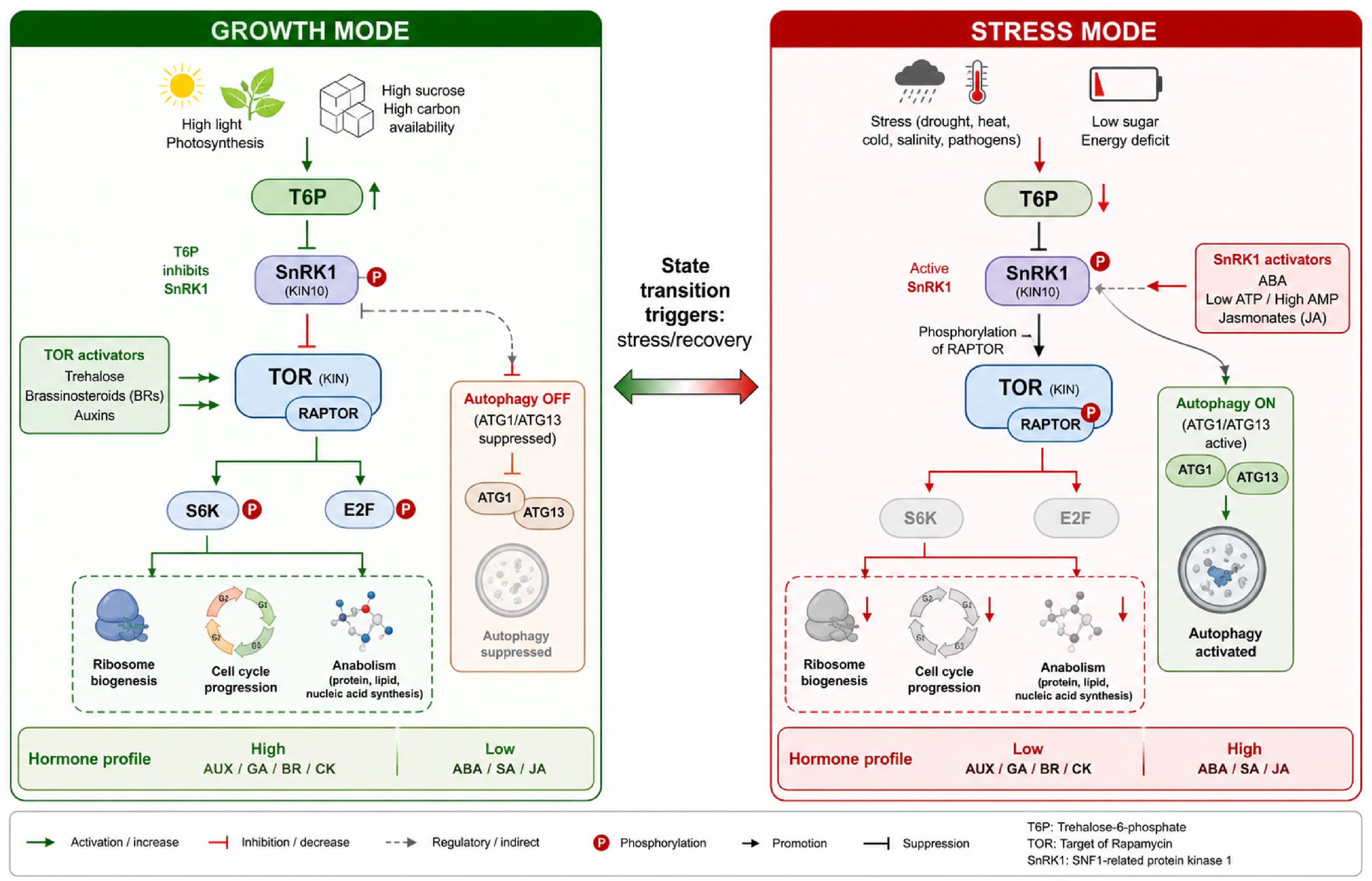
Figure 3.
TOR–SnRK1–T6P molecular switch regulating growth and stress adaptation in plants. Schematic two-panel representation of the metabolic and signaling switch between growth and stress modes. Left panel (growth mode): Under conditions of high sucrose availability and light input, trehalose-6-phosphate (T6P) accumulates, leading to inhibition of SnRK1 and activation of TOR kinase. Activated TOR promotes phosphorylation of S6K and E2F, thereby stimulating ribosome biogenesis, cell cycle progression, and anabolic metabolism. Autophagy is suppressed through inhibition of the ATG1/ATG13 complex. Hormonal profile is characterized by elevated auxins (AUX), gibberellins (GA), brassinosteroids (BR), and cytokinins (CK), with reduced abscisic acid (ABA), salicylic acid (SA), and jasmonic acid (JA). Right panel (stress mode): Under low sugar/energy availability or environmental stress, T6P levels decrease, resulting in activation of SnRK1 and repression of TOR signaling via RAPTOR phosphorylation. Downstream targets S6K and E2F are inactive, leading to suppression of growth-related processes. Autophagy is activated through ATG1/ATG13 complex induction. Hormonal balance shifts toward elevated ABA, SA, and JA, while growth-promoting hormones are reduced. A central bidirectional arrow indicates reversible state transitions driven by 'stress–recovery signals'. Positive regulatory inputs to TOR include trehalose signaling, BR, and AUX, whereas SnRK1 activation is promoted by ABA, low ATP/AMP ratio, and jasmonates. All major molecular components and signaling nodes are explicitly labeled.
Growth-promoting hormones: AUX, GA, BR, CK
-
AUX (primarily indole-3-acetic acid, IAA) are the primary drivers of cell elongation and organogenesis in the growth-dominant state. At the molecular level, auxin-dependent activation of auxin response factors (ARFs), through proteasomal degradation of Aux/IAA repressors, stimulates expansin and xyloglucan endotransglucosylase/hydrolase (XTH) gene expression, directly promoting cell wall loosening and elongation[36,38]. Auxin signaling antagonizes SA-dependent immunity through suppression of NPR1 activity and stabilization of AUX/IAA proteins that compete with JAZ repressor degradation, thereby reducing the energy available for immune gene expression[3,38]. Pathogen effectors frequently target the auxin pathway precisely because of its immunosuppressive function, highlighting the evolutionary significance of this connection[6].
GA sustain growth dominance by promoting the GID1-mediated proteasomal degradation of DELLA proteins—universal growth repressors that also function as positive regulators of JA/ET-dependent immune programs and as negative regulators of BR signaling[30,39]. Declining DELLA levels during growth dominance simultaneously relieve growth inhibition and attenuate JA/ET-mediated defense, creating a GA-dependent link between growth and immune suppression[30]. This places DELLA proteins at a regulatory node connecting multiple hormonal axes and makes them attractive targets for biotechnological manipulation of the growth–defense balance[30,39].
BR contribute to growth dominance through BZR1/BES1-mediated transcriptional activation of cell elongation genes[40,41]. However, the relationship between BR signaling and immunity is dose-, tissue-, and context-dependent and should not be presented as uniformly antagonistic to immune responses. BR can both stimulate and suppress SA-, JA-, and ET-mediated immune reactions depending on pathogen lifestyle, developmental stage, and concentration[40,41]. Low BR doses have been reported to enhance basal defense responses in some systems, while higher concentrations tend to favor growth dominance and can suppress SA/JA-dependent immunity through TOR activation and NPR1–TGA pathway interference[40]. BR signaling interacts with TOR through the BRI1–BSK1 pathway, and BR application has been shown to enhance TOR activity under moderate stress, partly preserving growth capacity[41]. A more complete account of BR in immunity can be found in Nolan et al.[41].
CK, produced primarily in root meristems and exported to shoots, stimulate ARR-mediated cell cycle gene activation, sustain meristematic activity, and are associated with enhanced TOR signaling, potentially through mechanisms that may involve stimulation of sugar transport and carbon partitioning toward growth tissues[42]. CK signaling also antagonizes ABA-mediated growth suppression, thereby reinforcing the growth-dominant state during mild water deficit[42].
Stress hormones and their antagonistic interactions with growth signals
-
SA and the growth-promoting hormonal network engage in extensive bidirectional antagonism. SA suppresses auxin signaling through multiple mechanisms: induction of auxin-degrading GH3 enzymes, suppression of auxin biosynthesis genes, and interference with ARF transcriptional activity[22,38]. Reciprocally, AUX can suppress SA-mediated PR gene expression by promoting TGA transcription factor interactions that inhibit NPR1 activity[38]. The net functional consequence is that high SA concentrations enforce an immune-dominant configuration incompatible with full growth activation, while high auxin levels reduce SA responsiveness and facilitate growth dominance[22].
Jasmonic acid/ethylene (JA/ET) crosstalk with growth hormones is equally complex and exhibits context-dependent directionality. The COI1–JAZ–MYC2 module stabilizes JAZ proteins under low JA conditions, allowing growth gene expression through MYC2-independent transcription factors. Under high JA, JAZ degradation releases MYC2 for defense gene activation while simultaneously restricting growth through JAZ-dependent interactions with growth transcription factors[7,23]. GA promote JAZ protein stability in some contexts by preventing DELLA-dependent JAZ stabilization, creating a GA–JA regulatory crosstalk that directly links growth and defense through DELLA[30,39]. ABA occupies a biphasic position: moderate concentrations can support root growth and basal stress tolerance without strongly activating SnRK1, while high ABA concentrations fully engage the ABA-dominant regulatory configuration and suppress TOR through SnRK1-dependent and SnRK1-independent mechanisms[8,29].
A particularly important integrative node is represented by the interaction between BR and the SA pathway. As noted above, this interaction is bidirectional and concentration-dependent; BR can both enhance and suppress SA-mediated immunity depending on cellular context and developmental stage[40]. This property makes BR potentially valuable as biostimulants that can calibrate the growth–immunity balance without completely foreclosing either option[9,11,41].
ROS and NO as universal state messengers
-
ROS and NO are not merely downstream effectors of hormonal signaling but function as universal secondary messengers that integrate information across all regulatory states[37,43]. Their concentration and subcellular distribution function as state indicators: basal, controlled ROS promote growth-associated MAPK cascade activation and calcium wave propagation in growing meristems; elevated ROS trigger immune activation, hypersensitive responses, and programmed cell death[37,43].
NO interacts closely with ROS to modulate the ABA, TOR, and immune signaling networks through protein S-nitrosylation: S-nitrosylation of RBOHD limits ROS production via negative feedback; S-nitrosylation of NPR1 activates SA-mediated defense[43,44]. Regarding the proposed S-nitrosylation-mediated suppression of TOR, there is limited direct experimental evidence for this mechanism in plants. Lindermayr[44] reports S-nitrosylation of various signaling proteins and its regulatory role in plant immunity, but direct evidence for TOR complex inhibition via S-nitrosylation remains preliminary. This claim is therefore explicitly flagged as a working hypothesis requiring further experimental validation[44]. The authors note that if this claim cannot be supported by additional primary evidence, it should be understood as speculative.
The ROS–NO system therefore functions as a rapid, post-translational signaling layer that complements the slower, transcription-dependent hormonal network in state determination. Importantly, the ROS–NO balance at any given cellular location is influenced by the microbiome: mycorrhizal colonization and PGPR inoculation shift basal ROS homeostasis, affecting the sensitivity threshold for stress-state entry[17,45] (Fig. 4).
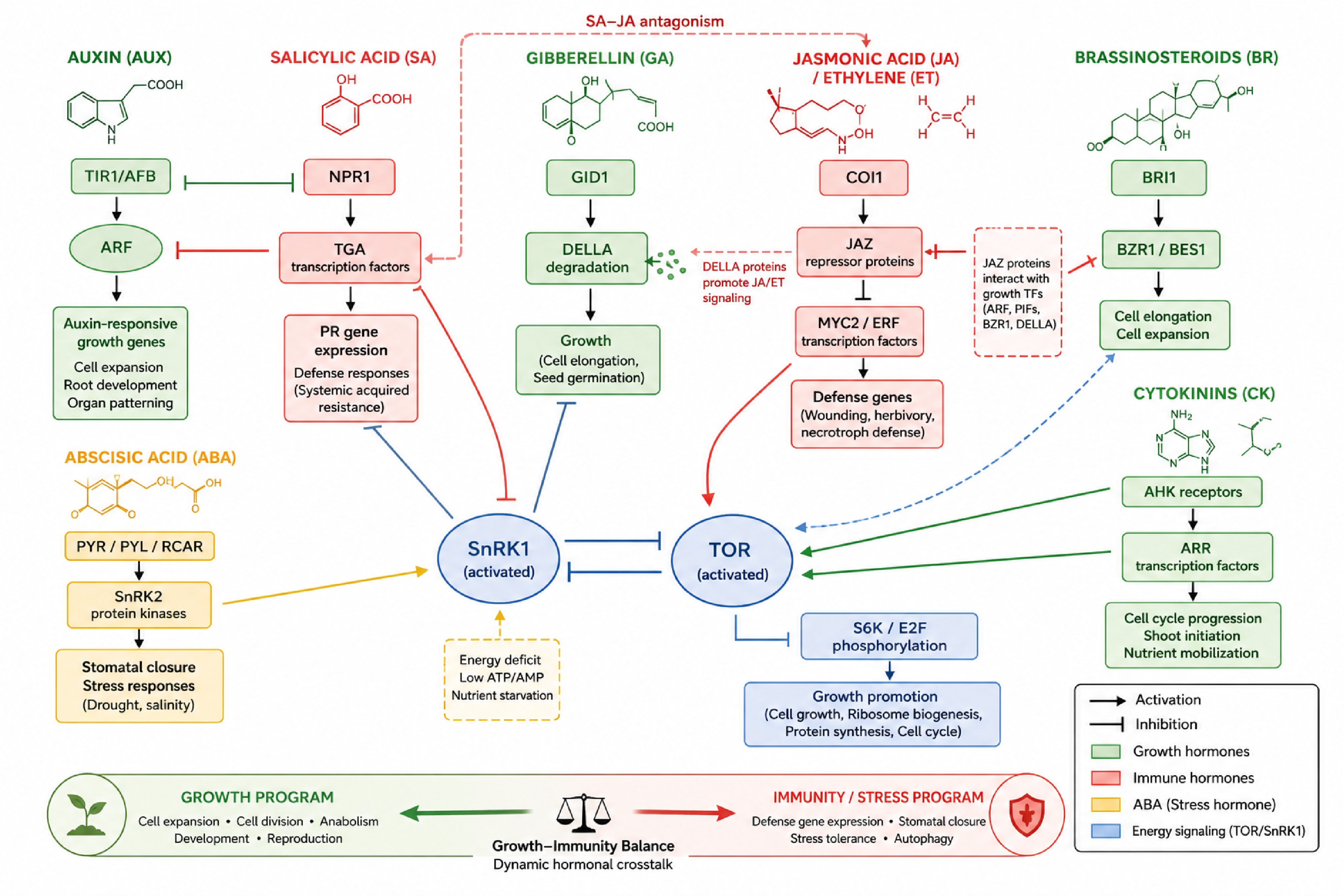
Figure 4.
The hormonal crosstalk network governing the growth–immunity balance. Schematic network illustrating major phytohormonal interactions within the SA–JA/ET–ABA–TOR/SnRK1 regulatory framework that integrates plant growth, development, and immune responses. Key regulatory modules include: (1) salicylic acid (SA) signaling via NPR1/TGA leading to PR gene expression; (2) auxins (AUX) signaling through ARF promoting growth-related gene expression, with mutual antagonism where SA suppresses ARF activity and AUX suppresses NPR1-mediated immune signaling; (3) gibberellins (GA) perception via GID1 resulting in DELLA protein degradation and growth promotion, while DELLA proteins also enhance JA/ET signaling; (4) jasmonic acid/ethylene (JA/ET) signaling via COI1–JAZ–MYC2 regulating defense gene expression, with JAZ proteins interfacing with growth-related transcription factors; (5) brassinosteroids (BR) signaling via BRI1–BZR1 promoting cell elongation and TOR activation; (6) cytokinins (CK) signaling via AHK–ARR supporting cell cycle progression and TOR-mediated growth regulation; (7) abscisic acid (ABA) signaling via PYR/PYL–SnRK2 regulating stomatal closure and activating SnRK1 under stress conditions; (8) central energy signaling through TOR promoting growth via S6K/E2F, while SnRK1 mediates stress responses and antagonistically suppresses TOR activity. Interactions are depicted with directional arrows indicating activation and blunt-ended lines indicating inhibition. Hormonal groups are color-coded as follows: growth-promoting hormones (green), immune/stress-related hormones (red/orange), ABA signaling (yellow), and central energy regulators TOR/SnRK1 (blue).
-
The growth–immunity trade-off is increasingly recognized not as an absolute biochemical constraint imposed by resource limitation, but as a dynamically regulated property of the plant's signaling network[3,5,13]. Several lines of evidence support this reinterpretation. First, the trade-off depth varies substantially with developmental stage: young seedlings and rapidly growing tissues tend to show stronger growth–defense antagonism than mature, slower-growing tissues, partly because the resource demands of growth are highest in actively dividing cells[1,46]. Second, the directional specificity of the trade-off depends on which stress hormones are dominant: SA-dominant states impose stronger growth penalties than JA/ET-dominant states, partly because SA more directly interferes with auxin signaling than JA/ET does[22,38].
Third, and most importantly from a systems perspective, TOR kinase functions as an adjustable rheostat that modulates the depth of the trade-off by determining the threshold at which immune programs are activated[13,24]. Partial TOR activity—neither maximally activated nor fully suppressed—allows simultaneous maintenance of moderate growth and a primed immune state, corresponding to an intermediate physiological configuration between the extremes of the growth-immune network[13,24]. This regulatory flexibility suggests that engineering plants with optimized TOR activity profiles—high enough to support productivity, but sensitive enough to allow rapid immune transitions when needed—could generate crops that maintain both yield potential and stress resilience[13,46].
Empirical evidence for dynamic trade-off management in natural plant populations is provided by the wide variation in growth–defense allocation phenotypes observed across ecotypes and populations, which reflect adaptation to local stress regimes rather than any single optimal growth–defense balance[5,46]. Field-grown crops, which experience multiple overlapping stresses simultaneously, exhibit trade-off dynamics that are difficult to predict from single-stress laboratory experiments, emphasizing the need for integrative, whole-season physiological monitoring approaches in agricultural research[12,46].
-
Current biostimulant science is characterized by a fundamental conceptual limitation: most biostimulants are developed and evaluated based on demonstrable effects on plant growth parameters (shoot biomass, root length, yield) under standardized conditions, without systematic consideration of the plant's physiological state at the time of application[11,12,47]. This reflects an implicit assumption—borrowed from conventional fertilizer logic—that the plant is a passive system in which increased nutrient or hormone inputs translate directly into increased output, regardless of internal regulatory status. Modern plant physiology, as reviewed in preceding sections, demonstrates that this assumption is incorrect: the efficiency with which external inputs are translated into growth depends critically on whether TOR signaling is permissive for anabolic programs[9,11].
The consequences of this conceptual limitation are apparent in the field: biostimulant effects are notoriously variable across seasons, locations, and application timings, with coefficients of variation frequently exceeding 30%–50% between trials[12,47]. This variability is, at least partly, attributable to the mismatch between application timing and the plant's actual physiological state[9,11].
A mechanistically informed biostimulant typology
-
Rather than classifying biostimulants by their chemical identity or biological origin, a mechanistically grounded typology classifies them by the regulatory state they engage or facilitate[9,11]. This yields four principal categories. First, state-priming biostimulants sensitize the plant to incoming stress signals, primarily by activating SA- or JA/ET-dependent priming pathways; this category includes beta-glucans, chitosan, salicylate analogs, and some PGPR inoculants[17,48]. Second, stabilization biostimulants support the plant during active stress-dominant configurations by enhancing antioxidant capacity (ascorbate, GSH precursors, melatonin), osmoprotection (glycine betaine, trehalose analogs), and ROS/NO homeostasis; these are most appropriately applied at peak stress[49,50].
Third, recovery-phase biostimulants facilitate TOR re-activation and growth resumption following stress relief; this category includes trehalose (acting through T6P to suppress SnRK1), polyamines (spermidine stimulates autophagy clearance of stress-damaged components while also promoting growth), nitrogen-rich amino acid hydrolysates, and biostimulants that normalize cytokinin and auxin levels[47,51]. Fourth, growth-dominant state amplifiers prolong or deepen TOR-dependent growth through brassinosteroid analogs, synthetic cytokinin formulations, or microbiome-modulating consortia that sustain root zone nutrient availability[41,52]. This state-based typology does not imply that single biostimulants cannot fulfill multiple functions—many complex formulations (e.g., seaweed extracts, protein hydrolysates) contain diverse bioactive components that act at multiple regulatory nodes—but it provides a rational framework for matching product design and application timing to plant physiological needs[47,53].
-
The integrated understanding developed in preceding sections supports the articulation of a novel applied paradigm that we propose to term Regulatory Agronomy (the concept of Immune-metabolic crop management). Rather than managing crops through the calendar-based application of pre-specified inputs (fertilizers, pesticides, biostimulants, water), Regulatory Agronomy aims to manage the physiological state of the crop—specifically, to guide it along the adaptive trajectory of Stress–Stabilization–Recovery–Growth Dominance in a temporally precise manner that maximizes productive output and minimizes resource waste[9,11]. The fundamental shift is from input management to state management.
The conceptual foundations of Regulatory Agronomy rest on three pillars. First, state diagnosis: the ability to assess the plant's current physiological state from observable indicators—visual markers of stress, canopy senescence patterns, stomatal dynamics, leaf temperature differentials (correlating with transpiration and ABA status), and ideally molecular markers accessible through rapid diagnostic tools[9,54,55]. Second, transition prediction: knowledge of the factors that determine the timing and rate of state transitions, including stress duration and intensity, metabolic recovery capacity, and microbiome-mediated buffering[19,45]. Third, targeted intervention: the application of state-appropriate products and practices at the physiological window where they are most effectively utilized, based on the state-based biostimulant typology outlined in Section 'Rethinking biostimulants: from empirical inputs to state-targeted interventions'[9,11].
Several important practical challenges of implementing Regulatory Agronomy in field conditions must be acknowledged explicitly. (1) State transitions, particularly between stabilization and recovery, are difficult to diagnose from a single physiological indicator; multi-parameter approaches (e.g., canopy temperature, Normalized Difference Vegetation Index [NDVI], stomatal conductance, hormone proxy assays) are likely necessary. (2) Different crop species, developmental stages, stress types, and growing environments may require different diagnostic criteria and transition thresholds. (3) In field conditions, multiple stresses (drought, heat, pathogen attack, nutrient deficiency) can occur simultaneously or in rapid succession; the Regulatory Agronomy framework must account for such overlapping dynamics. (4) Canopy- or population-level diagnostics must account for spatial heterogeneity within fields (soil type, microclimate, plant growth stage). (5) The residual effects, degradation rates, and metabolic persistence of previously applied biostimulants must be considered before recommending additional interventions to avoid over-management. These limitations are discussed further in Section 'Limitations and critical assessment'.
The two-phase agronomic strategy
-
A practical implementation of Regulatory Agronomy for stress management is the two-phase technology strategy: stabilization followed by recovery. During the stabilization phase, agronomic interventions focus on supporting the plant through the stress-dominant configuration: applications that normalize ROS/NO balance (ascorbate, polyphenols), maintain cell turgor (osmoprotectant precursors, potassium), moderate ion toxicity under salinity (Si, zeolite-based amendments), and sustain systemic signaling capacity[25,49]. These interventions do not attempt to suppress the stress-dominant state but rather prevent the metabolic collapse that would compromise the plant's ability to recover subsequently[9,25].
During the recovery phase, the agronomic strategy shifts to facilitating and accelerating TOR re-activation: applications of T6P analogs or trehalose (SnRK1 suppression), optimized nitrogen delivery (TOR activation through amino acid sensing), cytokinin formulations (meristem reactivation), and root microbiome enrichment with recovery-phase PGPR (TOR/auxin/cytokinin pathway stimulation)[17,51]. The timing precision required by this two-phase approach is challenging under current agronomic practice but is increasingly feasible with the development of precision agriculture technologies, including canopy temperature monitoring, satellite-based stress detection, and digital crop models that incorporate physiological state variables[55] (Fig. 5).
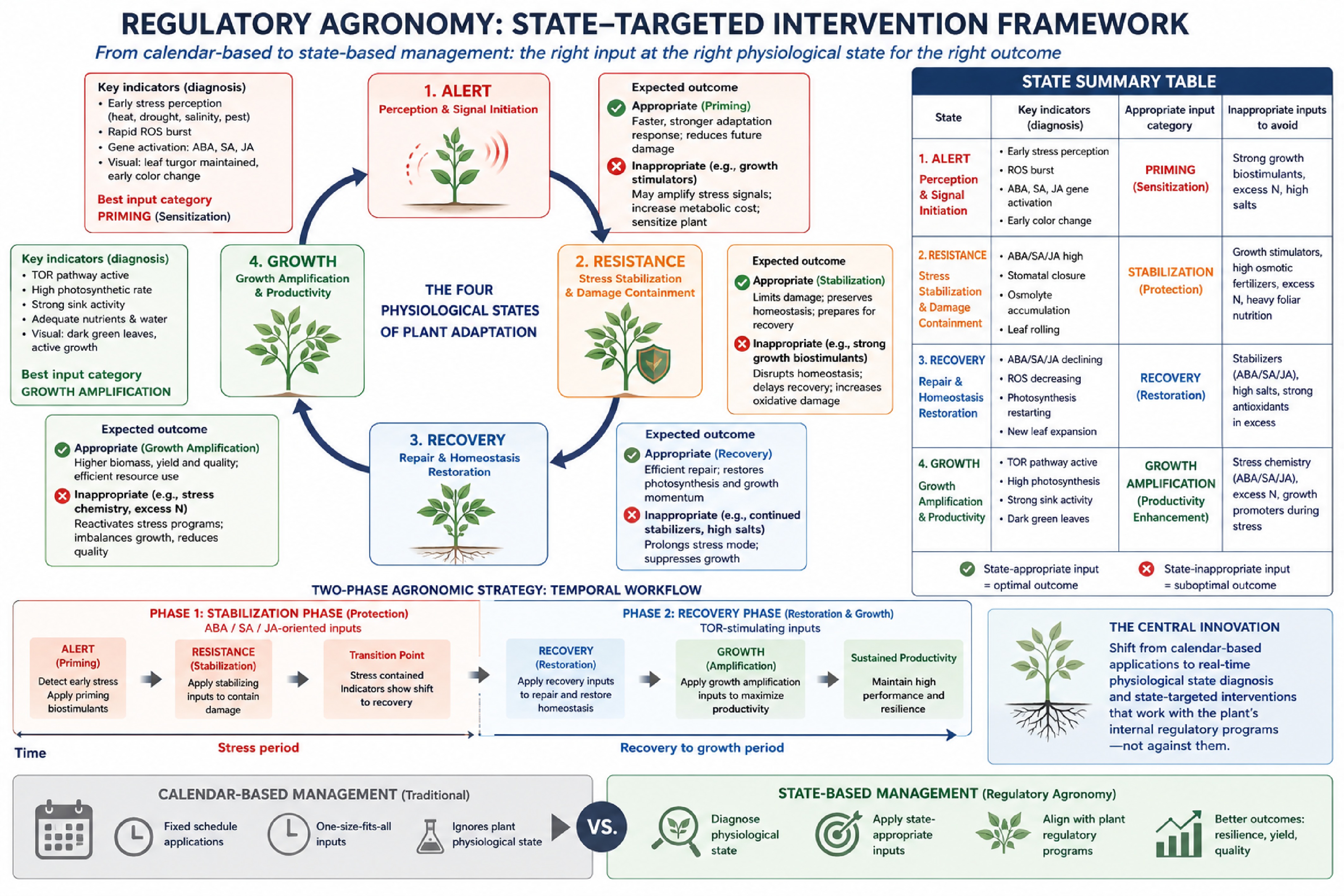
Figure 5.
Regulatory Agronomy (the concept of immune–metabolic crop management): a state-targeted intervention framework. Schematic representation of the Regulatory Agronomy decision-making framework based on state-dependent physiological diagnostics and targeted biostimulant application. The central cycle illustrates four plant physiological states: alert, resistance, recovery, and growth; each associated with characteristic diagnostic indicators, recommended input categories (priming, stabilization, recovery, or growth amplification), and the predicted outcomes of state-appropriate vs inappropriate interventions. The lower panel presents a two-phase agronomic workflow, including a stabilization phase supported by ABA/SA/JA-oriented inputs and a recovery phase supported by TOR-stimulating inputs. The framework highlights the transition from conventional calendar-based management to dynamic, state-based agronomic decision-making as the core innovation of Regulatory Agronomy (Immune–metabolic crop management).
Implications for crop breeding and biotechnology
-
Regulatory Agronomy also has implications for crop breeding and biotechnology priorities. From a long-term crop improvement perspective, identification and optimization of beneficial allelic variants or regulatory configurations at key nodes such as TOR, SnRK1, and DELLA may be more sustainable than reliance on frequent field application of exogenous biostimulants. Such a genomics-based approach would build resilience into the crop genome rather than requiring repeated external interventions. Genetic traits that enhance the efficiency of state transitions—faster TOR re-activation after stress resolution, improved epigenetic memory for growth-state priming, and optimized T6P sensing for SnRK1 suppression—could yield cultivars with enhanced agronomic responsiveness to state-targeted management[9,46]. CRISPR/Cas9-mediated engineering of DELLA proteins to reduce growth inhibition under moderate stress, or modification of TOR complex components to calibrate their sensitivity to nutrient signals, represents a biotechnologically tractable approach to improving growth-dominant state depth and recovery speed[46].
Furthermore, the integration of AI-based design approaches, synthetic biology, and multi-omics-guided genomic selection represents promising directions for engineering crops with optimized TOR–SnRK1 balance profiles tailored to specific agroecological environments. Genomic selection for favorable alleles at TOR, SnRK1, DELLA, and ARF loci using large multi-environment trial datasets could accelerate the development of environmentally responsive crop varieties without requiring an understanding of every individual molecular interaction[46].
-
The integrative framework presented here builds directly on classical plant immunity models while extending them in two important directions. First, by explicitly conceptualizing the TOR-dependent growth-dominant state as an equivalent member of the plant's hypothetically multistable regulatory repertoire—alongside SA-, JA/ET-, and ABA-dominant states—it corrects the implicit asymmetry of existing models that describe defense states in molecular detail while treating growth as a default 'non-stressed' condition[3,9]. Second, by introducing the trajectory concept (Stress–Stabilization–Recovery–Growth Dominance) as the relevant operational unit for agronomic management, it transforms the growth–immunity trade-off from a passive evolutionary constraint into an actionable regulatory target.
The proposed framework converges with and extends several important prior contributions. The recognition of TOR and SnRK1 as central growth–defense modulators, established by pioneering work from several groups, provides the molecular foundation of our model[13,14,32]. The concept of putative multistability in plant signaling networks, although mathematically under-formalized, is consistent with systems biology analyses of hormone network topology[19]. The recognition that biostimulant efficacy is state-dependent is supported by meta-analyses of biostimulant trials showing systematic variation with environmental conditions and application timing[12,47]. The novel synthesis offered here lies in the integration of these elements into a coherent framework with explicit agronomic applications.
Limitations and critical assessment
-
Several important limitations of the proposed framework must be acknowledged. First, the evidence base for strict multistability—discrete attractors with mathematically defined basin boundaries and bifurcation dynamics—in plant hormonal networks is primarily qualitative and inferred from genetic experiments rather than from quantitative dynamical modeling. Rigorous testing of the multistability hypothesis requires time-resolved, single-cell resolution measurement of hormone concentrations and kinase activities across state transitions[19,56]. Second, most mechanistic evidence is derived from the model organism Arabidopsis thaliana under controlled laboratory conditions. The generalizability of the SA–JA/ET–ABA–TOR conceptual framework to polyploid crop species (wheat, canola, cotton) under fluctuating multi-stress field conditions remains to be systematically established[46,56,57]. Third, the Regulatory Agronomy concept, while conceptually compelling, currently lacks the diagnostic tools and management algorithms needed for practical implementation at scale[55].
Fourth, the TOR–SnRK1 relationship as described throughout this manuscript is based primarily on work in Arabidopsis thaliana and selected crop species[58−61]. The universality of the mutual phosphorylation mechanism, and of T6P as a SnRK1 inhibitor, should be understood as context-dependent until validated across diverse species, tissue types, and environmental conditions[14,62]. Fifth, the field implementation challenges of Regulatory Agronomy—including multi-stress diagnosis, spatial heterogeneity, biostimulant residual effects, and the difficulty of determining individual transition thresholds in real-time—are substantial and require dedicated experimental and engineering solutions before the framework can be considered operationally ready.
The quantitative projections for yield gains from state-targeted biostimulant application are based on reasoning from first principles and carry substantial uncertainty; they should be interpreted as indicative estimates rather than validated forecasts and require empirical validation in multi-location, multi-year field trials across diverse crop–stress combinations[11].
Alternative models and points of divergence
-
Alternative conceptual models of the growth–defense relationship deserve consideration. The 'optimal allocation theory' framework models the trade-off as a resource optimization problem in which the plant continuously adjusts investment in growth vs defense according to marginal benefit-cost analysis, without requiring discrete attractor states[1,46]. This model has strong empirical support for explaining intraspecific variation in growth–defense allocation across ecotypes and populations[46]. The putative multistable network framework proposed here is not strictly incompatible with optimal allocation theory—attractor states may represent energetically optimal configurations given particular environmental parameter combinations—but the emphasis on discrete states and discontinuous transitions differs from the continuous optimization perspective.
The 'immunity ontogeny' model proposes that age-related changes in plant immune capacity are a primary driver of the observed growth–defense transition[9,56]. While this developmental perspective is not emphasized in the present framework, it is important to recognize that the TOR–SnRK1 balance, hormone levels, and stress sensitivity all change substantially during plant ontogeny, and a complete model of plant state regulation must integrate developmental context. Future work should explicitly incorporate developmental stage as a modulator of proposed attractor accessibility and transition kinetics.
-
The growth-dominant state emerges from this synthesis as a biologically coherent and agronomically significant physiological configuration that deserves explicit recognition alongside the established immune-dominant and stress-tolerant states in plant physiology. Defined by TOR kinase activation, the predominance of AUX/GA/BR/CK hormonal profiles, SnRK1 suppression, metabolic anabolism, and high cell cycle activity, the growth-dominant state constitutes one of four conceptually proposed interacting regulatory configurations in the plant's SA–JA/ET–ABA–TOR regulatory network. The trajectory Stress–Stabilization–Recovery–Growth Dominance represents the relevant operational sequence for both plant physiology and agronomic management, with each phase characterized by distinct hormonal profiles, molecular marker sets, and productivities in response to external inputs.
The TOR–SnRK1 regulatory module, modulated by T6P, ABA, and growth-promoting hormones, functions as a proposed central molecular switch governing state transitions. This relationship is context-dependent—its precise mechanism may vary with species, tissue, and developmental stage—and should be understood as a working model requiring continued experimental refinement across diverse biological systems[13,14,62,63]. The reframing of biostimulants as state-targeted interventions, classified by the regulatory state they engage rather than by their chemical composition, offers a rational basis for improving the consistency and efficacy of biostimulant applications in agricultural practice.
Several research priorities emerge from this framework. First, the development of rapid, field-deployable diagnostic tools for plant physiological state assessment—potentially including hormone ratio biosensors, canopy-level TOR activity proxies, and transcriptomic state classifiers—is urgently needed to enable state-aware crop management. Second, multi-location, multi-season field trials are required to validate the state-dependent efficacy of biostimulant applications. Third, systems biology approaches—including quantitative dynamical modeling of the TOR–SnRK1–hormone network calibrated against time-series multi-omics data—are needed to rigorously test the hypothetical multistability model and predict state transition dynamics. Fourth, crop breeding programs should incorporate state-transition efficiency as an explicit selection criterion through genomic selection for favorable alleles at TOR, SnRK1, DELLA, and ARF loci. Fifth, integration of AI-assisted crop modeling, satellite-based physiological state monitoring, and synthetic biology approaches for engineering crop genomes represents a forward-looking direction aligned with next-generation precision agriculture[64−66].
This research did not receive any specific grant from funding agencies in the public, commercial, or not-for-profit sectors.
-
During the preparation of this work, the authors used NotebookLM and Claude (Anthropic) (version/period of use: 2025–2026) for language editing, grammar checking, stylistic refinement, and limited assistance with the annotation of Figs 1−5. The authors reviewed and edited all content generated with the assistance of these tools, verified its accuracy, and assume full responsibility for the accuracy, integrity, and originality of the final manuscript. This work represents the authors' own intellectual contribution, and no artificial intelligence tool is credited as an author.
-
Claude (Anthropic) was used exclusively for grammar checking, stylistic editing, and English-language text formulation. All scientific content, analyses, interpretations, and conclusions were independently developed, verified, and fully approved by the authors.
-
The authors confirm their contributions to the paper as follows: study conception and design: Khablak SH, Bondareva LM; literature analysis and critical evaluation: Khablak SH, Bondareva LM, Abdullaieva YA, Spychak VM; writing − original draft: Khablak SH; writing − review and editing: Abdullaieva YA, Spychak VM; scientific supervision: Khablak SH. All authors reviewed the results and approved the final version of the manuscript.
-
Data sharing is not applicable to this article as no datasets were generated or analyzed during the current study.
-
The authors declare no conflict of interest.
- Copyright: © 2026 by the author(s). Published by Maximum Academic Press on behalf of Chongqing University. This article is an open access article distributed under Creative Commons Attribution License (CC BY 4.0), visit https://creativecommons.org/licenses/by/4.0/.
-
About this article
Cite this article
Khablak SH, Bondareva LM, Abdullaieva YA, Spychak VM. 2026. From stress to growth dominance: hormonal switches, energy sensing, and the concept of Regulatory Agronomy in plants. Plant Hormones 2: e017 doi: 10.48130/ph-0026-0016 

From stress to growth dominance: hormonal switches, energy sensing, and the concept of Regulatory Agronomy in plants
- Received: 02 May 2026
- Revised: 03 June 2026
- Accepted: 09 June 2026
- Published online: 14 July 2026
Abstract: Plants face a fundamental allocation trade-off between growth and defense. Classical models centered on salicylic acid (SA), jasmonic acid/ethylene (JA/ET), and abscisic acid (ABA) accurately describe stress responses but do not fully explain the regulatory logic of the opposing growth-dominant state. Here, we propose that the growth-dominant state, maintained by Target of Rapamycin (TOR) signaling and associated hormones (auxins, gibberellins, brassinosteroids, and cytokinins), represents a distinct and putative stable physiological regulatory configuration within a hypothetically multistable plant regulatory network. We synthesize current knowledge on hormonal and metabolic mechanisms underlying this state, the molecular switches governing transitions along the trajectory Stress–Stabilization–Recovery–Growth Dominance, and their interaction with immune-dominant configurations. Evidence suggests that the growth–immunity trade-off is not fixed but dynamically regulated by the TOR–SnRK1 energy-sensing module, epigenetic memory, and systemic signaling, including root–microbiome interactions. Based on this framework, we introduce Regulatory Agronomy (Immune-metabolic crop management) as a conceptual approach that shifts crop management from empirical input application to targeted regulation of plant physiological states. This perspective provides a mechanistic basis for next-generation biostimulants and precision agriculture strategies aimed at optimizing productivity and stress resilience.
-
Key words:
- Growth-dominant state /
- TOR kinase /
- SnRK1