








Search
2025 Volume 1
Article Contents
INVITED REVIEW   Open Access    

Harnessing RNA molecules for therapy: advances in design, delivery, and clinical development

  • #Authors contributed equally: Jiahui Zou, Xiaoke He, Zimin Li

More Information
  • Received: 22 September 2025
    Revised: 02 November 2025
    Accepted: 06 November 2025
    Published online: 19 November 2025
    Targetome  1(1) Article number: e005 (2025)  |  Cite this article
  • RNA-based therapeutics have emerged as attractive candidates for clinical applications, offering distinct advantages over conventional small-molecule drugs, which play an important role in the treatment of a variety of diseases. Through specific and rational design, exogenous coding/noncoding RNA therapeutics, including messenger RNA (mRNA), small interfering RNA (siRNA), RNA aptamers, microRNA (miRNA), antisense oligonucleotides (ASOs), short activating RNA (saRNA), RNA aptamers, circular RNA (circRNA), and CRISPR-based therapeutics are increasingly used to modulate the process of diseases at the genetic level. However, insufficient cellular delivery, RNA instability, and complex in vivo biological barriers significantly limit the therapeutic efficacy of RNA therapeutics. Numerous delivery strategies (e.g., nanotechnology, material-based carriers, and structural modification) have been used to overcome these key issues. In this review, the ongoing development and latest advances in RNA therapeutics are thoroughly summarized, focusing on therapeutic mechanisms, delivery challenges, and emerging drug delivery strategies. In particular, the clinical applications and current challenges in translating RNA therapeutics are discussed, highlighting future directions and opportunities to improve clinical efficacy.
  • 加载中
  • [1] Crooke ST, Witztum JL, Bennett CF, Baker BF. 2018. RNA-targeted therapeutics. Cell Metabolism 27:714−39 doi: 10.1016/j.cmet.2018.03.004

    CrossRef   Google Scholar

    [2] Wang S, Weissman D, Dong Y. 2025. RNA chemistry and therapeutics. Nature Reviews Drug Discovery 24:828−851 doi: 10.1038/s41573-025-01237-x

    CrossRef   Google Scholar

    [3] Zhu Y, Zhu L, Wang X, Jin H. 2022. RNA-based therapeutics: an overview and prospectus. Cell Death & Disease 13:644 doi: 10.1038/s41419-022-05075-2

    CrossRef   Google Scholar

    [4] Khorkova O, Stahl J, Joji A, Volmar CH, Wahlestedt C. 2023. Amplifying gene expression with RNA-targeted therapeutics. Nature Reviews Drug Discovery 22:539−561 doi: 10.1038/s41573-023-00704-7

    CrossRef   Google Scholar

    [5] Amine IM, Salsabil H, Fadil B, Adnane B, Khaoula E. 2025. The impact of ncRNAs on type 2 diabetes: a comprehensive review covering molecular mechanisms to clinical applications. Molecular Therapy Nucleic Acids 36:102629 doi: 10.1016/j.omtn.2025.102629

    CrossRef   Google Scholar

    [6] He X, Li G, Huang L, Shi H, Zhong S, et al. 2025. Nonviral targeted mRNA delivery: principles, progresses, and challenges. MedComm 6:e70035 doi: 10.1002/mco2.70035

    CrossRef   Google Scholar

    [7] Li T, Liu X, Qian H, Zhang S, Hou Y, et al. 2024. Blocker-SELEX: a structure-guided strategy for developing inhibitory aptamers disrupting undruggable transcription factor interactions. Nature Communications 15:6751 doi: 10.1038/s41467-024-51197-w

    CrossRef   Google Scholar

    [8] Cooper TA, Wan L, Dreyfuss G. 2009. RNA and disease. Cell 136:777−793 doi: 10.1016/j.cell.2009.02.011

    CrossRef   Google Scholar

    [9] Dowdy SF. 2017. Overcoming cellular barriers for RNA therapeutics. Nature Biotechnology 35:222−229 doi: 10.1038/nbt.3802

    CrossRef   Google Scholar

    [10] Paunovska K, Loughrey D, Dahlman JE. 2022. Drug delivery systems for RNA therapeutics. Nature Reviews Genetics 23:265−280 doi: 10.1038/s41576-021-00439-4

    CrossRef   Google Scholar

    [11] Haussecker D. 2014. Current issues of RNAi therapeutics delivery and development. Journal of Controlled Release 195:49−54 doi: 10.1016/j.jconrel.2014.07.056

    CrossRef   Google Scholar

    [12] Dammes N, Peer D. 2020. Paving the road for RNA therapeutics. Trends in Pharmacological Sciences 41:755−775 doi: 10.1016/j.tips.2020.08.004

    CrossRef   Google Scholar

    [13] Shi Y, Zhen X, Zhang Y, Li Y, Koo S, et al. 2024. Chemically modified platforms for better RNA therapeutics. Chemical Reviews 124:929−1033 doi: 10.1021/acs.chemrev.3c00611

    CrossRef   Google Scholar

    [14] Jasinski D, Haque F, Binzel DW, Guo P. 2017. Advancement of the emerging field of RNA nanotechnology. ACS Nano 11:1142−1164 doi: 10.1021/acsnano.6b05737

    CrossRef   Google Scholar

    [15] Guo P. 2010. The emerging field of RNA nanotechnology. Nature Nanotechnology 5:833−842 doi: 10.1038/nnano.2010.231

    CrossRef   Google Scholar

    [16] Han X, Mitchell MJ, Nie G. 2020. Nanomaterials for therapeutic RNA delivery. Matter 3:1948−1975 doi: 10.1016/j.matt.2020.09.020

    CrossRef   Google Scholar

    [17] Qin S, Tang X, Chen Y, Chen K, Fan N, et al. 2022. mRNA-based therapeutics: powerful and versatile tools to combat diseases. Signal Transduction and Targeted Therapy 7:166 doi: 10.1038/s41392-022-01007-w

    CrossRef   Google Scholar

    [18] Wang J, Zhu H, Gan J, Liang G, Li L, et al. 2024. Engineered mRNA delivery systems for biomedical applications. Advanced Materials 36:2308029 doi: 10.1002/adma.202308029

    CrossRef   Google Scholar

    [19] Curreri A, Sankholkar D, Mitragotri S, Zhao Z. 2023. RNA therapeutics in the clinic. Bioengineering & Translational Medicine 8:e10374 doi: 10.1002/btm2.10374

    CrossRef   Google Scholar

    [20] Thomas SJ, Moreira ED Jr, Kitchin N, Absalon J, Gurtman A, et al. 2021. Safety and efficacy of the BNT162b2 mRNA covid-19 vaccine through 6 months. The New England Journal of Medicine 385:1761−1773 doi: 10.1056/NEJMoa2110345

    CrossRef   Google Scholar

    [21] Aimo A, Castiglione V, Rapezzi C, Franzini M, Panichella G, et al. 2022. RNA-targeting and gene editing therapies for transthyretin amyloidosis. Nature Reviews Cardiology 19:655−667 doi: 10.1038/s41569-022-00683-z

    CrossRef   Google Scholar

    [22] Tani H. 2024. Recent advances and prospects in RNA drug development. International Journal of Molecular Sciences 25:12284 doi: 10.3390/ijms252212284

    CrossRef   Google Scholar

    [23] Tang Q, Khvorova A. 2024. RNAi-based drug design: considerations and future directions. Nature Reviews Drug Discovery 23:341−364 doi: 10.1038/s41573-024-00912-9

    CrossRef   Google Scholar

    [24] Zhang Q, Yang L, Liu YH, Wilkinson JE, Krainer AR. 2023. Antisense oligonucleotide therapy for H3.3K27M diffuse midline glioma. Science Translational Medicine 15:eadd8280 doi: 10.1126/scitranslmed.add8280

    CrossRef   Google Scholar

    [25] Kang JY, Mun D, Chun Y, Park DS, Kim H, et al. 2023. Engineered small extracellular vesicle-mediated NOX4 siRNA delivery for targeted therapy of cardiac hypertrophy. Journal of Extracellular Vesicles 12:12371 doi: 10.1002/jev2.12371

    CrossRef   Google Scholar

    [26] Kilikevicius A, Meister G, Corey DR. 2022. Reexamining assumptions about miRNA-guided gene silencing. Nucleic Acids Research 50:617−634 doi: 10.1093/nar/gkab1256

    CrossRef   Google Scholar

    [27] Liu X, Zhang Y, Zhou S, Dain L, Mei L, et al. 2022. Circular RNA: an emerging frontier in RNA therapeutic targets, RNA therapeutics, and mRNA vaccines. Journal of Controlled Release 348:84−94 doi: 10.1016/j.jconrel.2022.05.043

    CrossRef   Google Scholar

    [28] Bicknell AA, Reid DW, Licata MC, Jones AK, Cheng YM, et al. 2024. Attenuating ribosome load improves protein output from mRNA by limiting translation-dependent mRNA decay. Cell Reports 43:114098 doi: 10.1016/j.celrep.2024.114098

    CrossRef   Google Scholar

    [29] Casmil IC, Friesen JJ, Bathula NV, Strumpel A, Ho CH, et al. 2025. Divergent delivery and expression kinetics of lipid and polymeric nanoparticles across mRNA modalities. Advanced Science 12:e08907 doi: 10.1002/advs.202508907

    CrossRef   Google Scholar

    [30] Yang H, Patel DJ. 2024. Structures, mechanisms and applications of RNA-centric CRISPR–Cas13. Nature Chemical Biology 20:673−688 doi: 10.1038/s41589-024-01593-6

    CrossRef   Google Scholar

    [31] Xu S, Xu Y, Solek NC, Chen J, Gong F, et al. 2024. Tumor-tailored ionizable lipid nanoparticles facilitate IL-12 circular RNA delivery for enhanced lung cancer immunotherapy. Advanced Materials 36:e2400307 doi: 10.1002/adma.202400307

    CrossRef   Google Scholar

    [32] de Voogt WS, Tanenbaum ME, Vader P. 2021. Illuminating RNA trafficking and functional delivery by extracellular vesicles. Advanced Drug Delivery Reviews 174:250−264 doi: 10.1016/j.addr.2021.04.017

    CrossRef   Google Scholar

    [33] Liu Y, Qi H, Zong J, Li M, Yang Y, et al. 2024. Oral piwi-interacting RNA delivery mediated by green tea-derived exosome-like nanovesicles for the treatment of aortic dissection. Advanced Healthcare Materials 13:e2401466 doi: 10.1002/adhm.202401466

    CrossRef   Google Scholar

    [34] Zhang Y, Shi Y, Khan MM, Xiao F, Chen W, et al. 2024. Ocular RNA nanomedicine: engineered delivery nanoplatforms in treating eye diseases. Trends in Biotechnology 42:1439−1452 doi: 10.1016/j.tibtech.2024.05.002

    CrossRef   Google Scholar

    [35] Kim J, Jozic A, Mukherjee A, Nelson D, Chiem K, et al. 2022. Rapid generation of circulating and mucosal decoy human ACE2 using mRNA nanotherapeutics for the potential treatment of SARS-CoV-2. Advanced Science 9:e2202556 doi: 10.1002/advs.202202556

    CrossRef   Google Scholar

    [36] Zheng L, Bandara SR, Tan Z, Leal C. 2023. Lipid nanoparticle topology regulates endosomal escape and delivery of RNA to the cytoplasm. Proceedings of the National Academy of Sciences of the United States of America 120:e2301067120 doi: 10.1073/pnas.2301067120

    CrossRef   Google Scholar

    [37] Spadea A, Jackman M, Cui L, Pereira S, Lawrence MJ, et al. 2022. Nucleic acid-loaded lipid nanoparticle interactions with model endosomal membranes. ACS Applied Materials & Interfaces 14:30371−30384 doi: 10.1021/acsami.2c06065

    CrossRef   Google Scholar

    [38] Kwak E, Kim T, Yang K, Kim YM, Han HS, et al. 2022. Surface-functionalized polymeric siRNA nanoparticles for tunable targeting and intracellular delivery to hematologic cancer cells. Biomacromolecules 23:2255−2263 doi: 10.1021/acs.biomac.1c01497

    CrossRef   Google Scholar

    [39] Han J, Sul JH, Lee J, Kim E, Kim HK, et al. 2024. Engineered exosomes with a photoinducible protein delivery system enable CRISPR-Cas–based epigenome editing in Alzheimer's disease. Science Translational Medicine 16:eadi4830 doi: 10.1126/scitranslmed.adi4830

    CrossRef   Google Scholar

    [40] Ali Zaidi SS, Fatima F, Ali Zaidi SA, Zhou D, Deng W, et al. 2023. Engineering siRNA therapeutics: challenges and strategies. Journal of Nanobiotechnology 21:381 doi: 10.1186/s12951-023-02147-z

    CrossRef   Google Scholar

    [41] Hoffmann T, Hörmann A, Corcokovic M, Zmajkovic J, Hinterndorfer M, et al. 2023. Precision RNAi using synthetic shRNAmir target sites. eLife 12:RP84792 doi: 10.7554/elife.84792

    CrossRef   Google Scholar

    [42] Iki T, Kawaguchi S, Kai T. 2023. miRNA/siRNA-directed pathway to produce noncoding piRNAs from endogenous protein-coding regions ensures Drosophila spermatogenesis. Science Advances 9:eadh0397 doi: 10.1126/sciadv.adh0397

    CrossRef   Google Scholar

    [43] Acharya D, Reis R, Volcic M, Liu G, Wang MK, et al. 2022. Actin cytoskeleton remodeling primes RIG-I-like receptor activation. Cell 185:3588−3602.e21 doi: 10.1016/j.cell.2022.08.011

    CrossRef   Google Scholar

    [44] Korwek Z, Czerkies M, Jaruszewicz-Błońska J, Prus W, Kosiuk I, et al. 2023. Nonself RNA rewires IFN-β signaling: a mathematical model of the innate immune response. Science Signaling 16:eabq1173 doi: 10.1126/scisignal.abq1173

    CrossRef   Google Scholar

    [45] Ma Y, Li S, Lin X, Chen Y. 2023. Bioinspired spatiotemporal management toward RNA therapies. ACS Nano 17:24539−24563 doi: 10.1021/acsnano.3c08219

    CrossRef   Google Scholar

    [46] Chow MYT, Qiu Y, Lam JKW. 2020. Inhaled RNA therapy: from promise to reality. Trends in Pharmacological Sciences 41:715−729 doi: 10.1016/j.tips.2020.08.002

    CrossRef   Google Scholar

    [47] Winkle M, El-Daly SM, Fabbri M, Calin GA. 2021. Noncoding RNA therapeutics—challenges and potential solutions. Nature Reviews Drug Discovery 20:629−651 doi: 10.1038/s41573-021-00219-z

    CrossRef   Google Scholar

    [48] Mancino C, Franke M, Greco A, Sontam T, McCulloch P, et al. 2025. RNA therapies for musculoskeletal conditions. Journal of Controlled Release 377:756−766 doi: 10.1016/j.jconrel.2024.11.057

    CrossRef   Google Scholar

    [49] Delaunay S, Helm M, Frye M. 2024. RNA modifications in physiology and disease: towards clinical applications. Nature Reviews Genetics 25:104−122 doi: 10.1038/s41576-023-00645-2

    CrossRef   Google Scholar

    [50] Rozners E. 2022. Chemical modifications of CRISPR RNAs to improve gene-editing activity and specificity. Journal of the American Chemical Society 144:12584−12594 doi: 10.1021/jacs.2c02633

    CrossRef   Google Scholar

    [51] Stewart JM. 2024. RNA nanotechnology on the horizon: self-assembly, chemical modifications, and functional applications. Current Opinion in Chemical Biology 81:102479 doi: 10.1016/j.cbpa.2024.102479

    CrossRef   Google Scholar

    [52] Tsuboi T, Hattori K, Ishimoto T, Imai K, Doke T, et al. 2025. In vivo efficacy and safety of systemically administered serinol nucleic acid-modified antisense oligonucleotides in mouse kidney. Molecular Therapy Nucleic Acids 36:102387 doi: 10.1016/j.omtn.2024.102387

    CrossRef   Google Scholar

    [53] Kim Y. 2023. Drug discovery perspectives of antisense oligonucleotides. Biomolecules & Therapeutics 31:241−252 doi: 10.4062/biomolther.2023.001

    CrossRef   Google Scholar

    [54] Keam SJ. 2022. Vutrisiran: first approval. Drugs 82:1419−1425 doi: 10.1007/s40265-022-01765-5

    CrossRef   Google Scholar

    [55] McKenzie LK, El-Khoury R, Thorpe JD, Damha MJ, Hollenstein M. 2021. Recent progress in non-native nucleic acid modifications. Chemical Society Reviews 50:5126−5164 doi: 10.1039/D0CS01430C

    CrossRef   Google Scholar

    [56] Crooke ST, Baker BF, Crooke RM, Liang XH. 2021. Antisense technology: an overview and prospectus. Nature Reviews Drug Discovery 20:427−453 doi: 10.1038/s41573-021-00162-z

    CrossRef   Google Scholar

    [57] Eckstein F. 1985. Nucleoside phosphorothioates. Annual Review of Biochemistry 54:367−402 doi: 10.1146/annurev.bi.54.070185.002055

    CrossRef   Google Scholar

    [58] Yang Q, Peng Y, Deng Z, Zhang D, Long CY, et al. 2023. Regulating the properties of XQ-2d for targeted delivery of therapeutic agents to pancreatic cancers. National Science Review 10:nwad113 doi: 10.1093/nsr/nwad113

    CrossRef   Google Scholar

    [59] Iwamoto N, Butler DCD, Svrzikapa N, Mohapatra S, Zlatev I, et al. 2017. Control of phosphorothioate stereochemistry substantially increases the efficacy of antisense oligonucleotides. Nature Biotechnology 35:845−851 doi: 10.1038/nbt.3948

    CrossRef   Google Scholar

    [60] Nikan M, Li Q, Tanowitz M, Li H, Damle S, et al. 2025. Single alkyl phosphonate modification of the siRNA backbone in the seed region enhances specificity and therapeutic profile. Nucleic Acids Research 53:gkaf692 doi: 10.1093/nar/gkaf692

    CrossRef   Google Scholar

    [61] Miroshnichenko SK, Patutina OA, Burakova EA, Chelobanov BP, Fokina AA, et al. 2019. Mesyl phosphoramidate antisense oligonucleotides as an alternative to phosphorothioates with improved biochemical and biological properties. Proceedings of the National Academy of Sciences of the United States of America 116:1229−1234 doi: 10.1073/pnas.1813376116

    CrossRef   Google Scholar

    [62] Liu W, Iwamoto N, Marappan S, Luu K, Tripathi S, et al. 2023. Impact of stereopure chimeric backbone chemistries on the potency and durability of gene silencing by RNA interference. Nucleic Acids Research 51:4126−4147 doi: 10.1093/nar/gkad268

    CrossRef   Google Scholar

    [63] Yao W, Han X, Ge M, Chen C, Xiao X, et al. 2020. N6-methyladenosine (m6A) methylation in ischemia-reperfusion injury. Cell Death & Disease 11:478 doi: 10.1038/s41419-020-2686-7

    CrossRef   Google Scholar

    [64] Liu J, Dou X, Chen C, Chen C, Liu C, et al. 2020. N6-methyladenosine of chromosome-associated regulatory RNA regulates chromatin state and transcription. Science 367:580−586 doi: 10.1126/science.aay6018

    CrossRef   Google Scholar

    [65] Zhu S, Wang JZ, Chen D, He YT, Meng N, et al. 2020. An oncopeptide regulates m6A recognition by the m6A reader IGF2BP1 and tumorigenesis. Nature Communications 11:1685 doi: 10.1038/s41467-020-15403-9

    CrossRef   Google Scholar

    [66] Wang JN, Wang F, Ke J, Li Z, Xu CH, et al. 2022. Inhibition of METTL3 attenuates renal injury and inflammation by alleviating TAB3 m6A modifications via IGF2BP2-dependent mechanisms. Science Translational Medicine 14:eabk2709 doi: 10.1126/scitranslmed.abk2709

    CrossRef   Google Scholar

    [67] Xiong X, Hou L, Park YP, Molinie B, Gregory RI, et al. 2021. Genetic drivers of m6A methylation in human brain, lung, heart and muscle. Nature Genetics 53:1156−1165 doi: 10.1038/s41588-021-00890-3

    CrossRef   Google Scholar

    [68] Tomikawa C. 2025. Pseudouridine modifications in transfer RNA and tRNA pseudouridine synthases. Journal of Molecular Biology 437:169183 doi: 10.1016/j.jmb.2025.169183

    CrossRef   Google Scholar

    [69] Luo N, Huang Q, Zhang M, Yi C. 2025. Functions and therapeutic applications of pseudouridylation. Nature Reviews Molecular Cell Biology 26:691−705 doi: 10.1038/s41580-025-00852-1

    CrossRef   Google Scholar

    [70] Kiss DJ, Oláh J, Tóth G, Varga M, Stirling A, et al. 2022. The structure-derived mechanism of box H/ACA pseudouridine synthase offers a plausible paradigm for programmable RNA editing. ACS Catalysis 12:2756−2769 doi: 10.1021/acscatal.1c04870

    CrossRef   Google Scholar

    [71] Verbeke R, Hogan MJ, Loré K, Pardi N. 2022. Innate immune mechanisms of mRNA vaccines. Immunity 55:1993−2005 doi: 10.1016/j.immuni.2022.10.014

    CrossRef   Google Scholar

    [72] Prokhorova D, Matveeva A, Zakabunin A, Ryabchenko A, Stepanov G. 2023. Influence of N1-methylpseudouridine in guide RNAs on CRISPR/Cas9 activity. International Journal of Molecular Sciences 24:17116 doi: 10.3390/ijms242317116

    CrossRef   Google Scholar

    [73] Chen TH, Potapov V, Dai N, Ong JL, Roy B. 2022. N1-methyl-pseudouridine is incorporated with higher fidelity than pseudouridine in synthetic RNAs. Scientific Reports 12:13017 doi: 10.1038/s41598-022-17249-1

    CrossRef   Google Scholar

    [74] Harcourt EM, Kietrys AM, Kool ET. 2017. Chemical and structural effects of base modifications in messenger RNA. Nature 541:339−346 doi: 10.1038/nature21351

    CrossRef   Google Scholar

    [75] Fang E, Liu X, Li M, Zhang Z, Song L, et al. 2022. Advances in COVID-19 mRNA vaccine development. Signal Transduction and Targeted Therapy 7:94 doi: 10.1038/s41392-022-00950-y

    CrossRef   Google Scholar

    [76] Ohno H, Akamine S, Mochizuki M, Hayashi K, Akichika S, et al. 2023. Versatile strategy using vaccinia virus-capping enzyme to synthesize functional 5' cap-modified mRNAs. Nucleic Acids Research 51:e34 doi: 10.1093/nar/gkad019

    CrossRef   Google Scholar

    [77] Walczak S, Nowicka A, Kubacka D, Fac K, Wanat P, et al. 2017. A novel route for preparing 5' cap mimics and capped RNAs: phosphate-modified cap analogues obtained via click chemistry. Chemical Science 8:260−267 doi: 10.1039/C6SC02437H

    CrossRef   Google Scholar

    [78] Xiao Y, Tang Z, Huang X, Chen W, Zhou J, et al. 2022. Emerging mRNA technologies: delivery strategies and biomedical applications. Chemical Society Reviews 51:3828−3845 doi: 10.1039/D1CS00617G

    CrossRef   Google Scholar

    [79] Chen H, Liu D, Guo J, Aditham A, Zhou Y, et al. 2025. Branched chemically modified poly(A) tails enhance the translation capacity of mRNA. Nature Biotechnology 43:194−203 doi: 10.1038/s41587-024-02174-7

    CrossRef   Google Scholar

    [80] Grandi C, Emmaneel M, Nelissen FHT, Roosenboom LWM, Petrova Y, et al. 2024. Decoupled degradation and translation enables noise modulation by poly(A) tails. Cell Systems 15:526−543.e7 doi: 10.1016/j.cels.2024.05.004

    CrossRef   Google Scholar

    [81] Lundstrom K. 2025. Self-amplifying RNA virus vectors for drug delivery. Expert Opinion on Drug Delivery 22:181−195 doi: 10.1080/17425247.2024.2445675

    CrossRef   Google Scholar

    [82] Wong B, Birtch R, Rezaei R, Jamieson T, Crupi MJF, et al. 2023. Optimal delivery of RNA interference by viral vectors for cancer therapy. Molecular Therapy 31:3127−3145 doi: 10.1016/j.ymthe.2023.09.012

    CrossRef   Google Scholar

    [83] Zhang L, Shi J, Zhu MH, Huang Y, Lu Q, et al. 2025. Liposomes-enabled cancer chemoimmunotherapy. Biomaterials 313:122801 doi: 10.1016/j.biomaterials.2024.122801

    CrossRef   Google Scholar

    [84] Filipczak N, Pan J, Yalamarty SSK, Torchilin VP. 2020. Recent advancements in liposome technology. Advanced Drug Delivery Reviews 156:4−22 doi: 10.1016/j.addr.2020.06.022

    CrossRef   Google Scholar

    [85] Shubhra QTH. 2024. Multi-compartment liposomes forge new paths in drug delivery. Advanced Drug Delivery Reviews 16:1578−1579 doi: 10.1038/s41557-024-01638-2

    CrossRef   Google Scholar

    [86] Wahane A, Waghmode A, Kapphahn A, Dhuri K, Gupta A, et al. 2020. Role of lipid-based and polymer-based non-viral vectors in nucleic acid delivery for next-generation gene therapy. Molecules 25:2866 doi: 10.3390/molecules25122866

    CrossRef   Google Scholar

    [87] Arber Raviv S, Alyan M, Egorov E, Zano A, Harush MY, et al. 2022. Lung targeted liposomes for treating ARDS. Journal of Controlled Release 346:421−433 doi: 10.1016/j.jconrel.2022.03.028

    CrossRef   Google Scholar

    [88] Li Y, Ji T, Torre M, Shao R, Zheng Y, et al. 2023. Aromatized liposomes for sustained drug delivery. Nature Communications 14:6659 doi: 10.1038/s41467-023-41946-8

    CrossRef   Google Scholar

    [89] Horejs C. 2021. From lipids to lipid nanoparticles to mRNA vaccines. Nature Reviews Materials 6:1075−1076 doi: 10.1038/s41578-021-00379-9

    CrossRef   Google Scholar

    [90] Couvreur P, Lepetre-Mouelhi S, Garbayo E, Blanco-Prieto MJ. 2023. Self-assembled lipid–prodrug nanoparticles. Nature Reviews Bioengineering 1:749−768 doi: 10.1038/s44222-023-00082-0

    CrossRef   Google Scholar

    [91] Cheng MHY, Zhang Y, Fox K, Leung J, Strong C, et al. 2025. Liposomal lipid nanoparticles for extrahepatic delivery of mRNA. Nature Communications 16:4135 doi: 10.1038/s41467-025-58523-w

    CrossRef   Google Scholar

    [92] Roces CB, Lou G, Jain N, Abraham S, Thomas A, et al. 2020. Manufacturing considerations for the development of lipid nanoparticles using microfluidics. Pharmaceutics 12:1095 doi: 10.3390/pharmaceutics12111095

    CrossRef   Google Scholar

    [93] Kim J, Jozić A, Bloom E, Jones B, Marra M, et al. 2024. Microfluidic platform enables shearless aerosolization of lipid nanoparticles for mRNA inhalation. ACS Nano 18:11335−11348 doi: 10.1021/acsnano.4c00768

    CrossRef   Google Scholar

    [94] Shui M, Chen Z, Chen Y, Yuan Q, Li H, et al. 2023. Engineering polyphenol-based carriers for nucleic acid delivery. Theranostics 13:3204−3223 doi: 10.7150/thno.81604

    CrossRef   Google Scholar

    [95] Jarzebska NT, Mellett M, Frei J, Kündig TM, Pascolo S. 2021. Protamine-based strategies for RNA transfection. Pharmaceutics 13:877 doi: 10.3390/pharmaceutics13060877

    CrossRef   Google Scholar

    [96] Chen Z, Hao W, Gao C, Zhou Y, Zhang C, et al. 2022. A polyphenol-assisted IL-10 mRNA delivery system for ulcerative colitis. Acta Pharmaceutica Sinica B 12:3367−3382 doi: 10.1016/j.apsb.2022.03.025

    CrossRef   Google Scholar

    [97] Shen W, Wang R, Fan Q, Li Y, Cheng Y. 2020. Natural polyphenol assisted delivery of single-strand oligonucleotides by cationic polymers. Gene Therapy 27:383−391 doi: 10.1038/s41434-020-0151-y

    CrossRef   Google Scholar

    [98] Chen J, Pan S, Zhou J, Lin Z, Qu Y, et al. 2022. Assembly of bioactive nanoparticles via metal-phenolic complexation. Advanced Materials 34:e2108624 doi: 10.1002/adma.202108624

    CrossRef   Google Scholar

    [99] Zhang Y, Hu Y, Tian H, Chen X. 2022. Opportunities and challenges for mRNA delivery nanoplatforms. The Journal of Physical Chemistry Letters 13:1314−1322 doi: 10.1021/acs.jpclett.1c03898

    CrossRef   Google Scholar

    [100] Wang D, Zhang P, Zhong QZ, Liu H, Yu Q, et al. 2025. Hydrogen bonding-driven adaptive coacervates as protocells. ACS Applied Materials & Interfaces 17:6095−6102 doi: 10.1021/acsami.4c20214

    CrossRef   Google Scholar

    [101] Gu Y, Chen J, Wang Z, Liu C, Wang T, et al. 2024. mRNA delivery enabled by metal–organic nanoparticles. Nature Communications 15:9664 doi: 10.1038/s41467-024-53969-w

    CrossRef   Google Scholar

    [102] Huang Y, Xiong X, Huang B, Luo X, Ke Q, et al. 2024. pH-responsive pathway-controlled layer-by-layer self-shedding nanoparticles for endothelial barrier repair and efficient tumor-targeted therapy. ACS Applied Nano Materials 7:14972−14983 doi: 10.1021/acsanm.4c01292

    CrossRef   Google Scholar

    [103] Takahashi Y, Takakura Y. 2023. Extracellular vesicle-based therapeutics: Extracellular vesicles as therapeutic targets and agents. Pharmacology & Therapeutics 242:108352 doi: 10.1016/j.pharmthera.2023.108352

    CrossRef   Google Scholar

    [104] Ma Y, Brocchini S, Williams GR. 2023. Extracellular vesicle-embedded materials. Journal of Controlled Release 361:280−296 doi: 10.1016/j.jconrel.2023.07.059

    CrossRef   Google Scholar

    [105] Cocozza F, Grisard E, Martin-Jaular L, Mathieu M, Théry C. 2020. SnapShot: extracellular vesicles. Cell 182:262−262.e1 doi: 10.1016/j.cell.2020.04.054

    CrossRef   Google Scholar

    [106] Mondal J, Pillarisetti S, Junnuthula V, Saha M, Hwang SR, et al. 2023. Hybrid exosomes, exosome-like nanovesicles and engineered exosomes for therapeutic applications. Journal of Controlled Release 353:1127−1149 doi: 10.1016/j.jconrel.2022.12.027

    CrossRef   Google Scholar

    [107] Witwer KW, Wolfram J. 2021. Extracellular vesicles versus synthetic nanoparticles for drug delivery. Nature Reviews Materials 6:103−106 doi: 10.1038/s41578-020-00277-6

    CrossRef   Google Scholar

    [108] Qiu M, Zou J, Yang Z, Yang D, Wang R, et al. 2024. Strategies for targeting peptide-modified exosomes and their applications in the lungs. International Journal of Nanomedicine 19:8175−8188 doi: 10.2147/IJN.S472038

    CrossRef   Google Scholar

    [109] Li Z, Zhou X, Gao X, Bai D, Dong Y, et al. 2020. Fusion protein engineered exosomes for targeted degradation of specific RNAs in lysosomes: a proof-of-concept study. Journal of Extracellular Vesicles 9:1816710 doi: 10.1080/20013078.2020.1816710

    CrossRef   Google Scholar

    [110] Ducrot C, Loiseau S, Wong C, Madec E, Volatron J, et al. 2023. Hybrid extracellular vesicles for drug delivery. Cancer Letters 558:216107 doi: 10.1016/j.canlet.2023.216107

    CrossRef   Google Scholar

    [111] Kandasamy G, Maity D. 2024. Inorganic nanocarriers for siRNA delivery for cancer treatments. Biomedical Materials 19:022001 doi: 10.1088/1748-605X/ad1baf

    CrossRef   Google Scholar

    [112] Graczyk A, Pawlowska R, Chworos A. 2021. Gold nanoparticles as carriers for functional RNA nanostructures. Bioconjugate Chemistry 32:1667−1674 doi: 10.1021/acs.bioconjchem.1c00211

    CrossRef   Google Scholar

    [113] Massich MD, Giljohann DA, Seferos DS, Ludlow LE, Horvath CM, et al. 2009. Regulating immune response using polyvalent nucleic Acid−Gold nanoparticle conjugates. Molecular Pharmaceutics 6:1934−1940 doi: 10.1021/mp900172m

    CrossRef   Google Scholar

    [114] Nair A, Chandrashekhar HR, Day CM, Garg S, Nayak Y, et al. 2024. Polymeric functionalization of mesoporous silica nanoparticles: biomedical insights. International Journal of Pharmaceutics 660:124314 doi: 10.1016/j.ijpharm.2024.124314

    CrossRef   Google Scholar

    [115] Kang MA, Fang J, Paragodaarachchi A, Kodama K, Yakobashvili D, et al. 2022. Magnetically induced brownian motion of iron oxide nanocages in alternating magnetic fields and their application for efficient siRNA Delivery. Nano Letters 22:8852−8859 doi: 10.1021/acs.nanolett.2c02691

    CrossRef   Google Scholar

    [116] Sakib S, Zou S. 2024. Attenuation of chronic inflammation in intestinal organoids with graphene oxide-mediated tumor necrosis factor-α_small interfering RNA delivery. Langmuir 40:3402−3413 doi: 10.1021/acs.langmuir.3c02741

    CrossRef   Google Scholar

    [117] Zhang J, Lang M, Zhou Y, Zhang Y. 2024. Predicting RNA structures and functions by artificial intelligence. Trends in Genetics 40:94−107 doi: 10.1016/j.tig.2023.10.001

    CrossRef   Google Scholar

    [118] Yazdani K, Jordan D, Yang M, Fullenkamp CR, Calabrese DR, et al. 2023. Machine learning informs RNA-binding chemical space. Angewandte Chemie 62:e202211358 doi: 10.1002/anie.202211358

    CrossRef   Google Scholar

    [119] Jumper J, Evans R, Pritzel A, Green T, Figurnov M, et al. 2021. Highly accurate protein structure prediction with AlphaFold. Nature 596:583−589 doi: 10.1038/s41586-021-03819-2

    CrossRef   Google Scholar

    [120] Wang Y, Parmar S, Schneekloth JS, Tiwary P. 2022. Interrogating RNA–small molecule interactions with structure probing and artificial intelligence-augmented molecular simulations. ACS Central Science 8:741−748 doi: 10.1021/acscentsci.2c00149

    CrossRef   Google Scholar

    [121] Wu T, He S, Liu J, Sun S, Liu K, et al. 2023. A brief overview of ChatGPT: the history, status quo and potential future development. IEEE/CAA Journal of Automatica Sinica 10:1122−1136 doi: 10.1109/JAS.2023.123618

    CrossRef   Google Scholar

    [122] Shen X, Hou Y, Wang X, Zhang C, Liu J, et al. 2025. A deep learning model for characterizing protein-RNA interactions from sequences at single-base resolution. Patterns 6:101150 doi: 10.1016/j.patter.2024.101150

    CrossRef   Google Scholar

    [123] Bae SH, Choi H, Lee J, Kang MH, Ahn SH, et al. 2025. Rational design of lipid nanoparticles for enhanced mRNA vaccine delivery via machine learning. Small 21:e2405618 doi: 10.1002/smll.202405618

    CrossRef   Google Scholar

    [124] Panda S, Eaton EJ, Muralikrishnan P, Stelljes EM, Seelig D, et al. 2025. Machine learning reveals amine type in polymer micelles determines mRNA binding, in vitro, and in vivo performance for lung-selective delivery. JACS Au 5:1845−1861 doi: 10.1021/jacsau.5c00084

    CrossRef   Google Scholar

    [125] Eugster R, Orsi M, Buttitta G, Serafini N, Tiboni M, et al. 2024. Leveraging machine learning to streamline the development of liposomal drug delivery systems. Journal of Controlled Release 376:1025−1038 doi: 10.1016/j.jconrel.2024.10.065

    CrossRef   Google Scholar

    [126] Li B, Raji IO, Gordon AGR, Sun L, Raimondo TM, et al. 2024. Accelerating ionizable lipid discovery for mRNA delivery using machine learning and combinatorial chemistry. Nature Materials 23:1002−1008 doi: 10.1038/s41563-024-01867-3

    CrossRef   Google Scholar

    [127] Sun T, Xia W, Shu J, Sang C, Feng M, et al. 2025. Advances and challenges in machine learning for RNA-small molecule interaction modeling: review. Journal of Chemical Theory and Computation 21:8615−8633 doi: 10.1021/acs.jctc.5c00973

    CrossRef   Google Scholar

    [128] Sparmann A, Vogel J. 2023. RNA-based medicine: from molecular mechanisms to therapy. The EMBO Journal 42:e114760 doi: 10.15252/embj.2023114760

    CrossRef   Google Scholar

    [129] Kimura M, Kothari S, Gohir W, Camargo JF, Husain S. 2023. microRNAs in infectious diseases: potential diagnostic biomarkers and therapeutic targets. Clinical Microbiology Reviews 36:e0001523 doi: 10.1128/cmr.00015-23

    CrossRef   Google Scholar

    [130] Rupaimoole R, Slack FJ. 2017. microRNA therapeutics: towards a new era for the management of cancer and other diseases. Nature Reviews Drug Discovery 16:203−222 doi: 10.1038/nrd.2016.246

    CrossRef   Google Scholar

    [131] Soroudi S, Jaafari MR, Arabi L. 2024. Lipid nanoparticle (LNP) mediated mRNA delivery in cardiovascular diseases: advances in genome editing and CAR T cell therapy. Journal of Controlled Release 372:113−140 doi: 10.1016/j.jconrel.2024.06.023

    CrossRef   Google Scholar

    [132] Plummer R, Sodergren MH, Hodgson R, Ryan BM, Raulf N, et al. 2025. TIMEPOINT, a phase 1 study combining MTL-CEBPA with pembrolizumab, supports the immunomodulatory effect of MTL-CEBPA in solid tumors. Cell Reports Medicine 6:102041 doi: 10.1016/j.xcrm.2025.102041

    CrossRef   Google Scholar

    [133] Sarker D, Plummer R, Meyer T, Sodergren MH, Basu B, et al. 2020. MTL-CEBPA, a small activating RNA therapeutic upregulating C/EBP-α, in patients with advanced liver cancer: a first-in-human, multicenter, open-label, phase I trial. Clinical Cancer Research 26:3936−3946 doi: 10.1158/1078-0432.CCR-20-0414

    CrossRef   Google Scholar

    [134] Gainor JF, Patel MR, Weber JS, Gutierrez M, Bauman JE, et al. 2024. T-cell responses to individualized neoantigen therapy mRNA-4157 (V940) alone or in combination with pembrolizumab in the phase 1 KEYNOTE-603 study. Cancer Discovery 14:2209−2223 doi: 10.1158/2159-8290.CD-24-0158

    CrossRef   Google Scholar

    [135] Weber JS, Carlino MS, Khattak A, Meniawy T, Ansstas G, et al. 2024. Individualised neoantigen therapy mRNA-4157 (V940) plus pembrolizumab versus pembrolizumab monotherapy in resected melanoma (KEYNOTE-942): a randomised, phase 2b study. The Lancet 403:632−644 doi: 10.1016/S0140-6736(23)02268-7

    CrossRef   Google Scholar

    [136] Lu M, Sullivan RJ, Chow J, Mehnert JM, Carlino MS, et al. 2025. Abstract 855: dynamics of T cell and T cell receptor following mRNA-4157 (V940) plus pembrolizumab or pembrolizumab alone in resected melanoma from the mRNA-4157-P201 (KEYNOTE-942) trial. Cancer Research 85:855 doi: 10.1158/1538-7445.AM2025-855

    CrossRef   Google Scholar

    [137] Sahin U, Oehm P, Derhovanessian E, Jabulowsky RA, Vormehr M, et al. 2020. An RNA vaccine drives immunity in checkpoint-inhibitor-treated melanoma. Nature 585:107−112 doi: 10.1038/s41586-020-2537-9

    CrossRef   Google Scholar

    [138] Kübler H, Scheel B, Gnad-Vogt U, Miller K, Schultze-Seemann W, et al. 2015. Self-adjuvanted mRNA vaccination in advanced prostate cancer patients: a first-in-man phase I/IIa study. Journal for Immunotherapy of Cancer 3:26 doi: 10.1186/s40425-015-0068-y

    CrossRef   Google Scholar

    [139] Lin YX, Wang Y, Blake S, Yu M, Mei L, et al. 2020. RNA nanotechnology-mediated cancer immunotherapy. Theranostics 10:281−299 doi: 10.7150/thno.35568

    CrossRef   Google Scholar

    [140] Raimondo TM, Reed K, Shi D, Langer R, Anderson DG. 2023. Delivering the next generation of cancer immunotherapies with RNA. Cell 186:1535−1540 doi: 10.1016/j.cell.2023.02.031

    CrossRef   Google Scholar

    [141] Zhang D, Tian J, Wang Y, Lu J. 2022. Evitar: designing anti-viral RNA therapies against future RNA viruses. Bioinformatics 38:2437−2443 doi: 10.1093/bioinformatics/btac144

    CrossRef   Google Scholar

    [142] The Lancet Infectious Diseases. 2020. COVID-19, a pandemic or not? The Lancet Infectious Diseases 20:383 doi: 10.1016/S1473-3099(20)30180-8

    CrossRef   Google Scholar

    [143] Wang Y, Zhang Z, Luo J, Han X, Wei Y, et al. 2021. mRNA vaccine: a potential therapeutic strategy. Molecular Cancer 20:33 doi: 10.1186/s12943-021-01311-z

    CrossRef   Google Scholar

    [144] Gupta A, Andresen JL, Manan RS, Langer R. 2021. Nucleic acid delivery for therapeutic applications. Advanced Drug Delivery Reviews 178:113834 doi: 10.1016/j.addr.2021.113834

    CrossRef   Google Scholar

    [145] Goswami J, Cardona JF, Hsu DC, Simorellis AK, Wilson L, et al. 2025. Safety and immunogenicity of mRNA-1345 RSV vaccine coadministered with an influenza or COVID-19 vaccine in adults aged 50 years or older: an observer-blinded, placebo-controlled, randomised, phase 3 trial. The Lancet Infectious Diseases 25:411−423 doi: 10.1016/S1473-3099(24)00589-9

    CrossRef   Google Scholar

    [146] Yuen MF, Locarnini S, Lim TH, Strasser SI, Sievert W, et al. 2022. Combination treatments including the small-interfering RNA JNJ-3989 induce rapid and sometimes prolonged viral responses in patients with CHB. Journal of Hepatology 77:1287−1298 doi: 10.1016/j.jhep.2022.07.010

    CrossRef   Google Scholar

    [147] Mak LY, Wooddell CI, Lenz O, Schluep T, Hamilton J, et al. 2025. Long-term hepatitis B surface antigen response after finite treatment of ARC-520 or JNJ-3989. Gut 74:440−450 doi: 10.1136/gutjnl-2024-333026

    CrossRef   Google Scholar

    [148] Buyo Lagares S, Picallo Vieito A, Grueiro Cao M, Pardal Iglesias M, Lagoa Pena A, et al. 2025. Neuropsychiatric symptoms in huntington's disease: a case report on manic and psychotic features Huntington's disease (HD). European Psychiatry 68:S239 doi: 10.1192/j.eurpsy.2025.534

    CrossRef   Google Scholar

    [149] McColgan P, Thobhani A, Boak L, Schobel SA, Nicotra A, et al. 2023. Tominersen in adults with manifest Huntington's disease. The New England Journal of Medicine 389:2203−2205 doi: 10.1056/NEJMc2300400

    CrossRef   Google Scholar

    [150] Mercuri E, Sumner CJ, Muntoni F, Darras BT, Finkel RS. 2022. Spinal muscular atrophy. Nature Reviews Disease Primers 8:52 doi: 10.1038/s41572-022-00380-8

    CrossRef   Google Scholar

    [151] Gowda V, Wraige E, Ong M, Atherton M, Majumdar A, et al. 2022. Real-world experience of gene therapy with onasemnogene-abeparvovec (Zolgensma®) for patients with SMA-type1 in UK. Journal of Neurology, Neurosurgery & Psychiatry 93:e2 doi: 10.1136/jnnp-2022-abn2.1

    CrossRef   Google Scholar

    [152] Strauss KA, Swoboda KJ, Farrar MA, McMillan HJ, Parsons J, et al. 2019. 15.33 AVXS-101 in presymptomatic spinal muscular atrophy (SMA). Journal of Neurology, Neurosurgery & Psychiatry 90:e7 doi: 10.1136/jnnp-2019-abn-2.20

    CrossRef   Google Scholar

    [153] Wang W, Zhao Z, Zhang Z, Wu Z, Zhang Y, et al. 2025. Delivery of small interfering RNA by hydrogen sulfide-releasing nanomotor for the treatment of Parkinson's disease. Journal of Controlled Release 377:648−660 doi: 10.1016/j.jconrel.2024.11.069

    CrossRef   Google Scholar

    [154] Wanionok NE, Morel GR, Fernández JM. 2024. Osteoporosis and Alzheimer's disease (or Alzheimer's disease and Osteoporosis). Ageing Research Reviews 99:102408 doi: 10.1016/j.arr.2024.102408

    CrossRef   Google Scholar

    [155] Bashir B, Pasha R, Kamath A, Wang J, Malik RA, et al. 2025. Neurodegeneration in familial chylomicronemia syndrome. Journal of Clinical Lipidology 19:1119−1128 doi: 10.1016/j.jacl.2025.05.023

    CrossRef   Google Scholar

    [156] Paik J, Duggan S. 2019. Volanesorsen: first global approval. Drugs 79:1349−1354 doi: 10.1007/s40265-019-01168-z

    CrossRef   Google Scholar

    [157] Scott LJ, Keam SJ. 2021. Lumasiran: first approval. Drugs 81:277−282 doi: 10.1007/s40265-020-01463-0

    CrossRef   Google Scholar

    [158] Syed YY. 2023. Nedosiran: first approval. Drugs 83:1729−1733 doi: 10.1007/s40265-023-01976-4

    CrossRef   Google Scholar

    [159] Hair P, Cameron F, McKeage K. 2013. Mipomersen sodium: first global approval. Drugs 73:487−493 doi: 10.1007/s40265-013-0042-2

    CrossRef   Google Scholar

    [160] Migliorati JM, Jin J, Zhong XB. 2022. siRNA drug Leqvio (inclisiran) to lower cholesterol. Trends in Pharmacological Sciences 43:455−456 doi: 10.1016/j.tips.2022.02.003

    CrossRef   Google Scholar

    [161] Clark VC, Strange C, Strnad P, Sanchez AJ, Kwo P, et al. 2024. Fazirsiran for adults with alpha-1 antitrypsin deficiency liver disease: a phase 2 placebo controlled trial (SEQUOIA). Gastroenterology 167:1008−1018.e5 doi: 10.1053/j.gastro.2024.06.028

    CrossRef   Google Scholar

    [162] Strnad P, Mandorfer M, Choudhury G, Griffiths W, Trautwein C, et al. 2022. Fazirsiran for liver disease associated with alpha1-antitrypsin deficiency. The New England Journal of Medicine 387:514−524 doi: 10.1056/NEJMoa2205416

    CrossRef   Google Scholar

    [163] Ray K. 2022. Fazirsiran shows promise for liver disease in AAT. Nature Reviews Gastroenterology & Hepatology 19:556 doi: 10.1038/s41575-022-00668-w

    CrossRef   Google Scholar

    [164] Koeberl D, Schulze A, Sondheimer N, Lipshutz GS, Geberhiwot T, et al. 2024. Interim analyses of a first-in-human phase 1/2 mRNA trial for propionic acidaemia. Nature 628:872−877 doi: 10.1038/s41586-024-07266-7

    CrossRef   Google Scholar

    [165] Blom DJ, Marais AD, Moodley R, van der Merwe N, van Tonder A, et al. 2022. RNA-based therapy in the management of lipid disorders: a review. Lipids in Health and Disease 21:41 doi: 10.1186/s12944-022-01649-3

    CrossRef   Google Scholar

    [166] Hastings ML, Krainer AR. 2023. RNA therapeutics. RNA 29:393−895 doi: 10.1261/rna.079626.123

    CrossRef   Google Scholar

    [167] Gauvreau GM, Pageau R, Séguin R, Carballo D, Gauthier J, et al. 2011. Dose-response effects of TPI ASM8 in asthmatics after allergen: dose response of TPI ASM8 in allergic asthmatics. Allergy 66:1242−1248 doi: 10.1111/j.1398-9995.2011.02638.x

    CrossRef   Google Scholar

    [168] Gauvreau GM, Boulet LP, Cockcroft DW, Baatjes A, Cote J, et al. 2008. Antisense therapy against CCR3 and the common beta chain attenuates allergen-induced eosinophilic responses. American Journal of Respiratory and Critical Care Medicine 177:952−958 doi: 10.1164/rccm.200708-1251OC

    CrossRef   Google Scholar

    [169] Adams D, Gonzalez-Duarte A, O'Riordan WD, Yang CC, Ueda M, et al. 2018. Patisiran, an RNAi therapeutic, for hereditary transthyretin amyloidosis. The New England Journal of Medicine 379:11−21 doi: 10.1056/NEJMoa1716153

    CrossRef   Google Scholar

    [170] Maurer MS, Kale P, Fontana M, Berk JL, Grogan M, et al. 2023. Patisiran treatment in patients with transthyretin cardiac amyloidosis. The New England Journal of Medicine 389:1553−1565 doi: 10.1056/NEJMoa2300757

    CrossRef   Google Scholar

    [171] Benson MD, Waddington-Cruz M, Berk JL, Polydefkis M, Dyck PJ, et al. 2018. Inotersen treatment for patients with hereditary transthyretin amyloidosis. The New England Journal of Medicine 379:22−31 doi: 10.1056/NEJMoa1716793

    CrossRef   Google Scholar

    [172] Yang J. 2019. Patisiran for the treatment of hereditary transthyretin-mediated amyloidosis. Expert Review of Clinical Pharmacology 12:95−99 doi: 10.1080/17512433.2019.1567326

    CrossRef   Google Scholar

    [173] Mercuri E, Darras BT, Chiriboga CA, Day JW, Campbell C, et al. 2018. Nusinersen versus sham control in later-onset spinal muscular atrophy. The New England Journal of Medicine 378:625−635 doi: 10.1056/NEJMoa1710504

    CrossRef   Google Scholar

    [174] Acsadi G, Crawford TO, Müller-Felber W, Shieh PB, Richardson R, et al. 2021. Safety and efficacy of nusinersen in spinal muscular atrophy: the EMBRACE study. Muscle & Nerve 63:668−677 doi: 10.1002/mus.27187

    CrossRef   Google Scholar

    [175] Mendell JR, Rodino-Klapac LR, Sahenk Z, Roush K, Bird L, et al. 2013. Eteplirsen for the treatment of Duchenne muscular dystrophy. Annals of Neurology 74:637−647 doi: 10.1002/ana.23982

    CrossRef   Google Scholar

    [176] Syed YY. 2016. Eteplirsen: first global approval. Drugs 76:1699−1704 doi: 10.1007/s40265-016-0657-1

    CrossRef   Google Scholar

    [177] Baden LR, El Sahly HM, Essink B, Kotloff K, Frey S, et al. 2021. Efficacy and safety of the mRNA-1273 SARS-CoV-2 vaccine. The New England Journal of Medicine 384:403−416 doi: 10.1056/NEJMoa2035389

    CrossRef   Google Scholar

    [178] Chalkias S, Dennis P, Petersen D, Radhakrishnan K, Vaughan L, et al. 2025. Efficacy, immunogenicity, and safety of a next-generation mRNA-1283 COVID-19 vaccine compared with the mRNA-1273 vaccine (NextCOVE): results from a phase 3, randomised, observer-blind, active-controlled trial. The Lancet Infectious Diseases 25:1230−1242 doi: 10.1016/S1473-3099(25)00236-1

    CrossRef   Google Scholar

    [179] Polack FP, Thomas SJ, Kitchin N, Absalon J, Gurtman A, et al. 2020. Safety and efficacy of the BNT162b2 mRNA covid-19 vaccine. The New England Journal of Medicine 383:2603−2615 doi: 10.1056/NEJMoa2034577

    CrossRef   Google Scholar

    [180] Hồ NT, Hughes SG, Ta VT, Phan LT, Đỗ Q, et al. 2024. Safety, immunogenicity and efficacy of the self-amplifying mRNA ARCT-154 COVID-19 vaccine: pooled phase 1, 2, 3a and 3b randomized, controlled trials. Nature Communications 15:4081 doi: 10.1038/s41467-024-47905-1

    CrossRef   Google Scholar

    [181] Xu K, Lei W, Kang B, Yang H, Wang Y, et al. 2023. A novel mRNA vaccine, SYS6006, against SARS-CoV-2. Frontiers in Immunology 13:1051576 doi: 10.3389/fimmu.2022.1051576

    CrossRef   Google Scholar

    [182] Luo M, Liu Y, Xu X, Liu K, Shen C, et al. 2023. Efficacy and safety of inclisiran in stroke or cerebrovascular disease prevention: a systematic review and meta-analysis of randomized controlled trials. Frontiers in Pharmacology 14:1158274 doi: 10.3389/fphar.2023.1158274

    CrossRef   Google Scholar

    [183] Siddiqui MAA, Keating GM. 2005. Pegaptanib: in exudative age-related macular degeneration. Drugs 65:1571−1577 doi: 10.2165/00003495-200565110-00010

    CrossRef   Google Scholar

    [184] Günther R, Wurster CD, Brakemeier S, Osmanovic A, Schreiber-Katz O, et al. 2024. Long-term efficacy and safety of nusinersen in adults with 5q spinal muscular atrophy: a prospective European multinational observational study. The Lancet Regional Health Europe 39:100862 doi: 10.1016/j.lanepe.2024.100862

    CrossRef   Google Scholar

    [185] Deng J, Zhang J, Shi K, Liu Z. 2022. Drug development progress in Duchenne muscular dystrophy. Frontiers in Pharmacology 13:950651 doi: 10.3389/fphar.2022.950651

    CrossRef   Google Scholar

    [186] Law S, Arnold J, Rauf MU, Heptinstall L, Gilbertson J, et al. 2023. Focal segmental glomerulosclerosis complicating therapy with inotersen, an antisense oligonucleotide inhibitor: a case report. American Journal of Kidney Diseases 81:606−610 doi: 10.1053/j.ajkd.2022.08.018

    CrossRef   Google Scholar

    [187] Saini A, Chawla PA. 2024. Breaking barriers with tofersen: enhancing therapeutic opportunities in amyotrophic lateral sclerosis. European Journal of Neurology 31:e16140 doi: 10.1111/ene.16140

    CrossRef   Google Scholar

    [188] Frangoul H, Locatelli F, Sharma A, Bhatia M, Mapara M, et al. 2024. Exagamglogene autotemcel for severe sickle cell disease. The New England Journal of Medicine 390:1649−1662 doi: 10.1056/NEJMoa2309676

    CrossRef   Google Scholar

    [189] Karimi MA, Esmaeilpour Moallem F, Gholami Chahkand MS, Azarm E, Emami Kazemabad MJ, et al. 2024. Assessing the effectiveness and safety of Patisiran and Vutrisiran in ATTRv amyloidosis with polyneuropathy: a systematic review. Frontiers in Neurology 15:1465747 doi: 10.3389/fneur.2024.1465747

    CrossRef   Google Scholar

    [190] Melch M, Lee J, Jomphe C, Robbie GJ. 2023. Population pharmacokinetic analysis of the RNAi therapeutic givosiran in patients with acute hepatic porphyria. Clinical Pharmacokinetics 62:89−99 doi: 10.1007/s40262-022-01197-0

    CrossRef   Google Scholar

    [191] Hussain A, Fareed A. 2025. Personalized medicine in pancreatic cancer: harnessing the potential of mRNA vaccines. Journal of Genetic Engineering and Biotechnology 23:100469 doi: 10.1016/j.jgeb.2025.100469

    CrossRef   Google Scholar

    [192] Zorde Khvalevsky E, Gabai R, Rachmut IH, Horwitz E, Brunschwig Z, et al. 2013. Mutant KRAS is a druggable target for pancreatic cancer. Proceedings of the National Academy of Sciences of the United States of America 110:20723−20728 doi: 10.1073/pnas.1314307110

    CrossRef   Google Scholar

    [193] Ramalingam K, Woody R, Glencer A, Schwartz CJ, Mori H, et al. 2025. Intratumoral injection of mRNA-2752 and pembrolizumab for high-risk ductal carcinoma in situ: a phase 1 nonrandomized clinical trial. JAMA Oncology 11:288−292 doi: 10.1001/jamaoncol.2024.5927

    CrossRef   Google Scholar

    [194] Hong DS, Kang YK, Borad M, Sachdev J, Ejadi S, et al. 2020. Phase 1 study of MRX34, a liposomal miR-34a mimic, in patients with advanced solid tumours. British Journal of Cancer 122:1630−1637 doi: 10.1038/s41416-020-0802-1

    CrossRef   Google Scholar

    [195] Reid G, Kao SC, Pavlakis N, Brahmbhatt H, MacDiarmid J, et al. 2016. Clinical development of TargomiRs, a miRNA mimic-based treatment for patients with recurrent thoracic cancer. Epigenomics 8:1079−1085 doi: 10.2217/epi-2016-0035

    CrossRef   Google Scholar

    [196] Lee IT, Nachbagauer R, Ensz D, Schwartz H, Carmona L, et al. 2023. Safety and immunogenicity of a phase 1/2 randomized clinical trial of a quadrivalent, mRNA-based seasonal influenza vaccine (mRNA-1010) in healthy adults: interim analysis. Nature Communications 14:3631 doi: 10.1038/s41467-023-39376-7

    CrossRef   Google Scholar

    [197] Carascal MB, Pavon RDN, Rivera WL. 2022. Recent progress in recombinant influenza vaccine development toward heterosubtypic immune response. Frontiers in Immunology 13:878943 doi: 10.3389/fimmu.2022.878943

    CrossRef   Google Scholar

    [198] Akingbola A, Adegbesan A, Adewole O, Adegoke K, Benson AE, et al. 2025. The mRNA-1647 vaccine: a promising step toward the prevention of cytomegalovirus infection (CMV). Human Vaccines & Immunotherapeutics 21:2450045 doi: 10.1080/21645515.2025.2450045

    CrossRef   Google Scholar

    [199] Barbier AJ, Jiang AY, Zhang P, Wooster R, Anderson DG. 2022. The clinical progress of mRNA vaccines and immunotherapies. Nature Biotechnology 40:840−854 doi: 10.1038/s41587-022-01294-2

    CrossRef   Google Scholar

    [200] Zhong L, Zhao Q, Zeng MS, Zhang X. 2024. Prophylactic vaccines against Epstein-Barr virus. The Lancet 404:845 doi: 10.1016/S0140-6736(24)01608-8

    CrossRef   Google Scholar

    [201] Rodrigue V, Gravagna K, Yao J, Nafade V, Basta NE. 2024. Current progress towards prevention of Nipah and Hendra disease in humans: a scoping review of vaccine and monoclonal antibody candidates being evaluated in clinical trials. Tropical Medicine & International Health 29:354−364 doi: 10.1111/tmi.13979

    CrossRef   Google Scholar

    [202] Essink B, Chu L, Seger W, Barranco E, Le Cam N, et al. 2023. The safety and immunogenicity of two Zika virus mRNA vaccine candidates in healthy flavivirus baseline seropositive and seronegative adults: the results of two randomised, placebo-controlled, dose-ranging, phase 1 clinical trials. The Lancet Infectious Diseases 23:621−633 doi: 10.1016/S1473-3099(22)00764-2

    CrossRef   Google Scholar

    [203] Gill DS, Ram S, Rice PA. 2025. Biologic drug development for treatment and prevention of sexually transmitted infections. Clinical Microbiology Reviews 38:e00107-24 doi: 10.1128/cmr.00107-24

    CrossRef   Google Scholar

    [204] Wooddell CI, Lenz O, Schluep T, Yuen MF, Biermer M. 2025. Discovery and Development of ARO-HBV/JNJ-3989. In Trends in Antiviral Drug Development, eds Sophia MJ, Wang Z. US: Wiley. pp. 211−246 doi: 10.1002/9783527845088.ch06
    [205] Rinaldi C, Wood MJA. 2018. Antisense oligonucleotides: the next frontier for treatment of neurological disorders. Nature Reviews Neurology 14:9−21 doi: 10.1038/nrneurol.2017.148

    CrossRef   Google Scholar

    [206] Damase TR, Sukhovershin R, Boada C, Taraballi F, Pettigrew RI, et al. 2021. The limitless future of RNA therapeutics. Frontiers in Bioengineering and Biotechnology 9:628137 doi: 10.3389/fbioe.2021.628137

    CrossRef   Google Scholar

    [207] Yuen MF, Heo J, Nahass RG, Wong GL, Burda T, et al. 2023. LBP-38 Preliminary safety and antiviral activity of AB-729 combination treatment with pegylated interferon alfa-2a in virally suppressed, HBeAg-negative subjects with chronic HBV infection. Journal of Hepatology 78:S125 doi: 10.1016/S0168-8278(23)00618-9

    CrossRef   Google Scholar

    [208] Wang H, Su Y, Chen D, Li Q, Shi S, et al. 2023. Advances in the mechanisms and applications of inhibitory oligodeoxynucleotides against immune-mediated inflammatory diseases. Frontiers in Pharmacology 14:1119431 doi: 10.3389/fphar.2023.1119431

    CrossRef   Google Scholar

    [209] Bae ON. 2012. Targeting von Willebrand factor as a novel anti-platelet therapy; application of ARC1779, an Anti-vWF aptamer, against thrombotic risk. Archives of Pharmacal Research 35:1693−1699 doi: 10.1007/s12272-012-1000-3

    CrossRef   Google Scholar

    [210] Jaffe GJ, Westby K, Csaky KG, Monés J, Pearlman JA, et al. 2021. C5 inhibitor avacincaptad pegol for geographic atrophy due to age-related macular degeneration. Ophthalmology 128:576−586 doi: 10.1016/j.ophtha.2020.08.027

    CrossRef   Google Scholar

    [211] Van de Roovaart HJ, Nguyen N, Veenstra TD. 2023. Huntington's disease drug development: a phase 3 pipeline analysis. Pharmaceuticals 16:1513 doi: 10.3390/ph16111513

    CrossRef   Google Scholar

    [212] Fontana M, Solomon SD, Kachadourian J, Walsh L, Rocha R, et al. 2024. CRISPR-Cas9 gene editing with nexiguran ziclumeran for ATTR cardiomyopathy. The New England Journal of Medicine 391:2231−2241 doi: 10.1056/NEJMoa2412309

    CrossRef   Google Scholar

    [213] Cohn DM, Gurugama P, Magerl M, Katelaris CH, Launay D, et al. 2025. CRISPR-based therapy for hereditary angioedema. The New England Journal of Medicine 392:458−467 doi: 10.1056/NEJMoa2405734

    CrossRef   Google Scholar

    [214] Pierce EA, Aleman TS, Jayasundera KT, Ashimatey BS, Kim K, et al. 2024. Gene editing for CEP290-associated retinal degeneration. The New England Journal of Medicine 390:1972−1984 doi: 10.1056/NEJMoa2309915

    CrossRef   Google Scholar

  • Cite this article

    Zou J, He X, Li Z, Song B, Xing X, et al. 2025. Harnessing RNA molecules for therapy: advances in design, delivery, and clinical development. Targetome 1(1): e005 doi: 10.48130/targetome-0025-0003
    Zou J, He X, Li Z, Song B, Xing X, et al. 2025. Harnessing RNA molecules for therapy: advances in design, delivery, and clinical development. Targetome 1(1): e005 doi: 10.48130/targetome-0025-0003

Figures(4)  /  Tables(2)

Article Metrics

Article views(456) PDF downloads(281)

INVITED REVIEW   Open Access    

Harnessing RNA molecules for therapy: advances in design, delivery, and clinical development

Targetome  1 Article number: e005  (2025)  |  Cite this article

Abstract: RNA-based therapeutics have emerged as attractive candidates for clinical applications, offering distinct advantages over conventional small-molecule drugs, which play an important role in the treatment of a variety of diseases. Through specific and rational design, exogenous coding/noncoding RNA therapeutics, including messenger RNA (mRNA), small interfering RNA (siRNA), RNA aptamers, microRNA (miRNA), antisense oligonucleotides (ASOs), short activating RNA (saRNA), RNA aptamers, circular RNA (circRNA), and CRISPR-based therapeutics are increasingly used to modulate the process of diseases at the genetic level. However, insufficient cellular delivery, RNA instability, and complex in vivo biological barriers significantly limit the therapeutic efficacy of RNA therapeutics. Numerous delivery strategies (e.g., nanotechnology, material-based carriers, and structural modification) have been used to overcome these key issues. In this review, the ongoing development and latest advances in RNA therapeutics are thoroughly summarized, focusing on therapeutic mechanisms, delivery challenges, and emerging drug delivery strategies. In particular, the clinical applications and current challenges in translating RNA therapeutics are discussed, highlighting future directions and opportunities to improve clinical efficacy.

    • RNA therapeutics exhibit high selectivity and hold great potential for targeting the currently undruggable genes/genetic products, thereby providing entirely new therapeutic paradigms in disease treatment[1]. This capability stems from their distinct physicochemical and physiological properties[2]. To date, various types of RNA therapeutics have been developed, including messenger RNA (mRNA), small interfering RNA (siRNA), RNA aptamers, microRNA (miRNA), antisense oligonucleotides (ASOs), short activating RNA (saRNA), RNA aptamers, circular RNA (circRNA), and CRISPR-based therapeutics, etc.[3]. These RNA therapeutics offer diverse therapeutic intervention through different functions and mechanisms[4]. RNA therapeutics such as siRNAs, ASOs, and miRNAs can specifically target mRNAs and noncoding RNAs (ncRNAs) via base pairing to downregulate the expression of disease-related genes[5]. In contrast, mRNA-based therapeutics are commonly used for protein replacement therapy or immunization after entering the cellular cytoplasm, which does not lead to irreversible genome changes, or genetic risks[6]. In addition, RNA aptamers act as small-molecule inhibitors and antibodies, directly blocking protein activity[7]. These RNA-based therapeutics have been widely used to treat a variety of major diseases, including cancer, infectious diseases, liver diseases, and lung disorders, and have shown remarkable treatment outcomes[8].

      However, one of the significant challenges that has long-term hindered the therapeutic efficacy and application prospects of RNA therapeutics is insufficient cellular delivery, which is mainly caused by sophisticated in vivo biological barriers (e.g., effective cellular internalization and subsequent endosomal escape, phagocytosis by the mononuclear phagocyte system, clearance by the kidney, etc.) and unstable properties[911]. The limited targeted cell internalization is usually induced by their negatively charged phosphate backbone and large molecular weight[12]. Currently, advances in delivery technologies have provided a fast lane for the development of RNA delivery[13,14]. In particular, nanotechnology-derived carriers (e.g., lipid-based nanoparticles, polymeric nanoparticles, polypeptide nanoparticles, inorganic nanoparticles, biomembrane/exosomes) are widely used to improve RNA delivery[15,16]. The key to improving delivery is the design optimization of carriers based on the characteristics of the disease or target cells[17]. However, the immunogenicity, biosafety, biocompatibility, and in vivo fate of the carriers should not be ignored for the translation[18].

      Several RNA therapeutics have been approved, including siRNA, ASO, mRNA vaccines, and RNA aptamers, etc.[19]. For example, two mRNA vaccines (BNT162b2 and mRNA-1273) received emergency marketing approval in 2020 for the prevention of SARS-CoV-2 infections[20]. Onpattro® (patisiran) is one of the siRNA-based RNA therapeutics approved for the clinical treatment of polyneuropathy in hereditary transthyretin-mediated amyloidosis[21]. Despite advances in the development of RNA therapeutics, their clinical translation and application still face several significant challenges, including unsatisfactory drug stability, large-scale production, product consistency, therapeutic bioequivalence, safety, and the risk of immunogenicity. Substantial efforts are being devoted to intensive mechanistic exploration, and to the continuous development of new strategies to promote RNA therapeutics in clinical disease treatment[22]. This review will summarize RNA therapeutics, including therapeutic mechanisms, delivery challenges, emerging RNA delivery strategies, clinical applications, and translation obstacles (Fig. 1). Advances in preclinical research and the clinical landscape of approved products and ongoing clinical trials are discussed, providing new insights and perspectives for future development and disease treatment.
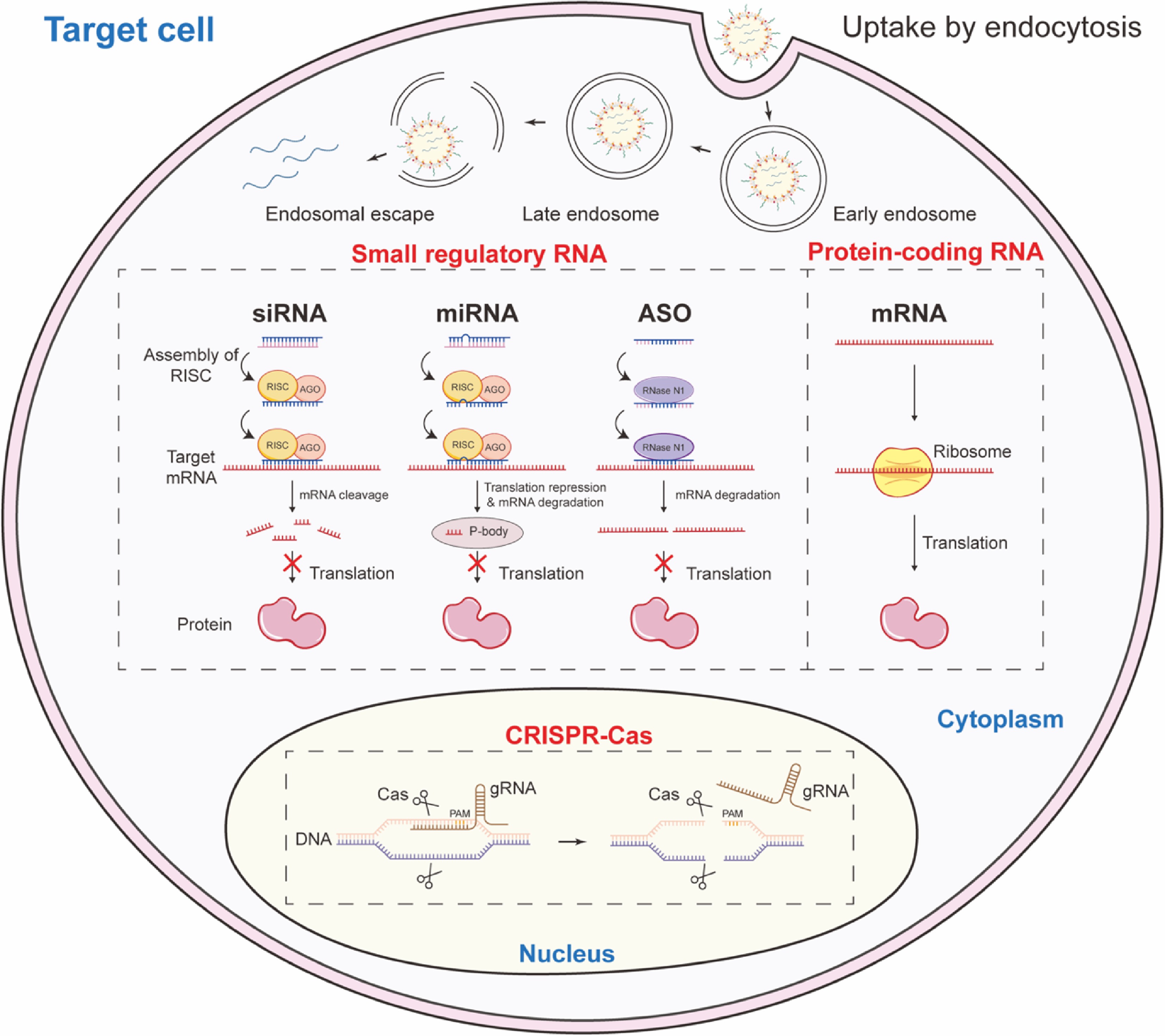
      Figure 1. 

      Categories and therapeutic mechanisms of RNA therapeutics.

    • Therapeutic RNAs are broadly classified into three categories according to the action mechanism: small regulatory RNA; protein-coding RNA; and clustered regularly interspaced short palindromic repeats (CRISPR)-derived guide RNA[2].

      Small regulatory RNAs include antisense oligonucleotides (ASOs), small interfering RNAs (siRNAs), and microRNAs (miRNAs). These molecules modulate gene expression by sequence-specific binding to target RNA[23]. ASOs are single-stranded, chemically modified deoxyribonucleotide fragments that inhibit gene expression by binding to specific mRNA sequences. The action mechanism includes degradation mediated by RNase H1 and the blocking of the transcriptional activity of target genes[24]. siRNAs are external double-stranded RNAs that guide the RNA-induced silencing complex (RISC) to cleave complementary mRNAs, thus silencing the gene encoding the mRNA[25]. miRNAs, endogenous single-stranded RNAs that also operate through the RISC, typically induce translational repression or degradation of partially matched target mRNAs, influencing broader gene networks[26].

      Protein-coding RNAs comprise messenger RNA (mRNA), self-amplifying RNA (saRNA), and circular RNA (circRNA). These RNAs are engineered to encode therapeutic proteins, and are translated by the host's cellular machinery[27]. mRNAs contain 5' caps and 3' poly tails, and facilitate translation initiation via formatting the complex of cap•eIF4E•eIF4G•PABP•poly(A), and are employed in vaccines, protein replacement therapies, and genome editing[28]. saRNA and circRNA represent new RNA forms that enhances translational durability and efficiency, reduces dosing, and prolongs protein expression[29].

      CRISPR guide RNAs are engineered molecules that direct CRISPR-associated enzymes (e.g., Cas9, Cas12, Cas13) to specific genomic or transcriptomic targets. These RNAs facilitate precise genetic modifications, including cleavage, base editing, and prime editing. Base editors consisting of cytosine use guide RNAs to obtain precise nucleotide conversion, while prime editing systems employ longer guide RNAs to direct insertions, deletions, or substitutions[30].

    • Although RNA holds great promise in drug development, the clinical translation of RNA therapeutics hinges on delivering the fragile RNA molecule to its intracellular site of action. This process is fraught with a multitude of sequential and interconnected challenges across biological scales, from the systemic to the molecular level (Fig. 2).
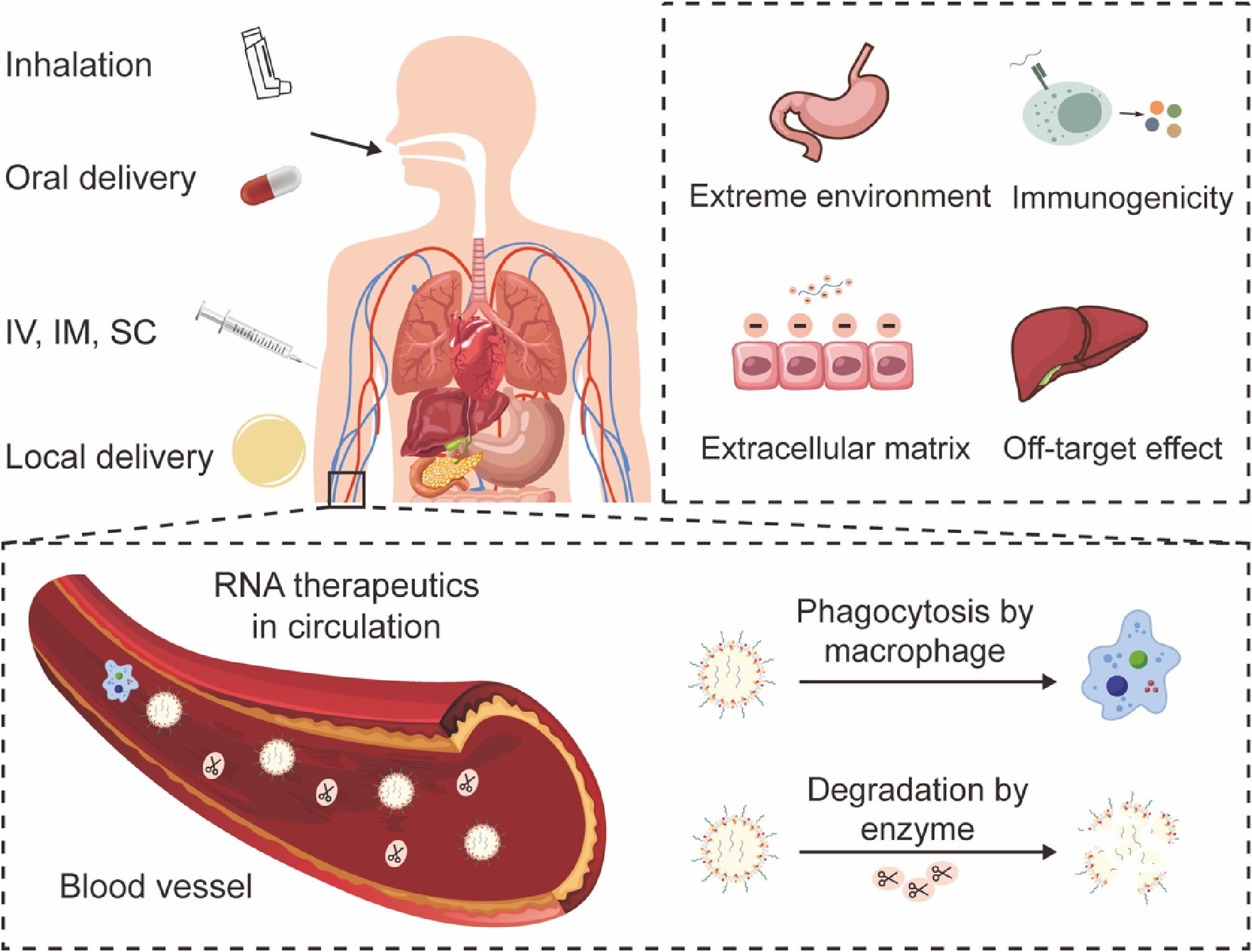
      Figure 2. 

      Administration routes and delivery challenges faced by RNA therapeutics.

      The choice of administration route is severely limited by RNA's inherent vulnerabilities, each of which presents unique hurdles. Intravenous (IV) injection is the direct method for systemic delivery, while exposing the RNA to the most hostile environment—the bloodstream—where nucleases (RNases) and immune factors are abundant[31]. IV administration requires sophisticated delivery systems to ensure the RNA survives circulation and reaches the target tissue. Subcutaneous (SC) and intramuscular (IM) injections offer a less harsh initial environment than IV injections. However, the diffusion of large, hydrophilic RNA molecules through the dense extracellular matrix (ECM) of tissues is inefficient. The journey from the injection site to the vasculature, and then to the target organ is a significant barrier, often leading to localized degradation, and limited bioavailability[32]. Oral administration of naked RNA is tough. RNAs are degraded rapidly in the gastrointestinal tract by low pH conditions in the stomach, and a high concentration of RNases in the intestines[33]. Furthermore, the gut epithelium is a formidable barrier to large, charged molecules. Although inhalation, intrathecal, and topical administration are being explored for localized delivery, they still face barriers such as mucosal clearance, epithelial barriers, and tissue-specific RNases[34].

      Upon entering the systemic circulation, naked RNA is subject to hydrolysis of the phosphodiester backbone and degradation by RNases. Naked RNA is degraded within seconds to minutes, possessing a circulatory half-life of less than several minutes[35]. In addition, the kidneys filter small molecules and nanoparticles below a certain size threshold (~5–10 nm). Thus, small regulatory RNAs will be rapidly cleared from the blood through glomerular filtration. Meanwhile, neutralizing antibodies and phagocytic clearance further reduce their bioavailability[30].

      If the RNA survives the bloodstream and reaches the target cell, it must overcome several cellular barriers. The inherent unfavorable physicochemical properties of RNA molecules make them unsuitable for crossing biological membranes. High molecular weight and large hydrodynamic size preclude passive diffusion through membrane pores. At the same time, the strong negative charge causes strong electrostatic repulsion with the negatively charged glycocalyx and phospholipid heads of cell membranes, forcing reliance on endocytic pathways (e.g., clathrin-mediated, caveolin-mediated, micropinocytosis). The efficiency of this uptake is highly dependent on the cell type and the surface properties of the delivery carrier[36,37]. After endocytosis, the RNA is trapped within endosomes, which mature and acidify (pH drops to ~5.0–6.0) before fusing with lysosomes. Lysosomes contain a suite of digestive enzymes (RNases, proteases) that will degrade both the carrier and its RNA cargo. A vast majority of internalized RNA is lost to this pathway[38]. The critical challenge is to engineer carriers that can disrupt the endosomal membrane and facilitate the 'endosomal escape' of the RNA into the cytosol before it is degraded. For small regulatory RNA and mRNA, the cytosol is the delivery destination. For CRISPR systems targeting nuclear RNA, the vector must further pass through the nuclear membrane via the nuclear pore complex, a process that is highly inefficient unless during cell division[39].

      Essentially, even with efficient delivery, off-target, and toxicological side effects should still be considered. The introduction of siRNA could lead to reduced expression of genes other than those targeted, potentially posing a danger in the treatment of disease[40]. Off-target effects can be attributed to two mechanisms: first, siRNA can tolerate several mismatches on the target mRNA, forming partially complementary pairings while continuing to exert its gene-silencing effect. The 3' untranslated region (3' UTR) of these transcripts is complementary to the 5' end of the siRNA sense strand[41]. Second, the RNAi level in the body is saturated when the external siRNAs are transported into the cells; they will compete with endogenous miRNAs, which are, therefore, subject to interference[42]. Some studies have found that the specific structure of RNA sequences and drug carriers can lead to the release of cytokines such as IFN-α and IFN-P[43,44], potentially triggering a potent innate immune response.

      Overcoming these challenges requires a multi-pronged engineering approach combining chemical modification of the RNA itself to enhance stability and reduce immunogenicity, and the development of advanced delivery systems (LNPs, GalNAc conjugates, polymers) designed to navigate this complex biological landscape, protect their cargo, and release it functionally at the correct site of action. The specific characteristics that an efficient RNA delivery system should possess include: (1) effective encapsulation and protection of RNA to prevent nuclease degradation during systemic delivery; (2) prolonged circulation time in the bloodstream to avoid rapid clearance by the kidneys and phagocytosis by the liver or spleen; (3) enhanced penetration and accumulation in target tissues/organs; (4) promotion of cellular internalization by target cells; (5) avoidance of lysosomal degradation during intracellular transport; (6) enhanced release of RNA in the cytoplasm to exert its genetic function.

    • To date, several RNA therapeutics approaches have been approved for disease treatment, including siRNA, miRNA, mRNA, antisense oligonucleotides (ASOs), and aptamers[10,45]. Despite significant progress in these RNA therapies, they still face challenges related to fabrication technology, safe and effective delivery, as well as clinical translation[4648]. Therefore, researchers are still striving to develop novel RNA delivery strategies to enhance the stability, targeting, and bioactivity of enzymes, promote cellular uptake and endosomal escape, while avoiding renal clearance and reducing immunogenicity (Fig. 3). Structural modification and the use of advanced delivery vectors/materials for encapsulation are common strategies in RNA therapy[49].
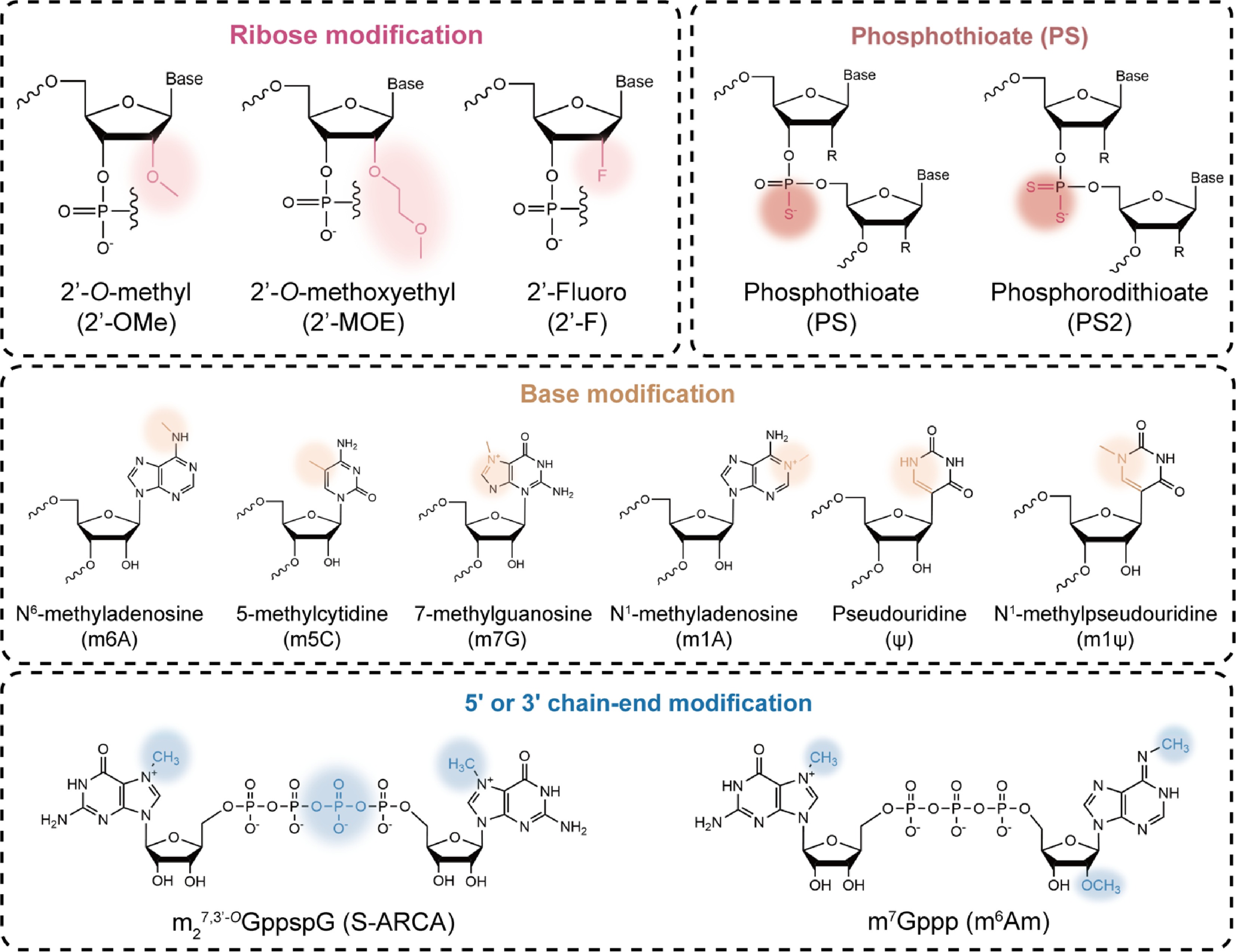
      Figure 3. 

      Representative structural modification strategies for RNA therapeutics.

    • Ribose chemical modifications involve replacing the 2'-OH group of the ribose sugar in RNA nucleotides with other atoms or groups, also known as 2'-ribose modifications. For instance, 2'-O-Methyl (2'-OMe), 2'-Methoxyethyl (2'-MOE), and 2'-Fluoro (2'-F) are involved[50]. These modifications enhance RNA stability against RNases by mimicking the biophysical properties of the 2'-OH, while preventing RNA from activating innate immune pattern recognition receptors, Toll-like receptors (TLRs)3/7/8, retinoic acid-inducible gene I (RIG-I), and melanoma differentiation-associated protein 5 (MDA-5), ultimately enhancing its affinity for target sequences[51].

      2'-MOE, a chemical modification commonly used in ASOs, replaces the 2'-OH group with a methoxyethyl group to improve oligonucleotide stability by increasing resistance to RNase, significantly prolonging the half-life[52]. For instance, Spinraza® is a fully phosphorothioate and 2'-MOE-modified ASO drug approved for the treatment of spinal muscular atrophy (SMA)[53]. However, it is worth noting that 2'-MOE modification at the 5' or 3' ends may affect siRNA silencing efficiency, so modifications are often applied to the central region of the siRNA sequence[13].

      In addition to 2'-MOE modification, 2'-OMe and 2'-F are commonly used for modifying siRNA compared to ASOs. To integrate multiple beneficial properties to enhance binding affinity and reduce immunogenicity, oligonucleotide therapeutics commonly comprise multiple modifications. For instance, Amvuttra® incorporates 2'-OMe, 2'-F, and 2'-deoxy chemical modifications to enhance therapeutic efficacy against hereditary transthyretin-mediated amyloidosis (hATTR)[54]. In contrast, ribose modifications are incompatible with RNase H activity and are therefore not commonly used in RNase H-dependent ASO therapeutics[55].

    • Phosphothioate (PS) modification replaces a non-bridging oxygen atom (O) on the phosphate backbone with a sulfur atom (S), forming a PS bond[56]. The PS modification enhances RNA binding to plasma proteins, prolongs half-life, and improves tissue permeability, making it one of the most common chemical modifications in ASO therapeutics[57]. A PS-modified aptamer, S-XQ-2d, has been reported to exhibit approximately 13-fold higher binding affinity for its target CD71 protein compared to the unmodified aptamer[58]. Furthermore, the stereochemical changes induced by the PS bond can influence the efficacy of the final oligonucleotide. PS bonds in the Sp configuration have been reported to be more stable than those in the Rp configuration, preventing drug inactivation through a stereo-protective mechanism[59].

      Furthermore, the impact of phosphate backbone modifications on RNA function may differ from nucleotide modifications. For instance, Nikan et al. observed that siRNA modified with monoalkyl phosphonate bonds exhibited enhanced specificity and therapeutic properties, with optimal efficacy when these modifications were positioned at the inter-nucleotide bond 6–7 positions from the 5' end of the guide strand[60]. Notably, PS modifications also reduce the affinity of nucleic acid therapeutics for their complementary nucleotide sequences and induce off-target effects. siRNAs modified at every linkage site have been reported to exhibit lower activity, leading to the common practice of modifying most PS bonds only at the siRNA ends[61]. Additionally, high-level PS modification may increase non-specific binding between nucleic acids and plasma proteins, thereby altering biodistribution, accumulation, and clearance processes, and exacerbating toxic reactions[62].

    • Nucleoside modifications primarily involve chemical alterations of nucleosides within RNA sequences, including pyrimidines and purines. Typically, N6-methyladenosine (m6A) is the most prevalent base modification in eukaryotic RNA, dynamically regulated by three enzymes[63]. The biological significance of m6A largely depends on m6A 'readers' that control mRNA fate and function[64,65]. However, m6A modification is unevenly distributed within RNA and is more prevalent in mature mRNA. Dysregulation of this modification has also been linked to various human diseases[66,67].

      In addition, pseudouridine (ψ) modification, also known as the 'fifth nucleotide' of RNA, serves as a natural isomer of the nucleoside uridine and represents the most prevalent natural RNA modification in nature[68,69]. ψ-modified RNA effectively avoids activating pattern recognition receptors such as TLRs, significantly reducing RNA immunogenicity while enhancing translation efficiency[70]. Compared to ψ, N1-methylpseudouridine (m1ψ) is less likely to activate protein kinase R (PKR), which offers greater advantages in reducing RNA immunogenicity and promoting translation capacity[7173]. Moreover, other commonly used examples of RNA base modifications include 7-methylguanosine (m7G), N1-methyladenosine (m1A), and 5-methylcytidine (m5C), etc.[74], which also have significant implications for the development of therapeutic RNA drugs.

    • 5'-end cap structure modification ensures mRNA stability and efficient translation by synthesizing cap analogs, such as Anti-Reverse Cap Analog (ARCA), and CleanCap Analogue[75]. Given the 5' cap's role in regulating mRNA stability and translational efficiency, researchers are engaged in identifying and synthesizing chemically modified 5' caps. For instance, functional mRNAs were synthesized using either vaccinia virus capping enzyme modification techniques or click chemistry to produce diverse 5' cap analogues[76,77].

      Furthermore, optimizing the length and sequence of the 3'-terminal polyadenylic acid (poly(A)) tail can enhance mRNA stability against RNases and prolong its half-life, thereby regulating gene expression at the post-transcriptional level[78,79]. Longer poly(A) tails may enhance mRNA stability and transfection efficiency; however, excessively elongated tails may paradoxically reduce protein output. Reports indicated that an optimal poly(A) tail length of approximately 100 nt yields the highest translation rates[80].

    • Generally, mRNA delivery carriers are categorized into viral and nonviral carriers. However, viral carriers are not widely used due to their higher immunogenicity, toxicity, and carcinogenic risks[81,82]. Nonviral carriers exhibit lower immunogenicity and higher delivery efficiency, making them the preferred choice for mRNA delivery. Here, nonviral carriers are mainly discussed (Fig. 4).
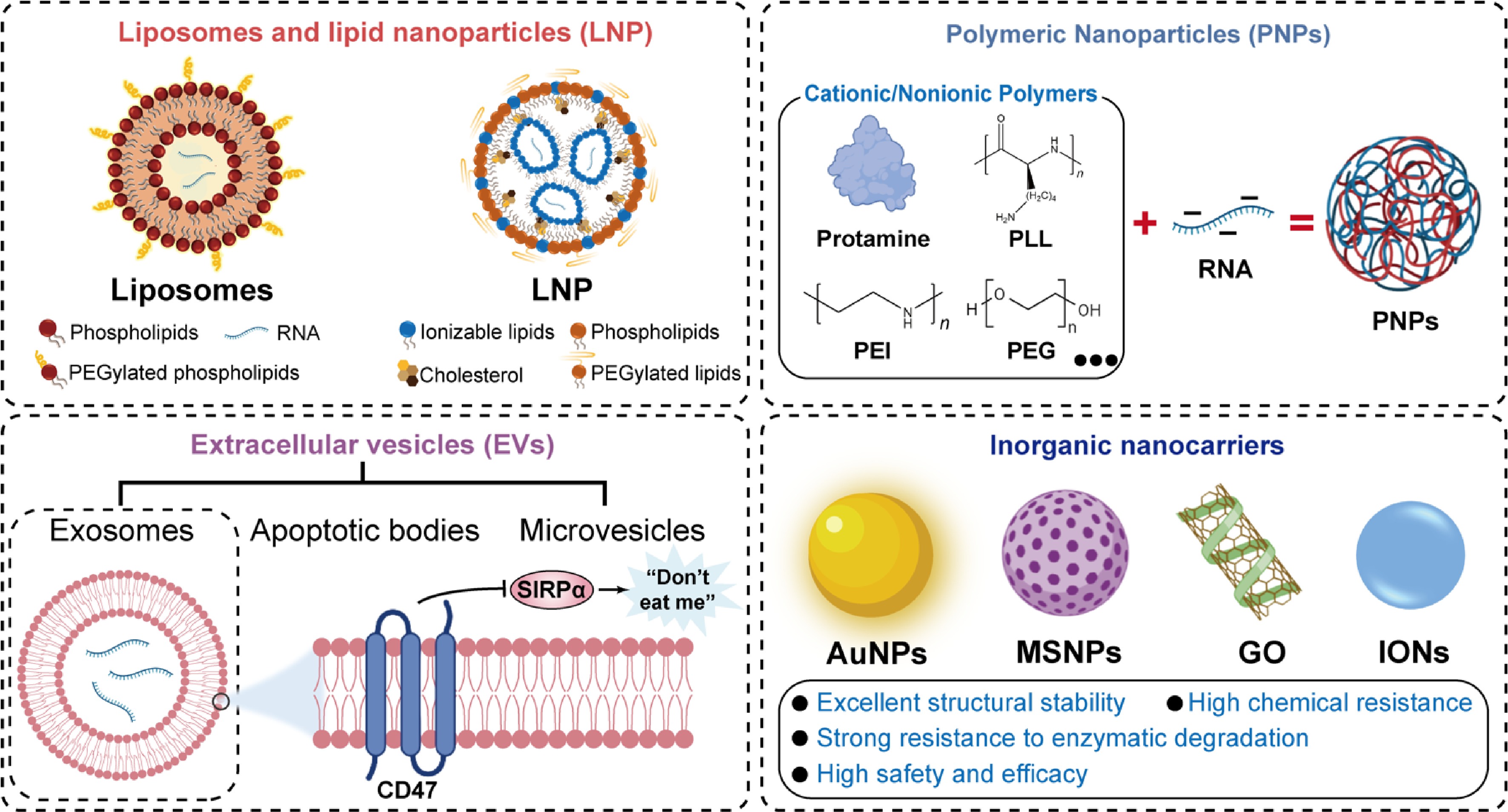
      Figure 4. 

      Emerging drug carriers for delivering RNAs.

    • Liposomes are bilayer spherical vesicles formed through the self-assembly of amphiphilic phospholipids, with several formulations already approved for clinical use[8385]. Positively charged cationic liposomes promote particle uptake and endosomal escape; however, they still face issues such as poor stability and high immunogenicity[86]. To address the limitations, chemically modified lipids are incorporated into the liposomes[87,88].

      LNPs have emerged as a prominent nucleic acid delivery platform[89]. Four LNP-based RNA therapeutics, including Onpattro®, Comirnaty®, Spikevax®, and mResvia®, were approved for clinical use. Typically composed of ionizable lipids, phospholipids, cholesterol, and PEGylated lipids, LNPs offer advantages including controllable lipid synthesis, flexible manufacturing processes, and robust nucleic acid encapsulation capacity[90]. Rational design of lipid structures and surface modifications significantly improves pharmacokinetic profiles, reduces immunogenicity, extends circulation half-life, and maintains high transfection efficiency[91]. Recently, precision-mixing methods by microfluidic technology enabled the efficient and controllable synthesis of LNPs, providing crucial support for their clinical translation[92,93]. Nonetheless, LNPs consistently demonstrated only a modest ability to enhance DNA transfection. LNP-based RNA therapeutics are expensive due to the use of ionizable lipids, limiting their application. In addition, LNPs demonstrate significant shortcomings, such as a severe immune response, complex manufacturing, and formulation discrepancies.

    • PNPs are a class of artificially synthesized nanocarriers constructed from biodegradable or biocompatible polymers through methods such as self-assembly. Due to RNA's relatively high negative charge and its sensitivity to nucleases, positively charged substances are introduced to bind with negatively charged RNA, forming stable complexes[94]. These substances include positively charged proteins (such as protamine)[95], polyethyleneimine (PEI), poly-L-lysine (PLL), and polycaprolactone (PCL)[9698]. However, these cationic components also trigger acute neutrophil infiltration and a cascade of inflammatory responses, exhibiting significant toxicity[99]. Nonionic polymers, such as polyethylene glycol (PEG), act as 'seeding agents' that promote nanoparticle formation at ambient conditions by increasing the local concentration of precursor RNA[100,101]. These interactions protect RNA from degradation and enhance cellular delivery by facilitating endosomal escape via proton-sponge effects[102]. No PNP-based RNA therapeutics are approved for clinical use so far. However, PNPs demonstrate less immune stimulation and liver accumulation and, as a result, could contribute to the RNA-based therapeutic landscape.

    • EVs with a diameter of 50–150 nm are naturally occurring vesicles actively secreted by cells that possess biological activity[103]. EVs can effectively encapsulate RNA, protect it from degradation, facilitate its crossing biological barriers, and target cells of interest, representing a safe and efficient method for RNA therapy[103,104]. Based on their biogenesis and size characteristics, EVs are primarily categorized into exosomes, microvesicles, and apoptotic bodies[105]. Exosomes, with well-defined membrane structure and rich surface protein composition, have the potential to improve RNA delivery. For instance, CD47 expressed on the exosome membrane transmits a 'do not eat me' signal through interaction with signal regulatory protein alpha (SIRPα), effectively evading clearance by the mononuclear phagocyte system and prolonging circulation time in vivo[106,107]. Various bioengineering techniques were used to functionalize exosomes, such as incorporating specific targeting peptides or fusion proteins, thereby improving tissue tropism and cellular uptake capacity[108,109]. Despite the significant potential in RNA therapeutics, biomimetic EVs face multiple challenges for clinical application, including standardized large-scale production, precise controllability of targeted modifications, and high preparation costs[110]. So far, no therapeutic applications of EV-based RNA delivery systems have been approved or entered clinical trials.

    • Inorganic nanocarriers represent a novel class of nonviral delivery systems composed of inorganic materials. Their unique size-dependent properties, precisely tunable physicochemical characteristics, and diverse functionalizable interfaces have demonstrated several advantages, including structural stability and high chemical resistance[111]. For instance, gold nanoparticles (AuNPs) possess outstanding optical properties and easily modifiable surface chemistry[112]. Their surfaces can covalently bind RNAs via gold-sulfur bonds for functionalization, achieving temporally and spatially controlled RNA release through photothermal effects[113]. Mesoporous silica nanoparticles (MSNPs) are gaining attention as potential RNA therapeutic carriers due to their highly ordered pore structures, large specific surface areas, and tunable pore sizes[114]. Carbon-based nanomaterials, such as iron oxide nanoparticles (IONs) and graphene oxide (GO), also represent compelling platforms for RNA delivery[115,116]. Whereas the prospects for inorganic carriers in RNA therapy are unclear due to the risks associated with complex metabolism and elimination.

    • Artificial intelligence (AI) and machine learning (ML) are increasingly integrated into the RNA therapeutics development process, providing powerful tools to accelerate drug discovery, optimize design strategies, enhance delivery efficiency, and predict clinical efficacy[117,118]. By integrating large-scale biological data, these computational methods effectively address key challenges in RNA-based drug development.

      AI is demonstrating its potential to drive the future of RNA drug development. The accuracy of AI models such as AlphaFold further underscores the transformative impact of AI[119]. AI-driven large models, combined with high-resolution 3D visualization technology, enable researchers to gain detailed insights into RNA structures and their dynamic changes. By analyzing omics data, AI platforms can simulate and predict RNA-target interactions in real time, thereby enabling rational design of RNA molecules[120]. Also, breakthroughs in deep learning-driven approaches, such as large language models like ChatGPT, have revolutionized the analysis of long RNA sequences[121]. These advanced AI models assist interactive RNA generation platforms in generating and refining RNA sequences based on criteria like target specificity. Simultaneously, RNA-protein affinities can be further analyzed from the predicted sequences[122].

      Beyond AI, ML is a core method for achieving AI. One of the standout contributions of ML tools to RNA therapeutics lies in the design of delivery systems, particularly in the discovery of mRNA delivery[123]. ML aids in screening and designing lipids by predicting the efficacy, stability, and biodistribution characteristics of LNPs[124]. Its combination with high-throughput screening enables the identification of optimal lipid formulations for achieving targeted tissue delivery and escaping endosomal sequestration[125]. For instance, Li et al.[126] reported a method that integrates ML and high-throughput synthesis to discover ionizable cationic lipids. They identified a lipid superior to the established benchmark lipid (SM-102) for transfecting muscle and immune cells across multiple tissues. In addition, ML models can be used to model interactions between RNA and small molecules, including binding sites, conformations, performance, and affinity[127].

      Traditional experimental techniques are gradually being replaced by AI-ML tools in RNA synthesis and sequencing, characterization methods, transfection efficiency, and toxicity assessment. These tools can save time, reduce costs, and, to a certain extent, produce more precise results. However, even when AI-ML tools perform well on specific datasets, they still lack universality. Meanwhile, the risk of ethical issues, data loss, high maintenance costs, and frequent software upgrades will also need to be addressed in the future. In summary, advanced AI-ML tools will revolutionize the design, optimization, and delivery strategies for RNA therapeutics, while efficient big-data model development will open new pathways for RNA therapies.

    • RNA therapy aims to achieve precise disease treatment by intervening at the mRNA level, modulating disease-causing proteins at their source[128]. Currently approved RNA drugs primarily address rare monogenic disorders using ASOs or siRNAs to silence or correct defective genes, as well as to modulate hepatic metabolism and prevent infectious diseases[129]. Meanwhile, the pipeline of investigational RNA drugs has expanded considerably to combat cancer, neurological disorders, and cardiovascular diseases[130]. The use of delivery strategies allows RNA therapies to extend their therapeutic reach beyond the liver to other tissues and organs, ultimately targeting previously 'undruggable' pathological pathways[131]. Based on the targeted disease types, RNA therapeutics have established a clear, broadly deployed clinical application landscape (Table 1). Here, the targets, RNA-based products, their market advancements, and RNA therapeutics under clinical investigation, for the treatment of major diseases, will be discussed (Table 2).

      Table 1.  RNA therapeutics on market for disease treatment.

      Disease classification Classification Development code Indications Target/mechanism of action RNA technology platform Delivery system Route of administration Launch year Ref.
      Infectious diseases Prophylactic mRNA vaccine mRNA-1345 Respiratory syncytial virus Respiratory syncytial virus stabilized prefusion F glycoprotein mRNA LNPs Intramuscular injection 2024 [145]
      Infectious diseases Prophylactic mRNA vaccine mRNA-1273 SARS-CoV-2/
      COVID-19 virus
      SARS-CoV-2 spike protein mRNA LNPs Intramuscular injection 2020 [177]
      Infectious diseases Prophylactic mRNA vaccine mRNA-1283 SARS-CoV-2/
      COVID-19 virus
      SARS-CoV-2/
      COVID-19 virus
      mRNA LNPs Intramuscular injection 2025 [178]
      Infectious diseases Prophylactic mRNA vaccine BNT162b2 SARS-CoV-2/
      COVID-19 virus
      SARS-CoV-2 spike protein mRNA LNPs Intramuscular injection 2020 [179]
      Infectious diseases Prophylactic mRNA vaccine ARCT-154 SARS-CoV-2/
      COVID-19 virus
      SARS-CoV-2 spike protein mRNA LNPs Intramuscular injection 2025 [180]
      Infectious diseases Prophylactic mRNA vaccine SYS6006 SARS-CoV-2/
      COVID-19 virus
      SARS-CoV-2 spike protein mRNA LNPs Intramuscular injection 2023 [181]
      Liver and metabolic diseases RNA interference (RNAi) therapy KJX839 Familial hypercholesterolemia (FH) and cardiovascular risk reduction PCSK9 mRNA siRNA GalNAc Subcutaneous injection 2020 [182]
      Hepatic and metabolic diseases RNA aptamer therapy NX1838 Neovascular (Wet)
      age-related macular degeneration
      Specifically targets
      the VEGF165
      isoform
      RNA aptamer Not required Intravitreal injection 2004 [183]
      Genetic diseases Antisense oligonucleotide (ASO) therapy Nusinersen Spinal muscular atrophy (SMA) Modulation of SMN2 pre-mRNA splicing ASO Ligand-conjugated active delivery Intrathecal injection 2016 [184]
      Genetic diseases Antisense oligonucleotide (ASO) therapy AVI-4658 Duchenne muscular dystrophy (DMD) DMD gene pre-mRNA ASO No specialized delivery system required Intravenous infusion 2016 [185]
      Genetic diseases Antisense oligonucleotide (ASO) therapy IONIS-TTRRx Hereditary transthyretin-mediated amyloidosis (hATTR) mRNA silencing of
      the TTR gene
      ASO Ligand-conjugated active delivery Subcutaneous injection 2018 [186]
      Genetic diseases Antisense oligonucleotide (ASO) therapy BIIB067 Amyotrophic lateral sclerosis (ALS) Targeted degradation of SOD1 mRNA ASO Ligand-conjugated active delivery Intrathecal injection 2023 [187]
      Genetic diseases CRISPR gene editing therapy CTX001 β-thalassemia,
      sickle cell disease
      Edits the BCL11A gene in autologous hematopoietic stem cells to reactivate
      fetal hemoglobin production
      CRISPR-Cas9 Electroporation Intravenous infusion 2023 [188]
      Genetic diseases RNA interference (RNAi) therapy ALN-TTR02 Hereditary transthyretin-mediated amyloidosis (hATTR) mRNA silencing of
      the TTR gene
      siRNA LNPs Intravenous infusion 2018 [189]
      Genetic diseases
      RNA interference (RNAi) therapy ALN-AS1 Acute hepatic porphyria (AHP) Targeted silencing
      of ALAS1 mRNA
      siRNA GalNAc Subcutaneous injection 2019 [190]

      Table 2.  RNA therapeutics under investigation for disease treatment.

      Disease classification Classification Development code Indications Target/mechanism of action RNA technology platform Delivery system Route of administration Status Ref.
      Cancer Personalized neoantigen vaccine mRNA-4157 Melanoma Personalized neoantigen mRNA LNPs Intramuscular injection Phase II [135]
      Cancer Personalized neoantigen vaccine BNT122 Melanoma, colorectal cancer, non-small cell
      lung cancer
      Personalized neoantigen mRNA LNPs Intravenous
      infusion
      Phase II [191]
      Cancer Shared-antigen vaccine BNT111 Melanoma Shared-antigen mRNA LNPs Intravenous
      infusion
      Phase II [137]
      Cancer Shared-antigen vaccine CV9104 Prostate cancer Shared-antigen mRNA Protamine complex Intradermal injection and subcutaneous injection Phase II [138]
      Cancer RNA interference (RNAi) therapy MTL-CEBPA Hepatocellular carcinoma CEBPA gene activation siRNA LNPs Intravenous
      infusion
      Phase II [132]
      Cancer RNA interference (RNAi) therapy siG12D-LODER Pancreatic cancer KRAS G12D silencing siRNA LODER™ (LOcal Drug EluteR) Endoscopic Intratumoral injection Phase II [192]
      Cancer mRNA-encoded cytokine/antibody mRNA-2752 Solid tumors, Lymphoma Cytokine encoding mRNA LNPs Intratumoral injection Phase I [193]
      Cancer microRNA therapy MRX34 Advanced or metastatic hepatocellular carcinoma (HCC), melanoma, lymphoma, and various other solid tumors miR-34a mimic Double-stranded
      RNA mimic
      LNPs Intratumoral injection Phase I [194]
      Cancer microRNA therapy MesomiR-1 Malignant pleural mesothelioma, advanced non-small cell lung cancer miR-16 mimic Double-stranded
      RNA mimic
      Targeted Bacterial Minicells Intratumoral injection Phase I [195]
      Infectious diseases Prophylactic mRNA vaccine mRNA-1010 Influenza Hemagglutinin (HA) glycoproteins of four influenza virus strains mRNA LNPs Intramuscular injection Phase III [196]
      Infectious diseases Prophylactic mRNA vaccine PF-07252220 Influenza Hemagglutinin (HA) glycoproteins of four influenza virus strains mRNA LNPs Intramuscular injection Phase I [197]
      Infectious diseases Prophylactic mRNA vaccine mRNA-1647 Cytomegalovirus Cytomegalovirus mRNA LNPs Intramuscular injection Phase III [198]
      Infectious diseases Prophylactic mRNA vaccine mRNA-1443 Cytomegalovirus Hemagglutinin (HA) protein of influenza virus mRNA LNPs Intramuscular injection Phase I [199]
      Infectious diseases Prophylactic mRNA vaccine mRNA-1189 E–B virus Epstein–Barr virus envelope glycoproteins gH, gL, gp42, and gp220 mRNA LNPs Intramuscular injection Phase I/II [200]
      Infectious diseases Prophylactic mRNA vaccine mRNA-1215 Nipah virus Nipah virus prefusion-stabilized F protein and G protein monomer mRNA LNPs Intramuscular injection Phase I [201]
      Infectious diseases Prophylactic mRNA vaccine mRNA-1893 Zika virus Zika virus mRNA LNPs Intramuscular injection Phase II [202]
      Infectious diseases Prophylactic mRNA vaccine mRNA-1608 Herpes simplex virus Herpes simplex virus mRNA LNPs Intramuscular injection Phase I/II [203]
      Infectious diseases Prophylactic mRNA vaccine mRNA-1283 SARS-CoV-2/
      COVID-19 virus
      SARS-CoV-2 spike protein mRNA LNPs Intramuscular injection Phase III [178]
      Infectious diseases RNA interference (RNAi) therapy ARO-HBV Hepatitis B virus Degradation of HBV mRNA siRNA Dynamic Polyconjugates Subcutaneous injection Phase I/II [204]
      Liver and metabolic diseases RNA interference (RNAi) therapy Fazirsiran α-1 antitrypsin
      deficiency (A1ATD)
      Specific silencing of mutant SERPINA1 siRNA TRiM™ Subcutaneous injection Phase III [161]
      Liver and metabolic diseases Antisense oligonucleotide (ASO) therapy Vupanorsen Familial hypercholesterolemia (FH) and cardiovascular risk reduction Targeted silencing of ANGPTL3 ASO GalNAc Subcutaneous injection Phase II [205]
      Liver and metabolic diseases Messenger RNA (mRNA) therapy mRNA-3927 Propionic acidemia (PA) PCCA and PCCB mRNA LNPs Intravenous
      infusion
      Phase I/II [164]
      Liver and metabolic diseases Messenger RNA (mRNA) therapy ARCT-810 Ornithine transcarbamylase deficiency (OTCD) Encoding a functional
      OTC enzyme
      mRNA LNPs Intravenous
      infusion
      Phase II [206]
      Liver and metabolic diseases RNA interference (RNAi) therapy AB-729 Hepatitis B virus GalNAc-conjugated siRNA targeting all HBV RNA transcripts that produces
      a marked and durable reduction in hepatitis B surface antigen (HBsAg) levels
      siRNA GalNAc Subcutaneous injection Phase II [207]
      Hepatic and metabolic diseases Hybrid antisense oligonucleotide (ASO) therapy TPI ASM8 Asthma mRNA targeting the two signaling molecules CCR3 and the βc chain ASO No delivery system required Nebulized inhalation Phase II [208]
      Hepatic and metabolic diseases RNA aptamer therapy ARC1779 Thrombotic Microangiopathy, Acquired Hemophilia,
      and other thrombotic disorders
      Targets the A1 domain of von Willebrand Factor (vWF) RNA aptamer Not required Intravitreal
      injection
      Phase III [209]
      Hepatic and metabolic diseases RNA aptamer therapy ARC1905 Age-related Macular Degeneration Complement C5 protein RNA aptamer Not required Intravitreal
      injection
      Phase III [210]
      Genetic diseases Antisense oligonucleotide (ASO) therapy RO7234292 Huntington's disease (HD) Targeted silencing of
      mutant huntingtin mRNA
      ASO Ligand-conjugated active delivery Intrathecal
      injection
      Phase III [211]
      Genetic diseases CRISPR gene editing therapy NTLA-2001 Hereditary Transthyretin Amyloidosis Knocks out the TTR gene in hepatocytes to reduce the production of disease-causing transthyretin protein CRISPR-Cas9 LNPs Intralesional injection Phase I/II [212]
      Genetic diseases CRISPR gene editing therapy NTLA-2002 Hereditary
      angioedema
      Knocks out the Kallikrein B1 gene in hepatocytes to reduce bradykinin and prevent swelling attacks CRISPR-Cas9 LNPs Intralesional injection Phase I/II [213]
      Genetic diseases CRISPR gene editing therapy EDIT-101 Leber Congenital Amaurosis Type 10 Use CRISPR to remove the pathogenic mutation in intron 26 of the CEP290 gene in retinal cells to restore normal protein function CRISPR-Cas12a Adeno-associated virus CRISPR-Cas12a Phase I/II [214]
    • RNA-based therapies have demonstrated significant potential in cancer treatment. The therapies currently in clinical trials are mainly divided into two categories: mRNA vaccines and RNAi therapies. RNA therapeutics can precisely modulate cancer targets. For instance, the first small activating RNA (saRNA) was used to activate CEBPA in the liver, promoting the differentiation of hepatocellular carcinoma cells toward a normal phenotype and inhibiting tumor proliferation[132,133]. The clinical trials of saRNA therapy are ongoing (NCT05097911, NCT02716012). Compared to genetic disorders and metabolic diseases, few RNA therapeutics have been approved for cancer treatments. Among these, the combination therapy of mRNA-4157 (V940) with Keytruda® represents a significant advancement of mRNA technology in cancer treatment[134]. mRNA-4157 (V940) is a personalized mRNA cancer vaccine developed by Merck and Moderna. It employs mRNA technology to encode up to 34 personalized tumor neoantigens, activating specific T-cell immunity and establishing long-term memory to treat high-risk melanoma and non-small cell lung cancer[135,136]. In Phase I/II clinical trials in combination with pembrolizumab, this vaccine demonstrated favorable efficacy[134,135]. As shared-antigen cancer vaccines, both BNT111 and CV9104 have demonstrated robust and durable antitumor efficacy in clinical trials in melanoma and prostate cancer patients, respectively[137,138]. Furthermore, several clinical trials of RNA therapeutics for cancer (e.g., lung, colorectal, and pancreatic cancers) are ongoing, targeting well-known oncogenes such as KRAS, MYC, and STAT3[139,140].

      RNA therapeutics have introduced a paradigm shift in cancer treatment. However, their full maturation requires overcoming significant translational challenges. The advancements require isolated technological breakthroughs and the deep integration of delivery technologies, bioinformatics, immunology, and clinical medicine. RNA therapeutics are poised to evolve from a cutting-edge technology into a mainstream pillar of oncology by addressing delivery limitations, enlarging application scenarios, and reducing costs. In the coming years, increasing RNA drugs are expected to enter the cancer treatment market.

    • For the prevention and control of infectious diseases, RNA therapeutics offers a highly efficient and versatile platform for vaccine development compared to traditional strategies, effectively addressing rapid viral mutations by targeting highly conserved regions of the viral genome, providing defense against potential future novel viruses[141]. The most representative example is the COVID-19 pandemic that erupted in late 2019, caused by the severe acute respiratory syndrome coronavirus 2 (SARS-CoV-2), which prompted the rapid launch of multiple vaccine development programs worldwides[142]. Among these, mRNA vaccines (mRNA-162b2 and mRNA-1273) utilizing LNP delivery to encode the receptor-binding domain (RBD) of the SARS-CoV-2 spike glycoprotein were approved for emergency use following accelerated development to curb the spread of COVID-19[143]. Subsequently, more candidate COVID-19 vaccines have entered clinical trials[144]. Another preventive mRNA vaccines, mRESVIA, utilizes LNP delivery technology to elicit specific immune responses within cells. In a Phase III clinical trial, it demonstrated 83.7% efficacy in preventing lower respiratory tract disease associated with respiratory syncytial virus (RSV) in adults aged 60 years and older[145]. The vaccine has been approved by the US Food and Drug Administration (FDA) for the prevention of RSV infection, becoming the second kind of marketed mRNA vaccine following COVID-19 vaccines.

      JNJ-3989, a therapeutic vaccine, is an RNAi-based therapy used to treat chronic hepatitis B by specifically silencing viral mRNA, reducing patients' levels of hepatitis B surface antigen (HBsAg), and holds considerable promise for achieving a functional cure in combination with other agents[146,147]. The transition from emergency pandemic response toward building a more agile, broad-spectrum, and accessible line of defense against infectious diseases is expected. By overcoming challenges related to stability, safety, and accessibility, and expanding their applications from prophylaxis to treatment, RNA technology will play a leading role in ending pandemic threats and even tackling some of the most intractable chronic infections.

    • RNA therapeutics demonstrate significant potential in treating neurological disorders due to their ability to target gene transcripts directly. Huntington's disease, one of the most representative neurological disorders, is caused by an excessive expansion of the CAG repeat sequence in the Huntington (HTT) gene[148]. Tominersen® is an ASO drug developed for Huntington's disease that inhibits HTT protein synthesis by targeting HTT mRNA, thereby slowing disease progression[149]. However, Tominersen® was halted in Phase III clinical trials due to failure to meet efficacy endpoints (NCT03761849).

      Spinal muscular atrophy (SMA) is another representative genetic neurological disorder classified as an autosomal recessive disease[150]. In 2019, Novartis Pharmaceuticals developed Zolgensma® (Onasemnogene abeparvovec), a gene therapy for SMA. The therapy promoted the expression of SMN protein in patients by delivering the survival motor neuron gene 1 (SMN1)[151]. AVXS-101 is another RNA therapy that delivers the SMN2 gene, developed by the Novartis subsidiary AveXis[152]. However, the US FDA partially suspended clinical trials of AVXS-101 in October 2025 due to safety concerns (NCT03505099). Additionally, RNA therapy shows increasing potential for treating Alzheimer's and Parkinson's diseases by targeting the amyloid precursor protein (APP)/BACE1 and α-synuclein (SNCA)[153,154].

    • RNA therapeutics have also achieved remarkable success in hepatic and metabolic diseases, expanding from treating rare disorders to standard conditions. For instance, familial chylomicronemia syndrome is a rare autosomal recessive disorder associated with hypertriglyceridemia and severe acute pancreatitis[155]. Waylivra® (Volanesorsen) is an ASO drug that significantly reduces plasma triglyceride levels by targeting apolipoprotein CIII (apo-CIII) mRNA to inhibit its synthesis[156]. Furthermore, primary hyperoxaluria is another rare autosomal recessive disorder. Oxlumo® (Lumasiran) is an RNAi therapy for treating type 1 hyperoxaluria by targeting the HAO1 gene (encoding oxalate oxidase), thereby inhibiting oxalate production at its source[157]. Similarly, Nedosiran® (DCR-PHXC) is an RNAi therapy targeting lactate dehydrogenase (LDH). It functions as a GalNAc-dsRNA conjugate that suppresses LDH expression via RNAi technology, thereby reducing urinary oxalate production[158].

      Apart from rare disorders, RNA therapeutics have also been applied to common hepatic and metabolic diseases. In 2013, Kynamro® (Mipomersen Sodium) was approved for the treatment of hypercholesterolemia. This ASO drug inhibits apo B-100 protein synthesis through RNase H-mediated mRNA degradation, lowering low-density lipoprotein cholesterol levels[159]. Similarly, Leqvio® (Inclisiran) is an RNAi targeting PCSK9 (proprotein convertase subtilisin/kexin type 9) mRNA. By catalyzing the degradation of PCSK9 mRNA, the medicine increases hepatic LDL-C receptor recycling and expression and reduces circulating LDL-C levels[160]. Fazirsiran silences explicitly the expression of the mutant SERPINA1 mRNA and reduces the synthesis and accumulation of aberrant Z-AAT protein. In Phase I and II clinical trials, Fazirsiran showed remarkable efficacy, significantly decreasing hepatic Z-AAT deposition and improving biomarkers associated with liver inflammation and fibrosis[161163]. mRNA-3927 is an mRNA-based therapy for propionic acidemia (PA), designed to encode two functional enzymes deficient in patients. Delivering the mRNA into cells can direct the synthesis of the corresponding enzyme proteins and restore metabolic function[164].

      As the liver serves as the central hub for metabolic regulation, and is the most established organ for RNA therapy delivery, RNA therapeutics have ushered in a new era of precision medicine for liver diseases. The use of delivery techniques allows the therapy shift from 'efficient liver targeting' to 'precise cell-specific targeting', from 'chronic suppression' to 'functional cure', and from 'treating rare disorders' to 'conquering common diseases'. RNA-based interventions are becoming central to reversing—and potentially even curing—a broad spectrum of liver pathologies. Emerging targets in lipid metabolism, glucose regulation, and energy balance are gaining prominence as research focal points[165,166]. Moreover, combining RNA therapeutics targeting different pathways or integrating them with conventional drugs may represent a promising strategy to pursue curative treatment of liver-associated diseases.

    • RNA-based drugs for pulmonary diseases represent a rapidly emerging field, with current clinical-stage candidates mainly employing mRNA, siRNA, and ASO technologies. TPI ASM8 is an inhalable and mixed ASO agent for asthma treatment by simultaneously targeting CCR3 and the βc chain. Experimental results indicate that the administration could significantly mitigate allergen-induced late asthmatic responses[167,168]. The application of RNA therapeutics in pulmonary diseases represents a formidable challenge—one whose success hinges critically on breakthroughs in delivery technology. Although still in its early stages, this approach holds the promise of establishing a new treatment paradigm characterized by localized action, high efficiency, and programmable design.

    • RNA therapeutics for genetic disorders are among the most mature sectors within this technological domain. Patisiran, the first globally approved siRNA drug, is indicated for hereditary transthyretin-mediated amyloidosis (hATTR), while inotersen is an approved ASO-based therapy. Amyloid deposition decreases by silencing the mRNA expression of the TTR gene, or reducing the production of misfolded TTR protein[169172]. Nusinersen, used for SMA, is also an ASO-based therapy that modulates the pre-mRNA splicing of the SMN2 gene to promote the production of full-length, functional SMN protein[173,174]. Eteplirsen, an ASO agent for specific mutation types of Duchenne muscular dystrophy (DMD), employs an 'exon-skipping' technique to skip exon 51 during DMD gene transcription, restoring the reading frame and resulting in a truncated but partially functional dystrophin protein[175,176]. Other relevant therapeutics for genetic disorders approved and in clinical trials are summarized in Table 1. RNA therapeutics have successfully transitioned from conceptual promise to clinical reality, reshaping the therapeutic landscape across multiple diseases. The therapeutics allow precise delivery of mRNA instructions or targeted degradation of pathogenic mRNA, demonstrating significant potential against major human disorders, including oncology, infectious diseases, genetic disorders, and hepatic and pulmonary conditions.

    • Due to the unique chemical/biological properties of different RNA molecules, RNA therapeutics have made significant advances in the treatment of diseases such as cancer, infectious diseases, liver disease, and lung disorders. However, various shortcomings, including poor cellular delivery, immunogenicity issues, poor stability, rapid clearance from the circulation, potential adverse effects, and challenges posed by complex in vivo biological barriers, significantly diminish the potential of RNA editing, markedly reducing the therapeutic efficacy of drugs. Therefore, extensive efforts have been devoted to overcoming these challenges, especially by optimizing delivery strategies/carriers to improve cell-targeted delivery efficiency and enhance RNA molecule stability. Various nanoparticle-based delivery strategies, including protein-RNA complexes, lipid carriers, and polymer carriers, have shown great promise in clinical evaluations and are being continuously optimized for efficient RNA delivery. Also, novel technologies such as AI, high-throughput RNA therapeutic screening, chemical modification, and RNA/single-cell sequencing methods further promote the optimization and validation of RNA therapeutics delivery. In addition, large-scale production, product consistency, and bioequivalence are important factors that limit widespread clinical translation. Manufacturers continually adapt to market demand by developing continuous production equipment, optimizing production processes, improving process quality monitoring and control, and ameliorating separation and purification methods. To date, over 40 carrier-based (LNP/Liposome) RNA therapeutics or structurally modified RNA molecules are currently undergoing different stages of clinical investigation. With further in-depth research into breakthroughs in drug-delivery strategies, more RNA-based products will be approved for disease treatment, offering more diversified clinical therapeutic approaches and providing potential for future precision or personalized medication.

      • Not applicable.

      • The authors confirm their contributions to the paper as follows: study conception: He W; writing—original draft: Zou J, He X, Li Z, Song B, Xing X, Yu J; review & editing: He W. All authors reviewed the results and approved the final version of the manuscript.

      • Data sharing not applicable to this article as no datasets were generated or analyzed during the current study.

      • This study was supported by the National Natural Science Foundation of China (Nos. 82073782 and 82241002).

      • The authors declare that they have no conflict of interest.

      • #Authors contributed equally: Jiahui Zou, Xiaoke He, Zimin Li

      • Copyright: © 2025 by the author(s). Published by Maximum Academic Press on behalf of China Pharmaceutical University. This article is an open access article distributed under Creative Commons Attribution License (CC BY 4.0), visit https://creativecommons.org/licenses/by/4.0/.
    Figure (4)  Table (2) References (214)
  • About this article
    Cite this article
    Zou J, He X, Li Z, Song B, Xing X, et al. 2025. Harnessing RNA molecules for therapy: advances in design, delivery, and clinical development. Targetome 1(1): e005 doi: 10.48130/targetome-0025-0003
    Zou J, He X, Li Z, Song B, Xing X, et al. 2025. Harnessing RNA molecules for therapy: advances in design, delivery, and clinical development. Targetome 1(1): e005 doi: 10.48130/targetome-0025-0003

Catalog

    /

    DownLoad:  Full-Size Img  PowerPoint
    Return
    Return