











-
Chimeric antigen receptor (CAR)-based adoptive cell therapies have accomplished outstanding results in malignancies of the blood system, mainly B-cell lymphomas and acute lymphoblastic leukemia, but extending these achievements to solid tumors has been shown to be exceedingly difficult. The solid tumor microenvironment (TME) poses formidable barriers, with antigen heterogeneity, physical obstruction by the extracellular matrix, and profound immunosuppression characterized by hypoxia, acidic pH, higher adenosine, and nutrient deprivation[2,3]. These encounters have deepened the search for alternative immune effector cells well suited to the unfavorable landscape of solid malignancies.
-
Natural killer (NK) cells have arisen as encouraging alternatives to T cells for cancer immunotherapy (Table 1). Even though NK cells exemplify a minor lymphocyte subset in peripheral blood, they constitute a noteworthy proportion of tissue-resident immune cells. Essentially, NK cells do not want major histocompatibility complex (MHC)-mediated antigen presentation; as an alternative, they integrate signals from activating and inhibitory receptors to perceive stress ligands and downregulated MHC class I expression hallmarks of malignant transformation[4]. This MHC-independent recognition permits allogeneic and off-the-shelf therapeutic applications with negligible risk of graft-vs-host disease (GVHD).
NK cell penetration into solid tumors is hampered by multiple obstacles within the tumor TME. Physical obstacles, with a dense extracellular matrix composed of collagen and stromal components, besides disorganized and inadequately perfused tumor vasculature, limit NK cell trafficking and entry into tumor sites. In parallel, the immunosuppressive TME characterized by hypoxia, acidic pH, high adenosine levels, and nutrient deprivation weakens NK cell migration, survival, and cytotoxic function[5]. Furthermore, insufficient or mismatched chemokine signaling decreases NK cell recruitment, while tumors often secrete factors that favorably attract immunosuppressive populations such as regulatory T cells and myeloid-derived suppressor cells. Tumor-associated stromal and immune cells, including cancer-associated fibroblasts and tumor-associated macrophages, further reinforce immune exclusion by releasing inhibitory cytokines such as TGF-β and IL-10. Ultimately, metabolic stress within the tumor, with low glucose and excessive lactate levels, limits NK cell energy accessibility, thereby lowering their preservation and anti-tumor efficacy[6,7].
A number of NK cell-based therapeutic approaches have been studied, from autologous infusions prolonged with cytokine cocktails (IL-2, IL-12, IL-15, IL-18, and IL-21) to haploidentical donor-derived NK cells selected by killer immunoglobulin-like receptor (KIR) ligand disparity models. Clinical trials in refractory acute myeloid leukemia (AML) have confirmed early-stage possibilities, although results have been tempered by transplant-related mortality, mainly in sequential chemotherapy and transplantation settings[8]. As of 2025, over 1,200 clinical trials comprising NK cells are registered worldwide, with approximately 10% retaining CAR-NK platforms.
Although CAR-NK therapies offer a number of advantages over CAR-T cell approaches, with a lower risk of cytokine release syndrome (CRS), minimal graft-vs-host disease, and the potential for off-the-shelf manufacturing, their efficacy in solid tumors remains inadequate due to several major challenges. CAR-NK cells often demonstrate inadequate long-term persistence following infusion, limited proliferative expansion, insufficient tumor infiltration, and progressive functional exhaustion within the immunosuppressive TME[3,5,8]. Furthermore, NK cells are relatively difficult to genetically engineer and frequently lose cytotoxic activity under hostile TME conditions. Metabolic stressors such as hypoxia, nutrient deprivation, lactate accumulation, and immunosuppressive cytokines, including TGF-β, further impair NK-cell survival, metabolic fitness, and anti-tumor function, thereby limiting durable therapeutic responses in solid malignancies[5,7]. In this regard, recent studies engineering metabolite-sensing receptors in NK and T cells have emphasized the importance of overcoming metabolic and immunosuppressive barriers within the TME to enhance solid tumor immunotherapy[9]. Similarly, advanced engineering approaches, including checkpoint blockade strategies and cytokine-supported CAR-NK platforms such as Neoleukin-2/15-armored CAR-NK cells, have demonstrated improved NK-cell persistence and anti-tumor activity[10]. Nevertheless, these strategies often require complex genetic modifications and still do not fully overcome TME-associated dysfunction. In this context, the identification of OR7A10 as a regulator capable of enhancing NK-cell metabolic fitness, persistence, and resistance to immunosuppressive stress highlights its potential as a promising strategy for next-generation CAR-NK therapy against solid tumors[11].
Table 1. Comparison of OR7A10-engineered CAR-NK cells with other advanced NK cell-based immunotherapy strategies for solid tumors, highlighting differences in cytotoxicity, persistence, TME resistance, engineering complexity, and safety considerations.
NK cell engineering strategy Cytotoxicity Persistence TME resistance Engineering complexity Safety concerns OR7A10-enhanced CAR-NK[1]. Strongly enhanced High Strong resistance to hypoxia, acidity, and adenosine Moderate Long-term GPCR effects unknown IL-15-armored CAR-NK[12] Enhanced Very high Moderate Moderate–high Cytokine-related toxicity Checkpoint-edited NK cells[12] Enhanced Improved Improved High (CRISPR-based) Off-target editing risk Metabolically engineered NK cells[12] Enhanced under stress Improved Strong High Metabolic dysregulation Memory-like NK cells (IL-12/15/18)[12] Moderate-high Moderate Partial Low-moderate Generally safe iPSC-derived CAR-NK[12] Potent High Variable High Genomic instability concerns Multi-specific/logic-gated CAR-NK[12] Highly specific Variable Improved Very high Off-target signaling complexity -
A recent collaborative finding tackled these limitations by employing a CRISPR-based Synergistic Activation Mediator (SAM) system to conduct a comprehensive genome-wide activation screen. Contrasting with conventional Cas9, which introduces double-strand DNA breaks, the SAM system employs catalytically inactive dead Cas9 (dCas9) fused to the VP64 transcriptional activator, with MS2 coat proteins and p65-HSF1 activation domains offering synergistic upregulation, supposedly accomplishing up to 100-fold overexpression over baseline levels[13]. This activation-based approach evades the complications of CRISPR-Cas9 knockout engineering, including DNA repair-associated off-target effects.
A genome-wide SAM sgRNA library encompassing over 70,000 guide RNAs was transduced into the NK92 cell line, an IL-2-dependent line resulting from non-Hodgkin lymphoma with basic NK cell activity and unspecified proliferative capability. Transduced cells were infused into immunodeficient mice bearing HT-29 colorectal cancer xenografts, consciously employing an in vivo screening approach to apprehend the complex interactions within the solid TME. Tumors were successively collected and investigated by next-generation sequencing to assess sgRNA enrichment.
A novel computational method called SAMBAR, benchmarked against six present analytical algorithms and representing superior accuracy, identified 66 extensively deepened genes. From the top five candidates, together with SCMS2, OR7A10, APLN, and PDP1—OR7A10 and SCMS2 displayed the broadest cytotoxic activity across a panel of solid tumor cell lines. Successive endorsement in primary NK cells with an advanced library comprising inimitable molecular identifiers established olfactory receptor OR7A10 as the most significantly enriched target, with the top SAMBAR enrichment score.
-
The investigators developed a third-generation HER2-targeted CAR that includes an OR7A10 overexpression cassette, along with a matched control constructing a premature stop codon to block OR7A10 expression. Primary NK cells were isolated using negative selection, transduced with these constructs, and then assessed in both in vitro and in vivo settings. OR7A10-overexpressing CAR-NK cells demonstrated notably better cytolytic activity across all seven donors tested (100% donor concordance), with dose-dependent tumor killing at different effector-to-target ratios against breast cancer, colorectal cancer, non-small cell lung cancer, estrogen receptor-negative breast cancer, ovarian cancer, and melanoma cell lines.
Functional profiling showed that OR7A10-overexpressing NK cells showed almost three-fold increases in CD107a (degranulation marker) expression, higher intracellular perforin and granzyme levels, upregulated Fas ligand and TRAIL expression, and substantially enhanced intracellular interferon-γ (IFN-γ) and TNF-α production. These results indicate the triggering of both granule-dependent and death receptor-mediated apoptotic pathways, advising a thorough improvement of NK cell effector mechanisms.
-
A key constraint of NK cell therapy in solid tumors is metabolic exhaustion within the nutrient-deprived, hypoxic TME. Seahorse metabolic profiling uncovered that OR7A10-overexpressing CAR-NK cells presented noticeably higher oxidative phosphorylation. Upon FCCP treatment (mitochondrial uncoupler), these cells confirmed a substantially greater maximal respiration rate compared to controls. Basal respiration, ATP-linked respiration, and spare respiratory capacity were all very elevated. Microscopic quantification of approximately 200 cells per condition displayed better mitochondrial numbers and mitochondrial area, though not length, suggesting better mitochondrial biogenesis rather than elongation or fusion.
To mimic the hostile TME in vitro, NK cells were exposed to conditions reflecting key stressors, including lactic acid (acidic pH), adenosine (immunosuppressive signaling), and cobalt chloride (chemical hypoxia). Across both individual and combined conditions, OR7A10-overexpressing CAR-NK cells consistently showed stronger anti-tumor activity, as indicated by the normalized cell index. These findings suggest that OR7A10 overexpression enhances functional resilience under the complex immunosuppressive conditions typical of solid tumors (Fig. 1).
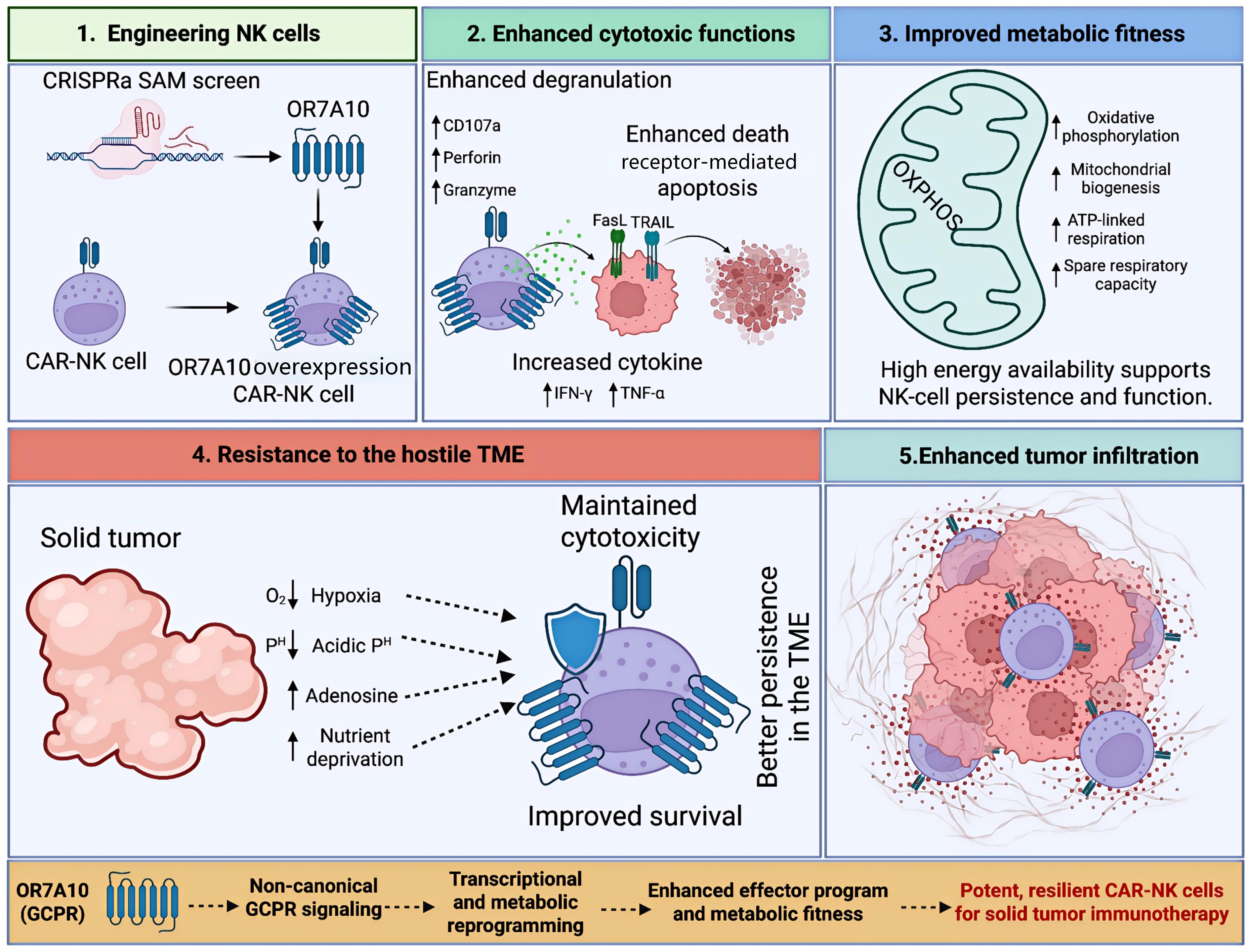
Figure 1.
OR7A10 engineering enhances CAR-NK cell effector function, metabolic fitness, and resistance to the tumor microenvironment. Schematic illustration showing the therapeutic impact of OR7A10 overexpression in CAR-NK cells. (1) A CRISPRa SAM screening strategy identified OR7A10 as a candidate GPCR for NK-cell engineering, leading to the generation of OR7A10-overexpressing CAR-NK cells. (2) OR7A10-engineered CAR-NK cells exhibit enhanced cytotoxic activity characterized by increased degranulation markers (CD107a), elevated perforin and granzyme release, enhanced death receptor–mediated apoptosis through FasL/TRAIL signaling, and increased cytokine secretion including IFN-γ and TNF-α. (3) OR7A10 expression promotes improved metabolic fitness through increased oxidative phosphorylation (OXPHOS), mitochondrial biogenesis, ATP-linked respiration, and spare respiratory capacity, thereby supporting sustained NK-cell persistence and function. (4) OR7A10-engineered CAR-NK cells demonstrate resistance to the hostile tumor microenvironment (TME), maintaining cytotoxicity and survival under conditions of hypoxia, acidic pH, elevated adenosine, and nutrient deprivation, resulting in improved persistence within the TME. (5) Enhanced tumor infiltration by OR7A10-overexpressing CAR-NK cells facilitates improved antitumor activity in solid tumors. Collectively, OR7A10-mediated non-canonical GPCR signaling drives transcriptional and metabolic reprogramming, leading to enhanced effector function, metabolic resilience, and the generation of potent CAR-NK cells for solid tumor immunotherapy.
-
Although the study identified OR7A10 as a potent enhancer of CAR-NK cell function, the precise molecular mechanisms underlying its activity remain incompletely understood. As a member of the olfactory receptor family within the GPCR superfamily, OR7A10 may engage non-canonical signaling pathways distinct from classical odorant-mediated GPCR activation. Interestingly, Yang et al.[1] demonstrated that OR7A10 overexpression was associated with reduced basal cAMP and PKA activity despite partial dependence on GNAS signaling, suggesting the involvement of complex or alternative downstream signaling mechanisms rather than conventional Gαs-coupled GPCR activation. Furthermore, enhanced ERK1/2 phosphorylation and NF-κB activation observed in OR7A10-engineered CAR-NK cells indicate that OR7A10 may function through integrated signaling networks that coordinate immune activation, metabolic adaptation, and stress resistance within the TME.
Importantly, the marked enhancement in oxidative phosphorylation, spare respiratory capacity, mitochondrial biogenesis, cytokine secretion, and resistance to hypoxia, acidic pH, adenosine, and nutrient deprivation suggests that OR7A10 signaling may directly intersect with pathways regulating NK-cell metabolic fitness and mitochondrial homeostasis. These findings raise the possibility that OR7A10 may act as a metabolic checkpoint regulator capable of sustaining NK-cell effector programs under immunosuppressive conditions. In addition, OR7A10-mediated upregulation of cytotoxic mediators, including perforin, granzyme B, FasL, TRAIL, IFN-γ, and TNF-α, further supports a broader role in coordinating both transcriptional and functional reprogramming of NK cells. Nevertheless, the endogenous ligands activating OR7A10 in immune cells remain unknown, and future studies employing phosphoproteomics, ligand screening, metabolomics, CRISPR perturbation approaches, and single-cell transcriptomic analyses will be essential to fully delineate the downstream signaling architecture and therapeutic potential of OR7A10 in NK-cell immunotherapy.
-
In vivo experiments utilizing colorectal tumor-bearing mice indicated that OR7A10-overexpressing CAR-NK cells appreciably lowered tumor volume over the experimental period. Survival analysis showed marked advancement, with nearly all mice receiving OR7A10-overexpressing cells surviving through the study endpoint, compared to significantly lower survival in control groups. These results provide convincing preclinical confirmation, encouraging the translational potential of OR7A10-enhanced CAR-NK cells for solid tumor therapy.
-
These findings denote a paradigm shift from conventional knockout-based NK cell engineering strategies toward activation-based gene discovery. The identification of OR7A10 as a potent enhancer of CAR-NK cell fitness across cytolytic activity, metabolic flexibility, and TME resistance opens new opportunities for next-generation cellular immunotherapy against solid malignancies.
Several considerations merit attention as this work improves toward clinical translation. The lack of isotype controls in certain metabolic experiments announces potential confounders. The specificity of SAM-mediated stimulation, given the prospect of turning on genes within numerous kilobases of the target promoter, should be addressed through complementary ORF-based overexpression studies. The limit in vivo durability of NK cells remains a concern; co-expression of IL-15 in the following construct recapitulations may address this limitation. Excitingly, the argument that solid tumors, being localized masses, may be more responsive to short-lived but potent NK cell-mediated approval compared to disseminated hematological malignancies is a convincing premise securing clinical investigation[14].
In future work, it will be important to better understand the signaling pathways driven by OR7A10 using detailed phosphoproteomic and transcriptomic analyses. At the same time, the construction design can be further improved by incorporating cytokine support elements. Long-term in vivo studies will also be needed to assess both safety and therapeutic durability in more advanced preclinical models. Importantly, the consistent activity observed across different donors and tumor types suggests that OR7A10 could be a strong candidate for developing off-the-shelf CAR-NK therapies.
-
Not applicable.
-
The authors confirm their contributions to the paper as follows: conception, manuscript revision and supervision: Marepally S; manuscript preparation: Rachamala H, Vetrivel P, Marepally S; figure creation: Rachamala H; funding acquisition: Marepally S. All authors reviewed the results and approved the final version of the manuscript.
-
Data sharing is not applicable to this commentary as no datasets were generated or analyzed.
-
The authors declare no conflict of interest.
- Copyright: © 2026 by the author(s). Published by Maximum Academic Press on behalf of China Pharmaceutical University. This article is an open access article distributed under Creative Commons Attribution License (CC BY 4.0), visit https://creativecommons.org/licenses/by/4.0/.
-
About this article
Cite this article
Rachamala HK, Vetrivel P, Marepally S. 2026. Enhancing the fitness of NK cell via olfactory receptor OR7A10: a novel strategy to improve immune therapy for solid tumors. Targetome 2(3): e023 doi: 10.48130/targetome-0026-0022 

Enhancing the fitness of NK cell via olfactory receptor OR7A10: a novel strategy to improve immune therapy for solid tumors
- Received: 26 March 2026
- Revised: 20 May 2026
- Accepted: 27 May 2026
- Published online: 17 June 2026
Abstract: Chimeric antigen receptor (CAR)-based adoptive cell therapies have displayed outstanding efficacy in hematological malignancies; in spite of this, success in solid tumors remains limited. Natural killer (NK) cells have arisen as an encouraging alternative to T cells for cancer immunotherapy owing to their innate cytotoxic capability, negligible risk of graft-vs-host disease (GVHD), and lowered cytokine release syndrome (CRS). Regardless of these improvements, NK cell therapies face substantial challenges in the solid tumor setting, with an immunosuppressive tumor microenvironment (TME), inadequate persistence, and poor metabolic fitness. In a recently published study, Yang et al. utilized a CRISPR-based Synergistic Activation Mediator (SAM) screen to find novel genetic targets capable of improving NK cell anti-tumor function. Using an in vivo screening approach with over 70,000 guide RNAs in an NK92 cell line model bearing colorectal tumors, the investigators identified olfactory receptor OR7A10 as a top-ranked candidate gene. Consequent validation in primary NK cells and third-generation CAR-NK constructs demonstrated that OR7A10 overexpression significantly boosted cytolytic activity among multiple solid tumor types, enriched metabolic fitness through increased oxidative phosphorylation and mitochondrial biogenesis, and conferred resistance to the hostile TME. These results acknowledged OR7A10 as a novel molecular target for engineering next-generation CAR-NK cell products with improved anti-tumor efficacy in solid malignancies[
-
Key words:
- NK cells /
- CAR-NK /
- Solid tumors /
- CRISPR activation screen /
- OR7A10 /
- Olfactory receptor /
- Tumor microenvironment /
- Immunotherapy /
- Metabolic fitness