










-
The concept of the tumour microbiota, which specific bacteria do not merely colonise but actively drive malignant transformation, has shifted from a provocative hypothesis to established biology over the past two decades. Among the growing cast of microbial oncobionts implicated in colorectal cancer (CRC), enterotoxigenic Bacteroides fragilis (ETBF) occupies a singular position. Its entire oncogenic programme is mediated by a single ~21-kDa zinc-dependent metalloprotease, the B. fragilis toxin (BFT; fragilysin), making it one of the most tractable systems available for dissecting how a commensal bacterium becomes a carcinogenic agent[1]. ETBF colonisation is detectable in a substantial proportion of patients with early-stage colorectal neoplasia[2,3] and drives tumorigenesis in experimental models through BFT-mediated cleavage of the E-cadherin ectodomain on colonic epithelial cells[4], triggering barrier disruption, mucosal T helper Type 17 inflammation and Wnt/β-catenin activation in a pro-carcinogenic cascade[5]. Despite nearly three decades of investigation, the identity of the epithelial receptor through which BFT first engages the colonocyte surface remained unknown[6,7], a gap that constrained both mechanistic understanding and any rational approach to therapeutic targeting.
A study published in Nature in April 2026 by White et al.[8] closes this gap. Using a genome-wide CRISPR knockout screen, the authors identify claudin-4 as the primary BFT receptor and show that receptor engagement is not merely an anchoring event but is mechanistically instructive. Claudin-4 recruits BFT to the plasma membrane, enabling it to access a sterically constrained, membrane-proximal substrate. The work resolves a longstanding question in bacterial pathogenesis, defines a druggable interface within the ETBF targetome, and illuminates a new dimension of how commensal bacteria co-opt host epithelial architecture to drive oncogenesis (Fig. 1).
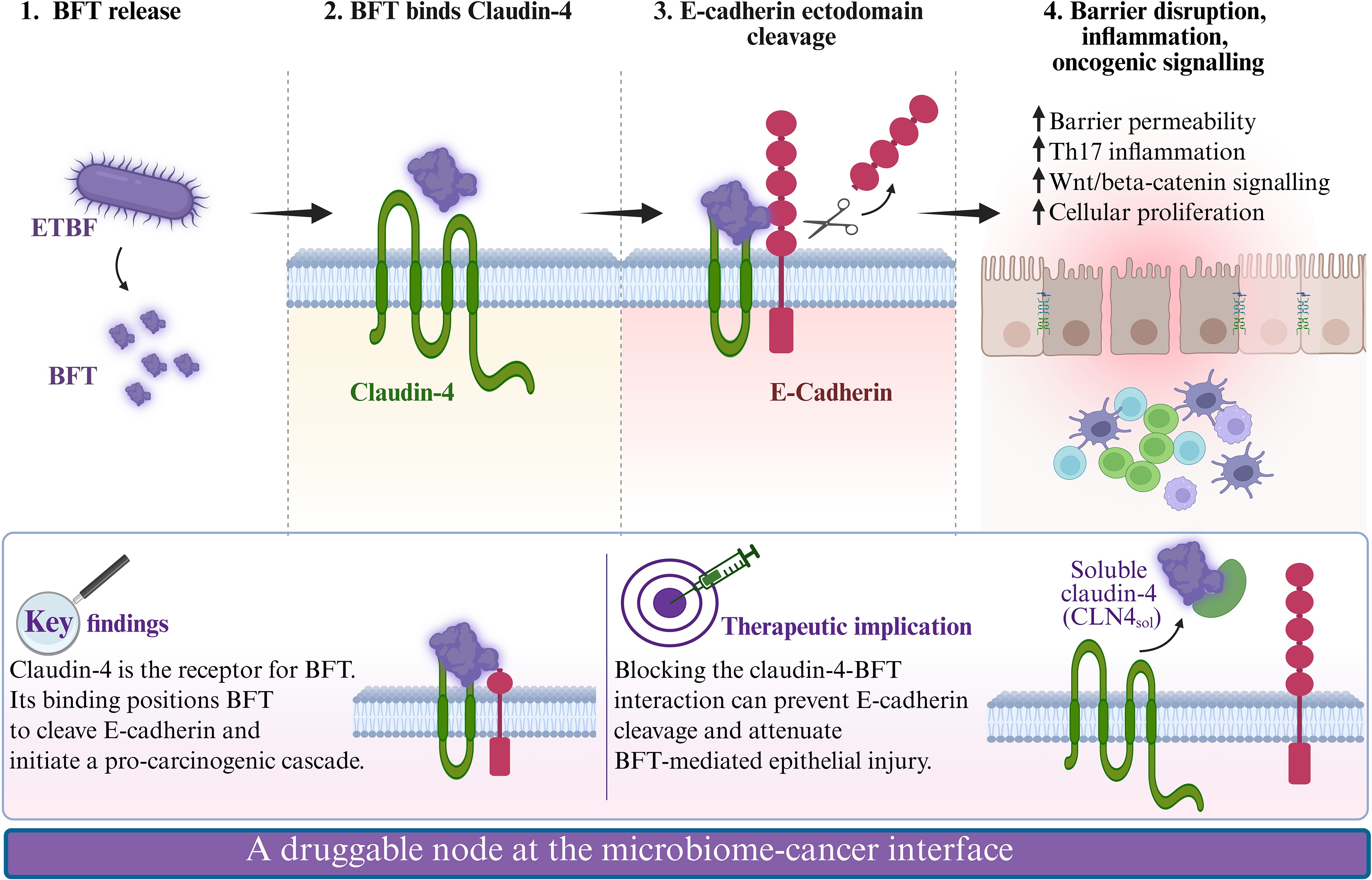
Figure 1.
Claudin-4 is the receptor that enables B. fragilis toxin to cleave E-cadherin and drive colorectal oncogenesis. (1) Enterotoxigenic B. fragilis (ETBF) secretes the metalloprotease B. fragilis toxin (BFT; fragilysin). (2) BFT binds claudin-4 on colonic epithelial cells, positioning its active site at the membrane. (3) This directs BFT to a membrane-proximal but otherwise inaccessible cleavage site in the E-cadherin ectodomain, releasing the soluble E-cadherin ectodomain. (4) Loss of E-cadherin adhesion disrupts barrier integrity and drives a pro-carcinogenic cascade of increased permeability, Th17 inflammation, Wnt/β-catenin activation and proliferation. Blocking the claudin-4–BFT interaction with the soluble claudin-4 analogue (CLN4sol), prevents E-cadherin cleavage and attenuates BFT-mediated epithelial injury, marking the interface as a druggable node at the microbiome–cancer interface. Created in BioRender.
https://BioRender.com/ibajvho
HTML
-
Prior genome-wide clustered regularly interspaced short palindromic repeat (CRISPR) screens for bacterial toxin receptors, including those identifying tissue factor pathway inhibitor (TFPI) as a receptor for Clostridioides difficile TcdB[9] and Frizzled proteins as TcdB co-receptors[10], have relied on toxin-induced cell death to enrich for resistant knockout populations. BFT does not kill colonocytes, which had historically made this approach inapplicable. White et al.[8] circumvented this by using the primary measurable consequence of BFT's activity, surface E-cadherin shedding, as their selection readout, isolating BFT-resistant cells that retain surface E-cadherin via fluorescence-activated cell sorting. The reformulation selects directly for the molecular phenotype of interest rather than an indirect surrogate and offers a transferable template for receptor discovery across epithelial-targeting bacterial toxins that modify rather than kill their host cells.
Two independent screen replicates converged on claudin-4 as the dominant hit. Validation confirmed that claudin-4 knockout confers approximately 20-fold resistance to BFT-mediated E-cadherin cleavage, rising to approximately 500-fold resistance in claudin-3/claudin-4 double-knockout cells, indicating partial functional redundancy between these highly homologous family members[11]. Claudin-4's emergence as a receptor for a second distinct bacterial toxin class, alongside its established role as the receptor for Clostridium perfringens enterotoxin (CPE)[11,12], underscores the accessibility of this tight junction protein to luminal pathogens and positions it as a recurring vulnerability at the host–microbiome interface. From a tumour microbiota perspective this is notable. Claudin-4's expression is dysregulated in CRC[13], raising the possibility that oncogenesis itself may modulate epithelial susceptibility to BFT, a form of microenvironmental feed-forward axis that warrants direct investigation.
-
The most conceptually significant contribution of White et al.[8] is not receptor identification per se but the mechanism it reveals. BFT is a structural xenolog of the mammalian ADAM (a disintegrin and metalloproteinase) family, most likely acquired through horizontal gene transfer from an intestinal host cell[14]. Yet despite this homology with a class of enzymes that cleave E-cadherin directly, purified BFT has consistently failed to cleave E-cadherin in cell-free systems, an incongruity that sustained competing mechanistic models for decades. The authors resolved this using a reductionist 293T cell system devoid of endogenous claudins and surface E-cadherin. Co-expression of claudin-4 with E-cadherin reconstitutes full BFT-mediated ectodomain shedding, whereas E-cadherin alone produces no detectable cleavage even at high toxin concentrations. Claudin-4 binding is indispensable for BFT's proteolytic activity at the cell surface.
AlphaFold 3 modelling of the claudin-4–BFT–E-cadherin ternary complex[15] predicts that claudin-4 anchors BFT at the membrane's surface, directing its active site towards the membrane-proximal linker between E-cadherin extracellular domain 5 and the transmembrane helix, a site that is inaccessible to a freely diffusing protease. Mutagenesis experiments corroborate this model. Shifting the cleavage site towards the membrane impairs BFT's activity more than equivalent distal deletions, consistent with steric constraints on active-site positioning at the lipid bilayer. This maps directly onto the biology of the mammalian sheddase ADAM10, whose substrate selectivity for N-cadherin and Notch is governed by engagement with specific tetraspanin proteins that provide analogous spatial orientation at the membrane[16]. The convergence is remarkable: a bacterially encoded ADAM xenolog uses a tight junction protein of the host as a membrane-positioning scaffold and mirrors the tetraspanin-guided mechanism of its mammalian counterpart. This raises broader questions about whether receptor-guided membrane positioning is a general mechanism among gut bacterial metalloproteases.
A single substitution, namely threonine to asparagine at Position 45 within Extracellular Segment 1, the sole residue difference between claudin-4 and claudin-3 at this site, completely abrogates stable BFT binding. Structural characterisation of the native BFT–claudin-4 complex, which the AlphaFold model does not resolve, is the most pressing experimental priority. From the perspective of the tumour microbiota field, understanding how this interface is shaped by the colonic microenvironment, where claudin's expression, tight junction organisation and membrane composition are all altered in neoplastic tissue, will be essential to understanding the full oncogenic relevance of BFT–claudin-4 engagement.
-
The therapeutic implications are most compelling when viewed through the lens of the microbiome–cancer field. Despite growing epidemiological and mechanistic evidence for the oncogenic roles of bacteria such as ETBF, Fusobacterium nucleatum and pks+ Escherichia coli, the field to date has lacked structurally defined, mechanistically validated drug targets at which microbial oncogenesis can be pharmacologically interrupted. The claudin-4–BFT interface, characterised here with a degree of molecular resolution not previously achieved for any oncobiont–host interaction, fills this gap.
White et al.[8] demonstrated proof-of-concept for therapeutic claudin-4 blockade using CLN4sol, a computationally designed soluble claudin-4 analogue displaying native extracellular segments. In murine caecal injection experiments, co-administration of CLN4sol significantly attenuated BFT-mediated epithelial cell shedding, submucosal oedema and E-cadherin degradation compared with a nonbinding control analogue. These are acute experiments in an anatomically constrained system and do not model chronic ETBF colonisation driving progressive neoplastic change. Nevertheless, the argument for selectively targeting the receptor-binding interface rather than the BFT catalytic site is persuasive. Claudin-4 blockade would neutralise a bacterially deployed metalloprotease with no physiological substrate role in the healthy host, leaving endogenous ADAM biology intact.
This therapeutic logic is substantially de-risked by the precedent of targeting other members of the claudin family. Zolbetuximab, an antibody against the related family member claudin-18.2, was approved in 2024 for claudin-18.2-positive gastric and gastroesophageal junction cancer after demonstrating a survival benefit in two Phase III trials[17,18]. The fact that a claudin family member is now a first-in-class approved oncology target strengthens confidence that claudin-4 itself is druggable. It also sets a cautionary expectation. Zolbetuximab's principal adverse effects are gastrointestinal, arising because claudin-18.2 retains physiological function in normal gastric mucosa even though it is more accessible on transformed or toxin-engaged cells. Claudin-4 performs an essential sealing function in tight junctions across the gut, kidney and lung, so any anti-claudin-4 strategy directed at BFT should anticipate, and design around, a similar tolerability ceiling.
The broader clinical implications extend beyond ETBF biology. ETBF colonisation is associated with early colorectal neoplasia[2,3] and, following lamina propria niche acquisition[19], represents a persistent oncogenic stimulus that is amenable to early intervention. A claudin-4-based neutralisation strategy could be positioned within a microbiome-informed chemoprevention framework for ETBF-colonised individuals at an elevated CRC risk, a group that may be prospectively identifiable through stool-based microbiome profiling integrated with existing CRC surveillance programmes. The observation that BFT activates Notch signalling in breast cancer cells[20] further suggests that the claudin-4-dependent BFT substrate repertoire extends beyond colonic E-cadherin, with potential relevance to ETBF's role in breast tumorigenesis and metastatic progression, a question now directly addressable in claudin-4-competent versus claudin-4-deficient systems.
Table 1 synthesises the current evidence, principal knowledge gaps and translational priorities across each of these areas, from receptor biology to therapeutic translation and precision prevention.
Table 1. From claudin-4 receptors' discovery to therapeutic translation: current evidence, knowledge gaps and future priorities.
Area Current evidence Knowledge gap Translational/future opportunity BFT receptor biology Claudin-4 is the primary epithelial receptor for BFT; claudin-3 provides partial functional redundancy The structural basis of native BFT/claudin-4 recognition remains unresolved Structural definition of the interaction could guide selective inhibitors E-cadherin cleavage Claudin-4 positions BFT to access a membrane-proximal E-cadherin cleavage site The full repertoire of BFT substrates remains unclear Define additional claudin-4-dependent epithelial substrates Epithelial barrier injury BFT-mediated E-cadherin cleavage promotes epithelial shedding and barrier disruption The consequences of chronic/repeated toxin exposure remain poorly defined Long-term organoid and chronic colonisation models Inflammation and oncogenic signalling ETBF/BFT is associated with Th17 inflammation, Wnt/β-catenin activation and epithelial proliferation The contribution of the claudin-4/BFT axis to tumour initiation versus progression is unresolved Genetically engineered and tumour-prone in vivo models Claudin-4 in CRC Claudin-4 expression is dysregulated in colorectal cancer Whether tumour-associated changes in claudin-4 alter susceptibility to BFT is unknown Patient-derived tissues/organoids and molecular stratification Therapeutic blockade Soluble CLN4sol reduces BFT-mediated epithelial injury in an acute murine model Long-term efficacy, selectivity and safety have not been established Interface-selective antibodies, peptides or soluble receptor mimetics Safety Claudin-4 has important physiological epithelial barrier functions Systemic blockade could disrupt normal tight junction biology Selective blockade of BFT binding without interfering with physiological claudin-4 Precision prevention ETBF is associated with colorectal neoplasia and represents a potentially identifiable microbial risk factor Appropriate patient populations and predictive biomarkers remain undefined Integrate stool ETBF/BFT profiling with tissue biomarkers and CRC surveillance BFT, B. fragilis toxin; CLN4sol, soluble claudin-4 analogue; CRC, colorectal cancer; ETBF, enterotoxigenic B. fragilis.
-
Although the identification of claudin-4 as the receptor for BFT represents a major conceptual advance, several important biological and translational questions remain. First, the current evidence is derived largely from acute in vitro systems and short-term animal models, whereas ETBF-associated colorectal carcinogenesis is likely to be driven by chronic bacterial colonisation, sustained epithelial injury, persistent inflammation, immune remodelling and progressive tumour evolution. Future studies using long-term colonisation models, genetically engineered tumour-prone mice and patient-derived systems will be essential to determine how the claudin-4/BFT axis contributes to tumours' initiation and progression over time. Longitudinal studies will also help clarify whether ETBF acts as a true tumour initiator or primarily accelerates the disease in a susceptible host[21].
Second, the biological role of claudin-4 deserves further attention. Claudin-4 is not simply a passive docking receptor; it appears to act as a spatial organiser that positions BFT at the membrane to enable E-cadherin cleavage. This raises the broader possibility that bacterial metalloproteases may exploit the host's junctional proteins to achieve substrate selectivity.
Third, therapeutic targeting requires caution. Claudin-4 has important physiological roles in epithelial barrier function, including in the gut, kidney and lung. Any claudin-4-directed intervention would therefore need to selectively block toxin engagement without disrupting normal tight junctions' biology.
Finally, the concept of microbiome-directed chemoprevention is compelling but remains to be clinically defined. Future studies should establish which patient populations are most likely to benefit, including individuals with persistent ETBF colonisation, inflammatory bowel disease, hereditary colorectal cancer syndromes or other high-risk cohorts. Integration of stool-based microbiome profiling with tissue biomarkers, including claudin-4 expression and molecular signatures of BFT activity, may enable patient stratification and precision prevention strategies. Such approaches could ultimately transform ETBF from a mechanistic biomarker of colorectal carcinogenesis into a clinically actionable target for early intervention[22,23].
-
The identification of claudin-4 as the BFT receptor resolves a three-decade gap in bacterial pathogenesis, defines a mechanistically grounded therapeutic target and illuminates a new principle by which members of the tumour microbiota exploit the host's epithelial architecture. By establishing that receptor engagement directs a microbial metalloprotease to a membrane-proximal substrate via a strategy that converges with mammalian sheddase biology, White et al. placed BFT in an unexpectedly sophisticated mechanistic class and, with the claudin-18.2 precedent as a guide, provide the field with one of the strongest examples to date of how a microbiome–host interaction may be therapeutically targeted. The immediate priorities are the structural resolution of the native claudin-4-BFT complex and testing of claudin-4-blocking agents in physiologically relevant models of chronic ETBF colonisation. In a field that has long been richer in epidemiological association than in actionable molecular targets, this study marks a genuine translational inflection point.
-
Not applicable.
-
The authors confirm contributions to the work as follows: manuscript conception and writing: Monaghan TM; figure preparation: Hatziapostolou M; manuscript revision: Polytarchou C, Hatziapostolou M, Nateri AS. All authors reviewed and approved the final version of the manuscript.
-
Data sharing is not applicable to this commentary as no datasets were generated or analyzed.
-
The authors have no conflict of interest to declare.
- Copyright: © 2026 by the author(s). Published by Maximum Academic Press on behalf of China Pharmaceutical University. This article is an open access article distributed under Creative Commons Attribution License (CC BY 4.0), visit https://creativecommons.org/licenses/by/4.0/.
Monaghan TM, Polytarchou C, Hatziapostolou M, Nateri AS. 2026. Claudin-4 as the molecular gateway to Bacteroides fragilis toxin-driven oncogenesis: implications for the microbiome–cancer targetome. Targetome 2(5): e052 doi: 10.48130/targetome-0026-0051


|