











-
Floral design has long been recognized for its artistic, cultural, and economic significance, contributing to aesthetic enhancement, emotional well-being, and the broader horticultural industry[1]. Despite its value, the floristry industry faces several critical challenges threatening its growth and sustainability. Among these concerns are declining enrollment in academic programs, leading to fewer trained professionals entering the workforce[2−8], an aging workforce[9], and intensified competition from supermarkets and online retailers[10]. According to the US Bureau of Labor Statistics (2024), employment for floral designers is projected to decline by 10% between 2023 and 2033, further exacerbating labor shortages and skill gaps in the industry[11].
The floristry workforce is undergoing a generational shift, with many experienced professionals nearing retirement while fewer young professionals are entering the field[9]. This generational gap presents long-term sustainability risks, as the floristry sector struggles to maintain a skilled workforce capable of adapting to evolving market demands. Without targeted interventions, these trends may lead to diminished industry competitiveness, skill erosion, and lower professional standards. Meanwhile, consumer purchasing behavior is shifting due to the rise of online floral retailers, supermarket floral departments, and DIY floral arrangement trends[10]. While these alternative retail channels offer convenience and affordability, they have also contributed to a decline in demand for professional floral design services, placing additional financial strain on traditional florists, whose competitive advantage relies on artisanal craftsmanship and personalized service[10,12].
Unlike other skilled trades that offer structured qualification pathways, floral design in the United States lacks a universally recognized system for education, certification, and career progression. This absence makes it challenging for aspiring floral designers to navigate their professional development and for employers to assess competency levels when hiring or promoting employees. Addressing these industry-wide challenges requires a structured approach to workforce development, ensuring that training programs align with industry needs while providing clear career progression opportunities.
To bridge these gaps, Texas A&M University developed two comprehensive frameworks to provide structured training and career advancement pathways in floral design:
1. Educational and Career Pathways Framework: this system integrates all available training and certification options to provide a structured roadmap for individuals entering and advancing within the floral design profession (references, paper, dissertation). It highlights multiple entry and advancement pathways, including high school certification programs, community college and university degrees, vocational training, and industry-recognized credentials such as the Certified Floral Designer (CFD) and American Institute of Floral Designers (AIFD) designations[13−15].
2. The Occupational Skills Qualifications Framework: this model defines the core competencies, technical skills, and career progression levels for floral designers, ranging from junior designers to master floral designers. Adapted from international practices in vocational training from countries including the United Kingdom, Finland, India, and Singapore, this framework establishes clear benchmarks for skill development, job responsibilities, and career advancement[14,16].
Both frameworks serve as valuable resources for educators, employers, and policymakers, ensuring that floral design training programs align with industry needs and that aspiring designers can follow a structured progression toward professional excellence[17,18].
Recent studies underscore the importance of structured educational frameworks in supporting professional development and career sustainability, particularly in fields facing workforce shortages[19,20]. Structured career pathways not only enhance the quality of training but also facilitate professional identity formation, a key factor in attracting and retaining new talent[21−23]. By establishing clear milestones for career advancement, these frameworks address existing gaps in workforce development and provide a systematic approach to career progression and skills acquisition[20]. Unlike in other industries, where structured career frameworks have been widely implemented, U.S. floristry lacks an officially recognized system. Establishing such frameworks can enhance the credibility of floral design as a profession, making it easier for industry professionals to navigate multi-level roles requiring both creative expertise and business acumen[18].
This study aims to evaluate the practicality and applicability of the educational and occupational frameworks through evaluation and feedback from industry professionals. Specifically, this research seeks to:
1. Evaluate the relevance of these frameworks' core competencies in aligning with industry practices.
2. Measure the level of interest among stakeholders in adopting these frameworks as tools for career development and training.
3. Identify potential areas for refinement to ensure the frameworks effectively meet the needs of the floristry sector.
By addressing these objectives, this research contributes to the development of comprehensive strategies that support workforce growth, professionalization, and long-term industry sustainability. Establishing a clear and structured educational and career trajectory for floral designers will help attract new talent, enhance training effectiveness, and ensure that florists remain competitive in an evolving marketplace.
-
To evaluate the practicality and adoption potential of the Educational and Career Pathways Framework and the Occupational Skills Qualifications Framework, a comprehensive survey instrument was developed and distributed among accredited members of the American Institute of Floral Designers (AIFD). AIFD, established in 1965, is the premier professional organization in the floristry industry, globally recognized for setting the highest standards in floral artistry, education, and accreditation. The institute's rigorous certification process ensures that its accredited members represent the most skilled and knowledgeable professionals in floral design[13].
The survey was distributed via two channels to maximize participation. In-person distribution of 100 physical survey booklets at the AIFD National Symposium in Las Vegas, NV. Online dissemination via email to the entire AIFD membership, reaching 5,558 recipients. The estimated survey completion time was 13 min, and all participants provided informed consent prior to participation. The online survey was developed and administered using Qualtrics Software (Qualtrics, Provo, UT). Before implementation, the study was reviewed and approved by the Texas A&M University Institutional Review Board (IRB2018-0849) to ensure compliance with ethical research guidelines.
The survey instrument consisted of four comprehensive sections:
1. Framework Presentation: participants were introduced to the educational and career pathways framework and the occupational skills qualifications framework. The participants were provided with an overview of the frameworks' purpose, structure, and intended applications[14,16].
2. Competency Evaluation: respondents assessed the importance of ten skill sets across four floral designer qualification levels[14,16] using a 7-point Likert scale.
Floral Designer Qualification Levels[14,16]
Junior Floral Designer: entry-level position focused on basic floral design tasks, such as assembling pre-designed arrangements and maintaining floral materials.
Floral Designer: skilled professional responsible for creating a variety of floral arrangements, managing customer service, and applying advanced design techniques.
Senior Floral Designer: experienced designer with leadership responsibilities, capable of designing complex arrangements, managing business operations, and mentoring junior designers.
Master Floral Designer: highly skilled expert with extensive technical knowledge, capable of innovative floral designs, trendsetting, and industry leadership.
Ten Core Competencies Assessed[14,16]
Horticultural Sciences: understanding plant materials, care, and seasonality.
Floristry Practices: techniques for handling and preserving floral materials.
Floral Design Skills: application of design principles and techniques.
Artistic Design Skills: integration of fine arts, architecture, and photography into floral compositions.
Customer Service Skills: managing customer expectations and sales.
Event Planning and Designing Skills: coordinating floral designs for events.
Business Skills: managing floral businesses, marketing, and finance.
Professional Presentation Skills: showcasing designs at events and exhibitions.
Education and Training: continuing education and mentoring.
Support Services: maintaining floral tools, supplies, and operations
3. Framework Utilization: participants rated the likelihood of adopting the frameworks in their businesses using a 5-point Likert scale (1 = 'Very unlikely' to 5 = 'Very likely'). Open-ended questions allowed respondents to provide qualitative feedback on framework improvements.
4. Demographic Data: the final section gathered respondent characteristics, including gender, age, education level, industry experience, and job roles.
-
Of the 5,558 recipients of the online survey, 1,640 (29.5%) opened the survey email, indicating a respectable open rate for email-based distributions. Among these, 302 recipients (18.4%) clicked the survey link, demonstrating engagement with the study. A total of 143 complete responses were collected, consisting of 123 online submissions and 20 in-person responses. The survey completion rate among those who clicked the link was 40.7%, indicating that nearly half of the engaged participants fully completed the survey (Table 1). The click-through and completion rates suggest that the survey was well-structured and engaging, effectively capturing industry perspectives on framework adoption.
Table 1. Engagement funnel breakdown of the floristry industry online survey sent to American Institute of Floral Designers (AIFD) members evaluating the Educational and Career Pathways and Occupational Skills Qualifications frameworks.
Stage Recipients % Progression Total emails sent 5,558 100% Emails opened 1,640 29.5% Clicked on the survey link 302 18.4% of openers Completed responses 123 40.7% of those who clicked Demographic characteristics
-
The respondent pool represented a diverse cross-section of the floral industry, including varied experience levels, job roles, and geographic locations (Table 2). The majority of survey respondents were female, accounting for 74.8% of the total sample, while 25.2% were male. The respondents covered a broad range of age groups. The largest segment, 38.5%, was between 51 and 60 years old, followed by 28.7% in the 61–70 age range. Those aged 41–50 accounted for 15.4%, while 10.5% were between 31–40 years old. The 18–30 age group represented 5.6%, and 1.4% of respondents were 71 years or older. Among the respondents, 38.5% held a bachelor's degree, while 22.4% had some college education but no degree. A graduate-level degree was reported by 19.6% of respondents. Associate degrees and high school diplomas/GEDs were each held by 9.8% of participants. The largest segment of respondents, 31.5%, had 31–40 years of experience in the floral industry. Those with 41 or more years of experience accounted for 16.1%. Respondents with 21–30 years of experience made up 15.4%, while 14.7% reported 11–20 years of experience. Another 14.7% had been in the industry for 0–5 years, and 7.7% had 6–10 years of experience. The most commonly reported job role was retail florist (25.2%), followed by freelance floral designer (17.5%) and floral educator/researcher (16.1%). Floral managers and retail floral designers each represented 9.8% of respondents. Event-only florists accounted for 7.7%, while floral business owners made up 4.2% of the sample. Wholesale designers, suppliers, and other specialized roles each constituted less than 2% of the respondents. Survey participants represented 40 states across the United States, with 3.5% of respondents residing in Canada (Table 2).
Table 2. Socio-demographic breakdown of members of the American Institute of Floral Designers who responded to a floral industry survey evaluating the educational and occupational skill qualifications frameworks.
Demographic categories Count Count N % Gender Male 36 25.2% Female 107 74.8% Age 18−30 8 5.6% 31−40 15 10.5% 41−50 22 15.4% 51−60 55 38.5% 61−70 41 28.7% 71 or over 2 1.4% Education High school diploma or GED 14 9.8% Some college, no degree 32 22.4% Associate's degree 14 9.8% Bachelor's degree 55 38.5% Graduate degree 28 19.6% Job position in the floral industry (select the most appropriate position title) Wholesale floral designer 1 0.7% Retail floral designer 14 9.8% Freelance floral designer 25 17.5% Floral manager 14 9.8% Floral design educator/researcher 23 16.1% Retail florist 36 25.2% Wholesaler/importer 1 0.7% Supplier/manufacturer 2 1.4% Grower 1 0.7% Event-only florist 11 7.7% Studio florist 2 1.4% Floral business owner 6 4.2% Others 7 4.9% Working experience in the floral industry (years) 0−5 21 14.7% 6−10 11 7.7% 11−20 21 14.7% 21−30 22 15.4% 31−40 45 31.5% 41 or over 23 16.1% Perceived importance of core competencies
-
The study identified ten core competencies as essential to the Occupational Skills Qualifications Framework. To assess their significance, respondents rated each competency based on its importance across four floral designer levels—junior floral designer, floral designer, senior floral designer, and master floral designer—using a 7-point Likert scale (1 = 'Not at all important', 7 = 'Extremely important'). The study identified ten core competencies integral to the occupational skill qualifications framework[13]. Respondents evaluated these competencies' importance across four floral designer levels—junior floral designer, floral designer, senior floral designer, and master floral designer—using a 7-point Likert scale (1 = 'not at all important', 7 = 'extremely important').
For junior floral designers, customer service skills were rated as the most critical competency (mean score: 6.1), followed by floristry practices (5.6), support services (5.5), and floral design skills (5.4). Competencies such as design skills (4.8), horticultural sciences (4.6), education and training (4.6), and business skills (4.2) were assigned moderate importance. The lowest-rated competencies for this group were professional presentation skills (3.8) and event planning/designing skills (3.5) (Table 3).
Table 3. Importance ratings of core competencies applicable to junior floral designers based on responses to a floristry industry survey evaluating the educational and occupational skills frameworks via a balanced Likert scale with ratings ranging from: 1 = Not at all important, to 7 = Extremely important.
Core knowledge
and skillsNumber Mean Std Dev F test
(p-value)zJunior Floral Designer Customer Services 143 6.0839 a 1.1290 Floristry Practices 143 5.6224 ab 1.3830 Support Services 143 5.5455 ab 1.3621 Floral Design Skills 143 5.3846 bc 1.4483 Design Skills 143 4.8042 cd 1.6795 Horticultural Sciences 143 4.5874 d 1.6373 Education and Training 143 4.5524 d 1.8677 Business Skills 143 4.2378 de 1.7073 Professional Presentation Skills 143 3.8252 ef 1.9728 Event Planning and Designing Skills 143 3.4895 f 1.7757 38.4332
(< 0.0001**)Floral Designer Floral Design Skills 143 6.5315 a 0.6587 Design Skills 143 6.2448 a 0.9361 Floristry Practices 143 6.2168 a 0.8892 Customer Services 143 6.2098 a 0.9483 Support Services 143 5.7343 b 1.1066 Event Planning and Designing Skills 143 5.6434 b 1.1032 Business Skills 143 5.5734 b 1.2361 Horticultural Sciences 143 5.4336 b 1.3192 Education and Training 143 5.4196 b 1.5941 Professional Presentation Skills 143 4.8881 c 1.8992 24.2116
(< 0.0001**)Senior Floral Designer Floral Design Skills 143 6.7413 a 0.5401 Customer Services 143 6.5804 ab 0.6860 Design Skills 143 6.5734 ab 0.6660 Event Planning and Designing Skills 143 6.4755 abc 0.7490 Floristry Practices 143 6.4755 abc 0.8034 Education and Training 143 6.3846 bc 0.8469 Professional Presentation Skills 143 6.3147 bc 1.0576 Business Skills 143 6.2238 cd 0.7638 Support Services 143 6.1889 cd 0.8717 Horticultural Sciences 143 5.9301 d 1.2256 11.0482
(< 0.0001**)Master Floral Designer Design Skills 143 6.8811 a 0.4194 Floral Design Skills 143 6.8741 ab 0.5798 Event Planning and Designing Skills 143 6.7413 abc 0.5530 Floristry Practices 143 6.7413 abc 0.7191 Education and Training 143 6.6503 abc 0.7984 Professional Presentation Skills 143 6.5944 abc 1.0294 Customer Services 143 6.5804 bc 0.8592 Business Skills 143 6.5105 c 0.7587 Support Services 143 6.4755 c 0.9482 Horticultural Sciences 143 6.4615 c 1.0732 5.3069
(< 0.0001**)z Single (*) and double (**) asterisks are used to denote significance at the 0.05 and 0.01 levels, respectively. Levels not connected by the same letter are significantly different. For floral designers, floral design skills (6.5) and design skills (6.2) were the most valued, with customer service (6.2) and floristry practices (6.2) also receiving high ratings. Competencies of moderate importance included support services (5.7), event planning/designing skills (5.6), and business skills (5.6). Professional presentation skills (4.9) were ranked the lowest among competencies in this category (Table 3).
For senior floral designers, floral design skills (6.7), customer service (6.6), and design skills (6.6) were rated highest. Event planning/designing skills (6.5) and floristry practices (6.5) followed closely, along with education and training (6.4), professional presentation skills (6.3), and business skills (6.2). Horticultural sciences received the lowest mean score (5.9) (Table 3).
For master floral designers, all ten competencies were rated as highly important. Design skills and floral design skills received the highest scores (6.9), while event planning/designing skills, floristry practices, and education/training skills followed closely (6.7 each). Customer service and professional presentation skills were both rated at 6.6, while business skills, support services, and horticultural sciences each achieved 6.5 (Table 3).
Likelihood of Framework Adoption
-
The survey included a set of close-ended questions designed to assess industry professionals' likelihood of adopting the Educational and Career Pathways Framework and the Occupational Skills Qualifications Framework. A 5-point Likert scale was used, where 1 = 'Very unlikely' and 5 = 'Very likely'. Participants were asked to evaluate:
1. Educational and Career Pathways Framework – 'Please rate the likelihood that you might use the educational and career pathway framework in assisting individuals in identifying a promising field, guiding yourself for professional development, upskilling employees, and/or maintaining sustained growth of the industry'.
2. Occupational Skills Qualifications Framework – 'Please rate the likelihood of using the occupational skill qualifications framework in promoting the learning process and training investment, communicating expectations for skills, evaluating skills, education and training programs, and raising workforce skills for the industry'.
For the Educational and Career Pathways Framework, the mean likelihood rating was 4.2 (Fig. 1). The majority of respondents expressed positive adoption intent, with 41% selecting 'likely' and 39% selecting 'very likely'. Only 3% rated it as 'unlikely', and none selected 'very unlikely' (Fig. 2).
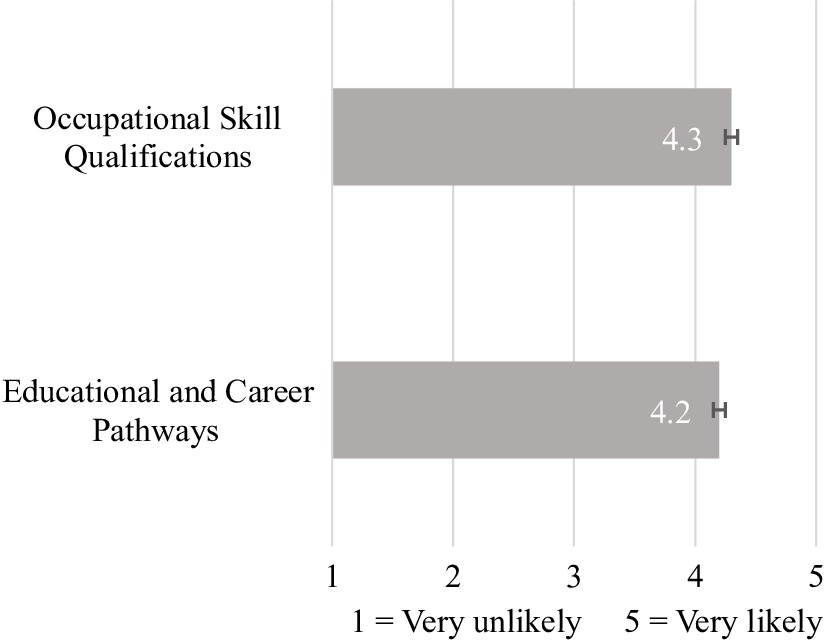
Figure 1.
Likert scale likelihood mean ratings of using the Educational and Career Pathways framework and the Occupational Skill Qualifications frameworks in the floristry industry survey across all respondents.
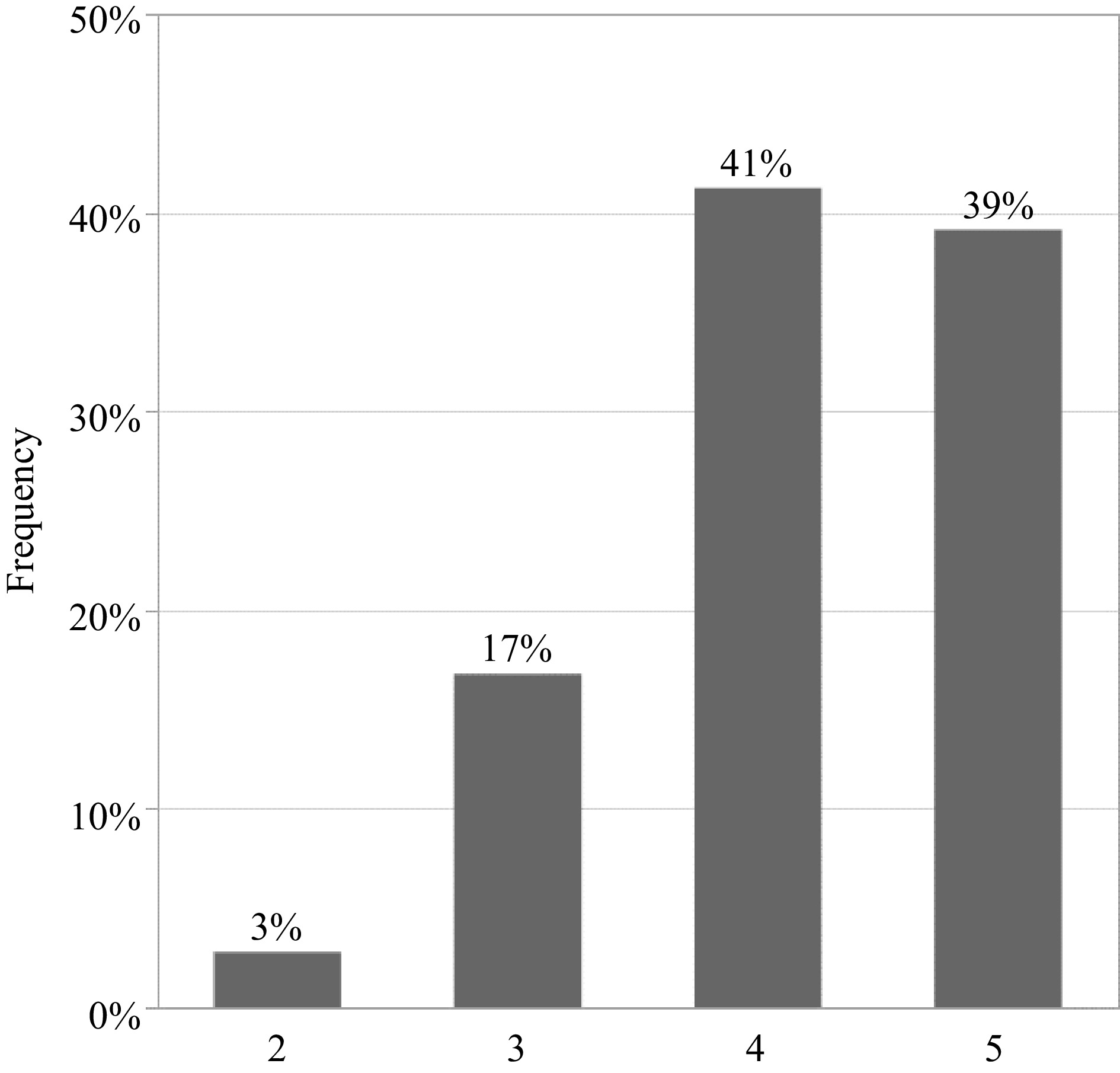
Figure 2.
Percentage distribution of respondents' likelihood (1 = Very unlikely, 5 = Very likely) to adopt the Educational and Career Pathways framework in the floristry industry survey.
For the Occupational Skills Qualifications Framework, the mean likelihood rating was 4.3 (Fig. 1), indicating a slightly higher adoption potential. Fifty percent of respondents selected 'likely', while 38% chose 'very likely'. Only 1% indicated 'unlikely', and none selected 'very unlikely' (Fig. 3).
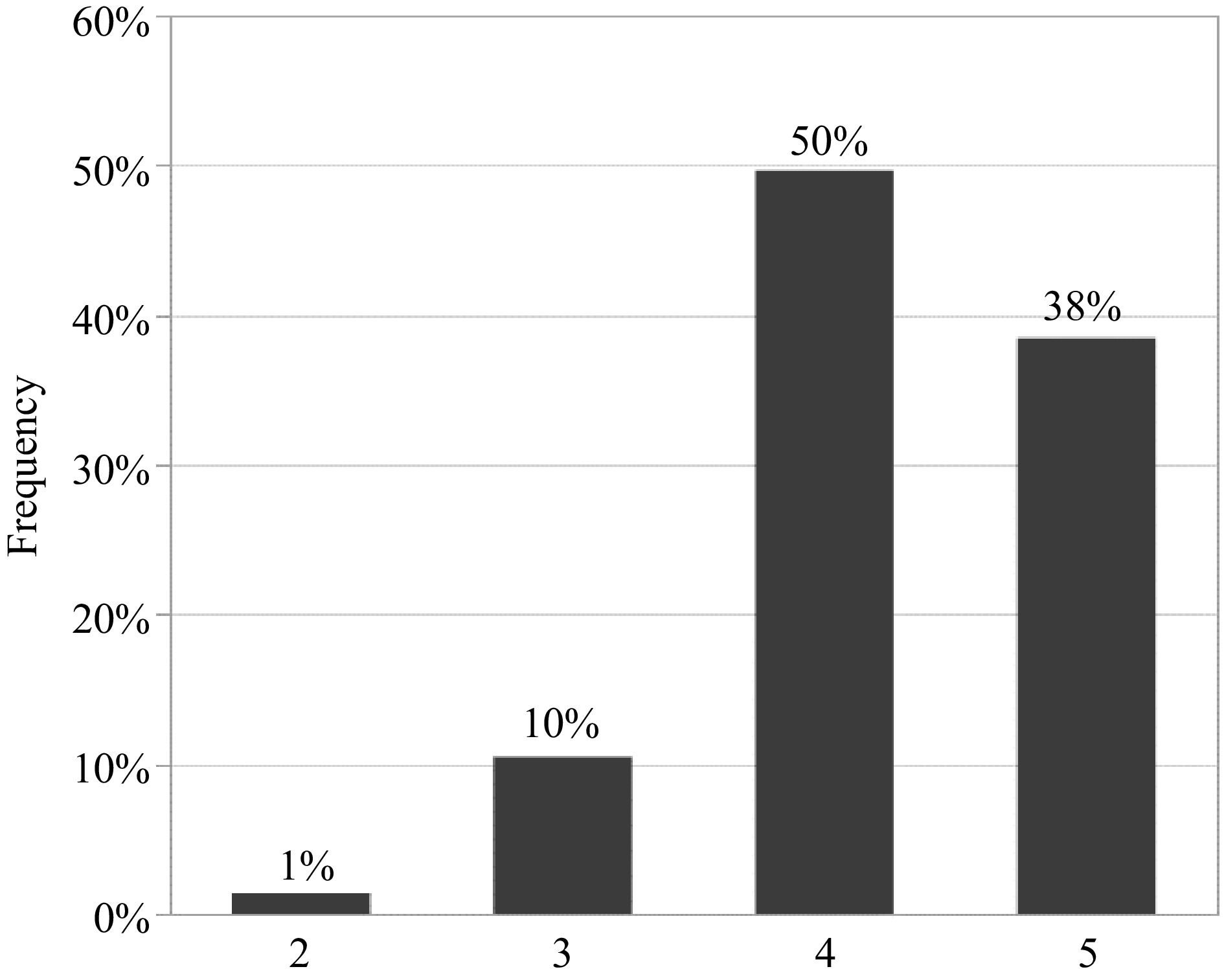
Figure 3.
Percentage distribution of respondents' likelihood (1 = Very unlikely, 5 = Very likely) to adopt the Occupational Skill Qualifications framework in the floristry industry survey.
Suggestions for improving the frameworks
-
Feedback from survey respondents highlighted strong support for the development of the two frameworks, with many expressing appreciation for their comprehensiveness and practicality. The frameworks were praised for encompassing all aspects of the floristry industry and for aligning closely with structured career progression levels. Respondents found the presentations well-structured, effectively outlining the steps necessary for professional success in floral design. In terms of practical application, respondents acknowledged the frameworks as valuable tools for mentoring new talent and supporting career development at all levels. While feedback was largely positive, several minor refinements were suggested to enhance clarity and effectiveness. Some respondents recommended incorporating additional explanations and examples to provide a clearer understanding of the framework's structure and objectives. Others suggested adjustments to language and phrasing to improve clarity, accessibility, and ease of interpretation. Additionally, participants emphasized the need for broader promotion and integration of the frameworks through partnerships with educational institutions, industry associations, and professional organizations to maximize awareness and adoption.
-
The demographic distribution of survey respondents provides key insights into potential challenges and opportunities for framework adoption (Table 2). With over two-thirds of respondents aged 51 or older, the floristry industry is characterized by an aging workforce, highlighting the urgent need for structured training programs to attract and retain younger professionals. The largest group of respondents (31.5%) had 31–40 years of industry experience, indicating that while seasoned professionals recognize the importance of formal career pathways, younger and less experienced designers may require additional resources and outreach efforts to fully engage with these frameworks. The relatively low representation of respondents under 30 (5.6%) further reinforces the importance of initiatives aimed at attracting younger individuals into the profession.
Variations in job roles further emphasize the potential impact of framework adoption across different industry segments (Table 2). The largest respondent groups—retail florists, freelance floral designers, and floral educators—are well-positioned to benefit from structured career pathways and competency benchmarks. However, given the high proportion of independent business owners and event-only florists, it is critical to ensure that the frameworks remain adaptable to diverse professional needs. Encouraging broader industry engagement through flexible training models and digital learning opportunities could help facilitate framework adoption across all floristry industry segments.
Survey respondents overwhelmingly validated the relevance of the core competencies, with floral design skills, customer service, and business acumen consistently rated as highly important across all career levels. The perceived importance of core competencies provides further insight into how skill priorities shift across career levels. For junior floral designers, customer service skills were rated the highest, emphasizing the critical role of client interaction and communication in early-stage career development. In contrast, master floral designers placed equal importance on technical expertise, event planning, business skills, and education and training, suggesting that leadership roles in the industry require a well-rounded skill set that extends beyond floral artistry (Table 3). These findings validate the structure of the Occupational Skills Qualifications Framework, ensuring that skill development aligns with career progression and the evolving responsibilities of floral professionals.
The findings of this study indicate strong industry support for both the Educational and Career Pathways Framework and the Occupational Skills Qualifications Framework, reinforcing their practical value in structuring career development and standardizing competency benchmarks (Figs 1−3). The high adoption likelihood ratings suggest that industry professionals recognize these frameworks as essential tools for professional growth, workforce training, and maintaining industry standards. The Occupational Skills Qualifications Framework received a high mean likelihood rating, reflecting its perceived importance in standardizing competencies and enhancing workforce training. The Educational and Career Pathways Framework also demonstrated strong adoption potential, particularly in guiding professional development and career advancement. These findings suggest that while both frameworks address critical industry needs, their effectiveness will depend on strategic implementation, industry engagement, and targeted training programs.
-
This study represents the final phase of a comprehensive research series aimed at developing and evaluating structured educational and occupational frameworks for the floristry industry. The findings confirm that the Educational and Career Pathways Framework and the Occupational Skills Qualifications Framework provide valuable, standardized approaches to workforce development, addressing key industry challenges such as career progression, mentorship, and skill standardization. The high likelihood of adoption among industry professionals underscores the urgent need for formalized training pathways that align with current market demands and workforce trends.
Despite strong industry support, successful implementation will require targeted refinements and expanded engagement efforts. Enhancing descriptive content, refining terminology for clarity, and strengthening outreach initiatives will be crucial in maximizing framework accessibility and long-term impact. Collaborations with educational institutions, industry organizations, and professional associations will further drive framework adoption and integration across different segments of the floristry industry.
As the final stage in this research series, this study provides a foundation for future investigations into framework implementation and long-term effectiveness. Future research should examine regional variations in adoption rates, assessing how geographic differences in training availability, industry structure, and workforce demographics influence framework integration. Additionally, longitudinal studies should explore the impact of framework adoption on career retention, skill development, and industry sustainability over time.
By addressing these critical aspects and leveraging strong industry endorsement, the floristry sector can establish a structured, sustainable, and professionally recognized career pathway, ensuring its continued evolution and competitiveness in a rapidly changing marketplace.
-
The authors confirm contribution to the paper as follows: study conception and design: Wu X, McKinley WJ, Hall CR; data collection: Wu X; analysis and interpretation of results: Wu X; draft manuscript preparation: Wu X. All authors reviewed the results and approved the final version of the manuscript.
-
The datasets generated during and/or analyzed during the current study are available from the corresponding authors upon reasonable request.
-
We want to acknowledge the Accredited Members of the American Institute of Floral Designers (AIFD) who provided valuable feedback for refining the proposed educational and occupational frameworks presented in this study.
-
The authors declare that they have no conflict of interest.
- Copyright: © 2025 by the author(s). Published by Maximum Academic Press, Fayetteville, GA. This article is an open access article distributed under Creative Commons Attribution License (CC BY 4.0), visit https://creativecommons.org/licenses/by/4.0/.
-
About this article
Cite this article
Wu X, McKinley WJ, Hall CR. 2025. Evaluating the practicality of the educational and occupational frameworks for floral designer education and training in the floristry industry. Technology in Horticulture 5: e021 doi: 10.48130/tihort-0025-0021 

Evaluating the practicality of the educational and occupational frameworks for floral designer education and training in the floristry industry
- Received: 26 December 2024
- Revised: 11 March 2025
- Accepted: 06 May 2025
- Published online: 06 June 2025
Abstract: The floristry industry faces enduring challenges, including an aging workforce, workforce shortages, and competition from mass-produced floral products. These challenges hinder the sector's growth and competitiveness. To address these issues, the Texas A&M University floral design team developed two comprehensive frameworks: an Educational and Career Pathways framework and an Occupational Skills Qualifications framework. These frameworks aim to support floral designer training and advancement. This study evaluates the practicality of these frameworks through feedback from industry professionals on the relevance of ten core competencies critical to various career levels in floral design. Survey findings indicate that 80% of respondents are inclined to adopt the educational framework, and 88% expressed interest in the occupational framework, recognizing their potential to standardize skills, enhance career development, and elevate professional standards. The frameworks show promise as tools to attract new talent and support sustained industry growth, positioning them as essential resources for strengthening the floristry industry.