











-
E-cigarettes are a growing global health concern, with the number of users nearly doubling from 58 million in 2018 to 114 million in 2023[1]. By comparison, adult e-cigarette use in the United States increased from 1.2% in 2017 to 4.1% in 2023[2], while in England, vaping use grew from 1.3% in 2013 to 10.0% in 2023[3], reflecting notable upward trends in both countries, highlighting the cross-national variability in prevalence. Often falsely marketed as 'harmless', 'trendy', and 'fragrant', e-cigarettes are especially appealing to youth and may serve as a trigger to start smoking[4]. Most hardcore smokers start smoking before the age of 20[5], and the early onset of tobacco smoking increases the risk of developing tobacco-related diseases[6].
China, as the largest country of tobacco consumption, had a relatively low adult e-cigarette use prevalence of 0.7% in 2022[7]. However, due to the country's large population base, even a modest prevalence may translate into a significant number of users, with approximately 30% being youth[8]. Notably, attempted use among middle school and university students reached 16.1% and 10.1% in 2021[9]. Although there was a slight decline to 13.5% among middle school students in 2023[10], the rate remains high, reflecting sustained interest and experimentation with e-cigarettes among youth. E-cigarettes remain affordable and accessible, further heightening concern over youth uptake[11]. The escalating experimentation among youth, and limited regulatory controls, make the case for urgent action to prevent e-cigarettes from encouraging early smoking.
-
Given these trends, concerns about the impact of e-cigarette use, particularly among youth, have grown significantly. E-cigarettes with sweet and fruity flavors are especially appealing to young consumers[12]. A recent survey conducted in Shenzhen, China, revealed that a significant proportion of e-cigarette users (44.7%) would consider quitting if flavored options were no longer available[13], while nearly half reported easy access to flavored e-cigarettes despite existing regulatory restrictions[13]. Youth are susceptible to misleading advertising and perceive e-cigarettes as less harmful, less addictive, and more popular than conventional cigarettes[14]. These misconceptions have been shown to increase susceptibility to e-cigarette use among youth[15]. Alarmingly, young people were found to be vulnerable to nicotine dependency, even with infrequent use[16].
Compounding these risks, social and psychological factors significantly drive the continued adoption of e-cigarettes among youth. Peer influence is pivotal, as youth are more likely to try e-cigarettes when offered by close friends, which normalizes usage within social circles[17]. Furthermore, youth often hold the misconception that e-cigarettes make them appear more attractive or help them feel more confident in social settings[17].
Compared to nonsmokers, e-cigarette users are at a higher risk of developing respiratory symptoms[18], potentially indicating long-term damage to lung function. These misperceptions and social influences not only encourage the initiation of e-cigarette use but also reinforce continued use, exacerbating long-term health risks.
Furthermore, there is growing concern about the illicit use of e-cigarettes, particularly the misuse of e-cigarette cartridges for drug delivery. E-cigarettes have emerged as an illicit delivery mechanism for etomidate, a sedative-hypnotic whose misuse is well-documented to induce severe health effects. Users may experience dizziness, instability, emotional disturbances, and cognitive impairment, with the risk of fatal outcomes[19]. This misuse of e-cigarettes to deliver drugs could increase the risks associated with their use, potentially leading to addiction and other long-term health complications.
These findings underscore the urgent need for a comprehensive regulatory framework that addresses the increasing use of e-cigarettes, particularly among vulnerable populations like youth. It is crucial to implement stronger measures to protect young people's health and reduce the disease-related costs associated with e-cigarette use.
-
As a signatory to the World Health Organization Framework Convention on Tobacco Control (WHO FCTC)[20], China is committed to comprehensive tobacco control. While the FCTC's original text primarily addressed traditional tobacco products, its Conferences of the Parties (COP) have consistently emphasized and outlined the application of FCTC principles and articles to e-cigarettes through various decisions, providing a crucial international framework for national regulation[21,22].
Since 2022, Chinese authorities have enforced national standards and Electronic Cigarette Administration Measures to manage the booming e-cigarette market and curb youth vaping[23,24]. Specifically, the 'Electronic Cigarette Administration Measures' (State Tobacco Monopoly Administration Announcement No. 1 of 2022) officially came into effect on May 1, 2022, and the mandatory national standard 'Electronic Cigarette' (GB 41700-2022) was implemented on October 1, 2022. These regulations prohibit the sale of e-cigarettes to minors (the Measures, Article 22), restrict permitted products to tobacco-flavored liquids (the Measures, Article 26), and require prominent warning statements on packaging (the Measures, Article 14) (Fig. 1). The detailed list of 101 approved additives permitted in e-liquids, along with nicotine, is stipulated within the national standard. The ban on consumer-filled cartridges (the Measures, Article 26) standardizes nicotine levels and reduces the risk of illicit substance use.
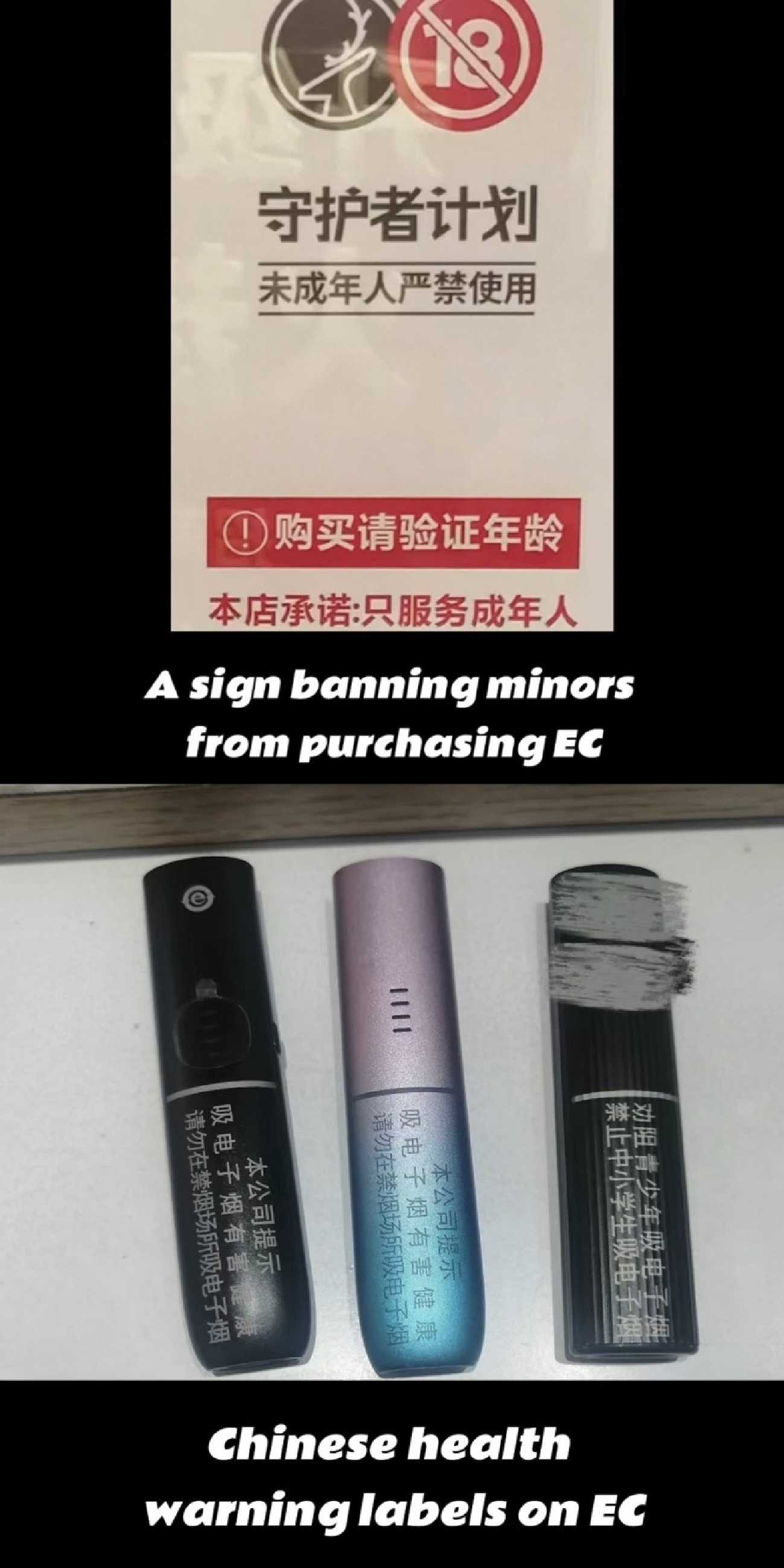
Figure 1.
The implementation of the e-cigarette (EC) regulation in China. Regulatory signage prohibiting the sale of e-cigarettes to minors, alongside examples of standard health warning labels currently used on e-cigarette packaging in China. These warnings generally indicate harm but lack specific or graphic content.
Currently, China's e-cigarette regulatory framework, consistent with its WHO FCTC commitments, has actively implemented significant measures focusing on strict product standardization, robust youth protection, and mandatory public health warnings. By officially categorizing e-cigarettes as tobacco products under the State Tobacco Monopoly Administration, these measures consolidate regulatory authority to mitigate associated public health risks.
-
While recent e-cigarette regulations in China represent a step forward, their effectiveness is undermined by significant implementation challenges and existing legal loopholes. For instance, nearly half of e-cigarette users report no difficulty in obtaining flavored products despite official restrictions[13]. This highlights enforcement gaps in preventing the sale of non-tobacco-flavored products. Furthermore, data indicated that 26.2% of e-cigarette users purchase their products online[13], where regulatory oversight is often harder to enforce, facilitating access to non-compliant products and exacerbating youth exposure to harmful substances.
Despite these regulatory efforts aiming to limit youth access and dispel public misconceptions about e-cigarettes, the current regulatory framework remains limited in its scope. It only partially aligns with broader international tobacco control guidelines and leaves other critical legal loopholes unaddressed. To address these multifaceted challenges, we propose three key regulatory enhancements based on both domestic findings and lessons learned from established international practices.
Raising the minimum legal age for purchasing e-cigarettes
-
Raising the legal age limit for purchasing e-cigarettes aligns closely with global tobacco control efforts outlined by the FCTC, which emphasizes the importance of protecting young people from tobacco use through comprehensive measures[20]. Specifically, FCTC Article 16 (Sales to Minors) is directly applicable to e-cigarettes to prevent youth initiation. Nearly 99% of tobacco users start smoking before the age of 26[11]. Upon reaching adulthood, individuals often gain increased independence and access to various products, including tobacco, potentially exposing them to greater health risks. Early tobacco use can cause long-lasting declines in task-related attention and lower rates of smoking cessation[25]. The brain does not fully develop until approximately 25 years of age[26].
Evidence from the United States suggests that raising the federal minimum age for the sale of all tobacco products, including e-cigarettes, from 18 to 21 years (Tobacco 21) contributed to a reduction of 12% in smoking prevalence and a 10% decrease in smoking-related fatalities[27]. While these reductions were primarily observed in conventional cigarette use, Tobacco 21 was also designed to curb e-cigarette initiation, reflecting the broader public health goal of preventing youth access to all addictive nicotine products during critical stages of brain development. Therefore, raising the minimum legal age applies effectively to both conventional cigarettes and e-cigarettes, as both pose similar risks of early nicotine addiction.
From a cost-effectiveness standpoint, the economic burden of smoking-related diseases in China has been estimated to range from RMB 57.2 to 368.3 billion (approximately USD
${\$} $ ${\$} $ Furthermore, given the ongoing brain development and heightened vulnerability to nicotine addiction in individuals aged 22 to 25, an innovative extension of youth protection efforts could also consider regulating purchase frequency within this age group. This additional measure could help mitigate the risks of nicotine dependence during this critical developmental period.
Enhancing health warning labels on packages
-
Improving the visibility and specificity of health warning labels on e-cigarette packaging may significantly strengthen public risk perception and deter use, particularly among young people. Effective warnings should combine both images and text, be large, and be printed in color for maximum visibility[30]. These principles align with the FCTC, particularly Article 11 (Packaging and Labelling of Tobacco Products), which has been extended by COP decisions to apply directly to e-cigarettes, providing a crucial regulatory framework for signatory nations like China.
Currently, China's regulation mandates a general statement, such as that e-cigarettes are harmful and should not be used in non-smoking areas. However, this vague language lacks the emotional salience and specific health risks needed to prompt real behavioral change, particularly among youth. Compared to international standards, such as those in the United States, where packages include specific warnings like 'This product contains nicotine, an addictive chemical', China's existing regulations fall short of effectively deterring youth initiation or informing consumers about potential dangers[31]. Although the evidence supporting health warning effectiveness primarily comes from studies on conventional cigarettes, the psychological and behavioral mechanisms, such as increasing perceived harm, reducing product attractiveness, and prompting cessation attempts through emotional and visual impact, could also be broadly applicable to e-cigarettes. Studies have shown that graphic warnings are more effective in eliciting negative emotional responses, reducing initiation, and motivating cessation than text-only warnings[32,33]. A recent microsimulation study across seven Latin American countries found that implementing graphic and plain packaging for conventional cigarettes could yield over 4 million additional healthy life years and reduce healthcare expenditures by USD
${\$} $ Evidence from China suggests that such packaging may influence social norms. For example, exposure to pictorial health warnings on cigarette packages has been associated with decreased approval of gifting and sharing cigarettes, which are common practices in Chinese culture[35]. This culturally specific evidence, though observed in the context of cigarette use, highlights how visual warnings can impact social acceptability and purchasing behaviors within a Chinese cultural context, making the principle also directly applicable to e-cigarettes. This culturally specific evidence provides a compelling rationale for adopting enhanced packaging regulations for e-cigarettes in China, leveraging visual warnings to shift public perception, and decrease youth usage.
Strengthening online sales regulation
-
A significant challenge remains in addressing the online promotion and marketing of e-cigarettes, particularly regarding misleading advertising and marketing tactics that specifically target young people. This area is directly addressed by the FCTC, notably Article 13 (Tobacco Advertising, Promotion, and Sponsorship), whose spirit, as reinforced by COP decisions, explicitly extends to e-cigarettes[20,22]. Furthermore, the FCTC's broader principles on product regulation and illicit trade (Article 15) are pertinent to controlling online sales channels and ensuring product compliance.
In China, approximately 50% of young adults obtain e-cigarette information online[36]. Some merchants circumvent regulations by disguising disposable fruit-flavored e-cigarettes as 'Milk Tea Cups' or 'Coke Cups' to increase appeal and avoid detection[37]. These products are promoted on platforms like TikTok and Rednote, often without proper health warnings, and then sold through informal channels like WeChat and Taobao[37]. Although the national e-cigarette transaction platform (
https://ecig.cn/login ), launched in 2022, has enabled traceability at the retailer level, it does not cover direct-to-consumer sales. As a result, it leaves gaps that allow for the continued sale of non-compliant products, including drug-laced e-cigarettes that contribute to nicotine addiction and other health risks.To address these challenges, stronger regulatory measures are necessary, aligned with relatively mature international practices. For example, comprehensive online monitoring and regulation of digital marketing and influencer content should be incorporated. Regular inspections should be mandated to identify and remove non-compliant products from the market. Online platforms should enforce stricter guidelines, including removing non-compliant posts, blocking related search terms, and implementing more rigorous controls on social media influencer promotions. Merchants failing to comply with regulations should face clear and appropriate penalties, such as fines, temporary bans, or even criminal charges, depending on the severity of the violation. Furthermore, age verification procedures on online platforms should be enhanced to prevent underage access to e-cigarettes.
Consistent with FCTC Article 13, additional measures could include a complete ban on the online promotions and influencer marketing of e-cigarettes. Evidence from Hong Kong, China, provides insights into the potential benefits of robust regulatory measures. In April 2022, Hong Kong implemented a total ban on the import, manufacture, and sale of e-cigarettes. While this policy represents a broader regulatory approach than solely online sales restrictions, its implementation notably led to a significant reduction in overall e-cigarette use among people aged 15 and older, from 13.2% to 7.5%[38]. Furthermore, the proportion of individuals intending to quit increased from 23.2% to 31.2% in the same period[38]. These findings highlight the effectiveness of comprehensive regulatory frameworks, such as those enforced in Hong Kong, in reducing e-cigarette use and related harm. They underscore the potential for strong controls, including online access and sales restrictions, to curb product availability and appeal.
-
Additionally, robust public health education may serve as a crucial complementary strategy to regulatory efforts aimed at curbing youth e-cigarette use. Most young people acquire misinformation about e-cigarettes from online sources or retail establishments[39]. Prolonged exposure to such content correlates with greater receptiveness and more favorable attitudes towards e-cigarettes, while concurrently diminishing perceived health risks[40]. These challenges underscore the importance of FCTC Article 12 (Education, Communication, Training, and Public Awareness), whose principles are vital for countering misinformation and promoting accurate risk perception regarding e-cigarettes[20].
Schools can use impactful health posters, while teachers and parents should actively lead by example in their behavior. Public health campaigns, both virtual and in-person, should be coordinated to reach broader audiences, with healthcare professionals and media outlets playing a crucial role in educating the public about the risk of e-cigarette use.
The FCTC's emphasis on public education highlights the need for developing culturally relevant materials tailored to local populations. These materials should counter industry-driven narratives that misrepresent the harms of e-cigarettes and should be designed to resonate with local youth. While not exhaustive, the proposed recommendations address several critical regulatory gaps in China's current e-cigarette framework. By targeting youth-specific vulnerabilities, misinformation sources, and regulatory enforcement weaknesses, these measures may serve as feasible and impactful steps toward reducing e-cigarette-related harm and promoting healthier behaviors among young people.
-
To effectively combat China's urgent youth e-cigarette epidemic and mitigate associated health risks, stricter regulations and more robust enforcement are crucial. While recent policies mark important progress, gaps remain in risk communication, access restrictions, and product design, contributing to widespread public misperceptions. Drawing on FCTC-aligned relatively mature international practices, this paper advocates for a comprehensive approach encompassing enhanced age restrictions, stronger health warning labels, and stringent online sales controls, complemented by targeted public education. The implementation of these evidence-informed measures could play a critical role in preventing nicotine addiction among young people, safeguarding long-term public health, and advancing China's broader tobacco control goals.
-
Ethical approval was not required for this article, as it does not involve original research on human participants, animals, or sensitive data.
We would like to thank the reviewers and editors for their valuable feedback and constructive comments. We also thank Benjamin Knight, MSc., from Edanz (
www.edanz.com/ac ) for his editing assistance with this manuscript. This study was funded by the National Natural Science Foundation of China (Xia W, 72104259), the Natural Science Foundation of Guangdong Province (Xia W, 2024A1515012147), the Science and Technology Planning Project of Guangdong Province (Xia W, 2023A1414020019) and the Special Funds for the Cultivation of Guangdong College Students' Scientific and Technological Innovation (Wang J, pdjh2022b0022).-
The authors confirm contribution to the paper as follows: conceptualization and original draft preparation: Wang J; review, revision, and editing: Xia W. Both authors reviewed the content and approved the final version of the manuscript.
-
Data sharing does not apply to this article as no datasets were generated or analyzed during the current study.
-
The authors declare that they have no conflict of interest.
- Copyright: © 2025 by the author(s). Published by Maximum Academic Press, Fayetteville, GA. This article is an open access article distributed under Creative Commons Attribution License (CC BY 4.0), visit https://creativecommons.org/licenses/by/4.0/.
-
About this article
Cite this article
Wang J, Xia W. 2025. Urgent need for new regulations to stop e-cigarettes from encouraging smoking among Chinese youth. Journal of Smoking Cessation 20: e006 doi: 10.48130/jsc-0025-0007 

Urgent need for new regulations to stop e-cigarettes from encouraging smoking among Chinese youth
- Received: 04 February 2025
- Revised: 21 June 2025
- Accepted: 25 June 2025
- Published online: 30 June 2025
-
Key words:
- Regulations /
- E-cigarettes /
- Youth /
- China