












-
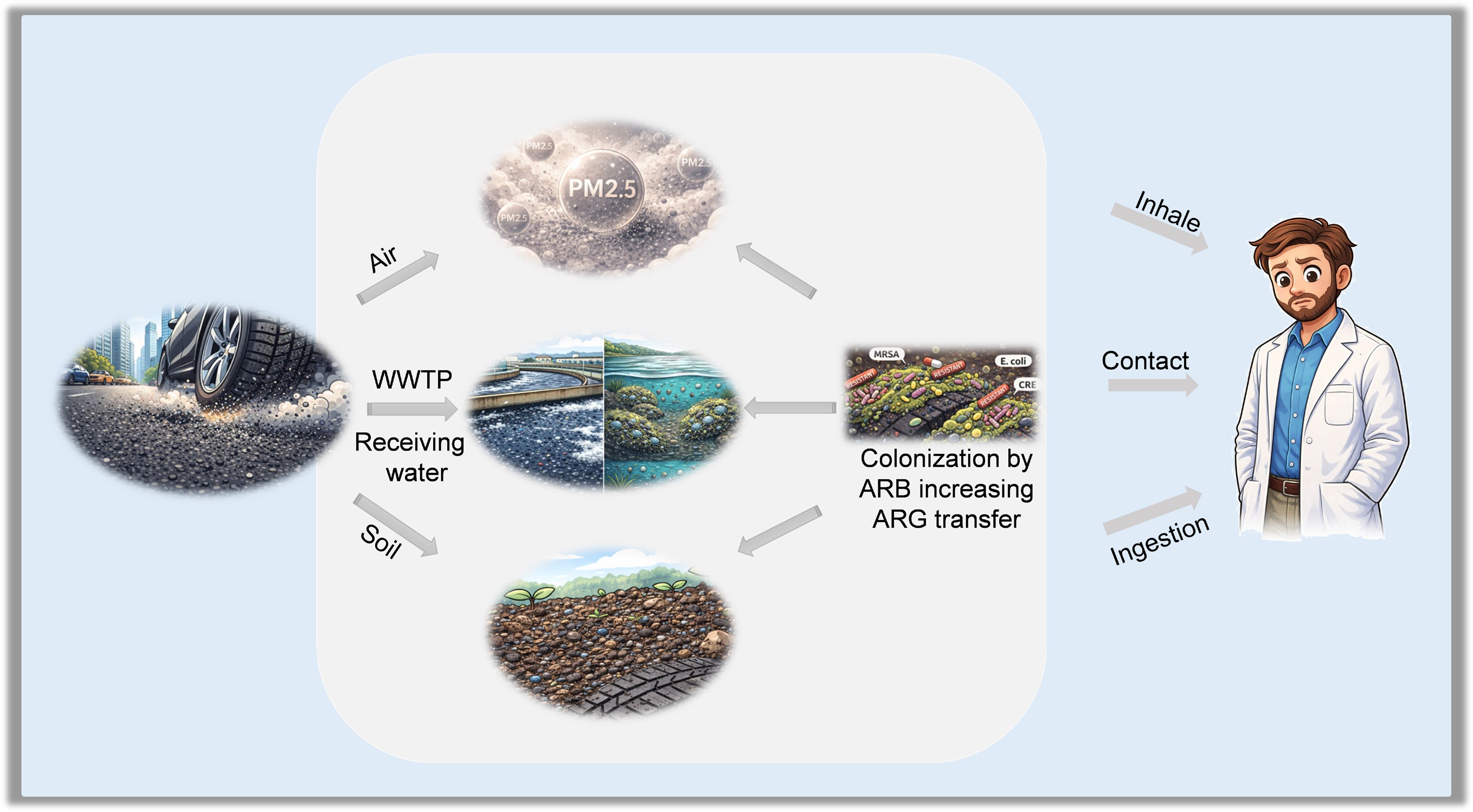
Antibiotic resistance genes (ARGs) are an increasing One Health challenge linking clinical failure to environmental dissemination and are estimated to contribute to ~1 million deaths annually[1−3]. Microplastics provide a plausible multiscale interface for ARGs' mobility because they persist across compartments, host biofilms, and co-transport ARGs, antibiotic-resistant bacteria (ARB), and mobile genetic elements (MGEs)[4,5]. In cities, tire microplastics (TMPs) are among the dominant sources of microplastic emissions. Continuous abrasion on road surfaces releases heterogeneous TMPs that are redistributed across the air, urban waters, and soils via runoff, drainage infrastructure, and environmental mixing. TMPs are estimated to contribute over 13% of ambient particulate matter (PM2.5) in urban air[6]. In urban rivers and lakes located near heavily trafficked roads, contamination by TMPs is often markedly elevated[7,8]. For example, in urban rivers and lakes within central Beijing, TMP concentrations have been reported to reach 0.65–46.18 mg L−1 in water and 0.28 × 10⁴–1.79 × 10⁴ mg kg−1 in sediments[7].
Unlike conventional microplastics (e.g., polyethylene), tires are composite materials composed mainly of rubber (50%–60%), fillers (30%–35%), plasticizers (15%–20%), and functional additives (e.g., antioxidants). Consequently, TMPs, particularly tire wear particles (TWPs), can release complex mixtures of metals and organic additives; among the > 200 organic compounds detected, ~66% are leachable[9,10]. However, the composition and environmental concentrations of TMP-derived leachates exhibit substantial variability depending on the tires' formulation, aging status, and environmental conditions. Reported concentrations of key additives (e.g., benzothiazoles and N-[1,3-dimethylbutyl]-N'-phenyl-p-phenylenediamine [6PPD]-quinone) in urban runoff and receiving waters typically range from ng L−1 to μg L−1 levels[11−13]. This variability introduces uncertainty when assessing their role in mediating ARG transfer and highlights the need for systematic quantification under environmentally relevant conditions.
Compared with traditional microplastics, TMPs form distinct bacterial communities[14,15]. Moreover, TMP leachates are chemically diverse and can include compounds toxic to microbes and aquatic ecosystems, such as the tire antioxidant 6PPD and its transformation product 6PPD-quinone (6PPD-Q)[8,16]. Together, the high urban exposure, distinct tire plastisphere, and chemically reactive leachate mixtures suggest that TMPs can actively promote ARG dissemination in urban environments, potentially to a greater extent than conventional microplastics. TMPs can develop biofilm-associated hotspots that are enriched in antibiotic-resistant bacteria and MGEs, where elevated cell density, extracellular polymeric substance (EPS)-mediated adhesion, and stress-induced responses enhance the likelihood of ARGs' mobility and transfer[17,18]. These resistance hotspots ultimately connect to human exposure pathways, including inhalation, dietary exposure, and water contact, highlighting TMPs as a system-level amplifier of antimicrobial resistance risk in urban environments. From a One Health perspective, these connected urban compartments couple environmental, animal, and human microbiomes and create multiroute exposures that can reinforce resistance emergence and dissemination. Therefore, the propagation and transfer of ARGs via TMPs, the potential mechanisms involved, and key directions for future work are discussed in this perspective.
-
On January 10, 2026, we searched the Web of Science database for published articles related to propagation and spread of ARGs affected by TMPs using a specific search strategy (Supplementary Table S1). In total, 273 records were retrieved. Subsequently, full-text screening was performed, and backward citation tracking was conducted by examining the reference lists of the screened articles. Ultimately, only seven studies were identified as directly addressing tire wear particles and/or associated tire-derived chemicals in relation to ARGs/ARB and/or gene transfer processes (Table 1).
Table 1. Related studies about the propagation and spread of ARGs affected by TMPs
Media TMPs or specific leachate chemicals ARGs or ARB Main findings Ref. Soil TMPs ARGs Distinct bacterial communities formed on TMPs; however, they exhibited lower richness and relative abundance of ARGs compared with the soil communities and were strongly influenced by soil pollutants. [19] Soil TMPs ARGs Unique biofilm formed on the pristine and ultraviolet (UV)-aged TMPs; they were found to increase the richness and potential transfer of ARGs in the TMP-enrichedsoils. [20] Sediment TMPs and leachate ARGs Raw tire particles and their leachates increased the abundance and diversity of ARGs and virulence factors in coastal sediments, with raw particles having the strongest effect, whereas specific chemicals in the leachates (e.g., Zn and N-cyclohexylformamide) directly influenced ARG profiles in pore water. [21] Sludge TMPs and leachate ARGs Both shade- and photoaged tire crumb rubber promote extracellular ARG spread by activating prophages, but through different mechanisms: Leached substances versus free radical generation. [22] Water TMPs ARGs TMPs significantly enhanced horizontal gene transfer (HGT) rates compared with traditional microplastics or natural chitosan, an effect observed both in biofilms and the planktonic phase. Furthermore, HGT rates associated with TMPs increased with temperature. [18] Water 6PPD and 6PPD-Q ARGs Tire rubber antioxidant 6PPD exhibited a lower rate of HGT of ARGs in Escherichia coli than its quinone derivative 6PPD-Q. This lower rate was caused by the lesser increases in membrane permeability and cell adhesion induced by 6PPD. [17] Water TMPs ARB Field-incubated tire wear particles, traditional microplastics, and wood particles did not enrich or transmit the multidrug-resistant, ESBL-producing E. coli present in surrounding estuarine to coastal waters. [23] Although the current studies remain limited, available findings collectively suggest that TMPs have been identified as distinctive substrates associated with the propagation and spread of antibiotic resistance through both habitat and chemical effects. In soils, TMP-associated plastispheres have been consistently described as novel microbial niches relative to the surrounding bulk soil, and distinct communities have been observed on both pristine and aged TMPs[19,20]. Lower ARG richness and relative abundance have been reported within the soil tire plastisphere itself[20], whereas ARG propagation has been observed in the surrounding soil and sediments following TMP amendment in some studies[19,23]. These contrasting observations suggest that ARG responses are highly spatially heterogeneous between the tire plastisphere and the adjacent matrix.
In aquatic environments, biofilm-rich tire plastispheres have been formed more readily than in the adjacent water[14,24], potentially increasing microbial density and intercellular contact. Consistent with this, higher horizontal gene transfer (HGT) rates of ARGs have been detected not only within the tire plastisphere but also in the surrounding water amended with TMPs[18]. Nevertheless, enrichment of extended spectrum beta-lactamase (ESBL)-producing Escherichia coli has not been detected in the tire plastisphere under field incubation conditions[23], suggesting that ARG hosts may be selectively enriched to favor the transfer of ARGs. In TMP-amended water and sludge, ARG dissemination has further been linked to TMP-derived leachates and aging-related reactivity, with enhanced conjugation and phage-mediated transfer (transduction) being attributed to leached substances and free radical generation, respectively[17,18]. Therefore, according to the current evidence, three nonexclusive mechanisms are proposed for how TMPs may enhance ARGs' mobility and transfer in urban environments. First, a distinct TMP plastisphere forms as a high-contact microhabitat that facilitates HGT, particularly in aquatic systems. Second, co-selection imposed by complex leachate mixtures promotes the maintenance and mobility of ARGs. Third, aging-associated reactive species (especially free radicals and reactive oxygen species [ROS]) trigger stress responses that can further enhance ARG transfer (Fig. 1).
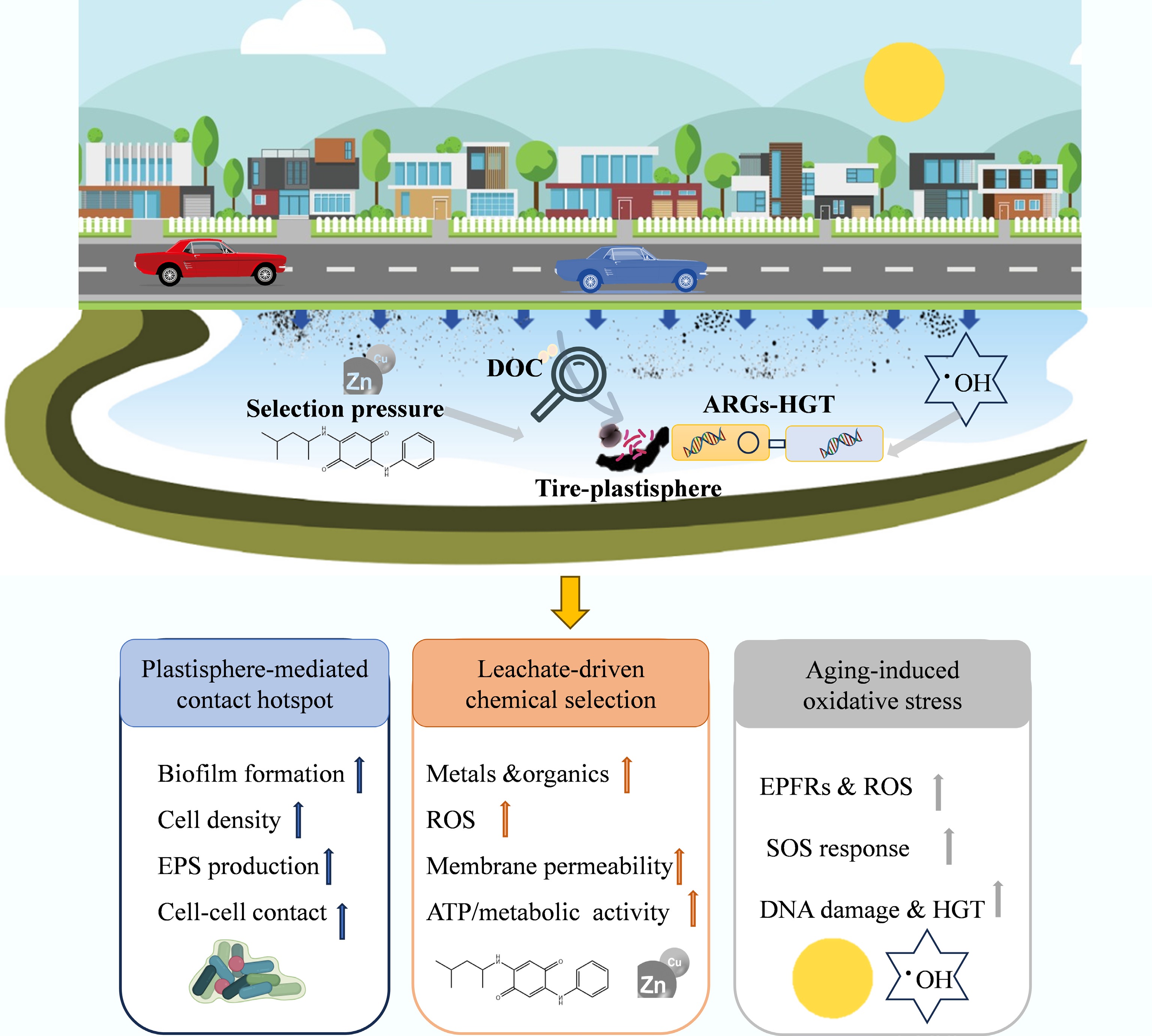
Figure 1.
The propagation and transfer of ARGs via TMPs.
-
Previously, tire-derived rubber has been recycled and used as a biofilm-supporting medium in wastewater treatment systems and constructed wetlands, where it serves as a carrier for microbial attachment and pollutant removal[25−28]. More recently, the TMP plastisphere has emerged as a growing concern, yet it remains far less studied than the plastisphere associated with conventional microplastics. Notably, TMPs have been shown to develop a distinct plastisphere that constitutes a novel microbial niche in both soils[19,20] and aquatic environments[14,24,29]. The richness and diversity of the TMP plastisphere have often been reported to be lower than those on natural particles and conventional microplastics in aquatic environments[14,24]. Nevertheless, TMP plastispheres have frequently exhibited higher richness than the surrounding water column and adjacent sediments[14,30]. These patterns likely reflect a dominant habitat/vector component, in which TMPs provide a biofilm-prone interface with a high surface area that concentrates cells and promotes interactions, alongside additional chemical filtering that may operate concurrently.
The elevated HGT of ARGs reported on TMP plastispheres compared with the surrounding water and conventional microplastics could be explained by the selection of specific taxa. For example, Rhizobiales, Xanthomonadales, Rhodobacterales, and Sphingomonadales have been identified as the dominant taxa on TMP plastispheres[14], and have also been considered potential ARG hosts[31−33]. In addition, an increase in potential pathogenic bacteria with prolonged incubation time has been reported on tire microplastics[29]. Beyond taxonomic selection, physicochemical co-factors may further enhance the potential for ARG transfer. Trivalent iron and ferrihydrite have been shown to increase cell density and EPS formation on rubber- and TMP-associated biofilms[28,34], which may facilitate cell–cell contact and promote ARG transfer within the plastisphere microhabitat. However, more research is still required to identify the dominant ARG hosts, key MGEs, and in situ transfer pathways within the TMP plastisphere itself.
Selection pressure by leachate mixtures enhances ARGs' mobility and transfer
-
The composition of TMP leachate is highly complex, comprising dissolved organic matter (DOM), tire additives (e.g., 6PPD/quinones and benzothiazoles), poly PAHs and other aromatic hydrocarbons, and inorganic metals released from formulations and fillers (for example, Zn, Fe, and Mn)[35−37]. Despite this complexity, the roles of individual organic and inorganic components in ARG propagation and transfer remain insufficiently understood, particularly under environmentally relevant conditions. For example, previous studies have reported relatively high concentrations of Zn, reaching up to 12,130 μg L−1 in freshwater and 5,138 μg L−1 in marine conditions for tire rubber[38]. Among the inorganic components, Mn and Fe have been reported to enhance ARG dissemination by promoting conjugation and extracellular DNA (eDNA)-mediated transformation[39,40]. The magnitude and direction of these effects can vary depending on microbial species and metal concentration. For example, low Zn levels inhibited conjugation in Salmonella London, whereas higher Zn levels promoted it, while no detectable Zn effects were observed for Salmonella Infantis[41].
Tire-derived organic pollutants, including 6PPD (and its transformation products), polycyclic aromatic hydrocarbons (PAHs), and benzothiazole compounds, have been found to exert selection pressure on bacterial communities and ARG transfer to some extent[42,43]. For PAHs, plasmid conjugation in E. coli depends on the compound type and concentration. Naphthalene enhances transfer at environmentally relevant levels, whereas phenanthrene inhibits it and pyrene shows little to no effect[42]. Enhanced plasmid conjugation caused by 6PPD-Q and certain PAHs appears to share common drivers, including elevated ROS levels, increased membrane permeability, stronger EPS-mediated cell adhesion, and greater cellular energy availability reflected by higher adenosine triphosphate (ATP) levels[17,42]. Co-selection by metals and organic pollutants is widely observed in ARGs' dissemination and transfer processes[44−46]. However, for complex tire leachates, it remains unclear whether metals or specific organic constituents dominate the net effect on the propagation and transfer of ARGs in the TMP plastisphere, and whether interactions with varying chemical mixtures are predominantly synergistic or antagonistic under environmentally realistic exposure conditions, particularly under stormwater pulse exposures typical for cities.
To resolve these uncertainties in a more mechanistically robust manner, a toxicity identification evaluation (TIE) framework can be adapted to TMP leachates using ARGs' conjugation efficiency as the primary endpoint (Fig. 2). Conjugation was selected as the primary endpoint because it is one of the major routes of ARG HGT in environmental systems, and plasmid-mediated transfer can be quantified robustly using standardized donor–recipient assays. Moreover, the RP4 model plasmids enable well-established intra- and interspecies conjugation tests, facilitating cross-study comparability[47,48]. It should be noted that TMP leachates represent complex chemical mixtures, and complete isolation of the individual components is inherently challenging. Therefore, the purpose of this framework is not absolute purification but the progressive identification of the dominant functional fractions and candidate drivers influencing conjugation. To ensure reliable interpretation, appropriate controls (including untreated leachate controls, reagent blanks, and procedural controls) should be incorporated to distinguish treatment-induced artifacts from genuine biological responses.
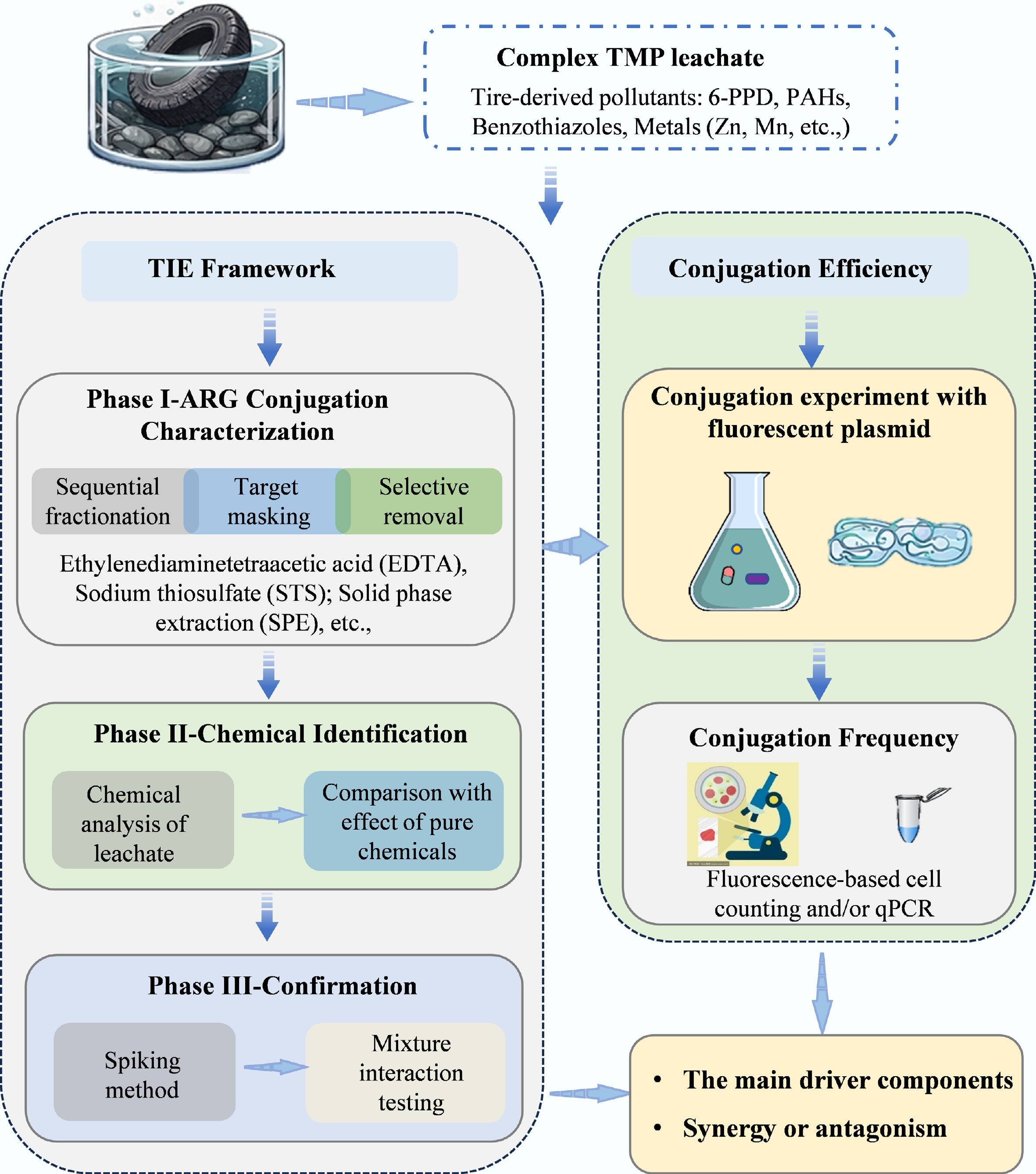
Figure 2.
A TIE-based framework to resolve the chemical drivers and interactions underlying ARG conjugation in TMP leachates.
In Phase I, the leachate is manipulated by sequential fractionation, target masking, and selective removal, for example, (ethylenediaminetetraacetic acid) EDTA chelation for metals, sodium thiosulfate (STS) quenching for reactive oxidants, and solid-phase extraction (SPE) for hydrophobic organics. The resulting shifts in transfer are quantified using a fluorescent plasmid assay with the conjugation frequency determined by fluorescence-based cell counting and/or quantitative polymerase chain reaction (qPCR). Because EDTA and STS act via complexation/quenching and may affect conjugation efficiency, matched reagent blanks and procedural controls should be included. In Phases II–III, active fractions are chemically characterized, benchmarked against pure chemicals, and confirmed by spiking and mixture reconstitution. This approach can identify the dominant drivers and interaction patterns in complex leachates, analogous to TIE applications in Tigriopus japonicus[49], and the mixture's synergy or antagonism can be evaluated using an isoeffective concentration design against additivity predictions.
Aging-associated ROS enhance ARG transfer
-
TMP aging processes can enrich environmentally persistent free radicals (EPFRs) and elevate ROS generation, thereby reshaping bacterial communities and potentially amplifying ARG transfer[22,50]. Across microbial systems, aged TMPs impose oxidative and surface-mediated stress, including membrane damage, enhanced EPS secretion, altered community composition, and reduced microbial cell abundance[50,51]. These EPFR- and ROS-driven hotspots can be further strengthened by photoaging and advanced oxidation pathways, which increase the reactivity and persistence of oxidative species associated with TMPs[52,53]. Consistent with this mechanism, photoaged tire crumb rubber has been reported to induce prophages and promote phage-associated extracellular ARG (eARG) dissemination, increasing ARGs' mobility under realistic urban runoff exposures[22]. However, •OH produced during the aging of polystyrene microplastics was reported to suppress ARG dissemination, partly by inhibiting putative antibiotic-resistant taxa in surface biofilms[54,55]. Taken together, aging-associated ROS regulate ARG transfer through multiple interconnected pathways, including selection for stress-tolerant taxa and mobile genetic elements, modulation of cell envelope properties (e.g., increased permeability) and EPS-mediated adhesion that enhances cell–cell contact, and the induction of phage-mediated gene transfer. These pathways operate in a concentration- and context-dependent manner. At higher ROS levels, oxidative damage may instead disrupt the biofilm's structure and compromise extracellular ARGs' integrity, thereby suppressing dissemination.
-
Current evidence supports the view that TMPs can contribute to ARG propagation through coupled physical and chemical pathways that are not well captured by frameworks developed for conventional microplastics. TMPs can form a distinct plastisphere that increases microbial encounter rates and creates a high-contact microhabitat; complex leachate mixtures impose co-selection that maintains ARGs and promotes transfer; and aging-associated reactivity further modulates these processes. In particular, EPFR and ROS generation trigger stress responses that can enhance ARG mobility. Taken together, we argue that urban TMPs should be treated as reactive, particle-scale interfaces rather than passive vectors. They physically and chemically connect engineered systems (e.g., roads and drainage networks) with environmental compartments (air, urban waters, and soils), thereby amplifying multiroute exposure risks to antibiotic resistance. This interplay positions TMPs not only as an environmental contaminant but as a governance object spanning urban planning, environmental health, and antimicrobial resistance containment strategies.
Future research should prioritize causal, mechanism-resolving evidence that links TMP exposure to quantified transfer processes and their drivers, rather than ARG profiles alone. A central gap is that the dominant routes of mobility remain unclear, including conjugation, transformation, and transduction, and still cannot be assigned to specific TMP-associated conditions, which limits risk-relevant inference. First, the intrinsic transfer mechanisms within the TMP plastisphere remain to be clarified by identifying the dominant ARG hosts and key mobile genetic elements. A key unresolved question is whether TMPs mainly concentrate high-transfer host and MGE combinations or instead reshape the surrounding communities where transfer occurs. Second, the relative contribution of leachate fractions should be disentangled using TIE-inspired fractionation, masking, and reconstitution approaches, with conjugation, transformation, and transduction quantified as primary endpoint measures. This step is needed to move from correlation to attribution by identifying which chemical classes control transfer rates and which primarily shift a community's composition. Subsequently, priority compounds should be identified and quantified under environmentally relevant conditions to strengthen causal inference between chemical profiles and ARGs' transfer dynamics. Third, the roles of radical-driven stress versus chemical selection pressure should be separated by experimentally controlling aging pathways such as photoaging versus dark aging and by applying ROS quenching and antioxidant controls alongside chemical characterization. We predict that aging will not uniformly increase mobility, and that threshold effects are likely, with sublethal oxidative windows enhancing transfer but stronger oxidative intensity suppressing hosts or reducing extracellular ARG persistence.
Ultimately, resolving these questions will define when and where TMPs materially drive ARG dissemination in urban environments and will enable risk-relevant thresholds for management. For urban water systems, TMPs represent a controllable source at the road drainage-receiving water nexus; consequently, mitigation should prioritize reducing particle and leachate loading at the source and intercepting transport through stormwater capture, filtration, and nature-based treatment. Together, these actions provide practical levers to curb TMP-associated ARG risks.
-
Not applicable.
-
The authors confirm their contributions to the paper as follows: Yuyi Yang: study conception and design, draft manuscript preparation; Li Lin: study conception and design; Xiong Pan: data collection; Yongxiang Yu: draft manuscript preparation, manuscript editing; Qun Wang: data collection, manuscript editing; Hans-Peter Grossart: manuscript editing and reviewing. All authors reviewed the results and approved the final version of the manuscript.
-
Data sharing not applicable to this article as no datasets were generated or analyzed during the current study.
-
This manuscript was supported by the National Natural Science Foundation of China (Grant Nos 32071614 and U23A2059), The Young Top-Notch Talent Cultivation Program of Hubei Province (Grant No. 2023000115), and The Talent Startup Fund of Wuhan Institute of Technology (Grant No. 25QD099), and The Open Research Fund Program of Hubei Key Laboratory of Microbial Transformation and Regulation of Biogenic Elements in the Middle Reaches of the Yangtze River (Wuhan Institute of Technology) (Grant No. CJWSW-2025-04).
-
The authors declare that they have no conflict of interest.
-
Full list of author information is available at the end of the article.
- The supplementary files can be downloaded from here.
- Copyright: © 2026 by the author(s). Published by Maximum Academic Press, Fayetteville, GA. This article is an open access article distributed under Creative Commons Attribution License (CC BY 4.0), visit https://creativecommons.org/licenses/by/4.0/.
-
About this article
Cite this article
Yang Y, Pan X, Yu Y, Lin L, Wang Q, et al. 2026. Tire microplastics amplify the risk of antibiotic resistance genes in the environment. Biocontaminant 2: e010 doi: 10.48130/biocontam-0026-0007 

Tire microplastics amplify the risk of antibiotic resistance genes in the environment
- Received: 04 February 2026
- Revised: 08 April 2026
- Accepted: 27 April 2026
- Published online: 19 May 2026
Abstract: Cities are hotspots for antimicrobial resistance because their dense human populations and engineered interfaces connect wastewater, runoff, air, and soils, enabling antibiotic resistance genes (ARGs) to persist and spread in urban environments. Tire microplastics, which are ubiquitous in urban environments, can amplify this risk through three mechanisms: (1) A high-contact tire plastisphere that concentrates potential ARG hosts and mobile genetic elements; (2) leachates rich in organic additives and metals that impose co-selective pressure; and (3) aging-driven surface reactivity that generates reactive oxygen species and persistent free radicals, potentially enhancing horizontal gene transfer. To identify the dominant chemical drivers, we propose adapting toxicity identification evaluations and using plasmid conjugation frequency as a functional endpoint. Moving beyond descriptive resistome surveys, mechanistic studies, and coordinated urban governance under a One Health framework that integrates human, animal, and environmental health, linking green infrastructure, integrated monitoring, and public health actions, are needed to curb this emerging risk.