











-
Soil is both a functional habitat and a long-term sink for plastic residues and inorganic contaminants[1]. Recent assessments indicate that terrestrial systems receive a substantial share of global plastic leakage, and soils in agricultural, urban, and peri-urban regions can accumulate considerable numbers of microplastics (MPs) through film mulching, sludge and manure application, compost, atmospheric deposition, traffic-derived particles, and landfill-derived inputs[2,3]. At the same time, heavy metal (HM) contamination remains a persistent environmental problem because of HMs' toxicity, nonbiodegradability, and long residence time in soil[4]. In evaluating agricultural implications and human exposure risks, it is also necessary to consider international frameworks, such as the health-based guidance from the World Health Organization (WHO) and the Food and Agriculture Organization (FAO)/WHO Codex-related food chain risk management concepts, alongside regional regulations. Against this background, understanding how MPs and HMs interact in the soil has become a central question for pollution assessment and remediation design[5,6].
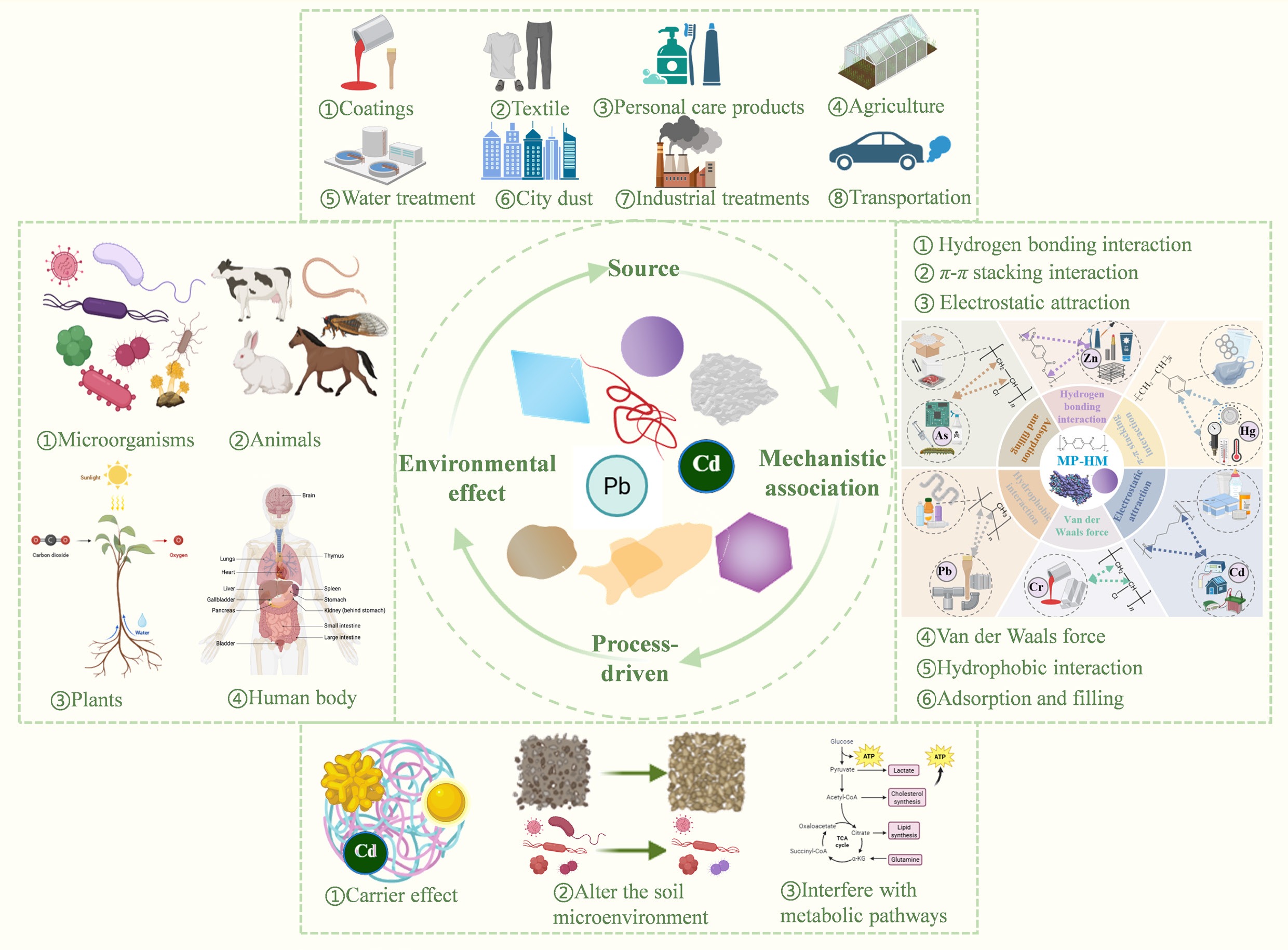
At the microinterface, MP–HM interactions can be understood as a hierarchical process involving physical contact, surface adsorption or entrapment, electrostatic attraction or repulsion, functional-group-mediated complexation, redox-sensitive interfacial transformation, and biologically mediated regulation by biofilms or eco-coronas (Fig. 1)[7−9]. The detailed evidence and specific case studies regarding these shared controlling factors are systematically evaluated in Influencing factors in the microscopic interactions between HMs and MPs, with emphasis on how particle size, polymer chemistry, aging, biofilm development, pH, and dissolved organic matter (DOM) produce different responses among Pb, Cr, Cd, As, and Hg[10]. In general, environmental aging introduces oxygen-containing groups such as hydroxyl, carbonyl, and carboxyl moieties, which often increase sorption capacity, whereas pristine hydrophobic surfaces tend to show weaker and more condition-dependent binding[11,12]. However, the same mechanistic driver does not generate identical outcomes for all metals because the metals' valence, hydrolysis behavior, coordination preference, and competing soil ligands vary substantially across systems[13].
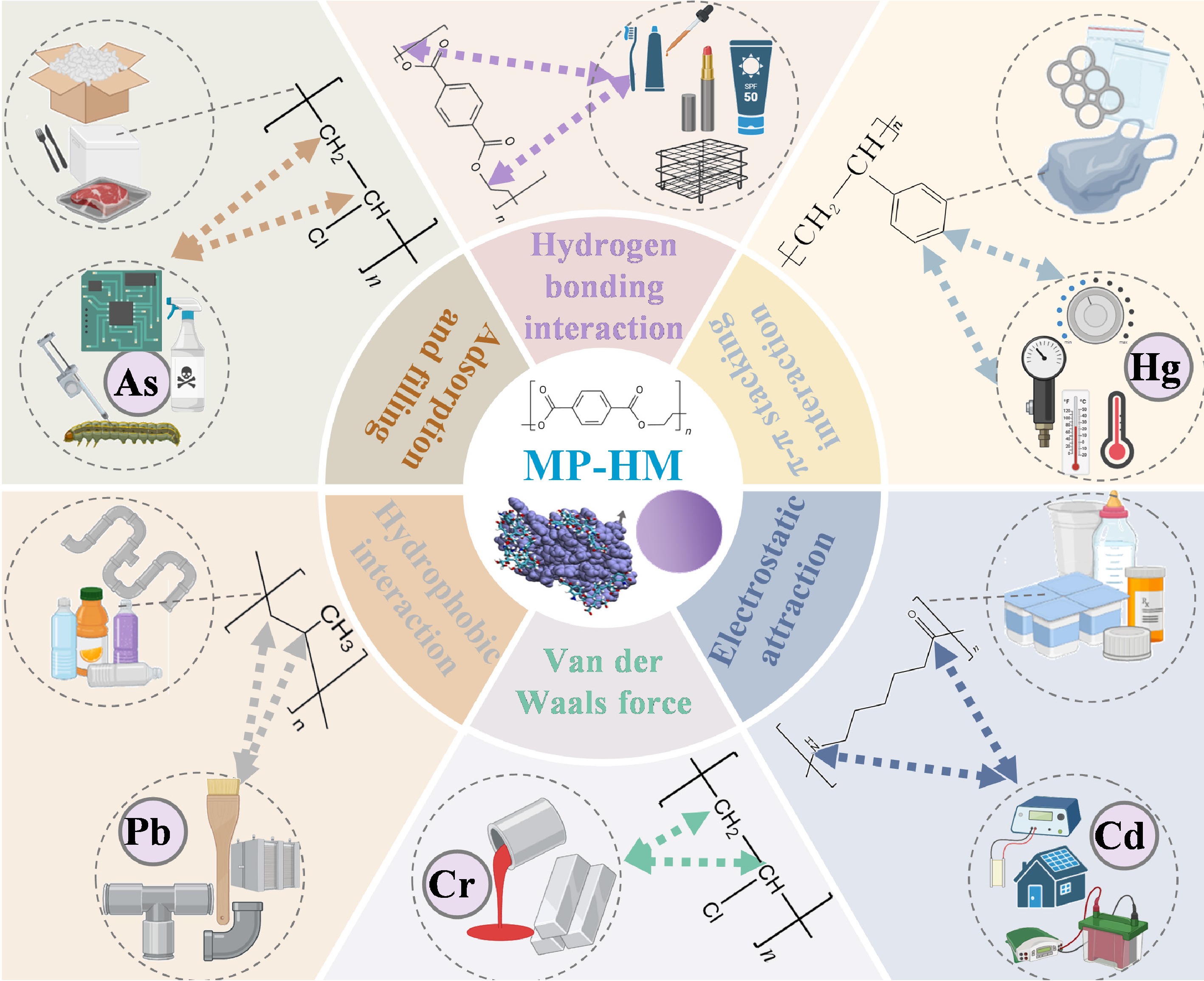
Figure 1.
Conceptual framework of MP–HM interactions in soil. The outer source icons indicate representative MP-related and HM-related inputs, the central sectors summarize the main interfacial pathways (surface adsorption/entrapment, electrostatic attraction, van der Waals force, hydrogen bonding, and related interactions), and the five circled metals indicate the focal elements discussed in this review (Pb, Cr, Cd, As, and Hg). Dashed arrows denote representative linkages between sources, polymer structures, and metal-specific interaction scenarios. The polymer repeat-unit sketches are schematic structural motifs rather than standalone abbreviations.
The current studies still lack sufficient scope and depth in several respects. First, many reports focus on individual polymers or one target metal under simplified laboratory conditions, making it difficult to compare differential responses among metals and to extrapolate the results to real soils containing minerals, DOM, biofilms, and mixed contaminants[14,15]. Second, transport is often discussed in a fragmented manner: source pathways, soil redistribution, plant uptake, and food web transfer are not always linked within one analytical framework[16]. Third, long-term field evidence remains limited, especially for biodegradable MPs whose aging trajectories, eco-corona development, and metal-binding behavior may differ substantially from those observed in short-term batch tests[17]. These gaps help explain why the same pair of pollutants may show adsorption, desorption, immobilization, or toxicity enhancement under different experimental settings.
A realistic soil perspective also requires connecting the source inputs to subsequent environmental redistribution. After entering the soil through mulch fragmentation, sludge application, atmospheric deposition, traffic-derived particles, or landfill-derived residues, MPs can be reworked by tillage, infiltration, root growth, and the activity of soil fauna[18]. During this movement, particle-associated HMs may be temporarily immobilized, released into pore water, or re-adsorbed onto minerals, organic matter, and biological surfaces[19]. In other words, detection of MPs/HMs in organisms should not be treated as an isolated endpoint but as the outcome of a transport sequence that begins with source emissions, proceeds through soil migration and transformation, and ends in uptake by microbes, fauna, plants, livestock, and ultimately humans[20]. Framing the problem in this way helps explain why the same polymer–metal pair may behave differently across soil textures, redox conditions, and management practices, and it also clarifies why mechanistic evidence must be interpreted together with transport pathways when assessing ecological and health risks[21,22].
Once introduced into soil, MPs can be redistributed by pore water flow, tillage, root growth, and soil fauna, and this mobility creates opportunities for the associated HMs to be retained, released, or transferred across trophic levels[23]. Accordingly, MP–HM co-pollution has been linked with shifts in the microbial community's composition, inhibition or stimulation of specific enzyme systems, altered uptake by invertebrates and plants, and changes in the potential for human exposure through food, dust, and water pathways[24]. However, the statement that current research lacks sufficient scope and depth requires concrete clarification. Most available studies still rely on short-term batch systems using one polymer and one metal, but comparatively fewer studies address aged or biofilm-coated particles, biodegradable MPs, realistic soil heterogeneity, ternary or multimetal systems, or the consistency between laboratory findings and field observations[25,26]. These gaps are especially important because the coexistence of DOM, mineral colloids, and rhizosphere processes can reverse the direction of apparent adsorption or the toxicity responses observed in simplified systems.
Against this background, the scientific value of the present review lies not in relisting isolated adsorption results but in comparing differential responses among key metals and MP types and in linking these responses with ecological risk and remediation design. Specifically, this review aims to (1) summarize the shared mechanisms that govern MP–HM interactions in soil while distinguishing metal-specific response patterns; (2) compare conventional and biodegradable MPs under the same analytical perspective; (3) synthesize the cascading effects of co-pollution from soil microorganisms to fauna, plants, and human exposure; and (4) discuss how a mechanistic understanding can guide combined remediation strategies in complex co-contaminated soils. By emphasizing differential responses rather than only general interactions, the review seeks to provide a more useful framework for interpreting inconsistent literature results and for identifying research priorities in realistic soil systems.
Compared with earlier reviews that tended either to summarize adsorption studies across media or to discuss MPs and HMs separately, the present review places soil-specific differential responses at the center of the discussion. This involves comparing how the same controlling factor—such as aging, pH, DOM, or biofilm growth—can strengthen Pb's complexation, reshape Cr's redox-sensitive behavior, alter Cd's availability through rhizosphere chemistry, modify As's methylation and competitive sorption, or influence Hg's transformation pathways. Bringing these responses into one framework is important because environmental management rarely deals with an abstract "metal effect"; it deals with specific metals in specific soils under realistic co-contamination scenarios. By emphasizing these distinctions, the review aims to move beyond a catalog of case studies and toward a comparative basis for risk interpretation and technology selection.
The organizational choice of Influencing factors in themicroscopicinteractions between HMs and MPs follows this same objective. We considered restructuring the chapter entirely by mechanism, but a purely mechanism-centered layout would distribute each metal across multiple pH-, aging-, DOM-, and biofilm-based subsections and would therefore weaken the cross-metal comparison emphasized by the term "differential responses" in the title. We therefore retained a metal-centered framework while reducing redundancy in two ways: shared controlling factors are synthesized comparatively in Condensed overview and Comparative synopsis of differential responses and Table 1, whereas each metal subsection was tightened so that it focuses primarily on metal-specific behavior, such as valence-sensitive Cr responses, methylation-linked As behavior, and the comparatively uncertain evidence base for Hg.
Table 1. Comparative summary of differential responses and interaction mechanisms among the five focal heavy metals (HMs) co-occurring with microplastics (MPs) in the soil
Metal Dominant interaction feature Key controlling
variableAging/biofilm response Representative ecological implication Core differential-response note Pb Surface complexation with oxygen-containing groups is prominent pH, soil organic matter (SOM)/humic acid (HA) bridging, particle size, dosage Weathering usually increases oxidized binding sites Plant uptake, oxidative stress, and particle-assisted transfer are frequently reported Useful model for strong pH-sensitive complexation and particle-bound plant transfer[31−36] Cr Response must be interpreted together with the Cr(III)/Cr(VI) redox state Valence, pH, redox condition, particle size, humic reducers Oxidation plus biofilm/eco-corona development can markedly strengthen retention Rhizosphere restructuring and crop quality changes under co-exposure Distinguished most clearly by coupled adsorption–redox behavior rather than sorption alone[41−50] Cd Bioavailability and bioaccumulation often dominate over valence effects Particle size, aging, rhizosphere chemistry, DOC, microbial mediation Weathering and biofilms often increase binding on otherwise weak surfaces Strong relevance for plant uptake, soil fauna toxicity, and nonlinear exposure responses Especially sensitive to indirect geochemical regulation and concentration-dependent responses[51−60] As Interaction depends strongly on anionic speciation, methylation, and mineral competition pH, Fe oxides, DOM/SOM, nanoplastic displacement, exposure duration Aging and nanoscale effects can either increase their release or strengthen complexation depending on the matrix Important for rice (Oryza sativa) systems, pore water mobility, and food chain risk Defined by combined roles of speciation, methylation, and mineral surface competition[62−66] Hg The current soil evidence base is comparatively limited; DOM-mediated processes are central Flooded/oxic status, DOM–Fe–S chemistry, methylation context, polymer aging Aged PVC-derived DOM can shift the response from immobilization toward photoreduction/
re-releasePotential concern for methylmercury control, digestive release, and Hg0 generation Conclusions remain more uncertain than for the other four metals and require cautious interpretation[28,31,58,69−72] This review was organized with reference to the Preferred Reporting Items for Systematic Reviews and Meta-Analyses (PRISMA)-oriented reporting logic rather than as a registered systematic review or meta-analysis. Systematic searches were conducted in Web of Science Core Collection, ScienceDirect, PubMed, and Google Scholar using combinations of terms related to "microplastics", "heavy metals", "soil", "interaction", "adsorption", "aging", "bioavailability", "ecotoxicity", and "remediation". The search window covered publications from 2000 to early 2026 and yielded 1,286 records before deduplication and manual updating. After the removal of 312 duplicate records, 974 records entered title/abstract screening; 629 were excluded at that stage, leaving 345 full texts for detailed assessment.
To improve transparency, the evidence base was not defined by database retrieval alone. Two authors independently screened the records at the title/abstract and full-text stages, and disagreements were resolved through discussion with the corresponding author. Of the 345 full texts assessed, 228 were excluded because they focused on nonsoil media or noncomparable exposure systems (n = 94), lacked mechanistic or ecotoxicological relevance to the present review questions (n = 61), duplicated the same evidence in review-only form (n = 45), or did not report sufficiently comparable metal/polymer/soil conditions (n = 28). The database of retained set therefore contained 117 core studies. To avoid underrepresenting China as a major hotspot of MP–HM co-contamination, we then manually checked Chinese core journals that frequently publish field-relevant agricultural soil studies, including Acta Scientiae Circumstantiae, Environmental Science, China Environmental Science, and Journal of Agro-Environment Science; 17 additional articles met the same inclusion logic and were retained. The final core evidence base used for the comparative synthesis therefore comprised 134 studies.
-
Among the interaction pathways summarized in Fig. 1, Pb is the clearest case in which pH-dependent surface complexation on oxidized MP surfaces dominates the reported response[27]. Unlike Cr and As, Pb's behavior is affected much more by coordination chemistry than by valence transformation. Unlike Hg, it is not primarily interpreted through methylation or photoreduction[28,29]. Environmental weathering introduces oxygen-containing groups, especially carboxyl and carbonyl moieties, and releases MP-derived organic matter, thereby increasing the number of reactive surface sites[30]. As a result, severely aged polystyrene (PS) MPs can exhibit Pb adsorption capacities about 1.5 times those of pristine particles[31]. Pb's response is also strongly pH-dependent: under neutral to weakly alkaline conditions, Pb2+ more readily forms coordination bonds with hydroxyl- and carboxyl-bearing surfaces, whereas under acidic conditions the interaction becomes more electrostatic. When pH exceeds 6, hydrolysis of Pb2+ to Pb(OH)+ can further enhance complexation with adjacent MPs' surface groups[32].
Pb also illustrates how polymer identity modifies the same general mechanism. Polyamide (PA) MPs can directly adsorb both Pb2+ and tetracycline (TC), whereas pristine polyvinyl chloride (PVC) MPs predominantly retain Pb through secondary capture pathways involving preformed TC–Pb complexes; after environmental aging, however, oxygen-containing groups on PVC surfaces may also support more direct Pb adsorption. In binary TC–Pb systems, both polymers still show measurable adsorption enhancement, indicating that coordination remains important in mixed-pollutant settings[33]. Particle size and dosage further regulate this response. Smaller particles provide larger specific surface areas, whereas increasing polyethylene (PE) MPs' size from 150 to 300 μm and the dosage from 0.5% to 5% can reduce Pb adsorption by 30%–50% and increase desorption by 20%–40%[34,35].
Relative to the other focal metals summarized in Fig. 2, Pb is especially responsive to pH-dependent complexation and to bridging by soil organic matter. In complex field soils, PS MPs and humic acids (HA) can form MP–Pb–HA complexes after the particles first adsorb dissolved Pb2+, increasing the apparent Pb retention of HA by about 15%–20%[36]. This particle-bound Pb can also enter plants' roots and be transported through vascular tissues, where combined exposure has been associated with oxidative stress, inhibition of peroxidase and superoxide dismutase, and chlorophyll losses of about 30%–50%[36]. Compared with Cr, Cd, As, and Hg, Pb therefore remains the clearest example of strong surface complexation being translated into particle-assisted biological transfer.
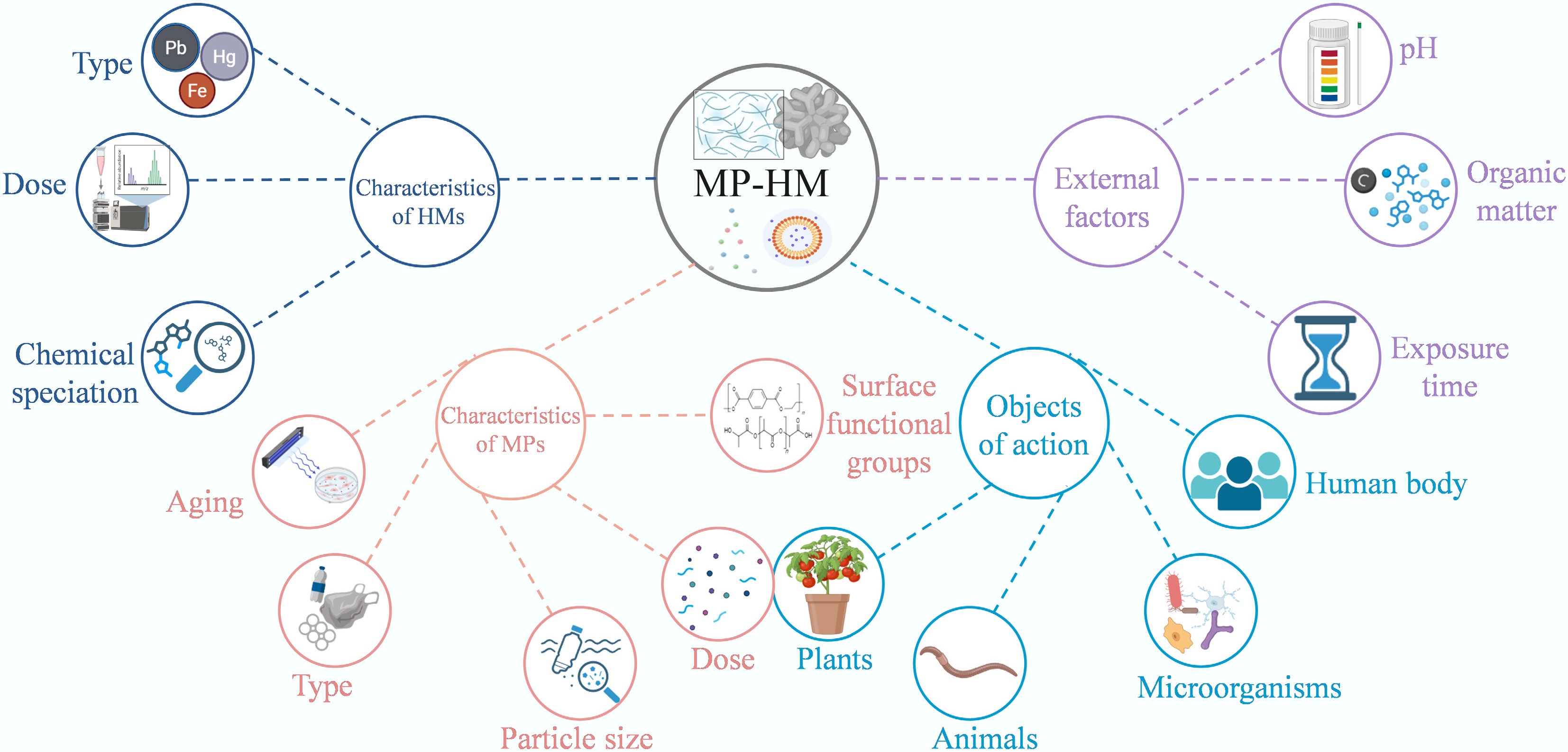
Figure 2.
Comparative framework of the main controls on MP–HM co-pollution. The upper left branch summarizes metal-side controls (type, dose, and chemical speciation), the lower left branch summarizes MP-side controls (aging, type, particle size, dose, and surface functional groups), the upper right branch summarizes environmental controls (pH, organic matter, and exposure time), and the lower right branch summarizes the principal biological receptors (microorganisms, animals, plants, and the human body). The arrows indicate how these linked modules jointly regulate adsorption, redistribution, bioavailability, trophic transfer, and the risk to ecological or human health across soil systems.
In agricultural soils, the coexistence of biodegradable poly(butylene succinate) (PBS) MPs and the veterinary antibiotic sulfadimidine has been reported to increase the lateral mobility of Pb[37]. However, the current literature still emphasizes shifts in soil biota and resistance genes more than the detailed chemistry of biodegradable MP–Pb interactions. As biodegradable film residues become more common in cultivated soils, future work should move beyond simple binary models and evaluate the combined behavior of biodegradable MPs, antibiotics, and Pb under realistic aging and soil management conditions[38−40].
An additional Pb-specific point concerns oxidation–biofilm synergy. For Pb, the growth of an eco-corona or biofilm tends to amplifies the number of oxygenated ligands and extracellular polymeric binding domains available for surface complexation, so the dominant consequence is usually stronger retention on oxidized particles rather than a change in metal valence. Compared with Cr or As, the consequence for Pb is therefore more often enhanced sorption and particle-assisted plant transfer than redox-driven speciation shift[32,36,39].
Chromium (Cr)
-
As indicated by Fig. 1, Cr differs from Pb because its adsorption must be interpreted together with the oxidation state. Chromium in the soil mainly occurs as Cr(III) and Cr(VI), and the interaction with MPs depends strongly on the valence, polymer properties, and soil chemistry[41]. Because Cr(VI) is generally more mobile and toxic, many studies focus on how MPs alter its adsorption, desorption, and redistribution in soil[42]. Polymer type and concentration can shift Cr from less labile fractions toward exchangeable and reducible forms[42]. For example, PE MPs or mixed plastic particles can increase the mobility of Cd and Cr in agricultural soils and thereby intensify their phytotoxicity in wheat (Triticum aestivum), partly through changes in pH and water-holding capacity. By contrast, low additions of biodegradable polylactic acid (PLA) have been reported to suppress Cr's downward migration in some soils[41]. Particle size is another major control: reducing the particle diameter from 2–5 mm to < 0.9 mm can increase Cr(III) adsorption by about 1.3–1.5 times[43,44].
A second Cr-specific feature is the close coupling among oxidation, aging, and eco-corona/biofilm development. As particles weather, polymer fragmentation and oxidation generate carboxyl, hydroxyl, and carbonyl groups, whereas biofilm or eco-corona formation provides extracellular polymeric substances and additional binding domains. This combined oxidation–biofilm process helps explain why aged particles often retain Cr more strongly than pristine materials[45,46]. The effect can be especially pronounced for biodegradable polymers: Pristine PLA MPs may show weak chromium affinity, whereas ultraviolet (UV)-photooxidized polylactic acid can display large increases in Cr(III) and Cr(VI) adsorption. In the presence of humic substances such as tannic acid, the reduction of Cr(VI) to Cr(III) can further promote association with aged plastic surfaces or organic matter–Cr complexes[46].
Compared with the other metals in Table 1, Cr is therefore distinguished most clearly by its redox-sensitive response and by the risk of interpreting its adsorption without accompanying speciation information[47]. Polyethylene terephthalate (PET) debris, for example, can function simultaneously as a carbon source, an electron donor, a biofilm substrate, and a gene carrier, shifting part of the metal pool toward less labile fractions while still increasing longer-term persistence[48,49]. Under high Cr(VI) exposure, biodegradable PLA MPs have also been linked with marked restructuring of rhizosphere communities and plant physiology, including increases in Bacillus and Pseudomonas, decreases in fungal diversity, and reductions in quality indicators in cucumber (Cucumis sativus)[50]. Chromium should therefore be evaluated as a coupled adsorption–redox system rather than as a sorption problem alone.
Cadmium (Cd)
-
In contrast to Pb and Cr, Cd's response in soil is more often dominated by changes in bioavailability, bioaccumulation, and rhizosphere chemistry than by valence transformation. Cadmium is highly toxic and readily transferred through food webs, and MPs can either increase or decrease the labile Cd pool, depending on the polymers' properties and the soil conditions[51−53]. This makes Cd a useful case for comparing how the same broad controls—surface chemistry, particle size, aging, and microbial mediation—translate into biologically different outcomes across polymer types.
At the mechanistic level, pristine biodegradable MPs often show relatively weak direct Cd adsorption because their surfaces remain hydrophobic and contain few active coordination sites[52]. After soil exposure, however, biofilm growth and oxidative weathering can roughen these surfaces and add oxygen-containing groups, thereby increasing Cd binding[51,54]. Conventional polymers show a different pattern. PE remains highly persistent and, when unweathered, often causes little additional phytotoxicity because its surface reactivity is low[55−57]. By contrast, degrading PLA can intensify Cd's toxicity, reduce plant biomass, and decrease fungal diversity[58]. Smaller particles and aged polypropylene (PP) also bind Cd more strongly because weathering increases surface roughness, the carbonyl index, and hydrophilicity[59].
Cd also differs from the other focal metals in that indirect geochemical regulation is often as important as direct adsorption. Prior Cd exposure may alter PS MPs' surface properties and intensify membrane toxicity, although the particles themselves may disturb ionic homeostasis through parallel stress pathways[58,59]. In soil, PVC can modify the pH and microbial structure and thereby shift Cd toward less bioavailable forms[60], whereas PE may acidify the rhizosphere, increase DOC, suppress sulfate-reducing bacteria, and ultimately limit CdS precipitation[60]. These coupled rhizosphere and microbial effects explain why Cd's responses are frequently nonlinear across concentration gradients and why Cd is particularly sensitive to particle size, aging, and soil biogeochemistry rather than to one dominant redox or complexation pathway[60,61].
For Cd, oxidation–biofilm synergy expresses itself less as a single increase in surface affinity and more as a coupled change in sorption and rhizosphere chemistry. Aging and biofilm formation can increase the number of oxygen-containing binding sites, but they may also alter the release of DOC, Fe/S cycling, and sulfide availability through microbial activity. Relative to Pb, where stronger complexation is the main outcome, Cd is more likely to show a mixed response in which particle-bound retention and dissolved bioavailability change at the same time[54,59,60].
Arsenic (As)
-
Arsenic differs from Pb, Cr, and Cd because its interaction with MPs depends strongly on anionic speciation, methylation, and competition with mineral sorbents. Arsenic is a toxic metalloid whose environmental risk is controlled mainly by mobility and bioavailability[62]. Current studies generally describe four interacting pathways at the MPs' surface: electrostatic–complexation coupling, π–π donor–acceptor interaction, pore filling with competitive dehydration, and surface-mediated oxidation–reduction catalysis[62]. The balance among these pathways depends on the particle size, surface chemistry, pH, temperature, and organic matter.
Polymer chemistry is especially important for As because conventional and biodegradable MPs can drive opposite outcomes. At relatively high doses, conventional MPs may immobilize part of the As pool while still promoting methylation, whereas biodegradable MPs can enhance the release and supermethylation of As, increasing methyl-As and pore water As concentrations[63]. Degrading PLA may therefore increase As's mobility and bioavailability in the rhizosphere, induce oxidative stress in plants, shift internal As speciation, and inhibit growth in rice (Oryza sativa)[64]. Biodegradable MPs such as PLA and poly(butylene adipate-co-terephthalate) (PBAT) may also stimulate catalase and dehydrogenase activities by releasing labile carbon during degradation, whereas conventional polymers such as PE and PS more often suppress these enzyme systems[64].
The response of As is also strongly time- and concentration-dependent. In the short term, negatively charged PS surfaces can temporarily increase extractable As by limiting adsorption onto natural soil particles, but with longer exposure, the disturbance may diminish as As becomes associated with iron oxides and soil organic matter (SOM)[58,62]. This means that As should not be interpreted from one batch equilibrium endpoint alone; the same system may move from short-term remobilization to longer-term retention as the mineral and organic matrix re-equilibrates.
Among the five focal metals, As is additionally notable for its sensitivity to nanoplastic-driven displacement. Because nanoplastics compete strongly for reactive sites on soil particles and metal oxides, 25-nm PS has been shown to accelerate teh breakthrough of As(V) and increase recovery more strongly than larger particles[65]. These effects remain pH-dependent, because stronger electrostatic repulsion under acidic conditions can further increase leaching[66]. Taken together, the differential response of As is defined by the combined roles of anionic speciation, methylation, mineral competition, and nanoplastic transport rather than by adsorption strength alone.
For As, the oxidation–biofilm/eco-corona effect must be interpreted together with anionic competition, mineral surface exchange, and microbial methylation. Biofilm coatings and humic-like interfacial layers can create new complexation domains, but they may also change Fe-associated sorption, promote the formation of methyl-As, or alter the balance between short-term remobilization and longer-term retention. Compared with Pb and Cd, the key consequence of As is therefore not only stronger attachment but also altered speciation and methylation behavior[67,68].
Mercury (Hg)
-
Hg is currently the least resolved of the five focal metals in the soil-specific evidence base. Existing studies nevertheless suggest that co-occurrence with MPs can modify Hg's speciation, mobility, and exposure pathways[69]. Weathered PE MPs released from wastewater systems, for example, can adsorb Hg(II) through pore filling and electrostatic attraction, but these particles may then act as temporary carriers rather than permanent sinks because digestive degradation can release retained Hg and increase the risk of internal exposure[69].
The most distinctive Hg-related mechanism currently identified is the coupling among DOM–Fe–S processes, methylation control, and polymer aging. In flooded paddy soils, PVC MPs (0.1–10 μm) have been reported to suppress methylmercury formation by about 30%, partly by immobilizing Hg2+ in acidic red soils through DOM–Fe–S–microbial interactions and by suppressing sulfate-reducing bacteria in alkaline soils[31,70]. This inhibitory effect applies to methylmercury formation under these flooded soil conditions; it does not mean that all aged PVC necessarily lowers the overall Hg risk. Under stronger aging, the same polymer can release MP-derived DOM and thereby alter Hg's redox transformation in a different direction.
Accordingly, the second Hg-specific mechanism is DOM-mediated photoreduction. Ultraviolet exposure and microbial attack can fragment PVC and increase the release of MP-derived DOM (MPDOM); under solar illumination, this MPDOM can promote reactive oxygen species formation and facilitate the reduction of Hg2+ to volatile Hg0[28,71,72]. In experimental systems, PVC-derived MPDOM increased Hg0 generation by about 30% relative to controls, indicating that aging can shift the net effect of PVC from immobilization toward transformation and re-release[28,71,72]. In contrast, unweathered PS generally showed no statistically significant influence on Hg's adsorption, desorption, or transformation under the conditions reported to date[58].
For Hg, oxidation–biofilm synergy is most relevant because it changes the transformation pathways rather than sorption alone. Oxidized surfaces, DOM-like coatings, and biofilm-associated sulfur and organic ligands can all modify how Hg is retained, methylated, reduced, or re-released. Unlike Pb and Cd, whose eco-corona effects are discussed mainly in terms of stronger particle binding, Hg requires explicit attention to the way aging and biofilm development redirect DOM-mediated methylation and photoreduction processes[69−71].
Because polymer coverage is still narrow and realistic soil comparisons remain limited, current conclusions on Hg should be interpreted more cautiously than those for Pb, Cr, Cd, or As. Future work should prioritize multipolymer comparisons, coupled redox–DOM experiments, and field-relevant assessments of both the methylation and photochemical transformation of Hg under scenarios with aging MPs[28,58,72].
Interactions and toxicity of multicomponent HM–MP complex systems
-
Multimetal systems introduce an additional layer of complexity because MPs interact not with one dissolved species at a time but with mixtures whose components can compete for the same particle-bound ligands, mineral-associated sites, and dissolved organic binding domains. Under these conditions, the relevant question is not only whether a given MP increases or decreases total sorption, but which metal is preferentially redistributed, which labile fraction is amplified, and whether the resulting exposure differs from that in single-metal systems[42,63].
The first response mode is competitive or selective redistribution rather than complete valence transformation[73−75]. Available evidence suggests that Pb and Cr(III), because of their stronger complexation with oxygen-containing groups on oxidized particles, can compete more effectively than Cd for newly generated binding domains on aged MPs, whereas As and Hg remain more dependent on anionic speciation, DOM mediation, or transformation pathways than on simple site occupation[76,77]. Thus, multimetal coexistence can shift the relative priority of sorption sites and cause one metal to be stabilized while another is displaced into more mobile fractions.
The second response mode is nonadditive ecological amplification. In wheat systems, combined Cd and Cr exposure in the presence of PE, PS, or PLA has been linked to higher metal uptake, stronger oxidative stress, increased sodium dismutase (SOD) and peroxidase (POD) activities, elevated malondialdehyde (MDA) content, and reductions in plant height, root length, and biomass[42]. More broadly, Cd–Pb combinations tend to show clearer carrier-enhanced uptake and stronger joint toxicity than Cr–As pairs because their ecological effects more often track changes in the labile pools and their digestive or rhizosphere release, whereas Hg-containing mixtures still lack the systematic data needed to quantify comparable nonadditive patterns[78].
The third response mode concerns the contrast between multimetal and single-metal scenarios. In single-metal systems, the central question is often whether adsorption increases or decreases the bioavailable pool. In multimetal systems, the more important issue is whether MPs reorder site competition, redistribute the metals across labile fractions, or switch the system from fixation toward remobilization and methylation-sensitive pathways. This contrast may be especially important for biodegradable MPs, whose degradation products and biofilm development can shift As- and (potentially) Hg-related pathways toward release or methylation, whereas conventional MPs more often behave as carriers that intensify the transport and uptake of Pb/Cd[79]. These differences indicate that multimetal responses should be interpreted as a metal-specific competition problem rather than as a scaled-up version of single-metal sorption.
Condensed overview
-
Previous microscopic evaluations showed that MP–HM interactions in soil are controlled by three major groups of factors: HMs' characteristics, polymers' properties, and the environmental conditions (Fig. 2). Metal speciation affects the initial reactivity, whereas polymers' size, chemistry, and aging determine the available binding sites and transport behavior. Weathering can introduce reactive functional groups, and the concurrent development of biofilms or eco-coronas can further add extracellular polymeric substances and additional coordination domains[32,45]. This oxidation–biofilm synergy is therefore a shared but unevenly expressed driver across the five focal metals: it most clearly enhances redox-sensitive Cr retention, strengthens oxidized-site binding for Pb and Cd, changes the balance between release and remobilization for As, and may redirect Hg's transformation through DOM-mediated pathways rather than simple sorption alone[62,67].
External parameters such as pH, SOM, DOM, and redox condition further regulate these processes. Formation of ternary complexes such as MPs–As–HA can modify HMs' bioavailability, whereas associated changes in microbial communities and oxidative stress help link microscopic interfacial processes with larger ecological outcomes[46]. These effects are also time-dependent: short-term electrostatic interactions can evolve into longer-term sequestration, redistribution, or biological uptake as soils age and particles acquire eco-coronas or biofilms[36,66,68].
A key comparative lesson is that a differential response is not simply a matter of stronger versus weaker adsorption[46]. Pb is dominated by pH-sensitive complexation; Cr requires the interpretation of combined adsorption and redox factors; Cd is highly responsive to particle size, rhizosphere chemistry, and microbial mediation; As depends on anionic speciation, methylation, and competition with Fe oxides and DOM; and Hg is shaped by methylation control and photoreduction pathways under a still-limited evidence base[63]. These contrasts explain why risk and remediation cannot be generalized from one polymer–metal pair to all others[32,60,70].
A practical implication is that sorption data alone are insufficient[31]. Strong binding may either immobilize a metal or create a mobile particle-bound reservoir, depending on the soil transport conditions, digestive desorption, and biological uptake[42]. Conversely, weak apparent affinity in a batch test does not imply limited environmental relevance if the polymer subsequently ages or acquires an eco-corona after entering the soil. Differential responses should therefore be assessed across a sequence of processes (e.g., surface interactions, redistribution within the soil, bioavailability to organisms, and persistence under field conditions) rather than by equilibrium sorption data alone[58,65].
Taken together, the MP–HM interface should be interpreted as a coupled biogeochemical system rather than as a collection of independent adsorption events. This perspective is essential for translating mechanistic studies into realistic ecological risk assessments and remediation designs.
Comparative synopsis of differential responses
-
To better reflect the differential responses emphasized in the title, Table 1 summarizes representative contrasts among the five focal metals across six dimensions: the dominant interaction feature, sensitivity to soil chemistry, aging/biofilm response, ecological implication, representative evidence base, and key notes on differential responses[31−33]. The table is not intended as a universal ranking, because the response depends on the polymer type, aging state, and soil conditions; instead, it highlights recurrent patterns reported in the literature and helps explain why apparently inconsistent results can still be mechanistically compatible[34−36].
The comparative framework also highlights an important interpretive caution: apparent differences among metals may change depending on whether the response is evaluated at the level of sorption, speciation, mobility, organism uptake, or remediation performance[41,42]. For example, Pb may display strong coordination with oxidized surfaces, yet its mobility can still increase if particle-bound transport dominates[43]. Cr's responses depend strongly on the oxidation state, so adsorption data alone may not capture risk without any accompanying redox information[50]. Cd often appears to be highly sensitive to particle size and rhizosphere effects, whereas As and Hg require closer consideration of anionic speciation, methylation, and DOM-mediated transformation pathways[51,60]. These distinctions reinforce why a review centered on differential responses should compare mechanisms and outcomes together rather than treating all metals as interchangeable examples of a generic HM effect[69,70,72].
-
SMCs are key mediators of soil-based biogeochemical cycling and therefore represent the first ecological level at which MP–HM co-pollution is often detected[80]. Changes at this level can propagate upward by altering nutrient transformation, organic matter turnover, pollutant speciation, and the exposure conditions experienced by soil fauna and plants[81,82]. Accordingly, this section first discusses microorganisms, then soil fauna, and then plant communities, before integrating their cross-trophic linkages in Cross-trophic cascade effects.
In actual soils, MPs and HMs often coexist and influence SMCs through several linked pathways. Microplastics can adsorb or redistribute HMs, alter the pore structure and soil physicochemical conditions, and interfere with microbial metabolism[16,80,83]. For example, PE MPs can reduce the immediate bioavailability of Ni, Cr, and Cu in soil solutions[83]. Under acidic conditions, PVC MPs may also buffer pH and induce the hydrolysis precipitation of metal cations, thereby decreasing their availability to microorganisms[80].
The ecological responses of SMCs to MP–HM co-contamination extend from the community's structure to metabolic function and functional genes. In Cd–Pb-contaminated systems, PE MPs can reshape root-associated communities by enriching stress-tolerant taxa such as Actinobacteria while Proteobacteria remain dominant[16].
Functionally, combined exposure may suppress nitrate reductase and glutamine synthetase, thereby constraining nitrogen assimilation, although the responses vary among polymers and soil conditions[16]. Under acidic conditions, PVC MPs have also been reported to shift microbial metabolism away from recalcitrant carbon degradation and toward nitrogen and phosphorus turnover, accompanied by changes in metagenomic functional profiles[80].
From a differential response perspective, microbial disturbance caused by Pb and Cd more often translates into changes in bioavailable pools and subsequent carrier-assisted uptake, whereas the effects of Cr and As remain more tightly coupled to valence or anionic-speciation shifts that alter the form rather than only the amount of the metal available to organisms[84,85]. By contrast, the microbial implications of Hg remain more uncertain because the current soil-specific evidence base is smaller and more focused on flooded, DOM-rich systems than on broadly comparable soils[86].
Soil faunal community
-
Soil fauna such as springtails, nematodes, and earthworms constitute the next trophic interface after microorganisms. Their feeding activity, burrowing, and gut processes strongly influence the decomposition of organic matter, nutrient turnover, and the redistribution of MPs and HMs in the soil. Therefore, faunal responses integrate both direct toxic exposure and upstream changes in microbial activity and HMs' bioavailability[87,88].
At this level, toxicity is strongly influenced by the form of HM. Exchangeable metals such as dissolved Cd2+ and Pb2+ can bind rapidly to MPs' functional groups and be transported into soil animals through carrier-assisted uptake pathways, producing much stronger effects than residual fractions[89]. For example, exchangeable Cd has been associated with far higher earthworm mortality than residual Cd at the same nominal concentration[41].
Combined exposure links chemical and physical stress. High Cd can damage gut epithelial mitochondria and decrease membrane potential, whereas MPs can obstruct feeding or concentrate associated metals in the digestive tract[90−92]. Together these processes have been associated with 40%–60% reductions in sensitive fauna such as springtails and nematodes and with shifts toward more pollution-tolerant groups[88,90,93].
Functional consequences then extend to ecosystem processes. Reported outcomes include 30%–50% reductions in the decompostion of organic matter, 15%–20% decreases in soil porosity, and 20%–30% losses of available nutrients relative to healthier soils[89,94]. Broader cascade effects may include declines in predatory arthropods, reduced avian reproductive success owing to prey limitation, and lower offspring survival under some combined exposure scenarios[95−97].
At the fauna level, Cd and Pb generally show clearer carrier-amplified uptake than Cr because their ecological effects more often track changes in labile pools and digestive release from particle surfaces[98]. Cr- and As-related effects, by contrast, remain more dependent on speciation, redox history, and mineral competition, whereas the data on Hg are still too limited to support a similarly robust cross-faunal comparison. Thus, even when the outward endpoint is toxicity to soil fauna, the mechanism of amplification is not uniform across metals[99].
Soil plant community
-
Soil plant communities connect belowground processes with food production and human exposure[100]. Plant responses to MP–HM co-contamination depend on the root zone's physicochemistry, rhizosphere microorganisms, and the capacity of MPs to modify HM uptake pathways. Thus, plant-level outcomes should be interpreted as the cumulative result of earlier microbial and faunal disturbances, together with direct root exposure[101,102].
Mps also introduce additional physical stressors into agricultural soils. Derived mainly from degraded mulch films, compost inputs, and mismanaged solid waste, these particles can reach abundances of up to 40,800 items kg−1 in heavily managed farmland[103,104]. By altering pore structure and particle aggregation, MPs may restrict root elongation, modify water retention, and redistribute biomass allocation between shoots and roots. Reported responses include increases in shoot dry weight of about 32.7% but decreases in root dry weight and root length of about 4.1% and 14.3%, respectively[105]. Mps may also affect soil biochemical processes, including enzyme activities and nutrient turnover, and can enhance metal accumulation in plants. For example, co-exposure to MPs increased Cd concentrations in Amaranthus tricolor seedlings by 158% compared with Cd alone[106,107].
The coexistence of MPs and HMs in the rhizosphere can intensify plant stress through several interacting pathways. Mps may alter HMs' speciation, diffusion, and bioavailability, thereby changing the amount of metal that reaches the roots' surfaces[25]. Experimental evidence indicates that increasing the MP dosage can raise soil Cd extractability from 14.4% to 25.4%, accompanied by declines of about 38% in root yield and 32% in aboveground biomass[108]. Co-pollution can also shift the plant community's composition by reducing the competitiveness of sensitive species while favoring more tolerant taxa.
At the cellular level, combined exposure can induce severe oxidative stress, and under prolonged or high-dose conditions, antioxidant defenses may no longer fully offset the damage[109]. In addition, MPs can influence HMs' behavior indirectly through changes in the soil microbial communities, redox conditions, chelation, and precipitation processes, thereby affecting the quantity and form of metals crossing the root barrier[91,93].
From a differential response perspective, Pb and Cd are more often linked with MP-assisted plant enrichment because particle-bound transport, rhizosphere mobilization, and carrier-mediated root contact can directly increase the bioavailable fraction reaching plant tissues. The effects of Cr and As depend more strongly on the oxidation state or anionic speciation, meaning that apparent plant toxicity may reflect transformation pathways as much as gross uptake, whereas Hg-related plant evidence remains comparatively sparse and more uncertain. These contrasts show why ecological risk in crop systems cannot be inferred from a single generic MP-assisted HM uptake model.
Cross-trophic cascade effects
-
Viewed across the whole soil food web (Fig. 3), MP–HM co-pollution rarely remains confined to one biological compartment. Microbial shifts can change extracellular enzymes' activity, the redox microenvironment, and organic ligand production, thereby altering the forms and mobility of the HMs that are subsequently encountered by soil fauna and plant roots[16,20]. For example, suppression of metal-transforming or sulfur-cycling microorganisms can weaken HMs' immobilization, whereas stimulation of stress-tolerant taxa may increase extracellular polymer production and indirectly favor HMs' redistribution on particle surfaces. These apparently microbial responses therefore influence higher trophic levels by modifying both the intensity of exposure and pollutant speciation[89,90,98].
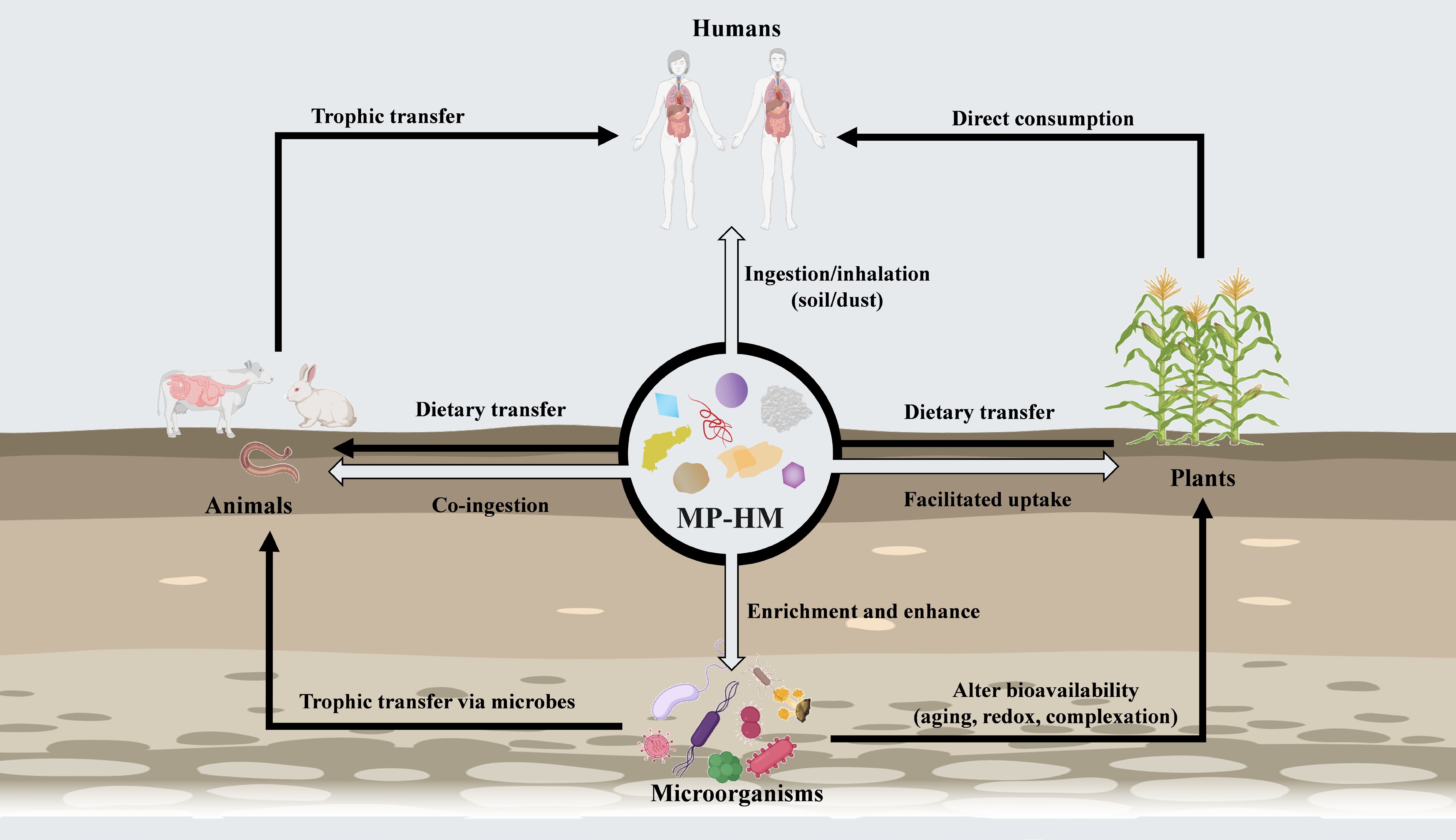
Figure 3.
Schematic illustration of the migration pathways and ecological risks of heavy metals (HMs) and microplastics (MPs) in the soil ecosystem. The central circle represents the soil matrix contaminated with HMs and MPs, serving as the source of pollution. Plants uptake HMs and MPs directly from the soil, where microbial activities (e.g., aging, redox reactions, complexation) alter the bioavailability of pollutants, facilitating their transfer into the food chain. Animals (e.g., earthworms, livestock) ingest HMs and MPs through soil consumption or by feeding on contaminated plants, enabling trophic transfer to higher levels. Humans are exposed to HMs and MPs via multiple pathways: direct consumption of contaminated plants, trophic transfer through animal products, and incidental ingestion/inhalation of polluted soil or dust.
At the faunal level, ingestion, egestion, and bioturbation can further reshape the exposure landscape. Earthworms and other detritivores physically transport MPs within the soil profile, concentrate particle-bound HMs in their gut microenvironments, and generate casts with altered pH and organic matter characteristics[89−91]. These processes can modify the availability of HMs to rhizosphere microorganisms and plants, while simultaneously changing the faunal community's composition, reproduction, and energy allocation. As a result, co-pollution can propagate from microorganisms to fauna not only through direct toxicity but also through the restructuring of habitat quality and trophic resources[95,98].
The cross-trophic implication is that exposure is not propagated by a simple linear chain but by repeated transformation at each level[20,25]. Microbial metabolism can modify metals' valence and ligand availability; faunal gut passage can alter pH, aggregation state, and desorption kinetics; and plant roots then encounter a chemically modified pool of dissolved and particle-associated contaminants[110]. In agricultural soils, this means that human exposure may arise through several parallel routes rather than through one food item alone. Direct plant consumption, livestock transfer, dust inhalation from managed fields, and drinking water pathways linked to runoff or leaching can all contribute to the final exposure burden[90,98,111].
The strength and mode of this cascade are therefore not identical among metals. Cadmium and, in many cases, Pb show clearer cross-trophic amplification because changes in the labile pools and particle-assisted transport can more readily propagate from microorganisms to fauna, plants, and food products. Chromium and As cascades depend more strongly on redox or speciation transitions, so trophic propagation may be substantial even when teh total change in concentration is modest. By contrast, Hg remains the least certain case in current soil-based evidence because methylation, DOM-mediated transformation, and volatilization can redirect exposure away from the same pathways emphasized for Pb/Cd. These differences complete the logic developed in Influencing factors in the microscopicinteractions between HMs and MPs: different mechanisms at the particle–metal interface translate into distinct ecological and risk trajectories across trophic levels.
This broader cascade perspective also clarifies the structure of human exposure. Humans may encounter MP–HM mixtures not only through the consumption of animals that have accumulated contaminants but also directly through edible plant tissues, contaminated water, and particle-bearing dust. In crop-based systems, root uptake and rhizosphere-mediated remobilization can place metals and particle-associated contaminants into leaves, grains, or vegetables without an intermediate animal host. In mixed farming systems, the same contaminants may then be transferred further to livestock and dairy products, creating intersecting entry routes into the human diet and complicating food safety assessments[25,98,111].
Industrialization, urbanization, and intensive agriculture have increased the probability that humans will be exposed to MP–HM co-pollution through food, drinking water, dust, and occupational pathways. Practices such as sewage sludge application, mulching film fragmentation, mining, waste disposal, and industrial emissions can all contribute to mixed exposure scenarios. In highly affected agricultural regions, soil Cd concentrations can exceed national screening values; where this occurs, the associated risk of Cd accumulation in rice may also exceed the food safety concepts reflected in the FAO/WHO Codex's cereal guidance, linking soil contamination directly with concerns about dietary exposure.
-
Driven by rapid industrialization, urbanization, and intensive agriculture, the probability of humans encountering combined microplastic and heavy metal pollution through food, water, dust, and work-related pathways has markedly increased. Practices such as mining, fertilizer and pesticide use, wastewater irrigation, sludge application, and extensive use of plastic film have caused many agricultural soils to accumulate both toxic metals and plastic debris. A representative example is provided by the paddy fields in Hunan Province, China, where the average Cd concentrations have been reported at 1.4 mg kg−1, substantially above the national screening value of 0.3 mg kg−1, thereby increasing the likelihood of transfer to rice grain[111]. This soil burden is also consistent with elevated concern for potential exceedance of the FAO/WHO Codex's maximum levels for Cd in polished rice and related cereal commodities, linking regional soil contamination more directly with internationally relevant food chain risk management frameworks[111].
Exposure does not occur only through crop ingestion. Microplastic–HM complexes can move from soils to crops and soil fauna and then to livestock and humans, but humans may also be exposed directly through edible plant tissues, contaminated drinking water, or particle-bearing dust generated from fields, roads, and industrial sites. For this reason, the exposure pathway should be viewed as a branching network rather than as a single linear food chain route (Fig. 3)[112,113].
Inhalation and dermal contact provide additional routes. Microplastics and HM-containing particulates may be inhaled, particularly in dusty workplaces and traffic- or industry-influenced settings, whereas repeated contact with contaminated water, sediment, or soil can contribute to dermal exposure[25]. Because MPs possess a large specific surface area and can adsorb metals through electrostatic interaction and complexation, they may serve as particle-scale carriers that alter both the route and timing by which HMs enter biological systems.
Toxic mechanisms
-
When MPs and HMs coexist, the toxic mechanism is not limited to simple co-exposure. MPs may adsorb, transport, and—under changing pH or digestive conditions—release HMs, thereby modifying target organs' exposure. From an organ-level perspective, particle-assisted transfer can increase the bioavailability of co-occurring metals. For example, soil MPs have been reported to enhance Cd uptake by rice roots, which may subsequently intensify Cd-related renal risk in exposed populations[25,111,114]. In respiratory contexts, inhaled plastic-associated volatile compounds and particulate HMs may jointly aggravate alveolar injury and increase the probability of chronic pulmonary disease[115,116].
At the cellular level, combined exposure is frequently associated with oxidative stress, elevated reactive oxygen species, damage to DNA and proteins, apoptosis, and immune dysregulation[112,117,118]. Mechanistically, MPs may enter cells through endocytosis, whereas dissolved metals can alter the expression of membrane transport proteins; together, MP–HM assemblies may cross biological barriers more efficiently than either pollutant alone. Figure 4 summarizes these carrier-assisted pathways and the major organ systems currently discussed in the literature.
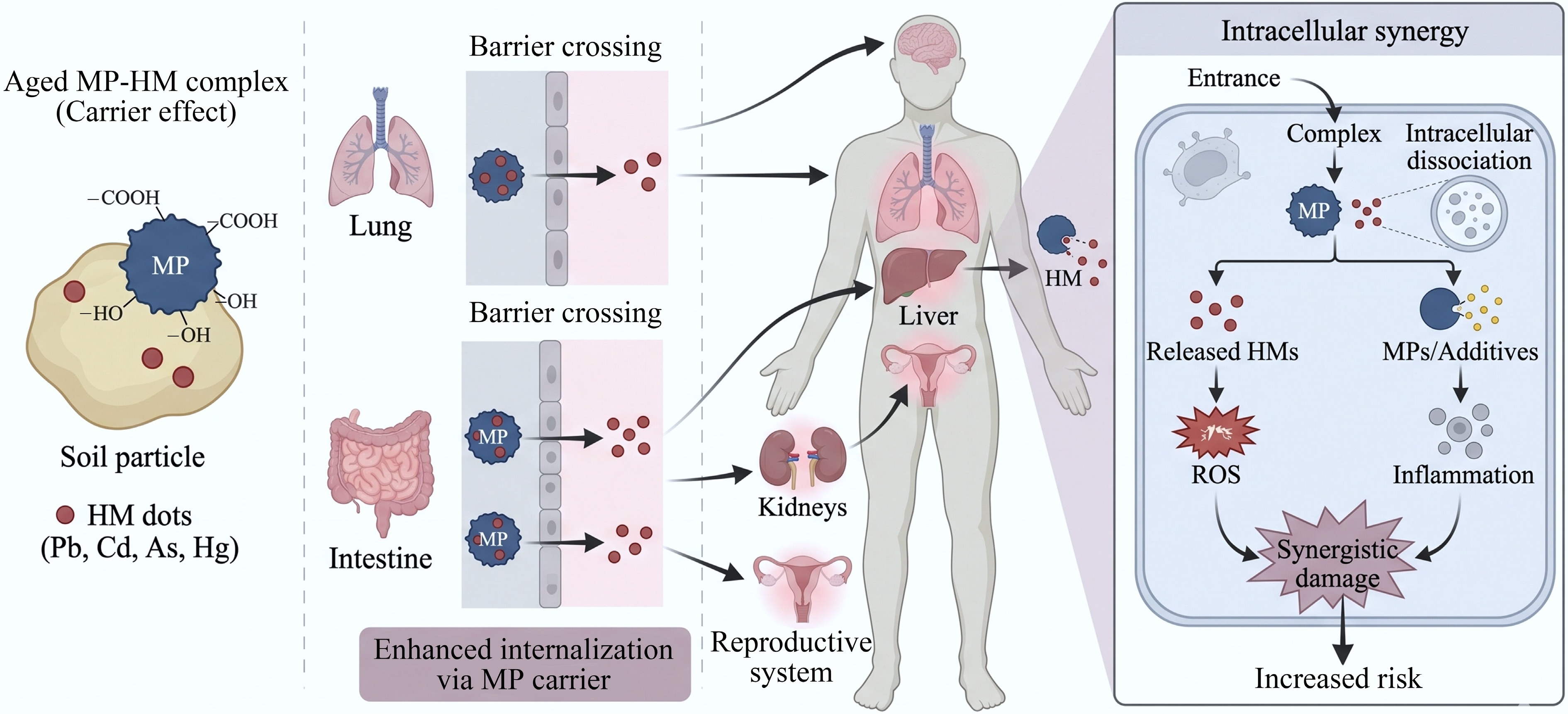
Figure 4.
Proposed mechanistic pathway of soil-derived microplastics (MPs) as carriers for heavy metals (HMs) across biological barriers, leading to target organ accumulation and synergistic human health risks. The diagram illustrates the MP-mediated transport across lung and intestinal barriers, followed by organ-specific risks through converging reactive oxygen species generation and inflammation pathways, resulting in escalated disease risk.
Release processes are equally important. Previous studies have shown that MPs can increase the bioaccumulation of Cd in earthworms by up to 140%, impair antioxidant defenses, and induce DNA damage. Once metal-laden particles are ingested or subjected to environmental change, desorption may further elevate internal exposure, indicating that the human health risk of co-pollution is linked to both transport and release processes[119].
Population-specific health impacts and short-/long-term effects
-
The health impacts of combined exposure to HMs and MPs vary among demographic groups and exposure contexts. Children and adolescents are particularly sensitive because exposure to metals such as Pb and Cd during development can contribute to neurodevelopmental deficits, cognitive impairment, and anemia[120]. Infants may also experience relatively high plastic exposure through feeding bottles, toys, and frequent hand-to-mouth behavior; some studies reported PET concentrations in infant feces that were several times higher than those measured in adults[121]. Older adults may be more vulnerable because reduced metabolic clearance and immune resilience can increase susceptibility to neurological and inflammatory effects[112,113,122]. Occupationally exposed groups, including workers in mining, smelting, waste handling, and plastic processing, may experience greater inhalation and dermal contact with mixed pollutants, which can elevate the risk to the respiratory and renal systems[112,113].
Short-term exposure is often associated with oxidative stress, epithelial irritation, inflammation, and gastrointestinal symptoms, whereas long-term exposure raises broader concerns about cumulative metal retention, endocrine and reproductive disruption, immune dysregulation, and carcinogenic risk[112,123,124]. Communities living near mining areas, waste disposal facilities, industrial parks, or plastic-intensive agricultural zones may experience co-exposure through multiple media at the same time, including soil, irrigation water, homegrown food, and airborne dust[125,126]. Taken together, these findings indicate that human health assessments should distinguish susceptible populations, exposure pathways, and the duration of exposure when evaluating MP–HM co-pollution[127].
Current limitations
-
Current limitations in human health assessments arise first from how exposure is characterized. Most studies still estimate the risk from one medium at a time, whereas realistic co-exposure occurs through mixed food, water, dust, and occupational routes. Existing exposure models also rarely distinguish among metal-specific carrier pathways, even though Pb/Cd are more likely to show amplified dietary exposure through plant and food chain enrichment, Cr/As require closer attention to changes in valence or speciation, and Hg may involve volatilization- and methylation-related pathways that are not captured by concentration-only assessments.
A second limitation concerns resolution of the mechanism within the differential response framework of this review. Current evidence is still dominated by single-metal/one-polymer systems, and direct side-by-side comparisons among Pb, Cr, Cd, As, and Hg in the same soil matrix remain rare. Time-resolved data are especially limited for biodegradable MPs, so it is still difficult to determine how aging stage, biofilm development, and degradation products alter the five metals differently over time or how those changes modify human-relevant exposure pathways.
A third limitation concerns risk quantification and translation of the evidence. Epidemiological data for true mixed MP–HM exposure remain scarce, and dose metrics are not standardized across soil, food, dust, and biological tissues. As a result, Pb/Cd's dietary amplification, Cr/As's speciation-sensitive health risk, and Hg's volatilization-related exposure are rarely evaluated within one comparable framework. Future assessments therefore need harmonized metrics that can connect metal-specific exposure routes with particle aging, trophic transfer, and realistic co-exposure scenarios.
Remediation strategies and future perspectives
-
Remediation of soil co-contaminated by MPs and HMs should be framed around one central question: How can a remediation system simultaneously suppress MPs' carrier effects, lower HMs' bioavailability, and avoid secondary release during particle aging or transformation? A design that addresses only one side of this coupling is unlikely to be sufficient in realistic soils[127].
Generic removal-or-isolation approaches remain relevant but are insufficient on their own for coupled pollution. Excavation, washing, filtration, or intensive separation may remove part of the particle load, whereas stabilization amendments can immobilize metals, yet neither approach alone guarantees that aged MPs will not continue to transport or re-release HMs. For this reason, coupled remediation must be evaluated against two parallel outcomes: reduced dissolved/labile metal pools and the interruption of particle-assisted redistribution[128].
Biological and coupled biological–material approaches are more promising because they can operate on both sides of the MP–HM interaction. Plant–microorganism systems can immobilize or transform metals in the rhizosphere while also modifying particle retention, aggregation, and the development of organic coatings. At the same time, reactive amendments such as engineered biochar, Fe/Mn-rich minerals, clay-rich barriers, and functional porous composites can intercept dissolved metals, limit contact between MPs and root surfaces, and reduce the probability that aging particles become renewed metal carriers[129].
Recent studies show that remediation performance is MP-sensitive rather than related to the metal only. In a ternary Pb–Cr–Cd system containing PE MPs, co-modified biochar reduced diethylenetriaminepentaacetic acid (DTPA)-extractable Pb, Cr, and Cd by 50.8%, 46.7%, and 38.3%, respectively, while also decreasing MP-associated microbial disturbance and improving soil enzyme activity[79]. In rhizoremediation-oriented systems, the presence of MPs has also been shown to change metal uptake trajectories and greenhouse gas outcomes during phytoremediation, indicating that remediation efficiency cannot be extrapolated from metal-only controls[130]. Furthermore, risk control in phytoremediation does not stop with metal extraction; the harvested metal-enriched biomass must undergo controlled disposal, thermal treatment, or resource recovery to prevent the pollutants from re-entering the environment.
Integrated amendment systems are especially relevant when remediation must simultaneously intercept dissolved metals and reduce the mobility of particle-bound contaminants[131]. Porous biochar, Fe/Mn-rich minerals, and engineered sorbent composites can stabilize Pb/Cd-dominated systems by binding the labile pool and decreasing carrier-assisted transport. By contrast, Cr- and As-dominated systems require stronger oxidation–reduction control because remediation must regulate speciation as well as sorption; in these cases, redox-buffering minerals or microbially coupled reduction/oxidation strategies become more important than sorption capacity alone[132]. Hg-affected soils require yet another emphasis: suppression of methylation, control of DOM-mediated transformation, and reducing unwanted photochemical re-release[133].
A practical metal–polymer-specific design framework therefore follows directly from the differential response patterns summarized in Table 1. Pb- and Cd-dominated soils often benefit most from stabilization-oriented designs that combine reactive sorbents with physical interception of particle movements. Cr- and As-contaminated systems require stronger attention to oxidation–reduction control, ligand competition, and speciation-sensitive amendment choice. Hg-affected soils should be managed with strategies that suppress methylation and unintended photoreduction or DOM-mediated re-release rather than relying on sorption-only logic[134].
Polymer identity matters as well. Conventional hydrophobic MPs often require stronger control of aggregation, detachment, and carrier-assisted transport, whereas biodegradable MPs additionally require the management of time-dependent aging, labile carbon release, and biofilm-driven remobilization. In practice, this means that a remediation strategy effective for a PE–Pb or PE–Cd system may not be transferable to a PLA–As or aging-PVC–Hg system without modification of redox control and the amendment's lifetime, and monitoring secondary release.
Overall, remediation for MP–HM co-pollution is most likely to be effective when it combines stabilization, selective removal, interruption of the exposure pathway, and ecological restoration according to site-specific differential responses. The key point is not to apply a generic combined pollution recipe, but to design a metal–polymer-specific control strategy that simultaneously targets MPs' transport behavior, the HMs' form, and the ecological pathway most responsible for the risk.
-
This review advances our current understanding of MP–HM co-pollution in three linked ways. First, it shows that the five focal metals do not respond identically to the same MP-related control factor: Pb is most strongly associated with pH-sensitive complexation, Cr with redox-coupled transformation, Cd with carrier-assisted bioavailability shifts, As with anionic speciation and methylation, and Hg with transformation-sensitive DOM pathways. Second, it demonstrates that conventional and biodegradable MPs cannot be treated as interchangeable because their aging trajectory, biofilm development, and degradation products often change both the direction and intensity of metals' response. Third, it argues that these mechanistic contrasts should translate into differential ecological interpretation and metal–polymer-specific remediation designs rather than into one generic framework for all MP–HM combinations.
(1) Long-term field monitoring should compare how conventional and biodegradable MPs at different aging stages regulate the migration of Pb, Cd, Cr, As, and Hg in soil–crop systems, so that laboratory conclusions on carrier effects, oxidation–biofilm synergy, and speciation change can be tested under realistic hydrological and rhizosphere conditions.
(2) Multimetal MP systems require the systematic study of competitive site occupation and nonadditive toxicity. Future work should quantify the priority with which different metals occupy aged particle surfaces, compare whether Cd/Pb amplification is consistently stronger than the responses of Cr/As, and determine under what conditions biodegradable MPs shift the system from fixation toward As/Hg release or methylation-sensitive pathways.
(3) Cross-trophic transfer should be evaluated in a metal-specific way. Particular attention is needed for Pb/Cd's dietary magnification, Cr/As's valence- or speciation-sensitive transfer, and Hg's methylation-linked trophic exposure, so that human health assessments can move beyond concentration-only summaries toward differential exposure pathways driven by MPs' transport and aging.
(4) Remediation research should move toward field-validated, metal–polymer-specific designs. Lead/Cd-contaminated soils require stronger stabilization plus interception systems, Cr/As-contaminated soils require redox-sensitive amendment strategies, and Hg-affected soils require the suppression of methylation and secondary release. Comparative trials that evaluate amendments' performance separately for conventional versus biodegradable MPs will be essential for turning mechanism-based insights into practical control technologies.
-
Not applicable.
-
The authors confirm their contributions to the paper as follows: Xinwen Liang: writing – original draft; Ling Wang: writing – original draft; Caiyun Sun: data curation, investigation; Kunlong Hui: writing – reviewing and editing, characterization analysis, funding acquisition; Juntao Zhang: writing – reviewing and editing, data curation; Ying Yuan: investigation. All authors reviewed the results and approved the final version of the manuscript.
-
All data used in this article are derived from public domain resources.
-
The authors declare that they have no conflict of interest.
-
# Authors contributed equally: Xinwen Liang, Ling Wang
Full list of author information is available at the end of the article. - Copyright: © 2026 by the author(s). Published by Maximum Academic Press, Fayetteville, GA. This article is an open access article distributed under Creative Commons Attribution License (CC BY 4.0), visit https://creativecommons.org/licenses/by/4.0/.
-
About this article
Cite this article
Liang X, Wang L, Sun C, Hui K, Zhang J, et al. 2026. The interplay between microplastics and heavy metals in soil: altered risks and differential responses. New Contaminants 2: e018 doi: 10.48130/newcontam-0026-0015 

The interplay between microplastics and heavy metals in soil: altered risks and differential responses
- Received: 10 March 2026
- Revised: 21 April 2026
- Accepted: 25 May 2026
- Published online: 06 June 2026
Abstract: Soil ecosystems are increasingly exposed to combined contamination by microplastics (MPs) and heavy metals (HMs), yet the interaction does not follow one generic pattern across metals. This review focuses on five priority heavy metals (Pb, Cr, Cd, As, and Hg) and compares their differential responses to interactions with conventional and biodegradable MPs under changing particle size, oxidation, biofilm/eco-corona development, pH, dissolved organic matter, and redox conditions. We show that the oxidation–biofilm synergy does not act uniformly: it most consistently strengthens Pb/Cd complexation and carrier-assisted enrichment, modulates Cr mainly through the coupling of adsorption with valence transformation, reshapes As's sorption–methylation pathways, and alters Hg predominantly through dissolved organic matter (DOM)-mediated transformation rather than sorption alone. We further show that conventional and biodegradable MPs can regulate heavy metals' mobility, bioavailability, trophic transfer, and ecological risk in contrasting ways, especially in the rhizosphere and in multimetal settings. On this basis, the review advances three linked contributions: a comparative framework for metal-specific differential responses, a direct comparison between conventional and biodegradable MPs, and a metal–polymer-specific remediation design framework for complex co-contaminated soils. Finally, we identify priorities for future work, including long-term field validation, multimetal competition, time-resolved aging of biodegradable MPs, cross-trophic transfer, and mechanism-guided remediation that jointly suppresses MPs' carrier effects and HMs' bioavailability.