












-
Sustainable agriculture in the rice (Oryza sativa) paddy system is imperative for global food security and environmental health, given rice's role as a staple food for over half of the world's population and its significant contribution to greenhouse gas emissions[1]. In particular, the contamination of heavy metals (HMs) in soils and their accumulation in rice grains remain a global concern[2,3], although decades of effort has attempted to mitigate HM accumulation in rice, such as immobilization techniques, phytoremediation, cultivar selection, and genome editing[4,5]. This is because HMs readily enter the soil via atmospheric deposition, irrigation, and fertilizer applications[6,7]. Once introduced, HMs can bind to minerals and organic matter (OM) and persist in the soil, resulting in elevated concentrations of HMs in crops[8]. Current mitigating approaches for cropland, such as immobilization and phytoremediation, are less effective in mitigating HM accumulation in crops[9]. This is because even though HMs can be immobilized temporarily, they can be remobilized if the conditions change[10]. Therefore, even with regulatory restrictions on direct discharges, HM contamination persists as a pressing concern in the rice paddy system[2,11,12].
Rice straw, a byproduct of the rice paddy system, has long been incorporated into paddies as a disposal measure and has been reported to increase rice yield and improve soil health[13,14]. This agricultural activity has been reported to impact HMs' mobility and bioaccumulation, yet conflicting results have been yielded for different metals. For instance, it has been reported to reduce rice cadmium (Cd) uptake by 17%−92% but to facilitate the methylation process for certain HMs, such as mercury (Hg) and arsenic (As), thus increasing their accumulation in rice grains[15−18]. This suggests that a comprehensive evaluation of HM accumulation after rice straw incorporation is critical, as HMs co-exist in paddy soils and OM is generally considered to be deeply involved in the biogeochemical cycling of HMs[6,18]. In addition, converting rice straw into biochar is also a common approach, particularly for the purpose of HM immobilization in the soil[19]. Numerous studies have investigated the impacts of straw-derived biochar on improving soil fertility, elevating rice yields, and mitigating HM accumulation[20−23], providing a potential option for straw disposal. However, relatively high application rates, e.g., 1%−5%[19,24], have usually been adopted, which may not be applicable in the field. Therefore, despite many advances in elucidating the effects of straw return or straw-derived biochar on the mobility and accumulation of a specific single HM, a critical question arises: Is rice straw incorporation a safe measure of straw disposal regarding the bioaccumulation of multiple HMs in rice grains?
Here, a pot experiment was conducted with a type of paddy soil contaminated by Cd to answer this question. Six HMs, i.e., As, Cd, copper (Cu), nickel (Ni), lead (Pb), and zinc (Zn), were selected in this study, as they have been reported as the primary HM contaminants in paddy soils[6,9,25]. Considering that HMs' mobility and bioavailability in paddy soils are closely associated with soil pH and water management, additional mitigation scenarios were included in this study[26,27]. Meanwhile, six scenarios of straw disposal, i.e., straw removal, straw incorporation, and four other scenarios designed to potentially mitigate HM accumulation induced by straw return, were considered. By discussing the respective merits and drawbacks of the different treatments, a more appropriate straw disposal measure can be identified. The results obtained in this study may provide actionable insights to balance agricultural productivity, HM risk mitigation, and climate benefits (e.g., reduced straw burning emissions) in rice paddy systems, advancing sustainable agricultural practices and public health protection.
-
A pot experiment was conducted in a greenhouse at Nanjing University. Six treatments, representing six agricultural scenarios, were designed, i.e., the control treatment without rice straw incorporation (referred to as CK), rice straw incorporation (referred to as RS), rice straw incorporation with facilitated decomposition (referred to as RS+D), the RS+D treatment coupled with soil pH adjustment using the common agent CaCO3 (referred to as RS+D-CaCO3), the RS+D treatment combined with water management (referred to as RS+D-WM), and application of biochar derived from rice straw (referred to as BC). The soil used in the pot experiment was Cd-contaminated and was collected from a paddy field in Yixing, Jiangsu Province. The soil was air-dried and sieved through a 2-mm mesh prior to use. The experimental soil has a soil organic carbon (SOC) content of 1.7% ± 0.0% and is dominated by silt (86.2% ± 4.4%), with sand and clay accounting for 6.7% ± 0.9% and 7.1% ± 3.4%, respectively. The background concentrations were 6.84 ± 0.38, 2.58 ± 0.05, 17.28 ± 0.92, 16.28 ± 0.68, 29.32 ± 1.22, and 75.10 ± 6.4 mg/kg for As, Cd, Cu, Ni, Pb, and Zn, respectively. Rice straw was collected from the same field, washed three times with tap water, oven-dried at 40 °C, ground, and sieved through a 1-mm mesh. Biochar was made from the same rice straw at 600 °C for 2 h under oxygen-limited conditions.
Three replicate pots were designed for each treatment, and each pot contained 4 kg of Yixing soil. Rice straw was added at a ratio of 1% (w/w), representing a scenario in which all the rice straw was incorporated into the soil[19,24,28]. The decomposer was purchased from a local agricultural market and was applied at a ratio of 1% of rice straw (w/w) to simulate facilitated straw decomposition. For RS+D-CaCO3, 1% CaCO3 was added to the soil, increasing the pH from 5.7 to 6.7[29]. This treatment was designed to test whether elevating soil pH could mitigate straw-incorporation-induced changes in HM accumulation. Water management was started at the flowering stage (Day 80), during which the standing water was maintained below 1 cm until the mature stage. For the BC treatment, an amount of rice straw equivalent to 1% of the soil weight was pyrolyzed under oxygen-limited conditions at 600 °C for 2 h to produce biochar, which was then added to the soils. Considering the mass loss during pyrolysis, the application rate of biochar was ~0.3%. Once the soil and amendments were mixed thoroughly, water was added to the soil to maintain a 3−5 cm water layer (defined as Day 1) throughout the entire experimental period (except for the RS+D-WM treatment after Day 80). On Day 16, two or three rice seedlings (3 weeks old) were transplanted into each pot. Rice plants were grown for 131−135 days at an ambient temperature ranging from 20 to 36 °C before harvest. Plant height was monitored during the whole growth period.
Sample collection
-
Soil samples were collected on Days 3, 7, 16 (before transplanting), 85, and 131 for analyses of soil pH (HACH 30D, HACH, US), Cd speciation (CaCl2-extractable and European Community Bureau of Reference (BCR) sequential extraction, see the details in the Supplementary Text 1), and the contents of dissolved organic carbon (DOC) (TOC 5000A, Shimadzu, Japan) and soil organic carbon (SOC) (analyzed using the potassium dichromate oxidation spectrophotometric method, Ministry of Environmental Protection, 2011). Soil redox potentials were also measured during the growth period, i.e., Days 85, 111, and 127, using an Oxidation-Reduction Potential (ORP) meter (FJA-6, Nanjing Chuan-Di Instrument & Equipment Co., Ltd., China).
Rice panicles/grains, rice straw, and rice roots were collected separately at the mature stage. Rice panicles/grains and straw were washed with tap water and deionized water three times each, and then oven-dried (40 °C). Rice roots were washed with tap water first and then with a dithionite−citrate−bicarbonate (DCB) solution to remove iron plaque before being oven-dried. The biomass of each part was recorded[30]. All the tissues were crushed using an IKA grinder (A11, Germany) and sieved through a 1-mm mesh before the HM analyses.
Heavy metal concentration analysis
-
A proportion of each tissue was ground and digested for the analysis of HM concentrations (i.e., As, Cd, Cu, Ni, Pb, and Zn). Briefly, ~0.1 g rice tissue was digested using concentrated HNO3 and H2O2 at 110 °C for 3 h. Heavy metal concentrations were detected using inductively coupled plasma mass spectrometry (ICP-MS) (NexION, PerkinElmer, US). A reagent blank, replicative analyses, and standard reference material for rice (GBW100358) were included. The recovery rates were 102.74% ± 17.49%, 84.89% ± 10.9%, 83.51% ± 0.62%, 84.27% ± 3.4%, 125% ± 20.33%, and 83.16% ± 2.57% for As, Cd, Cu, Ni, Pb, and Zn, respectively (n = 3 for each metal).
Data retrieval
-
To evaluate the impacts of rice straw incorporation on HM accumulation in rice grains, we retrieved the ratios of changes in HM accumulation in rice grains from the Web of Science using 'rice straw', 'heavy metal', 'soil', and 'accumulation' as keywords. The data were collected only when the incorporation rate was 1% or when the paper clearly demonstrated complete straw incorporation. In addition, data from studies incorporating other crop straws, such as wheat (Triticum aestivum), were not included. Only data about Cd, As, Cu, Pb, and Ni (but not Zn) were obtained (Supplementary Table S1).
Statistical analysis
-
The statistical analysis was performed using SPSS 18.0, with a one-way analysis of variance (ANOVA) conducted on the experimental data at a significance level of p < 0.05.
-
Rice straw amendment, in the form of either rice straw or biochar, generally increased soil pH (Fig. 1a), the DOC content (Fig. 1b), and SOC (Fig. 1c), although the changes were not significant at some sampling points. To be specific, compared with the addition of rice straw (i.e., RS and RS+D), pH adjustment (RS+D-CaCO3) and water management (RS+D-WM) showed greater impacts on soil pH during the entire growth period. In addition, rice straw amendment alone (RS) showed the highest increases in the DOC concentration, with increases of 370% on Day 3 and 58% at harvest. The application of a rice straw decomposer (RS+D), pH adjustment (RS+D-CaCO3), and water management (RS+D-WM) exhibited smaller increases in DOC, with ranges of 4%−343%, 40%−348%, and from −60% to 362%, respectively, suggesting that DOC mineralization was potentially facilitated in these treatments. The application of rice straw-derived biochar (BC) also showed similar impacts on DOC concentration, with increases ranging from 9% to 304%. By contrast, the increases in SOC were minor, and SOC contents in all treatments were comparable at harvest, indicating that the added rice straw had almost decomposed within a season of rice growth. For DOC and SOC, the increases were more significant at the early stages of straw incorporation. Furthermore, rice straw tended to decrease soil Eh, whereas water management and biochar application elevated it (Supplementary Fig. S1).
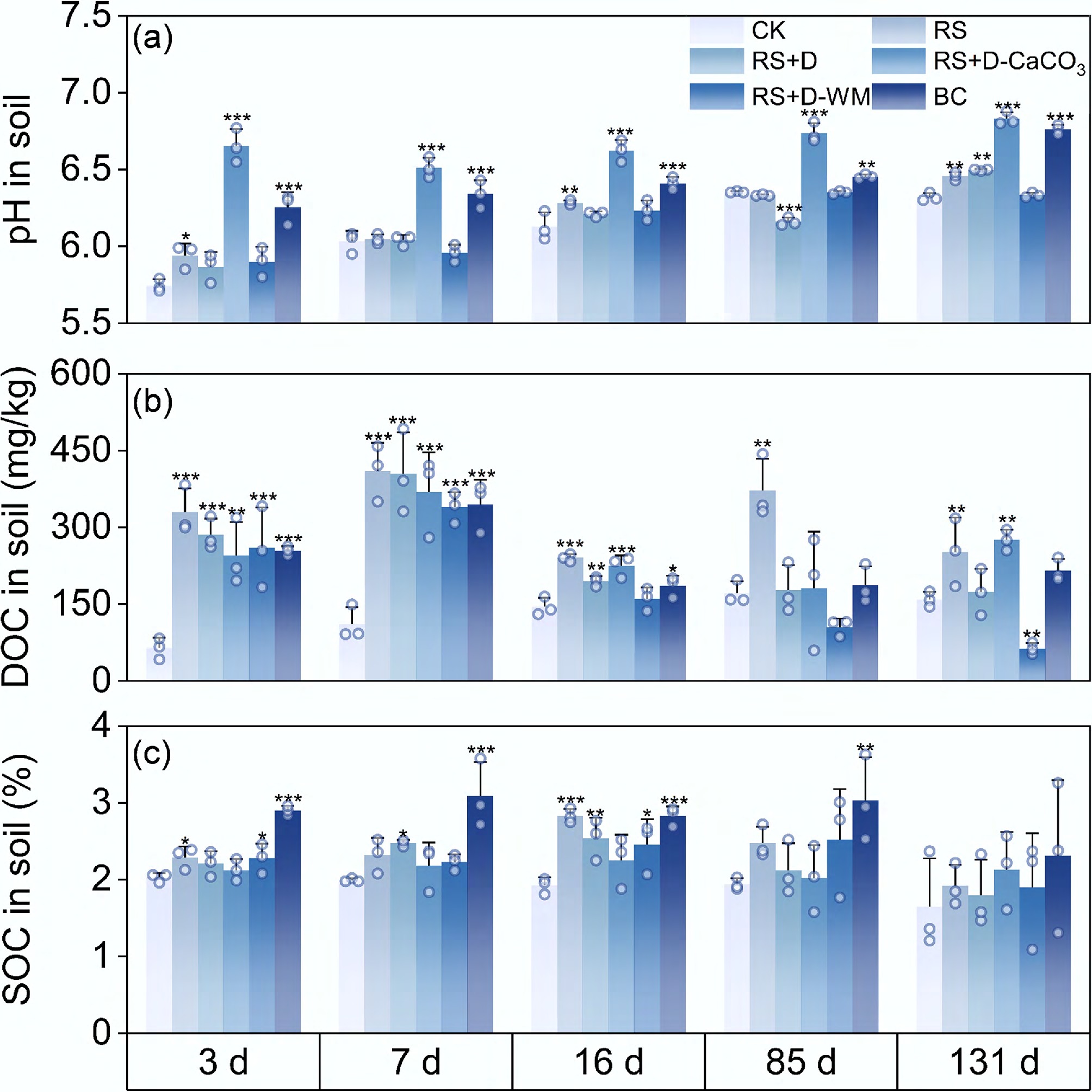
Figure 1.
(a) Soil pH, (b) dissolved organic carbon (DOC), and (c) soil organic carbon (SOC) under different scenarios of straw addition. *, **, and *** represent a significant difference at p < 0.05, p < 0.01, and p < 0.001 compared with the control. Data are presented as the mean ± standard deviation (SD), n = 3.
Changes in rice plants' growth
-
Addition of rice straw promoted growth in rice and increased the biomass and yields. Generally, plant height was consistently higher in rice straw- and biochar-added treatments (RS, RS+D, and BC; Supplementary Fig. S2), as well as the biomass in grains, straw, roots, and whole plants (Fig. 2), although not all the increases were significant. However, the increases in both plant height and tissue biomass induced by rice straw were counteracted by pH adjustment and water management. The biomass in grains and the whole plant decreased by 12% and 9% in RS+D-CaCO3, and by 1% and 15% in RS+D-WM, respectively, compared with the CK treatment. Although the changes were not significant compared with the CK treatment, they were more notable than those under RS, particularly in terms of inhibiting whole-plant biomass (p < 0.05). This suggests that soil pH adjustment might not be suitable for paddy soils, even if the soil pH is near neutral after adjustment; by contrast, rice yield was minimally affected by water management despite significant decreases in the biomass of straw and roots (Fig. 2b, c).
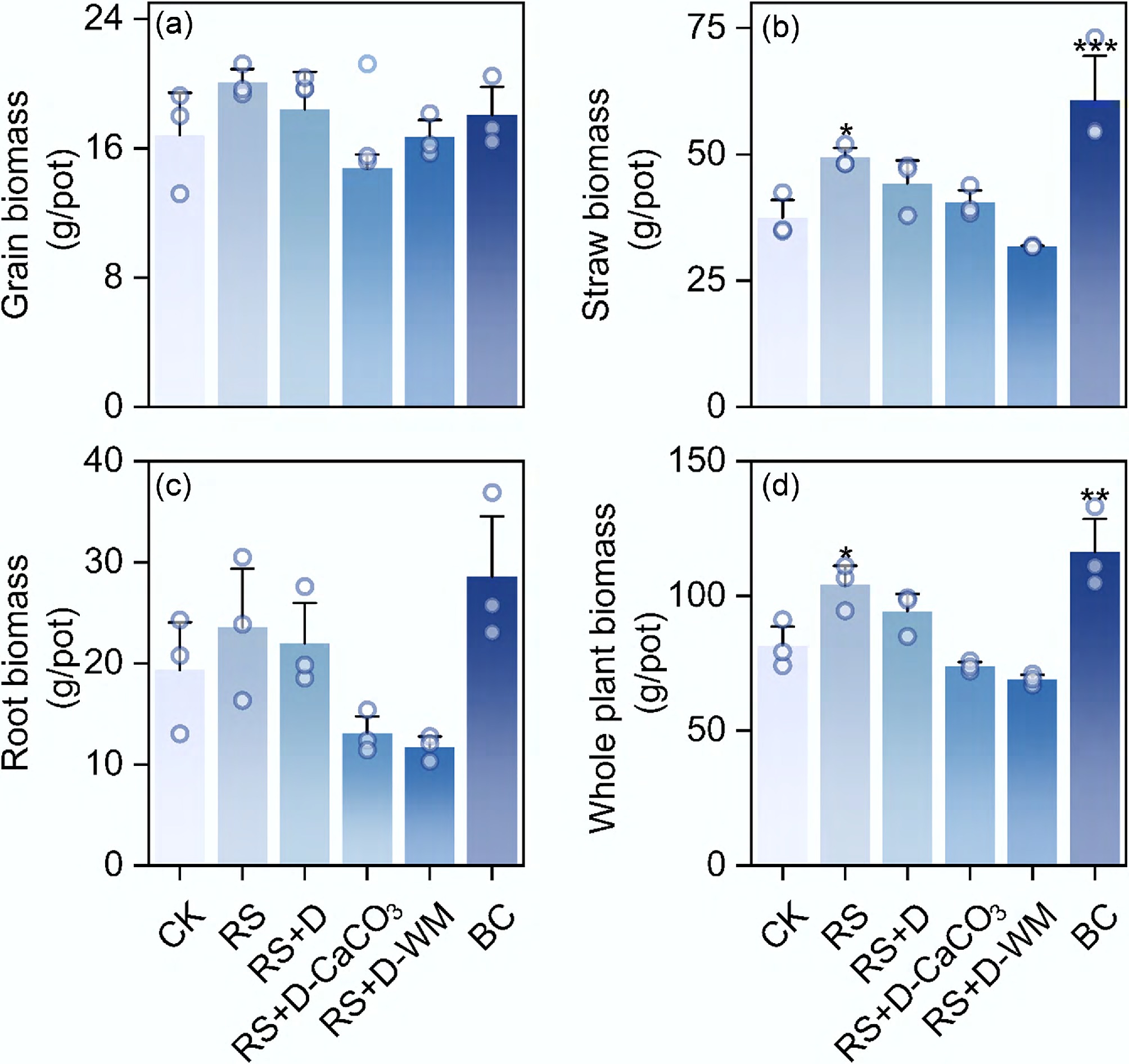
Figure 2.
The tissue and whole plant biomass under different straw addition treatments: (a) grain biomass, (b) straw biomass, (c) root biomass and (d) whole plant biomass. *, **, and *** represent a significant difference at p < 0.05, p < 0.01, and p < 0.001 compared with the control. Data are presented as the mean ± SD, n = 3.
Changes in HM accumulation in rice grains
-
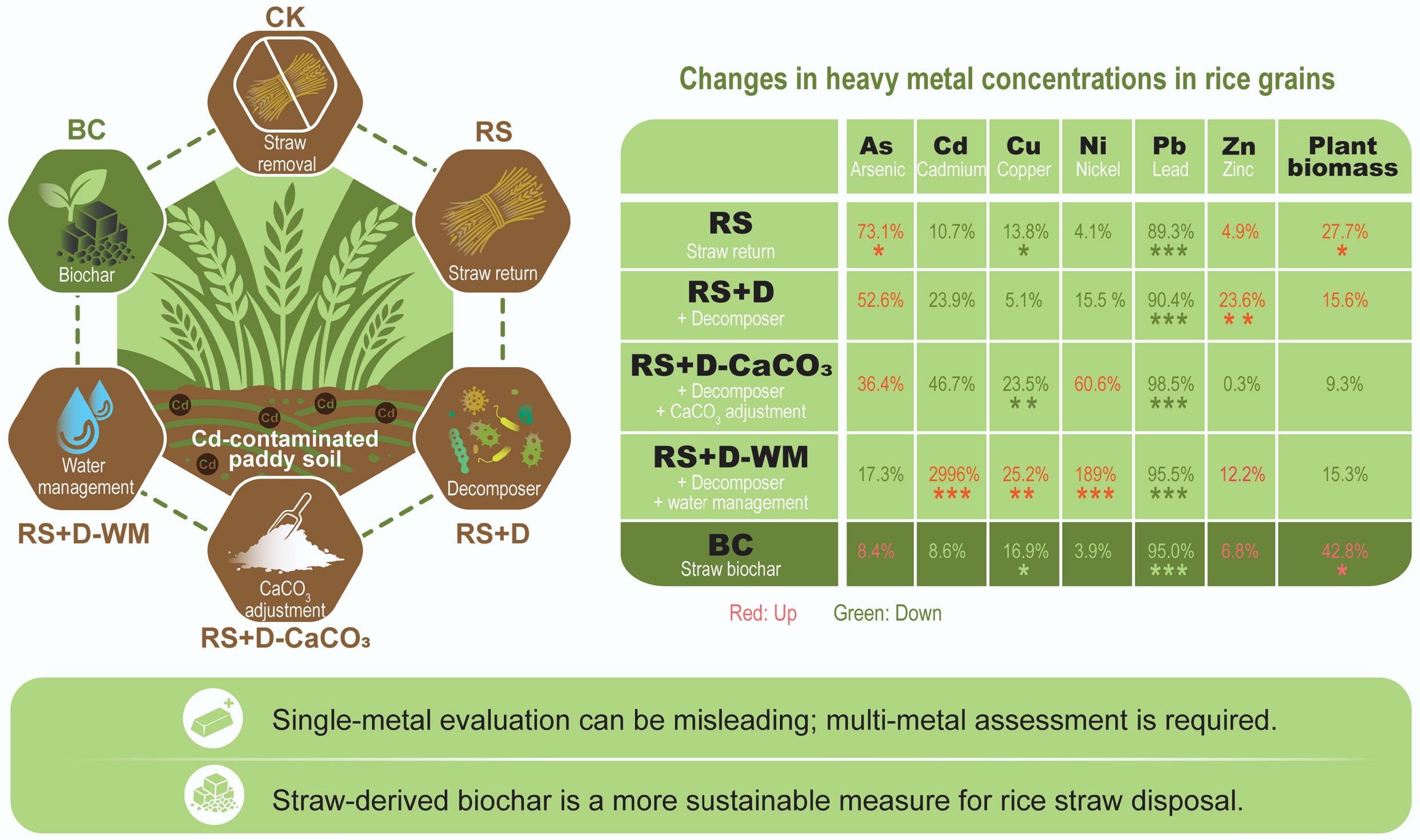
Across all treatments, rice straw incorporation consistently elevated the grain As concentration (73.1%; p < 0.05) and significantly reduced Cu (13.8%) and Pb concentrations (89.3%), with the accumulation of Cd, Ni, and Zn being insignificantly impacted in the studied soil (Fig. 3). Notably, the increases in the grain As concentration were significant (Fig. 3a; p < 0.05) in the RS treatment but not in other treatments, suggesting that soil pH modifications and redox potential regulation might mitigate the bioavailability of As induced by straw addition. Aligning with previous studies, Cd accumulation in rice grains was essentially elevated under water-saving measures, increasing by 30-fold and exceeding the Chinese national food safety standard (0.2 mg/kg) by 15-fold (Fig. 3b; p < 0.001). For HM accumulation in the straw, rice straw incorporation significantly reduced the concentrations of As, Cu, Ni, and Pb and showed insignificant impacts on Cd and Zn (Supplementary Fig. S3). Notably, water management increased the concentration of all the metals in straw except As. The concentrations of HMs in roots were not significantly impacted by straw incorporation, except in RS+D-WM, where significant increases were observed for Cd, Cu, Ni, Pb, and Zn (As data were not available; Supplementary Fig. S4). These findings imply that straw incorporation and mitigation measures primarily influence translocation of HMs from the straw to grains rather than from roots to straw (Supplementary Fig. S5), highlighting the complexity of metal redistribution pathways under straw-amended systems. The application of biochar only significantly reduced the accumulation of Cu and Pb in the grains (Fig. 3c, p < 0.05; Fig. 3e, p < 0.001) compared with the CK. The decrease was significant for As only when compared with the RS treatment (p < 0.05). For HM mobility, Cd was mainly distributed in the acid-extractable fraction (F1), with only minor variations in Cd fractionation among different straw disposal scenarios (Supplementary Fig. S6). In addition, after 3 days of straw returning, the CaCl2-extractable Cd in most straw-returning treatment groups was significantly lower than that in the CK; BC addition significantly reduced soil CaCl2-extractable Cd content on Day 7 and Day 85, whereas water management significantly increased the soil CaCl2-extractable Cd content on Day 131 (Supplementary Fig. S7). These results are generally consistent with previous studies reporting soil-dependent responses of Cd mobility to straw incorporation[31,32].
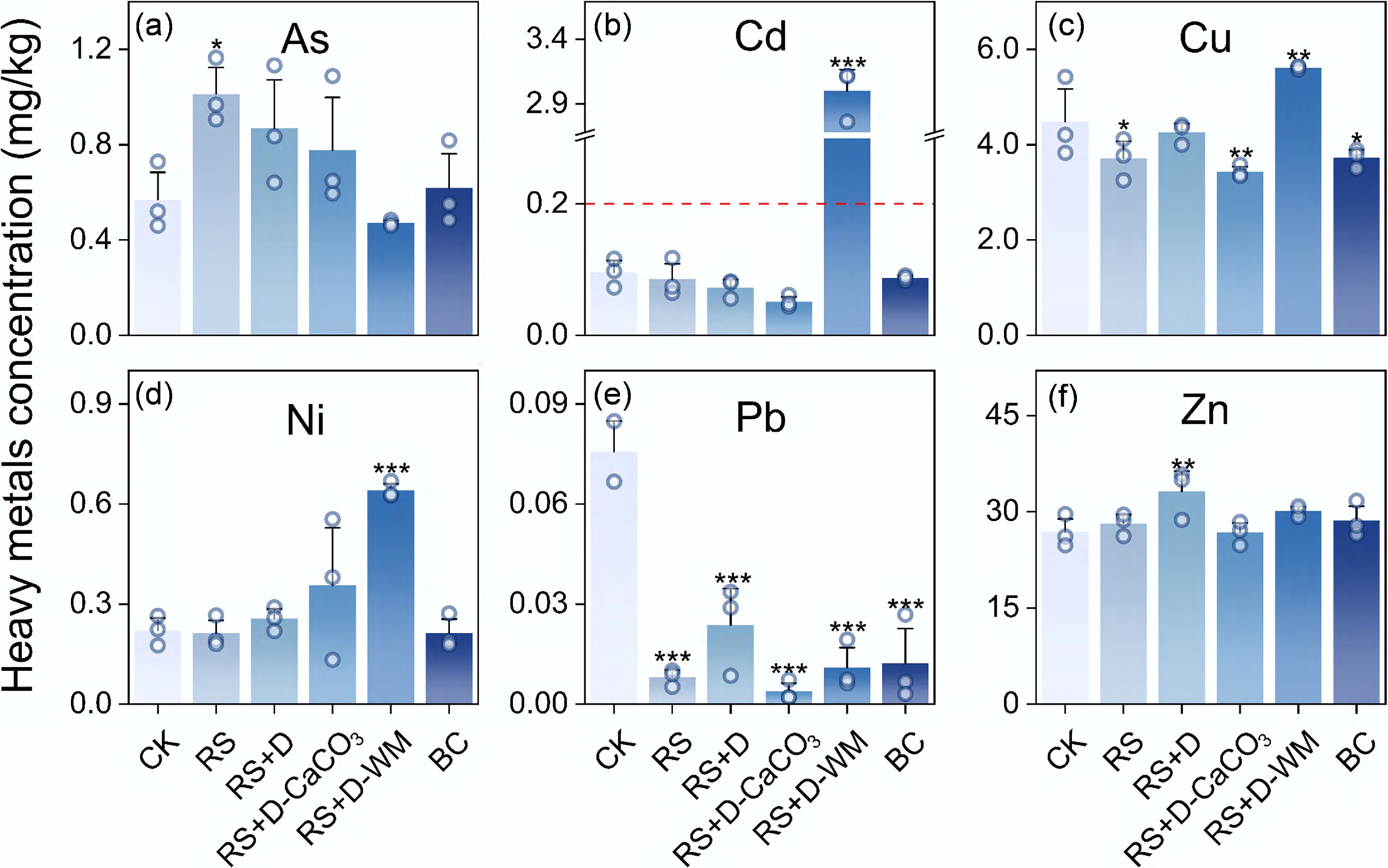
Figure 3.
Accumulation of heavy metals in rice grains under different scenarios of straw addition. Panels (a), (b), (c), (d), (e), and (f) represent the accumulation of As, Cd, Cu, Ni, Pb, and Zn, respectively. *, **, and *** represent a significant difference at p < 0.05, p < 0.01, and p < 0.001 compared with the control. Data are presented as the mean ± SD, n = 3. The red dashed line in panel (b) indicates the national limitation of Cd concentration in rice grains in China.
Reported changes in HM accumulation induced by rice straw incorporation
-
The retrieved data generally support increased HM accumulation in rice grains. To be specific, 56 reported ratios of change in HM accumulation after 1% rice straw incorporation were obtained, including 40 for Cd, 11 for As, 2 for Cu, 1 for Ni, and 2 for Pb (Supplementary Table S1). Rice straw incorporation, on average, led to a 30.3% increase in the grain Cd concentration, with 34 out of 40 pieces of data supporting an increase. A similar increase in the total As concentration in grain (28.5%) was also observed. Although the data are limited, rice straw seems to increase grain Cu (8.9%−22.1%) and Pb accumulation (11.3%−53.5%) and decrease the grain Ni concentration (9%).
-
Here, we conclude that incorporating rice straw is not encouraged, as it elevates overall HM accumulation. Previous studies reported that rice straw impacts HM accumulation primarily through four pathways: (1) The dissolution effects of DOM, which facilitated reductive conditions; (2) complexation by DOM, which reduces HMs' availability; (3) the methylation effect of labile carbon that fuels the growth of microbial methylators (primarily for As); and (4) the physiological effect of plants, which is a dual effect of increasing both HM uptake and plant biomass (generally known as biodilution)[6,18]. Whether the accumulation of a specific metal increases or decreases depends on the dominant effect, which is metal-dependent. For instance, the complexing effects might be dominant for metals such as Cu and Pb that have a relatively high affinity to functional groups, leading to reduced metal mobility[19]. As a result, straw incorporation might significantly reduce their accumulation in grains. For example, the CaCl2-extractable Cu(II) and Pb(II) were found to decrease by ~75% and ~50%, respectively[24]. This also aligned with this study, where significant decreases in Cu and Pb accumulation were observed in rice straw-treated soils (Fig. 3c, e). By contrast, metals such as Zn and Ni, which show less affinity to functional groups and are more sensitive to changes in soil pH[6,33], might be insignificantly impacted by straw incorporation, which also agrees with this work (Fig. 3d, f). For As, a metal that can be methylated, cascading-facilitated methylation would lead to sustainable increases in the metal's accumulation[18]. Though it should be noted that methylated As is less toxic than inorganic As[34], increases in total As in grains do not necessarily equate to increased health risks, which is opposite to the case of Hg. Unfortunately, the content of inorganic As was not measured in this work. Additionally, although Hg, the metal ranking fifth in China in terms of the pollution rate[35], was not tested in this work, studies have confirmed elevated Hg accumulation in grains under rice straw incorporation[16]. All these previous studies support the conclusion that rice straw incorporation may elevate human exposure to HMs.
Neutralizing soil is a widely adopted measure used to reduce HM accumulation[36]. It is generally believed that increasing the soil pH could immobilize HMs and reduce their bioaccumulation[26,37]. In this study, despite significant increases in soil pH under the RS+D-CaCO3 treatment (p < 0.001; Fig. 1a), increasing the soil pH from 5.7 to 6.7 (measured before use in the pot experiment) showed minor impacts on mitigating HM accumulation in rice grains (RS+D-CaCO3 vs. RS+D; Fig. 3). This might be attributed to the synergetic effects of OM and increased pH on metals' immobilization.
It is also important to note that the changes in HM accumulation induced by rice straw incorporation may be dependent on the soil's properties. This may be why no significant changes in Cd were observed in this work, whereas such changes were consistently reported in previous studies (Supplementary Table S1). In this work, the soil is relatively acidic, which limits the contribution of Cd mobility to the grain induced by straw incorporation. In addition, only a single metal or contaminant has been considered in studies for a long period. As a result, the advice based on single-metal data is sometimes contradictory. For instance, rice straw has been reported to increase the accumulation of Hg while reducing Cd in rice tissues[15]. Rice straw might be discouraged for because of Hg but encouraged for treating Cd. Therefore, we call attention to considering the potential risks of multiple HMs. A comprehensive evaluation of the impacts on multiple key HMs is necessary to propose a practical suggestion.
Incorporating straw as biochar is a promising approach to sustainable agriculture
-
Disposing of rice straw is a critical issue. About 186 million tons of rice straw are produced annually in China (assuming that the mass ratio of rice straw to grains is 0.9; China Statistical Yearbook 2024). Traditionally, rice straw was burned in the field, and the straw ash, which is rich in inorganic nutrients, is favorable for plant growth and increasing rice yield. However, burning can cause severe air pollution and produce particulate matter (PM2.5)[38], volatile organic compounds (VOCs), CO2, SO2, NOX[39], polycyclic aromatic hydrocarbons (PAHs)[40], etc. The large amount of released pollutants has made burning straw the second largest contributor to PM2.5, accounting for 53% of the total industrial sources in 2010[41]. In addition, burning straw might induce fires, leading to massive ecological and economic loss. Therefore, burning straw has been strictly banned by the Chinese government and is no longer an appropriate disposal measure for this massive byproduct in some areas.
Rice straw incorporation is also a common practice in farms. Rice straw has been reported to either promote or inhibit the growth of rice plants and rice yield[14,42,43]. Promoted plant growth was observed in this work (Fig. 2), although the increase in rice yield was not significant (Fig. 2a). Furthermore, incorporating rice straw directly into the soils is the most labor-saving approach for dealing with this biomaterial. However, direct rice straw amendment might also incorporate potential pathogens into the soils, leading to potential disease in plants in the next season[44]. Worse still, at the early stage of straw decomposition, the intensive OM decomposition, as indicated by substantial increases in DOM, and some organic acids released from rice straw have been reported to adversely impact plants' growth through allelopathic effects[45]. In addition, plants would also be forced to compete with microbes, which carry out OM decomposition, for N, leading to N deficiency in the plants during growth[46]. This is supported by the inhibited rice growth observed in the direct rice straw incorporation treatments, i.e., RS, RS+D, and RS+D-CaCO3 (Supplementary Fig. S2). In this study, we tried to accelerate straw decomposition (RS+D) and improve soil pH (RS+D-CaCO3), but neither measure showed significant improvement (Fig. 3c, d), and both measures even decreased plant biomass, although this was statistically insignificant for RS+D (Fig. 2d). Notably, incorporating rice straw directly into paddies might promote the emission of greenhouse gases, including CO2 and CH4[47,48]. This is of particular importance, as rice paddies account for 22% of annual CH4 emissions globally (United States Environmental Protection Agency, 2019). It has been estimated that straw incorporation increases the emissions of CO2 and CH4 by 51% and 111%, respectively[48]. Therefore, regarding the potential adverse impacts of rice straw on plant growth and greenhouse gas emissions, we propose that such a measure is not a sustainable approach despite the long application history and its labor-saving advantage.
Pyrolysis of rice straw into biochar might be an optimal pathway to sustainable agriculture. This disposal pathway of rice straw has been proposed for over 10 years to mitigate HM accumulation in crops and dispose of this renewable biomaterial[22,49]. In this study, biochar application (BC) did not significantly reduce HM accumulation compared with RS and RS+D. This might be attributed to the low application rate of biochar in this study, ~0.3%. Relatively high application rates of biochar have been reported to reduce HM accumulation. For instance, the application of rice straw-derived biochar at a dose of 5% was reported to reduce Cd, Zn, and Pb in rice shoots by 98%, 83%, and 72%, respectively[22]. Notably, incorporating rice straw in the form of biochar is effective in promoting plant growth (Fig. 2), reducing hazardous material accumulation (Fig. 3), and improving soil properties (Fig. 1 and Supplementary Fig. S1), serving as a promising method of straw disposal. Incorporating rice straw in the form of biochar has also been reported to reduce greenhouse gas emissions in paddy fields[20,21], which are hotspots of greenhouse gas emissions and account for ~48% of global greenhouse gas emissions from croplands[1]. Indeed, a recent study involving 8-year field experiments revealed that applying 1% (w/w of surface soils) rice straw-derived biochar annually reduced CO2 by 52%, yielding a net benefit of US
${\$} $ The potential of incorporating biochar needs to be evaluated comprehensively before being promoted. One issue that needs to be considered is the impact of an annual input of biochar on soil properties and rice yield. As rice is harvested one to three times each year, the application of rice straw-derived biochar might be intensive if biochar were only applied to paddy soils. Another critical issue is the potential costs of labor for collecting rice straw and the manufacturing and application of biochar, which might impede farmers' enthusiasm for adopting this measure. Nevertheless, turning rice straw into biochar still shows notable advantages in reducing greenhouse gas emissions and improving air quality.
-
On the basis of the bioaccumulation of HMs in rice grains with or without rice straw incorporation, we propose that direct rice straw incorporation is likely to increase the overall accumulation of HMs in rice grains. In contrast, producing biochar from rice straw could be a sustainable disposal pathway that also yields positive environmental impacts.
It is worth noting that although data from our pot experiment and previous studies suggest elevated grain HM accumulation after rice straw incorporation, field-scale validation is urgently required before large-scale implementation of straw-to-biochar conversion. Meanwhile, a comprehensive evaluation of the costs and benefits, considering the costs of rice straw collection and constructing a biochar-related facility, as well as the benefits to the ecosystem and the environment, is essential. Furthermore, we also highlight the importance of evaluating the potential environmental impacts of multiple contaminants rather than focusing on a single pollutant, particularly in the context of ubiquitous co-contamination. Although the accumulation of six HMs was evaluated in this work, the potential impacts of rice straw on both primary inorganic and organic contaminants remain to be further evaluated. Only through a comprehensive evaluation can we develop a practical measure for sustainable agriculture and sustainable human development.
-
It accompanies this paper at: https://doi.org/10.48130/ebp-0026-0007.
-
Not applicable.
-
The authors confirm their contributions to the paper as follows: Jiannan Liao: data analysis, data visualization, manuscript revision; Wenjing Ning: data analysis, data visualization, manuscript drafting; Yu Gong: manuscript revision; Wenli Tang: study design, investigation, supervision, manuscript drafting and revision, funding acquisition; Huan Zhong: study design, supervision, manuscript revision. Jiannan Liao and Wenjing Ning contributed equally to this work. All authors read and approved the final manuscript.
-
The data supporting the findings of this study are available from the corresponding authors upon reasonable request.
-
The authors declare no competing interests.
-
# Authors contributed equally: Jiannan Liao, Wenjing Ning
Full list of author information is available at the end of the article. - The supplementary files can be downloaded from here.
- Copyright: © 2026 by the author(s). Published by Maximum Academic Press, Fayetteville, GA. This article is an open access article distributed under Creative Commons Attribution License (CC BY 4.0), visit https://creativecommons.org/licenses/by/4.0/.
-
About this article
Cite this article
Liao J, Ning W, Gong Y, Tang W, Zhong H. 2026. Incorporating rice straw in the form of biochar: a sustainable measure to protect humans from heavy metal exposure. Environmental and Biogeochemical Processes 2: e012 doi: 10.48130/ebp-0026-0007 

Incorporating rice straw in the form of biochar: a sustainable measure to protect humans from heavy metal exposure
- Received: 30 March 2026
- Revised: 19 May 2026
- Accepted: 12 June 2026
- Published online: 30 June 2026
Abstract: Incorporating rice (Oryza sativa) straw into paddies is a globally prevalent and effective strategy for managing agricultural biomass. However, previous studies have generally focused on a single metal, and the inconsistent effects of straw incorporation on multiple heavy metals have been reported, leaving the safety of straw return under co-occurring heavy metals uncertain. To evaluate the potential sustainability of straw incorporation in paddy systems, we conducted a pot experiment to explore the bioaccumulation of six common heavy metals (i.e., As, Cd, Cu, Ni, Pb, and Zn) under six distinct scenarios of rice straw incorporation. The results show that rice straw incorporation significantly reduced the accumulation of Cu and Pb in grains, while significantly increasing grain As levels (73.1%), with no significant effects on Cd, Ni, or Zn. Facilitating straw decomposition, elevating soil pH, and reducing water supply failed to diminish the elevation induced by straw incorporation and even amplified it further. Notably, incorporating rice straw in its pyrolyzed form, i.e., as biochar at an incorporation rate of ~0.3%, did not elevate heavy metal accumulation in the grain and even showed similar inhibition of Cu and Pb accumulation compared with direct rice straw incorporation. Considering the mitigation of the accumulation of multiple heavy metals and the enhancement of plant growth and rice yield, together with the avoidance of air pollutant emissions from burning straw and the decreased greenhouse gas emissions associated with direct straw incorporation, our results suggest that the application of rice straw in the form of biochar may constitute a promising pathway for straw disposal and sustainable agricultural practices.
-
Key words:
- Heavy metal /
- Bioaccumulation /
- Rice /
- Organic matter /
- Sustainable agriculture