













-
Rice is one of the most important food crops in the world, providing staple food for more than half of the global population[1]. Traditional rice cultivation in China has long relied mainly on puddled transplanted rice (PTR), which involved high labor costs and significant water consumption[2]. Direct-seeded rice (DSR) is a simplified and efficient planting method that eliminates the complex procedures of PTR, offering multiple advantages such as labor and cost savings, water and land conservation, reduced labor intensity, and improved planting efficiency. It is gradually becoming a preferred model for rice cultivation[3]. However, the transition from PTR to DSR means that the soil environment for rice growth shifts from continuous flooding to a state characterized by fluctuating water conditions and relatively better aeration, with roots being the key organ that first perceives this change.
The root system serves as the interface between the plant and the complex soil environment. Root architecture is a comprehensive manifestation of how roots perceive changes in the soil environment and organize themselves spatially, encompassing various aspects of root structure and morphology[3]. Root architecture is also a key factor determining the efficiency of nutrient and water uptake by plants, as it directly influences the spatial distribution and absorptive function of roots in the soil[4−6]. However, root morphological traits are not fixed and can adjust in response to environmental changes, a phenomenon known as root plasticity. Root plasticity refers to the ability of roots to sense variations in the soil environment and actively modify their morphological characteristics, including length, diameter, density, number, and root-to-shoot ratio, to better adapt to their surroundings[7,8]. This adaptive capacity is a key trait for rice to withstand stress and maintain stable yield.
Rice roots possess strong plasticity. Numerous studies have shown that root growth patterns change in response to variations in the soil environment. Different direct seeding methods influence rice root growth and architecture by altering factors such as soil moisture, aeration, and nutrient distribution. Research has indicated that dry direct-seeded rice (DDSR) promotes increases in root length, root surface area, root volume, and root weight, thereby improving water use efficiency[9]. Rice root length and volume can increase significantly within days in response to declining soil moisture[10,11]. The increase in fine root length, in particular, helps expand the contact area with the soil and enhances water acquisition efficiency[12]. Furthermore, changes in root branching and density are highly significant, as more branches and denser roots can better occupy soil space[13,14]. An increase in the number of lateral roots and root hairs also enhances their ability to absorb water and nutrients[15]. Therefore, investigating how roots adapt to different direct seeding environments through plasticity is of great importance for DSR production.
To explore and utilize the genetic potential of rice germplasm resources in adapting to different direct seeding methods, this study conducted quantification of root traits at the seedling stage under DDSR and wet direct-seeded rice (WDSR), with materials of 205 rice varieties, and measured leaf fresh weight above the soil. By integrating aboveground and belowground phenotypic data, we analyzed the plastic responses of rice roots to different direct seeding methods and elucidated the synergistic relationship between root plasticity and aboveground growth. Based on this, representative varieties exhibiting typical root plasticity and extreme phenotypes under DDSR and WDSR conditions were screened from the population according to root-shoot synergy. This study provides a theoretical foundation for further elucidating the physiological and molecular mechanisms of rice root plasticity in response to different direct seeding methods, identifying key regulatory genes, and offering material support for breeding new rice varieties suitable for direct seeding cultivation.
-
A total of 205 rice accessions were used in this study (Supplementary Table S1), comprising 111 Japonica rice and 94 Indica rice accessions. The accession 'Dianheyou 615' was provided by the Rice Research Institute of Yunnan Agricultural University, while all other accessions were obtained from the core germplasm within the 6K genome by the Chinese Academy of Agricultural Sciences[16].
Planting method and growth conditions
-
The experiment was conducted in a greenhouse located at Yunnan Agricultural University, with the temperature constantly maintained at 28 °C throughout the rice growth period. The tested soil was red soil collected from the 0–20 cm plow layer, with the following physicochemical properties: pH 6.25, organic matter 34.42 g/kg, electrical conductivity 180.73 μs/cm, alkaline hydrolyzable nitrogen 147.87 mg/kg, available phosphorus 9.65 mg/kg, and available potassium 328.9 mg/kg. A randomized complete block design was adopted in this study. All unsoaked and non-pregerminated dry seeds were directly sown at a depth of 5 cm. This depth conforms to rice production practices in Southwest China, ensuring stable seedling emergence and root growth. Planting bags (18 cm height, 16 cm diameter) were used with one seed per bag, and 30 biological replicates were set for each material. After seedling emergence, moisture was controlled: WDSR was maintained at 100% soil moisture, while DDSR was maintained at 50%−55% soil moisture. Soil moisture was measured daily at 9:00 AM using a digital soil moisture tester (LY-201). When the soil moisture fell below the required level, water was added to the planting bags until the final root sampling was completed.
Root sampling and trait data extraction
-
Rice root systems were sampled at the 3rd, 4th, and 5th leaf stages, with three replicates per accession per treatment. Due to uneven seedling emergence and low emergence rates in some rice varieties under direct seeding conditions, the number of varieties from which roots were successfully collected under both treatments was 71 at the 3rd stage, 34 at the 4th leaf stage, and 14 at the 5th stage. For root sampling, the rice plant along with the soil was gently removed from the planting bag. It was then placed in water and shaken lightly to dislodge most of the soil, followed by rinsing under running water. The cleaned root system was placed in a black tray filled with water, and the roots were carefully separated by tweezers. The roots were photographed using a camera (Nikon Z7II with a Z MC 50mm f/2.8 lens). The root images were subsequently uploaded to RhizoVision Explorer 2.0.3 software for trait data extraction (Fig. 1). Root fresh weight and leaf fresh weight were measured using a 0.001 g precision analytical balance. A total of 30 root traits and leaf fresh weight data were obtained (Supplementary Table S2).
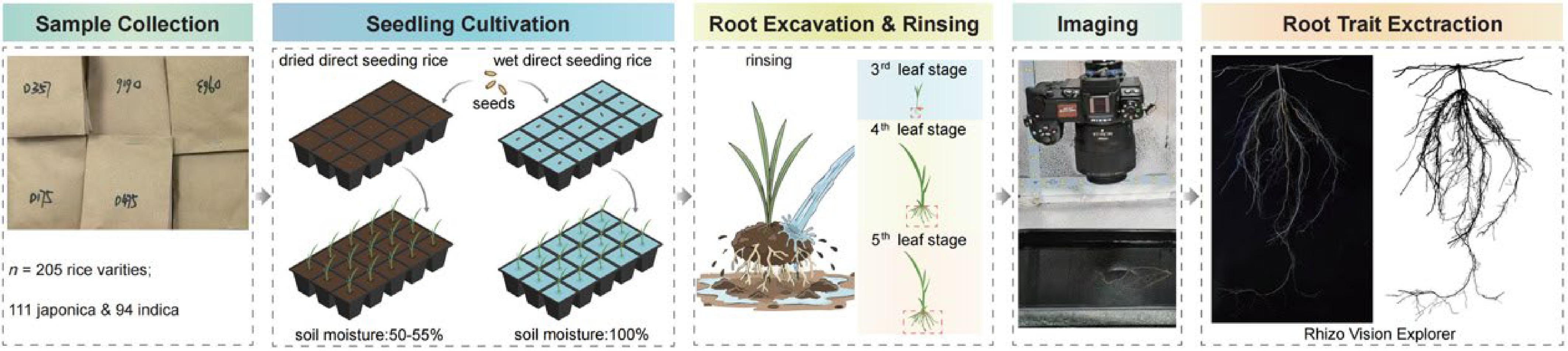
Figure 1.
Schematic diagram of this research.
Calculation of phenotypic plasticity
-
Phenotypic plasticity for all traits was calculated using the following formula, representing the relative changes in DDSR compared to WDSR[17]:
$ \text{Phenotypic }\mathrm{Plasticity}=\dfrac{\mathrm{DDSR}-\text{WDSR}}{\text{WDSR}} $ To distinguish plasticity values from the original trait values, all plasticity abbreviations are prefixed with a lowercase letter 'r'.
Data analysis
-
Microsoft Excel 2019 was used for preliminary data statistics and calculation of mean values. Subsequent analyses were based on these means. Significance testing for differences in the same root trait under different treatments was performed using SPSS 23.0. GraphPad Prism 10.3.0 was utilized to visualize traits with significant differences and to generate quadrant diagrams. R language (v4.3.2) was employed for the analysis and generation of root trait histograms, correlation heatmaps, and cluster heatmaps. The 'readxl' package was used to import data, and the 'dplyr' package was used to filter root trait data for each growth stage. Data were grouped by DDSR and WDSR to calculate means, standard deviations, sample sizes, and determine bin widths. The 'ggplot2' package was used to plot histograms overlaid with frequency-based normal distribution curves, with group mean lines added. Pearson correlation analysis was performed using the corr.test function from the 'psych' package to extract correlation coefficient matrices (r) and corresponding p-value matrices (p). Correlation heatmaps in various styles were generated using the 'corrplot' package. Data wrangling and transformation were performed using the 'tidyverse' package, and cluster heatmaps were generated using the 'pheatmap' package.
Genotype-by-treatment interaction analysis
-
The observed variation in each phenotypic trait was partitioned into the effects of genotype (G), treatment (T), and their interaction (G × T). Analysis of variance (ANOVA) was performed using a linear mixed-effects model for each phenotypic trait in R, as defined by:
$ {y}_{ijk} =\mu +G_{i} +T_{j} +(G\times T)_{ij} +r_{k(j)}+e_{ ijk} $ where, yijk is the measured trait value, μ is the overall mean, Gi is the effect of the ith genotype, Tj is the effect of the jth treatment, (G × T)ij is the interaction between the ith genotype and the jth treatment, rk(j) is the effect of the kth replication within the jth treatment, and eijk is the random error. Genotypic, treatment, and their interaction (G × T) effects were considered as fixed effects in the model, while replications were treated as random effects.
Statistical power analysis
-
Given that the sample size of root phenotypic data gradually decreased across growth stages, post-hoc statistical power analysis was performed using the pwr package in R to scientifically evaluate the dynamic changes in statistical power. Since each rice variety was set with three biological replicates, the mean value of each variety was used as the statistical unit. Cohen's d (effect size) was estimated based on the mean differences between the two treatments at each growth stage, and statistical power was calculated under the framework of a two-sample t-test (significance level α = 0.05), to verify the reliability of the experimental design under different sample sizes. Most core root traits achieved acceptable statistical power (≥ 0.8) at the late rice growth stage, whereas several root traits measured at the 5th leaf stage exhibited low statistical power values. Even with the supplementary post-hoc power validation performed in this study, the gradual decline in sample size across developmental stages remains an inherent limitation of the present work. Detailed results are presented in the Supplementary Table S3.
-
To observe the distribution of each root trait within the population, histogram analysis was performed on rice root traits under both DDSR and WDSR conditions. The results showed that at the 3rd (Supplementary Fig. S1) and 4th leaf stages (Supplementary Fig. S2), most root traits exhibited a normal distribution, while a few traits, such as root volume (RV) and root length at root diameter > 0.5 mm (RL-DR4), showed a skewed distribution. Water conditions exerted differential effects on root architecture. DDSR shifted the overall distribution range and mean values of most root traits towards higher numerical ranges, including total root length (TRL), root surface area (RSA), and RV. Conversely, WDSR favored traits related to fine roots, such as root length in the 0−0.1 mm diameter class (RL-DR1), root projected area in the 0−0.1 mm diameter class (RPA-DR1), root surface area in the 0−0.1 mm diameter class (RSA-DR1), root volume in the 0−0.1 mm diameter class (RV-DR1), root fresh weight (RFW), root-shoot ratio (RSR), median of root number (MeRN), and maximum of root number (MaRN). This indicates that each treatment confers adaptive advantages for different sets of root traits; DDSR advantages are concentrated in conventional core root traits, while WDSR advantages focus on fine root-related traits and biomass. At the 5th leaf stage (Supplementary Fig. S3), all traits followed a normal distribution. For 11 root traits, the overall distribution range and mean values were shifted towards higher numerical ranges under WDSR; for the remaining root traits, this shift occurred under DDSR. Linear mixed-effects model analysis revealed that significant genotype-by-treatment (G × T) interactions were detected for most root traits at the 3rd, 4th, and 5th leaf stages. Treatment effects were significant for multiple root traits, whereas no universal significant genotypic main effects were detected.
The distribution patterns of traits changed dynamically with advancing periods. Examining the average root diameter (ARD) and TRL across the three stages revealed that under DDSR conditions, the distribution of ARD gradually shifted towards lower values, while TRL shifted towards higher values (Fig. 2). This clearly indicates that DDSR guides rice roots towards a more plastic adaptation, leading to a thinner and longer architectural configuration.
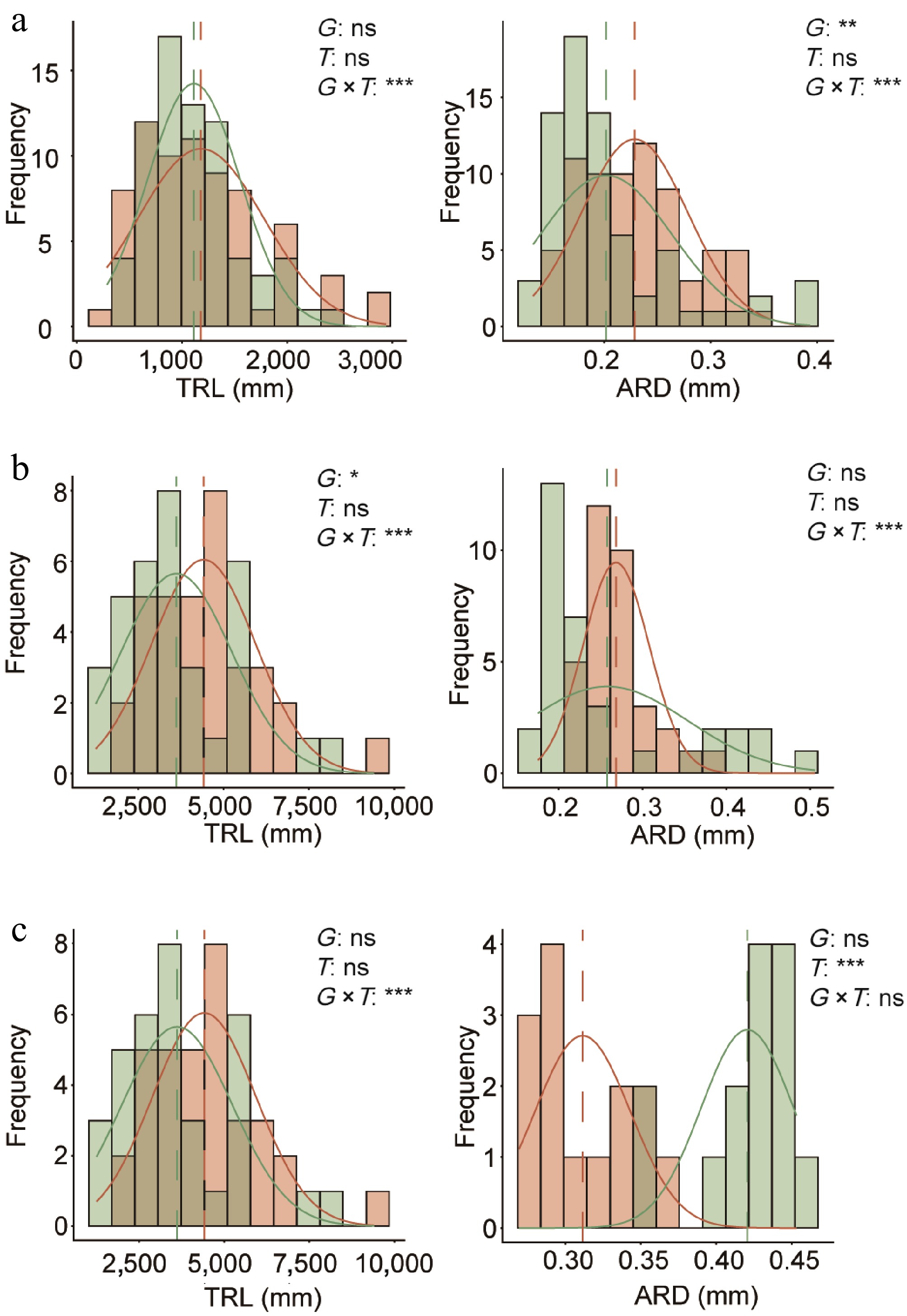
Figure 2.
Histogram of root trait distribution under different direct seeding methods.
(a) TRL and ARD at the 3rd leaf stage; (b) TRL and ARD at the 4th leaf stage; (c) TRL and ARD at the 5th leaf stage. Histograms show the frequency distribution of traits under each treatment, with green bars representing WDSR and orange bars representing DDSR; brown bars indicate the overlapping range between the two treatments. Overlaid normal distribution curves reflect the population distribution characteristics for WDSR (green) and DDSR (orange), with green and orange dashed lines marking the population means of the respective treatments. The significance levels from linear mixed-effects models are indicated in the top-right corner of each panel, including genotype (G), treatment (T), and genotype-by-treatment interaction (G × T) effects. * p < 0.05; ** p < 0.01; *** p < 0.001; ns, not significant.Comparison of key root traits under different seeding treatments
-
To clarify the effects of DDSR and WDSR on root architecture, a significance analysis of root traits between the two treatments was performed (Fig. 3). At the 3rd leaf stage, 17 root traits showed significant differences; except for MeRD, all other traits were significantly higher under DDSR than under WDSR (Fig. 3a). At the 4th leaf stage, a total of 18 traits exhibited significant differences, all of which were significantly higher under DDSR (Fig. 3b). Among the 17 significantly different traits at the 5th leaf stage, 10 were significantly higher under DDSR, while 7 showed the opposite trend: ARD, median root diameter (MeRD), maximum root diameter (MaRD), RV, root projected area in the > 0.5 mm diameter class (RPA-DR4), root surface area in the > 0.5 mm diameter class (RSA-DR4), and root volume in the > 0.5 mm diameter class (RV-DR4) (Fig. 3c). Furthermore, three traits, RPA-DR4, RSA-DR4, and RV, showed significant differences across all three stages (Fig. 3d). These three traits were significantly higher under DDSR at the 3rd and 4th leaf stages, but this difference gradually diminished and reversed by the 5th leaf stage, becoming significantly higher under WDSR. In summary, as the seedling stage progressed, rice roots under DDSR exhibited an overall plastic trend toward a thinner and longer morphology compared to those under WDSR. When the rice varieties at the three stages were classified into Japonica and Indica subgroups for comparative analysis of root traits, no significant differences were detected between the two types under either treatment (Supplementary Fig. S4). However, this result may be attributed to the relatively small number of Japonica varieties included in the study.
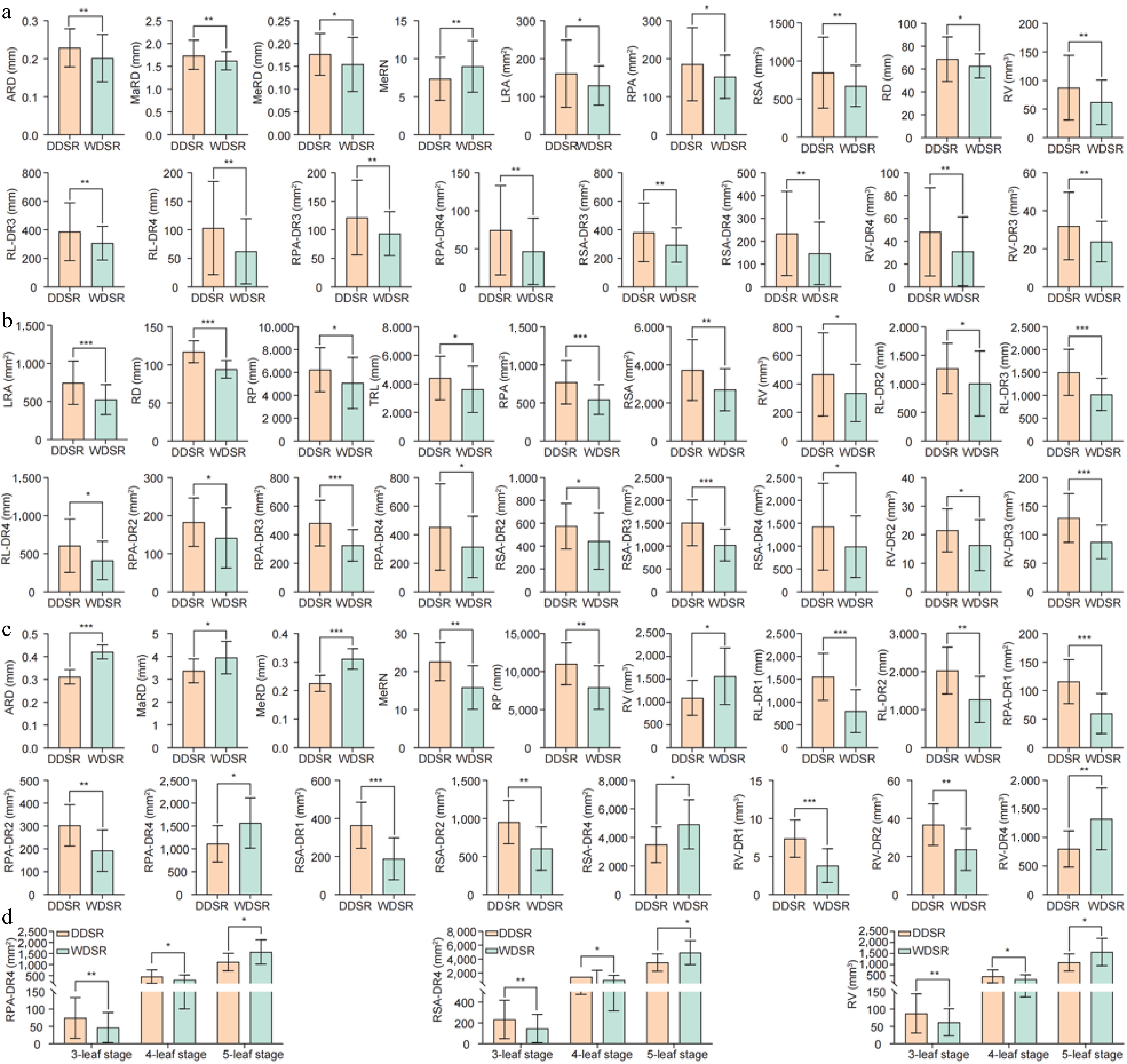
Figure 3.
Significant differences in root traits between DDSR and WDSR rice.
(a) Significantly different root traits at the 3rd leaf stage; (b) significantly different root traits at the 4th leaf stage; (c) significantly different root traits at the 5th leaf stage; (d) significantly different root traits across the three stages. Significance levels: * p < 0.05, ** p < 0.01, *** p < 0.001.Correlation analysis among traits under different treatments
-
To elucidate the interactions among rice traits and their environmental response characteristics under DDSR and WDSR conditions, correlation analysis was performed for traits under both treatments (Fig. 4). Results from the 3rd leaf stage (Fig. 4a) showed that under both treatments, most root traits exhibited significant positive correlations with each other, indicating generally coordinated root development. However, a few root traits showed negative correlations. Specifically, ARD and MeRD were negatively correlated with TRL, MeRN, MaRN, root perimeter (RP), RL-DR1, root length in the 0.1−0.2 mm diameter class (RL-DR2), RPA-DR1, root projected area in the 0.1−0.2 mm diameter class (RPA-DR2), RSA-DR1, root surface area in the 0.1−0.2 mm diameter class (RSA-DR2), RV-DR1, and root volume in the 0.1−0.2 mm diameter class (RV-DR2). Furthermore, the strength of positive correlations was greater under DDSR, while the strength of negative correlations was greater under WDSR. This suggests that DDSR enhances the synergistic effects among root traits, whereas in the water-sufficient WDSR environment, reduced environmental constraints allow antagonistic relationships between root traits to become more prominent. The correlation trends at the 4th leaf (Fig. 4b) and 5th leaf stages (Fig. 4c) were similar to those at the 3rd leaf stage, indicating that the response of rice root traits to water conditions exhibits dynamic characteristics across developmental stages. This further demonstrates that rice roots are highly plastic, environment-responsive organs whose developmental priorities and resource allocation strategies are determined by water conditions.
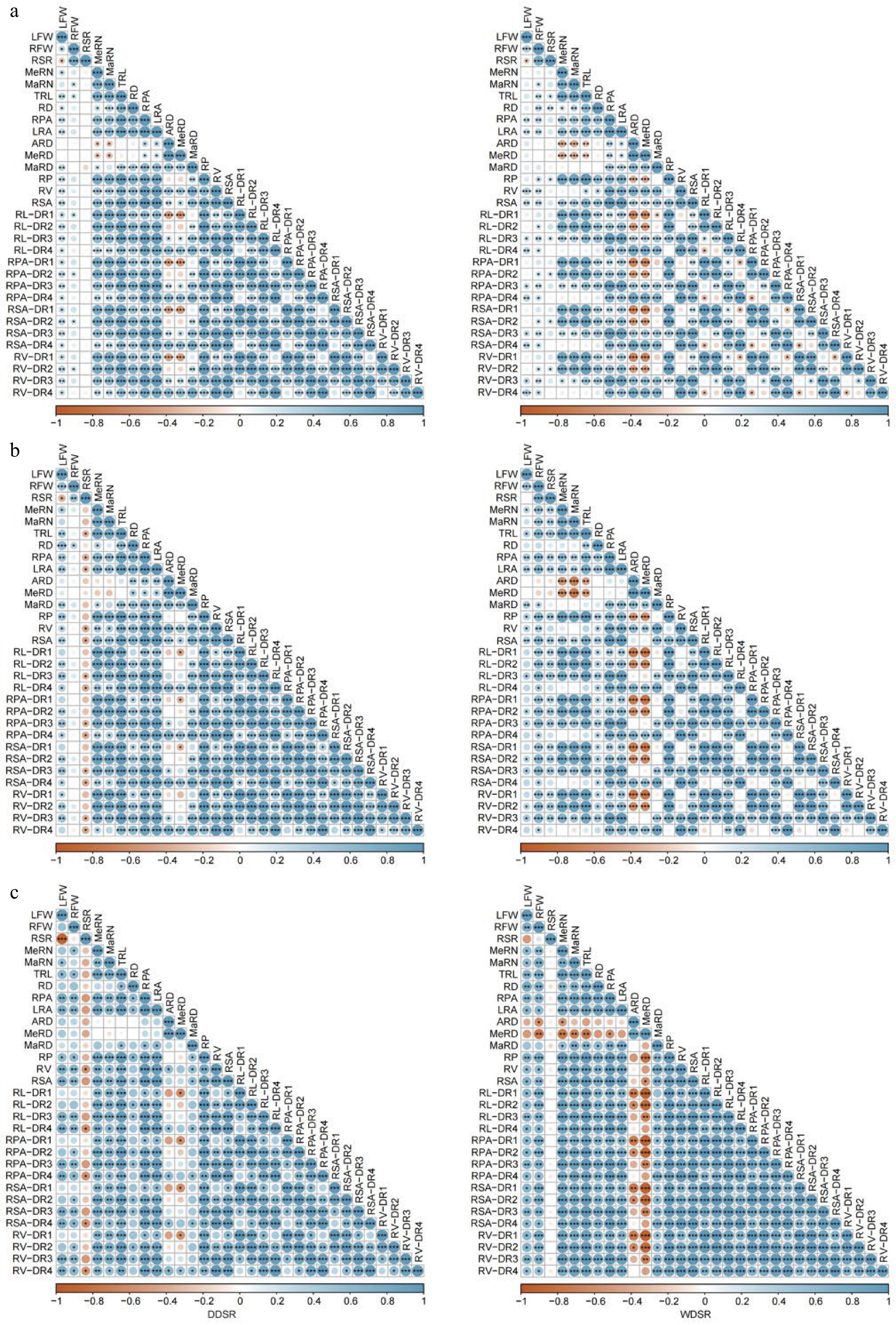
Figure 4.
Correlation analysis of root traits under DDSR and WDSR conditions.
(a) Correlation analysis of root traits at the 3rd leaf stage; (b) correlation analysis of root traits at the 4th leaf stage; (c) correlation analysis of root traits at the 5th leaf stage. Significance levels: * p < 0.05, ** p < 0.01, *** p < 0.001.From the 3rd to the 5th leaf stage under both treatments, the positive correlation between aboveground leaf fresh weight (LFW) and most root traits gradually strengthened. This reflects the intensifying root-shoot synergistic growth during development and the increasingly significant supporting role of root architecture for aboveground growth in the later seedling stages. LFW showed significant positive correlations with RSA, root projected area (RPA), lower root area (LRA), RV, root length in the 0.2−0.5 mm diameter class (RL-DR3), root projected area in the 0.2−0.5 mm diameter class (PRA-DR3), root surface area in the 0.2−0.5 mm diameter class (RSA-DR3), and root volume in the 0.2−0.5 mm diameter class (RV-DR3) across all three stages. These eight traits exhibited strong stability and consistency across different treatments, being less affected by environmental fluctuations, and can thus serve as core phenotypic indicators for root development during the rice seedling stage.
Differences in adaptive plasticity to DDSR among rice varieties
-
Based on the most complete phenotypic dataset from the 3rd leaf stage, eight core root traits identified through correlation analysis and the aboveground leaf fresh weight (LFW) were selected. The plasticity index for each trait was calculated, and a quadrant scatter plot was constructed to classify the rice varieties into groups (Fig. 5a). The results showed highly consistent classification outcomes for these eight root traits across the vast majority of varieties, indicating significant synergy in their plasticity performance. Different variety groups exhibited distinct clustering characteristics in the plot. Group 1 demonstrated strong positive plasticity under DDSR for both LFW and root traits (i.e., phenotypes were superior under DDSR compared to WDSR). Group 2 showed strong positive plasticity under DDSR for root traits, but a relatively subdued environmental response in aboveground growth. Group 4 exhibited strong positive plasticity under WDSR for both roots and LFW. Group 3 was primarily characterized by positive plasticity under WDSR for roots but positive plasticity under DDSR for LFW. Such classification reveals the diverse adaptation types within the population based on varying root-shoot coordination strategies. Notably, DHY615 belongs to Group 1, exhibiting strong plasticity in both aboveground LFW and core root traits under DDSR conditions, indicating that this variety achieves superior phenotypes in the DDSR environment and demonstrating its strategy of responding to water stress through root-shoot coordination.
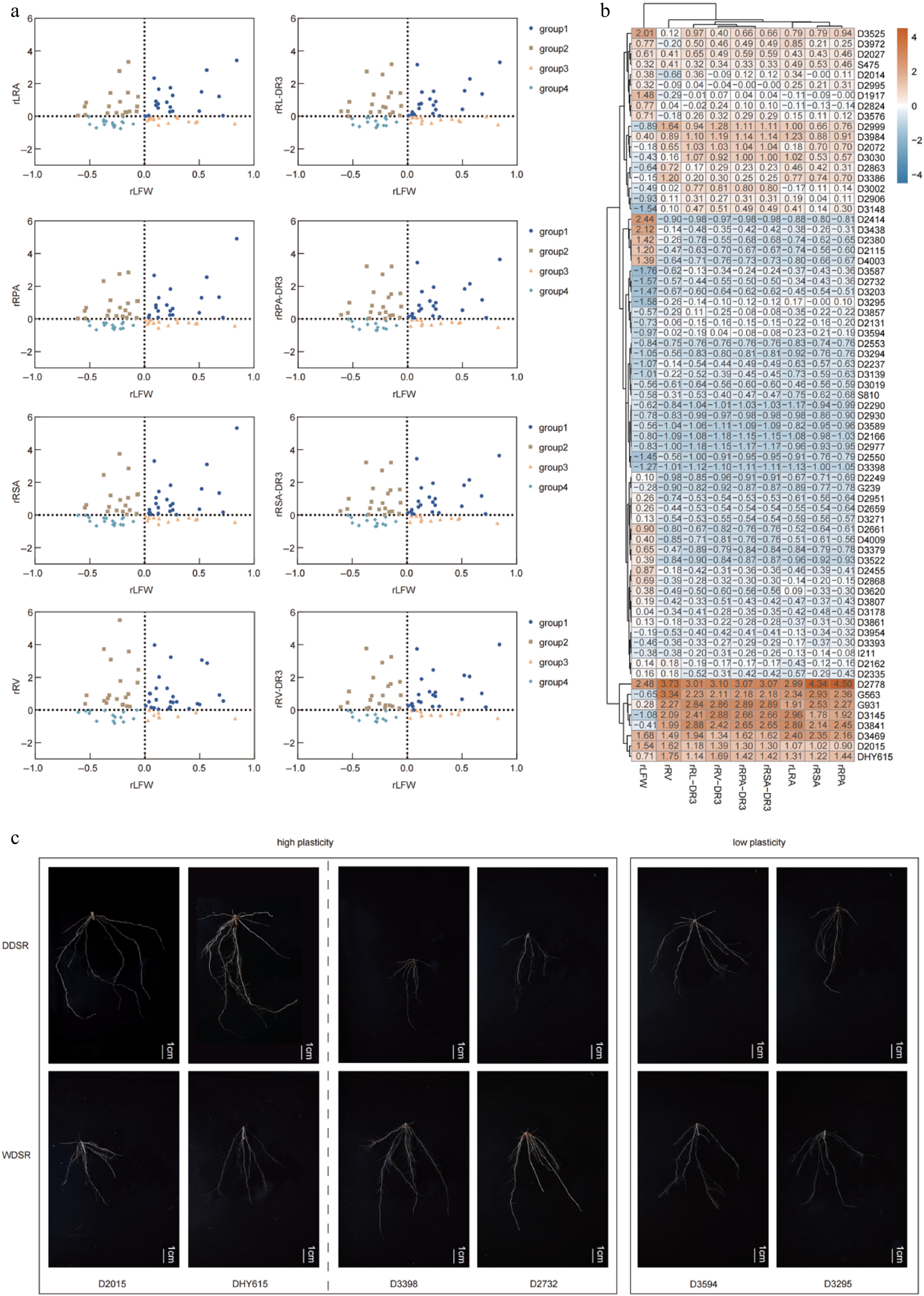
Figure 5.
Population distribution and clustering of rice varieties at the 3rd leaf stage.
(a) Quadrant scatter diagram showing population distribution based on root-shoot plasticity; (b) hierarchical clustering dendrogram of tested rice varieties; (c) comparative analysis of root morphological traits between varieties with high and low root plasticity. All indicators starting with the prefix 'r' represent plasticity values of corresponding phenotypic traits.Based on the plasticity indices of LFW and the eight core root traits, cluster analysis was performed on the rice varieties to clarify population differentiation characteristics regarding root-shoot coordinated plasticity patterns (Fig. 5b). The clustering results divided the 71 rice varieties into groups with distinct features. These included a high-plasticity group under DDSR, represented by varieties such as D2778, D2015, DHY615, and D3469; a high-plasticity group under WDSR, represented by varieties such as D3398, D2977, and D2550; and a low-plasticity group, represented by varieties such as D3295, D2131, and D3594.
-
Root traits such as length, diameter, number, branching, and growth angle are influenced by factors including water and nutrient availability, soil physicochemical properties, and cultivation methods. These indicators reflect morphological changes in rice roots during growth and development[3]. In this study, by comparing the distribution of root traits under DDSR and WDSR conditions, it is found that root development differed between the two direct seeding methods, with most root traits being higher under DDSR than under WDSR. This may be attributed to the reallocation of assimilates in rice under DDSR conditions, where more photosynthetic products are preferentially allocated to the roots to support their growth and expansion[18−21]. Notably, the increase in root surface area (RSA) is particularly significant. Uddin et al.[22] reported that root absorption rate depends on RSA. Numerous studies have shown that an increase in RSA implies greater root hair density and length, which expands the root-soil contact area and enhances the efficiency of water and nutrient uptake[23−25].
Furthermore, root architecture also dynamically alters with seedling growth. From the 3rd to the 5th leaf stage, average root diameter (ARD) declined while total root length (TRL) rose under DDSR, consistent with previous research[8]. Slender roots serve as an economical growth strategy under limited dry matter accumulation[26]. Reduced root diameter improves water capture capacity and crop performance under water deficit[27]. It elevates specific root length at equivalent biomass and raises surface-to-volume ratio, further boosting the absorption of water and minerals[28,29]. Most previous studies only observed a single growth stage. This study continuously tracked dynamic root morphology changes across three periods, offering new insights into rice root responses to varied water conditions.
Differential response of root plasticity to planting environments
-
As a typical environment-responsive organ, the rice root system exhibits high architectural plasticity for adapting to different planting environments. In this study, under both direct seeding methods, most root traits showed significant positive correlations with each other, while a few showed negative correlations, consistent with Shafi et al.[30]. Notably, positive correlations among root traits were enhanced under DDSR, whereas negative correlations were greater under WDSR. This difference may be attributed to DDSR conditions prompting rice to concentrate limited resources on constructing an efficient absorptive root system, thereby strengthening trait synergy[31,32]. Under WDSR, relaxed environmental constraints allow more pronounced resource allocation changes. As Lynch[33] proposed, plants face a dilemma in allocating carbon: under well-watered conditions, more resources may go to thicker roots at the expense of lateral branching and elongation. Dorlodot et al.[34] suggest that reduced selective pressure in favorable environments allows diverse phenotypic variations and developmental trade-offs. Thus, root plasticity is manifested not only in morphological adjustments but also in the dynamic restructuring of trait relationships, with resource allocation determined by water conditions.
This study also showed that root trait correlations became increasingly pronounced as the seedling stage progressed. This may be because early root development involves cell division and differentiation, with traits developing independently[35], leading to weaker correlations. At later stages, increased aboveground size and higher demand for water and nutrients[36] drive the formation of a coordinated root network, synchronizing trait development and strengthening correlations. DDSR-induced root plasticity not only ensures water acquisition but also maintains aboveground photosynthesis through root-shoot coordination.
Variation in root plasticity intensity among different rice varieties
-
The intensity of root plasticity varies among different rice varieties, representing a complex trait shaped by genetic basis, physiological mechanisms, and environmental adaptation[17,37]. In this study, high root-shoot coordinated plasticity varieties, such as D2778, DHY615, and others, may carry advantageous alleles related to root development and stress response, including genes regulating primary root elongation such as DRO1[38] and OsPINs[39], genes mediating lateral root development such as OsARFs[40], and genes involved in root-shoot resource allocation such as OsCKX2[41]. Under DDSR conditions, these varieties rapidly adjust root morphology (e.g., increased root length and surface area) in coordination with aboveground growth responses (enhanced leaf fresh weight), forming a strongly plastic phenotype characterized by root-shoot synergistic adaptation. Low-plasticity groups may lack these advantageous genes in their genetic backgrounds or carry genes that inhibit root development, such as RRS1[32], which regulates root length and lateral root length and density, resulting in slow root adjustment and weak plasticity. It should be noted that the above hypotheses regarding the involvement of specific genes require direct validation through future molecular experiments. In this study, rice varieties were further classified into four types using quadrant analysis. Among them, varieties in Group 1 exhibited strong root-shoot coordinated plasticity. It is hypothesized that this may be due to rapid ABA synthesis induced by the DDSR environment, which not only promotes root elongation for deep water and nutrient capture but also modulates IAA/CTK balance to coordinate aboveground leaf area expansion, achieving positive root-shoot growth synergy[24,42]. Alternatively, these varieties may possess more active root antioxidant systems (SOD, POD, CAT enzyme activities) and energy metabolism, enabling reduced reactive oxygen species damage under DDSR and ensuring material and energy supply for root-shoot morphological adjustments[43].
The importance of seedling emergence capacity for DDSR
-
A total of 205 rice accessions were sown, yet valid samples declined sharply during seedling growth. Set at 5 cm, the fixed sowing depth led to poor soil emergence in some germplasms, which failed to develop healthy seedlings. Though emergence data were not statistically recorded, obvious varietal differences in DDSR adaptability were observed. Seedling emergence capacity stands as a core trait determining yield performance under dry direct seeding, which features deeper sowing compared with PTR. Rice emergence ability is tightly associated with mesocotyl elongation controlled by ethylene, gibberellins, and brassinosteroids. Screening germplasm with favorable mesocotyl traits helps improve seedling emergence and benefits DDSR production[44−46]. Apart from genetics, soil temperature, moisture, and compaction also affect seedling establishment. Light inhibits mesocotyl growth; deeper sowing weakens the light signal and facilitates mesocotyl elongation[47]. Thus, screening and breeding rice germplasm with a high emergence rate based on mesocotyl traits is vital for DDSR cultivation.
-
This study systematically analyzed the plastic adaptation of rice seedling roots to different direct seeding methods. The results indicated that DDSR induced changes in root architecture, leading to the formation of a thinner and longer root system to optimize water acquisition. Correlation analysis further revealed enhanced synergies among root traits under DDSR conditions, reflecting the environment-dependent nature of the root plasticity response mechanism. As the growth advanced, root-shoot coordination continuously strengthened, with the root architecture playing an increasingly critical role in supporting aboveground growth during the later stages. Based on root-shoot coordinated plasticity patterns, 71 rice varieties were classified into four adaptation types: efficient root-shoot coordinated type, root-prioritized type, aboveground-compensatory type, and sensitive type. This classification elucidates the diversity of adaptation strategies employed by rice under direct seeding conditions. Among them, D2778, D2015, DHY615, and D3469 were identified as highly plastic varieties under DDSR. Therefore, rice roots are highly plastic organs that respond through multi-trait coordination, with their adaptation patterns influenced by water conditions. This study provides a theoretical foundation and germplasm resources for phenotypic screening and genetic improvement targeting different direct seeding environments.
-
The authors confirm their contributions to the paper as follows: conception and design of the experiments: Liu Y, Chen J, He Q, Wu Q; experiment implementation, data collection and manuscript drafting: Yang Y; participation in experiments and data collection: Lin G, Jin N; data analysis: Zhang H, Yang M, Dong S. All authors reviewed the results and approved the final version of the manuscript.
-
All data generated or analyzed during this study are included in this published article and its supplementary information files.
-
This work was supported by the Yunnan Provincial Science and Technology Department's Science and Technology Plan Program (202402AE090026), the Yunnan Provincial Grassroots Expert Workstation Program (Liu Yixiang Expert Workstation), and the Yunnan High-level Personnel Training Program Young and Elite Talents Project (YNWR-QNBJ-2020-285).
-
The authors declare that they have no conflict of interest.
-
accompanies this paper online at: https://doi.org/10.48130/abd-0026-0007.
-
#Authors contributed equally: Yunxiu Yang, Guangjun Lin
- Supplementary Table S1 Rice germplasm information.
- Supplementary Table S2 Definition and description of rice root phenotypic traits.
- Supplementary Table S3 Post-hoc statistical power analysis of root traits treatments across different growth stages.
- Supplementary Fig. S1 Histogram of root trait distribution under different direct seeding methods at the 3rd leaf stage.
- Supplementary Fig. S2 Histogram of root trait distribution in rice under different direct seeding methods at the 4th leaf stage.
- Supplementary Fig. S3 Histogram of root trait distribution in rice under different direct seeding methods at the 5th leaf stage.
- Supplementary Fig. S4 Differences in root traits between Japonica and Indica rice under different environments.
- Copyright: © 2026 by the author(s). Published by Maximum Academic Press on behalf of Yunnan Agricultural University. This article is an open access article distributed under Creative Commons Attribution License (CC BY 4.0), visit https://creativecommons.org/licenses/by/4.0/.
-
About this article
Cite this article
Yang Y, Lin G, Zhang H, Yang M, Jin N, et al. 2026. Effects of different direct seeding moisture conditions on seedling root plasticity in rice. Agrobiodiversity 3(3): 82−91 doi: 10.48130/abd-0026-0007 

Effects of different direct seeding moisture conditions on seedling root plasticity in rice
- Received: 04 May 2026
- Revised: 12 July 2026
- Accepted: 15 July 2026
- Published online: 31 July 2026
Abstract: Direct seeding serves as a simple and efficient, labor-saving, and water-conserving cultivation method; thus, it is of significance to clarify the plastic changes in root architecture under different direct seeding environments to ensure high and stable yields of direct-seeded rice. This study utilized 205 rice varieties as materials, applying dry direct-seeded rice (DDSR) and wet direct-seeded rice (WDSR) treatments during the seedling stage, with measurements of root architectural traits and leaf fresh weight at the 3rd, 4th, and 5th leaf stages. The results showed that most root traits under DDSR were significantly better than under WDSR, with rice developing a longer and thinner root architecture. Based on their significant positive correlations with leaf fresh weight, eight core phenotypic indicators for the seedling stage were identified. Cluster heatmap analysis identified D2778, D2015, DHY615, and D3469 as rice varieties exhibiting superior root phenotypes at the seedling stage under DDSR conditions. Rice roots respond to drought through coordinated plasticity of multiple traits, a pattern regulated by water conditions. This study provides important phenomics data and core germplasm support for elucidating the regulatory mechanisms of root plasticity under different direct seeding methods and for breeding rice varieties suitable for DDSR.
-
Key words:
- Direct-seeded rice /
- Root architecture /
- Root plasticity