












-
Tea originated in China and is widely acknowledged as one of the most important beverages and trade commodities[1]. In the research history of tea between the 1940s and 1990s, it was characterized as a plant rich in polyphenols and aroma compounds by British and Japanese scientists[2,3]. Some of the main metabolites in various types of tea leaves were gradually purified and identified. Undoubtedly, these volatile and nonvolatile components contribute to the overall tea flavor in terms of aroma, taste, and color. The star compound of aroma is linalool, a floral aroma compound discovered in the early stages of tea aroma research[1]. Linalool is identified as the main contributor to the floral fragrance of tea, which is characteristic in high-grade tea products. Theaflavins are one of the most important flavor and health-relevant compounds in black tea, which is a type of orange-red pigment composed of a benzotropolone skeleton, formed by pyrogallol catechin and catechol catechin[4]. In addition to flavor, with stronger awareness about preventing metabolic diseases, chronic diseases, and tumors at the end of 20th century, the health benefits of tea extracts and ingredients and their active constituents in these areas have attracted more attention[5]. Nonclinical studies have found that tea components exhibit excellent antioxidant, anti-inflammatory, lipid-lowering, and hypoglycemic functionalities, and even the capability for preventing tumorigenesis[5].
However, constraints are gradually emerging within the frameworks of traditional organic chemistry, natural product chemistry, and sensory science. These issues include, but are not limited to, the fate of catechins, the structure of thearubigins, and the multisensory integration of tea flavor.[6] Therefore, the need for interdisciplinary studies and methods is imminent.
-
Identifying chemical composition is the cornerstone of fundamental research in tea studies[1]. The discovery of a new substance often involves the identification of a series of structural analogs that share a common core skeleton, formation mechanism, and physicochemical properties. Essentially, the formation of functional chemical substances in tea are either caused by secondary metabolism processes in tea plant itself, or chemical transformations during tea processing.
Although the aroma compounds account for only 0.01% of the dry matter of tea[7], they have significant effects on the aroma type of different teas. According to NIST (National Institute of Standards and Technology) data, along with the promotion of molecular sensory science technology in recent years, gas chromatography–mass spectrometry (GC-MS) has been the most widely applied tool of molecular sensory science technology in tea aroma research, coupled with extraction methods, such as solid phase microextraction (SPME) and solvent-assisted flavor evaporation (SAFE)[8]. Researchers have continuously discovered more and more key aroma compounds from various types of tea. For example, there are usually flowery, sweet, grassy, and roasted aromas, with their specific proportions determining the unique aroma profile of tea products. The formation of aroma compounds originates from precursor compounds such as glycosides, carotenoids, unsaturated fatty acids, sugars, and amino acids. The final aroma presentation depends on the aroma threshold, flavor type, and release[9]. Therefore, careful screening is required for detecting critical aroma contributions within a mixture, enabling the reconstruction of the aroma type of tea.
Besides aroma compounds, nonvolatile compounds are the primary chemical basis for the flavor and health benefits of tea. Approximately 1,000 nonvolatile components have been found in tea[1,10], with the vast majority being polyphenolic substances derived from catechins, which have the basic skeleton of flavan-3-ols. For example, some oxidation products of catechins are formed from polyphenol oxidase during the fermentation (enzymatic oxidation) of black tea and oolong tea[11−16]. The N-ethyl-2-pyrrolidinone substituted flavan-3-ols (EPSFs) are synthesized by nucleophilic reaction of the A-ring of flavan-3-ols to the carbonyl groups under heating or long-term storage of yellow and white tea[17−20]. The main galloylated catechins can undergo hydrolysis of the galloyl group during pile-fermentation of dark tea[21], and most of these reactions are promoted by environmental microorganisms.
-
Although a series of flavor compounds have been identified in tea, the interactions among them remain elusive. In addition, the hidden relationship between these interactions and human sense are unexplored, despite the vital importance of these interactions from the outside to the inside of the human body. Researchers have contributed to studying the interactions among these flavor compounds[22−26]; however, when interactions within the human body are involved, limitations with current theories and methods are apparent (Fig. 1). Recent studies provided a new viewpoint of the interactions within human body, positing that synesthesia is not only a concept but a linkage of human senses which could be established by multiple senses, called multisensory integration[27,28].
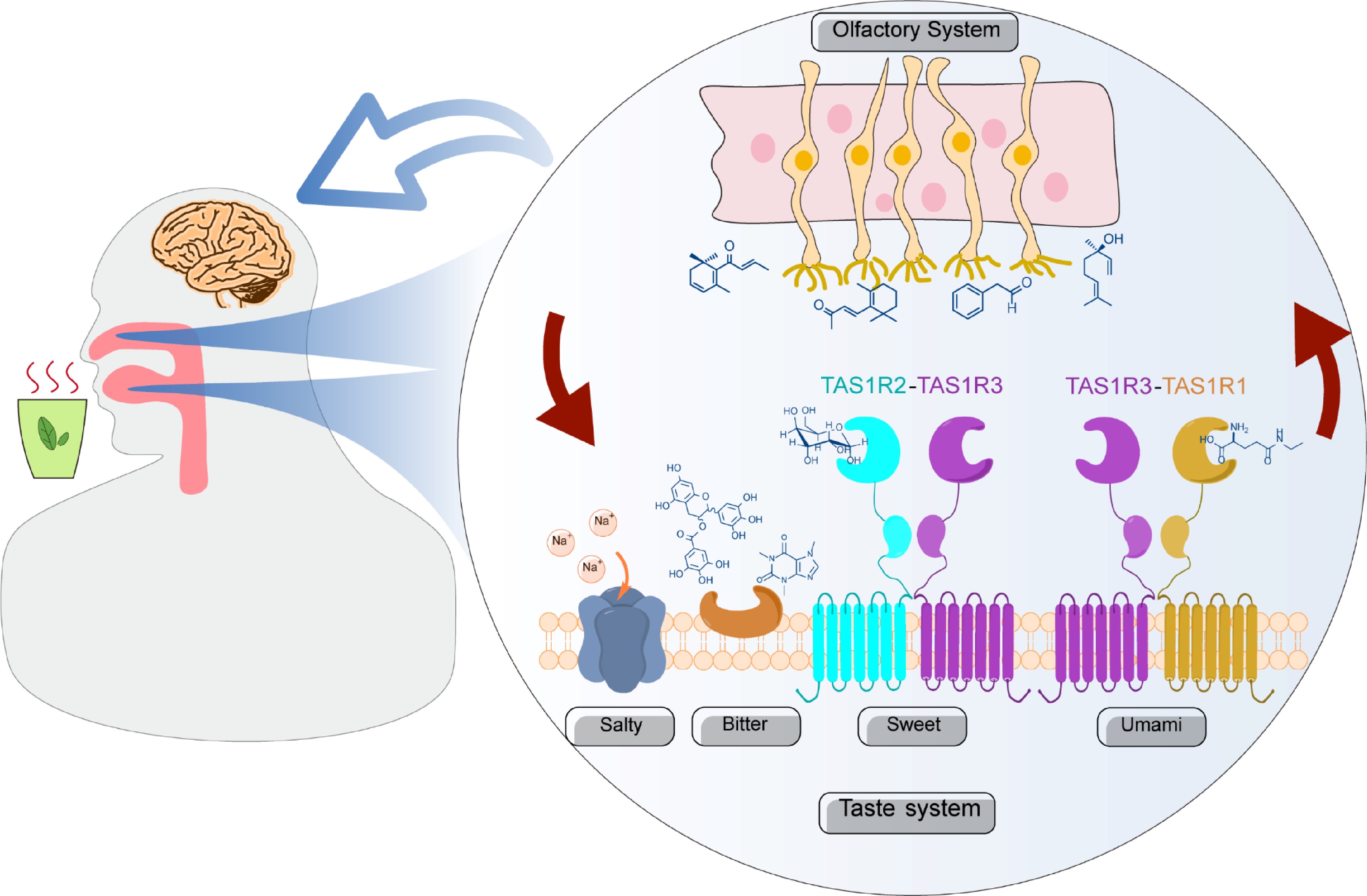
Figure 1.
Schematic diagram of flavor sensing and establishment of multisensory integration.
Multisensory integration is the process by which stimuli from different sensory modalities, such as visual, auditory, and tactile inputs are combined to produce one response.[27,28] The processing that originates from the brain nerves may selectively enhance a certain sense or weaken it. When we enjoy a cup of tea, three senses are activated together, namely vision, smell, and taste, where multisensory integration is probably established. Interestingly, the total content of sweet substances in tea infusion is far below their threshold values, but we can still taste the sweetness, probably because of the decreased sweetness thresholds of the aroma compounds, or the intensified sense of sweetness in humans.[29] Unfortunately, how multisensory integration of tea flavor is established and operates in the actual human body still remains a huge gap and topic for research.
Recent studies have built some sensors based on nanotechnology to simulate certain senses, but artificial systems and the algorithms of multisensory integration are hard to achieve[28,30]. Large-scale investigation of the nervous system's characteristics, along with large-scale modeling and algorithm development, forms the cornerstone of multisensory integration research[30]. From an economic perspective, the study of tea flavor's multisensory integration seems hard to support, given its cost and size. Basic sensory science and neuroscience experiments, such as threshold experiments and electroencephalogram (EEG) analyses, may be more suitable.
Labeled catechin tracing: forward analysis
-
Catechins, with a content of 12%−24% in dry tea leaves, are one of the most important compounds in tea[1]. Through the application of high-throughput mass spectrometry, metabolomics, natural product chemistry, and other spectroscopic methods, numerous catechin oligomers have been discovered[2,31]. However, the limitation is that the majority of catechins cannot be traced to their final products; as a result, fully elucidating their flow and fate during processing remains a significant challenge. Labeling and tracking seem to be the most natural and logical methods (Fig. 2), but how can we achieve that? It is worth mentioning that this analytical method, from catechins to catechin oligomers, is what we define as forward analysis.
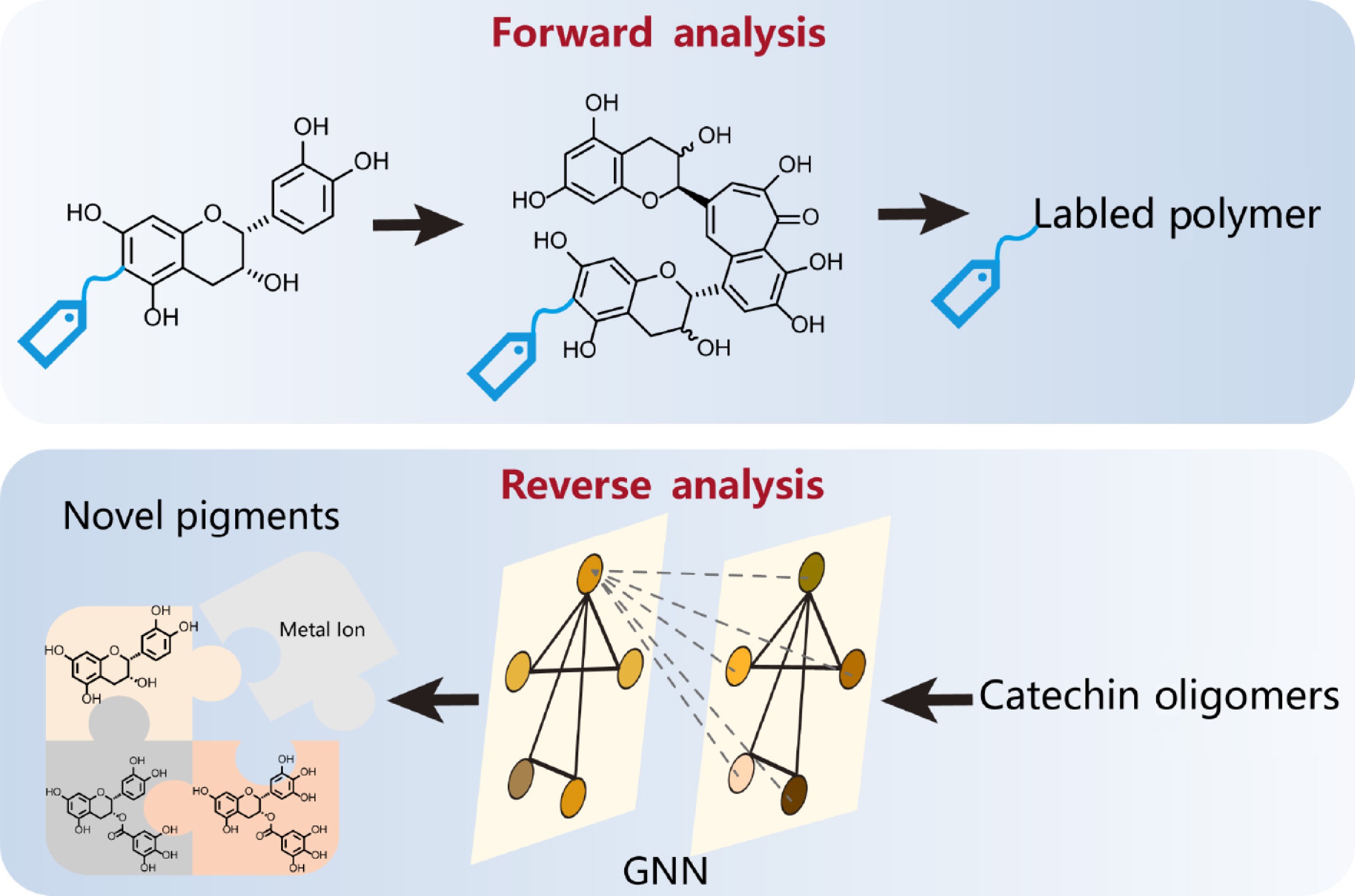
Figure 2.
Schematic diagram of forward analysis and reverse analysis. Forward analysis is defined as the analysis from catechins to catechin oligomers, where the blue label indicates halogen substitution sites. Reverse analysis is defined as the analysis from catechin oligomers to catechins.
Labeling is the key prerequisite. The main catechins in the tea plant are epicatechin (EC), epigallocatechin (EGC), epicatechin gallate (ECG), and epigallocatechin gallate (EGCG). However, isotope-labeled catechins have a prohibitive cost, and it is doubtful whether fluorescent probes can retain their fluorophore integrity during tea processing. Hence, a stable, economical, simple, and easily obtainable labeling method is required. The property of catechin's A-ring is well-known, with impressive nucleophilicity in the C-6 and C-8 positions, and halogen elements (Cl or F) could be introduced to catechin by an electrophilic substitution reaction, making mass spectrometry or nuclear magnetic resonance (NMR) tracing relatively feasible.
Halogen-labeled catechins can be added to fresh tea leaves, which undergo further processing and mass spectrometry or NMR analysis. For small molecules, untargeted metabolomics can be performed to identify the A-ring's primary or secondary ions containing halogen atoms. Molecules that are not amenable to mass spectrometry, such as cellulose and lignin, can be analyzed using techniques like infrared spectroscopy or NMR to track the fate of catechins.
The impact of artificial intelligence: reverse analysis
-
Reverse analysis, as the name suggests, is the idea of analyzing from catechin oligomers to catechins (Fig. 2). Using this strategy, we have identified many products of tea, such as EPSF, theaflavins, and others. It is also possible to analyze the mechanisms and substrate compositions involved in reverse analysis, which previous tea chemists have done[2]. However, the bottleneck lies in cost and scalability. In other words, we can hardly guess the mechanisms behind unknown structures such as thearubigins. Another challenge is the steep learning curve. Only after mastering organic chemistry, understanding tea processing, and obtaining in-depth knowledge of various catechin oligomers' structures can we begin to speculate about their mechanisms. Facing these challenges, machine learning may offer a promising solution.
Machine learning is a branch of artificial intelligence (AI) that focuses on the development of algorithms and statistical models that enable computers to learn from data and make predictions or decisions based on that data, without being explicitly programmed for every specific task[32]. Graph neural networks (GNNs) are a type of deep learning model that understands graphs, extracts features, and is trained on data[33]. There are three main components: Nodes, edges, and global features. In a molecule, atoms act as the nodes, chemical bonds serve as the edges, and the overall properties of the molecule are the global features. The definition is relatively flexible; the key is what task you aim to accomplish (refer to the cited works for the workflow[34]). Computational chemistry can be used to validate the predictions[35].
Machine learning could support reverse analysis by leveraging a workflow established based on catechin products, which could learn and understand how the products are formed by extensive training and iteration[34]. Subsequently, the global properties of the outputs could be predicted, such as the color and reaction site. The other issue of tea chemistry is the polymers of polyphenols, including thearubigins, an amorphous polyphenol-based pigment with an indefinite molecular weight. We hope that by applying this workflow, analysis of polyphenol polymers could be comprehensively strengthened.
-
Two fundamental issues rely on the chemistry of tea flavor: The basic flavor substances and how humans perceive these flavor substances. The introduction of methods from metabolomics, organic chemistry, and analytical chemistry has made significant progress in addressing these two fundamental issues. Although the chemistry of tea flavor is multidisciplinary, interdisciplinary studies will never stop developing. Multisensory integration and GNN-based deep learning models are briefly introduced in this regard. We aim to provide insight and foresight for researchers in the chemistry of tea flavor, hoping that more interdisciplinary methods will be introduced to address these two fundamental issues, and thus contribute to elucidating and promoting tea flavor.
-
The authors confirm their contributions to this study as follows: writing − original draft: Wang Z, Zhang L; writing − review & editing: Chen X, Zhang L; conceptualization & funding acquisition: Zhang L. All authors reviewed the results and approved the final version of the manuscript.
-
Data sharing is not applicable to this perspective as no datasets were generated or analyzed during the current study.
-
This work was supported by the National Natural Science Foundation of China (32472789), the Leader-Type Innovation and Entrepreneurship team of Zhejiang Province (2022R01015), and the Excellent Scientific Research and Innovation team of Anhui Province for Universities (2023AH010027).
-
The authors declare that they have no known competing financial interests or personal relationships that could have appeared to influence the work reported in this paper.
- Copyright: © 2026 by the author(s). Published by Maximum Academic Press, Fayetteville, GA. This article is an open access article distributed under Creative Commons Attribution License (CC BY 4.0), visit https://creativecommons.org/licenses/by/4.0/.
-
About this article
Cite this article
Wang Z, Chen X, Zhang L. 2026. Challenges and possibilities in the chemistry of tea flavor from a multidisciplinary perspective. Beverage Plant Research 6: e030 doi: 10.48130/bpr-0026-0013 

Challenges and possibilities in the chemistry of tea flavor from a multidisciplinary perspective
- Received: 13 November 2025
- Revised: 18 March 2026
- Accepted: 28 March 2026
- Published online: 05 August 2026
Abstract: The demand for tea has been increasing since well before the 21st century, both for its health benefits and its flavor qualities, all of which rely on the development of research into the chemistry of tea flavor. Since the 1840s, numerous flavor-related compounds of tea have been identified, such as catechin, theaflavins, and linalool. These achievements have been accomplished through the application of natural product chemistry. Nevertheless, many challenges remain to be addressed. With the development of interdisciplinary research, neuroscience and machine learning have been widely applied in various fields and have obtained significant progress. Tea chemistry research would benefit more from further input from these disciplines. From this perspective, we hope to integrate cutting-edge and interdisciplinary methods for solving long-lasting scientific and industrial problems.
-
Key words:
- Tea /
- Flavor /
- Chemistry /
- Polyphenols /
- Machine learning /
- Multisensory integration