












-
Healthy soils are essential for maintaining food security and agricultural sustainability[1]. They can reduce the occurrence of crop diseases and enhance the quality[2]. Maize is one of the most economically and ecologically important bioenergy crops globally, feeding billions of people and supporting human well-being[3]. Soilborne diseases, especially ear rot caused by Fusarium and other fungi, are a global challenge threatening maize yield and quality. Mycotoxins produced by Fusarium, such as deoxynivalenol (DON) and zearalenone (ZEN), can cause serious health issues in animals and human beings, and lead to significant economic losses to food resources worldwide due to contamination[4]. Hence, creating effective and environmentally friendly methods to prevent and manage ear rot disease is essential for safe production in the maize industry.
Incorporating maize straw into the soil has been demonstrated to enhance soil quality by improving soil porosity, augmenting soil organic carbon (SOC) levels, restoring essential nutrient availability, and modulating the microbial community structure[5]. Liu et al.[6] suggested that inversion tillage combined with straw return treatment represented a highly effective approach to soil management aimed at enhancing soil quality and increasing crop productivity within the Mollisols region. Zhao et al.[7] confirmed that straw management practices elicited differential responses across various soil strata. Enhancements in the quality of both the subsoil and the rhizosphere resulting from deep-plowed straw incorporation and deep-injected straw incorporation treatments were found to contribute significantly to increased crop yields. However, improper application can reduce soil macro-aggregates, leading to greater nutrient leaching[8]. Since straw can potentially carry pathogens, returning to the field may have complex effects on disease development by changing soil quality and the structure of microbial communities[9].
The soil microbiome is known to play a key role in influencing maize growth and soil health by regulating a broad range of ecosystem processes, including pathogenesis[10]. Shi et al.[11] demonstrated that soil microbes could explain up to 29% of the variation in maize biomass. Multiple soil microbiomes significantly influence maize growth. For example, Lutz et al.[12] showed that inoculation with arbuscular mycorrhizal fungi could significantly increase maize yield. Trichoderma asperellum GDFS1009 has been reported to inhibit Rhizoctonia solani on maize via competition and hyperparasitism, and further degrade the pathogen[13]. However, some microorganisms can also lead to negative effects. Fusarium proliferatum may act as an opportunistic pathogen, causing disease in maize under favorable conditions[14]. Fusarium head blight (FHB) is a mycotoxigenic disease of cereals, including maize[15]. Various Fusarium species within the FHB complex synthesize diverse mycotoxins that pose significant risks to human and animal health, eliciting a broad spectrum of toxicological effects[16]. The soil microbiome is strongly affected by abiotic and biotic factors such as soil properties and interactions between microorganisms and plants[17]. Currently, most studies of straw incorporation primarily concentrate on soil physicochemical characteristics or maize yields, with insufficient understanding of associated diseases and mycotoxin contamination. It is well recognized that the rhizosphere microbiome plays a pivotal role in either suppressing or promoting soilborne pathogens, and that tillage practices can substantially influence root-associated microbial communities by altering soil habitat conditions[17,18]. Nevertheless, these findings have predominantly emerged from investigations contrasting distinct tillage systems (e.g., conventional tillage vs no-till), thereby leaving a significant gap in understanding how incremental variations in the depth of straw incorporation affect the root zone microbiome and, in turn, the incidence of maize ear rot and the accumulation of mycotoxins. There is limited mechanistic research on how varying depths of straw returning influence the root zone and overall microbial ecology, which might impact the development of maize ear rot diseases and the buildup of mycotoxins.
This study was conducted to determine how the depth of straw incorporation affects the severity of maize ear rot and the level of mycotoxin contamination in maize, with a central focus on the underlying shifts in soil qualities and microbial community. We conducted a field experiment employing graded straw incorporation depths (0–5, 10–20, 20–30, and 30–40 cm), followed by comprehensive profiling of disease incidence, mycotoxin levels, soil physicochemical properties, and multi-compartment microbial communities (bulk soil, rhizosphere, and root endosphere). As soil quality exerts strong selective pressures on microbial assemblages across the plant rhizosphere, we hypothesized that incorporation depth acts as a key filter, significantly restructuring microbial communities across soil compartments. Given that rhizosphere and root-endophytic microorganisms may have an impact on the growth status of the aboveground parts of plants, we speculate that an optimal incorporation depth exists that minimizes the pathogen reservoir and its upward transmission while preserving the soil health benefits of straw return. By testing these two hypotheses, our work aims to provide a microbial ecological mechanism for optimizing straw management, thereby contributing actionable insights for integrating soil conservation with disease and mycotoxin control in maize production systems.
-
The field experiment was conducted at Gongzhuling (43°30´19" N, 124°49´21" E), Jilin Province, China. The study adopted a field plot experimental design, setting up four straw deep tillage and return treatments, with tillage depth as the only variable: shallow return (SD, the depth of straw plowing was 0–5 cm, as a control), middle return (MD, the depth of straw plowing was 10–20 cm), deep return (DD, the depth of straw plowing was 20–30 cm) and ultra-deep return (UD, the depth of straw plowing was 30–40 cm). Each treatment was replicated three times, with plot dimensions of 4 m × 50 m and a 20 cm buffer ditch between adjacent plots. The maize varieties used were Xianyu 335 and Fumin 985. They were sown in early June and harvested in September during the growing seasons. Row spacing was 25 cm, and planting density was 45,000 plants ha−1. Before sowing corn in 2024, five soil samples (0–30 cm) were obtained from each plot in the midst of the field, and they were then combined into a single composite sample to relate the indicators of the soil of the corresponding plot (a schematic diagram of soil sample collection was shown in Fig. 1a). All specimens were processed using a 2 mm sieve prior to further analysis.
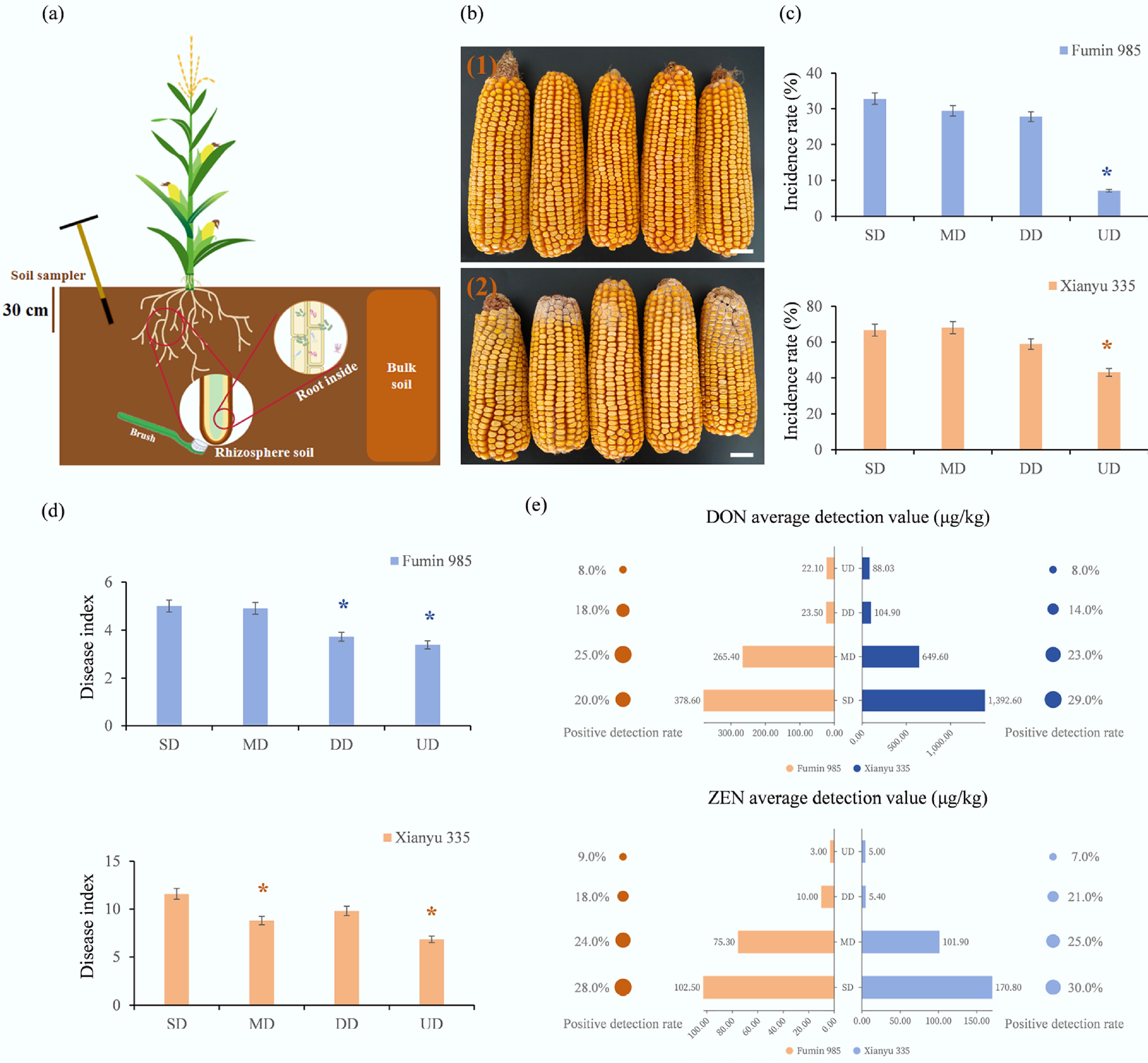
Figure 1.
Analysis of maize disease and mycotoxin contamination. (a) Sampling methods for different parts. (b) Healthy maize ears and those infected with rot disease. (c) Disease incidence rate of maize ear rot in plots under different treatments. (d) Disease index of maize ear rot in plots under different treatments. (e) Mycotoxin concentrations in maize kernels. DON: deoxynivalenol, ZEN: zearalenone. The circular areas on both sides of the bar chart are used to represent the positive detection rate of mycotoxins in maize samples (n = 100). Data are expressed as means ± SD (from at least three independent replicates) and were compared with the SD treatment by Student's t-test (* p < 0.05).
Disease investigation
-
The incidence of maize ear rot was assessed using a five-point sampling method. Within each treatment plot, five sampling points were arranged in a quincunx pattern, with 100 consecutive plants surveyed at each point for a total of 500 plants per plot. All maize ears were examined for symptoms of infection, and the number of diseased ears was recorded to calculate disease incidence (the number of diseased ears/total ears surveyed × 100%). Disease severity was rated on a 0–9 scale based on the proportion of the ear surface showing rot symptoms: 0 (no symptoms), 1 (≤ 5%), 3 (6%–25%), 5 (26%–50%), 7 (51%–75%), and 9 (75%–100%).
$ \begin{split} & {Disease\ Index=} \\ & {\dfrac{\text{∑(Number of ears in each severity grade × Corresponding grade value)}}{\text{Total ears surveyed × 9}} \times 100}\end{split} $ Surveys were conducted uniformly from the late milk stage to the early dough stage (approximately 110–120 d after sowing) by the same team to ensure consistency.
Mycotoxin detection
-
Rapid multi-residue liquid chromatography-tandem mass spectrometry (LC-MS/MS) techniques were employed to assess the concentrations of mycotoxins in maize samples. Mycotoxin concentrations were determined on a dry weight basis. Corn kernels (4 g, dry weight) were ground into fine powder and extracted with ethyl acetate (EtOAc) at room temperature five times (12 h for each extraction). HPLC-DAD analysis of the purified ethyl acetate (EtOAc) extracts was conducted using an LC-20A system equipped with an SPD-M20A photodiode array detector. Separation was achieved on an analytical C18 column (100 mm × 2.1 mm internal diameter, 1.7 µm particle size; Phenomenex Inc., Torrance, CA, USA) using a mobile phase composed of methanol and water containing 0.01% trifluoroacetic acid (TFA). A gradient elution was applied, increasing methanol concentration from 10% to 100% over a 45-min period, at a flow rate of 0.3 mL/min. The column temperature was maintained at 30 °C throughout the analysis. High-resolution electrospray ionization mass spectrometry (HRESIMS) spectra were acquired using a 5500 Qtrap mass spectrometer (AB SCIEX, USA). The limits of detection (LOD) and quantification (LOQ) were 4.0 and 10.0 μg/kg for DON, and 1.0 and 5.0 μg/kg for ZEN, respectively. Mycotoxin concentrations were compared against the maximum limits established by the Chinese National Food Safety Standard (GB 2761-2017): 1,000 μg/kg for DON and 60 μg/kg for ZEN in maize. The concentrations of Fusarium mycotoxins in the samples were compared with the standards and recorded.
Determination of soil properties
-
The bulk density (BD) of the soil samples was obtained from the oven-dry mass relative to the sample volume. Soil water content (SWC) was measured by the gravimetric method[19]. Soil saturated water content (SSW) was measured by the core method combined with the saturation drying method. Maximum pore radius (Max) was measured by the pressure plate/pressure membrane method. Mean pore radius (Mean) was calculated from the soil water suction curve. Total pore area (Area) was measured by mercury intrusion porosimetry (MIP, AutoPore V series)[19]. Soil pH was measured using a pH meter in soil-water suspensions prepared at a ratio of 1:5 (weight to volume)[20]. Soil samples designated for SOC analysis were air-dried at ambient temperature and subsequently quantified using elemental analysis (Vario EL III, Elementar, Germany) in conjunction with Kjeldahl digestion[21]. Soil available phosphorus (AP) was measured using the Olsen method, while soil available nitrogen (AN) was determined via a modified Kjeldahl procedure. Soil available potassium (AK) concentrations were assessed using a flame photometer[22]. Additionally, phospholipid fatty acids were extracted from 4 g of soil to evaluate the microbial community structure. The contents of microbial nitrogen, phosphorus, and carbon were determined according to the method of Qu et al.[23,24].
SQI analysis
-
For the SQI analysis, soil physical, chemical, and microbial properties were transformed into dimensionless scores ranging from 0 to 1. A linear scoring model was employed, characterized as follows:
$ S_L=1-\dfrac{x-L}{H-L} $ (1) In this context, SL denotes the linear score ranging from 0 to 1, where, x corresponds to the observed value of the index, and L and H represent the minimum and maximum values of the index, respectively. Notably, the pH values across all treatments exceeded the optimal range and were normalized using Eq. (1).
Then, the weight of each indicator (Wi) was established through Principal Component Analysis (PCA), defined as the proportion of its variance relative to the cumulative variance. Subsequently, soil quality was computed using the following equation:
$ SQI=\sum \limits_{i=1}^{n}W_\text{i}\times S_L $ (2) In this context, Wi represents the weight assigned to the ith evaluation indicator, SL denotes the score of the indicator, and n corresponds to the total number of indicators.
DNA extraction, sequencing, and data processing
-
Approximately 200 ng of DNA was extracted from soil and plant samples using the PowerSoil® DNA Isolation Kit (MoBio Laboratories, Carlsbad, CA, USA) according to the manufacturer's instructions. A NanoDrop ND-2000 spectrophotometer (Thermo Scientific, USA) was used to assess DNA quality. The V4 region of the bacterial 16S rRNA gene was amplified from soil-derived genomic DNA using the primers 515F and 907R (515F: 5′-GTGCCAGCMGCCGCGGTAA-3′, 907R: 5′-GGACTACHVGGGTWTCTAAT-3′). In contrast, the fungal internal transcribed spacer 1 (ITS1) region was amplified using the primers ITS1F and ITS2 (ITS1-F: 5′-CTTGGTCATTTAGAGGAAGTAA-3′, ITS2: 5′-GCTGCGTTCTTCATCGATGC-3′). Amplicons were sequenced using the Illumina MiSeq PE250 platform (BIOZERON BIOTECHNOLOGY Co., Ltd, Shanghai, China). The quality-filtered sequences were analyzed using Quantitative Insights into Microbial Ecology 2 (QIIME2), with the 16S rRNA gene and ITS ASVs taxonomically classified against the SILVA database and UNITE database, respectively. Archaea and bacterial taxonomic classifications were derived using the SILVA reference database version 132, while fungal taxonomic information was obtained from the UNITE database version 8.3. After quality filtering and chimera removal, the average sequencing depth was 50,000 reads per sample for the 16S rRNA gene amplicon and 50,000 reads per sample for the ITS amplicon. Rarefaction curves approached saturation, indicating that the sequencing depth was sufficient to capture the majority of bacterial and fungal diversity in the samples. Operational Taxonomic Unit (OTU) counts and Pielou's evenness index were employed to assess species richness and community evenness, respectively. Shannon diversity index and Chao1 index were used to assess bacterial and fungal diversity for rhizosphere soil samples, while Chao1 and Simpson indices were applied for root endosphere samples, as the Shannon index did not show significant differences among treatments in the root compartment. The OTUs whose abundance significantly differed between groups were identified by STAMP 2.1.3. A corrected p-value of less than 0.05 was regarded as indicative of statistical significance. The DNA sequences have been submitted to the CNGB Sequence Archive (CNSA) within the China National GeneBank Database (CNGBdb) and are accessible under accession number CNP0007366.
Statistical analysis
-
Statistical analysis was performed by Student's t-test or the Kruskal–Wallis test for two-group comparisons and one-way analysis of variance (ANOVA) followed by Tukey's honestly significant difference (HSD) post-hoc test for multiple-group comparisons. p-values were used to determine significant differences (* p < 0.05, ** p < 0.01).
SEM building method
-
Structural equation model (SEM) was used to explore the mechanism of multi-factor effects. SEM was calculated through SmartPLS 4.0. First, we defined the measurement model by specifying reflective or formative indicators for each latent variable, followed by drawing the structural model to establish the hypothesized paths between latent variables. The path weighting scheme was used for iteration, with maximum iterations set to 300 and a stop criterion of 10−7. To assess the measurement model, reflective constructs should meet the following criteria: factor loadings > 0.708, composite reliability (CR) > 0.7, and average variance extracted (AVE) > 0.5. We then examined the significance of weights and ensured that the variance inflation factor (VIF) < 5 to avoid multicollinearity. Finally, the structural model was evaluated by testing the significance of path coefficients using bootstrapping, along with examining the coefficient of determination (R2), effect size (f2), and predictive relevance (Q2) calculated via the blindfolding procedure.
Absolute quantification of pathogenic fungi by qPCR
-
To validate the relative abundance results obtained from amplicon sequencing, absolute quantification of pathogenic fungi was performed using quantitative real-time PCR (qPCR). DNA extracts from rhizosphere soil and root endosphere samples were used as templates. For Fusarium, genus-specific primers targeting the ITS region (Forward: 5'-TCCTCAGCTTTAAGTTGTAGG-3'; Reverse: 5'-GTCTCGTTGTGTTGTTCAG-3') were used[25]. For Aspergillus, primers targeting the 18S rRNA gene (Forward: 5'-GGAGGGATGATTGCCCGC-3'; Reverse: 5'-TCACTCGCATTTTGCTCTT-3') were used[26]. qPCR assays were conducted in triplicate utilizing the CFX96 Real-Time System (Bio-Rad, USA). Standard curves were generated using serial dilutions (101–107 copies/μL) of plasmid DNA containing the target amplicons. Results were expressed as copy numbers per gram of dry soil or root tissue. The detection limit was 102 copies per reaction.
-
At harvest, we assessed the incidence of ear rot disease and associated mycotoxin contamination. Healthy and infected maize ears are shown in the Fig. 1b. In the SD treatment field, the incidence rate of ear rot of the maize resistant variety Fumin 985 reached 32.85%, and the disease index was 5.01 (Fig. 1c). The ear rot disease of the susceptible variety Xianyu 335 was as high as 60%, with a disease index of 10.00, indicating a relatively high risk value (Fig. 1c). As tillage depth increased, a clear improvement was observed. When tillage reached 30–40 cm with straw incorporation in the UD treatment field, the incidence rate of ear rot of Fumin 985 was reduced to below 10%, and the disease index was controlled below 5.00 (Fig. 1c). Meanwhile, the incidence rate of ear rot of Xianyu 335 was reduced about 40%, and the disease index was controlled below 8.00 (Fig. 1c). Furthermore, maize affected by ear rot showed marked quality deterioration compared with healthy grains. Significant mycotoxin contamination was detected in kernels, with deoxynivalenol (DON) and zearalenone (ZEN) indicators exceeding established safety thresholds. This phenomenon was significantly more pronounced in the SD-treatment field compared with the other three treatments (Fig. 1d). However, the contamination level of maize mycotoxins in the UD-treatment field was controlled within safe limits. Notably, elevated toxin levels were also found in some visually healthy kernels, highlighting a latent contamination risk.
Effects of soil straw incorporation depth on soil physical, chemical, and microbial properties
-
The incorporation of straw at varying depths via tillage markedly enhanced the physical, chemical, and microbial characteristics of the soil. Deep tillage significantly increased soil bulk density, thereby increasing soil compaction. In comparison to the SD soil, the bulk density in MD, DD, and UD soils increased by 3.7%, 3.7%, and 5.6%, respectively (p < 0.05) (Table 1). Additionally, the treatments involving DD, and UD resulted in a significant increase in soil saturated water content, maximum and mean pore radius, and total pore area compared with the SD and MD treatments (p < 0.05) (Table 1).
Table 1. Soil physical properties
Treatment SD MD DD UD BD (g/cm3) 1.08 ± 0.01a 1.12 ± 0.01b 1.12 ± 0.01b 1.14 ± 0.01c SWC (%) 41.0 ± 0.5a 40.0 ± 0.6a 41.2 ± 0.4a 41.0 ± 0.6a SSW (%) 59.1 ± 0.4a 60.1 ± 0.5a 61.5 ± 0.4b 63.5 ± 0.5c Max (mm) 0.16 ± 0.01a 0.18 ± 0.01a 0.20 ± 0.01a 0.28 ± 0.01b Mean (mm) 0.045 ± 0.002a 0.044 ± 0.003a 0.055 ± 0.002b 0.062 ± 0.001bc Area (mm2) 128 ± 3a 210 ± 2b 228 ± 2b 336 ± 3c Note: BD, soil bulk density; SWC, soil water content; SSM, soil saturated water content; Max, maximum pore radius; Mean, mean pore radius; Area, total pore area. Values are presented as mean ± standard deviation (n = 5). Different lowercase letters (a, b, c) within the same row indicate significant differences among treatments at p < 0.05 (Tukey’s HSD post-hoc test). Deep return of straw into the soil (especially UD) significantly improved soil fertility compared with shallow return and middle return (SD and MD), with enhancements in SOC, AP, AK, and AN contents (Table 2). pH is often described as the master soil variable because it influences a wide range of soil chemical and biological processes[27]. In the different treatment fields, a decrease in pH was observed under plowing in MD, DD, and UD soils (Table 2). However, there was no significant difference in soil EC among different treatments (Table 2).
Table 2. Soil chemical properties
Treatment SD MD DD UD pH 7.45 ± 0.01a 7.34 ± 0.01a 7.04 ± 0.01b 7.02 ± 0.01b SOC (g/kg) 26.70 ± 0.05a 28.32 ± 0.08a 28.70 ± 0.03a 32.70 ± 0.05b AP (mg/kg) 26.1 ± 0.4a 29.1 ± 0.3a 54.0 ± 0.4b 65.8 ± 0.2c AN (mg/kg) 156.2 ± 0.1a 152.8 ± 0.1a 172.8 ± 0.2ab 191.9 ± 0.1c AK (mg/kg) 213.5 ± 0.1a 214.7 ± 0.4a 262.5 ± 0.2b 302.1 ± 0.1bc Note: SOC, soil organic carbon; AP, available phosphorus; AN, available nitrogen; AK, available potassium. Values are presented as mean ± standard deviation (n = 5). Different lowercase letters (a, b, c) within the same row indicate significant differences among treatments at p < 0.05 (Tukey’s HSD post-hoc test). Regarding soil microbial characteristics, the deep incorporation of straw enhanced the biomass levels of bacteria, fungi, and overall microbial communities within the soil (Table 3). The abundances of both Gram-positive bacteria was improved in DD and UD soils compared with SD and MD soils (Table 3). However, it did not change the actinomycetes levels when compared with the other three treatment fields (Table 3). Further testing revealed that the microbial element contents in the SD and MD soils also changed accordingly under different treatments (Table 3). Based on this, we speculated that the depth of straw returned to the field had a certain impact on soil properties.
Table 3. Soil microbial properties
Treatment SD MD DD UD Bacteria (nmol/g) 50.44 ± 0.34a 56.12 ± 0.20a 57.95 ± 0.44ab 59.80 ± 0.73bc Fungi (nmol/g) 20.15 ± 0.65a 24.33 ± 0.37b 24.97 ± 0.44bc 26.80 ± 0.65bc Actinomycetes (nmol/g) 12.88 ± 0.35a 13.12 ± 0.25a 13.34 ± 0.20a 13.28 ± 0.24a G+ (nmol/g) 12.88 ± 0.24a 16.12 ± 0.55a 20.25 ± 0.20b 25.33 ± 0.60c G− (nmol/g) 25.54 ± 0.15a 24.59 ± 0.44a 25.32 ± 0.75a 25.76 ± 0.45a Microbial nitrogen (mg/kg) 22.42 ± 0.26a 23.87 ± 0.55a 25.62 ± 0.38b 24.45 ± 0.25a Microbial phosphorus (mg/kg) 23.42 ± 0.42a 25.76 ± 0.56a 28.97 ± 0.34ab 30.42 ± 0.95ab Microbial carbon (mg/kg) 425.7 ± 3.2a 463.2 ± 2.8b 487.4 ± 2.7b 509.6 ± 3.5c Note: G+, Gram-positive bacteria; G−, Gram-negative bacteria. Values are presented as mean ± standard deviation (n = 5). Different lowercase letters (a, b, c) within the same row indicate significant differences among treatments at p < 0.05 (Tukey’s HSD post-hoc test). Soil quality evaluation
-
Utilizing the aforementioned data, we calculated the soil physical index (SPI), chemical index (SCI), and microbial index (SMI), and analyzed the soil quality index (SQI) under four treatments (Fig. 2a). The soil property indices were markedly affected by the depth at which straw was incorporated. A significant improvement in soil quality was observed across treatments (SD < MD < DD < UD). Notably, UD treatment soil exhibited an SQI value roughly four times higher than SD treatment soil. Contribution analysis of SQI revealed a consistent shift in the dominant factors driving soil quality across different treatments (Fig. 2b). Under SD treatment, the contribution of SPI reached 65.2% in the soil, representing the primary limiting factor for overall soil quality (Fig. 2b). With increasing straw incorporation depth, the role of microbial activity became more pronounced, contributing more than 40% of SQI in both MD and DD treatments. In UD treatment soil, which exhibited the highest overall quality, the contribution of SMI also exceeded 35% (Fig. 2b). Notably, soil microbial carbon and Gram-positive bacteria abundance showed a positive correlation with SQI, suggesting that microorganisms may serve as a critical link between physicochemical properties and overall soil quality.
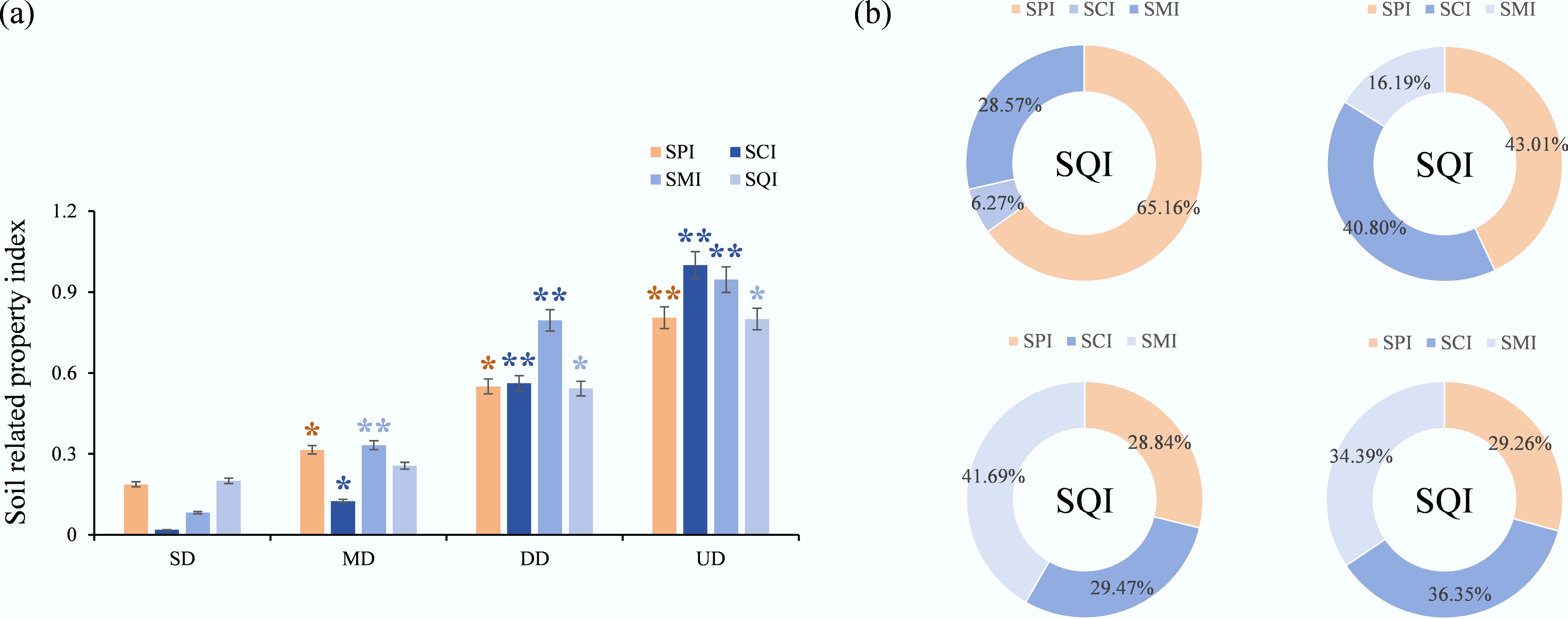
Figure 2.
Soil quality assessment. (a) Effects of straw incorporation depth on soil quality and the indices of soil physical properties, soil chemical properties, and soil microbial properties under different treatments. (b) Contributions of SPI, SCI, and SMI to SQI under different treatments. SPI, soil physical property index; SCI, soil chemical property index; SMI, soil microbial property index. Asterisks indicate significant differences (* p < 0.05, ** p < 0.01).
Effects of straw incorporation depth on rhizosphere soil microbiomes
-
Then we compared the community diversity of rhizosphere microbiomes between Fumin 985 and Xianyu 335 varieties at four planting sites. The Chao1 richness and Shannon index of the rhizosphere bacterial communities in the DD treatment were significantly higher than those of the SD and MD treatments in both varieties. The variability observed in the rhizosphere fungal communities, with respect to both community diversity and richness, demonstrated consistent patterns (Fig. 3a). The findings demonstrated that the rhizosphere microbiome in soil subjected to the DD treatment exhibited greater community diversity compared with soils treated with SD and MD. Meanwhile, we observed that different treatments had no significant influence on the relative abundance of dominant bacteria and fungi at the phylum level in the two varieties (Fig. 3b). Despite observed variations in bacterial and fungal abundance across the four treatment soils, our analysis revealed that certain bacterial phyla, specifically Actinobacteria and Acidobacteriota, as well as fungal phyla such as Basidiomycota and Mucoromycota, demonstrated distinct patterns of enrichment (Fig. 3b). Moreover, rhizosphere microbiomes under different treatments formed distinctive ecological clusters (Fig. 3c). As anticipated, these OTUs exhibited a statistically significant variation in abundance across the four planting sites (p < 0.05). We further found that the SD treatment OTUs included the fungal genera Fusarium and Aspergillus, which are well-known pathogens causing maize ear rot and mycotoxin contamination[4]. In contrast, DD and UD treatment OTUs were enriched in the bacterial family Enterobacteriaceae and the fungal genus Trichoderma (Fig. 3d, e). Trichoderma is a widely recognized biocontrol agent that suppresses soilborne pathogens through mycoparasitism, competition, and induced plant resistance[13], while certain Enterobacteriaceae members have been reported to produce antifungal compounds and enhance plant stress tolerance. To validate whether the observed reduction in the relative abundance of pathogenic fungi reflected a true decrease in their population sizes, we performed qPCR to quantify the absolute abundances of Fusarium and Aspergillus in rhizosphere soil samples. Consistent with the relative abundance patterns, the absolute copy numbers of both Fusarium and Aspergillus were significantly lower under the DD and UD treatments compared with the SD and MD treatments (p < 0.05; Supplementary Fig. S1). These results suggested that distinctive patterns of soil treatments were closely associated with microbial communities. Furthermore, by searching the database of plant-associated beneficial and pathogenic microorganisms, we identified plant pathogenic fungi in all the rhizosphere soil samples.
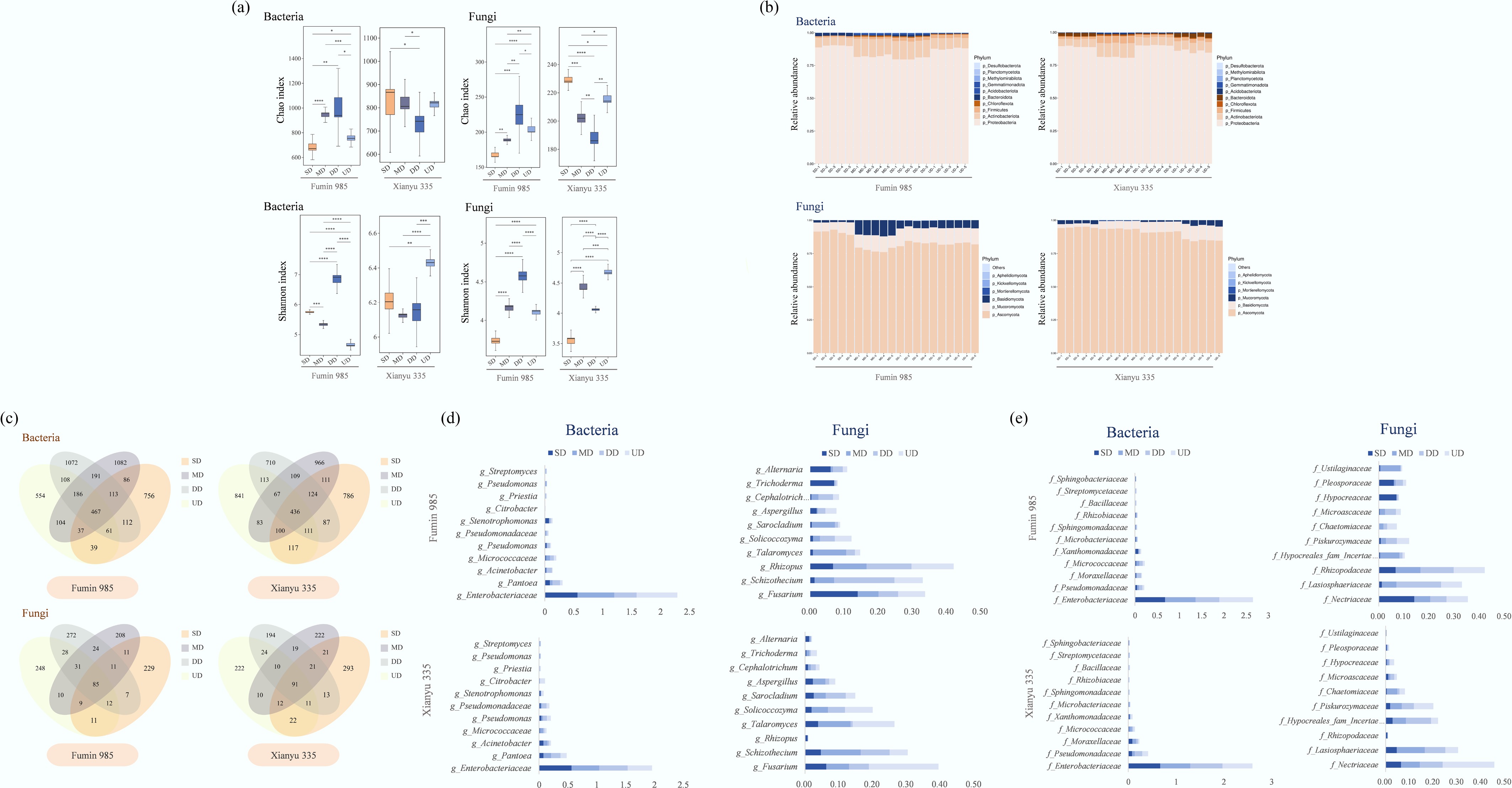
Figure 3.
Effects of straw incorporation depth on bacterial and fungal communities in the maize rhizosphere soil. (a) The Shannon and Chao1 indices of bacterial and fungal communities in all rhizosphere soil samples. Asterisks indicate significant differences (* p < 0.05, ** p < 0.01, *** p < 0.001, ****p < 0.0001). (b) Relative abundances of dominant phyla under different treatments in different maize cultivars. (c) Shared operational taxonomic units (OTUs) in different treatments for the Fumin 985 and Xianyu 335 cultivars. (d) Relative abundances of SD, MD, DD, and UD treatment OTUs in bacteria and fungi at the genus level. (e) Relative abundances of SD, MD, DD, and UD treatment OTUs in bacteria and fungi at the family level.
Diversity, structure, and composition of root-endophytic microbiomes under four treatments
-
Subsequently, we compared the community diversity of root-endophytic microbiomes between the two varieties under the four treatment-planting sites. Compared to the SD treatment, the UD treatment slightly decreased the diversity of bacterial communities, while significantly increasing the α diversity index of fungi (Fig. 4a). As speculated, the root microbiota under different treatments also formed unique ecological clusters (Fig. 4b). The dominant phyla of bacteria included Pseudomonadota, Bacillota, and Thermodesulfobacteriota across all the treatments. The dominant phyla of fungi included Ascomycota and Basidiomycota (Fig. 4c). The results also demonstrated that the straw incorporation affected the community structures of bacterial and fungi groups in the roots when comparing the four treatments in the two varieties (Fig. 4d). Both bacterial and fungal communities showed significant structuring based on tillage (p < 0.05), however, the influence of Fumin 985 was stronger than that of Xianyu 335 on bacterial clustering in the roots. Notably, the beneficial taxa enriched in the rhizosphere under the DD and UD treatments, such as Trichoderma, were also detected in root endosphere samples (Fig. 4c, d), suggesting potential vertical transmission or recruitment of these beneficial microbes from the rhizosphere into root tissues. qPCR quantification of Fusarium and Aspergillus in root endosphere samples further corroborated the findings from rhizosphere soil. Absolute copy numbers of both pathogens were significantly lower under the DD and UD treatments compared with SD and MD treatments (p < 0.05; Supplementary Fig. S2), indicating that the suppression of pathogenic fungi extends into the root tissues under deeper straw incorporation. The results showed that the microbial communities in roots were markedly dissimilar to those in the rhizosphere soil.
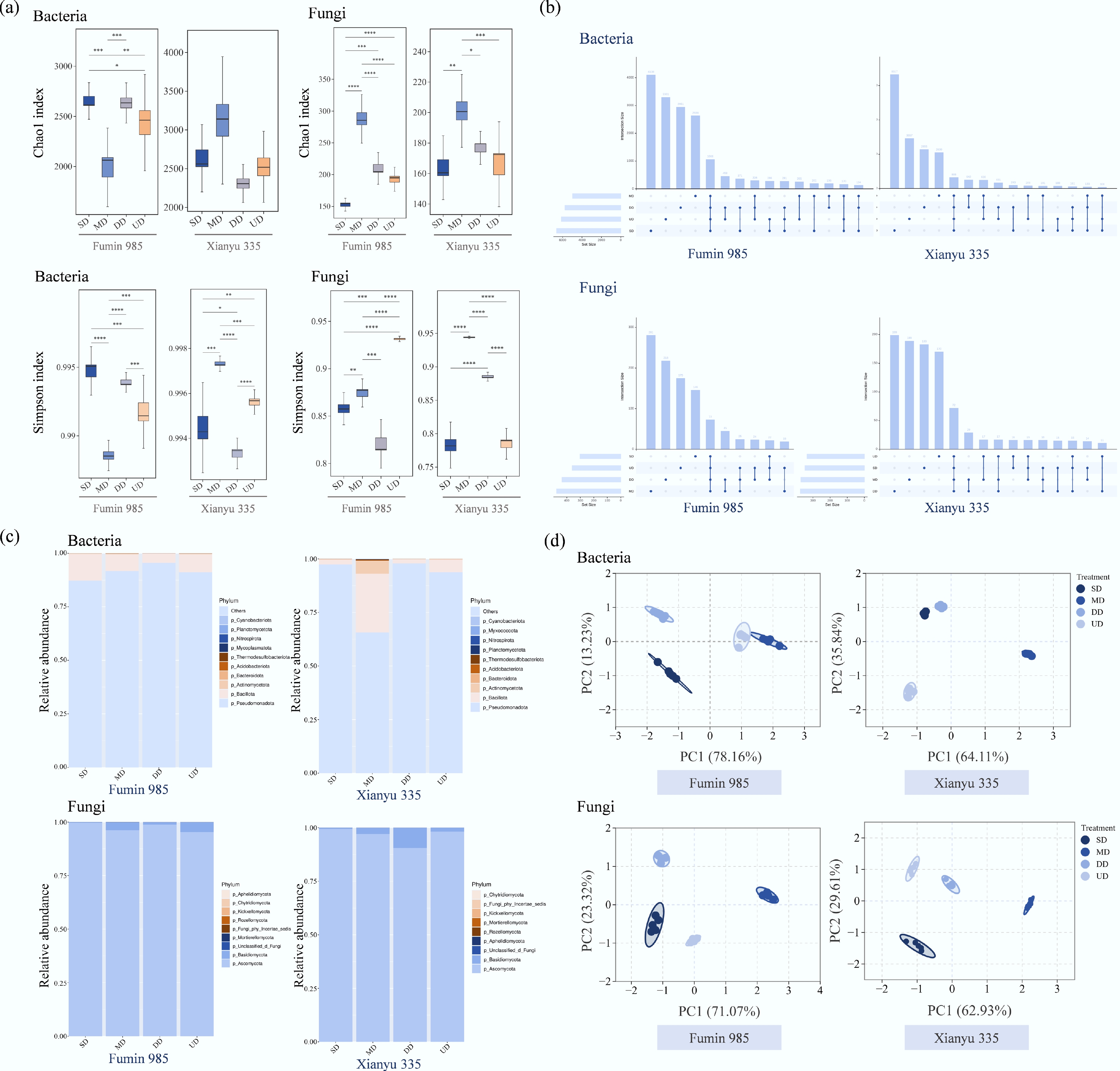
Figure 4.
Effects of straw incorporation depth on bacterial and fungal communities in maize roots. (a) The Chao1 and Simpson indices of bacterial and fungal communities in all samples. Asterisks indicate significant differences (* p < 0.05, ** p < 0.01, *** p < 0.001, **** p < 0.0001). (b) Shared OTUs in different treatments for the Fumin 985 and Xianyu 335 cultivars. (c) Relative abundances of dominant phyla in different maize cultivars under the four treatments. (d) Principal component analysis (PCA) ordination plots of roots, with different treatment samples colored by tillage depth. The percentages of variance explained by the first principal component (PC1) and the second principal component (PC2) are labeled on the corresponding coordinate axis.
The DD and UD treatment soils possessed more complex microbial community interaction networks
-
To investigate the impact of variation in deep straw incorporation on soil microbial communities, we developed bacterial–fungal interkingdom interaction networks based on statistically significant pairwise correlations. We analyzed bacterial and fungal OTUs that appeared in more than 20% of samples and had a total relative abundance exceeding 0.05% in bulk soils. Spearman correlations were calculated, and strong associations were identified when the absolute correlation was above 0.8 and the p-value was below 0.05. Ultimately, a network graph comprising nodes and edges was created, which illustrated the potential interactions among microbial OTUs in soil under various treatment conditions. The DD and UD treatments led to a reduction in total network links and a simultaneous increase in positive links in the bulk soils, compared with the SD and MD treatments (Fig. 5a). Average path length, clustering coefficient, degree correlation, and degree distribution were calculated to assess the relevant indicators of complex interaction networks (Fig. 5b–d). The shorter average path length observed in the DD- and UD-treated soils indicates more efficient information or nutrient transfer among microbial taxa, which may facilitate rapid community-level responses to environmental fluctuations[28]. The higher clustering coefficient in these networks suggests increased functional redundancy, meaning that the loss of a single microbial taxon could be compensated by other functionally similar taxa, thereby enhancing community resilience to disturbances[29]. As straw incorporation depth increased, the networks in the bulk soil became denser, featuring a greater number of nodes and connections. Based on these results, we speculated that a more intricate microbial network structure might enhance the stability and resilience of soil microecology.
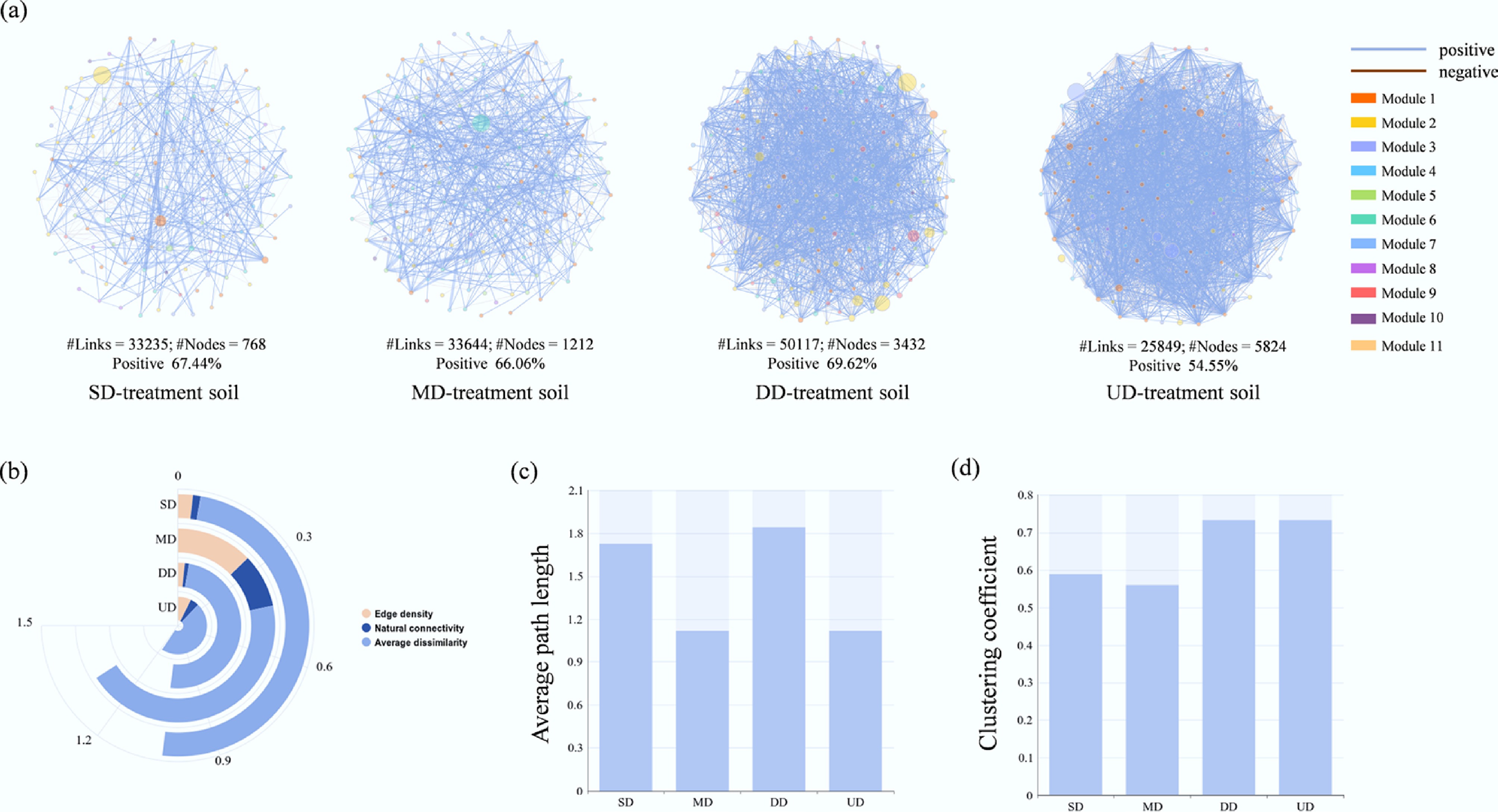
Figure 5.
Co-occurrence networks of the community model of bacterial and fungal communities. (a) Microbial co-occurrence networks of communities in bulk soil under four treatments. Blue edges represent positive associations, and orange edges represent negative associations. Node size indicates degree, and node color indicates modularity class. (b) Average path length of the networks. (c) Clustering coefficient of the networks. (d) Three network topological characteristics of the networks.
Correlation among soil properties, microbial community, and maize mycotoxin contamination
-
Pearson correlation analysis was conducted to examine the relationship between soil properties and microbial community composition with two maize varieties (Fig. 6a, b). For the rhizosphere soil microbial community, SOC, SSW, and multiple microbial properties all exhibited significant correlations with bacteria and fungi in two varieties (r > 0.5, p < 0.01). Furthermore, for root-endophytic microbiomes, the correlations became weaker and were no longer statistically significant for most microbial properties under the Fumin 985 variety. Microbial nitrogen, phosphorus, and carbon exhibited significant negative correlations with bacteria in the Fumin 985 variety, and almost all exhibited correlations with bacteria and fungi in the Xianyu 335 variety. Then we identified the relative abundance of potential pathogens of maize ear rot disease under four treatments. The analysis revealed that the relative abundance of potentially pathogenic bacteria exhibited similar levels in rhizosphere soils under different treatments in both varieties (Fig. 6c). However, the relative abundance of potentially pathogenic fungi exhibited lower levels under DD and UD treatment than under the SD and MD treatments (Fig. 6c). A similar trend was observed in the root-endophytic microbiota community (Fig. 6d).
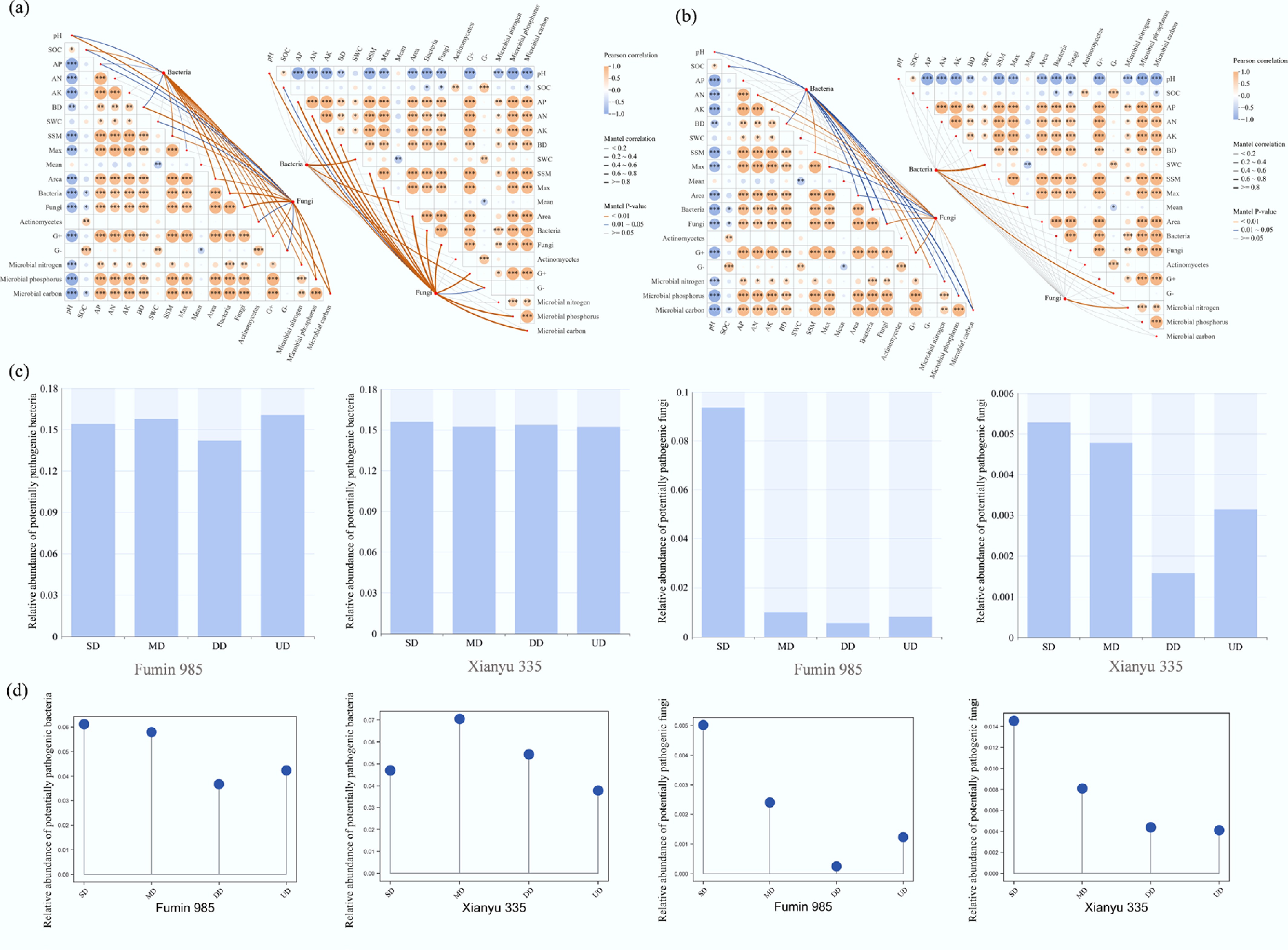
Figure 6.
Relationship of soil properties and microbial communities with maize varieties (Fumin 985 and Xianyu 335) of (a) rhizosphere soil microbial communities, and (b) root-endophytic communities by Pearson tests. (c) Relative abundance of potentially pathogenic microbes in rhizosphere soils under four treatments in Fumin 985 and Xianyu 335 varieties. (d) Relative abundance of potentially pathogenic microbes in roots under four treatments in Fumin 985 and Xianyu 335 varieties. Asterisks indicate significant differences (* p < 0.05).
SEM results showed that different treatments had a profound impact on soil quality and subsequent biological processes in the two maize varieties. In the Fumin 985-planted plots, soil physicochemical indicators could be driven by treatment intensity, collectively explaining up to 89% of the variation in SQI (Fig. 7a). The abundance and structural diversity of soil microbial communities might be promoted by the improved SQI, while the relative abundance of potential pathogens was inhibited (Fig. 7a). It can be speculated that the combined effect of healthier microbial communities and fewer potential pathogens might reduce the occurrence of ear rot disease and mycotoxin contamination in Fumin 985.
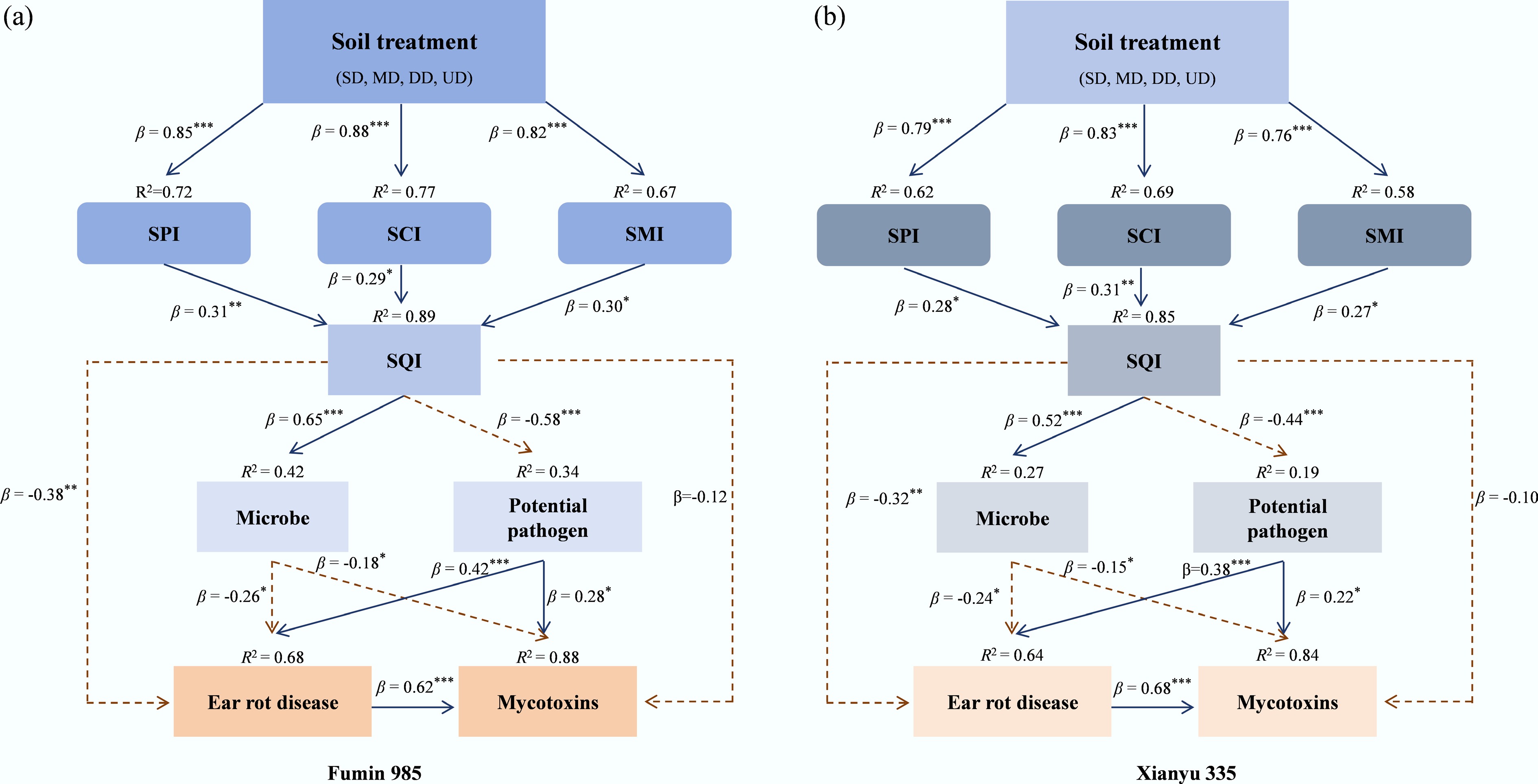
Figure 7.
Partial least squares path analysis for the effects of straw incorporation on ear rot disease and mycotoxin contamination with (a) Fumin 985 and (b) Xianyu 335 varieties. * p < 0.05, ** p < 0.01, and *** p < 0.001. Continuous and dashed lines indicate positive and negative relationships, respectively. β denotes the direct effect intensity, and R2 denotes the proportion of variance explained.
In the field planted with Xianyu 335, the effects of straw returning treatments on the soil ecosystem exerted similar impacts, though the intensity and focus varied. SEM results indicated that the treatment intensity could also effectively improve soil properties and enhance SQI (Fig. 7b). However, the influence of SQI on microbial communities was somewhat reduced. Nonetheless, the enhanced SQI still suppressed potential pathogens. Notably, the influence of disease severity on mycotoxin accumulation was stronger in Xianyu 335 than in Fumin 985 (Fig. 7b). This difference could be attributed to the fundamental differences among the varieties themselves.
-
Tillage and straw incorporation are key management practices in modern agriculture, which ensure crop safety through modifications to soil properties and microbial community. Dissecting how differing tillage intensities shape microbial community composition in distinct soil niches is therefore pivotal to advancing microbiome-based precision agriculture and alleviating mycotoxin contamination in agroecosystems. Through a field-based trial, we investigated the effects of gradient tillage depths on the diversity and complexity of microbial assemblages colonizing bulk soil, the rhizosphere, and root systems.
Impacts of tillage incorporation depth and straw residue return on soil characteristics
-
Enhanced incorporation of straw at greater depths (DD and UD treatments) markedly enhanced the physical, chemical, and microbial characteristics of the soil. This aligns with the core premise that straw return modulates soil habitats via biogeochemical and biophysical mechanisms[30].
The UD treatment significantly improved soil physical properties, as evidenced by increased SWC by 7.4%, maximum pore radius by 75.0%, and total pore area by 162.5% compared with the SD treatment, although BD showed a moderate increase of 5.6% (Table 1). The observed increase in BD following deeper straw incorporation might seem paradoxical in light of simultaneous enhancements in soil porosity and water retention. The potential mechanisms underlying this phenomenon are speculated as follows. First, the presence of undecomposed straw fragments may temporarily occupy pore spaces, thereby increasing BD prior to their full decomposition[31]. Second, the timing of sampling, conducted six–eight months post-incorporation, might have coincided with an intermediate phase during which the loosening effects of tillage were partially counterbalanced by natural soil consolidation. Third, the inadvertent inclusion of straw fragments in BD measurements could lead to an overestimation of the mass-to-volume ratio. Notwithstanding the moderate increases in BD, parameters such as saturated water content, pore radius, and total pore area exhibited improvements under both DD and UD treatments (Table 1), reflecting an overall enhancement in soil physical quality. Consequently, BD alone does not comprehensively represent the physical improvements in soil following deep straw incorporation.
Chemically, the UD treatment increased SOC, AP, AN, and AK by 22.5%, 152.1%, 22.8%, and 41.5% relative to SD, while optimizing pH. This mirrors findings that deep straw incorporation enriches subsoil nutrients by slowing organic matter decomposition and enhancing nutrient retention[32]. Microbially, deeper tillage elevated bacterial biomass, Gram-positive bacteria abundance, and microbial carbon by up to 18.6%, 96.7%, and 19.7% (Table 3), consistent with observations that straw-derived organic substrates stimulate microbial growth and activity[33]. The fourfold higher SQI in UD- than SD-treatment highlights that microbial factors increasingly dominate soil health regulation with deeper tillage (Fig. 2). This might mainly reinforce the reciprocal relationship between soil properties and microbiomes[18].
Microbial diversity and co-occurrence network analysis
-
In rhizosphere soil, DD and UD treatments significantly increased bacterial and fungal α-diversity (Shannon and Chao1 indices) for both maize varieties (Fig. 3a), while root-endophytic microbiomes showed elevated fungal α-diversity in the UD treatment (Fig. 4a). Teng et al.[33] have also reported a relationship between soil disturbance from deep tillage and microbial diversity. There are multiple pathogens, such as F. graminearum and A. flavus, in Fusarium and Aspergillus that could cause maize ear rot. Distinct ecological clustering of rhizosphere and root microbial communities across treatments (Figs 3c, 4b) reflected niche differentiation, with the SD treatment enriching pathogenic genera (Fusarium, Aspergillus) and DD and UD treatments favoring beneficial taxa (Enterobacteriaceae, Trichoderma) (Fig. 3d, e). Such taxonomic shifts were consistent with reports that straw incorporation selects for functional guilds involved in nutrient cycling and pathogen suppression[32,34], underscoring the role of management practices in shaping microbial community functionality. Deeper straw incorporation (DD and UD treatments) shaped more complex and stable microbial interaction networks in bulk soil, supporting the notion that agricultural management modulates microbial network complexity[35]. Compared with the SD and MD treatments, DD and UD treatments reduced total network links but enhanced positive associations, with higher node numbers, denser connections, and optimized topological properties (Fig. 5). These traits are linked to improved community resilience[36].
The relationship among tillage incorporation depth, soil micro-environment, and maize health
-
SOC and other properties are key drivers of plant health[18]. Pearson correlations revealed strong positive links between SOC, saturated water content, and microbial properties with rhizosphere microbiomes (r > 0.5, p < 0.01) (Fig. 6a, b), as SOC and moisture directly influence microbial activity and nutrient availability. Notably, DD and UD treatments reduced the relative abundance of pathogenic fungi in the rhizosphere and roots (Fig. 6c, d), leading to a 33.3% lower ear rot incidence and a 20.0% reduced disease index for Xianyu 335, with mycotoxin (DON, ZEN) levels within safe limits (Fig. 1c–e). SEM confirmed that straw incorporation mitigates maize ear rot and mycotoxin contamination by regulating soil properties and microbial communities (Fig. 7). Although the intensity of inter-varietal effects varies, they all demonstrate a consistent and strong principle for managing agricultural ecosystems. These findings might indicate that deep straw incorporation improves soil structure and enriches beneficial microbes, thereby suppressing soilborne pathogens[32]. Collectively, these results highlight that deep straw incorporation enhances soil health, reshapes beneficial microbial assemblages, and ultimately improves maize health, providing a climate-smart agronomic practice for food safety.
Agronomic and economic considerations for practical application
-
The findings of this study indicate that ultra-deep straw incorporation (30–40 cm) yields the most substantial reduction in ear rot incidence and mycotoxin contamination. However, the practical implementation of such deep tillage practices by farmers necessitates careful evaluation of the associated economic and energy costs. Increased tillage depth typically results in higher fuel consumption, greater tractor power demands, and accelerated mechanical wear, all of which contribute to elevated operational expenses and a carbon footprint[37,38]. Notably, deep tillage at 20–30 cm in our investigation already achieved a significant decrease in ear rot occurrence, ranging from 33.3% to 66.7%, while maintaining mycotoxin concentrations within acceptable safety thresholds. This level of disease control accounts for the majority of the benefits observed with ultra-deep tillage. Considering the principle of diminishing returns, the additional 10 cm increase in tillage depth from DD to UD is likely to impose disproportionately greater energy costs relative to the marginal improvement in disease suppression[39]. Therefore, from a cost-benefit standpoint, DD may represent the most advantageous balance between disease management effectiveness and economic viability for maize producers. Future research integrating life-cycle assessments and precision tillage technologies could provide further insights to optimize these recommendations.
Limitations
-
A limitation of the present study is that soil sampling was restricted to the 0–30 cm depth interval across all treatment groups. In the case of the UD treatment, where straw was incorporated at a depth of 30–40 cm, the sampled soil layer did not directly encompass the zone containing the incorporated straw. Although the observed enhancements in soil properties within the 0–30 cm layer under the UD treatment are attributed to tillage-induced physical disturbance, upward movement of soluble nutrients, and root-mediated influences, we recognize that concurrent sampling of both the 0–30 cm and 30–40 cm layers would have yielded a more comprehensive understanding of the depth-specific dynamics of straw decomposition. Therefore, future research should employ depth-stratified sampling protocols to more effectively disentangle the direct and indirect effects associated with straw incorporation depth.
-
Our results demonstrate that the effects of tillage incorporation depth on maize ear rot disease and mycotoxin contamination vary among soil properties and microbial communities. Mechanistically, deeper straw incorporation improves soil physical structure and chemical fertility, thereby creating a more favorable soil habitat. The improved habitat selectively enriches beneficial microbial taxa (e.g., Trichoderma, Enterobacteriaceae) while suppressing pathogenic fungi (e.g., Fusarium, Aspergillus), and fosters more complex and stable microbial co-occurrence networks. Consequently, these shifts lead to effective pathogen suppression and reduced mycotoxin accumulation in maize kernels. The positive relationship between tillage incorporation depth and soil microenvironment highlights the potential to enhance soil health and promote sustainable agriculture. Our study emphasizes the importance of tillage incorporation depths in the field to gain a more comprehensive understanding of agricultural microbiomes. We conclude that deep straw incorporation at 20–30 cm offers an optimal balance between disease control efficacy and economic feasibility, providing a practical and sustainable strategy for safer maize production and food security.
Not applicable.
-
It accompanies this paper at: https://doi.org/10.48130/aee-0026-0019.
-
Not applicable.
-
The authors confirm their contributions to the paper as follows: Mengyao Xue: writing – original draft, methodology, investigation, data analysis, data curation; Jiao Jia: writing – review & editing, investigation; Zheng Qu: writing – review & editing, investigation; Tingting Jiang: writing – review & editing; Mengmeng Yang: writing – review & editing; Fulong Zhang: writing – review & editing; Yannan Shi: writing – review & editing; Qi Liu: writing – review & editing; Qianfu Su: supervision, methodology; Yanpo Yao: supervision, methodology, funding acquisition. All authors reviewed the results and approved the final version of the manuscript.
-
The datasets generated during and/or analyzed in the current study are available from the corresponding author on reasonable request.
-
The authors declare no conflict of interest.
-
# Authors contributed equally: Mengyao Xue, Jiao Jia
Full list of author information is available at the end of the article. - The supplementary files can be downloaded from here.
- Copyright: © 2026 by the author(s). Published by Maximum Academic Press, Fayetteville, GA. This article is an open access article distributed under Creative Commons Attribution License (CC BY 4.0), visit https://creativecommons.org/licenses/by/4.0/.
-
About this article
Cite this article
Xue M, Jia J, Qu Z, Jiang T, Yang M, et al. 2026. Deep straw incorporation reduces maize ear rot and mycotoxin contamination by improving soil health and microbial community. Agricultural Ecology and Environment 2: e021 doi: 10.48130/aee-0026-0019 

Deep straw incorporation reduces maize ear rot and mycotoxin contamination by improving soil health and microbial community
- Received: 17 April 2026
- Revised: 05 June 2026
- Accepted: 21 July 2026
- Published online: 18 August 2026
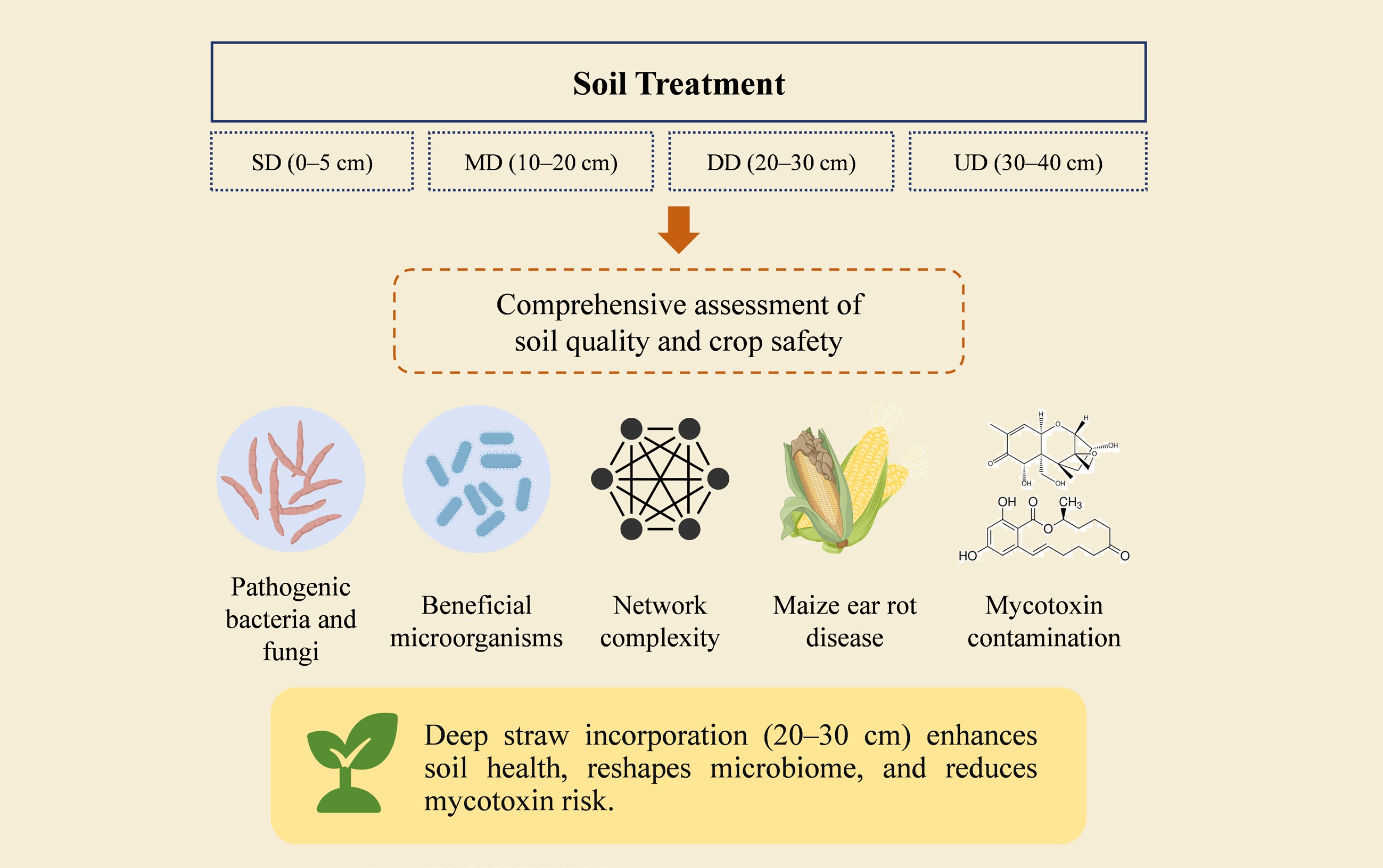
Abstract: Deep straw incorporation is considered a key tillage practice for improving soil health and reducing crop disease. However, how the depth of straw return affects soil microbial communities and associated maize ear rot and mycotoxin contamination remains poorly understood. Here, a three-year field experiment was conducted with four straw incorporation depths: shallow return (SD, straw depth 0–5 cm), middle return (MD, straw depth 10–20 cm), deep return (DD, straw depth 20–30 cm), and ultra-deep return (UD, straw depth 30–40 cm). Results showed that deeper straw incorporation increased soil bulk density by up to 5.6%, increased total pore area by up to 162.5%, and enhanced soil organic carbon, available nitrogen, phosphorus, and potassium by 22.5%–152.1%. Soil quality index (SQI) increased with tillage depth, with UD exhibiting a fourfold higher SQI than SD, driven largely by enhanced microbial contributions (explaining > 35% of SQI). Deeper incorporation enriched beneficial taxa (e.g., Trichoderma, Enterobacteriaceae) by more than 2-fold while suppressing pathogenic fungi (e.g., Fusarium, Aspergillus) in rhizosphere soil and root endosphere, and fostered more complex and stable microbial co-occurrence networks in bulk soil. Consequently, DD and UD reduced ear rot incidence by 33.3%–66.7% and disease index by 20.0%–50.0% relative to SD. DON and ZEN concentrations were also kept within safe thresholds. Structural equation modeling confirmed that deep straw incorporation mitigates maize ear rot and mycotoxin contamination primarily by improving soil properties and shaping functional microbial assemblages. These findings demonstrate that deep straw incorporation (20–40 cm) enhances soil health, restructures microbial communities, and effectively reduces maize ear rot and mycotoxin risks, providing a sustainable tillage strategy for safer maize production.
-
Key words:
- Straw incorporation depth /
- Soil health /
- Maize /
- Mycotoxin /
- Microbiome