











-
The long-standing agricultural emphasis on monoculture of single varieties, while improving management efficiency and yield in the short term, has incurred systemic risks, including increased pest and disease pressure and diminished stress resilience. Plant diversity-based cropping offers a new avenue to address this dilemma. Scientists have proposed a novel approach for disease control through spatiotemporal optimization of crop diversity[1]. When multiple plant species co-exist, they collectively defend against pests and diseases through a set of sophisticated natural mechanisms. Specifically, complex volatile blends released by diverse plants can disrupt host location by specialist herbivores; diversified vegetation provides habitats for natural enemies such as ladybeetles and parasitic wasps, thereby enhancing biological control; structurally heterogeneous canopies modify the local microclimate, suppressing pathogen spore dispersal; and root-exuded allelochemicals from different plant species inhibit soil-borne pathogens while promoting beneficial microbial communities[2−6].
From an ecological perspective, cultivar mixture cropping by increasing genetic heterogeneity can achieve analogous benefits in pest/disease regulation and yield improvement at the population level. In this perspective, we present the core causal pathway through which plant diversity suppresses pests, diseases, and weeds, and ultimately enhances overall productivity, using structural equation modeling (Fig. 1a). We propose that this mode operates not only in mixtures of different genotypes or varieties within the same species, but can also be extended to the mixture of distinct plant species.
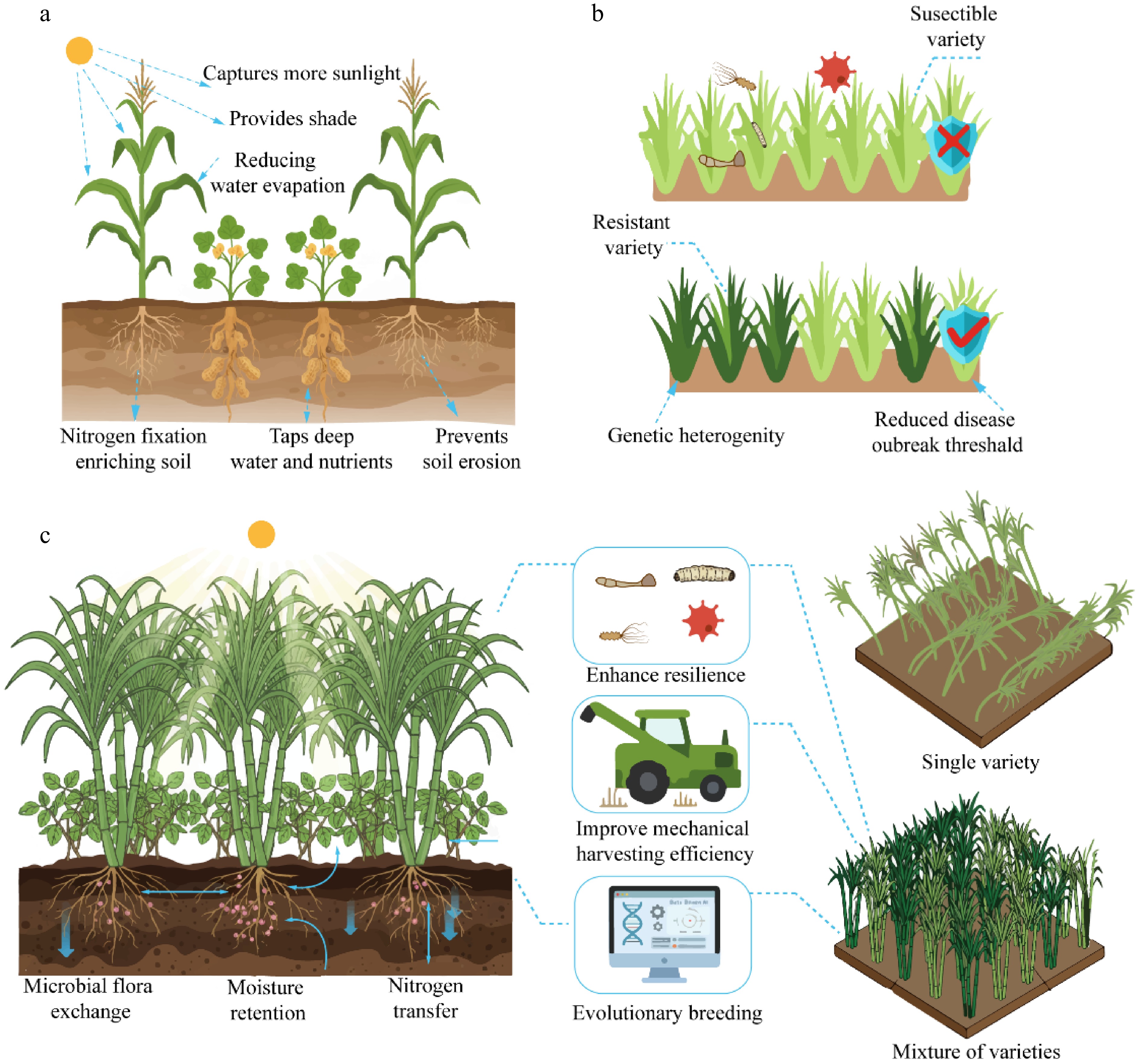
Figure 1.
A proposed model of different cropping patterns in agricultural production. (a) Biological basis of a classic intercropping pattern (maize and peanut) in agricultural production. (b) Planting model for improving comprehensive resistance through intercropping of different resistance types within the same species. (c) Field application model of cropping patterns in sugarcane production. (Left panel) Intercropping pattern of sugarcane with nitrogen-fixing and other crops facilitates the co-growth of sugarcane and intercropped plants, while improving canopy light use efficiency, promoting microbial community exchange, maintaining soil water retention, enhancing nitrogen conversion efficiency, and increasing disease resistance. This represents an evolutionary direction for future breeding strategies. (Right panel) A mixed cropping pattern that enhances lodging resistance and improves pest and disease management in sugarcane.
-
A meta-analysis across 12 major crops showed that cultivar mixtures increased average yield by 3.82% and reduced disease incidence by 24.1%, with larger effects under low latitudes, high temperatures, and high precipitation[7]. Compared with monocultures, mixed cropping of varieties reduced disease incidence by 68% on average in rice, with susceptible varieties achieving an 80% reduction[8]. The disease-suppression mechanisms of mixing different genotypes within a species resemble those of inter-specific mixtures: genetic differences among varieties can slow the spread of a single virulent pathogen lineage, creating a dilution effect (Fig. 1b). Similarly, a study in Arabidopsis showed that mixing two different genotypes reduced herbivorous insect damage by 24.8%. The underlying mechanism involves volatile blends from distinct varieties interfering with host location by pests, while genetic heterogeneity increases the dispersal resistance for herbivores within the population[9].
Accordingly, variety mixing provides unique advantages in improving population-level lodging resistance. Field trials with wheat cultivar mixtures revealed no lodging in any mixed population, whereas some susceptible varieties lodged in monoculture, leading to yield losses[10]. Lodging resistance in mixed populations was positively correlated with the breaking strength of the second internode, an effect attributed to enhanced stem morphological traits and increased lignin and cellulose contents[11]. A further study demonstrated that mixing enhances the synthesis of structural carbohydrates (cellulose, lignin) in stems by optimizing the canopy light environment, resulting in thicker sclerenchyma walls, greater rigidity and elasticity, and thus greater improvement in lodging resistance at the population level[12,13]. In maize, intercropping short with tall varieties resulted in significantly lower lodging in the mixed population than in the monoculture[14]. Studies have confirmed that intercropping the maize stalk rot-resistant cultivar DH662 with the susceptible cultivar DH701 can significantly reduce the disease incidence of the susceptible cultivar and increase grain yield. This mixed-cultivation system alters the rhizosphere microbial community structure of the susceptible cultivar, thereby enhancing overall disease resistance[15]. These findings indicate that the core mechanism of cultivar mixtures lies in the skeleton support provided by lodging-resistant varieties to the population, accompanied by improved microenvironments that trigger intrinsic stem quality enhancement.
-
Sugarcane is the primary sugar crop in China, supplying more than 85% of domestic sugar. As a ratoon crop, sugarcane is usually kept for three to four ratoon cycles after planting, and ratoon cane accounts for approximately 70% of the total cultivation area in China. High-yield and high-sugar management of ratoon cane is therefore crucial for stabilizing planting area and economic return[16]. A major production issue is the increasing prevalence of mechanical harvesting, which frequently causes uprooting and splitting of stools (commonly termed ratoon damage). Such damage leads to severe gaps and missing hills in ratoon fields, ultimately reducing ratoon cane yield and sugar content[17,18].
Sugarcane smut is the most damaging fungal disease in Chinese sugarcane-growing regions. Currently, integrated management strategies emphasize smut-resistant varieties within a variety–cultivation–control framework[19]. Resistance to smut varies markedly among sugarcane varieties: for example, GT53 (Guitang 53) exhibited 3.68% disease incidence after artificial inoculation, reaching a highly resistant level[20], whereas GT12-162 (Guitang 12-162) showed 13.25% disease incidence, corresponding to a moderately susceptible level[21]. Rational mixed planting of highly resistant and moderately resistant varieties can reduce the efficiency of pathogen spread in the field and delay disease outbreaks[22,23]. Therefore, supported by the theory of plant mixed cropping, mixing sugarcane varieties with different resistance levels can significantly enhance disease resistance while maintaining stable yield and quality, providing a valuable reference for future sugarcane disease resistance breeding practices.
Stem borers are among the most destructive insect pests of sugarcane. An evaluation of borer resistance in 163 sugarcane germplasm accessions revealed significant differences in borer infestation rates. These accessions provide a rich germplasm reservoir for designing borer-resistant variety mixtures. Planting borer-resistant and borer-susceptible varieties in defined proportions can exploit inter-varietal volatile interference and physical barrier effects, thereby reducing the damage intensity of borers on susceptible varieties[24].
Lodging is a core bottleneck limiting high yield and mechanized harvesting in sugarcane. The mechanical strength of sugarcane stalks depends primarily on the cellulose content of the rind tissue, which differs considerably among varieties[25]. Drawing on successful experiences from wheat and maize cultivar mixtures, rational deployment of strongly lodging-resistant sugarcane varieties (e.g., GT53, GT42) with moderately resistant varieties can provide a mechanical skeleton support to the population, while also improving canopy ventilation and light penetration, collectively reducing lodging incidence at the population level[14,26]. In addition, sugarcane production faces challenges such as frequent typhoons and tall stature, making the value of lodging-resistant mixtures even more prominent. Researchers have proposed that mixing sugarcane varieties with contrasting growth characteristics can reduce yield gaps and improve production stability[27]. In terms of intercropping, sugarcane–peanut and similar systems have already demonstrated comprehensive benefits including improved ventilation, reduced pests and diseases, and enhanced soil fertility (Fig. 1c).
Apart from these factors, there are several factors that need to be considered for mixed cultivation of sugarcane: (1) the plant heights of varieties should be similar to facilitate mechanized harvesting; (2) the maturation periods should be closely aligned to allow for a uniform harvest time; and (3) all varieties should possess strong ratooning ability to ensure satisfactory economic returns over successive cropping cycles. These practices indicate a solid technical foundation for introducing diversity into sugarcane cropping, and logically extend from within-species variety mixing to inter-specific intercropping.
-
From all the above, cultivar mixtures hold considerable promise for sugarcane production; however, several challenges must be overcome. First, as a vegetatively propagated crop, sugarcane has a low multiplication coefficient and a high demand for planting material, which means that mixed varieties would substantially increase the complexity and cost of seed-cane preparation. In other words, the efficient supply of mixed planting material is a primary bottleneck for large-scale adoption. Second, not all variety combinations generate positive interactions. It is urgent to develop genome-prediction-based methods for selecting compatible mixtures, akin to the use of genome-wide association studies in Arabidopsis to identify beneficial combinations. Third, optimization of mixture proportions and field spatial arrangements must consider the dynamic balance between inter-varietal competition and complementarity. Fourth, given the extended ratoon cycle of sugarcane (multiple years), long-term stability of mixed populations across successive ratoon crops remains uncharacterized due to a lack of longitudinal data.
Future research should focus on: developing a database of resistance traits for sugarcane varieties together with algorithmic tools for variety compatibility, enabling predictive models for the performance of cultivar mixtures; conducting multi-site field trials across different sugarcane agroecological zones to systematically assess the resistance benefits and yield outcomes of diverse mixtures over multiple ratoon cycles; and establishing agronomic guidelines for mixture cultivation that are compatible with mechanized operations, thereby lowering the threshold for practical adoption (Fig. 1c). Translating multi-resistance cultivar mixtures from the laboratory to sugarcane fields represents a practical application of the ecological theory of plant diversity. It also offers an effective pathway to overcome continuous cropping obstacles, enhance comprehensive resistance, and promote the green and sustainable development of the sugarcane industry.
-
The authors confirm their contributions to the paper as follows: conceptualization: Zhao W, Wu Q, Wu J, Guo J, Que Y; data curation: Liu G, Zhao Y; investigation: Wu Q, Liu G, Cai W, Deng J; writing original draft preparation: Zhao W, Wu Q; review and editing: Zhao W, Wu Q, Que Y; resources: Wu J, Guo J, Que Y; funding acquisition: Wu Q, Que Y. All authors reviewed the results and approved the final version of the manuscript.
-
Data sharing is not applicable to this article as no datasets were generated or analyzed during the current study.
-
The authors declare that they have no conflict of interest.
-
Received 12 May 2026; Accepted 13 July 2026; Published online 24 August 2026
-
# Authors contributed equally: Wanying Zhao, Qibin Wu
- Copyright: © 2026 by the author(s). Published by Maximum Academic Press on behalf of Hainan University. This article is an open access article distributed under Creative Commons Attribution License (CC BY 4.0), visit https://creativecommons.org/licenses/by/4.0/.
-
About this article
Cite this article
Zhao W, Wu Q, Zhao Y, Liu G, Cai W, et al. 2026. Mitigating key constraints by cultivar mixtures in sugarcane under mechanized harvesting. Tropical Plants 5: e029 doi: 10.48130/tp-0026-0029 

Mitigating key constraints by cultivar mixtures in sugarcane under mechanized harvesting
- Received: 12 May 2026
- Revised: 03 July 2026
- Accepted: 13 July 2026
- Published online: 24 August 2026
Abstract: Monoculture of single varieties tends to exacerbate risks associated with pest outbreaks, disease epidemics, and lodging. Plant diversification strategies, including intraspecific cultivar mixtures, offer an ecological solution to these challenges. Across major crops, cultivar mixtures have been shown to reduce disease severity, enhance yield stability, and improve lodging resistance through both mechanical support and enhanced stem strength. In sugarcane, varieties differ substantially in their resistance to smut, stem borers, and lodging, suggesting that strategic mixing of resistant and susceptible genotypes could help limit pathogen spread, mitigate insect damage, and reduce the incidence of lodging. Nevertheless, the practical implementation of such mixtures in sugarcane faces several bottlenecks: low propagation coefficient, high seed-cane demand, need for compatible combinations, and long-term stability over ratoon cycles. To address these constraints, future research should focus on developing predictive tools for assessing variety compatibility, conducting multisite field trials, and establishing agronomic guidelines for mechanized operations. Ultimately, translating diversity mixtures into sugarcane fields promises to overcome continuous cropping obstacles and promote sustainable production.
-
Key words:
- Cultivar mixtures /
- Resistance to smut /
- Lodging /
- Sugarcane varieties /
- Cropping patterns