












-
Colorectal cancer (CRC) ranks among the most prevalent cancers globally, experiencing a rise in incidence, particularly in developed countries[1]. According to the Global Cancer Statistics 2020, CRC is the third most commonly diagnosed cancer and the second leading cause of cancer-related deaths globally[2]. The high mortality associated with CRC is primarily due to late-stage diagnosis, advanced tumor spread, and poor prognosis[3]. Despite better screening and treatment, advanced colorectal cancer still has poor survival rates[4]. The complexity of CRC pathophysiology, coupled with challenges in early detection and individualized treatment, underscores the need for better prognostic biomarkers to improve patient outcomes and optimize clinical management.
Nutrition and supportive care are critical components of cancer treatment, especially in colorectal cancer patients who often experience malnutrition, weight loss, and a decline in physical function. Proper nutritional support can enhance recovery, reduce complications, and enhance the general well-being of these patients[5−7]. The Prognostic Nutritional Index (PNI), calculated from serum albumin and lymphocyte counts, serves as a useful marker of nutritional and immune function in cancer patients[8]. PNI has been significantly associated with outcomes in multiple types of cancer, including CRC, where lower PNI scores are associated with poorer survival outcomes[9]. This index provides a simple, cost-effective measure to predict postoperative complications and long-term survival.
ACSL4 converts long-chain fatty acids to acyl-CoA esters, critical for lipid biosynthesis and energy metabolism[10]. ACSL4 is implicated in the regulation of cell membrane composition, energy homeostasis, and inflammation[11]. Studies suggest that ACSL4 might also influence cancer progression and prognosis, particularly in relation to ferroptosis[12,13]. In cellular research, ACSL4 has been found to be upregulated in CRC tissues, and inhibiting the expression of ACSL4 can reduce the proliferation and invasion of CRC cells[14]. Nevertheless, no clinical research has focused on the expression and clinical significance of ACSL4 in CRC patients. Given its key role in lipid metabolism and cell processes related to tumor growth, ACSL4 may be an important factor for assessing the nutrition, inflammatory status, and prognosis of CRC patients.
This study seeks to evaluate the prognostic significance of serum ACSL4 levels in colorectal cancer patients, particularly in conjunction with the PNI. The research examines the correlation between these biomarkers and clinical outcomes to explore potential improvements in prognostic assessment through integrating lipid metabolism and nutritional status indicators.
-
This prospective observational cohort study enrolled 215 CRC patients who sought treatment between May 2020 and July 2022. All participants were required to meet the following inclusion criteria: (1) histopathological diagnosis of colorectal cancer; (2) undergoing primary tumor resection; and (3) availability of complete clinical data. Exclusion criteria were: (1) patients who had received preoperative radiotherapy or chemotherapy; (2) patients with TNM stage IV colorectal cancer; (3) patients who were unable to undergo tumor resection; (4) patients with preoperative severe liver, kidney, or pulmonary dysfunction; and (5) patients with a history of other malignancies. All patients underwent tumor resection according to the colorectal cancer treatment guidelines of our hospital. This study was approved by the Ethics Committee of our Hospital (Approval No. LUCM2020021), and all participants provided informed consent to participate in the study. Baseline clinical data and blood samples were collected at enrollment before surgery.
Surgical treatment and postoperative nutritional care
-
All patients underwent standard surgical procedures for tumor resection. The surgical process included preoperative bowel preparation, tumor excision, and regional lymph node dissection as per the established clinical protocols. Postoperative care included general nutritional support to optimize recovery. It is important to note that this was an observational study, and no specific nutritional or therapeutic interventions were administered beyond the standard care provided.
ELISA detection
-
Enzyme-linked immunosorbent assays (ELISA) were performed to measure serum levels of key biomarkers, including ACSL4, C-reactive protein (CRP), interleukin-6 (IL-6), interleukin-1β (IL-1β), carcinoembryonic antigen (CEA), and cancer antigen 199 (CA199). These biomarkers were selected based on their association with lipid metabolism, inflammation, and cancer progression. ELISA kits were used according to the manufacturer's instructions, and the assays were performed in triplicate to ensure reliability of results. Serum samples were collected from patients at baseline. Upon admission, all subjects provided 5 mL fasting venous blood samples from the cubital vein within the first day. Serum ACSL4 and cytokine levels were measured using commercially obtained MyBioSource (USA) ELISA kits according to the manufacturer's protocols.
Observed indicators
-
Clinical data were collected upon patient admission, including demographic information, disease severity, preoperative clinical characteristics, and oncological variables. The collected oncological variables included tumor location, differentiation grade, lymphovascular invasion, perineural invasion, adjuvant chemotherapy, surgical approach, and margin status. A fully automated biochemical analyzer (Hitachi 7600, Hitachi Ltd., Japan) was used for complete blood count testing. PNI for each patient was calculated based on serum albumin (ALB) levels and peripheral blood lymphocyte count[15,16], using the following formula: PNI = (serum albumin, g/L) + (5 × blood lymphocyte count, 109/L). Patients were dichotomized into low and high PNI groups using a cutoff of 43, based on previous cancer studies showing prognostic relevance[17,18]. The PNI cutoff of 43 was literature-based and was used only for the descriptive PNI subgroup analysis. Postoperative follow-up was performed every 3 months for 24 months. During follow-up, patients underwent clinical evaluations, laboratory tests, and imaging studies to monitor disease recurrence. The primary analysis focused on binary risk classification. Patients were classified into favorable or poor prognosis groups based on the occurrence of tumor recurrence or all-cause death within 24 months after surgery. This binary endpoint was used for ROC and logistic regression analyses. Additionally, disease-free survival (DFS) and overall survival (OS) were analyzed descriptively using Kaplan–Meier curves to illustrate the time-to-event patterns of these outcomes.
Statistical analysis
-
Statistical analyses were performed using SPSS software (v26.0). Continuous variables were presented as mean ± standard deviation (SD) or median with interquartile range (IQR) based on their distribution. Categorical variables were expressed as frequencies and percentages. Comparisons between groups were performed using independent t-tests for continuous variables and chi-square tests for categorical variables. Spearman's rank correlation was used for correlation analysis. The role of serum ACSL4 and PNI in the prediction of patient prognosis was analyzed using ROC curve analysis. Optimal ROC cutoffs were determined using the maximum Youden index. The mean serum ACSL4 level (24.78 ng/mL) was used as a separate, non-ROC cutoff for Kaplan-Meier stratification. Logistic regression was performed for risk factors of poor prognosis. To further evaluate the incremental predictive value of PNI and serum ACSL4 beyond established clinicopathologic variables, three logistic regression models were constructed. The base model included TNM stage, tumour diameter, and lymphovascular invasion. The second model added PNI to the base model, and the third model added both PNI and serum ACSL4 to the base model. AUCs of the nested models were compared using the DeLong test. Considering that 53 patients experienced poor prognosis events, the number of variables included in the multivariable model was limited according to the events per variable principle to reduce overfitting. Five variables were included in the final model, including TNM stage, tumour diameter, lymphovascular invasion, PNI, and serum ACSL4. TNM stage and tumour diameter were selected as established clinicopathological prognostic factors. Lymphovascular invasion was selected as the pathological invasion variable because it is directly related to tumour dissemination and recurrence risk. PNI and serum ACSL4 were included because they were the core variables of this study. A two-sided p < 0.05 was considered statistically significant.
-
According to the predefined 24-month prognostic endpoint, 53 patients experienced poor prognosis, defined as tumor recurrence or all-cause death, whereas 162 patients had no recurrence or death and were included in the favorable prognosis group. Among the 53 patients with poor prognosis, all experienced recurrence and 25 died from any cause within 24 months. Compared to the poor prognosis group, the good prognosis group had a significantly lower proportion of TNM stage 3 tumors and smaller tumor size. Additionally, there were statistically significant differences in serum albumin, blood lymphocyte count, and PNI (Prognostic Nutritional Index) between the two groups. The good prognosis group exhibited higher levels of serum albumin, blood lymphocyte count, and PNI (Table 1). Among the additional oncological variables, lymphovascular invasion and perineural invasion were more frequent in the poor prognosis group, whereas tumor location, differentiation grade, adjuvant chemotherapy, surgical approach, and margin status did not differ significantly between the two groups.
Table 1. Demographic and clinical data of all subjects.
Variable Poor prognosis
group, n = 53Favorable prognosis
group, n = 162p Age (year) 58 (44–72) 55 (42–69) 0.020 Sex, female (%) 21 (39.6) 69 (42.6) 0.666 BMI 21.73 ± 2.69 21.29 ± 2.93 0.332 TNM stage < 0.001 I-II, n (%) 22 (41.5) 128 (79.0) III, n (%) 31 (58.5) 34 (21.0) Tumour diameter (cm) 7.02 ± 1.36 4.69 ± 1.05 < 0.001 ALB (g/L) 35.63 ± 3.04 37.58 ± 3.72 0.001 BL (109/L) 1.68 ± 0.40 1.95 ± 0.63 0.003 TC (mmol/L) 3.41 ± 0.52 3.39 ± 0.47 0.756 TG (mmol/L) 1.33 ± 0.15 1.35 ± 0.14 0.420 LDLC (mmol/L) 2.85 ± 0.27 2.83 ± 0.30 0.724 HDLC (mmol/L) 1.10 ± 0.17 1.08 ± 0.18 0.448 PNI 43.99 ± 3.35 47.35 ± 4.85 < 0.001 Tumor location 0.340 Right-sided colon 11 (20.8) 40 (24.7) Left-sided colon 14 (26.4) 55 (34.0) Rectum 28 (52.8) 67 (41.4) Differentiation grade 0.072 Well/moderate 37 (69.8) 132 (81.5) Poor 16 (30.2) 30 (18.5) Lymphovascular invasion 0.002 No 30 (56.6) 127 (78.4) Yes 23 (43.4) 35 (21.6) Perineural invasion 0.013 No 37 (69.8) 138 (85.2) Yes 16 (30.2) 24 (14.8) Adjuvant chemotherapy 0.436 No 20 (37.7) 71 (43.8) Yes 33 (62.3) 91 (56.2) Surgical approach 0.728 Open surgery 13 (24.5) 36 (22.2) Laparoscopic surgery 40 (75.5) 126 (77.8) Margin status 0.420 R0 51 (96.2) 159 (98.1) R1/R2 2 (3.8) 3 (1.9) ALB: albumin, BL: blood lymphocyte count, TC: total cholesterol, TG: triglyceride, LDLC: low-density lipoprotein cholesterol, HDLC: high-density lipoprotein cholesterol, PNI: prognostic nutritional index, BMI: body mass index, TNM: tumor-node-metastasis. Serum levels of ACSL4 and other biomarkers in colorectal cancer patients
-
To further investigate the relationship between ACSL4 and nutritional status in colorectal cancer patients, we measured the serum levels of ACSL4, IL-6, IL-1β, CRP, CEA, and CA199. ACSL4 is involved in lipid metabolism and may be related to inflammatory processes. Between the favorable prognosis and poor prognosis groups, the favorable prognosis group had significantly higher ACSL4 levels, while the inflammatory markers IL-1β and CRP were significantly lower. On the other hand, baseline CEA and CA199 levels were significantly elevated in the poor prognosis group compared to the favorable prognosis group (Fig. 1). Spearman rank correlation analysis revealed a negative correlation between ACSL4 levels and serum CEA and CA199 (Table 2).
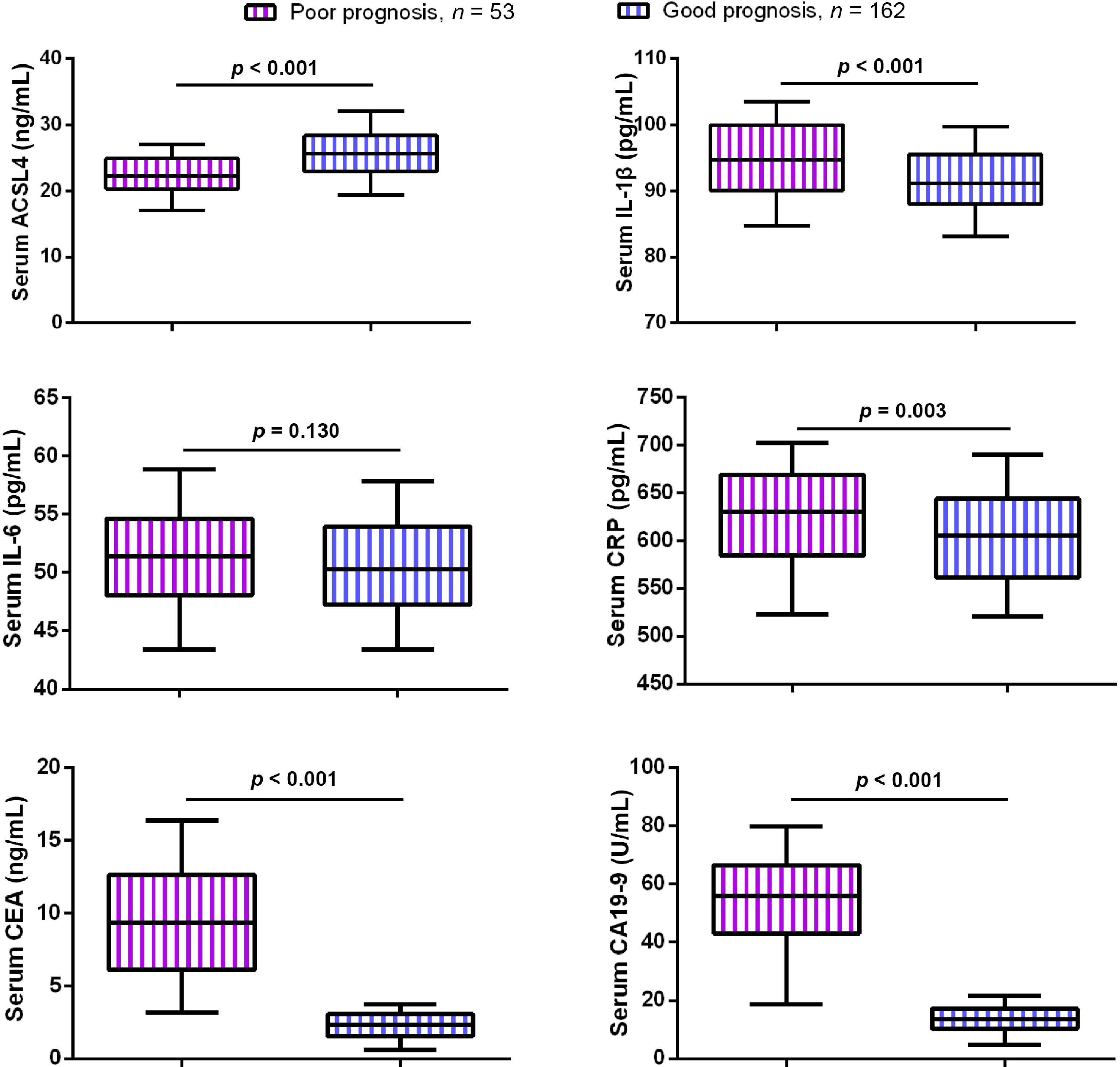
Figure 1.
Serum levels of ACSL4 and other biomarkers in colorectal cancer patients.
Table 2. Correlation analysis between ACSL4 and other biomarkers.
Variable ACSL4 (ng/mL) Spearman' ρ p IL-1β (pg/mL) −0.049 0.475 IL-6 (pg/mL) 0.036 0.595 CRP (pg/mL) −0.074 0.282 CEA (ng/mL) −0.330 < 0.001 CA199 (U/mL) −0.244 < 0.001 ACSL4: acyl-CoA synthetase long-chain family member 4, IL-1β: interleukin-1 beta, IL-6: interleukin-6, CRP: C-reactive protein, CEA: carcinoembryonic antigen, CA199: carbohydrate antigen 19-9. Association of serum ACSL4 and other biomarkers with PNI
-
We subsequently divided all colorectal cancer patients into two groups using the literature-based PNI cutoff of 43: the low PNI group (< 43, n = 50) and the high PNI group (≥ 43, n = 165). Comparison of baseline serum ACSL4 and other biomarker levels between the two groups revealed that, compared to the low PNI group, the high PNI group had significantly higher serum ACSL4 levels, while CEA and CA199 levels were notably lower (Fig. 2). No significant differences were found in the serum levels of inflammatory markers between the two groups. Spearman rank correlation analysis showed a positive correlation between serum ACSL4 levels and PNI (ρ = 0.193, p = 0.004), suggesting that higher ACSL4 levels were associated with better nutritional status (Fig. 3).
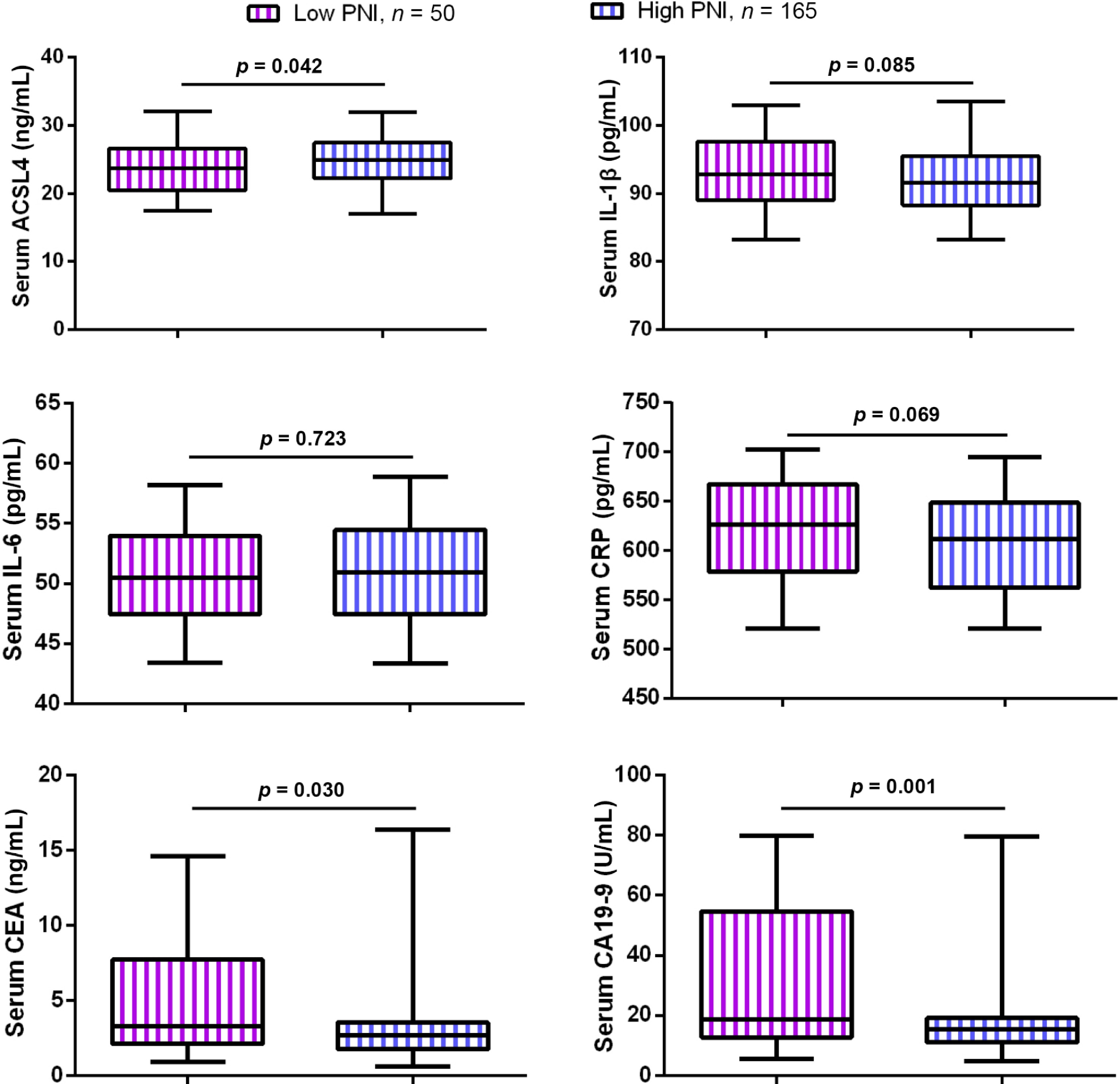
Figure 2.
Association of serum ACSL4 and other biomarkers with PNI.
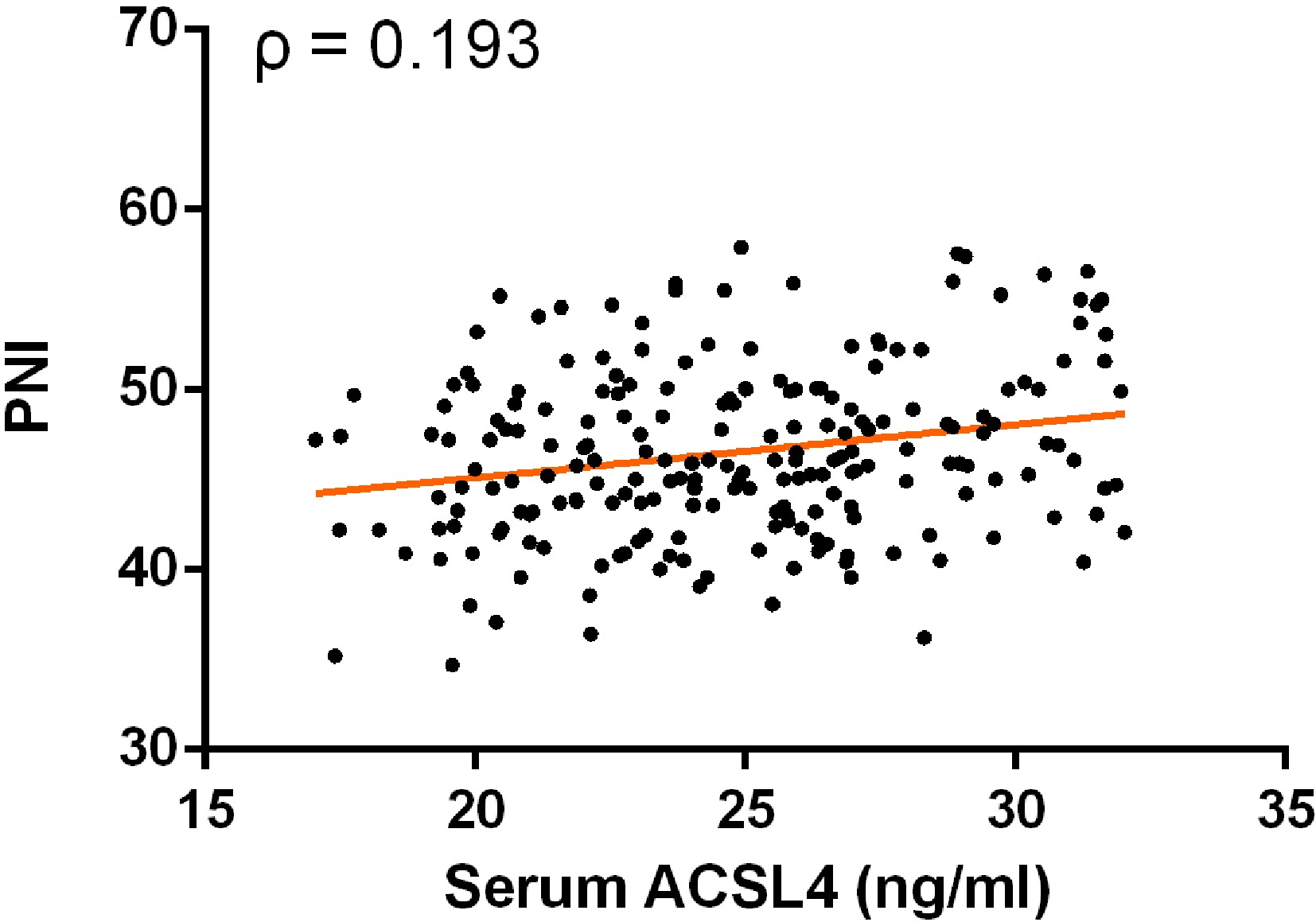
Figure 3.
Scatterplot of serum ACSL4 and PNI (Spearman's ρ = 0.193, p = 0.004)
Predictive value of PNI combined with serum ACSL4 levels for prognosis in colorectal cancer patients
-
We further analyzed the predictive value of baseline serum ACSL4 levels and PNI score for prognosis in colorectal cancer patients using ROC curves. The ROC cutoffs reported below were selected by the maximum Youden index. As shown in Fig. 4, the baseline serum ACSL4 level had an AUC of 0.750 for predicting poor prognosis in colorectal cancer patients, with a cutoff value of 23.87 ng/mL, sensitivity of 71.7%, and specificity of 66.7%. Preoperative PNI also predicted poor prognosis with an AUC of 0.712, cutoff value of 48.05, sensitivity of 90.6%, and specificity of 44.4%. Furthermore, we found that the combination of preoperative PNI and serum ACSL4 levels demonstrated a higher predictive value, with an AUC of 0.811, sensitivity of 79.0%, and specificity of 69.8%.
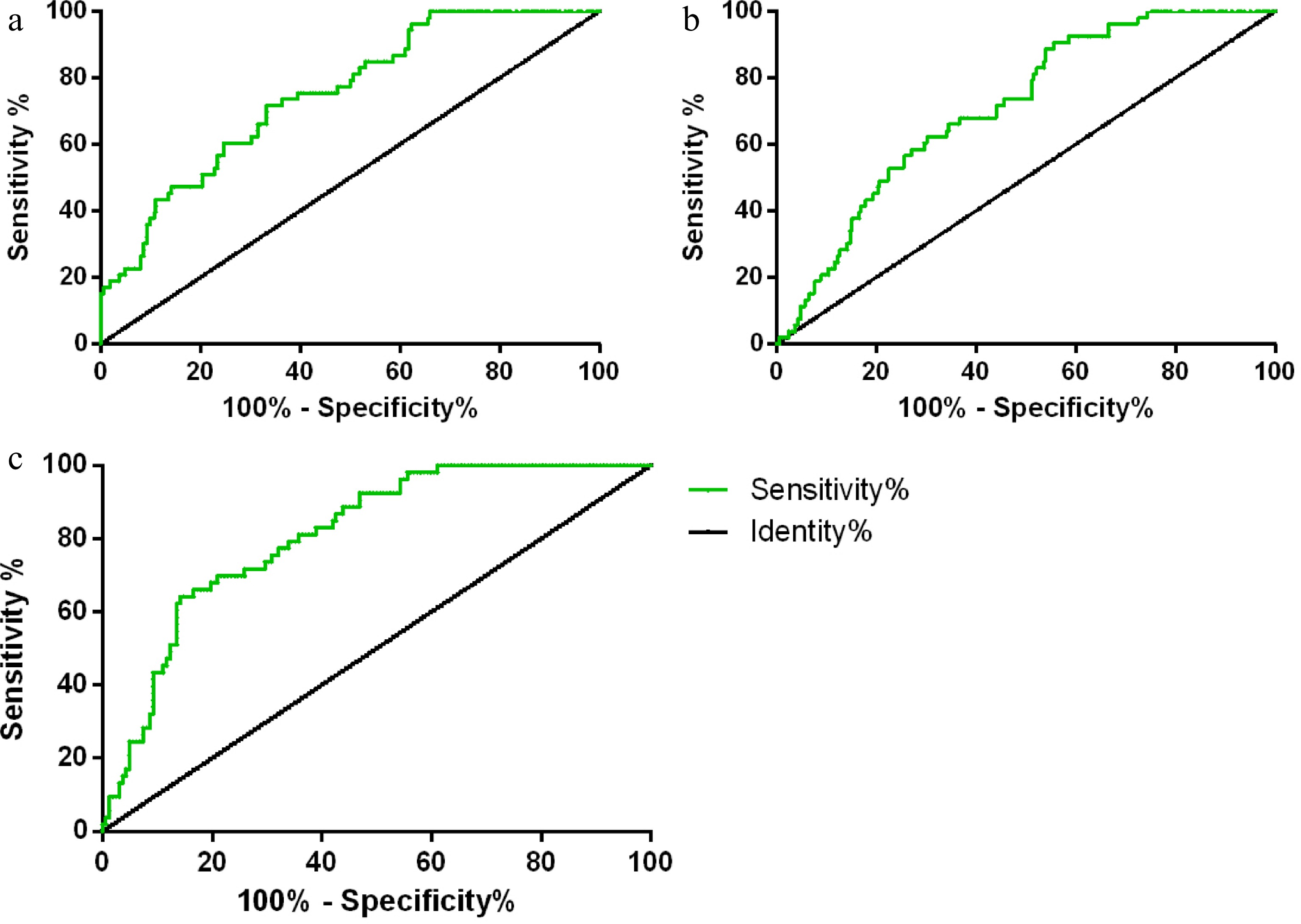
Figure 4.
ROC curves for prognosis in colorectal cancer patients. ROC curve for patients with poor prognosis: (a) ACSL4: AUC = 0.750, 95% CI 0.679–0.821; (b) PNI: AUC = 0.712, 95% CI: 0.639–0.784; (c) combine ACSL4 and PNI: AUC = 0.811, 95% CI 0.751–0.871.
To further evaluate whether PNI and serum ACSL4 added predictive information beyond established clinicopathologic variables, an incremental model comparison was performed. The base model, including TNM stage, tumour diameter, and lymphovascular invasion, had an AUC of 0.941 (95% CI 0.909–0.972). After adding PNI, the AUC increased to 0.953 (95% CI 0.928–0.978), and the increase was not statistically significant (DeLong p = 0.055). After adding both PNI and serum ACSL4, the AUC further increased to 0.964 (95% CI 0.942–0.986). This additional increase was not statistically significant (DeLong p = 0.062). The full model had a significantly higher AUC than the base model (DeLong p = 0.008) (Table 3).
Table 3. Incremental AUC of clinicopathologic model with PNI and ACSL4.
Model Variables included AUC 95% CI Base model TNM stage + tumour diameter + lymphovascular invasion 0.941 0.909–0.972 Base model + PNI TNM stage + tumour diameter + lymphovascular invasion + PNI 0.953 0.928–0.978 Base model + PNI + ACSL4 TNM stage + tumour diameter + lymphovascular invasion + PNI + ACSL4 0.964 0.942–0.986 AUC, area under the receiver operating characteristic curve; CI, confidence interval; PNI, prognostic nutritional index; ACSL4, acyl-CoA synthetase long-chain family member 4; CEA, carcinoembryonic antigen; TNM, tumor-node-metastasis. Kaplan–Meier analysis of disease-free survival and overall survival according to serum ACSL4 levels in CRC patients
-
To evaluate the prognostic significance of serum ACSL4 levels in CRC patients, Kaplan–Meier survival analyses were performed with patients stratified into high and low ACSL4 groups according to the mean serum ACSL4 level (24.78 ng/mL). This threshold was used only for survival stratification and was separate from the ROC-derived cutoff. The results showed that patients in the high ACSL4 group had significantly longer DFS and OS compared with those in the low ACSL4 group. The differences in both DFS and OS between the two groups were statistically significant, as determined by the log-rank test (both p < 0.05) (Fig. 5). Kaplan–Meier curves were generated to describe DFS and OS over the follow-up period. These analyses provide complementary survival information but are secondary to the primary binary risk prediction endpoint.
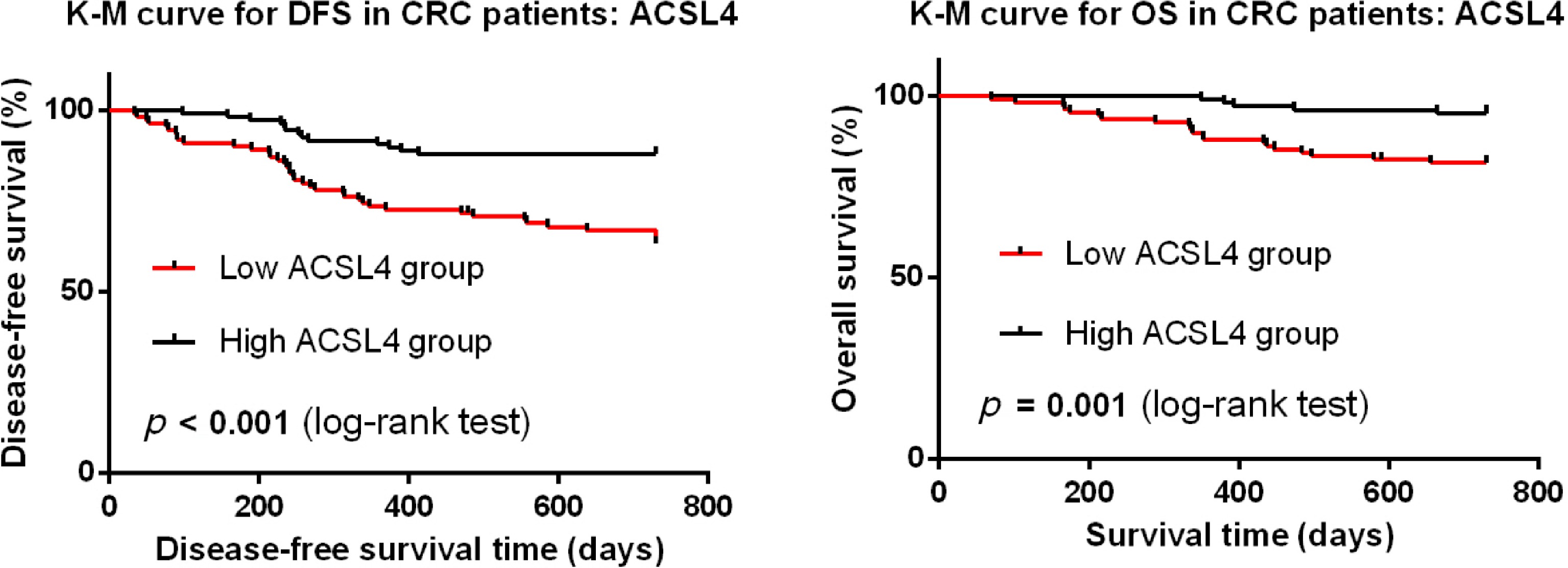
Figure 5.
Kaplan–Meier survival curves stratified by serum ACSL4 levels in CRC patients.
The risk factors for poor prognosis in CRC patients
-
Binary logistic regression analysis was performed to identify factors associated with poor prognosis in CRC patients. Considering the number of poor prognosis events, five variables were included in the multivariable model, including TNM stage, tumour diameter, lymphovascular invasion, PNI, and serum ACSL4. The results showed that TNM stage (OR = 8.298, 95% CI 2.487–27.688, p = 0.001) and tumour diameter (OR = 5.617, 95% CI 3.064–10.299, p < 0.001) were independently associated with a higher risk of poor prognosis. In contrast, PNI (OR = 0.880, 95% CI 0.779–0.994, p = 0.040) and serum ACSL4 (OR = 0.736, 95% CI 0.606–0.893, p = 0.002) were independently associated with a lower risk of poor prognosis (Table 4).
Table 4. Logistic regression for risk factors of poor prognosis in CRC patients.
Variables Wald Odds ratio 95% CI p TNM stage 11.854 8.298 2.487–27.688 0.001 Tumour diameter (cm) 31.138 5.617 3.064–10.299 < 0.001 PNI 4.209 0.880 0.779–0.994 0.040 ACSL4 (ng/mL) 9.649 0.736 0.606–0.893 0.002 Lymphovascular invasion 1.787 2.219 0.690–7.137 0.181 PNI: prognostic nutritional index, ACSL4: acyl-CoA synthetase long-chain family member 4. -
CRC persists as a major global cause of mortality associated with cancer[19]. Despite advances in surgical treatments and adjuvant therapies, patient prognosis remains highly variable, influenced by multiple factors such as tumor stage, size, nutritional status, and inflammation. Our study showed that higher serum ACSL4 levels and higher PNI were associated with better prognosis in CRC patients. After adjustment for TNM stage, tumour diameter, and lymphovascular invasion, serum ACSL4 and PNI remained associated with poor prognosis.
Preoperative nutritional status has been widely recognized as a key factor influencing the prognosis of CRC patients. Malnutrition, which is common in cancer patients due to factors such as poor appetite, systemic inflammation, and metabolic changes, can significantly impair immune function, delay wound healing, and increase the risk of postoperative complications[20]. Several studies have shown that better nutritional support, including appropriate caloric intake, protein supplementation, and micronutrient management, can improve postoperative recovery and survival outcomes[21,22]. PNI reflects both the nutritional and immune status of patients, and in CRC, it plays a significant role in predicting prognosis. In a study analyzing 196 patients with CRC who underwent radical resection, it was found that a higher preoperative PNI was associated with better postoperative survival and fewer complications[9]. Another study involving 227 patients undergoing adjuvant chemotherapy (AC) highlighted that a low PNI before surgery correlated with poorer long-term outcomes, but patients who recovered their PNI after surgery showed prognosis similar to those with consistently high PNI values[23]. Additionally, Li et al.’s study involving 511 CRC patients emphasized the clinical significance of preoperative PNI in predicting OS and DFS, with low values of PNI indicating the poorest outcomes[24]. Our study supported the utility of PNI as a predictive tool, finding that a higher PNI score was associated with improved survival outcomes and lower recurrence rates. The findings further highlight the significance of monitoring and addressing nutritional deficiencies in CRC patients as part of a comprehensive treatment strategy.
Serum biomarkers are essential for the monitoring and prognosis of cancer. In CRC, established biomarkers such as CEA and CA199 are commonly used to assess disease progression and predict treatment response. However, these biomarkers alone do not always provide sufficient predictive power, particularly in early-stage disease or during follow-up[25]. Our study focused on ACSL4, a lipid metabolism-related enzyme that has gained attention for its potential role in cancer progression. ACSL4 is involved in the synthesis of long-chain fatty acyl-CoA, which impacts cellular membrane composition, energy production, and inflammation—key processes in cancer cell survival and proliferation[26]. In addition, ACSL4 participates in phospholipid remodeling and provides lipid substrates for lipid peroxidation and ferroptosis[26]. CRC progression is closely related to metabolic reprogramming, and abnormal lipid metabolism may influence tumor growth, inflammatory regulation, and treatment response[27]. Therefore, serum ACSL4 may reflect not only lipid metabolism-related tumor biology but also the systemic metabolic and inflammatory status of CRC patients. Previous cellular research has shown that ACSL4 is upregulated in CRC tissues and promotes tumor cell proliferation and invasion[14]. Tissue ACSL4 mainly reflects local tumor cell metabolism and ferroptosis-related activity within the tumor microenvironment. In contrast, circulating serum ACSL4 may capture broader systemic biological information, including host lipid metabolic status, inflammatory stress, nutritional reserve, and tumor-associated metabolic disturbance. Therefore, the association of higher serum ACSL4 with better prognosis and higher PNI does not necessarily contradict the tumor-promoting role of tissue ACSL4 observed in cellular studies. Serum ACSL4 should be interpreted as a circulating biomarker reflecting host-tumor metabolic interactions rather than a direct surrogate for tissue ACSL4 expression. Circulating ACSL4 concentrations may also be influenced by release and turnover from multiple tissues and by systemic metabolic and inflammatory conditions, so their association with outcome need not parallel intratumoral ACSL4 expression. Because paired tumor-tissue and serum ACSL4 measurements were not available in this study, this explanation remains hypothesis-generating. In our study, serum ACSL4 was positively correlated with PNI and negatively correlated with CEA and CA199. This finding suggests that circulating ACSL4 may provide prognostic information related to both tumor burden and immune-nutritional status.
Furthermore, recent studies in gastrointestinal oncology have emphasized a shift from single-marker prediction toward integrated risk stratification models. A multimodal digital biopsy study in gastric cancer showed that occult peritoneal metastasis could be predicted preoperatively by integrating CT-based radiomic features with clinical factors, rather than relying on isolated variables alone[28]. Similarly, another gastric cancer study using an artificial intelligence-based virtual biopsy approach identified dissemination-related high-risk disease before treatment, further supporting the movement toward integrated prediction rather than dependence on a single blood-based indicator[29]. In addition, a radiomics-based ensemble model for postoperative recurrence prediction in locally advanced gastric cancer showed that recurrence risk can be modeled through a more structured and biologically layered framework rather than through one or two markers alone[30]. Furthermore, current expectations for prognostic prediction emphasize not only discrimination but also interpretability and clinical contextualization. A recent interpretable multimodal fusion model for early postoperative recurrence prediction in gastrointestinal cancer illustrates how prognostic tools are increasingly moving beyond simple marker associations toward integrated, clinically meaningful frameworks[31]. This supports the rationale for considering ACSL4 together with PNI and clinicopathologic variables within a framework that balances predictive performance with interpretability. A recent deep learning-based digital biopsy study for early recurrence prediction in gastric cancer further showed that recurrence risk models may be linked to postoperative management pathways, emphasizing clinical actionability rather than descriptive prognostic grouping alone[32]. In line with this concept, serum ACSL4 may be better viewed as one component of a broader composite prognostic model rather than as a stand-alone biomarker. Our combined analysis of ACSL4, PNI, and clinicopathologic variables follows this integrated framework and supports further evaluation of these biomarkers within broader prognostic models in CRC.
In prostate cancer (PCa), serum levels of ACSL4 were observed to be markedly lower compared to benign prostate hyperplasia (BPH) patients, suggesting that ACSL4 could be utilized as a reliable marker for both initial diagnosis and prognosis assessment in PCa patients[33]. Similarly, in breast cancer, the expression of ACSL4, along with GPX4, was identified as independent indicators of pathological complete response (pCR) to neoadjuvant chemotherapy, indicating its critical role in chemotherapy sensitivity and prognosis[12]. In hepatocellular carcinoma (HCC), ACSL4 expression was negatively correlated with the IC50 values of sorafenib, suggesting that higher ACSL4 levels may predict better responses to sorafenib treatment, positioning ACSL4 as a valuable biomarker for sorafenib sensitivity[34]. Furthermore, in CRC, ACSL4 was implicated in ferroptosis, a regulated cell death process, with its expression being significantly upregulated in response to apatinib treatment, thus offering new insights into the mechanisms underlying ferroptosis and potential therapeutic strategies for CRC[35]. Our findings revealed a correlation between serum ACSL4 levels and the nutritional status as well as prognosis of the participants. Moreover, the combination of ACSL4 and PNI offered superior predictive value for CRC prognosis compared to either marker alone. However, in the nested clinicopathologic models, the sequential AUC increases after adding PNI and ACSL4 were small and did not individually reach statistical significance. These findings suggest that serum ACSL4 may be better interpreted as a circulating metabolic marker rather than a direct substitute for tissue ACSL4 expression. The combination of ACSL4 and PNI may provide complementary information by linking lipid metabolism-related signals with immune-nutritional status in CRC patients.
While the findings of this research are promising, several limitations need to be considered. First, the study excluded stage IV colorectal cancer patients, which may introduce selection bias and limit the generalizability of our results. Second, this was a single-center study without external validation, and the relatively small sample size may affect the broader applicability of the findings. Third, the follow-up period was limited to 24 months, which may not fully capture long-term outcomes. Fourth, both ACSL4 and PNI were measured only preoperatively, and the dynamic changes of these biomarkers during treatment were not assessed. Fifth, longitudinal nutritional assessment was not performed, preventing evaluation of how changes in nutritional status over time might influence prognosis. Lastly, potential confounding from postoperative treatment differences, such as chemotherapy or targeted therapy regimens, was not controlled for in this study. The clinical applicability of ACSL4 and PNI remains uncertain, and external validation is required before these biomarkers or models can be considered for clinical application. Future multi-center studies with larger cohorts, longer follow-up, repeated biomarker measurements, and detailed treatment information are warranted to confirm and extend our findings.
-
In summary, serum ACSL4 and PNI were associated with poor prognosis in CRC patients. While the full model showed higher discrimination than the clinicopathologic base model, the sequential AUC gains after adding PNI and ACSL4 were small and not individually significant. The current findings support an association rather than a clinically validated decision tool. Further multicenter studies with larger cohorts and external validation are necessary before clinical application.
We thank everyone who supported us in finishing this study.
-
The study was conducted in accordance with the Declaration of Helsinki. The protocol was approved by the Ethics Committee of the Second Affiliated Hospital of Hunan University of Chinese Medicine (No. LUCM2020021), and written informed consent was obtained from all participants.
-
The authors confirm their contributions to this study as follows: conceptualization, validation, visualization, writing – original draft: Zhao S; project administration, supervision, software: Wang Z; data curation, formal analysis, methodology: Ouyang C; resources, investigation: Ma S; writing – review and editing: Zhao S, Wang Z, Ouyang C, Ma S. All authors reviewed the results and approved the final version of the manuscript.
-
All data generated or analyzed during this study are included in this article. The data that support the findings of this study are available from the corresponding author upon reasonable request.
-
The authors declare that they have no competing interests.
- Copyright © 2026 by the author(s). European Journal of Cancer Care by Maximum Academic Press on behalf of John Wiley & Sons Ltd. This is an open access article under the terms of the Creative Commons Attribution License, which permits use, distribution and reproduction in any medium, provided the original work is properly cited.
-
About this article
Cite this article
Zhao S, Wang Z, Ouyang C, Ma S. 2026. The role of serum ACSL4 combined with Prognostic Nutritional Index (PNI) in predicting clinical prognosis in colorectal cancer. European Journal of Cancer Care 2026: e011 doi: 10.48130/ejcc-0026-0011 

The role of serum ACSL4 combined with Prognostic Nutritional Index (PNI) in predicting clinical prognosis in colorectal cancer
- Received: 31 March 2026
- Revised: 12 June 2026
- Accepted: 13 July 2026
- Published online: 27 August 2026
Abstract: Although tissue ACSL4 has been implicated in CRC progression, the prognostic significance of circulating serum ACSL4, particularly in combination with PNI, remains unclear. This study evaluated the prognostic value of serum acyl-CoA synthetase long-chain family member 4 (ACSL4) combined with the prognostic nutritional index (PNI) in patients with colorectal cancer (CRC). A total of 215 CRC patients who underwent primary tumor resection were enrolled. Serum ACSL4 levels were measured before treatment using an enzyme-linked immunosorbent assay. PNI was calculated from serum albumin concentration and peripheral lymphocyte count. Poor prognosis was defined as tumor recurrence or death from any cause within 24 months after surgery. Spearman rank correlation analysis, receiver operating characteristic curve analysis, Kaplan-Meier survival analysis, logistic regression analysis, and DeLong tests were performed. Patients with poor prognosis had lower serum ACSL4 levels and PNI than those with favorable prognosis. Serum ACSL4 was positively correlated with PNI and negatively correlated with CEA and CA199. ACSL4, PNI, and their combination showed predictive value for poor prognosis, with AUC values of 0.750, 0.712, and 0.811, respectively. Kaplan–Meier analysis showed that patients with high serum ACSL4 levels had longer disease-free survival and overall survival than those with low ACSL4 levels. Multivariable logistic regression showed that TNM stage and tumour diameter were associated with a higher risk of poor prognosis, whereas PNI and serum ACSL4 were associated with a lower risk. The combination of serum ACSL4 and PNI was associated with CRC prognosis. In the incremental analysis, the full model had a higher AUC than the clinicopathologic base model (DeLong p = 0.008), whereas the sequential AUC increases after adding PNI and ACSL4 were not individually significant. Further validation is needed before clinical application.
-
Key words:
- ACSL4 /
- Prognostic nutritional index /
- Colorectal cancer /
- Prognosis /
- Serum biomarkers