










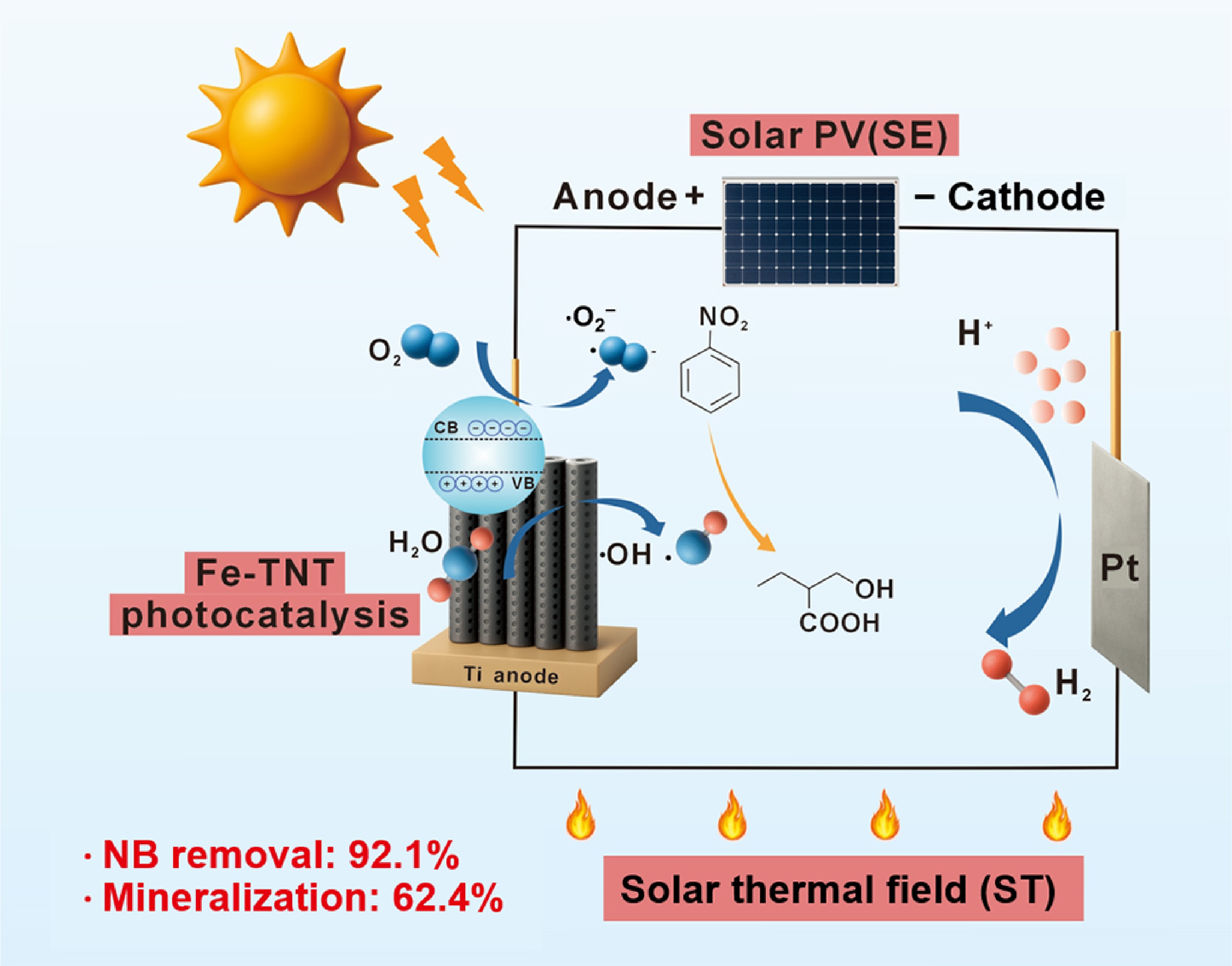



-
The occurrence of organic micropollutants (OMPs) in agricultural, municipal, and pharmaceutical wastewater is an emerging concern for the environment and human health[1]. Among all OMPs, nitrobenzene (NB) is widely recognized as a highly toxic pollutant due to its strong electron affinity stemming from the –NO2 group[2], which imparts chemical stability and makes it resistant to oxidation through common methods[3]. On the other hand, its reduced component, aniline (AN), could be easily mineralized via microbial ortho-cleavage and meta-cleavage pathways[4,5] or advanced oxidation processes (AOP)[6,7]. Therefore, most NB degradation strategies, especially biodegradation, focus on a two-step process, requiring a pre-reduction of NB into AN under anaerobic conditions[8−10]. At the same time, numerous studies have explored various potential approaches for direct NB removal from wastewater, such as AOP[11,12] and biological degradation[13]. However, most of these strategies necessitate the addition of other chemical reagents, resulting in potential secondary pollution concerns[14] or additional cost to sustain long-term operation[15]. Consequently, there is a pressing need to develop new technologies that are both cost-effective and environmentally friendly for direct NB degradation and mineralization. In this context, recent photocatalytic systems have increasingly focused on interfacial charge-transfer regulation and active-site engineering to enhance the degradation or removal of refractory organic pollutants, including quinolone antibiotics and other emerging contaminants[16,17].
Solar energy has been widely recognized as one of the most promising renewable energy sources for environmental remediation and sustainable chemical processes[18−20]. Numerous studies have demonstrated the feasibility of individual solar-driven processes—such as photoelectrocatalytic, solar thermal (ST), and solar electrochemical (SE) systems—for hydrogen production via water electrolysis[21] and for the degradation of organic pollutants in industrial wastewater[22,23]. However, most of these studies relied on the utilization of only one or two solar energy components, leading to substantial solar energy losses and limited overall efficiency[24,25]. To overcome this limitation, the solar thermal electrochemical photocatalytic (STEP) system has been proposed as an integrated strategy that couples photo-, thermal-, and electrochemical fields to enhance pollutant degradation. In this configuration, the ultraviolet fraction of sunlight drives photocatalytic reactions, the visible-light component powers photovoltaic electricity generation, and the infrared portion provides thermal energy to accelerate reaction kinetics[26,27]. Other studies on solar thermal electrochemical oxidation and related multi-field coupling systems have further demonstrated the feasibility of combining thermal and electrochemical effects with solar-driven processes for efficient pollutant removal[28−30]. Various electrode materials, including metal oxide electrodes and noble metal electrodes with nanocarbon-supported catalysts, have been explored in STEP and related systems to enhance interfacial charge transfer and catalytic activity[26,27,29]. Nevertheless, the widespread application of these systems remains constrained by the high cost and limited availability of noble metal- or nanocarbon-based electrodes, underscoring the need for more cost-effective and scalable catalytic materials for practical STEP implementation. Recent studies on self-supported and interfacially engineered electrodes have further demonstrated that rational regulation of electrode architecture, interfacial bonding, and charge redistribution can significantly improve electrochemical reaction kinetics and energy-conversion efficiency[31,32].
To reduce the material cost and optimize the utilization of the ultraviolet (UV) component of solar energy, the development of cost-effective electrodes with stable and consistent performance is essential for effectively harnessing and balancing the multiple energy fields in STEP systems. Previous studies have demonstrated the feasibility of dispersing inexpensive TiO2 photocatalyst particles within the reaction medium of STEP systems to achieve complete mineralization of azo dyes in wastewater[33]. However, the wide bandgap of TiO2 (~3.2 eV) restricts its light absorption primarily to the UV region, which accounts for only about 4% of the solar spectrum[34]. To overcome this limitation, considerable efforts have been devoted to narrowing the TiO2 bandgap through elemental doping with earth-abundant metals[35] or through morphology engineering[36]. Among these strategies, Fe(III) doping or co-doping has been widely investigated as an effective approach to regulate the electronic structure of TiO2, extend light absorption, and improve photocatalytic/photoelectrochemical performance. Previous studies from independent groups have demonstrated that Fe incorporation can introduce Fe-related electronic states, promote charge separation, and enhance interfacial reaction kinetics in TiO2-based photocatalysts[37,38]. Nonetheless, the fundamental mechanisms by which Fe(III) incorporation modifies the band structure of TiO2-based electrodes and subsequently influences the adsorption, degradation, and mineralization behaviors of persistent organic pollutants, such as NB, remain poorly understood.
In this study, Fe-modified TiO2 nanotube arrays (Fe-TNT) were fabricated on Ti foil via a two-step anodization and Fe-introduction process and employed as the anode in a STEP system for nitrobenzene (NB) degradation. Density functional theory (DFT) calculations were performed to elucidate the electronic structure modulation induced by Fe-substitution and to identify six optimized adsorption configurations of NB on Fe-TNTs, revealing the enhanced interfacial interaction and activation pathways responsible for the improved mineralization performance. Comparative experiments under solar electrochemical (SE), solar thermal electrochemical (SE + ST), and STEP conditions were conducted to clarify the degradation mechanism and to determine the most efficient operational mode for NB oxidation and mineralization behavior, yielding environmentally benign end-products such as NO3−, CO2, and H2O.
-
TiO2 nanotube arrays (TNTs) were synthesized via a two-step anodic oxidation process at room temperature[39,40], followed by Fe modification through an impregnation-annealing technique, as shown in Supplementary Fig. S1. Briefly, a 2-mm thick titanium foil (99.6% purity, Stream Chemicals, China) was cut into 20 mm × 10 mm pieces and sequentially ultrasonicated in acetone, ethanol (AR, Tianjin Damao), and deionized (DI) water. The first anodization was conducted at 60 V for 30 min using the Ti foil as the anode and a Pt foil (20 mm × 10 mm) as the cathode, with an electrolyte composed of 0.5 wt% NH4F and 2 vol% DI water in ethylene glycol (AR, Tianjin Damao) without stirring. The as-formed oxide layer was removed by ultrasonication to expose the hexagonally patterned Ti substrate, which was then subjected to a second anodization at 30 V for 30 min to form well-aligned TNTs. After the two-step anodization, the prepared TiO2 NT sample was cleaned with DI water and dried off with N2 gas. Fe species were introduced by immersing the obtained TNTs in an Fe(NO3)3 solution (0.1 mol/L) for 10 h and rinsing with DI water, followed by 1-h annealing in air at 450 °C with a heating rate of 5 °C per min.
The surface morphology and microstructure of the Fe-TNT electrodes were characterized using field-emission scanning electron microscopy (FE-SEM, Zeiss Sigma HV), while the elemental composition was analyzed by energy-dispersive X-ray spectroscopy (EDS) coupled with SEM. The crystalline phases of the Fe-modified TiO2 nanotubes were identified by X-ray diffraction (XRD, Rigaku D/MAX 2200) using Cu Kα radiation over a 2θ range of 10°–80°, with a scan rate of 1°/min.
Quantum ab initio calculations
-
Quantum ab initio calculations[41] were performed to investigate the electronic structure of representative Fe-substituted TiO2 local active-site models, including charge density differences, density of states (DOS), and electronic-gap variations, as well as the adsorption mechanisms of nitrobenzene (NB) on the Fe-TNT surface. All first-principles calculations were carried out using the plane-wave-based Vienna ab initio Simulation Package (VASP)[42−44], within the framework of spin-polarized density functional theory (DFT). The generalized gradient approximation (GGA) with the Perdew-Burke-Ernzerhof (PBE) was employed to modify the electronic exchange-correlation energy[45−47]. The interactions between the ionic cores and valence electrons were described by the projector augmented-wave (PAW) pseudopotential[48−50]. The valence wave functions near the atomic cores were expanded as a linear combination of plane waves, with an energy cut-off of 500 eV. For self-consistent field (SCF) calculations, the convergence criteria of electronic relaxation were reached when the change in energy between successive iterations was less than 10−5 eV; meanwhile, the Hellmann–Feynman forces on each atom were below 0.01 eV/Å[42]. Partial occupancies of the Kohn–Sham orbitals were realized using the Gaussian smearing method with a smearing width of 0.05 eV. The semiempirical correction of Grimme's DFT + D3 approach, as executed in VASP, was adopted to treat the long-range van der Waals interaction between the NB and the Fe-substituted TiO2 surface[51−53].
Construction of anatase TiO2 (001) and (101) slab models
-
The slab models were constructed by multiplication of the anatase TiO2 unit cell obtained via optimization of lattice parameters and atomic positions, followed by cutting bulk anatase TiO2 along a desired direction. Specifically, the pristine anatase TiO2 slab with a (101) surface was modelled by a 2 × 2 × 1 supercell constructed from 16 Ti atoms and 32 O atoms. The supercell had lattice parameters of a = 10.28 Å and b = 7.58 Å. Additionally, this work also studied the introduction of an Fe atom on an anatase TiO2 slab with a (001) surface. The pristine anatase TiO2 slab with a (001) surface was built by a 2 × 2 × 1 supercell with lattice parameters of a = 7.58 Å and b = 7.58 Å, containing 16 Ti atoms and 32 O atoms. Periodic boundary conditions (PBCs) were consistently applied in DFT calculations. The simulation cells were built with a 20 Å vacuum space in the z-direction to prevent interaction among periodic images. One Ti5c atom on the (101) and (001) surfaces was replaced by an Fe atom. All atoms in the Fe-substituted TiO2 slab system were allowed to relax during SCF calculations. The integration of total system energy and charge density in the first Brillouin zone was performed using the Monkhorst–Pack (MP) algorithm[54−56]. Considering the convergence precision of the system energy and configuration, the k-point mesh of 18 × 8 × 2 and 8 × 8 × 2 was used for the supercell of the anatase TiO2 slab model with the (101) and (001) surfaces, respectively.
It should be emphasized that the Fe-substituted TiO2 slab used in the DFT calculations is a representative simplified local active-site model rather than a complete structural reproduction of the experimentally prepared Fe-modified TiO2 nanotube electrode. The real electrode may contain surface FeOx/Fe2O3 domains as well as interfacial or near-surface Fe-O-Ti coordination environments. Directly modeling the full TiO2/FeOx interface would require the consideration of multiple FeOx stoichiometries, surface terminations, oxygen vacancies, hydroxylation states, amorphous structures, and dynamic interfacial reconstruction, leading to non-unique structures and an impractically large number of possible NB adsorption geometries. Therefore, the Fe-substituted anatase TiO2 surface was adopted to represent the local Fe-O-Ti coordination environment and to isolate the electronic effect of Fe centers on NB adsorption and activation.
The adsorption of nitrobenzene (NB) on the Fe-substituted TiO2 surface was investigated in six different orientations of NB. Adsorption energy was calculated following the standard definition Eads = Esurf/NB − Esurf − ENB, where Esurf/NB represents the total energy of the Fe-substituted TiO2 surface with an adsorbed NB molecule, Esurf represents the energy of the pristine Fe-substituted TiO2 surface, and ENB represents that of the NB molecule. We excluded the solvent effects from consideration as our work aims to study different properties of the TiO2 substrate and its reaction with NB molecules. VASPKIT was used for the post-processing of VASP calculation data[57].
Experiment setup for STEP system and operation conditions for NB degradation
-
The STEP system was operated using a visible-UV spectrophotometer (Shimadzu UV-1700, Japan) coupled with an in situ photo-thermal-electrochemical analyzer specifically designed for NB degradation in a microreactor (Supplementary Fig. S2). The real-time current response was monitored using a digital multimeter (Victor 70/86) interfaced with a computer. The microreactor was constructed from a quartz cell (12.5 mm × 12.5 mm × 45 mm) containing 2 mL of electrolyte and 20 mg/L NB as the reactant. Three operational modes were evaluated to compare NB degradation and mineralization performance. In this laboratory configuration, the term 'solar' is used here following the STEP concept to denote coupled solar-derived energy fields. However, the experiment was performed using an external solar heater and UV lamp to distinguish the distinct roles played by sunlight across different wavelength bands. Future experiments under simulated solar irradiation are recommended to further assess the practical applicability of this concept under real solar-driven conditions.
(1) Solar-electrochemical (SE) condition: an electrochemical mode operated with an externally supplied 1.2 V voltage between two Pt electrodes (20 mm × 10 mm) at 30 °C.
(2) Solar-thermal-electrochemical (SE + ST) condition: the same electrochemical mode assisted by thermal input. Solar illumination directly heated the reactor, with the temperature maintained at 90 °C.
(3) Solar thermal electrochemical photocatalytic (STEP) condition: the Pt anode in the SE + ST configuration was replaced by the Fe-TNT photoanode, and a 28 W UV lamp (λ = 254 nm) was introduced as the laboratory photo-input to activate the Fe-TNT electrode. The UV lamp was not intended to reproduce the full solar spectrum.
Intermediate product analysis
-
The degradation kinetics of NB under different solar coupling conditions (SE, SE + ST, and STEP) were evaluated by monitoring the absorbance at 267 nm, corresponding to the characteristic UV peak of NB. Cyclic voltammetry (CV) and high-performance liquid chromatography (HPLC) were conducted for the intermediate product detection during NB degradation. The reported mineralization efficiency in this study was calculated from the conversion of nitrogen in nitrobenzene to nitrate. Detailed experimental procedures are provided in Appendix S1.
-
The Fe-TNT electrode exhibited well-aligned tubular structures with diameters ranging from 30 to 90 nm after two-step anodization followed by Fe(III) modification. As depicted in Fig. 1a, Fe(III) species were observed near the orifices of the TiO2 nanotube arrays. These visible species are tentatively assigned to surface FeOx/Fe2O3 domains formed during the impregnation–annealing process. Meanwhile, interfacial or near-surface Fe-O-Ti coordination environments may also be generated during thermal treatment (highlighted by red circles). Cross-sectional SEM imaging (Supplementary Fig. S3) revealed that the TiO2 NT layer possessed a uniform thickness of approximately 1.4–1.5 μm. Owing to their large specific surface area and excellent charge transport properties, TiO2 NT arrays are known to facilitate efficient light harvesting and charge separation, which are advantageous for photocatalytic degradation processes[58,59].
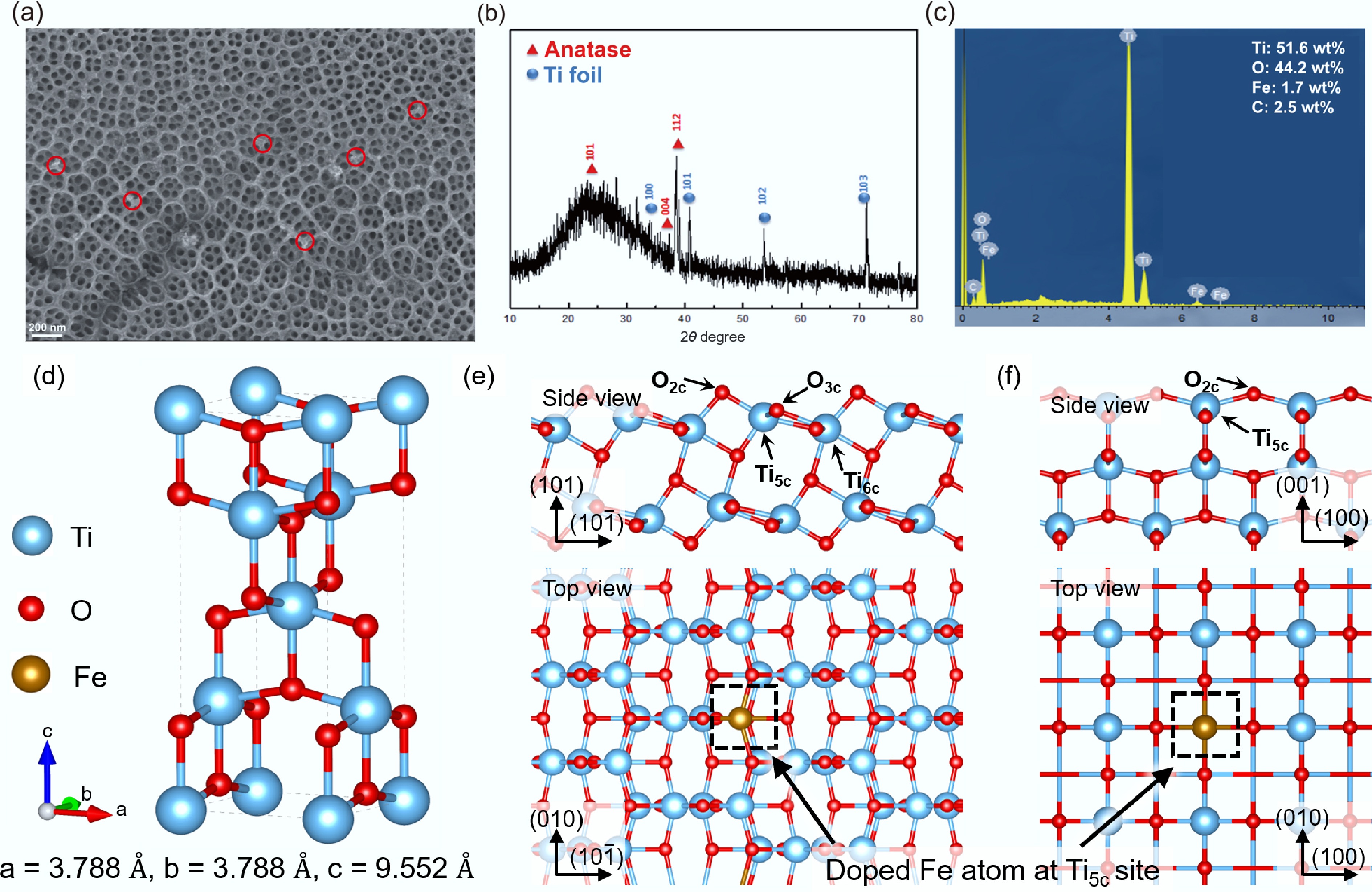
Figure 1.
(a) SEM images of the surface morphology of Fe(III)/TiO2 NTs; (b) XRD pattern of Fe(III)/TiO2 NTs; (c) EDS spectra of Fe(III)/TiO2 NTs; (d) crystal model of bulk anatase TiO2; (e) representative Fe-substituted anatase TiO2 (101) surface (FexTi1-xO2, x = 0.0625); (f) representative Fe-substituted anatase TiO2 (001) surface (FexTi1-xO2, x = 0.0625).
X-ray diffraction (XRD, Fig. 1b) patterns confirmed that the Fe-TNT retained the anatase crystalline phase, with characteristic diffraction peaks corresponding to the (101), (004), and (112) planes. Additional peaks, such as (100), (101), (102), and (103), mainly came from the background signals of the metal Ti foil. Anatase TiO2 has been reported to have strong water adsorption capability and a small contact angle at the electrode-water interface, which could lead to the generation of more hydroxyl radicals during the photocatalytic degradation of wastewater[60]. Energy-dispersive X-ray spectroscopy (EDS) further verified the successful introduction of Fe, showing a surface Fe content of 1.7 wt% on the Fe-TNT/Ti electrode (Fig. 1c). While TiO2 modified with less than 1 wt% Fe(III) has been reported to exhibit excellent performances for photocatalysis[61] and pollutant degradation[62], the TiO2 NT arrays with slightly higher Fe(III) loading in this study might further enhance catalytic performance toward nitrobenzene degradation under STEP conditions.
To elucidate the possible electronic effect of local Fe centers coupled with anatase TiO2, first-principles calculations were performed using a representative Fe-substituted TiO2 surface model. This model represents an idealized local Fe-O-Ti coordination environment at the Fe-modified TiO2 surface. Figure 1d–f illustrate the optimized crystal structures of bulk anatase TiO2 and Fe-substituted Ti sites on the (101) and (001) surfaces, corresponding to a doping concentration of x = 0.0625 in FexTi1-xO2. The anatase TiO2 (101) and (001) surfaces, shown in Fig. 1e and f, expose five-coordinated Ti (Ti5c) and two-coordinated O (O2c) atoms, where Fe atoms substitute for surface Ti5c sites. The calculated lattice constants of the Fe-doped structures remain close to those of pristine TiO2 (a = 3.788, b = 3.788, and c = 9.552 Å for bulk), indicating only minor structural distortion after Fe incorporation and confirming the preservation of the anatase phase with localized electronic modification.
Band structure and density of states (DOS) calculations were used to evaluate the relative electronic-structure changes induced by local Fe-O-Ti coordination. It should be noted that the calculated electronic gaps obtained from GGA–PBE calculations are not intended to reproduce the absolute experimental bandgap of the photoelectrode. Instead, they are used here to compare the relative electronic-structure changes between pristine and Fe-modified TiO2 models under the same computational framework. For the pristine anatase TiO2 (101) surface, the band structure (Fig. 2a) reveals an indirect bandgap of 2.63 eV, with the valence band maximum (VBM) and conduction band minimum (CBM) located at different k-points. The total and projected DOS (TDOS and PDOS) in Fig. 2b and c indicate that the VB is primarily comprised of O 2p orbitals, whereas the CB originates from Ti 3d orbitals, consistent with the wide bandgap that restricts light absorption to the UV range. Upon Fe substitution, the GGA-PBE-calculated band structure (Fig. 2d) exhibits an effective reduced bandgap of 1.42 eV, attributed to the introduction of Fe-induced impurity states. The corresponding TDOS and PDOS plots in Fig. 2e and f confirm that these mid-gap states arise from Fe 3d orbitals, which hybridize with O 2p and Ti 3d orbitals, thereby extending the absorption edge into the visible region. This hybridization results in an aggregated conduction band and shifts the Fermi level upward toward the conduction band, indicating enhanced electronic conductivity and improved charge transport for photocatalytic reactions. It is established that GGA-PBE calculations underestimate semiconductor bandgaps because of self-interaction/delocalization errors and the missing derivative discontinuity in approximate exchange–correlation potentials. This limitation can be particularly significant for transition-metal oxides containing localized d states. Therefore, the electronic-gap values reported here are GGA-PBE-calculated Kohn–Sham gaps used only for relative comparison between the pristine and representative surfaces. They should not be interpreted as experimentally measured optical bandgaps of the Fe-TNT electrode.
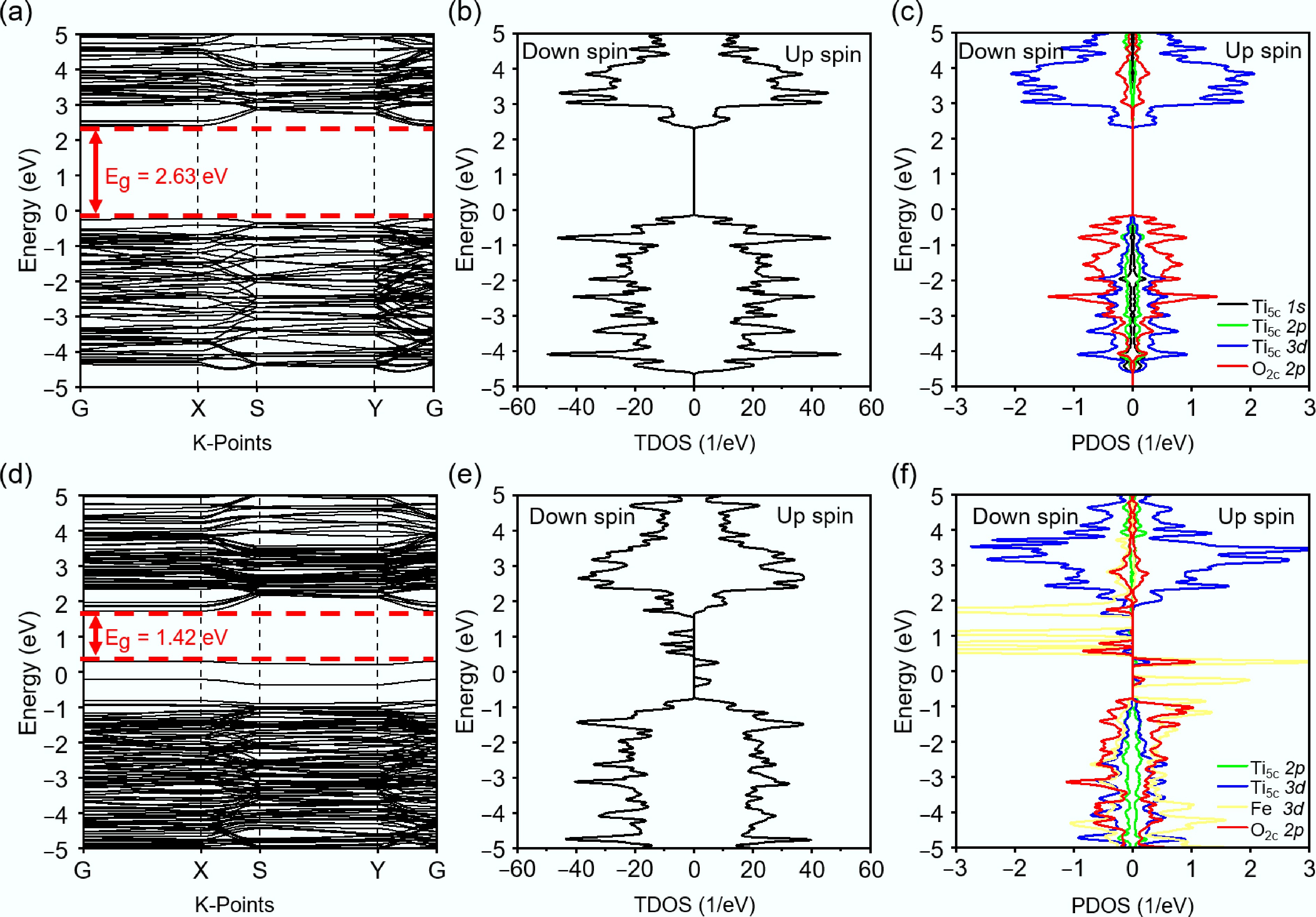
Figure 2.
Electronic structure of pristine anatase TiO2 (101) slab: (a) band structures (the bandgap is 2.63 eV), (b) total density of states (TDOS), and (c) projected density of states (PDOS) of the atomic types that construct the structure. Electronic structure of representative Fe-substituted anatase TiO2 (101) slab: (d) Band structures (the bandgap is 1.42 eV), (e) TDOS, and (f) PDOS. Fermi level was shifted to zero. All electronic-gap values shown in the figure are calculated using GGA-PBE and are provided only for relative comparison between the two models; they are not experimentally measured optical bandgaps.
Similar trends are observed for the (001) surface. The pristine (001) surface has a bandgap of 1.41 eV (Supplementary Fig. S4a), with TDOS and PDOS (Supplementary Fig. S4b, S4c) dominated by O 2p and Ti 3d contributions. Fe doping further narrows the bandgap to 0.94 eV (Supplementary Fig. S4d), introducing spin-polarized Fe 3d states in impurity levels and O 2p states in the VB (Supplementary Fig. S4e, S4f). This reduction in bandgap is more pronounced in the (101) surface, suggesting that the (101) facet may exhibit higher photoactivity due to enhanced carrier mobility and reduced recombination. For reference, the bulk pristine anatase TiO2 shows a bandgap of 2.06 eV in Supplementary Fig. S5, with symmetric TDOS and PDOS, underscoring the surface-specific effects of doping. The VBM and CBM of bulk pristine anatase TiO2 fall at the G point, indicating that it is a direct bandgap semiconductor.
These electronic modifications provide a possible mechanistic explanation for the enhanced performance of the Fe-TNT electrode in the STEP system. The narrowed bandgap suggests more favorable charge excitation and interfacial charge transfer under photo-input, consistent with the higher NB oxidation efficiency observed under STEP conditions compared with that in the SE and SE + ST processes. The introduction of Fe 3d states acts as electron traps, reducing charge recombination and promoting the generation of reactive oxygen species for direct oxidation of NB to maleic acid without the involvement of complex intermediates. The selection of Fe substitution addresses the UV-only response limitation of pristine TiO2.
Nitrobenzene adsorption onto the Fe-TNT surface
-
Understanding the adsorption behavior of NB on the Fe-TNT surface is crucial for elucidating the initial steps of its degradation pathway under STEP conditions. The optimized geometry of the NB molecule prior to adsorption is shown in Supplementary Fig. S6. The molecule consists of a nitro (–NO2) substituent attached to a benzene ring, with an N–O bond length of 1.241 Å and an ∠O–N–O bond angle of 124.6°. The benzene ring exhibits C1–C2, C2–C3, and C3–C4 bond lengths of 1.396, 1.395, and 1.340 Å, respectively (Fig. 3g). The dihedral angle formed by C2–C1–N–O2 is calculated to be 3.23°, indicating that the NB molecule is nearly planar in its equilibrium configuration.
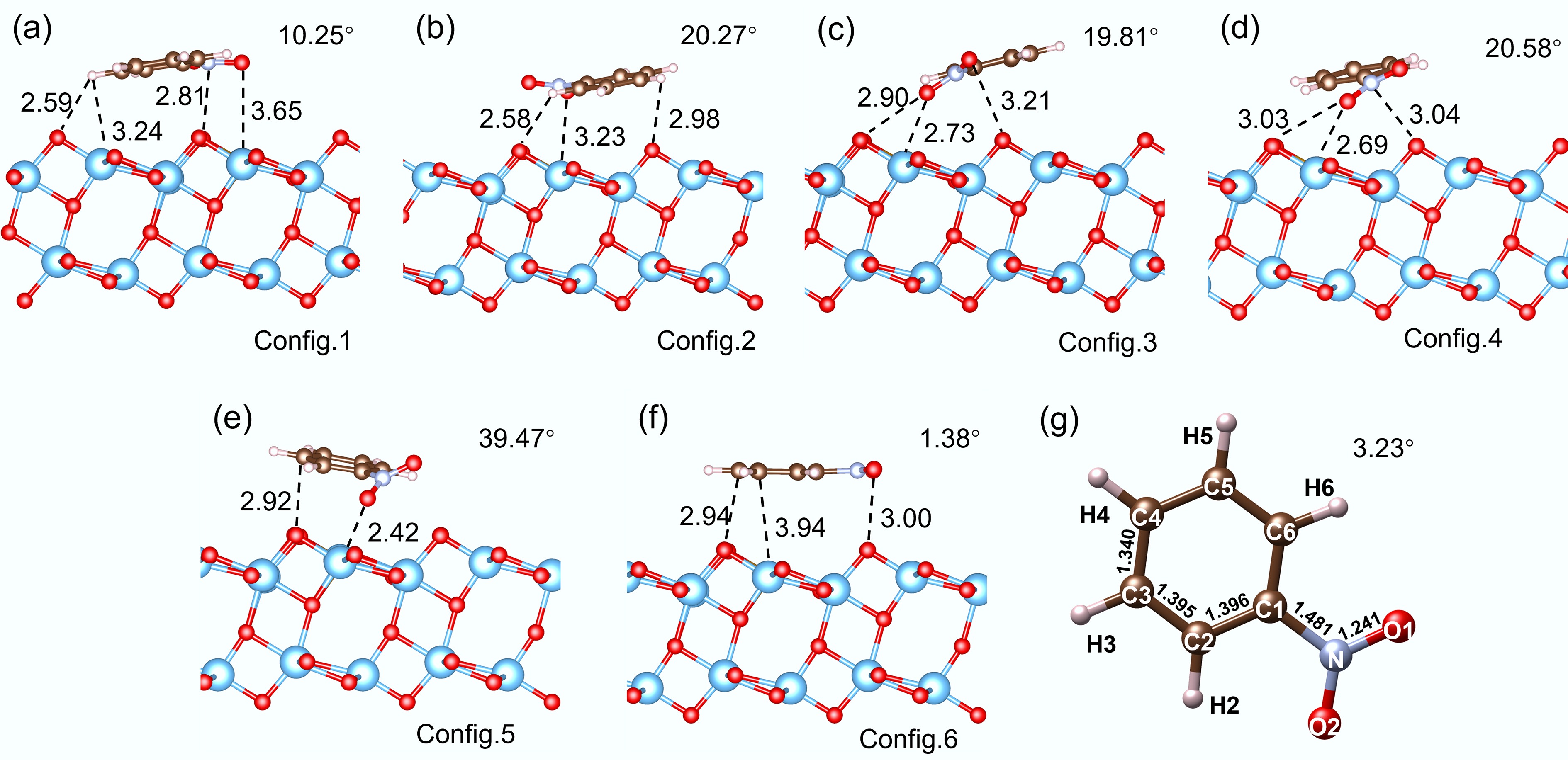
Figure 3.
The side view of optimized adsorption configurations and important distances (in Å) of NB on a representative Fe-substituted anatase TiO2 (101) surface. The torsion of the nitro group is represented by the angle between plane C2–C1–C6 and plane O1–N–O2. Fe atoms are obscured in the structure. The Fe atom is included in all optimized adsorption models but is partially obscured from the selected side-view direction by neighboring surface atoms. The Fe-substituted site is shown clearly in Fig. 1e, with Fe represented by the golden sphere.
The top views of six optimized adsorption configurations of NB on the anatase TiO2 (101) surface were presented in Supplementary Fig. S6, highlighting the interaction with Ti5c and O2c sites. Configurations 1 to 4 involve NB adsorption on Ti5c sites, while configurations 5 and 6 depict adsorption on O2c sites (Fig. 3a–f). All configurations initially adopt a parallel orientation, as the NB molecule energetically favors parallel adsorption over vertical alignment. The calculated adsorption and binding energies (Supplementary Table S1) are all negative, indicating that NB adsorption on the TiO2 surface is exothermic and thermodynamically favorable. The greater the magnitude of the adsorption energy, the more stable the configuration. Although subsequent degradation is influenced by activation barriers, efficient NB adsorption is a prerequisite for effective photocatalytic oxidation. It should be noted that the STEP degradation process occurs in aqueous media, where competitive adsorption between NB and water molecules takes place. Despite this competition, NB adsorption remains favorable due to its negative adsorption energies. Meanwhile, water adsorption and dissociation on TiO2 surfaces contribute critically to hydroxyl radical generation, which initiates the oxidation of the nitro group in NB.
For the representative Fe-substituted anatase TiO2 (101) surfaces, configurations 4 and 5 exhibit the highest stability, with adsorption energies of −0.5297 and −0.6336 eV, respectively. The optimized geometries and key interatomic distances are shown in Fig. 3. In configuration 4, the O2 atom in the nitro group interacts with the Fe atom at a distance of 2.69 Å, while O2–O2c and N–O2c separations are 3.03 and 3.04 Å, respectively. The N–O2 bond length of the adsorbed NB increases by 0.01 Å, accompanied by a 0.9° reduction in the ∠O–N–O bond angle and a nitro group torsion of 20.58°. In configuration 5, the nitro group binds through a surface Ti5c atom with an O2–Ti5c distance of 2.42 Å. The adsorption distances of C3–O2c and C1–O3c are 2.92 and 3.03 Å. The N–O2 bond length of the adsorbed NB increases by 0.02 Å, and the ∠O–N–O bond angle decreases by 1.5°. The NB molecule adopts the most tilted orientation among all configurations, with its benzene ring semi-parallel to the surface and the nitro group twisted by a dihedral angle of 39.47°, indicating surface-induced deformation that facilitates activation of the nitro group for subsequent oxidation.
The charge density difference profiles of adsorption configuration 5, as shown in Fig. 4, further illustrate the electron transfer dynamics between NB and the Fe-TNT surface. The green and red isosurfaces (at a 0.001 Bohr−3 level) represent regions of charge accumulation around the nitro group and charge depletion near the benzene ring and adjacent surface Ti atoms. A donor-acceptor interaction occurs where the electron-withdrawing nitro group pulls electrons from the Fe-substituted surface, facilitated by the mid-gap Fe 3d states. This strengthens the binding strength between the surface and the adsorbate. Partial charge transfer may weaken the C–N bond in NB and facilitate subsequent ring-opening oxidation.
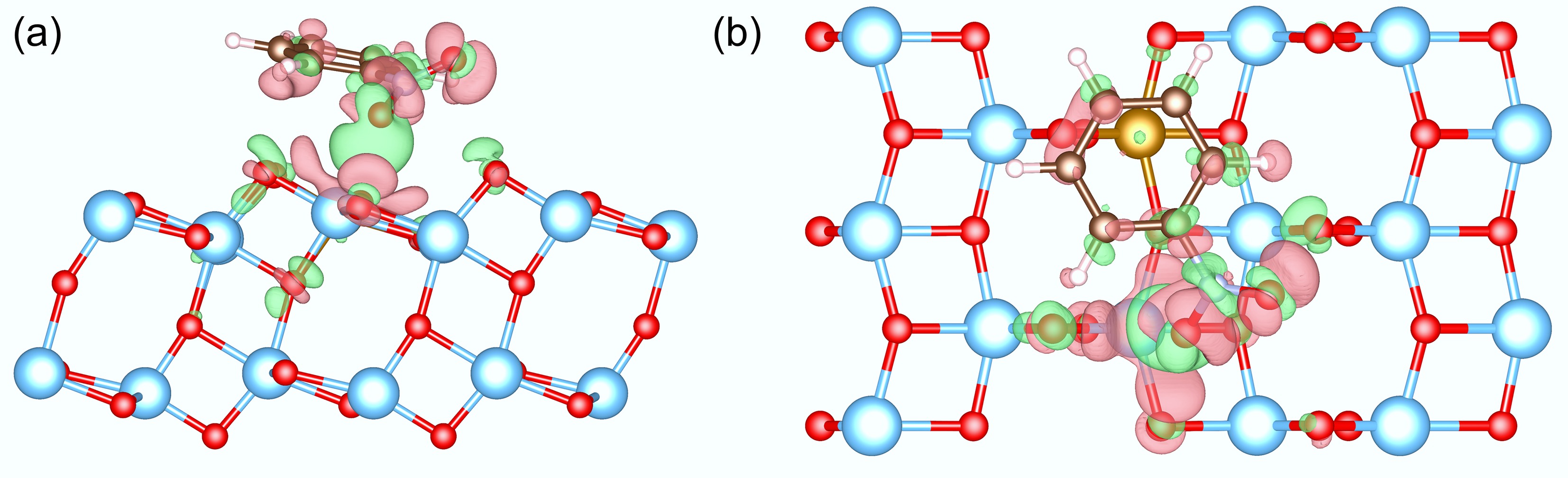
Figure 4.
The charge density difference profiles between the NB and Fe-substituted TiO2 surface in optimized adsorption configuration 5 (green: charge accumulation, red: charge depletion). Isosurfaces are plotted at a level of 0.001 Bohr−3. The Fe atom is represented by the golden sphere and is visible in the top-view panel.
These adsorption analyses provide mechanistic understanding for the NB degradation pathway observed in the STEP system. The preferential adsorption on Ti5c sites, enhanced by local Fe-O-Ti coordination, facilitates electron transfer under photo-electro-thermal synergy. This insight highlights the role of surface engineering in optimizing pollutant-electrode interactions, advancing STEP as an effective method for organic micropollutant removal.
NB degradation under different operating conditions
-
Leveraging the enhanced electronic structure and NB adsorption capability of the Fe-TNT electrode, the STEP system demonstrated efficient NB removal with significantly improved mineralization. Under conventional SE conditions, NB degradation was notably slow, achieving only 7.5% removal after 2 h of solar illumination (Fig. 5) and corresponding to a rate constant of 6 × 10⁻⁴ min−1 (Supplementary Table S2 and Supplementary Figure S7). The mineralization efficiency under SE conditions was merely 3.2%, likely due to the accumulation of intermediate products at relatively low reaction temperatures. In the absence of an ion-exchange membrane between the anode and cathode, a portion of NB could be electrochemically reduced to aniline at the cathode, which then diffused back to the anode for partial oxidation. Consequently, NB degradation and mineralization partially competed with such side reactions.
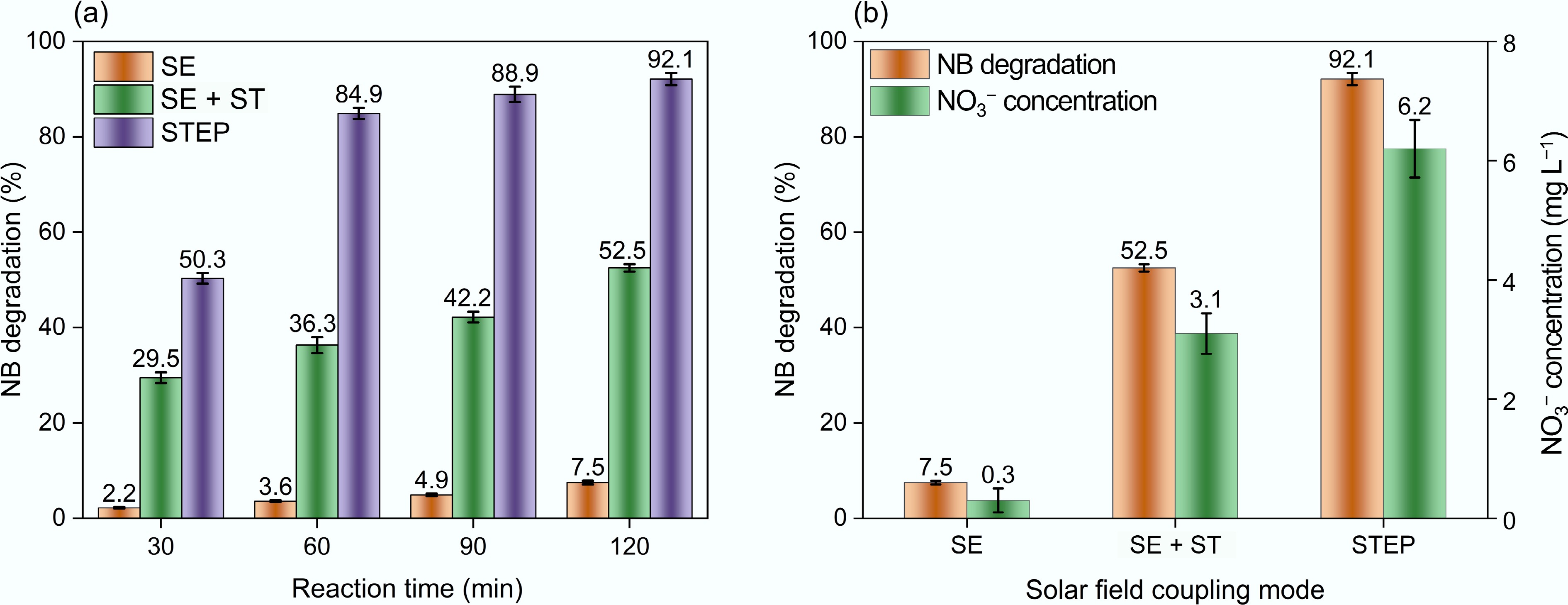
Figure 5.
Nitrobenzene (NB) removal and nitrate formation under different operation modes. (a) Time-dependent NB removal after 30, 60, 90, and 120 min; (b) NB removal efficiency and NO3− concentration after 120 min, from which mineralization efficiency was calculated. The key comparison is the enhanced NB removal and nitrate formation achieved under STEP conditions relative to SE and SE + ST.
When the system was operated under solar-thermal-electrochemical (SE + ST) conditions, elevated temperatures promoted the formation of reactive oxygen species (e.g., ·OH), which facilitated rapid oxidation of NB into intermediate organics such as phenols and quinones. The NB degradation efficiency increased to 52.5%, representing a 45.0% improvement over SE. Throughout the degradation process, both NB and its intermediates were further oxidized into smaller molecules, leading to higher fluctuations in concentration profiles and a reduced correlation coefficient for kinetic fitting. Notably, the inclusion of the solar thermal field enhanced the reaction rate constant from 6 × 10⁻⁴ min−1 to 5 × 10⁻³ min−1, an 8.5-fold increase relative to SE. Correspondingly, the concentration of NO3− increased to 3.1 mg/L after 2 h, raising the mineralization efficiency to 31.2%.
Building upon the SE + ST mode, the further inclusion of photocatalysis to form the full STEP system further promoted the generation of reactive oxygen species, resulting in an enhanced reaction rate constant of 2.2 × 10⁻² min−1. The STEP system exhibited approximately 4-fold faster degradation kinetics compared to SE + ST, achieving a remarkable NB removal efficiency of 92.1% within 2 h. Correspondingly, the calculated mineralization efficiency reached 62.4%, highlighting the synergistic effect of combining solar thermal, electrochemical, and photocatalysis for accelerated NB degradation and mineralization. The NB removal efficiency obtained here surpasses that of previously reported STEP systems employing Ti/RuO2/IrO2 (81.2%) or nano-carbon/TiO2 NTs/Ti (84.9%) as central electrodes[25,26], which can be attributed to the enhanced photocatalytic activity associated with Fe modification[61,62]. It is noteworthy that the nitrogen-based mineralization efficiencies under all solar coupling modes remained lower than the corresponding degradation efficiencies. This discrepancy arises because NB is initially converted into other nitrogen-containing organic intermediates, which require additional time to be fully mineralized into NO3−.
Determination of intermediate products during NB degradation under different solar coupling conditions
-
The formation of intermediate products during NB degradation was probed using cyclic voltammetry (CV), as presented in Fig. 6. The impact of elevated temperature induced by a solar thermal field under SE + ST conditions on NB degradation was illustrated in Fig. 6a. In the positive scanning direction, two main oxidation peaks were observed. Under SE conditions, the anodic oxidation peak intensity was relatively weak, reflecting the slow reaction kinetics and limited formation of intermediate products. Upon increasing the system temperature to 90 °C under SE + ST conditions, the peak intensities corresponding to NB oxidation to para-benzoquinone (PBQ, around –0.1 V vs. Ag/AgCl) and subsequent PBQ oxidation to maleic acid (0.7 V vs. Ag/AgCl) were significantly enhanced, demonstrating the higher NB degradation rate under SE + ST conditions. The peak positions of the corresponding oxidation reactions also slightly decreased, suggesting a lower potential requirement at the higher temperature for NB degradation and mineralization under SE + ST conditions.
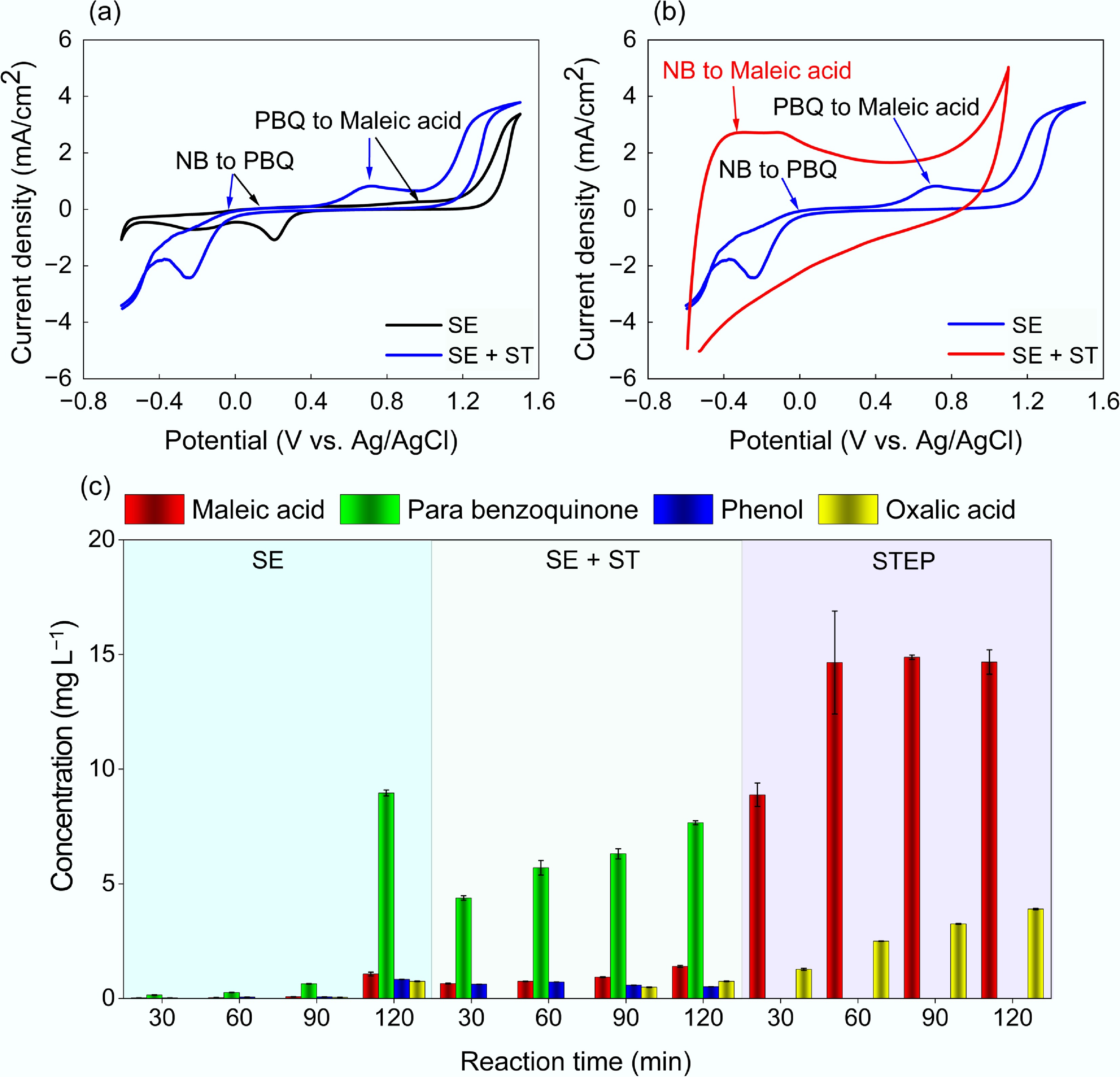
Figure 6.
Electrochemical responses and detected intermediates during nitrobenzene (NB) degradation under different operation modes. (a) Cyclic voltammetry (CV) curves comparing SE and SE + ST conditions; (b) CV curves comparing SE + ST and STEP conditions; (c) high-performance liquid chromatography (HPLC)-based detection of intermediate products after 30, 60, 90, and 120 min, including phenol, para-benzoquinone (PBQ), maleic acid, and oxalic acid.
The introduction of photocatalysis on the Fe-TNT electrode changed the peak distribution in the CV curve for the STEP system (Fig. 6b). Only one anodic oxidation peak was observed, indicating that NB underwent a direct major oxidation pathway to maleic acid under STEP conditions. The current density from the STEP system was substantially higher than that in the SE + ST system, reflecting accelerated reaction kinetics and more efficient NB degradation. Analysis of the reduction curves (Fig. 6a and b) revealed two, one, and zero reduction peaks under SE, SE + ST, and STEP conditions, respectively. As previously noted, NB can undergo reduction at the cathode to form aniline before complete mineralization[8,22]. The reduction peaks were significantly diminished or became undetectable under the tested STEP conditions, indicating that cathodic reduction was largely suppressed and thereby enhancing the overall degradation rate[27].
To corroborate the observations from CV analysis, the formation of intermediate products during NB degradation was also examined by HPLC (Fig. 6c). The detected intermediates included phenol, para-benzoquinone (PBQ), maleic acid, and oxalic acid. Under both SE and SE + ST conditions, a similar degradation pathway was observed. Within 60 min, phenol, PBQ, and maleic acid were detected, with PBQ being the dominant intermediate (Fig. 6c). This aligns with the CV results (Fig. 6a), which indicate sequential oxidation of NB to PBQ and subsequent conversion of PBQ to maleic acid via phenol mediation. During this process, continuous NB degradation contributed to increased overall degradation efficiency. Compared to SE, the NB degradation rate under SE + ST conditions was significantly accelerated. Notably, oxalic acid became detectable, and the concentration of maleic acid slightly increased after 1 h of NB degradation, while phenol concentration decreased at the same time, indicating possible further degradation of phenol into oxalic acid through maleic acid mediation. These findings confirm that elevated temperature under SE + ST conditions not only accelerates NB degradation but also promotes subsequent oxidation of intermediate products, facilitating enhanced mineralization.
Under the STEP condition, the HPLC profiles of NB degradation intermediates differed markedly from those observed under SE and SE + ST modes (Supplementary Figs. S8 and S9). Notably, peaks corresponding to phenol and PBQ were absent, and maleic acid emerged as the dominant product (Fig. 6c), indicating the possible change in the NB degradation pathway due to the introduction of photocatalysis on the Fe-TNT electrode. Concurrently, oxalic acid was detected within the first 30 min, and its concentration increased as maleic acid levels declined, which indicates the positive effects of photocatalysis on the facilitated mineralization of NB. Throughout the entire experiment, no phenol or PBQ peaks were observed, and the characteristic NB peak nearly disappeared after 120 min (Supplementary Fig. S9), demonstrating the high efficiency of NB mineralization under the synergistic photo-electro-thermal fields of the STEP system.
Mechanism of the STEP process for NB degradation
-
Based on the CV and HPLC analyses, three distinct pathways for NB degradation were proposed, as illustrated in Fig. 7. Compared to conventional SE and SE + ST modes, the STEP system benefits from the synergistic effects of solar-electro, solar-thermal, and photocatalytic processes. Under SE conditions, the electron-withdrawing nitro group in NB increases the electron density along the C–N bond, rendering it susceptible to nucleophilic attack and facilitating cleavage of the C–N bond, with substitution of –NO2 by –OH groups[63]. The resulting phenol is subsequently oxidized to para-benzoquinone (PBQ), which is further converted into maleic acid and eventually oxalic acid through aromatic ring cleavage (Fig. 7). Ultimately, only a small fraction of NB molecules is fully mineralized to NO3−, CO2, and H2O. The SE + ST pathway follows the same basic steps as SE (Fig. 7), however, elevated temperatures under the solar-thermal field activate NB molecules into a high-energy excited state, promoting charge transfer at the anode[29]. This results in accelerated degradation, as reflected in the increased current and intermediate product formation observed in Fig. 6a and c, leading to higher degradation and mineralization efficiencies relative to SE alone. Despite this enhancement, both SE and SE + ST processes generate substantial quantities of intermediate products that remain potentially toxic[29,64,65].
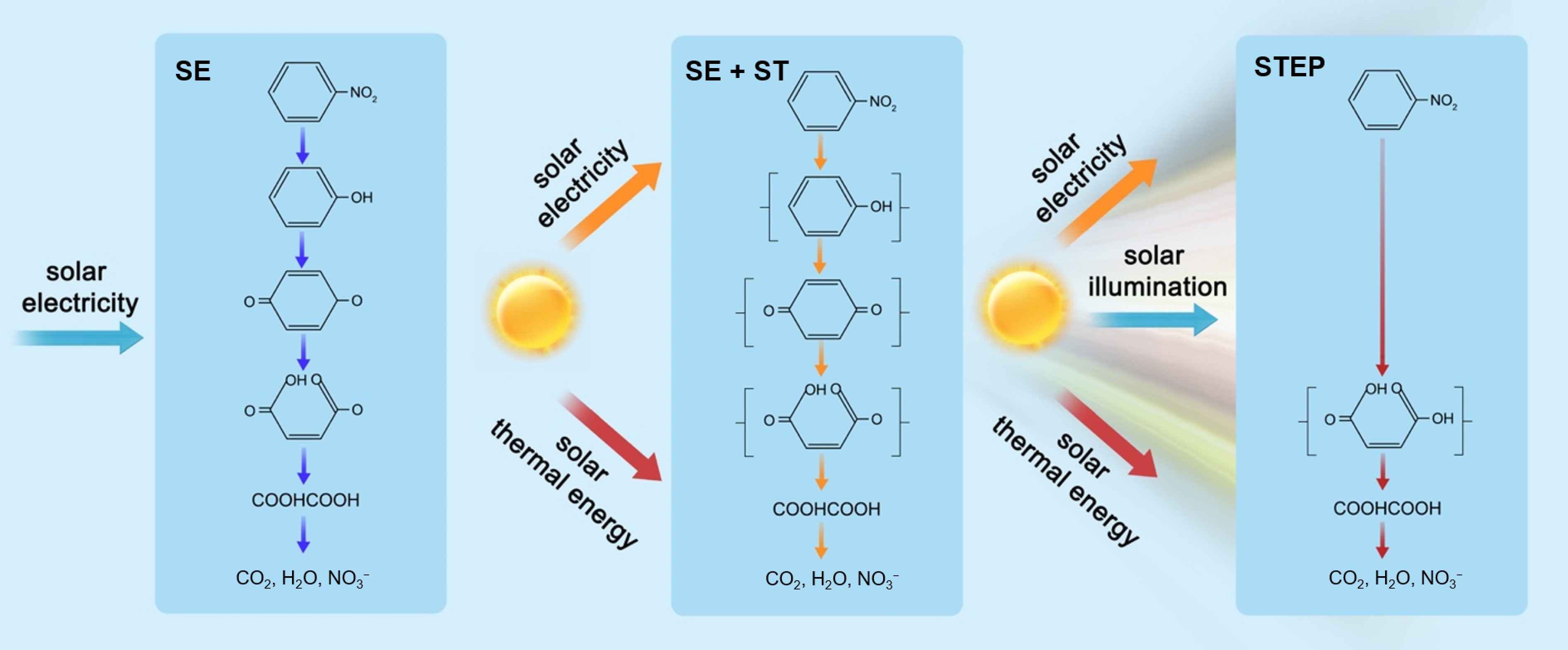
Figure 7.
Comparison of degradation and partial mineralization pathways of nitrobenzene (NB) under solar-electrochemical (SE), solar-thermal-electrochemical (SE + ST), and solar thermal electrochemical photocatalytic (STEP) conditions.
In contrast to SE and SE + ST modes, the NB degradation pathway under STEP conditions exhibited a markedly different behavior, resulting in a significant reduction in intermediate product formation (Fig. 7). NB molecules were directly oxidized to maleic acid under the synergistic action of solar thermal and solar photo fields, with maleic acid subsequently converted into oxalic acid, thereby streamlining the mineralization process. Overall, the NB degradation in the STEP system proceeded more directly and rapidly than in SE and SE + ST systems, which could be attributed to the impacts induced by the photocatalytic property of the Fe-TNT electrode. The introduction of Fe(III) onto the TiO2 NTs/Ti electrode introduces mid-gap states within the wide bandgap of TiO2, lowering the energy required for electron excitation from the valence band to the conduction band. Under sunlight irradiation, particularly in the UV region, Fe-associated electronic states may facilitate photogenerated charge trapping, forming Fe(II) and Fe(IV) species. Due to their inherent instability, Fe(II) and Fe(IV) react with oxygen and hydroxyl ions adsorbed on the Fe-TNT electrode surface, producing highly reactive hydroxyl (·OH) and superoxide (·O2–) radicals[66,67]. These radicals efficiently cleave the C–N bond of NB, enabling its direct conversion into maleic acid (Supplementary Fig. S10). However, as the reactive oxygen species (ROS) were not directly quantified in the present study, the Fe-associated contribution is proposed as a plausible pathway consistent with the DFT results, electrochemical response, and enhanced NB degradation behavior, rather than as a directly demonstrated mechanism. In summary, the synergistic coupling of solar electro, thermal, and photo fields significantly enhances NB removal and partial mineralization, facilitating a highly efficient mineralization pathway. It should be noted that the proposed degradation pathway was inferred from the combined results of HPLC analysis, cyclic voltammetry, DFT, and ROS simulations. Since HPLC retention times alone cannot provide unequivocal structural identification of degradation intermediates, further LC–MS/MS analysis would be valuable for confirming the molecular structures of the proposed degradation products and further validating the degradation pathway.
Although the STEP system achieved enhanced NB degradation and nitrogen-based mineralization, its practical application requires further consideration of energy consumption and operating costs. The chronoamperometry (CA) curves for SE, SE + ST, and STEP are shown in Supplementary Fig. S11. The current density generally decreased with time at the beginning of the NB degradation and reached a steady state after around 45 min. Under SE conditions, the current density stabilized at a relatively low value (~7 μA/cm2), indicating weak electrochemical oxidation of NB on the Pt electrode surface. With the introduction of a solar-thermal field, the current density significantly increased by ~3 times from 7 to 23 μA/cm2, leading to a significant enhancement in the degradation (from 7.5% to 52.5%) and mineralization (from 3.2% to 31.2%) efficiency of NB. The coupling of the solar-photo field further increased the current density to 35 μA/cm2, which prompted the NB degradation efficiency to 92.1%. The detailed calculation of energy input under different coupling conditions could be seen in Supplementary Table S3. Compared to SE, SE + ST and STEP coupling modes provided 3.5 and 5 times more electric energy, respectively, which represented more electron uptake from NB degradation and agreed well with NB degradation efficiency. Though thermal energy inputs for all three different coupling modes were relatively low compared to the electric energy inputs (less than 0.1%), the thermal effect had a significant impact on the mineralization rate. Further optimization of solar thermal utilization, heating requirements, and operating conditions is needed to improve energy efficiency and practical feasibility. In addition to energy consumption, the long-term stability of Fe-TNT electrodes is important for practical applications. Prolonged operation may affect surface active sites, TiO2 nanotube structure, and Fe species stability. Therefore, systematic cycling tests, structural characterization, and Fe leaching analysis are suggested to further evaluate electrode durability[68,69].
-
In this study, a solar thermal electrochemical photocatalytic (STEP) system integrating an Fe(III)-modified TiO2 nanotube (Fe-TNT) electrode was developed for efficient nitrobenzene degradation. The Fe-TNT electrode, with a calculated narrowed bandgap of 1.42 eV, effectively utilized solar energy to achieve 92.1% NB removal and 62.4% mineralization based on NO3– concentration within 2 h, significantly outperforming conventional SE and SE + ST systems. DFT calculations suggest that local Fe-O-Ti coordination introduces Fe 3d-related states and strengthens NB adsorption. The improved STEP performance is consistent with enhanced interfacial charge-transfer kinetics and possible ROS-assisted oxidation, although charge-carrier dynamics and ROS generation were not directly measured in this study. This streamlined degradation route minimized toxic intermediates and improved mineralization efficiency. Overall, the study demonstrates that the Fe-TNT-based STEP configuration provides a promising platform for enhanced removal and substantial partial mineralization of refractory organic pollutants under coupled photo-thermal-electrochemical conditions.
No acknowledgements are applicable for this work.
-
It accompanies this paper at: https://doi.org/10.48130/een-0026-0018.
-
During the preparation of this study, the authors did not use any AI tools for language refinement, data analysis, figure enhancement, or any other purpose. The authors take full responsibility for the integrity and originality of the final manuscript.
-
The authors confirm their contributions to the paper as follows: Bin Bian: conceptualization; Bin Bian, Jiayue Hu: writing – original draft; Bin Bian, Jiayue Hu: visualization; Bin Bian, Jiayue Hu, Xinrui Ma, Pengkai Wang: investigation; Jiayue Hu, Ling Liu: simulation; Xinrui Ma, Pengkai Wang: data analysis; Zhan Shen, Pascal E. Saikaly, Ling Liu: writing – review & editing; Ling Liu: supervision. All authors reviewed the results and approved the final version of the manuscript.
-
The datasets generated during and/or analyzed during the current study are available from the corresponding author upon reasonable request.
-
The authors declare that they have no conflict of interest.
-
# Authors contributed equally: Bin Bian, Jiayue Hu
Full list of author information is available at the end of the article. - The supplementary files can be downloaded from here.
- Copyright: © 2026 by the author(s). Published by Maximum Academic Press, Fayetteville, GA. This article is an open access article distributed under Creative Commons Attribution License (CC BY 4.0), visit https://creativecommons.org/licenses/by/4.0/.
-
About this article
Cite this article
Bian B, Hu J, Ma X, Wang P, Shen Z, et al. 2026. Enhanced nitrobenzene mineralization in a STEP system. Energy & Environment Nexus 2: e024 doi: 10.48130/een-0026-0018 

Enhanced nitrobenzene mineralization in a STEP system
- Received: 22 June 2026
- Revised: 07 August 2026
- Accepted: 24 August 2026
- Published online: 15 September 2026
Abstract: Nitrobenzene (NB) is a highly toxic and persistent organic pollutant that is difficult to remove from wastewater. Conventional energy-intensive treatment processes often show limited mineralization, leading instead to the accumulation of harmful byproducts. In this study, an electrochemical system equipped with a highly active Fe-modified TiO2 nanotube array (Fe-TNT) electrode was developed to enhance NB degradation through a synergistic solar thermal electrochemical photocatalytic (STEP) process. Density functional theory (DFT) calculations using a representative Fe-substituted TiO2 local active-site model suggest that local Fe-O-Ti coordination introduces Fe 3d-related states and reduces the effective electronic gap, thereby facilitating interfacial charge transfer and NB activation. As a result, the STEP process achieved a high NB oxidation efficiency of 92.1%, compared with the solar-electrochemical (SE, 7.5%) and solar-thermal-electrochemical (SE + ST, 52.5%) processes. The calculated mineralization efficiency based on NO3− concentration reached 62.4% after 2 h, indicating substantial but incomplete mineralization. Mechanistic analysis further indicated that NB was directly converted to maleic acid via one-step oxidation, demonstrating efficient benzene-ring cleavage. Overall, this work highlights the synergistic advantage of integrating solar thermal, photocatalytic, and electrochemical processes, establishing STEP systems as a promising platform for efficient solar energy utilization and organic pollutant removal in wastewater treatment.