











-
Length–weight relationships (LWRs) are widely used in fish biology and fisheries research because they allow the conversion of length data into biomass, facilitate comparisons of growth patterns among populations, and provide basic information for studies of fishes' condition, reproduction, and feeding ecology[1−4]. Despite their broad application, LWR data remain unavailable or limited for many regional ichthyofaunas[5].
The Yalu River originates from Changbai Mountain and forms part of the border between China and the Democratic People's Republic of Korea (DPRK). The basin supports a diverse freshwater fish fauna, but published LWR data for this river system are still scarce. Previous studies from the Yalu River Basin have reported LWRs for only five species: Odontobutis yaluensis, Ladislavia taczanowskii, Gobio macrocephalus, Misgurnus mohoity, and Pungtungia herzi[6,7].
The five target species in this study were Tanakia lanceolata (Temminck & Schlegel, 1846), Squalidus gracilis (Temminck & Schlegel, 1846), Pseudogobio longirostris Mori, 1934, Zacco platypus (Temminck & Schlegel, 1846), and Acheilognathus yamatsutae Mori, 1928. These native fishes represent common small-bodied components of the Yalu River fish assemblage and occupy different ecological positions. However, LWR records from the Yalu River Basin were previously unavailable for these species. Therefore, this study provides the first LWR records for these five species in the Yalu River Basin and offers baseline data for biomass estimation, growth comparisons, and future ecological studies in this transboundary river system.
-
Fish were collected from the Chinese section of the Yalu River Basin in August 2022 using traps with an aperture of 0.5 cm × 0.5 cm and a length of 10 m. Sampling was conducted once at each of the 18 sites. At each site, two traps were deployed for 12 h. The sampling sites covered both the mainstream and tributaries of the Yalu River Basin and included representative riverine habitats, such as riffles, pools, and nearshore shallow-water habitats. The locations of all sampling sites are shown in Fig. 1.
Species identification
-
All specimens were identified to species by two professional fish taxonomists according to published taxonomic references and books on fishes of the Yalu River Basin[8−12]. Voucher specimens were deposited in the Institute of Zoology, Chinese Academy of Sciences, Beijing, China (ASIZB).
Length and weight measurements
-
Standard length (L) was measured with a digital caliper to the nearest 0.001 cm, and body weight (W) was measured with an electronic scale to the nearest 0.01 g. All measurements were taken in the field after collection. Males and females were not distinguished because reliable sex identification based only on external morphology was not feasible for the target species during field measurements, and no dissection or gonadal examination was conducted.
Statistical analysis
-
The LWRs were estimated using the allometric equation
$ W=a{L}^{b} $ 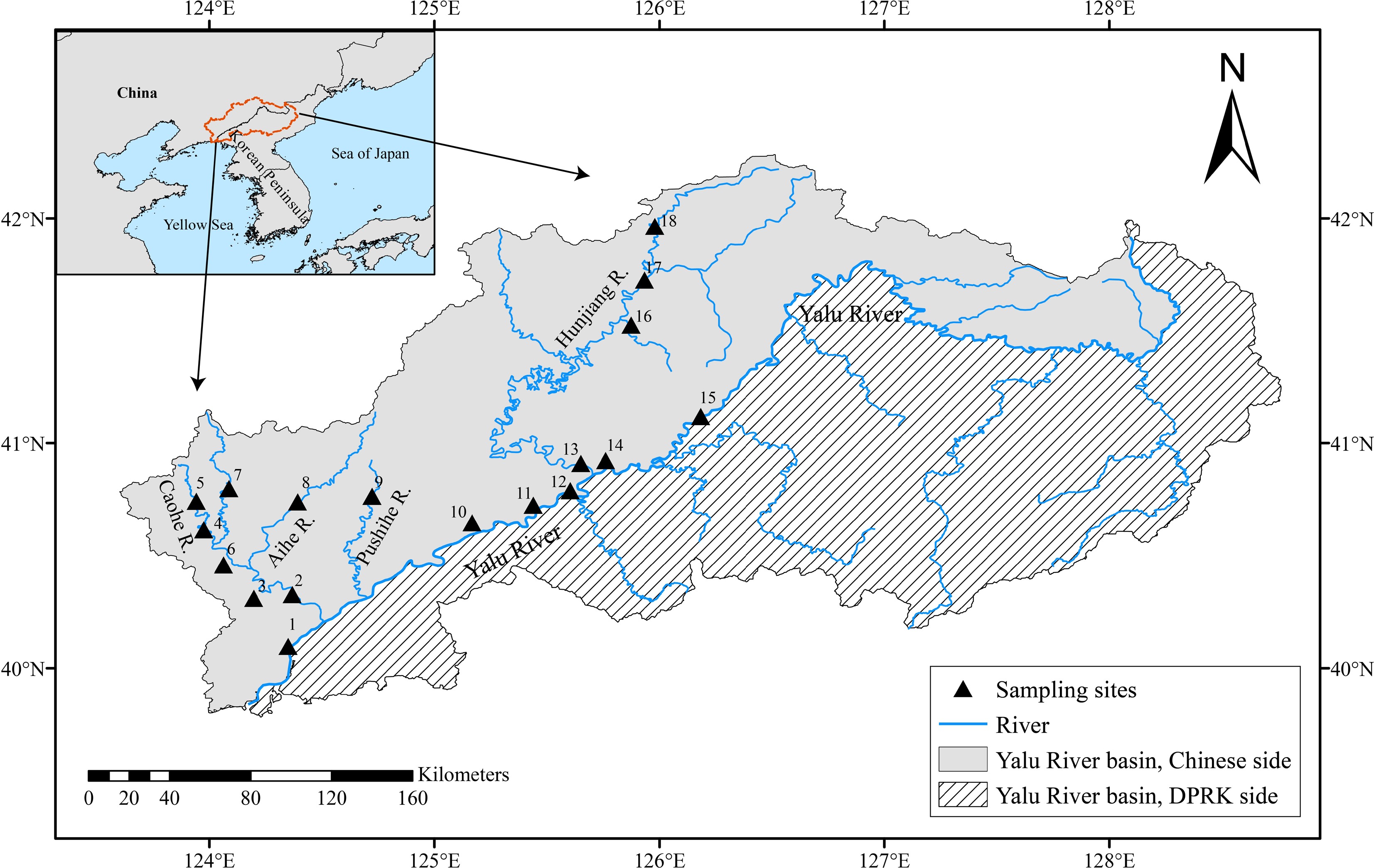
Figure 1.
Map of the Yalu River Basin showing the 18 sampling sites in the Chinese section. Country boundaries and coastlines were obtained from Natural Earth (Admin 0 – Countries, 1:10 m Cultural Vectors, version 5.1.1). River network and drainage basin data were obtained from HydroRIVERS and HydroBASINS, respectively[14].
-
In total, 514 individuals representing five fish species from the Chinese section of the Yalu River Basin were analyzed (Table 1). Sample sizes ranged from 47 (P. longirostris) to 155 (A. yamatsutae). All LWRs showed high goodness of fit, with R2 values ranging from 0.93650 (S. gracilis) to 0.98907 (P. longirostris). The values of coefficient a ranged from 0.00961 (Z. platypus) to 0.03056 (A. yamatsutae) and the values of exponent b ranged from 2.76164 (A. yamatsutae) to 3.17873 (Z. platypus). According to the 95% CI of b, T. lanceolata, S. gracilis, and P. longirostris showed isometric growth, whereas Z. platypus showed positive allometric growth and A. yamatsutae showed negative allometric growth.
Table 1. Descriptive statistics and parameters of LWRs for five native fish species in the Chinese section of the Yalu River Basin.
Species n Standard length (cm) Weight (g) 95% CI of a a 95% CI of b b R2 Max Min Max Min T. lanceolata 152 7.173 2.823 8.42 0.55 0.01826–0.02426 0.02126 2.93445–3.09955 3.01700 0.97165 S. gracilis 50 5.841 3.785 3.59 0.89 0.01057–0.02402 0.01729 2.73362–3.20479 2.96921 0.93650 P. longirostris 47 13.130 5.576 28.00 1.84 0.00788–0.01236 0.01012 2.98602–3.17132 3.07867 0.98907 Z. platypus 110 11.243 1.003 19.60 1.20 0.00702–0.01221 0.00961 3.05373–3.30372 3.17873 0.96577 A. yamatsutae 155 6.671 2.340 5.84 0.36 0.02693–0.03419 0.03056 2.68818–2.83511 2.76164 0.97050 -
The parameter b in the LWR equation reflects the rate at which body weight increases with body length and therefore provides an important indication of the growth pattern of fish. A value of b close to 3 indicates isometric growth, whereas b > 3 suggests that fish become relatively heavier or deeper-bodied with increasing length, and b < 3 indicates that fish become relatively lighter or more elongated as their length increases[4]. In this study, all estimated b values fell within the expected range of 2.5–3.5 for most fish species[4]. The high R2 values further supported strong LWRs in the dataset[15]. Given the limited LWR records from the Yalu River Basin, this study provides the first LWR records from this basin for T. lanceolata, S. gracilis, P. longirostris, Z. platypus, and A. yamatsutae[6,7].
Compared with FishBase records, four species showed broad agreement with the corresponding values, whereas A. yamatsutae exhibited a relatively large discrepancy[16]. For example, the present b value of Z. platypus was 3.17873, slightly higher than the FishBase reference value of 3.10. In contrast, the present b value of A. yamatsutae was 2.76164, which is lower than the FishBase reference value of 3.10, suggesting more pronounced negative allometric growth in the sampled population from the Yalu River Basin. This inconsistency may be partly related to geographic differences among populations. The FishBase records for A. yamatsutae are from Korean waters, whereas the present samples were collected from the Yalu River Basin, which is located farther north. Such geographic differences may influence growth patterns through variations in water temperature, growing season, habitat conditions, and food availability[4]. In addition, differences in body size ranges, sampling method, and sex ratio may also contribute to interstudy variation in LWRs[4,17,18].
Several limitations of this study should be noted. As the Yalu River is located along the China–North Korea border, repeated sampling has been relatively challenging. Therefore, our investigation was primarily conducted in August. Since the breeding season had already passed, it was difficult to accurately distinguish between male and female specimens on the basis of external morphology. The estimated LWRs were restricted to the observed standard length ranges under the sampling conditions of the present study. Despite these limitations, the present LWRs provide baseline parameters for converting length data into biomass and for comparing the growth patterns of native fishes in future monitoring studies. In the context of the transboundary Yalu River Basin, where comparable biological data remain limited, these records may contribute to long-term population assessment, planning fishery conservation, and aquatic biodiversity management.
We thank Yingnan Wang and Xiaowei Meng for assisting us in examining the fish specimens at the Institute of Zoology, Chinese Academy of Sciences, Beijing, China.
-
Fish used in this study were collected during field surveys in the Chinese section of the Yalu River Basin and were identified and measured following standard ichthyological procedures. No experimental manipulation was conducted. According to the relevant institutional and national regulations applicable to this study, formal animal ethics approval was not required. All procedures were carried out in accordance with applicable guidelines to minimize harm to the animals.
-
The authors confirm their contributions to the paper as follows: conceptualization, methodology, and writing – original draft: Li X, Xue W; Specimen collection: Tian C; data analysis: Li X, Xue W, Tian C, Zhang Y, Li T; data curation: Tian C, Zhang Y, Li T; review, editing and supervision: Zhao Y. All authors reviewed the results and approved the final version of the manuscript.
-
The datasets generated in this study are available from the corresponding author on reasonable request.
-
The authors declare that they have no conflicts of interest.
- Copyright © 2026 by the author(s). Journal of Applied Ichthyology published by Maximum Academic Press on behalf of John Wiley & Sons Ltd. This is an open access article under the terms of the Creative Commons Attribution License, which permits use, distribution and reproduction in any medium, provided the original work is properly cited.
-
About this article
Cite this article
Li X, Xue W, Tian C, Zhang Y, Li T, et al. 2026. First records of length–weight relationships for five fish species from the Chinese section of the Yalu River Basin. Journal of Applied Ichthyology 2026: e005 doi: 10.48130/jai-0026-0006 

First records of length–weight relationships for five fish species from the Chinese section of the Yalu River Basin
- Received: 22 April 2026
- Revised: 06 June 2026
- Accepted: 28 July 2026
- Published online: 20 September 2026
Abstract: Standard length–weight relationships (LWRs) were estimated for five native fish species from the Chinese section of the Yalu River Basin, including Tanakia lanceolata (Temminck & Schlegel, 1846), Squalidus gracilis (Temminck & Schlegel, 1846), Pseudogobio longirostris Mori, 1934, Zacco platypus (Temminck & Schlegel, 1846), and Acheilognathus yamatsutae Mori, 1928. Fish specimens were collected in August 2022 by using traps in a variety of aquatic environments. In total, 514 individuals were measured for standard length (L) and weight (W), and LWRs were described by the equation W = aLb. The b values of LWRs ranged from 2.76164 to 3.17873, and all relationships showed high coefficients of determination (R2 = 0.9365 – 0.98907). According to the 95% confidence intervals of b, T. lanceolata, S. gracilis, and P. longirostris showed isometric growth; Z. platypus showed positive allometric growth; and A. yamatsutae showed negative allometric growth. These results provide the first LWR records of all five species in the Yalu River Basin, as well as a valuable reference for future research in this transboundary basin.
-
Key words:
- Freshwater fish /
- Yalu River /
- Length–weight relationships