













-
Panax ginseng is valued for its medicinal benefits, primarily because of its ginsenosides[1−3]. The rare ginsenoside Compound K (CK), a protopanaxadiol-derived metabolite, shows antiallergic, anti-inflammatory, antiaging, and anticancer activities. However, biotransformation-based CK production is hindered by the enzyme's instability, high costs, and poor reusability, restricting industrial scale-up[4−6]. Heterologous biosynthesis, therefore, represents a promising alternative approach.
The biosynthetic pathways of ginsenosides in Panax species have been explored by a number of research groups. Dammarenediol-II synthase (DS) first catalyzes the conversion of 2,3-oxidosqualene to dammarenediol-II, which is then hydroxylated at C-12 to form protopanaxadiol (PPD)-type sapogenins under the catalytic effect of cytochrome P450, such as CYP716A47. Finally, the ginsenoside CK is produced through the selective glycosylation of PPD at C-20 by uridine diphosphate (UDP)-glycosyltransferases (UGTs)[7,8]. UGTPg1 from P. ginseng can generate the ginsenoside CK from the glycosylation of PPD at position C-20 (Fig. 1). The biosynthesis of CK has been successfully achieved by introducing its biosynthetic enzymes into yeast, tobacco (Nicotiana benthamiana), and Yarrowia lipolytica[8,9].
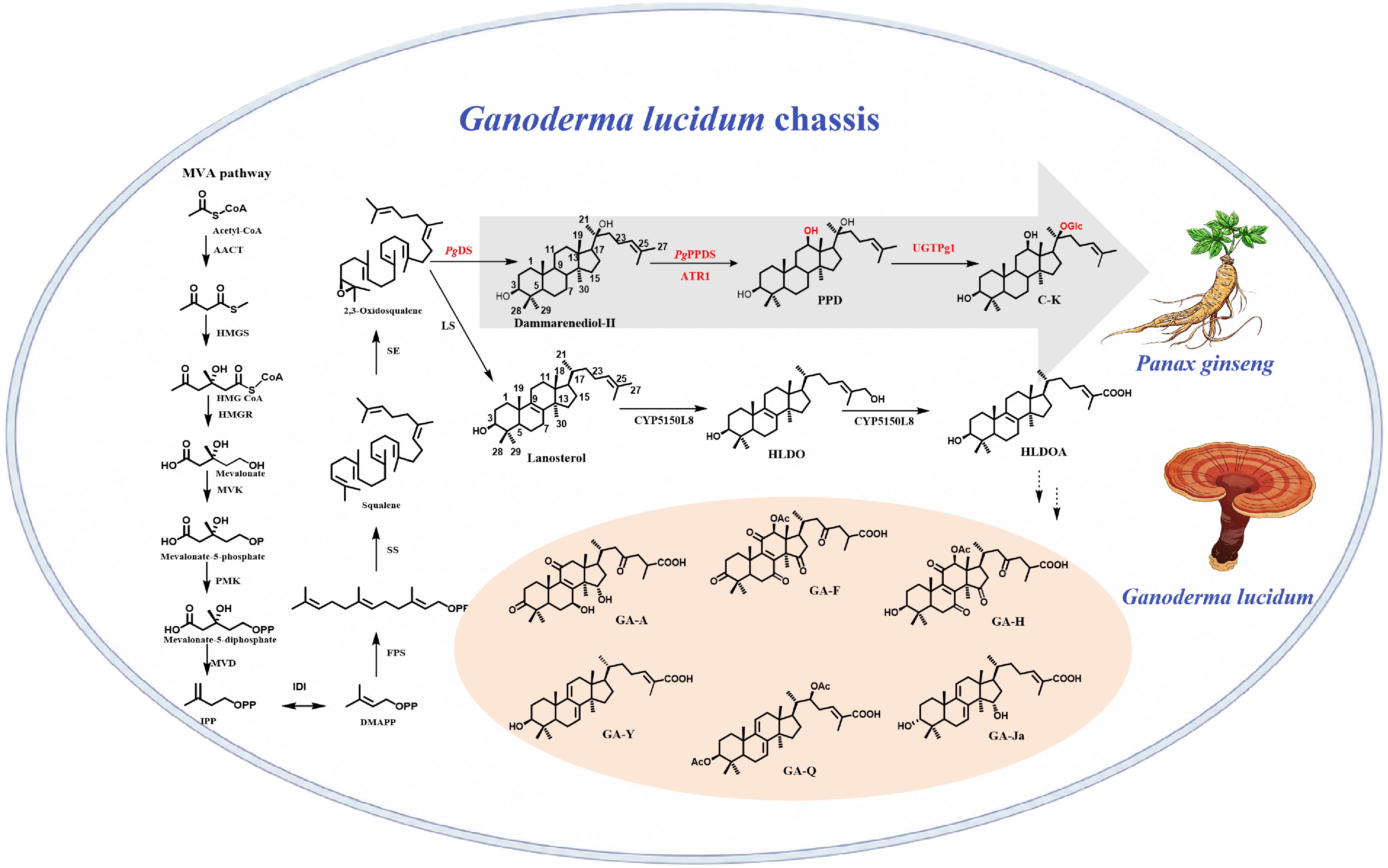
Figure 1.
Biosynthetic pathways of ganoderic acids and the ginsenoside CK. AATC, acetoacetyl-Coenzyme A (CoA) thiolase; HMGS, HMG-CoA synthase; HMGR, HMG-CoA reductase; MVK, mevalonate kinase; PMK, phosphomevalonate kinase; MVD, mevalonate diphosphate decarboxylase; IPP, Isopentenyl pyrophosphate; DMAPP, Dimethylallyl pyrophosphate; FPS, farnesyl diphosphate synthase; SS, squalene synthase; SE, squalene epoxidase; LS, lanosterol synthase; PgDS, dammarenediol II synthase from P. ginseng; PgPPDS, protopanaxadiol synthase from P. ginseng; ATR1, cytochrome P450 reductase; UGTPg1, UDP-glycosyltransferase 1 from P. ginseng; HLDO, 3-hydroxy-lanosta-8,24-dien-26-ol; HLDOA, 3-hydroxy-lanosta-8,24-dien-26-oic acid; GA, ganoderic acid).
Ganoderma lucidum has been used medicinally in Asia for more than 2,000 years. Its principal bioactive constituents are lanostane-type triterpenoids, most of which are ganoderic acids (GAs)[10,11] (Fig. 1). It serves as a useful model organism because of its short growth cycle, sequenced genome, easy cultivation, and established transformation system. With an active Mevalonate (MVA) pathway providing abundant precursors, G. lucidum is a promising chassis for heterologous ginsenoside production[12,13].
Despite its potential as a terpenoid biosynthesis chassis, G. lucidum still lacks sufficient functional promoters for genetic engineering, with the endogenous gpd promoter being the most commonly used[14]. This limitation restricts coordinated multigene expression and metabolic pathway optimization. Therefore, this study screened constitutive promoters and introduced key genes for biosynthesis of the ginsenoside CK into G. lucidum to establish a heterologous production system. The engineered strains combine exogenous CK production with native GA accumulation, creating a dual-functional fungal chassis and providing a new strategy for producing sustainable medicinal natural products.
-
The haploid G. lucidum strain B (from 'Xianzhi No. 1', provided by Zhejiang Shouxiangu Pharmaceutical Co., Ltd.) was maintained on potato dextrose agar (PDA) medium. Protoplast regeneration was performed on Complete Yeast Medium (CYM) medium. Escherichia coli DH5α and Agrobacterium tumefaciens EHA105 were grown in lysogeny broth (LB) medium with appropriate antibiotics.
Promoter prediction
-
Candidate promoter region sequences were retrieved from the local G. lucidum genome database via BLAST, converted to FASTA format using DNAMAN or BioEdit, and validated by NCBI BLAST to exclude sequences containing deletions or mismatches. Promoter prediction was performed using the BDGP NNPP platform with a threshold of 0.8; transcription start site (TSS) positions scoring ≥0.8 were recorded along with their coordinates (Supplementary Fig. S1).
Construction of expression plasmids
-
Vector components were polymerase chain reaction (PCR)-amplified from G. lucidum genomic DNA using Tsingke-synthesized primers and Vazyme high-fidelity polymerase. Promoters, terminators, and mCherry fragments with homologous arms were assembled into a linearized vector using the Vazyme multifragments homologous recombination kit at 37 °C for 30 min (primers are listed in Supplementary Table S1 and S2; nucleotide sequences of gene expression elements are included in the Supplementary File 1). The products were transformed into Escherichia coli DH5α by heat shock and selected on antibiotic-containing LB agar. Sequence-verified plasmids were then introduced into Agrobacterium tumefaciens EHA105 by the freeze–thaw method.
Agrobacterium-mediated transformation of G. lucidum protoplasts and transformant verification
-
G. lucidum protoplasts were prepared as previously described[14]. A. tumefaciens (optical density at 600 nm [OD600] = 0.8) was mixed 1:1 with the protoplasts (1.0 × 10⁷ protoplasts/mL) and co-cultivated for 30 minutes on CYM medium supplemented with 100 mg/L of timentin and 40 mg/L of acetosyringone. Subsequently, single colonies were transferred to PDA selective medium containing 4.0 mg/L carboxin. For PCR screening, a small mycelial sample was heated in 100 mM NaOH at 95 °C for 10 min, and 2 μL of the clarified supernatant was used as the template.
Determination of total triterpenoid content
-
Total triterpenoid content was extracted and quantified according to the method specified in the Chinese Pharmacopoeia (2025 edition). A standard curve was constructed using oleanolic acid as the reference standard, and total triterpenoid content was calculated on the basis of the standard curve equation.
Fluorescence intensity measurement using ImageJ
-
All transformed strains were inoculated at a uniform dose and incubated for an identical duration to ensure consistent physiological status and mycelial density. For slide preparation, fresh mycelia were harvested, and dense mycelial clumps were dispersed by gently twisting the coverslip prior to microscopic observation. During quantification of fluorescence intensity with ImageJ, background fluorescence interference in the field of view was first subtracted, and only individual hyphae with well-defined edges were selected for quantification. mCherry fluorescence images (TIFF format) were imported into ImageJ software via File > Open. The scale was calibrated using Analyze > Set Scale with the pixel-to-micrometer ratio obtained from the microscope, and the "Global" option was selected to apply the calibration to all images. Background subtraction was performed on the mCherry channel using Process > Subtract Background with a rolling ball radius of 50–100 pixels, and the "Light background" and "Create background" options were checked. Regions of interest (ROIs) were manually selected using the freehand selection or oval selection tools. For multiple samples, ROIs were added to the ROI manager via Edit > Selection > Add to Manager. Fluorescence intensity measurements were obtained by selecting all ROIs and clicking Analyze > Measure. The resulting data were exported for statistical analysis.
Construction of Level 1 vectors for ginsenoside biosynthetic genes
-
The biosynthetic genes for the ginsenoside CK, which had been codon-optimized for yeast and fungi and stored in our laboratory, were used as templates for PCR amplification. Primers were designed to introduce BsaI recognition sites and specific complementary overhangs at both ends of each gene fragment, following the predetermined multigene assembly order. The amplified fragments were then ligated into SmaI-digested Level 0 vectors using Thermo FastDigest SmaI. The ligation products were transformed into E. coli DH5α, and positive clones were verified by Sanger sequencing to generate Level 1 vectors (Supplementary Table S3).
Site-directed mutagenesis via circular plasmid PCR
-
High-purity plasmids containing the target genes served as templates for site-directed mutagenesis. Mutagenic primers were designed using Primer Premier 5 software, with the mutation site positioned in the middle of each primer pair. Full-length mutant plasmids were generated via PCR amplification over 18 cycles. The PCR products were then digested with the DpnI restriction enzyme at 37 °C for 2 h to remove the template plasmids. The digested products were subsequently transformed into E. coli DH5α, and single colonies were sequenced to confirm the presence of the desired mutation and the absence of any unintended mutations (Supplementary Fig. S2).
Construction of the Golden Gate expression backbone
-
The pCAMBIA1304-MSdhB empty vector was used as a template to amplify three backbone fragments with designed primers containing BsaI restriction sites and compatible overhangs (Supplementary Fig. S3). The PCR products were gel-purified and ligated into the pCE3 Blunt Vector (ampicillin [Amp]-resistant). After transformation into E. coli DH5α and sequence verification, the three fragments (pCE3-Amp-mSdhB, pCE3-Amp, and pCE3-Ori) were assembled to construct the final Golden Gate expression backbone.
Multigene assembly via the Golden Gate reaction
-
Plasmids containing the verified Level 1 gene constructs and the Golden Gate expression backbone were extracted and purified (Supplementary Fig. S4). Multigene assembly was performed using the NEBridge Golden Gate Assembly Kit (BsaI-HF®v2) (NEB #E1601) according to the manufacturer's instructions. The reaction mixture was incubated in a thermal cycler for 30 cycles of 37 °C for 1 min and 16 °C for 1 min, followed by a final heat inactivation step at 60 °C for 5 min. The assembly products were transformed into E. coli DH5α, and positive clones were verified by Sanger sequencing.
Construction of Golden Gate multigene expression vectors for biosynthesis of the ginsenoside CK
-
Level 0 gene fragments encoding PgDS, PgPPDS, PgATR1, and UGTPg1 were PCR-amplified from laboratory-stored templates using primers carrying BsaI recognition sites and predefined overhangs. PgDS and PgPPDS were assembled into the Level 0 backbone pCE3-PGlgpd-TtrpC, PgATR1 into pCE3-PGltrpC-TGltrpC, and UGTPg1 into pCE3-PGlsdhB-TGlsdhB by homologous recombination to generate the corresponding Level 1 vectors. To eliminate internal BsaI sites that would interfere with Golden Gate assembly, synonymous mutations were introduced by circular plasmid PCR at the BsaI recognition sites of PgPPDS (position: 378 bp) and UGTPg1 (position: 672 bp); the mutated codons did not change the encoded amino acid sequences.
The original pCAMBIA1304-MsdhB vector was split into three functional modules, namely pCE3-RepA (plasmid replication), pCE3-KanaR (kanamycin resistance), and pCE3-MsdhB (carboxin resistance) for G. lucidum transformation, with BsaI sites and compatible cohesive ends added to both ends of each amplified fragment. Level 1 cassettes were arranged in the order of metabolite flow and assembled with the three backbone modules using the NEBridge Golden Gate Assembly Kit (BsaI-HF v2, NEB #E1601) under the conditions described in the "Method", yielding CK4. The LaeA expression module was subsequently integrated into CK4 to generate CK5. Assembly products were screened by colony PCR; plasmids from positive clones were Sanger-sequenced to confirm the gene order and open reading frame integrity, and then transformed into A. tumefaciens EHA105 by the freeze–thaw method.
Quantification of triterpenoid compounds by liquid chromatography–tandem mass spectrometry
-
G. lucidum mycelia (Supplementary Fig. S5) were cultured at 30 °C and 120 rpm for 5 d, then static-cultured for 14 d. Harvested mycelia were dried (60 °C), ground, and sieved (60-mesh). Samples (50 mg) were extracted with 1 mL 80% methanol containing Astragaloside IV (IS), vortexed, incubated overnight (4 °C), and ultrasonicated twice (240 W, 40 Hz, 45 min each). Extracts were centrifuged and filtered. Analysis was performed using ultrahigh-performance liquid chromatography quadrupole time-of-flight mass spectrometry (UPLC-QTOF-MS) with a C18 column, gradient elution, Electrospray Ionization (ESI+) mode (m/z 100–1000), and LabSolutions software for data processing.
Statistical analysis
-
All statistical analyses were performed using GraphPad Prism 9.0 software (GraphPad Software, USA). Quantitative data are expressed as the mean ± standard deviation (SD), with n = 5 independent biological replicates per group for promoter reporter assays (Fig. 2b, c) and n = 3 biological replicates per group for ginsenoside CK and total triterpenoid measurements (Fig. 3b, c). Error bars in all figures represent the SD.
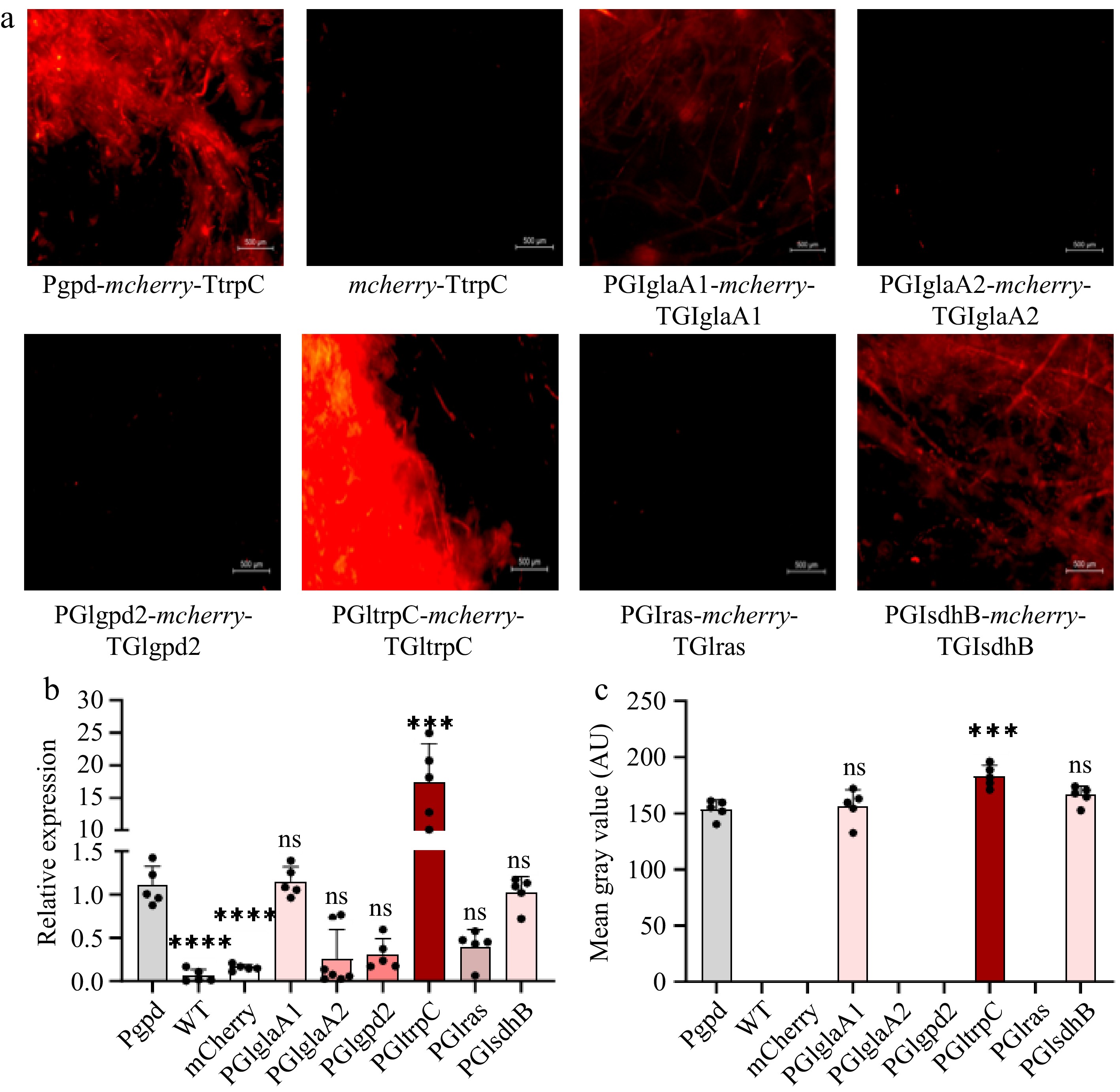
Figure 2.
Verification of candidate gene promoter and terminator activities via Agrobacterium-mediated transformation of G. lucidum protoplasts. (a) mCherry transformants observed by fluorescence microscopy. (b) Relative expression level of mCherry in transformants. (c) Fluorescence intensity of transformants analyzed by ImageJ. Data are shown as the mean ± SD (n = 5 independent biological replicates); error bars represent the SD. Statistical significance was determined by Student's t-test against the Pgpd control (ns, not significant; *** p < 0.001, **** p < 0.0001).
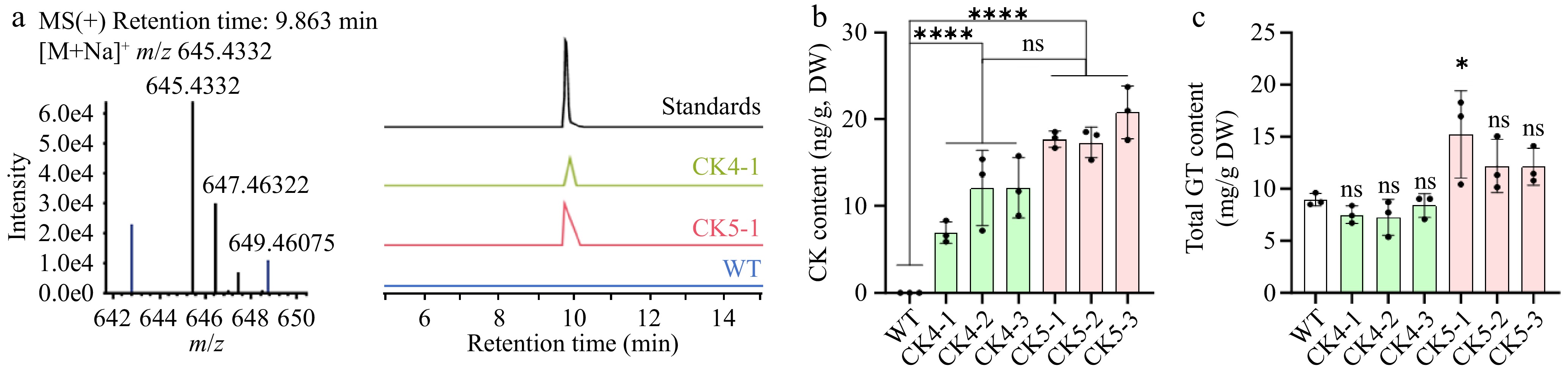
Figure 3.
Detection of strains transformed with genes in the CK biosynthesis pathway. (a) Determination of ginsenoside CK in CK4- and CK5-transformed strains by liquid chromatography–mass spectroscopy (LC-MS). (b) Determination of the content of the ginsenoside CK in CK4- and CK5-transformed strains. (c) Total ganoderma triterpenoid content in CK4- and CK5- transformed strains. Data are shown as the mean ± SD (n = 3 biological replicates); error bars represent the SD. Statistical significance was determined by one-way analysis of variance followed by Dunnett's post hoc test against the wild-type control (ns, not significant; * p < 0.01, **** p < 0.0001).
The statistical strategies were as follows. For promoter reporter assays, each experimental group was compared with the Pgpd control group using independent-sample Student's t-tests. For the multigroup analysis of the ginsenoside CK and total triterpenoid contents, one-way analysis of variance (ANOVA) was first conducted to assess the overall difference across groups, followed by Dunnett's post hoc test for pairwise comparisons between each treatment group and the wild-type (WT) control group. The significance threshold was set at a two-tailed p < 0.05. Significance notations are defined as follows: ns, not significant; * p < 0.05; ** p < 0.01; *** p < 0.001; **** p < 0.0001.
-
Six constitutive genes (glaA, gpd, trpC, ras, tef1, sdhB) were selected for promoter screening in G. lucidum. Promoter regions (2,000 bp upstream of ATG) were retrieved from the genome database. GlglaA and Glgpd each have two paralogs, yielding the promoters PGlglaA1/A2 and PGlgpd1/Pgpd2 (PGlgpd1 matches the previously reported Pgpd). PGltrpC, PGlras, PGltefl, and PGlsdhB were also cloned. TSSs were predicted using BDGP NNPP (threshold 0.8). No TSS was found for PGltefl; accordingly, this candidate promoter was excluded from subsequent functional validation experiments. And the TSSs of all other promoters were localized within 1,500 bp upstream of ATG.
Functional validation of candidate promoters and terminators
-
Based on the predicted transcription start sites, the regions 1,500 bp upstream and 500 bp downstream were amplified from G. lucidum genomic DNA as the candidate promoters and terminators, respectively. Using pCAMBIA1304 as the backbone, mCherry and the MsdhB resistance marker were assembled with these elements by multifragment homologous recombination to generate pCAMBIA1304-MSdhB-Pgene vectors. Recombinant plasmids were verified in E. coli DH5α and introduced into A. tumefaciens EHA105. Target vectors were then delivered into G. lucidum protoplasts via Agrobacterium-mediated transformation, and positive strains were obtained by resistance screening. After 30 days on PDA at 30 °C, red fluorescence was detected in strains carrying Pgpd, PGlglaA1, PGlglaA2, PGltrpC, PGlras, or PGlsdhB expression cassettes, but not in WT or promoter-free controls.
Fluorescence microscopy of mycelial samples showed distribution patterns consistent with blue light imaging. Quantitative analysis revealed that PGltrpC-mCherry-TGltrpC strains exhibited significantly higher fluorescence intensity than the Pgpd control, whereas PGlglaA1 and PGlsdhB showed comparable activity. Total RNA from fresh transgenic mycelia was reverse-transcribed into cDNA, and quantitative reverse transcription (qRT)-PCR analysis confirmed that mCherry transcript levels were highly consistent with fluorescence intensity data (Fig. 2).
These experimental findings demonstrate that the assembled heterologous expression cassettes, including PGltrpC-mCherry-TGltrpC, PGlglaA1-mCherry-TGlglaA1, and PGlsdhB-mCherry-TGlsdhB, can efficiently drive exogenous gene expression in G. lucidum via conventional genetic transformation approaches. Among all tested regulatory modules, the PGltrpC-based expression cassette presents the strongest driving capacity. Moreover, the gene expression efficiency regulated by PGlglaA1 and PGlsdhB is comparable with that of the maturely applied Pgpd-mCherry-TtrpC system widely used in metabolic engineering research based on G. lucidum.
To date, only the endogenous glyceraldehyde-3-phosphate dehydrogenase (GPD) promoter (PGlgpd) is widely used for genetic transformation in G. lucidum, which fails to meet the demands for multigene co-expression and fine-tuned regulation[15]. Drawing on constitutive promoters commonly used in other macrofungi, such as Lentinula edodes and Pleurotus ostreatus, this study systematically evaluated the promoter activities of six candidate genes[16−19]. The results revealed that the transcriptional activity of PGltrpC was significantly higher than that of the commonly used PGlgpd, whereas the activities of PGlglaA1 and PGlsdhB were similar to that of PGlgpd. These findings are consistent with previous studies in diverse basidiomycetes, all of which demonstrate that the promoters GlaA, trpC, and sdhB possess strong constitutive activity.
Construction of multigene expression vectors for CK biosynthesis
-
Using the promoters and terminators validated in section "Functional validation of candidate promoters and terminators", the four CK biosynthetic genes—PgDS, PgPPDS, PgATR1, and UGTPg1—were assembled into matched expression units in the pCE3 backbone, with PgDS/PgPPDS driven by PGlgpd, PgATR1 by PGltrpC, and UGTPg1 by PGlsdhB (Supplementary Fig. S4). Internal BsaI sites in PgPPDS and UGTPg1 were removed by synonymous mutations to avoid interference with Golden Gate assembly, without altering the encoded amino acid sequences.
These expression units were arranged in the order of metabolite formation in the ginsenoside biosynthetic pathway and assembled with the replication (pCE3-RepA), kanamycin-resistance (pCE3-KanaR), and carboxin-resistance (pCE3-MsdhB) backbone modules via the optimized Golden Gate system, yielding the CK biosynthetic vector CK4. Subsequently, the LaeA expression module was additionally incorporated, giving rise to CK5. LaeA, a widely-conserved fungal global secondary metabolism regulator harboring an S-adenosylmethionine (SAM)-binding motif for putative methyltransferase activity (substrates unknown), functions in the velvet complex to modulate secondary metabolite gene clusters via chromatin-dependent transcription and differentially controls terpenoid and polyketide biosynthesis[20]. In G. lucidum, LaeA knockout decreases GA levels and transcription of biosynthetic genes, whereas its overexpression elevates triterpenoid accumulation[21], making LaeA an attractive candidate for triterpenoid yield improvement in metabolic engineering of medicinal fungi.
Golden Gate assembly enables seamless, directional multifragment cloning using Type IIS restriction enzymes and is a synthetic biology standard, but has not been established in G. lucidum.[22,23]. In this study, the original pCAMBIA1304-MsdhB vector was modified by splitting it into three functional modules: the replication origin, the kanamycin resistance cassette, and the carboxin resistance cassette, thereby constructing a Golden Gate assembly vector system suitable for G. lucidum. Using this system, the six-gene biosynthetic pathway of the ginsenoside CK was successfully assembled. This system significantly improves the efficiency of constructing complex biosynthetic pathways in G. lucidum and lays a technical foundation for large-scale genetic engineering of this fungus.
Screening and molecular identification of transgenic G. lucidum protoplasts
-
The haploid strain B isolated from the dikaryotic G. lucidum cultivar 'Xianzhi No.1' was used as the recipient material for genetic transformation. Verified A. tumefaciens EHA105 strains harboring target recombinant plasmids were cultured on a large scale and subsequently used to perform Agrobacterium-mediated genetic transformation of G. lucidum protoplasts. The mixture of bacterial suspension and protoplasts was spread onto a protoplast regeneration medium supplemented with carboxin, and resistant fungal transformants were successfully screened.
Positive transformants carrying the CK4 or CK5 vectors were cultured in a liquid fermentation medium, and dried mycelia were collected for metabolite extraction. Liquid chromatography–mass spectrometry (LC-MS) analysis confirmed the production of the ginsenoside CK in transgenic lines (Fig. 3). The CK standard showed a characteristic peak at 9.863 min with a [M+Na]+ ion at m/z 645.4332, and identical signals were detected in the CK4-1 and CK5-1 strains.
Quantitative analysis was carried out using Astragaloside IV as the internal standard. The accumulation level of the ginsenoside CK was determined to be at the nanogram level. The results showed that the average CK content in CK4 and CK5 were 10.37 and 18.59 ng/g dry weight (DW), respectively. No statistically significant difference was observed between the CK4 and CK5 groups, whereas an overall upward trend in CK yield was found in CK5 transgenic strains compared with CK4 lines (Fig. 3). Notably, the total content of endogenous ganoderma triterpenoids in CK5 transgenic strains was markedly higher than that in WT strains and CK4 transformants. By comparison, no obvious difference in total triterpenoid content was detected between WT strains and CK4 lines. To improve production yields, future work will use clustered regularly interspaced short palin-dromic repeat(CRISPR)/CRISPR-associated protein 9 (Cas9)-mediated targeted integration for multicopy insertion at predefined genomic safe harbors, thereby ensuring consistent and predictable transgene expression. Additionally, the overexpression of rate-limiting enzymes in the mevalonate pathway, such as HMG-CoA Reductase (HMGR), could augment the intracellular pools of the key precursors Isopentenyl pyrophosphate (IPP) and Dimethylallyl pyrophosphate (DMAPP). Fermentation parameters, including pH, temperature, aeration, and elicitor addition, significantly influence both biomass accumulation and product titers, and thus warrant systematic optimization. Ultimately, a synergistic combination of genetic engineering and bioprocess tuning will be essential to achieve commercially viable yields.
The ginsenoside CK is a rare ginsenoside with significant antitumor, neuroprotective, and anti-inflammatory activities[24]. This study achieved the heterologous synthesis of CK in G. lucidum for the first time. Although the yield was low, this advance represents the first synthesis of ginsenoside in macrofungi, which has important milestone value and lays a key foundation for the subsequent development of a macrofungal chassis. Currently, Saccharomyces cerevisiae remains the most mature chassis system for the heterologous synthesis of CK. Yan et al. first achieved de novo biosynthesis of CK from simple sugars in S. cerevisiae by co-expressing UGTPg1 and the protopanaxadiol pathway[25]. Subsequent optimization raised the CK titer to 5.74 g/L in fed-batch fermentation[26]. In a plant chassis, Gwak et al. reconstituted the full CK pathway in transgenic tobacco via PgDS, PgPPDS, and UGTPg1; however, the significant cytotoxicity of the heterologous synthetic pathway severely inhibited the normal growth and reproduction of tobacco plants, resulting in a final CK yield of only 1.55–2.64 μg/g DW in tobacco leaves[8].
-
In summary, this study screened and validated three novel strong constitutive promoters in G. lucidum and established the first Golden Gate multigene assembly system for this fungus, enabling the efficient construction of complex biosynthetic pathways. Using this system, heterologous synthesis of the rare ginsenoside CK was successfully achieved. Significantly, the engineered G. lucidum chassis exhibits a "one strain–dual function" characteristic, as it simultaneously produces exogenous CK and endogenous GAs, forming a synergistic triterpenoid system that leverages the bioactivities of both components. This dual production strategy fully capitalizes on the host's intrinsic metabolic capabilities, thereby differentiating our approach from conventional heterologous platforms. Collectively, these advances lay a solid theoretical and technical foundation for developing G. lucidum into a versatile cell factory for sustainable, green production of high-value natural medicinal products.
The authors acknowledge the technical support of Dr. Shengnan Tan from the Analysis and Test Center, Northeast Forestry University.
-
Any engineered strains were handled in accordance with the applicable BSL-1/2 protocols and relevant laboratory biosafety standards.
-
The authors confirm their contributions to this study as follows: data curation: Xu S, Guo Y, Liu S, Li C; formal analysis: Xu S, Guo Y, Li Y, Li C; writing − revision and editing: Yang Z, Guo J; investigation: Guo J; resources: Cui G; funding acquisition: Cui G, Xue Z; writing − original draft preparation: Li C; supervision, project administration: Xue Z. All authors reviewed the results and approved the final version of the manuscript.
-
All data generated or analyzed during this study are included in this published article and its supplementary information files.
-
The authors declare no conflict of interest.
-
accompanies this paper online at: https://doi.org/10.48130/els-0026-0014.
-
# Authors contributed equally: Shuhao Xu, Yanhong Guo
- Supplementary Table S1 Primers for cloning & validation of expression elements.
- Supplementary Table S2 Primers for ginsenoside synthetic vector construction.
- Supplementary Table S3 Biosynthetic pathway genes of ginsenoside CK.
- Supplementary Fig. S1 Bioinformatic prediction of transcription start sites in gene promoters
- Supplementary Fig. S2 Site-directed mutagenesis of BsaI restriction sites in circular plasmids of PgPPDS and GlLaeA genes.
- Supplementary Fig. S3 Optimization and modification of the pCAMBIA1304-MsdhB gene expression vector.
- Supplementary Fig. S4 Construction of expression vectors for CK biosynthesis.
- Supplementary Fig. S5 Screening culture of protoplasts from Ganoderma haploid strains B transformed with ginsenoside synthesis genes.
- Supplementary File 1 Nucleotide sequences of gene expression elements.
-
Copyright © 2026 by the author(s).
Engineering in Life Sciences published by Maximum Academic Press on behalf of John Wiley & Sons Ltd. This is an open access article under the terms of the Creative Commons Attribution License, which permits use, distribution and reproduction in any medium, provided the original work is properly cited. -
About this article
Cite this article
Xu S, Guo Y, Li Y, Liu S, Yang Z, et al. 2026. Biosynthesis of a rare ginsenoside Compound K in engineered Ganoderma lucidum. Engineering in Life Sciences 26: e013 doi: 10.48130/els-0026-0014 

Biosynthesis of a rare ginsenoside Compound K in engineered Ganoderma lucidum
- Received: 14 August 2026
- Revised: 01 September 2026
- Accepted: 09 September 2026
- Published online: 29 September 2026
Abstract: Ginsenoside Compound K (CK) is a rare protopanaxadiol-type ginsenoside with notable bioactivities. Production of CK via biotransformation remains limited by several challenges, including insufficient enzyme stability, high production costs, and poor catalyst reusability, which substantially hinder efficient production and restrict its large-scale application. Here, we report the first heterologous production of CK in Ganoderma lucidum, a medicinal macrofungus with an active triterpenoid biosynthetic pathway. Constitutive promoters suitable for G. lucidum were screened and validated using an mCherry reporter, with the PGltrpC cassette showing stronger activity than Pgpd. A Golden Gate-based multigene assembly system was then established to construct the biosynthetic pathway of CK and introduce it into G. lucidum. Liquid chromatography–mass spectrometry confirmed CK production in transgenic strains, and the effect of LaeA overexpression on yield was evaluated. This work expands the genetic toolbox for G. lucidum and supports its use as a chassis for sustainable production of medicinal natural products.
-
Key words:
- Ganoderma lucidum /
- Synthetic biology /
- Fungal chassis /
- Ginsenoside CK /
- Triterpenoids