












-
The airport apron—including runways, taxiways, and parking stands—serves as a critical hub within the air transportation system. Its safe and efficient operation has a direct impact on flight punctuality and passenger safety. According to statistics from the International Civil Aviation Organization (ICAO)[1], approximately 30% of global aviation accidents occur in the apron area each year, with delays in target detection and conflict warning identified as major contributing factors. With the ongoing development of smart airports, automated target detection technologies based on computer vision have emerged as essential tools for enhancing apron surveillance. These technologies enable real-time identification of aircraft, ground vehicles, and personnel, thereby providing fundamental data support for systems such as the Surface Movement Guidance and Control System (SMGCS) and the Automatic Conflict Avoidance System (ACAS). Among them, pure computer vision (CV) methods based on visible light imaging have become core technologies for smart airport construction due to their advantages in non-contact operation, high resolution, and the ability to monitor multiple targets simultaneously[2]. Nevertheless, the unique characteristics of airport environments—such as wide variations in target scale, frequent dynamic occlusions, and complex lighting conditions—impose stringent requirements on the accuracy and real-time performance of detection algorithms[3]. Early research in target detection predominantly relied on traditional image processing approaches, including manually designed feature-based recognition techniques[4,5]. These methods typically employed heuristic rules (e.g., edge detection, texture analysis) for target representation. However, their inherent limitations have become increasingly evident. First, their feature representation capabilities are confined to specific target categories, resulting in poor generalization across different scenes and low robustness to environmental noise[6]. Second, the overall pipeline—from feature extraction to classifier design—requires extensive manual parameter tuning. As a result, algorithmic complexity increases significantly with target diversity, making it difficult to achieve the millisecond-level latency required for real-time performance in industrial applications[7].
In UAV-based airport monitoring, the detection model must simultaneously handle small targets, visually similar ground objects, wide-area backgrounds, and strict real-time requirements. Although CNN-based detectors and transformer-based detectors such as DETR[8] have achieved strong performance in general object detection tasks, their direct application to airport surface scenarios remains challenging. YOLO-based methods[9−12] are efficient but may suffer from inaccurate localization when targets are small, densely distributed, or partially occluded. Two-stage detectors such as Faster R-CNN[13,14] can provide accurate region proposals, but their computational cost is less suitable for real-time UAV deployment. RT-DETR[15] provides an attractive end-to-end detection framework by combining transformer modeling with real-time inference. However, in airport scenes, its feature representation and cross-scale fusion capability still need to be strengthened to better distinguish aircraft, vehicles, and personnel under complex backgrounds. To address these challenges, this paper proposes AeroRTD, a real-time detection transformer framework tailored for airport scenarios. The main contributions of this work are summarized as follows:
(1) We propose a lightweight Parallel Convolution Enhancement (PCE) module to improve fine-grained feature representation. Compared with conventional convolutional designs, PCE enhances local detail modeling and channel interaction while maintaining computational efficiency, leading to improved detection of small and visually similar targets.
(2) We introduce a Multi-Scale Context Self-Attention (MSCSA) module to handle extreme scale variations. Unlike standard attention mechanisms, MSCSA integrates multi-scale convolution with self-attention to capture both local structures and global dependencies, significantly improving robustness to large-scale disparities.
(3) We design an Adaptive Grid Upsampling (AGU) module and a Channel-Spatial Dual Attention (CSDA) module to enhance cross-scale feature fusion. Compared with traditional upsampling and fusion strategies, the proposed modules achieve more accurate feature alignment and more effective suppression of redundant information, resulting in improved detection performance under complex and dense scenarios.
-
Object detection, as one of the core tasks in the field of computer vision, aims to identify the locations (bounding boxes) and categories of objects within images or videos. In recent years, with the rapid advancement of deep learning technologies, object detection algorithms have achieved remarkable breakthroughs, providing robust technical support for a wide range of practical applications. In the context of airport surveillance, multi-object detection technology plays a crucial role by enabling real-time detection and tracking of various targets such as aircraft, ground vehicles, and pedestrians. This capability not only enhances the safety of surface operations by preventing collisions and abnormal behaviors but also optimizes resource scheduling and reduces flight delays. Furthermore, object detection significantly improves airport security by facilitating the rapid identification of suspicious objects. Simultaneously, it provides critical support for intelligent airport management and data-driven decision-making, thereby promoting the digital transformation and efficient operation of modern airports.
Two-stage object detection
-
Two-stage object detection frameworks, such as Faster R-CNN[16], have long been acknowledged for their high detection accuracy, particularly in scenarios characterized by complex backgrounds and dense object distributions. By decoupling the detection process into region proposal generation and object classification, these methods enable precise localization and demonstrate robust performance across varying object scales. The introduction of the Region Proposal Network (RPN) has further enhanced the ability of two-stage frameworks to generate high-quality candidate regions, thereby facilitating fine-grained object classification and bounding box refinement. As a result, two-stage detectors have become the benchmark in applications that demand extremely high precision, such as medical imaging and autonomous driving.
However, in scenarios with highly diverse and densely overlapping objects, the reliance on the region proposal mechanism introduces inherent limitations. Two-stage detectors often struggle to capture the fine-grained contextual information necessary for accurate predictions, particularly for small or partially occluded objects. While the hierarchical structure of these models aids in multi-scale feature learning, it may lead to information loss in deeper layers, diminishing the model's ability to differentiate between visually similar or contextually complex objects. These challenges are particularly pronounced in environments like airport aprons, where objects such as ground service vehicles, baggage carts, and personnel exhibit significant diversity in appearance and are frequently subject to occlusion.
Single-stage target detection
-
Single-stage object detectors have experienced significant advancements since their inception, primarily driven by the need to simplify the detection process and enhance computational efficiency. The introduction of SSD (Single Shot MultiBox Detector)[17] marked a breakthrough in the region proposal mechanism of two-stage detectors. SSD uses a single convolutional network to directly predict object categories and bounding boxes, achieving object detection across different scales through multi-scale feature maps. However, its reliance on fixed anchor boxes and limited contextual information restricts its performance, particularly in detecting small objects.
The YOLO (You Only Look Once) series further revolutionized the field of single-stage detection by reinterpreting object detection as a regression problem. YOLOv1[18] introduced a grid-based prediction mechanism, offering impressive inference speed but at the cost of some accuracy, particularly in detecting dense and small objects. Subsequent versions, such as YOLOv2[19] and YOLOv3[20], incorporated key improvements, including anchor boxes, multi-scale detection, and optimizations to the Darknet backbone, which significantly boosted detection accuracy while maintaining real-time performance.
Recent developments have primarily focused on addressing the intrinsic limitations of single-stage methods. YOLOv4[21] and YOLOv5 introduced advanced features such as the Cross Stage Partial Network (CSPNet), Spatial Pyramid Pooling (SPP), and improved activation functions, enhancing feature extraction capabilities and robustness in complex environments. Additionally, lightweight versions designed for embedded systems, such as YOLOv5-Nano, have balanced speed and accuracy. YOLOX[22] further improved detection accuracy and speed by introducing innovative features such as an anchor-free structure, multiple positive samples, decoupled heads, advanced label assignment, and robust data augmentation. However, its strong augmentation strategy may lead to the model's reliance on specific data augmentations, and further optimization is required for better robustness in highly complex scenarios. YOLOv8[23] has made notable improvements in both detection accuracy and speed by introducing an anchor-free detection strategy, decoupled head design, and optimized network structures (e.g., the C2f module and PA-FPN). It also supports multi-task capabilities, including object detection, instance segmentation, and pose estimation. Its advantages lie in its efficiency, flexibility, and multi-task support, making it easy to deploy. However, there remains room for improvement in detecting small objects.
Overall, single-stage detectors provide a practical balance between detection speed and deployment efficiency, which makes them suitable for real-time visual perception tasks. The recent YOLO-family detectors[23−25] and related efficient detection frameworks[26] further improve this balance through anchor-free prediction, optimized training strategies, and streamlined network structures. However, UAV-based airport scenes introduce additional challenges that are not fully addressed by general-purpose single-stage designs, including large viewpoint changes, strong background interference, small service vehicles, and dense object distribution around aircraft. Therefore, simply adopting existing YOLO-family detectors may not fully satisfy the accuracy and robustness requirements of airport target detection, motivating the design of a more task-oriented lightweight detection framework.
Object detection based on transformer architecture
-
DETR was initially proposed by Carion et al.[8], introducing a novel paradigm to the field of object detection by discarding components traditionally relied upon in conventional methods, such as manually designed anchor boxes and Non-Maximum Suppression (NMS). DETR employs a transformer-based encoder–decoder architecture, enabling end-to-end prediction from the input image to the object bounding boxes and class labels. The model utilizes a set-based loss function, implemented via the Hungarian algorithm, to match the predicted boxes with the ground truth, ensuring a one-to-one correspondence. Despite its simplicity in structure and impressive performance, DETR faces two major limitations: (1) its training convergence is slow, typically requiring up to 500 epochs to achieve optimal performance; and (2) the model underperforms in small object detection tasks due to insufficient utilization of multi-scale features. These challenges primarily arise from the high computational complexity of the transformer attention mechanism, where the computational cost increases quadratically with the input resolution.
To address these challenges, researchers have proposed various improved models. Among them, Deformable DETR[27] introduced a deformable attention mechanism with sparse sampling, which focuses solely on key sampling points around reference points. This approach significantly reduces computational complexity and accelerates the convergence process. Additionally, the model's performance in detecting small objects is enhanced through a multi-scale feature fusion mechanism. Building on this, SMCA-DETR[28] further incorporates a spatial modulation co-attention mechanism in the decoder. By predicting the center and scale of the object to generate a Gaussian-shaped weight map, it improves the model's spatial selective attention, thereby enhancing training efficiency. Conditional DETR[29] proposed a conditional cross-attention mechanism. By separating content and location queries, the decoder can more effectively focus on the object region, further mitigating the training convergence issue.
In addition, DN-DETR[30] introduced adversarial noisy object queries, simulating the uncertainty of object presence during the training process. This approach enhances the model's robustness and accelerates convergence. Anchor DETR[31] explicitly modeled object queries as anchor points, incorporating more physically meaningful position priors. This improvement enables the model to focus on more relevant regions. Building upon the aforementioned methods, DINO[32] integrated contrastive learning with a multi-positive and negative noise mechanism, achieving state-of-the-art (SOTA) performance with a significantly reduced number of training epochs, particularly excelling in small object detection tasks.
Building upon these variants, RT-DETR (Real-Time DETR) was proposed to address the computational efficiency challenges of transformer models in real-time applications. The core innovation of RT-DETR lies in its hybrid encoder design, which integrates intra-scale feature interaction with cross-scale feature fusion, effectively reducing the computational burden of the transformer encoder. Additionally, RT-DETR introduces an IoU-aware query selection mechanism, which optimizes the quality of the initial object queries by leveraging Intersection-over-Union (IoU) scores during the training process. This mechanism not only enhances detection accuracy but also ensures the model's stability during inference, eliminating the need for traditional Non-Maximum Suppression (NMS) post-processing. While maintaining high accuracy, RT-DETR significantly improves inference speed, making it a strong candidate for real-time object detection tasks.
For airport target detection, the advantage of RT-DETR[15] lies in its end-to-end inference and favorable speed–accuracy trade-off. Compared with earlier transformer-based detectors such as DETR[8] and its improved variants[27−32], RT-DETR is more suitable for real-time deployment. In addition, recent fine-grained detection studies, such as PCLDet[33], further indicate that scale-aware feature modeling and discriminative feature representation are important for detecting small and visually similar objects in aerial scenes. Nevertheless, airport apron images usually contain small targets, scale-varying aircraft, cluttered ground equipment, and partially occluded objects, which place higher demands on local detail extraction and cross-scale feature interaction. This motivates the improvement of RT-DETR from the perspectives of fine-grained feature enhancement, multi-scale contextual modeling, and adaptive feature fusion.
-
The overall architecture of the improved RT-DETR model is designed to enhance both the accuracy and efficiency of airport surface object detection, optimizing the feature processing pipeline through innovative module design. Upon inputting the image, it first passes through the backbone network. The PCE Module (Parallel Convolution Enhancement Module) enhances the ability to extract both local and global features through parallel PConv 3 × 3 convolutions, linear layers, and activation functions, generating multi-level features (P1−P5). In the encoder, the MSCSA (Multi-Scale Context Self-Attention Module) extracts multi-scale features from the P5 feature map, integrates spatial and channel attention mechanisms, calibrates feature weights, and emphasizes key information. It outputs K (keys) and V (values) of size C × P × P, which are used in subsequent operations, such as multi-head self-attention, to capture associations between features at different positions.
Subsequently, the traditional upsampling operation in the CCFF Module (Feature Fusion Module) of the original model is replaced with AGU (Adaptive Grid Upsampling). This adjustment optimizes the feature fusion process by enhancing the information processing mechanism. During this optimization, the CSDA (Channel-Spatial Dual Attention Module) is introduced to dynamically capture associations between features across scales, enhance the representation of key features, and further refine the feature fusion process. The final enhanced model, referred to as AeroRTD, is illustrated in Fig. 1.
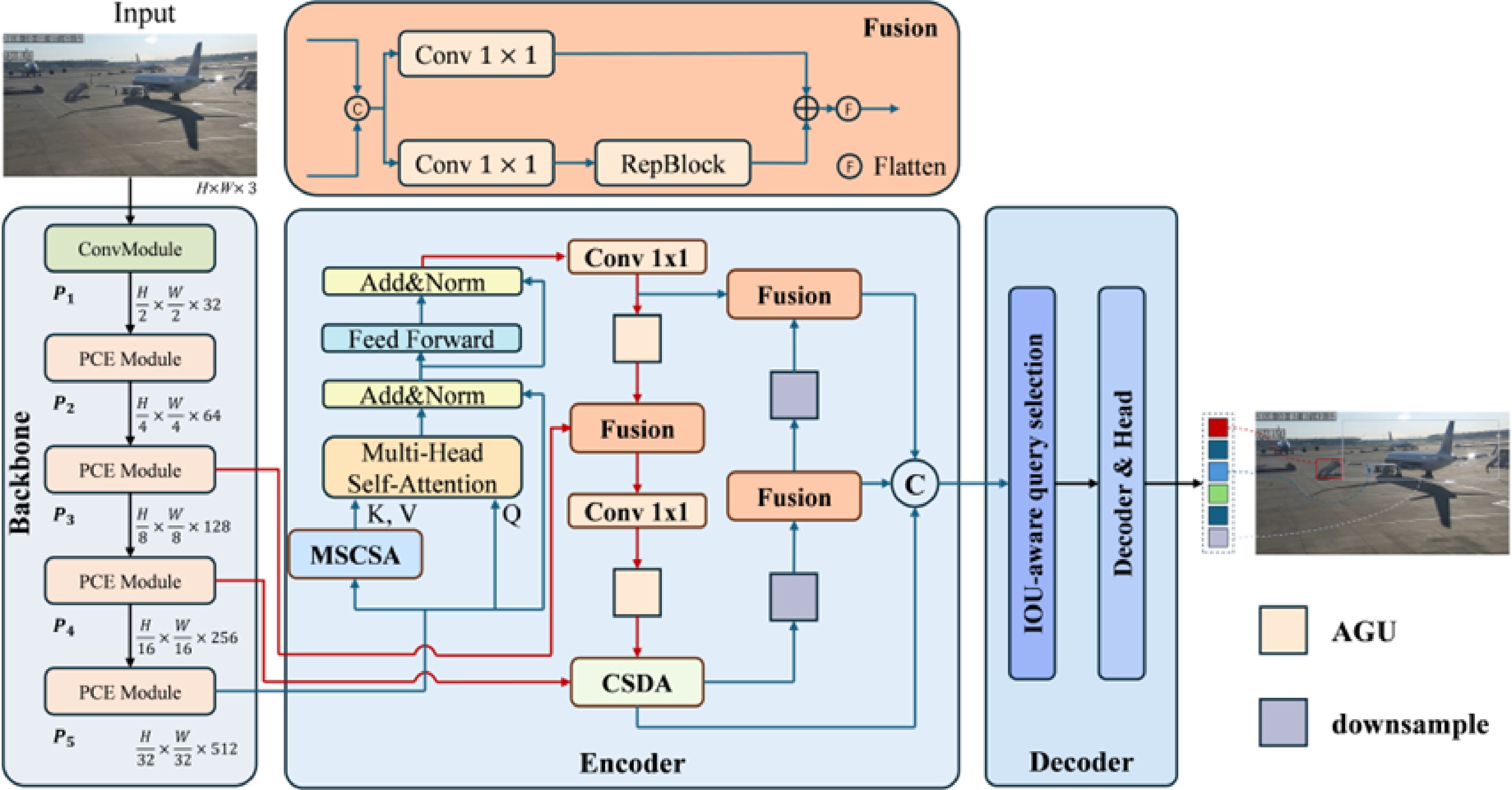
Figure 1.
Overall flow of the proposed algorithm.
From a unified perspective, the proposed AeroRTD framework can be interpreted as an effective solution for enhancing multi-scale feature representation and cross-scale feature interaction. Specifically, the PCE module improves fine-grained feature extraction by strengthening local feature representation, while the MSCSA module enhances global contextual modeling through multi-scale attention mechanisms. Furthermore, the AGU and CSDA modules focus on optimizing cross-scale feature alignment and suppressing redundant information during feature fusion.
Overall, these modules work in a complementary manner to address key challenges in object detection, including scale variation, occlusion, and dense object distribution. This unified design perspective highlights that AeroRTD is not merely a combination of independent modules, but a coherent framework for improving feature representation and interaction in complex detection scenarios.
To further clarify the functional roles of each proposed module and avoid potential ambiguity, a structured comparison is provided in Table 1, summarizing the design motivation and unique contribution of each component in the AeroRTD framework.
Table 1. Functional comparison of proposed modules.
Module Targeted problem Key idea Position Unique role PCE Small objects/fine-grained features Parallel partial conv + linear fusion Backbone Enhance local details MSCSA Scale variation Multi-scale conv + self-attention Encoder Model cross-scale context AGU Misaligned upsampling Dynamic sampling grid Fusion stage Achieve precise alignment CSDA Redundant features Channel + spatial attention Fusion stage Suppress redundant information Parallel Convolution Enhancement module
-
To improve the feature expression capability of the model for object detection in complex airport environments, this paper introduces the PCE module (Parallel Convolution Enhancement module) within the backbone network, inspired by recent lightweight convolution and feature enhancement strategies[34]. The core concept behind this module is parallel feature extraction combined with multi-level information fusion to strengthen the model's feature extraction capacity. Specifically, it is designed to enhance the modeling of local features while maintaining computational efficiency and a lightweight structure. This approach aims to improve the model's recognition accuracy, particularly for fine-grained objects.
As illustrated in Fig. 2, the PCE module (Parallel Convolution Enhancement module) consists of two 3 × 3 partial convolutions (PConv) and several linear transformations, enabling stable training and feature fusion within the deep network via residual connections and DropPath technology. Initially, the input features undergo PConv 3 × 3, which performs convolution operations on a subset of channels, thus significantly reducing the computational load while preserving local spatial information. The output is then fused with another branch containing linear operations before passing through a second PConv 3 × 3 and activation stages to further refine the fine-grained features. During this process, the activation weight of each channel is adaptively adjusted based on the local convolution features, enabling more targeted channel attention. The fused result is projected into the feature space with the same dimensionality as the input via a linear projection, with some connections randomly discarded using DropPath to mitigate overfitting. Finally, the enhanced output features are obtained by adding the result to the original input through a residual connection. The PCE module not only captures local details and spatial context but also improves recognition performance for small objects and complex backgrounds, all while maintaining a high inference speed. It is particularly well-suited for real-time detection tasks, such as identifying aircraft and ground service vehicles in airport scenarios.
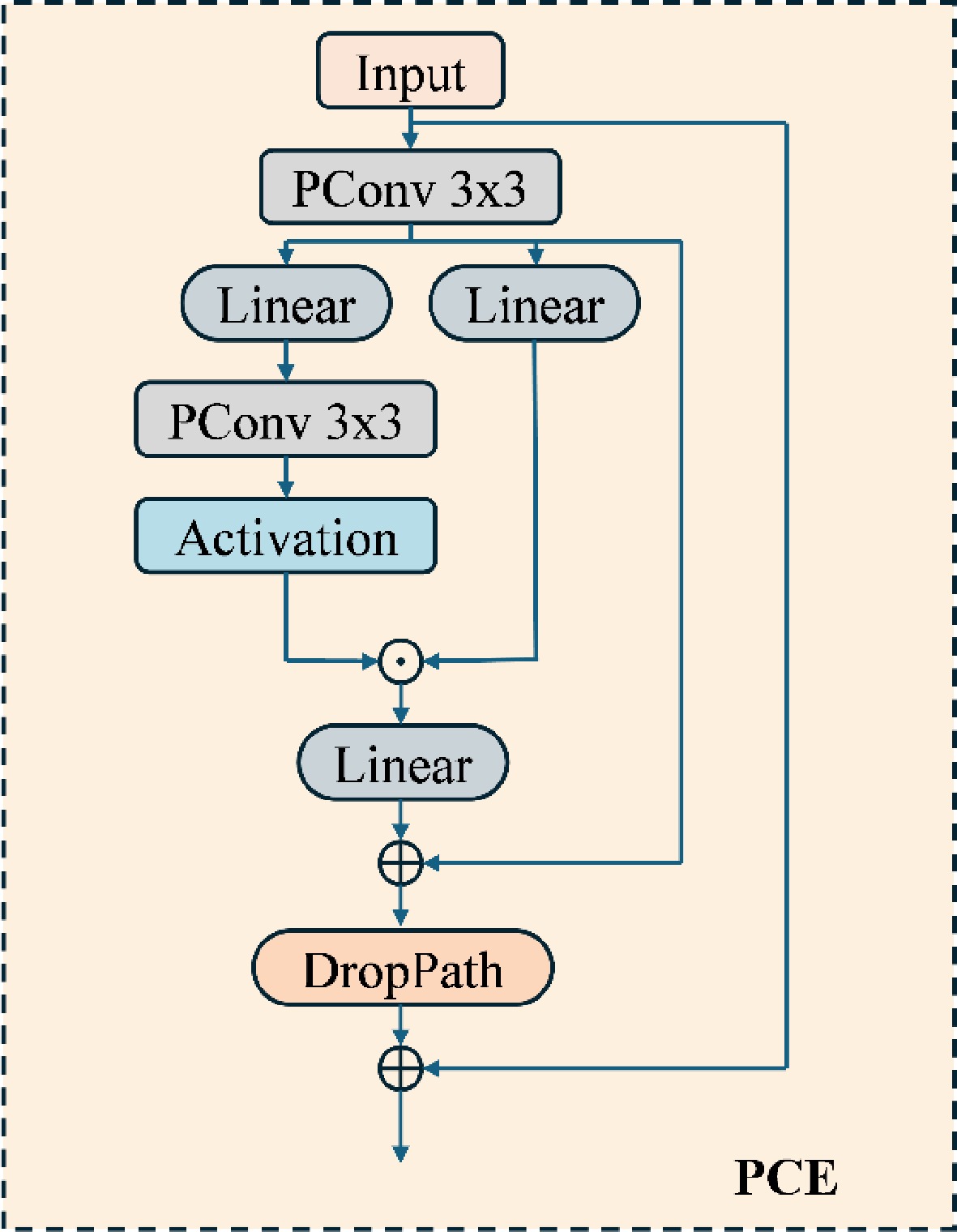
Figure 2.
PCE module.
To effectively fuse features and introduce a dynamic mechanism, the PCE module is designed, and its calculation process can be described in detail through the following formulas. Let the input feature be Xin. The PCE module first introduces a dynamic mask M through partial convolution to screen the effective regions, and its operation is defined as:
$ {X}^{\left(1\right)}=PConv\left({X}^{\left(0\right)},M\right)=\dfrac{\text{Conv}\left({X}^{\left(0\right)}\odot M\right)}{{\displaystyle\sum }_{i,j}{M}_{i,j}+\varepsilon }\sum \limits_{i,j}1+{b}_{1} $ (1) where M is the dynamic mask,
$ \odot $ Subsequently, the feature X(1) goes through two independent linear transformations to achieve the interaction and adjustment of the feature dimensions. The specific calculation is as follows:
$ U={W}_{2}{X}^{\left(1\right)}+{b}_{2},\;\;V={W}_{1}{X}^{\left(1\right)}+{b}_{1} $ (2) where W1 and W2 are the weight matrices of the linear layers, respectively, and b1 and b2 are the corresponding bias terms.
Next, the feature V further undergoes a second partial convolution operation, using a new dynamic mask M' for fine-grained screening, and applying the ReLU activation function to introduce non-linear expression ability. The calculation process is as follows:
$ {X}^{\left(2\right)}=ReLU(PConv(V,M'))=ReLU \left(\dfrac{\text{Conv}\left(V\odot M'\right)}{{\displaystyle\sum }_{i,j}{M}'_{i,j}+\varepsilon }\sum \limits_{i,j}l\right) $ (3) To fuse the local convolution features and the linearly mapped features, the PCE module performs element-wise multiplication on U and X(2) for fusion, obtaining a composite feature representation:
$ {X}^{\left(3\right)}=U\odot {X}^{\left(2\right)} $ (4) The fused feature X(3) then goes through a linear mapping layer to further optimize the feature representation:
$ {X}^{\left(4\right)}={W}_{3}{X}^{\left(3\right)}+{b}_{3} $ (5) To enhance the generalization ability of the model and suppress overfitting, the PCE module introduces the DropPath random dropout mechanism. Specifically, first, a residual connection is made with the output of the partial convolution to obtain:
$ \hat{Y}={X}^{\left(4\right)}+{X}^{\left(1\right)} $ (6) $ Y'=\left\{\begin{array}{cc} 0\ ,& p \\ \dfrac{\hat{Y}}{1-p},& 1-p\end{array}\right\} $ (7) Finally, the module makes a second skip connection between the output processed by DropPath and the original input Xin to obtain the final output feature:
$ {Y}_{\text{out}}={Y}^{\prime}+{X}^{\left(0\right)} $ (8) Multi-scale context self-attention
-
As shown in Fig. 3, the MSCSA (Multi-Scale Context Self-Attention) module is designed to enhance the self-attention mechanism, inspired by transformer-based detection frameworks such as DETR[8] and its variants[15]. For the input feature of size C × H × W, a 1 × 1 convolution is first used to adjust the channel dimension. Subsequently, the feature is divided into three paths, and multi-scale local features are captured through 3 × 3, 5 × 5, and 7 × 7 depthwise separable convolutions (dwConv), respectively. This approach significantly reduces the number of parameters and computational cost required for standard convolution operations while maintaining high model expressiveness. Capturing multi-scale local features through convolution kernels of different scales helps improve the model's adaptability to targets of different sizes. Then, the feature maps obtained from the above three paths are added together and then pooled. The pooled output is processed by a 7 × 7 depthwise separable convolution and a Sigmoid function, and then fused with the processed global features, followed by a 1 × 1 convolution. Meanwhile, global features are extracted through average pooling (AvgPool). These features are sequentially processed by a 1 × 1 convolution, a ReLU activation function, and another 1 × 1 convolution. Finally, K (keys) and V (values) are generated through adaptive pooling. They allow the model to dynamically adjust its focus of attention based on the relationships between different parts of the input, thereby enhancing the model's ability to understand and correlate features of targets at different scales. This design enables the module to provide rich multi-scale context information for the subsequent attention mechanism, effectively enhancing the model's ability to understand and correlate features of targets at different scales.
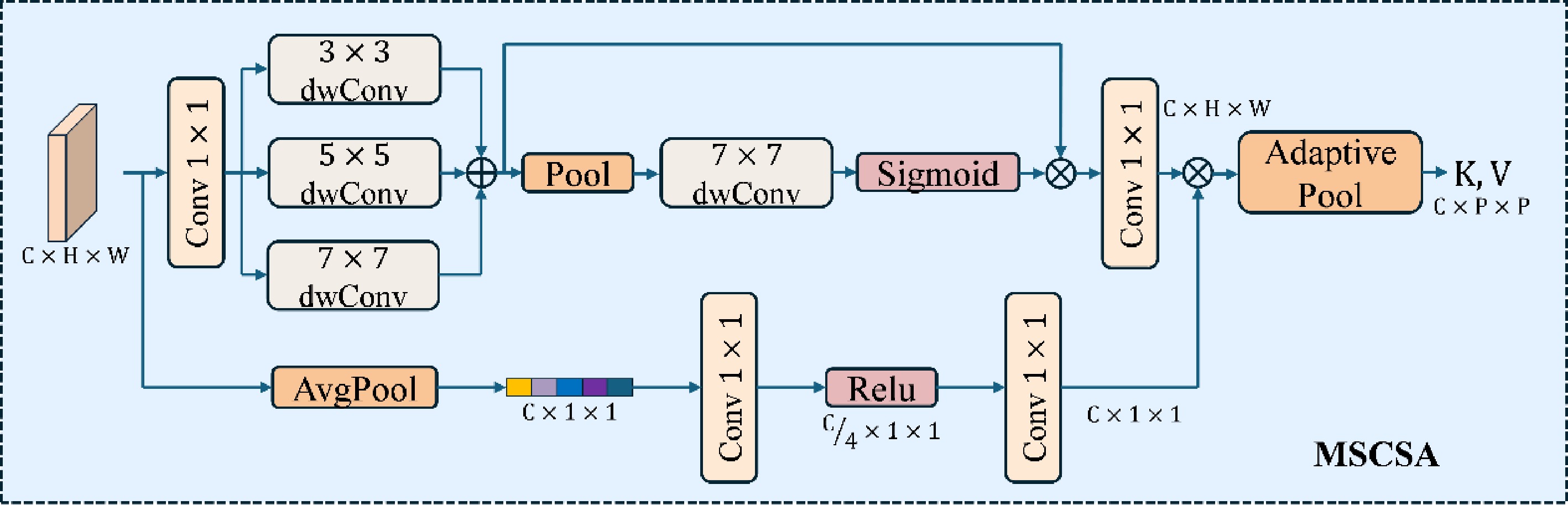
Figure 3.
MSCSA module.
The MSCSA module achieves efficient modeling of complex scenarios through the synergistic effect of multi-scale convolution, spatial attention, channel attention, and self-attention mechanisms. Its core calculation process is as follows:
First, the input features
$ {X\in R}^{C\times H\times W} $ $ D=\sum_{k\in \{3,5,7\}}{\mathrm{DWConv}}_{k\times k}(X) $ (9) where
$ {\text{DWConv}}_{k\times k}(\cdot) $ $ D $ In order to further model the feature responses at the spatial level, MSCSA introduces a spatial attention mechanism. Specifically, a pooling operation is first applied to D to compress the channel information, and then spatial context information is extracted using a 7 × 7 depth-separable convolution and the spatial attention map
$ S\in [0,1{]}^{1\times H\times W} $ $ S=\sigma \left({\text{DWConv}}_{7\times 7}\left(\text{Pool}\left(D\right)\right)\right) $ (10) where
$ \sigma \left(\cdot \right) $ $ \mathrm{Pool}(\cdot ) $ Meanwhile, to capture the inter-channel dependencies, the module introduces a channel attention mechanism. Firstly, the input features X are globally average-pooled to compress the spatial dimensions, followed by a two-layer 1 × 1 convolution to achieve the compression and recovery of the channel dimensions, and the Sigmoid function to generate the channel attention weights
$ F\in [0,1{]}^{C\times 1\times 1} $ $ F=\sigma \left({W}_{2}\text{ReLU}\left({W}_{1}\text{AvgPool}\left(X\right)\right)\right) $ (11) where
$ \mathrm{AvgPool} (\cdot ) $ $ {W}_{1}\in {\text{R}}^{\frac{C}{4}\times C} $ $ {W}_{2}\in {\text{R}}^{C\times \frac{C}{4}} $ Next, spatial attention and channel attention are weighted and summed to the input feature X, respectively, to obtain the fused feature. The information is then further fused by a 1 × 1 convolution to form the final enhanced feature representation X' with the following formula:
$ {X}^{\prime}={\text{Conv}}_{1\times 1}\left(X\odot S+X\odot F\right) $ (12) where
$ \odot $ Finally, the augmented feature X' is channel-transformed by another layer of 1 × 1 convolution, and Key and Value features for subsequent attention mechanisms (e.g., self-attention or interaction modules) are generated by an Adaptive Pooling operation:
$ K,V=\text{AdaptivePool}\left({\text{Conv}}_{1\times 1}\left({X}^{\prime}\right)\right) $ (13) where K and V are generated by adaptive pooling for subsequent self-attention computation.
AGU
-
In the feature fusion stage of RT-DETR[15], low-resolution semantic features need to be aligned with higher-resolution spatial features. In UAV airport images, this process is particularly important because small vehicles, personnel, and partially occluded aircraft structures may occupy only limited image regions. Conventional upsampling operations restore feature resolution using fixed interpolation rules, which may weaken boundary details and introduce inaccurate feature alignment in dense airport scenes. To improve the recovery of spatial details while maintaining computational efficiency, this study introduces Adaptive Grid Upsampling (AGU) into the cross-scale feature fusion process. Inspired by dynamic point-sampling strategies[35], AGU learns adaptive offsets for sampling locations and adjusts the sampling range according to feature content, thereby improving feature alignment for small and scale-varying targets. The overall structure of the AGU module is shown in Fig. 4.
Feature encoding: Learn offsets through convolution to provide adaptive sampling point position adjustment relative to the standard grid. Since the offset of each position is dynamically learned, it can adapt to the information requirements of different regions, especially the edge regions. Apply a 2D convolution to the low-resolution feature map
$ X\in {\text{R}}^{H\times W\times C} $ $ \Delta P={f}_{\theta }\left(X\right)\in {\mathbb{R}}^{H\times W\times 2g{{s}^{2}}} $ (14) where
$ {f}_{\theta }\left(\cdot \right) $ $ \text{Δ}P $ $ H\times W\times 2g{s}^{2} $ $ 2g{s}^{2} $ $ \mathit{\Delta }x $ $ \mathit{\Delta }y $ $ g{s}^{2} $ Dynamic offset prediction: Use a grouping strategy to calculate the offset information of different regions and generate new sampling positions through normalized coordinates. To make the sampling point distribution adapt to the input features, we use standard normalized coordinates:
$ P_{grid}=\left(\dfrac{2i}{W}-1,\dfrac{2j}{H}-1\right),\ \ \ i=0,\cdots,W-1,\ \ \ \ \ j=0,\ldots,H-1 $ (15) $ {P}_{sample}={P}_{grid}+\Delta P $ (16) where Pgrid is the standardized grid coordinate, with a range between [−1, 1]; and Psample is the sampling position after adding the dynamic offset. Mapping the normalized coordinates to the range of [−1, 1] allows the offsets to be adjusted on a unified scale. By dynamically predicting the offset ΔP, the distribution of sampling points can be changed, enhancing the feature capture ability of different regions.
Adaptive scale regulation: A dynamic range factor Sdyn is introduced, which can adaptively adjust the scale of the offset according to the feature content. This helps to reduce the sampling overlap problem and enhance the information capture ability in edge regions:
$ {S}_{dyn}=\sigma \left({W}_{s}*X\right) $ (17) $ \Delta {P}^{\prime}={S}_{dvn}\cdot \Delta P $ (18) where Ws is an additional convolution weight used to learn the range factor;
$ \sigma \left(\cdot \right) $ Grid-based bilinear interpolation sampling: Bilinear interpolation can be used to smoothly obtain feature values and avoid information loss caused by sampling at non-integer positions. Combining with dynamic offsets enables the feature map to be more accurately aligned to appropriate sampling point positions. Since the sampling points Psample may fall between the pixel grids, bilinear interpolation is used to calculate the final features:
$ Y(x,y)=\sum_{m=0}^1\sum_{n=0}^1 w_{mn}X(x_m,y_n) $ (19) $ {w}_{mn}=\left(1-\left| x-{x}_{m}\right| \right)\left(1-\left| y-{y}_{n}\right| \right) $ (20) where
$ \left({x}_{m},{y}_{n}\right) $ $ {w}_{mn} $ $ Y\left(x,y\right) $ 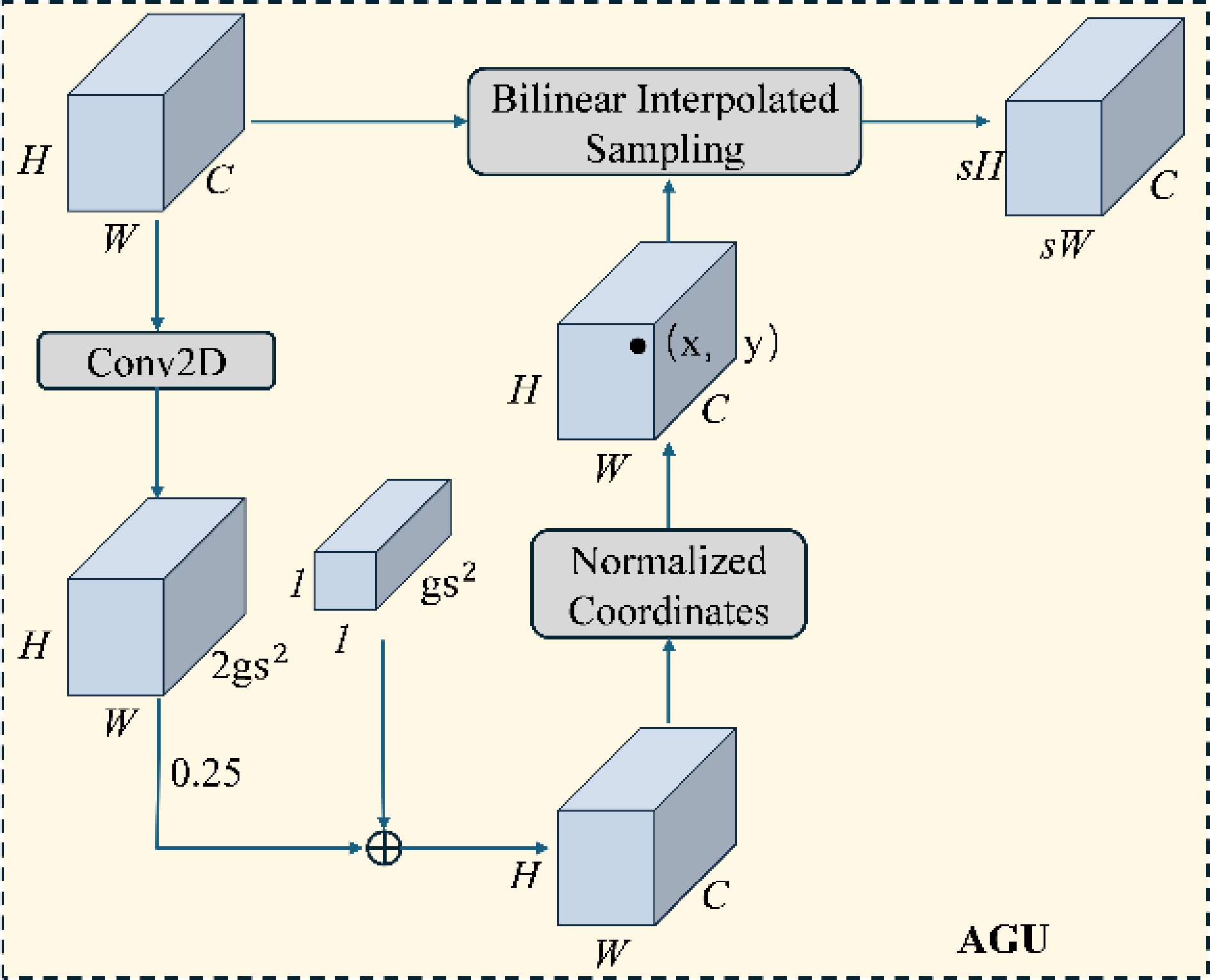
Figure 4.
AGU module.
Channel–Spatial Dual Attention module
-
Traditional fusion modules are mainly used for cross-scale feature fusion to enhance the detector's perception ability of targets at different scales. However, ordinary feature fusion methods usually adopt convolution or weighted summation, making it difficult to capture global information in both the channel and spatial dimensions simultaneously. This paper proposes the Channel–Spatial Dynamic Attention (CSDA) module to replace the Fusion module in RT-DETR, aiming to enhance the modeling ability of multi-scale features and optimize computational efficiency at the same time. The CSDA (Channel–Spatial Dynamic Attention) module aims to optimize the feature fusion process in RT-DETR to improve the performance of object detection. Its core idea is to combine channel attention and spatial attention, inspired by attention mechanisms widely used in computer vision[36], thereby enhancing the ability to extract key information. First, the module extracts channel-level features through global average pooling and calculates channel weights using a non-linear transformation to highlight useful information and suppress redundant interference. Then, a spatial attention mechanism is used to calculate the correlation between feature points, enabling the model to dynamically adjust the weights of different regions and enhance the spatial perception ability of targets. Finally, the feature maps after fusing channel and spatial attention are combined to achieve a more accurate target representation. This module effectively alleviates the over-dependence of traditional fusion methods on high-resolution features and reduces computational redundancy, enabling the detector to more efficiently detect small and dense targets in complex airport scenarios. The specific network structure is shown in Fig. 5. The core idea is as follows:
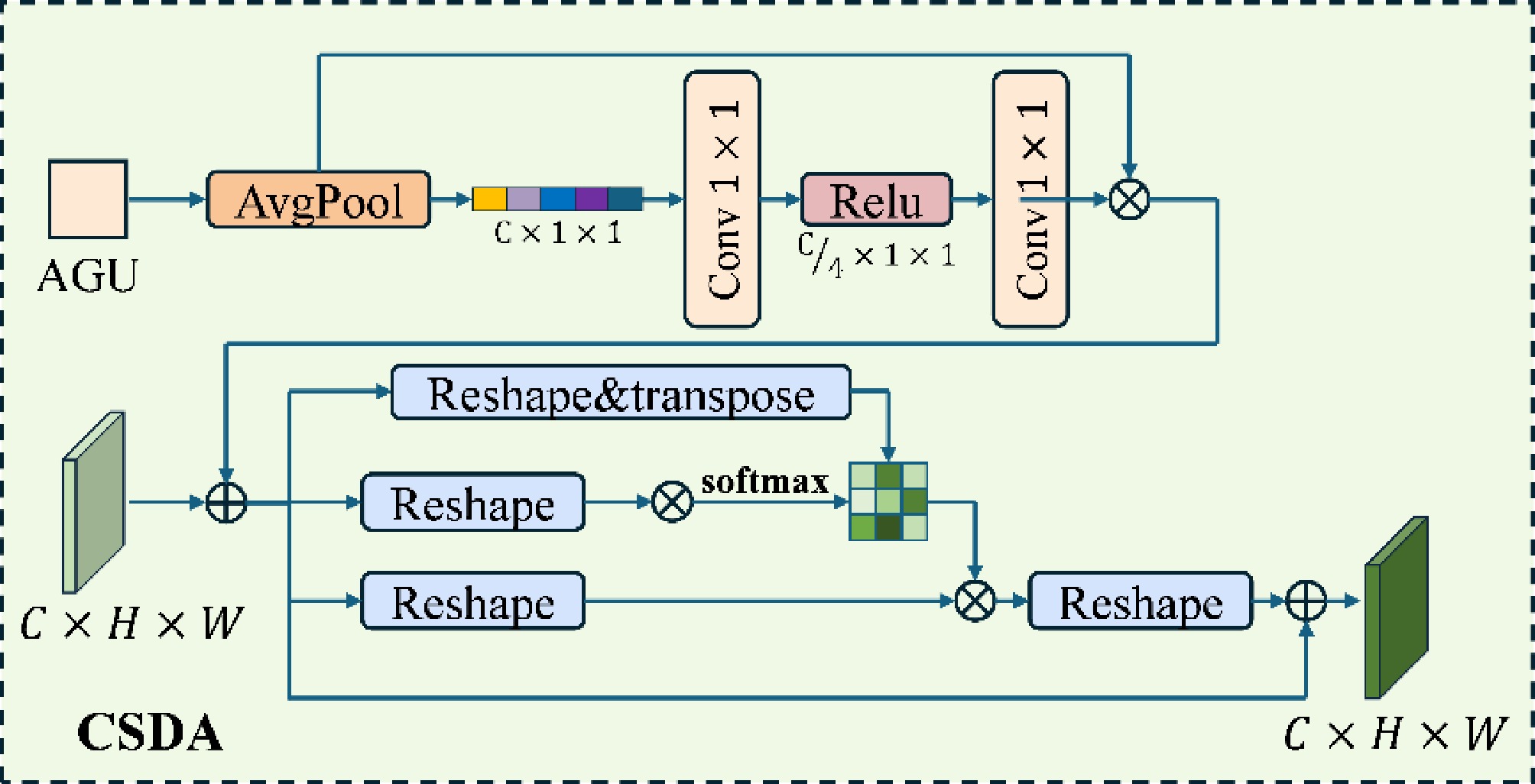
Figure 5.
CSDA module.
Calculate the importance of channel-level features through global average pooling (GAP), enabling the network to adaptively adjust the weights of each channel to enhance the focus on key features. For the input feature map
$X\in {\mathbb{R}}^{H\times W\times C}$ $ X_{gap}=\dfrac{1}{H\times W}\sum_{i=1}^{H}\sum_{j=1}^W X_{c,i,j} $ (21) Then, the channel weights Sc are calculated through a fully connected layer:
$ {S}_{c}=\sigma \left({W}_{2}\delta \left({W}_{1}{X}_{gap}\right)\right) $ (22) where
$ \delta (\cdot ) $ $ \sigma (\cdot ) $ Rearrange the input feature X into a matrix form and calculate the spatial attention matrix. Then, normalize it using the Softmax function to ensure the stability of the attention weights:
$ A=softmax\left({X}^{T}X\right) $ (23) Then, calculate the weighted features:
$ {X}_{att}=AX $ (24) where A is the spatial attention matrix that represents the correlation between feature points.
Finally, fuse the channel attention and spatial attention to obtain the final output:
$ Y={X}_{att}\cdot {S}_{c} $ (25) where
$Y\in {\mathbb{R}}^{C\times H\times W}$ -
In this study, the AFTD (Airport Surface Foreground Target Detection) dataset is selected as the experimental verification object. AFTD is an application-oriented dataset for monitoring moving targets on the airport surface[37]. Currently, the AFTD dataset consists of 10,050 image data, which includes 25,968 aircraft instances, 24,388 vehicle instances, and 5,745 person instances. It covers various challenges in airport surface movement target detection, such as extreme multi-scale, multi-level occlusion, and viewpoint changes. A total of 6,868 images are selected for the training set, 1,963 for the validation set, and 982 for the test set. There are three types of objects and various image sizes, and the distribution of the dataset is shown in Fig. 6.
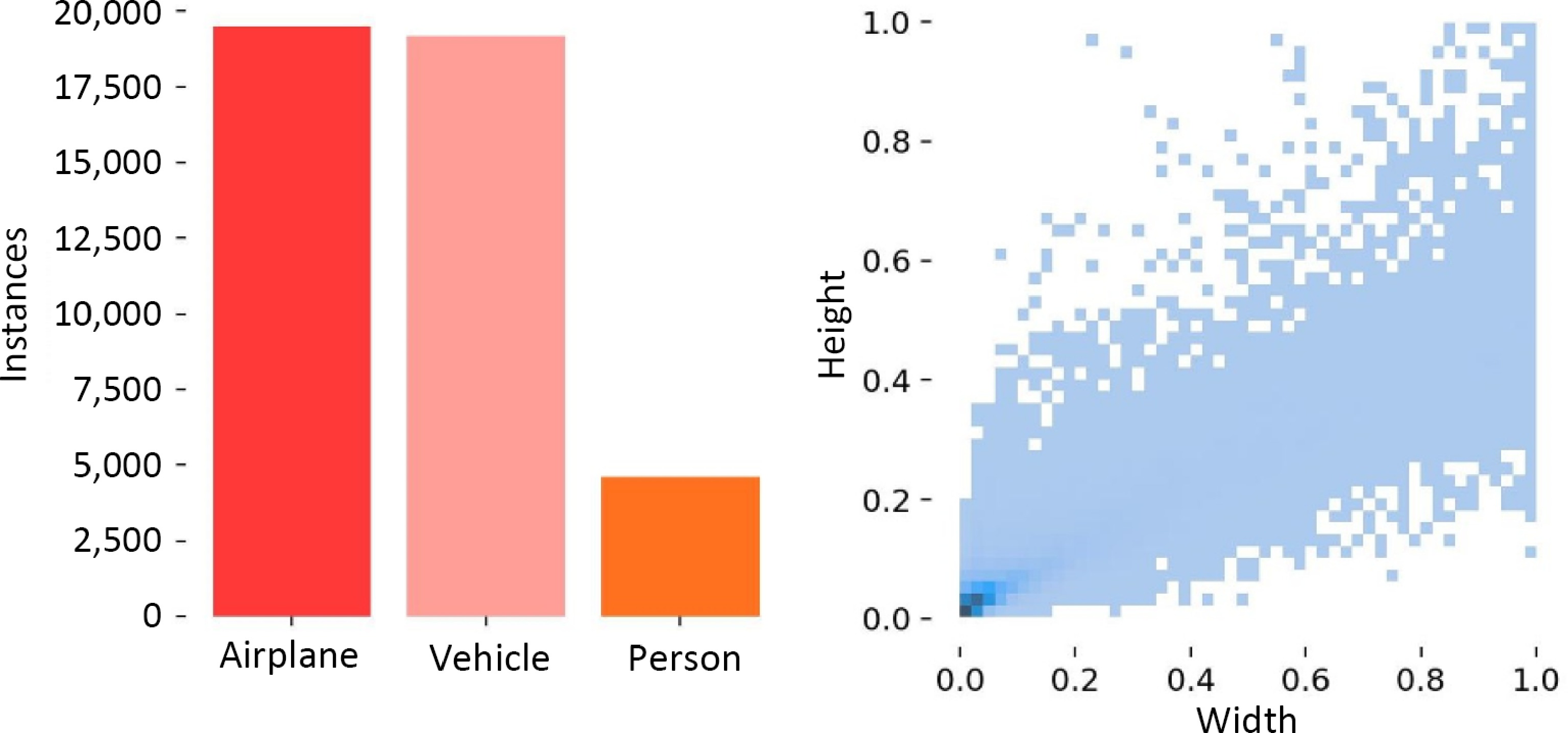
Figure 6.
Target category distribution and size diagram.
Experimental validation
Setting
-
The experimental platform processor for this paper is the Intel(R) Core(TM) i7-14700KF 20-Core processor; the GPU uses the RTX 4090 with a system video memory size of 24 GB; the operating system is Ubuntu 20.04, and the programming language is Python 3.8 with PyTorch 1.13.0 architecture. As shown in Table 2, the main training parameters include 300 epochs, a batch size of 16, an input image size of 640, and the AdamW optimizer with an initial learning rate of 0.0001.
Table 2. Setting table of experimental environment parameters.
Parameters Settings Epochs 300 Batch 16 Imgsz 640 Workers 4 Optimizer AdamW[38] Lr0 0.0001 In this paper, we use the commonly used detection performance metrics (mean average precision mAP@50, mAP@50–95, precision P [Precision], recall R [Recall]) and model efficiency metrics (number of model parameters Paras, inference speed FPS) in the field of target detection to comprehensively validate the detection effect of the model. Among them, mAP@50 represents the average precision mean value when the intersection and merger ratio threshold is 0.5, mAP@50–95 reflects the average detection precision under different intersection and merger ratio thresholds from 0.5 to 0.95, and FPS quantifies the real-time inference capability of the model by processing frames per second.
Comparison experiment
-
This experiment evaluates the performance of various target detection algorithms on the airport field target detection dataset with respect to precision (P), recall (R), mean average precision (mAP) of different IoU thresholds (
$ {mAP}_{0.5} $ $ {mAP}_{0.5:0.95} $ As shown in Fig. 7, in the initial training phase (Epoch 0−50), the
$ {mAP}_{0.5} $ $ {mAP}_{0.5} $ $ {mAP}_{0.5:0.95} $ $ {mAP}_{0.5} $ $ {mAP}_{0.5} $ $ {mAP}_{0.5:0.95} $ $ {mAP}_{0.5} $ $ {mAP}_{0.5:0.95} $ 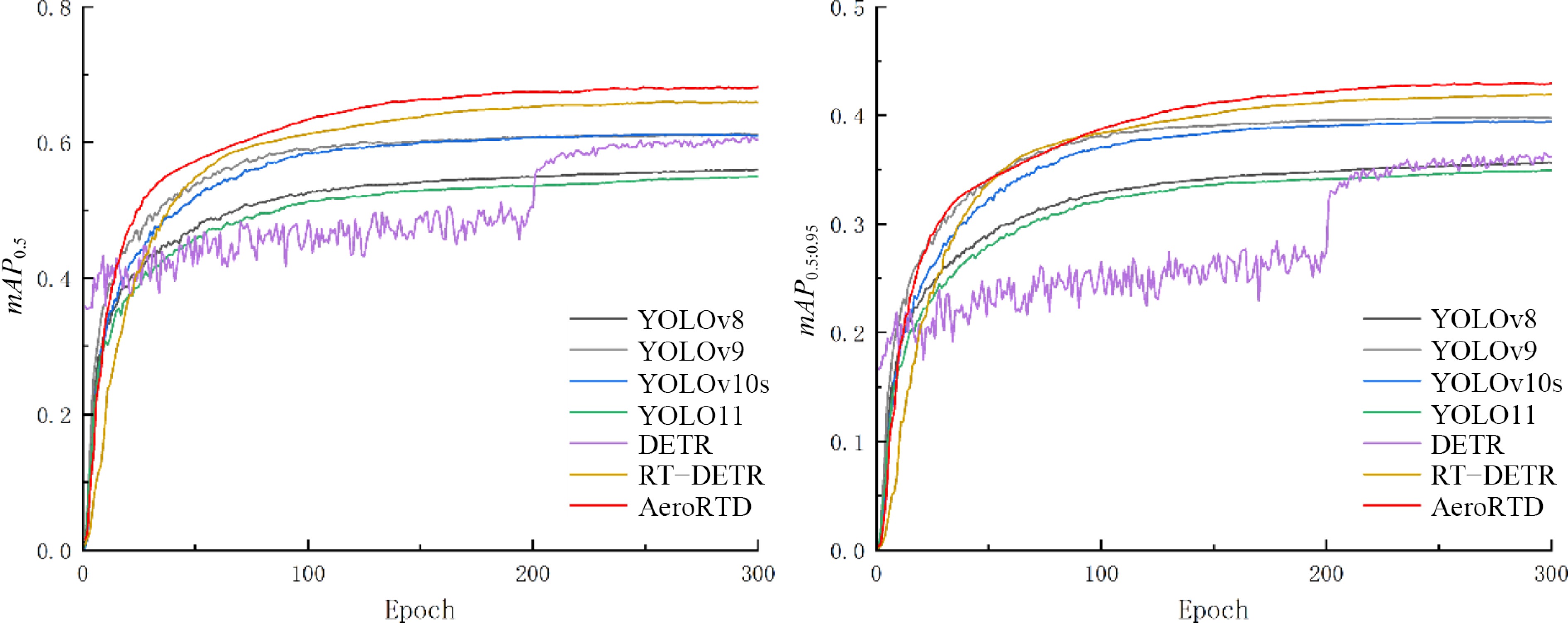
Figure 7.
Comparative experimental chart.
As shown in Table 3, AeroRTD has the best precision (0.758) and recall (0.635), which indicates that it can identify the target more accurately and miss fewer targets; RT-DETR has the second-best precision (0.754) and recall (0.612), while YOLOv9 and YOLOv10s also have good performance in terms of precision and recall. In terms of the number of parameters, DETR is as high as 36,739,785, which is a complex model, while AeroRTD is 15,762,572, which is relatively lightweight and has excellent performance. GFLOPs reflect the amount of operations, with DETR at 100.94, which is a heavy burden of operations, and AeroRTD at 50.9, which is moderate in terms of the amount of operations. In terms of inference speed, AeroRTD (ours) leads with 23.89 FPS, balancing detection, accuracy, and speed; RT-DETR is 22.59 FPS, which is also good for real-time performance; in the YOLO series, YOLOv8 is 13.14 FPS, YOLOv9 is 10.77 FPS, YOLOv10s is 11.96 FPS, YOLOv11 is 12.96 FPS, DETR is 11.85 FPS, and the inference speed is relatively slow.
Table 3. Comparison parameter table.
Modules P R mAP0.5 mAP0.5:0.95 Params GFLOPs FPS YOLOv8[23] 0.701 0.518 0.56 0.357 3,006,233 8.1 13.14 YOLOv9[24] 0.743 0.567 0.613 0.399 7,168,249 26.7 10.77 YOLOv10s[25] 0.734 0.567 0.611 0.394 8,037,282 24.5 11.96 YOLOv11[39] 0.659 0.521 0.55 0.35 2,582,737 6.3 12.96 DETR[8] – – 0.604 0.362 36,739,785 100.94 11.85 RT-DETR[15] 0.754 0.612 0.659 0.419 19,875,612 56.9 22.59 AeroRTD (ours) 0.758 0.635 0.681 0.43 15,762,572 50.9 23.89 Bold values represent the best-performing results for the corresponding metrics. To further evaluate the generalization capability of the proposed AeroRTD, we conduct additional experiments on the public VisDrone2019 dataset. This dataset contains a large number of small and densely distributed objects captured in UAV scenarios, which is significantly different from the AFTD dataset.
For the VisDrone2019 experiments, we used the object detection subset and followed the official data split. The training set was used for model optimization, the validation set was used for performance evaluation during training, and the test set was used for final comparison. Unless otherwise specified, all compared methods were trained and evaluated under the same experimental environment as the AFTD experiments, using an input size of 640, a batch size of 16,300 training epochs, the AdamW optimizer, and an initial learning rate of 0.0001. The experiments were conducted on the same workstation equipped with an Intel Core i7-14700KF CPU and an NVIDIA RTX 4090 GPU with 24 GB of memory, ensuring a fair comparison under identical hardware and training settings.
As shown in Table 4, AeroRTD achieves competitive performance compared with other state-of-the-art methods, demonstrating its strong generalization ability across different datasets and application scenarios.
Table 4. Performance comparison on VisDrone2019 dataset.
In order to visually compare the regions of interest of YOLOv8, RT-DETR, and the AeroRTD proposed in this paper on target detection, we visualised the heatmaps of their responses on the same test image. The heatmaps were all generated using GradCAMPlusPlus with consistent parameter settings to ensure fairness of comparison. As shown in Fig. 8, YOLOv8's activation hotspots are more dispersed, especially at both the background and target edges, which tends to introduce noise and lead to an increased risk of false detection. RT-DETR is more responsive in the main body area, but still generates large hotspots at the tail or the bottom of the aircraft, which suggests that it is not yet accurate enough to localise the details. The thermograms of AeroRTD (ours), on the other hand, show the most focused activation: almost all the high-intensity response is focused on the key structures of the target (the centre of the fuselage and the nose area), while the response to the background and non-target areas is effectively suppressed. In the third row of samples (small aircraft at night), the activation signals of YOLOv8 and RT-DETR are weak and scattered for small targets, whereas AeroRTD gives a clear, focused, and higher-confidence (see labelling in the figure) response, even in low light and with a small target size. From the confidence labels on the thermograms, AeroRTD's detection confidence is slightly higher or equal to other methods in all cases (e.g., 0.92 to 0.97 in the first row and 0.98 to 0.99 in the second row), and its thermograms are much more interpretable. AeroRTD can provide a more focused response in a variety of complex scenarios than YOLOv8 and RT-DETR. AeroRTD, compared with YOLOv8 and RT-DETR, can provide more focused and accurate activation heat maps in various complex scenarios, accompanied by higher detection confidence, which proves the advantages of this method in terms of localisation accuracy and robustness.
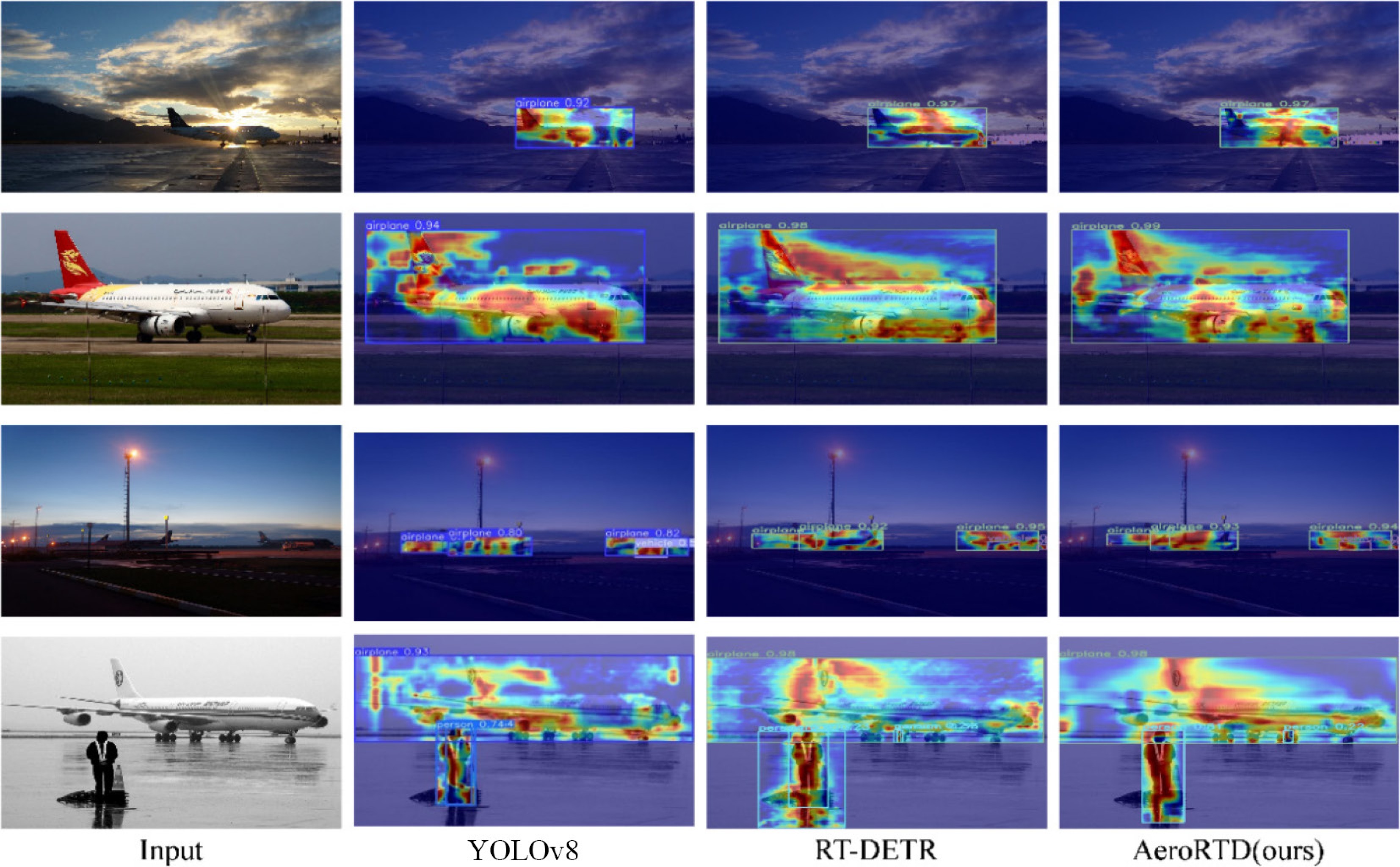
Figure 8.
Visualization results.
Although the AFTD dataset is a publicly available benchmark for airport surface target detection, it does not provide an official scale-based categorization (e.g., small, medium, and large objects) as defined in datasets such as COCO. Therefore, a strictly standardized scale-wise quantitative evaluation cannot be directly conducted in this study.
Nevertheless, the AFTD dataset inherently contains significant scale variations. For example, aircraft may occupy a large portion of the image, while ground personnel and service vehicles often appear as small or densely distributed targets. This characteristic makes it particularly suitable for evaluating the robustness of detection models under scale variation.
From the experimental results and visualization analysis, AeroRTD demonstrates strong performance in handling such challenges. In particular, the proposed method shows clear advantages in detecting small and densely distributed targets, as evidenced by the improved mAP performance and the more focused activation regions in the visualization results. This improvement can be attributed to the PCE module, which enhances fine-grained feature representation, and the MSCSA and AGU modules, which effectively model multi-scale contextual information and improve cross-scale feature alignment.
These observations indicate that, although explicit scale-wise metrics are not available, the proposed AeroRTD framework exhibits robust performance across a wide range of target scales in complex airport scenarios.
Ablation results
-
In order to systematically verify the function of each core component in the proposed model, this study designs an ablation experiment system. By selectively removing the key modules of the model, the experiment compares the performance of the model with different component configurations while ensuring that the network architecture, training hyperparameters (learning rate, iteration rounds, etc.), and dataset partitioning rules are identical. The ablation results of different module combinations are shown in Table 5, where A, B, and C denote the PCE module, MSCSA module, and the AGU + CSDA fusion strategy, respectively.
Table 5. Table of ablation experiments.
Modules P R mAP0.5 mAP0.5:0.95 Params GFLOPs FPS RT-DETR (baseline) 0.754 0.612 0.659 0.419 19,875,612 56.9 22.59 Baseline + A 0.757 0.624 0.669 0.429 15,405,804 46.2 25.47 Baseline + A + B 0.76 0.624 0.675 0.424 15,726,988 50.7 23.03 Baseline + A + B + C 0.758 0.635 0.681 0.43 15,762,572 50.9 23.89 Compared to the RT-DETR benchmark model, adding components gradually improves the precision and recall of the model. After adding component PCE, the precision improves from 0.754 to 0.757, and the recall improves from 0.612 to 0.624, indicating that A can enhance the model's ability to identify and detect targets. Further adding component B, the degree improves to 0.76, confirming the positive effect of B in enhancing the targeting of feature extraction. After adding all components, the recall rate increases significantly to 0.635, and the precision is maintained at 0.758, indicating that component C can help the model to identify more targets and maintain accuracy.
On the
$ {mAP}_{0.5} $ $ {mAP}_{0.5:0.95} $ In terms of the number of model parameters, the number of GFLOPs decreases significantly after adding component A, and increases slightly after adding component B and all components, but the overall level stays low. In terms of GFLOPs, the computational burden decreases after adding component A and increases slightly after adding component B and all components, which is still within a reasonable range. In terms of inference speed, FPS is increased after adding component A and maintained at 23.89 after adding all components, maintaining high real-time performance.
In summary, the core components A, B, and C can effectively improve the model performance, not only significantly improving the detection precision and recall rate but also reasonably controlling the model complexity and maintaining a high inference speed, which verifies the effectiveness and necessity of these components in model optimisation.
To further analyze the contribution of each module, we examine the incremental performance gains brought by each component. It can be observed that the introduction of the PCE module leads to a noticeable improvement, indicating its effectiveness in enhancing fine-grained feature representation. The MSCSA module further improves performance by strengthening multi-scale contextual modeling, which is particularly beneficial for handling scale variation.
In contrast, the AGU and CSDA modules contribute more moderate but consistent improvements, mainly by refining feature alignment and enhancing feature fusion efficiency. These results suggest that while all modules are beneficial, their contributions are not equally significant, and they play complementary roles in improving the overall detection performance.
-
This paper proposes AeroRTD, an enhanced real-time detection framework for UAV-based airport target detection under complex conditions. Built upon RT-DETR, the proposed method improves feature representation, contextual modeling, and cross-scale fusion, enabling robust detection of small, densely distributed, and occluded targets. Experimental results on the AFTD dataset demonstrate that AeroRTD achieves superior detection performance while maintaining a lightweight architecture and efficient inference speed. These results validate the effectiveness and practicality of the proposed approach for real-world airport monitoring applications. Future work will focus on incorporating multi-modal sensing (e.g., infrared and radar) and semantic prior information to further enhance robustness under challenging conditions such as low illumination and adverse weather.
-
The authors confirm their contributions to the paper as follows: study conception and design: Qu X, Wang Xichao; data collection: Zhang J, Jiang Y; analysis and interpretation of results: Zhang J, Liu S; draft manuscript preparation: Wang Xia. All authors reviewed the results and approved the final version of the manuscript.
-
The VisDrone2019 dataset used in this study is publicly available at: https://github.com/VisDrone/VisDrone-Dataset. The dataset used in this study (AFTD) is publicly available. The data can be accessed from the corresponding published source. No additional data were generated during the current study.
-
The authors declare that they have no conflict of interest.
- Copyright: © 2026 by the author(s). Published by Maximum Academic Press, Fayetteville, GA. This article is an open access article distributed under Creative Commons Attribution License (CC BY 4.0), visit https://creativecommons.org/licenses/by/4.0/.
-
About this article
Cite this article
Qu X, Zhang J, Wang X, Liu S, Wang X, et al. 2026. AeroRTD: boosting UAV-based airport target recognition with a lightweight enhanced RT-DETR framework. International Journal of Micro Air Vehicles 18: e015 doi: 10.48130/mav-0026-0007 

AeroRTD: boosting UAV-based airport target recognition with a lightweight enhanced RT-DETR framework
- Received: 30 January 2026
- Revised: 03 April 2026
- Accepted: 16 June 2026
- Published online: 29 September 2026
Abstract: When micro unmanned aerial vehicles (UAVs) are deployed for airport target detection, they face significant challenges such as complex backgrounds, frequent occlusion, and large-scale variations, which degrade detection accuracy and real-time performance. To address these issues, this paper proposes AeroRTD, an enhanced detection algorithm based on an improved RT-DETR framework. Specifically, a Parallel Convolution Enhancement (PCE) module is introduced to improve feature representation, while a Multi-Scale Contextual Self-Attention (MSCSA) module and a Channel-Spatial Dual Attention (CSDA) module are designed to enhance multi-scale contextual modeling and robustness to scale variations. In addition, an Adaptive Grid Upsampling (AGU) module is proposed to improve feature fusion efficiency. Experimental results on the AFTD dataset demonstrate that AeroRTD achieves superior performance compared with both the baseline RT-DETR and several state-of-the-art object detection methods. The proposed method reaches an mAP0.5 of 0.681 with an inference speed of 23.89 FPS, achieving improved accuracy while maintaining a lightweight model structure (15.76 M parameters) and moderate computational cost (50.9 GFLOPs). These results indicate that AeroRTD provides an effective and efficient solution for UAV-based airport target detection in complex environments.