









Search
2025 Volume 1
Article Contents
REVIEW   Open Access    

Biohybrids for sustainable chemical synthesis

  • Full list of author information is available at the end of the article.

  • Biohybrids employ abiotic materials to tap diverse energies for biosynthesis.

    Biocathode limitations and formate-mediated tandem reactions were reviewed.

    Solar-powered semi-artificial photosynthetic systems were covered.

    Abiotic-microbial interactions, energy form, and applications were outlooked.

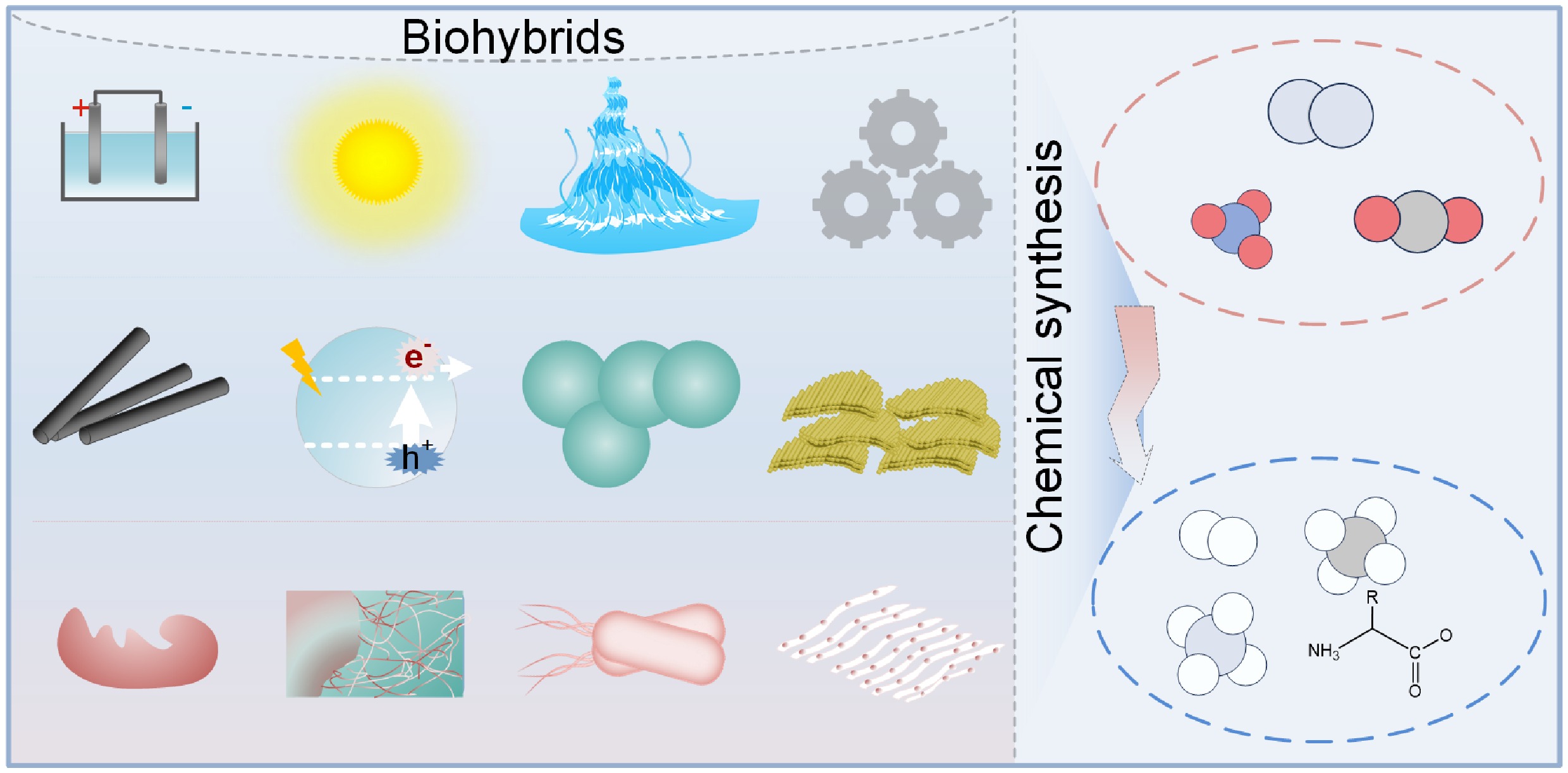
  • Amid rising global energy demands and mounting environmental challenges, the development of sustainable chemical synthesis technologies has become increasingly imperative. Biohybrid synthesis systems present a promising pathway by integrating abiotic materials capable of harnessing diverse energy sources—including direct current electricity, solar radiation, hydrovoltaic, and mechanical energy—to generate excited electrons that drive the metabolic activities of various biological components. This review first examines recent advances in microbial electrosynthesis (MES) technologies that utilize poised electrodes to replicate the activated abiotic materials capable to excite electrons. Special emphasis is placed on the structural limitations of biocathodes and innovations in formate-mediated electrocatalytic–biocatalytic tandem systems. Additionally, the review highlights progress in semi-artificial photosynthetic systems that utilize whole cells to directly capture solar energy for the biosynthesis of value-added chemicals. Emerging frontiers in biohybrid design are also explored, with a focus on the incorporation of hydrovoltaic and piezoelectric materials. The review further underscores the critical importance of understanding the interactions between abiotic materials and microbial systems, and discusses the potential of alternative energy modalities for constructing biohybrids, along with their applications in diverse environmental contexts. In conclusion, this work offers timely insights into cutting-edge technologies at the intersection of energy and environmental science, contributing to the advancement of sustainable chemical synthesis for a more resilient future.
    Graphical Abstract
  • 加载中
  • [1] Xie W, Li B, Liu L, Li H, Yue M, et al. 2025. Advanced systems for enhanced CO2 electroreduction. Chemical Society Reviews 54:898−959 doi: 10.1039/D4CS00563E

    CrossRef   Google Scholar

    [2] Chu N, Li D, Zeng RJ, Jiang Y, Liang P. 2025. Microbial electrochemical wastewater refining. Engineering 46:245−256 doi: 10.1016/j.eng.2024.07.018

    CrossRef   Google Scholar

    [3] Van Den Berghe M, Walworth NG, Dalvie NC, Dupont CL, et al. 2024. Microbial Catalysis for CO2 Sequestration: A Geobiological Approach. Cold Spring Harbor Perspectives in Biology 16:a041673 doi: 10.1101/cshperspect.a041673

    CrossRef   Google Scholar

    [4] Gong A, Wang G, Qi X, He Y, Yang X, et al. 2025. Energy recovery and saving in municipal wastewater treatment engineering practices. Nature Sustainability 8:112−119 doi: 10.1038/s41893-024-01478-5

    CrossRef   Google Scholar

    [5] Fasihi M, Jouzi F, Tervasmäki P, Vainikka P, Breyer C. 2025. Global potential of sustainable single-cell protein based on variable renewable electricity. Nature Communications 16:1496 doi: 10.1038/s41467-025-56364-1

    CrossRef   Google Scholar

    [6] Zhu Q, Rooney CL, Shema H, Zeng C, Panetier JA, et al. 2024. The solvation environment of molecularly dispersed cobalt phthalocyanine determines methanol selectivity during electrocatalytic CO reduction. Nature Catalysis 7:987−999 doi: 10.1038/s41929-024-01190-9

    CrossRef   Google Scholar

    [7] Zhang ZM, Wang T, Cai YC, Li XY, Ye JY, et al. 2024. Probing electrolyte effects on cation-enhanced CO2 reduction on copper in acidic media. Nature Catalysis 7:807−817 doi: 10.1038/s41929-024-01179-4

    CrossRef   Google Scholar

    [8] Zhang S, Shen Y, Zheng C, Xu Q, Sun Y, et al. 2024. Recent advances, challenges, and perspectives on carbon capture. Frontiers of Environmental Science & Engineering 18:75 doi: 10.1007/s11783-024-1835-0

    CrossRef   Google Scholar

    [9] Xu M, Zhou H, Zou R, Yang X, Su Y, et al. 2021. Beyond the farm: Making edible protein from CO2 via hybrid bioinorganic electrosynthesis. One Earth 4:868−878 doi: 10.1016/j.oneear.2021.05.007

    CrossRef   Google Scholar

    [10] Shi J, Lin Y, Li P, Mickel P, Sun C, et al. 2024. Monolithic-to-focal evolving biointerfaces in tissue regeneration and bioelectronics. Nature Chemical Engineering 1:73−86 doi: 10.1038/s44286-023-00008-y

    CrossRef   Google Scholar

    [11] Luo S, Adam D, Giaveri S, Barthel S, Cestellos-Blanco S, et al. 2023. ATP production from electricity with a new-to-nature electrobiological module. Joule 7:1745−1758 doi: 10.1016/j.joule.2023.07.012

    CrossRef   Google Scholar

    [12] Chen P, Liu X, Gu C, Zhong P, Song N, et al. 2022. A plant-derived natural photosynthetic system for improving cell anabolism. Nature 612:546−554 doi: 10.1038/s41586-022-05499-y

    CrossRef   Google Scholar

    [13] Wang C, Dong W, Zhang P, Ma Y, Han Z, et al. 2024. Formate-Mediated Electroenzymatic Synthesis via Biological Cofactor NADH. Angewandte Chemie International Edition 63:e202408756 doi: 10.1002/anie.202408756

    CrossRef   Google Scholar

    [14] Hou J, Lu Y, Chen Q, Liao X, Wu X, et al. 2024. Multifunctional biomolecular corona-inspired nanoremediation of antibiotic residues. Proceedings of the National Academy of Sciences 121:e2409955121 doi: 10.1073/pnas.2409955121

    CrossRef   Google Scholar

    [15] Iwasaki K, Neuhauser C, Stokes C, Rayshubskiy A. 2025. The fruit fly, Drosophila melanogaster, as a microrobotics platform. Proceedings of the National Academy of Sciences 122:e2426180122 doi: 10.1073/pnas.2426180122

    CrossRef   Google Scholar

    [16] Zhang P, Cao M, Chetwynd AJ, Faserl K, Abdolahpur Monikh F, et al. 2024. Analysis of nanomaterial biocoronas in biological and environmental surroundings. Nature Protocols 19:3000−3047 doi: 10.1038/s41596-024-01009-8

    CrossRef   Google Scholar

    [17] Cong Y, Qiao R, Wang X, Ji Y, Yang J, et al. 2024. Protein corona-mediated inhibition of nanozyme activity: impact of protein shape. Journal of the American Chemical Society 146:10478−10488 doi: 10.1021/jacs.3c14046

    CrossRef   Google Scholar

    [18] Ma X, Liang X, Li Y, Feng Q, Cheng K, et al. 2023. Modular-designed engineered bacteria for precision tumor immunotherapy via spatiotemporal manipulation by magnetic field. Nature Communications 14:1606 doi: 10.1038/s41467-023-37225-1

    CrossRef   Google Scholar

    [19] Liang J, Xiao K, Wang X, Hou T, Zeng C, et al. 2024. Revisiting Solar Energy Flow in Nanomaterial-Microorganism Hybrid Systems. Chemical Reviews 124:9081−9112 doi: 10.1021/acs.chemrev.3c00831

    CrossRef   Google Scholar

    [20] Han HX, Tian LJ, Liu DF, Yu HQ, Sheng GP, Xiong Y. 2022. Reversing electron transfer chain for light-driven hydrogen production in biotic-abiotic hybrid systems. Journal of the American Chemical Society 144:6434−6441 doi: 10.1021/jacs.2c00934

    CrossRef   Google Scholar

    [21] Ding Y, Bertram JR, Eckert C, Bommareddy RR, Patel R, et al. 2019. Nanorg microbial factories: light-driven renewable biochemical synthesis using quantum dot-bacteria nanobiohybrids. Journal of the American Chemical Society 141:10272−10282 doi: 10.1021/jacs.9b02549

    CrossRef   Google Scholar

    [22] Kang W, Mu L, Hu X. 2024. Marine colloids boost nitrogen fixation in trichodesmium erythraeum by photoelectrophy. Environmental Science & Technology 58:9236−9249 doi: 10.1021/acs.est.4c01849

    CrossRef   Google Scholar

    [23] Wang B, Xiao K, Jiang Z, Wang J, Yu JC, et al. 2019. Biohybrid photoheterotrophic metabolism for significant enhancement of biological nitrogen fixation in pure microbial cultures. Energy & Environmental Science 12:2185−91 doi: 10.1039/C9EE00705A

    CrossRef   Google Scholar

    [24] Wang B, Zhang Y, Minteer SD. 2023. Renewable electron-driven bioinorganic nitrogen fixation: a superior route toward green ammonia? Energy & Environmental Science 16:404−420 doi: 10.1039/D2EE03132A

    CrossRef   Google Scholar

    [25] Huang S, Chen K, Chen X, Liao H, Zeng RJ, et al. 2023. Sunlight Significantly Enhances Soil Denitrification via an Interfacial Biophotoelectrochemical Pathway. Environmental Science & Technology 57:7733−7742 doi: 10.1021/acs.est.3c00236

    CrossRef   Google Scholar

    [26] Chen M, Cai Q, Chen X, Huang S, Feng Q, et al. 2022. Anthraquinone-2-sulfonate as a microbial photosensitizer and capacitor drives solar-to-N2O production with a quantum efficiency of almost unity. Environmental Science & Technology 56:5161−5169 doi: 10.1021/acs.est.1c08710

    CrossRef   Google Scholar

    [27] Huang S, Chen M, Diao Y, Feng Q, Zeng RJ, et al. 2022. Dissolved organic matter acting as a microbial photosensitizer drives photoelectrotrophic denitrification. Environmental Science & Technology 56:4632−4641 doi: 10.1021/acs.est.1c07556

    CrossRef   Google Scholar

    [28] Guo M, Liu G, Qiao S, Quan X. 2024. Bacteria-photocatalyst biohybrid system for sustainable ammonium production. Engineering 50:52−59 doi: 10.1016/j.eng.2024.08.004

    CrossRef   Google Scholar

    [29] Zhong C, Ren Y, Guo YY, Lu A, Liu J. 2024. Photoelectron-Promoted sulfate reduction for heavy metal removal without organic carbon addition. Environmental Science & Technology 58:21680−21691 doi: 10.1021/acs.est.4c08073

    CrossRef   Google Scholar

    [30] Gralnick JA, Vali H, Lies DP, Newman DK. 2006. Extracellular respiration of dimethyl sulfoxide by Shewanella oneidensis strain MR-1. Proceedings of the National Academy of Sciences 103:4669−74 doi: 10.1073/pnas.0505959103

    CrossRef   Google Scholar

    [31] Rabaey K, Rozendal RA. 2010. Microbial electrosynthesis - revisiting the electrical route for microbial production. Nature Reviews Microbiology 8:706−716 doi: 10.1038/nrmicro2422

    CrossRef   Google Scholar

    [32] Kundu BB, Krishnan J, Szubin R, Patel A, Palsson BO, et al. 2025. Extracellular respiration is a latent energy metabolism in Escherichia coli. Cell 188:2907−2924 doi: 10.1016/j.cell.2025.03.016

    CrossRef   Google Scholar

    [33] Saunders SH, Tse ECM, Yates MD, Otero FJ, Trammell SA, et al. 2020. Extracellular DNA promotes efficient extracellular electron transfer by pyocyanin in Pseudomonas aeruginosa biofilms. Cell 182:919−932.e19 doi: 10.1016/j.cell.2020.07.006

    CrossRef   Google Scholar

    [34] Baquero DP, Cvirkaite-Krupovic V, Hu SS, Fields JL, Liu X, et al. 2023. Extracellular cytochrome nanowires appear to be ubiquitous in prokaryotes. Cell 186:2853−2864.e8 doi: 10.1016/j.cell.2023.05.012

    CrossRef   Google Scholar

    [35] Wang F, Gu Y, O'Brien JP, Yi SM, Yalcin SE, et al. 2019. Structure of microbial nanowires reveals stacked hemes that transport electrons over micrometers. Cell 177:361−369.e10 doi: 10.1016/j.cell.2019.03.029

    CrossRef   Google Scholar

    [36] Logan BE, Rossi R, Ragab Aa, Saikaly PE. 2019. Electroactive microorganisms in bioelectrochemical systems. Nature Reviews Microbiology 17:307−19 doi: 10.1038/s41579-019-0173-x

    CrossRef   Google Scholar

    [37] Logan BE, Hamelers B, Rozendal R, Schröder U, Keller J, et al. 2006. Microbial fuel cells: methodology and technology. Environmental Science & Technology 40:5181−5192 doi: 10.1021/es0605016

    CrossRef   Google Scholar

    [38] Cao X, Huang X, Liang P, Xiao K, Zhou Y, et al. 2009. A new method for water desalination using microbial desalination cells. Environmental Science & Technology 43:7148−7152 doi: 10.1021/es901950j

    CrossRef   Google Scholar

    [39] Liu H, Grot S, Logan BE. 2005. Electrochemically assisted microbial production of hydrogen from acetate. Environmental Science & Technology 39:4317−4320 doi: 10.1021/es050244p

    CrossRef   Google Scholar

    [40] Cao B, Zhao Z, Peng L, Shiu HY, Ding M, et al. 2021. Silver nanoparticles boost charge-extraction efficiency in Shewanella microbial fuel cells. Science 373:1336−1340 doi: 10.1126/science.abf3427

    CrossRef   Google Scholar

    [41] Lu A, Li Y, Jin S, Wang X, Wu XL, et al. 2012. Growth of non-phototrophic microorganisms using solar energy through mineral photocatalysis. Nature Communications 3:768 doi: 10.1038/ncomms1768

    CrossRef   Google Scholar

    [42] Kato S, Hashimoto K, Watanabe K. 2012. Microbial interspecies electron transfer via electric currents through conductive minerals. Proceedings of the National Academy of Sciences 109:10042−46 doi: 10.1073/pnas.1117592109

    CrossRef   Google Scholar

    [43] Nevin KP, Woodard TL, Franks AE, Summers ZM, Lovley DR. 2010. Microbial electrosynthesis: Feeding microbes electricity to convert carbon dioxide and water to multicarbon extracellular organic compounds. mBio 1:e00103−10 doi: 10.1128/mBio.00103-10

    CrossRef   Google Scholar

    [44] Lu A, Liu J, Xu M, Zhou S, Liu J, et al. 2025. Novel energy utilization mechanisms of microorganisms in the hydrosphere. Fundamental Research 5(4):1584−1596 doi: 10.1016/j.fmre.2023.12.014

    CrossRef   Google Scholar

    [45] Liu X, Huang L, Rensing C, Ye J, Nealson KH, Zhou S. 2021. Syntrophic interspecies electron transfer drives carbon fixation and growth by Rhodopseudomonas palustris under dark, anoxic conditions. Science Advances 7:eabh1852 doi: 10.1126/sciadv.abh1852

    CrossRef   Google Scholar

    [46] Ter Heijne A, Harnisch F. 2024. Microbial electrodes. Nature Reviews Methods Primers 4:60 doi: 10.1038/s43586-024-00332-4

    CrossRef   Google Scholar

    [47] Guan X, Xie Y, Liu C. 2024. Performance evaluation and multidisciplinary analysis of catalytic fixation reactions by material–microbe hybrids. Nature Catalysis 7:475−482 doi: 10.1038/s41929-024-01151-2

    CrossRef   Google Scholar

    [48] Boucher DG, Carroll E, Nguyen ZA, Jadhav RG, Simoska O, et al. 2023. Bioelectrocatalytic Synthesis: Concepts and Applications. Angewandte Chemie International Edition 62:e202307780 doi: 10.1002/anie.202307780

    CrossRef   Google Scholar

    [49] Chu N, Hao W, Wu Q, Liang Q, Jiang Y, et al. 2022. Microbial electrosynthesis for producing medium chain fatty acids. Engineering 16:141−153 doi: 10.1016/j.eng.2021.03.025

    CrossRef   Google Scholar

    [50] Lovley DR, Holmes DE. 2022. Electromicrobiology: the ecophysiology of phylogenetically diverse electroactive microorganisms. Nature Reviews Microbiology 20:5−19 doi: 10.1038/s41579-021-00597-6

    CrossRef   Google Scholar

    [51] Chu N, Jiang Y, Liang Q, Liu P, Wang D, et al. 2023. Electricity-driven microbial metabolism of carbon and nitrogen: a waste-to-resource solution. Environmental Science & Technology 57:4379−4395 doi: 10.1021/acs.est.2c07588

    CrossRef   Google Scholar

    [52] Cestellos-Blanco S, Zhang H, Kim JM, Shen YX, Yang P. 2020. Photosynthetic semiconductor biohybrids for solar-driven biocatalysis. Nature Catalysis 3:245−255 doi: 10.1038/s41929-020-0428-y

    CrossRef   Google Scholar

    [53] Song W, Zhang X, Li W, Li B, Liu B. 2025. Engineering biotic-abiotic hybrid systems for solar-to-chemical conversion. Chem 11:102351 doi: 10.1016/j.chempr.2024.10.018

    CrossRef   Google Scholar

    [54] Zhang J, Li F, Liu D, Liu Q, Song H. 2024. Engineering extracellular electron transfer pathways of electroactive microorganisms by synthetic biology for energy and chemicals production. Chemical Society Reviews 53:1375−1446 doi: 10.1039/D3CS00537B

    CrossRef   Google Scholar

    [55] Liu Z, Wang K, Chen Y, Tan T, Nielsen J. 2020. Third-generation biorefineries as the means to produce fuels and chemicals from CO2. Nature Catalysis 3:274−288 doi: 10.1038/s41929-019-0421-5

    CrossRef   Google Scholar

    [56] Wood JC, Grové J, Marcellin E, Heffernan JK, Hu S, et al. 2021. Strategies to improve viability of a circular carbon bioeconomy - a techno-economic review of microbial electrosynthesis and gas fermentation. Water Research 201:117306 doi: 10.1016/j.watres.2021.117306

    CrossRef   Google Scholar

    [57] Jiang Y, May HD, Lu L, Liang P, Huang X, et al. 2019. Carbon dioxide and organic waste valorization by microbial electrosynthesis and electro-fermentation. Water Research 149:42−55 doi: 10.1016/j.watres.2018.10.092

    CrossRef   Google Scholar

    [58] Harnisch F, Deutzmann JS, Boto ST, Rosenbaum MA. 2024. Microbial electrosynthesis: opportunities for microbial pure cultures. Trends in Biotechnology 42:1035−1047 doi: 10.1016/j.tibtech.2024.02.004

    CrossRef   Google Scholar

    [59] Claassens NJ, Cotton CAR, Kopljar D, Bar-Even A. 2019. Making quantitative sense of electromicrobial production. Nature Catalysis 2:437−447 doi: 10.1038/s41929-019-0272-0

    CrossRef   Google Scholar

    [60] Jourdin L, Grieger T, Monetti J, Flexer V, Freguia S, et al. 2015. High acetic acid production rate obtained by microbial electrosynthesis from carbon dioxide. Environmental Science & Technology 49:13566−13574 doi: 10.1021/acs.est.5b03821

    CrossRef   Google Scholar

    [61] Xia R, Cheng J, Chen Z, Zhou X, Zhang Z, et al. 2023. Tailoring interfacial microbiome and charge dynamics via a rationally designed atomic-nanoparticle bridge for bio-electrochemical CO2-fixation. Energy & Environmental Science 16:1176−1186 doi: 10.1039/D2EE03886B

    CrossRef   Google Scholar

    [62] Xia R, Cheng J, Chen Z, Zhang Z, Zhou X, et al. 2023. Revealing Co-N4@Co-NP Bridge-Enabled Fast Charge Transfer and Active Intracellular Methanogenesis in Bio-Electrochemical CO2-Conversion with Methanosarcina Barkeri. Advanced Materials 35:2304920 doi: 10.1002/adma.202304920

    CrossRef   Google Scholar

    [63] Quek G, Vázquez RJ, McCuskey SR, Lopez-Garcia F, Bazan GC. 2023. An n-Type Conjugated Oligoelectrolyte Mimics Transmembrane Electron Transport Proteins for Enhanced Microbial Electrosynthesis. Angewandte Chemie International Edition 62:e202305189 doi: 10.1002/anie.202305189

    CrossRef   Google Scholar

    [64] LaBelle EV, Marshall CW, May HD. 2020. Microbiome for the electrosynthesis of chemicals from carbon dioxide. Accounts of Chemical Research 53:62−71 doi: 10.1021/acs.accounts.9b00522

    CrossRef   Google Scholar

    [65] Hu L, Yang Y, Fu Q, Zhang L, Zhu X, et al. 2023. In situ probing the mass transport property inside an imitated three-dimensional porous bioelectrode. Environmental Science & Technology 57:6159−6168 doi: 10.1021/acs.est.2c09786

    CrossRef   Google Scholar

    [66] Li F, Zhang B, Long X, Yu H, Shi S, et al. 2025. Dynamic synthesis and transport of phenazine-1-carboxylic acid to boost extracellular electron transfer rate. Nature Communications 16:2882 doi: 10.1038/s41467-025-57497-z

    CrossRef   Google Scholar

    [67] Zhang L, Zhang Y, Liu Y, Wang S, Lee CK, et al. 2024. High power density redox-mediated Shewanella microbial flow fuel cells. Nature Communications 15:8302 doi: 10.1038/s41467-024-52498-w

    CrossRef   Google Scholar

    [68] Xie Y, Ersan S, Guan X, Wang J, Sha J, et al. 2023. Unexpected metabolic rewiring of CO2 fixation in H2-mediated materials-biology hybrids. Proceedings of the National Academy of Sciences 120:e2308373120 doi: 10.1073/pnas.2308373120

    CrossRef   Google Scholar

    [69] Liu C, Colón BC, Ziesack M, Silver PA, Nocera DG. 2016. Water splitting–biosynthetic system with CO2 reduction efficiencies exceeding photosynthesis. Science 352:1210−1213 doi: 10.1126/science.aaf5039

    CrossRef   Google Scholar

    [70] Li B, Jin P, Zhang Y. 2025. Powering up protein: How hydrogel-coated electrodes enhance biohybrid production. Water Research 278:123341 doi: 10.1016/j.watres.2025.123341

    CrossRef   Google Scholar

    [71] Rad R, Gehring T, Pellumbi K, Siegmund D, Nettmann E, et al. 2023. A hybrid bioelectrochemical system coupling a zero-gap cell and a methanogenic reactor for carbon dioxide reduction using a wastewater-derived catholyte. Cell Reports Physical Science 4:101526 doi: 10.1016/j.xcrp.2023.101526

    CrossRef   Google Scholar

    [72] Tian Y, Wu J, Liang D, Li J, Liu G, et al. 2023. Insights into the electron transfer behaviors of a biocathode regulated by cathode potentials in microbial electrosynthesis cells for biogas upgrading. Environmental Science & Technology 57:6733−42 doi: 10.1021/acs.est.2c09871

    CrossRef   Google Scholar

    [73] Rodrigues RM, Guan X, Iñiguez JA, Estabrook DA, Chapman JO, et al. 2019. Perfluorocarbon nanoemulsion promotes the delivery of reducing equivalents for electricity-driven microbial CO2 reduction. Nature Catalysis 2:407−414 doi: 10.1038/s41929-019-0264-0

    CrossRef   Google Scholar

    [74] Angenent LT, Casini I, Schröder U, Harnisch F, Molitor B. 2024. Electrical-energy storage into chemical-energy carriers by combining or integrating electrochemistry and biology. Energy & Environmental Science 17:3682−3699 doi: 10.1039/D3EE01091K

    CrossRef   Google Scholar

    [75] Cheng S, Xing D, Call DF, Logan BE. 2009. Direct biological conversion of electrical current into methane by electromethanogenesis. Environmental Science & Technology 43:3953−3958 doi: 10.1021/es803531g

    CrossRef   Google Scholar

    [76] Jiang Y, Su M, Zhang Y, Zhan G, Tao Y, et al. 2013. Bioelectrochemical systems for simultaneously production of methane and acetate from carbon dioxide at relatively high rate. International Journal of Hydrogen Energy 38:3497−502 doi: 10.1016/j.ijhydene.2012.12.107

    CrossRef   Google Scholar

    [77] Deutzmann JS, Sahin M, Spormann AM. 2015. Extracellular enzymes facilitate electron uptake in biocorrosion and bioelectrosynthesis. mBio 6:e00496-15 doi: 10.1128/mBio.00496-15

    CrossRef   Google Scholar

    [78] Deutzmann JS, Spormann AM. 2016. Enhanced microbial electrosynthesis by using defined co-cultures. The ISME Journal 11:704−714 doi: 10.1038/ismej.2016.149

    CrossRef   Google Scholar

    [79] Le QAT, Kim HG, Kim YH. 2018. Electrochemical synthesis of formic acid from CO2 catalyzed by Shewanella oneidensis MR-1 whole-cell biocatalyst. Enzyme and Microbial Technology 116:1−5 doi: 10.1016/j.enzmictec.2018.05.005

    CrossRef   Google Scholar

    [80] Li Y, Xia D, Xie Y, Dong R, Cao M, et al. 2025. Direct CO2 transformation to malate via bioelectrosynthesis upon engineered Shewanella oneidensis. Journal of the American Chemical Society 147:15397−15407 doi: 10.1021/jacs.5c01494

    CrossRef   Google Scholar

    [81] Fang W, Guo W, Lu R, Yan Y, Liu X, et al. 2024. Durable CO2 conversion in the proton-exchange membrane system. Nature 626:86−91 doi: 10.1038/s41586-023-06917-5

    CrossRef   Google Scholar

    [82] Yang Y, Louisia S, Yu S, Jin J, Roh I, et al. 2023. Operando studies reveal active Cu nanograins for CO2 electroreduction. Nature 614:262−269 doi: 10.1038/s41586-022-05540-0

    CrossRef   Google Scholar

    [83] Jin J, Wicks J, Min Q, Li J, Hu Y, et al. 2023. Constrained C2 adsorbate orientation enables CO-to-acetate electroreduction. Nature 617:724−729 doi: 10.1038/s41586-023-05918-8

    CrossRef   Google Scholar

    [84] Huang JE, Li F, Ozden A, Sedighian Rasouli A, García de Arquer FP, et al. 2021. CO2 electrolysis to multicarbon products in strong acid. Science 372:1074−1078 doi: 10.1126/science.abg6582

    CrossRef   Google Scholar

    [85] Guerra OJ, Almajed HM, Smith WA, Somoza-Tornos A, Hodge BMS. 2023. Barriers and opportunities for the deployment of CO2 electrolysis in net-zero emissions energy systems. Joule 7:1111−1133 doi: 10.1016/j.joule.2023.05.002

    CrossRef   Google Scholar

    [86] O'Brien CP, Miao RK, Shayesteh Zeraati A, Lee G, Sargent EH, et al. 2024. CO2 electrolyzers. Chemical Reviews 124:3648−3693 doi: 10.1021/acs.chemrev.3c00206

    CrossRef   Google Scholar

    [87] Li H, Opgenorth PH, Wernick DG, Rogers S, Wu TY, et al. 2012. Integrated electromicrobial conversion of CO2 to higher alcohols. Science 335:1596 doi: 10.1126/science.1217643

    CrossRef   Google Scholar

    [88] Jiang Y, Chu N, Zhang W, Ma J, Zhang F, et al. 2019. Zinc: A promising material for electrocatalyst-assisted microbial electrosynthesis of carboxylic acids from carbon dioxide. Water Research 159:87−94 doi: 10.1016/j.watres.2019.04.053

    CrossRef   Google Scholar

    [89] Ye C, Dattila F, Chen X, López N, Koper MTM. 2023. Influence of cations on HCOOH and CO formation during CO2 reduction on a PdMLPt(111) electrode. Journal of the American Chemical Society 145:19601−19610 doi: 10.1021/jacs.3c03786

    CrossRef   Google Scholar

    [90] Liu W, Zhai P, Li A, Wei B, Si K, et al. 2022. Electrochemical CO2 reduction to ethylene by ultrathin CuO nanoplate arrays. Nature Communications 13:1877 doi: 10.1038/s41467-022-29428-9

    CrossRef   Google Scholar

    [91] Lees EW, Liu A, Bui JC, Ren S, Weber AZ, et al. 2022. Electrolytic methane production from reactive carbon solutions. ACS Energy Letters 7:1712−1718 doi: 10.1021/acsenergylett.2c00283

    CrossRef   Google Scholar

    [92] Staerz AF, van Leeuwen M, Priamushko T, Saatkamp T, Endrődi B, et al. 2024. Effects of Iron Species on Low Temperature CO2 Electrolyzers. Angewandte Chemie International Edition 63:e202306503 doi: 10.1002/anie.202306503

    CrossRef   Google Scholar

    [93] Zhang P, Chen K, Xu B, Li J, Hu C, et al. 2022. Chem-bio interface design for rapid conversion of CO2 to bioplastics in an integrated system. Chem 8:3363−3381 doi: 10.1016/j.chempr.2022.09.005

    CrossRef   Google Scholar

    [94] Ji Z, Zhang H, Liu H, Yaghi OM, Yang P. 2018. Cytoprotective metal-organic frameworks for anaerobic bacteria. Proceedings of the National Academy of Sciences 115:10582−10587 doi: 10.1073/pnas.1808829115

    CrossRef   Google Scholar

    [95] Haas T, Krause R, Weber R, Demler M, Schmid G. 2018. Technical photosynthesis involving CO2 electrolysis and fermentation. Nature Catalysis 1:32−39 doi: 10.1038/s41929-017-0005-1

    CrossRef   Google Scholar

    [96] Pu Y, Wang Y, Wu G, Wu X, Lu Y, et al. 2024. Tandem Acidic CO2 Electrolysis Coupled with Syngas Fermentation: A Two-Stage Process for Producing Medium-Chain Fatty Acids. Environmental Science & Technology 58:7445−7456 doi: 10.1021/acs.est.3c09291

    CrossRef   Google Scholar

    [97] Guo S, Li C, Su Y, Huang X, Zhang C, et al. 2025. Scalable Electro-Biosynthesis of Ectoine from Greenhouse Gases. Angewandte Chemie International Edition 64:e202415445 doi: 10.1002/anie.202415445

    CrossRef   Google Scholar

    [98] Molitor B, Mishra A, Angenent LT. 2019. Power-to-protein: converting renewable electric power and carbon dioxide into single cell protein with a two-stage bioprocess. Energy & Environmental Science 12:3515−3521 doi: 10.1039/C9EE02381J

    CrossRef   Google Scholar

    [99] Hann EC, Overa S, Harland-Dunaway M, Narvaez AF, Le DN, et al. 2022. A hybrid inorganic–biological artificial photosynthesis system for energy-efficient food production. Nature Food 3:461−471 doi: 10.1038/s43016-022-00530-x

    CrossRef   Google Scholar

    [100] Sheng H, Liu C. 2022. Spatial decoupling boosts CO2 electro-biofixation. Nature Catalysis 5:357−58 doi: 10.1038/s41929-022-00792-5

    CrossRef   Google Scholar

    [101] Feng Y, Park Y, Hao S, Fang Z, Terlier T, et al. 2024. Three-chamber electrochemical reactor for selective lithium extraction from brine. Proceedings of the National Academy of Sciences 121:e2410033121 doi: 10.1073/pnas.2410033121

    CrossRef   Google Scholar

    [102] Chen FY, Elgazzar A, Pecaut S, Qiu C, Feng Y, et al. 2024. Electrochemical nitrate reduction to ammonia with cation shuttling in a solid electrolyte reactor. Nature Catalysis 7:1032−1043 doi: 10.1038/s41929-024-01200-w

    CrossRef   Google Scholar

    [103] Zhang SK, Feng Y, Elgazzar A, Xia Y, Qiu C, et al. 2023. Interfacial electrochemical-chemical reaction coupling for efficient olefin oxidation to glycols. Joule 7:1887−1901 doi: 10.1016/j.joule.2023.06.022

    CrossRef   Google Scholar

    [104] Zhang X, Fang Z, Zhu P, Xia Y, Wang H. 2025. Electrochemical regeneration of high-purity CO2 from (bi)carbonates in a porous solid electrolyte reactor for efficient carbon capture. Nature Energy 10:55−65 doi: 10.1038/s41560-024-01654-z

    CrossRef   Google Scholar

    [105] Zhu P, Wu ZY, Elgazzar A, Dong C, Wi TU, et al. 2023. Continuous carbon capture in an electrochemical solid-electrolyte reactor. Nature 618:959−966 doi: 10.1038/s41586-023-06060-1

    CrossRef   Google Scholar

    [106] Zhang G, Tan B, Mok DH, Liu H, Ni B, et al. 2024. Electrifying HCOOH synthesis from CO2 building blocks over Cu-Bi nanorod arrays. Proceedings of the National Academy of Sciences 121:e2400898121 doi: 10.1073/pnas.2400898121

    CrossRef   Google Scholar

    [107] Yuan CY, Feng L, Qin X, Liu JX, Li X, et al. 2024. Constructing Metal(II)-sulfate site catalysts toward low overpotential carbon dioxide electroreduction to fuel chemicals. Angewandte Chemie International Edition 63:e202405255 doi: 10.1002/anie.202405255

    CrossRef   Google Scholar

    [108] Liu G, Zhong Y, Liu Z, Wang G, Gao F, et al. 2024. Solar-driven sugar production directly from CO2 via a customizable electrocatalytic-biocatalytic flow system. Nature Communications 15:2636 doi: 10.1038/s41467-024-46954-w

    CrossRef   Google Scholar

    [109] Zhu J, Li J, Lu R, Yu R, Zhao S, et al. 2023. Surface passivation for highly active, selective, stable, and scalable CO2 electroreduction. Nature Communications 14:4670 doi: 10.1038/s41467-023-40342-6

    CrossRef   Google Scholar

    [110] Li L, Liu Z, Yu X, Zhong M. 2023. Achieving high single-pass carbon conversion efficiencies in durable CO2 electroreduction in strong acids via electrode structure engineering. Angewandte Chemie International Edition 62:e202300226 doi: 10.1002/anie.202300226

    CrossRef   Google Scholar

    [111] Lin L, He X, Zhang XG, Ma W, Zhang B, et al. 2023. A nanocomposite of bismuth clusters and Bi2O2CO3 Sheets for highly efficient electrocatalytic reduction of CO2 to formate. Angewandte Chemie International Edition 62:e202214959 doi: 10.1002/anie.202214959

    CrossRef   Google Scholar

    [112] Xia C, Zhu P, Jiang Q, Pan Y, Liang W, et al. 2019. Continuous production of pure liquid fuel solutions via electrocatalytic CO2 reduction using solid-electrolyte devices. Nature Energy 4:776−785 doi: 10.1038/s41560-019-0451-x

    CrossRef   Google Scholar

    [113] Fan L, Xia C, Zhu P, Lu Y, Wang H. 2020. Electrochemical CO2 reduction to high-concentration pure formic acid solutions in an all-solid-state reactor. Nature Communications 11:3633 doi: 10.1038/s41467-020-17403-1

    CrossRef   Google Scholar

    [114] Fan L, Zhu Z, Zhao S, Panda S, Zhao Y, et al. 2024. Blended nexus molecules promote CO2 to l-tyrosine conversion. Science Advances 10:eado1352 doi: 10.1126/sciadv.ado1352

    CrossRef   Google Scholar

    [115] Miao RK, Xu Y, Ozden A, Robb A, O'Brien CP, et al. 2021. Electroosmotic flow steers neutral products and enables concentrated ethanol electroproduction from CO2. Joule 5:2742−2753 doi: 10.1016/j.joule.2021.08.013

    CrossRef   Google Scholar

    [116] Zhu HL, Huang JR, Zhang MD, Yu C, Liao PQ, et al. 2024. Continuously producing highly concentrated and pure acetic acid aqueous solution via direct electroreduction of CO2. Journal of the American Chemical Society 146:1144−1152 doi: 10.1021/jacs.3c12423

    CrossRef   Google Scholar

    [117] Wi TU, Xie Y, Levell ZH, Feng D, Kim JYT, et al. 2024. Upgrading carbon monoxide to bioplastics via integrated electrochemical reduction and biosynthesis. Nature Synthesis 3:1392−1403 doi: 10.1038/s44160-024-00621-6

    CrossRef   Google Scholar

    [118] Miao C, Xu S, An Z, Pan X, Li Y, et al. 2025. Self-optimized reconstruction of metal-organic frameworks introduces cation vacancies for selective electrosynthesis of hydrogen peroxide. Angewandte Chemie International Edition 64:e202501930 doi: 10.1002/anie.202501930

    CrossRef   Google Scholar

    [119] Fan L, Zhao Y, Chen L, Chen J, Chen J, et al. 2023. Selective production of ethylene glycol at high rate via cascade catalysis. Nature Catalysis 6:585−595 doi: 10.1038/s41929-023-00977-6

    CrossRef   Google Scholar

    [120] Fan L, Bai X, Xia C, Zhang X, Zhao X, et al. 2022. CO2/carbonate-mediated electrochemical water oxidation to hydrogen peroxide. Nature Communications 13:2668 doi: 10.1038/s41467-022-30251-5

    CrossRef   Google Scholar

    [121] Zhang X, Zhao X, Zhu P, Adler Z, Wu ZY, et al. 2022. Electrochemical oxygen reduction to hydrogen peroxide at practical rates in strong acidic media. Nature Communications 13:2880 doi: 10.1038/s41467-022-30337-0

    CrossRef   Google Scholar

    [122] Hu X, Mei G, Chen X, Liu J, Xia BY, You B. 2023. Simultaneous generation of H2O2 and formate by co-electrolysis of water and CO2 over bifunctional Zn/SnO2 nanodots. Angewandte Chemie International Edition 62:e202304050 doi: 10.1002/anie.202304050

    CrossRef   Google Scholar

    [123] Xia C, Xia Y, Zhu P, Fan L, Wang H. 2019. Direct electrosynthesis of pure aqueous H2O2 solutions up to 20% by weight using a solid electrolyte. Science 366:226−231 doi: 10.1126/science.aay1844

    CrossRef   Google Scholar

    [124] Zhao E, Zhang Y, Zhan J, Xia G, Yu G, et al. 2025. Optimization and scaling-up of porous solid electrolyte electrochemical reactors for hydrogen peroxide electrosynthesis. Nature Communications 16:3212 doi: 10.1038/s41467-025-58385-2

    CrossRef   Google Scholar

    [125] Sun Y, Dai L, Sui NLD, Li Y, Tian M, et al. 2024. Direct parallel electrosynthesis of high-value chemicals from atmospheric components on symmetry-breaking indium sites. Proceedings of the National Academy of Sciences 121:e2409620121 doi: 10.1073/pnas.2409620121

    CrossRef   Google Scholar

    [126] Liu YC, Huang JR, Zhu HL, Qiu XF, Yu C, et al. 2025. Electrosynthesis of pure urea from pretreated flue gas in a proton-limited environment established in a porous solid-state electrolyte electrolyser. Nature Nanotechnology 20:907−913 doi: 10.1038/s41565-025-01914-3

    CrossRef   Google Scholar

    [127] Elgazzar A, Wang H. 2025. Beyond molecular transformations in electrochemical porous solid electrolyte reactors. Nature Chemical Engineering 2:3−7 doi: 10.1038/s44286-024-00160-z

    CrossRef   Google Scholar

    [128] Zhu P, Wang H. 2021. High-purity and high-concentration liquid fuels through CO2 electroreduction. Nature Catalysis 4:943−951 doi: 10.1038/s41929-021-00694-y

    CrossRef   Google Scholar

    [129] Li W, Zhai Y, Xia Q, Zhang X. 2024. An Emerging Solid-State Electrolyte Reactor to Drive the Future of Electrochemical Synthesis. Advanced Energy Materials 14:2403841 doi: 10.1002/aenm.202403841

    CrossRef   Google Scholar

    [130] Chu N, Jiang Y, Zeng RJ, Li D, Liang P. 2024. Solid electrolytes for low-temperature carbon dioxide valorization: a review. Environmental Science & Technology 58:10881−10896 doi: 10.1021/acs.est.4c02066

    CrossRef   Google Scholar

    [131] Jiang Y, Wu G, Pu Y, Wang Y, Chu N, et al. 2024. Flow-electrode capacitive separation of organic acid products and recovery of alkali cations after acidic CO2 electrolysis. Proceedings of the National Academy of Sciences 121:e2408205121 doi: 10.1073/pnas.2408205121

    CrossRef   Google Scholar

    [132] Lim J, Choi SY, Lee JW, Lee SY, Lee H. 2023. Biohybrid CO2 electrolysis for the direct synthesis of polyesters from CO2. Proceedings of the National Academy of Sciences 120:e2221438120 doi: 10.1073/pnas.2221438120

    CrossRef   Google Scholar

    [133] Chu N, Jiang Y, Wang D, Li D, Zeng RJ. 2023. Super-fast charging biohybrid batteries through a power-to-formate-to-bioelectricity process by combining microbial electrochemistry and CO2 electrolysis. Angewandte Chemie International Edition 62:e202312147 doi: 10.1002/anie.202312147

    CrossRef   Google Scholar

    [134] Chu N, Zeng RJ, Jiang Y, Liang P. 2025. Conductivity-based rapid characterization of porous solid-state electrolyte reactors. Environmental Science & Technology Letters 12(8):963−969 doi: 10.1021/acs.estlett.5c00510

    CrossRef   Google Scholar

    [135] Kim JYT, Zhu P, Chen FY, Wu ZY, Cullen DA, et al. 2022. Recovering carbon losses in CO2 electrolysis using a solid electrolyte reactor. Nature Catalysis 5:288−299 doi: 10.1038/s41929-022-00763-w

    CrossRef   Google Scholar

    [136] Lin S, Wang J, Chen J, Lin P, Wang H, et al. 2025. Electrochemical pilot H2O2 production by solid-state electrolyte reactor: insights from a hybrid catalyst for 2-electron oxygen reduction reaction. Angewandte Chemie International Edition 137:e202502144 doi: 10.1002/anie.202502144

    CrossRef   Google Scholar

    [137] Wu B, Wang B, Cai B, Wu C, Tjiu WW, et al. 2024. A solid-state electrolyte facilitates acidic CO2 electrolysis without alkali metal cations by regulating proton transport. Journal of the American Chemical Society 146:29801−29809 doi: 10.1021/jacs.4c11564

    CrossRef   Google Scholar

    [138] Chu N, Wu X, Zhao Z, Zheng X, Lu Y, et al. 2024. Biohybrid CO2 electrolysis under external mode: using pure formic acid extracted from CO2 electroreduction for diverse microbial conversion. Fundamental Research In Press doi: 10.1016/j.fmre.2024.02.008

    CrossRef   Google Scholar

    [139] Cherniack LH, Hansen KU, Li Z, Taylor AK, Neyerlin KC, et al. 2025. An interfacial engineering approach toward operation of a porous solid electrolyte CO2 electrolyzer. ACS Energy Letters 10:1508−1516 doi: 10.1021/acsenergylett.5c00079

    CrossRef   Google Scholar

    [140] Zheng T, Zhang M, Wu L, Guo S, Liu X, et al. 2022. Upcycling CO2 into energy-rich long-chain compounds via electrochemical and metabolic engineering. Nature Catalysis 5:388−396 doi: 10.1038/s41929-022-00775-6

    CrossRef   Google Scholar

    [141] Garg S, Xie Z, Chen JG. 2024. Tandem reactors and reactions for CO2 conversion. Nature Chemical Engineering 1:139−148 doi: 10.1038/s44286-023-00020-2

    CrossRef   Google Scholar

    [142] Bai X, Chen C, Zhao X, Zhang Y, Zheng Y, et al. 2024. Accelerating the reaction kinetics of CO2 reduction to multi-carbon products by synergistic effect between cation and aprotic solvent on copper electrodes. Angewandte Chemie International Edition 63:e202317512 doi: 10.1002/anie.202317512

    CrossRef   Google Scholar

    [143] Teng ZJ, Qin QL, Zhang W, Li J, Fu HH, et al. 2021. Biogeographic traits of dimethyl sulfide and dimethylsulfoniopropionate cycling in polar oceans. Microbiome 9:207 doi: 10.1186/s40168-021-01153-3

    CrossRef   Google Scholar

    [144] Lidbury I, Kröber E, Zhang Z, Zhu Y, Murrell JC, et al. 2016. A mechanism for bacterial transformation of dimethylsulfide to dimethylsulfoxide: a missing link in the marine organic sulfur cycle. Environmental Microbiology 18:2754−2766 doi: 10.1111/1462-2920.13354

    CrossRef   Google Scholar

    [145] Zeng M, Fang W, Cen Y, Zhang X, Hu Y, et al. 2024. Reaction environment regulation for electrocatalytic CO2 reduction in acids. Angewandte Chemie International Edition 63:e202404574 doi: 10.1002/anie.202404574

    CrossRef   Google Scholar

    [146] Ma M, Seger B. 2024. Rational design of local reaction environment for electrocatalytic conversion of CO2 into multicarbon products. Angewandte Chemie International Edition 63:e202401185 doi: 10.1002/anie.202401185

    CrossRef   Google Scholar

    [147] Ha PT, Lindemann SR, Shi L, Dohnalkova AC, Fredrickson JK, et al. 2017. Syntrophic anaerobic photosynthesis via direct interspecies electron transfer. Nature Communications 8:13924 doi: 10.1038/ncomms13924

    CrossRef   Google Scholar

    [148] Dranseike D, Cui Y, Ling AS, Donat F, Bernhard S, et al. 2025. Dual carbon sequestration with photosynthetic living materials. Nature Communications 16:3832 doi: 10.1038/s41467-025-58761-y

    CrossRef   Google Scholar

    [149] Tu W, Xu J, Thompson IP, Huang WE. 2023. Engineering artificial photosynthesis based on rhodopsin for CO2 fixation. Nature Communications 14:8012 doi: 10.1038/s41467-023-43524-4

    CrossRef   Google Scholar

    [150] Zheng Y, Wang H, Liu Y, Liu P, Zhu B, et al. 2024. Electrochemically coupled CH4 and CO2 consumption driven by microbial processes. Nature Communications 15:3097 doi: 10.1038/s41467-024-47445-8

    CrossRef   Google Scholar

    [151] Kong W, Huang L, Quan X, Zhao Z, Li Puma G. 2021. Efficient production of acetate from inorganic carbon (HCO3) in microbial electrosynthesis systems incorporating Ag3PO4/g-C3N4 anaerobic photo-assisted biocathodes. Applied Catalysis B: Environmental 284:119696 doi: 10.1016/j.apcatb.2020.119696

    CrossRef   Google Scholar

    [152] Liu C, Gallagher JJ, Sakimoto KK, Nichols EM, Chang CJ, et al. 2015. Nanowire-bacteria hybrids for unassisted solar carbon dioxide fixation to value-added chemicals. Nano Letters 15:3634−3639 doi: 10.1021/acs.nanolett.5b01254

    CrossRef   Google Scholar

    [153] Nichols EM, Gallagher JJ, Liu C, Su Y, Resasco J, et al. 2015. Hybrid bioinorganic approach to solar-to-chemical conversion. Proceedings of the National Academy of Sciences 112:11461−11466 doi: 10.1073/pnas.1508075112

    CrossRef   Google Scholar

    [154] Wang Q, Kalathil S, Pornrungroj C, Sahm CD, Reisner E. 2022. Bacteria–photocatalyst sheet for sustainable carbon dioxide utilization. Nature Catalysis 5:633−641 doi: 10.1038/s41929-022-00817-z

    CrossRef   Google Scholar

    [155] Ding R, Wu Y, Wang Z, Tian X, Chen L, Zhao F. 2024. Lumichrome metabolism mediates semiconductor-driven solar energy conversion in non-phototrophic Shewanella. Cell Reports Physical Science 5:102017 doi: 10.1016/j.xcrp.2024.102017

    CrossRef   Google Scholar

    [156] Jin S, Jeon Y, Jeon MS, Shin J, Song Y, et al. 2021. Acetogenic bacteria utilize light-driven electrons as an energy source for autotrophic growth. Proceedings of the National Academy of Sciences 118:e2020552118 doi: 10.1073/pnas.2020552118

    CrossRef   Google Scholar

    [157] Wu H, Feng X, Wang L, Chen C, Wu P, et al. 2024. Solar energy for value-added chemical production by light-powered microbial factories. CCS Chemistry 6:1776−1788 doi: 10.31635/ccschem.023.202303011

    CrossRef   Google Scholar

    [158] Li X, Sun H, Mao X, Lao Y, Chen F. 2020. Enhanced photosynthesis of carotenoids in microalgae driven by light-harvesting gold nanoparticles. ACS Sustainable Chemistry & Engineering 8:7600−7608 doi: 10.1021/acssuschemeng.0c00315

    CrossRef   Google Scholar

    [159] Guo J, Suástegui M, Sakimoto KK, Moody VM, Xiao G, et al. 2018. Light-driven fine chemical production in yeast biohybrids. Science 362:813−816 doi: 10.1126/science.aat9777

    CrossRef   Google Scholar

    [160] Lin Y, Shi J, Feng W, Yue J, Luo Y, et al. 2023. Periplasmic biomineralization for semi-artificial photosynthesis. Science Advances 9:eadg5858 doi: 10.1126/sciadv.adg5858

    CrossRef   Google Scholar

    [161] Honda Y, Hagiwara H, Ida S, Ishihara T. 2016. Application to photocatalytic H2 Production of a whole-cell reaction by recombinant escherichia coli cells expressing [FeFe]-hydrogenase and maturases genes. Angewandte Chemie International Edition 55:8045−8048 doi: 10.1002/anie.201600177

    CrossRef   Google Scholar

    [162] Luo B, Wang YZ, Li D, Shen H, Xu LX, et al. 2021. A periplasmic photosensitized biohybrid system for solar hydrogen production. Advanced Energy Materials 11:2100256 doi: 10.1002/aenm.202100256

    CrossRef   Google Scholar

    [163] Ye J, Wang C, Gao C, Fu T, Yang C, et al. 2022. Solar-driven methanogenesis with ultrahigh selectivity by turning down H2 production at biotic-abiotic interface. Nature Communications 13:6612 doi: 10.1038/s41467-022-34423-1

    CrossRef   Google Scholar

    [164] Ye J, Yu J, Zhang Y, Chen M, Liu X, et al. 2019. Light-driven carbon dioxide reduction to methane by Methanosarcina barkeri-CdS biohybrid. Applied Catalysis B: Environmental 257:117916 doi: 10.1016/j.apcatb.2019.117916

    CrossRef   Google Scholar

    [165] Ye J, Ren G, Kang L, Zhang Y, Liu X, et al. 2020. Efficient photoelectron capture by Ni decoration in Methanosarcina barkeri-CdS biohybrids for enhanced photocatalytic CO2-to-CH4 conversion. iScience 23:101287 doi: 10.1016/j.isci.2020.101287

    CrossRef   Google Scholar

    [166] Hu A, Ye J, Ren G, Qi Y, Chen Y, Zhou S. 2022. Metal-free semiconductor-based bio-nano hybrids for sustainable CO2-to-CH4 conversion with high quantum yield. Angewandte Chemie International Edition 61:e202206508 doi: 10.1002/anie.202206508

    CrossRef   Google Scholar

    [167] Kalathil S, Rahaman M, Lam E, Augustin TL, Greer HF, et al. 2024. Solar-driven methanogenesis through microbial ecosystem engineering on carbon nitride. Angewandte Chemie International Edition 63:e202409192 doi: 10.1002/anie.202409192

    CrossRef   Google Scholar

    [168] Gu W, Hu J, Li L, Hong M, Yang C, et al. 2024. Natural AIEgens as ultraviolet sunscreens and photosynergists for solar fuel production. Environmental Science & Technology 58:20434−20443 doi: 10.1021/acs.est.4c05605

    CrossRef   Google Scholar

    [169] Gu W, Hu J, Li L, Hong M, Zhang D, et al. 2025. Liquid metal nanobiohybrids for high-performance solar-driven methanogenesis via multi-interface engineering. Angewandte Chemie International Edition 64:e202423336 doi: 10.1002/anie.202423336

    CrossRef   Google Scholar

    [170] Huang L, Liu X, Zhang Z, Ye J, Rensing C, et al. 2022. Light-driven carbon dioxide reduction to methane by Methanosarcina barkeri in an electric syntrophic coculture. The ISME Journal 16:370−377 doi: 10.1038/s41396-021-01078-7

    CrossRef   Google Scholar

    [171] Sakimoto KK, Wong AB, Yang P. 2016. Self-photosensitization of nonphotosynthetic bacteria for solar-to-chemical production. Science 351:74−77 doi: 10.1126/science.aad3317

    CrossRef   Google Scholar

    [172] Kornienko N, Sakimoto KK, Herlihy DM, Nguyen SC, Alivisatos AP, et al. 2016. Spectroscopic elucidation of energy transfer in hybrid inorganic–biological organisms for solar-to-chemical production. Proceedings of the National Academy of Sciences 113:11750−11755 doi: 10.1073/pnas.1610554113

    CrossRef   Google Scholar

    [173] Wen N, Jiang Q, Cui J, Zhu H, Ji B, et al. 2022. Intracellular InP quantum dots facilitate the conversion of carbon dioxide to value-added chemicals in non-photosynthetic bacteria. Nano Today 47:101681 doi: 10.1016/j.nantod.2022.101681

    CrossRef   Google Scholar

    [174] Shi Y, Zhang K, Chen J, Zhang B, Guan X, et al. 2024. Long-term autotrophic growth and solar-to-chemical conversion in Shewanella Oneidensis MR-1 through light-driven electron transfer. Angewandte Chemie International Edition 63:e202412072 doi: 10.1002/anie.202412072

    CrossRef   Google Scholar

    [175] Wang X, Zhang J, Li K, An B, Wang Y, et al. 2022. Photocatalyst-mineralized biofilms as living bio-abiotic interfaces for single enzyme to whole-cell photocatalytic applications. Science Advances 8:eabm7665 doi: 10.1126/sciadv.abm7665

    CrossRef   Google Scholar

    [176] Xu M, Tremblay PL, Jiang L, Zhang T. 2019. Stimulating bioplastic production with light energy by coupling Ralstonia eutropha with the photocatalyst graphitic carbon nitride. Green Chemistry 21:2392−2400 doi: 10.1039/C8GC03695K

    CrossRef   Google Scholar

    [177] Yu W, Pavliuk MV, Liu A, Zeng Y, Xia S, et al. 2023. Photosynthetic polymer dots–bacteria biohybrid system based on transmembrane electron transport for fixing CO2 into poly-3-hydroxybutyrate. ACS Applied Materials & Interfaces 15:2183−2191 doi: 10.1021/acsami.2c18831

    CrossRef   Google Scholar

    [178] Guan X, Erşan S, Hu X, Atallah TL, Xie Y, et al. 2022. Maximizing light-driven CO2 and N2 fixation efficiency in quantum dot–bacteria hybrids. Nature Catalysis 5:1019−1029 doi: 10.1038/s41929-022-00867-3

    CrossRef   Google Scholar

    [179] Zeng Y, Zhou X, Qi R, Dai N, Fu X, et al. 2021. Photoactive Conjugated Polymer-Based Hybrid Biosystems for Enhancing Cyanobacterial Photosynthesis and Regulating Redox State of Protein. Advanced Functional Materials 31:2007814 doi: 10.1002/adfm.202007814

    CrossRef   Google Scholar

    [180] Ye J, Zhuang M, Hong M, Zhang D, Ren G, et al. 2024. Methanogenesis in the presence of oxygenic photosynthetic bacteria may contribute to global methane cycle. Nature Communications 15:5682 doi: 10.1038/s41467-024-50108-3

    CrossRef   Google Scholar

    [181] Chen S, Chen J, Zhang L, Huang S, Liu X, et al. 2023. Biophotoelectrochemical process co-driven by dead microalgae and live bacteria. The ISME Journal 17:712−719 doi: 10.1038/s41396-023-01383-3

    CrossRef   Google Scholar

    [182] Wang C, Yu J, Ren G, Hu A, Liu X, et al. 2022. Self-replicating biophotoelectrochemistry system for sustainable CO methanation. Environmental Science & Technology 56:4587−4596 doi: 10.1021/acs.est.1c08340

    CrossRef   Google Scholar

    [183] Ye J, Hu A, Gao C, Li F, Li L, et al. 2024. Abiotic Methane Production Driven by Ubiquitous Non-Fenton-Type Reactive Oxygen Species. Angewandte Chemie International Edition 63:e202403884 doi: 10.1002/anie.202403884

    CrossRef   Google Scholar

    [184] Rivnay J, Raman R, Robinson JT, Schreib C, Cohen-Karni T, et al. 2025. Integrating bioelectronics with cell-based synthetic biology. Nature Reviews Bioengineering 3:317−332 doi: 10.1038/s44222-024-00262-6

    CrossRef   Google Scholar

    [185] Zhang Z, Li X, Yin J, Xu Y, Fei W, et al. 2018. Emerging hydrovoltaic technology. Nature Nanotechnology 13:1109−1119 doi: 10.1038/s41565-018-0228-6

    CrossRef   Google Scholar

    [186] Yin J, Zhou J, Fang S, Guo W. 2020. Hydrovoltaic energy on the way. Joule 4:1852−1855 doi: 10.1016/j.joule.2020.07.015

    CrossRef   Google Scholar

    [187] Song Y, Fang S, Xu N, Zhu J. 2025. Solar-driven interfacial evaporation technologies for food, energy and water. Nature Reviews Clean Technology 1:55−74 doi: 10.1038/s44359-024-00009-x

    CrossRef   Google Scholar

    [188] Liu X, Gao H, Ward JE, Liu X, Yin B, et al. 2020. Power generation from ambient humidity using protein nanowires. Nature 578:550−554 doi: 10.1038/s41586-020-2010-9

    CrossRef   Google Scholar

    [189] Hu Q, Ma Y, Ren G, Zhang B, Zhou S. 2022. Water evaporation–induced electricity with Geobacter sulfurreducens biofilms. Science Advances 8:eabm8047 doi: 10.1126/sciadv.abm8047

    CrossRef   Google Scholar

    [190] Hu Q, Lin X, Ren G, Lü J, Wang W, et al. 2024. Hydrovoltaic electricity generation induced by living leaf transpiration. Nature Water 2:988−998 doi: 10.1038/s44221-024-00311-9

    CrossRef   Google Scholar

    [191] Ren G, Ye J, Hu Q, Zhang D, Yuan Y, et al. 2024. Growth of electroautotrophic microorganisms using hydrovoltaic energy through natural water evaporation. Nature Communications 15:4992 doi: 10.1038/s41467-024-49429-0

    CrossRef   Google Scholar

    [192] Ye J, Ren G, Liu L, Zhang D, Zeng RJ, et al. 2024. Wastewater denitrification driven by mechanical energy through cellular piezo-sensitization. Nature Water 2:531−540 doi: 10.1038/s44221-024-00253-2

    CrossRef   Google Scholar

    [193] Wu W, Wang ZL. 2016. Piezotronics and piezo-phototronics for adaptive electronics and optoelectronics. Nature Reviews Materials 1:16031 doi: 10.1038/natrevmats.2016.31

    CrossRef   Google Scholar

    [194] Cheng H, Jing Z, Yang L, Lu A, Ren G, et al. 2021. Sunlight-triggered synergy of hematite and Shewanella oneidensis MR-1 in Cr(VI) removal. Geochimica et Cosmochimica Acta 305:19−32 doi: 10.1016/j.gca.2021.04.034

    CrossRef   Google Scholar

    [195] Li R, Liu X, Wu G, Li G, Chen JH, et al. 2025. Pyrite stimulates the growth and sulfur oxidation capacity of anoxygenic phototrophic sulfur bacteria in euxinic environments. Science Advances 11:eadu7080 doi: 10.1126/sciadv.adu7080

    CrossRef   Google Scholar

    [196] Chen C, Ding S, Wang J. 2024. Materials consideration for the design, fabrication and operation of microscale robots. Nature Reviews Materials 9:159−172 doi: 10.1038/s41578-023-00641-2

    CrossRef   Google Scholar

    [197] Hahn J, Ding S, Im J, Harimoto T, Leong KW, et al. 2024. Bacterial therapies at the interface of synthetic biology and nanomedicine. Nature Reviews Bioengineering 2:120−135 doi: 10.1038/s44222-023-00119-4

    CrossRef   Google Scholar

    [198] Zhang Z, Chen Y, Klausen LH, Skaanvik SA, Wang D, et al. 2023. The rational design and development of microalgae-based biohybrid materials for biomedical applications. Engineering 24:102−113 doi: 10.1016/j.eng.2022.09.016

    CrossRef   Google Scholar

    [199] Zhang F, Li Z, Duan Y, Luan H, Yin L, et al. 2022. Extremophile-based biohybrid micromotors for biomedical operations in harsh acidic environments. Science Advances 8:eade6455 doi: 10.1126/sciadv.ade6455

    CrossRef   Google Scholar

    [200] Zhang F, Guo Z, Li Z, Luan H, Yu Y, et al. 2024. Biohybrid microrobots locally and actively deliver drug-loaded nanoparticles to inhibit the progression of lung metastasis. Science Advances 10:eadn6157 doi: 10.1126/sciadv.adn6157

    CrossRef   Google Scholar

    [201] Yu Q, Mao H, Zhao Z, Quan X, Zhang Y. 2023. Electromotive force induced by dynamic magnetic field electrically polarized sediment to aggravate methane emission. Water Research 240:120097 doi: 10.1016/j.watres.2023.120097

    CrossRef   Google Scholar

    [202] Sun Z, Li T, Wu F, Yao T, Yang H, et al. 2024. Precise synergistic photothermal therapy guided by accurate temperature-dependent NIR-II fluorescence imaging. Advanced Functional Materials 34:2311622 doi: 10.1002/adfm.202311622

    CrossRef   Google Scholar

    [203] Zarei M, Lee G, Lee SG, Cho K. 2023. Advances in biodegradable electronic skin: material progress and recent applications in sensing, robotics, and human–machine interfaces. Advanced Materials 35:2203193 doi: 10.1002/adma.202203193

    CrossRef   Google Scholar

    [204] Ye J, Wang S, Yang C, Zuo Z, Gu W, et al. 2025. Biohybrid-based pyroelectric bio-denitrification driven by temperature fluctuations. Nature Communications 16:5877 doi: 10.1038/s41467-025-60908-w

    CrossRef   Google Scholar

    [205] Pi S, Yang W, Feng W, Yang R, Chao W, et al. 2023. Solar-driven waste-to-chemical conversion by wastewater-derived semiconductor biohybrids. Nature Sustainability 6:1673−84 doi: 10.1038/s41893-023-01233-2

    CrossRef   Google Scholar

    [206] Lin Y, Gao X, Yue J, Fang Y, Shi J, et al. 2023. A soil-inspired dynamically responsive chemical system for microbial modulation. Nature Chemistry 15:119−28 doi: 10.1038/s41557-022-01064-2

    CrossRef   Google Scholar

    [207] Li Y, Li Y, Liu Y, Wu Y, Wu J, et al. 2020. Photoreduction of inorganic carbon(+IV) by elemental sulfur: Implications for prebiotic synthesis in terrestrial hot springs. Science Advances 6:eabc3687 doi: 10.1126/sciadv.abc3687

    CrossRef   Google Scholar

    [208] Ge Q, Liu Y, You W, Wang W, Li K, et al. 2023. Prebiotic synthesis of mineral-bearing microdroplet from inorganic carbon photoreduction at air–water interface. PNAS Nexus 2:pgad389 doi: 10.1093/pnasnexus/pgad389

    CrossRef   Google Scholar

    [209] Sleep NH, Meibom A, Fridriksson T, Coleman RG, Bird DK. 2004. H2-rich fluids from serpentinization: geochemical and biotic implications. Proceedings of the National Academy of Sciences 101:12818−12823 doi: 10.1073/pnas.0405289101

    CrossRef   Google Scholar

    [210] Fones EM, Colman DR, Kraus EA, Nothaft DB, Poudel S, et al. 2019. Physiological adaptations to serpentinization in the Samail Ophiolite, Oman. The ISME Journal 13:1750−62 doi: 10.1038/s41396-019-0391-2

    CrossRef   Google Scholar

    [211] Beyazay T, Ochoa-Hernández C, Song Y, Belthle KS, Martin WF, et al. 2023. Influence of composition of nickel-iron nanoparticles for abiotic CO2 conversion to early prebiotic organics. Angewandte Chemie International Edition 62:e202218189 doi: 10.1002/anie.202218189

    CrossRef   Google Scholar

    [212] Hudson R, de Graaf R, Strandoo Rodin M, Ohno A, Lane N, et al. 2020. CO2 reduction driven by a pH gradient. Proceedings of the National Academy of Sciences 117:22873−22879 doi: 10.1073/pnas.2002659117

    CrossRef   Google Scholar

  • Cite this article

    Jiang Y, Ren G, Zhang Y, Liang P, Zhou S. 2025. Biohybrids for sustainable chemical synthesis. Energy & Environment Nexus 1: e003 doi: 10.48130/een-0025-0002
    Jiang Y, Ren G, Zhang Y, Liang P, Zhou S. 2025. Biohybrids for sustainable chemical synthesis. Energy & Environment Nexus 1: e003 doi: 10.48130/een-0025-0002

Figures(5)  /  Tables(2)

Article Metrics

Article views(1721) PDF downloads(1004)

Review   Open Access    

Biohybrids for sustainable chemical synthesis

Energy & Environment Nexus  1 Article number: e003  (2025)  |  Cite this article

Abstract: Amid rising global energy demands and mounting environmental challenges, the development of sustainable chemical synthesis technologies has become increasingly imperative. Biohybrid synthesis systems present a promising pathway by integrating abiotic materials capable of harnessing diverse energy sources—including direct current electricity, solar radiation, hydrovoltaic, and mechanical energy—to generate excited electrons that drive the metabolic activities of various biological components. This review first examines recent advances in microbial electrosynthesis (MES) technologies that utilize poised electrodes to replicate the activated abiotic materials capable to excite electrons. Special emphasis is placed on the structural limitations of biocathodes and innovations in formate-mediated electrocatalytic–biocatalytic tandem systems. Additionally, the review highlights progress in semi-artificial photosynthetic systems that utilize whole cells to directly capture solar energy for the biosynthesis of value-added chemicals. Emerging frontiers in biohybrid design are also explored, with a focus on the incorporation of hydrovoltaic and piezoelectric materials. The review further underscores the critical importance of understanding the interactions between abiotic materials and microbial systems, and discusses the potential of alternative energy modalities for constructing biohybrids, along with their applications in diverse environmental contexts. In conclusion, this work offers timely insights into cutting-edge technologies at the intersection of energy and environmental science, contributing to the advancement of sustainable chemical synthesis for a more resilient future.

    • The dual crises of greenhouse gas emissions and energy scarcity present urgent challenges for modern society[1,2]. Although natural processes such as CO2 sequestration and geological storage exist, they operate over extended timescales that are insufficient to meet the pressing climate objectives[3]. The transition from fossil fuels to renewable energy sources is imperative; however, renewable energy inherently suffers from temporal and spatial intermittency[4,5]. At the nexus of energy and environmental imperatives, the conversion of CO2 into high-value chemicals—effectively storing renewable energy—emerges as a transformative technology[6,7], ultimately supporting the development of a sustainable society[8,9].

      Interactions between abiotic materials and biological components has garnered significant interest across diverse fields, including nanomaterials science, environmental chemistry, automation, and biomedicine. For example, engineered material–biology interfaces, whether monolithic, distributed, or focal, are fundamental to disease diagnostics and therapeutics[10]. In environmental contexts, functional nanomaterials often undergo biotransformation, most notably through the adsorption of biological components to form a "biocorona". These biological components can range from enzymes, organelles, and cellular appendages to entire cells, tissues, plants, animals (e.g., Drosophila melanogaster, Tubifex tubifex), and even the human body[1115]. The biocorona critically influences the fate and functionality of nanomaterials, complicating their biological and environmental identities and posing significant challenges for characterization and application[16]. For instance, studies of plasma protein coronas have shown that protein conformational states significantly affect surface coverage, substrate permeability, and catalytic performance[17]. In a related study, a modularly engineered bacterium enabled spatiotemporal control of gene expression and drug release via magnetothermal activation of magnetic nanoparticles, advancing precision immunotherapy for tumors[18].

      Recently, biohybrids for sustainable chemical synthesis have emerged as a cutting-edge research frontier at the intersection of energy and environmental sciences. These systems integrate diverse energy inputs—including direct current electricity, solar radiation, hydrovoltaic, and mechanical energy—with a broad spectrum of abiotic materials, spanning from nanoscale functional components to solid electrodes at the micrometer scale and beyond. Coupled with various biotic components—such as enzymes, protein nanowires, whole cells, and tissues—biohybrids enable the conversion of multiple substrates into value-added products (Fig. 1). Remarkably, compared with natural photosynthesis, semi-artificial photosynthetic systems integrating the strengths of natural and artificial photosynthesis can achieve higher solar energy conversion efficiency and, in contrast to abiotic artificial photosynthetic systems, can produce high-value products that the latter cannot generate[19].
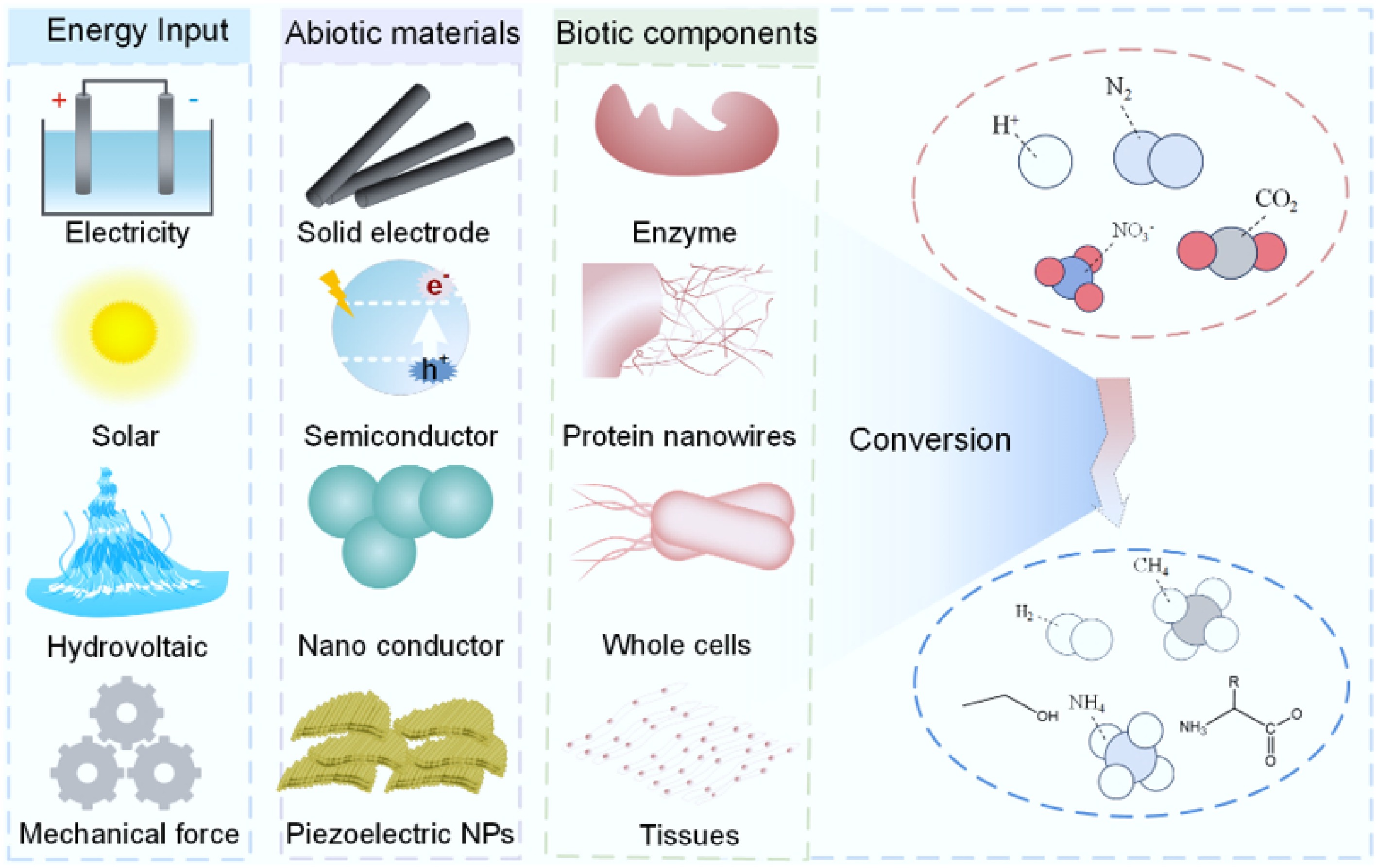
      Figure 1. 

      Biohybrids for sustainable chemical synthesis. These systems leverage diverse energy inputs, a wide range of abiotic materials, and various biotic components to produce valuable products from multiple substrates.

      This review focuses specifically on whole microbial cells as the biotic components of biohybrids; subcellular structures, plant or animal cells, tissues, and multicellular organisms fall outside the scope of this discussion. While the central emphasis is on carbon-based transformations—particularly CO2 conversion—the strategies and methodologies presented are also applicable to other important processes such as H2 production[20,21], N2 fixation[2124], denitrification[2527], dissimilatory nitrate reduction to ammonium (DNRA)[28], and sulfate reduction[29].

      Focused specifically on whole microbial cells, microbial uptake of extracellular electrons constitutes the core of energy conversion in biohybrids. Microbes capable of exporting electrons are termed exoelectrogens, whereas those capable of electron uptake are referred to as electrotrophs. Microbial extracellular electron transfer (EET) can operate bidirectionally. Microbes either export intracellular electrons to external acceptors (e.g., iron/manganese oxides, humic substances, electrodes, or syntrophic partners)[30] or import electrons from external solid substrates (e.g., reduced minerals, humics, electrodes, or syntrophic partners)[31]. Notably, the model industrial microorganism Escherichia coli has been adaptively evolved to use an anode as a terminal electron acceptor, which involved rapid genetic changes in the outer membrane porin OmpC, significantly enhancing EET mediated by 2-hydroxy-1,4-naphthoquinone (HNQ), thereby supporting cellular growth[32]. Nevertheless, elucidating the molecular mechanisms underlying microbial EET remains a complex and ongoing endeavor[3335].

      Poised electrodes are frequently employed in microbial electrochemical systems to simulate the electron-donating or -accepting behavior of abiotic materials under external energy stimulation. On the anodic side, numerous electroactive microbes have been identified[36], laying the foundation for microbial fuel cells (MFCs) and derivative technologies[3740]. On the cathodic side, microbes such as methanogens, acetogens, and sulfate-reducing bacteria (SRB) can directly uptake extracellular electrons to sustain their metabolic functions[41,42]. The concept of microbial electrosynthesis (MES) is widely acknowledged to have emerged in 2010, when a model acetogenic bacterium, Sporomusa ovata, was employed to capture electrons from an electrode for reducing CO2, ultimately leading to the generation of extracellular products including acetate and 2-oxobutyrate[43]. Notably, the MES technology employs poised electrodes in dark environments to replicate the activated abiotic materials capable of exciting electrons, thereby establishing a robust experimental framework for probing interfacial redox interactions between abiotic substrates and microbial consortia[44,45].

      Numerous reviews have explored microbial electrochemical chemical synthesis, covering multiple topics including microbial electrodes[46], multidisciplinary analyses[47], energy flow[19], product diversity[48,49], electroactive microbes[36,50], metabolic and energy conversion strategies[44,51], fundamental mechanisms[52,53], and the engineering of EET pathways[54].

      Building on this foundation, the present review adopts a broader macroscopic perspective and focuses on biohybrid systems for sustainable chemical synthesis. It begins by discussing recent advancements in MES technologies, with critical attention to the structural limitations of biocathodes and the development of formate-mediated electrocatalytic–biocatalytic tandem systems. It then examines recent progress in semi-artificial photosynthetic systems. Emerging directions involving hydrovoltaic, piezoelectric, magnetic, and thermosensitive materials for next-generation biohybrid designs are also explored. Finally, the review considers the environmental applications of biohybrid technologies, with particular emphasis on their potential role in soil carbon sequestration.

    • MES is recognized as a promising water–energy–carbon nexus technology[46]. In its narrower sense, MES refers specifically to systems employing biocathodes that support direct microbial attachment, enabling power-to-X conversions via valorization of CO2[31]. As a representative of the third-generation (3G) biorefinery technologies[55], MES offers notable advantages, including mild operating conditions, high product selectivity for multi-electron transformations, tolerance of feedstock impurities, and extended operational stability[55,56].

      Microbial catalysts in MES systems are generally categorized as either pure or mixed cultures. Mixed cultures are often considered to be more effective in enhancing MES synthesis rates, through which thermodynamically constrained end-products can be produced[36,57], while pure cultures are predominantly utilized for fundamental research, enabling the tailored production of a high-value target products, frequently without optimization of the reactor's design or operational conditions[58].

      From an electron transfer perspective, MES systems can be classified into three primary types: (i) direct electron transfer (DET), (ii) mediated electron transfer using either exogenous or self-secreted redox mediators, and (iii) hydrogen-mediated electron transfer (Fig. 2)[46].
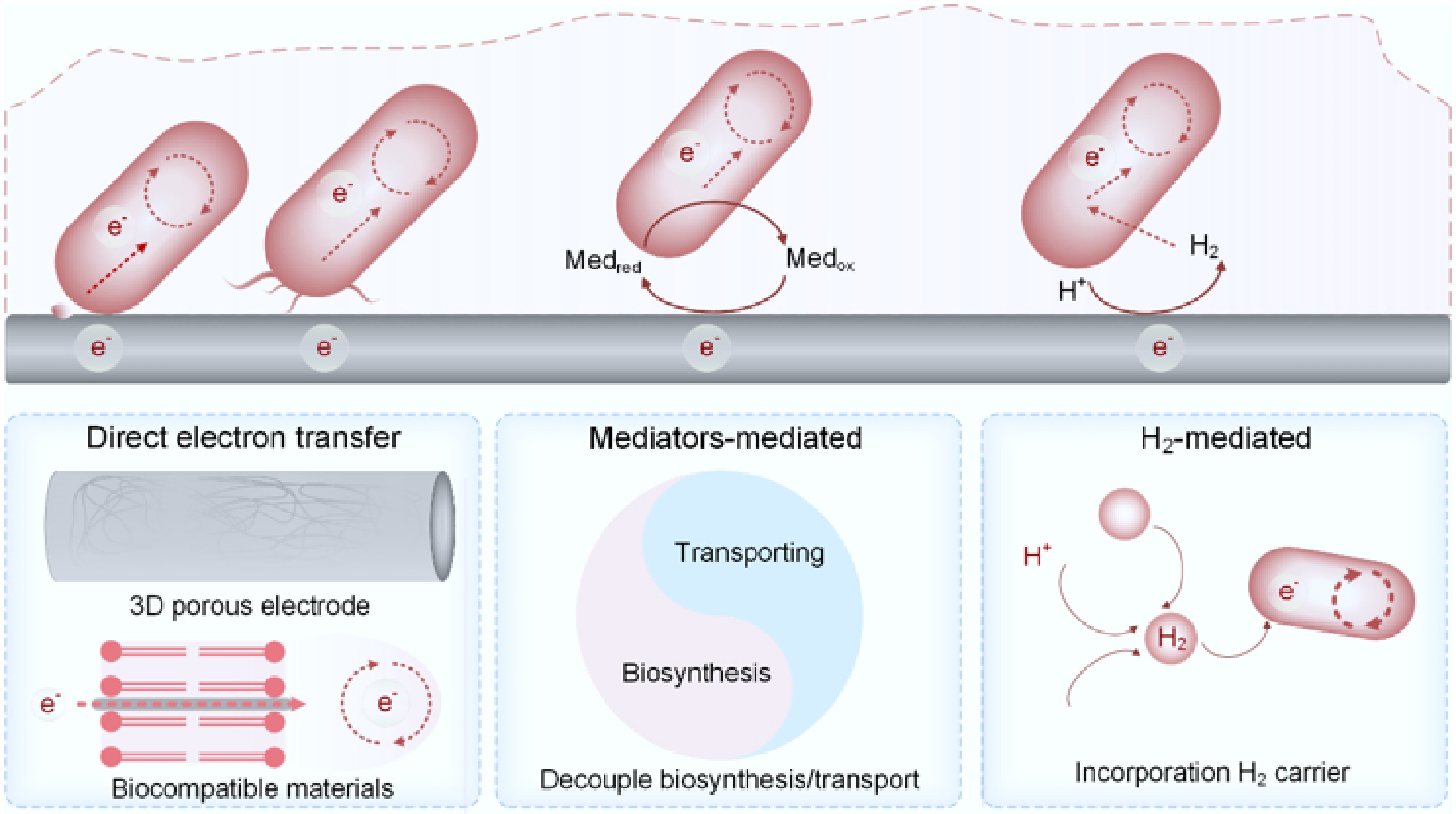
      Figure 2. 

      MES based on biocathode architectures and strategies to address their limitations.

      DET is typically facilitated by extracellular nanowires composed of cytochromes, enabling long-range electron transport within prokaryotic systems[34]. However, MES systems relying solely on DET generally exhibit low current densities, often an order of magnitude lower than those achieved via hydrogen-mediated pathways or by electricity-generating bioanodes[59]. This suggests that DET-based MES alone may be insufficient to fully exploit the carbon fixation potential of nonphotosynthetic microorganisms[51,60]. To address this issue, the overall approach encompasses two dimensions: (1) enhancing the interactions between microbial cells and active materials on electrode surfaces at the microscopic, molecular, or even atomic scale (that is, increasing the DET rate per cell); (2) employing three-dimensional (3D) macroscopic electrodes to facilitate microbial attachment, thereby increasing the biomass loading per unit volume (or cross-sectional area). The electrode architectures can influence electron transfer efficiency through microbe–electrode interactions. For instance, an atomic–nanoparticle bridge (CoSA@Co-NP) was meticulously engineered, and finite element analysis demonstrated that the incorporation of the underlying Co nanoparticles significantly enhances the electrode's electronegativity and electric field density[61]. This, in turn, promotes the formation of densely packed biohybrids through electrostatic interactions, while the optimized surface electronic structure facilitates efficient extracellular charge exchange and lowers the activation energy barrier, thereby enabling expedited charge transfer to the microbial counterparts. Additionally, when the atomic–nanoparticle bridge material was employed to investigate its interaction with a model methanogen, M. barkeri, it was found that the atomically dispersed Co–N4 sites provide a rapid direct electron transfer pathway by directly bonding with the molecular center of Cytochrome b (Cytb)[62]. Meanwhile, the Co nanoparticles enhance both this direct pathway and the F420-mediated electron transfer pathway through their multiorbital modulation of surface electronic structures. Other efforts to overcome these barriers have included the incorporation of biocompatible materials—such as oligoelectrolytes and silver nanoparticles—to modify cell surfaces or for intercalation into membranes, thereby lowering the activation energy barriers and enhancing CO2 fixation rates[40,63]. The use of 3D cathode materials has been proposed as a potential solution and has shown some success[64], though issues related to mass and electron transport limitations persist[65].

      Mediated electron transfer offers an alternative strategy, leveraging biocompatible artificial mediators with suitable redox potentials. For systems utilizing self-produced mediators, effective control over biosynthesis and transmembrane transport is critical[66]. This decoupled approach mitigates the limitations associated with carrier synthesis and threshold tolerances, while significantly reducing electrons' translocation resistance. Notably, mediated electron transfer does not inherently require biofilm formation, suggesting that its full potential remains largely underexplored. Recent work on redox-mediated Shewanella-based microbial flow fuel cells further supports this view, demonstrating that biofilm-free systems can overcome the trade-offs typically associated with dense biofilms[67].

      Considerable efforts have also been directed toward improving the hydrogen evolution reaction (HER) to enhance the efficiency of hydrogen-mediated electron transfer[48,68,69], which is particularly important in single-chamber reactors inoculated with hydrogen-oxidizing bacteria (HOB), where it is critical to suppress undesired cathodic reactions involving O2, such as the formation of hydrogen peroxide[69,70]. With the creation of hydrogen-mediated electron transfer in hybrid material–microbe systems, Sporomusa ovata has shown increased levels of redox cofactors and upregulation of genes related to proton transport and adenosine triphosphate (ATP) synthesis, outperforming conventional gas fermentation systems in reducing equivalent utilization[68]. However, hydrogen-mediated MES faces persistent challenges, including low gas–liquid mass transfer efficiency, safety concerns, and the inhibition of biofilm development through the formation of hydrogen bubbles[7174]. Strategies such as the use of biocompatible perfluorocarbon (PFC) nanoemulsions as hydrogen carriers have been shown to enhance the efficiency of acetic acid production from electricity-driven CO2 reduction[73].

      In summary, since MES was first formally conceptualized in 2010, the majority of implementations have relied on biocathode-based designs[31,43,75]. Over the past 15 years, considerable progress has been made, including substantial contributions by our own group[48,51,57]. Encouragingly, recent advancements have expanded the range of MES products to include higher-value compounds such as medium-chain fatty acids (MCFAs)[49]. Despite this progress, MES systems' current densities remain one to two orders of magnitude lower than those achieved in HER or CO2 electroreduction (CO2RR) systems[76]. A critical insight has emerged: unlike in CO2RR systems, where performance is typically constrained by CO2 mass transfer [a limitation that can be addressed via flow cells or membrane electrode assemblies (MEAs) with gas diffusion electrodes (GDEs)], MES systems are primarily limited by the thickness of the microbial biofilms and the intrinsic catalytic activity of the microorganisms employed[47,59].

    • Formate-mediated electron transfer has received comparatively limited attention in MES research. This phenomenon can predominantly be ascribed to the widespread utilization of electrochemically inert carbon-based electrodes or electrocatalysts that are exclusively optimized for the HER, thereby overshadowing the potential of CO2RR electrocatalysts. Most crucially, the integration of CO2RR electrocatalysts and microbial catalysts within a shared catholyte continues to pose a formidable challenge, primarily due to the inherent difficulty of preserving the activity of both catalysts under identical operational conditions.

      Nevertheless, even in the absence of CO2RR electrocatalysts, some studies have demonstrated that acetogens can secrete formate dehydrogenase, which adsorbs onto graphite electrodes to catalyze formate production within a specific electrochemical window[77]. In co-culture systems, such as those comprising an iron-oxidizing bacterium (IS4) and the acetogen Acetobacterium woodii, formate has been detected as an intermediate during acetate biosynthesis[78]. Wild-type S. oneidensis strains are also capable of converting CO2 to formate[79]. Moreover, through the introduction of a reductive glycine pathway module and a C2+ product synthesis module, engineered S. oneidensis strains have been employed for malate production via bioelectrochemical CO2 reduction[80].

      Recent advances in CO2RR have yielded electrocatalysts capable of selectively producing carbon monoxide (CO) and formate at current densities one to two orders of magnitude higher than those typically achieved in MES systems[8184]. The direct electrochemical synthesis of highly reduced products (e.g., methane, acetate, ethylene) from CO2 is attractive[85], as it generally requires sophisticated and costly electrocatalysts[86]. While formate itself has a limited market price and carbon intensity[86], it is a soluble electron carrier and an easily assimilated carbon source[85], making it an ideal intermediate for electrocatalytic–biocatalytic tandem systems[47,59]. These tandem systems combine the high reaction rates of electrocatalysis with the product specificity of biocatalysis.

      The first demonstration of a formate-mediated tandem system within a shared catholyte was reported in 2012[87]. In this study, a ceramic membrane separated an indium foil electrocatalyst from a Ralstonia strain, enabling the production of approximately 140 mg/L of mixed alcohol products, including 3-methyl-1-butanol and isobutanol. However, our own efforts to integrate indium foil and biocathodes within a shared catholyte resulted in severe catalyst corrosion and poor stability in the system[88].

      Beyond the need for high-selectivity formate-producing electrocatalysts—such as p-block metal oxides or sulfides[86]—a major bottleneck remains the shared catholyte environment. The operational requirements of electrocatalytic and microbial processes are often fundamentally incompatible. Electrocatalysts for CO2RR typically require alkaline electrolytes, whereas microbial systems demand near-neutral pH, buffering agents, essential nutrients, and trace elements. Electrolyte composition is critical for CO2RR's performance: alkali metal ions modulate catalytic activity[84,89]; chloride ions suppress HER[90]; and cationic surfactants, such as cetyltrimethylammonium bromide (CTAB), enhance CO2/H2O regulation at the catalyst interfaces[91]. Conversely, impurities such as Fe and Mn can poison catalysts[92]. Several strategies have been proposed to address these incompatibilities, including physical separation using ceramic membranes or filter papers[87,93], and direct protection of microbial catalysts with biocompatible materials such as metal–organic frameworks (MOFs)[94]. However, these approaches have achieved only partial success.

    • While gaseous intermediates such as H2, CO, and even CH4 have been explored in electrocatalytic–biocatalytic tandem systems[9598], liquid-phase formate offers distinct advantages as a nexus molecule. However, formate dissolved in highly concentrated catholyte (generally > 1 M of potassium is used in CO2RR studies) can inhibit microbial activity[99]. The emergence of SSE reactors offers a promising solution to this challenge[100].

      SSE reactors have been utilized across a variety of fields, including metal recovery[101], metal-free electrochemical reactions[102], local reactant concentration enhancement[103], and CO2 capture and release cycles[104,105]. They have also enabled the electrosynthesis of high-purity chemicals such as formic acid[106113], ethanol[114,115], acetic acid[116,117], hydrogen peroxide[118124], ammonia[102,125], and even urea[126]. These advancements suggest that SSE technology could serve as a transformative platform for sustainable chemical production[105,123]. Several recent reviews on SSE technology are recommended for further reading[127130].

      The operating principles of SSE reactors can be illustrated using the example of pure formic acid production (Fig. 3a). A cation exchange membrane (CEM) and an anion exchange membrane (AEM) sandwich an ion exchange resin layer between the anode and cathode. At the cathode, CO2 is electrochemically reduced to formate, which migrates through the AEM under an electric field. Simultaneously, protons generated at the anode migrate through the CEM. When deionized water is introduced into the SSE layer (made of ion exchange resin microspheres with a particle size ranging from tens to thousands of micrometers) as an extraction solvent, a neutralization reaction produces a concentrated aqueous formate solution.
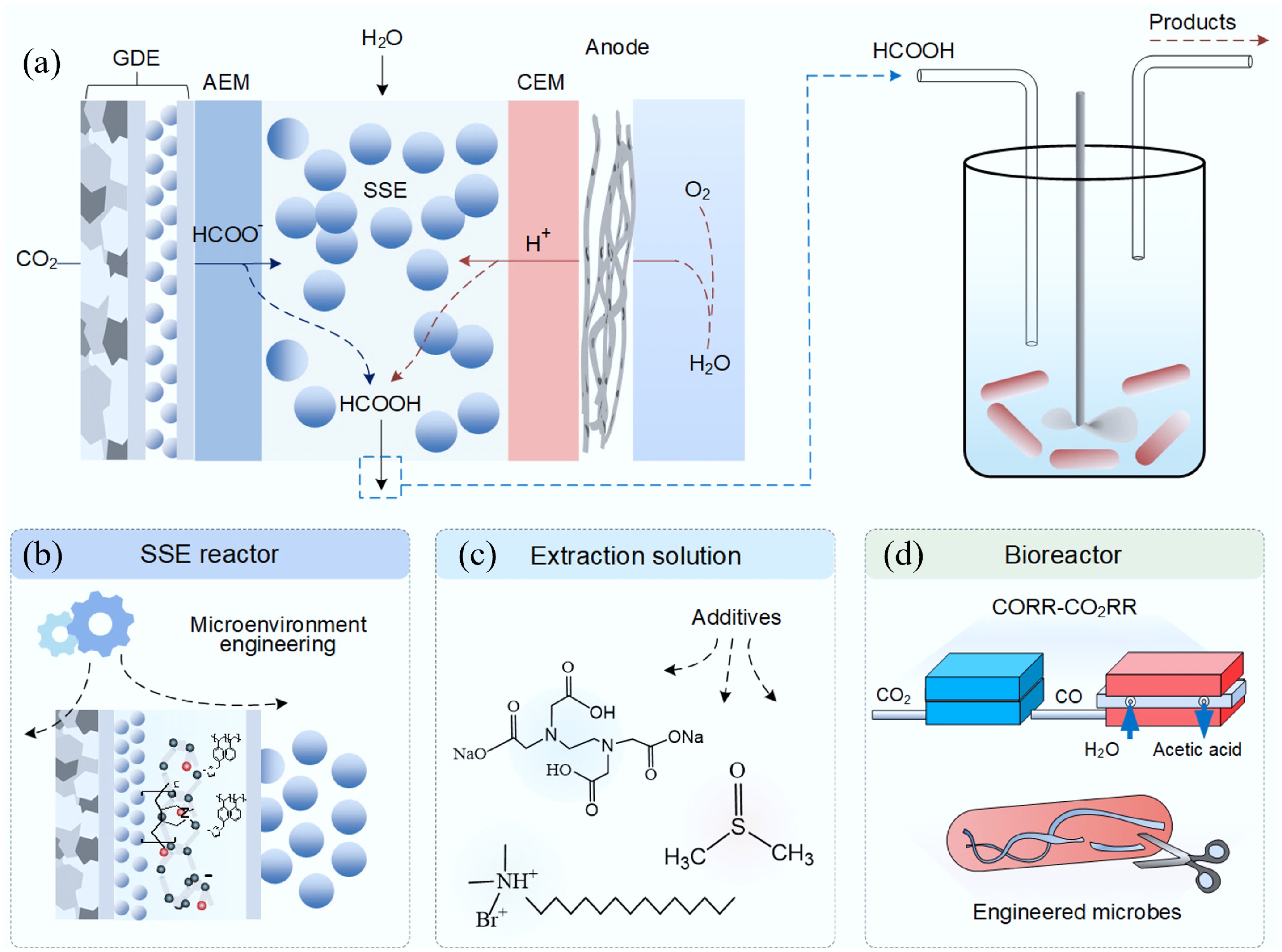
      Figure 3. 

      SSE-based electrocatalytic–biocatalytic tandem systems and strategies to address the associated limitations. (a) Schematic illustration of an SSE-based electrocatalytic–biocatalytic tandem system. (b) Rational modulation of the interfacial microenvironment to improve the CO2 reduction efficiency. (c) Application of chemical additives to enhance CO2 reduction performance, with consideration of their potential impacts on microbial metabolism. (d) Two-step conversion pathway in which CO2 is first reduced to CO, followed by microbial conversion of CO to acetate; alternatively, this process can be facilitated by genetically engineered microbial strains.

    • SSE reactors enable the production of high-purity liquid organic acids without the need for extensive downstream separation processes[106,131], while facilitating the construction of tandem systems that couple CO2 reduction to microbial assimilation[132].

      Nonetheless, several technical challenges must be addressed to enable broader adoption.

      First, optimizing the CO2RR requires the deliberate modulation of the interfacial microenvironment (Fig. 3b). While high-performance AEMs (e.g., poly N-methyl-piperidine-co-p-terphenyl (QAPPT), Sustainion X37-50) have been used to ensure efficient ion transport and to increase the local alkalinity on the surface of the catalyst[124,133,134], their high cost and limited durability—particularly under the acidic conditions (pH < 2) within SSE layers—hinder their large-scale deployment[106,135,136]. A recent study observed that commercial AEMs exhibited notably distinct performances for H2O2 electrosynthesis within the SSE reactor[124]. Generally, Sustainion XC-37T demonstrated the best performance in terms of H2O2 concentration, faradaic efficiency (FE), cell voltage, and energy consumption (EC), followed by Piperion A-40, Pention 7215-30, FAA-3-50, FAA-3-PK-130, and AMI-7001, in descending order. This performance trend can be primarily attributed to the varying conductivities of the AEMs, as the resistance (Rs) for these six AEMs increased in the same sequence. Additionally, the incorporation of a SSE layer and a pair of ion exchange membranes increases the internal resistance, resulting in current densities that are often an order of magnitude lower than those achieved in flow cells or MEAs[124,130]. The extraction chamber packed with ion-exchange resin particles constitutes the most substantial contributor to the internal resistance of the SSE reactor. This can be ascribed to several key factors. First, the restricted contact area between the resin particles plays a significant role, as the compaction of these particles not only increases the pump pressure but also augments the risk of GDEs leaking. Secondly, despite the resin's ability to facilitate proton conduction, numerous studies have unequivocally shown that its proton conductivity exhibits limited effectiveness. Interestingly, this very characteristic has even been leveraged in certain research endeavors to deliberately suppress the HER[126,137]. Indeed, prior investigations have revealed that when the extraction chamber is alternatively filled with a 1 M KOH solution (in place of the ion-exchange resin particles), the observed cell voltage is approximately reduced by half[138]. It is thus challenging to standardize the SSE reactor and ensure consistent performance[139].

      Second, regarding the extraction solution, while decoupling the electrochemical and biological compartments helps address any kinetic incompatibilities[132,140], systematic studies on optimized extractant formulations remain limited[130,141]. Additives such as cetrimonium bromide (CTAB), ethylenediaminetetraacetic acid (EDTA), and dimethyl sulfoxide (DMSO), which enhance CO2RR's performance by modulating the catalyst interfaces (Fig. 3c)[142], may influence microbial metabolism or membrane permeability, or act as competing electron acceptors when transferred into the bioreactor[143,144].

      Third, from a biological perspective, not all microorganisms possess the inherent ability to directly metabolize formate, and the synthesis efficiency of high-value products in wild strains remains suboptimal, necessitating substantial enhancement. For instance, yeast typically requires acetate as a carbon source. However, the electrochemical production of acetate via CO2RR remains challenging. A promising approach involves two-step conversion process of first electrochemically reducing CO2 to CO (a reaction with high selectivity)[92,145,146], followed by reducing CO to acetate (with high carbon efficiency)[1,141]. Additionally, microbial strains have been genetically engineered to enhance their biocompatibility with electrocatalytically synthesized compounds while concurrently optimizing the efficiency of converting carbon to the final product (Fig. 3d). For example, engineered yeast strains have been utilized to convert acetate into extracellular glucose in SSE-based tandem systems[140]. Similarly, Ralstonia. eutropha can use acetate from SSE reactors to produce bioplastics[117], and an acetate/ethanol blend has been employed to support E. coli mutants engineered for the production of L-tyrosine[114].

    • Semi-artificial photosynthetic systems, which integrate biological components with semiconductor materials, offer improved solar energy conversion efficiency compared with natural photosynthesis and enable the production of high-value chemicals that are often unachievable with purely abiotic artificial systems[19]. Notably, a growing body of recent research has concentrated on enhancing the solar energy conversion efficiency of photosynthetic microorganisms, either through the development of novel electron utilization pathways or via physical protection mechanisms afforded by advanced materials. For example, photosynthetic microorganisms have been explored as candidates for constructing semi-artificial biohybrid photosynthetic systems. Under illumination, electrons released by Geobacter sulfurreducens can be utilized by the green sulfur bacterium Prosthecochloris aestuarii to drive photosynthetic processes[147]. In the absence of light, G. metallireducens can transfer electrons to the model purple non-sulfur bacterium Rhodopseudomonas palustris, providing the reducing power necessary for CO2 fixation[45]. More recently, living photosynthetic materials have been fabricated by immobilizing the cyanobacterium Synechococcus sp. PCC 7002 within a pluronic F-127-based polymeric network. This mechanically stable 3D matrix, formed through photo-crosslinking in the presence of a photoinitiator, provided physical protection while permitting nutrient diffusion, supporting sustained cellular activity. Notably, this system enabled dual carbon sequestration via biomass accumulation and insoluble carbonate formation over a period exceeding 400 days[148]. In fact, nonphotoelectrosynthetic bacteria can be engineered into photoelectrotrophs, as demonstrated by the engineering of R. eutropha to establish a photon- and electron-harvesting system for synthesizing biomass from CO2[149].

      A comparative summary of MES systems employing biocathode structures versus semi-artificial photosynthetic systems is provided in Table 1. Notably, unlike MES systems that require the deployment of both anodes and cathodes within a constructed reactor and typically depend on biofilm formation (which often entails a long startup period), semi-artificial systems can directly harness solar energy without such infrastructural constraints. Certainly, these technologies exhibit overlaps and variations that evolve from one another. For example, biocathodes operated under dark conditions can be coupled with photoanodes, using solar energy to drive electron excitation at the anode[45,150]. Biocathodes can also function under illumination when paired with photosensitizers or natural/artificial phototrophic microorganisms[151]. When semiconductors are applied as coatings on cathodes to construct photocathodes[152,153] or as photocatalyst sheets in Z-scheme systems[154], biofilm attachment may again become advantageous in semi-artificial systems, particularly to enhance electron transfer efficiency during direct extracellular electron transfer.

      Table 1.  Comparison of MES systems based on biocathode structures and semi-artificial photosynthetic systems

      Items MES systems based on biocathode structures Semi-artificial photosynthetic systems
      Energy input Direct current electricity Solar
      Abiotic materials Electrode Semiconductor
      Biofilm attachment Yes Not necessary

      In these semi-artificial photosynthetic systems, photons with energy equal to or greater than the semiconductor bandgap induce charge separation. When the reduction potential of the semiconductor is more negative than that of outer membrane cytochromes (OMCs, −0.15 V vs. Ag/AgCl) or flavins (−0.46 V vs. Ag/AgCl), photogenerated electrons can spontaneously transfer to nonphotosynthetic microorganisms via inward EET pathways to drive metabolic synthesis[53]. These EET pathways may involve membrane-associated redox protein complexes or diffusible electron mediators such as methyl viologen or neutral red. On the basis of their energy band alignment, most semiconductors, excluding Fe2O3, WO3, and BiVO4, are theoretically suitable for direct integration into semi-artificial photosynthetic systems (Fig. 4a)[35].
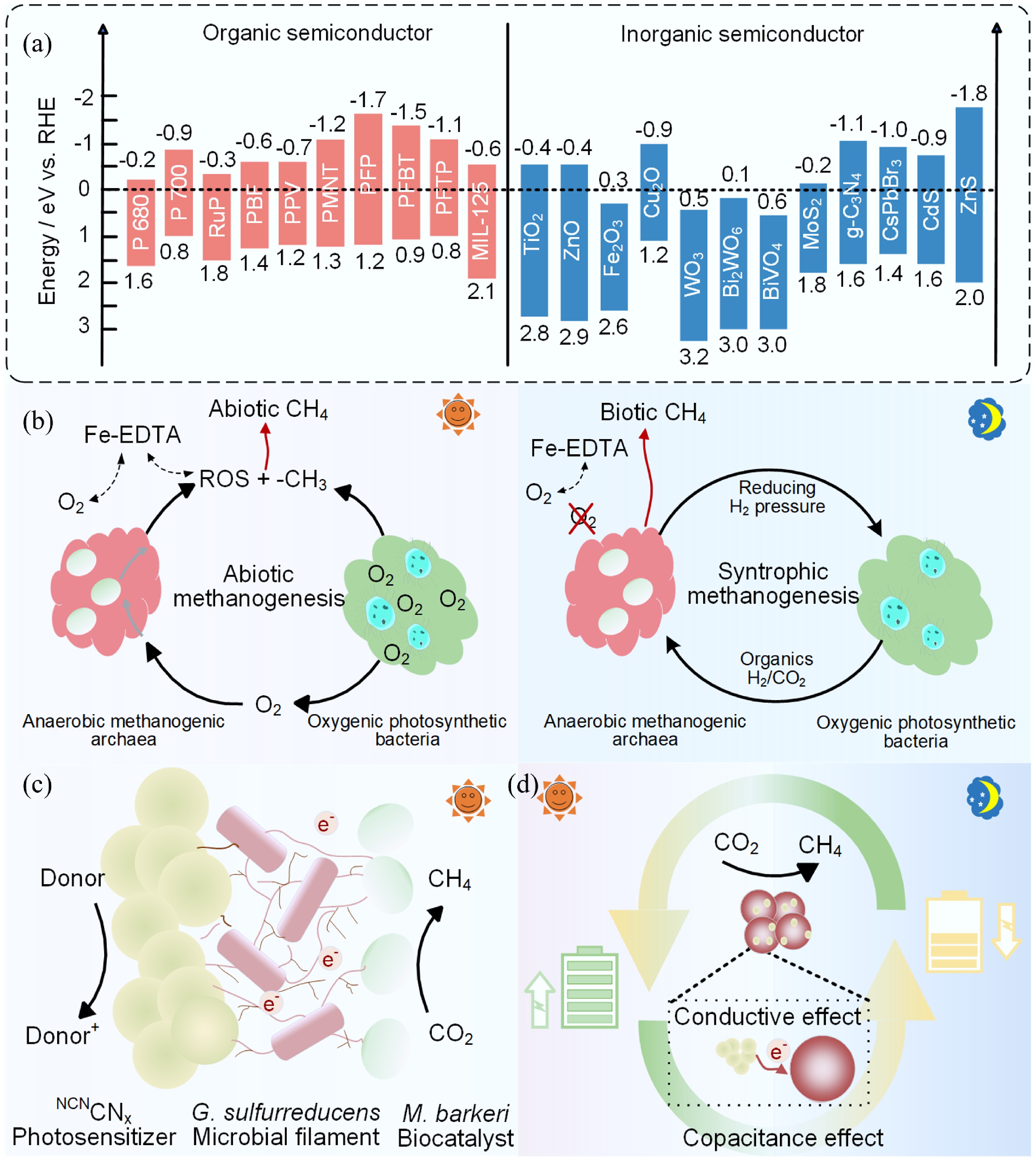
      Figure 4. 

      Representative organic and inorganic semiconductors and studies on semi-artificial photosynthetic systems. (a) The conduction band (CB) and valence band (VB) of common semiconductors. Reproduced with permission from Song et al.[53]. (b) Biotic and abiotic CH4 production under anoxic dark and oxic light conditions with oxygenic photosynthetic bacteria. Reproduced with permission from Ye et al.[180]. (c) Engineering a microbial ecosystem to balance electron generation and utilization. Reproduced with permission from Kalathil et al.[167]. (d) Capacitive modification of biohybrid interfaces. Reproduced with permission from Hu et al.[166].

      As early as 2012, it was reported that nonphotosynthetic microorganisms, such as Acidithiobacillus ferrooxidans and Alcaligenes faecalis, could indirectly utilize solar energy for growth via photoelectrons generated by semiconductor minerals like goethite, sphalerite, and rutile[41]. Building on this concept, a variety of biohybrid semi-artificial photosynthetic systems have been developed by combining nonphotosynthetic microbes—electroactive or otherwise—with nanomaterials. Examples include hybrids such as S. oneidensis–CdS hybrids, Moorella thermoacetica–CdS, Clostridium autoethanogenum–CdS, and M. thermoacetica–Au[155,156]. A summary of semi-artificial photosynthetic systems for chemical synthesis via CO2 valorization is provided in Table 2.

      Table 2.  Summary of reported semi-artificial photosynthetic systems for chemical synthesis from valorization of CO2

      Microorganisms Photosensitizer Products Ref.
      M. barkeri CdS CH4 [163,164]
      M. barkeri Ni: CdS CH4 [165]
      M. barkeri CNx CH4 [166168]
      M. barkeri EGaIn CH4 [169]
      M. barkeri R. palustris CH4 [170]
      M. thermoacetica CdS Acetate [171,172]
      S. ovata Photocatalyst sheet Acetate [154]
      S. ovata Si nanoarrays Acetate [152]
      S. ovata InP/ZnSe/ZnS QDs Acetate [173]
      C. autoethanogenum CdS Acetate [156]
      S. oneidensis MR-1 CdS Acetate [174]
      E. coli CdS Formic acid [175]
      Azotobacter vinelandii CdS/CdSe/InP/
      Cu2ZnSnS4@ZnS
      Formic acid [21]
      Cupriavidus necator CdS/CdSe/InP/
      Cu2ZnSnS4@ZnS
      C2H4, PHB, IPA, BDO, MKs [21]
      Chlorella zofingiensis Gold nanoparticles Carotenoid [158]
      R. eutropha g-C3N4 PHB [176]
      R. eutropha Organic polymer dots PHB [177]
      X. autotrophicus CdTe Biomass [178]
      Synechococcus sp. Poly(fluorene-co-phenylene) derivative (PFP) Biomass [179]
      Polyhydroxybutyrate, PHB; isopropanol, IPA; 2,3-butanediol, BDO; methyl ketones, MKs; polymeric carbon nitride, CNx; eutectic gallium–indium alloys, EGaIn.

      Although this review primarily focuses on CO2 valorization, it is important to note that organic substrates can serve as the sole carbon source, create mixotrophic conditions, or act as precursors in semi-artificial photosynthetic systems for the biosynthesis of structurally complex, high-value chemicals such as astaxanthin, shikimic acid, and carotenoids[157159]. For instance, guided biomineralization strategies have been employed to direct the in situ synthesis of semiconductor nanoparticles within the periplasmic space of E. coli, enhancing the efficient transfer of photogenerated electrons into the oxidative respiratory chain and driving ATP synthesis. This process redirects the carbon flux of glucose metabolism from pyruvate to malate[160]. In addition, another significant application scenario of semi-artificial photosynthetic systems is hydrogen production. For instance, in the TiO2/MV/recombinant Escherichia coli (expressing [FeFe]-hydrogenase) hybrid system, the MV2+/MV+ mediator facilitates electron transfer between TiO2 and E. coli, thus promoting hydrogen production[161]. Another study delivered CuInS2/ZnS quantum dots to the periplasmic space of Shewanella, constructing a quantum-dot-photosensitized hybrid system for efficient solar hydrogen generation[162].

      In addition to common organic and inorganic semiconductors, the photoelectrochemical properties of bacteria and algae have recently attracted significant attention as new photosensitizers for photogenerated electron excitation. For instance, R. palustris can harvest solar energy and conduct anoxygenic photosynthesis using sodium thiosulfate as an electron donor. When co-cultured with Methanosarcina barkeri under illumination, it can function as a living photosensitizer to drive CO2 to CH4[170]. Furthermore, studies have shown that photoelectrons generated from illuminated, nonviable cells of Raphidocelis subcapitata and Chlorella vulgaris can transfer electrons to electroactive microbes, facilitating microbial redox reactions, including methyl orange decolorization, denitrification, and hexavalent chromium reduction[181].

      Several critical challenges must be addressed to advance semi-artificial photosynthetic systems:

      First, conversion products may originate from both biotic and abiotic pathways. For instance, a M. barkeri–CdS photoelectrochemical system enhanced CH4 production by 1.7-fold and yield by 9.5-fold when CO was used instead of CO2, attributed to CO's ability to quench reactive oxygen species (ROS) and serve as a more direct carbon source[182]. In another example, a biofilm-based co-culture composed of Synechocystis PCC 6803, M. barkeri, and EDTA–Fe complexes demonstrated methane production via both biotic and abiotic pathways (Fig. 4b)[180]. Therefore, it is essential to distinguish between biotic and abiotic contributions when elucidating reaction mechanisms[180,183].

      Second, improving the interface compatibility between abiotic materials and living cells is crucial. Ultraviolet (UV) photons can cause photodegradation of semiconductors and irreversible microbial damage. To address this, encapsulation strategies using natural luminogens and the incorporation of berberine into polymeric carbon nitride–M. barkeri hybrids have been developed, significantly boosting CH4 yields (a 2.75-fold increase)[168]. Similarly, the integration of biocompatible eutectic gallium–indium alloys with M. barkeri produced stable liquid metal nanobiohybrids, achieving over 99% CH4 selectivity across multiple operational cycles[169]. Microbial ecosystem engineering, such as introducing G. sulfurreducens KN400 to mediate electron transfer to the neighboring M. barkeri, can also address mismatches between electron generation and utilization (Fig. 4c)[167]. Alternatively, capacitive modifications using cyanamide-decorated polymeric carbon nitride (NCNCNx) enhanced photogenerated electron storage and redistribution at the biotic–abiotic interface, thereby improving the quantum yield and selectivity of CH4 (Fig. 4d)[166].

      Third, it is crucial to expand cellular functionality and diversify the product spectrum. The production of high-value compounds can be achieved through C–N coupling processes. A study constructed a hybrid system by integrating the autotrophic Xanthobacter autotrophicus, which possesses the capability to fix CO2 and N2, with cadmium telluride (CdTe) quantum dots, and the internal quantum yield (IQY) of this system reached 47.2% ± 7.3% and 7.1% ± 1.1%, respectively[178]. Additionally, synthetic biology approaches have facilitated the engineering of cells that can be remotely activated via various stimuli, enabling access to diverse metabolic pathways for the production of complex biomolecules[184]. Finally, given the complexity of the processes involved, there is an urgent need to apply advanced characterization techniques to analyze mechanisms such as charge separation, interfacial electron transfer, and microbial metabolism[53].

    • Nanostructured materials can generate electricity through interactions with water, a phenomenon known as the hydrovoltaic effect. This emerging approach enables energy harvesting from natural processes within the Earth's water cycle—including raindrops, waves, evaporation, and atmospheric humidity—offering innovative solutions to challenges in climate, energy, and water management[185,186]. Notably, hydrovoltaic devices utilizing nanomaterials have demonstrated significantly enhanced performance[187].

      Recently, biological materials such as proteins, cells, biofilms, and even whole plants have attracted increasing interest for hydrovoltaic power generation. For example, thin-film devices composed of nanometer-scale protein wires derived from G. sulfurreducens have been shown to generate continuous power via a self-sustained moisture gradient, achieving a steady voltage (~0.5 V) and a current density of ~17 µA/cm2[188]. Similarly, a prototype based on G. sulfurreducens biofilms achieved continuous power generation with a peak output of approximately 685.12 µW/cm2, attributed to the biofilm's hydrophilicity, porosity, and conductivity[189]. Our group recently reported a transpiration-driven generator (LTG), which harnesses the hydrovoltaic effect in plant transpiration to capture latent environmental heat for sustained electricity production[190].

      Hydrovoltaic electrons can also be directly harnessed by electroactive microorganisms. For instance, R. palustris was shown to grow within biofilms by capturing evaporation-induced electrons via extracellular electron uptake, with carbon fixation coupled to nitrate reduction (Fig. 5a)[191]. Under similar conditions, Thiobacillus denitrificans and M. thermoacetica also exhibited significant growth, while electroheterotrophic bacteria such as S. oneidensis and G. sulfurreducens maintained metabolic activity without cellular proliferation. In contrast, nonelectroactive strains such as E. coli and Bacillus subtilis showed neither growth nor viability. These findings suggest that, with proper metabolic and electron utilization pathway design, hydrovoltaic electrons could be effectively harnessed in biohybrids for sustainable chemical synthesis, rather than biomass accumulation.
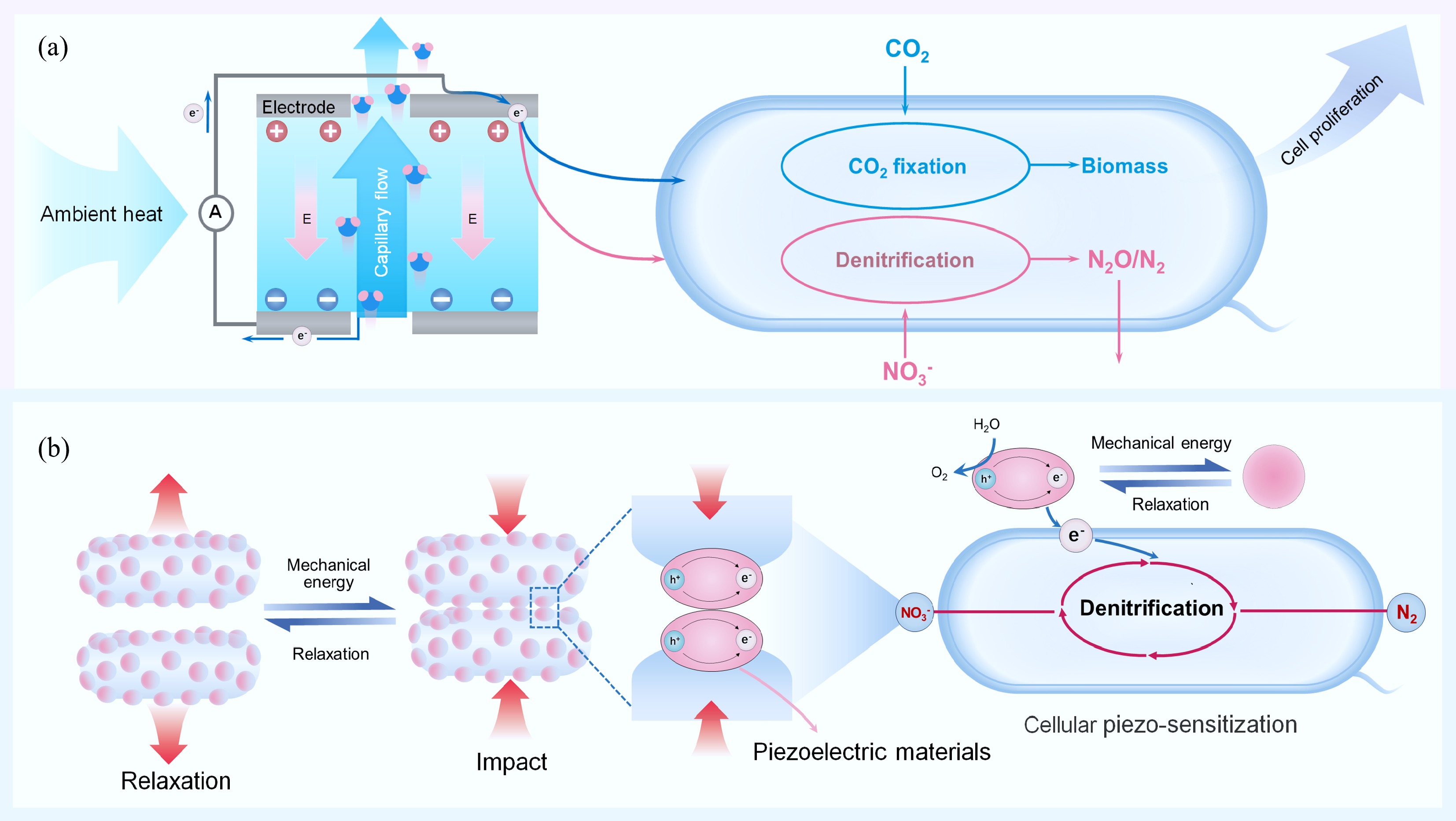
      Figure 5. 

      Biohybrids with hydrovoltaic energy and mechanical energy input. (a) Schematic diagram of hydrovoltaic electron generation within a biofilm supporting microbial growth. Reproduced with permission from Ren et al.[191]. (b) Schematic diagram of mechanically driven denitrification. Reproduced with permission from Ye et al.[192].

      In parallel, there is growing interest in nanostructured piezoelectric semiconductors, which have revealed novel phenomena arising from the coupling of piezoelectric polarization and semiconductor properties[193]. Despite these advances, the direct application of mechanical energy to drive microbial metabolism remains relatively unexplored. A recent study demonstrated that mechanical agitation-induced strain in piezoelectric materials generates free charges that can be transferred via surface enzymes and proteins into microbial intracellular nitrate reduction pathways, enabling mechanically driven denitrification (Fig. 5b)[192].

    • This review examines biohybrid systems used for sustainable chemical synthesis through the lens of different energy input modalities, providing an overview of recent advancements, identifying key challenges, and proposing potential solutions. To further advance the field, we highlight the urgent need for a deeper understanding of the interactions between abiotic materials and microbial systems, as well as the exploration of additional viable energy conversion pathways. These efforts will be instrumental in broadening the applicability of sustainable biohybrid technologies across a range of environmental contexts.

      First, understanding the interaction between abiotic materials and microbes is essential for the creation of biohybrid systems. For example, S. oneidensis MR-1 donates electrons from lactate metabolism to fill photoholes in hematite, while hematite photoelectrons reduce hexavalent chromium, enhancing microbial tolerance and remediation capacity[194]. Another study showed that the anoxygenic phototrophic sulfur bacterium Chlorobaculum tepidum directly interacts with pyrite surfaces, secreting organic compounds that modify the mineral interface[195]. The presence of pyrite significantly upregulated the genes involved in photosynthesis, sulfur metabolism, and organic compound biosynthesis, while downregulating iron transporter proteins. In summary, understanding the interaction between abiotic materials and microbes is a complex task, involving various energy input forms, different electron transfer mechanisms, and responses at multiple biological levels. This complexity requires the application of interdisciplinary knowledge and techniques, including bioinformatics, materials science, theoretical calculations, and in situ spectrum imaging.

      Secondly, there is an urgent need to explore additional forms of energy input for the construction of biohybrid systems for sustainable chemical synthesis. In this review, we primarily focused on energy modalities such as direct current electricity, solar, hydrovoltaic, and mechanical energy. It is worth noting that biological components can respond to a wide range of external stimuli. For instance, magnetic materials have been utilized to stimulate electron transfer at material–biology interfaces, particularly in nanobiotechnology-based bacterial therapies and microrobotic applications[196198]. Examples include an extremophile-based biohybrid micromotor powered by acidophilic microalgae operating under extremely low pH conditions[199], and algae-driven microrobots capable of delivering drug-loaded nanoparticles for the treatment of lung metastases[200]. However, the use of magnetic fields in biohybrids for sustainable chemical synthesis remains underdeveloped. One report indicated that exposure to dynamic magnetic fields enhanced methane emissions from sediments, likely due to increased electron exchange among extracellular respiratory microorganisms[201]. Whether this enhancement results from magnetic field-induced electron transfer at the material–biology interface remains to be elucidated.

      Thermosensitive materials have been employed to create material–biological interfaces, enabling precise temperature monitoring in living organisms. For example, they have been used to accurately monitor and adjust the internal temperature of solid tumors during photothermal therapy (PTT)[202]. Additionally, thermosensitive materials have facilitated continuous and precise body temperature monitoring through the development of hybrid biodegradable and bioresorbable temperature sensors and e-skins[203]. Recently, a study reported that tungsten disulfide (WS2) can either precipitate on the cellular surface or be internalized by the cells of Thiobacillus denitrificans, generating pyroelectric charges that act as reducing equivalents to drive bio-denitrification[204]. This finding demonstrates the application potential of thermosensitive materials in biohybrids for sustainable chemical synthesis.

      Thirdly, the expansion of sustainable energy technologies across diverse environmental scenarios is necessary. Biohybrids have demonstrated considerable potential in wastewater treatment and show promising prospects for soil carbon sequestration. However, their application in the remediation of gaseous pollutants and solid waste remains largely underexplored.

      In wastewater treatment, for example, T. denitrificans has been shown to utilize dissolved organic matter (DOM) as a microbial photosensitizer, enabling nitrate reduction and producing nitrogen gas as the final product[27]. Additionally, photoelectrons from both biogenic and abiogenic sphalerite nanoparticles have been found to enhance the activity of Desulfovibrio desulfuricans G20 for reducing sulfate and lead removal without the need for organic substrates, a long-standing challenge in sulfate-reducing bacteria (SRB)-based applications for heavy metal remediation[29]. Mechanically driven biodenitrification has also been successfully implemented, achieving up to a 117% increase in nitrate removal efficiency[192]. Notably, by engineering microbial cell factories, abiotic components recovered directly from wastewater can be valorized to enable the scalable synthesis of biohybrids for the conversion of organic pollutants into value-added chemicals[205].

      Another particularly promising avenue is the application of biohybrids for soil carbon sequestration, which presents further opportunities for investigating the role of formate. Inspired by natural soil's composition and functions, a bottom-up fabrication strategy has been employed to develop synthetic soil chemical systems, effectively modulating the microbial community's distribution and activity in vitro[206]. A self-sustaining "geo-battery" was constructed using iron minerals to mediate electron transfer, where the charging process drives CH4 oxidation and the discharging process drives CO2 reduction, offering a promising strategy for mitigating soil greenhouse gases[150]. Formate, a key small organic molecule, plays a central role in biogeochemical processes and can be synthesized abiotically through photoelectrocatalysis[207,208], water–rock interactions[209,210], and hydrothermal reactions[211,212]. Formate is secreted across all three major biological kingdoms—animals, plants, and microorganisms—and is involved in a wide array of biogeochemical cycles[212]. As discussed earlier, in the field of green chemical engineering, formate has received significant attention as a "nexus molecule" for constructing SSE-based electrocatalytic–biocatalytic tandem systems. We therefore propose that collaboration between soil minerals and nonphotosynthetic microbes may drive the development of formate-mediated carbon fixation technologies, with potential applications in energy and the environmental.

    • This review highlights the emerging role of biohybrid systems in sustainable chemical synthesis and outlines several critical challenges that must be addressed to advance the field. MES systems based on biocathode architectures commonly suffer from low current densities and necessitate the use of both anodes and cathodes within complex reactor configurations. However, the recent development of SSE reactors presents promising opportunities for the construction of more efficient formate-mediated electrocatalytic–biocatalytic tandem systems. Key obstacles limiting the progress of semi-artificial photosynthetic biohybrids include the need to elucidate complex photochemical mechanisms and electron transfer pathways, the optimization of interfacial compatibility and charge transfer kinetics between abiotic and biotic components, and the development of advanced microbial engineering strategies to expand the diversity of biosynthesized products. Notably, biological components, ranging from proteins to whole cells and biofilms, have exhibited hydrovoltaic effects, suggesting new avenues for designing self-powered biohybrid systems. Moving forward, a deeper understanding of the interactions between abiotic materials and microbial systems, along with the development of alternative energy input modalities such as mechanical, magnetic, and thermal energy, will be essential. While biohybrids have demonstrated considerable potential in wastewater treatment, their applications in the remediation of gaseous pollutants and solid waste remain largely underexplored. Furthermore, biohybrid systems, particularly those optimized for formate-mediated electron transfer, show significant promise in advancing soil carbon sequestration technologies.

      • The authors confirm their contributions to the paper as follows: study conception and design: Jiang Y, Zhou S; data collection: Jiang Y; analysis and interpretation of results: Jiang Y, Zhou S, Ren G, Zhang Y, Liang P; draft manuscript preparation: Jiang Y. All authors reviewed the results and approved the final version of the manuscript.

      • All data generated or analyzed during this study are included in this published article.

      • This work was supported by the National Natural Science Foundation of China (42525702, 52370033) and the Natural Science Foundation of Fujian Province (2024J010021).

      • The authors declare that there is no conflict of interest. Shungui Zhou is the Associate Editor of Energy & Environment Nexus who was blinded from reviewing or making decisions on the manuscript. The article was subject to the journal's standard procedures, with peer-review handled independently of this Editorial Board member and the research groups.

      • Biohybrids employ abiotic materials to tap diverse energies for biosynthesis.

        Biocathode limitations and formate-mediated tandem reactions were reviewed.

        Solar-powered semi-artificial photosynthetic systems were covered.

        Abiotic-microbial interactions, energy form, and applications were outlooked.

      • Full list of author information is available at the end of the article.

      • Copyright: © 2025 by the author(s). Published by Maximum Academic Press, Fayetteville, GA. This article is an open access article distributed under Creative Commons Attribution License (CC BY 4.0), visit https://creativecommons.org/licenses/by/4.0/.
    Figure (5)  Table (2) References (212)
  • About this article
    Cite this article
    Jiang Y, Ren G, Zhang Y, Liang P, Zhou S. 2025. Biohybrids for sustainable chemical synthesis. Energy & Environment Nexus 1: e003 doi: 10.48130/een-0025-0002
    Jiang Y, Ren G, Zhang Y, Liang P, Zhou S. 2025. Biohybrids for sustainable chemical synthesis. Energy & Environment Nexus 1: e003 doi: 10.48130/een-0025-0002

Catalog

    /

    DownLoad:  Full-Size Img  PowerPoint
    Return
    Return